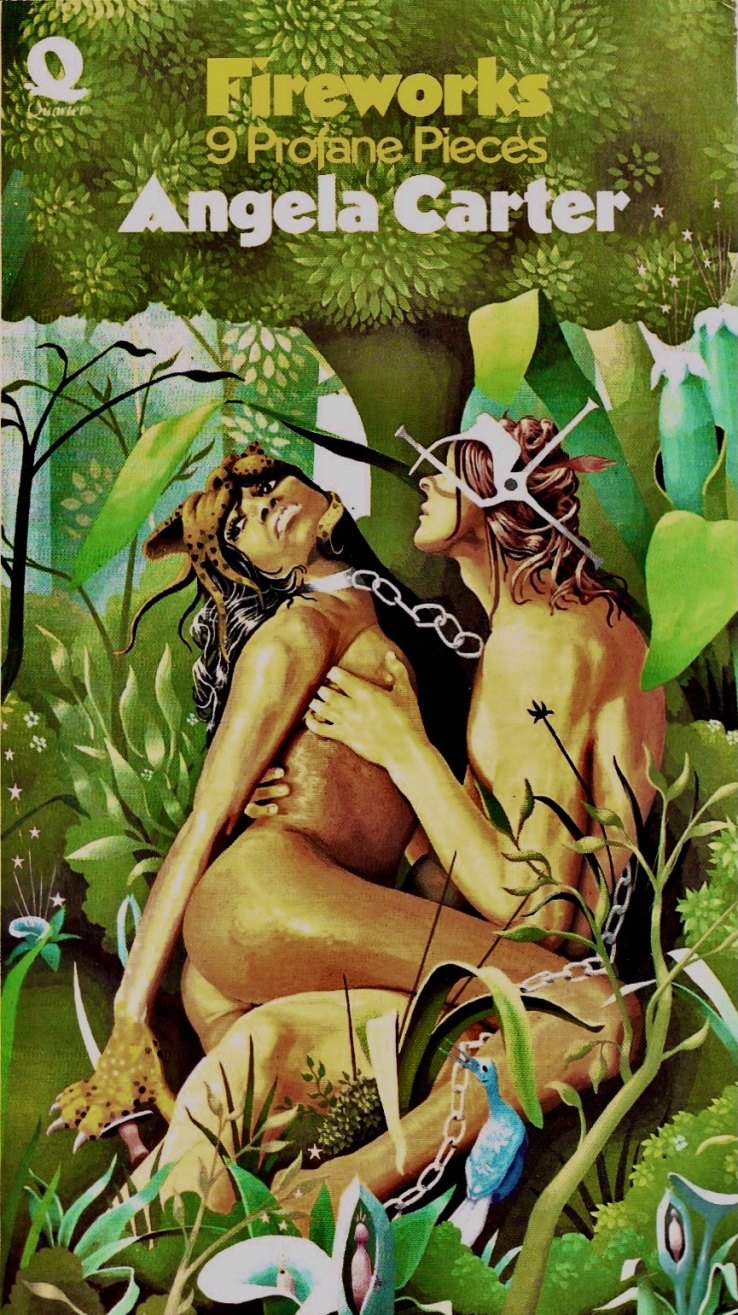
Iain Banks’s The Wasp Factory is an abject coming-of-age novel narrated by a teenage psychopath

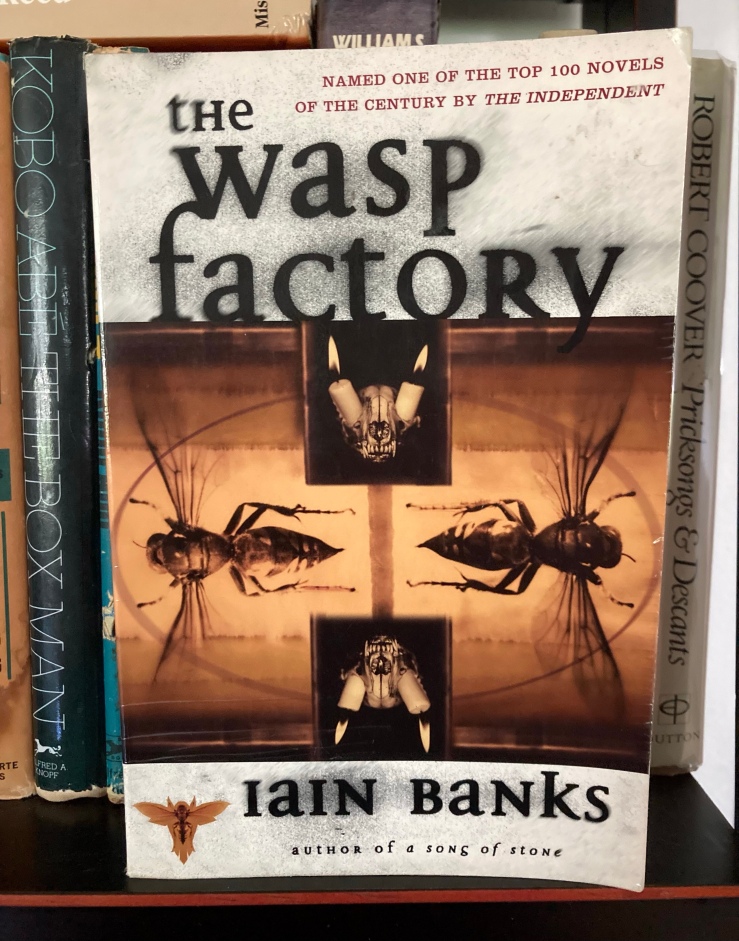
Frank Cauldhame, the narrator of Iain Banks’s 1984 debut novel The Wasp Factory, is a teenage psychopath. Frank lives with his eccentric father on an island in rural Scotland. He is an unregistered person with “no birth certificate, no National Insurance number,” nothing to officially prove his existence. He enjoys this unofficial existence, patrolling his island, which he protects through various rituals.

One of these rituals is to construct and maintain “Sacrifice Poles,” and when we first meet Frank, he is “making the rounds” of these talismans: “One of the Poles held a rat head with two dragonflies, the other a seagull and two mice.” Frank has to keep plenty of dead animals on hand for his ritual defenses, and he kills them by slingshot, air-gun, explosives, and even an improvised flamethrower. (Readers sensitive to depictions of animal cruelty, or just cruelty in general, may wish to avoid The Wasp Factory.)

Another of Frank’s rituals consists of sacrificing a live wasp to the titular Wasp Factory (“beautiful and deadly and perfect,” in our narrator’s words). Frank has devised the Wasp Factory as a bizarre death trap built from “the face of the old clock which used to hang over the door of the Royal Bank of Scotland in Porteneil.” Once introduced to the Factory, the poor wasp can fall prey to one of a dozen different deaths, including the Boiling Pool, the Spider’s Parlour, the Acid Pit, or even “the rather jocularly named Gents (where the instrument of ending is [Frank’s] own urine, usually quite fresh).”

Frank’s urine becomes an important motif in The Wasp Factory. We learn fairly early that he is a “unique eunuch,” supposed victim of a dog bite accident that has left him forever unmanned (and deeply misogynistic). Our lad must piss sitting down, a shame he accepts with a hateful forbearance. Urine flows throughout the novel, an abject magical potion.

Indeed, Frank’s rituals frequently call for the most abject residues and excretions for the magic to work. Consider the Naming Ceremony he performs for a new weapon he’s purchased:

I smeared the metal, rubber and plastic of the new device with earwax, snot, blood, urine, belly-button fluff and toenail cheese, christened it by firing the empty sling at a wingless wasp crawling on the face of the Factory, and also fired it at my bared foot, raising a bruise.

Parts of me thought all this was nonsense, but they were in a tiny minority. The rest of me knew this sort of thing worked. It gave me power, it made me part of what I own and where I am. It makes me feel good.

Were it not for the animal cruelty, Frank’s rituals, no matter how abject, might be the stuff of antic children’s games–playing war, building dams, shooting pellets at cans, and so forth. But the ritualized animal murders are part and parcel of Frank’s most sadistic crimes. He is a serial killer.

Frank confesses his crimes early in The Wasp Factory, and the Scribner trade paperback edition uses his confession as copy on the back of the book to entice would-be readers, so I don’t think I’ll spoil much by sharing it:

Two years after I killed Blyth I murdered my young brother Paul, for quite different reasons than I’d disposed of Blyth, and then a year after that I did for my young cousin Esmerelda, more or less on a whim.

That’s my score to date. I haven’t killed anybody for years, and don’t intend to ever again.

It was just a stage I was going through.

The punchline there at the end is indicative of the dark humor that pervades The Wasp Factory. The edition I’m quoting includes blurbs from negative reviews as well, again highlighting Banks’s mordant glee with the monster he’s conjured. “Rubbish!” declares The Times of London; “There’s nothing to force you, having been warned, to read it; nor do I recommend it,” warns The Scotsman.

Elsewhere, Banks’s humor is earthier, as when Frank recounts some of the early days of his homeschooling at the hands of his ex-hippy chemist father:

For years I believed Pathos was one of the Three Musketeers, Fellatio was a character in Hamlet, Vitreous a town in China, and that the Irish peasants had to tread the peat to make Guinness.

There’s also a sweet streak to the book as well as Frank himself, who, despite his psychotic behavior, is a genuinely caring person at times. His relationship to his only friend, a dwarf named Jamie, is damn near tender; Frank perches Jamie on his shoulders so that the latter can better see the awful punk bands at the local pub.

Frank also cares deeply for his older brother Eric. In the first line of the novel, we learn that Eric has “escaped”; we soon learn he’s escaped from a psychiatric ward he’d been sent to after terrorizing the town folk. Eric’s insane crimes also involve animal cruelty: burning local dogs; force-feeding children worms.

The plot of The Wasp Factory is actually quite simple: What will happen when Eric comes home? Banks keeps the pot boiling through a series of phone calls Eric makes to Frank. We come to see that while Frank might be a psychopath, he is not insane in the way that his older brother is. (A late reveal in the novel that explains the cause of Eric’s insanity is one of the most disgusting pieces of prose I’ve ever read (I write this in admiration.)) In the meantime, Frank attempts to break into the office door that his father has always kept locked.

These twin plots—prodigal son coming home, daddy’s secret locked door—drive the action of The Wasp Factory (oh, and Frank’s basement is full of explosive cordite, too). The book’s real weight comes not from the plot, but from Frank’s narration. He’s a perceptive intelligence, and tuning into his voice is by turns mesmerizing and horrifying.

Not everyone will enjoy The Wasp Factory, as I’ve tried to make as clear as possible in this review. To borrow from The Scotsman, “There’s nothing to force you, having been warned, to read it.” And even admirers may find the twist ending a bit dated and the final moments of Frank’s deep reflection a bit rushed. But Banks does give the reader a conclusion, when it might have been so much easier to leave his characters (and readers) in a noncommittal fuzz of ambiguity. There’s a point of view here, even if it disturbs. The Wasp Factory is a truly fucked up coming-of-age novel, an abject anti-Huckleberry Finn whose narrator makes Holden Caulfield seem perfectly well adjusted. Not for everyone, but I loved it. Recommended.

Riff on Ursula K. Le Guin’s collection The Wind’s Twelve Quarters

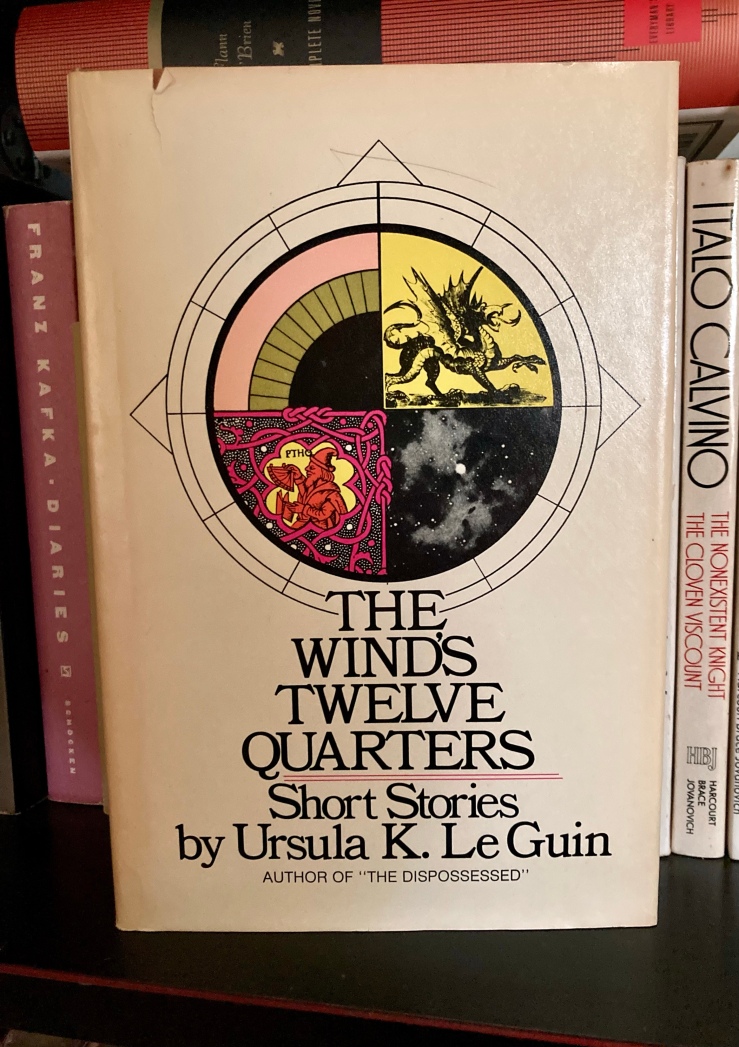
Ursula K. Le Guin’s 1975 volume The Wind’s Twelve Quarters collects seventeen short stories, offering, as the author puts it in her foreword, “a retrospective” of her career to date: “a roughly chronological survey of my short stories during the first ten years after I broke into print.” Le Guin adds that The Wind’s Twelve Quarters is “by no means a complete collection” of her short stories to date, and that the book does not include “fiction which doesn’t fit under the headings Fantasy or Science Fiction.” In addition to her foreword, Le Guin offers brief introductory notes to each of the seventeen tales.

For me, these introductions were often as interesting as the stories themselves. In her introduction to “Semley’s Necklace,” for example, Le Guin declares that the “candor and simplicity” of this early story exemplifies the “romanticism” characteristic of her early work — a mode that has “gradually become something harder, stronger, and more complex” as her career developed. In her introduction to “The Good Trip,” she tells us that her “only strong opinion about drugs (pot, hallucinogens, alcohol) is anti-prohibition and pro-education” but also admits that “people who expand their consciousness by living instead of by taking chemicals usually come back with much more interesting reports of where they’ve been.” In her intro to “Nine Lives,” which was originally published in Playboy in 1968, Le Guin laments that it appeared “under the only pen name I have ever used: U. K. Le Guin,” and that it is “surprising to me to realize how thoughtlessly I went along with them. It was the first (and is the only) time I met with anything I understood as sexual prejudice, prejudice against me as a woman writer, from any editor or publisher; and it seemed so silly, so grotesque, that I failed to see that it was also important.” In her introduction for “A Trip to the Head,” Le Guin describes a dark bout of writers block she experienced over a period of two years living in England. Giving herself permission to write “A Trip to the Head” released the block:

There is a kind of story which I would describe as a Bung Puller. The writer for one reason or another has been stuck, can’t work; and gets started again suddenly, with a pop, and a lot of beer comes leaping out of the keg and foaming all over the floor. This story was definitely a Bung Puller.

“A Trip to the Head” is one of the very few examples in the collection where the introductory material outweighs the tale it introduces. The story starts promisingly enough:

“Yes, this is Earth,” said the one beside him, “nor are you out of it. In Zambia men are rolling down hills inside barrels as training for space flight. Israel and Egypt have defoliated each other’s deserts. The Reader’s Digest has bought a controlling interest in the United States of America/General Mills combine. The population of the Earth is increasing by thirty billion every Thursday. Mrs Jacqueline Kennedy Onassis will marry Mao Tse-Tung on Saturday, in search of security; and Russia has contaminated Mars with bread mold.”

“Why then,” said he, “nothing has changed.”

—but then Le Guin makes good on that “nothing has changed” idea, even as, paradoxically, her story’s undefined protagonist transforms through a series of identities. “A Trip to the Head” is a postmodern experiment that doesn’t really succeed, unless, of course, you count that its creation unblocked our author.

And it’s a good thing Le Guin broke her block: some of her strongest work came after “A Trip to the Head,” including The Lathe of Heaven, The Dispossessed, and the first two Earthsea novels. Most of the stories in The Wind’s Twelve Quarters that came after “A Trip to the Head” are quite strong. 1971’s “Vaster Than Empires and More Slow,” part of Le Guin’s Hainish universe, tells the story of SPACE MADNESS! and a murderous empathic jungle. “The Ones Who Walk Away from Omelas” (1973) is a successful morality experiment (or “psychomyth,” to use Le Guin’s term). “Omelas” proposes a utopia where “millions [are] kept permanently happy on the one simple condition that a certain lost soul on the far-off edge of things should lead a life of lonely torment.” In her introduction, Le Guin attributes this riff on the scapegoat to William James’s essay “The Moral Philosopher and the Moral Life” (although she concedes that she first read the scenario in Dostoyevsky’s Brothers Karamazov). “Omelas” is a highlight of The Wind’s Twelve Quarters, as is 1974’s “The Day Before the Revolution,” which details a day in the life of the aged anarchist revolutionary Odo. “The Day Before the Revolution” serves as a kind of prologue to The Dispossessed, a move that appears elsewhere in the collection.

The opening story, “Semly’s Necklace,” is quite literally the prologue to Le Guin’s first novel Rocannon’s World (1966). “Winter’s King” (1969) was the spark that led to what many consider Le Guin’s finest novel The Left Hand of Darkness (published later the same year). 1964’s “The Word of Unbinding” and “The Rule of Names” preceded the Earthsea novels that Le Guin would begin in the late sixties. While these germinal tales are intriguing, its clear the Le Guin, ever the anthropologist, would like to do more than her limited canvas can hold. These tales are most notable as ancillary material to be situated in the worlds that Le Guin would go on to conjure in a much wider scope.

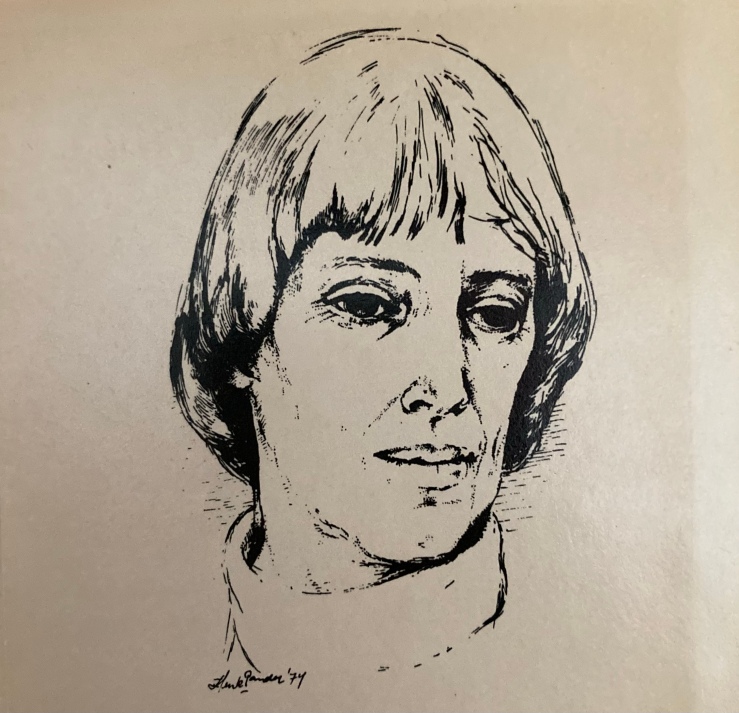
Ursula K. Le Guin portrait by Henk Pander.

Some of the best stories in the collection are self-contained, even as they point to Le Guin’s developing larger themes and goals as a writer. “The Masters” (1963) is a lovely dystopian riff on power, control, and knowledge (“The theme of this story is one I returned to later, with considerably better equipment,” Le Guin remarks in her intro, adding, “It has a good sentence in it, though: ‘He had been trying to measure the distance between the earth and God'” — that is a good sentence!) 1970’s “Things” imagines the paranoia of a promised apocalypse, with a brickmaker turned boatbuilder and a widowed weaver providing their own imaginative resistance to the coming onslaught. 1962’s “April in Paris” is a lovely oddity—a romantic time traveling tale with a sentimental happy ending:

The alchemist and the interstellar archaeologist went first, speaking French; the Gaulish slave and the professor from Indiana followed, speaking Latin, and holding hands. The narrow streets were crowded, bright with sunshine. Above them Notre Dame reared its two square towers against the sky. Beside them the Seine rippled softly. It was April in Paris, and on the banks of the river the chestnuts were in bloom

The Wind’s Twelve Quarters is not a great starting place for anyone interested in Le Guin’s worlds. Interested parties would do better to start with The DispossessedThe Lathe of Heaven, or The Left Hand of Darkness—but interested parties are probably aware of that. The book is better suited for folks like me—folks who tore through the Hainish cycle and the Earthsea books and collections, and still wanted a little moreThe Wind’s Twelve Quarters is ultimately most interesting as a document of a writer coming into the prime of her powers, and, as such, is indispensable for hardcore Le Guin fans.

A review of Stone Junction, Jim Dodge’s alchemical pot-boiler

Jim Dodge’s 1990 novel Stone Junction tells the life story of Daniel Pearse, a young man of preternatural talents and sharp intelligence who trains under various tutors in a secret society, steals an enormous diamond, and eventually attains enlightened apotheosis. A lot of other stuff happens too.

Dodge subtitled his novel An Alchemical Pot-Boiler, a description that punctures any premature accusations of pretension, yet also calls attention to the novel’s arcane subject matter. The subtitle’s also a joke, of course—Dodge invites us to read his 500-pager as a kind of alchemist’s cauldron, a kitchen sink overloaded with spies and thieves, gamblers and quick change artists, holy fools and madmen. 

And Dodge, as promised, keeps his pot boiling. Stone Junction is a propulsive and engaging read largely because of the world he imagines for Daniel to grow up in. Stone Junction isn’t a magical realism act, but magic exists here. From a very young age, Daniel is initiated into a clandestine organization called AMO. Said aloud, as a young Daniel points out, the name “AMO” is suggestive of both “ammo” and the Latin verb amo, it’s really an acronym:

AMO is the acronym for Alliance of Magicians and Outlaws – or, as some members claim, Alchemists, Magicians, and Outlaws, which they contend was the original name. Another faction, small but vocal, insists AMO has always stood for Artists, Myth-singers, and Outriders. As you might sense, there is constant and long-standing contention about AMO’s origins and development

…AMO is a secret society – though more on the order of an open secret, in fact. Basically, AMO is a historical alliance of the mildly felonious, misfits, anarchists, shamans, earth mystics, gypsies, magicians, mad scientists, dreamers, and other socially marginal souls.

After the violent and mysterious death of his mother (and his own near-death), Daniel comes under the tutelage of those dreamers and socially-marginal souls. Extended episodes of Daniel’s working and growing under a new teacher make up the bulk of Stone Junction; these inventive and enjoyable sections are the finest parts of the book. Thomas Pynchon offers a nice catalog of Daniel’s various mentors in his introduction to the 1997 reprint of Stone Junction:

Wild Bill Weber teaches meditation, fishing, waiting. Mott Stocker teaches Dope, its production and enjoyment. Ace safecracker Willie Clinton (yep) instructs the boy in how to get past all kinds of locks and alarms, rendering him thus semi-permeable to certain protected parts of the world, setting him on his path to total dematerialization. For a while Daniel teams up with poker wizard Bad Bobby Sloane, roving the American highways in search of opportunities to risk capital in ways that cannot be officially controlled… The shape-shifting genius Jean Bluer teaches Daniel the arts of disguise… At last Daniel comes circling back to Volta…who teaches him the final secret of Invisibility. None of your secular Wellsian tricks with refractive indices and blood pigmentation here, but rather the time-honored arts of ceasing to be material.

It makes sense that Pynchon (who praises Stone Junction as “an outlaw epic for our own late era of corrupted romance and defective honor”) would stick on that big “I” Invisibility, always a byword in his own novels.

Dodge’s byword in Stone Junction is another i-word: imagination. Especially in its final third, Dodge’s novel, and its characters, repeat the importance of imaginative possibility, of imagining new realities, new states of being.

Volta is the dark sage magician guiding Daniel on his quest toward imagination. Or, rather, his quest to steal an enormous, perfectly-circular diamond from the U.S. government. He might throw Daniel into a den of lions, but our boy’s an escape artist. His last name, Pearse, among other transmutations (pierce, purse, pairs), suggests Percival, one of Arthur’s Knights of the Round Table. (Like Percival, Daniel is raised alone in hermetic seclusion by his solo mother.) The diamond is Daniel’s grail.

In her contemporary New York Times review of Stone Junction, Michele Slung pointed out the novel’s debt to Arthurian legends, among other sources, calling it “a post-psychedelic coming-of-age fable that’s part Thomas Pynchon, part Tolkien, part Richard Brautigan, a story that owes as much to The Once and Future King as it does to Huckleberry Finn.” Like Huck FinnStone Junction has a ramshackle, picaresque energy, but it nevertheless adheres to a plot, with the mystical diamond a MacGuffin for Daniel (among other thieves and spies) to quest after—once he’s matured and advanced in his outlaw skills, of course.

As I stated above, the strongest elements of Stone Junction revolve around Daniel’s adventures and training. (His time on the poker circuit with Bad Bobby Sloane is a particular highlight.) Dodge transmogrifies the raw material of American Weirdo Mythos into new inventions, zany recapitulations of occult outlaw fables.

Dodge’s prose style, while effective in its descriptions of characters, cannot quite approach the register of his imaginative inventory. The novel relies heavily on exposition, and while major characters like Volta and Bad Bobby Sloane speak with authentic and differentiated voices, a monolingual sameiness pervades too much of the prose. In its strongest moments, Stone Junction reads like a YA Pynchon novel; in its weakest moments, it reminded me of Tom Robbins.

The stronger moments prevail, however—Stone Junction is a fun, flighty, and at times unexpectedly heavy summer read. The novel might also be read in (stoned) conjunction with Pynchon’s 1990 twin Vineland. Both novels diagnose the fallout of the 1960s counterculture wave crashing against the Reagan eighties; both seem attempts to, at least in the world of letters, check the burgeoning nostalgic romanticization of that turbulent decade. Pynchon’s is the more flawed, sillier, and better-written effort; Dodge’s is likely his magnum opus.

If I’ve namechecked Pynchon too much in my review, forgive me: His name is on the cover of Jim Dodge’s novel, and his own (far more-detailed, far better-written) review precedes Jim Dodge’s novel, and his endorsement is frankly the reason I sought it out to begin with. I called Stone Junction “YA Pynchon” above, but I didn’t mean it as an insult—it’s YA in an older sense, in the sense of the novels handed me when I was young, hardly adult, novels that etched their own versions of reality onto our own banal reality; realities more real: Adventures of Huckleberry FinnThe OutsidersThe Once and Future KingThe Lord of the RingsHatchet… Stone Junction is about youth, but it’s also about maturation, and the ache and melancholy of aging out of the game, personified in the semi-tragic figure of Daniel’s would-be mentor, Volta.

I don’t think I would’ve appreciated the depth of Volta’s melancholy as a much younger person, which is the time I wished I had first read Stone Junction. I should’ve found the novel almost 30 years ago—let’s say the summer I stayed in my cousin’s old bedroom. I was fifteen or sixteen, and he, a decade older than me, was doing Adult Things. I listened to the tapes and records he had left in his high school bedroom, taking a few with me at the end of the summer. (Tripp, if you’re reading, I still have your cassette of New Order’s Low-Life in a box somewhere. Drive up sometime and we can search it out together.) I read almost all of his cheap paperbacks, and took as many as I thought I could reasonably get away with with me: Fear and Loathing, Cat’s CradleEven Cowgirls Get the Blues, both Miller Tropic novels, The Electric Kool-Aid Acid TestThe Dharma BumsDelta of VenusThe Beautiful and the Damned. That would’ve been the perfect summer for me to first read Stone Junction, but I didn’t read it then. I read it now. Let a younger person in your life steal it from you, sooner rather than later.

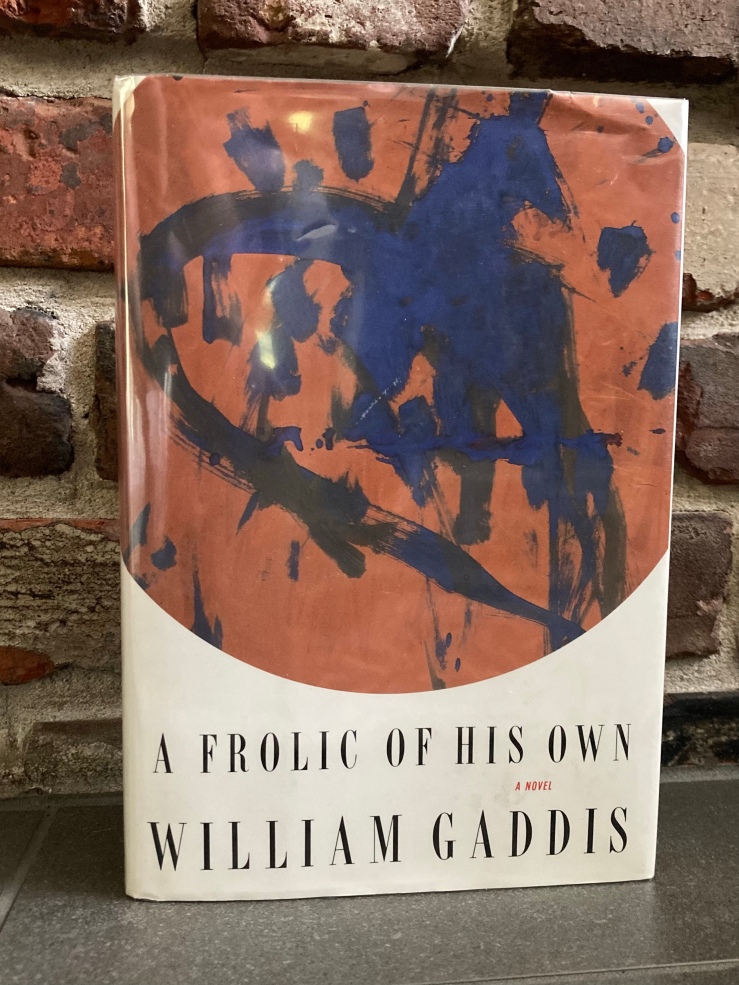
Cannibals all | On William Gaddis’s novel A Frolic of His Own

I want to comment on the themes and style of William Gaddis’s fourth novel, 1994’s A Frolic of His Own, and I’d like to do so without the burden of summarizing its byzantine plot, so I’ll crib from Steven Moore’s contemporary review of the novel that was first published in the Spring 1994 issue of The Review of Contemporary Fiction. Although he initially protests that the “plot is too wonderfully complex to summarize,” Moore nevertheless offers a concise precis. Moore writes that A Frolic of His Own

…concerns an interlocking set of lawsuits involving the Crease family: Oscar, a historian and playwright; Christina, his stepsister and married to a lawyer named Harry Lutz; and their father Judge Thomas Crease, presiding over two cases in Virginia during the course of the novel. The story unfolds by way of Gaddis’s trademark dialogue but also by various legal opinions, brilliantly rendered in the majestic language of the law.

Law, one of the major themes of the novel, is announced in its opening lines: “Justice? —You get justice in the next world, in this world you have the law.” A Frolic of His Own delves into the intersection of justice, law, art, theft, and compensation, all while foregrounding language as the mediating force of not just these nebulous concepts, but the medium, of course, of the novel itself. “What do you think the law is, that’s all it is, language,” the exasperated lawyer Harry declaims to his wife Christina.

Language is always destabilized and destabilizing in A Frolic of His Own. Gaddis lards the novel with mistakes, misinterpretations, and muddles of every mixture. Characters repeatedly fail to communicate clearly with each other, their dialogue twisting into new territories before they’ve mapped out their present concerns. A Frolic reads as linguistic channel surfing, an addled mind constantly turning the dial before a thought can fully land.

The effect of this linguistic channel surfing at times stuns and overwhelms the reader, approximating the noise of modern language that Gaddis’s heroes so often rail against, even as they participate in and create more of this noise. It’s worth sharing a paragraph in full to offer a sense of what Gaddis is doing in A Frolic of His Own. Here, Christina takes a phone call from her husband Harry, while her brother Oscar (who is slowly going mad) watches the evening news:

—Has Harry called? And when it finally rang —We’re fine, did you get to that new doctor? Well whatever you call him, you… I know that Harry but you’ve simply got to make time, if you don’t you’re going to end up like… that’s exactly what I mean, he’s sitting right here waiting for the evening news to whet his appetite for supper, I mean I can’t take care of both of you can I? Scenes of mayhem from Londonderry to Chandigarh, an overweight family rowing down main street in a freak flood in Ohio, a molasses truck overturned on the Jersey Turnpike, gunfire, stabbings, flaming police cars and blazing ambulances celebrating a league basketball championship in Detroit interspersed with a decrepit grinning couple on a bed that warped and heaved at the touch of a button —because they offered him a settlement Harry, almost a quarter million dollars but of course he insists on going ahead with the case or rather Mister Basie does, he was out here for… what? The Stars and Bars unfurled in a hail of rocks and beer cans showering the guttering remnants of a candlelight vigil—but if you can just try to be patient with her Harry, you know her mother just died and she’s been in an awful state trying to… to what? Oscar will you turn that down! that now she wants you to help her break her mother’s will? I don’t see what… well they never really got on after her mother was converted by that wildeyed Bishop Sheed was it? a million years ago convincing her that it was more exclusive with Clare Luce and all that after the wads of money she’d been giving St Bartholomew’s with these millions of Catholics jamming every slum you can think of if you call that exclusive, she…—Look! Christina look! Placards brandishing KEEP GOD IN AMERICA, MURDERER  come quickly! and caught in the emergency vehicles’ floodlights towering over it all the jagged thrust of —that, that Szyrk thing that, look!

The noisy force of mass-mediated language threatens to overwhelm the reader, whom Gaddis challenges to make meaning of his mess. Later, Christina sums up the problem: “I mean you talk about language how everything’s language it seems all that language does is drive us apart.” Naive Oscar, whose multiple lawsuits initiate the plot of A Frolic, tries to clarify the problem of language in his own way too: “—Isn’t that what language is for? to say what you mean? That’s why man invented language, isn’t it? so we can say what we mean?” But the events that Gaddis arranges in his novel suggest that the answer is, Not quite. There’s only one language all Americans understand—money:

—You want to sue them for damages, that’s money isn’t it?

—Because that’s the only damn language they understand! …Steal poetry what do you sue them for, poetry? …Two hundred hours teaching Yeats to the fourth grade?

Oscar’s complaint is the apparent plagiarism of his Civil War play Once at Antietam by a major Hollywood studio that has turned it into a “piece of trash” called The Blood in the Red White and Blue. Gaddis includes large sections of Oscar’s play in A Frolic of His Own, often having various characters (including its author) stop to make critical remarks. Here, Gaddis has actually cannibalized parts of a play he wrote in the late 1950s after he’d finished The Recognitions. He was unable to get Once at Antietam produced or published. In a 1961 letter, he admitted that “Now it reads heavy-handed, obvious, over-explained, oppressive,” adding that there might be some value somewhere in the work “but the vital problem remains, to extract it, to lift out something with a life of its own, give it wings, release it.” A Frolic of His Own may, on one hand, “release” Gaddis’s old play, but it denies it any life of its own. The play is bound within the text proper, incomplete, riddled with elisions, terminally unfinished.

It also comes to light (via a lengthy legal deposition) that Oscar (and perhaps the younger Gaddis?) has plagiarized large sections of his play, notably from Plato’s Republic. Oscar pleads that his plagiarisms are justified—they are art. But in A Frolic of His Own, “it all evaporates into language confronted by language turning language itself into theory till it’s not about what it’s about it’s only about itself turned into a mere plaything.”

Language is, of course, Gaddis’s plaything, and his novel repeatedly underlines its own textuality without the preciousness that sometimes afflicts postmodernist writing. For all his innovations and experimentation with form, Gaddis here and elsewhere is at his core a traditionalist like his hero T.S. Eliot. And like Eliot, he seeks to pick up the detritus of culture and meld it into something new, all while attacking the hollow men who run America. There’s more than just crankiness here: There is howling and bleating and often despair. There’s no justice for our characters, but at the same time, they hardly deserve any. For all their apparent cares and worries, these rich, venal, petty characters are ultimately, to borrow a phrase from another book, careless people, leaving messes for others to clean up (often quite literally). The satire bites; it’s rightfully mean-spirited, caustic, and bitter.

As such, A Frolic of His Own, for all its humor, is often very bleak. It also becomes increasingly claustrophobic. The characters get stuck in their language loops; the only way out seems to be madness or death. Gaddis’s writing had long evoked suffocating domestic spaces, whether it was the paper-stuffed 96th Street apartment shared by Bast, Eigen, and Gibbs in 1975’s J R or the haunted house of 1985’s Carpenter’s GothicA Frolic of His Own takes the madness to another level, setting the stage for the monolingual stasis of his final work, Agapē Agape.

Even if its cramped quarters are often gloomy and crammed with sharp objects, there’s a zaniness to the linguistic channel surfing of A Frolic that propels its fractured narrative forward. “The rest of it’s opera,” repeats Harry throughout, calling attention to the novel’s satirical histrionics. “It’s a farce,” repeats Oscar, pointing to both his own legal cases and his family history. As A Frolic progresses, its farcical twists become more and more bizarre, yet Gaddis always ties his loose ends. The modern world he satirizes is absurd, but it is real.

The realism Gaddis evokes in A Frolic centers around food and shelter. The action is confined primarily to the dilapidated old Crease estate, with its family (in ever-shifting configurations) frequently trying to feed themselves: “We’ve got to get some food in the house” becomes a mantra. Poor privileged half-siblings Oscar and Christina can hardly shop for themselves, let alone cook.

They are very adroit at drinking, however. As the novel careens towards madness, the half-siblings respond by hitting the booze. Consumption runs throughout the novel, presaged in its domestic-but-dooming epigraph, a recollection of something Thoreau said to Emerson while they were walking:

What you seek in vain for, half your life, one day you come full upon, all the family at dinner. You seek it like a dream, and as soon as you find it you become its prey.

Gaddis was fond of repurposing language, and first used the lines in his first novel, 1955’s The Recognitions. The last line of the epigraph, which finds the seeker become prey to his own dream, seems to me now to further highlight A Frolic’s themes of consumption—taboo consumption: cannibalism.

Very early in the novel, the narrator calls attention to Oscar’s copy of George Fitzhugh’s 1857 defense of slavery, Cannibals All! The phrase “cannibals all” is then inverted near the very end of the novel, when a former lawyer, in the hopes of perpetrating an insurance scam, wedges his foot in Oscar’s door: “they’re cannibals Mister Crease, they’re all cannibals,” the former lawyer insists, referring broadly to the insurance industry (he’ll later extend the term to those working in the real estate market in particular and humanity in general).

These direct inversions—cannibals-all/all-cannibals—bookend A Frolic of His Own, neatly encasing the metaphorical cannibalism that runs through the novel. Gaddis depicts a “dog eat dog” world (full of literal dead dogs) ruled by venal consumption. Family members cannibalize family members, law cannibalizes art, texts cannibalize texts. “When the food supply runs out and the only ones around are your own species, why go hungry?” interjects the narrator of a nature documentary that Oscar watches absentmindedly. Harry puts it succinctly:

That’s…what this whole country’s really all about? tens of millions out there with their candy and beer cans and this inexhaustible appetite for being entertained? Anything they can get their hands on…

Gaddis depicts a world where all attempts at culture and art are ultimately cannibalized and excreted by capital. In one of the novel’s goofiest and meanest gags, an entrepreneur seeks to exploit the highly-publicized death of Spot, a dog trapped and then zapped in an ugly postmodernist sculpture. The huckster, capitalizing on the public’s love for Spot, creates “Hiawatha’s Magic Mittens…labeled ‘Genuine Simulated Spotskin® Wear ‘Em With The Furside Outside.'”

“Hiawatha’s Magic Mittens” might seem like a throwaway joke, but the joke is nevertheless part of the novel’s theme of cannibalized culture. Those familiar with the legend of Hiawatha may recall that in many versions, Hiawatha practices ritual cannibalism until he is converted by the Great Peacemaker Deganawida. After his conversion, Hiawatha ceases to eat human flesh and strives for mutual aid and cooperation.

Gaddis also evokes the Hiawatha of Henry Wadsworth Longfellow’s epic poem, itself a cannibalization of sorts of the mytho-historical Hiawatha. Gaddis grafts the oft-cited opening line of “Hiawatha’s Childhood,” “By the shores of Gitche Gumee” a few times early in the novel. The poem seems to loll and roll around in Oscar’s skull; as his alcoholic madness increases, the poem’s trochaic tetrameter infects his thoughts. The result is some of the most beautiful prose in the book (even if the lines are intended as half-parody). Consider the following passage, which begins with Oscar watching the sunset on the wetlands around his crumbling estate, takes flight into the poetic cannibalization of Longfellow’s lines, and winds up in the jumble of Oscar’s fish tank (I strongly suggest reading the passage aloud to hear the trochaic tetrameter):

Neither the red scream of sunset blazing on the icebound pond nor the thunderous purple of its risings on a landscape blown immense through leafless trees off toward the ocean where in flocks the wild goose Wawa, where Kahgahgee king of ravens with his band of black marauders, or where the Kayoshk, the seagulls, rose with clamour from their nests among the marshes and the Mama, the woodpecker seated high among the branches of the melancholy pine tree past the margins of the pond neither rose Ugudwash, the sunfish, nor the yellow perch the Sahwa like a sunbeam in the water banished here, with wind and wave, day and night and time itself from the domain of the discus by the daylight halide lamp, silent pump and power filter, temperature and pH balance and the system of aeration, fed on silverside and flake food, vitamins and krill and beef heart in a patent spinach mixture to restore their pep and lustre spitting black worms from the feeder when a crew of new arrivals (live delivery guaranteed, air freight collect at thirty dollars) brought a Chinese algae eater, khuli loach and male beta, two black mollies and four neons and a pair of black skirt tetra cruising through the new laid fronds of the Madagascar lace plant.

Forgive the long quote. Or don’t. As the novel swerves to its gloomy end, the poem overtakes Oscar’s consciousness, the transcendental beauty of Longfellow’s vision cannibalized by the chainsaws of “land developers,” the real fauna replaced with Disneyfied simulations to send him off to drunken troubled dream. Dreamy Oscar:

…made a bed with boughs of hemlock where the squirrel, Adjidaumo, from his ambush in the oak trees watched with eager eyes the lovers, watched him fucking Laughing Water and the rabbit, the Wabasso sat erect upon his haunches, watched him fucking Minnehaha as the birds sang loud and sweetly where the rumble of the trucks drowned the drumming of the pheasant and the heron, the Shuh-shuh-gah gave a cry of lamentation from her haunts among the fenlands at the howling of the chainsaws and the screams of the wood chipper for that showplace on the corner promising a whole new order of woodland friends for the treeless landscape, where Thumper the Rabbit and Flower the Skunk would introduce the simpering Bambi to his plundered environment and instruct him in matters of safety and convenience by the shining Big-Sea-Water, by the shores of Gitche Gumee where the desolate Nokomis drank her whisky at the fireside, not a word from Laughing Water left abandoned by the windows, from the wide eyed Ella Cinders with the mice her only playmates as he turned his back upon them with his birch canoe exulting, all alone went Hiawatha.

Many contemporary reviewers suggested that A Frolic of His Own was Gaddis’s most accessible novel to date, and it might be. Whereas J R and Carpenter’s Gothic are composed almost entirely in dialogue, Gaddis provides more stage direction and connective tissue in A Frolic. There are also the fragments of other forms: legal briefs, depositions, TV news clips, Oscar’s play…Some of these departures can exhaust a reader. Gaddis’s parodies of legalese are full of jokes, but the tone of the delivery can lead one’s mind’s eye to glaze over. Oscar/Gaddis’s play is problematic too, but in a rewarding if confounding way: Is it supposed to be, like, good? The answer, I think, comes in its cannibalized version—I mean the cannibalized version that Oscar watches over broadcast television. When he finally sees The Blood in the Red White and Blue, Oscar experiences a wild array of emotions, both positive and negative—but his feelings are real.

A Frolic of His Own is not the best starting point for anyone interested in William Gaddis’s fiction, although I don’t think that’s where most people start. It is rewarding though, especially read contextually against his other works, in which it fits chaotically but neatly, underscoring the cranky themes in a divergent style that still feels fresh three decades after its original publication. Highly recommended.
A life obscene | On Cormac McCarthy’s early novel Child of God

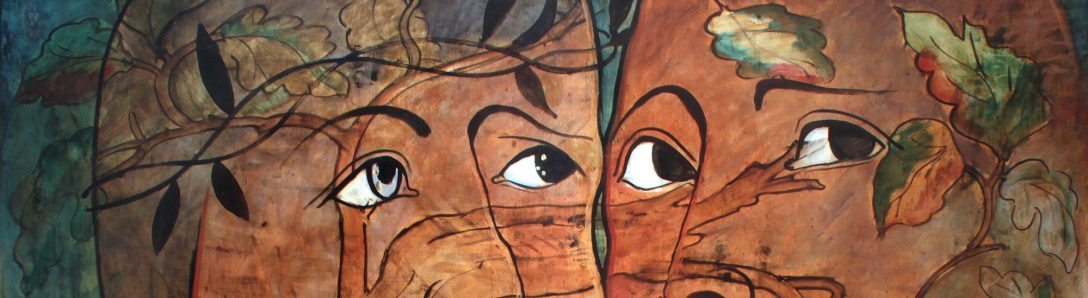
Overflow, 1978, Andrew Wyeth

In ancient Greek drama, acts of violence or sex were “ob skena,” relegated to offstage. Thus, the horrific violence of Oedipus gouging out his eyes is not shown, but rather reported by a messenger. We see the same tradition in Shakespeare, of course, as well as the modern novel. And while many writers elide scenes too taboo or offensive to the sensibilities of the general reading public, books like Ulysses, Lolita, and Tropic of Capricorn, demonstrate that novels are often the site of debate over what can and cannot be shown or described or articulated plainly in our culture. Our concept of “the obscene” (the Greek “ob skena” simply translates to “off stage”) demands that certain actions might only be referred to or implied, but not graphically depicted, that the offensive action takes place out of our vision. The great lie or paradox of the obscene then is that in pushing the offensive action off stage, the author necessitates that the audience must envision that very action that was removed, that they must privately articulate their own understanding or schema or representation of what is taboo.

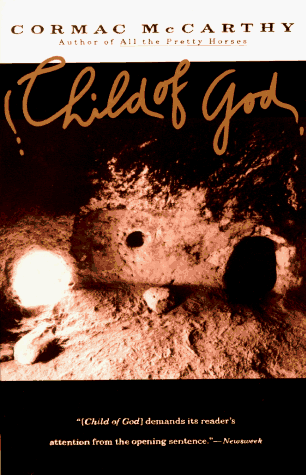
While this strategy can often be quite effective and affecting (think of Tarantino pulling the camera away as Mr. Blonde cuts off the cop’s ear in Reservoir Dogs), in a character-centered novel it can also lead to a larger denial, a larger exclusion. What if one’s entire life was obscene? In his third novel, Child of God, Cormac McCarthy tells the story of a man who has been pushed from life’s stage, who exists in the uncanny and indigent margins of society.

The ersatz protagonist of Child of God, Lester Ballard, is a poor, stooped, abject wretch of a man. The book opens with Ballard losing his house in a humiliating debacle. From there, he wanders the earth, finding an abandoned shack and barely eking out the means to leave. Ballard is an outsider, literally, always looking in at the lives of more normal, more stable people. His voyeurism leads him to creep up to parked cars to spy on the lovers inside. Wanting some connection or sense of love–or perhaps just out of general dejected weirdness–he masturbates against the cars, watching the people inside. His identity as voyeur is magnified in his only apparent skill. Ballard is an ace sharpshooter who carries his rifle almost everywhere he goes, surreptitiously spying on the normal folks through its lethal scope.

As the book develops in McCarthy’s spare, terse prose, Ballard becomes more and more unhinged. Everywhere he goes he is slighted or outright rejected and cheated by his fellow man. The indignities and affronts against Ballard range from being falsely accused of rape to simply being ignored by his neighbors. At the same time, Ballard is a creep, a loser, and seems largely deserving of this treatment. And yet, as McCarthy points out early in the novel, he is a “child of God, much like yourself perhaps.” This early call to identify with Ballard as a fellow human being is constantly strained by his wildly antisocial behavior, and yet it’s McCarthy’s genius as a writer that anchors the novel in some measure of sympathy for such a wretched anti-hero. When a young girl rejects Ballard’s advances, she taunts him, saying, “You ain’t even a man. You’re just a crazy thing.” In many ways, this is the major question of the novel: Is Ballard a man, or a thing? What makes a person a person, and not simply an object estranged from the human race? To test this question, McCarthy has Ballard plumb almost every conceivable taboo, from murder to arson to necrophilia. However, Ballard isn’t the only one in these Tennessee backwoods who behaves despicably: there’s the father who rapes his daughter, the gangster behavior of the Ku Klux Klan, and the mob justice of the townspeople as a whole. Still, Ballard’s descent into violence and madness–graphically portrayed by McCarthy–is the central action in this compelling novel.

child-of-godReaders looking for redemptive story arcs or tales of heroism will likely be turned off by Child of God, and squeamish readers will probably not get past the first fifty pages. Those interested in McCarthy’s fiction will find more in common here with the visceral grit of The Road or Blood Meridian than the reflective romanticism of his “Border Trilogy” novels (including crowd-pleaser All the Pretty Horses). Child of God continues the Gothicism of Carson McCullers and William Faulkner, bearing a favorable comparison to those writers’ works. And like those writers’ works, McCarthy’s novel has faced its challengers. Those who see the book as obscene are perhaps right, in the sense that the word implies “that which must be shown off stage.” However, one of the legal definitions of obscenity necessitates that the work “lacks serious literary, artistic, political or scientific value,” a claim that I do not think can be seriously substantiated against Child of God. Don’t believe me? Read it for yourself.

[Ed. note–Biblioklept first published a version of this review in 2009. I recently reread the novel in January of 2023, as part of a big McCarthy reread prompted by the publication of his final novels, Stella Maris and The Passenger, and I found Child of God much funnier and sadder than I had remembered.]

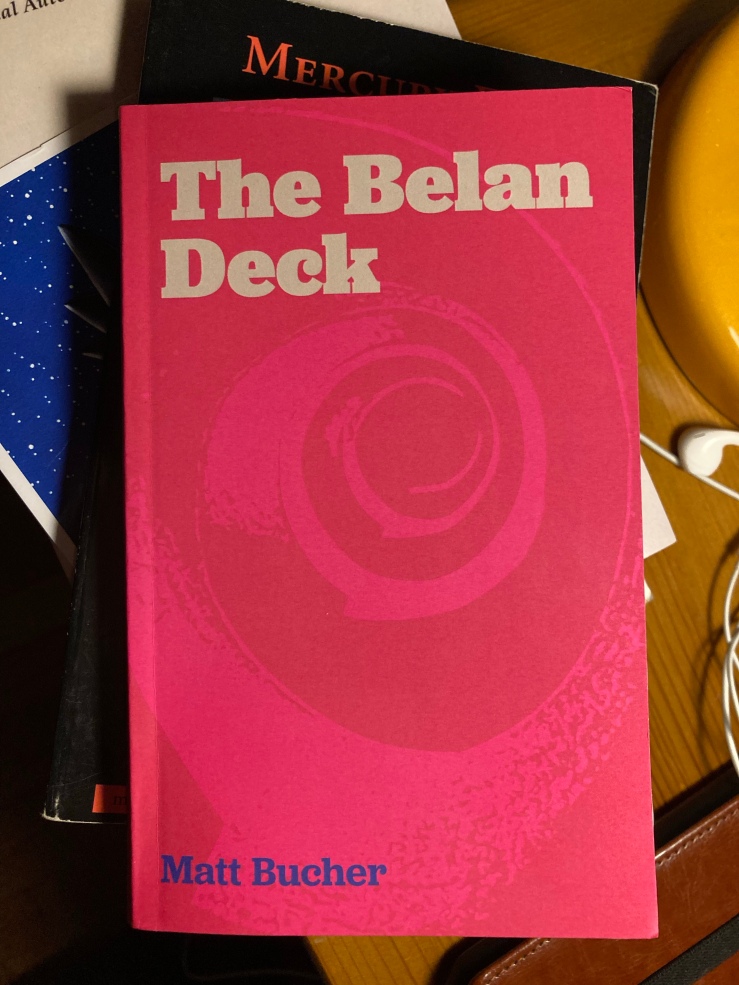
Matt Bucher’s The Belan Deck is an unexpectedly moving argument for humanity and serious triviality

I stayed up later than I meant to the other night reading all of Matt Bucher’s new book The Belan Deck in one cover-to-cover go. On his website, Bucher describes The Belan Deck as “a little book…set mostly during a layover at SFO” that “centers around a person who maybe doesn’t really fit in at their AI tech job but still needs to produce one final PowerPoint deck.” This description approximates the plot, in the barest sense, but doesn’t touch on the spirit or form of The Belan Deck.

Let’s talk about the spirit and form of The Belan Deck. Bucher borrows the epigraphic, anecdotal, fractured, discontinuous style that David Markson practiced (perfected?) in his so-called Notecard Quartet (1996-2007: Reader’s Block, This Is Not A NovelVanishing Point, and The Last Novel). “An assemblage…nonlinear, discontinuous, collage-like,” wrote Markson, to which Bucher’s narrator replies, “Bricolage. DIY culture. Amateurism. Fandom. Blackout poems.”

Bucher’s bricolage picks up Markson’s style and spirit, but also moves it forward. Although Markson’s late quartet is arguably (I would say, by definition) formally postmodernist, the object of the Notecard Novels’ obsession is essentially Modernism. Bucher’s book is necessarily post-postmodern, taking as its objects the detritus and tools of postmodern communication: PowerPoint, Google Street View, Wikipedia, social media, artificial intelligence.

At the same time, Bucher continues Markson’s obsessions with artists and death, adding to the mortality lists that wormed through DM’s quartet. Bucher’s updates are odd though, in that they seem to, in their print form, contextualize anew coincidences that were so raw and immediate when they popped up on Twitter and other social media:

Nicanor Parra died the day after Ursula K. LeGuin died.

Larry McMurty and Beverly Cleary died the same day.

(In my memory, William H. Gass died the day before LeGuin, but this is not true. He died almost two months before LeGuin. But I recall teaching selections from both of their work in a literature class in the spring semester of 2018, and pointing out to my students that the empty spaces behind the dashes after their birth years might now be filled in. “An encyclopedia entry demands at least a birth or a death,” notes Bucher’s narrator.)

The encyclopedia, by which I mean Wikipedia, becomes a heroic motif in The Belan Deck. “Wikipedia is the number one result for over 50% of Google searches,” Bucher’s narrator points out, following it up with,

Wikipedia, made by humans, for free, is a better search engine than Google, the most expensive and sophisticated algorithm in the world.

Earlier in The Belan Deck, the narrator points to the “mindless pleasure of going down a deep Wikipedia rabbit hole,” a pleasure that an artificial intelligence, no matter how developed, could never feel. About three dozen pages later, Bucher’s narrator throws a slant rhyme to his previous note on the “mindless pleasures” of Wikipedia rabbit holes, pointing out that Thomas Pynchon had used Mindless Pleasures as a working title for Gravity’s Rainbow. That’s how this book operates: Disparate fragments of information are “Clues rather than trivia.”

The goal is to find the sublime in these connections; Bucher’s narrator repeatedly and succinctly argues that finding the beautiful, much less the sublime, is impossible for an artificial intelligence. The Belan Deck plays out as a discursive, looping, and unexpectedly moving argument for humanity, in all its serious triviality, against the backdrop of capital’s rapid encroachment into the human position in the arts.

“Capitalism is incompatible with being an artist, for most people,” avers our narrator. “Yet you participate!” might come the retort, and it’s true—not only does Bucher’s narrator work in a soulless medium, the deck (trying to inject some soul, some sublime, some humanity into it), he also works for the soulless Belan, a money guy who would love to replace artists with machines. (In what I think has to be a great intentional gag, Bucher’s narrator’s point of contact for Belan is a middleman named  Jimmy Chen. I just have to believe that the character’s a take on the Jimmy Chen who wrote and designed on HTMLGIANT for all those years.)

The narrator participates because there aren’t that many other options, as we all know. “Do you understand what I am saying? Does it also feel this way to you?” the narrator plaintively asks. I mean, for me, that’s a Yes, all the time. 

There’s much more in The Belan Deck than I can get to here—more on art, artists, baseball, airports—it’s voluminous for a “little book.” (“When we buy a book, we think we are buying time to read” is a line I underlined but could not otherwise work into this review, so I’ll include it here parenthetically. (A lot of this review has happened in parentheses.))

I’ll end with two bits of personal trivia, two coincidences.

First: The day The Belan Deck arrived in my mail, which is the day that I read The Belan Deck, some AI-cheerleading dork went viral on Twitter for posting a series of unasked-for renderings of “what the backgrounds of the most famous paintings in the world look like with AI.” He was roundly and rightly mocked for his endeavors, and I found the general antipathy heartening, but still a small cadre of people who know absolutely nothing about art congratulated his vapidity.

Second: Earlier that same day, I read a passage from Walter Tevis’s 1980 dystopian novel Mockingbird, and found its sentiment largely heartening as well. The hero of the novel, staring at a “dumb parody of humanity” declares it “nothing, nothing at all.” He continues, pointing out that the forces of capital “had given robots to the world with the lie that they would save us from labor or relieve us from drudgery so that we could grow and develop inwardly.” But underneath this false promise was a deep “contempt for the ordinary life of men and women,”  a deep hatred of human life itself. The sentiment I find heartening here is in the hero’s recognition and resistance to this contempt.

The Belan Deck isn’t a straightforward guidebook or manifesto or map, but it nevertheless, in its elliptical, poetic approach, offers a winding, thinking, feeling path of opposition to not only the machines themselves, but also the hollow men who would gladly replace artists and creators and thinkers with those machines. It’s also really fun to read. Great stuff.

This is not a review of Fernanda Melchor’s This Is Not Miami

  1. This is not a review of Fernanda Melchor’s collection This Is Not Miami.
  2. First published in 2013, This Is Not Miami is now available in English translation by Sophie Hughes.
  3. Hughes previously translated Melchor’s two novels, the recent shorty Paradais and the superb 2017 novel Hurricane Season.
  4. Melchor composed the twelve pieces collected in This Is Not Miami between 2002 and 2011.
  5. In her introduction to the collection, Melchor declares that the pieces in This Is Not Miami are not properly tales or stories or works of journalism, but rather relatos—reports “based on events that really happened.”
  6. Melchor crafts her relatos from eyewitness accounts.
  7. (There’s also some journalistic research in there.)
  8. Like Paradais and Hurricane Season, the relatos of This Is Not Miami all take place in Melchor’s native Veracruz.
  9. Like Paradais and Hurricane Season, the relatos of This Is Not Miami describe and explore violent crime.
  10. Some characters: narcos, corrupt cops, crackheads, corrupt judges, petty drug dealers, petty drug users, an infanticidal beauty queen, a child rapist, a ufologist, a lynch mob, starving stowaways, scared cadets, a demon-possessed teen, a healer, a priest, an older couple clinging to the floor of their apartment as bullets fly through the walls, etc.
  11. (And Melchor’s “I” of course.)
  12. (Oh, and there’s a brief appearance by Mel Gibson.)
  13. Most of Melchor’s relatos are short. There are two significantly longer pieces: “Queen, Slave, Woman” and “The House on El Estero.”
  14. “Queen, Slave, Woman” tells the story of Evangelina Tejera Bosada, queen of the 1983 Veracruz Carnival who killed her children and cut them into pieces.
  15. In the previous sentence, the phrase “tells the story” is imprecise. In “Queen” and in most of the relatos in the collection, Melchor is telling the story of the witnesses who are telling the story.
  16. “The House on El Estero,” the longest piece, is a haunted house/exorcism riff that ends up being a kind of love story, a story about falling in love with a storyteller.
  17. “The House on El Estero” began to to wear thin for me, its premise stretched farther than my interest.
  18. However, William T. Vollmann singled out “The House on El Estero” as a favorite in his New York Times review of This Is Not Miami, a review I read a few minutes before I decided not to write a review of This Is Not Miami.
  19. While I don’t think “El Estero” is one of the better pieces in the collection, I generally agree with Vollmann’s assessment of the book’s trajectory.
  20. Vollmann points out that “because the relatos are arranged mostly in order between 2002 and 2011, during which time the author was obviously working hard at her craft, the style rapidly improves, in Sophie Hughes’s translation, into something natural, careful and smooth.”
  21. And, I’d add, rough when necessary.
  22. I hate to say that I was disappointed in This Is Not MiamiI mean, I was, disappointed, but also deeply interested.
  23. The sketches here are not sketchy; they are ballast, the raw and vivid material that points to the Hurricane Season’s masterful hallucinatory language explosion.
  24. As such, This Is Not Miami reads like a minor work, but one nonetheless vital to its creator’s artistic maturation.
  25. For me, This Is Not Miami is most appreciable as an apprenticeship work that points toward the Bigger Thing to come.
  26. And of course I want more.

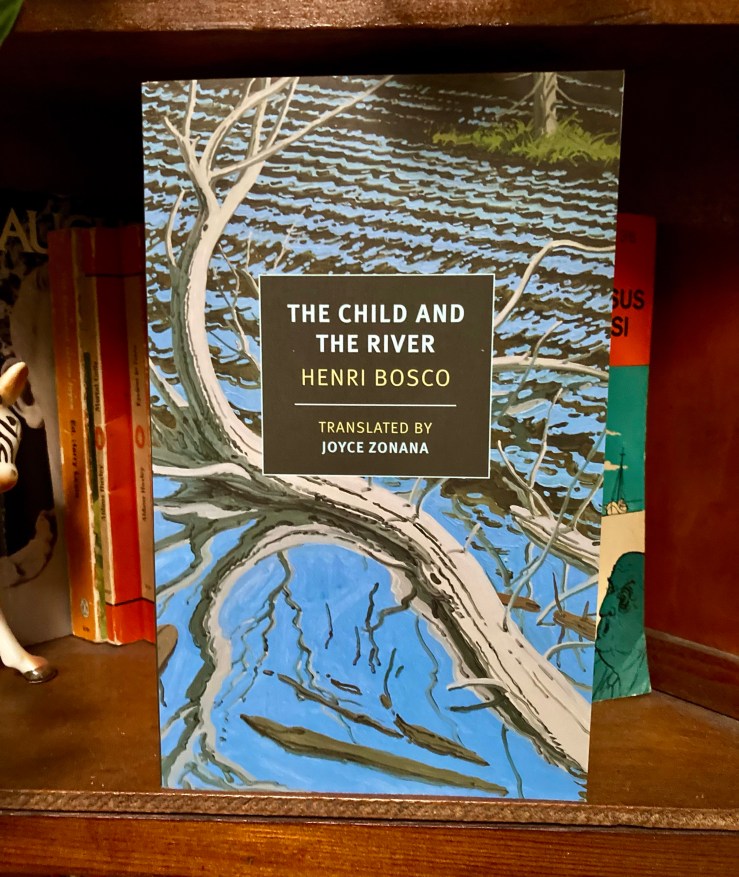
On Henri Bosco’s lovely brief novel, The Child and the River

Last week or maybe the week before last, I received in the mail a review copy of Henri Bosco’s slim 1945 novel The Child and The River. This new translation by Joyce Zonana is available now from publisher NYRB. I picked up The Child and the River this week twice: once before bed, and then again immediately upon waking the next morning, where I finished it before rising.

Set some years before either of the Big Wars, The River and the Child takes place in the countryside somewhere in the south of France (likely Bosco’s native Provence). Narrator Pascalet, now an older man, looks back on a transformational episode in his youth. He relates how as a young boy, he was free to roam the countryside wherever he pleased, excepting the river, where, according to his parents, “there are black holes where you can drown; there are snakes in the reeds and Gypsies on the banks.”

When his parents go on a trip, leaving him in the care of sweet Tante Martine, young Pascalet makes his way to the forbidden river posthaste, blaming any mischief on newly-arrived Spring:

…one fine April morning, temptation caught me unawares. It knew how to speak to me. It was a springtime temptation, one of the sweetest there is, I think, for anyone who is open to clear skies, tender leaves, and newly-blossomed flowers.

That is why I succumbed.

Pascalet’s adventure quickly goes awry, or improves in intensity, depending on how you like to think of it. He falls asleep in an old rowboat, drifts downriver, and ends up on an island inhabited by Gypsies. Hungry, he spies them from behind the brush. Near their cauldron they keep a dog and a bear—and a bound prisoner: “He was a handsome child, sturdy, taller than me and stronger, most likely a Gypsy.” The men in the group beat the young prisoner with a whip, but he endures it. Late in the night, under cover of darkness, Pascalet frees this boy, Gatzo; they then steal a boat and escape to live out a boyhood fantasy of utter freedom—for a few days, at least.

The Child and the River brims with lovely nostalgic pleasures. The boys playact their boyish fantasies, forging crude bows and arrows of reed and pretending that they might have to fend off monsters or “headhunters, cannibals.” Pascalet describes the wonderful sensation of escalating these fantasies:

Then I would feel a mock terror. I enjoyed it. Because when you scare yourself through make-believe, you know well enough that you are not in any danger, but still you are afraid. It is one of the most delicious pleasures.

And yet the boys are not merely playacting—they are surviving: fishing, foraging, strategically moving and mooring their boat to avoid detection. They make fire; they cook. In a lovely little scene, they dig a spring to enjoy fresh water:

We made a hole near a bulge in the clay. Water was seeping through. We continued to dig and fashioned a little basin. Through a breach in the clay, the water moistened a bed of sand. We flattened one side of our hole and stuck in a hollow reed. At first the reed stayed dry. We were aching with impatience, even more than for the fire. At long last, a droplet formed and grew round; for a long time, it hung, uncertain. Suddenly it fell. Another drop came, and slowly, at the tip of the green reed, the spring was born.

This passage exemplifies the simple precision of Bosco’s prose via Zonana’s clean, clear translation. The joy of The Child and the River comes from Pascalet’s gentle, limpid observations of his time on the river, which are generally free of intrusive, muddy “adult” meditations. Instead, we experience what the boys experience:

Everywhere, plants and waters, shorelines and trees, came alive at nightfall with a confused, mysterious life. A duck would flap its wings in the reeds; an owl would screech on a black poplar; a brutal badger would rummage in a bush; a weasel, gliding from branch to branch, would cause two or three leaves to tremble lightly; a roving fox would yelp in the distance.

“It is a sad animal,” Gatzo told me. “It is thinking

The adventures of Pascalet and Gatzo culminate in a strange, dreamlike encounter with “the Puppeteer of Souls.” I won’t remark on the episode at any length, only add that it provides a nearly-mystical, memorable climax to the book. I’ll also add that the novel’s last two sentences are some of the sweetest I’ve read in a while.

I loved reading The Child and the River; I loved the feeling of reading it. It took me back to books I’d loved as a child: Arthur Ransome’s Swallows and Amazons, abridged and bowdlerized versions of Moby-Dick and Huckleberry Finn, and countless Robinsades. In a letter to a friend, Bosco suggested that The Child and the River was “a novel very good, I think, for children, adolescents, and poets.” Is there a better audience?

The Child and the River is one of two Bosco books in publication now from NYRB; they released Zonana’s translation of his 1948 novel Malicroix in early March of 2020. I have it on my shelf, still unread, but not for long. I hope NYRB and Zonana will do a few more Bosco titles. Recommended.

A review of Trey Ellis’s polyglossic satire Platitudes

Trey Ellis’s 1988 debut novel Platitudes begins with a typical metatextual conceit: the novel-within-a-novel gambit. Our story starts with Earle, a nerdy, idealistic high school sophomore who lusts after True Love (and some sex if he can get it). After about a dozen pages though, the “author” shows his hand. Depressed divorced Dewayne Wellington is Earle’s creator, and he’s stuck in his novel-in-progress Platitudes. “I’m sorry. I don’t know what more to write,” Wellington declares, before soliciting help from his readers.

Wellington soon receives manuscript pages from bestselling author Isshee Ayam, who transplants his story from 1980s Manhattan to 1930s rural Georgia. When Wellington introduces worldly and gorgeous Dorothy as Earle’s romantic foil, Ayam’s rhetorical interventions take on a new intensity as the two authors duel to guide the spirit of the novel-in-progress.

The plot threads and styles intertwine, with Wellington’s experimental mode clashing with Ayam’s “Afro-baroque” style (as Ellis described it in a 1989 Los Angeles Times profile). A parodic pastiche of competing Black American artistic voices, Platitudes ultimately synthesizes polyglossic tones into a strangely endearing romantic comedy. Sharp but breezy, ironic and earnest, and utterly metatextual yet soaked in pathos, Ellis’s first novel seems to be an overlooked late-postmodernist gem.

Although Platitudes remains in print (via Northeastern University Press’s New England Library of Black Literature series), I have never seen it mentioned along with its contemporaries—books like David Foster Wallace’s 1989 collection Girl with Curious Hair or Bret Easton Ellis’s 1987 novel The Rules of Attraction. Instead, Ellis’s novel seems to be connected more often along with the works of Ishmael Reed, particularly his 1986 novel Reckless Eyeballing.

Reed’s novel concerns an experimental playwright who finds his career under attack from feminists. As Itabari Njeri pointed out in the LA Times profile mentioned above, many readers “assumed that Ayam is a thinly veiled Alice Walker and that Wellington is the novelist, poet and playwright, Ishmael Reed.” Ellis told Njeri that he hadn’t read Reckless Eyeballing until after he finished Platitudes. He also stated in the profile that he hadn’t read Walker’s The Color Purple. Before I read the Njeri profile I was almost certain that Ellis was parodying (lovingly though at times sharply) Reed and Walker.

Ayam’s “Afro-baroque” style is a particularly purple prose, telegraphed in the oh-so-unsubtle titles of her bestsellers: Chillun o’ de Lawd, Hog Jowl Junction, and My Big Ol’ Feets Gon’ Stomp Dat Evil Down. Here’s the first sentence of Ayam’s version of Platitudes:

Earle awakened to a day as new and as fresh as Mama’s hand-starched and sun-dried petticoat, a huge, plain garment as large and as fresh-smelling as the revival tents that bloomed every summer along Route 49 in Lowndes County, Georgia.

What an awesomely bad awesome sentence! The simple sentence is there: “Earle awakened,” but the adornment tacks on and on, a traffic jam of adjectives glommed onto a simile growing out of another simile, like a lichen that grows on a moss that grows on a rock.

Here’s Ayam’s next sentence:

Yes, from out of those wide Baptist thighs, thighs that shook with the centuries of injustice and degradation, thighs that twitched with the hope of generations yet unplanted, thighs that quivered with the friction of jubilant, bed-thumping, and funky-smelling lovemaking, emerged Earle.

“I’m speechless, Ms. Ayam,” responds Wellington by post after receiving her pages, and offers up as a return gift a list of Earle’s favorite things (to be sung to the tune Coltrane’s take on the Rodgers and Hammerstein song):

All kinds of tanks, Janey Rosebloom, Cream of Wheat, neighbors, Corinthians, toast-r-waffles, his own bean-fart vapors,

A tightly-tucked-in-bed,

Chef Boy-Ar-Dee

Schefflera, balsa wood, and Pay TeeVee.

Eff. Ay. Oh. Schwarz, lingerie straps, cowboy boots and hats.

Sunggle sacks, Chap Stick tubes, BeeBee guns, and films!

Sci-fi, cars, dance—Slurpees.

This list, printed in the console font that demarcates the many other lists, charts, menus, etc. that populate Platitudes then gives way to a brick list paragraph in whatever font Vintage Contemporaries are printed in. This second list might also comprise some of Wellington’s (and perhaps even Ellis’s?) favorite things, and includes “Jamaican accents, cleavage, efficiency, artificial cheese-food product” and

the way a pretty woman’s high heel dangles insecurely from the big toe of the crossed leg always near falling or—from a slight kick—flying spike-over-toe—an exotic Oriental weapon; but never doing either, just dangling, the toe of the shoe covering just enough to promise…

The back-and-forth of the two authors plays out as a personification of the tensions between two modes of Black literature that Ellis seeks to parody, synthesize, and ultimately transcend in Platitudes. While appreciative of the traditions and anti-traditions that came before him, he sought something new in his novel. A year later after the publication of Platitudes, Ellis published his essay “The New Black Aesthetic” in the journal Callaloo. Here, Ellis argued for a new kind of Black arts, evoking the concept of a ludic “cultural mulatto,” an artist free to borrow from both tradition and popular culture alike: “We no longer need to deny or suppress any part of our complicated and sometimes contradictory cultural baggage to please either white people or black,” Ellis declared in his essay.

Platitudes is not an essay—far from it—but it does enact the radical hybridization that Ellis put forth in his New Black Aesthetic manifesto. In his LA Times profile, Ellis declared Platitudes an “anti-novel,” adding that “It’s satirical and primarily about language performance, which has its own delights, as opposed to traditional narrative.”

And yet there is a traditional narrative here. Call it boy meets girl or coming of age or classical-in-the-Aristotelian-sense comedy or whatever you want, but Platitudes offers its reader a satisfying conclusion without selling out the ambiguities and ironies that course through its 180 or so pages.

In his back-cover blurb for Platitudes, Ishmael Reed wrote: “I was zapped by Trey Ellis’s humongous talent. His book, Platitudes, is delightfully rad.” Zapped and delightfully rad are perfect descriptors, and I feel like I’ve neglected to share enough of Ellis’s prose, which at times approximates linguistic channel surfing (at one point, quite literally). The book is both fun and funny, and while the book has not been neglected in academia (Christian Schmidt devotes a chapter to it in his study Postblack Aesthetics, for example), it deserves a wider readership from those who enjoy satirical postmodern novels. Highly recommended.
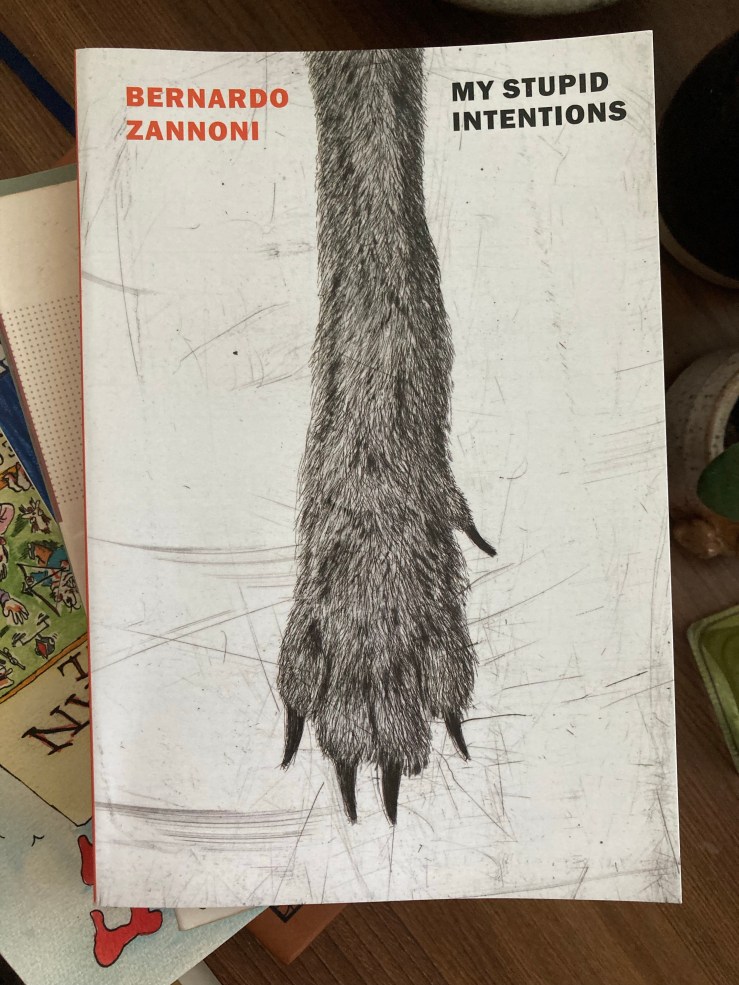
Bernardo Zannoni’s My Stupid Intentions is a brash and brilliant picaresque fable

A few pages into Bernardo Zannoni’s brash, brilliant novel My Stupid Intentions, our narrator Archy and his eldest brother Leroy have the following conversation about their youngest brother Otis:

“Are you cold?” he said.

“I’m hungry.”

“Me too. We could eat Otis. He’s small, and weak.”

Otis is small and weak, but his brothers ultimately elect to remain hungry and not consume him. A few pages later, Archy falls from a tree, leaving one leg permanently lame. He then engages in sexual intercourse with his sister Louise. And poor Otis? “I’m going to die because I’m not growing,” he declares at the family dinner. This prediction quickly proves true. Archy is then sold into the service of a writer named Solomon for the low price of one and a half chickens.

Perhaps, having put forth details in lieu of a bigger picture, I should backtrack:

My Stupid Intentions (I miei stupidi intenti) is Bernardo Zannoni’s first published novel. It won the 2022 Campiello Prize, and is now available in English thanks to translator Alex Andriesse and publisher NYRB. I enjoyed all 211 pages of it.

Archy, the narrator of My Stupid Intentions is a beech marten, a kind of mustelid similar to a weasel or ferret. My Stupid Intentions is Archy’s life story—and it is crammed with life, with nerve, joy, terror, anger, and discovery.

I mentioned some names above, mostly of Archy’s family members, but we can dispense with them now. The most important character in Archy’s life is Solomon, an old fox who has learned to read and write. Solomon’s ability to cipher makes him a market nexus for the animals of the forest, who come to him to trade in goods like chickens, eggs, and vegetables. A fiercely loyal dog named Joel protects Solomon and their enterprise (Joel claims that Solomon rescued him from a wasp’s nest when he was an infant). Crippled Archy soon finds his place in Solomon and Joel’s routine, even venturing out with Joel to collect delinquent accounts.

In time, Solomon teaches Archy to read and write. They begin with the business, keeping track of customers’ debts, but soon advance to the bible. Here, Archy learns about God and comes to despise him: “Why had he inflicted this pain upon me? Why wasn’t I a man? Hadn’t I sought him, hadn’t I been on his side?”

In knowing God, Zannoni seems to suggest, Archy and Solomon become imbued with a consciousness otherwise unavailable to animals. The curse of this consciousness is the revelation of mortality. While other animals comprehend that death exists, they do not, at least from Archy’s perspective, fully understand what death entails. Understanding his own mortality is Archy’s curse, and his agon with God weaves through the novel’s bright and dark adventures. In one of the novel’s most poignant moments, Archy, unable to provide succor to his friend Joel, offers him an illusion, a proper telos for his dog’s soul:

He went off searching for a place that didn’t exist, beyond the wrong mountains, where no three rivers parted ways. He would wander all his life, clinging to a spurious hope, the only thing that made him keep going, like a phantom. I am terrified to think he may still be out there, searching. I am terrified to think he may have realized he has been damned to a pointless existence, a life of grasping at smoke. I am terrified to think I have been crueler than God.

My Stupid Intentions is full of cruelties and heroics. There are bandits and thieves and duels. There is a strange underground club for maimed and toothless animals to huddle together. (“Even in their loneliness, their exhaustion, their absence of appetite, they did not think they were going to die, and absurdly I envied them.”) There are doctors and apprentices and violent brigands—again, Zannoni’s novel bristles with life, teems with a propulsive energy.

This energy pulses at both the sentence and paragraph level in Andriesse’s nimble translation. The book’s jacket summary describes My Stupid Intentions as a “picaresque fable,” and it indeed rockets along with picaresque energy, its sharp turns often made even sharper by an ironic quip from Archy.

As for the “fable” bit…well, any story with anthropomorphic animals might be called a “fable,” especially if there is a moral dimension highlighted. Archy’s complaint against God is direct yet ultimately ambiguous. I didn’t catch a didactic whiff from Zannoni. My Stupid Intentions is more complex than Aesop’s fables; it has more in common with the visceral reality of Richard Adam’s novel Watership Down or the zany violence of Roald Dahl’s The Fantastic Mr. Fox (especially in Anderson’s film adaptation). My Stupid Intentions also reminded me strongly of Neko Case’s nature songs, some of the essays in Joy Williams’ collection Ill Nature, Disney’s loose, picaresque 1970’s take on the legend of Robin Hood, Russell Hoban’s inimitable novel Riddley Walker, Brian Jacques’ Redwall books, and Italo Calvino’s novel The Baron in the Trees.

My Stupid Intentions is also a book about writing, a kind of self-creating document, Archy’s autobiography in action, a sort of funny animal Künstlerroman. If there were any urges on Zannoni’s part to give into postmodern cleverness here, to play with the metatextual nature of his tale, not a trace of such frippery is evident. The novel is, for all its twisting and turning and snapping, wonderfully and refreshingly straightforward. There is nothing stupid about this book. I loved it. Highly recommended.
 

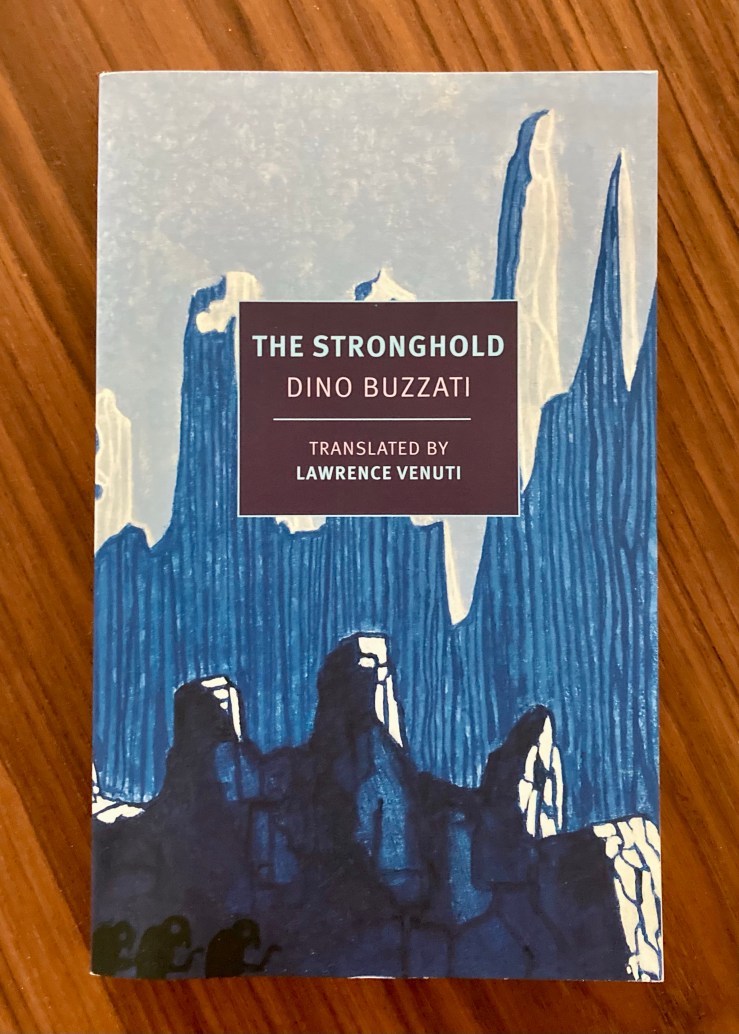
A review of The Stronghold, Dino Buzzati’s novel of deferred hope and ecstatic boredom

Dino Buzzati’s 1940 novel Il deserto dei Tartari (retitled The Stronghold in Lawrence Venuti’s new English translation) takes place in an unidentified time in an unidentified country. Our protagonist is Giovanni Drogo, freshly graduated from an unspecified military academy and ready for a thrilling life of combat and adventure at his new post, Fortezza Bastiani, a fortress at the border of the Tartar steppe. He and his fellow soldiers wait in the hope of attaining glory.

And they continue to wait.

The nebulous Tartars repeatedly fail to appear, offering only the vaguest hints of their alien existence. The soldiers of Fortezza Bastiani live a life of anxious monotony, their desires and hopes for the heroics of war flattened by the boredom of day to day life. It’s all very existentialist.

From the opening pages of The Stronghold, Buzzati conjures a strange but familiar world, usually telegraphed in brisk, unadorned prose (a style he honed in his career as a journalist). Everything is slightly off, slightly anxious. Initially, a reader might chalk the disquieting style up to our viewpoint-character Drogo’s own hesitancy as he enters into a new life as a military officer, but we soon find ourselves in an uncanny realm.

The world of the fortezza is somehow simultaneously dull and enthralling. Consider Drogo’s first glimpse of the fortress:

Fortezza Bastiani was neither imposing, with its low walls, or beautiful in any  way. Its towers and ramparts weren’t picturesque. Absolutely nothing alleviated its starkness or recalled the sweet things of life. Yet Drogo gazed at it, hypnotized, as on the previous night at the base of the gorge. And an inexplicable ardor penetrated his heart.

This “inexplicable ardor” is nevertheless ambiguous in its penetration; after learning he is nominally free to choose a different, perhaps more invigorating post, Drogo elects to transfer from the fort. However, his commanding officer suggests that he stay for four months to avoid bureaucratic problems with the higher ups. That four-month season of waiting turns into a lifetime of waiting. And then waiting some more.

Drogo and his fellow soldiers hunger for the glory of contesting the Tartars, an enemy they know utterly nothing about. Like almost every sociopolitical, cultural, and even technological detail in The Stronghold, the specific nature of the Tartar enemy is collapsed into something closer to a fairy tale or a rumor. Vague and dreamlike, the Tartars are not a geopolitical entity; they are not even an other, but rather the figment of an other, the kernel of a dream that promises action. And this dim promise keeps the soldiers waiting at the Fortezza:

From the northern desert would arrive their fortune, the occasion of their exploits, the miraculous hour that befalls everyone at least once. Because of this vague eventuality, which grew increasingly uncertain with time, grown men wasted the best part of their lives there.

The narrator, hovering in Drogo’s consciousness, imagines an interlocutor explaining to one of these soldiers that his “entire life will be the same, utterly the same, till the very last moment” — and then imagines the hypothetical soldier’s response: “Something else must come to pass, something truly worthy.” Drogo here believes he has grasped the “transparent secret” of the soldiers of the Fortezza, but also imagines himself an “uncontaminated onlooker.” But it’s too late. Drogo too has committed to waiting for something else to come to pass.

Nothing comes to pass—or nearly nothing. (One might read The Stronghold as an extended riff on Kafka’s wonderful parable “Before the Law.“) However, this is not to say though that Buzzati’s portraiture of tedium is itself tedious. The boredom he conjures is an ecstatic boredom, anxious and writhing, exploding in strange, magical moments of hallucinations and night terrors.

In one of the novel’s most extraordinary sequences, “fragile apparitions, quite like fairies” enter Drogo’s dreams, bearing away to some spectacular land Drogo’s fallen comrade who is now converted to a child dressed in a rich velvet suit. In another episode, a mysterious horse appears from the desert, sending the men into fits of hope and despair culminating in a horrific incident that underscores the absurdities of military rigor. Late in the novel, a much-older Drogo’s desire for action, for something to come to pass, tips into near-comic paranoia, as he and a younger officer fool around with a telescope to no avail.

After all this waiting in hope, The Stronghold concludes with a devastating Kafkaesque punchline which I shall not spoil here.

It will be clear to most seasoned readers that Kafka was an influence on Buzzati even without Venuti’s afterword, which details Buzzati’s admiration for the Bohemian writer. Buzzati does not ape the older master so much as evoke the same state of anxious alterity we find in texts like “The Great Wall of China” and The Castle. Stepping into The Stronghold, one is reminded of other branches of the Kafka tree, like Kazuo Ishiguro’s The Unconsoled, Kobo Abe’s The Woman in the Dunes, Alasdair Gray’s Lanark, and Albert Camus’ The Stranger, among many others.

Like many Kafkaesque works, one might be inclined to fob his own allegorical readings onto The Stronghold. In his afterword, Venuti points out that early English-language readings of Buzzati’s novel tended to interpret Il deserto dei Tartari as an anti-totalitarian tract. Il deserto dei Tartari was first translated as The Tartar Steppe by Stuart Hood in 1952, and many of its contemporary critics read the novel against the backdrop of the Cold War.

While praising the “remarkable accomplishment” of Hood’s translation, Venuti differentiates his own “historically oriented interpretation” of the novel; namely, his attempt to more emphatically underline Il deserto dei Tartari’s “latent critique” of fascism. Venuti points out that “Hood had twice rendered the generic ‘stivali’ (boots) with the politically marked term ‘jackboots,'” adding, “I tripled its use.”

Venuti also discusses at some lengths his choice to change Hood’s title. He writes that Buzzati initially wanted to title the book La fortezza, but this name was rejected by the novel’s publisher who worried it might be misunderstood by the reading public. In his attempt to further historicize his translation (and differentiate it from Hood’s), Venuti elected to remove Steppe from the title fearing it “might be taken as an anachronistic reference to the Soviet Union.” He also avoided The Fort or The Fortress as a possible titles, worried they might underscore Buzzati’s “debt to Kafka’s The Castle.” Venuti eventually settled on The Stronghold, suggesting that this title helps to emphasize the “cult of virility championed during the Fascist period” while also “conveying the sheer tenaciousness of the soldier’s heroic fantasies, as well as their inability to escape their debilitating obsession.”

I haven’t read Hood’s translation of Il deserto dei Tartari, but I appreciated Venuti’s, which, as I pointed out above, takes place in an unidentified time in an unidentified country. The novel’s eerie, fable-like quality—a quality that resists historicity—is what most engages me. Buzzati’s book captures the paradox of a modern life that valorizes the pursuit of glory (or at least happiness) while simultaneously creating a working conditions that crush the human spirit. We can find this paradox in Herman Melville’s Bartleby or Mike Judge’s Office Space; we can find it in Antonio di Benedetto’s Zama or Mike Judge’s Enlightened; we can find if in David Foster Wallace’s The Pale King or Dan Erickson’s recent show Severance. I could go on of course.

Some of these boredom narratives seek to assuage us, or make us laugh or cry—in recognition, spite, pity, despair, or hope. Some of these boredom narratives find resistance in art, or in just plain resistance. Buzzati’s novel offers something more like a warning. It is not possible to be an “uncontaminated onlooker” in one’s own life. It’s not enough to wait forever, even if we wait in hope.

The Stronghold is available now from New York Review Books.

On A.V. Marraccini’s ekphrastic, discursive book We the Parasites

Detail from The Age of Alexander, 1959 by Cy Twombly

“The best and most skilled of parasites live, reproduce, and die, without their hosts ever really knowing, or at least being able to do anything about it,” declares A.V. Marraccini, early in her new book We the Parasites. “I’m not even a good parasite because painters or novelists can see me seeing them, drawing off their vital fluid, forming new and odd things in my dark-lobed ovarians, and then shoving them out, hastily and fitfully, into the world of papers and reviews.”

We the Parasites belongs in part to that “world of papers and reviews,” that world of criticism, but it also exists on the other side of any genre margin we might wish to impose. A.V. Marraccini’s book is generative, creative, fruitful, a hybrid that points to something beyond the lyric essay. It is stuffed with art and poetry and life; it is erudite and frequently fun; it is moody and sometimes melodramatic, but tonally consistent.

Marraccini’s central metaphor is that critics are parasites. This metaphor gives Marraccini space in which to wander: through history, through art. Through her own history and her present consciousness. She concocts a discursive ekphrasis that zigs and zags from the commensalism of figs and wasps to the paintings of Cy Twombly to John Updike’s novel 1963 The Centaur.

These nimble discursions are one of the primary joys in reading We the Parasites. Marraccini will offer a nice chunk of an H.D. poem before grafting an entire section of Cy Twombly’s Wikipedia page into her text. The particular section Marraccini excises details the so-called Phaedrus incident, in which “Cambodian-French artist Rindy Sam [was arrested] after she kissed one panel of Twombly’s triptych Phaedrus. The panel, an all-white canvas, was smudged by Sam’s red lipstick and she was tried in a court in Avignon for ‘voluntary degradation of a work of art.’ …The prosecution described the act as a ‘sort of cannibalism, or parasitism…'” Marraccini goes on to describe Twombly’s Phaedrus as “a sort of cannibalism or parasitism on Theocritus.”

Apart from Marraccini herself, Cy Twombly strikes me as the major figure of We the Parasites. This statement is arguable, as others loom–Alexander the Great, Rainer Maria Rilke, the pseudonymous “Chiron,” one-time mentor to Marraccini who insists she read Updike’s novel The Centaur. But it’s Twombly whom Marraccini most frequently and successfully trains her ekphrastic powers on. Her multivalent reading of Twombly’s 1959 painting The Age of Alexander consumes the end of the book, and no wonder, for she attests that she sees the painting in her sleep, finding in its grafts a symbolic aesthetic language that approaches her own obsessions of parasitism:

Am I “over interpreting” this painting? Probably. It certainly meant nothing about wounds and fish louses to Cy Twombly. Were I writing an historical or academic argument I would have to care then, about the boundary conditions for believability, for perceived intent, and for context. Whatever this is, I’ve now called them off. I can say anything, which is nothing so much as dangerously overwhelming. I do this all the time to the whole world; see it as a layering of partially readable signs and portents, like some unlucky augur forever staring into the guts of sheep, the flightpath of certain birds. This often calls for melodrama, especially when the drama of the world as it really is doesn’t result in any kind of expected catharsis, Aristotelian or otherwise. I map myself onto whatever interpretation I’ve divined for that day, that hour, and then map myself back into the world again in another looping cycle.

Detail from The Age of Alexander, 1959 by Cy Twombly

While she never states it directly, Marraccini’s appreciation for Twombly’s paintings seems to come as an aesthetic reaction to their hybridity, their apparent incompleteness, their textual overdetermination. Many of Twombly’s paintings seem like studies, unfinished things that the viewer must complete with their own gaze. (Perhaps such thoughts or feelings went through Rindy Sam’s mind right before she kissed Phaedrus.) In a section of We the Parasites that has nothing to do with Twombly, she writes

Sometimes the study is better than the finished thing as it is here, suffused with longing. The provisionality of the study leaves room for it to be free. Right now, like time and the future, language is also provisional, so provisional and free that it feels like you might fall of something huge and intractable every time you write a sentence. There is danger here, with passion, the same frisson always but configured anew. No one is touching anyone’s strange body.

“No one is touching anyone’s strange body.” This is not some tortured metaphor, no. We the Parasites is a stealth plague memoir. 2020 and Covid-19 hang over the book, inverting its would-be-flânerie into flânerie for silent nights, cybernights, flânerie for necessary introversion. We stroll (or jog, or even run) along with Marraccini (a “3 a.m. cryptid”) and her private thoughts, late at night in dead quiet London. She scavenges with some foxes. She names the foxes. She thinks about Twombly; she thinks about an old love; she thinks about “Chiron.”

But We the People is not a straightforward Covid-19 memoir (it is not a straightforward anything)—its memoir intentions are largely aesthetic, often dwelling on Marraccini’s feelings of being an outsider in the Oxbridge world she now inhabits:

I’m a thief; a  thousand hundred generations of starving Sicilian farmers indenturing their backs to some steep, rocky crag, a thousand hundred shtetl girls married off young. I’m from a hot, flat suburb of a third-rate city near a swam and the sea, I’m nothing from nowhere to you. I’ve seen the seen the asphalt burble in the heat before a thunderstorm in the summer. Do you think that there are barbarians? That I am one? Well, barbar then.

(Oh, you’re also from Florida? I thought after reading these sentences.)

But I don’t think that Marraccini really would accept the mantle of barbarian. There’s a defensive hedging in some of We the Parasite’s erudition; there are times our author need not try so hard. The prose flows finer (or coarser, as necessary) when the hedges give way: “We always go back to Homer, or I do, the I who wants to be the authoritative we,” Marraccini admits. The next sentence highlights the anxiety inherent in the pretense of critical authority: “I have also always been late to Homer, that same belatedness that creeps up everywhere again.” The anxiety here echoes an early sentiment, one I believe plainly felt by anyone who has ever dared to write about art:

All the battles royale are decided…How do you look at the plain, the beach, the walls of the city, the oak trees and the cauldrons on the tripods over small fires—how do you look at it all and live with the fact that you are always after? Always, somehow, about to break into tenderness and despair?

And yet an abiding love and appreciation and a desire to communicate that love and appreciation overcomes this despair. Like any writer sensitive enough to attend to all the before that they have come after, Marraccini understands the risk and guts it takes to write. The critic may be a parasite, but the critic does not seek to remove art from the world—the critic seeks to enliven the art, to expand its lifeforce:

If I am greedy for, say, a novel, or Bruegel’s Fall of Icarus, or the piano sonatas of the Younger of the Scarlattis, I don’t take it from the world. Or I do, a version of it, and put it in my Simoneidean memory house which is perhaps also a private brothel. But the Bruegel is still there, the Scarlatti, the novel, to seduce other people, other critics. Parasites want their hosts to live so they can spread.

But We the Parasites isn’t exactly a work of sustained criticism, nor is it a lyric essay, nor a memoir. It grafts elements of those genres, in the spirit of works by authors like W.G. Sebald, S.D. Chrostowska, Claudine Rankine, Ben Lerner, and Maggie Nelson. I’ve tried to give enough of a sample of the prose and scope of Marraccini’s book here to let potential readers determine whether or not this is their cup of figs and wasps. I admired much in We the People, and even admired it when it irritated me. I look forward to seeing what Marraccini will do next. Recommended.

We the Parasites is new from Sublunary Editions.

On Gwendoline Riley’s First Love, a spare, precise study of passive-aggressive cruelty, abjection, and sublimated dreams

I forced myself through the last half of Gwendoline Riley’s 2017 novel First Love wondering if I actually liked her latest novel My Phantoms, a book I read just a few weeks ago.

(What do I mean to capture in the puny verb like?)

The material of First Love will be familiar to anyone who’s read My Phantoms, and I kept mentally underlining the similarities: first-person narrator, woman, living in London, a city she is culturally alienated from; bad parents–abusive asshole dad, narcissistic dippy mum. Vegetarian cooking.

Like My Phantoms, First Love is a slim, spare, precise study of passive-aggressive cruelty, sublimated dreams, and lowered expectations. Pervading the novel is a general sense that one would prefer not to get stuck in a corner with any of these characters at a party, let alone end up living with one.

The thrust of First Love (one wouldn’t call it a plot, which isn’t a negative criticism) is something like this: Neve, a thirty-three-year-old writer (who makes some money teaching) is married to a man named Edwyn, who is a generation older from her, and suffering a heart condition. His heart condition has left him close to death at least once, but it also doubles as a symbol for his trashed spirit: Edwyn’s heart condition is that Edwyn has the heart of an asshole.

Edwyn belittles and abuses Neve, condescends her feminism, and generally bullies her. Most of the abuse is verbal, but sometimes it is physical. The abuse is always awful though—an abuse of spirit, of love.

Riley announces the themes of this awful “love” by the novel’s fourth paragraph:

We don’t talk much in the evenings, but we’re very affectionate. When we cuddle on the landing, and later in the kitchen, I make little noises—little comfort noises—at the back of my throat, as does he. When we cuddle in bed at night, he says, ‘I love you so much!’ or ‘You’re such a lovely little person!’ There are pet names, too. I’m ‘little smelly puss’ before a bath, and ‘little cleany puss’ in my towel on the landing after one; in my dungarees I’m ‘you little Herbert!’ and when I first wake up and breathe on him I’m his ‘little compost heap’ or ‘little cabbage.’ Edwyn kisses me repeatingly, and with great emphasis, in the morning.

There have been other names, of course.

‘Just so you know,’ he told me last year, ‘I have no plans to spend my life with a shrew. Just so you know that. A fishwife shrew with a face like a fucking arsehole that’s had…green acid shoved up it.’

‘You can always just get out if you find me so contemptible,’ he went on, feet apart, fists clenched, glaring at me over on the settee. ‘You have to get behind the project, Neve, or get out.’

What’s the project? you might wonder, as does Neve—well, it’s not “winding up” Edwyn and “feel like shit all the time!’”

Does Edwyn actually feel abused by Neve’s behavior?

Riley certainly gives the man plenty of opportunities to vocalize his self-pitying and abusive rants. The central totem Edwyn hangs his anger on is an episode in which Neve drank alcohol excessively and vomited (apparently) all over the couple’s apartment. Riley does not depict the episode because Neve, natch, cannot recall it. The bits we get from it involve Edwyn’s violence, his anger. An ugly and true recollection of the sweaty abject reality of a hangover.

Much of First Love is mired in abjection—sweat and grime and piss and shit. Early in the book Neve and Edwyn exchange reminiscences of their young mothers on the toilet, Neve’s suffering IBS, Edwyn terrified of “The thundering waterfall of her first piss” in the early morning. “Terrifying. I thought bodies were terrifying.”

The abject reality of bodies and filth repulses Edwyn, and he buries his repulsion into a store of misogynistic tropes and curses that explode with more ugly frequency as First Love progresses. “You live in shit, so we all have to live in shit, is that right?” he demands of Neve, who he repeatedly accuses of slovenliness, filth. For Edwyn, Neve’s apparent uncleanliness is also related to her Northernness, underscoring the novel’s themes of class and place. Neve herself capitulates, reminiscing:

But was anybody clean back then? When I think of my friends’ houses, they weren’t any less filled with shit. Here were cold, cluttered bedrooms, greased sheets. The kitchens were a horror show: ceilings bejewelled with pus-coloured animal fat, washing-up sitting in water which was spangled like phlegm. Our neighbour’s house, where we went after school, was an airlocked chamber smelling of bins that hadn’t been put out. There was a long skid mark, I remember, on one of the towels in their bathroom. It was there for three years.

So—I did grow up in shit. It was no slander.

Shit, filth, stupidity, dishonesty. (Mother looking up slyly from a crying jag.)

I did use to be sick a lot. No slander, though Edwyn didn’t know it.

Edwyn doesn’t know fucking anything. I was relieved in the novel’s final moments, where the narrative disappeared him.

But now and so I go back to the beginning of this riff and see the opening clause, I forced: I did force myself to finish First Love, poison cup. And, that second sentence up at the top: Did I like the novelNo. Reading it hurt. Riley offers up raw reality, ugly, abject, mean. The novel is well-written, which I don’t mean pejoratively: no seams show, and thematic resonance carries from minute details: dialogue, concrete imagery, minor moments that coalesce into an abject portrait of sick “love,” messy and cruel. I am so happy that I’m now outside of the thing.

October recommendation: Fireworks, Angela Carter’s collection of sadomasochistic erotica

It’s October, and maybe you want some light heavy reading, something titillating but deep, sharp, maybe a little gross at times, always unnerving, right?

How about reading Angela Carter’s 1974 collection Fireworks?

Subtitled Nine Profane Pieces, the collection features nine profane pieces. Actually, I don’t think profane is the right adjective (although I’d always cede to Carter’s judgment in matters of diction). Many, no, most, of these stories approach the spiritual—albeit in a roundabout, okay, profane, manner. In the phallically-titled “Penetrating to the Heart of the Forest,” for example, Carter reimagines Adam and Eve in a new garden through a lens that ironizes both Rousseau’s notion of the noble savage as well as the European colonial project in general. There’s also some mild incest in the tale, to boot—so, okay, sure, profane.

The noun in Carter’s subtitle, pieces, is wholly accurate: the selections in Fireworks have a unified tone, but are disparate in form. There are fabulous thrillers here (“The Loves of Lady Purple,” the story of a puppet prostitute who sucks the life out of her ventriloquist master), morality tales (“Master,” a riff on the Great White Hunter with a figurative middle finger pointed in the general direction of Defoe’s Crusoe), and reminiscences that approach so-called autofiction (“A Souvenir of Japan” and “The Smile of Winter,” mementos of the years Carter lived in Japan). “Flesh and the Mirror” expands on Carter’s years in Japan, but swerves into Borgesian territory; “Reflections” goes straight through the Borgesian mirror into Burroughs world (William S., with just a touch of Edgar R.).

The strongest piece in the collection, at least in my estimation, is “The Executioner’s Beautiful Daughter,” which reads like a travelogue into incestuous abjection. “Here we are, high in the uplands,” our detached narrator begins, before offering up an anthropological catalog of life in that upland. The barest ghost of a plot clutches onto “The Executioner’s Beautiful Daughter,” and the piece is all the stronger for it. Instead, we get a cold, ugly study in cruelty and horror.

Readers new to Carter might prefer to start with her seminal 1979 collection The Bloody Chamber, a book whose inverted fairy tales eviscerate the adjective I used in the previous clause, that adjective seminalThe Bloody Chamber is great! (Check out “Wolf-Alice” for a taste.) (And while I’m hanging out in parentheses, I’ll point out that Burning Your Boats collects pretty much all of Carter’s short fiction.) But back to Fireworks—if the pieces here are not as refined and unified as the anti-fairy tales that comprise Carter’s more-celebrated collection The Bloody Chamber, they are all the more fascinating as studies in sadomasochism, alienation, and the emerging of a new literary consciousness. Great stuff.

Vladimir Sorokin’s Their Four Hearts made me physically ill. (This is praise.)

Vladimir Sorokin’s novel Their Four Hearts (in English translation by Max Lawton) made me physically ill several times. To be clear, the previous statement is a form of praise. I finished it a few weeks ago and put it on a high shelf where no one in my family might come across it.

I picked up Their Four Hearts on the strength of the first Sorokin novel I read, Telluria, and the third, Blue Lard (both also in translation by Max Lawton). The kinetic energy of those novels evoked cinema in my mind’s eye—something akin to Alejandro Jodorowsky’s surreal Holy Mountain or Luis Buñuel’s comic masterpiece L’Age d’Or—narratives that engender their own new visual grammars. In Their Four Hearts, I again found a cinematic comparison, this time in Pier Paolo Pasolini’s study of depravity and cruelty, Salò, or the 120 Days of Sodom.

Like Salò, Sorokin’s Their Four Hearts explores seemingly every form of depravity in extreme detail. It is not for the faint of heart or stomach. (Sorokin’s potent language, in Lawton’s sharp translation, would eviscerate the cliches that precede this parenthetical aside.) Their Four Hearts is fairly short—200 pages, including over 30 pages of charcoal illustrations by Greg Klassen—but I had parcel it out over four distinct sittings. (After the second time I had to put it down because of nausea, I decided to avoid reading it close to mealtimes.)

Frontispiece for Their Four Hearts, Greg Klassen

Before I touch briefly on that depravity, it might be useful to interested readers to offer a gloss on the plot of Their Four Hearts. There is no recognizable plot. Or, rather, the plot hides behind the accumulation of violent, abject details, forever unavailable to a reader, no matter how keen a detective that reader might be. It is a cannibalizing plot, both literally and figuratively, stochastic, absurd, consuming its own horrific iterations.

But, like, what is it about?, hypothetical you might ask. In lieu of a list of depravities, let me cannibalize the back cover copy:

Their Four Hearts follows the violent and nonsensical missions carried out by a group of four characters who represent Socialist Realist archetypes: Seryozha, a naive and optimistic young boy; Olga, a dedicated female athlete; Shtaube, a wise old man; and Rebrov, a factory worker and a Stakhanovite embodying Soviet manhood. However, the degradation inflicted upon them is hardly a Socialist Realist trope. Are the acts of violence they carry out a more realistic vision of what the Soviet Union forced its “heroes” to live out? A corporealization and desacralization of self-sacrificing acts of Soviet heroism? How the Soviet Union truly looked if you were to strip away the ideological infrastructure? As we see in the long monologues Shtaube performs for his companions––some of which are scatological nonsense and some of which are accurate reproductions of Soviet language––Sorokin is interested in burrowing down to the libidinal impulses that fuel a totalitarian system and forcing the reader to take part in them in a way that isn’t entirely devoid of aesthetic pleasure.

Libidinal forces . . . totalitarian system . . . forcing the reader . . . aesthetic pleasure?

Aesthetic pleasure? Pleasure is doing a lot in that phrase, although I was admittedly alternately rapt by Their Four Hearts even while I was (quite literally) disgusted. I’ve read enough Sorokin to this point that I didn’t have to be forced into the surreal, jarring logic of the plot, finding instead deeply dark humor in it, where possible (although more often than not, horror without humor).

“Rebrov took a noose out of his pocket and put it around Alexandra Olegnova’s neck,” Greg Klassen

I have resisted turning this ostensible “review” into a catalog of the horrors Sorokin offers in Their Four Hearts. These horrors are all the more horrible for their sensory evocation set against their seemingly senseless (lack of) meaning. When the foursome, very early in the novel, drug and murder Seryozha’s parents, remove the glans from his father’s penis, and pop into the kid’s mouth to suck on, does that mean something exterior to the novel’s own aesthetics? That the quartet continues to trade the glans off, taking turns sucking on it throughout the novel—are we to plumb that for some kind of allegorical gloss? Or do we simply ride with it? Their Four Hearts confounds its readers, creating not only its own inventions of vocabulary, but its own grammar of storytelling.

Instead of my describing further the horrors of Their Four Hearts (murder, pedophilia, parricide, torture, mutilation, coprophagia, rape, cannibalism, etc. ), it might be more profitable for interested readers to inspect the illustrations by Greg Klassen I’ve included in this review. Reminiscent of George Grosz or Hans Bellmer, Klassen’s charcoals capture the tone and vibe of Their Four Hearts. They add to the text’s cinematic quality. (Publisher Dalkey Archive should have given Klassen the cover.)

“With only a few strokes, Schtaube opened up the maxillary sinus cavities in the corpse’s face,” Greg Klassen

By now you likely have a clear idea if Their Four Hearts is For You or Not For You. I found the experience of reading Sorokin’s novel paradoxically compelling and repellent. (One of the closest experiences I can compare reading it to was eating beef chitterlings at a Korean restaurant in Tokyo. The waitress brought the raw gray intestines to our table, where we grilled them ourselves over charcoal, dipping them in sauces. We ate three orders.)

“He skewered all of their hands on the first meter-long spoke,” Greg Klassen

Telluria and the forthcoming Blue Lard are much better starting places for those interested in Sorokin, but his translator Lawton suggested in an interview that,

…any new reader of Sorokin [should] immediately chase TELLURIA with THEIR FOUR HEARTS: those two combined give something like a complete picture of the master at work.

It’s a strange chaser, and it leaves a flavor unlike anything else I’ve ever tasted. Highly recommended.
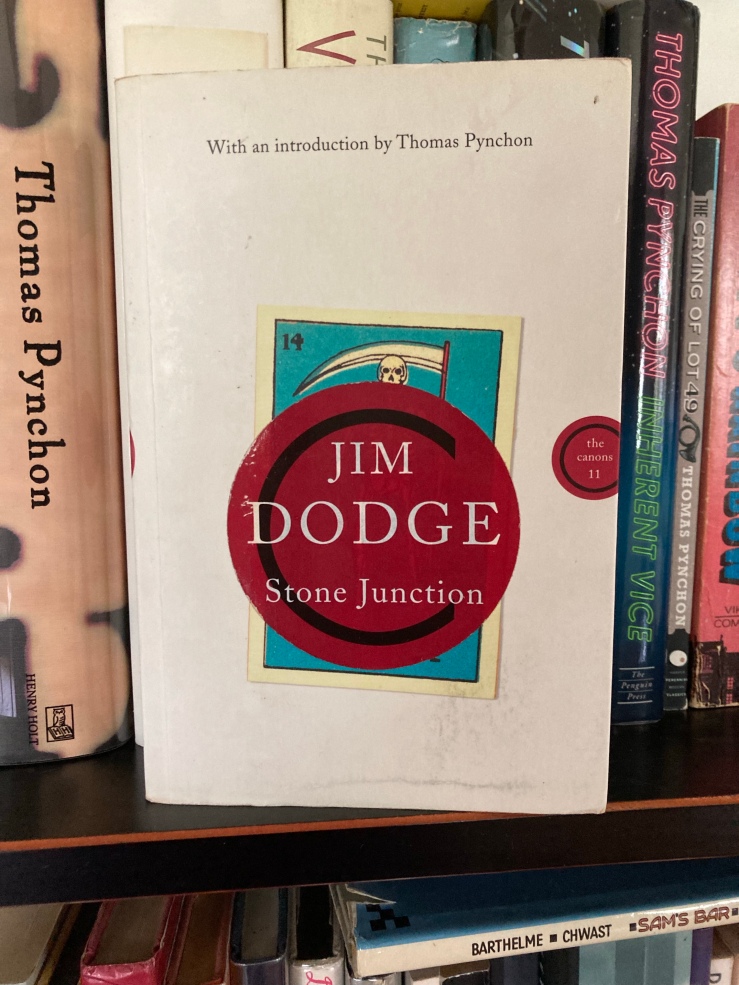
Vladimir Sorokin’s novel Telluria is a polyglossic satirical epic pieced together in vital miniatures


Vladimir Sorokin’s 2013 novel Telluria, in its first English translation thanks to the estimable talents of Max Lawton, is one of the best contemporary novels I’ve read in a long time. Telluria is a polyglossic satirical epic pieced together in vital miniatures. Its fifty sections are simultaneously discrete and porous, richly dense but also loose and funny. It teems with life and language, exploding notions of stable storytelling into a carnival of wild voices.

The world Sorokin conjures in Telluria is best experienced without map or gloss. My joy in reading the novel came from wandering through its fifty chapters and slowly building my own sense of this post-collapse world. You explore Telluria, finding footing after stumbling initially over the disorienting newness of a particular section. And just as you’ve tuned into the particular section’s frequency, you find yourself in a new chapter, a new idiom, a new voice. It’s a goddamn linguistic picaresque best enjoyed on its own terms, terms it refuses to spell out in simple exposition.

Telluria does not have a plot in the traditional sense, although its sum is greater than its parts. The fifty sections are not mere exercises in style, but rather a reflection of post-twentieth century consciousness: fractured, paranoid, hallucinatory, kaleidoscopic, chaotic, joyous, dystopian, utopian, ironic, earnest, strange…The reader who wanders through the fifty chapters will piece together a brave weird world where our contemporary nation states and political alliances have splintered into a cacophony of fiefdoms, city states, monarchies, republics, and so on. (There’s even a system of “enlightened theocratocommunofeudalism.”)

The needle that threads through it all is tellurium, a real (if earth-rare) element (as you’ll undoubtedly recall from your high-school chemistry class). In our world, tellurium is mostly employed in creating alloys for machines. In the world of Telluria, it is a drug that can take its user on a transcendental journeys, Those lucky enough to get their hands on a tellurium spike might find themselves transported into metaphysical spaces. Expert “carpenters” hammer tellurium nails into the heads of seekers, and these seekers go on to communicate with the dead, rampage fearlessly in battle, meet Christ in heaven, fly above mountaintops, or, in some cases, simply perish.

I should have by now offered a taste of the language in Telluria. A nice chunk of text set within the gum of context, no? But I don’t know how to do that effectively–Telluria is a dazzle of tongues. Offering a taste of just two or three of the sections would insufficient. It would amount to something like the parable of the blind men and the elephant.

Instead, I’ll offer Max Lawton’s thoughts on translating Telluria, from an interview he granted me earlier this year

Sorokin’s conceit in writing the thing was not to symbolically represent a particular historical period or something like that, but to give voice to difference itself. 50 voices and 50 differences. Because of that, my task was monomaniacal in its complexity: to follow Sorokin out into deep waters of difference and, like him, give birth to 50 absolutely unique voices…I had to be impenetrable where he was impenetrable, ungainly where he was ungainly, and senseless where he was senseless; anything less would have been a betrayal of what makes the book worth reading. As such, I appealed to Chaucer (for the centaur), Céline (for the bagmen), Turgenev translations (for the hunting), Faulkner and McCarthy (for the oral narratives about highly rural situations…), Ginsberg (for the “Howl” rip-off), Mervyn Peake (for the overripe fantasy-novel fun), and a great many others.

Telluria’s verbal carnival matches (and, really, engenders) seemingly endless imaginative invention on Sorokin’s part. We get dog-headed mutants engaged in philosophical discourse, “litluns” planning a revolution over the normies, the Carpenters of Western Europe hammering tellurium spikes into an army of Knights Templar who are about to set off on their thirteenth flying crusade against Islamic invaders. There are late-night, drug-fueled, multilingual bullshitting sessions, orgies, a princess who gets her kicks slumming it in disguise and fucking the serfs. There are lovers separated by thousands of miles, mutated horses larger than three-story houses, tourists in the USSR — the Ultra-Stalinist Soviet Socialist Republic. A centaur falls in love. Etc.

I copped out of citing any passages from Telluria above, protesting that it might offer an incomplete picture—and that’s true. But reviewing my notes, I think it’s worth sharing one passage at some length, a passage that I think both describes the milieu of the novel as well as approaches a kind of moral vision for the novel (with the strong caveat that any one distinct moral vision is necessarily exploded and ironized by the other voices that thread through the novel—as Lawton stated in our interview, Telluria is “an ode to difference….For Sorokin, the world is a million different textures, a million different languages, and no ONE can be said to triumph.”)

“We must not take anyone else’s karma upon ourselves, not even in small matters,” the brigadier continued. “Especially now in our renewed, post-war world. Take a look at the Eurasian continent: after the collapse of ideological, geopolitical, and technological utopias, it was finally plunged back into the blessèd and enlightened Middle Ages. The world returned to human scale. Nations found themselves. Man ceased to be the sum of the technology around him. Mass production is living out its final years. There aren’t two identical nails beaten into humanity’s head. Man regained a sense of the thing, started to eat healthy grub and ride horses again. Genetic engineering helps man to feel his true size. Man has regained faith in the transcendental. Regained his sense of time. We’re not rushing anywhere anymore. Most importantly–we understand that there can be no technological heaven on earth. And, and in broader terms, no heaven at all. Earth has been given to us as an island of overcoming. Everyone chooses what to overcome and how to overcome it. And they make that choice themselves!”

Sorokin’s post-collapse world doesn’t seem all that bad to me. 

Telluria was my first encounter with Sorokin, and I think it makes a grand introduction. I’ve since read Day of the Oprichnik (translated by Jamey Gambrell) and Blue Lard (forthcoming next year from NYRB and also translated by Max Lawton). I’m currently reading Lawton’s translation of Their Four Hearts. While I think Blue Lard is the strongest of these titles (and I look forward to/dread reviewing it in the future), Telluria is an excellent introduction to Sorokin’s work, offering an engaging taste of his methods (all through Lawton’s lively translation). The book’s energy and imagination offer a nice counter to the dour dystopian narratives that abound these days.

Telluria is Not For Everyone. Readers interested in clear “worldbuilding” or plots that tie up all the loose ends will find themselves exasperated, as will readers who actively resist the linguistic playfulness of Lawton’s translation. Similarly, readers searching for a moral analogy for contemporary Russian politics and culture will find themselves straining to apply whatever mold they’ve already forged in their minds. Neither is this book particularly interested in the Americas or Western Europe. Sorokin’s province is the vast vacillating mass of Eurasia. In his 2012 book Russia: A Very Short History, Geoffrey Hosking notes “the arduous and challenging task of building a coherent polity on the flat open plains of northern Eurasia,” arguing that although Russia “has been a remarkable success story,” it is nevertheless a country “which had its own weaknesses programmed into it.” Hoskings continues: “[Russia] rested on a tacit compact between ruler, elites, and communities of ordinary people, renewed after periods of upheaval and crisis, yet never wholly harmonious, always subject to internal strains.” Telluria is an ecstatic and jarring exploration of those upheavals, those crises, those wonderful strains, a satire on the very notion of a coherent polity.

I loved it. Very highly recommended.
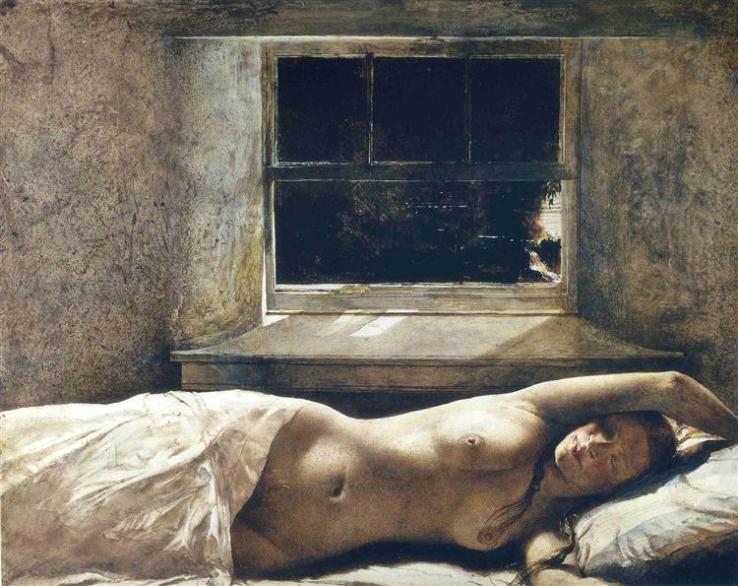
Schrödinger’s Deer | A review of Dashiel Carrera’s surreal debut novel The Deer

Dashiel Carrera’s debut novel The Deer is puzzling, sometimes brilliant, and occasionally frustrating. Gloomy, surreal, and terse, The Deer is at its best when it’s at its most sinister—namely, on its first half, “Side A.” Taking a record album as its model, The Deer has two sides (A and B), each divided into titled Tracks  (on side A) or Lessons (side B). This unusual structure results in a genuinely experimental novel, where some elements crackle with eerie verve and others fall flat. The result is a novel that simultaneously compels and baffles readers, while challenging their notions of what a novel can—or should—do.

“Side A” of The Deer follows a man who may or may not be quantum physicist Henry Haverford, who may or may not have been drunk when he may or may not have hit a deer with his automobile at the beginning of the story. Henry may or may not be going back to his parents’ home to bury his father. I could keep adding may or may not to pretty much everything else that happens in The Deer, which operates on its own nightmare logic. The name Schrödinger is invoked in the fourth paragraph. The Deer reads like an attempt to apply quantum superposition theory to a novel about family trauma.

The family trauma that resonates in the first half is dark and icky—dead dogs, dead deer, Henry’s aloof brother Arthur, their sinister father, a dying (dead) mother, and a mother-figure girlfriend. In the background murmurs jazz piano, messages from the International Space Station, baseball on the radio, and the stifling threat of the police force, which Henry Haverford’s father may or may not have been a member of.

Henry’s multiple encounters with the police, who are simultaneously local law enforcement officers as well as Kafkaesque Authorities — “the Force” — showcase some of the best writing in The Deer. An early run-in with the police at the grocery store unfolds with particularly menacing grace:

“What have you got there, Mr. Haverford?”
The cops sip their coffees and grin.
“Beets,” I say. “I’ve got to bring home some beets for
dinner.”
“We heard you were sick,” says one of the cops.
“You did?”
“Yes, we heard you’ve come down with something really awful.”
“Truly awful.”
“That you’ve been asking all sorts of strange questions.”
I frown. “Well, I’ve been remembering a few things here and there. It’s been a long time since I was home.”
“Yes, but very strange things, Mr. Haverford. You haven’t been thinking straight.”
I force a chuckle.
“Is that liquor in your bag?”
I fondle the cap and lean back. The sliding glass doors open. “Yes. It’s for Arthur.”
“Oh, Arthur.” The men exchange a smile.
“Yes—I should get back to him, actually.”
“Oh, of course, Mr. Haverford. We wouldn’t want to
keep Arthur waiting.”
“Thank you. Yes, I shouldn’t keep him waiting.” I turn.
“It’s just that—well—we’d like to have you come into
the station tomorrow. For a few questions.”
“Questions?”
The other man takes off his cap. “Just a routine follow-up, Mr. Haverford. I’m sure you understand.”
“Right. Sure.”
“Wonderful.” One of the cops glances at the other.
“Well, we must be off.” He grasps my forearm and smiles.
“Great to see you again, Mr. Haverford.”
I nod. “Right. Very good to see you too, Officer.”

When he goes to his first interrogation, things get even stranger, with the police asking Henry what they believe should be done with the dead deer. The interrogation culminates with an ominous line that shouldn’t feel like a threat, but nevertheless sounds like one:

“Am I free to go?”
“Yes,” says the man in the long grey coat. “But we’ll
have you back to see the fawn.”

From there, side A of The Deer edges further into a nightmare of superimpositions and displacements—Henry seems unstuck in time and reality, he’s a boy, a teen, a man, but also a deer, even a fawn, a victim. The situation climaxes in the final track on side A, “The Deer.” It’s another interrogation scene, far more intense, and by the end of it one senses that our Henry, like a character from a David Lynch film, has shifted identities by the time he’s left the room—although nothing is permanent or stable in the world Carrera’s constructed.

Side B continues exploring the may-or-may not themes of the first half, but in an entirely different setting. We move to a first-person narrator, a woman who cares for an ailing mother with her sister. They live in a vaguely post-apocalyptic world, with threats of marauding “riders,” illness, drought. Although the settings are radically different, Carrera takes pains to underscore the thematic line in his novel, invoking Schrödinger’s cat again:

Mother prepares another bowl. We eat slowly. The
kitchen light rocks back and forth. Sister leans back on the counter, popping bread in her mouth.
I read aloud to Mother. It is the Old Book, from the
Before Times. The title has long disintegrated.

I say, this is the story of a cat.

She nods slightly. Or maybe it is a rocking. Maybe her head was rocking, and I only thought it was a nod.

I say, the cat goes into a box.

I say, a man comes up to the box, and he leans down
next to it.

I say, the cat does not make a sound. Not even a scratch.

I say, the cat’s tail slowly curls around itself but the man does not know, because he cannot see the cat and the cat cannot see him.

I say, the man must decide if the cat exists.

At times the choppy, etiolated first-person voice of side B didn’t resonate as fully-realized in my ear, and I found some of the genre-bound descriptors (like “Before Times”) too on-the-nose in a book that is otherwise full of compelling obliquities. Other moments are stronger, like in the following passage, which again underscores the book’s theme of quantum superposition:

Read to me in the book how everything is shaking. Read to me how all the objects are composed of molecules and these molecules are fluid in structure. Read to me how all things twirl in recombination and the existence of objects is confirmed only through collective patterns of sensory perception. Read to me about how we must stay in sync, how these objects which we know to be real must be kept afloat by a rhythm of agreement, how this Earth which tilts so slowly pulls us all in the same direction. Read it to me again, Sister, because I can only feel the cool of the ink and the scratch of the parchment. Read it to me again, Sister, because I can only see the glimmers of this world.

It’s a remarkable paragraph, which feels both timely and timeless, for are we not always in a crisis of the “rhythm of agreement”?

Carrera studied writing under both Jason Schwartz and Evan Lavender-Smith, and the imprint of those writers, as well as the tree from which their own fiction might be said to extend, bears influence on The Deer. In his masterful John the Posthumous, Schwartz found sinister power in the vignette, in the cruel detail, which Carrera evokes in his novel as well. The Deer’s engagement with radical ambiguity also brings to mind Lavender-Smith’s novella Avatar, a study in untethered consciousness. Beyond that, Carrera branches from the Kafka tree, and The Deer will appeal to those who can hang in the surreal abject worlds of, say, João Gilberto Noll or Kōbō Abe or Anna Kavan or Hiroko Oyamada, without collapsing into goo. Good stuff.

The Deer is available from Dalkey Archive.