Brown 1 chicken in oven. Chop: 2 onions, 2 bell peppers, 1 lb. okra. Place in large pot with enough water and 1/2 oil to cover all. Simmer for about an hour. Add baked chicken and a couple of quarts of water. Add salt and garlic to taste. Simmer for about 1/2 hour more. Serve over rice with French bread.
From The Great American Writers’ Cookbook (ed. Dean Faulkner Wells, 1981).
Outside of insects and bum sleeping the rock that wrecks most camping trips is cooking. The average tyro’s idea of cooking is to fry everything and fry it good and plenty. Now, a frying pan is a most necessary thing to any trip, but you also need the old stew kettle and the folding reflector baker.
A pan of fried trout can’t be bettered and they don’t cost any more than ever. But there is a good and bad way of frying them.
The beginner puts his trout and his bacon in and over a brightly burning fire; the bacon curls up and dries into a dry tasteless cinder and the trout is burned outside while it is still raw inside. He eats them and it is all right if he is only out for the day and going home to a good meal at night. But if he is going to face more trout and bacon the next morning and other equally well-cooked dishes for the remainder of two weeks he is on the pathway to nervous dyspepsia.
The proper way is to cook over coals. Have several cans of Crisco or Cotosuet or one of the vegetable shortenings along that are as good as lard and excellent for all kinds of shortening. Put the bacon in and when it is about half cooked lay the trout in the hot grease, dipping them in cornmeal first. Then put the bacon on top of the trout and it will baste them as it slowly cooks.
The coffee can be boiling at the same time and in a smaller skillet pancakes being made that are satisfying the other campers while they are waiting for the trout.
With the prepared pancake flours you take a cupful of pancake flour and add a cup of water. Mix the water and flour and as soon as the lumps are out it is ready for cooking. Have the skillet hot and keep it well greased. Drop the batter in and as soon as it is done on one side loosen it in the skillet and flip it over. Apple butter, syrup or cinnamon and sugar go well with the cakes.
While the crowd have taken the edge from their appetites with flapjacks the trout have been cooked and they and the bacon are ready to serve. The trout are crisp outside and firm and pink inside and the bacon is well done—but not too done. If there is anything better than that combination the writer has yet to taste it in a lifetime devoted largely and studiously to eating.
Hemingway’s article “Camping Out” first appeared in the Toronto Daily Star on 26 June 1920
The following is from a 1942 letter from William Faulkner to his son-in-law William Fielden, instructing the young man on the author’s preferences for curing recently-slaughtered pork. From The Faulkner Journal Vol. 2, No. 1, Fall, 1986.
Curing Hams Shoulders Bacon
After the pieces are trimmed and thoroughly cooled, either by 24 hours of natural temperature or by artificial temperature NOT LOW ENOUGH TO FREEZE IT, that is, about 35 degrees F.
Lay the pieces flat, flesh side up, cover thoroughly with plain salt, about ¼ inch deep. Work saltpeter into the bone-joints and into the ends where the feet were removed, and into any other crevices or abrasions. Do this well and carefully, to prevent “blowing.” A slightly higher temperature will help the salt penetrate. Leave 24 hours.
After 24 hours, turn the pieces over SKIN SIDE UP, to drain. Sprinkle skin side with salt. I punch holes through the skin with an ice pick, to help draining. Leave 24 hours.
After 24 hours, turn the pieces flesh side up again, make a paste
½ plain salt
½ molasses, sugar, red and black pepper
just moist enough to spread over the pieces without flowing off. Leave 7 days.
After 7 days, make a paste
¼ plain salt
¾ molasses, sugar, red and black pepper
slightly more fluid than the first mixture, so that it will flow slowly over the pieces, penetrating the remains of last week’s treatment, dripping down the sides. Leave 7 days.
After 7 days, make a paste WITHOUT SALT
molasses, sugar, red and black pepper
fluid enough to cover the pieces without flowing off too much, cover the pieces and the residue of the two former treatments, leave seven days.
Hang the pieces and smoke with hickory or oak chips, keep it in smoky atmosphere for 2 to 7 days. The meat may be treated either before smoking or afterward with a preparation to prevent blow flies. Then wrap or enclose in cloth or paper bags and leave hanging until used.
My fine homemade soups are interesting, economical, and tasty. To make them, one proceeds in the following way:
Fine Homemade Leek Soup
Take one package Knorr Leek Soupmix. Prepare as directed. Take two live leeks. Chop leeks into quarter-inch rounds. Throw into Soupmix.
Throw in ½ cup Tribuno Dry Vermouth. Throw in chopped parsley.
Throw in some amount of salt and a heavy bit of freshly-ground pepper.
Eat with good-quality French bread, dipped repeatedly in soup.
Fine Homemade Mushroom Soup
Take one package Knorr Mushroom Soupmix. Prepare as directed.
Take four large mushrooms. Slice. Throw into Soupmix. Throw in ⅛ cup Tribuno Dry Vermouth, parsley, salt, pepper. Stick bread as above into soup at intervals. Buttering bread enhances taste of the whole.
Fine Homemade Chicken Soup
Take Knorr Chicken Soupmix, prepare as directed, throw in leftover chicken, duck, or goose as available. Add enhancements as above.
Fine Homemade Oxtail Soup
Take Knorr Oxtail Soupmix, decant into same any leftover meat (sliced or diced) from the old refrigerator. Follow above strategies to the letter.
The result will make you happy. Knorr’s Oxtail is also good as a basic gravy-maker and constituent of a fine fake cassoulet about which we can talk at another time. Knorr is a very good Swiss outfit whose products can be found in both major and minor cities. The point here is not to be afraid of the potential soup but to approach it with the attitude that you know what’s best for it. And you do. The rawness of the vegetables refreshes the civilization of the Soupmixes. And there are opportunities for mercy-if your ox does not wish to part with his tail, for example, to dress up your fine Oxtail Soup, you can use commercial products from our great American supermarkets, which will be almost as good. These fine homemade recipes work! Use them with furious enthusiasm.
From The Great American Writers’ Cookbook (ed. Dean Faulkner Wells, 1981).
Make a cream sauce with tablespoon butter, 2 tablespoons flour, 1 cup milk. Add about 1½ cup grated Tillamook cheese (or more—or less … if you are unable to obtain Tillamook, you may use any inferior American Cheddar, but the difference will be noticeable unless you have a calloused palate).
Now add about ½ pound? 2 cups?—Well, add enough crab. (If you are unable to obtain Pacific crab, you may use those flabby little Atlantic ones, or even lobster; but if you are reduced to King Crab, forget it.)
Flavor with sherry to taste, salt, pepper, parsley.
Serve on rice, or wild rice if you are J. Paul Getty, or English muffins, or whatever.
5 cups vegetable purée or gruel (see note)
5 cups stone-ground wholewheat flour
4 tablespoons fresh minced dill
1 teaspoon salt
1. Combine purée and flour in a large mixing bowl. Mix thoroughly. If the mixture is too liquid to knead add more flour. If too dry add more liquid.
2. Knead the mixture for 10 minutes. Turn into an 8½ -by–4½ -by–2½ breadpan.
3. Bake in a pre-heated 375 degree oven for 1 hour 15 minutes.
4. Turn out onto a rack and cool.
Note: Mr. Cage uses leftover cooked vegetables such as broccoli, kale, spinach, carrots, celery, celery root and squash, which he purées in a food processor with vegetable stock or water. The bread has the consistency of a dense German pumpernickel and goes well with smoked salmon.
Empire Star, Samuel R. Delany. Bantam Books (1983). No cover artist credited. 132 pages.
Although he is not formally credited, the cover artist is Wayne Barlowe. I still haven’t read Delany’s 1966 novella, but I think I might read it this weekend.
Dinner had been good. Margaret sat with her book on her lap and watched her husband digesting, an operation to which he always gave much time and thought. As she watched he put his cigar down without looking and used his free hand to turn the page of his paper. Margaret found herself thinking with some pride that unlike many men she had heard about, her husband did not fall asleep after a particularly good dinner.
She flipped the pages of her book idly; it was not interesting. She knew that if she asked her husband to take her to a movie, or out for a ride, or to play gin rummy, he would smile at her and agree; he was always willing to do things to please her, still, after ten years of marriage. An odd thought crossed her mind: she would pick up the heavy glass ashtray and smash her husband over the head with it.
“Like to go to a movie?” her husband asked.
“I don’t think so, thanks,” Margaret said. “Why?”
“You look sort of bored,” her husband said.
“Were you watching me?” Margaret asked. “I thought you were reading.”
“Just looked at you for a minute.” He smiled at her, the smile of a man who is still, after ten years of marriage, very fond of his wife.
The idea of smashing the glass ashtray over her husband’s head had never before occurred to Margaret, but now it would not leave her mind. She stirred uneasily in her chair, thinking: what a terrible thought to have, whatever made me think of such a thing? Probably a perverted affectionate gesture, and she laughed. Continue reading “Read “What a Thought,” a short story by Shirley Jackson”→
Bought some books today, mass-market paperbacks by Barry N. Malzberg and Walter M. Miller, Jr. I don’t need them and honestly my eyes are so bad by now that I probably couldn’t make it through one—I’ll have to find them online probably. But they were so cheap and such a cheap indulgence and so lovely as objects.
I’ve only ever come across two Walter M. Miller Jr. books: A Canticle for Leibowitz, a fantastic post-apocalyptic western theodicy, and its sequel, Saint Leibowitz and the Wild Horse Woman, which, for whatever reasons, I’ve chosen to abstain from reading. His 1965 novel The View from the Stars looks fairly generic but I picked it up anyway. I also picked up Barry N. Malzberg’s The Destruction of the Temple, simply because it looks so goofy. I listened to an audiobook of his 1975 novel Galaxies earlier this year. It wasn’t very good, but it was also fascinating, a metatextual mess dripping with anxiety about/against the “legit” lit of Barthelme, Barth, Pynchon, et al. I found pirated copies of two “erotic” novels he wrote under the pseudonym Gerrold Watkins, 1969’s Southern Comfort and 1970’s A Satyr’s Romance. Both were better than Galaxies, and not nearly as horny as, say, Robert Coover’s pornographies. Southern Comfort is actually a pretty good novel. (I mean it’s also, like, very deeply problematic in many ways, but those are the same ways that maybe makes it so more interesting than so-called “legit” so-called “literary” fiction.)
As a weird bit of chaotic (serendipity is not the right word) coincidence, The Destruction of the Temple features this blurb/description:
The year is 2016, and President Kennedy is being murdered – again and again and again. The director has come to the charred ruins of New York to re-enact a mad dream from the past – the assassination of President Kennedy.
JFK was assassinated 22 Nov. 1963, of course, sixty years ago today.
31. “Sakrete” (first published in The New Yorker, 25 Sep. 1983)
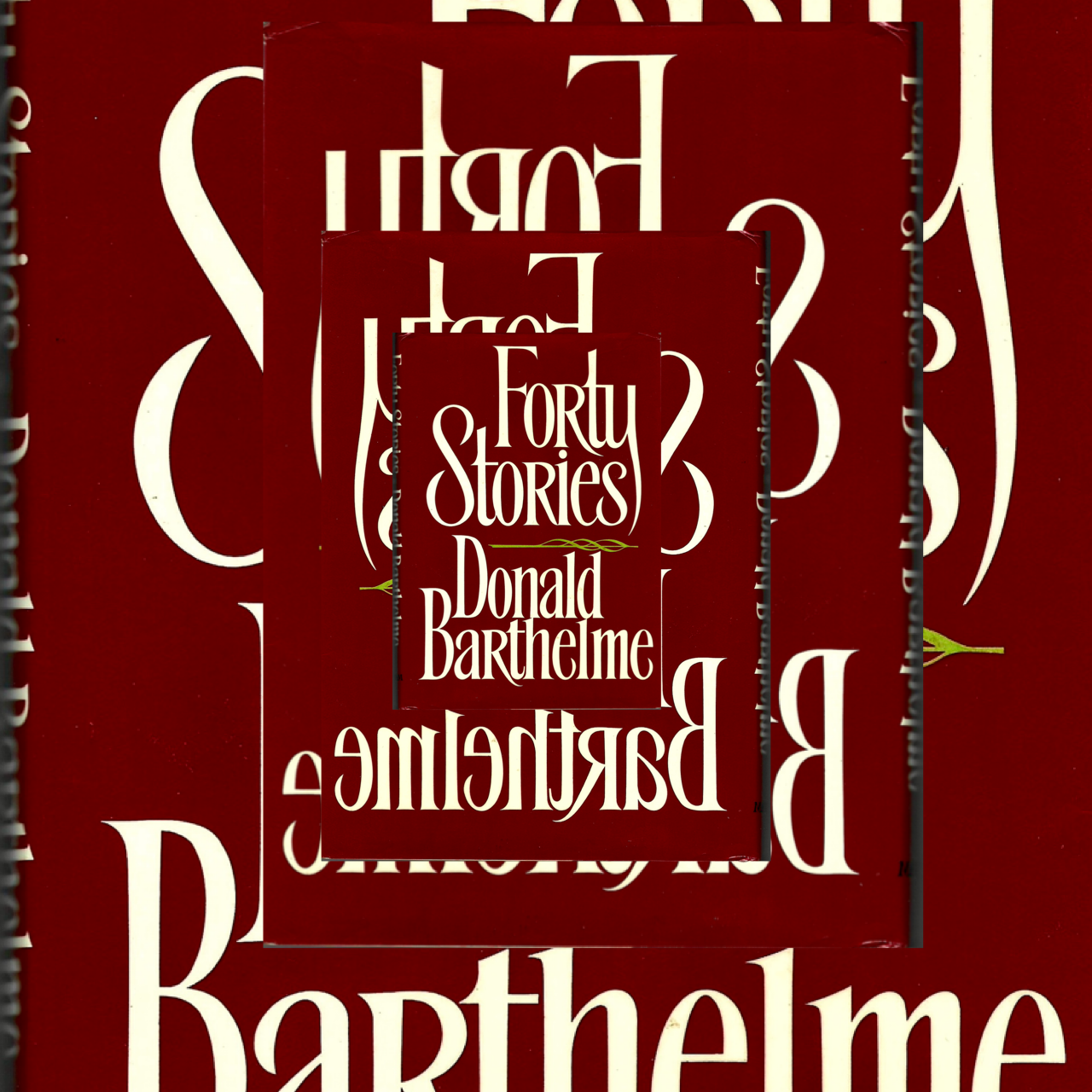
“Sakrete” is a silly little domestic riff about garbage can theft, rats, and an alcoholic trying to work with concrete. It’s not a very good story and I have no idea why it was included in Forty Stories. I do like that it shows a general respect for garbage cans and garbage collection (very interested parties should check out Stephen Dixon’s excellent novel Garbage). Here is the last paragraph, the highlight of the story:
There are now no garbage cans on our street—no garbage cans left to steal. A committee of rats has joined with the Special Provisional committee in order to deal with the situation, which, the rats have made known, is attracting unwelcome rat elements from other areas of the city. Members of the two committees exchange secret grips, grips that I know not of. My wife drives groups of rats here and there in her yellow Pontiac convertible, attending important meetings. The crisis, she says, will be a long one. She has never been happier.
30. “Porcupines At The University” (Amateurs, 1976)
Another trifle—am I regretting this project, this rereading of Forty Stories? The stories in Sixty Stories are so, so much stronger—and those stories were organized chronologically. Going backwards through these is not really going backwards through time, through the artist’s anti-maturation, but rather just, like, making it more difficult to find one’s place in a book. “Porcupines” is a goof on academia that — and I say this as a compliment — at best reads like an alcoholic’s surrealist riff on a college film. Skip it!
29. “The Catechist” (Sadness , 1972)
This is a good story, “The Catechist.” But also a very Catholic one, without being, like, small-c catholic. There’s a bit of narrativizing here that Barthelme would eventually dispense with in his dialogues, the form that he would eventually settle on for his short stories. I say “settle on” but Barthelme died quite young, or, it seems to me, at 45, quite young—dying at 58. Barthelme died from throat cancer, probably a result of his alcoholism (pure conjecture on my part, this last clause):
The catechist reads from his book. “The candidate should be questioned as to his motives for becoming a Christian.”
I think: My motives?
He says: “Tell me about yourself.”
I say: “I’m forty. I have bad eyes. An enlarged liver.”
“That’s the alcohol,” he says.
“Yes,” I say.
“You’re very much like your father, there.”
“A shade more avid.”
28. “Lightning” (Overnight to Many Distant Cities, 1983)
This is a great story. Or at least a very good story, unexpectedly so, written a mode approaching near-realism or even near-dirty-realism. Was Barthelme flexing his muscles in the mirror after having read a story by Raymond Carver? Probably not, but I like to imagine it (I imagine his muscles beefier and musclier than they likely were). “Lightning” has a fairly straightforward ( and unBarthelemesque) plot:
Edward Connors, on assignment for Folks, set out to interview nine people who had been struck by lightning. “Nine?” he said to his editor, Penfield. “Nine, ten,” said Penfield, “doesn’t matter, but it has to be more than eight.” “Why?” asked Connors, and Penfield said that the layout was scheduled for five pages and they wanted at least two people who had been struck by lightning per page plus somebody pretty sensational for the opening page. “Slightly wonderful,” said Penfield, “nice body, I don’t have to tell you, somebody with a special face. Also, struck by lightning.”
The story is ultimately a romantic comedy, with reporter Edward finally finding his “face”:
People would dig slant wells for this woman, go out into a producing field with a tank truck in the dead of night and take off five thousand gallons of somebody else’s crude, write fanciful checks, establish Pyramid Clubs with tony marble-and-gold headquarters on Zurich’s Bahnhofstrasse. What did he have to offer?
He finds something to offer. This is probably the best one yet in Forty Stories (in reverse, anyway).
This is Friday—not today, I mean, this, this blog, is Friday, four or five days ago, depending on how you count such things. We were maybe fifteen or twenty minutes on the road heading northwest to Atlanta—my wife driving the first leg before we stopped for gas—when I checked social media again to see if Godspeed You! Black Emperor were still going to play that night. They were not. This information came via opener Low legend Alan Sparhawk, who had reported the past two nights’ shows canceled.
We headed north anyway. The kids had left school early; my daughter pointed out that she had already missed an AP Bio test and that she wasn’t going with me and the boy to the show anyway, she just wanted to go to Atlanta to hang out. Fair point, of course.
My son was bummed and I was bummed. I don’t know exactly how he came to Godspeed You! Black Emperor’s strange, hypnotic, droney anthems—via an algorithm, really—but a few years ago I heard him blasting Lift Your Skinny Fists Like Antennas to Heaven in his bedroom. I gave him my copy of their debut LP, F♯ A♯ ∞, which I’d bought from the band back in 1998 or 1999 when they opened for Low at a record story I was working at in Florida. They knocked our socks off. It seemed there were more Godspeeds Yous than audience members, and to be clear, the tiny record store was packed. It was a summer afternoon in Florida; very hot and very sunny, a throbbing miasma of sound across Hemming Park, now James Weldon Johnson Park, in beautiful ugly downtown Jacksonville.
(It was just such a night my friend Travis was arrested for skateboarding across Laura Street. Jayskating. (I don’t think it was the same night.))
After the show I bought their record. It had a pouch crammed with incidentals—flattened pennies, a Canadian stamp, some illustrated scraps. I think I listened to it a million times that summer. One of the guys in the band asked me where they could get some hash in Jacksonville. I suggested the Waffle House. Low played after; everyone sat down, exhausted from what Godspeed had required. It was lovely. Perfect day.
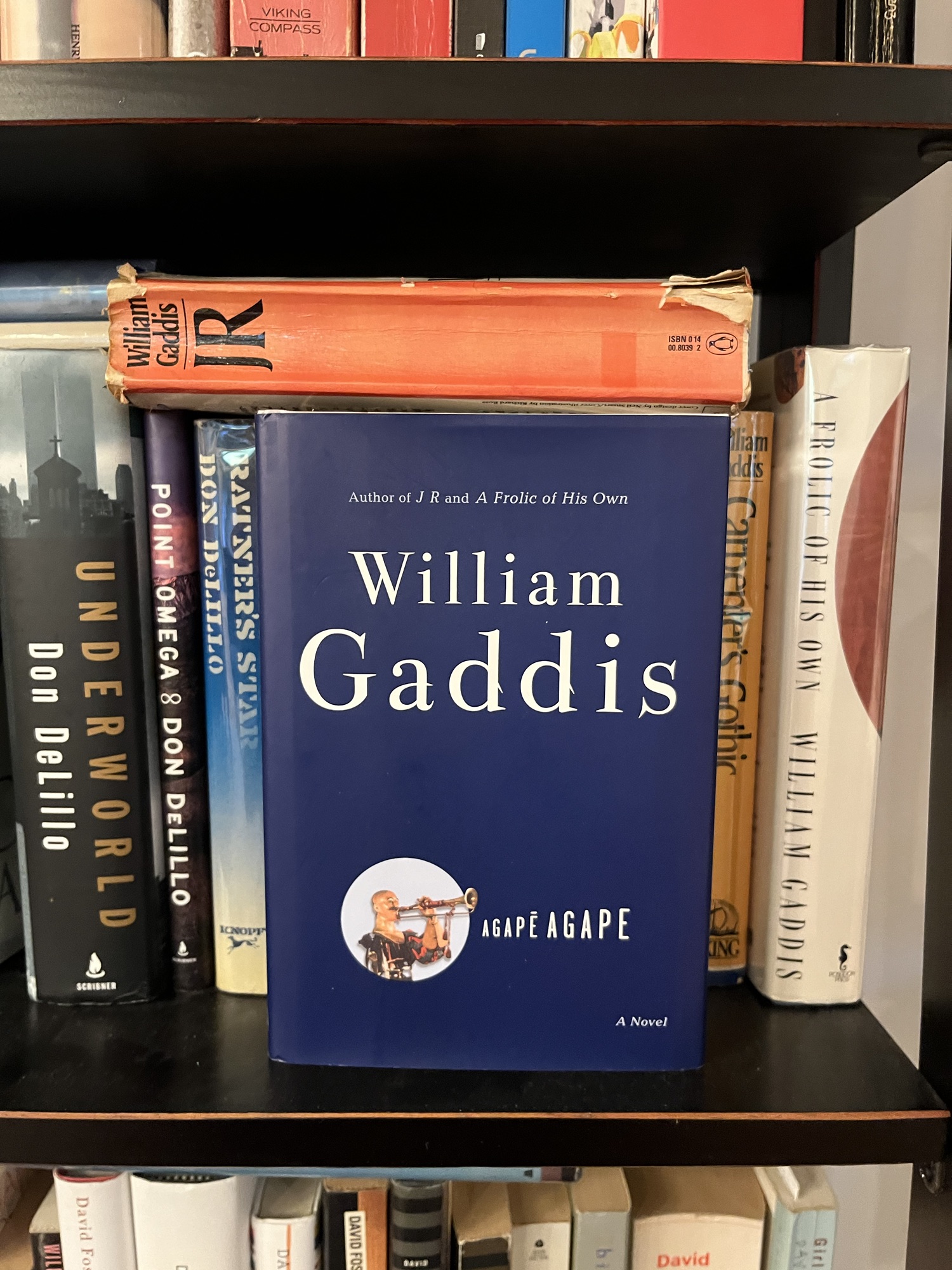
I had really wanted to experience my imaginative inversion of this concert this past weekend, but it didn’t emerge. I mean Alan Sparhawk, whose new record is so strange and daring and wonderful—I wanted to see that with my kid, who, he, my kid, wanted to see the ensemble Godspeed do their drone magic. I bought him an Aphex Twin record at Wax n’ Facts as a consolation prize, and he bought himself the first volume of Katsuhiro Otomo’s Akira at A Capella Books. I picked up a first edition hardback of William Gaddis’s last novel Agapē Agape.
And so well we made a weekend of it, browsing book stores and record stores and walking the Beltline. Love that city and my best wishes to GY!BE founding member, Efrim Menuck—I hate that we missed you on the tour but I hope that your health recovers. Thank you for making music my son and I love.
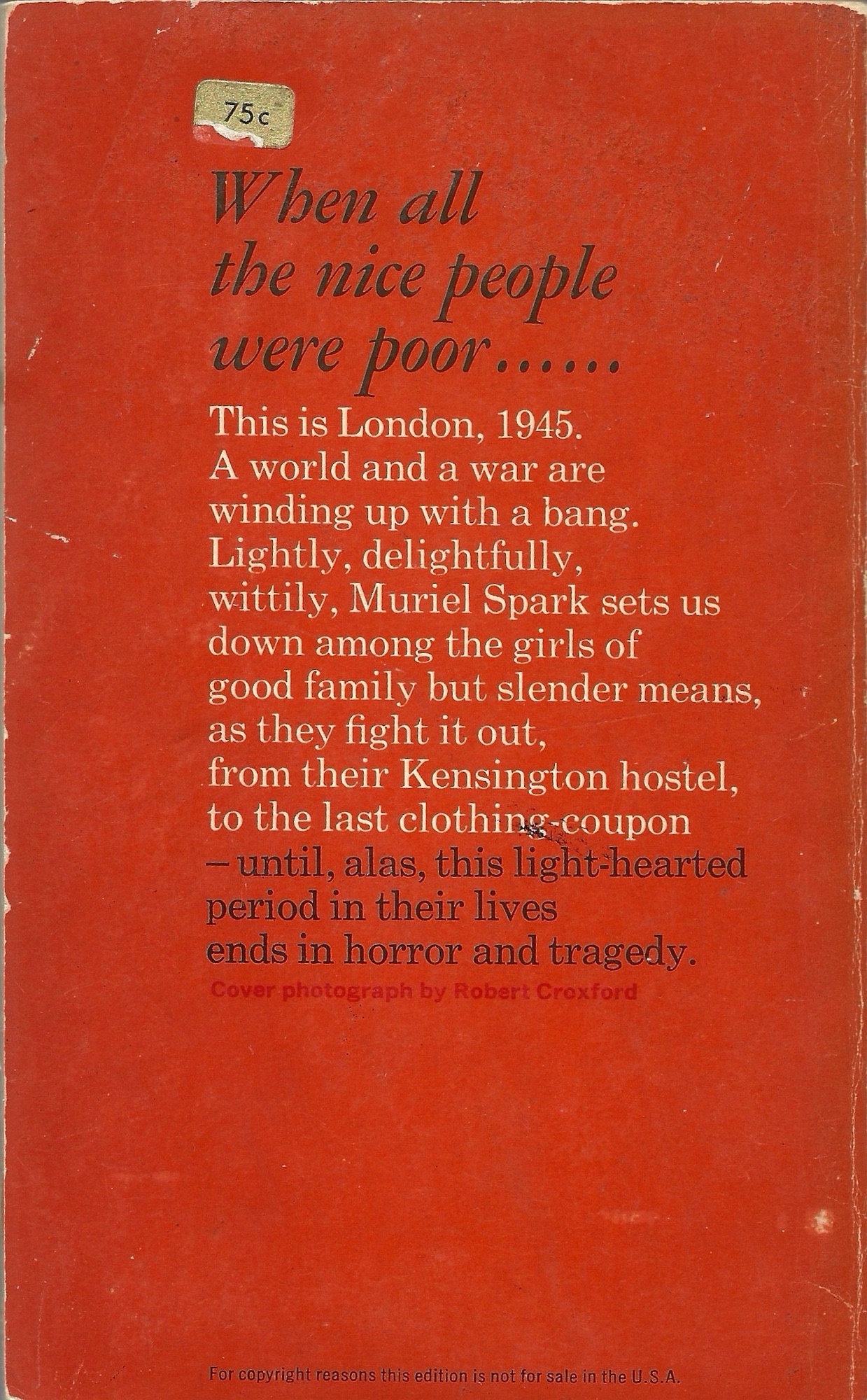
Slender Means unself-consciously employs postmodern techniques to paint a vibrant picture of what the End of the War might feel like. The climax coincides with the bombings of Hiroshima and Nagasaki, the title takes on a whole new meaning, and the whole thing unexpectedly ends in a negative religious epiphany.
Got a review copy of Paul Valéry’s Monsieur Teste, a slim lil fellow from NYRB in translation by Charlotte Mandell. The back cover includes a blurb from William H. Gass—
Monsieur Teste is a monster, and is meant to be—an awesome, wholly individualized machine—yet in a sense he is also the sort of inhuman being Valéry aimed to become himself: a Narcissus of the best kind, a scientific observer of consciousness, a man untroubled by inroads of worldly trivia, who vacations in his head the way a Platonist finds his Florida in the realm of Forms.
What the fuck does Gass mean by “Florida” here? I really want to know.
This style of post, the book acquired post, is an established, which is to say tired, blog post format on this blog, Biblioklept, probably going back a decade now, born from a glut of review copies piling up, mostly unasked for but many asked for, books that stack up their own measures of guilt, unread, or then maybe read, months, years later—but the post style is ephemeral, yes, fluffy, sure, embarrassing even maybe. The form is stale; I apologize. I do think the Valéry book seems pretty cool.
I have a not-insubstantial stack of newly acquired new (and used books) stacked on the cherry side table by the black leather couch that I should have made book acquired posts about. These have piled up over the last few weeks. These are not interesting sentences (several of the books seem very interesting).
I am not going to find the new form I want here, am I?
When I was a freshman in high school, my then-girlfriend’s older brother gave me a mixtape that a girl had given him. He didn’t like anything on the mixtape; he liked Buddy Holly. I can’t remember why he gave me the tape—I think I saw it in his car and asked about it. But it ended up changing my life in some ways, as small giant things like songs or books or films can do when they come over you at the right time and place.
There were a few bands on the tape that I knew or had heard of, and even some I owned albums by, like the Cure and the Smiths. But for the most part, the tape opened a new aural world to me. I heard My Bloody Valentine, Big Star, Ride, the Cocteau Twins, and This Mortal Coil, among others, for the first time. There were also two songs by one band: Slowdive’s “When the Sun Hits” and “Dagger.”
(This particular blog post is no longer about acquiring a Valéry translation; it is about something else.)
Those songs are from Slowdive’s 1993 classic Souvlaki. I owned it on cassette. That cassette melted, just slightly, on the top of my 1985 Camry’s dashboard in like August of 1995. The tape was just warped enough not to fit into a cassette deck. I liked to imagine how it would sound. The next year, my lucky privileged ass found a used CD of Slowdive’s follow-up, Pygmallion on a school trip to London. Slowdive kinda sorta broke up after that.
I have always been a proponent of bands breaking up. I think a decade is long enough; get what you need done in five or six albums and move on. There are many many exceptions to this rule. But generally, I don’t think beloved bands—by which I means bands beloved by me—should keep going on too long. And if they break up, they should stay broken.
But I bought Slowdive’s 2017 reunion album Slowdive used at a St. Petersburg record store and listened to it again and again, amazed at how strong it was, how true to form. My kids liked it a lot. And then they put out a record last year, Everything Is Alive—I like that one too (not as good as the self titled one).
(There’s no point to any of this; I might’ve had some wine; I might just feel like writing.)
I guess if you’d told me back in ’95 or ’05 or even ’15 that I’d see a reunited Slowdive twice in one year I’d say that that sounded silly. (The ’15 version of me that had seen Dinosaur Jr.’s dinosaur act wouldn’t have been interested.) But we went out into the woods to see Slowdive this Sunday. They played the St. Augustine Amphitheatre to a large, strange, diverse crowd, out there in the Florida air. A band named Wisp, TikTok famous I’m told, opened, and they were pretty good. But Slowdive was perfect—better than back in May in Atlanta—echo and reverb ringing out into Anastasia State Park.
We stayed in a cheap motel off of AIA that night—another sign of my age. When I was younger, I could drive six hours, watch a band, and drive the six hours back without blinking. We are about 45 minutes from St. Augustine. It was a nice night out.
A younger version of me could’ve read the 80 pages of Paul Valéry’s Monsieur Teste in the time it took to twiddle my thumbs in this post and write a real (and likely bad) review to boot. Again, apologies. I’m getting old, a dinosaur act. But I can’t break up, not now.
Slowdive, St. Augustine Amphitheatre, 10 Nov. 2024
“A Sudden Story”
by
Robert Coover
Once upon a time, suddenly, while it still could, the story began. For the hero, setting forth, there was of course nothing sudden about it, neither about the setting forth, which he’d spent his entire lifetime anticipating, nor about any conceivable endings, which seemed, like the horizon, to be always somewhere else. For the dragon, however, who was stupid, everything was sudden. He was suddenly hungry and then he was suddenly eating something. Always, it was like the first time. Then, all of a sudden, he’d remember having eaten something like that before: a certain familiar sourness… And, just as suddenly, he’d forger. The hero, coming suddenly upon the dragon (he’d been trekking for years through enchanted forests, endless deserts, cities carbonized by dragonbreath, for him “suddenly” was not exactly the word), found himself envying, as he drew his sword (a possible ending had just loomed up before him, as though the horizon had, with the desperate illusion of suddenness, tipped), the dragon’s tenseless freedom. Freedom? the dragon might have asked, had he not been so stupid, chewing over meanwhile the sudden familiar sourness (a memory… ?) on his breath. From what?
(Forgotten.)












 Biblioklept