A review of Pierre Senges’ confounding novel Geometry in the Dust

img_5150-800x567

Describing Geometry in the Dust is a challenge. I’ve deleted so many openings now and my frustration is mounting: so some very basic description:

Geometry in the Dust is a novel by the French author Pierre Senges with accompanying illustrations by the Oubapo comix artist Killoffer. The novel was originally published in France (as Géométrie dans la poussière) in 2004. The English translation is by Jacob Siefring, and was published by Inside the Castle earlier this year. Geometry in the Dust is 117 pages and includes 22 black and white illustrations. The prose is set in two columns per page, with infrequent inclusions of inset notes of a smaller font obtruding into the text proper. The typeset is Venetian. The book is approximately 217cm long, 172cm tall, and 10cm thick. It weighs approximately 210 grams.

This is a lousy way to describe a book.

What is it about?, you’ll want to know. What’s the plot? Who are the characters? What’s the drama, the conflict, the themes?, you’ll insist.

So there’s a geometer.

The geometer is a first-person “I” who addresses himself to the “inheriting prince” who rules a “country of sand.” The geometer is of course also addressing himself to you the reader. In addition to being a geometer, he is also

your minister (of Economy, of Religion, of War, and also of the City, we decided). As your sole, faithful minister, your counsellor, chamberlain, and your scapegoat, having weathered many dry seasons and countless reorganizations of your cabinet, I am your confidant too, and, judging from appearances–one can say this without offending the dignity of your kingdom or its constitution, we might even call me your friend.

And so we have our characters: Geometer and his absent audience, his sultan, his reader.

And so for plot? What is our friend, our confidant doing in Geometry in the Dust? He is trying to describe the city that he and his monarch (?) have…dreamed up? Built from scratch? Proposed as a thought experiment?

(I’m not sure.)

The reality or unreality of the city in question should be dispensed with entirely of course. The city is made of words, and it exists in Geometry in the Dust through words. Our narrator implores us in the novel’s second paragraph: “do not be afraid of words!”

So our narrator the geometer tries to describe the city, this city, the sultan’s city, in words. But of course capturing a city in words is a problem—

How does one form an idea of the city, when all one has seen of it are little pieces of it brought back from voyages in trunks? how to describe a metropolis to someone who has only ever known sand and its forms through the cycle of seasons? how to speak of snow to a Moor, of cannibalism to a vegetarian Jesuit?

Measuring a city for our narrator amounts to measuring the angles of waves as they break on the shore: an impossible task. Even metaphors run dry, point in the wrong directions, and ultimately, “all of these measures will be in vain and mediocre , the descriptions will be lost in allegories.” Nevertheless, our narrator will try. 

This trying to describe the city is the plot, I suppose, such as it is. And it’s really quite marvelous, far richer and smarter and funnier than I’ve managed to capture here so far. Our geometer is observant, sharp, witty, strangely sincere, flighty and whimsical at times. He advises his prince, his reader, on the value of getting lost in the city (the only way to know it), and a lot of Geometry might amount to our narrator getting lost himself, losing us, leading us in, out, around.

“You will readily understand that a city is not composed only of itself,” he avers at one point, continuing that, “a city is composed of city, the intentions present in the city, and the difference between the city and those intentions…” Perhaps too Geometry is our narrator’s effort to measure the gaps and lacunae between split intentions, and to situate the various players that fill these gaps: black marketeers and insomniacs, calligraphers and macabre dancers, crowders and loners, musicians and animals (including “an alligator of the White Nile” to reside “in the conduits of our main sewer,” whose presence will surely “spice up the lives of your people, those incorrigible auditors of fables.” And if such an alligator can’t be find, never mind–just spread its legends. Words).

And themes?, you ask after. I don’t know. I’ve read Geometry twice now and it’s thick with themes, the basic one, I suppose (and I could be wrong) is: What is a city(This is too easy, I know). Senges’ narrator invokes and evokes every manner of archaic text, imagined or otherwise; he considers our native tendencies, the roles outsiders play, the movements of crowds, what constitutes a garden, and so forth.

Maybe a better description of Geometry is to simply look at the text itself. Here is a short chapter (go on, read it—click on it if you need a bigger version):

senses


Notice the punctuation: the semicolons, the dashes (em and en), the periods, the parentheses, the commas. Senges’ prose in Geometry is syntactically thick. Sentences, like alleys in a strange city, begin in one place and end up somewhere quite different. The interposition of jostling clauses might cause a reader to lose the subject, to drop the thread or diverge from the path (or pick your metaphor). The effect is sometimes profound, with our narrator arriving at some strange philosophical insight after piling clause upon clause that connects the original subject with something utterly outlandish. And sometimes, the effect is bathetic. In one such example, the narrator, instructing his sovereign on the proper modes of religious observance in the city, moves from a description of the ideal confessional to an evocation of Limbourg’s hell to the necessity of being able grasp a peanut between two fingers. The comical effect is not so much punctured as understood anew though when Senges’ narrator returns to the peanut as a central metaphor for the scope of a city (“there are roughly as many men in the city as peanuts in the city’s bowls”), a metaphor that he extends in clause after clause leading to an invocation of “Hop o’ my Thumb’s pebbles,” a reference to Charles Perrault fairy tale about a boy who uses riverstones to find his way home after having been abandoned in the woods by his parents. 

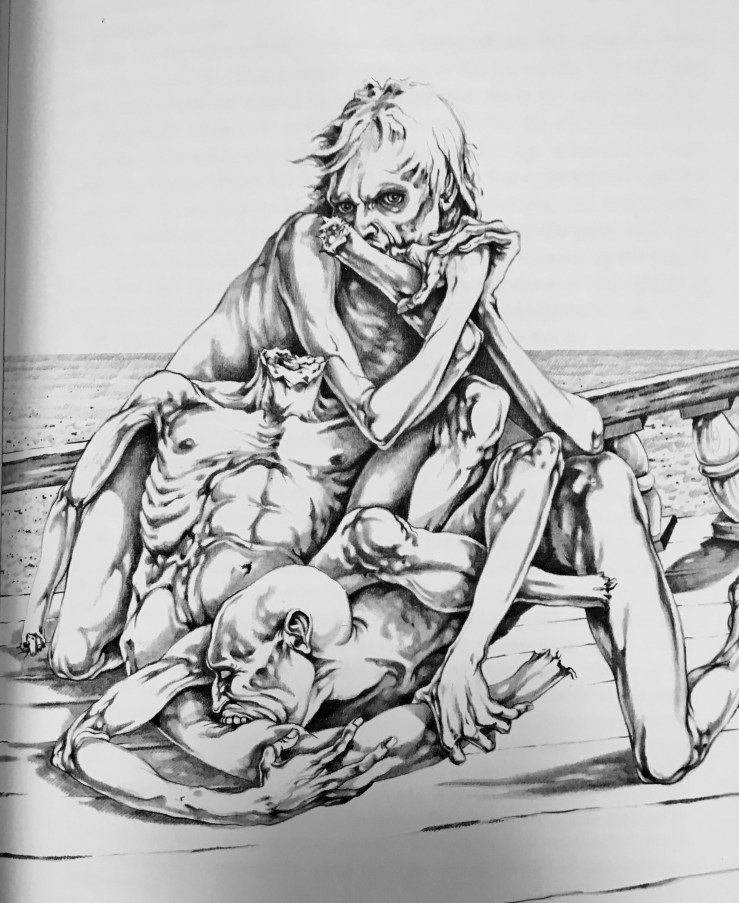
What is the path through Geometry in the Dust? The inset notes, as you can see in the image above, also challenge the reader’s eye, as do the twin columns, so rare in contemporary novels.

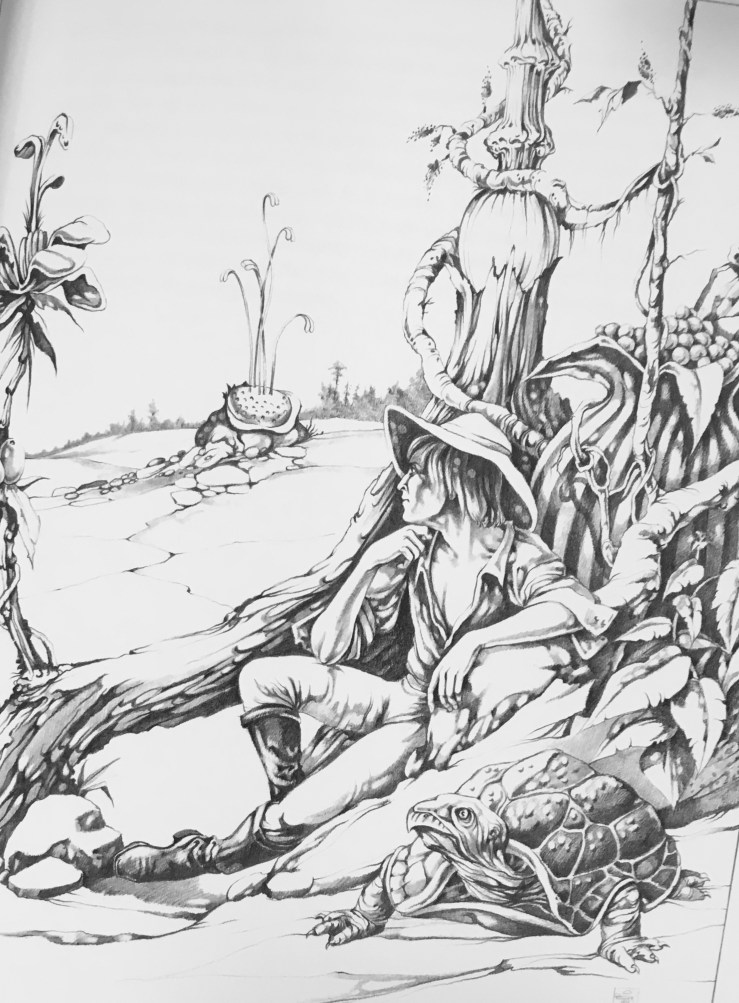
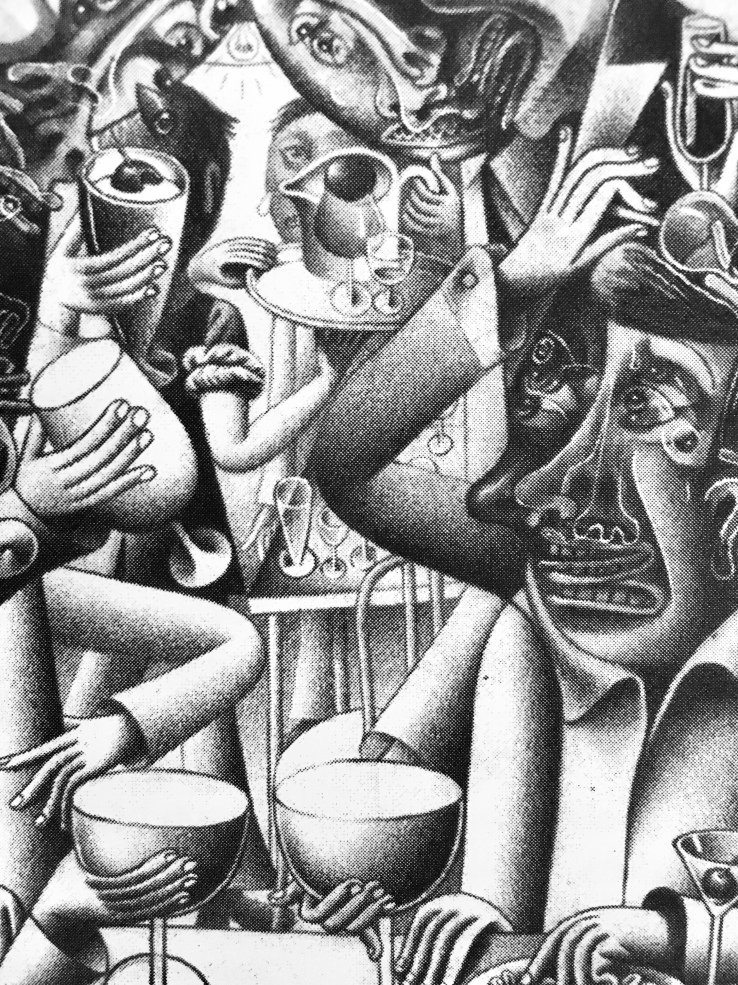
Killoffer’s illustrations also challenge the reader. They do not necessarily correspond in pagination to the sections that they (may) illustrate; rather, they seem to obliquely capture the spirit of the novel. The following image is perhaps the most literal illustration in the novel, evoking something in the passage I shared above:

killoffer

The experience of reading Geometry is confounding but also rewarding. The first time I read it, at least for the first third or so, I kept looking for all those basic signs of a novel—character, plot, clear conflict, etc. I was happy to find instead something else, something more challenging, but also something unexpectedly fun and funny. In its finest moments, Geometry evokes the essays that Borges disguised as short stories. Readers familiar with Italo Calvino and Georges Perec will find familiar notes here too, as well as those who love the absurd tangles Donald Barthelme’s sentences can take. But Senges is singular here, his own weird flavor, a flavor I enjoyed very much. Recommended. 

Blog about a book acquired and a bit of recent reading

img_3073

The copy I ordered of Fernando A. Flores’ novel Tears of the Trufflepig arrived today and I finished the first three chapters before putting on the USA-ENG World Cup game—sort of a noir sci-fi tone so far (Flores’ novel, not the World Cup match).

I ordered the book after reading the first five paragraphs of J. David Gonzalez’s review in the Los Angeles Review of Books a few days ago. I’ll read the rest of the review after I finish Trufflepig; these are the paragraphs I stopped with—

Now, about the plot. Drugs have been made legal, so the cartels have taken to trafficking “filtered” animals, bio-engineered exotics brought back from extinction and served at black market dinners for the incredibly rich and extraordinarily vacuous. The death (by filtered ostrich, no less) of El Gordo Pacheco, the leader of the world’s most powerful cartel, has led to a global turf war for control of the filtering syndicates. Australia, Helsinki, Tangiers, New Hampshire: They all want in. Enter Leone McMasters, the silver-mustached head of McM Imports, a shadowy multinational corporation. Think Pynchon’s Golden Fang. Think Monsanto.

Also, there is a thriving black market for the shrunken heads of the Aranaña Indians, a fictional tribe of indigenous people at the heart of Trufflepig’s mystery. Having been vanished for over 400 years, their sudden reappearance portends something. Perhaps it’s doom, but perhaps it’s nothing at all, simply the passing of time. Still, tokens of their existence have led to a Möbius strip of tragedy, “with Indians now killing other Indians for their heads, because they are left out on the margins of the modern world and have few recourses to feed their families.”

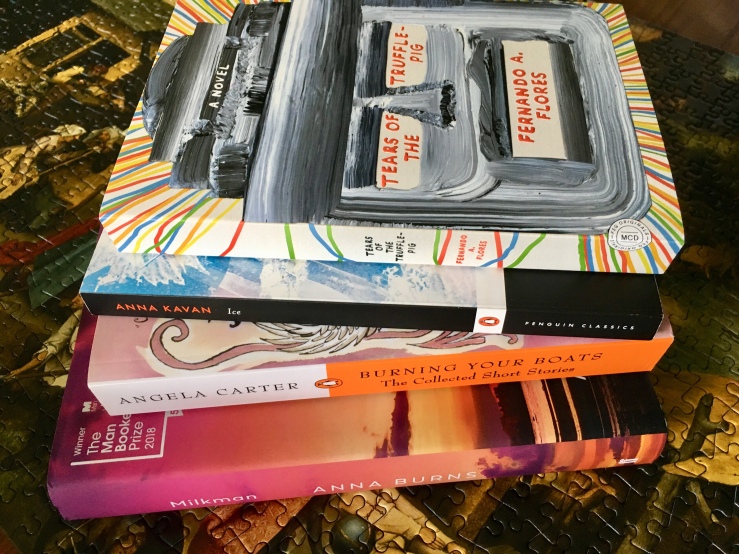
I finished Anna Kavan’s novel Ice a few days ago (I wrote about it herehere, and here). I realized after having written about Ice that I’d neglected to compare it favorably to a number of other novels and stories. By compare—well, what I want to say is that reading Ice feels a particular way; it’s disorienting, a bit upsetting, and truly strange. I had meant to compare it to Georg Büchner’s novella Lenz, the novels of João Gilberto Noll, Kazuo Ishiguro’s “A Village after Dark,” plenty of Poe, and the films of David Lynch.

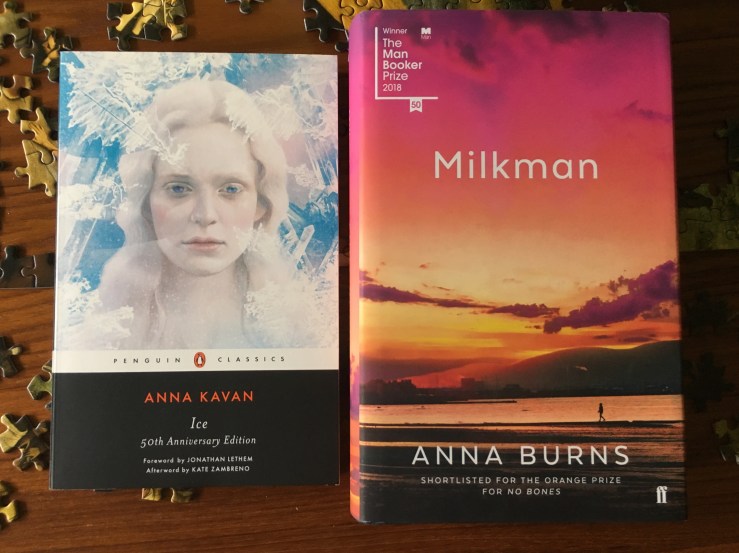
After Ice I read a bit of Anna Burns’ recent novel Milkman, but it didn’t stick for whatever reason—I’ll give it a proper effort soon though. I ended up pulling a collection of Angela Carter from the shelf and rereading some of the tales in The Bloody Chamber (specifically, Carter’s riffs on Bluebeard and Beauty and the Beast). I think maybe it was the lingering Kavan flavors—the fable-making psychosexual thrust of it all—that prompted rereading a bit of Carter, which served as almost a palate cleanser. I’ll probably read a few more tales from it after I finish Trufflepig. But now back to the soccer match, which just tied up at 2-2.

An area of total strangeness | Blog about the final third of Anna Kavan’s novel Ice

0_1eb696_d8a8fe87_orig
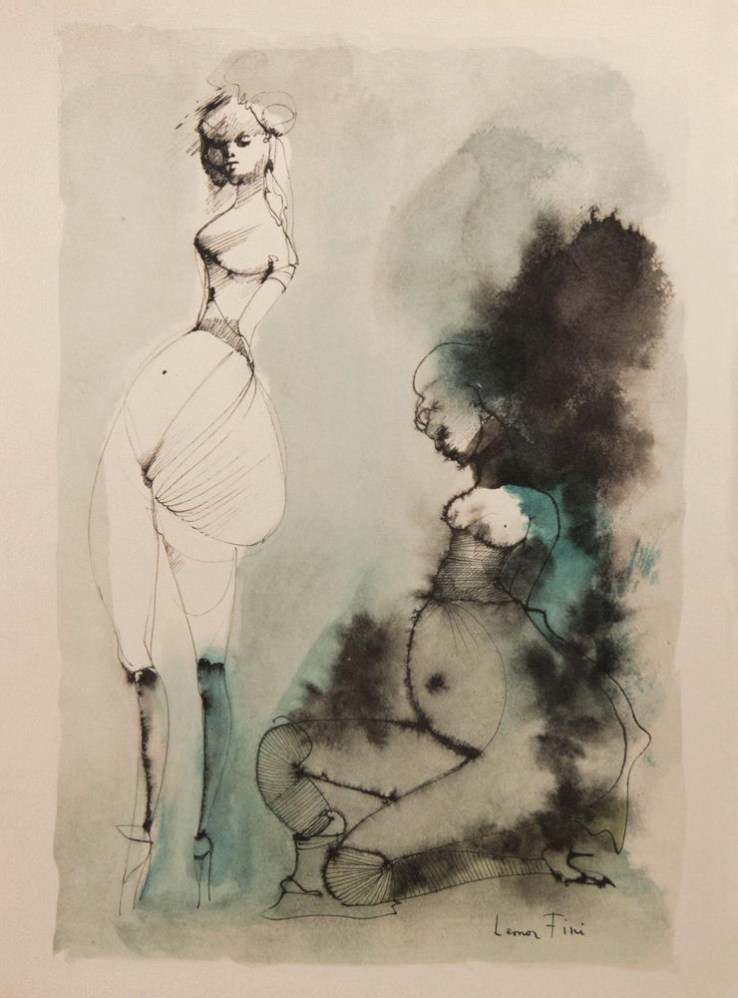
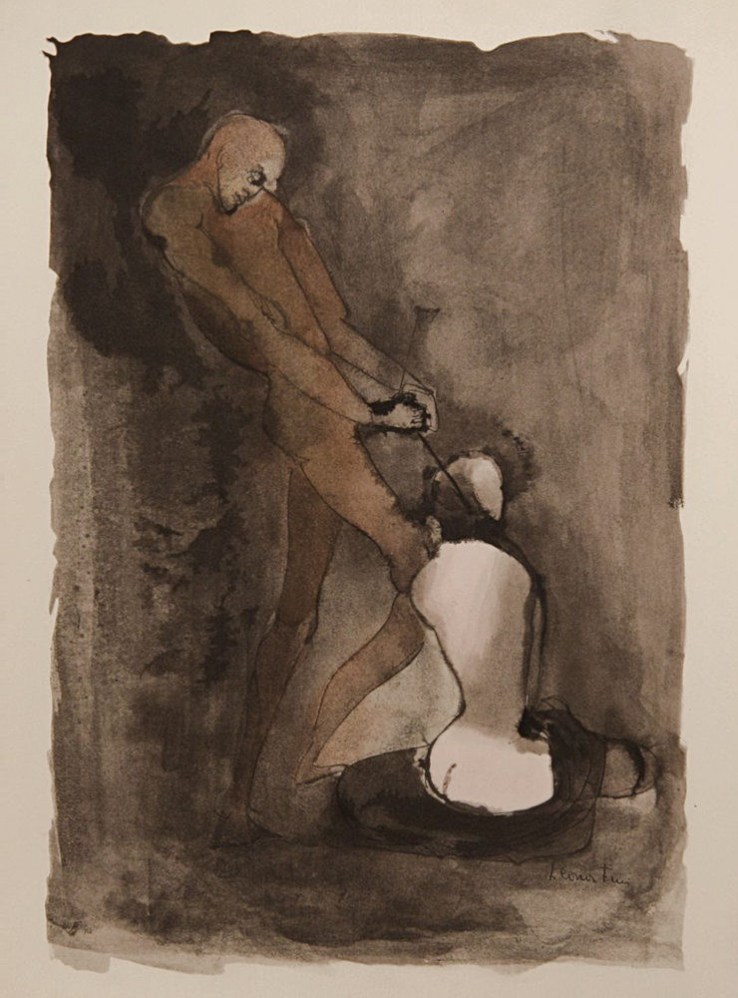
Bondage by Leonor Fini. Part of Fini’s illustrations for a 1962 edition of Pauline Réage’s novel The Story of O.

I wrote about the first third of Anna Kavan’s 1967 novel Ice here and then wrote about the second third here. This third blog will discuss, sort of, the novel’s final third. If you want a very short review though, here goes: If you like novels that disrupt our conventional sense of how a novel should “work” and challenge the very process by which we understand narrative, you will like Ice. Like is maybe not the right verb here, but I’ll let it stand. Ice is simultaneously claustrophobic and expansive, personal and alienating, small and epic. Kavan conjures an apocalypse that refuses the promise of revelation that an apocalypse entails, leaving her readers and characters in a state of radical unknowing. Kavan’s strangeness is Kafkaesque, yes, but hardly imitative, instead drawing from the same wells of modern absurdity, but also sculpting that absurdity into something new, something postmodern, a tale that deconstructs its own telling with  gothic earnestness. If you “like” weird ones, Ice might be for you.

Now then.

So I finished reading Ice the other afternoon. I then made the mistake of reading Kate Zambreno’s marvelous afterword to the novel (originally published as “Anna Kavan” in Context N°18). Zambreno’s essay is fantastic. She reads Kavan’s novels and contextualizes them within and against the novelist’s life. If Zambreno’s essay were not a work rooted in biographical reality, it would be a highly-achieved short story. Kavan’s life was fascinating.

I used the noun “mistake” in the second sentence of the previous paragraph; what I mean to say is: I should have let myself write this third blog before I had any context about Kavan’s biography. I’m glad I initially skipped Jonathan Lethem’s foreword to the Penguin Classics 50th Anniversary Edition of Ice that I read, which would have done me the disservice of coloring the lens through which I read Ice. Zambreno’s essay is excellent, and I don’t begrudge it (Lethem’s is, like, fine), but the fact that Penguin felt the need to wedge Ice into such a contextual frame perhaps attests to the novel’s wonderful estranging weirdness.

(Of course, had I read Zambreno’s essay beforehand (which, like, go for it, I would have picked up Ice as soon as possible.)

0_1eb695_64aed64b_orig
At Her Feet by Leonor Fini. Part of Fini’s illustrations for a 1962 edition of Pauline Réage’s novel The Story of O.

Where was I? Ok. The last third of Ice.

Kavan structures her novel (structure is not the right verb) around three persons, all unnamed: the narrator, the girl, and the warden. The narrator and the warden pursue the girl, a cipher who is placed, displaced, replaced, and displaced again throughout Ice. But as the narrative progresses, it seems that this unstable menage a trois might simply be the narrator’s projection—indeed, Ice is a monomaniac narrative. Projection in the previous sentence is not the right word—I think it implies too much a level of psychological introspection that Ice subverts. There are objects and subjects and analyses in Kavan’s novel, but they never quite meet up.

The ever-shifting setting of the novel is apocalypse in the form of (of course) the titular ice. We never quite learn the specific cause of this apocalypse, although we do know that it is humanity itself that has engendered its own permanent victimhood. Beyond this slim explanation, Ice is a novel that defers, derails, and deconstructs our traditional notions of cause and effect. While there’s often a Ballardian tone to Kavan’s apocalyptic narrative, there’s none of the connective tissue that we might expect from even the strangest science fiction. There’s instead push and pull, contraction and expansion.

We see these oppositions at the beginning of Ch. 11, which initiates the novel’s final third. Our narrator somehow arrives at a safe harbor, a small paradise subsisting on illusions and borrowed time—

The past was forgotten, the long, hard, dangerous voyage and the preceding nightmare. Nothing but the nightmare had seemed real while it was going on, as if the other lost world had been imagined or dreamed. Now that world, no longer lost, was here the one solid reality. There were theatres, cinemas, restaurants and hotels, shops where goods of all sorts were sold freely, without coupons. The contrast was staggering. The relief overwhelming. The reaction too great. A kind of delirium was induced, a mad gaiety.

The passive voice our narrator employs here highlights his arcing agency as he moves from nightmare to a “solid reality” that will, in due time, disintegrate. And everything in Ice disintegrates, only to re-integrate into new textual territories.

It would be too easy to read Ice as a prescient allegory for our own stark era of impending ecological disaster (the poet picked fire, although he noted that ice would suffice). Still, it’s hard not to nod in recognition at a passage like this one—

The festivities went on and on: carnivals, battles of flowers, balls, regattas, concerts, processions. Nobody wanted to be reminded of what was happening in other parts of the world. Rumours coming from outside were suppressed by order of the consul, who had assumed responsibility for the maintenance of law and order, ‘pending the restoration of the status quo’. To speak of the catastrophe was an offence under the new regulations. The rule was to choose not to know.

“The rule was to choose not to know,” but our narrator’s delusions of grandeur won’t permit him to party nonstop at the threshold of apocalypse (even if he has the girl with him)—

I could not remain isolated from the rest of the world. I was involved with the fate of the planet, I had to take an active part in whatever was going on. The endless celebrations here seemed both boring and sinister, reminiscent of the orgies of the plague years. Now, as then, people were deluding themselves; they induced a false sense of security by means of self-indulgence and wishful thinking. I did not believe for one moment they had really escaped.

And so our narrator departs, leaving the girl (who must always be abandoned, found again, imprisoned, and stolen in endless deferrals of victimhood). He heads out in search of the indris, large lemurs who reside in Madagascar (the country is never named of course). These lemurs, whom the narrator claims sing sweetly, are absurd symbols of peace, a world that suspends the very predation and violence that the narrator has participated in and will continue to participate in.

In time he joins a guerrilla force—does it matter which one?—and finds his way back to the warden, a powerful warlord here in the end of days. The warden is horrified to learn that the narrator has abandoned the girl. He chides the narrator, underscoring Ice’s Sadean themes—

‘You don’t know how to handle her,’ he stated coldly. ‘I’d have licked her into shape. She only needs training. She has to be taught toughness, in life and in bed.’

The narrator though is not upset at this idea; rather, he is mortified that his sense of identification with the warden has been sundered:

At that moment I was more concerned with him, linked to him so closely, as if we shared the same blood. I could not bear to be alienated from him. ‘Why are you so angry?’ I went a step closer, tried to touch his sleeve, but he moved out of my reach. ‘Is it only because of her?’ I could not believe this, the bond between him and myself seemed so strong. Just then she was nothing to me by comparison, not even real. We could have shared her between us…’

But of course that sharing has happened throughout the novel, in the most cruel and sadistic way. The girl, a trace, the decenterd center, slips between narrator and warden, all three agents of the same narrative force.

0_1eb69c_5763059c_orig
Submission by Leonor Fini. Part of Fini’s illustrations for a 1962 edition of Pauline Réage’s novel The Story of O.

As Ice approaches its apocalyptic conclusion, the narrator continues to contend with his disintegrating perception of reality. Perhaps the greatest strength of Kavan’s novel is the way in which it reckons with how a first-person perspective is always under duress, always under the pressure to witness to and account for a world that will not stand still, a world to which we can never fully acclimate—

 I should have been inured to climatic changes; but I again felt I had moved out of ordinary life into an area of total strangeness. All this was real, it was really happening, but with a quality of the unreal; it was reality happening in quite a different way.

The final paragraphs of Ice give way to insular, speeding destruction, the narrator and the girl (and the warden, implicitly always with them) in a heated car shuttling through a dying world. Indeed, the narrator remarks near the very end that, “The world seemed to have come to an end already. It did not matter.” The final moments of Ice are sinister and a bit heartwarming, the final phallic image an ironic spike to the narrator’s conciliatory tone. And the apocalypse? Well, the narrative ends, and the world of Ice ends with it—much as it began, with a narrative voice, lost in the cold. Very highly recommended.

Increasingly derealized | Blog about the second third of Anna Kavan’s novel Ice

0_1eb69e_c0eae96a_orig
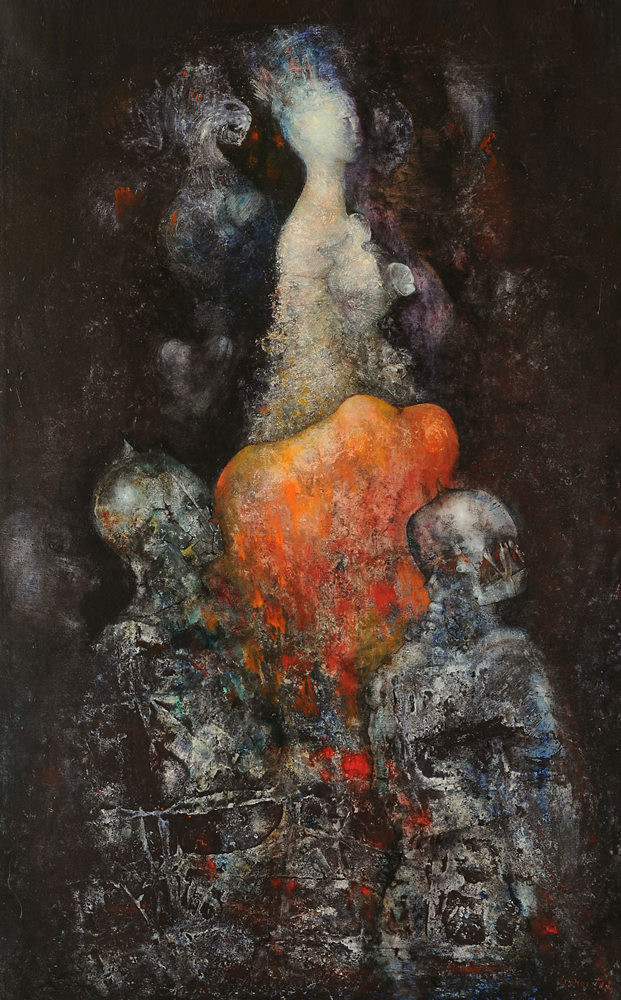
La Victime est reine (The Victim Is Queen), 1963 by Leonor Fini 

 In my last blog on Anna Kavan’s 1967 cult novel Ice, I focused on the book’s first third (the first five chapters), focusing in particular on how the novel’s narration upends our expectations that a novel deliver a stable reality accessed through first-person perspective. This trend continues into the book’s second third, (chapters six through ten).

I stepped into Ice with almost no information about the book aside from the fact that it was a cult classic of the British avant-garde that I had somehow up until now missed. I dispensed with the blurb on the back and skipped Jonathan Lethem’s introduction, and I know nothing yet about Kavan herself—which is like, starting to itch, the not-knowing. The novel is so wonderfully strange, so perfectly frustrating in its surreal upheavals and affronts to a reader’s sense of how a novel is supposed to work.

We access the world of Ice through an unnamed narrator’s first-hand account, an account that the narrator himself constantly places under radical suspicion. Consider these lines early in Chapter 6:

I got only intermittent glimpses of my surroundings, which seemed vaguely familiar, and yet distorted, unreal. My ideas were confused. In a peculiar way, the unreality of the outer world appeared to be an extension of my own disturbed state of mind.

Our narrator drops hints at times that the world he conjures through his telling might be his own surreal creation, that his quest to find “the girl” (the slippery displaced decentered center of Ice) might all be a weird fantasy. 

The weird fantasy continues to take plenty of weird turns in the middle third of Ice. Our hero continues to transmogrify into different roles—a victorious commander of some antique battle, claiming “the girl” as a prize for war, or a criminal unjustly detained, or a secret agent—a double agent—playing espionage he doesn’t understand as he tracks “the girl” from unnamed country to unnamed country.

The fantasies, which arise in bursts of literary pastiche and near-parody, showcase the narrator’s expanding and contracting sense of self. His ego vacillates between energy and lethargy, intense interest and detached boredom. Kavan’s narrator echoes any number of Edgar Allan Poe’s maniacs. Sometimes he’s a ghost, immaterial, a cipher—

Nobody took the least notice of me. I must have been recognized, but received no sign of recognition from anyone, felt increasingly derealized, as familiar faces came up and passed me without a glance. 

A few paragraphs later he projects grand delusions—or rather, what I take to be grand delusions. Ice presents them as reality.

Reality for our narrator is the fight between stasis and action, a reality/unreality that we get as a sort of constant narrative implosion/explosion—

In spite of an almost feverish anxiety over the girl, instead of attempting to find her I stood there doing nothing at all; became aware of an odd sort of fragmentation of my ideas.

Those ideas are always fragmenting, which for some readers (by which I mean me) makes Ice a compelling read, and for others will undoubtedly lead to frustration. Again, Kavan’s novel upends our expectations of how a novel is supposed to work.

Our first-person narrator, privy to scenes he cannot possibly have attended, tries to stabilize the whole project for both himself and us, his readers (without whom we begin to suspect he cannot exist). All of a sudden (to use a stock phrase that Kavan employs in the quote below, a stock phrase that sums up Ice’s picaresque energy) our narrator dispenses with the impending apocalypse as simply incredible and instead elects to ponder a future beyond disaster—

No snow; no ruins; no armed guards. It was a miracle, a flashback to something dreamed. Then another shock, the sensation of a violent awakening, as it dawned on me that this was the reality, and those other things the dream. All of a sudden the life I had lately been living appeared unreal: it simply was not credible any longer. I felt a huge relief, it was like emerging into sunshine from a long cold black tunnel. I wanted to forget what had just been happening, to forget the girl and the senseless, frustrating pursuit I had been engaged in, and think only about the future.

Of course, the future has other plans, at least if we take “the reality” of Ice at face value. The novel anticipates total apocalypse. Indeed, our narrator learns that as the ice collapses countries north of him, “destruction must have been on a gigantic scale. Little could have survived.” Even if broadcasters and their listeners “actually seemed to believe their country would escape the cataclysm,” our sly savvy psychopathic narrator “knew no country was safe, no matter how far removed from the present devastation, which would spread and spread, and ultimately cover the entire planet.” Thank goodness the ecological collapse dramatized in the background of Ice is wholly an imaginative fictional conceit and not an impending reality!

The world is a victim of an unexplained disaster in Ice. The narrator too can’t fully explain his desire to victimize “the girl” he chases throughout the novel, although he does repeatedly describe it. Kavan’s cipher is a strange Sadean object for the narrator, and each chapter suggests that he might find a masochistic identification in her terror and torture—

Her face haunted me: the sweep of her long lashes, her timid enchanting smile; and then a change of expression I could produce at will, a sudden shift, a bruised look, a quick change to terror, to tears. The strength of the temptation alarmed me. The black descending arm of the executioner; my hands seizing her wrists … I was afraid the dream might turn out to be real … Something in her demanded victimization and terror, so she corrupted my dreams, led me into dark places I had no wish to explore. It was no longer clear to me which of us was the victim. Perhaps we were victims of one another.

The narrator here seems to double himself with “the girl,” his erstwhile cipher and victim. As Ice progresses, we begin to sense that he is also a double of “the warden,” a presence of masculine force and authority—

In an indescribable way our looks tangled together. I seemed to be looking at my own reflection. Suddenly I was entangled in utmost confusion, not sure which of us was which. We were like halves of one being, joined in some mysterious symbiosis. I fought to retain my identity, but all my efforts failed to keep us apart. I continually found I was not myself, but him. At one moment I actually seemed to be wearing his clothes.

I’ll read he final third of Kavan’s Ice tonight or tomorrow, and I’m sure I’ll pull together another riff on it. I’ll close simply by pointing out that I really like what the novel is doing. More to come.

drvkaqmxqaavcqi
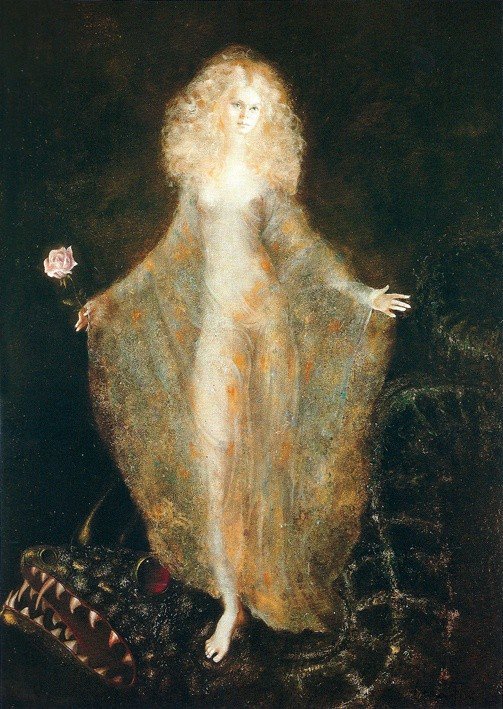
La Passagère (The Passenger), 1974 by Leonor Fini

Uncertainty of the real | Blog about the first third of Anna Kavan’s novel Ice

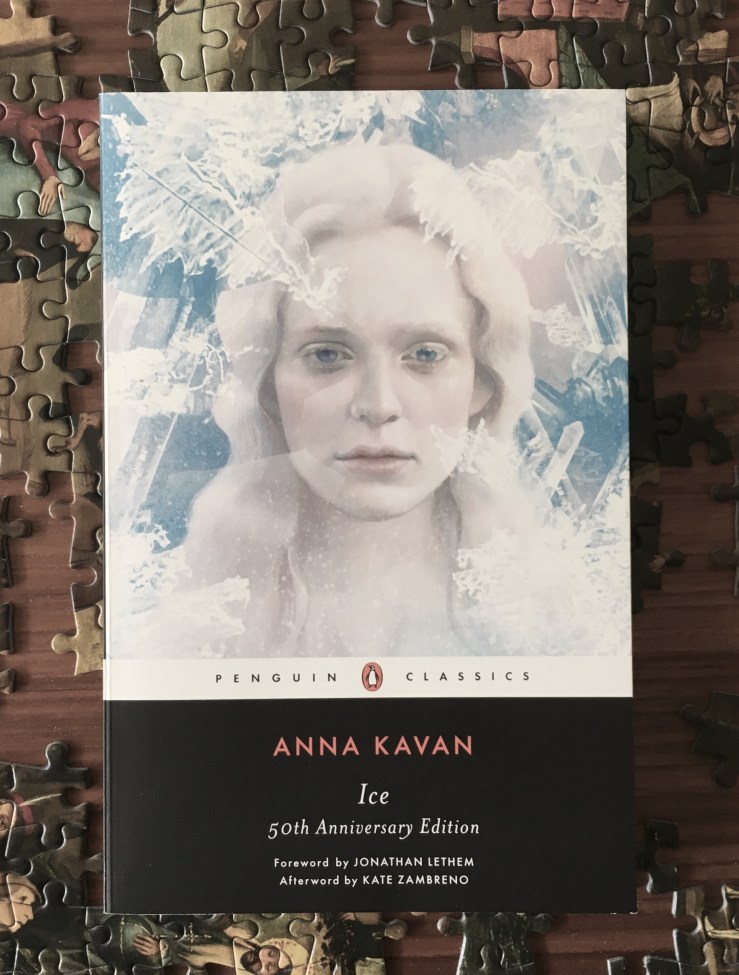
The first three words of Anna Kavan’s 1967 novel Ice are “I was lost,” a simple declaration that seems to serve as a mission statement for the next 60 odd pages. I read these 60 odd pages (63, to be precise, in my Penguin Classics 50th Anniversary Edition of the novel) today, often feeling lost, and glad of it. I like it when I don’t really know what a book is doing, and Ice is such a book.

Ice is told in first-person by an as-yet-unnamed narrator who strikes me as more than a little unreliable. “Reality had always been something of an unknown quantity to me,” he tells us early in the first chapter, admitting that, “At times this could be disturbing.”

Kavan crafts a disturbing, dreamlike tone from the novel’s opening pages, a sinister menace that intensified over the five chapters that I read today. The novel’s settings are detailed but also indistinct, not tethered to any specific time or place, yet nevertheless vaguely familiar. Ice starts in a place like England, and our narrator soon travels to what seems like a Scandinavian country—more on that in a minute—and it’s unclear when exactly the story is taking place: the past? The future? A twisted version of now?

What is clear is that Ice is set in a world that has fallen or is falling into ruin. The word ruins repeats throughout the book; there’s a sense of a post-war world that never recovered—crumbling walls, abandoned buildings, and a reliance on ancient fortresses as symbols of civilization. It’s simultaneously real and unreal, uncanny, disquieting. “The situation was alarming, the atmosphere tense, the emergency imminent,” our narrator tells us, pointing to the vague horror that writhes under the novel’s surface.

Our unnamed narrator repeatedly underscores Ice’s central unreality, an unreality that it is possible he, as the narrator, actually is creating through his witnessing and telling:

I was aware of an uncertainty of the real, in my surroundings and in myself. What I saw had no solidity, it was all made of mist and nylon, with nothing behind.”

Our narrator, who claims to have been at times a soldier and at times an explorer, admits that his medication might contribute to his sense of unreality, to his getting lost. Reading Ice is to get lost from paragraph to paragraph, which I mean in the most complimentary sense. I often had to backtrack, especially in the early chapters, to make sure I hadn’t somehow missed a sentence or stray line of connective tissue that might explain why we had suddenly ended up in, say, a Boschian-nightmare battle, or in the inside of a mesmerist’s chamber in a high tower.

The first swerve into unreality (if it is indeed unreality) happens in the opening paragraphs. Our narrator is lost, driving icy hills, looking for the home of a woman (“the girl”) he claims is his former betrothed, now married to another. It’s not quite clear why he needs to see her, but he’s looking for her, and he’s lost. (I have just describe the plot of the first several chapters.) Here is how we first meet the girl:

An unearthly whiteness began to bloom on the hedges. I passed a gap and glanced through. For a moment, my lights picked out like searchlights the girl’s naked body, slight as a child’s, ivory white against the dead white of the snow, her hair bright as spun glass. She did not look in my direction. Motionless, she kept her eyes fixed on the walls moving slowly towards her, a glassy, glittering circle of solid ice, of which she was the centre. Dazzling flashes came from the ice-cliffs far over her head; below, the outermost fringes of ice had already reached her, immobilized her, set hard as concrete over her feet and ankles. I watched the ice climb higher, covering knees and thighs, saw her mouth open, a black hole in the white face, heard her thin, agonized scream. I felt no pity for her. On the contrary, I derived an indescribable pleasure from seeing her suffer. I disapproved of my own callousness, but there it was.

Kavan’s narrator never fully explains that what he might have just communicated to the readers was an hallucination or other species of unreality. He concedes that his medication (for “trauma” inflicted by the girl’s desertion of him) leads him to have nightmares and visions, always of the girl becoming a “victim” of some kind (the word victim repeats throughout Ice).

He finally arrives at the house of the girl and her husband. Kavan layers this visit with his memories (or fantasies?) of at least one other visit to their home. Kavan condenses these scenes with surreal fabulsim. Our narrator, like Vonnegut’s hero Billy Pilgrim, seems unstuck in time, yet also seems unable, or unwilling, to provide his audience any guideposts. We get lost together.

Our narrator can also see sights that seem impossible to a first-person perspective—he seems able to see the girl in rooms we understand to be closed, in spaces we understand to be private, from distances we understand to be impossible. In one such instance, he even seems to peer through the girl’s own consciousness:

Instead of the darkness, she faced a stupendous sky-conflagration, an incredible glacial dream-scene. Cold coruscations of rainbow fire pulsed overhead, shot through by shafts of pure incandescence thrown out by mountains of solid ice towering all around. Closer, the trees round the house, sheathed in ice, dripped and sparkled with weird prismatic jewels, reflecting the vivid changing cascades above. Instead of the familiar night sky, the aurora borealis formed a blazing, vibrating roof of intense cold and colour, beneath which the earth was trapped with all its inhabitants, walled in by those impassable glittering ice-cliffs. The world had become an arctic prison from which no escape was possible, all its creatures trapped as securely as were the trees, already lifeless inside their deadly resplendent armour.

This apocalyptic vision is a foretaste of images to come later in the novel, although Kavan (or her narrator, I should write) is more interested, for now anyway, in the dream-like psychological apocalypse of the girl over the ecological apocalypse vaguely hinted at in initial chapters (“a steep rise in radioactive pollution, pointing to the explosion of a nuclear device,” “substantial climatic change,” impending secret wars).

The girl moves closer to the “arctic prison” of her vision after running away from home and husband (or is she kidnapped?)—and our narrator follows her, trusting his intuition, which somehow gets him on a ship headed to a Scandinavianish country in a town that pulses with mythical dread. Here, the girl seems to be imprisoned by a man called only “the warden” in a fortress called the High House. Our narrator, as before, is able to access this private space, which he describes for us in horrific, archetypal terms:

She was in bed, not asleep, waiting. A faint pinkish glow came from a lamp beside her. The wide bed stood on a platform, bed and platform alike covered in sheepskin, facing a great mirror nearly as long as the wall. Alone here, where nobody could hear her, where nobody was meant to hear, she was cut off from all contact, totally vulnerable, at the mercy of the man who came in without knocking, without a word, his cold, very bright blue eyes pouncing on hers in the glass. She crouched motionless, staring silently into the mirror, as if mesmerized. The hypnotic power of his eyes could destroy her will, already weakened by the mother who for years had persistently crushed it into submission. Forced since childhood into a victim’s pattern of thought and behaviour, she was defenceless against his aggressive will, which was able to take complete possession of her. I saw it happen

“I saw it happen”: How?

Our narrator poses as a researcher of ruins in the town; the warden allows it (or at least seems to allow it) in the hopes that the narrator will convince his countrymen to help the warden’s country with the coming apocalypse. Meanwhile, the girl seems subject to multiple instances of becoming a victim, sacrificial and otherwise. (There are cliffs, there are dragons, there are battles, there are phosphorescent skeletons). How real these instances are is impossible to say. They are real enough to the narrator in any case, even if he seems able to walk away from them after a paragraph or two. “I had a curious feeling that I was living on several planes simultaneously,” he tells us, adding that “the overlapping of these planes was confusing.”

Confusing is one word, although Kafkaesque would do as well. I have tried to avoid using the word Kafkaesque to describe literature of late—it’s overused, and a bit of a crutch. Ice is reminiscent of The Castle, sure, but that’s not why I use the term here. Kavan’s writing achieves what Kafka’s writing achieves: It evokes the image and psychology of apocalypse while at the same time negating, displacing, suspending, delaying, or otherwise withholding the revelation that apocalypse promises. It is apocalypse without explanation, without understanding, without wisdom. It is being lost.

Kavan’s novel’s fable-like quality also calls to mind Angela Carter’s stories and novels, and the psychological dynamics recall J.G. Ballard (whose blurb appears on my copy). There are other notes of course—Charlotte Perkins Gilman, Robin Hardy’s 1973 film The Wicker Man, Piercy’s Woman on the Edge of Time—but Ice strikes me as its own flavor and idiom of strange, a flavor and idiom I am digging very much right now. More thoughts to come.

Blog about some recently acquired books

img_3038

I have acquired a goodly amount of books in the last two weeks and failed to do any of these silly “books acquired” posts about them, having been busy with summer classes and occupying summer-bound children (and, admittedly spending too many free hours rewatching Deadwood so that I can watch the Deadwood film and doing a Brueghel puzzle, and not really writing).

I ordered Pierre Senges’ strange little book Geometry in the Dust. It’s new in English translation by Jacob Siefring from publisher Inside the Castle. (Siefring also translated Senges’ novel The Major Refutation, which I read a few years ago.) Geometry in the Dust is a rectangular novella that includes black and white illustrations by Patrice Killoffer. The text is set in two columns, with occasional inset notes set in a smaller font.

img_3040

I mention the size/shape, the inset notes, and the illustrations because, for whatever reason, these things make the reading experience even odder (although I can’t articulate why, and to be clear, I find the oddness compelling).

img_3041

Told in the articulate, observant, and often-funny first-person voice of the “sole faithful minister…advisor, chamberlain and…scapegoat” of a certain monarch—a “you” this minister addresses—like, you, the reader—told in this funny and strange voice, Geometry in the Dust is “about” (a term that we’d have to place under suspicion here) the planning, the mental construction of a great city. A sort of extended thought experiment, Senges’ novella captivated me for two quick afternoon reads, and I hope to go through it again in preparation for a proper review. For now, I’ll lazily compare it to Borges, Calvino, Perec, and Antoine Volodine—writers that Senges does not imitate, but seems to drink from the same imaginative well as.

img_3031

I went to my beloved used bookstore last Friday to browse, as is often my habit, and while I didn’t find any of the Joy Williams Vintage Contemporaries I was hoping to find, I did find a copy of Anna Kavan’s 1967 novel Ice. I’ll admit I hadn’t heard of Kavan until I read Ann Quin’s fantastic novel Berg (which I reviewed recently on this blog). I subsequently read/heard Kavan’s name brought up in conversations concerning Quin. Ice is my next read.

I also spied a new copy of Anna Burns’ Milkman at half price and picked it up. I’d heard good things about the novel—that it’s weird, challenging; that a lot of folks hated it. And, like, look—Ann, Anna, Anna. Why not? Milkman after Ice?

I got home to three separate review copies in the mail, a bit of an overwhelming shock, really, as one is NYRB’s new edition of Gregor von Rezzori’s The Death of my Brother Abel (translated by Joachim Neugroschel and revised by Marshall Yarbrough) b/w Cain: The Last Text (translated by David Dollenmayer). (The novel and its sequel have been published as Abel and Cain.) At nearly 900 pages it is a brick, or maybe a nice big hole to fall into soon.

I was also pleasantly surprised to see that Contra Mundum Press has published Iceberg Slim’s novel Night Train to Sugar Hill, which was never published in Slim’s (aka Robert Beck’s) lifetime. I’m not sure if this is the first publication of this late novel, but I think it is.

I had read some of Greg Gerke’s essays at LARB and 3:AM before getting See What I See (which is out later this year), and am generally impressed with what I’ve read so far. I admit that I skipped around almost immediately, reading (or rereading, in one case) pieces on William Gass and William Gaddis, before turning through pieces on Paul Thomas Anderson and Ingmar Bergman. An essay ostensibly on Mike Leigh’s film Mr. Turner is really about criticism itself, and contains this paragraph:

Critics have a job incompatible with their raw materials. They are to respond promptly and pithily to a work of art—the very life of which changes by different viewings, listenings, and readings, and at different times in one’s life. It is like being a bull rider—one being is not made to situate itself onto the other. Yet, our culture still respects some views and honors the guidance offered. In conjunction, it is no exaggeration to say we live in an era that disposes of language, including the etiolation of the sentence, punctuation, spelling, and grammar by the rush to judgment, and by the ego not caring what it’s form of thought is like, only that it’s owner’s name is lit up. Our species is changing—words, because they are not respected, boil more easily over into lies and exaggeration, disregarding the best humanistic advice possible, courtesy of Shakespeare: “Speak what we feel, not what we ought to say.” Where once words were imbricated and limned to grasp at wisdom, we now have the sweet satisfactions of irony, the insulting tweet, and the ham-handed “article” on why this or that does or doesn’t meet one’s satisfaction.

Gerke’s essay reminded me that I had wanted to see Mr. Turner (admiring both Leigh and his subject). (And if Gerke is a namegoogler—I loved Boyhood.)

A review of Berg, Ann Quin’s grimy oedipal comedy of horrors

ann_quinn_berg_hi_rgb

Ann Quin’s 1964 novel Berg begins with one of the best opening lines I’ve ever read:

A man called Berg, who changed his name to Greb, came to a seaside town intending to kill his father…

This opening line encapsulates the plot of Berg, its terminal ellipses pointing to the radical indecision that propels the novel’s central oedipal conflict—will Berg do it? Can he actually kill his father?

The “seaside town” mentioned in the opening line is presumably Brighton, where Quin was born and died. Quin’s Brighton is hardly a holiday-goer’s paradise though. Grimy and seedy, claustrophobic and cold, it’s populated by carousers and vagabonds. There’s a raucous, sinister energy to Quin’s seaside setting; her Brighton is a combative hamlet pinned against the monstrous swelling sea.

While we sometimes find ourselves in this seaside town’s drunken dancehalls, shadowy train stations, or under grubby piers, most of Berg takes place in a dilapidated boarding house. Here, Alistair Berg (going by Greb) has taken a room adjacent the room his father Nathaniel lives in with his younger mistress Judith. Nathan and Judith’s apartment is a strange horror of antiques and taxidermy beasts. Berg’s apartment is full of the wigs and hair tonics he ostensibly sells for a living. It’s all wonderfully nauseating.

Through the thin wall between these two spaces, Berg hears his father and mistress fight and fuck. He attends both animal grunting and human speech, an imaginative voyeur, and is soon entangled in their lives, as neatly summarized in a letter to his mother Edith, the fourth major character who is never-present yet always-present in the novel. Writing to thank Edith for a food parcel she’s mailed him (Berg is a mama’s boy), he reports:

How are you? Everything here is fine. I’ve seen my father, but so far haven’t revealed who I really am (how Dickensian can one get, and what can I really put—that he’s been fucking another woman next door, and probably a dozen others besides over the past fifteen years, is about to go on tour with some friend in a Vaudeville show, trailing a dummy around, that he’s in love with a budgie…?) Somehow I think you’re better off without him, he seems a bit the worse for wear, not at all like the photograph, or even like the ones you already have of him, and he still hasn’t any money, as far as I can make out he’s sponging left right and centre.

After promising to return home in time for Christmas, Berg signs off with this ambiguous and oedipal ending: “Meanwhile—meanwhile—well I’m going to fuck her too…”

As the novel progresses, the relationships tangle into a Freudian field day: Berg and his father Nathaniel; Berg and his mother; Berg and Judith; Judith and Nathaniel; Nathaniel and Edith. Desire is a funny floating thing in Berg, which plays at times like a horror story and at times like a demented closet farce. As the narrative voice tells us at one point, “no one is without a fetish or two.”

Berg’s desire to kill his father is explored, although his rationale is muddy. Certainly, Edith, whose voice ventriloquizes Berg’s memory, helps spur Berg’s oedipal impulse: “There you see that’s your father who left us both,” she tells him as a boy, pointing to a photograph, adding, “you’ll have to do a lot to overcome him Aly before I die.” So much is loaded into that word overcome. Quin’s novel is precise in its ambiguities, evoking a feeling of consciousness in turmoil.

Berg’s turmoil is indeed the central thrust of the novel. He can’t decide to patricide. Berg works through the justifications for murder, ultimately trying to root out the impetus of his desire to kill his father. “Of course it’s ridiculous to think the whole thing is simply a vehicle for revenge, or even resentment—hardly can it be called personal, not now, indeed I have never felt so objective,” he tells himself at one point, sounding like one of Poe’s maniacs. Quin’s narrative affords him several opportunities to go through with the murder, but, in the novel’s first half anyway, he stalls. “Yes, that’s what it amounts to, decide rather than desire,” he proclaims.

Like Prince Hamlet, Berg is terribly indecisive, spending much of the novel vacillating between action and inaction, letting his consciousness fly through every imaginative possibility. Indeed, the main setting of Berg is not really Brighton or the boarding house, but Alistair Berg’s mind. And yet consciousness is his biggest curse: “Definitely the supreme action is to dispose of the mind, bring reality into something vital, felt, seen, even smelt. A man of action conquering all.” Later, he tells us that “The conscience only sets in when one is static,” coaxing himself toward action. Berg aspires to more than Eliot’s Prufrock. He desires to be more than an attendant lord to swell a progress, start a scene or two.

Indeed, Berg is author, director, and star in this drama of his own creation—he just has to finally follow the call to action. When he finally does snap the mental clapperboard, he comes into the possession—or at least believes he comes into the possession—of his own agency: “How separated from it all he felt, how unique too, no longer the understudy, but the central character as it were, in a play of his own making.”

Throughout Berg, Quin employs a free-indirect style that emphasizes her character’s shifting consciousness. Whatever “reality” Berg experiences is thoroughly mediated by memories of his mother’s voice and his own projections and fantasies. Consider the shift from “he” to “I” in these two sentences:

Half in the light he stood, a Pirandello hero in search of a scene that might project him from the shadow screen on to which he felt he had allowed himself to be thrown. If I could only discover whether cause and effect lie entirely in my power.

Perhaps his dramatic flair comes from his father, a vaudevillian ventriloquist whose most prized possession is a dummy. The dummy is the tragicomic symbol at the heart of Berg, a totem of the way that other voices might inhabit our mouths and drive our desires in bizarre directions. Berg, desirer of the power to cause and effect, often sees others around him as mere props. “She’s not unlike a display dummy really,” he thinks about Judith, who accuses him as someone who’s “always playing a part.” Hefting (what he believes to be) his father’s body, Berg, “aware of the rubbery texture of the flesh,” thinks, “ah well the old man had never been a flesh and blood character really.”

Berg is both victim and hero in a mental-play that he aspires to make real. Consider this wonderful passage that collapses Berg’s monomania, prefigurations of guilt, and dramatic impulses into a courtroom trial:

Alistair Berg, alias Greb, commercial traveller, seller of wigs, hair tonic, paranoiac paramour, do you plead guilty? Yes. Guilty of all things the human condition brings; guilty of being too committed; guilty of defending myself; of defrauding others; guilty of love; loving too much, or not enough; guilty of parochial actions, of universal wish-fulfilments; of conscious martyrdom; of unconscious masochism. Idle hours, fingers that meddle. Alistair Charles Humphrey Greb, alias Berg, you are condemned to life imprisonment until such time you may prove yourself worthy of death.

Berg’s guilt fantasies are bound up in a sense of persecution as well as his notion that he is the real hero of this (his) world, in his belief that he is above “the rest of the country’s cosy mice in their cages of respectability”:

A parasite living on an action I alone dared committing, how can they possibly convict, or even accuse one who’s faced reality, not only in myself, but the whole world, that world which had been rejected, denounced, leaving a space they hardly dared interpreting, let alone sentence.

Although Berg takes place primarily in Our Boy Berg’s consciousness, Quin leavens the fantasy with a hearty ballast of concrete reality. Consider this icky sexual encounter between Berg and Judith, which involves hair tonic and a nosy landlady:

Berg shrank back, bringing Judith with him, she taking the opportunity of pressing closer; sticky, the tonic now drying—gum from a tree—almost making it impossible for Berg to tear himself away. He felt Judith’s warmth, her soft wet tongue in his ear, soon she became intent on biting all available flesh between hairline and collar. But the landlady’s demanding voice made her stop. Berg sank back, while Judith squirmed above him. But as soon as the landlady seemed satisfied that no one was about and closed the door, Judith began licking his fingers. He pulled sharply away, until he lay flat on the floor, his head resting against something quite soft. Judith began wiping his clothes down with a large handkerchief that distinctly smelt of wet fur and hard-boiled sweets. He tried getting up, but she leaned over him, and in the half light he saw her lips curl almost—yes almost—he could swear in a sneer, a positive leer, or was he mistaken and it was only the lustful gaze of a frustrated woman? He jerked sideways. Judith fell right across the body.

Ah, yes — “the body” — well, does Berg carry out his patricide? Of course, in his imagination, a million times—but does his mental-play map onto reality? Do you need to know? Read the book.

Read the book. There’s nothing I can do in this review that approaches the feeling of reading Ann Quin’s Berg. I can make lame comparisons, saying that it reminds me of James Joyce’s Ulysses (in its evocations of loose consciousness), or David Lynch’s Blue Velvet (in its oedipal voyeuristic griminess), or Luis Buñuel’s The Exterminating Angel (for its surreal humor and dense claustrophobia). Or I can point out how ahead of her time Quin was, how Berg bridges modernism to postmodernism while simply not giving a fuck about silly terms like modernism and postmodernism. Or I can smuggle in big chunks of Quin’s prose, as I’ve sought to do, and which I’ll do again, like, here, in this big passage wherein our hero dreams:

Two white-foaming horses with female heads and hooves of fire, with strands of golden mane—honey cones—bore him across a silken screen of sky, over many islands that floated away, and became clouds, a landscape of snow stretching below, and above a canopy of gold. But a harsh voice needled him, pin-pricked his heart, and three drops of blood poured out, extended across the canopy. From this whirlpool a shape formed, then a massive head appeared, without eyes. He turned to the horses, but they were now toads, squat and squeaking, leaping into the hissing pool. The face grew, the mouth opened, swallowing everything, nearer and nearer, until he felt himself being sucked in, down, down and yet farther down, into quicksands of fire and blood, only the dark mass left, as though the very centre of the earth had been reached. The sun exploded between his eyes. He stood up, practically hurling the rug over his shoulder, and jogged towards the station.

Or I can repeat: Read the book.

Of course Berg is Not for Everyone. Its savage humor might get lost on a first read, which might make the intense pain that underwrites the novel difficult to bear. Its ambiguities necessitate that readers launch themselves into a place of radical unknowing—the same space Berg himself enters when he comes to a seaside town, intending to kill his father.

But I loved reading Berg; I loved its sticky, grimy sentences, its wriggly worms of consciousness. I wanted more, and I sought it out, picking up The Unmapped Country, a collection of unpublished Quin stuff edited by Jennifer Hodgson and published by And Other Stories, the indie press that reissued BergHodgson is also a guest on the Blacklisted Podcast episode that focuses on Berg. That episode offers a rallying ringing endorsement, if you need voices besides mine. The Blacklisted episode also features a reading of most of novelist Lee Rourke’s 2010 appreciation for Ann Quin’s Berg. (Rourke had championed online as early as 2007.) Rourke should be commended for being ahead of the curve on resurfacing a writer who feels wholly vital in our own time. He concludes his 2010 piece, “Berg should be read by everyone, if only to give us a glimpse of what the contemporary British novel could be like.” Read the book. 

Quin wrote three other novels before walking into the sea in 1973 and never coming back. Those novels are Three (1966), Passages (1969), and Tripticks (1972). I really hope that And Other Stories will reissue these in the near future. Until then: Read the book. 


Blog about some recent reading

img_2962-2

It’s been pretty busy around Biblioklept World Headquarters this week. It’s the first week of my kids’ summer vacation, and they both had birthdays this week, as did I. I managed to read but not write that much—so here’s this lazy post.

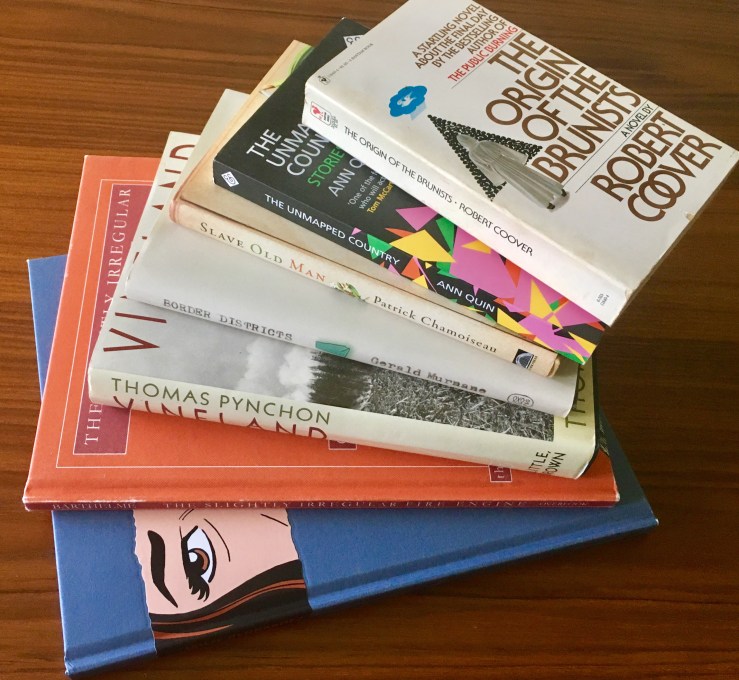
I finally finished Robert Coover’s 1966 debut novel The Origin of the Brunists this morning, which I had started with a huge wave of enthusiasm way back at the end of February. The novel has one of the finest second chapters I can remember, a long description of a mine’s implosion, and the rest of the book simply never matches its intensity. Coover conjures a mining town called West Condon, and explores the fallout of the disaster and how it affects seemingly every citizen. The central conflict is between a doomsday cult (the Brunists) and the rest of the town. There are some wonderful moments, but there’s a maudlin streak to the novel that Coover’s later work would satirize. The Origin of the Brunists suffers from the strains of First Novel Syndrome—Coover overstuffs the beast, and doesn’t leaven his unwieldy monster with enough humor. It’s a shaggy read, which, like, fine—I love shaggy novels!—but shagginess should correlate with theme, and Coover’s theme is decidedly unshaggy. You could probably cull a dozen short stories from Origin and end up with a finer book. I ended up reading it out of a sense of duty to the author. Maybe the sequel, which came out a few years ago, is a better affair.
I should have a review of Ann Quin’s first novel Berg out next week, but here is a short review: Go read Berg. It’s extraordinary. It’s so extraordinary that upon finishing it I immediately needed more Quin. I’ve been reading the collection of fragments and stories The Unmapped Country slowly, interspersing them with other reads. Good stuff.

I picked up Linda Coverdale’s translation of Patrick Chamoiseau’s novel Slave Old Man this Friday as I browsed my favorite bookstore as a birthday treat for myself. I read the first two chapters that afternoon. The language is extraordinary, strange, poetic, bracing. More thoughts to come.

I read Gerald Murnane’s Border Districts over the course of three mornings. I then immediately reread it, finding it even more precise and accomplished than I had realized the first time. Murnane’s “fiction” is a compelling meditation on seeing and trying to see what can’t be seen. It’s about place, memory, image, and color—the colors of marbles, of liveries, of racing flags and stained glass windows. It’s also a strange and ironic exercise in literary criticism—but ultimately, it’s about waiting for the epiphanies our stories promise us, and perhaps waiting in vain. Very highly recommended.

I had hoped to write Something Big on Thomas Pynchon’s Vineland but found myself a bit too exhausted at the end of it to muster anything. I know among Pynchon fans it has a certain cult status, but I’d rather pick up Gravity’s Rainbow or Against the Day or Mason & Dixon again than reread Vineland. The book is a shaggy mess, really, with some excellent bits that never properly cohere. (It is possible that the book doesn’t cohere on purpose—there’s a narratological implication that the entire book is simply a film treatment, or, a few characters riffing over a film treatment.) Vineland features characters from other Pynchon novels, notably the Traverse family from Against the Day, as well as folks from Gravity’s Rainbow and The Crying of Lot 49, suggesting that there is of course a Pynchonverse. The book is an indictment on the baby boomers selling out in the seventies and really the eighties, and attack on Nixonia and the rise of Reagan. The indictment could be stronger. Vineland’s also an extended attack on television, but also a love letter to The Tube. (There’s also a motif about cars and driving that I didn’t fully understand.) And there are all the usual Pynchon themes: zeros and ones, preterite and elect, visible and invisible, paranoia, paranoia, paranoia. Probably the weirdest thing about Vineland is that its “B” plot about a ninja and her partner and their strange adventures actually seems to take up way more of the book than the “A” plot (about a daughter and her estranged mother reuniting). I liked the “B” plot a lot better. I’m sure I’ll reread all of Pynchon at some point, but for now, I’d put it at the bottom of this list.

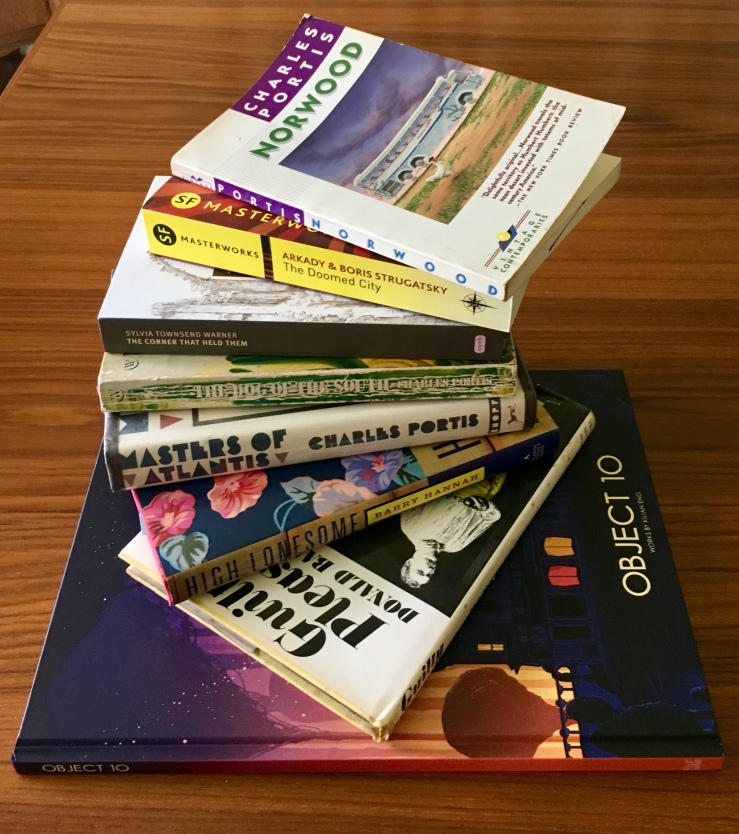
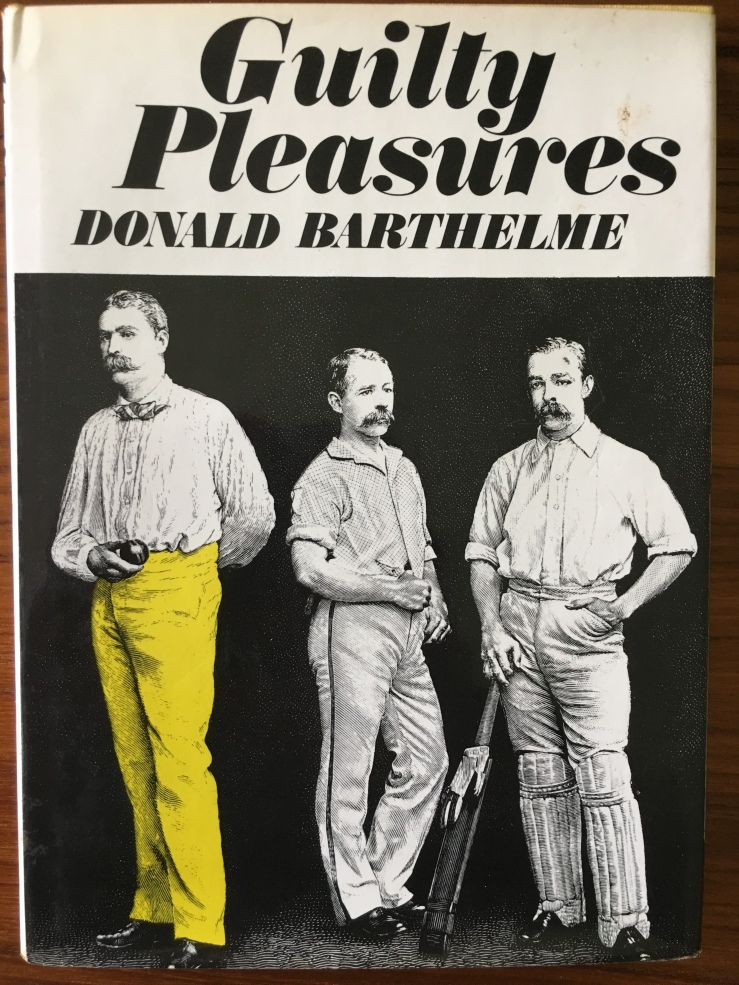
I finally found a copy of Donald Barthelme’s children’s book The Slightly Irregular Fire Engine: Or, the Hithering Thithering Djinn. My kids seem a little too old for it but I dig it, and the collage work (by Barthelme himself) is fun, if not exactly Une Semaine de Bonté.

img_2964-2

I actually did muster a review of Jaime Hernandez latest Love & Rockets book, Is This How you See Me? The review is at The Comics Journal.

Not pictured in the stack above (because I have it out as a digital loan from my local library) is Maria Gainza’s novel (is it a novel?) Optic Nerve, in translation by Thomas Bunstead. I’m a little over half way through, and just really digging it. It’s kinda like a life story told through paintings and art history, but it’s also very much about aesthetics and ways of seeing. It reminds me a lot of  W.G. Sebald, Roberto Bolaño Claire-Louise Bennett, Lucia Berlin, and David Markson, but also really original. Good stuff.

Blog about “All My Happiness Is Gone,” a song from David Berman’s new band Purple Mountains

Screenshot 2019-05-17 at 3.48.03 PM

A few hours ago, my best friend send me a text with a link to listen to “All My Happiness Is Gone,” the first single from David Berman’s new band Purple Mountains. We’d been excited to hear the tune since it was announced last week. It’s been over a decade since Berman’s last record, Lookout Mountain, Lookout Sea came out, and I’ve missed his voice. The six records the Silver Jews put out between 1994 and 2008 were formative to me. I remember each distinctly as evocations of time and place, the songs on each record emotional spaces different versions of me inhabited.
I’ve listened to “All My Happiness Is Gone” about half a dozen times now, and listened to the two remixes of it a couple of times too. I really like the song—it’s sad and moving, a song about aging and friendship and, uh, despair, a song that opens with, “Friends are warmer than gold when you’re old / And keeping them is harder than you might suppose.”

When we were 15, my best friend, the one who texted me a link to listen to “All My Happiness Is Gone” a few hours ago, we were between bands. Or really, we were calling the music we made together in our bedrooms a band. We’d soon hook up with a drummer, and then another drummer, other players, and so on, different iterations of an amateur psych art rock band that played shows in clubs and smaller clubs, houses, record stores, art galleries and you get the idea. Anyway, when we were 15, between bands, we recorded what we called an “album” (an album!) on my then-girlfriend’s older brother’s 4-track. The tape we made is and was awful, but we covered the Silver Jews’ song “Trains Across the Sea,” all two chords of it, with what I still think of as a kind of clumsy grace, my best friend delivering the lead vocal with an admirably faulty feigned maturity. We even adapted the line “In 27 years I’ve drunk 50, 000 beers” to better suit our own then slim duration, even though we had to stretch the syllables in “15” a bit too far for the meter. Over the past 25 years I’ve recorded hundreds of hours of music, a lot of it with this friend, and that cover of “Trains Across the Sea” is maybe my favorite thing we ever did.

Wait—didn’t I say that this was a blog about “All My Happiness Is Gone,” a new song by the band Purple Mountains? I did, I know—but I can’t write about music. Sorry. It’s better to just hear the song, right? Here it is:

The first two minutes of this video aren’t part of the single edit, but I like the way Berman’s plunky guitar meanders around the melody and rhythm of the song before the canned orchestra propels us into the sad sad sad lyric. The intro also balances out the end of the song, which doesn’t so much conclude as it slows into near-collapse, stretched thin like the spirit of the song itself: ” …the fear’s so strong it leaves you gasping / No way to last out here like this for long.”

Berman’s albums with the Silver Jews were always tinged with melancholy or even outright depression, but there was always, at least in my estimation, a leavening irony. Take “Honk If You’re Lonely,” from American Water, for instance, in which Berman celebrates and sends up classic country tunes, and, ultimately connects to his audience: “Honk if you’re lonely tonight / If you need a friend to get through the night.” Two decades later in “All My Happiness Is Gone,” Berman sounds like the one who needs a friend:

Mounting mileage on the dash
Double darkness falling fast
I keep stressing, pressing on
Way deep down at some substratum
Feels like something really wrong has happened
And I confess I’m barely hanging on

The music is simple and sweet, moving between two chords for the most part—the second chord lingering just a bit longer before the chorus hits, the same trick that Berman pulled off in “Trains Across the Sea.” The chorus, in which Berman repeats the titular line with a plaintive sadness that hurts me, hangs around a melody that reads like a country goth cribbing of Modern English’s “I Melt with You.” It’s a bit of an emotional apocalypse, which is kinda maybe what you want from a sad song, but the sadness seems so sincere, the despair so visceral, that again, it hurts. Maybe share it with a friend.

Strugatsky brothers/Mutis/Pynchon (Books acquired, 8 May 2019)

img_2805

I went to the bookstore on Pynchon in Public Day, 2019 to pick up the only Thomas Pynchon novel I don’t own, Bleeding Edge. I’ve given the book a shot or three, checking it out from the library, but it’s never quite clicked for me. I’m reading Vineland right now though, the other Pynchon novel I haven’t previously read, and finally really digging it. So maybe I’ll read Bleeding Edge after (although I think I’ll probably immediately reread Vineland after reading Vineland).

img_2806

I have a little mental list of books and authors I look for while browsing, including the Australian writer Gerald Murnane whom I did not find a scrap by—but I did unexpectedly find The Mansion, a collection of early short stories and fragments by Colombian author Álvaro Mutis. Here’s one of those little sections (in translation by Beatriz Hausner):

img_2807

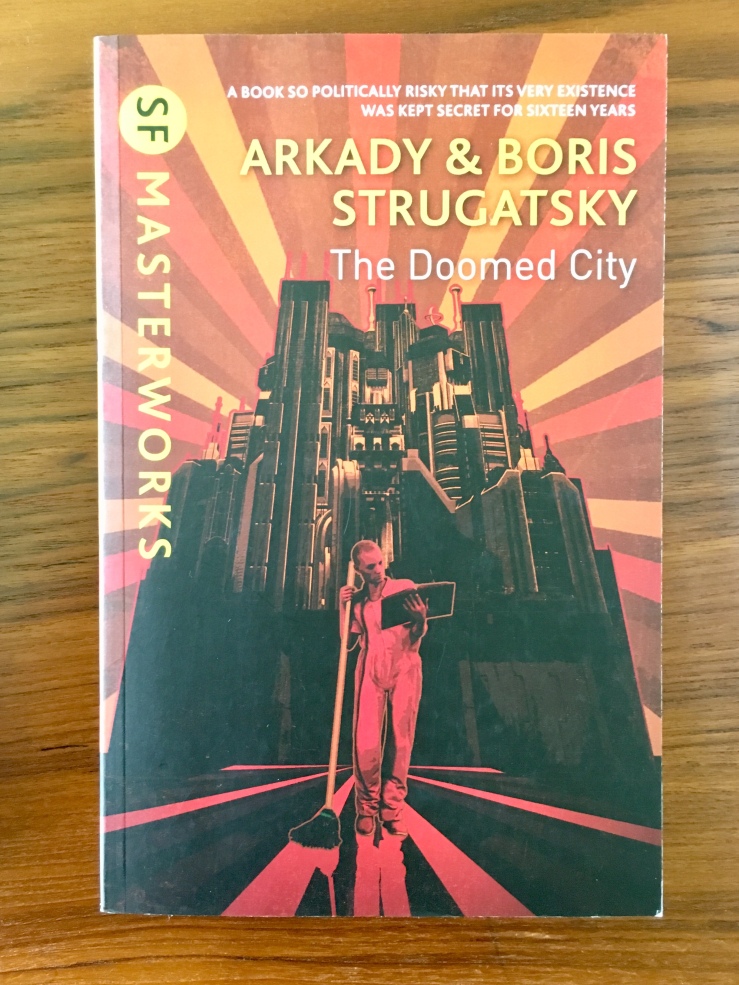
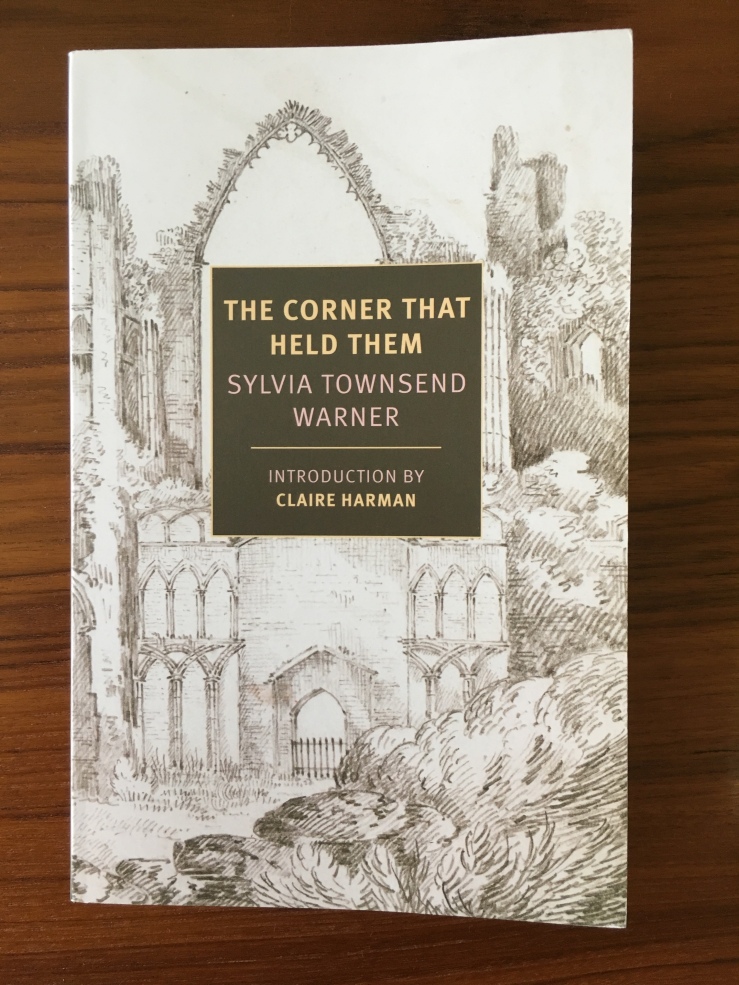
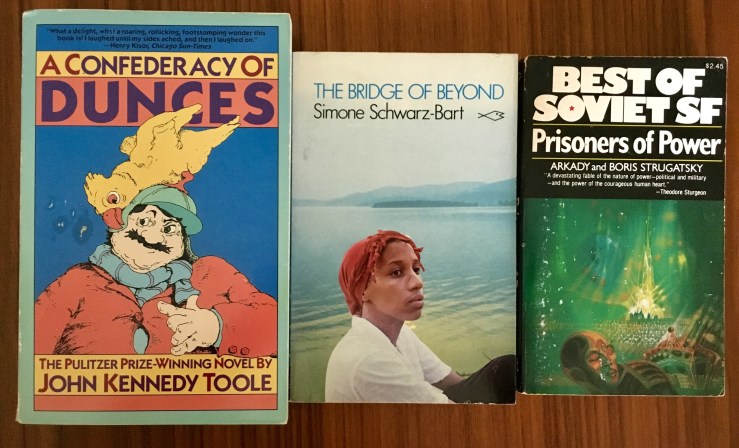
I also like to scan the massmarket scifi paperbacks at this particular used bookstore for original US editions of works by the Strugatsky Brothers. I’ve been a bit lucky lately, finding Hard to Be a God and The Final Circle of Paradise—and I was thrilled to find the Pocket edition of Roadside Picnic/Tale of the Troika. I read Olena Bormashenko’s 2012 translation of this book a few years ago, and loved it (I also really dug her translation of the Strugatsky’s superweird novel The Snail on the Slope). This translation is by Antonina W. Bouis, and includes an introduction by Theodore Sturgeon. I haven’t read Tale of the Troika, but Sturgeon describes it as a satire that evokes “Kafkaesque horror.” Sounds delightful.

img_2809

Marlon James’s Black Leopard, Red Wolf is a postmodern fantasy novel that challenges the conventions of storytelling itself

img_2496

Marlon James’s novel Black Leopard, Red Wolf is a postmodern fantasy that takes place in medieval sub-Saharan Africa. Set against the backdrop of two warring states, the North Kingdom and the South Kingdom, Black Leopard, Red Wolf is the story—or stories, really—of Tracker, a man “with a nose” who can track down pretty much anyone (as long as he’s got the scent).

The central quest of Black Leopard, Red Wolf is for Tracker to find and recover a missing child of great importance. An explanation of exactly how and why the child is so important is deferred repeatedly; indeed, James’s novel is as much a detective story as it is a fantasy. In his detective-quest, Tracker partners with a number of strange allies: a talkative giant (who tells us repeatedly that he is not a giant), an anti-witch who places charms on Tracker, a duplicitous Moon Witch, a skin-shedding warrior-spy, a sandy-colored soldier from an alien land, a surly archer, a very smart buffalo, and more, more, more.

I used the word allies above, but truculent Tracker is just as likely to fight against the members of his fellowship as he is to fight with them. Black Leopard, Red Wolf runs on the same logic we find in comic books, where heroes fight each other first and then figure out why they are fighting each other after the fact. Sure, they’ll band together to fight lightning zombies, vampires, or roof-walking night demons—but they’re just as likely to go at each other with brass knuckles, axes, or arrows right after.

Chief among Tracker’s  allies/rivals is the Leopard, a shapeshifter. Throughout the book, Tracker and the Leopard fall in and fall out, fight and fuck, laugh and scream. Their bond is forged early in the novel, when they work together to rescue Mingi children, outcast mutants with strange appearances and stranger abilities. These children become an ersatz family for Tracker and provide an emotional ballast to a novel that often reads like a violent tangle of chaotic, meaningless tangents.

The fact that Leopard and Tracker—the title characters for the novel (Tracker gets his eye sucked out by a were-hyena and replaces it with a magical wolf eye; don’t ask)—the fact that Leopard and Tracker save children, particularly strange children is central to understanding their motivations in their quest to save the missing child.

From the outset though, the reader has to doubt just how successful the quest will be. Black Leopard, Red Wolf opens with these intriguing sentences: “The child is dead. There is nothing left to know.” These lines for foreground the novel’s two major themes: radical infanticide and the problem of knowing what we know and (story)telling what we know.

James’s novel uses infanticidal threat as the impetus for its central plot, the fellowship’s quest to save a child. In the backdrop though is Tracker’s oedipal rage toward his father/grandfather (don’t ask), a rage born out of the infanticidal threats Tracker himself has survived. Tracker has survived, but he is not at peace. He is perhaps the angriest narrator I have ever read, quick to temper and driven by (oedipal) impulses of revenge against a target he cannot name. His anger boils over repeatedly, and not just at his foes, but at his partners and his lovers—the Leopard, in particular.

At the same time, Black Leopard, Red Wolf transports us to scenes of strange love and strange families. James’s novel shows how radical love—Tracker and his Mingi children—might mediate, disrupt, or upend the impulses of revenge. And yet there is nothing permanent or stable in this postmodern novel.

Indeed, Black Leopard, Red Wolf is very much about the problem of how we know what we know and how we can express what we know. Tracker is our narrator, but he doesn’t tell us his story straight (there is nothing straight about this queer novel). Tracker tells his stories—the novel—to someone he addresses as inquisitor, but we never learn how Tracker came to be the inquisitor’s captive. Like Sheherezade in One Thousand and One Nights, Tracker seems to spin his story as a life-saving trick.

Black Leopard, Red Wolf is a tangle, a fluid that courses this way and that, a jumble of time and space. Like the “Ten and Nine Doors” that Tracker’s fellowship uses to teleport from one city-state to another, the narrative leaps through time and space, discursive and discontinuous. Tracker nests his narrative as well. We get tales inside tales inside tales, a matryoshka doll without a clear and definite shape. I occasionally felt submerged in reading James’s novel, as if I’d disappeared into an undersea cave only to find some strange current that bore me elsewhere.

Late in Black Leopard, Red Wolf, Tracker neatly summarizes the novel’s deconstruction of a stable truth, and then reverses the roles, demanding testimony from the inquisitor:

And that is all and all is truth, great inquisitor. You wanted a tale, did you not? From the dawn of it to the dusk of it, and such is the tale I have given you. What you wanted was testimony, but what you really wanted was story, is it not true? Now you sound like men I have heard of, men coming from the West for they heard of slave flesh, men who ask, Is this true? When we find this, shall we seek no more? It is truth as you call it, truth in entire? What is truth when it always expands and shrinks? Truth is just another story.

James has planned to write two sequels to Black Leopard, Red Wolf in what he is calling his “Dark Star” trilogy, and he’s stated that each entry in the series will, like an episode in Akira Kurosawa’s 1950 film Rashomon, tell the story from another perspective. After all, “Truth is just another story.”

Of course, Tracker’s telling can be confounding, even exhausting. James’s prose often feels picaresque, one-damn-thing-happening-after-another, a phantasmagoria of sex and violence signifying nothing—only it doesn’t signify nothing. It means something. Many readers won’t want to puzzle that out though.

A lot of the plot is delivered after the fact of the action. We get a form of clunky post-exposition—another form of storytelling, really, with one character summarizing the fragmented details the reader has been wading through for another character. In a kind of metatextual recognition of his tale’s messiness, James will often wink at the reader through his characters. Summarizing pages and pages of plot for the Leopard (and the reader), Tracker finds himself befuddled:

I told the Leopard all this and this is truth, I was more confused by the telling than he was by listening. Only when he repeated all that I said did I understand it.

A few chapters later, the pattern repeats. “The more you tell me the less I know,” one character tells another. Even storytelling can’t stabilize the truth.

While the plot’s unwieldiness can become tiresome, it is not a defect of the book as much as an intentional feature. However, some of the battle scenes fall into a kind of mechanical repetition of blank violence. Tracker tells us again and again how he “hacked” or “yanked,” etc. in scenes that become duller and duller as there are more of them.

The book is far more fun when it’s weirder—Tracker getting trapped by a mutant spider demon who sprays webs all over his face, or Tracker swimming with mermaids to the land of the dead, or Tracker and his companion visiting a technologically-advanced tree city-state ruled by a mad queen. James’s best set pieces don’t need battles to reverberate with energy.

The sex is more interesting than the violence in Black Leopard, Red Wolf—and there’s plenty of both. “Fantastic beasts, fantastic urges,” our lead characters repeat to themselves. James’s novel is deeply horny, its characters fluidly shifting into all kinds of weird fucking. Tracker partners with various members of his fellowship in more ways than one. Sex is magic in Black Leopard, Red Wolf, too—only ten pages in, Tracker ejaculates on a witch, she flicks his semen into a river, fish eat it, and turn into mermaids who lead him to the land of the dead.

There’s so much more in Black Leopard, Red Wolf that I haven’t touched on. The novel is lurid and horny, abject and affecting. It’s often quite funny, and, in the end, it turned out to be unexpectedly moving. It’s also exhausting and confusing, and will likely prove divisive for many readers. It’s clear that Lord of the Rings was a reference point for James (the word “fellowship” is oft-repeated in his novel), but Black Leopard, Red Wolf reminded me more of Jonathan Littell’s The Kindly Ones than it did a traditional fantasy.

In its vivid weirdness and pure invention, James’s book also reminded me of Brian Catling’s novel The Vorrh. However, Catling’s novel often takes the colonialist viewpoint. Black Leopard, Red Wolf  points to a fantasy that could reverse our own history, potentially obliterate that viewpoint’s existence. When Tracker asks the inquisitor, “Now you sound like men I have heard of, men coming from the West for they heard of slave flesh, men who ask, Is this true?”, his questioning seems to point to the larger implications of the James’s Dark Star universe—a precolonial space with a looming threat from the West. Late in Black Leopard, Red Wolf, one character warns the others that the warring between the North and South Kingdoms, between tribes and city-states must end. There’s an existential threat on the horizon. I find the potential storytelling here intriguing.

Black Leopard, Red Wolf is clearly Not for Everybody. It’s violent and strange, and the sex in it will likely upset conservative readers. It’s also shaggy and unwieldy. It probably has a future as a cult novel. You just sort of have to go with its fluid (in every sense of that word) program and enjoy the ride. I enjoyed it very much and am looking forward to the sequel.

Pynchon in Public Post, 2019

img_2774

Today is the 82nd birthday of the American author Thomas Ruggles Pynchon, which a lot of jokers on the internet have turned into Pynchon in Public Day.

The spirit of Pynchon in Public Day is zany fun, and mostly centers around reading Pynchon’s works in public and spreading the muted post horn symbol from The Crying of Lot 49 around as much as possible. I am the last person in the world who will read a book in a coffee shop, but I did don my second 49 shirt today—-

66581c11-b06d-4dfe-89e3-0bc25fa0c64c

—and head to the bookstore to pick up the only Pynchon novel I don’t own, Bleeding Edge. More on that in second, but—no real recognition on the shirt today, although I’ve gotten some reactions to the other muted post horn shirt I own over the years, mostly from booksellers (not that interesting I know).

A few years ago though, wandering around downtown Los Angeles (wearing a muted post horn shirt), a stranger passing opposite me on the sidewalk hailed me with this question: “Are you the Trystero, guy?” At least that’s what I thought I said. I looked confused, asked, “What?” and he repeated — “Are you the Trystero guy?”

This particular moment struck me with a neat silly wave of minor paranoia, a Pynchonian moment, maybe—was this some kind of call sign for me to repeat, a password in a game of good fun? So I did the only thing that seemed sensible and replied, “Yes, I am the Trystero.”

The guy then proceeded to tell me that he loved my coffee. This confused me, so I told him that loved his coffee. Then he looked confused. After a few minutes on the hot July L.A. sidewalk we finally figured out a few things: He was referring to Trystero Coffee, which he showed me all about on his iPhone, and I was referring to The Crying of Lot 49, which he promised to read at the end of our exchange.

So anyway I went to the bookstore and picked up Bleeding Edge (and a few other books too, I admit). Along with Vineland, it’s the only Pynchon novel I haven’t read (despite two attempts on each). I’ll read Bleeding Edge before May 8th, 2020 though.

I started a retry of Vineland though. I had hoped to get past the farthest I remember going in—like the first 90 pages—before this post—-but I only made it through the first five chapters these past two days (through page 67). Still, I’d forgotten all about Ch. 5, the “Kahuna Airlines” chapter, which steers the book into new territory, and even though it still hasn’t hooked me yet (unlike the other Pynchons at this point), I’m starting to appreciate it for what I guess it is: Pynchon’s analysis of the eighties, of the absorption of the counterculture into culture, of nostalgia. The jokes are often hilarious and terrible, sometimes simultaneously. Pynchon sets up a Loony Tunes diner bit to deliver the execrable punchline, “Check’s in the mayo” for example. Pynchon names a lawn care company “The Marquis de Sod.” There’s a moment where protagonist Zoyd Wheeler pays for a ludicrous psychedelic party dress with “a check both he and the saleslady shared a premonition would end up taped to this very cash register after failing to clear,” a wonderful little throwaway line that shows Zoyd’s brokeassedness and empathy (and also highlights the Lebowski-Pynchon overlap, if you like). The line that’s cracked me up each time I’ve read it though is Zoyd’s daughter Prairie’s punker boyfriend being described as “the NBA-sized violence enthusiast who might or might not be fucking his daughter.” It’s just so dumb and poetic. I had also missed a few things — the night manager of Bodhi Dharma Pizza is named “Baba Havabananda,” a reference I’m thinking to Gravity’s Rainbow (“Have a banana”). There’s also a reference to the Vulcan hand salute, which shows up improbably in Pynchon’s next novel, Mason & Dixon (more on that here). And there’s the whole Bigfoot motif too, which Pynchon would echo in Inherent Vice, with Zoyd and Zuniga prefigurations of Doc Sportello and Bigfoot Bjornsen. And like every Pynchon novel, I’m sure I’ve already missed a ton of stuff.

Anyway, more on Vineland to come. In the meantime, if you haven’t read Pynchon–why not check him out?

Blog about acquiring some books (Books acquired, 3 May 2019)

img_2751

Yesterday marked both my wedding anniversary and the end of my spring semester, so I celebrated by spending a spare hour browsing my beloved used bookshop. I had dropped by last week to drop off a box of trade books—mostly old instructor editions of textbooks no longer in use—but I didn’t pick anything up. I did, however, snap a few photographs of the covers of the old 1980s Latin American authors series that Avon Bard put out. I love these covers, and have bought a few over the years.

I ended up picking up two yesterday: Gabriel Garcia Marquez’s In Evil Hour and Machado de Assis’s Dom Casmurro. The cover for Dom Casmurro is pretty bad, actually, but I want to read it.

img_2752

Near the Machado de Assis, I found a used copy of Berlin Alexanderplatz by Alfred Döblin, which I couldn’t resist. I also found a Grove edition of Kathy Acker’s Don Quixote, which I haven’t read since college.

img_2753

I also got a book in the mail. I loved Ann Quin’s novel Berg so much that I had to get more Quin, so I ordered The Unmapped Country from publisher And Other Stories. Very excited for this one.

img_2754

Post script as self portrait, or, Throwing out a bunch of old magazines

img_2735

In February of 2002, three friends came to visit me and my girlfriend in our tiny apartment in Tokyo. We had been living there for just a few months, since September of 2001. I was ostensibly teaching English, but really just serving as a conversation partner for overworked salarymen, bored hobbyists, and hopeless teens. These folks were essentially being scammed by a national corporation pretending to be a school for language instruction. It was my first job out of college. I loved Tokyo and I had made a ton of friends and I was tired all the time. It was famous times for me, and I was thrilled that my friends came to share a week of it.

My friends brought with them a care package, bolstered with items from my parents and other friends. The care package included things that weren’t easy to get in Tokyo, like taco shells and NyQuil. There was a bottle of Jack Daniels that never made it to Japan. My friends drank it on the airplane, which I guess you could still do just a few months after 9/11. There was also the October 2001 issue of Harper’s Magazine.

*

Last month my dean called me into his office and explained that I would have to move out of my office. We would all have to move out of our offices; our beloved shabby building was to be gutted that summer, sooner than to be expected, and the college would not be able to store much beyond a few file cabinets and boxes of books. Take all that art home, etc. This was a stressful chore at the end of term, not just because it necessitated moving physical items at the same time I had finals to grade and students to meet with (students tend to show up to office hours a lot this time of year), but also because I had essentially been using my office as a proxy storage facility for the last decade, and it was crammed with stuff I probably needed to just, like, hell, go ahead and part with.

I filled boxes with old mass-market paperbacks that had migrated, triple-stacked, to my shelves over the years, and took them to classrooms, where students swooped on them with an eagerness that I found frankly shocking. I gave away posters and framed art, little plastic toys and boxes of permanent markers. I surrendered a green Underwood typewriter I’d lugged around for years to a student who promised to write poems on it. I ditched hard copies of over a decade of work I’d originated–lecture notes and quizzes and the like. And I shredded years and years of student work. All of this was cathartic and a little exhausting.

The materials in my office represented, in a way, more than a decade of my unwillingness to fully surrender the crap I’d accumulated over the years. My children needed their own space for their own things, and scores of cheap paperback books, a ribbonless typewriter, cheap ¥100-shop masks, Simpsons Lego figurines, and boxes and binders of papers had to go somewhere. There were shelves in my office though. Filing cabinets too. And I filled one of those filing cabinet drawers with around a hundred back issues of Harper’s Magazine that I could not bear to part with.

*

Beginning in 1998, I subscribed on and off to Harper’s for twenty years. The magazine’s journalism and short stories were a developmental influence on me, and its editorial position in the early years of Bush 2 were especially important to how I conceived of both politics and rhetoric. The book reviews—John Leonard’s in particular—were always a favorite, too, as was “Harper’s Index,” a monthly poem comprised of data.

But it was the “Readings” section of Harper’s that I loved the most. Short extracts—musings, art, poetry, petitions, found poetry, jokes, essays, letters, lists, rebukes, rejoinders, absurdities, profundities, hilarities. And art! Lots and lots of art–photography, oil painting, drawings, and so on. Harper’s “Readings” section was like a curated feed of the best content, before such a vile term as “curated feed of the best content” existed. (Please forgive me for typing “curated feed of the best content” and know that I will never forgive myself). “Readings” influenced this blog, Biblioklept, tremendously.

*

img_2730

The “Readings” section of the October 2001 issue of Harper’s Magazine does not feature any big names, other than Lucian Freud. (His painting Leigh on Green Sofa is there, but is not as intriguing as Clive Smith’s Waited, which looks like it could be a Freud painting from a previous era). The most memorable bits of this “Readings” section are a selection of excerpts from fourth graders’ essays about their experiences with their school’s rat infestation (“I saw a rat in the classroom. It was big and weird and I saw it by Sierra’s shoes. I saw it by the trash”), and this riddle:

img_2732

*

So I disposed of, by giving away or recycling or cutting up, almost every issue of Harper’s I’d accrued over the years. By “cutting up,” I mean that I cut sections out of certain issues—mostly bits from the “Readings” section, or essays, or short stories—stuff from Margaret Atwood, William Burroughs, Wells Tower, Ursula Le Guin.

I ended up keeping eleven issues, including the October 2001 issue.

*

How did I decide what to keep? In some cases, I knew what I was looking for in some cases—a “Folio” section by William T. Vollmann that was later collected in Imperial, for instance, or stories and essays by old masters like William Gass and Robert Coover. Also, the double-sized June 2000 issue, the 150th Anniversary edition loaded with ringers, both in “Readings” (Barry Hannah, Gertrude Stein, Orson Welles, Mark, Twain, JL Borges) and in the magazine proper (Tom Wolfe, Russell Banks, Ha Jin, Annie Proulx). For the most part, my aim was to cut out stories or essays, but sometimes I’d end up with an issue to of-its-time to dispose of. The February 2008 of Harper’s was very 2008, for instance: David Foster Wallace, Slavoj Žižek, Malcolm Morley’s painting Death of Dale Earnhardt—

img_2734

–and Ursula Le Guin’s essay “Staying Awake: Notes on the Alleged Decline of Reading.” As I went to cut out the William Gass essay on Malcolm Lowry from the January 2008 issue, I browsed the contents long enough to see a story by Ben Marcus and readings from Robert Walser and Grace Paley. There’s also a full-page image of Julie Heffernan’s painting Self Portrait as Post Script. 

*

(I have stolen and skewed the title of Julie Heffernan’s painting for the title of my own silly blog post, which is, after all, simply my own postscript, my own unnecessary, sentimental, messy afterthought on throwing out years and years of papers, an afterthought bumbling about in the semblance of a crude self portrait, a little sketch about then and now).

*

img_2736

Gass’s name on the cover from an issue one year later, January 2009, saved a section memorializing David Foster Wallace, including selections from Zadie Smith, George Saunders, and Don DeLillo. (The issue also has an exhaustive triple-length “Harper’s Index” titled “A retrospective of the Bush era). A 2005 issue—again Bill Gass’s name on the cover—included a drawing by George Boorujy, who I interviewed on this site in 2012.

For the most part though, I threw issues away.

*

I did not throw out the October 2001 issue of Harper’s. I probably read it half a dozen times back in 2002. It would be a lie to say the issue is tattooed into my brain, but it’s there—like a kind of psychic residue, a blurry vibe of a weird time in my young life. I most remembered “All God’s Children Can Dance,” a short story by Haruki Marukami, an author I’ve never thought was particularly good—but I loved this story. It was the first Marukami I read and it opened with the line, “Yoshiya woke with the worst possible hangover,” and included details like riding the Marunouchi Line, the train I took every day or almost every day to work in Shinjuku to chat about my Florida lifestyle with sweating business guys and lonely housewives. The story is very Raymond Carver (it’s translated by Jay Rubin) and not especially good, I realize, as I stop to reread it now, but I love it.

The October 2001 issue of Harper’s Magazine also features a charming essay about dinosaurs as pop culture by Jack Hitt, a sad riff on Alzheimer’s by Eleanor Clooney, and a lead story about troubles in Palestine by Chris Hedges. None of these selections are particularly remarkable. What’s strange to me about the issue, I guess, is that it bears absolutely no trace whatsoever of the September 11th terrorist attacks. It’s as if the event simply had not happened yet, which it hadn’t, at least for a magazine already planned and executed weeks ahead of time. I’m guessing that the issue probably was on sale in September of 2001. So the October 2001 issue of Harper’s was already a relic when it came to me in February of 2002; the world had shifted at the time of its publication. By the time I read it the U.S. military had been in Afghanistan for four months already. They are still there today.

This publishing lag in the October 2001 issue of Harper’s seems utterly bizarre in retrospect, especially given the tenor of issues a few months later. I kept the January and March 2002 issues, both brought over by a friend who visited me in Tokyo (maybe the worst house guest I’ve ever had. We sang karaoke until 8am on my 23rd birthday). Both issues are suffused in the horror of the new normal, and both feature fantastic short fiction — “The New Female Head” by Ben Marcus in the January issue, and Adam Johnson’s “Teen Sniper,” a tale that could give George Saunders a run for his money.

*

I searched just now for links to free online versions of “The New Female Head” and “Teen Sniper,” but I couldn’t find any. If you have a subscription to Harper’s, you can read them there, online, as pdfs or as, uh, microfiche. I haven’t used the digital archive in a long time, but I recall its being clunky and somewhat hard to use. And even if it can lead you to a pdf version of, say, an old Steven Millhauser or Don DeLillo story, the online archive simply can’t replicate the stochastic reading experience of flipping through a magazine, tumbling from weird short readings to art to lists of statistics before settling down in a long feature essay (or skimming through one of Lapham’s lectures).

My subscription is lapsed now—I don’t think the magazine is as good as it used to be—but I’ll occasionally peruse an issue at the library or flick through it at the bookstore. I’m sure something on some future cover will tempt me to commit to purchasing the issue and rounding out my archive to a nice dozen issues. For now though, I’m content to skim through this old issue from October 2001, in which Lewis Lapham, in a “Notebook” column dated September 1, 2001, concludes, quite ironically, that “Fortunately we don’t live in times that try men’s souls.” And then maybe I’ll skim through some of the later issues I held on to and see how that assessment panned out.

Blog about some recent reading

img_2644

I am reading too many books right now.

The big book I am reading is Marlon James’s surreal fantasy Black Leopard, Red Wolf. I am a little over half way through this long, long book, which is by turns rich, dazzling, baffling, and befuddling. Black Leopard, Red Wolf is a fantasy-quest novel set in a mythical medieval Africa. The story is told by Tracker, a detective under magical protection who uses his magnificent nose to search for a missing boy, Tracker is aided (and sometimes stymied) on this quest by a strange and ever-shifting fellowship of superpowered heroes and antiheroes, including a sad, talkative giant, a mysterious witch, and the titular Leopard. Leopard is a shapeshifter, and Tracker’s erstwhile partner, both in adventures and in love. “Fantastic beasts, fantastic appetites,” he remarks at one point, summarizing the novel’s horny program. “The more you tell me, the less I know,” another character remarks, summarizing the novel’s shaggy structure. Black Leopard, Red Wolf unspools its plot in the most confounding way. Tracker is hardly a reliable narrator, but we are not even sure if he is the primary narrator. He’s telling his tale to an Inquisitor, but the tale-telling spins ever on, each story a deferral. And those deferrals often open into other storytellers, who tell stories with their own embedded stories. James’s book is like a matryoshka doll full of blood and guts and fucking and surreal ceiling-walking demons. It’s as much a detective story as a fantasy, but for all its genre troping, it makes few concessions to its various genres’ conventional forms. Reading Black Leopard, Red Wolf often feels more like playing a really long game of very weird Dungeons & Dragons campaign with an inventive Dungeon Master making wild shit up as he goes along than it does a cohesive and coherent story. I’m digging the play so far.

The other long book I’m reading—crawling through, really—is Robert Coover’s The Origin of the Brunists. I loved the first 100 pages or so, but it’s turning into a slog. The novel’s climactic crisis, a mining disaster, occurs very early in the novel, an interesting gambit given that the novel is about an apocalyptic cult awaiting the end of the world. This apparent second crisis, a consequence of the first crisis, is then deferred. Coover explores this deferral and its consequences over a series of non-climaxes that we see through the eyes of the (many many too many) characters. There are little pockets of Origin that are fantastic, but too little humor to buoy the novel—it gets weighed down under its unwieldy cast and the authorial sense that This Is A Big Important Novel About Life. I will finish it though.

I loved loved loved Ann Quni’s novel Berg. I will do a full review of this marvelous weird claustrophobic novel when it comes out from And Other Stories in the U.S. this summer, but for now: Just amazing. The novel, originally published in 1964, begins like this: “A man called Berg, who changed his name to Greb, came to a seaside town intending to kill his father…” That, my friends, is basically the plot. Berg is a grisly Oedipal comedy that will make some readers’ skin crawl. Great stuff.

Anthony Howell’s Consciousness (with Mutilation) is another strange one. It’s part memoir, part collage, part family history, often told in a dreamlike prose, but also sometimes conveyed with reportorial simplicity. Check it out.

I’ve also been reading Anne Boyer’s A Handbook of Disappointed Fate, a discursive collection of essays, lists, little anti-poems, etc. More thoughts to come, but I really dig the feeling of reading it.

Finally, I picked up Leslie Fiedler’s 1964 book of criticism Waiting for the End this Friday. Fiedler begins with the (then-recent) deaths of Hemingway and Faulkner. Fiedler uses the deaths of these “old men” to riff on the end of Modernism, although he never evokes the term. Neither does he use the term “postmodernism” in his book, although he edges towards it in his critiques of kitsch and middlebrow culture, and especially in his essay “The End of the Novel.” In parts of the book, he gets close to describing, or nearing a description of, an emergent postmodernist literature (John Barth and John Hawkes are favorite examples for Fiedler), but ultimately seems more resigned to writing an elegy for the avant garde. Other aspects of Waiting for the End, while well-intentioned, might strike contemporary ears as problematic, as the kids say, but Fiedler’s sharp and loose style are welcome over stodgy scholarship. Ultimately, I find the book compelling because of its middle position in its take on American literature. It’s the work of a critic seeing the beginnings of something that hasn’t quite emerged yet—but his eye is trained more closely on what’s disappearing into the past.

Blog about giving books away and buying books for a friend and acquiring some books for myself

img_2588

This morning my dean told me that I needed to pack up my office over the summer as the building I’m in will be undergoing a renovation. Even though I knew this was coming, the prospect hit me as a series of big anxiety waves. My walls are covered with masks, art, pictures. I have file drawers of student work going back over a decade. And books. Lots and lots of books. Books and art and stuff that I don’t really have room for anywhere else, even for a season.

Three shelves in my office are doublestacked with old mass market paperbacks from my youth—-Vonnegut, Edgar Rice Burroughs, Hemingway, Jack London, Philip K. Dick, Richard Adams, Stephen Crane, etc. Shabby books, well worn, glue splitting. Over the years I’ve acquired nicer versions of the ones I want to reread, but my sentimental attachment to this small library of paperbacks doesn’t quite fade. When I taught high school, they were the bulk of my classroom library. I insisted on their return, and was always disappointed in students who seemed interested in certain novels but never quite managed to steal them. I was always thrilled when a student would ask to borrow one “over the summer” and then forget to return it.

This sorry shabby mass-market library has been depleted over my past decade teaching community college. Every semester, a few students ask if they can borrow something they see on the shelves when they stop by to chat. It is the most wonderful feeling to give a young person a copy of Brave New World (“I’ve heard it’s good”) or Cat’s Cradle (“Is it as good as Slaughterhouse Five?”) of Studies in Classic American Literature and then insist that they keep it and not worry about returning it.

This morning, a young man approached me after class and told me he’d noticed I had a copy of Do Androids Dream Electric Sheep? in my office—could he maybe borrow it? He made a point of calling it Do Androids Dream Electric Sheep? and not Blade Runner, despite the fact that it’s a movie tie-in. He seemed so happy when I repeated that the book was his now.

Earlier that morning I gave another student my copy of Howard Zinn’s A People’s History of the United States. He’s taken a couple of classes with me, and based on our conversations and his writing, I thought he could us the book more than I could. Again—young kid so happy to get a book, to think that someone thought he should read a particular book—I recall the feeling so vividly, from the other side. I love watching the old library dwindle away. Maybe I can give away more before I have to pack it up again.

img_2578

After classes and office hours I swung by my beloved bookstore. I do this a lot on Fridays, in the spare hour that I have between work and picking up kids. I had a little mission this time—buying some books for a great old friend who turns forty this weekend. He loves hiking and camping and poetry—more than I love those things, I think—so I asked twitter to throw out some recommendations, which they did. I had fun browsing the “Nature” section. I ended up getting three: Tom Clark’s Fractured Karma (a favorite of mine), Gary Snyder’s Turtle Island (I had never heard of it until today), and Annie Dillard’s Teaching a Stone to Walk (I dug a few of the short essays I read in the store). I enjoyed buying books for my friend. I am almost 100% he never reads this blog so I’m sure my posting this will not spoil his present, and, if not, Happy Birthday.

While browsing the “Nature” section, I resisted Shelters Shacks and Shanties—for now. Apologies to D.C. Beard, whose hut diagrams are exquisite:

img_2575

I of course selfishly picked up books for myself, although I didn’t browse for myself. I keep a silly geeky list of names to check in on, including Robert Coover. Even though I’m slogging my way through his first novel, The Origin of the Brunists, I still have a desire to read its sequel, The Brunist Day of Wrath. No wrath, but I picked up Plume editions of Pricksongs & Descants (which I’ve read but didn’t own) and Gerald’s Party (which I haven’t read and now own). The editions match the copy of  The Universal Baseball AssociationInc., J. Henry Waugh, Prop. I picked last summer (and no I have not read goddamn it).

img_2589

I was also thrilled to pick up a 1974 Daw Paper edition of Wendayne Ackerman’s translation of Arkadi and Boris Strugatsky’s Hard to Be a God. I read Olena Bormashenko’s translation as an e-book a few years ago, after seeing Aleksei German’s film adaptation. (I loved Bormashenko’s translation of Snail on the Slope, by the way).

img_2577

This copy of Hard to Be a God, blurbed by Ursula K. Le Guin, will end up in a stack on my shelf of massmarket paperbacks, cheap pulp editions with colorful, zany, vibrant covers. Lovely unroughed, somehow pristine copies of Philip K. Dick and Stanislaw Lem and Ishmael Reed and Ursual K. Le Guin and J.G. Ballard and etcetera that’s been building up over the years, a private collection—but another library I’m sure I’ll eventually end up giving away.

Reviews, March 2019 (and an unrelated wombat)

Links to and brief excerpts from reviews I mustered this month (and an unrelated wombat):

I reviewed João Gilberto Noll’s short novel Lord, writing,

Lord is an abject and surreal tale of madness. Madness is perhaps not the correct term, although it does point towards Lord’s gothic and abject modes. Perhaps it’s more accurate to say that in Lord, Noll gives us a consciousness dissolving and reconstituting itself, a first-person voice shifting from one reality to the next with absurdly picaresque energy.

I also wrote about Ishmael Reed’s novel The Last Days of Louisiana Red. First grafs—

Ishmael Reed’s 1974 novel The Last Days of Louisiana Red is a sharp, zany satire of US culture at the end of the twentieth century. The novel, Reed’s fourth, is a sequel of sorts to Mumbo Jumbo (1972), and features that earlier novel’s protagonist, the Neo-HooDoo ghost detective Papa LaBas.

In Mumbo Jumbo, Reed gave us the story of an uptight secret society, the Wallflower Order, and their attempt to root out and eradicate “Jes’ Grew,” a psychic virus that spreads freedom and takes its form in arts like jazz and the jitterbug. The Last Days of Louisiana Red also employs a psychic virus to drive its plot, although this transmission is far deadlier. “Louisiana Red” is a poisonous mental disease that afflicts black people in the Americas, causing them to fall into a neo-slave mentality in which they act like “Crabs in the Barrel…Each crab trying to keep the other from reaching the top.”

I really dug Joy Williams’ debut short story Taking Care. From my review:

…enduring, patient love is unusual in Taking Care, where friendships splinter, marriages fail, and children realize their parents’ vices and frailties might be their true inheritance. These are stories of domestic doom and incipient madness, alcoholism and lost pets. There’s humor here, but the humor is ice dry, and never applied as even a palliative to the central sadness of Taking Care. Williams’ humor is something closer to cosmic absurdity, a recognition of the ambiguity at the core of being human, of not knowing. It’s the humor of two girls eating chips on a beach, unable to decide if the people they are gazing at are drowning or just having a good time.

I also reviewed Octavia Butler’s Parable of the Sower. First paragraph of the review:

Octavia Butler’s 1993 novel Parable of the Sower imagines what a radical affirmation of life might look like set against a backdrop of impending extinction. Set between 2024 and 2027, Parable of the Sower conjures  a crumbling America. Hyperinflation abounds, infrastructure is falling apart, water is scarce, environmental collapse is imminent, and the social institutions that bind the nation have all but frayed.

And I reviewed Jon McNaught’s graphic novel Kingdom for The Comics Journal.

First two paragraphs:

Not much happens in Jon McNaught’s latest graphic novel Kingdom. A mother takes her son and daughter to Kingdom Fields Holiday Park, a vacation lodge on the British coast. There, they watch television, go to a run-down museum, play on the beach, walk the hills, and visit an old aunt. Then they go home. There is no climactic event, no terrible trial to endure. There is no crisis, no trauma. And yet it’s clear that the holiday in Kingdom Fields will remain forever with the children, embedded into their consciousness as a series of strange aesthetic impressions. Not much happens in Kingdom, but what does happen feels vital and real.

“Life, friends, is boring,” the poet John Berryman wrote in his fourteenth Dream Songbefore quickly appending, “We must not say so / After all, the sky flashes, the great sea yearns.” In Kingdom, McNaught creates a world of flashing sky and yearning sea, natural splendor populated by birds and bats, mice and moths. In Kingdom Fields, waves crash in gorgeous dark blues, the sun rises in golden pinks, rain teems down in violet swirls, and the wind breezes through meadows of grass. It’s all very gorgeous, and the trio of main characters spend quite a bit of the novel ignoring it. The narrator of John Berryman’s fourteenth Dream Song understood the transcendental promise of nature’s majesty, yet also understood that “the mountain or sea or sky” alone are not enough for humans—that we are of nature and yet apart from it.

Promised wombat:

The Invalid – Cheyne Walk 1869, 2017 by Walton Ford (b. 1960)

pk_24007-image

(About Ford’s painting).