Ann Quin’s novel Passages collapses hierarchies of center and margin

Ann Quin’s third novel Passages (1969) ostensibly tells the story of an unnamed woman and unnamed man traveling through an unnamed country in search of the woman’s brother, who may or may not be dead.

The adverb ostensibly is necessary in the previous sentence, because Passages does not actually tell that story—or it rather tells that story only glancingly, obliquely, and incompletely. Nevertheless, that is the apparent “plot” of Passages.

Quin is more interested in fractured/fracturing voices here. Passages pushes against the strictures of the traditional novel, eschewing character and plot development in favor of pure (and polluted) perceptions. There’s something schizophrenic about the voices in Passages. Interior monologues turn polyglossic or implode into elliptical fragments.

Quin repeatedly refuses to let her readers know where they stand. Indeed, we’re never quite sure of even the novel’s setting, which seems to be somewhere in the Mediterranean. It’s full of light and sea and sand and poverty, and the “political situation” is grim. (The woman’s brother’s disappearance may or may not have something to do with the region’s political instability.)

Passage’s content might be too slippery to stick to any traditional frame, but Quin employs a rhetorical conceit that teaches her reader how to read her novel. The book breaks into four unnamed chapters, each around twenty-five pages long. The first and third chapters find us loose in the woman’s stream of consciousness. The second and fourth chapters take the form of the man’s personal journal. These sections contain marginal annotations, which might be meant to represent actual physical annotations, or perhaps mental annotations–the man’s stream of consciousness while he rereads his journal.

Quin’s rhetorical strategy pays off, particularly in the book’s Sadean climax. This (literal) climax occurs at a carnivalesque party in a strange mansion on a small island. We see the events first through the woman’s perception, and then through the man’s. But I’ve gone too long without offering any representative language. Here’s a passage from the woman’s section, just a few paragraphs before the climax. To set the stage a bit, simply know that the woman plays voyeur to a bizarre threesome:

Mirrors faced each other. As the two turned, approached. Slower in movement in the centre, either side of him, turning back in the opposite direction to their first movement. Contours of their shadows indistinct. The first mirror reflected in the second. The second in the first. Images within images. Smaller than the last, one inside the other. She lay on the floor, wrists tied together. She bent back over the chair. He raised the whip, flung into space.

Later, the man’s perception of events at the party both clarify and cloud the woman’s account. As you can see in the excerpt above, the woman frequently refuses to qualify her pronouns in a way that might stabilize identities for her reader. Such obfuscation often happens in the course of a sentence or two:

I ran on, knowing I was being followed. She came to the edge, jumped into expanding blueness, ultra violet tilted as she went towards the beach. We walked in silence.

The woman’s becomes a She and then merges into a We. The other half of that We is a He, the follower (“He later threw the bottle against the rocks”), but we soon realize that this He is not the male protagonist, but simply another He that the woman has taken as a one-time lover.

The woman frequently takes off somewhere to have sex with another man. At times the sex seems to be part of her quest to find her brother; other times it’s simply part of the novel’s dark, erotic tone. The man is undisturbed by his lover’s faithlessness. He is passive, depressive, and analytical, while she is manic and exuberant. Late in the novel he analyzes himself:

How many hours I waste lying in bed thinking about getting up. I see myself get up, go out, move, drink, eat, smile, turn, pay attention, talk, go up, go down. I am absent from that part, yet participating at the same time. A voyeur in all senses, in my actions, non-actions. What a delight it might be actually to get up without thinking, and then when dressed look back and still see myself curled up fast asleep under the blankets.

The man longs for a kind of split persona, an active agent to walk the world who can also gaze back at himself dormant, passive.

This motif of perception and observation echoes throughout Passages. Consider one of the man’s journal entries from early in the book:

Above, I used an image instead of text to give a sense of what the journal entries and their annotations look like. Here, the man’s annotation is a form of self-observation, self-analysis.

Other annotations dwell on describing myths or artifacts (often Greek or Talmudic). In a “December” entry, the man’s annotation is far lengthier than the text proper. The main entry reads:

I am on the verge of discovering my own demoniac possibilities and because of this I am conscious I am not alone with myself.

Again, we see the fracturing of identity, consciousness as ceaseless self-perception. The annotation is far more colorful in contrast:

An ancient tribe of the Kouretes were sorcerers and magicians. They invented statuary and discovered metals, and they were amphibious and of strange varieties of shape, some like demons, some like men, some like fishes, some like serpents, and some had no hands, some no feet, some had webs between their fingers like gees. They were blue-eyed and black-tailed. They perished struck down by the thunder of Zeus or by the arrows of Apollo.

Quin’s annotations dare her reader to make meaning—to put the fragments together in a way that might satisfy the traditional expectations we bring to a novel. But the meaning is always deferred, always slips away. Passages collapses notions of center and margin. As its title suggests, this is a novel about liminal people, liminal places.

The results are wonderfully frustrating. Passages is abject, even lurid at times, but also rich and even dazzling in moments, particularly in the woman’s chapters, which read like pure perception, untethered by traditional narrative expectations like causation, sequence, and chronology.

As such, Passages will not be every reader’s cup of tea. It lacks the sharp, grotesque humor of Quin’s first novel, Berg, and seems dead set at every angle to confound and even depress its readers. And yet there’s a wild possibility in Passages. In her introduction to the new edition of Passages recently published by And Other Stories, Claire-Louise Bennett tries to capture the feeling of reading Quin’s novel:

It’s difficult to describe — it’s almost like the omnipotent curiosity one burns with as an adolescent — sexual, solipsistic, melancholic, fierce, hungry, languorous — and without limit.

Bennett, whose anti-novel Pond bears the stamp of Quin’s influence, employs the right adjectives here. We could also add disorienting, challengingabject and even distressing. While clearly influenced by Joyce and Beckett, Quin’s writing in Passages seems closer to William Burroughs’s ventriloquism and the hollowed-out alienation of Anna Kavan’s early work. Passages also points towards the writing of Kathy Acker, Alasdair Gray, and João Gilberto Noll, among others. But it’s ultimately its own weird thing, and half a century after its initial publication it still seems ahead of its time. Passages is clearly Not For Everyone but I loved it. Recommended.


Books acquired, May Day 2021

Every year, within a week or two of Mother’s Day, our family likes to get a place in a proximal walkable beach town. Some place not too far a drive from our simple ranch home near the mighty northward-flowing St. Johns River, some place not too touristy, some place with nachos and beer and etc. St. Augustine Beach is a favorite and frequent spot, but this year we opted for St. Simons Island, a sea island off the Georgia coastline. We did not do a trip in 2020, for obvious reasons, but the wife and I have been fully vaccinated for weeks now, and we knew we’d be more or less outside for the entire weekend, so the fam drove an hour north. It was the first time we’d been out like this since March of 2020, when we stayed on a houseboat on Jekyll Island (the sea island immediately north of St. Simons). It was a nice, chill weekend—fried fish, golf carts, minigolf, the beach (with thousands of dead jellyfish to amuse the kids).

The Literary Guild of St. Simons was also having their annual spring sale–basically a Friends of the Library sale, if you know what that is. If you don’t: outdoors, lots of flat boxes of books, books, books. I ended up picking up more than I should have—I haven’t even done any of these stupid “books acquired” posts for the last three books that came in (including the lovely book I was reading this weekend, Rachel Eisendrath’s Gallery of Clouds)–but I have it on no small authority that these semi-annual Guild sales help fund most of the SSI library’s budget. (Also, as is often the case with these things, it was cheaper to add a book or two than not to.)

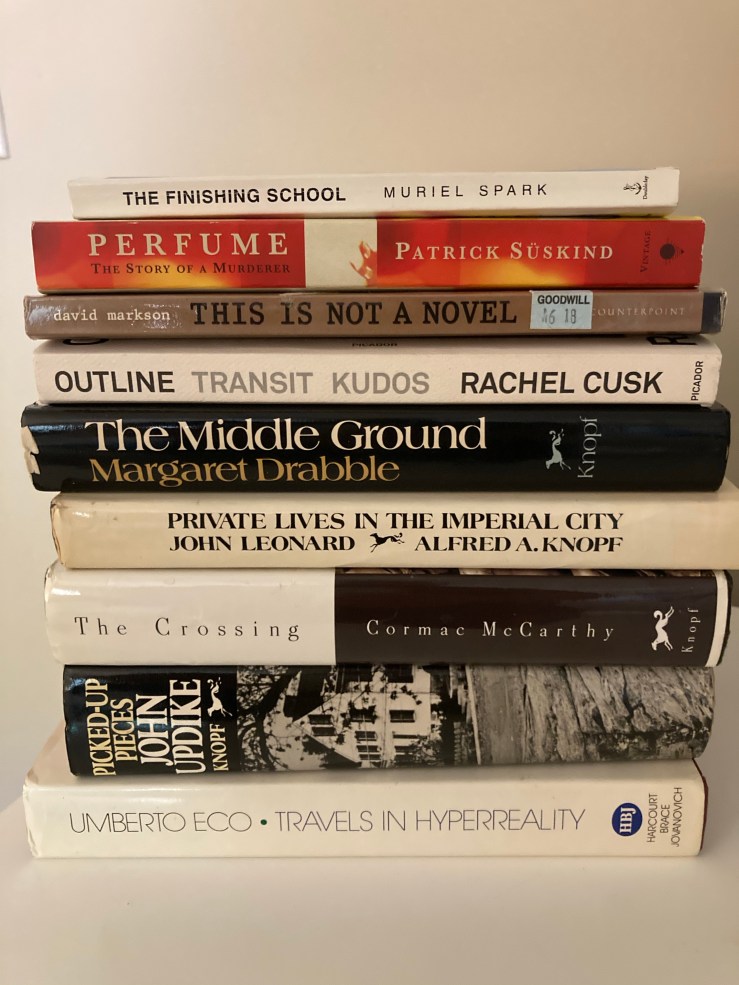
So: Top of stack to bottom:

The Finishing School, Muriel Spark. This is, I believe, the last novel Spark wrote. It came out in 2004; I read a bunch of her earlier stuff last year (and her early novel The Bachelors this March), but it was the mid-period novel Loitering with Intent that I thought the best. I’m not sure if this last novel has the best reputation, but Kakutani hated it, so maybe I’ll dig it. (Oh, and this edition is an ARC!)

Perfume: The Story of a Murderer, Patrick Suskind (trans. by John E. Woods). I loved the 2006 film adaptation. No idea if the book is any good, but the story is all kindsa fucked up.

This Is Not a Novel, David Markson. Look, I already own a copy. But I have a friend who doesn’t (I think).

Outline, Rachel Cusk. I think this is the first of these, right? Admittedly I avoided Cusk’s trilogy, which seemed overhyped (like Knausgaard, maybe?), but for a dollar I’ll give it a shot.

The Middle Ground, Margaret Drabble. A pristine first edition of a mid-period Drabble novel which is perhaps a take on Mrs. Dalloway. Drabble was nowhere on my radar until a few weeks ago when I read that the experimental British novelist B.S. Johnson included her on a list of (then) contemporary British writers he esteemed as writing “as though it mattered.”

Private Lives in the Imperial City, John Leonard. I mostly knew Leonard’s work as a reviewer for Harper’s—his column “New Books” was a go-to for me for a decade, and I wouldn’t presume to say I learned anything from him about writing book reviews (he would be horrified if he cared enough to be horrified), but I thought him an exemplary critic. But mostly fun to read. I didn’t even know about his New York Times column, “Private Lives,” which he wrote between 1977 and 1980. I had no idea what Private Lives was about—I just loved the spine (and then the great cover, featuring a Frank Stella painting)—but most of all I knew I wanted a book by John Leonard. I ended up spending a nice chunk of Saturday reading through the columns, which read like witty, snarky, intimate blog posts—stories about friends, relatives, exploits in New York and abroad. Leonard hates parties; Leonard hated Blow-Up; Leonard finds compassion for a loudmouth on a coast-to-coast flight. This might be the gem in the batch.

The Crossing, Cormac McCarthy. Hey. Look. I own it. But I don’t own it in first edition hardback, right? I recall it as my favorite of the so-called “Border Trilogy.”

Picked Up Pieces, John Updike. I’ve never been a big fan of Updike’s fiction, but I’ve always found something to admire in his criticism and nonfiction. He’s holding a turtle on the cover of this edition. The final section is called something like “One Big Interview,” and the last question asks him which animal he most admires, and he answers that it is the turtle.

I’m pretty sure that the Leonard and Updike (and probably the Drabble) all came from the same collection—there was basically a near-complete set of pristine first-editions of Updikes and John Cheevers, as well as a heavy dose of Philip Roths—all in impeccable condition, tidy jackets, no foxing, clearly read, but unmarked.

Travels in Hyperreality, Umberto Eco. There was also a first-edition of Foucault’s Pendulum in hardback, which I should’ve picked up instead.

A review of Berg, Ann Quin’s grimy oedipal comedy of horrors

ann_quinn_berg_hi_rgb

Ann Quin’s 1964 novel Berg begins with one of the best opening lines I’ve ever read:

A man called Berg, who changed his name to Greb, came to a seaside town intending to kill his father…

This opening line encapsulates the plot of Berg, its terminal ellipses pointing to the radical indecision that propels the novel’s central oedipal conflict—will Berg do it? Can he actually kill his father?

The “seaside town” mentioned in the opening line is presumably Brighton, where Quin was born and died. Quin’s Brighton is hardly a holiday-goer’s paradise though. Grimy and seedy, claustrophobic and cold, it’s populated by carousers and vagabonds. There’s a raucous, sinister energy to Quin’s seaside setting; her Brighton is a combative hamlet pinned against the monstrous swelling sea.

While we sometimes find ourselves in this seaside town’s drunken dancehalls, shadowy train stations, or under grubby piers, most of Berg takes place in a dilapidated boarding house. Here, Alistair Berg (going by Greb) has taken a room adjacent the room his father Nathaniel lives in with his younger mistress Judith. Nathan and Judith’s apartment is a strange horror of antiques and taxidermy beasts. Berg’s apartment is full of the wigs and hair tonics he ostensibly sells for a living. It’s all wonderfully nauseating.

Through the thin wall between these two spaces, Berg hears his father and mistress fight and fuck. He attends both animal grunting and human speech, an imaginative voyeur, and is soon entangled in their lives, as neatly summarized in a letter to his mother Edith, the fourth major character who is never-present yet always-present in the novel. Writing to thank Edith for a food parcel she’s mailed him (Berg is a mama’s boy), he reports:

How are you? Everything here is fine. I’ve seen my father, but so far haven’t revealed who I really am (how Dickensian can one get, and what can I really put—that he’s been fucking another woman next door, and probably a dozen others besides over the past fifteen years, is about to go on tour with some friend in a Vaudeville show, trailing a dummy around, that he’s in love with a budgie…?) Somehow I think you’re better off without him, he seems a bit the worse for wear, not at all like the photograph, or even like the ones you already have of him, and he still hasn’t any money, as far as I can make out he’s sponging left right and centre.

After promising to return home in time for Christmas, Berg signs off with this ambiguous and oedipal ending: “Meanwhile—meanwhile—well I’m going to fuck her too…”

As the novel progresses, the relationships tangle into a Freudian field day: Berg and his father Nathaniel; Berg and his mother; Berg and Judith; Judith and Nathaniel; Nathaniel and Edith. Desire is a funny floating thing in Berg, which plays at times like a horror story and at times like a demented closet farce. As the narrative voice tells us at one point, “no one is without a fetish or two.”

Berg’s desire to kill his father is explored, although his rationale is muddy. Certainly, Edith, whose voice ventriloquizes Berg’s memory, helps spur Berg’s oedipal impulse: “There you see that’s your father who left us both,” she tells him as a boy, pointing to a photograph, adding, “you’ll have to do a lot to overcome him Aly before I die.” So much is loaded into that word overcome. Quin’s novel is precise in its ambiguities, evoking a feeling of consciousness in turmoil.

Berg’s turmoil is indeed the central thrust of the novel. He can’t decide to patricide. Berg works through the justifications for murder, ultimately trying to root out the impetus of his desire to kill his father. “Of course it’s ridiculous to think the whole thing is simply a vehicle for revenge, or even resentment—hardly can it be called personal, not now, indeed I have never felt so objective,” he tells himself at one point, sounding like one of Poe’s maniacs. Quin’s narrative affords him several opportunities to go through with the murder, but, in the novel’s first half anyway, he stalls. “Yes, that’s what it amounts to, decide rather than desire,” he proclaims.

Like Prince Hamlet, Berg is terribly indecisive, spending much of the novel vacillating between action and inaction, letting his consciousness fly through every imaginative possibility. Indeed, the main setting of Berg is not really Brighton or the boarding house, but Alistair Berg’s mind. And yet consciousness is his biggest curse: “Definitely the supreme action is to dispose of the mind, bring reality into something vital, felt, seen, even smelt. A man of action conquering all.” Later, he tells us that “The conscience only sets in when one is static,” coaxing himself toward action. Berg aspires to more than Eliot’s Prufrock. He desires to be more than an attendant lord to swell a progress, start a scene or two.

Indeed, Berg is author, director, and star in this drama of his own creation—he just has to finally follow the call to action. When he finally does snap the mental clapperboard, he comes into the possession—or at least believes he comes into the possession—of his own agency: “How separated from it all he felt, how unique too, no longer the understudy, but the central character as it were, in a play of his own making.”

Throughout Berg, Quin employs a free-indirect style that emphasizes her character’s shifting consciousness. Whatever “reality” Berg experiences is thoroughly mediated by memories of his mother’s voice and his own projections and fantasies. Consider the shift from “he” to “I” in these two sentences:

Half in the light he stood, a Pirandello hero in search of a scene that might project him from the shadow screen on to which he felt he had allowed himself to be thrown. If I could only discover whether cause and effect lie entirely in my power.

Perhaps his dramatic flair comes from his father, a vaudevillian ventriloquist whose most prized possession is a dummy. The dummy is the tragicomic symbol at the heart of Berg, a totem of the way that other voices might inhabit our mouths and drive our desires in bizarre directions. Berg, desirer of the power to cause and effect, often sees others around him as mere props. “She’s not unlike a display dummy really,” he thinks about Judith, who accuses him as someone who’s “always playing a part.” Hefting (what he believes to be) his father’s body, Berg, “aware of the rubbery texture of the flesh,” thinks, “ah well the old man had never been a flesh and blood character really.”

Berg is both victim and hero in a mental-play that he aspires to make real. Consider this wonderful passage that collapses Berg’s monomania, prefigurations of guilt, and dramatic impulses into a courtroom trial:

Alistair Berg, alias Greb, commercial traveller, seller of wigs, hair tonic, paranoiac paramour, do you plead guilty? Yes. Guilty of all things the human condition brings; guilty of being too committed; guilty of defending myself; of defrauding others; guilty of love; loving too much, or not enough; guilty of parochial actions, of universal wish-fulfilments; of conscious martyrdom; of unconscious masochism. Idle hours, fingers that meddle. Alistair Charles Humphrey Greb, alias Berg, you are condemned to life imprisonment until such time you may prove yourself worthy of death.

Berg’s guilt fantasies are bound up in a sense of persecution as well as his notion that he is the real hero of this (his) world, in his belief that he is above “the rest of the country’s cosy mice in their cages of respectability”:

A parasite living on an action I alone dared committing, how can they possibly convict, or even accuse one who’s faced reality, not only in myself, but the whole world, that world which had been rejected, denounced, leaving a space they hardly dared interpreting, let alone sentence.

Although Berg takes place primarily in Our Boy Berg’s consciousness, Quin leavens the fantasy with a hearty ballast of concrete reality. Consider this icky sexual encounter between Berg and Judith, which involves hair tonic and a nosy landlady:

Berg shrank back, bringing Judith with him, she taking the opportunity of pressing closer; sticky, the tonic now drying—gum from a tree—almost making it impossible for Berg to tear himself away. He felt Judith’s warmth, her soft wet tongue in his ear, soon she became intent on biting all available flesh between hairline and collar. But the landlady’s demanding voice made her stop. Berg sank back, while Judith squirmed above him. But as soon as the landlady seemed satisfied that no one was about and closed the door, Judith began licking his fingers. He pulled sharply away, until he lay flat on the floor, his head resting against something quite soft. Judith began wiping his clothes down with a large handkerchief that distinctly smelt of wet fur and hard-boiled sweets. He tried getting up, but she leaned over him, and in the half light he saw her lips curl almost—yes almost—he could swear in a sneer, a positive leer, or was he mistaken and it was only the lustful gaze of a frustrated woman? He jerked sideways. Judith fell right across the body.

Ah, yes — “the body” — well, does Berg carry out his patricide? Of course, in his imagination, a million times—but does his mental-play map onto reality? Do you need to know? Read the book.

Read the book. There’s nothing I can do in this review that approaches the feeling of reading Ann Quin’s Berg. I can make lame comparisons, saying that it reminds me of James Joyce’s Ulysses (in its evocations of loose consciousness), or David Lynch’s Blue Velvet (in its oedipal voyeuristic griminess), or Luis Buñuel’s The Exterminating Angel (for its surreal humor and dense claustrophobia). Or I can point out how ahead of her time Quin was, how Berg bridges modernism to postmodernism while simply not giving a fuck about silly terms like modernism and postmodernism. Or I can smuggle in big chunks of Quin’s prose, as I’ve sought to do, and which I’ll do again, like, here, in this big passage wherein our hero dreams:

Two white-foaming horses with female heads and hooves of fire, with strands of golden mane—honey cones—bore him across a silken screen of sky, over many islands that floated away, and became clouds, a landscape of snow stretching below, and above a canopy of gold. But a harsh voice needled him, pin-pricked his heart, and three drops of blood poured out, extended across the canopy. From this whirlpool a shape formed, then a massive head appeared, without eyes. He turned to the horses, but they were now toads, squat and squeaking, leaping into the hissing pool. The face grew, the mouth opened, swallowing everything, nearer and nearer, until he felt himself being sucked in, down, down and yet farther down, into quicksands of fire and blood, only the dark mass left, as though the very centre of the earth had been reached. The sun exploded between his eyes. He stood up, practically hurling the rug over his shoulder, and jogged towards the station.

Or I can repeat: Read the book.

Of course Berg is Not for Everyone. Its savage humor might get lost on a first read, which might make the intense pain that underwrites the novel difficult to bear. Its ambiguities necessitate that readers launch themselves into a place of radical unknowing—the same space Berg himself enters when he comes to a seaside town, intending to kill his father.

But I loved reading Berg; I loved its sticky, grimy sentences, its wriggly worms of consciousness. I wanted more, and I sought it out, picking up The Unmapped Country, a collection of unpublished Quin stuff edited by Jennifer Hodgson and published by And Other Stories, the indie press that reissued BergHodgson is also a guest on the Blacklisted Podcast episode that focuses on Berg. That episode offers a rallying ringing endorsement, if you need voices besides mine. The Blacklisted episode also features a reading of most of novelist Lee Rourke’s 2010 appreciation for Ann Quin’s Berg. (Rourke had championed online as early as 2007.) Rourke should be commended for being ahead of the curve on resurfacing a writer who feels wholly vital in our own time. He concludes his 2010 piece, “Berg should be read by everyone, if only to give us a glimpse of what the contemporary British novel could be like.” Read the book. 

Quin wrote three other novels before walking into the sea in 1973 and never coming back. Those novels are Three (1966), Passages (1969), and Tripticks (1972). I really hope that And Other Stories will reissue these in the near future. Until then: Read the book. 

[Ed. note—Biblioklept first published this review in the summer of 2019.]

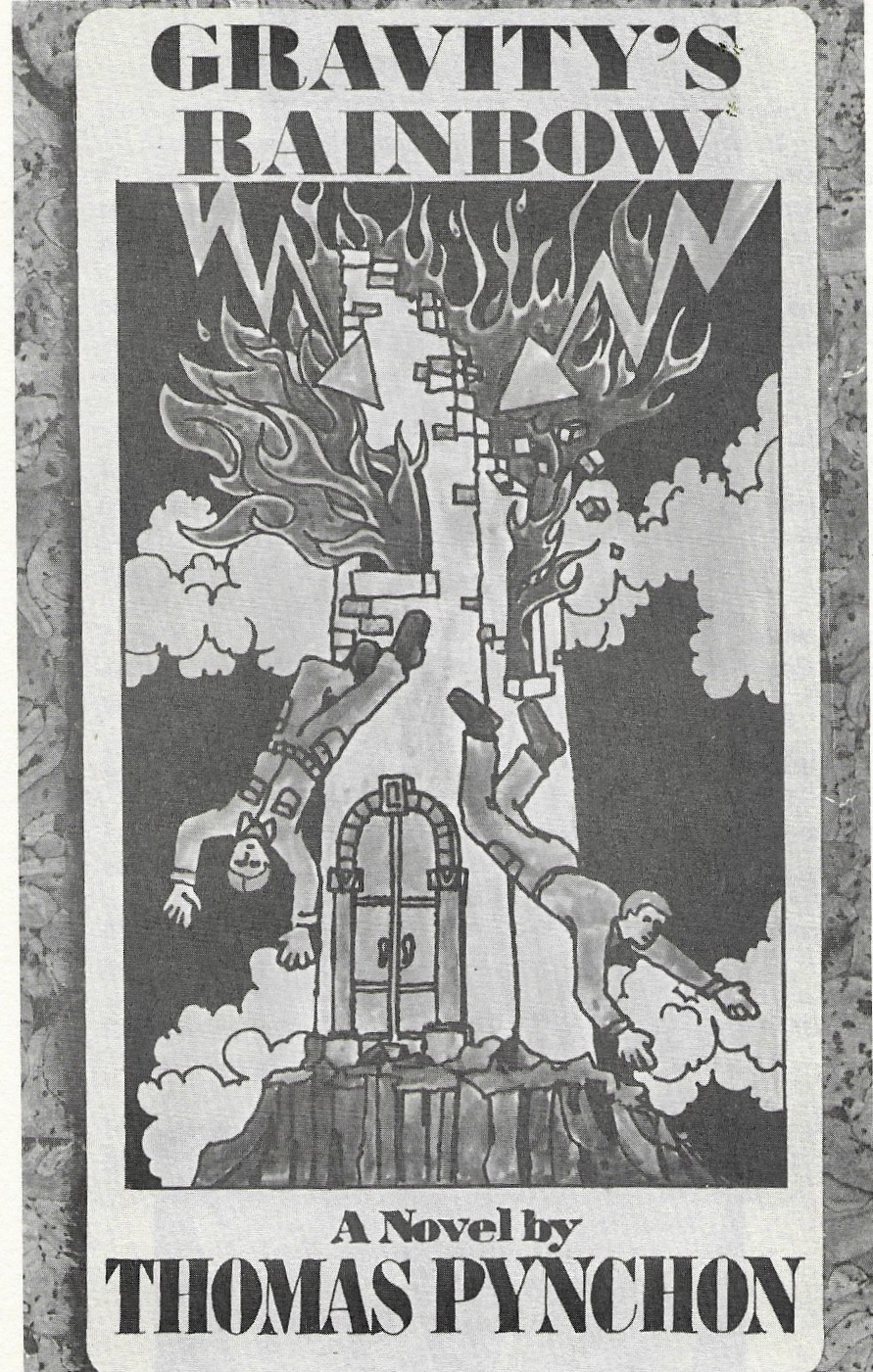
There’s no magic words. Not even I love you is magic enough | A short riff on (a short riff from) Thomas Pynchon’s first novel V.


img_2194

McClintic Sphere, an innovative jazz saxophonist, and Paolo Majistral, the Maltese “girl [who] lived proper nouns” are two minor characters in Thomas Pynchon’s first novel, V. I will get back to them in a second.

But—

A novel crammed with minor characters (hundreds of them, I’d guess) V. pulsates with intersections, drive-bys, concordances and discordance. Characters crisscross and quick-change in ways that both parody and honor the authorial sleight-of-hand in play in V.

Pynchon repeatedly challenges his readers’ credulity–while its intersections are never as neat and tidy as its titular vee angle might suggest, V. is still a confusion of happenstance that both confounds and sanctifies coincidence, even as it ironizes those winds of fate.

The mode is necessarily postmodern. Pynchon repeatedly evokes Modernist poets by name—Pound and Eliot, especially—but it’s the immediate postwar (post, war, world, two) that he’s most concerned with in V. The novel critiques Modernist critiques (through a double lens of a critique of colonialism).

The great concern here is for the divergent angle of the second half of the twentieth century. As such, much of V. is a loving parody of the Beat scene (much more loving than Gaddis’s sustained attack on art poseurs in The Recognitions). In V., Pynchon creates a non-chorus in The Whole Sick Crew, an outcast cast of losers and would-bes and pseudointellectuals.

The Whole Sick Crew lards V.’s enormous, hard-to-follow cast. Two members of the nebulous Crew are

McClintic Sphere, an innovative jazz saxophonist, and Paolo Majistral, the Maltese “girl [who] lived proper nouns.”

And so–

There’s a marvelous moment about two-thirds of the way through V. where McClintic and Paolo, erstwhile lovers (Paolo in the guise of “Ruby” — everyone here is a quick change artist)—where McClintic and Paolo transcend the quick-changing and irony and and sensory-cloggingness of the modern condition. They drive upstate, talk straight—the plot details don’t matter here, just read:

Maybe the only peace undisturbed that night was McClintic’s and Paola’s. The little Triumph forged along up the Hudson, their own wind was cool, taking away whatever of Nueva York had clogged ears, nostrils, mouths.

She talked to him straight and McClintic kept cool.

And then our man McClintic comes to something close to an epiphany, although epiphanies are always hedged, suspicious, constrained in Pynchon—but I think there’s something real here. Earlier in the novel, McClintic feels concern for the postwar “cool,” for the feeling that the world might flip or flop again, go from zero to binary in a weird heartbeat (that binary code theme pulsates through the rest of Pynchon’s work to date). Makes sense for machines, maybe, but people aren’t, or shouldn’t be, machines.

McClintic’s epiphany is a pragmatic resolution, and I take it to be Pynchon’s cautionary thesis:

…there came to McClintic something it was time he got around to seeing: that the only way clear of the cool/crazy flipflop was obviously slow, frustrating and hard work. Love with your mouth shut, help without breaking your ass or publicizing it: keep cool, but care. He might have known, if he’d used any common sense. It didn’t come as a revelation, only something he’d as soon not’ve admitted.

The epiphany is bitter, and Pynchon’s narrator refuses its epiphanic value (“It didn’t come as a revelation”), even as the narrative acknowledges its intrinsic power. A few lines later, McClintic addresses the Real Work to Be Done in the World:

Nobody is going to step down from Heaven and square away Roony and his woman, or Alabama, or South Africa or us and Russia. There’s no magic words. Not even I love you is magic enough. Can you see Eisenhower telling Malenkov or Khrushchev that? Ho-ho.”

“Keep cool but care,” he said. Somebody had run over a skunk a ways back. The smell had followed them for miles. “If my mother was alive I would have her make a sampler with that on it.”

The highway stinks, sticks skunky to fleeing motion, gummed up in the nostalgic emblems we’d imaginatively credit to our loving forebears. The grist, grit, and horror of the big postwar world will cling to the present. Nobody’s stepping down from heaven, or Heaven and there are no magic words—but there is a kind of love, a loving with your mouth shut, a kind of radical, earnest, transcendent love that Pynchon evokes, soils, and sanctifies here.

Thomas Pynchon: A Bibliography (Book acquired and then unacquired in that long COVID march of March 2020-March 2021)

Clifford Mead’s Thomas Pynchon: A Bibliography was published in 1989 by Dalkey. As far as I can tell, the book is out of print and has not been updated.

I checked out Thomas Pynchon: A Bibliography via interlibrary loan back in early March, 2020. My librarian borrowed it for me from the good librarians at the University of South Florida. I can’t really recall why I wanted it—probably not anything specific. I’ve used ILL to get a number of weird or rare items in the past, including a pristine copy of Samuel Chamberlain’s My Confessions (a major source for Cormac McCarthy’s Blood Meridian), and a handful of early stories by William Gaddis (I did not need to get my hands on this juvenalia).

I probably got the bibliography on Tuesday, March 10, 2020. I think that’s the date because I tweeted this photo from its appendix:

If I recall correctly, I had taken that Monday (March 9th) and the preceding Friday off work. My family and I went to Georgia’s coastal Golden Isles and stayed on a houseboat for a few nights. It was the end of my kids’ spring break, and I would have a week of work before my spring break started.

This—the family vacation week—was the first week of March and I was beginning to get pretty paranoid about COVID-19. But I’d been paranoid and tired and really just exhausted for four years straight by now.

I took a break from Mervyn Peake’s Gormenghast trilogy to read Charles Wright’s novel The Wig that weekend. I read it on a houseboat with a corny name on Jekyll Island. We rode bikes around the island and ate sea food, fried food. It was beautiful.

I came back to work, worried but happy to get the Pynchon bibliography, even if it only went to ’89, thus leaving out, like, the last three decades. That must have been, like I said, Tuesday, March 10th.

On Wednesday, March 11th, the NBA canceled their season and I knew what was up.

My department chair decorated our office suite with glittery shamrocks for the upcoming St. Patrick’s Day.

I filled a box with the books and binders and gear I figured I needed to teach from home after Spring Break. A colleague made a joke, something like a, Hey did you get fired with that box in your hands? joke.

(Maybe I’ll see him this fall?)

(Those St. Patrick’s Day decorations are still up, by the way, and, once again, out of season. Although I think they fit the mode of the day, the zeitgeist, the long tacky sparkling sad celebratory day.)

And you more or less know the rest, having lived it in your own first-person perspective.

For most of the year that passed I kept Thomas Pynchon: A Bilbiography with my textbooks. I reached out to my librarian around the time it was due, 10 May 2020 (my wife and I were supposed to be in Chicago then; we weren’t). My librarian said to keep the book in good condition.

In the meantime, I picked up some of the books that Thomas Pynchon had blurbed, often preferring his blurbs to the novels he blurbed.

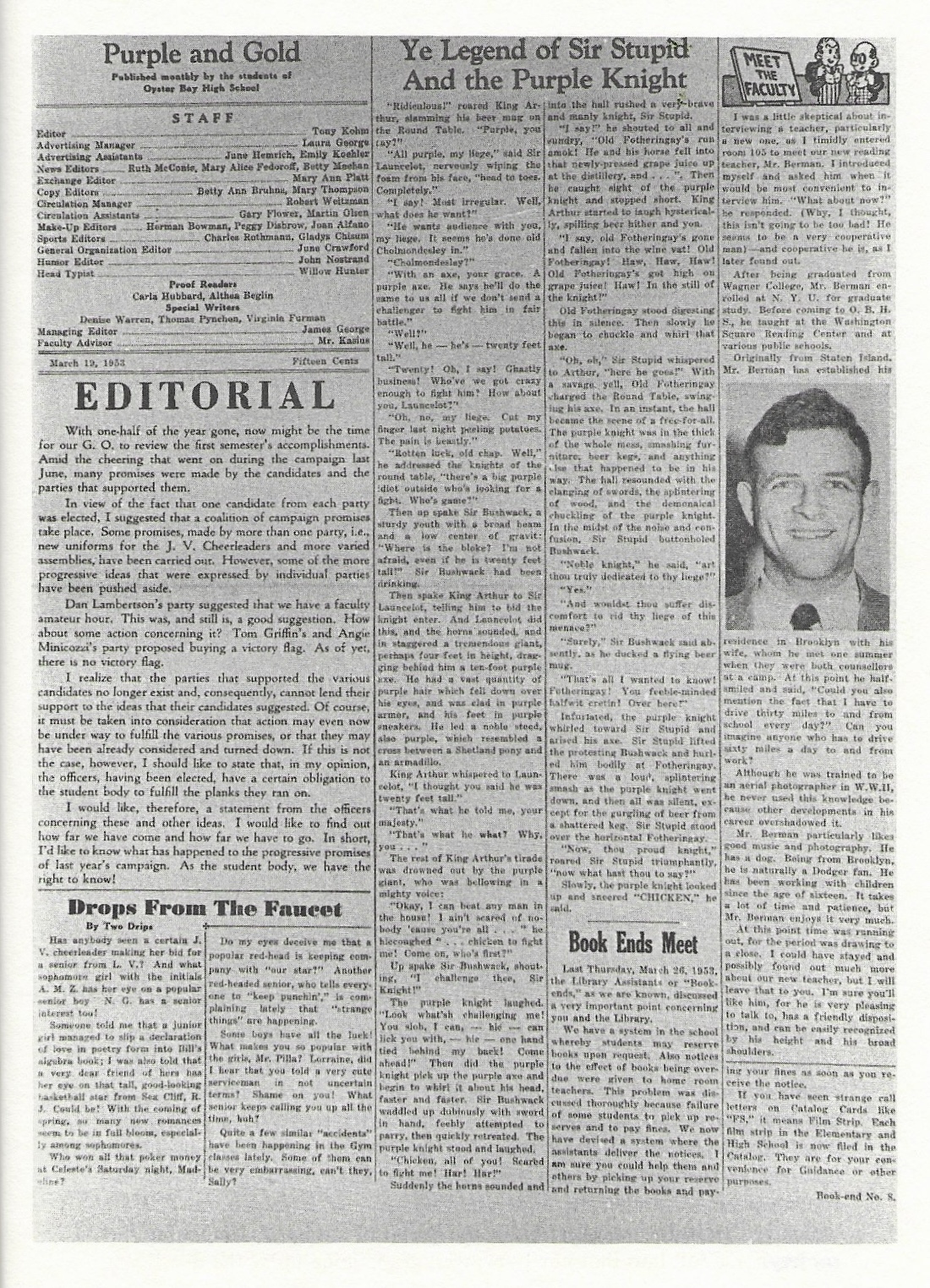
I read some of his juvenalia again, like “Ye Legend of Sir Stupid and the Purple Knight”:

In May I  finally read Pynchon’s latest (last?!) novel Bleeding Edge.

I looked online for bootleg editions of the material that showed up in Slow Learner. I read more of Slow Learner, leaving two tales…just to leave them, just to not have exhausted a…final supply?

In the absence of March Madness college basketball, I ran a silly bracket of dystopian/sci fi writers — “zeitgeisty” writers” — and Pynchon won, beating out J.G. Ballard, who I still think should have won.

(Someone wrote in to tell me that it was the “most shite” thing that I’ve ever done on the blog and to never do it again. Thanks guy! That felt good.)

And also,

I worried, fretted, washed, ranted, cried even at times, but

I never missed a meal and my family had a regular four square game going and Florida actually gave us real Spring weather, crisp and cool and sunny, and the trees bloomed and budded, and I figure in some ways I was as happy as I’ve ever been.

And the year passed, with its plague, its violent racism, its protests, all swelling into its ugly electioneering.

And then this Spring 2021 semester I went back in, setting my feet on campus for Tues and Thurs classes and the world seemed a bit more normal. We got a normal, boring president; a lot of us started to get the vaccine. Things felt…better? Like other folks, I looked forward to hanging out with all the folks I’d seen so little of in the last year.

I got my first vax jab a few weeks ago; I get my second this Friday. I look forward to hanging with “The Boys” (and “the girls,” and etc.)


At some point in the last year I shelved Thomas Pynchon: A Bibliography with the rest of the Pynchon books in the house. I just assumed that it was mine, that it was an artifact of the plague year. My covid acquired.

But last week my librarian let me know, Hey, USF wants that Pynchon book back. I held on to it a second week, revisiting it in parts, but mostly to write this here blog post, mostly to find another way to say, Hey, what a year, eh? I’ll drop it off with my librarian tomorrow, but I think it’ll make me feel a bit sad.

But also maybe relieved.


The drama’s done | Moby-Dick reread, riff 40

Moby-Dick illustration by Barry Moser

I. In this riff, Chapter 135, “The Chase—Third Day” and the Epilogue of Moby-Dick.

The beginning of the end begins, “The morning of the third day dawned fair and fresh” — we are in the tranquil pacified Pacific, beautiful blue, the calm site of a coming calamity.

II. After calling for news of the White Whale, Ahab riffs to himself on the wind. The wind is an apparently concrete force that operates with abstract agency. The wind is a kind of fate, an invisible entity that both propels and repels objects of the phenomenal world:

Would now the wind but had a body; but all the things that most exasperate and outrage mortal man, all these things are bodiless, but only bodiless as objects, not as agents. There’s a most special, a most cunning, oh, a most malicious difference! And yet, I say again, and swear it now, that there’s something all glorious and gracious in the wind.

III. Ahab glimpses his folly:  “I’ve oversailed him,” he mutters about Moby Dick, continuing, “How, got the start? Aye, he’s chasing me now; not I, him—that’s bad; I might have known it, too. Fool!”

The fool there is of course a bit of self-talk Ahab directs to his self-same self.

IV. This final chapter is full of self-talk. Starbuck’s inner monologue turmoils, “I misdoubt me that I disobey my God in obeying him!” Ahab swears to meet Moby Dick, “Forehead to forehead…this third time”; we enter the final private thoughts of Stubb and Flask (but never the pagan harpooneers).

As always, my question remains—

How does Ishmael bear witness to these voices?

V. In a potent soliloquy, Ahab’s sentimentality takes over. He addresses the vast ocean, “the same to Noah as to me.” He seems to portend his own demise, and is distracted momentarily by the “lovely leewardings” that “must lead somewhere—to something else than common land, more palmy than the palms.” But he won’t escape: “Leeward! the white whale goes that way; look to windward, then; the better if the bitterer quarter. But good bye, good bye, old mast-head!”

By the end of the soliloquy Ahab is again convinced — or maybe not wholly convinced, but nevertheless affirming — of his impending victory. He addresses the masthead anew: “We’ll talk to-morrow, nay, to-night, when the white whale lies down there, tied by head and tail.”

VI. Ahab rejects two final calls to remain and retreat. The first is Starbuck’s:

“Some men die at ebb tide; some at low water; some at the full of the flood;—and I feel now like a billow that’s all one crested comb, Starbuck. I am old;—shake hands with me, man.”

Their hands met; their eyes fastened; Starbuck’s tears the glue.

Starbuck’s tears the glue! What a line!

The second entreaty I take to be Ahab’s other first mate, the mad cabinboy Pip:

“Oh, my captain, my captain!—noble heart—go not—go not!—see, it’s a brave man that weeps; how great the agony of the persuasion then!”

“Lower away!”—cried Ahab, tossing the mate’s arm from him. “Stand by the crew!”

“The sharks! the sharks!” cried a voice from the low cabin-window there; “O master, my master, come back!” But Ahab heard nothing; for his own voice was high-lifted then; and the boat leaped on.

Ahab rejects all fellow-feeling here. His monomaniacal voice overtakes all bandwidth, drowning out any sensation of otherness.

VII. The sharks follow Ahab’s boat like “vultures hover over the banners of marching regiments in the east”; as usual, Melville is not shy about slathering on the foreshadowing. He enlists Starbuck’s help; the Christian mate remarks that this, “the third evening,” be “the end of that thing—be that end what it may.”

VIII. Meanwhile, Ahab repeats pagan Fedallah’s pagan prophecy: “Drive, drive in your nails, oh ye waves! to their uttermost heads drive them in! ye but strike a thing without a lid; and no coffin and no hearse can be mine:—and hemp only can kill me! Ha! ha!”

Those dashes, those exclamations—that madness!

IX. Moby Dick then resurfaces, all veils, rainbows, milk:

A low rumbling sound was heard; a subterraneous hum; and then all held their breaths; as bedraggled with trailing ropes, and harpoons, and lances, a vast form shot lengthwise, but obliquely from the sea. Shrouded in a thin drooping veil of mist, it hovered for a moment in the rainbowed air; and then fell swamping back into the deep. Crushed thirty feet upwards, the waters flashed for an instant like heaps of fountains, then brokenly sank in a shower of flakes, leaving the circling surface creamed like new milk round the marble trunk of the whale.

Our boy Moby Dick sets to violence, dashing the boats of Daggoo and Queequeg.

X. The violent spectacle culminates in the most gruesome imagery within Moby-Dick. We learn the fated fate of fated Fedallah:

Lashed round and round to the fish’s back; pinioned in the turns upon turns in which, during the past night, the whale had reeled the involutions of the lines around him, the half torn body of the Parsee was seen; his sable raiment frayed to shreds; his distended eyes turned full upon old Ahab.

XI. Ahab commands his sailors to remain rowing after the White Whale, despite the downed lieutenants and zombified harpooneer. He threatens them:

Down, men! the first thing that but offers to jump from this boat I stand in, that thing I harpoon. Ye are not other men, but my arms and my legs; and so obey me.—

Ahab, who has repeated the idea that his mates are but mechanical things throughout the novel, here spells out his distance from human sympathy, his complete fascistic capitulation. “Ye are not other men” is the exact opposite of the Gospels’ injunction to do unto others. Ahab fails Starbuck’s moral test—and Ishmael’s.

XII. Ahab sees his pagan harpooneers and wrecked mates return to The Pequod to repair boats and rearm:

…he saw Tashtego, Queequeg, and Daggoo, eagerly mounting to the three mast-heads; while the oarsmen were rocking in the two staved boats which had but just been hoisted to the side, and were busily at work in repairing them. One after the other, through the port-holes, as he sped, he also caught flying glimpses of Stubb and Flask, busying themselves on deck among bundles of new irons and lances. As he saw all this; as he heard the hammers in the broken boats; far other hammers seemed driving a nail into his heart. But he rallied. And now marking that the vane or flag was gone from the main-mast-head, he shouted to Tashtego, who had just gained that perch, to descend again for another flag, and a hammer and nails, and so nail it to the mast.

I’ve quoted at length because I think our eyes should be trained on Tashtego, the Native American twice now denied his proper place. He was the first to raise a whale on The Pequod’s voyage (denied by Stubb), and the first to raise Moby Dick (denied by Ahab). Tash will be the last to go down with the ship, nailing a new banner to its highest mast.

XIII. Meanwhile, the sharks chew and chomp at the oarsmen’s oars in Ahab’s whaleboat, to the point “that the blades became jagged and crunched, and left small splinters in the sea, at almost every dip.”

They row on.

XIV. Ahab’s boat comes about and he darts “his fierce iron, and his far fiercer curse into the hated whale.” Three of his oarsmen are knocked from the boat, and only two return, although the one who bobs asea is reported “still afloat and swimming.”

This third castaway is Ishmael.

XV. Moby Dick then attacks The Pequod, “bethinking it—it may be—a larger and nobler foe.”

(“‘The whale! The ship!’ cried the cringing oarsmen.”)

XVI. The White Whale destroys The Pequod, and Melville takes us into the last lungfuls of language from the three mates, Starbuck, Stubb, and Flask. These are mini-monologues that Moby Dick’s ensuing vortex will swamp to oblivion.

“My God, stand by me now!” beseeches Starbuck; “Stand not by me, but stand under me, whoever you are that will now help Stubb,” Stubb non-prays, before praying against this “most mouldy and over salted death”— he’d prefer “cherries! cherries! cherries!” And Flask? “Cherries? I only wish that we were where they grow.” Poor Flask then think of his dear mama, before the ship fails.

XVII. Moby Dick wrecks The Pequod. The crew (in Ishmael’s telling) bears witness:

…all their enchanted eyes intent upon the whale, which from side to side strangely vibrating his predestinating head, sent a broad band of overspreading semicircular foam before him as he rushed. Retribution, swift vengeance, eternal malice were in his whole aspect, and spite of all that mortal man could do, the solid white buttress of his forehead smote the ship’s starboard bow, till men and timbers reeled. Some fell flat upon their faces. Like dislodged trucks, the heads of the harpooneers aloft shook on their bull-like necks. Through the breach, they heard the waters pour, as mountain torrents down a flume.

XVIII. As Ahab watches the disaster, he comes to understand Fedallah’s prophecy: “The ship! The hearse!—the second hearse!” cried Ahab from the boat; “its wood could only be American!”

XIX. And then—

Ahab’s final speech:

Oh, now I feel my topmost greatness lies in my topmost grief. Ho, ho! from all your furthest bounds, pour ye now in, ye bold billows of my whole foregone life, and top this one piled comber of my death! Towards thee I roll, thou all-destroying but unconquering whale; to the last I grapple with thee; from hell’s heart I stab at thee; for hate’s sake I spit my last breath at thee. Sink all coffins and all hearses to one common pool! and since neither can be mine, let me then tow to pieces, while still chasing thee, though tied to thee, thou damned whale! Thus, I give up the spear!

Ahab is knocked from the boat, and hanged in hemp and hate.

XX. The Pequod sinks, but

the pagan harpooneers still maintained their sinking lookouts on the sea. And now, concentric circles seized the lone boat itself, and all its crew, and each floating oar, and every lance-pole, and spinning, animate and inanimate, all round and round in one vortex, carried the smallest chip of the Pequod out of sight.

The final image is devastating: Tashtego nails a seahawk to the mast. Again, forgive me for quoting at length:

…as the last whelmings intermixingly poured themselves over the sunken head of the Indian at the mainmast…a red arm and a hammer hovered backwardly uplifted in the open air, in the act of nailing the flag faster and yet faster to the subsiding spar. A sky-hawk that tauntingly had followed the main-truck downwards from its natural home among the stars…now chanced to intercept its broad fluttering wing between the hammer and the wood; and simultaneously feeling that ethereal thrill, the submerged savage beneath, in his death-gasp, kept his hammer frozen there; and so the bird of heaven, with archangelic shrieks, and his imperial beak thrust upwards, and his whole captive form folded in the flag of Ahab, went down with his ship, which, like Satan, would not sink to hell till she had dragged a living part of heaven along with her, and helmeted herself with it.

What an image!

(I have nothing to add here.)

XXI (Excepting, I would add: I think Melville loads so much in this near-final image of his big book. There are only two paragraphs after this one: a scant sentence that’s basically an exhalation from the image of a submerged Tashtego nailing a hawk to the mast of the sinking Pequod—and then the Epilogue. The Pequod takes its name from an extinct Native American tribe. Tashtego is doubly-denied his due as the First to raise whale. Melville seems to point back to America’s founding as a genocidal project here. I probably need to reread the book again, I now realize. Or maybe read some commenters on this matter that I’ve yet to read. I hate to stick this thought in parentheses, as it’s the thing that interests me the most at the end of this reread—Tashtego the Indian, I mean.)

XXII. And so well the end of the end, the Epilogue.

Here it is in the Arion Press edition I read this time through:

XXIII. Ishmael survives, “floating on the margin of the ensuing scene, and in full sight of it.”

What a position! To be both marginal and omnipresent, both at edge and center to the drama, comedy, tragedy of it all!

The notation from the Book of Job is everything here—the disaster is only a disaster if there is one to bear witness to it. Otherwise, disaster is simply a phenomenological event in nature—random, stochastic, energy, mass, and matter moving without meaning.

Ahab pretends at a great searcher for meaning, but he fixes his search on vengeance. “Madness!” Starbuck chides (if Starbuck could chide) — “To be enraged with a dumb thing, Captain Ahab, seems blasphemous.” Ahab has read too deep, read too twisted—he’s a bad reader, a mutant reader, an overreader—but he’s failed repeatedly to read the souls and faces of his fellows.

XXIV. The final curse and blessing is upon Ishmael though. He names himself at the novel’s famous outset — “Call me Ishmael” — a call that likens him to Hagar’s outcast son. At its end, he likens himself to another outcast, “another Ixion,” all the while circling into a vortex of nature, meaning, language—all the forces that would swallow him. (He’s Melville’s maddened howl here.)

Ishmael floats on “a soft and dirgelike main,” bobbing alive on Queequeg’s coffin, the strange lifebuoy of his strange bedfellow, until he’s saved by The Rachel—the ship Ahab had earlier denied—which still cruises for a lost son. He is not the lost son, but he has been lost, and is here saved by The Rachel’s “retracing search after her missing children” — a retracing, a rereading, a rewriting — one that surfaces the wailing of only another orphan.

Moby-Dick illustration by Barry Moser

A life-buoy of a coffin! Does it go further? | Moby-Dick reread, riff 37

Moby-Dick illustration by Barry Moser

I. In this riff, Chapters 127-129 of Moby-Dick.

II. Ch. 127, “The Deck.”

Another chapter composed as playwright’s drama—mostly dialogue, and a few spare stage directions.

The dialogue is between Ahab and the carpenter. The poor old man has been charged with the task of converting Queequeg’s coffin into a life-buoy (you will recall The Pequod lost both the life-buoy and the sailor it was thrown to save in the previous chapter).

Ahab’s back-and-forth with the carpenter highlight’s the captain’s careen into deeper madness. He’s alarmed by the carpenter’s ironic task:

Then tell me; art thou not an arrant, all-grasping, intermeddling, monopolising, heathenish old scamp, to be one day making legs, and the next day coffins to clap them in, and yet again life-buoys out of those same coffins? Thou art as unprincipled as the gods, and as much of a jack-of-all-trades.”

It’s another metatextual moment in Moby-Dick, where Ahab plays a critic, pointing out perhaps that Melville’s ironic foreshadowing here is overdetermined stuff. But the dialogue leads Ahab inward to monologue, and he tries to play out the greater meaning of the symbol, beyond plot-bound gimmickry. The phenomenal experience of hearing the carpenter’s work sends him into a philosophical reverie:

Rat-tat! So man’s seconds tick! Oh! how immaterial are all materials! What things real are there, but imponderable thoughts? Here now’s the very dreaded symbol of grim death, by a mere hap, made the expressive sign of the help and hope of most endangered life. A life-buoy of a coffin! Does it go further? Can it be that in some spiritual sense the coffin is, after all, but an immortality-preserver! I’ll think of that.

In the end though the coffin is a life-preserver—it saves Ishmael, and, in a sense, is an immortality-preserver, as it becomes the mechanism that sustains Ishmael’s infinite witnessing.

III. Ch. 128, “The Pequod Meets The Rachel.”

This is possibly the saddest chapter in Moby-Dick.

The Pequod meets The Rachel, also of Nantucket. It’s the penultimate ship they will meet in their soon-to-be-over voyage (the ironically named Delight is their last exchange).

The captain of The Rachel is able to affirm Ahab’s monomaniacal hailing, and then pose his own rejoinder:

“Hast seen the White Whale?”

“Aye, yesterday. Have ye seen a whale-boat adrift?”

The Rachel’s captain boards The Pequod. It turns out that one of the whaling boats of The Rachel set out after Moby Dick, yet never returned. We then learn his motivation for the curt gam:

The story told, the stranger Captain immediately went on to reveal his object in boarding the Pequod. He desired that ship to unite with his own in the search; by sailing over the sea some four or five miles apart, on parallel lines, and so sweeping a double horizon, as it were.

Callous Stubb suggests that the captain is anxious to get the boat’s crew back because “some one in that missing boat wore off that Captain’s best coat; mayhap, his watch.” Stubb shows a tenderer heart though when the truth is revealed: “My boy, my own boy is among them,” pleads the captain,” begging Ahab to charter The Pequod for two days.

Stubb—who I’ve thought in this reread the villain of the novel for his bullying humor—redeems himself here: “His son!” cried Stubb, “oh, it’s his son he’s lost! I take back the coat and watch—what says Ahab? We must save that boy.”

What says Ahab?

But first—what says the captain—referred to repeatedly as “the stranger” in this chapter:

“I will not go,” said the stranger, “till you say aye to me. Do to me as you would have me do to you in the like case.

We find here Melville reworking the Gospel of Matthew, 25:35-45. 

The specific passages from Matthew’s Gospel repeatedly refer to the stranger—who is to be fed, clothed, visited, etc. — like, generally, done unto. (Melville would explore the concept in a leaner story with more depth in Bartleby.)

The Gospel’s injunction is straightforward. We must treat others—particularly strangers, those othered-others, “the least of these,” in the NIV translation—as we wish to be treated.

And so well,

What says Ahab?

“Avast,” cried Ahab—“touch not a rope-yarn”; then in a voice that prolongingly moulded every word—“Captain Gardiner, I will not do it. Even now I lose time. Good-bye, good-bye. God bless ye, man, and may I forgive myself, but I must go.

Ahab hopes he can forgive himself. But the end of Matthew Ch. 25 is pretty clear (KJV this time).: “Verily I say unto you, Inasmuch as ye did it not to one of the least of these, ye did it not to me. And these shall go away into everlasting punishment.”

IV. Ch. 129, “The Cabin.”

Another chapter composed as playwright’s drama—mostly dialogue, and a few spare stage directions—and, like Ch. 127, a chapter that ends in a crazed monologue.

The chapter starts with Ahab telling Pip way too late, “Lad, lad, I tell thee thou must not follow Ahab now. The hour is coming when Ahab would not scare thee from him, yet would not have thee by him.” Ahab tells Pip that Pip is the cure for his malady, but that his “malady becomes [his] most desired health.” It’s a strange moment between two cursed persons—Ahab recognizes here the injunction in the Gospel of Matthew that he’s failed to meet in the previous chapter (and hey, I even forgot to point out that the captain of The Rachel is not even a stranger to Ahab—our monomaniac calls the man by name!)—but where was I? I think it’s a weird tender moment. Ahab recognizes Pip as a kind of son, and tells him to stay safe in his cabin. But he also seems to know that the entire ship is headed toward some kind of Big Death.

Ahab departs; Pip fills the cabin — and the end of the “The Cabin” — with his crazed voice. He’s already the vacant post that Ishmael will evoke in the novel’s epilogue. So let him speak:

Here he this instant stood; I stand in his air,—but I’m alone. Now were even poor Pip here I could endure it, but he’s missing. Pip! Pip! Ding, dong, ding! Who’s seen Pip? He must be up here; let’s try the door. What? neither lock, nor bolt, nor bar; and yet there’s no opening it. It must be the spell; he told me to stay here: Aye, and told me this screwed chair was mine. Here, then, I’ll seat me, against the transom, in the ship’s full middle, all her keel and her three masts before me. Here, our old sailors say, in their black seventy-fours great admirals sometimes sit at table, and lord it over rows of captains and lieutenants. Ha! what’s this? epaulets! epaulets! the epaulets all come crowding! Pass round the decanters; glad to see ye; fill up, monsieurs! What an odd feeling, now, when a black boy’s host to white men with gold lace upon their coats!—Monsieurs, have ye seen one Pip?—a little negro lad, five feet high, hang-dog look, and cowardly! Jumped from a whale-boat once;—seen him? No! Well then, fill up again, captains, and let’s drink shame upon all cowards! I name no names. Shame upon them! Put one foot upon the table. Shame upon all cowards.—Hist! above there, I hear ivory—Oh, master! master! I am indeed down-hearted when you walk over me. But here I’ll stay, though this stern strikes rocks; and they bulge through; and oysters come to join me.


Crying and sobbing with their human sort of wail | Moby-Dick reread, riff 36

I. In this riff, Chapters 124-126 of Moby-Dick.

II. Ch. 124, “The Needle.”

“The Needle” is another one of Melville’s satanic reversals in Moby-Dick. Lightning from the tempest that The Pequod endured over the past few chapters has caused all compasses aboard the ship to be perfectly reversed.  Needles fly in the exact opposite directions. What might have been up, in a certain sense, points downward.

Again, Ahab is a bad reader—or a reader whose monomania overrides his ability to comprehend other perspectives, other views, other directions.

III. And yet Ahab is a bold reader, one who shapes nature to his own direction (or will in anywise perish doing so):

“Men,” said he, steadily turning upon the crew, as the mate handed him the things he had demanded, “my men, the thunder turned old Ahab’s needles; but out of this bit of steel Ahab can make one of his own, that will point as true as any.”

Ahab sets about to magnetize a needle with the “steel head of the lance,” and the crew watches on in wonder and mild horror. Ishmael (Melville) notes that, “with fascinated eyes they awaited whatever magic might follow”  — and then tellingly: “But Starbuck looked away.” 

Starbuck’s attempt to see no evil reverberates through the crew who gaze at the new compass needle in turns at the end of the scene:

One after another they peered in, for nothing but their own eyes could persuade such ignorance as theirs, and one after another they slunk away.

In his fiery eyes of scorn and triumph, you then saw Ahab in all his fatal pride.

Slink away; perish still.

Moby-Dick illustration by Barry Moser

IV. Ch. 125, “The Log and Line.”

A somewhat extended episode, the mechanics of which I’m in no mood to summarize here. Suffice to say that “the log and line” — basically, a way of calculating the ship’s speed — “had but very seldom been in use” lately on The Pequod’s voyage. Ahab has found other ways to measure and to read the phenomenal world. But, thinking he’s closing in on the White Whale, he commands the “golden-hued Tahitian and the grizzly Manxman” to the task of log and line.

V. The Manxman declares the line “rotten,” a prescient analysis that reads The Pequod’s impending doom.

A mark of that rottenness evinces in Pip’s emergence. The crazed cabin boy alights on the deck, a rotten line in a book of glowing rotten lines. He contests his own identity. He’s a vacant post, a drowned sailor:

“Pip? whom call ye Pip? Pip jumped from the whale-boat. Pip’s missing. Let’s see now if ye haven’t fished him up here, fisherman. It drags hard; I guess he’s holding on. Jerk him, Tahiti! Jerk him off; we haul in no cowards here. Ho! there’s his arm just breaking water. A hatchet! a hatchet! cut it off—we haul in no cowards here. Captain Ahab! sir, sir! here’s Pip, trying to get on board again.”

VI. (I will leave the line Jerk him off in this oh-so-phallic novel alone, apart from noting it here in these parentheses.)

VII. “Peace, thou crazy loon,” cries the Manxman, trying to shoo him from the quarter-deck, but Ahab admonishes the older sailor and enters into conversation with the insane cabin boy:

“The greater idiot ever scolds the lesser,” muttered Ahab, advancing. “Hands off from that holiness! Where sayest thou Pip was, boy?

“Astern there, sir, astern! Lo! lo!”

“And who art thou, boy? I see not my reflection in the vacant pupils of thy eyes. Oh God! that man should be a thing for immortal souls to sieve through! Who art thou, boy?”

“Bell-boy, sir; ship’s-crier; ding, dong, ding! Pip! Pip! Pip! One hundred pounds of clay reward for Pip; five feet high—looks cowardly—quickest known by that! Ding, dong, ding! Who’s seen Pip the coward?”

“There can be no hearts above the snow-line. Oh, ye frozen heavens! look down here. Ye did beget this luckless child, and have abandoned him, ye creative libertines. Here, boy; Ahab’s cabin shall be Pip’s home henceforth, while Ahab lives. Thou touchest my inmost centre, boy; thou art tied to me by cords woven of my heart-strings. Come, let’s down.”

Pip then, and not Fedallah, is Ahab’s true squire. Poor child.

Moby-Dick illustration by Barry Moser

VIII. Ch. 126, “The Life-Buoy.”

“[D]etermined by Ahab’s level log and line; the Pequod held on her path towards the Equator.” On their way there,

sailing by a cluster of rocky islets…the watch…was startled by a cry so plaintively wild and unearthly—like half-articulated wailings of the ghosts of all Herod’s murdered Innocents—that one and all, they started from their reveries…

The wailing there again calls to me. I’ve probably stated ad nauseum in these riffs that Moby-Dick is a whaling book about wailing.

IX. Ishmael continues his ironic critique of the viewpoints of “pagans” and “civilized” folk:

The Christian or civilized part of the crew said it was mermaids, and shuddered; but the pagan harpooneers remained unappalled.

The pagan harpooneers remain unappalled because they are not in the thrall of superstitious ignorance.

X. The wailing is not lost souls or mermaids, we learn, but rather the crying of

some young seals that had lost their dams, or some dams that had lost their cubs, [who] must have risen nigh the ship and kept company with her, crying and sobbing with their human sort of wail.

Their human sort of wail—a wailing, a hailing, an interpellation that the sailors can read.

XI. After this wailing episode, we learn that a lookout posted at the top of The Pequod  drowns. The crew spies him, “a falling phantom in the air,” and throw out the titular life-buoy to recover him.

Neither returns.

XII. The life-buoy must be resurrected in a new form, though. However, “no cask of sufficient lightness could be found.” Fortunately (ultimately, for Ishmael), “by certain strange signs and inuendoes Queequeg hinted a hint concerning his coffin”

“A life-buoy of a coffin!” cried Starbuck, starting.

“Rather queer, that, I should say,” said Stubb.

“It will make a good enough one,” said Flask, “the carpenter here can arrange it easily.”

And so the carpenter does, despite the queerness of this job—making a life preserver of a coffin.

Hence Moby-Dick formalizes its theme of LIFE | DEATH in an overdetermined symbol, an abstract concrete thing our living ghosting narrator will cling to after the drama’s done, after the sweep of disaster vortexes all.

Wild nights | Moby-Dick reread, riff 35

I. In this riff, Ch. 123, “The Musket.”

Here, we—and by which we, I guess I mean Ishmael’s consciousness–or maybe I just mean we—enter Starbuck’s consciousness.

Our good Christian co-commander stands outside crazy Captain Ahab’s quarters, wondering whether to tell his commander that The Pequod has escaped a typhoon–or to kill the tyrant.

II. Ch. 123 delivers the longest (I mean, I’m pretty sure it’s the longest) monologue we get from Starbuck in the novel, as he ponders the morality of assassinating his captain, Ahab. It begins:

“He would have shot me once,” he murmured, “yes, there’s the very musket that he pointed at me;—that one with the studded stock; let me touch it—lift it. Strange, that I, who have handled so many deadly lances, strange, that I should shake so now. Loaded? I must see. Aye, aye; and powder in the pan;—that’s not good. Best spill it?—wait. I’ll cure myself of this. I’ll hold the musket boldly while I think.

Starbuck’s monologue is riddled with the kind of dashes and question marks we might more readily identify with Poe’s bipolars or Dickinson’s Riddles. Madness infects, and Starbuck is touched.

III. “Has he not dashed his heavenly quadrant?” Starbuck dashingly muses, prefiguring, perhaps, Emily Dickinson’s lines, “Done with the Compass – / Done with the Chart!”

Wild nights indeed!

IV. Starbuck’s wild night again shifts into Poe territory. He’s got a touch of craze to his soul, but he’s still the Christian moral (a)center of Melville’s satanic novel. Here, he weighs the metaphysical against the physical:

But shall this crazed old man be tamely suffered to drag a whole ship’s company down to doom with him?—Yes, it would make him the wilful murderer of thirty men and more, if this ship come to any deadly harm; and come to deadly harm, my soul swears this ship will, if Ahab have his way. If, then, he were this instant—put aside, that crime would not be his. Ha! is he muttering in his sleep? Yes, just there,—in there, he’s sleeping. Sleeping? aye, but still alive, and soon awake again.

V. Starbuck understands that Ahab will wholly infect the crew of The Pequod, dooming them in his disease:

Not reasoning; not remonstrance; not entreaty wilt thou hearken to; all this thou scornest. Flat obedience to thy own flat commands, this is all thou breathest. Aye, and say’st the men have vow’d thy vow; say’st all of us are Ahabs.

VI. In the end though—well, in the end, Starbuck chickens out, as we knew he would. “Great God, where art Thou? Shall I? shall I?” he implores, but God does not answer in any language Starbuck is prepared to read. Instead, Ahab answers (and God through him?) — “Stern all! Oh Moby Dick, I clutch thy heart at last!” — another prefiguration of the demise of the crew Starbuck would save if he were made of sterner stuff.

VII. The episode ends with Starbuck retreating, telling Stubb to wake Ahab.

All of us are Ahabs | Moby-Dick reread, riff 34

I. In this riff, Chapters 120-122 of Moby-Dick.

II. Ch. 120, “The Deck Towards the End of the First Night Watch.”

A very short chapter with a mediumish-length title

After the title, we have a stage direction: Ahab standing by the helm. Starbuck approaching him.

The rest is a brief exchange between Captain and First Mate, in which Starbuck is overwhelmed (again) by Ahab’s tyrannical force.

III. Ch. 121, “Midnight.—The Forecastle Bulwarks.”

We go from Ahab and Starbuck to “Stubb and Flask mounted on them [the forecastle bulwarks], and passing additional lashings over the anchors there hanging.” 

After this stage direction, again—dialogue. I might summarize their brief conversation, which we audit unimpeded by authorial intrusions—but I’d rather point out the complete retreat of Ishmael. He is again a ghostly voyeur, here there and everywhere in the text, an open ear, unobtrusive, the ship’s silent spirit.

IV. Ch. 122, “Midnight Aloft.—Thunder and Lightning.”

Great little poem, this chapter. Look, here it is. Read it aloud, make it rhyme:

Give us a glass of rum. Um, um, um!

Thy incommunicable riddle, thy unparticipated grief | Moby-Dick reread, riff 33

Moby-Dick illustration by Barry Moser

I. In this riff, Chapters 118 and 119 of Moby-Dick.

II. Ahab has already gone mad before The Pequod sets sail on this particular voyage, but Ch. 118, “The Quadrant,” feels like a tipping point where his madness spills a bit too outside of himself. Starbuck has already expressed his mortification for their revenge mission, but it’s not until the end of “The Quadrant” that he seems to fully comprehend the depth of Ahab’s madness:

“I have sat before the dense coal fire and watched it all aglow, full of its tormented flaming life; and I have seen it wane at last, down, down, to dumbest dust. Old man of oceans! of all this fiery life of thine, what will at length remain but one little heap of ashes!”

What prompts this strange, deathly, foreboding analogy? A monomaniacal monologue from Ahab, of course.

III. Starbuck—and physical foil to Starbuck’s metaphysical moralizing, Stubb—witness Ahab castigate his quadrant in a fury, trampling upon it “with his live and dead feet” alike.

Ahab’s anger comes down again to the limitations of reading, of knowing through the signs and symbols of the world. Gazing at “its numerous cabalistical contrivances,” he censures the device as a “Foolish toy! babies’ plaything of haughty Admirals, and Commodores, and Captains.”

For Ahab, this navigation tool does not measure up: “what after all canst thou do, but tell the poor, pitiful point, where thou thyself happenest to be on this wide planet, and the hand that holds thee: no! not one jot more!” He curses the “vain toy,” which can attest where he is, but cannot find him the object of his murderous desire, Moby Dick.

Moby-Dick illustration by Barry Moser

IV. Ch. 119, “The Candles.”

The titular candles here are the three masts of The Pequod, which, struck by lightning during a typhoon, catch on fire. Hence, Ahab’s ship doubles Ahab’s body, which has been afflicted with its own lightning scar.

The scene is bombastic, and Ahab attends it in a kind of prayer-like reverie. He delivers another monologue that indirectly echoes Starbuck’s undelivered admonition that Ahab might end “a heap of ashes”:

“Oh! thou clear spirit of clear fire, whom on these seas I as Persian once did worship, till in the sacramental act so burned by thee, that to this hour I bear the scar; I now know thee, thou clear spirit, and I now know that thy right worship is defiance. … In the midst of the personified impersonal, a personality stands here…Oh, thou clear spirit, of thy fire thou madest me, and like a true child of fire, I breathe it back to thee.”

Here, Melville—or is it Ishmael?—delivers stage directions:

[Sudden, repeated flashes of lightning; the nine flames leap lengthwise to thrice their previous height; Ahab, with the rest, closes his eyes, his right hand pressed hard upon them.]

V. Ahab at this point is full-on crazy. He directly addresses the lightning and fire, in which he finds a kind of power unconstrained by maps and charts, a force that no quadrant might locate. He vows to read the lightning, to find meaning by groping in blindness, a thing of ashes:

“I own thy speechless, placeless power; said I not so? Nor was it wrung from me; nor do I now drop these links. Thou canst blind; but I can then grope. Thou canst consume; but I can then be ashes. Take the homage of these poor eyes, and shutter-hands. I would not take it. The lightning flashes through my skull; mine eye-balls ache and ache; my whole beaten brain seems as beheaded, and rolling on some stunning ground.

Ahab continues to read the lightning with his eyes closed. He claims that he is darkness, the dark that affords the light its position through opposition, and goes so far as to claim the lightning as his father:

Oh, oh! Yet blindfold, yet will I talk to thee. Light though thou be, thou leapest out of darkness; but I am darkness leaping out of light, leaping out of thee! The javelins cease; open eyes; see, or not? There burn the flames! Oh, thou magnanimous! now I do glory in my genealogy. But thou art but my fiery father; my sweet mother, I know not.

But mother? Sweet mother, I know not: “Oh, cruel! what hast thou done with her?”

Again—Moby-Dick is a novel of orphans wailing.

And fathers? Well, they’re out there, in the natural phenomena, I guess—symbols are all Ahab needs to father him.

VI. Ahab’s series of satanic inversions continues. He envies the lightning’s “unbegotten…unbegun” singularity. He also evokes in his anti-prayer the “unsuffusing thing beyond thee, thou clear spirit, to whom all thy eternity is but time.” Ahab tries to read god through this “clear spirit”: “Through thee, thy flaming self, my scorched eyes do dimly see it” — but dimly here does so much work. Ahab is a failed transcendentalist.

VII. He reads in the fire another orphan, another outcast figuration of himself (and Ishmael, and the others who crew The Pequod):

Oh, thou foundling fire, thou hermit immemorial, thou too hast thy incommunicable riddle, thy unparticipated grief. Here again with haughty agony, I read my sire. Leap! leap up, and lick the sky! I leap with thee; I burn with thee; would fain be welded with thee; defyingly I worship thee!”

Ahab now dominates not just The Pequod, but the voice of the novel itself. He reads the lightning, worships the fire, and finds not solace but the confirmation of his vengeance in its clarifying spirit.

The ineffaceable, sad birth-mark in the brow of man, is but the stamp of sorrow in the signers | Moby-Dick reread, riff 29

I. In this riff, Chapters 106-108 of Moby-Dick.

This trio of chapters introduces the carpenter, who proves a strange foil to Ahab.

Moby-Dick illustration by Barry Moser

II. Ch. 106, “Ahab’s Leg.”

Moby-Dick is a phallic novel, full of thrusts, jabs, ejaculations, and sperm sperm sperm. “Ahab’s Leg” reinforces this theme through negation. Melville (or is it Ishmael?) underscores here the notion that Ahab has been symbolically castrated by Moby Dick; this symbolic castration leads to Ahab’s revenge quest—the monomaniacal captain seeks to reassert his power through domination. (It’s all a dick swingin’ contest.)

III. The symbolic castration repeats when Ahab quits The Samuel Enderby, and endures “some small violence to his own person.” We learn that in the jostling of the boat, “his ivory leg had received a half-splintering shock.” This second figurative castration actually follows a near-literal one though:

For it had not been very long prior to the Pequod’s sailing from Nantucket, that he had been found one night lying prone upon the ground, and insensible; by some unknown, and seemingly inexplicable, unimaginable casualty, his ivory limb having been so violently displaced, that it had stake-wise smitten, and all but pierced his groin; nor was it without extreme difficulty that the agonizing wound was entirely cured.

And yet it’s clear that the wound is still not entirely cured. Ahab seeks to repair his phallic wound by way of a phallic spearing of the White Whale.

IV. The chapter continues down a stranger path. Ishmael, with his all-access pass to consciousness, relates that Ahab, reflecting on his woes, decries that, “all miserable events do naturally beget their like.” The text continues, dwelling on sodomy, hell, and the perpetuation of grief:

Yea, more than equally, thought Ahab; since both the ancestry and posterity of Grief go further than the ancestry and posterity of Joy. For, not to hint of this: that it is an inference from certain canonic teachings, that while some natural enjoyments here shall have no children born to them for the other world, but, on the contrary, shall be followed by the joy-childlessness of all hell’s despair; whereas, some guilty mortal miseries shall still fertilely beget to themselves an eternally progressive progeny of griefs beyond the grave; not at all to hint of this, there still seems an inequality in the deeper analysis of the thing. For, thought Ahab, while even the highest earthly felicities ever have a certain unsignifying pettiness lurking in them, but, at bottom, all heartwoes, a mystic significance, and, in some men, an archangelic grandeur; so do their diligent tracings-out not belie the obvious deduction. To trail the genealogies of these high mortal miseries, carries us at last among the sourceless primogenitures of the gods; so that, in the face of all the glad, hay-making suns, and soft cymballing, round harvest-moons, we must needs give in to this: that the gods themselves are not for ever glad. The ineffaceable, sad birth-mark in the brow of man, is but the stamp of sorrow in the signers.

The depressive, fatalistic tone here is pure Ahab–if Ishmael’s expansive over-soul touches the paragraph, it does so in opposition. (What an amazing passage.)

V. Ch. 107, “The Carpenter.”

A nice little chapter describing the ship’s carpenter, who is a sort of Swiss army knife of a man:

He was like one of those unreasoning but still highly useful, multum in parvo, Sheffield contrivances, assuming the exterior—though a little swelled—of a common pocket knife; but containing, not only blades of various sizes, but also screw-drivers, cork-screws, tweezers, awls, pens, rulers, nail-filers, countersinkers. So, if his superiors wanted to use the carpenter for a screw-driver, all they had to do was to open that part of him, and the screw was fast: or if for tweezers, take him up by the legs, and there they were.

He sets about crafting Ahab a new leg.

VI. Ch. 108, “Ahab and the Carpenter.”

Melville (Ishmael?) again turns his novel into a Shakespearian play, complete with stage directions. The carpenter files away at the ivory leg-to-be, while the blacksmith bangs about in the background. He sneezes as he files away at the crutch he creates.

Ahab enters, invoking the carpenter as a Promethean figure:

“Well, manmaker!”

The carpenter then sets about to measure for Ahab’s leg. Ahab sticks his stump into a vice (an implicitly sexual image). The carpenter warns him about the vice’s grip, but Ahab is malevolently jocular. He then directly invokes Prometheus;

No fear; I like a good grip; I like to feel something in this slippery world that can hold, man. What’s Prometheus about there?—the blacksmith, I mean—what’s he about?

V. Ahab essentially ignores the carpenter’s plain answers, and instead begins soliloquizing. Again, he’s monovocal in stereophonic world:

I do deem it now a most meaning thing, that that old Greek, Prometheus, who made men, they say, should have been a blacksmith, and animated them with fire; for what’s made in fire must properly belong to fire; and so hell’s probable.

VI. Ahab’s monomania crests: He sets about to become the Prometheus in the scene—but a commander Prometheus, an artistic director. His idealized “complete man” reveals more of Ahab’s singular vision—a vision that precludes all other perspectives. He conjures a heartless giant–an intellectual giant:

Hold; while Prometheus is about it, I’ll order a complete man after a desirable pattern. Imprimis, fifty feet high in his socks; then, chest modelled after the Thames Tunnel; then, legs with roots to ’em, to stay in one place; then, arms three feet through the wrist; no heart at all, brass forehead, and about a quarter of an acre of fine brains; and let me see—shall I order eyes to see outwards? No, but put a sky-light on top of his head to illuminate inwards. There, take the order, and away.

Ahab’s ideal man has no outward-seeing eyes–there is no perspective at all here except that which will “illuminate inwards.” He mentions no mouth.

VII. Ahab finally quits the carpenter’s shop, and the poor old man begins his own monologue. He repeats the key word queer ten times over in his evocation of Ahab:

Well, well, well! Stubb knows him best of all, and Stubb always says he’s queer; says nothing but that one sufficient little word queer; he’s queer, says Stubb; he’s queer—queer, queer; and keeps dinning it into Mr. Starbuck all the time—queer—sir—queer, queer, very queer.

And who is queer Ahab’s bedfellow?

Yes, now that I think of it, here’s his bedfellow! has a stick of whale’s jaw-bone for a wife!

Face set like a flint | Moby-Dick reread, riff 27

Moby-Dick illustration by Barry Moser

I. In this riff, Chapter 100 of Moby-Dick — “Leg and Arm • The Pequod, of Nantucket, meets the Samuel Enderby, of London.”

II. I probably should’ve rolled this chapter into my last riff.Chapter 100 serves again to underscore Ahab’s monomaniacal monologuing, his inability to read the world through any lens but his singular quest to destroy the White Whale—and it does so by employing one of the novel’s thematic devices, negation. Here, Ahab (the absent, negative leg) meets Captain Boomer (the absent, negative arm). Both captains have lost their limbs to Moby Dick. However, their dispositions could not be more different. After losing his arm while attempting to harpoon Moby Dick, Captain Boomer of the Samuel Enderby runs into the whale two more times, but does not attempt to capture it, to Ahab’s disbelief. Why? Boomer answers jocularly, “ain’t one limb enough?

III. Indeed, the very spirit of “Leg and Arm” is the opposing attitudes of Ahab and Boomer. Ahab is all monomaniacal vengeance, but Boomer is more practical. Ahab is sundered from connection to his fellow man—even his mates limit their discourse with him—while Boomer is a genial and hearty joker. Much of “Leg and Arm” contrasts Ahab’s one-track mind with Boomer’s expansive loquaciousness. Ahab initiates the discourse with the Enderby with his regular hailing: “Hast seen the white whale?” — and the rest of his interrogation focuses solely on this end. He is not interested in conversing with Boomer, nor with Boomer’s first mate and surgeon, who attend their meeting.

The officers of the Enderby are a lively fraternity though, telling their tale with a chummy joy. Consider this exchange between Boomer and his surgeon Bunger:

“It was a shocking bad wound,” began the whale-surgeon; “and, taking my advice, Captain Boomer here, stood our old Sammy—”

“Samuel Enderby is the name of my ship,” interrupted the one-armed captain, addressing Ahab; “go on, boy.”

“Stood our old Sammy off to the northward, to get out of the blazing hot weather there on the Line. But it was no use—I did all I could; sat up with him nights; was very severe with him in the matter of diet—”

“Oh, very severe!” chimed in the patient himself; then suddenly altering his voice, “Drinking hot rum toddies with me every night, till he couldn’t see to put on the bandages; and sending me to bed, half seas over, about three o’clock in the morning. Oh, ye stars! he sat up with me indeed, and was very severe in my diet. Oh! a great watcher, and very dietetically severe, is Dr. Bunger. (Bunger, you dog, laugh out! why don’t ye? You know you’re a precious jolly rascal.) But, heave ahead, boy, I’d rather be killed by you than kept alive by any other man.”

“My captain, you must have ere this perceived, respected sir”—said the imperturbable godly-looking Bunger, slightly bowing to Ahab—“is apt to be facetious at times; he spins us many clever things of that sort. But I may as well say—en passant, as the French remark—that I myself—that is to say, Jack Bunger, late of the reverend clergy—am a strict total abstinence man; I never drink—”

“Water!” cried the captain; “he never drinks it; it’s a sort of fits to him; fresh water throws him into the hydrophobia; but go on—go on with the arm story.”

The scene’s quick-witted bonhomie stands in stark contrast to Ahab’s dour and fear-riddled relation with his own crew and mates.

IV. The episode concludes with Ahab finally snapping—he’s had enough of the Englishmen yapping away—enough of their conviviality. He demands to know which direction they last saw Moby Dick heading. Dr. Bunger tries to intervene, offering Ahab a medical examination, which is swiftly rejected. Ahab gets his answer and departs without a shred of civility:

“Bless my soul, and curse the foul fiend’s,” cried Bunger, stoopingly walking round Ahab, and like a dog, strangely snuffing; “this man’s blood—bring the thermometer!—it’s at the boiling point!—his pulse makes these planks beat!—sir!”—taking a lancet from his pocket, and drawing near to Ahab’s arm.

“Avast!” roared Ahab, dashing him against the bulwarks—“Man the boat! Which way heading?”

“Good God!” cried the English Captain, to whom the question was put. “What’s the matter? He was heading east, I think.—Is your Captain crazy?” whispering Fedallah.

But Fedallah, putting a finger on his lip, slid over the bulwarks to take the boat’s steering oar, and Ahab, swinging the cutting-tackle towards him, commanded the ship’s sailors to stand by to lower.

In a moment he was standing in the boat’s stern, and the Manilla men were springing to their oars. In vain the English Captain hailed him. With back to the stranger ship, and face set like a flint to his own, Ahab stood upright till alongside of the Pequod.

V. The final notation that “Ahab stood upright” is a significant detail. The Enderby is the only ship he meets with in person, and to board it, he must lower himself—quite literally. Ishmael devotes several paragraphs detailing how difficult it is for Ahab to board a ship from his boat. Indeed, the crew of The Enderby have to pull him up in a net. The whole process might be neatly summed up in the notation that, “Ahab now found himself abjectly reduced to a clumsy landsman again.” His abjection feeds his anger, but also shows that he’s willing to abase himself in his quest for the whale—but only for that quest. He will not lower himself to his fellow man’s warmth and empathy.

“I look, you look, he looks; we look, ye look, they look” | Moby-Dick reread, riff 26

Moby-Dick illustration by Barry Moser

I. In this riff, Chapter 99 of Moby-Dick — “The Doubloon.”

II. Moby-Dick is a big big book stuffed with big big themes. One of those themes is perspective and interpretation, and Ch. 99, “The Doubloon,” showcases that theme, as various characters stop to inspect and reflect on the coin that Ahab hammered to the masthead back in Ch. 36, “The Quarter-Deck.” This gold piece is the prize for the first man to sight Moby Dick, and thus already symbolically overdetermined in the narrative. It becomes a thing that the sailors translate into ideas, for, as Ishmael points out (again prefiguring William Carlos Williams), “some certain significance lurks in all things, else all things are little worth, and the round world itself but an empty cipher, except to sell by the cartload.”

III. Here is Ishmael’s description (not interpretation) of the coin:

On its round border it bore the letters, REPUBLICA DEL ECUADOR: QUITO. So this bright coin came from a country planted in the middle of the world, and beneath the great equator, and named after it; and it had been cast midway up the Andes, in the unwaning clime that knows no autumn. Zoned by those letters you saw the likeness of three Andes’ summits; from one a flame; a tower on another; on the third a crowing cock; while arching over all was a segment of the partitioned zodiac, the signs all marked with their usual cabalistics, and the keystone sun entering the equinoctial point at Libra.

IV. Enter Ahab, pacing the quarter-deck, as he often does. On this particular morning, “turning to pass the doubloon, [Ahab] seemed to be newly attracted by the strange figures and inscriptions stamped on it, as though now for the first time beginning to interpret for himself in some monomaniac way whatever significance might lurk in them.”

V. Ishmael repeatedly describes Ahab as a “monomaniac.” The crippled captain focuses only on the hated whale. Ahab’s perspective is limited and constrained. Ahab sees and interprets in mono, unlike the whale, who, as Ishmael reminds us in Ch. 74, “The Sperm Whale’s Head—Contrasted View,” sees in stereo. The whale’s eyes are on either side of its head. Ish wonders if the whale “can at the same moment of time attentively examine two distinct prospects, one on one side of him, and the other in an exactly opposite direction.” The passage again recalls Keats’s notion of Negative Capability—to hold two possibly contrasting views in one’s consciousness “without any irritable reaching after fact and reason.”

VI. But Ahab holds only one vision, one mania. He interprets the doubloon (“not unobserved by others,” Ishmael double-negatively observedly informs us):

“There’s something ever egotistical in mountain-tops and towers, and all other grand and lofty things; look here,—three peaks as proud as Lucifer. The firm tower, that is Ahab; the volcano, that is Ahab; the courageous, the undaunted, and victorious fowl, that, too, is Ahab; all are Ahab; and this round gold is but the image of the rounder globe, which, like a magician’s glass, to each and every man in turn but mirrors back his own mysterious self.

In his monomania, Ahab sees himself in the coin. It’s a mirror for a man on a Luciferian quest.

VII. Perspective shifts then to Starbuck, who states, “He goes below; let me read,” as Ahab descends. Starbuck, the good Christian counterbalance to Ahab’s satanic awe—

VIII. —but look, wait. I think I have to stop here a moment and point out again, amid this riff on a chapter of perspective and seeing and being seen and interpreting and outright voyeurism—I feel the need to point out again that Our Dear Ishmael is an Omnipresent Voyeur, a first-person consciousness who attends and interprets the private thoughts of his fellows. How? How? But anyway—

IX. So perspective shifts then to Starbuck, who first interprets Ahab’s interpretation: “The old man seems to read Belshazzar’s awful writing.” Christian Starbuck here refers to Chapter Five of The Book of Daniel, the main message of which has come to us colloquially as The writing on the wall. But it’s really Starbuck who reads the impending doom—he reads Ahab reading the coin.

X. And Starbuck reading the coin:

A dark valley between three mighty, heaven-abiding peaks, that almost seem the Trinity, in some faint earthly symbol. So in this vale of Death, God girds us round; and over all our gloom, the sun of Righteousness still shines a beacon and a hope. If we bend down our eyes, the dark vale shows her mouldy soil; but if we lift them, the bright sun meets our glance half way, to cheer. Yet, oh, the great sun is no fixture; and if, at midnight, we would fain snatch some sweet solace from him, we gaze for him in vain! This coin speaks wisely, mildly, truly, but still sadly to me. I will quit it, lest Truth shake me falsely.

Again, he reads and interprets the sign through his own lens of wisdom, mildness, truth, and, ultimately, sadness. But he elects to “quit it” before he stares too long into its abyss.

XI. Cruel conniving sardonic Stubb then enters the scene, spying his captain and first mate. “I’d not look at it very long ere spending it,” he says of the doubloon, adding, “Humph! in my poor, insignificant opinion, I regard this as queer.” Stubb riffs a bit on the many gold coins he’s seen, complaining that it’s odd—queer—that anyone would take the time to inspect this one: “What then should there be in this doubloon of the Equator that is so killing wonderful?”

XII. Stubb decides to “read it once,” and immediately discerns, “signs and wonders truly.” He gives the following Zodiac reading, which I can’t help but share in full. In the reading, Stubb converts the ideas, the avatars, the signs, into things—people, places, events—life:

Look you, Doubloon, your zodiac here is the life of man in one round chapter; and now I’ll read it off, straight out of the book. Come, Almanack! To begin: there’s Aries, or the Ram—lecherous dog, he begets us; then, Taurus, or the Bull—he bumps us the first thing; then Gemini, or the Twins—that is, Virtue and Vice; we try to reach Virtue, when lo! comes Cancer the Crab, and drags us back; and here, going from Virtue, Leo, a roaring Lion, lies in the path—he gives a few fierce bites and surly dabs with his paw; we escape, and hail Virgo, the Virgin! that’s our first love; we marry and think to be happy for aye, when pop comes Libra, or the Scales—happiness weighed and found wanting; and while we are very sad about that, Lord! how we suddenly jump, as Scorpio, or the Scorpion, stings us in the rear; we are curing the wound, when whang come the arrows all round; Sagittarius, or the Archer, is amusing himself. As we pluck out the shafts, stand aside! here’s the battering-ram, Capricornus, or the Goat; full tilt, he comes rushing, and headlong we are tossed; when Aquarius, or the Water-bearer, pours out his whole deluge and drowns us; and to wind up with Pisces, or the Fishes, we sleep.

XIII. Stubb then plays stage manager, ushering in the next interpreter, Flask, and declares that he will hide behind the boilers to audit the scene unseen: “here comes little King-Post; dodge round the try-works, now, and let’s hear what he’ll have to say. There; he’s before it; he’ll out with something presently. So, so; he’s beginning.”

Flask’s interpretation of the thing is purely economic and transactional—or really, what I want to say, thing based: “I see nothing here, but a round thing made of gold, and whoever raises a certain whale, this round thing belongs to him.” He interprets its thingness in terms of other things: “It is worth sixteen dollars, that’s true; and at two cents the cigar, that’s nine hundred and sixty cigars.”

XIV. Melville-Ishmael-narrator-voyeur-Flask in this moment announces the next player: “But, avast; here comes our old Manxman.” The old Manxman (a “hearse-driver, he must have been, that is, before he took to the sea,” ominously foreshadows Flask) reads the doubloon: “If the White Whale be raised, it must be in a month and a day, when the sun stands in some one of these signs. I’ve studied signs, and know their marks.”

The Manxman underscores the chapter’s theme of textual interpretation: “There’s another rendering now; but still one text. All sorts of men in one kind of world, you see.”

XV. Stubb then announces the next interpreter: “Dodge again! here comes Queequeg—all tattooing—looks like the signs of the Zodiac himself. What says the Cannibal?”

Here, the narrative voyeurism remains at a distance—we do not get into Queeg’s consciousness. Instead, whiteman Stubb reports the scenario: “As I live he’s comparing notes; looking at his thigh bone; thinks the sun is in the thigh, or in the calf, or in the bowels, I suppose, as the old women talk Surgeon’s Astronomy in the back country. And by Jove, he’s found something there in the vicinity of his thigh—I guess it’s Sagittarius, or the Archer.”

The I guess there is key—Melville gives us Ishmael giving us Stubb eading the inscrutable zodiac-tattooed other, Queequeg, reading the doubloon, the central sign of the chapter, nailed to the phallic mast.

XVI. Stubb also delivers his interpretation of the otherly-othered Fedallah’s inspection of the coin: “But, aside again! here comes that ghost-devil, Fedallah; tail coiled out of sight as usual, oakum in the toes of his pumps as usual. What does he say, with that look of his? Ah, only makes a sign to the sign and bows himself; there is a sun on the coin—fire worshipper, depend upon it.”

He cannot read Fedallah, who “only makes a sign to the sign” — but that in itself is a reading.

XVII. And then:

Ho! more and more. This way comes Pip—poor boy! would he had died, or I; he’s half horrible to me. He too has been watching all of these interpreters—myself included—and look now, he comes to read, with that unearthly idiot face. Stand away again and hear him. Hark!

Recall now that Stubb is the author, or at least co-author, of Pip’s “idiot face.” He’s “half horrible” to Stubb because Stubb abandoned him.

And mad sane wonderful abject Pip delivers a grammar of interpretation:

“I look, you look, he looks; we look, ye look, they look.”

Pip traces the mantra three times—this is interpretation, this is reading:

“I look, you look, he looks; we look, ye look, they look.”

This is what Melville nails to the mast in this chapter (the nail is a ghost nail)—perspective, perspective, perspective.

We look, we interpret, we read.

Let us squeeze ourselves universally into the very milk and sperm of kindness | Moby-Dick reread, riff 25

I. In this riff, Chapters 94-98 of Moby-Dick.

In these chapters, Ishmael (again) describes the business of rendering oil and etcetera from a whale’s corpse. The chapters show again Ishmael’s push-pull narration style, vacillating between the physical/commercial and the metaphysical/philosophical.

II. Ch. 94, “A Squeeze of the Hand.”

A perfect chapter in a perfectly imperfect book. Go ahead and read (it’s fine to read it on its own).

Look—I’m gonna quote the hell out of this chapter. Ish and his fellows set to a big ole tub of sperm, by which he means, of course, spermaceti, the vital stuff found in an organ in the sperm whale’s head; the vital stuff that energizes and lights Ishmael’s world. On that self-same sperm:

It had cooled and crystallized to such a degree, that when, with several others, I sat down before a large Constantine’s bath of it, I found it strangely concreted into lumps, here and there rolling about in the liquid part. It was our business to squeeze these lumps back into fluid. A sweet and unctuous duty! No wonder that in old times this sperm was such a favourite cosmetic. Such a clearer! such a sweetener! such a softener! such a delicious molifier! After having my hands in it for only a few minutes, my fingers felt like eels, and began, as it were, to serpentine and spiralise.

The next sentence—a full paragraph—is something else:

As I sat there at my ease, cross-legged on the deck; after the bitter exertion at the windlass; under a blue tranquil sky; the ship under indolent sail, and gliding so serenely along; as I bathed my hands among those soft, gentle globules of infiltrated tissues, woven almost within the hour; as they richly broke to my fingers, and discharged all their opulence, like fully ripe grapes their wine; as I snuffed up that uncontaminated aroma,—literally and truly, like the smell of spring violets; I declare to you, that for the time I lived as in a musky meadow; I forgot all about our horrible oath; in that inexpressible sperm, I washed my hands and my heart of it; I almost began to credit the old Paracelsan superstition that sperm is of rare virtue in allaying the heat of anger; while bathing in that bath, I felt divinely free from all ill-will, or petulance, or malice, of any sort whatsoever.

The sentence above: 161 words, eleven semicolons, fourteen commas, one dash, and of course, one final period. In these words and characters—halts and stops, connections and jumps—Ishmael converts his pain, his “horrible oath,” his drastic hypos, his desire to go about knocking the hats off men, his general misanthropy—he converts all of this into a moment of transcendence.

The moment of transcendence extends into a kind of spermy mindmeld:

Squeeze! squeeze! squeeze! all the morning long; I squeezed that sperm till I myself almost melted into it; I squeezed that sperm till a strange sort of insanity came over me; and I found myself unwittingly squeezing my co-laborers’ hands in it, mistaking their hands for the gentle globules. Such an abounding, affectionate, friendly, loving feeling did this avocation beget; that at last I was continually squeezing their hands, and looking up into their eyes sentimentally; as much as to say,—Oh! my dear fellow beings, why should we longer cherish any social acerbities, or know the slightest ill-humor or envy! Come; let us squeeze hands all round; nay, let us all squeeze ourselves into each other; let us squeeze ourselves universally into the very milk and sperm of kindness.

Here, I think is the the grand thesis of Moby-Dick.

III. But no. That’s not the thesis. That’s the grand ecstatic epiphany of joy, which Ishmael deflates in the next paragraph:

Would that I could keep squeezing that sperm for ever! For now, since by many prolonged, repeated experiences, I have perceived that in all cases man must eventually lower, or at least shift, his conceit of attainable felicity; not placing it anywhere in the intellect or the fancy; but in the wife, the heart, the bed, the table, the saddle, the fireside, the country; now that I have perceived all this, I am ready to squeeze case eternally. In thoughts of the visions of the night, I saw long rows of angels in paradise, each with his hands in a jar of spermaceti.

Locate the epiphany elsewhere than the intellect or the fancy then: wife, bed, saddle, etc.

—Say it, no ideas but in things—, wrote William Carlos Williams not quite a century later.

IV. Ishmael turns from ideas to things. He lists some of the other magic potions in the sperm whale’s body: white-horse, plum pudding, slobgollion, gurry, and nippers. 

The chapter ends with Ish describing the process by which a spademan and gaffman cut the whale into pieces. It’s a mechanical, thingy business, one that points back to the reason for Ahab’s revenge quest:

 This spade is sharp as hone can make it; the spademan’s feet are shoeless; the thing he stands on will sometimes irresistibly slide away from him, like a sledge. If he cuts off one of his own toes, or one of his assistants’, would you be very much astonished? Toes are scarce among veteran blubber-room men.

Toes are scarce, but perhaps not as vital as legs.

V. Ch. 95, “The Cassock.”

Another short chapter on a long subject. Ishmael describes-but-not-defines “a very strange, enigmatical object . . . lying along lengthwise in the lee scuppers.” His description is an accumulation of negations:

Not the wondrous cistern in the whale’s huge head; not the prodigy of his unhinged lower jaw; not the miracle of his symmetrical tail; none of these would so surprise you, as half a glimpse of that unaccountable cone,—longer than a Kentuckian is tall, nigh a foot in diameter at the base, and jet-black as Yojo, the ebony idol of Queequeg.

And what is that enormous jet black cone? A “grandissimus, as the mariners call it.”

It’s the whale’s dick, natch.

Moby-Dick illustration by Barry Moser

Ishmael compares it to the idol “found in the secret groves of Queen Maachah in Judea” — the Asherah pole — and points out that “King Asa, her son, did depose her, and destroyed the idol, and burnt it for an abomination.”

This is a phallic book full of castrations, cuttings off both figurative and literal.

VI. Ch. 96, “The Try-Works”

Another chapter initially focused on the practical business of whaling. In this case, we learn about the try-works, where blubber is cooked down to oil. I’ll let Moser’s illustration stand in here:

Moby-Dick illustration by Barry Moser

And here:

The chapter ends though in a great metaphysical rush, as Ish goes from things back to ideas:

The truest of all men was the Man of Sorrows, and the truest of all books is Solomon’s, and Ecclesiastes is the fine hammered steel of woe. “All is vanity.” ALL. This wilful world hath not got hold of unchristian Solomon’s wisdom yet. But he who dodges hospitals and jails, and walks fast crossing graveyards, and would rather talk of operas than hell; calls Cowper, Young, Pascal, Rousseau, poor devils all of sick men; and throughout a care-free lifetime swears by Rabelais as passing wise, and therefore jolly;—not that man is fitted to sit down on tomb-stones, and break the green damp mould with unfathomably wondrous Solomon.

The chapter concludes with a puzzling set of metaphors:

There is a wisdom that is woe; but there is a woe that is madness. And there is a Catskill eagle in some souls that can alike dive down into the blackest gorges, and soar out of them again and become invisible in the sunny spaces. And even if he for ever flies within the gorge, that gorge is in the mountains; so that even in his lowest swoop the mountain eagle is still higher than other birds upon the plain, even though they soar.

VII. Ch. 97, “The Lamp.”

In this very short (three-paragraph) chapter, Ishmael notes that whalemen light their lamps from the oil of the animals they hunt.

VIII. Ch. 98, “Stowing Down and Clearing Up.”

A chapter about cleaning up. Ish declares that, “were it not for the tell-tale boats and try-works, you would all but swear you trod some silent merchant vessel, with a most scrupulously neat commander. The unmanufactured sperm oil possesses a singularly cleansing virtue.” In other words, despite all the butchery, blood, and bits involved, there’s something in the whale itself that purifies the decks after a good scrub down.

The chapter ends with Ishmael recognizing the mechanical repetition of his business though—no wonder the Modernists revived Moby-Dick!

Yet this is life. For hardly have we mortals by long toilings extracted from this world’s vast bulk its small but valuable sperm; and then, with weary patience, cleansed ourselves from its defilements, and learned to live here in clean tabernacles of the soul; hardly is this done, when—There she blows!—the ghost is spouted up, and away we sail to fight some other world, and go through young life’s old routine again.

Oh! the metempsychosis! Oh! Pythagoras, that in bright Greece, two thousand years ago, did die, so good, so wise, so mild; I sailed with thee along the Peruvian coast last voyage—and, foolish as I am, taught thee, a green simple boy, how to splice a rope!

Moby-Dick illustration by Barry Moser

The intense concentration of self in the middle of such a heartless immensity, my God! who can tell it?  | Moby-Dick reread, riff 24

Moby-Dick illustration by Barry Moser

I. In this riff, Chapters 91, 92, and 93 of Moby-Dick.

II. Ch. 91, “The Pequod Meets The Rose-bud.”

Stubb stars in this humorous chapter in which The Pequod encounters a French vessel which is towing a pair of “what the fishermen call a blasted whale, that is, a whale that has died unmolested on the sea, and so floated an unappropriated corpse.” The smell from these two dead whales is awful. (Ish claims the odor is “worse than an Assyrian city in the plague, when the living are incompetent to bury the departed.”)

We soon learn the French ship bears an ironic name: “Bouton de Rose,”—Rose-button, or Rose-bud; and…this was the romantic name of this aromatic ship.”

Stubb hails the ship to ask Ahab’s famous question to all the ships The Pequod encounter, but the The Rose-bud has not seen the White Whale. Ahab leaves off, letting Stubb take over the chapter with his cruel comedy:

He now perceived that the Guernsey-man, who had just got into the chains, and was using a cutting-spade, had slung his nose in a sort of bag.

“What’s the matter with your nose, there?” said Stubb. “Broke it?”

“I wish it was broken, or that I didn’t have any nose at all!” answered the Guernsey-man, who did not seem to relish the job he was at very much. “But what are you holding yours for?”

“Oh, nothing! It’s a wax nose; I have to hold it on. Fine day, ain’t it? Air rather gardenny, I should say; throw us a bunch of posies, will ye, Bouton-de-Rose?”

“What in the devil’s name do you want here?” roared the Guernsey-man, flying into a sudden passion.

The Guernsey-man is irritated because his captain knows nothing of whales and refuses to discard the rotten animals, which his crew understand to be worthless. Stubb, however, thinks that one of the whales might be full of ambergris, a valuable substance, and he hatches a cunning plan to get the whale for himself. Stubb enlists the Gurnsey-man’s help in his plan: Stubb will appear as an expert witness on whales to The Rose-bud’s captain (ironically, a former perfumier)–only the captain speaks no English—so the Gurnsey-man will translate. However, the Gurnsey-man will simply say whatever he wants (namely, that they should cut the whales loose).

The scene plays out in comedy that I think still holds up today:

“What shall I say to him first?” said he.

“Why,” said Stubb, eyeing the velvet vest and the watch and seals, “you may as well begin by telling him that he looks a sort of babyish to me, though I don’t pretend to be a judge.”

“He says, Monsieur,” said the Guernsey-man, in French, turning to his captain, “that only yesterday his ship spoke a vessel, whose captain and chief-mate, with six sailors, had all died of a fever caught from a blasted whale they had brought alongside.”

Upon this the captain started, and eagerly desired to know more.

“What now?” said the Guernsey-man to Stubb.

“Why, since he takes it so easy, tell him that now I have eyed him carefully, I’m quite certain that he’s no more fit to command a whale-ship than a St. Jago monkey. In fact, tell him from me he’s a baboon.”

The scene continues in this line, with Stubb repeatedly insulting the captain who remains unaware of his abuse. When the captain offers Stubb a glass of wine to thank him for his advice, he replies thus:

“Thank him heartily; but tell him it’s against my principles to drink with the man I’ve diddled. In fact, tell him I must go.”

“He says, Monsieur, that his principles won’t admit of his drinking; but that if Monsieur wants to live another day to drink, then Monsieur had best drop all four boats, and pull the ship away from these whales, for it’s so calm they won’t drift.”

Stubb makes off with the whale and digs into it with his spade. He hits gold:

“I have it, I have it,” cried Stubb, with delight, striking something in the subterranean regions, “a purse! a purse!”

Dropping his spade, he thrust both hands in, and drew out handfuls of something that looked like ripe Windsor soap, or rich mottled old cheese; very unctuous and savory withal. You might easily dent it with your thumb; it is of a hue between yellow and ash colour. And this, good friends, is ambergris, worth a gold guinea an ounce to any druggist.

III. Stubb is the star of “The Pequod Meets The Rose-bud.” The chapter showcases his wit, and affords him all the best lines—lines a far cry from Ahab’s Shakespearean mode.

But this particular chapter also underlines my suspicion that Stubb is the villain of Moby-Dick. He’s cruel and greedy, duplicitous and hardhearted. He’s the opposite of largehearted Ishmael. Stubb has shown his double-edged comic cruelty earlier in the novel—most notably in the way he bullies his boat’s crew with sweethearted insults, but also in Ch. 64, “Stubb’s Supper,” when he plays cruel fun on Fleece, the Black cook of The Pequod. Stubb’s cruel avarice comes to a head in Ch. 93, “The Castaway.” But let’s first attend to Ch. 92, “Ambergris.”

IV. Ch. 92, “Ambergris.”

“Who would think, then, that such fine ladies and gentlemen should regale themselves with an essence found in the inglorious bowels of a sick whale!” Ishmael ponders near the beginning of this short chapter, which again riffs on a major theme of Moby-Dick; namely, how every thing earthly (and unearthly) finds its definition in its opposition.

V. Ch. 93, “The Castaway.”

Right.

So. Anyway. Per point III—I think I was arguing that Stubb is something of an asshole. He’s a bully, a bad boss, and despite the genial empathy in Ishmael’s voice (Melville’s voice?) that extends to all the horribles of The Pequod, he does not acquit himself well in “The Castaway.”

Ish sets the tragic scene from the outset:

It was but some few days after encountering the Frenchman, that a most significant event befell the most insignificant of the Pequod’s crew; an event most lamentable; and which ended in providing the sometimes madly merry and predestinated craft with a living and ever accompanying prophecy of whatever shattered sequel might prove her own.

In other words: The fate of poor Pip, the Black cabin boy, prefigures the fate of all the crew of the damned Pequod—-

and—

VI. (And, parenthetically—

I’ve been falling asleep to an audiobook of Cormac McCarthy’s novel Blood Meridian, which many many many folks have pointed out follows Moby-Dick, both rhetorically and thematically

(I mean hey, consider those opening lines:

“Call me Ishmael”

“See the child.

 )

And anyway, I sort of dip into Blood Meridian in random places, finding concurrent moments, motifs, intersections—

And in the Tarot scene of Blood Meridian, the Judge tells the Black Jackson that “In your fortune lie our fortunes all” — an echo here of the fate of poor Pip.

)

VII. And anyway,

—So, “in the ambergris affair Stubb’s after-oarsman chanced so to sprain his hand, as for a time to become quite maimed; and, temporarily, Pip was put into his place.”


Pip was put into his place.

Pip freaks out and jumps from the boat his first time, a jump that results in the loss of a whale. Sadistic Stubb is stern (and more than racist) in his rebuke:

“Stick to the boat, Pip, or by the Lord, I won’t pick you up if you jump; mind that. We can’t afford to lose whales by the likes of you; a whale would sell for thirty times what you would, Pip, in Alabama. Bear that in mind, and don’t jump any more.” Hereby perhaps Stubb indirectly hinted, that though man loved his fellow, yet man is a money-making animal, which propensity too often interferes with his benevolence.

(Old Ishmael (and Old Melville) — what’s with the verb hinted there?)

And so and well—

But we are all in the hands of the Gods; and Pip jumped again. It was under very similar circumstances to the first performance; but this time he did not breast out the line; and hence, when the whale started to run, Pip was left behind on the sea, like a hurried traveller’s trunk. Alas! Stubb was but too true to his word. It was a beautiful, bounteous, blue day; the spangled sea calm and cool, and flatly stretching away, all round, to the horizon, like gold-beater’s skin hammered out to the extremest. Bobbing up and down in that sea, Pip’s ebon head showed like a head of cloves. No boat-knife was lifted when he fell so rapidly astern. Stubb’s inexorable back was turned upon him; and the whale was winged. In three minutes, a whole mile of shoreless ocean was between Pip and Stubb. Out from the centre of the sea, poor Pip turned his crisp, curling, black head to the sun, another lonely castaway, though the loftiest and the brightest.

Ishmael understands the incredible existential loss of being castaway in the wide waste of the sea:

…the awful lonesomeness is intolerable. The intense concentration of self in the middle of such a heartless immensity, my God! who can tell it?

Poor Pip goes mad. His fate will be the fate of the company proper.

And if Ishmael’s sympathy sympathizes the victim, so too does it sympathize the villain—-

For the rest, blame not Stubb too hardly. The thing is common in that fishery; and in the sequel of the narrative, it will then be seen what like abandonment befell myself.

—and yet that sympathy is an empathetic prefiguring gust of our narrator Ish’s ultimate fate.