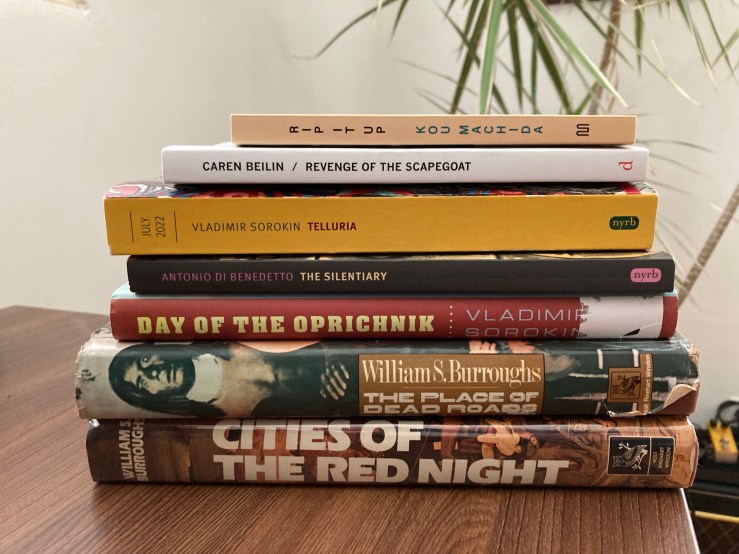
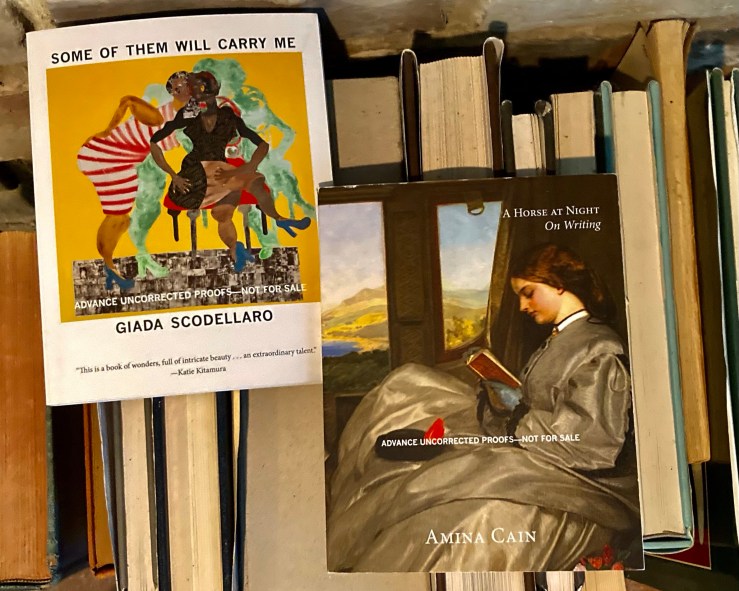
New books by Caren Beilin and Cristina Rivera Garza from the Dorothy Project (Books acquired, 28 March 2022)

Two new enticing titles from the Dorothy Project: Caren Beilin’s novel Revenge of the Scapegoat and Cristina Rivera Garza’s collection New and Selected Stories. 

The Beilin seems like a picaresque surrealist joint, which is right up my alley. Press copy:

One day Iris, an adjunct at a city arts college, receives a terrible package: recently unearthed letters that her father wrote to her in her teens, in which he blames her for their family’s crises. Driven by the raw fact of receiving these devastating letters not once but twice in a lifetime, and in a panic of chronic pain brought on by rheumatoid arthritis, Iris escapes to the countryside—or some absurdist version of it. Nazi cows, Picassos used as tampons, and a pair of arthritic feet that speak in the voices of Flaubert’s Bouvard and Pécuchet are standard fare in this beguiling novel of odd characters, surprising circumstances, and intuitive leaps, all brought together in profoundly serious ways.

I spent a half hour reading a few of the stories in the Rivera Garza collection, going from an older track to a few that haven’t yet been published in Spanish yet. The later stories seem more daring in form and content–exciting stuff.

New and Selected Stories brings together in English translation stories from across Rivera Garza’s career, drawing from three collections spanning over 30 years and including new writing not yet published in Spanish. It is a unique and remarkable body of work, and a window into the ever-evolving stylistic and thematic development of one of the boldest, most original, and affecting writers in the world today.

The collection seems like a great introduction to Rivera Garza’s three decades of work. The translations are by Sara Brooker, Lisa Dillman, Francisca González Arias, Alex Ross, and Rivera Garza herself.

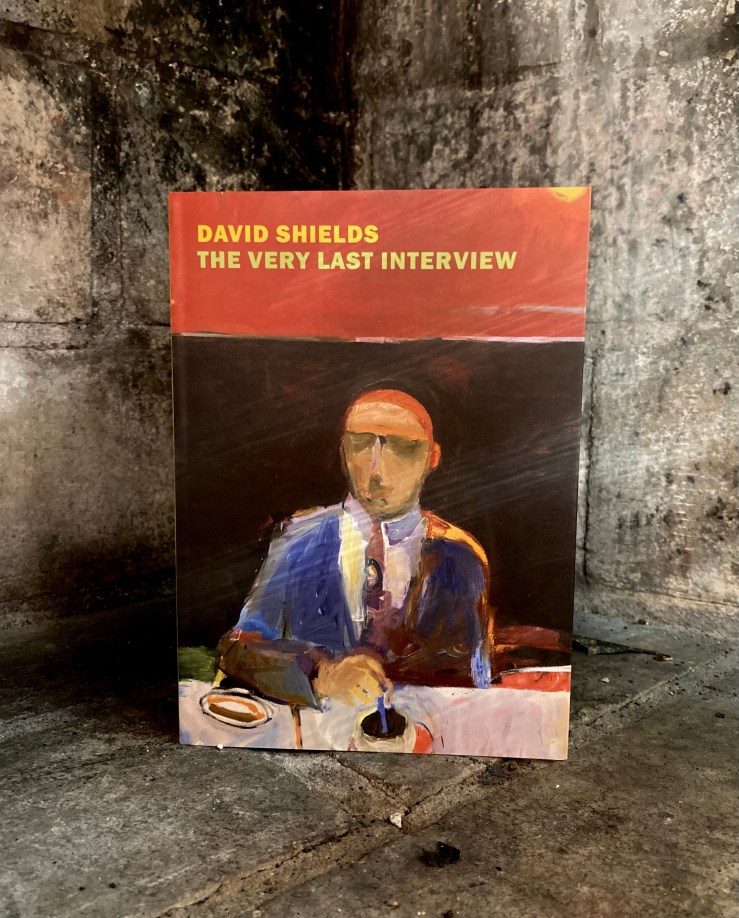
Is this a review of David Shields’ “autobiography” The Very Last Interview?

Is David Shields’ new book The Last Interview indeed an “autobiography in question form, with the reader working to supply answers based on the questions that follow,” as Bret Easton Ellis’ blurb attests?

Is it “Brilliant,” as Bret Easton Ellis’ blurb attests?

(Is this the same David Shields who authored Reality Hunger?)

Does, as Chris Kraus’ blurb states, Shields remix and reimagine “2,000 of the most annoying questions he’s been asked during his forty-year writing life”?

Is it really an “operatic tragic sojourn across American cultural life” (Kraus)?

Does The Very Last Interview confirm “Shields as the most dangerously important American writer since William S. Burroughs,” as Kenneth Goldsmith claims in his blurb?

(Is this the same Kenneth Goldsmith who was called out seven years ago for a publicly reading Michael Brown’s autopsy under the guise of “conceptual poetry”?)

Is it actually “very funny,” as Sheila Heti’s blurb contends?

Should I flip it over and actually dig in?

Is that a Richard Diebenkorn painting adorning the cover?

Are there actually five more blurbs once one opens the book?

Does Shields organize this “remix: of questions he’s (supposedly) been asked into chapters with titles like “Process,” “Truth,” “Art,” “Failure,” “Criticism,” and “Suicide”?

Does Shields open each chapter with epigraphs?

Does he attribute the authors of the epigraphs?

Is there an epigraph from Nietzsche?

Why doesn’t he attribute any of the interviewers at any point in The Very Last Interview?

Does David Shields believe he is a genius?

Does he believe that his audience will find delight or joy or even a momentary reprieve from reading The Very Last Interview?

When Jonathan Lethem (whose blurb makes the inside but not the back cover) claims he “blasted through it in one night,” is it possible that by “night” he means a thin hour or two?

Is the book skinnier than its 150 pages might suggest?

Are there any bits of the book that are, as Heti blurbed, “Very, very funny”?

How about this trio?

“When we are not sure, we are alive” — are you sure this is something that Graham Green said?

Can you prove it?

Do you know what “JSTOR” stands for?

Does this little blip skate closer to mildly amusing as opposed to very very funny?

But is there a general undertone of contempt that radiates in Shields’ curation of questions?

What about these?

Do you share my contempt for Greenpoint hipsters who look and act cool but whose work is about as challenging as a Toblerone bar?

Did you every study with Gordon Lish?

What did he like about your bracelet-cum-watch?

(What would we get if we removed the hyphens from the phrase bracelet-cum-watch?)

Is it possible that David Shields overestimates how interesting he is?

Does he really want us to empathize at points, to provide answers for questions, such as the ones below?

What’s the matter with you?

No, seriously. What is your underlying impasse?

Why can’t you feel?

What’s buried beneath that seeming numbness?

Anything?

Is The Last Interview pretentious, solipsistic, shallow, bathetic, and also very readable?

Is The Last Interview available in paperback from NYRB next month?

Are we done?

Are we?

Ballard/Burroughs/James | Hello/Night/Witch (Books acquired 25 Feb. 2022)

Dropped by my beloved sprawling used bookstore yesterday to pick up a new copy of Marlon James’s Moon Witch, Spider King. It’s not exactly the sequel to 2019’s Black Leopard, Red Wolf as much as it is a kind of parallel story to that novel. From the publisher’s description:

In Black Leopard, Red Wolf, Sogolon the Moon Witch proved a worthy adversary to Tracker as they clashed across a mythical African landscape in search of a mysterious boy who disappeared. In Moon Witch, Spider King, Sogolon takes center stage and gives her own account of what happened to the boy, and how she plotted and fought, triumphed and failed as she looked for him. It’s also the story of a century-long feud—seen through the eyes of a 177-year-old witch—that Sogolon had with the Aesi, chancellor to the king. It is said that Aesi works so closely with the king that together they are like the eight limbs of one spider. Aesi’s power is considerable—and deadly. It takes brains and courage to challenge him, which Sogolon does for reasons of her own.

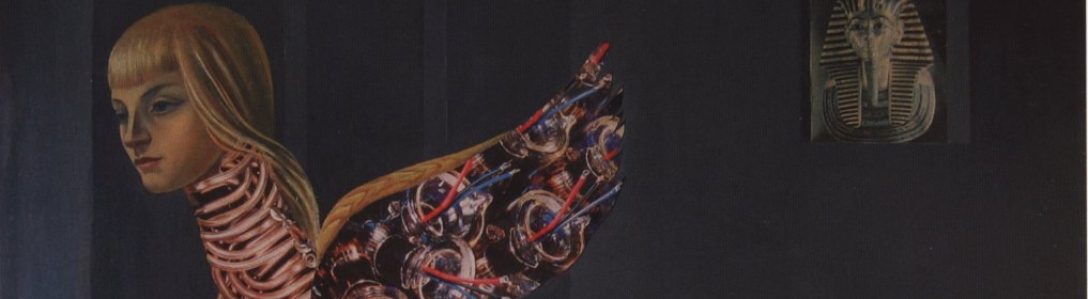
I also couldn’t pass up a first-edition hardback of William S. Burroughs’s late novel Cities of the Red Night. I haven’t read it in at least twenty years, but I remember it as my favorite Burroughs novel. An excerpt, via The Floating Library–

The Cities of the Red Night were six in number: Tamaghis, Ba’dan, Yass-Waddah, Waghdas, Naufana, and Ghadis. These cities were located in an area roughly corresponding to the Gobi Desert, a hundred thousand years ago. At that time the desert was dotted with large oases and traversed by a river which emptied into the Caspian Sea….

…The towns of Ba’dan and Yass-Waddah were opposite each other on the river. Tamaghis, located in a desolate area to the north on a small oasis, could properly be called a desert town. Naufana and Ghadis were situated in mountainous areas to the west and south beyond the perimeter of usual trade routes between the other cities…

….The inhabitants were divided into an elite minority known as the Transmigrants and a majority known as the Receptacles. Within these categories were a number of occupational and specialized strata and the two classes were not in practice separate: Transmigrants acted as Receptacles and Receptacles became Transmigrants.

To show the system in operation: Here is an old Transmigrant on his deathbed. He has selected his future Receptacle parents, who are summoned to the death chamber. The parents then copulate, achieving orgasm just as the old Transmigrant dies so that his spirit enters the womb to be reborn. Every Transmigrant carries with him at all times a list of alternative parents, and in case of accident, violence, or sudden illness, the nearest parents are rushed to the scene. However, there was at first little chance of random or unexpected deaths since the Council of Transmigrants in Waghdas had attained such skill in the art of prophecy that they were able to chart a life from birth to death and determine in most cases the exact time and manner of death.

Many Transmigrants preferred not to wait for the infirmities of age and the ravages of illness, lest their spirit be so weakened so to be overwhelmed and absorbed by the Receptacle child. These hardy Transmigrants, in the full vigor of maturity, after rigorous training in concentration and astral projection, would select two death guides to kill them in front of the copulating parents. The methods of death most commonly employed were hanging and strangulation, the Transmigrant dying in orgasm, which was considered the most reliable method of ensuring a successful transfer. Drugs were also developed, large doses of which occasioned death in erotic convulsions, smaller doses being used to enhance sexual pleasure. And these drugs were often used in conjunction with other forms of death.

I also couldn’t pass up a mass market edition of J.G. Ballard’s 1981 novel Hello America (with a nice cover by Tim White). I have not read Hello America. Yet.

John Elizabeth Stintzi’s novel My Volcano (Book acquired, 20 Feb. 2022)

I finally had a spare half hour to dip into John Elizabeth Stintzi’s novel My Volcano this afternoon. After hearing about the novel from the good folks at weirdo indie stalwart Two Dollar Radio, I thought—well, look, here’s the publisher’s blurb:

My Volcano is a kaleidoscopic portrait of a menagerie of characters, as they each undergo personal eruptions, while the Earth itself is constantly shifting. It takes place during the turbulent summer of 2016, which saw the Pulse nightclub shooting in Orlando, and a spate of horrific hate-crimes across the country. This grounding in reality, contrasted with the sensational action that occurs in the narrative, floats the idea — which appears as the epigraph to the book, and also as a line within — that “reality is nothing but the opinion of power.” Parable, myth, science-fiction, eco-horror, My Volcano is a radical work of literary art, emerging as a subversive, intoxicating artistic statement.

–and the blurb at the TDR website is more detailed—

On June 2, 2016, a protrusion of rock growing from the Central Park Reservoir is spotted by a jogger. Three weeks later, when it finally stops growing, it’s nearly two-and-a-half miles tall, and has been determined to be an active volcano.

As the volcano grows and then looms over New York, an eight-year-old boy in Mexico City finds himself transported 500 years into the past, where he witnesses the fall of the Aztec Empire; a Nigerian scholar in Tokyo studies a folktale about a woman of fire who descends a mountain and destroys an entire village; a white trans writer in Jersey City struggles to write a sci-fi novel about a thriving civilization on an impossible planet; a nurse tends to Syrian refugees in Greece while grappling with the trauma of living through the bombing of a hospital in Kunduz, Afghanistan; a nomadic farmer in Mongolia is stung by a bee, magically transforming him into a green, thorned, flowering creature that aspires to connect every living thing into its consciousness.

With its riveting and audacious vision, My Volcano is a tapestry on fire, a distorted and cinematic new work from the fiercely talented John Elizabeth Stintzi.

—anyway, I expected a kind of weirdness of prose, something “experimental” — but Stintzi’s prose is tight, lucid, and crisp. They employ filmic techniques, including interstitial chapters announcing the myriad horrific deaths recorded in 2016, including Philando Castile, Alton Sterling, and the victims of the Pulse nightclub massacre. Flicking through the novel to graze these placards reminded me of the cruelty of the 2016, but also underlined that that cruelty was not especially special, besides, maybe, the fact that more folk could not deny systematic institutional violence in the grand ole USA. (Accept that they did. A lot of folk signed up for denying that shit.)

—well anyway, the intriguing thing, so far, is Stintzi’s spare evocations of extraordinary moments. There’s something both banal and beautiful in a sentence like, “The bumblebee in central Mongolia was eaten by a whitethroated needletail on JUNE 5.” Or hardly banal, but still frank and clear: “It didn’t take more than seeing strangely dressed Angel ingest a cloud for the Mexica people of Tenochtitlan to believe that he was holy.”

There’s also a heavy sadness under what I read, although maybe I brought that myself.

Józef Czapski’s Memories of Starobielsk (Book acquired, 7 Feb. 2022)

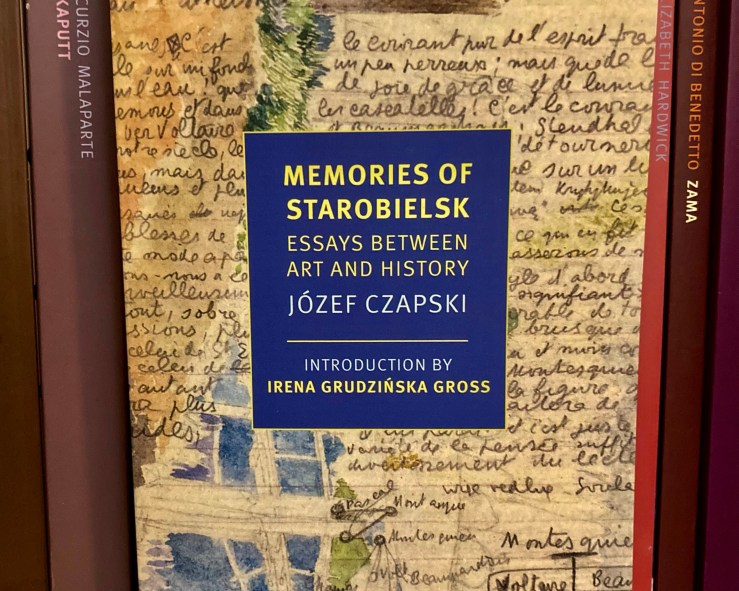
Józef Czapski’s Memories of Starobielsk: Essays between Art and History is forthcoming from NYRB in Alissa Valles’s translation. Their blurb:

Interned with thousands of Polish officers in the Soviet prisoner-of-war camp at Starobielsk in September 1939, Józef Czapski was one of a very small number to survive the massacre in the forest of Katyń in April 1940. Memories of Starobielsk portrays these doomed men, some with the detail of a finished portrait, others in vivid sketches that mingle intimacy with respect, as Czapski describes their struggle to remain human under hopeless circumstances. Essays on art, history, and literature complement the memoir, showing Czapski’s lifelong engagement with Russian culture. The short pieces on painting that he wrote while on a train traveling from Moscow to the Second Polish Army’s strategic base in Central Asia stand among his most lyrical and insightful reflections on art.

Rahel Varnhagen: The Life of a Jewish Woman by Hannah Arendt (Book acquired, mid-January 2022)

Hannah Arendt’s Rahel Varnhagen: The Life of a Jewish Woman is forthcoming from NYRB (in translation by Clara Winston and Richard Winston, and with an introduction by Barbara Hahn). NYRB’s blurb:

Rahel Varnhagen: The Life of a Jewish Woman was Hannah Arendt’s first book, largely completed when she went into exile from Germany in 1933, though not published until the 1950s. It is the biography of a remarkable, complicated, passionate woman, and an important figure in German romanticism. Rahel Varnhagen also bore the burdens of being an unusual woman in a man’s world and an assimilated Jew in Germany.

She was, Arendt writes, “neither beautiful nor attractive . . . and possessed no talents with which to employ her extraordinary intelligence and passionate originality.” Arendt sets out to tell the story of Rahel’s life as Rahel might have told it and, in doing so, to reveal the way in which assimilation defined one person’s destiny. On her deathbed Rahel is reported to have said, “The thing which all my life seemed to me the greatest shame, which was the misery and misfortune of my life—having been born a Jewess—this I should on no account now wish to have missed.” Only because she had remained both a Jew and a pariah, Arendt observes, “did she find a place in the history of European humanity.”

Vladimir Sorokin’s Telluria (Book acquired, 13 Jan. 2022)

I read the first few bits of Vladmir Sorokin’s postapocalyptic novel Telluria today. The book is forthcoming from NYRB in translation by Max Lawton. The fantastic blurb captured my interest right away:

Telluria is set in the future, when a devastating holy war between Europe and Islam has succeeded in returning the world to the torpor and disorganization of the Middle Ages. Europe, China, and Russia have all broken up. The people of the world now live in an array of little nations that are like puzzle pieces, each cultivating its own ideology or identity, a neo-feudal world of fads and feuds, in which no one power dominates. What does, however, travel everywhere is the appetite for the special substance tellurium. A spike of tellurium, driven into the brain by an expert hand, offers a transforming experience of bliss; incorrectly administered, it means death.

The fifty chapters of Telluria map out this brave new world from fifty different angles, as Vladimir Sorokin, always a virtuoso of the word, introduces us to, among many other figures, partisans and princes, peasants and party leaders, a new Knights Templar, a harem of phalluses, and a dog-headed poet and philosopher who feasts on carrion from the battlefield. The book is an immense and sumptuous tapestry of the word, carnivalesque and cruel, and Max Lawton, Sorokin’s gifted translator, has captured it in an English that carries the charge of Cormac McCarthy and William Gibson.

Telluria is forthcoming this summer; NYRB plans to publish three more by Sorokin, including Blue Lard, “which included a sex scene between clones of Stalin and Khrushchev [and] led to public demonstrations against the book and to demands that Sorokin be prosecuted as a pornographer.”

Two by Pessoa and Zak Smith’s Gravity’s Rainbow Illustrated (Books acquired last week and late last year)

Last week I finally got into a collection of Fernando Pessoa’s writing called Writings on Art and Poetical Theory. The books contains pieces that Pessoa composed in English, and is out next year from Contra Mundum Press. Their blurb:

Writings on Art and Poetical Theory contains a selection of Fernando Pessoa’s writings (or those of his heteronyms) on art and poetical theory, originally written in English. In Pessoa’s oeuvre one finds not only literary and fictional works but also a multiplicity of theoretical texts on the most diverse subjects concerning artistic movements, literature, and writers.

In this book, we witness Pessoa explore, through various heteronyms, general theories on poetics, the poetries of other heteronyms, the uses and abuses of criticism, and more. Also included are essays on sensationism (an aesthetic movement Pessoa dubs a new species of Weltanschauung), translation, and a brief history of English literature, which is comprised of fragments on Shakespeare, Milton, the British Romantics, Dickens, Wilde, and others, as well as additional material, such as Pessoa’s own poem Antinous.

This edition, prepared by Nuno Ribeiro and Cláudia Souza, allows us to have an overview of Pessoa’s writings on art and poetic theory — most of which are presented here for the first time to English readers —, thus opening the way for future studies on one of the most significant authors of Portuguese modernism.

Dabbling about in Writings reminded me that I’ve never made a stab at Pessoa’s monumental work, The Book of Disquiet. I picked up New Directions’ recent Complete Edition in translation by Margaret Jull Costa. I ended up reading a big chunk of it that night and have dipped into it all week and I’m not sure if I love it or hate it. It’s like the anti-Leaves of Grass, if that makes sense. It also seems like the kind of book to just pick up and read and random, which I’ve been doing since my initial fifty-page jog into it. In a short doses the fragments are lovely, poetic, aphoristic, but in longer dives the language becomes oppressive, the spirit draining and even venomous.

While I was at the bookstore I also spied a copy of Zak Smith’s Gravity’s Rainbow Illustrated. I’d found a used copy at this same story maybe ten years ago and thought twenty bucks was too much for it, and have regretted that decision for years now. Here’s the first page:

John Berryman’s Stephen Crane biography (Book acquired, 9 Dec. 2021)

I’ve been casually looking for a copy of John Berryman’s 1950 biography of Stephen Crane for a few years now. Berryman is one of my favorite poets and Crane is one of my favorite short story writers. A write up of Paul Auster’s new Crane bio led me to reread some Crane favorites over the past few weeks, which in turn made me look a bit harder for Berryman’s Stephen Crane. The used bookstore I frequent has something like two and a half million books; I had been looking for the Crane bio in three sections: with Crane’s fiction, in biographies, and in literary criticism. This week I grabbed a stool and searched through the overstock above the Crane section and found what I’d been looking for.

As he points out in his preface, Berryman’s approach is a mix of biography and critical appraisal. Berryman claims that very little was written about Crane’s fiction (apart from The Red Badge of Courage) after his death, and that his (Crane’s) reputation was essentially invisible apart from “the war book” until later modernists took to championing him (much like earlier modernists recovered Herman Melville).

After the preface, I couldn’t help but read some of the section on composing “The Open Boat”; it’s a favorite of mine, I live in Jacksonville, where the story originates, and I use it in the classroom every semester. I also dipped into the penultimate chapter, “Crane’s Art,” which includes this nugget:

…Crane has been dead half a century, academic interest has avoided him as both peculiar and undocumented, and some of his work is still decidedly alive. This is long enough.

Elizabeth Taylor’s Mrs Palfrey at the Claremont (Book acquired, late Nov. 2021)

NYRB is reprinting the last novel of Elizabeth Taylor (not that one, the other one), Mrs Palfrey at the Claremont. NYRB’s blurb:

On a rainy Sunday afternoon in January, the recently widowed Mrs. Palfrey moves to the Claremont Hotel in South Kensington. “If it’s not nice, I needn’t stay,” she promises herself, as she settles into this haven for the genteel and the decayed. “Three elderly widows and one old man . . . who seemed to dislike female company and seldom got any other kind” serve for her fellow residents, and there is the staff, too, and they are one and all lonely. What is Mrs. Palfrey to do with herself now that she has all the time in the world? Go for a walk. Go to a museum. Go to the end of the block. Well, she does have her grandson who works at the British Museum, and he is sure to visit any day.

Mrs. Palfrey prides herself on having always known “the right thing to do,” but in this new situation she discovers that resource is much reduced. Before she knows it, in fact, she tries something else.

Elizabeth Taylor’s final and most popular novel is as unsparing as it is, ultimately, heartbreaking.

Heimito von Doderer’s The Strudlhof Steps (Book acquired, 15 Nov. 2021)

Heimito von Doderer’s The Strudlhof Steps is forthcoming in translation by Vincent Kling from NYRB. Their blurb:

The Strudlhof Steps is an unsurpassed portrait of Vienna in the early twentieth century, a vast novel crowded with characters ranging from an elegant, alcoholic Prussian aristocrat to an innocent ingenue to “respectable” shopkeepers and tireless sexual adventurers, bohemians, grifters, and honest working-class folk. The greatest character in the book, however, is Vienna, which Heimito von Doderer renders as distinctly as James Joyce does Dublin or Alfred Döblin does Berlin. Interweaving two time periods, 1908 to 1911 and 1923 to 1925, the novel takes the monumental eponymous outdoor double staircase as a governing metaphor for its characters’ intersecting and diverging fates. The Strudlhof Steps is an experimental tour de force with the suspense and surprise of a soap opera. Here Doderer illuminates the darkness of passing years with the dazzling extravagance that is uniquely his.

Barthelme/Calvino/Garner/Jackson (Books acquired, 19 Nov. 2021)

Spent a spare hour this afternoon at the local used bookshop.

A few months ago I found a first edition of Donald Barthelme’s collection Forty Stories. This afternoon I picked up a first edition of my favorite Barthelme novel, The Dead Father. The jacket design–by Ruth Ansel–is really cool, which doesn’t really come through in the photograph. The back cover simply reverses the silver-black set up of the front cover; the spine reads bottom to top instead of top to bottom, like most U.S. titles.

I’ve never read Under the Jaguar Sun by Italo Calvino, but I picked it up because I enjoyed rereading three by Calvino earlier this year (and it’s very short and has a cool cover by Malcolm Tarlofsky).

I’d never heard of Alan Garner’s 1973 novel Red Shift until today. I always pull NYRB spines out, and the novel’s description on the back caught my attention. Part of the description:

In second-century Britain, Macey and a gang of fellow deserters from the Roman army hunt and are hunted by deadly local tribes. Fifteen centuries later, during the English Civil War, Thomas Rowley hides from the ruthless troops who have encircled his village. And in contemporary Britain, Tom, a precocious, love-struck, mentally unstable teenager, struggles to cope with the imminent departure for London of his girlfriend, Jan.

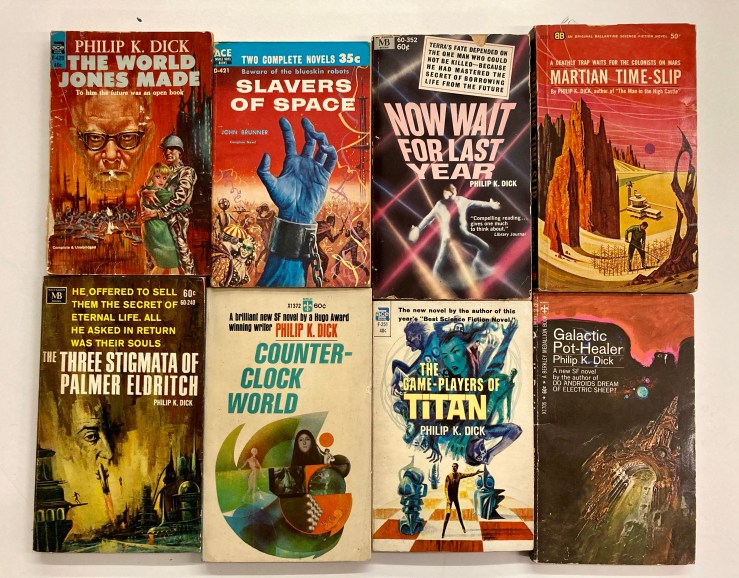
The blurb from Ursula K. Le Guin (“A bitter, complex, brilliant book”) made me pick it up. I love the NYRB cover, which has a My Bloody Valentine feeling to it, at least to me, but I also am a big proponent of genre covers–sci-fi/fantasy covers that might not be as “respectable” as the “literary” crossover covers that adorn works that live a second life. So I trekked over to the sci-fi/fantasy section to see if I could find another edition of Red Shift. This is what I found:

I regret not looking for the artist’s name now. I dig the Ballantine cover, but the NYRB edition was far more readable in the end.

From the sci-fi/fantasy section, I somehow wandered into U.S. history, staring at an endcap titled “Salem witchcraft.” I did not know that Shirley Jackson wrote a book about Salem—or Salem Village, as she points out in her initial note—a place that is not the same place as Salem—I did not know that Jackson wrote a book about the Salem (Village) witchcraft trials. I picked it up and started in and didn’t want to stop.

Apparently it’s a children’s book.

Ed Skoog’s Rough Day (Book acquired, 13 Nov. 2021)

So we had a great long weekend with some friends in New Orleans. We stayed in Marigny—great food, great music, maybe too many drinks—but made it into the quarter for a few hours midday Saturday. I led our little group to Jackson Square where we respectfully finished our Bloody Marys before entering St. Louis Cathedral. My real aim though was Faulkner House Books on Pirate Alley right by the cathedral. Faulkner House imposed a strict four-guests-at-a-time policy, so my friends found a bar while I browsed. The stock in the small store is impeccable. Plenty of NYRB titles, a cadre of hardback Bolaños (including almost all of the poetry available in English), more Anne Carson than I’ve ever seen in a store. (I didn’t make it to Faulkner House when I visited NOLA in late 2016, but in 2012 I got some good stuff.) This time, I picked up a signed copy of Ed Skoog’s Rough Day, which seemed fitting—I’d scheduled a post that day of his poem “Run the Red Lights.”

After I finished up I headed to a bar on the outskirts of the Quarter to meet my friends, but first popped in to Arcadian Books & Prints on Orleans St.—perhaps the most chaotic bookstore I’ve ever been to. 

As always, I loved NOLA and look forward to returning sooner rather than later.

Nastassja Martin’s In the Eye of the Wild (Book acquired, late Oct. 2021)

Nastassja Martin’s In the Eye of the Wild is out in a few weeks from NYRB in a translation by Sophie R. Lewis. I dove in this morning and it’s engrossing stuff. Any book that begins with a bear mauling the author is off to a weird start. Here’s NYRB’s blurb:

In the Eye of the Wild begins with an account of the French anthropologist Nastassja Martin’s near fatal run-in with a Kamchatka bear in the mountains of Siberia. Martin’s professional interest is animism; she addresses philosophical questions about the relation of humankind to nature, and in her work she seeks to partake as fully as she can in the lives of the indigenous peoples she studies. Her violent encounter with the bear, however, brings her face-to-face with something entirely beyond her ken—the untamed, the nonhuman, the animal, the wild. In the course of that encounter something in the balance of her world shifts. A change takes place that she must somehow reckon with.

Left severely mutilated, dazed with pain, Martin undergoes multiple operations in a provincial Russian hospital, while also being grilled by the secret police. Back in France, she finds herself back on the operating table, a source of new trauma. She realizes that the only thing for her to do is to return to Kamchatka. She must discover what it means to have become, as the Even people call it, medka, a person who is half human, half bear.

In the Eye of the Wild is a fascinating, mind-altering book about terror, pain, endurance, and self-transformation, comparable in its intensity of perception and originality of style to J. A. Baker’s classic The Peregrine. Here Nastassja Martin takes us to the farthest limits of human being.

Paul Griffiths’ Mr. Beethoven (Book acquired, October 2021)

Paul Griffiths’ novel Mr. Beethoven is new this week from NYRB. Their blurb—

It is a matter of historical record that in 1823 the Handel and Haydn Society of Boston (active to this day) sought to commission Beethoven to write an oratorio. The premise of Paul Griffiths’s ingenious novel is that Beethoven accepted the commission and traveled to the United States to oversee its first performance. Griffiths grants the composer a few extra years of life and, starting with his voyage across the Atlantic and entry into Boston Harbor, chronicles his adventures and misadventures in a new world in which, great man though he is, he finds himself a new man. Relying entirely on historically attested possibilities to develop the plot, Griffiths shows Beethoven learning a form of sign language, struggling to rein in the uncertain inspiration of Reverend Ballou (his designated librettist), and finding a kindred spirit in the widowed Mrs. Hill, all the while keeping his hosts guessing as to whether he will come through with his promised composition. (And just what, the reader also wonders, will this new piece by Beethoven turn out to be?) The book that emerges is an improvisation, as virtuosic as it is delicate, on a historical theme.


The Old People (Book acquired, Sept. 2021)

The Old People is a 2014 novel by A.J. Perry. The Old People gets a new life thanks to Carrying Woman Originals, an imprint of Cow Eye Press, which also published Perry’s novel Cow Country a few years ago.  As you can see in the photo above, Perry’s name is not on the cover. There’s no blurb on the back. Perry’s name shows up on the editions page and then on a second title page that faces the edition page (but not on the first title page).

I was under metaphorical water in September when The Old People arrived, having decided to recommit to doing a good job at my job, by which I mean trying to provide much more feedback and coaching and general mental attendance to my students than I think I was giving in the last (covid-drenched) semesters, all the while worrying about the utter idiocy of Florida Fall 2021’s Death Campaign. Anyway, I stacked it in a growing stack of other TBR copies and retreated into Barthelme’s stories I’d already read a few times when I made the time to read for pleasure.

I moved the stack around today, dropping The Old People to the floor. I picked it up, decided to read the opening pages, and then kept reading. It’s really good! I mean, it’s a really strange thing. It’s a book about tying a knot, which I guess is a metaphor, but it’s really focused on that metaphor’s concrete component. Pages and pages of digging holes and tying knots. I’m not sure exactly what The Old People reminds me of, but it taps into the intersection of myth and anthropology, all without being precious or pretentious (so far, anyway). I hunted down a blurb on Cow Eye’s site:

Since the beginnings of darkest silence the people of a mythical island have spent their days tying the ancient knot that binds them to their past. To tie this knot they must dig a hole; to dig a hole they first must have fire; and to make a fire that is hot enough for hole digging, the knot that they have been tying must finally be tied. From silence to mud to rope to knot to wood to words to fire, the Old People will work to tie their knot under the cool shade of the island’s original knotmaking.


Barthelme/Delany/Rivera Garza (Books acquired, 24 Sept. 2021)

For a few months I’ve been slowly unloading boxes from my grandmother’s old house at my beloved used bookstore, browsing a bit, and coming back with books I don’t need.

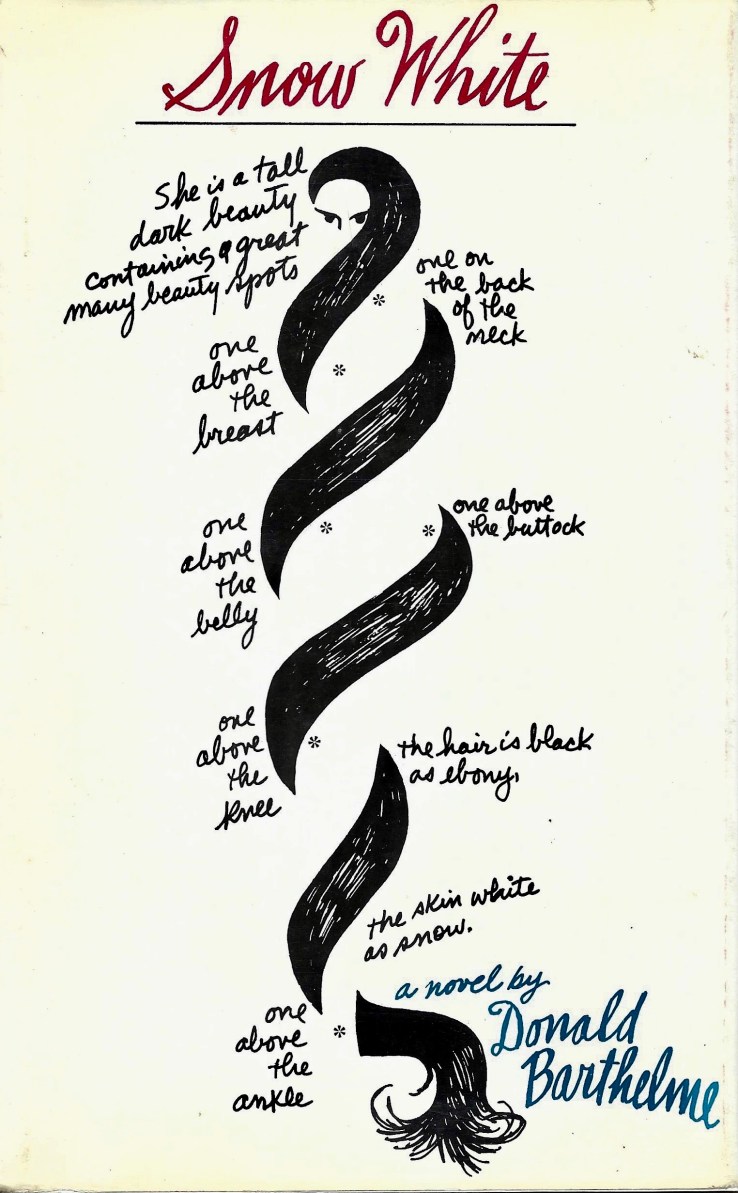
Last Friday I found a hardback first edition of Barthelme’s Forty Stories, which is cool (it’s much more handsome and plain than the paperback Penguin Contemporary Fiction edition I have). I’ve been re-reading Barthelme’s Sixty Stories and writing blog posts about them that no one reads for a few weeks now.

I also picked up Cristina Rivera Garza’s novel The Taiga Syndrome, in translation by Suzanne Jill Levine and Aviva Kana. Here’s publisher Dorothy’s blurb:

A fairy tale run amok, The Taiga Syndrome follows an unnamed Ex-Detective as she searches for a couple who has fled to the far reaches of the earth. A betrayed husband is convinced by a brief telegram that his second ex-wife wants him to track her down—that she wants to be found. He hires the Ex-Detective, who sets out with a translator into a snowy, hostile forest where strange things happen and translation betrays both sense and one’s senses. Tales of Hansel and Gretel and Little Red Riding Hood haunt the Ex-Detective’s quest into a territory overrun with the primitive excesses of Capitalism—accumulation and expulsion, corruption and cruelty—though the lessons of her journey are more experiential than moral: that just as love can fly away, sometimes unloving flies away as well. That sometimes leaving everything behind is the only thing left to do.

I picked up Samuel R. Delany’s novel Babel-17 too, maybe in part of a continued attempt to get into his stuff, despite stall outs, shrugs, and, Hey, that was okays, and maybe just because of this cover:

The book’s Wikipedia entry notes that, “Rush drummer and lyricist Neil Peart noted that Babel-17 was one of his early literary influences, and was an important part of the crafting of the band’s hugely successful 2112 album.”

Well there you go.