Riff on rereading Riddley Walker, Russell Hoban’s post-apocalyptic coming-of-age novel

  1. I first read Russell Hoban’s 1980 post-apocalyptic quasi-religious coming-of-age novel Riddley Walker in maybe 1996 or 1997, when I was sixteen or seventeen, or possibly eighteen.
  2. That was the right age to read Riddley Walker for the first time, although I think anyone of any age, for the most part, could read Riddley Walker, if they want.
  3. This is not a review of Riddley Walker, but here is a nice summary from Benjamin DeMott’s 1981 NYT’s review:
  4. Set in a remote future and composed in an English nobody ever spoke or wrote, this short, swiftly paced tale juxtaposes preliterate fable and Beckettian wit, Boschian monstrosities and a hero with Huck Finn’s heart and charm, lighting by El Greco and jokes by Punch and Judy. It is a wrenchingly vivid report on the texture of life after Doomsday.

  5. The setting is near what was known – until 1997, when cataclysms wiped us out – as Canterbury, England. It is about 2,000 years after that disaster. The mostly dim lights of human life who survive are slaves to the obsessions of their invisible rulers. From generation to generation, they labor ceaselessly, under close surveillance, to disinter by hand the past that lies buried beneath tons of muck – mangled machines, mysteriously preserved bits of flesh, indecipherable fragments of writing. The rulers dream of uncovering the secret of secrets – the key to the power that enabled the giants of yesteryear to create a world in which boats sailed in the air and pictures moved on the wind.

  6. If the plot of Riddley Walker seems a trickle familiar it of course is. It’s been warmed up and reserved many times (and wholesale ripped off in the third Mad Max Max film). (It’s good eating.)
  7. But the novel still feels fresh (and grimy!) because of Hoban’s electrifying prose. Young Riddley’s narration is odd and alienating, even if, in, say, 2023, the novel’s premise seems worn.
  8. Back in the halcyon nineteennineties, when the world seemed generally less apocalpytic, a very good friend of mine loaned me his copy of Riddley Walker.
  9. I never gave it back.
  10. (Somehow, he still gives me books.)
  11. I too lost the first copy of Riddley Walker that I read. I loaned it to a student who never returned it, or Dune, or The Left Hand of Darkness, or a bunch of other sci-fi novels, god keep his soul.
  12. Riddley Walker was one of the first novels I wrote about on this silly website, way back in 2006. It wasn’t a review, it was about book theft.
  13. I had no plan to reread Riddley Walker, but here’s what happened—
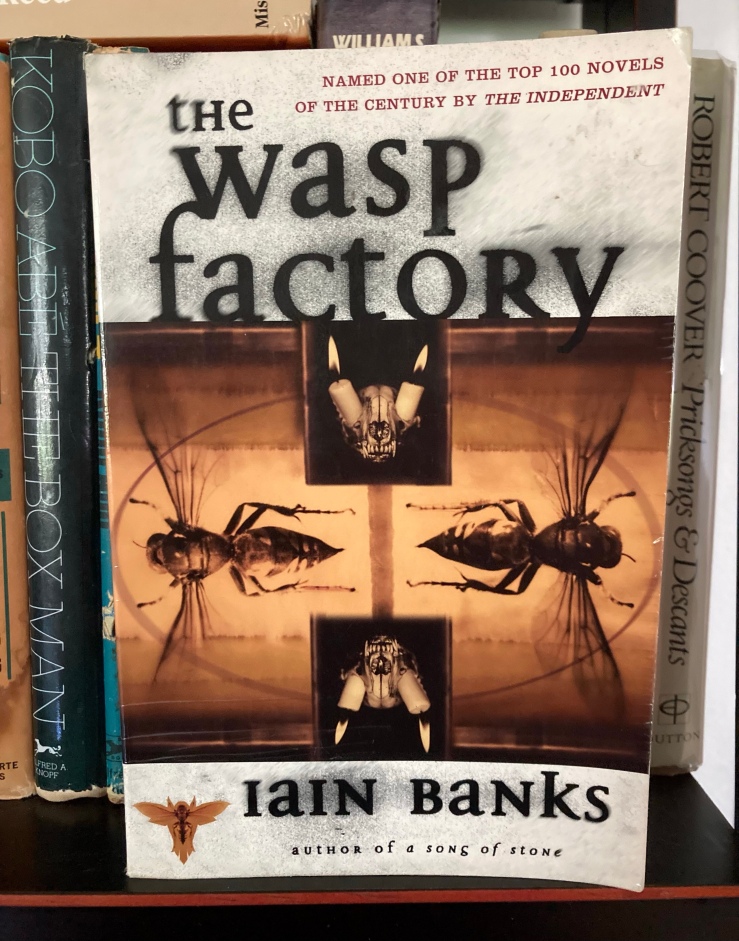
  14. —I had finished reading Ian Banks’s odd coming-of-age novel The Wasp Factory
  15. —and I had and have been listening to the audiobook of T.H. White’s Arthur saga, a return perhaps inspirited by—
  16. —reading Jim Dodge’s alchemical-grail-quest-coming-of-age novel Stone Junction
  17. —and really, there were a lot of coming-of-age novels I seemed to get into this year:
  18. Trey Ellis’s postmodern polyglossic satire Platitudes—
  19. —Kathy Acker’s Great Expectations and Blood and Guts in High School—
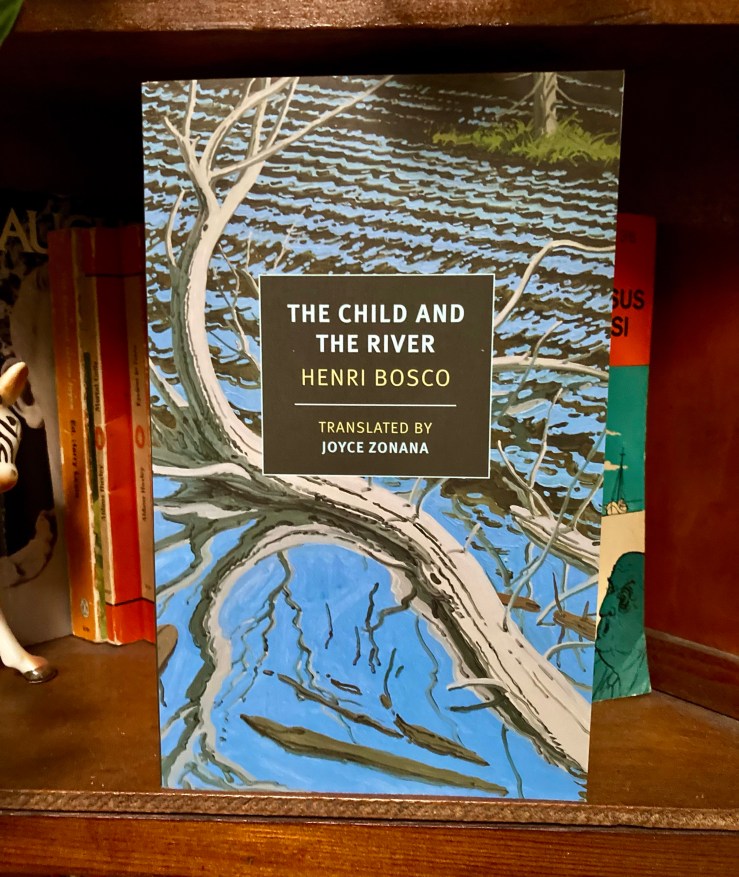
  20. Henri Bosco’s The River and the Child
  21. Bernardo Zanonni’s picaresque My Stupid Intentions—
  22. and Cormac McCarthy’s coming-of-age novel The Crossing
  23. And so well and anyway, I was reading a novel in bed, my eyes working overtime, they’re older now, lenses over them but still there’s never enough light. I was reading this novel, it doesn’t matter what novel, but there was this little weird urge, germinating from the reading of the novels I mentioned above, asking me to Go pick up Riddley Walker again and check in.
  24. So I went and found my copy of Riddley Walker.
  25. It was not, obviously, the copy that I stole from my good friend that was later stolen from me.
  26. I’m not sure when I picked up this particular copy of Riddley Walker, but I’m thinking it was around 2008 or 2009.
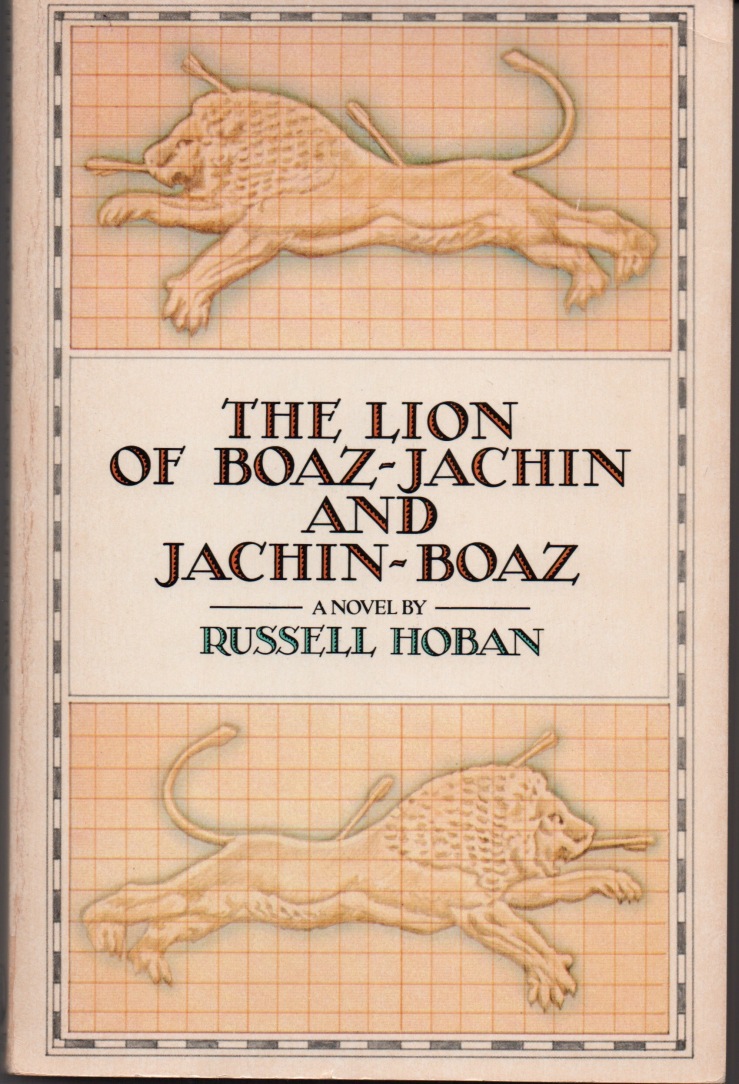
  27. I think that’s when I read the other Hoban novels that I’ve read: The Lion of Boaz-Jachin and Jachin-Boaz; Kleinzeit; Pilgermann.
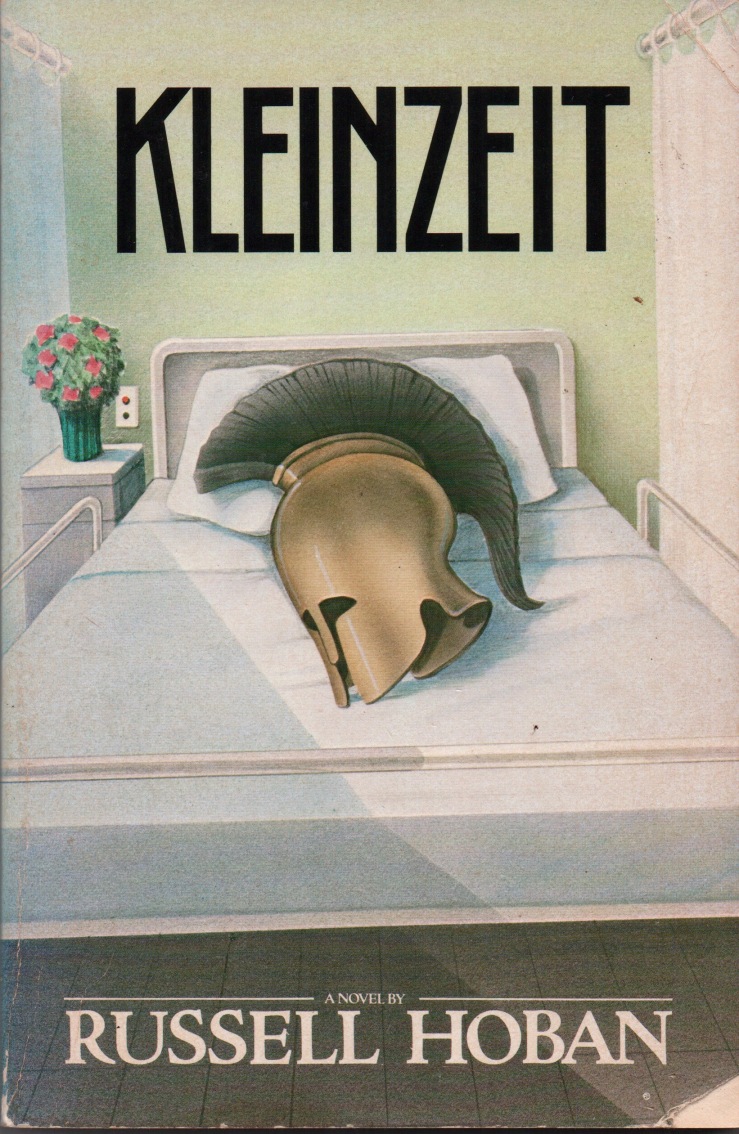
  28. IMG_0010IMG_0012IMG_0013
  29. Of these three novels, Pilgermann is the best and most fucked up.
  30. (I like Kleinzeit, but it’s too indebted to Beckett.)
  31. Well so and anyway, I put down the novel I had been trying to read, and dug up Riddley Walker, put the thing under my poor old lensed eyes.
  32. Here are the first two paragraphs of Russell Hoban’s novel Riddley Walker:
  33. On my naming day when I come 12 I gone front spear and kilt a wyld boar he parbly ben the las wyld pig on the Bundel Downs any how there hadnt ben none for a long time befor him nor I aint looking to see none agen. He dint make the groun shake nor nothing like that when he come on to my spear he wernt all that big plus he lookit poorly. He done the reqwyrt he ternt and stood and clattert his teef and made his rush and there we wer then. Him on 1 end of the spear kicking his life out and me on the other end watching him dy. I said, ‘Your tern now my tern later.’ The other spears gone in then and he wer dead and the steam coming up off him in the rain and we all yelt, ‘Offert!’                                      The woal thing fealt jus that littl bit stupid. Us running that boar thru that las littl scrump of woodling with the forms all roun. Cows mooing sheap baaing cocks crowing and us foraging our las boar in a thin grey girzel on the day I come a man.

  34. I think this is probably the fifth time I’ve read Riddley Walker. I have a very distinct memory of using the novel as the basis for a project in a linguistics class in college. The project had something to do with graphemes and phonemes and was very harebrained, and I am lucky, as always, that the internet was an infant at the time. (I got a “B” on the project and recycled it my senior year in an English class, getting (earning?) an “A.”)
  35. The previous point is a way of protesting that, even as familiar as I was and perhaps am with Riddley Walker’s linguistic barrier, I still found rereading it physically exhausting.
  36. (I am older now, and all reading tires my body in ways I didn’t expect would be possible even five years ago.)
  37. I also find myself putting the book down to chase rabbits down internet holes that simply weren’t available to me the last times I read the book—
  38. —reading variations of the legend of St. Eustace or mapping Hoban’s Riddley Walker map to contemporary England—
  39. —or just getting hung up on particular phrases and images, letting them rattle around. (And now wishing I’d underlined them so as to share them here, which I didn’t, underline them that is.)
  40. Riddley himself is far more arrogant and decisive than I’d remembered; the angst here is more about a great becoming of a world to come than it is a becoming into the self of adulthood.
  41. (Whatever the fuck that last phrase means; sorry.)
  42. I find myself with new connections too—Aleksei German’s 2013 film adaptation of the Strugagtski’s novel Hard to Be a God comes readily to mind, as does Alfonso Cuarón’s 2006 film Children of Men.
  43. And David Mitchell’s novel Cloud Atlas, too (along with the Wachowskis’ film adaptation), which stole readily from Riddley Walker.
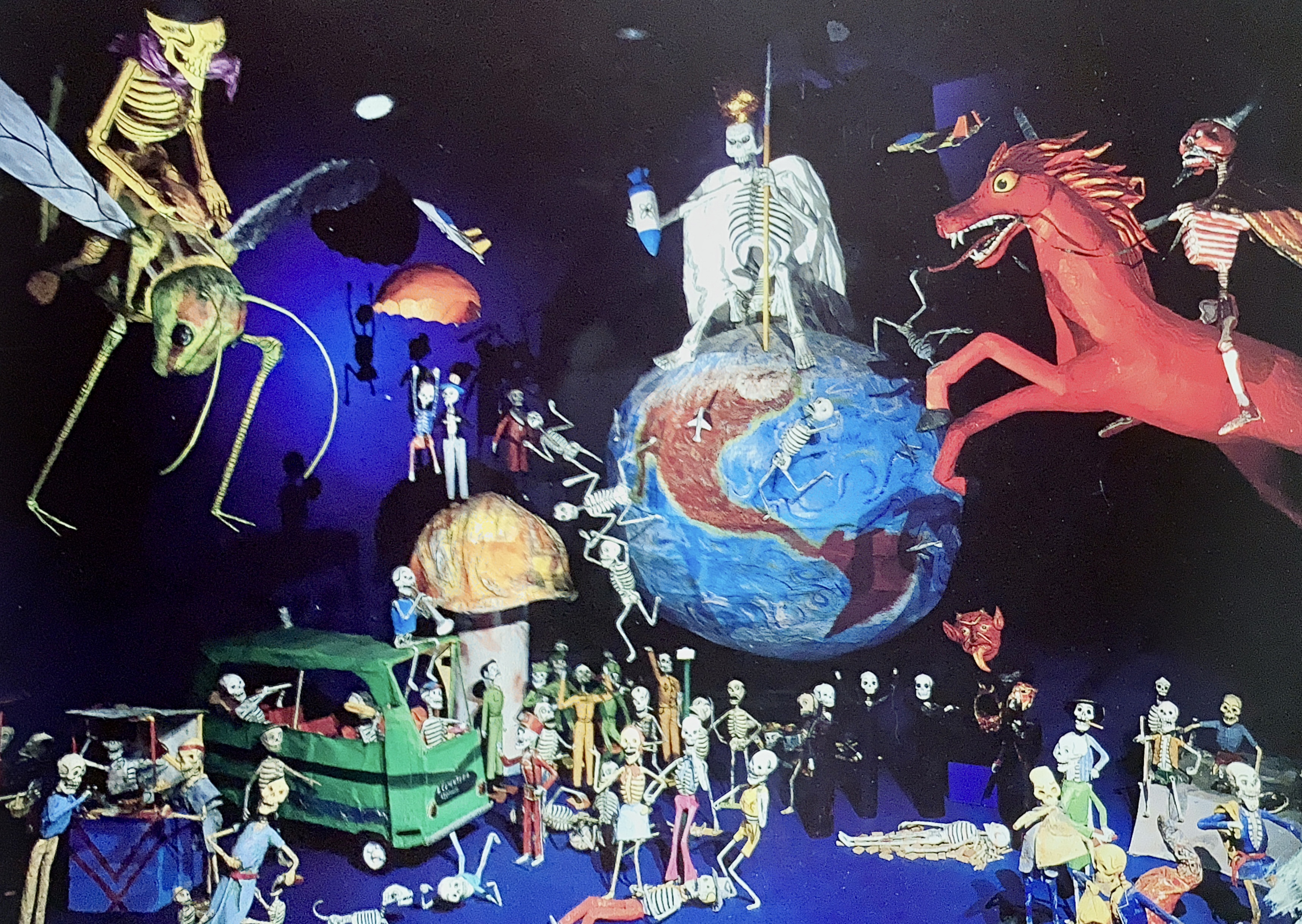
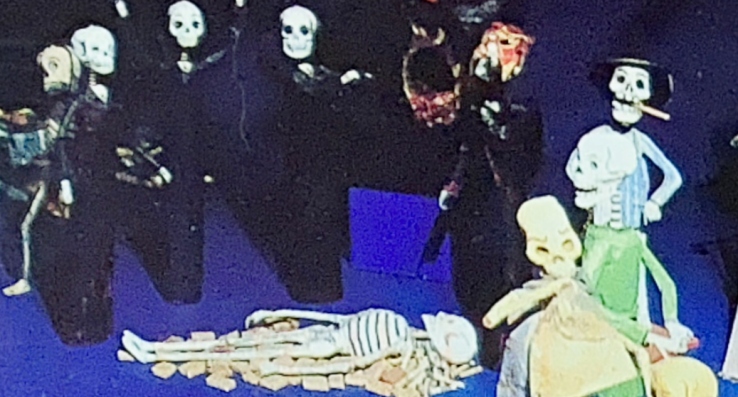
  44. The bookmark at the back of the copy of Riddley Walker I opened was a postcard from Mexico from Texas:
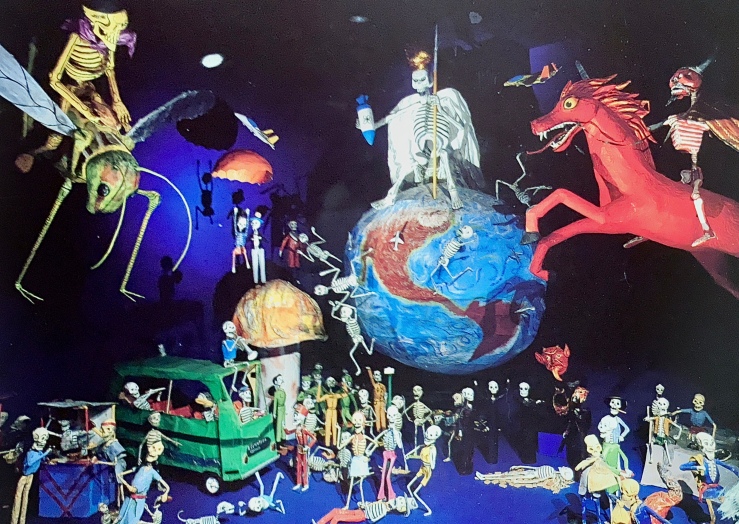
  45. The piece, according to the back of the postcard, is appropriately titled The Atomic Apocalypse—Will Death Die? The piece is a photograph of a painted papier mache menagerie, attirbuted to the Linares Family of Mexico City, 1989.
  46. Some old younger version of myself stuck it in the back of Riddley Walker as a joke.
  47. The postcard came from a man in Texas who won a contest to win a copy of the 25th-anniversary edition of Blood Meridian. 
  48. This man sent several postcards, and I scanned them and shared them on the site, but this particular postcard is not in that set of shared postcards.
  49. Why? Did the postcard not fit on the scanner? Was it sent later, as a polite Thank you? (I don’t think so; on the postcard’s b-side, the man who won the contest shared a quote from Blood Meridian describing the physical appearance of Judge Holden.)
  50. Let this postcard stand as aesthetic précis for Riddley Walker though, and let me be done. (I will find the other postcards over the years, or not.)
Patient with the French | From Natalia Ginzburg’s memoir Family Lexicon

In the autumn, I went with my mother to visit Mario, who was now living in a small town near Clermont-Ferrand. He was teaching in a boarding school. He had become great friends with the school’s headmaster and his wife. He said that they were extraordinary people, very sophisticated and honest, the kind of people you could only find in France. In his small room he had a coal stove. From his window you could see the countryside covered in snow. Mario wrote long letters to Chiaromonte and Cafi in Paris. He translated Herodotus and fiddled with the stove. Under his jacket, he wore a dark turtleneck sweater that the headmaster’s wife had made for him. To thank her, he’d given her a sewing basket. Everyone in the town knew him. He stopped and chatted with everyone and he was asked by all to come home with them and drink “le vin blanc.”

My mother said, “How French he’s become!”

In the evenings, he played cards with the headmaster and his wife. He listened to their conversations and discussed educational methods with them. They also spoke a long time about whether or not there had been enough onion in the soup served at dinner.

“How patient he’s become!” my mother said. “How patient he is with these people. With us he never had any patience. Whenever he was home, he thought we were all so boring. These people seem even more boring than we are!”

And she said, “He’s patient with them only because they’re French!”

From Natalia Ginzburg’s 1963 memoir Lessico famigliarein translation (under the title Family Lexicon) by Jenny McPhee.


Iain Banks’s The Wasp Factory is an abject coming-of-age novel narrated by a teenage psychopath

Frank Cauldhame, the narrator of Iain Banks’s 1984 debut novel The Wasp Factory, is a teenage psychopath. Frank lives with his eccentric father on an island in rural Scotland. He is an unregistered person with “no birth certificate, no National Insurance number,” nothing to officially prove his existence. He enjoys this unofficial existence, patrolling his island, which he protects through various rituals.

One of these rituals is to construct and maintain “Sacrifice Poles,” and when we first meet Frank, he is “making the rounds” of these talismans: “One of the Poles held a rat head with two dragonflies, the other a seagull and two mice.” Frank has to keep plenty of dead animals on hand for his ritual defenses, and he kills them by slingshot, air-gun, explosives, and even an improvised flamethrower. (Readers sensitive to depictions of animal cruelty, or just cruelty in general, may wish to avoid The Wasp Factory.)

Another of Frank’s rituals consists of sacrificing a live wasp to the titular Wasp Factory (“beautiful and deadly and perfect,” in our narrator’s words). Frank has devised the Wasp Factory as a bizarre death trap built from “the face of the old clock which used to hang over the door of the Royal Bank of Scotland in Porteneil.” Once introduced to the Factory, the poor wasp can fall prey to one of a dozen different deaths, including the Boiling Pool, the Spider’s Parlour, the Acid Pit, or even “the rather jocularly named Gents (where the instrument of ending is [Frank’s] own urine, usually quite fresh).”

Frank’s urine becomes an important motif in The Wasp Factory. We learn fairly early that he is a “unique eunuch,” supposed victim of a dog bite accident that has left him forever unmanned (and deeply misogynistic). Our lad must piss sitting down, a shame he accepts with a hateful forbearance. Urine flows throughout the novel, an abject magical potion.

Indeed, Frank’s rituals frequently call for the most abject residues and excretions for the magic to work. Consider the Naming Ceremony he performs for a new weapon he’s purchased:

I smeared the metal, rubber and plastic of the new device with earwax, snot, blood, urine, belly-button fluff and toenail cheese, christened it by firing the empty sling at a wingless wasp crawling on the face of the Factory, and also fired it at my bared foot, raising a bruise.

Parts of me thought all this was nonsense, but they were in a tiny minority. The rest of me knew this sort of thing worked. It gave me power, it made me part of what I own and where I am. It makes me feel good.

Were it not for the animal cruelty, Frank’s rituals, no matter how abject, might be the stuff of antic children’s games–playing war, building dams, shooting pellets at cans, and so forth. But the ritualized animal murders are part and parcel of Frank’s most sadistic crimes. He is a serial killer.

Frank confesses his crimes early in The Wasp Factory, and the Scribner trade paperback edition uses his confession as copy on the back of the book to entice would-be readers, so I don’t think I’ll spoil much by sharing it:

Two years after I killed Blyth I murdered my young brother Paul, for quite different reasons than I’d disposed of Blyth, and then a year after that I did for my young cousin Esmerelda, more or less on a whim.

That’s my score to date. I haven’t killed anybody for years, and don’t intend to ever again.

It was just a stage I was going through.

The punchline there at the end is indicative of the dark humor that pervades The Wasp Factory. The edition I’m quoting includes blurbs from negative reviews as well, again highlighting Banks’s mordant glee with the monster he’s conjured. “Rubbish!” declares The Times of London; “There’s nothing to force you, having been warned, to read it; nor do I recommend it,” warns The Scotsman.

Elsewhere, Banks’s humor is earthier, as when Frank recounts some of the early days of his homeschooling at the hands of his ex-hippy chemist father:

For years I believed Pathos was one of the Three Musketeers, Fellatio was a character in Hamlet, Vitreous a town in China, and that the Irish peasants had to tread the peat to make Guinness.

There’s also a sweet streak to the book as well as Frank himself, who, despite his psychotic behavior, is a genuinely caring person at times. His relationship to his only friend, a dwarf named Jamie, is damn near tender; Frank perches Jamie on his shoulders so that the latter can better see the awful punk bands at the local pub.

Frank also cares deeply for his older brother Eric. In the first line of the novel, we learn that Eric has “escaped”; we soon learn he’s escaped from a psychiatric ward he’d been sent to after terrorizing the town folk. Eric’s insane crimes also involve animal cruelty: burning local dogs; force-feeding children worms.

The plot of The Wasp Factory is actually quite simple: What will happen when Eric comes home? Banks keeps the pot boiling through a series of phone calls Eric makes to Frank. We come to see that while Frank might be a psychopath, he is not insane in the way that his older brother is. (A late reveal in the novel that explains the cause of Eric’s insanity is one of the most disgusting pieces of prose I’ve ever read (I write this in admiration.)) In the meantime, Frank attempts to break into the office door that his father has always kept locked.

These twin plots—prodigal son coming home, daddy’s secret locked door—drive the action of The Wasp Factory (oh, and Frank’s basement is full of explosive cordite, too). The book’s real weight comes not from the plot, but from Frank’s narration. He’s a perceptive intelligence, and tuning into his voice is by turns mesmerizing and horrifying.

Not everyone will enjoy The Wasp Factory, as I’ve tried to make as clear as possible in this review. To borrow from The Scotsman, “There’s nothing to force you, having been warned, to read it.” And even admirers may find the twist ending a bit dated and the final moments of Frank’s deep reflection a bit rushed. But Banks does give the reader a conclusion, when it might have been so much easier to leave his characters (and readers) in a noncommittal fuzz of ambiguity. There’s a point of view here, even if it disturbs. The Wasp Factory is a truly fucked up coming-of-age novel, an abject anti-Huckleberry Finn whose narrator makes Holden Caulfield seem perfectly well adjusted. Not for everyone, but I loved it. Recommended.

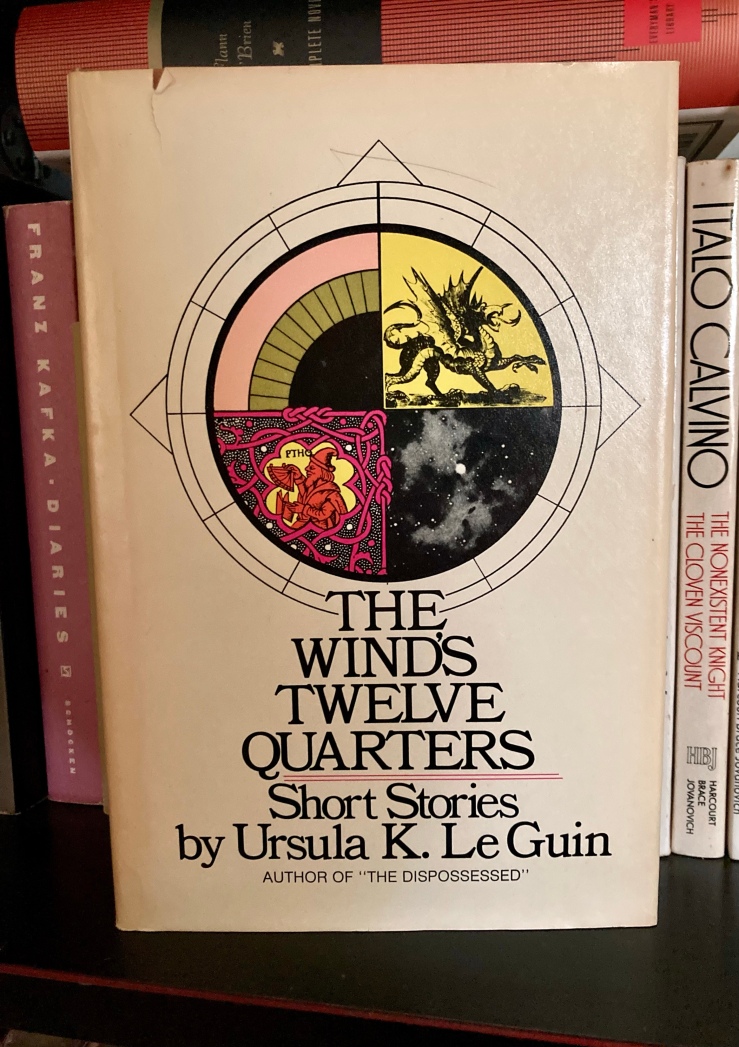
Riff on Ursula K. Le Guin’s collection The Wind’s Twelve Quarters

Ursula K. Le Guin’s 1975 volume The Wind’s Twelve Quarters collects seventeen short stories, offering, as the author puts it in her foreword, “a retrospective” of her career to date: “a roughly chronological survey of my short stories during the first ten years after I broke into print.” Le Guin adds that The Wind’s Twelve Quarters is “by no means a complete collection” of her short stories to date, and that the book does not include “fiction which doesn’t fit under the headings Fantasy or Science Fiction.” In addition to her foreword, Le Guin offers brief introductory notes to each of the seventeen tales.

For me, these introductions were often as interesting as the stories themselves. In her introduction to “Semley’s Necklace,” for example, Le Guin declares that the “candor and simplicity” of this early story exemplifies the “romanticism” characteristic of her early work — a mode that has “gradually become something harder, stronger, and more complex” as her career developed. In her introduction to “The Good Trip,” she tells us that her “only strong opinion about drugs (pot, hallucinogens, alcohol) is anti-prohibition and pro-education” but also admits that “people who expand their consciousness by living instead of by taking chemicals usually come back with much more interesting reports of where they’ve been.” In her intro to “Nine Lives,” which was originally published in Playboy in 1968, Le Guin laments that it appeared “under the only pen name I have ever used: U. K. Le Guin,” and that it is “surprising to me to realize how thoughtlessly I went along with them. It was the first (and is the only) time I met with anything I understood as sexual prejudice, prejudice against me as a woman writer, from any editor or publisher; and it seemed so silly, so grotesque, that I failed to see that it was also important.” In her introduction for “A Trip to the Head,” Le Guin describes a dark bout of writers block she experienced over a period of two years living in England. Giving herself permission to write “A Trip to the Head” released the block:

There is a kind of story which I would describe as a Bung Puller. The writer for one reason or another has been stuck, can’t work; and gets started again suddenly, with a pop, and a lot of beer comes leaping out of the keg and foaming all over the floor. This story was definitely a Bung Puller.

“A Trip to the Head” is one of the very few examples in the collection where the introductory material outweighs the tale it introduces. The story starts promisingly enough:

“Yes, this is Earth,” said the one beside him, “nor are you out of it. In Zambia men are rolling down hills inside barrels as training for space flight. Israel and Egypt have defoliated each other’s deserts. The Reader’s Digest has bought a controlling interest in the United States of America/General Mills combine. The population of the Earth is increasing by thirty billion every Thursday. Mrs Jacqueline Kennedy Onassis will marry Mao Tse-Tung on Saturday, in search of security; and Russia has contaminated Mars with bread mold.”

“Why then,” said he, “nothing has changed.”

—but then Le Guin makes good on that “nothing has changed” idea, even as, paradoxically, her story’s undefined protagonist transforms through a series of identities. “A Trip to the Head” is a postmodern experiment that doesn’t really succeed, unless, of course, you count that its creation unblocked our author.

And it’s a good thing Le Guin broke her block: some of her strongest work came after “A Trip to the Head,” including The Lathe of Heaven, The Dispossessed, and the first two Earthsea novels. Most of the stories in The Wind’s Twelve Quarters that came after “A Trip to the Head” are quite strong. 1971’s “Vaster Than Empires and More Slow,” part of Le Guin’s Hainish universe, tells the story of SPACE MADNESS! and a murderous empathic jungle. “The Ones Who Walk Away from Omelas” (1973) is a successful morality experiment (or “psychomyth,” to use Le Guin’s term). “Omelas” proposes a utopia where “millions [are] kept permanently happy on the one simple condition that a certain lost soul on the far-off edge of things should lead a life of lonely torment.” In her introduction, Le Guin attributes this riff on the scapegoat to William James’s essay “The Moral Philosopher and the Moral Life” (although she concedes that she first read the scenario in Dostoyevsky’s Brothers Karamazov). “Omelas” is a highlight of The Wind’s Twelve Quarters, as is 1974’s “The Day Before the Revolution,” which details a day in the life of the aged anarchist revolutionary Odo. “The Day Before the Revolution” serves as a kind of prologue to The Dispossessed, a move that appears elsewhere in the collection.

The opening story, “Semly’s Necklace,” is quite literally the prologue to Le Guin’s first novel Rocannon’s World (1966). “Winter’s King” (1969) was the spark that led to what many consider Le Guin’s finest novel The Left Hand of Darkness (published later the same year). 1964’s “The Word of Unbinding” and “The Rule of Names” preceded the Earthsea novels that Le Guin would begin in the late sixties. While these germinal tales are intriguing, its clear the Le Guin, ever the anthropologist, would like to do more than her limited canvas can hold. These tales are most notable as ancillary material to be situated in the worlds that Le Guin would go on to conjure in a much wider scope.

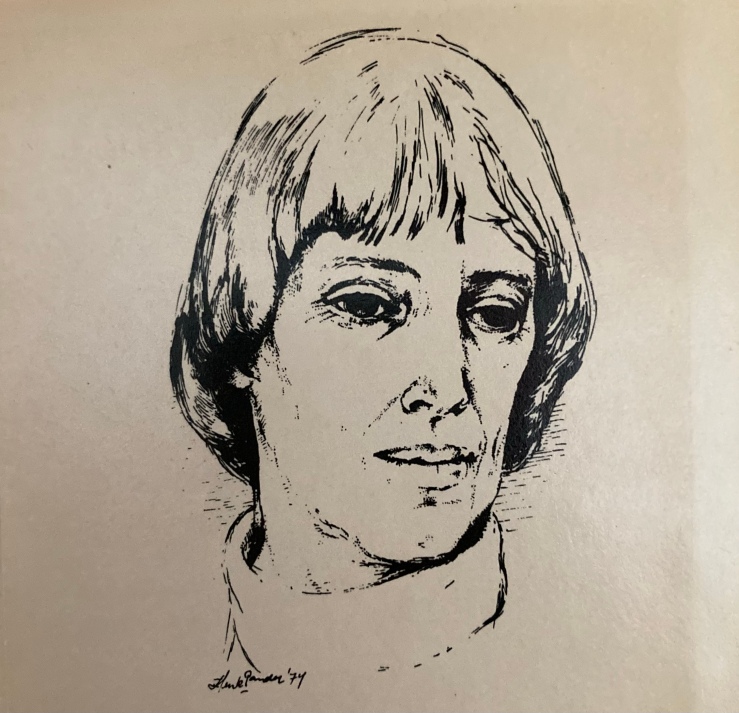
Ursula K. Le Guin portrait by Henk Pander.

Some of the best stories in the collection are self-contained, even as they point to Le Guin’s developing larger themes and goals as a writer. “The Masters” (1963) is a lovely dystopian riff on power, control, and knowledge (“The theme of this story is one I returned to later, with considerably better equipment,” Le Guin remarks in her intro, adding, “It has a good sentence in it, though: ‘He had been trying to measure the distance between the earth and God'” — that is a good sentence!) 1970’s “Things” imagines the paranoia of a promised apocalypse, with a brickmaker turned boatbuilder and a widowed weaver providing their own imaginative resistance to the coming onslaught. 1962’s “April in Paris” is a lovely oddity—a romantic time traveling tale with a sentimental happy ending:

The alchemist and the interstellar archaeologist went first, speaking French; the Gaulish slave and the professor from Indiana followed, speaking Latin, and holding hands. The narrow streets were crowded, bright with sunshine. Above them Notre Dame reared its two square towers against the sky. Beside them the Seine rippled softly. It was April in Paris, and on the banks of the river the chestnuts were in bloom

The Wind’s Twelve Quarters is not a great starting place for anyone interested in Le Guin’s worlds. Interested parties would do better to start with The DispossessedThe Lathe of Heaven, or The Left Hand of Darkness—but interested parties are probably aware of that. The book is better suited for folks like me—folks who tore through the Hainish cycle and the Earthsea books and collections, and still wanted a little moreThe Wind’s Twelve Quarters is ultimately most interesting as a document of a writer coming into the prime of her powers, and, as such, is indispensable for hardcore Le Guin fans.

Moby-Dick, but just the punctuation

. ( . ) — — , , , ; . , , . ; . ” , – , , , , , . ” — — . ” . * * * . . . ; . . ” — — ‘ . ” . * * * . . ; . . – , , . ” — — ‘ . , . , . , . , – . , . , . , . , . , . , . , . – – , . – – , . . ( – – ) . – – – , , . , , – , , , . . , , , ‘ , , , , , . , – , . , ; – ; , – , ; ; , , — — , – ! , ! ! – ; – , – , , , . — — , ! . ” . ” — — . ” ; . ” — — . ” . ” — — . ” ; . ” — — . ” , , , , , ; . ” — — . ” ‘ , , , , , . ” — — ‘ ‘ . ” : , . ” — — ‘ . ” , , . , . . . . , – , , . ” — — ‘ . ” . ” ” – , , . . . . , – , . . ” — — ‘ , . . . ” , , ‘ ( ‘ ) , , – , . ” — — . — — . ” , ! . ” — — . ” ‘ . ” — — ‘ . ” . ” — — ‘ . ” . , . ” — — . ” . ” ” . ” — — . ” . ” — — . ” , ‘ , ‘ , , , , ‘ . ” — — . ” , . ” — — . . ” , , , , . ” — — . . . . . ” ‘ . . . . ‘ , . ” — — ‘ . ” , — — ( , ) . ” — — ‘ . ” , . ” — — ‘ . ” , . ” — — . — — ” , , , ; , . ” — — . ” , . ” — — ‘ . ” , , , . ” — — ‘ . ” , , ; . ” — — ‘ , . ” , , . ” — — . ‘ . . ” , . ” — — ‘ . ” , . . – – – . . . . ‘ , . . . . , . . . . , . . . . . ” — — , . . . . ” ( ) , – , ( ) , , . . ” — — ‘ . ” – , , . ” — — ‘ . . . . . . ” ‘ . ” — — . . . ” , , , ; . ” — — ‘ , . . . ” . . . , . ” — — ‘ . ” , , . – , ‘ . ” — — . ” , , . . ” — — , . . ” , . ” — — . ” , , , . , . ” — — ‘ . ” , . , , , – , – , , . ” — — ‘ ‘ ‘ . ” , , , . ” — — ‘ . ” , , ? ” — — ‘ – . ” — — . ” — — . ( . ) ” ‘ , , , . , , . ” — — . ” : ‘ , . ” — — ‘ . ” , , , , . ” , , – , . ” — — , ‘ . ” , . ” — — ‘ . ( . ) ” – , ‘ . ” — — ‘ . ” . ” — — . ” , , , . ” — — ‘ . ” , , , , , , , ; , ; : ‘ , , , , , , , ‘ , , , , . ” — — ‘ . ” ! ! ! . ‘ . ; , . ” — — ‘ . ” , : — — — — ‘ – . ” — — ‘ . ” , ‘ . ” — — ‘ . ” , , . ” — — . ” , , ‘ , ” ; ” ; . ‘ – , ! ” — — ‘ . ” , . ” — — ‘ . ” ! . , ? ” , ” . ” — — ” , . ” , . , . ” , ; , , , , . ” — — . ” , , . . . . ” , , , . ” — — . ” , ; , ; ; , . . . . , , , ( ) , , , , . ” — — ‘ , . ” ” ( ) ” ” ( ) ” , , , , . ” — — ‘ , . . ” , ” – . ” ? ” . ” , . ” ” . ! ” ” , . ” ” – ! ? ” ” , ! ! ! ! ” ” ! ! ” ” , ! ! — — — — — — — — – – ! ” ” ? ” ” . ” ” ! ! . ” — — . ‘ . . ” – , , . ” — — ” , ” . . . . , ; ; . ” — — . ” , ” . , ” . , . ” — — ‘ . . , . . ” , . ” — — ” , ‘ ‘ , . ” . . . ” , ” , ” . ” — — ( ) , , . – . ” , , , , , – . ” — — ‘ . ” ; , ; , – . ” — — ” ” . ” – . , – – , , . ” — — . . . . . ” , , , . ” — — . ” , . ” — — – . ” ( ) . ” — — . ” , . . ” — — . ” ; , , . ” — — . ” ( ) , , , ‘ ” ( ) , ” . ” — — ‘ . ” ‘ ! ‘ , , , ; — — ‘ , ! ‘ ” — — . ” , , , ! ” — — . ” , , , , . ” — — . . . . — — — — , , . . ; , ; , ; , , ‘ — — , . . ; . . , , , . , — — . , . , , , . – . . , , , . ? — — , . ; – ; ; , . ; — — , , . ? ? ? ! , , . ! ; . . . — — — — . , , — — , , , . . , ? . ; . , , . . – — — , – , , . , , . , , . . , , , . ? , , ; , ; . , – . , – ‘ , , ‘ . , – – — — ? — — — — ! , ? , , , , ? , ? , , ? ? , ? . , , , . , . ; . , , , . , . , – — — — — ‘ — — , ; — — , ; , , Continue reading “Moby-Dick, but just the punctuation”

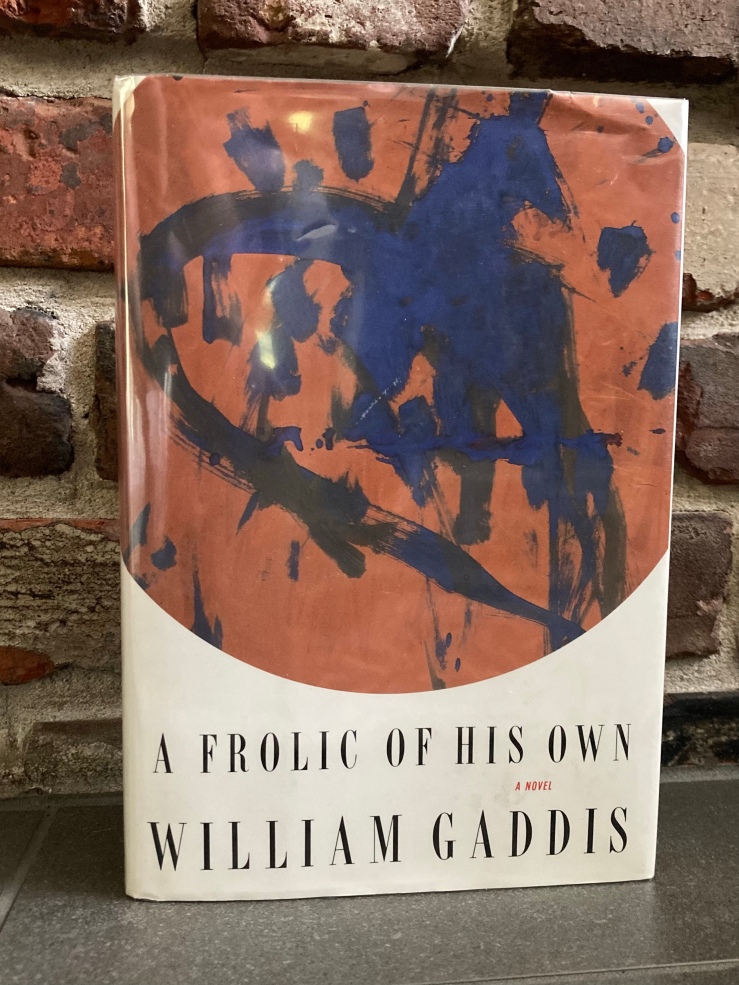
Cannibals all | On William Gaddis’s novel A Frolic of His Own

I want to comment on the themes and style of William Gaddis’s fourth novel, 1994’s A Frolic of His Own, and I’d like to do so without the burden of summarizing its byzantine plot, so I’ll crib from Steven Moore’s contemporary review of the novel that was first published in the Spring 1994 issue of The Review of Contemporary Fiction. Although he initially protests that the “plot is too wonderfully complex to summarize,” Moore nevertheless offers a concise precis. Moore writes that A Frolic of His Own

…concerns an interlocking set of lawsuits involving the Crease family: Oscar, a historian and playwright; Christina, his stepsister and married to a lawyer named Harry Lutz; and their father Judge Thomas Crease, presiding over two cases in Virginia during the course of the novel. The story unfolds by way of Gaddis’s trademark dialogue but also by various legal opinions, brilliantly rendered in the majestic language of the law.

Law, one of the major themes of the novel, is announced in its opening lines: “Justice? —You get justice in the next world, in this world you have the law.” A Frolic of His Own delves into the intersection of justice, law, art, theft, and compensation, all while foregrounding language as the mediating force of not just these nebulous concepts, but the medium, of course, of the novel itself. “What do you think the law is, that’s all it is, language,” the exasperated lawyer Harry declaims to his wife Christina.

Language is always destabilized and destabilizing in A Frolic of His Own. Gaddis lards the novel with mistakes, misinterpretations, and muddles of every mixture. Characters repeatedly fail to communicate clearly with each other, their dialogue twisting into new territories before they’ve mapped out their present concerns. A Frolic reads as linguistic channel surfing, an addled mind constantly turning the dial before a thought can fully land.

The effect of this linguistic channel surfing at times stuns and overwhelms the reader, approximating the noise of modern language that Gaddis’s heroes so often rail against, even as they participate in and create more of this noise. It’s worth sharing a paragraph in full to offer a sense of what Gaddis is doing in A Frolic of His Own. Here, Christina takes a phone call from her husband Harry, while her brother Oscar (who is slowly going mad) watches the evening news:

—Has Harry called? And when it finally rang —We’re fine, did you get to that new doctor? Well whatever you call him, you… I know that Harry but you’ve simply got to make time, if you don’t you’re going to end up like… that’s exactly what I mean, he’s sitting right here waiting for the evening news to whet his appetite for supper, I mean I can’t take care of both of you can I? Scenes of mayhem from Londonderry to Chandigarh, an overweight family rowing down main street in a freak flood in Ohio, a molasses truck overturned on the Jersey Turnpike, gunfire, stabbings, flaming police cars and blazing ambulances celebrating a league basketball championship in Detroit interspersed with a decrepit grinning couple on a bed that warped and heaved at the touch of a button —because they offered him a settlement Harry, almost a quarter million dollars but of course he insists on going ahead with the case or rather Mister Basie does, he was out here for… what? The Stars and Bars unfurled in a hail of rocks and beer cans showering the guttering remnants of a candlelight vigil—but if you can just try to be patient with her Harry, you know her mother just died and she’s been in an awful state trying to… to what? Oscar will you turn that down! that now she wants you to help her break her mother’s will? I don’t see what… well they never really got on after her mother was converted by that wildeyed Bishop Sheed was it? a million years ago convincing her that it was more exclusive with Clare Luce and all that after the wads of money she’d been giving St Bartholomew’s with these millions of Catholics jamming every slum you can think of if you call that exclusive, she…—Look! Christina look! Placards brandishing KEEP GOD IN AMERICA, MURDERER  come quickly! and caught in the emergency vehicles’ floodlights towering over it all the jagged thrust of —that, that Szyrk thing that, look!

The noisy force of mass-mediated language threatens to overwhelm the reader, whom Gaddis challenges to make meaning of his mess. Later, Christina sums up the problem: “I mean you talk about language how everything’s language it seems all that language does is drive us apart.” Naive Oscar, whose multiple lawsuits initiate the plot of A Frolic, tries to clarify the problem of language in his own way too: “—Isn’t that what language is for? to say what you mean? That’s why man invented language, isn’t it? so we can say what we mean?” But the events that Gaddis arranges in his novel suggest that the answer is, Not quite. There’s only one language all Americans understand—money:

—You want to sue them for damages, that’s money isn’t it?

—Because that’s the only damn language they understand! …Steal poetry what do you sue them for, poetry? …Two hundred hours teaching Yeats to the fourth grade?

Oscar’s complaint is the apparent plagiarism of his Civil War play Once at Antietam by a major Hollywood studio that has turned it into a “piece of trash” called The Blood in the Red White and Blue. Gaddis includes large sections of Oscar’s play in A Frolic of His Own, often having various characters (including its author) stop to make critical remarks. Here, Gaddis has actually cannibalized parts of a play he wrote in the late 1950s after he’d finished The Recognitions. He was unable to get Once at Antietam produced or published. In a 1961 letter, he admitted that “Now it reads heavy-handed, obvious, over-explained, oppressive,” adding that there might be some value somewhere in the work “but the vital problem remains, to extract it, to lift out something with a life of its own, give it wings, release it.” A Frolic of His Own may, on one hand, “release” Gaddis’s old play, but it denies it any life of its own. The play is bound within the text proper, incomplete, riddled with elisions, terminally unfinished.

It also comes to light (via a lengthy legal deposition) that Oscar (and perhaps the younger Gaddis?) has plagiarized large sections of his play, notably from Plato’s Republic. Oscar pleads that his plagiarisms are justified—they are art. But in A Frolic of His Own, “it all evaporates into language confronted by language turning language itself into theory till it’s not about what it’s about it’s only about itself turned into a mere plaything.”

Language is, of course, Gaddis’s plaything, and his novel repeatedly underlines its own textuality without the preciousness that sometimes afflicts postmodernist writing. For all his innovations and experimentation with form, Gaddis here and elsewhere is at his core a traditionalist like his hero T.S. Eliot. And like Eliot, he seeks to pick up the detritus of culture and meld it into something new, all while attacking the hollow men who run America. There’s more than just crankiness here: There is howling and bleating and often despair. There’s no justice for our characters, but at the same time, they hardly deserve any. For all their apparent cares and worries, these rich, venal, petty characters are ultimately, to borrow a phrase from another book, careless people, leaving messes for others to clean up (often quite literally). The satire bites; it’s rightfully mean-spirited, caustic, and bitter.

As such, A Frolic of His Own, for all its humor, is often very bleak. It also becomes increasingly claustrophobic. The characters get stuck in their language loops; the only way out seems to be madness or death. Gaddis’s writing had long evoked suffocating domestic spaces, whether it was the paper-stuffed 96th Street apartment shared by Bast, Eigen, and Gibbs in 1975’s J R or the haunted house of 1985’s Carpenter’s GothicA Frolic of His Own takes the madness to another level, setting the stage for the monolingual stasis of his final work, Agapē Agape.

Even if its cramped quarters are often gloomy and crammed with sharp objects, there’s a zaniness to the linguistic channel surfing of A Frolic that propels its fractured narrative forward. “The rest of it’s opera,” repeats Harry throughout, calling attention to the novel’s satirical histrionics. “It’s a farce,” repeats Oscar, pointing to both his own legal cases and his family history. As A Frolic progresses, its farcical twists become more and more bizarre, yet Gaddis always ties his loose ends. The modern world he satirizes is absurd, but it is real.

The realism Gaddis evokes in A Frolic centers around food and shelter. The action is confined primarily to the dilapidated old Crease estate, with its family (in ever-shifting configurations) frequently trying to feed themselves: “We’ve got to get some food in the house” becomes a mantra. Poor privileged half-siblings Oscar and Christina can hardly shop for themselves, let alone cook.

They are very adroit at drinking, however. As the novel careens towards madness, the half-siblings respond by hitting the booze. Consumption runs throughout the novel, presaged in its domestic-but-dooming epigraph, a recollection of something Thoreau said to Emerson while they were walking:

What you seek in vain for, half your life, one day you come full upon, all the family at dinner. You seek it like a dream, and as soon as you find it you become its prey.

Gaddis was fond of repurposing language, and first used the lines in his first novel, 1955’s The Recognitions. The last line of the epigraph, which finds the seeker become prey to his own dream, seems to me now to further highlight A Frolic’s themes of consumption—taboo consumption: cannibalism.

Very early in the novel, the narrator calls attention to Oscar’s copy of George Fitzhugh’s 1857 defense of slavery, Cannibals All! The phrase “cannibals all” is then inverted near the very end of the novel, when a former lawyer, in the hopes of perpetrating an insurance scam, wedges his foot in Oscar’s door: “they’re cannibals Mister Crease, they’re all cannibals,” the former lawyer insists, referring broadly to the insurance industry (he’ll later extend the term to those working in the real estate market in particular and humanity in general).

These direct inversions—cannibals-all/all-cannibals—bookend A Frolic of His Own, neatly encasing the metaphorical cannibalism that runs through the novel. Gaddis depicts a “dog eat dog” world (full of literal dead dogs) ruled by venal consumption. Family members cannibalize family members, law cannibalizes art, texts cannibalize texts. “When the food supply runs out and the only ones around are your own species, why go hungry?” interjects the narrator of a nature documentary that Oscar watches absentmindedly. Harry puts it succinctly:

That’s…what this whole country’s really all about? tens of millions out there with their candy and beer cans and this inexhaustible appetite for being entertained? Anything they can get their hands on…

Gaddis depicts a world where all attempts at culture and art are ultimately cannibalized and excreted by capital. In one of the novel’s goofiest and meanest gags, an entrepreneur seeks to exploit the highly-publicized death of Spot, a dog trapped and then zapped in an ugly postmodernist sculpture. The huckster, capitalizing on the public’s love for Spot, creates “Hiawatha’s Magic Mittens…labeled ‘Genuine Simulated Spotskin® Wear ‘Em With The Furside Outside.'”

“Hiawatha’s Magic Mittens” might seem like a throwaway joke, but the joke is nevertheless part of the novel’s theme of cannibalized culture. Those familiar with the legend of Hiawatha may recall that in many versions, Hiawatha practices ritual cannibalism until he is converted by the Great Peacemaker Deganawida. After his conversion, Hiawatha ceases to eat human flesh and strives for mutual aid and cooperation.

Gaddis also evokes the Hiawatha of Henry Wadsworth Longfellow’s epic poem, itself a cannibalization of sorts of the mytho-historical Hiawatha. Gaddis grafts the oft-cited opening line of “Hiawatha’s Childhood,” “By the shores of Gitche Gumee” a few times early in the novel. The poem seems to loll and roll around in Oscar’s skull; as his alcoholic madness increases, the poem’s trochaic tetrameter infects his thoughts. The result is some of the most beautiful prose in the book (even if the lines are intended as half-parody). Consider the following passage, which begins with Oscar watching the sunset on the wetlands around his crumbling estate, takes flight into the poetic cannibalization of Longfellow’s lines, and winds up in the jumble of Oscar’s fish tank (I strongly suggest reading the passage aloud to hear the trochaic tetrameter):

Neither the red scream of sunset blazing on the icebound pond nor the thunderous purple of its risings on a landscape blown immense through leafless trees off toward the ocean where in flocks the wild goose Wawa, where Kahgahgee king of ravens with his band of black marauders, or where the Kayoshk, the seagulls, rose with clamour from their nests among the marshes and the Mama, the woodpecker seated high among the branches of the melancholy pine tree past the margins of the pond neither rose Ugudwash, the sunfish, nor the yellow perch the Sahwa like a sunbeam in the water banished here, with wind and wave, day and night and time itself from the domain of the discus by the daylight halide lamp, silent pump and power filter, temperature and pH balance and the system of aeration, fed on silverside and flake food, vitamins and krill and beef heart in a patent spinach mixture to restore their pep and lustre spitting black worms from the feeder when a crew of new arrivals (live delivery guaranteed, air freight collect at thirty dollars) brought a Chinese algae eater, khuli loach and male beta, two black mollies and four neons and a pair of black skirt tetra cruising through the new laid fronds of the Madagascar lace plant.

Forgive the long quote. Or don’t. As the novel swerves to its gloomy end, the poem overtakes Oscar’s consciousness, the transcendental beauty of Longfellow’s vision cannibalized by the chainsaws of “land developers,” the real fauna replaced with Disneyfied simulations to send him off to drunken troubled dream. Dreamy Oscar:

…made a bed with boughs of hemlock where the squirrel, Adjidaumo, from his ambush in the oak trees watched with eager eyes the lovers, watched him fucking Laughing Water and the rabbit, the Wabasso sat erect upon his haunches, watched him fucking Minnehaha as the birds sang loud and sweetly where the rumble of the trucks drowned the drumming of the pheasant and the heron, the Shuh-shuh-gah gave a cry of lamentation from her haunts among the fenlands at the howling of the chainsaws and the screams of the wood chipper for that showplace on the corner promising a whole new order of woodland friends for the treeless landscape, where Thumper the Rabbit and Flower the Skunk would introduce the simpering Bambi to his plundered environment and instruct him in matters of safety and convenience by the shining Big-Sea-Water, by the shores of Gitche Gumee where the desolate Nokomis drank her whisky at the fireside, not a word from Laughing Water left abandoned by the windows, from the wide eyed Ella Cinders with the mice her only playmates as he turned his back upon them with his birch canoe exulting, all alone went Hiawatha.

Many contemporary reviewers suggested that A Frolic of His Own was Gaddis’s most accessible novel to date, and it might be. Whereas J R and Carpenter’s Gothic are composed almost entirely in dialogue, Gaddis provides more stage direction and connective tissue in A Frolic. There are also the fragments of other forms: legal briefs, depositions, TV news clips, Oscar’s play…Some of these departures can exhaust a reader. Gaddis’s parodies of legalese are full of jokes, but the tone of the delivery can lead one’s mind’s eye to glaze over. Oscar/Gaddis’s play is problematic too, but in a rewarding if confounding way: Is it supposed to be, like, good? The answer, I think, comes in its cannibalized version—I mean the cannibalized version that Oscar watches over broadcast television. When he finally sees The Blood in the Red White and Blue, Oscar experiences a wild array of emotions, both positive and negative—but his feelings are real.

A Frolic of His Own is not the best starting point for anyone interested in William Gaddis’s fiction, although I don’t think that’s where most people start. It is rewarding though, especially read contextually against his other works, in which it fits chaotically but neatly, underscoring the cranky themes in a divergent style that still feels fresh three decades after its original publication. Highly recommended.

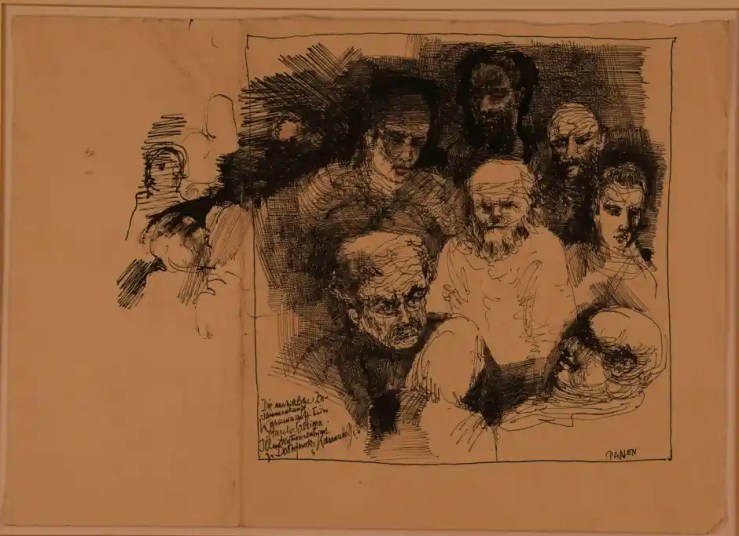
Illustration for Dostoevsky’s Karamazov — Wolfgang Paalen

Illustration for Dostoevsky’s Karamazov, 1923 by Wolfgang Paalen (1905-1959)

Riff on the death of Cormac McCarthy

We were about an hour north of the border, driving a rented car from Quebec City to a hiker hostel our friends own in Maine, when I got a text from my uncle: “It seems your favorite author has died…” (The ellipses were part of his text.)

At first, I thought he meant Thomas Pynchon, who is 86, which is pretty old. I opened Twitter and realized he meant Cormac McCarthy, who is also my favorite author, who died at the age of 89 about a week ago.

It may be unseemly to bring up another author, Pynchon, in an ostensible eulogy for McCarthy (to be clear, this is not a eulogy, this is a riff)—but I found my reactions to the non-news of Pynchon’s non-death and the true-news of McCarthy’s true-death revealing, insomuch as my reactions revealed how I thought about these two writers’ latest and last works. Simply put, I felt a sharp, ugly pang at the thought that there might not be one last Pynchon novel in the author’s lifetime, one last big, baggy, flawed, majestic synthesis of the artist’s oeuvre to capstone the grand career.

Cormac McCarthy published his big, baggy, flawed, majestic capstone last year and titled it The Passenger. It confused and irritated many reviewers and readers, who were likely expecting something other than a sprawling and elliptical summation of the philosophical and aesthetic preoccupations of McCarthy’s previous work. (I made an indirect argument for The Passenger as the elliptical summation of the philosophical and aesthetic preoccupations of McCarthy’s previous work in a series of riffs.) The subsequent release of Stella Maris, a short, spare novella composed entirely in dialogue further befuddled many readers. Neither sequel nor coda, Stella Maris is a cold satellite orbiting The Passenger’s strange sun. Or maybe Stella Maris is The Passenger’s incestuous sibling; the very nature of its publication as a separate text deliberately invites us to read the novels intertextually. And then to read the sibling novels intertextually with/against the McCarthy family of novels.

A proper eulogy (which this riff is not) would remark at some length on the McCarthy family of novels. Such a eulogy might demarcate the novels by both time and location, perhaps separating the early Southern novels (The Orchard Keeper, 1965; Outer Dark, 1968; Child of God, 1973; Suttree, 1978) from the later Westerns (1985’s Blood Meridian up through No Country for Old Men, 2005). Such a eulogy might also point to the commercial success and film adaptations of All the Pretty Horses (1992), No Country for Old Men, and 2006’s The Road. There’s even a segue there, I suppose, to mention McCarthy’s own efforts at screenwriting (The Gardener’s Son, 1976; The Counselor, 2013) and stage writing (The Stonemason, 1995; The Sunset Limited, 2006). Another segue presents itself: one might suggest that these screen and stage efforts need not be situated in McCarthy’s oeuvre. The eulogist might then attend himself to sorting McCarthy’s work into tiers: Blood Meridian and Suttree; The Crossing and The Passenger; everything else. But this riff is not a eulogy.

A eulogy, which this riff is not, should ideally contain a kernel of grief. Like most of his readers, I did not know Cormac McCarthy except through his work, and I feel gratitude for that work—for Blood Meridian and Suttree in particular, but also for The Passenger, which, as I’ve stated above, serves as a perfectly imperfect final marker for a fantastic and rightfully-lauded career. There’s no grief then; McCarthy wrote everything he could possibly write.

He was still writing at the time of his death, of course. Director John Hillcoat revealed just a few weeks ago that he was co-writing the screenplay for a Blood Meridan adaptation with McCarthy. Hillcoat, who adapted The Road into a 2009 film, did know McCarthy, and was working with him, again, and thus might feel a grief personal and professional, a grief and love that licensed him to author a eulogy for his friend, which he did here. I have no such license.

As my wife finished the drive from Quebec to Maine, I scrolled through Twitter, where readers and authors shared their thoughts on McCarthy’s passing. We soon arrived at our friends’ hostel, a large, comfortable old house not too far from the Appalachian Trail’s northern terminus. Years ago, one of these friends became infected with Blood Meridian, obsessed with its bombastic language. I spied his worn copy on the shelf, next to the copy of Suttree I had given him, which he still hasn’t finished. I vaguely recall toasting “Cormac” over some too-strong IPAs that night.

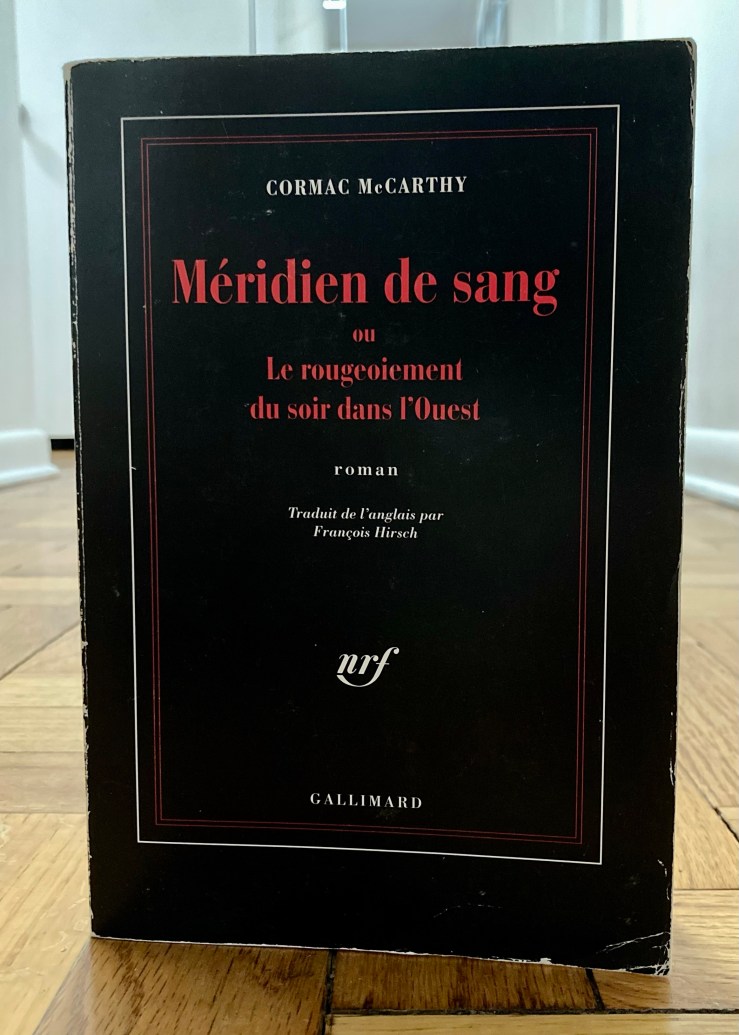
We drove back to Quebec City the following afternoon. (It is nice to visit one’s friends and see the hiker hostel they operate, but a hiker hostel is not a comfortable place for a family who is not hiking.) A day or two later we strolled Rue Saint-Jean outside of the Old City, where I visited four used bookstores. I can’t really read French, but I enjoy looking at book covers and simply looking at what’s in stock at a particular place. I ended up buying a used copy of François Hirsch’s French translation of Blood Meridian that I found for about eight U.S. dollars. I read the “legion of horribles” passage in Hirsch’s translation, and while my French vocabulary is awful, I know the book well enough to have enjoyed the experience. “Oh mon Dieu, dit le sergent” even made me crack up.

I was far from Florida and my home and my laptop in my home, so I did not write any riff on the death of Cormac McCarthy. I recycled old posts I’d written, reading and editing them from my phone, finding some of my early reviews pretty callow. My 2008 first-read review of Blood Meridian is particularly bad; the book clearly overwhelmed me. I’ve read it many, many times since then. The “review” I wrote of No Country back in 2007 is so bad I won’t even link to it. Like most great writers, McCarthy’s work is best reread, not read.

And I reread so much of his work this year. The Passenger left me wanting more McCarthy–not in an unsatisfied way, but rather to confirm my intimations about its status as a career capstone. I reread All the Pretty Horses in the lull before Stella Maris arrived. I went on to reread The Crossing (much, much stronger than I had remembered), Cities of the Plain (weaker than I had remembered), The Road (about exactly as I remembered), Child of God (ditto), and The Orchard Keeper (as funny as I had remembered but also much sadder than I had remembered).

This riff has been too long and too self-indulgent; it was not (as I promised it would not be) a eulogy for the great dead writer, but rather blather on my end—a need to get something out of my own system. If I were younger and more full of foolish energy, I’d probably take the time to rebut McCarthy’s detractors, critics who take to task both his baroque style and dark themes. The truth is I don’t care—I’ve got the books, I’ve read them and reread them, and I know what’s there and how it rewards my attention.

I’ll end simply by inviting anyone interested in McCarthy’s work to read him. And then I’ll really end, here, now, end this riff, with a Thank you to the void.

“It was a lone tree burning on the desert” | Blood Meridian’s Moral Core

Cormac McCarthy’s Blood Meridian begins as a strange, violent picaresque bildungsroman, detailing the adventures of a teenage runaway known only as “the kid.” When the Kid falls in with John Glanton’s marauders, the narrative lens expands and pulls back; Glanton’s gang essentially envelopes the Kid’s personality. The pronoun “they” dominates the Kid’s own agency, for the most part, and the massive figure of Judge Holden usurps the narrative’s voice. The effect is that the Glanton gang’s killing, raping, and scalping spree becomes essentially de-personalized, and, to a certain extent, amoralized.

The Kid, and perhaps the ex-priest Tobin and the Kid’s erstwhile partner Toadvine, are the only major characters who bear any semblance of conventional morality in the narrative. The Kid exhibits a willingness to help others early on when he agrees to stitch one of Tobin’s wounds; later, he removes an arrowhead from a wounded man when no other member of the company will (Tobin chides him for caring, declaring that the wounded man would have killed the Kid had the Kid’s efforts been unsuccessful). For most of the central narrative though, the Kid’s individual actions are consumed into the gang’s “they.” However, at the beginning of chapter 15 the narrative focuses again on the Kid, who is charged with killing a wounded man named Shelby to “spare” him from the approaching Mexican army (this is a bizarre version of mercy in Blood Meridian). Shelby pleads to live and the Kid allows it, even giving the man some water from his own canteen. After he leaves he catches up with a man named Tate whose horse is wounded. Tate remarks on the boy’s foolishness for helping him, but the Kid does so nonetheless, sharing Tate’s burden as they try to make their way back to the rest of their party. Tate is soon killed by Mexican scouts. In both cases, the outcome of the Kid’s moral actions–the will to help, to save, to preserve life–are negated by the book’s narrative outcomes, but I would argue that his intentions in the face of violence somehow secure his humanity.

His journey alone to rejoin the Glanton gang is figured as a kind of vision quest, a strange echo of Christ in the desert, perhaps. At its core–and perhaps the moral core of the book–is the following strange passage–

It was a lone tree burning on the desert. A herladic tree that the passing storm had left afire. The solitary pilgrim drawn up before it had traveled far to be here and he knelt in the hot sand and held his numbed hands out while all about in that circle attended companies of lesser auxiliaries routed forth into the inordinate day, small owls that crouched silently and stood from foot to foot and tarantulas and solpugas and vinegarroons and the vicious mygale spiders and beaded lizards with mouths black as a chowdog’s, deadly to man, and the little desert basilisks that jet blood from their eyes and the small sandvipers like seemly gods, silent and the same, in Jedda, in Babylon. A constellation of ignited eyes that edged the ring of light all bound in a precarious truce before the torch whose brightness had set back the stars in their sockets.

The burning tree alludes to YHWH’s appearance to Moses as a burning bush, and also the tree of smoke that led the Israelites through the desert. Significantly, all the strange, terrible creatures of the desert come to meet around it in a “precarious truce.” The burning tree inverts the natural, inescapable violence that dominates the novel and turns it into a solitary, singular moment of peace. When the Kid awakes–alone–the tree is merely a “smoldering skeleton of a blackened scrog.” God is not in the permanence of the object but rather in the witnessing of the event–Blood Meridian locates (a version of a) god in the natural violence of burning and consumption. There is a strong contrast here, I believe, with the book’s other version of god, the Judge’s proclamation that “War is god.” The Judge, a cunning, devilish trickster, wants to reduce (or enlarge) war to all contest of wills, to pure violence–to divorce it from any ideological structure. Yet the burning tree episode reveals natural violence divorced from ideology. The animals (and the man, the Kid) suspend their Darwinian animosities in order to witness the sublime. The episode is silent, outside of language, order, ideology. This silence is echoed in the novel’s final confrontation between the Judge and the Kid, who retorts simply “You ain’t nothin'” to the Judge’s barrage of grandiose language. While the rejoinder may not save the Kid, its rejection perhaps saves his soul (if such a thing exists in the novel, which I believe it does). So, while larger-than-life Judge Holden may dominate the novel, Cormac McCarthy has nonetheless given us another moral road to follow, should we choose.

[Ed. note—Biblioklept first published a version of this post in October, 2010.]

“Books are made out of books” | Blood Meridian and Samuel Chamberlain

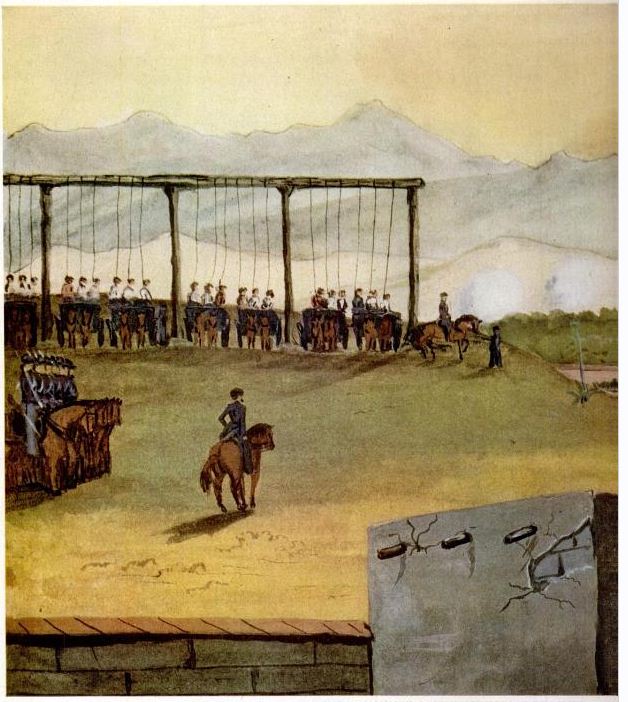
In his 1992 interview with The New York Times, Cormac McCarthy said, “The ugly fact is books are made out of books. The novel depends for its life on the novels that have been written.” McCarthy’s masterpiece Blood Meridian, as many critics have noted, is made of some of the finest literature out there–the King James Bible, Moby-Dick, Dante’s Inferno, Paradise Lost, Faulkner, and Shakespeare. While Blood Meridian echoes and alludes to these authors and books thematically, structurally, and linguistically, it also owes much of its materiality to Samuel Chamberlain’s My Confession: The Recollections of a Rogue.

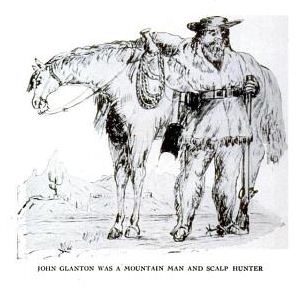
Chamberlain, much like the Kid, Blood Meridian’s erstwhile protagonist, ran away from home as a teenager. He joined the Illinois Second Volunteer Regiment and later fought in the Mexican-American War. Confession details Chamberlain’s involvement with John Glanton’s gang of scalp-hunters. The following summary comes from the University of Virginia’s American Studies webpage

According to Chamberlain, John Glanton was born in South Carolina and migrated to Stephen Austin’s settlement in Texas. There he fell in love with an orphan girl and was prepared to marry her. One day while he was gone, Lipan warriors raided the area scalping the elderly and the children and kidnapping the women- including Glanton’s fiancee. Glanton and the other settlers pursued and slaughtered the natives, but during the battle the women were tomahawked and scalped. Legend has it, Glanton began a series of retaliatory raids which always yielded “fresh scalps.” When Texas fought for its independence from Mexico, Glanton fought with Col. Fannin, and was one of the few to escape the slaughter of that regiment at the hands of the Mexican Gen. Urrea- the man who would eventually employ Glanton as a scalp hunter. During the Range Wars, Glanton took no side but simply assassinated individuals who had crossed him. He was banished, to no avail, by Gen. Sam Houston and fought as a “free Ranger” in the war against Mexico. Following the war he took up the Urrea’s offer of $50 per Apache scalp (with a bonus of $1000 for the scalp of the Chief Santana). Local rumor had it that Glanton always “raised the hair” of the Indians he killed and that he had a “mule load of these barbarous trophies, smoke-dried” in his hut even before he turned professional.
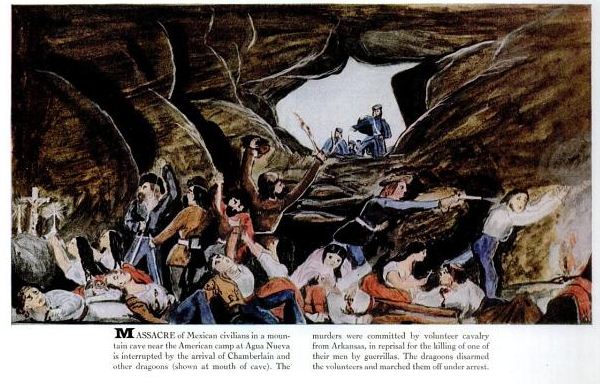
Chamberlain’s Confession also describes a  figure named Judge Holden. Again, from U of V’s summary–

Glanton’s gang consisted of “Sonorans, Cherokee and Delaware Indians, French Canadians, Texans, Irishmen, a Negro and a full-blooded Comanche,” and when Chamberlain joined them they had gathered thirty-seven scalps and considerable losses from two recent raids (Chamberlain implies that they had just begun their careers as scalp hunters but other sources suggest that they had been engaged in the trade for sometime- regardless there is little specific documentation of their prior activities). Second in command to Glanton was a Texan- Judge Holden. In describing him, Chamberlain claimed, “a cooler blooded villain never went unhung;” Holden was well over six feet, “had a fleshy frame, [and] a dull tallow colored face destitute of hair and all expression” and was well educated in geology and mineralogy, fluent in native dialects, a good musician, and “plum centre” with a firearm. Chamberlain saw him also as a coward who would avoid equal combat if possible but would not hesitate to kill Indians or Mexicans if he had the advantage. Rumors also abounded about atrocities committed in Texas and the Cherokee nation by him under a different name. Before the gang left Frontreras, Chamberlain claims that a ten year old girl was found “foully violated and murdered” with “the mark of a large hand on her throat,” but no one ever directly accused Holden.

It’s fascinating to note how much of the Judge is already there–the pedophilia, the marksmanship, the scholarship, and, most interesting of all, the lack of hair. Confession goes on to detail the killing, scalping, raping, and raiding spree that comprises the center of Blood Meridian. Chamberlain even describes the final battle with the Yumas, an event that signals the dissolution of the Glanton gang in McCarthy’s novel.

Content aside, Chamberlain’s prose also seems to presage McCarthy’s prose. In his book Different Travelers, Different Eyes, James H. Maguire notes that, “Both venereal and martial, the gore of [Chamberlain’s] prose evokes Gothic revulsion, while his unschooled art, with its stark architectural angles and leaden, keen-edged shadows, can chill with the surreal horrors of the later Greco-Italian painter Giorgio de Chirico.” Yes, Chamberlain was an amateur painter (find his paintings throughout this post), and undoubtedly some of this imagery crept into Blood Meridian.

You can view many of Chamberlain’s paintings and read an edit of his Confession in three editions of Life magazine from 1956, digitally preserved thanks to Google Books–here’s Part I, Part II, and Part III. Many critics have pointed out that Chamberlain’s narrative, beyond its casual racism and sexism, is rife with factual and historical errors. He also apparently indulges in the habit of describing battles and other events in vivid detail, even when there was no way he could have been there. No matter. The ugly fact is that books are made out of books, after all, and if Chamberlain’s Confession traffics in re-appropriating the adventure stories of the day, at least we have Blood Meridian to show for his efforts.
[Ed. note–Biblioklept first ran this post in September of 2010.]

Selections from One-Star Amazon Reviews of Cormac McCarthy’s Blood Meridian

[Editorial note: The following citations come from one-star Amazon reviews Cormac McCarthy’s novel Blood MeridianI’ve preserved the reviewers’ original punctuation and spelling. More one-star Amazon reviews.].


It may be art.

Damn McCarthy.

I find him boring.

unrelenting nihilism

The story is thin at best.

Are we supposed to enjoy it?

I felt abused by Blood Meridian

not a traditionally enjoyable book

this book is simply just not “all that”

wordy, over the top speechy dialogue

endless streams of dependent clauses

I am a devout fan of Cormac McCarthy.

The characters are not really sympathetic

He is obviously a sick man psychologically.

all about violence and no plot what so ever.

if I was a trained geologist I might like it better.

too many words that are not in standard dictionary

I guess people think he is cool because he writes so violent.

This one guy peed on some clay stuff to create a bomb like thing

murder, slaughter, killing, massacre, beating, stabbing, shooting, scalping

It consists of a series of almost unconnected scenes of unspeakable violence.

Esoteric words, eccentric expressions, pedantic philosophizing, arcane symbolism

I have to believe that he must be embarrassed to have this book back on the market.

A bunch of guys ride around Mexico killing everyone they come across for no particular reason

If you’re a fan of babies, quotation marks, and native americans, then avoid this book like the plague.

The reception he has had shows how tone deaf America has become to moral values, any moral values.

This book was written long before McCarthy had mastered the style that has brought him so much fame and credit.

the unrelenting amount of violence and cruelty in Blood Meridian strikes me as having crossed the line to pornography

It seemed like Cormac McCarthy wrote this with a dictionary in his lap trying to find words that he had never used before

Many of the words have to have been made up or are contractions of words and/or non-words, including much Spanish dialogue

Eliminate five words from the English language (“They rode on” and “He spat”)and this book would have been about 25 pages long

In this book, one sees him trying hard to hone his now-extraordinary powers of observation and description, and failing badly.

The standards for writing have clearly fallen far if all the praise heaped upon this inchoate, pompous mess of a novel is to be taken seriously.

Everything died: mules, horses, chickens, plants, rivers, snakes, babies, toddlers, boys, girls, women, men, ranchhands, bartenders, cowboys, good guys, bad guys…

I dont think the writer knows very much about AMERICAN history, the way he makes all the scalping get done by the AMERICANS and never by the indians, nor do I think he a PATRIOT

Wherein a company of men wander northern Mexico and the West killing, maiming, raping, and/or torturing everyone they meet, all described in gory, endless detail, led by the symbolic characters Glanton and his advisor, ‘the judge’, and supposedly illustrating that war and bloodletting are the only things that count, and the rest of life is just a meaningless dance.

Some kid with a few guys and a spattering of mans rambling through some part of the US or Mexico or a post-apocalyptic Australian desert seeing scores of gruesome, pointless scenes of violence, inhumanity, and death.

Holden is the sort of overt child defiling character who in real life wouldn’t last a month in a state penitentiary, because someone would rightly dispatch him as soon as possible.

Self-consciously faux-baroque linguistic stylings make this fetus-hurtin’ Treatise a feast for weakest link readers fascinated by the mark of the beast.

This book has some wonderful flowery language, and some beautiful descriptions of the southwest countryside.

They say that this book contains BIBLICAL themes, but I’ve read it and I don’t see how that could be so.

The author seems as if he is somehow trying to make some kind of “statement” about AMERICA

In a well ordered society McCarthy would be serving a life term or he would not exist at all.

there are times when it even seems as though English were not McCarthy’s first language

this book cannot be called a novel because it does not have character development

Would you let Cormac McCarthy look after your child for the night?

McCarthy is the most evil person because he is a talented writer

the author likes to use pronouns without establishing a subject

Who are the good guys and the bad guys, everyone is bad.

read Lonesome Dove instead, it’s a hundred times better

rampant nonstop mindless violence and depravity

I can’t dislike a book more than I dislike this one

This is a great writer being lazy and skating

good if you enjoy violence and nonsense

Theres lots of scalping of indians

Was there a quota on similes?

this booked scarred me

sociopath killers

It’s pure bunk.

a moral blight

utter trash

Ugh

Suttree, Cormac McCarthy’s Grand Synthesis of American Literature

In his 1992 interview with The New York Times, Cormac McCarthy said, “The ugly fact is books are made out of books. The novel depends for its life on the novels that have been written.” McCarthy’s fourth novel, 1979’s Suttree is such a book, a masterful synthesis of the great literature — particularly American literature — that came before it. And like any masterful synthesis, Suttree points to something new, even as it borrows, lifts, and outright steals from the past. But before we plumb its allusions and tropes and patterns, perhaps we should overview the plot, no?

The novel rambles over several years in the life of Cornelius Suttree. It is the early 1950s in Knoxville, Tennessee, and Suttree ekes out a mean existence on the Tennessee River as a fisherman, living in a ramshackle houseboat on the edge of a shantytown. This indigent life is in fact a choice: Suttree is the college-educated son of an established, wealthy family. His choice is a choice for freedom and self-reliance, those virtues we like to think of, in our prejudicial manner, as wholly and intrinsically American. Suttree then is both Emersonian and Huck Finnian, a reflective and insightful man who finds his soul via a claim to agency over his own individuality, an individuality poised in quiet, defiant rebellion against the conforming forces of civilization. These forces manifest most pointedly in the Knoxville police, a brutal, racist organization, but we also see social constraint in the form of familial duty. One thinks of the final lines of Huckleberry Finn: “I reckon I got to light out for the Territory ahead of the rest, because Aunt Sally she’s going to adopt me and sivilize me and I can’t stand it. I been there before.”

Like Huck, Suttree aims to resist all forces that would “sivilize” him. His time on the river and in the low haunts of Tennessee (particularly the vice-ridden borough of McAnally) brings him into close contact with plenty of other outcasts, but also his conscience, which routinely mulls over its place in the world. Suttree is punctuated by–perhaps even organized by–several scenes of hallucination. Some of these psychotrips result from drunkeness, one comes from accidentally ingesting the wrong kind of mushrooms (or, the right kind, if that’s your thing), and the final one, late in the novel, sets in as Suttree suffers from a terrible illness. In his fever dream, a small nun–surely a manifestation of the guilt that would civilize us–accuses him–

Mr. Suttree it is our understanding that at curfew rightly decreed by law in that hour wherein night draws to its proper close and the new day commences and contrary to conduct befitting a person of your station you betook yourself to various low places within the shire of McAnally and there did squander several ensuing years in the company of thieves, derelicts, miscreants, pariahs, poltroons, spalpeens, curmudgeons, clotpolls, murderers, gamblers, bawds, whores, trulls, brigands, topers, tosspots, sots and archsots, lobcocks, smellsmocks, runagates, rakes, and other assorted and felonious debauchees.

The passage is a marvelous example of McCarthy’s stream-of-consciousness technique in Suttree, moving through the various voices that would ventriloquize Suttree, into the edges of madness, strangeness, and the sublimity of language. The tone moves from somber and portentous into bizarre imagery that blends humor and pathos. This is the tone of Suttree, a language that gives voice to transients and miscreants, affirming the dignity of their humanity even as it details the squalor of their circumstance.

It is among these criminals and whores, transvestites and gamblers that Suttree affirms his own freedom and humanity, a process aided by his comic foil, Gene Harrogate. Suttree meets Harrogate on a work farm; the young hillbilly is sent there for screwing watermelons. After his release, Harrogate moves to a shantytown in Knoxville. He’s the country mouse determined to become the city rat, the would-be Tom Sawyer to Suttree’s older and wiser Huck Finn. Through Harrogate’s endless get-rich-quick schemes, McCarthy parodies that most-American of tales, the Horatio Alger story. Simply put, the boy is doomed, on his  “way up to the penitentiary” as Suttree constantly admonishes. In one episode, Harrogate tries to buy arsenic from “a grayhaired and avuncular apothecary” to poison bats he hopes to sell to a hospital (don’t ask)–

May I help you? said the scientist, his hands holding each other.

I need me some strychnine, said Harrogate.

You need some what?

Strychnine. You know what it is dont ye?

Yes, said the chemist.

I need me about a good cupful I reckon.

Are you going to drink it here or take it with you?

Shit fire I aint goin to drink it. It’s poisoner’n hell.

It’s for your grandmother.

No, said Harrogate, craning his neck suspectly. She’s done dead

Suttree, unwilling father-figure, eventually buys the arsenic for the boy against his better judgment. The scene plays out as a wonderful comic inversion of William Faulkner’s “A Rose for Emily,” from which it is so transparently lifted. McCarthy borrows liberally from Faulkner here, of course, most notably in the language and style of the novel, but also in scenes like this one, or a later episode that plays off Faulkner’s comic-romantic story of a man and a woman navigating the aftermath of a flood, “Old Man.” Unpacking the allusions in Suttree surpasses my literary knowledge or skill, but McCarthy is generous, if oblique, with his breadcrumb trail. Take, for example, the following sentence: “Suttree with his miles to go kept his eyes to the ground, maudlin and muttersome in the bitter chill, under the lonely lamplight.” The forced phrase “miles to go” does not immediately present itself as a reference to Robert Frost’s famous poem, yet the direction of the sentence retreats into the history of American poetry; with its dense alliteration and haunted vowels, it leads us into Edgar Allan Poe territory. Only a few dozen pages later, McCarthy boldly begins a chapter with theft: “In just spring the goatman came over the bridge . . .” The reference to e.e. cummings explicitly signifies McCarthy’s intentions to play with literature. Later in the book, while tripping on mushrooms in the mountains, Suttree is haunted by “elves,” the would-be culprits in Frost’s poem “Mending Wall.” The callback is purposeful, but tellingly, McCarthy’s allusions are not nearly as fanciful as their surface rhetoric might suggest: the goatman does not belong in Knoxville–he’s an archaic relic, forced out of town by the police; the elves are not playful spirits but dark manifestations of a tortured psyche.

Once one spots the line-lifting in Suttree it’s hard to not see it. What’s marvelous is McCarthy’s power to convert these lines, these riffs, these stories, into his own tragicomic beast. An early brawl at a roadhouse recalls the “Golden Day” episode of Ralph Ellison’s Invisible Man; a rape victim’s plight echoes Hubert Selby’s “Tralala”; we find the comic hobos of John Steinbeck’s Cannery Row–we even get the road-crossing turtle from The Grapes of Wrath. A later roadhouse chapter replays the “Circe/Nighttown” nightmare in James Joyce’s Ulysses. Ulysses is an easy point of comparison for Suttree, which does for Knoxville what Joyce did for Dublin. Suttree echoes Ulysses’s language, both in its musicality and appropriation of varied voices, as well as its ambulatory structure, its stream-of-consciousness technique, its rude earthiness, and its size (nearly 600 pages). But, as I argued earlier, there’s something uniquely American about Suttree, and its literary appropriations tend to reflect that. Hence, we find Mark Twain, Herman Melville, Ernest Hemingway, Walt Whitman, Emerson and Thoreau, Emily Dickinson, and William Carlos Williams, to name just a few writers whose blood courses through this novel (even elegant F. Scott Fitzgerald is here, in an unexpected Gatsbyish episode late in the novel).

Making a laundry list of writers is weak criticism though, and these sources–all guilty of their own proud plagiarisms–are mentioned only as a means to an end, to an argument that what McCarthy does in Suttree is to synthesize the American literary tradition with grace and humor, while never glossing over its inherent dangers and violence. So, while it appropriates and plays with the tropes of the past, Suttree is still pure McCarthy. Consider the following passage, which arrives at the end of a drunken, awful spree, Suttree locked up for the night–

He closed his eyes. The gray water that dripped from him was rank with caustic. By the side of a dark dream road he’d seen a hawk nailed to a barn door. But what loomed was a flayed man with his brisket tacked open like a cooling beef and his skull peeled, blue and bulbous and palely luminescent, black grots his eyeholes and bloody mouth gaped tonguless. The traveler had seized his fingers in his jaws, but it was not alone this horror that he cried. Beyond the flayed man dimly adumbrate another figure paled, for his surgeons move about the world even as you and I.

Suttree’s dark vision points directly toward the language of McCarthy’s next novel, 1985’s Blood Meridian, roundly considered his masterpiece. Critics who disagree tend to point to Suttree as the pinnacle of McCarthy’s writing. I have no interest at this time in weighing the books against each other, nor do I think that doing so would be especially enlightening. For all of their sameness, they are very different animals: Suttree provides us intense access to its hero’s consciousness, where Blood Meridian always keeps the reader on the outside of its principals’ souls (if those grotesques could be said to have souls). And while Blood Meridian does display some humor, it is the blackest and driest humor I’ve ever read. Suttree is broader and more compassionate; it even has a fart joke. Blood Meridian, at least in my estimation (and many critics will contend this notion) has no flawed episodes; much of this results from the book’s own internal program–it resists love, compassion, and even human dignity. In contrast, Suttree is punctuated by two deaths the audience is meant to read as tragic, yet I found it impossible to do so. The first is the death of Suttree’s child, whom he has abandoned, along with its mother. As such, he is not permitted to take part in the funeral, observing the process rather from its edges. The second tragedy is the death of Suttree’s young lover in a landslide. The book begs us to empathize with Suttree, just as he often empathizes with the marginal figures in the novel, but ultimately these tragedies are a failed ploy. They underwrite a sublime encounter with death for Suttree, an encounter that deepens and enriches his character while paradoxically freeing him from the burdens of social duty and familial order. McCarthy is hardly alone in such a move; indeed, it seems like the signature trope of American masculine literature to me. It’s the move that Huck Finn wishes to make when he promises to light out for the Territory to escape the civilizing body of Aunt Sally; it’s the ending that Hemingway was compelled to give to Frederic Henry at the end of A Farewell to Arms; it’s all of Faulkner, with his mortification of fatherhood and the dramatic responsibility fatherhood entails. It is a cost analysis that neglects any potential benefits.

But these are small criticisms of a large, beautiful, benevolent novel, a book that begs to be reread, a rambling picaresque of comic and tragic proportions. “I learned that there is one Suttree and one Suttree only,” our hero realizes, but this epiphany is set against a larger claim. Near the end of the novel, Suttree goes to check on an old ragman who he keeps a watchful eye on. He finds the man dead, his shack robbed, his body looted. Despairing over the spectacle’s abject lack of humanity, Suttree cries, “You have no right to represent people this way,” for “A man is all men. You have no right to your wretchedness.” Here, Suttree’s painful epiphany is real and true, an Emersonian insight coded in the darkest of Whitman’s language. If there is one Suttree and one Suttree only, he is still beholden to all men; to be anti-social or an outcast is not to be anti-human. Self-hood is ultimately conditional on others and otherness. To experience the other’s wretchedness is harrowing; to understand the other’s wretchedness and thus convert it to dignity is life-affirming and glorious. Suttree is a brilliant, bold, marvelous book. Very highly recommended.

[Ed. note—Biblioklept originally published a version of this review on November 27, 2010].


They had given robots to the world with the lie that they would save us from labor or relieve us from drudgery so that we could grow and develop inwardly | From Walter Tevis’s Mockingbird

I had never looked at a robot that closely before, having been brought up to fear and respect them. And I became aware, looking at his stupid, manufactured face, that I was seeing for the first time what the significance of this dumb parody of humanity really was: nothing, nothing at all. Robots were something invented once out a blind love for the technology that could allow them to be invented. They had been made and given to the world of men as the weapons that nearly destroyed the world had once been given, as a “necessity.” And, deeper still, underneath that blank and empty face, identical to all the thousands of faces of its make, I could sense contempt—contempt for the ordinary life of men and women that the human technicians who had fashioned it had felt. They had given robots to the world with the lie that they would save us from labor or relieve us from drudgery so that we could grow and develop inwardly. Someone must have hated human life to have made such a thing—such an abomination in the sight of the Lord.

From Walter Tevis’s 1980 novel Mockingbird.

This is not a review of Fernanda Melchor’s This Is Not Miami

  1. This is not a review of Fernanda Melchor’s collection This Is Not Miami.
  2. First published in 2013, This Is Not Miami is now available in English translation by Sophie Hughes.
  3. Hughes previously translated Melchor’s two novels, the recent shorty Paradais and the superb 2017 novel Hurricane Season.
  4. Melchor composed the twelve pieces collected in This Is Not Miami between 2002 and 2011.
  5. In her introduction to the collection, Melchor declares that the pieces in This Is Not Miami are not properly tales or stories or works of journalism, but rather relatos—reports “based on events that really happened.”
  6. Melchor crafts her relatos from eyewitness accounts.
  7. (There’s also some journalistic research in there.)
  8. Like Paradais and Hurricane Season, the relatos of This Is Not Miami all take place in Melchor’s native Veracruz.
  9. Like Paradais and Hurricane Season, the relatos of This Is Not Miami describe and explore violent crime.
  10. Some characters: narcos, corrupt cops, crackheads, corrupt judges, petty drug dealers, petty drug users, an infanticidal beauty queen, a child rapist, a ufologist, a lynch mob, starving stowaways, scared cadets, a demon-possessed teen, a healer, a priest, an older couple clinging to the floor of their apartment as bullets fly through the walls, etc.
  11. (And Melchor’s “I” of course.)
  12. (Oh, and there’s a brief appearance by Mel Gibson.)
  13. Most of Melchor’s relatos are short. There are two significantly longer pieces: “Queen, Slave, Woman” and “The House on El Estero.”
  14. “Queen, Slave, Woman” tells the story of Evangelina Tejera Bosada, queen of the 1983 Veracruz Carnival who killed her children and cut them into pieces.
  15. In the previous sentence, the phrase “tells the story” is imprecise. In “Queen” and in most of the relatos in the collection, Melchor is telling the story of the witnesses who are telling the story.
  16. “The House on El Estero,” the longest piece, is a haunted house/exorcism riff that ends up being a kind of love story, a story about falling in love with a storyteller.
  17. “The House on El Estero” began to to wear thin for me, its premise stretched farther than my interest.
  18. However, William T. Vollmann singled out “The House on El Estero” as a favorite in his New York Times review of This Is Not Miami, a review I read a few minutes before I decided not to write a review of This Is Not Miami.
  19. While I don’t think “El Estero” is one of the better pieces in the collection, I generally agree with Vollmann’s assessment of the book’s trajectory.
  20. Vollmann points out that “because the relatos are arranged mostly in order between 2002 and 2011, during which time the author was obviously working hard at her craft, the style rapidly improves, in Sophie Hughes’s translation, into something natural, careful and smooth.”
  21. And, I’d add, rough when necessary.
  22. I hate to say that I was disappointed in This Is Not MiamiI mean, I was, disappointed, but also deeply interested.
  23. The sketches here are not sketchy; they are ballast, the raw and vivid material that points to the Hurricane Season’s masterful hallucinatory language explosion.
  24. As such, This Is Not Miami reads like a minor work, but one nonetheless vital to its creator’s artistic maturation.
  25. For me, This Is Not Miami is most appreciable as an apprenticeship work that points toward the Bigger Thing to come.
  26. And of course I want more.

The Hall of Spiders (An Illustration for Mervyn Peake’s Gormenghast) — Charles W. Stewart

On the Way to the Doctor, 1974 by Charles W. Stewart (1915 – 2001).

Part of a series of unpublished illustrations that were to illustrate Mervyn Peake’s 1950 novel, Gormenghast. (More here.)

On Henri Bosco’s lovely brief novel, The Child and the River

Last week or maybe the week before last, I received in the mail a review copy of Henri Bosco’s slim 1945 novel The Child and The River. This new translation by Joyce Zonana is available now from publisher NYRB. I picked up The Child and the River this week twice: once before bed, and then again immediately upon waking the next morning, where I finished it before rising.

Set some years before either of the Big Wars, The River and the Child takes place in the countryside somewhere in the south of France (likely Bosco’s native Provence). Narrator Pascalet, now an older man, looks back on a transformational episode in his youth. He relates how as a young boy, he was free to roam the countryside wherever he pleased, excepting the river, where, according to his parents, “there are black holes where you can drown; there are snakes in the reeds and Gypsies on the banks.”

When his parents go on a trip, leaving him in the care of sweet Tante Martine, young Pascalet makes his way to the forbidden river posthaste, blaming any mischief on newly-arrived Spring:

…one fine April morning, temptation caught me unawares. It knew how to speak to me. It was a springtime temptation, one of the sweetest there is, I think, for anyone who is open to clear skies, tender leaves, and newly-blossomed flowers.

That is why I succumbed.

Pascalet’s adventure quickly goes awry, or improves in intensity, depending on how you like to think of it. He falls asleep in an old rowboat, drifts downriver, and ends up on an island inhabited by Gypsies. Hungry, he spies them from behind the brush. Near their cauldron they keep a dog and a bear—and a bound prisoner: “He was a handsome child, sturdy, taller than me and stronger, most likely a Gypsy.” The men in the group beat the young prisoner with a whip, but he endures it. Late in the night, under cover of darkness, Pascalet frees this boy, Gatzo; they then steal a boat and escape to live out a boyhood fantasy of utter freedom—for a few days, at least.

The Child and the River brims with lovely nostalgic pleasures. The boys playact their boyish fantasies, forging crude bows and arrows of reed and pretending that they might have to fend off monsters or “headhunters, cannibals.” Pascalet describes the wonderful sensation of escalating these fantasies:

Then I would feel a mock terror. I enjoyed it. Because when you scare yourself through make-believe, you know well enough that you are not in any danger, but still you are afraid. It is one of the most delicious pleasures.

And yet the boys are not merely playacting—they are surviving: fishing, foraging, strategically moving and mooring their boat to avoid detection. They make fire; they cook. In a lovely little scene, they dig a spring to enjoy fresh water:

We made a hole near a bulge in the clay. Water was seeping through. We continued to dig and fashioned a little basin. Through a breach in the clay, the water moistened a bed of sand. We flattened one side of our hole and stuck in a hollow reed. At first the reed stayed dry. We were aching with impatience, even more than for the fire. At long last, a droplet formed and grew round; for a long time, it hung, uncertain. Suddenly it fell. Another drop came, and slowly, at the tip of the green reed, the spring was born.

This passage exemplifies the simple precision of Bosco’s prose via Zonana’s clean, clear translation. The joy of The Child and the River comes from Pascalet’s gentle, limpid observations of his time on the river, which are generally free of intrusive, muddy “adult” meditations. Instead, we experience what the boys experience:

Everywhere, plants and waters, shorelines and trees, came alive at nightfall with a confused, mysterious life. A duck would flap its wings in the reeds; an owl would screech on a black poplar; a brutal badger would rummage in a bush; a weasel, gliding from branch to branch, would cause two or three leaves to tremble lightly; a roving fox would yelp in the distance.

“It is a sad animal,” Gatzo told me. “It is thinking

The adventures of Pascalet and Gatzo culminate in a strange, dreamlike encounter with “the Puppeteer of Souls.” I won’t remark on the episode at any length, only add that it provides a nearly-mystical, memorable climax to the book. I’ll also add that the novel’s last two sentences are some of the sweetest I’ve read in a while.

I loved reading The Child and the River; I loved the feeling of reading it. It took me back to books I’d loved as a child: Arthur Ransome’s Swallows and Amazons, abridged and bowdlerized versions of Moby-Dick and Huckleberry Finn, and countless Robinsades. In a letter to a friend, Bosco suggested that The Child and the River was “a novel very good, I think, for children, adolescents, and poets.” Is there a better audience?

The Child and the River is one of two Bosco books in publication now from NYRB; they released Zonana’s translation of his 1948 novel Malicroix in early March of 2020. I have it on my shelf, still unread, but not for long. I hope NYRB and Zonana will do a few more Bosco titles. Recommended.

I’ve sat down many times and tried to write a bestseller but something always goes wrong | William S. Burroughs

BOCKRIS: Do you ever get worried that being a writer provides a pretty thin income?

BURROUGHS: It’s gotten very thin. I’ve sat down many times and tried to write a bestseller but something always goes wrong. It isn’t that I can’t bring myself to do it or that I feel I’m commercializing myself or anything like that, but it just doesn’t work. If your purpose is to make a lot of money on a book or film, there are certain rules to observe. You’re aiming for the general public, and there are all sorts of things the general public doesn’t want to see or hear. A good rule is never ask the general public to experience anything they cannot easily experience. You don’t want to scare them to death, knock them out of their seats, and above all, you don’t want to puzzle them.

From With William Burroughs: A Report from the Bunker by Victor Bockris. The selection is from Bockris’s recording of a 1978 dinner with Maurice Girodias, Gerard Malanga, and Glenn O’Brien.