

Category: Books
New Rachel Carson Biography (Book Acquired, 11.13.2012)
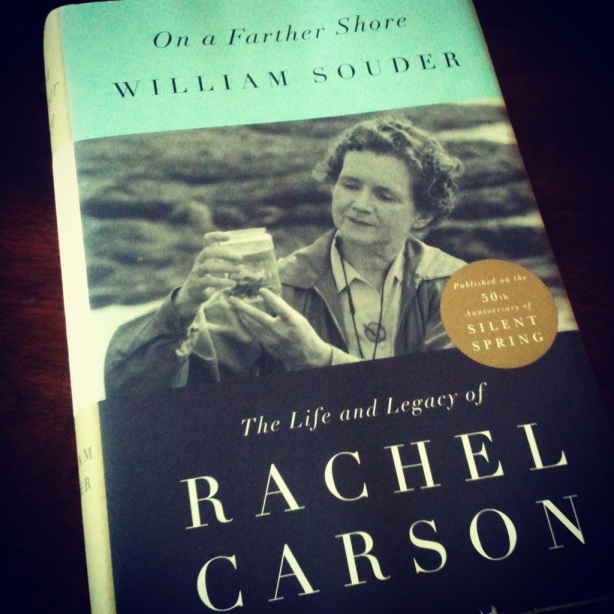
On a Farther Shore is William Souder’s big, bold biography of Rachel Carson, whose long (and often poetic) essay Silent Spring changed the way many people thought about humanity’s changing relationship with the environment. Here’s publisher Crown/Random House’s blurb:
She loved the ocean and wrote three books about its mysteries, including the international bestseller The Sea Around Us. But it was with her fourth book, Silent Spring, that this unassuming biologist transformed our relationship with the natural world.
Rachel Carson began work on Silent Spring in the late 1950s, when a dizzying array of synthetic pesticides had come into use. Leading this chemical onslaught was the insecticide DDT, whose inventor had won a Nobel Prize for its discovery. Effective against crop pests as well as insects that transmitted human diseases such as typhus and malaria, DDT had at first appeared safe. But as its use expanded, alarming reports surfaced of collateral damage to fish, birds, and other wildlife. Silent Spring was a chilling indictment of DDT and its effects, which were lasting, widespread, and lethal.
Published in 1962, Silent Spring shocked the public and forced the government to take action-despite a withering attack on Carson from the chemicals industry. The book awakened the world to the heedless contamination of the environment and eventually led to the establishment of the EPA and to the banning of DDT and a host of related pesticides. By drawing frightening parallels between dangerous chemicals and the then-pervasive fallout from nuclear testing, Carson opened a fault line between the gentle ideal of conservation and the more urgent new concept of environmentalism.
Elegantly written and meticulously researched, On a Farther Shore reveals a shy yet passionate woman more at home in the natural world than in the literary one that embraced her. William Souder also writes sensitively of Carson’s romantic friendship with Dorothy Freeman, and of her death from cancer in 1964. This extraordinary new biography captures the essence of one of the great reformers of the twentieth century.
Elizabeth Royte gave Shore a good review in The New York Times; excerpt:
Souder is at his best when he places Carson’s intellectual development in context with the nascent environmental movement. The storm over “Silent Spring,” he notes, was a “cleaving point” in history when the “gentle, optimistic proposition called ‘conservation’ began its transformation into the bitterly divisive idea that would come to be known as ‘environmentalism.’” (Souder isn’t shy about expressing his own disappointment with what he views as a permanent wall between partisans, with nature and science pitted against an “unbreakable coalition of government and industry, the massed might of the establishment.”)
I’ll let Lucy have the last word:

Land of Cockaigne — Pieter Bruegel the Elder

Book Shelves #47, 11.18.2012
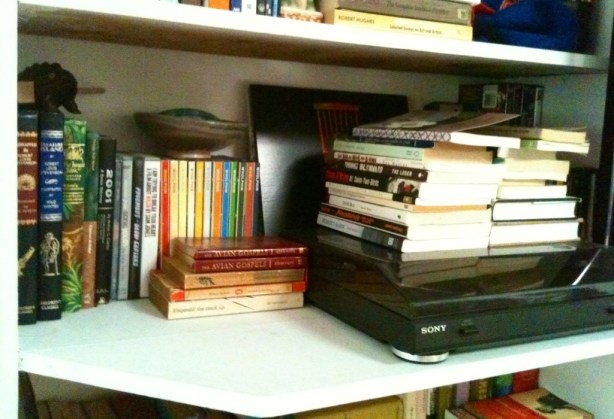
Book shelves series #47, forty-seventh Sunday of 2012
So this is what happens—books pile up. Okay, maybe that sentence is missing a clear subject: I pile books up.
This stack mounded on my record player over the last week; I intended to shelve about half of these:
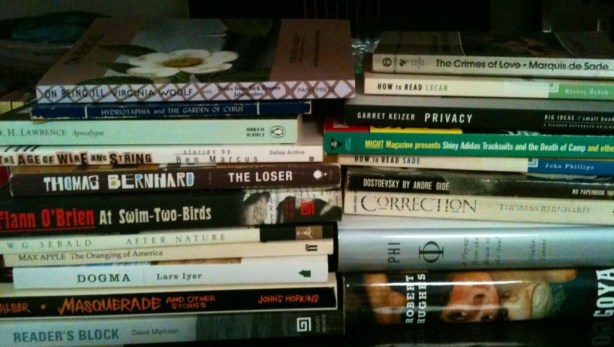
My shelving solution is woefully short-term (more double stocked shelves).
Anyway, this shelf is mostly other media, including DVDs, a few records, and playing cards.
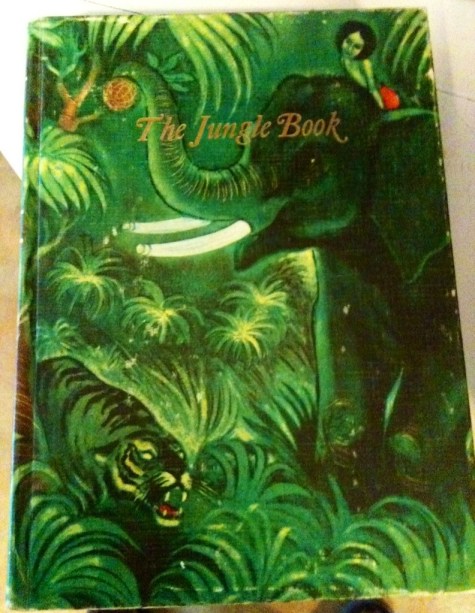
Of note (perhaps) are the three illustrated volumes on the left that I’ve had forever.
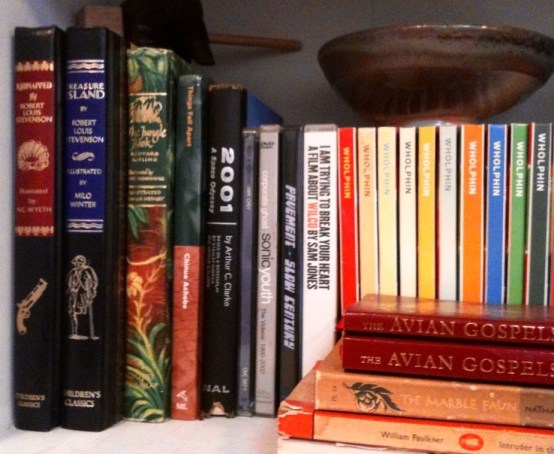
The illustrated Kidnapped features art by N.C. Wyeth:

The illustrated Kipling was actually my father’s:
Have you read Adam Novy’s novel The Avian Gospels? It’s good stuff.

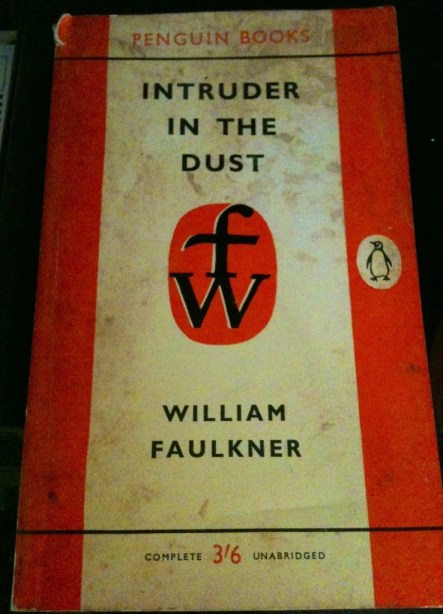
Like many bibliophiles, I’m a sucker for plain Penguins:
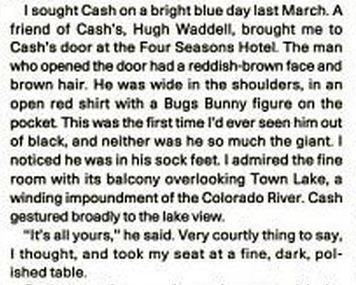
Read Barry Hannah’s Profile of Johnny Cash (SPIN, 1994)
Bookshop — Ben Shahn

Fireplace (Night) — Boris Kustodiev

Charles Dickens’s Own Punch
At Victorian Web, Philip V. Allingham shares a recipe for Charles Dickens’s punch:
“Charles Dickens’s Own Punch,” according to Brenda Marshall in The Charles Dickens Cookbook (1981), was that with which Mr. Micawber regales the eponymous youth in Chapter XXVIII of David Copperfield , the literary progeny with whom Dickens most closely identified himself. In an 1847 letter Dickens gave the following recipe for this second punch:
Peel into a very common basin (which may be broken in case of accident, without damage to the owner’s peace or pocket) the rinds of three lemons, cut very thin and with as little as possible of the white coating between the peel and the fruit, attached. Add a double handful of lump sugar (good measure [although Dickens had rather small hands]), a pint of good old rum, and a large wine-glass of good old brandy‹if it be not a large claret glass, say two. Set this on fire, by filling a warm silver spoon with the spirit, lighting the contents at a wax taper, and pouring them gently in. Let it burn three or four minutes at least, stirring it from time to time. Then extinguish it by covering the basin with a tray, which will immediately put out the flame. Then squeeze in the juice of the three lemons, and add a quart of boiling water. Stir the whole well, cover it up for five minutes, and stir again.
At this moment of crisis, the inimitable Boz suggests skimming off the lemon pips and doing some judicious sampling before one places the jug (sealed with leather on top) in a hot oven for ten minutes. However, the text’s editor proposes stove-top heating instead — “it could possibly alight in a modern oven.”
Virginia Woolf’s On Being Ill (Book Acquired, Some Time Last Month)

The kind people of Paris Press were good enough to send me a reader copy of their 10th anniversary edition of Virginia Woolf’s essay “On Being Ill,” which they’ve collected with “Notes from Sick Rooms,” an essay by Julia Stephen—Woolf’s mother. Paris Press’s blurb:
Published together for the first time, Woolf and Stephen create a literary conversation between parent and child, patient and care giver, from the vantage points each experience in the world of illness. Originally published by Paris Press in 2002, this new edition doubles the length of the original book and includes a new introduction to Notes from Sick Rooms by eminent Woolf scholar Mark Hussey, and a new afterword by Rita Charon, founder and director of the Narrative Medicine program at Columbia University, along with the original introduction to On Being Ill by Hermione Lee, Woolf’s biographer.
Lee’s introduction seems to be an expansion of a piece she wrote for The Guardian in 2004; in that piece she wrote:
The story of the body’s life, and the part the body has to play in our lives, is one of Virginia Woolf’s great subjects. Far from being an ethereal, chill, disembodied writer, she is always transforming thoughts and feelings and ideas into bodily metaphors. She writes with acute – often extremely troubling – precision about how the body mediates and controls our life stories. Body parts are strewn all over her pages. Rage and embarrassment are felt in the thighs; a headache can turn into a whole autobiography; dressing up the body is an epic ordeal; and a clenched fist, feet in a pair of boots, the flash of a dress or the fingertip feel of a creature in a salt-water pool, can speak volumes.
Nowhere is her attention to body parts more eloquent and intense than in the essay “On Being Ill”. It is one of Woolf’s most daring, strange and original short pieces of writing, and it has more subjects than its title suggests. Like the clouds that its sick watcher, “lying recumbent”, sees changing shapes and ringing curtains up and down, this is a shape-changing essay.
Woolf announces her theme in a long, winding opening sentence that showcases some of the “shape-shifting” Lee alludes to:
Considering how common illness is, how tremendous the spiritual change that it brings, how astonishing, when the lights of health go down, the undiscovered countries that are then disclosed, what wastes and deserts of the soul a slight attack of influenza brings to view, what precipices and lawns sprinkled with bright flowers a little rise of temperature reveals, what ancient and obdurate oaks are uprooted in us by the act of sickness, how we go down in the pit of death and feel the waters of annihilation close above our heads and wake thinking to find ourselves in the presence of the angels and the harpers when we have a tooth out and come to the surface in the dentist’s arm-chair and confuse his “Rinse the mouth-rinse the mouth” with the greeting of the Deity stooping from the floor of Heaven to welcome us – when we think of this, as we are so frequently forced to think of it, it becomes strange indeed that illness has not taken its place with love and battle and jealousy among the prime themes of literature.

And what of Stephen’s essay? It’s a practical, concrete, and mostly pragmatic approach to caring for sick people. Some parts compel more than others, as when Stephen discusses the absurd flights of fancy that might afflict the ill. In his introduction to “Notes from Sick Rooms,” Mark Hussey tries to amplify connections between the two texts that are either obvious (the texts share a common subject) or speculative (Stephen’s essay “foreshadows the wit and sharp observation that is characteristic of her famous daughter’s style”). Hussey’s comments are best when they provide basic context and don’t try to force the reader into making connections. There’s also an afterward by Rita Charon, an internist, who again tries to synthesize the two texts. I suppose context is important, but there’s a sense of inflation here that I’m not entirely sure either essay (Woolf’s or Stephen’s) necessarily merits.
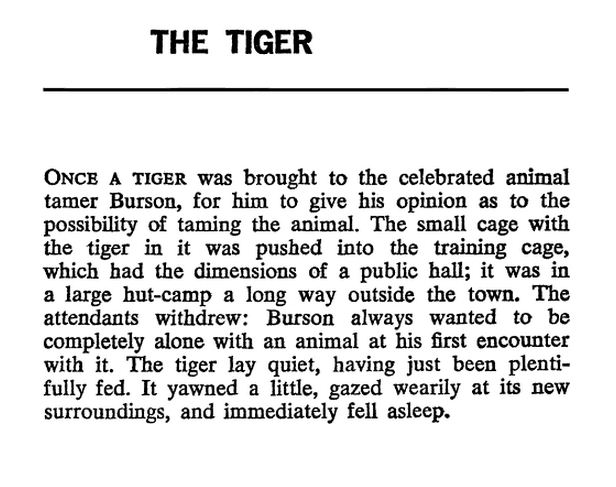
“The Tiger” — Kafka
Geometrician — Antoine Pesne

Reading Chris Ware’s Building Stories / Big Four Panel Board Book
Continuing reading Chris Ware’s Building Stories; also, continuing the ad hoc naming of its “chapters”: let’s call this one the Big Four Paneled Board Book.
It’s big. Shown here in relation to a local brew (clearly the best way to illustrate scale):

It’s difficult to describe how each chapter enriches the story of Building Stories. There’s something Borgesian about Ware’s novel—not in the sense that it’s something that Borges would have written—what I mean to suggest is it’s like something out of a Borges story—winding, maze-like, self-referential, but not solipsistic. Building Stories doesn’t come with a set of instructions, so the reader has to interact with it in a random way. What’s really thrilling and emotionally impactful is the way that each piece deepens the story and develops each character a little bit more.
In the forked path I’ve been following, Lonely Girl (this is the building’s name for her; we might also call her the Would-be Writer, The Diarist, or, perhaps, The Amputee) emerges as the central character, and she gets the lead story in the Big Four Panel Board book. She’s looking for a companion, so she places an ad:

This tiny little square says so much: Ware wastes no space. Lonely Girl’s personal ad is in some ways a metonymy of Building Stories (and Ware’s oeuvre all together): it combines ironic, self-aware humor with a stark and devastating sense of loneliness.
Lonely Girl shows up as a character in the lives of her downstairs neighbors, the Sour Couple. The soda-swilling boyfriend wonders how she might have lost her leg. In some ways he serves as audience surrogate here—I doubt we’ll get the full story. (The boyfriend also entertains other fantasies about Lonely Girl’s body).

Of course, the Lonely Landlady also gets her panel. We see more of her stunted life, her mother (and the building itself) a proverbial albatross around her neck. Ware uses the size and scope of the Big Book to optimum advantage; he knows that the book is so big (and his panels so small) that the reader simultaneously sees everything and comprehends nothing. Ware employs lines that crisscross from section to section, often running through narrative elements we’ve yet to engage, or sometimes tracing over what we’ve already seen. The effect is not disorienting, though—rather, Ware uses the visual space to show the ways in which his characters and narratives cross, abut, or fail to connect.

The Big Book’s theme is in fact about cross-pollination, about the ways that different strands intersect, conmingle, blend (or fail to). It’s appropriate then when our old friend Branford the bee arrives:

More to come.
Ben Jonson’s Egg Wine

Italo Calvino and Jorge Luis Borges

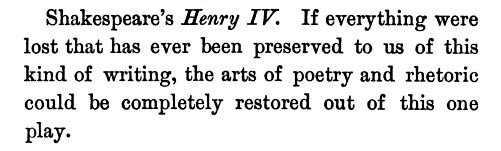
Goethe Comments on Shakespeare’s Henry IV
Head of a Woman with Flowers — Gustave Courbet

“Anacreontic” –Robert Herrick

 Biblioklept