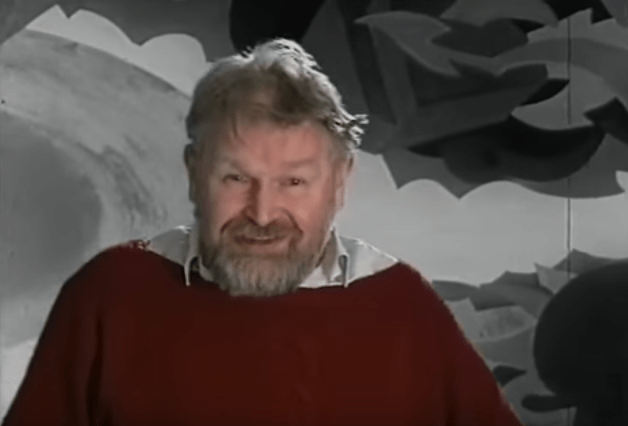
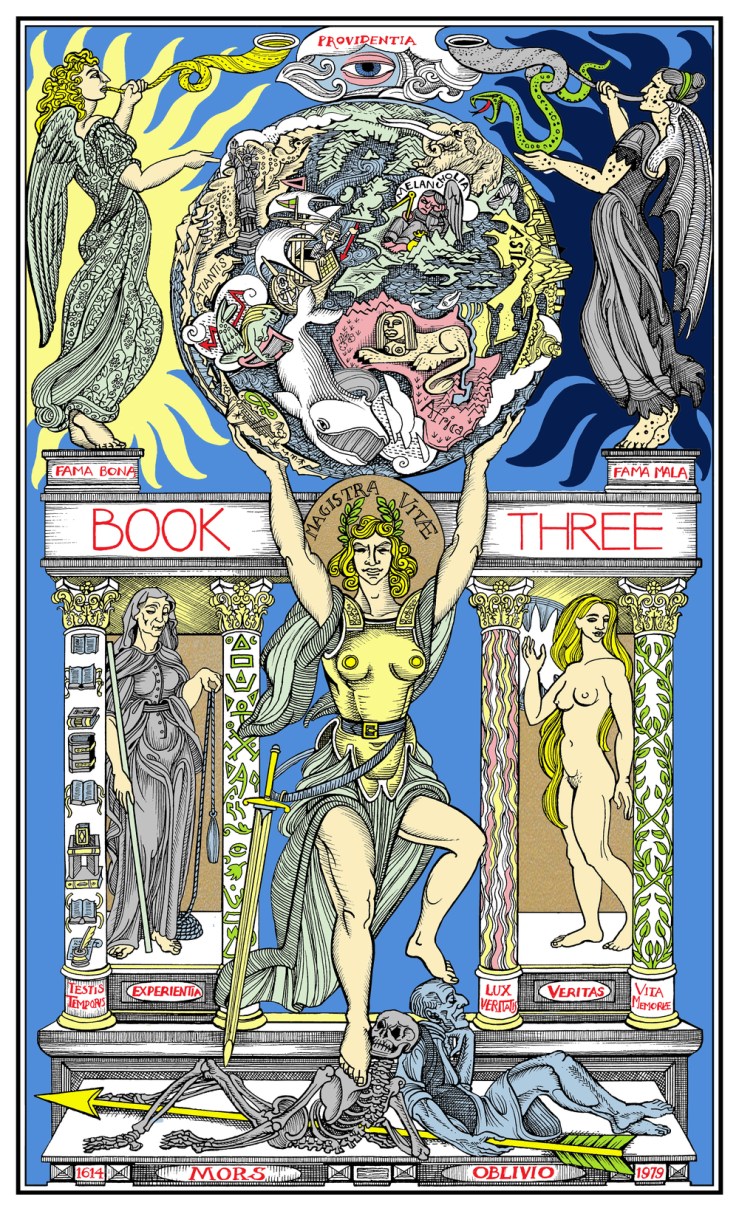
Why we like tragedies (Alasdair Gray)

A story can always end happily by stopping at a cheerful moment. Of course in nature the only end is death, but death hardly ever happens when people are at their best. That is why we like tragedies. They show men ending energetically with their wits about them and deserving to do it.

From Alasdair Gray’s novel Lanark

Moby-Dick (Alasdair Gray’s Lanark)

It is a relief to turn to the honest American book about the whale. A captain wants to kill it because the last time he tried to do that it bit off his leg while escaping. He embarks with a cosmopolitan crew who don’t like home life and prefer this way of earning money. They are brave, skilful and obedient, they chase the whale round the world and get themselves all drowned together: all but the storyteller. He describes the world flowing on as if they had never existed. There are no women or children in this book, apart from a little black boy whom they accidentally drive mad.

From Alasdair Gray’s unwieldy cult classic Lanark. In this particular episode, a version of the author of the novel Lanark itself (a conjurer-king, not named Gray) discusses and describes the great national epics; he chooses Moby-Dick as the American epic. There is no listing of a Scottish national epic; presumably Gray intends his novel to fill that slot.

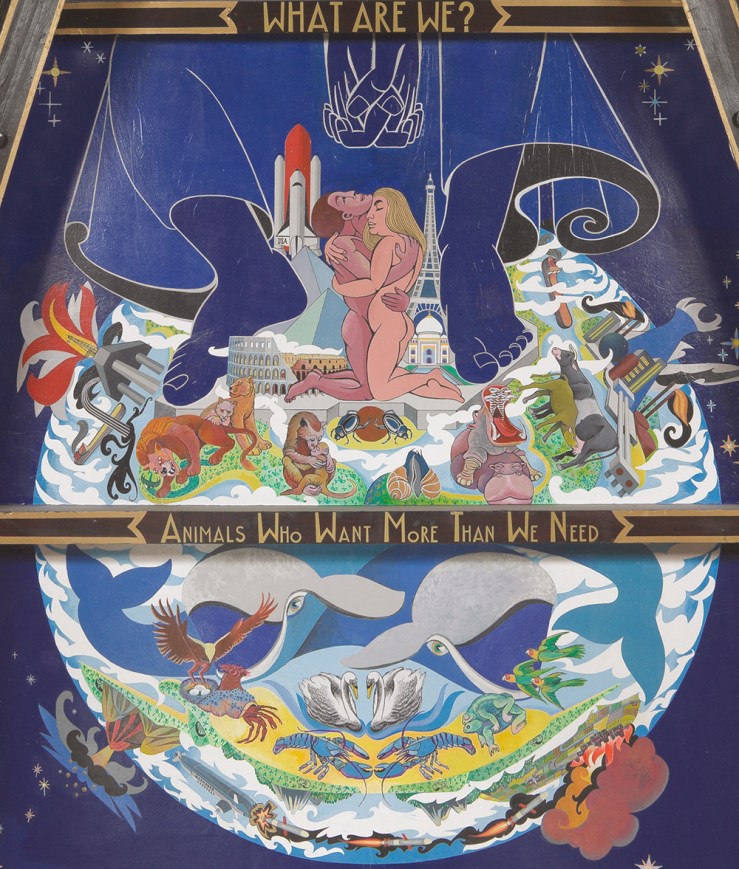
Complaint to God (Alasdair Gray’s Lanark)

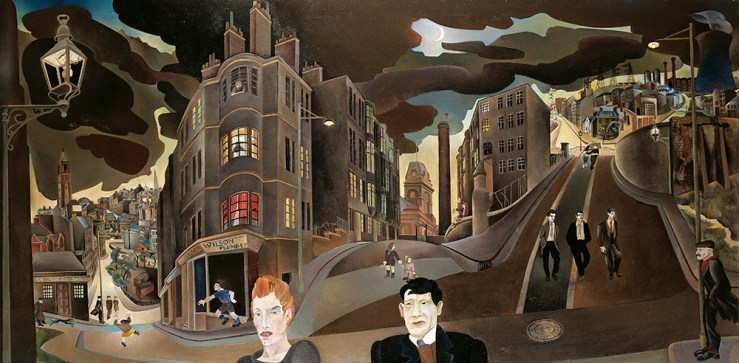
The more he worked the more the furious figure of God kept popping in and having to be removed: God driving out Adam and Eve for learning to tell right from wrong, God preferring meat to vegetables and making the first planter hate the first herdsman, God wiping the slate of the world clean with water and leaving only enough numbers to start multiplying again, God fouling up language to prevent the united nations reaching him at Babel, God telling a people to invade, exterminate and enslave for him, then letting other people do the same back. Disaster followed disaster to the horizon until Thaw wanted to block it with the hill and gibbet where God, sick to death of his own violent nature, tried to let divine mercy into the world by getting hung as the criminal he was. It was comical to think he achieved that by telling folk to love and not hurt each other. Thaw groaned aloud and said, “I don’t enjoy hounding you like this, but I refuse to gloss the facts. I admire most of your work. I don’t even resent the ice ages, even if they did make my ancestors carnivorous. I’m astonished by your way of leading fertility into disaster, then repairing the disaster with more fertility. If you were a busy dung beetle pushing the sun above the skyline, if you had the head of a hawk or the horns and legs of a goat I would understand and sympathize. If you headed a squabbling committee of Greek departmental chiefs I would sympathize. But your book claims you are a man, the one perfect man of whom we are imperfect copies. And then you have the bad taste to put yourself in it. Only the miracle of my genius stops me feeling depressed about this, and even so my brushes are clogged by theology, that bastard of the sciences. Let me remember that a painting, before it is anything else, is a surface on which colours are arranged in a certain order.

From Alasdair Gray’s novel Lanark.

Three Books (that were my favorite books I read in 2019 that were published in the 2010s (or whatever we’re calling this stupid decade))

As I mentioned in my last “Three Books” post (on the books I enjoyed the most that I read in 2019 that were actually published in 2019), I don’t read too much recent fiction. I find the idea of making a list of the best novels of this decade (by which I mean 2010-2019, knowing full well that many folks argue that this decade is in fact 2011-2020) impossible, both because most of the novels that I read this decade were published in the last century or earlier. (I made some remarks on a premature canon late last year.)

Here are three books published this decade that I read this year and enjoyed very much.

2019-12-27_145844

Border Districts by Gerald Murnane. 2017 hardback from FS&G. Cover design by Sarahmay Wilkinson with art by Gregory Reid.

I read Murnane’s late novel, or “fiction,” over the course of three mornings, and then reread it, or most of it, in two afternoons.  Border Districts is a compelling meditation on seeing and trying to see what can’t be seen. Like much of Murnane’s oeuvre, the autofiction explores the intersections of place, memory, and image, as our hero susses colors and forms, awaiting an epiphany. Border Districts is thematically and rhetorically precise, unspooling as a series of deferrals that lead back to their opening or aesthetic source. A perfect starting place for Murnane.

2019-12-27_145844_2

Milkman by Anna Burns. 2018 hardback from Faber & Faber. Cover design by Luke Bird using an image by Patrick Cullen.

I loved Milkman, despite its winning a major fiction prize. From my review:

Milkman is a maybe-horror, but also a maybe-comedy (it even ends in a maybe-laugh), and like many strong works that showcase the intense relationship between horror and comedy (Kafka, BrazilThe King of Comedy, “Young Goodman Brown,” Twin Peaks, Goya, Bolaño, Get OutCandideCurb Your EnthusiasmFunny Games, etc.)—like many strong works that showcase the intense relationship between horror and comedy, Milkman exists in a weird maybe-space, a queasy wonderful freaky upsetting maybe-space that, in its finest moments, makes us look at something we thought we might have understood in a wholly new way.  Highly recommended.

2019-12-27_145844_1

The Sellout Paul Beatty. 2016 trade paperback from Picador. Cover design by Rodrigo Corral with a cover illustration by Matt Buck.

I loved The Sellout, despite its winning a major fiction prize. Kinetic, ecstatic, angry, and zany, Beatty’s hit novel satirizes the very notion of a postracial America. In the novel’s chapter penultimate—part of a denouement, not a climax—our narrator and his girlfriend attend an open-mic night at a “black L.A.” comedy club. A white couple–the only white folks in the place—show up late to the set, sit “front and center” and laughed and “snickered knowingly like they’d been black all their lives.” The performer–a “traffic-court jester,” in Beatty’s parlance, demands, “What the fuck you honkies laughing at?” before telling them to “Get the fuck out!” Why? “This is our thing!”

The narrator ends the vignette:

When I think about that night, the black comedian chasing the white couple into the night, their tails and assumed histories between their legs, I don’t think about right or wrong. No, when my thoughts go back to that evening, I think about my own silence. Silence can be either protest or consent, but most times it’s fear. I guess that’s why I’m so quiet…It’s because I’m always afraid. Afraid of what I might say. What promises and threats I might make and have to keep. That’s what I liked about the man, although I didn’t agree with him when he said, “Get out. This is our thing.” I respected that he didn’t give a fuck. But I wish I hadn’t been so scared, that I had had the nerve to stand in protest. Not to castigate him for what or to stick up for the aggrieved white people. After all, they could’ve stood up for themselves, called in the authorities or their God, and smote everybody in the place, but I wish I’d stood up to the man and asked him a question: “So what exactly is our thing?”

As a white auditor of Beatty’s comic novel, I found this particular moment particularly heavy. I’m not exactly sure how to unpack it, or if it’s even my place to unpack it, but maybe I’ll have more thoughts when I read it again. Highly recommended.

Two Sublunary Editions (Books acquired, 16 Dec. 2019)

img_4545

I was pysched to get to Sublunary Editions titles the other week.

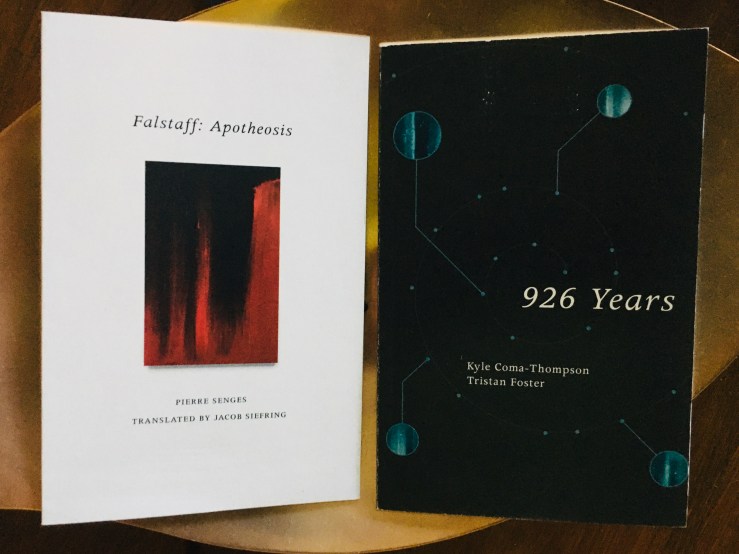
I read the chapbook Falstaff: Apotheosis on 19 Dec. 2019. The story, a wonderful riff on Henry IV Part I, V.iv—the part where Falstaff flops on the battlefield, faking his death in an act of cowardly heroism—is by the French author Pierre Senges. It is the third translation of Senges’ work by Jacob Siefring that I’ve read, and I enjoyed it very much, reading it surreptitiously on the back of the dais, cloaked by my colleagues during our fall commencement. (I had to tune out the ramblings of the commencement speaker, a local judge afflicted with a conservative streak.) Here’s novelist S.D. Chrostowska’s blurb:

Like Falstaff’s coffin in Orson Welles’s Chimes at Midnight, Pierre Senges’s erudite fragments are broader than most, their depth befitting Shakespeare’s original. Here’s Falstaff the master thespian, never wiser or more human than when he plays dead to save his skin and takes a nap. Well-served by this limpid translation, Senges resurrects him as a hero for our time. Bravo!

I also got 926 Years, and intriguing title by Tristan Foster and Kyle Coma-Thompson. Here’s Sublunary’s blurb:

Through twenty-two linked stories, Tristan Foster and Kyle Coma-Thompson explore the creative potential of people’s native estrangement from themselves and each other. Two writers who have never met, who live on opposite sides of the globe—one in Australia, the other in the United States—tracking the pattern of probable lives and fates that co-exist between them, from Korea to England, Senegal to Argentina. Their conclusion/suspicion: imagination is stronger, and subtler, than God, and offers more than mere consolation for the difficulties of living.

And here’s what novelist Gary Lutz has to say:

The intimate, globe-spanning microportraits of human crisis in 926 Years are at once sobering and uplifting, clarifying and mystifying. Tristan Foster and Kyle Coma-Thompson’s collaboration is a nonpareil of short-form virtuosity.

More thoughts forthcoming!


A review of Ishmael Reed’s Christmas satire, The Terrible Twos

Christmas is here, so let me recommend a Christmas novel for you: Ishmael Reed’s The Terrible Twos (1982). I read it back in unChristmasy August and dipped into it a bit again today, looking for a passage or two to share. Maybe the bit where Santa Claus starts an anti-capitalist riot in Times Square?, or where the First Lady is electrocuted while lighting the White House Christmas tree?, or where the idiot U.S. President meets Harry Truman in A Christmas Carol tour of hell? I scrounged for a big fat citation that works on its own, but I kept wanting to build a frame, set a stage, and ended up with this instead, a “review,” a recommendation. A stage setting.  Of course, Ishmael Reed’s novels create their own stages, their own contexts and rhythms, and each paragraph, each sentence, each note fits into that context, blaring or humming or blasting the reader. Reed’s satire is simultaneously bitter and salty and sweet and sharp sharp sharp, the sort of strange rich dish you gobble up too fast and then, Hell!, it gives you weird dreams. For months.

But nice fat slices of Reed’s prose can be served on their own, as John Leonard’s 1982 NYT  review of The Terrible Twos shows. Leonard’s review is ten paragraphs long and he quotes Reed in full for two of those paragraphs, including this one, the longest paragraph in the piece:

Two-year-olds are what the id would look like if the id could ride a tricycle. That’s the innocent side of 2, but the terrible side as well. A terrible world the world of 2-year-olds. The world of the witch’s door you knock on when your mother told you not to go near the forest in the first place. Pigs building houses of straw. Vain and egotistic gingerbread men who end up riding on the nose of a fox. Nightmares in the closet. Someone is constantly trying to eat them up. The gods of winter crave them – the gods of winter who, some say, are represented by the white horse that St. Nicholas, or St. Nick, rides as he enters Amsterdam, his blackamoor servant, Peter, following with his bag of switches and candy. Two-year-olds are constantly looking over their shoulders for the man in the shadows carrying the bag. Black Peter used to carry them across the border into Spain.

Leonard (who describes the paragraph as “a kind of jive transcendence”— I’ll settle for “transcendence”) offers up this nugget as a condensation of Reed’s themes and mythologies. The paragraph neatly conveys the central idea of Reed’s novel, that American capitalism refuses to allow its subjects to Grow Up. It’s a tidyish paragraph. Tidyish. Reed always sprawls into some new mumbo jumbo. The anarchic energy of his prose digs up old mythologies, boots skeletons out closets, and makes all the old ghosts of Western history sing and dance.

So there’s a lot going in The Terrible Twos’ not-quite 200 pages. Should I take a stab at unjumbling the plot? Okay, so: Reagan is elected president. Things are bad. Rough for, like, the people. Fast forward a few terms, to the early/mid-nineties (Reed’s future…this is a sci-fi fantasy). Former fashion model Dean Clift ascends to the Presidency. Only he’s just a puppet for his cabinet, a cabal of war-profiteering zealots secretly planning a genocidal operation that would not only destroy a nuclear-armed African nation, but also “rid America of surplus people.” Surplus = poor. After Clift’s wife dies in a freak (not-really-freak) Christmas-tree-lighting accident, his life changes, and Saint Nicholas (like, the real Santa) comes to visit him. Santa takes the President on a Dantean-cum-Dickensian trip through the hell of American past. The poor dumb idiot President transforms his soul. Hearing Truman lament the bombing of Hiroshima might do that (not that that’s the only horror that haunts this novel—but a nuclear winter is not a winter wonderland, and Reed’s characters, despite their verve, are all suffering from Cold War Blues). Clift goes on TV and advocates a Christmas Change—but too late. The conspiracy cabinet hits him with the 25th Amendment to the United States Constitution. Reed gives a history lesson to the highest office of the land, changes the man’s life, and then imprisons him in a sanatorium. Satire at its cruelest.

But hell, what am I doing here, foregrounding President Clift? Or even Santa? There’s so much more going on in The Terrible Twos: the secret sect of Nicolites who worship Saint Nick; devotees of Black Peter (a version of the Dutch tradition of “Zwarte Piet”); the North Pole syndicate; secret agents, thugs, and sundry assassins; punk rioters; a rasta dwarf (um, Black Peter). And somehow I’ve left out the novel’s semi-hapless hero, Nance Saturday…

Look, the plot—the picaresque, mumbo-jumbo, always-mutating plot of The Terrible Twos is, yes, fun—but it’s the prose, the energy, the commentary, and, yes, the prescience of the novel that makes it so engrossing and fun and terrifying. This is a book that begins: “By Christmas, 1980, the earth had had enough and was beginning to send out hints,” a book that has the American President meeting with the American Nazi Party in the Oval Office, a book that has one character comment to another, on the election of Reagan, that “It feels good to be a white man again with him in office.” The satire’s prescience is painful, but Reed’s wisdom—the ballast of this ever-shifting picaresque—anchors the commentary in a deeper condemnation: It has always been this way. Ishmael Reed seems so prescient because we keep failing the past. Same as it ever was. Thus The Terrible Twos plays out in a series of plots and schemes, retaliations and riots—but also wry comments and righteous resistance. And so if Reed’s analysis of American history is unbearably heavy, it also points towards a negation of that heavy history, towards a vision of something better.

I shall give the last words to Reed’s Santa:

Two years old, that’s what we are, emotionally—America, always wanting someone to hand us some ice cream, always complaining, Santa didn’t bring me this and why didn’t Santa bring me that…Nobody can reason with us. Nobody can tell us anything. Millions of people are staggering about and passing out in the snow and we say that’s tough. We say too bad to the children who don’t have milk….I say it’s time to pull these naughty people off their high chairs and get them to clean up their own shit. Let’s hit them where it hurts, ladies and gentlemen. In their pockets. Let’s stop buying their war toys, their teddy bears, their dolls, tractors, wagons, their video games, their trees. Trees belong in the forest.

A riot ensues.

Very highly recommended.

[Editorial note: Biblioklept ran a version of this review in December, 2017].

Three Books (that were my favorite books I read in 2019 that were published in 2019)

I read very few contemporary books, especially contemporary novels. This reluctance to read contemporary literature isn’t a rule as much as it is a necessity born from the human limitations of my time and the fact that I am a slow reader. (I’ll also admit to a certain wariness towards trends coupled with an antipathy toward publishing hype. (I’m sure many readers detest the trendy/hype couple, as do I. (I’m sure some readers think I use this blog to hype/trend. Forgive me; it’s not my intention. I’m enthusiastic at times.)))

I have no idea what the best books of 2019 are. Maybe I’ll know in 2039 or 2049 or 2079 (when I’ll be a magical one hundred years old).

I’ve been doing these Three Books posts on and off for a few years. They give me something to do on a Sunday, except when I have something to do on a Sunday, in which case, I don’t do them. There are two more Sundays in 2019 and I figured I’d do a Three Books post about the books published this year that I enjoyed most this year. A few jumped readily to mind, including books that were translated or republished in new editions this year, like João Gilberto Noll’s short novel Lord, or Sylvia Townsend Warner’s The Corner That Held Them, or Ann Quin’s 1964 novel BergBut new editions or new/first translations isn’t exactly “2019” is it? Or is it? I mean, these were published in 2019?

Just add them to the list anyway.

And add Anna Burns’ maybe-horror/maybe-comedy novel Milkman to the list, even though it was published in 2018.

And add Anna Kavan’s definitely-horror/definitely-sci-fi novel Ice to the list, even though it was re–published in 2018, a fiftieth anniversary edition. (It’s not a new book, right? New to me though.)

Ann Quin, Anna Burns, Anna Kavan…how about Anne Boyer? For me, 2019 was a variation on Annas, I guess.

2019-12-22_155858_1

The Undying by Anne Boyer. 2019 first edition hardback from FS&G. Jacket design by Srick&Williams; jacket art by Mykola Davydenko.

This is a wonderfully angry, discursive, recursive book: literary biography, literary criticism, art history, art criticism, Foucault, John Donne, Susan Sontag, Lucretius, Virginia Woolf; a howl at the hoaxers, frauds, self-helperists and their pinkwashed platitudes. And lots of pain, expressed with sentiment that bears no trace of sentimentality.

Boyer’s aphoristic style is engrossing. Her paragraphs and one-liners bear a ludic stamp seemingly at odds with her subject matter. The work of the writing, the heavy burden of smithing those sentences is all but elided—instead we get the clarity of a focused mind drawing together seemingly-disparate threads into a cohesive and compelling memoir that transcends the personal without necessarily meaning to.

Showing is a betrayal of the real, which you can never quite know with your eyes in the first place, and if you are trying to survive for the purpose of literature, showing and not telling is reason enough to endure the disabling processes required for staying alive.

Thank you again to BLCKDGRD for sending me this strange angry beautiful book.

2019-12-22_155858

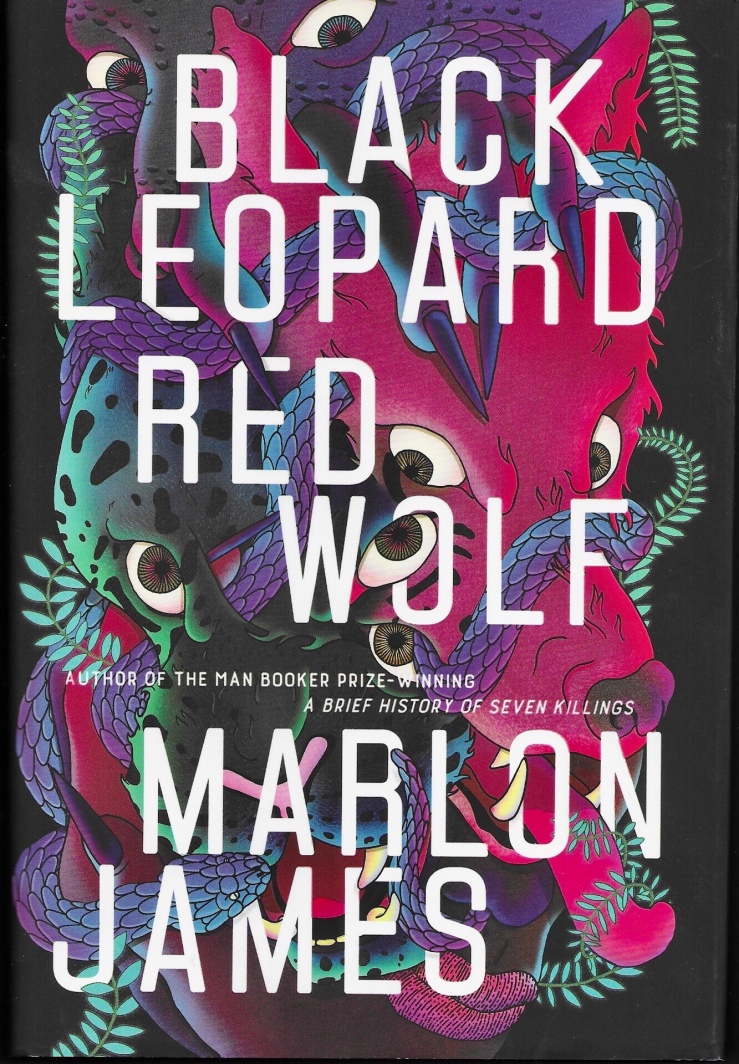
Black Leopard, Red Wolf by Marlon James. 2019 first edition hardback from Random House. Jacket design by Helen Yentus; jack illustration by Pablo Gerardo Camacho.

I wrote a review of Black Leopard, Red Wolf that I titled “Marlon James’s Black Leopard, Red Wolf is a postmodern fantasy novel that challenges the conventions of storytelling itself.”

Black Leopard, Red Wolf makes me think of that trend/hype problem I mentioned above—novels that get hyped, novels that seem trendy (“It’s Game of Thrones in a medieval mythical Africa!”) and then maybe not read. I think a lot of people read BL/RW though, and many found it Not to Their Taste, which, fine. I loved. it. From my review:

Black Leopard, Red Wolf is clearly Not for Everybody. It’s violent and strange, and the sex in it will likely upset conservative readers. It’s also shaggy and unwieldy. It probably has a future as a cult novel. You just sort of have to go with its fluid (in every sense of that word) program and enjoy the ride. I enjoyed it very much and am looking forward to the sequel.

Rusty Brown by Chris Ware. 2019 first edition hardback from Pantheon. No cover designer or artist credited, but the work is unquestionably Ware’s.

A masterpiece. I reviewed it for The Comics Journal, stating that,

Rusty Brown is a sprawling story about memory and perception, about minor triumphs and chronic failures, about how our inner monologues might not match up to the reality around us. In Ware’s world, life can be blurry, spotty, fragmented. His characters are so bound up in their own consciousnesses that they cannot see the bigger picture that frames them.

Rusty Brown is only the first part of (what I understand to be) a two-part novel. It took Ware eighteen years to finish. Maybe we’ll know in 2037 if it was in fact a really great important best favorite novel of 2019. Or maybe not.

But I love it now, and I loved these books this year.

Jonathan Buckley’s The Great Concert of the Night (Book acquired, sometime early December 2019)

img_4539

Jonathan Buckley’s novel The Great Concert of the Night is forthcoming from NYRB early next year (like, in a few weeks). NYRB’s blurb:

David has just spent New Year’s Eve alone, watching Le Grand Concert de la Nuit, a film in which his former lover Imogen starred. In the early hours of the new year, consoled and tormented by her ethereal presence, he begins to write. What follows is a brilliantly various journal, chronicling a year in the life of a thinking man. David works as a curator at the ailing Sanderson-Perceval Museum in southern England, whose small collection of porcelain, musical instruments, crystals, velvet mushrooms, and glass jellyfish is as eccentric and idiosyncratic as the long-dead collectors’ tastes. David himself is a connoisseur of the derelict and nonutilitarian, of objects removed from the flow of time. Refusing the imposed order of a straightforward chronology, his journal moves fluidly back and forth in time, filled with fragments of life remembered, imagined, and recorded, from memories of his past life with Imogen or with his ex-wife, Samantha, to reflections on the lives and relics of female saints or the history of medicine. There are quotations from Seneca, Meister Eckhart, and the Goncourt brothers mixed in with the equally compelling imagined words of fictional film directors, actors, and, always, the fascinating Imogen, who is alive now only “in the perpetual present of the sentence.” In The Great Concert of the Night, Jonathan Buckley expertly interweaves sexual despair, cultural critique, the plot lines of one man’s quietly brilliant life, and the problems and paradoxes of writing, especially writing about and to the dead.

Three Books

2019-12-08_113541_2

Mulata by Miguel Ángel Asturias; English trans. by Gregory Rabassa. 1982 mass market paperback from Avon-Bard. The Boschian cover art isn’t credited; neither is the designer credited, although my assumption is that it is Sidney Feinberg, who is credited as designer on Avon-Bard’s edition of Gabriel García Márquez’s novel In Evil Hour.

2019-12-08_113541

In Evil Hour by Gabriel García Márquez; English trans. by Gregory Rabassa. 1980 mass market paperback from Avon-Bard. The cover artist is not credited; book design by Sidney Feinberg,

2019-12-08_113541_1

The Ex-Magician and Other Stories by Murilo Rubião; English trans. by Thomas Colchie.  1984 mass market paperback from Avon-Bard. No cover artist or designer is credited, but my hunch is the design is by Sidney Feinberg.

Blog about some recent reading

img_4404

Bottom and then top:

I’ve been enjoying reading the imperative surreal poems in Jiří Kolář’s’s A User’s Manual (translated by Ryan Scott). I’ve been reading them slowly, one or two every other day.

I got Anna Kavan’s Machines in the Head a few weeks ago and have read the first few stories. These are unsettling little parables. The work Kafkaesque is much overused, but it applies here: Kavan’s stories are cryptic, often pulsing with vague menace and surreal flourishes, much like her masterpiece Ice.

Middle: Anne Boyer’s The Undying will likely end up one of the best books published in 2019 that I actually read in 2019 (I don’t read a lot of contemporary fiction, but I’ve read more this year than in the past few years). An aphoristic memoir-essay, The Undying is a discursive dive into Boyer’s diagnosis of, treatment of, and recovery from breast cancer. It’s an angry, smart book, with little bursts of mean humor, and it rips apart the ways that neoliberal late capitalism have made health care inhuman and inhumane.

I also really dug Carl Shuker’s slim novel A Mistake. Set in Wellington, New Zealand, A Mistake is the story of Elizabeth Taylor, the only female surgeon at her hospital. Like The Undying, Shuker’s novel is in some ways a critique of neoliberalism’s attempt to quantify every aspect of medical care. The novel is set against “the minister’s mistake,” a plan to publicize each surgeon’s results. And at the beginning of the novel, well, there’s a mistake, one which Elizabeth is involved with. Although the blurb describes A Mistake as a “procedural thriller,” I found it closer to a character study of an outsider who finds herself increasingly alienated by her peers and friends alike. Shuker conveys his hero edging into paranoia and depression in sharp, precise prose which occasionally recalls Don DeLillo.

I absolutely love love love Paul Beatty’s novel The Sellout so far. I recall its being hyped quite a bit a few years ago, after it won the Man Booker Prize (I think it was the first US book to do so), and hype often puts me off, but a short story I read a few months ago by Beatty at Granta made me seek out The Sellout. Beatty’s playful prose and zany plotting readily recalls the work of Thomas Pynchon and Ishmael Reed. The story focuses on a farmer who grows watermelons and weed in the strange farm town of Dickens, which is ensconced in urban Los Angeles. Dickens is erased, but the narrator seeks to bring it back. He somehow ends up keeping a slave, a former Little Rascals star named Hominy. I’m doing a bad job describing the plot. The book is energetic and very, very funny, and Beatty’s satirical take on race in America is scathing.

I’d love to get proper reviews of these books out over the winter break, but for now, I’ll simply say they’re all Good Stuff.

(Not Quite) All the Food in Thomas Pynchon’s Books

I was looking for something else when I found a fun article from six years ago in Bon Appétit. The article, by Nicole Villeneuve, is called “All the Food in Thomas Pynchon’s Books (and What It Means, Sorta),” and it riffs on most of the food in Pynchon’s oeuvre.

Here’s the section on “The Inedible,” which includes notes on two of my favorite scenes from Gravity’s Rainbow—–

The Inedible

“A lot of people who think they’re cooks but are clinically deluded,” says a mess hall manager in Vineland. Pynchon includes a lot of their misguided creations in his books, relishing the gross and inedible—the places where “even [the] Jell-O salads have scum on them.”

Maybe the most memorable example is the “English Candy Drill,” in which a parade of disgusting sweets are sampled, unwillingly, by Tyrone Slothrop, the protagonist (sorta) in Gravity’s Rainbow: rhubarb creams, cherry-quinine petit fours, eucalyptus-flavored fondant, and pepsin-flavored nougat, licorice drops with a “dribbling liquid center, which tastes like mayonnaise and orange peels” and “a hard sour gooseberry shell into a wet spurting unpleasantness of, he hopes it’s tapioca, little glutinous chunks of something all saturated with powdered cloves.”

Gravity’s Rainbow includes another scene that’s hard to stomach: As a culinary prank, Bodine and Roger hold a dinner party with an intentionally revolting menu: “snot soup,” “sum soufflé,” “vomit vichyssoise” and “wart waffles.” Needless to say, “A general loss of appetite reigns, not to mention overt nausea.”

It’s a fun article, like I said, but there are a few things missing. It notes Against the Day’s cult of mayonnaise but leaves out all the ketchup (ketjap) stuff in Mason & Dixon, as well as Mason & Dixon’s important core distinction between Grape People and Grain People:

“If this is as bad as it gets, why I can abide thah’. As long as the Spirits don’t run out.”

“Nor the Wine.”

“Wine.” Dixon is now the one squinting. Mason wonders what he’s done this time. ” ‘Grape or Grain, but ne’er the Twain,’ as me Great- Uncle George observ’d to me more than once,— ‘Vine with Corn, beware the Morn.’ Of the two sorts of drinking Folk this implies, than’ is, Grape People and Grain People, You will now inform rne of Your membership in the Brotherhood of the, eeh, Grape…? and that You seldom, if ever, touch Ale or Spirits, am I correct?”

“Happily so, I should imagine, as, given a finite Supply, there’d be more for each of us, it’s like Jack Sprat, isn’t it.”

“Oh, I’ll drink Wine if I must…?— and now we’re enter’d upon the Topick,— ”

“— and as we are in Portsmouth, after all,— there cannot lie too distant some Room where each of us may consult what former Vegetation pleases him?”

Dixon looks outside at the ebbing wintry sunlight. “Nor too early, I guess…?”

“We’re sailing to the Indies,— Heaven knows what’s available on Board, or out there. It may be our last chance for civiliz’d Drink.”

“Sooner we start, the better, in thah’ case…?”

Again, a fun article—but what other food bits are missing? (We can leave the coprophagia and urolagnia in Gravity’s Rainbow out, though.)

Culte de la mayonnaise (Thomas Pynchon)

THE NEXT TIME he saw Pléiade Lafrisée was at a café-restaurant off the Place d’Armes. It would not occur to him until much later to wonder if she had arranged the encounter. She was in pale violet peau de soie, and a hat so beguiling that Kit was only momentarily surprised to find himself with an erection. It was still early in the study of these matters, only a few brave pioneers like the Baron von Krafft-Ebing had dared peep into the strange and weirdly twilit country of hat-fetishism—not that Kit noticed stuff like that ordinarily, but it happened actually to be a gray toque of draped velvet, trimmed with antique guipure, and a tall ostrich plume dyed the same shade of violet as her dress. . . .

“This? One finds them in every other midinette’s haunt, literally for sous.”

“Oh. I must’ve been staring. What happened to you the other night?”

“Come. You can buy me a Lambic.”

The place was like a museum of mayonnaise. This being just at the height of the culte de la mayonnaise then sweeping Belgium, oversize exhibits of the ovoöleaginous emulsion were to be encountered at every hand. Heaps of Mayonnaise Grenache, surrounded by plates of smoked turkey and tongue, glowed redly as if from within, while with less, if any, reference to actual food it might have been there to modify, mountains of Chantilly mayonnaise, swept upward in gravity-impervious peaks insubstantial as cloud, along with towering masses of green mayonnaise, basins of boiled mayonnaise, mayonnaise baked into soufflés, not to mention a number of not entirely successful mayonnaises, under some obscure attainder, or on occasion passing as something else, dominated every corner.

“How much do you know of La Mayonnaise?” she inquired.

He shrugged. “Maybe up to the part that goes ‘Aux armes, citoyens’—”

But she was frowning, earnest as he had seldom seen her. “La Mayonnaise,” Pléiade explained, “has its origins in the moral squalor of the court of Louis XV—here in Belgium the affinity should not be too surprising. The courts of Leopold and Louis are not that different except in time, and what is time? Both monumentally deluded men, maintaining their power through oppression of the innocent. One might usefully compare Cleo de Mérode and the marquise de Pompadour. Neuropathists would recognize in both kings a desire to construct a self-consistent world to live inside, which allows them to continue the great damage they are inflicting on the world the rest of us must live in.

“The sauce was invented as a new sensation for jaded palates at court by the duc de Richelieu, at first known as mahonnaise after Mahon, the chief port of Minorca, the scene of the due’s dubious ‘victory’ in 1756 over the illfated Admiral Byng. Basically Louis’s drug dealer and pimp, Richelieu, known for opium recipes to fit all occasions, is also credited with the introduction into France of the cantharides, or Spanish fly.” She gazed pointedly at Kit’s trousers. “What might this aphrodisiac have in common with the mayonnaise? That the beetles must be gathered and killed by exposing them to vinegar fumes suggests an emphasis on living or recently living creatures—the egg yolk perhaps regarded as a conscious entity—cooks will speak of whipping, beating, binding, penetration, submission, surrender. There is an undoubtedly Sadean aspect to the mayonnaise. No getting past that.”

Kit was a little confused by now. “It always struck me as kind of, I don’t know . . . bland?”

“Until you look within. Mustard, for example, mustard and cantharides, n’estce pas? Both arousing the blood. Blistering the skin. Mustard is the widelyknown key to resurrecting a failed mayonnaise, as is the cantharides to reviving broken desire.”

“You’ve been thinking about mayonnaise a lot, mademoiselle.”

“Meet me tonight,” a sudden fierce whisper, “out at the Mayonnaise Works, and you shall perhaps understand things it is given only to a few to know. There will be a carriage waiting.” She pressed his hand and was gone in a mist of vetiver, abruptly as the other evening.

A passage from Thomas Pynchon’s novel Against the Day; I don’t think you need any context to appreciate this passage.


Three Books

2019-11-24-113310

Under the Volcano by Malcolm Lowry. 1965 hardback from Lippincott. Jacket design by David Lunn.

2019-11-24-113310-1

Under the Volcano by Malcolm Lowry. 2014 trade paperback from Harper Perennial Olive Editions. Cover design and illustration by Milan Bozic.

2019-11-24-113310-2

Under the Volcano by Malcolm Lowry. 1962 paperback from Vintage. Cover design by Harry Ford.

I have now bought four copies of Malcolm Lowry’s 1947 novel Under the Volcano. The first copy I bought was a cheap movie tie-in edition with a ghastly cover. I later replaced it with the 1962 edition, and reread it. A few years later I resisted buying a 2007 Harper Perennial paperback edition that featured an afterword by William Vollmann. (You can read Vollmann’s afterword—and the entire book, if a 700 page pdf is your thing—here).

On 8 Nov. 2019, I picked up the 2014 Olive edition.

On 22 Nov. 2019, I picked up the 1965 Lippincott hardback, blowing the rest of my store credit in the process. I couldn’t not buy it. I had to have it.

It also matches a folding hard print of Hokusai’s Red Fuji that a student gave me as a gift when I left Tokyo.

IMG-4400

This clipping of a 1984 not-really review of John Huston’s film adaptation was folded inside of the book.

IMG-4399

I wrote a review of Under the Volcano on this website back in 2011. From that review:

For all its bleak, bitter bile, Volcano contains moments of sheer, raw beauty, especially in its metaphysical evocations of nature, which always twist back to Lowry’s great themes of Eden, expulsion, and death. Lowry seems to pit human consciousness against the naked power of the natural world; it is no wonder then, against such a grand, stochastic backdrop, that his gardeners should fall. The narrative teems with symbolic animals — horses and dogs and snakes and eagles — yet Lowry always keeps in play the sense that his characters bring these symbolic identifications with them. The world is just the world until people walk in it, think in it, make other meanings for it.

Anne Boyer’s The Undying (Book acquired 12 Nov. 2019)

img_4281

Huge thanks to BLCKDGRD for sending me Anne Boyer’s aphoristic, poetic memoir-essay The Undying. I guess he read that I went to my bookstore to buy it a few weeks ago and came home not empty handed but nevertheless Undyingless. I wanted to read Boyer’s book after reading her essay collection (“essay” isn’t really the right word, but)  A Handbook of Disappointed Fate this summer—-also sent to me by generous Mr. BLCKDGRD

I’m about 100 pages away from finishing The Undying, a book that doesn’t so much chronicle Boyer’s 2014 diagnoses and treatment of breast cancer as it explores and explodes what cancer—a “twentieth-century disease” that we still treat with “twentieth-century” methods, in Boyer’s words—means and is and does in our neoliberal late-capitalist early twenty-first century. Boyer writes,

To become a cancer patient is to become a system-containing object inside another system that only partially allows the recognition of the rest of the systems in which one is a node and also almost wholly obscures the heaviest system of the arrangement of the world as it is, which hangs around, too, in the object that contains a system (by which I mean “me”) as part of the problem in the first place, requiring our latent unhealth just as it profits from our active one.

Later, again addressing that “latent unhealth” which is part and parcel of the system, Boyer declares: “I would rather write nothing at all than propagandize the world as is.” This is a wonderfully angry book.

This is a wonderfully angry, discursive, recursive book: literary biography, literary criticism, art history, art criticism, Foucault, John Donne, Susan Sontag, Lucretius, Virginia Woolf; a howl at the hoaxers, frauds, self-helperists and their pinkwashed platitudes. And lots of pain, expressed with sentiment that bears no trace of sentimentality.

Boyer’s aphoristic style is engrossing. Her paragraphs and one-liners bear a ludic stamp seemingly at odds with her subject matter. The work of the writing, the heavy burden of smithing those sentences is all but elided—instead we get the clarity of a focused mind drawing together seemingly-disparate threads into a cohesive and compelling memoir that transcends the personal without necessarily meaning to.

Showing is a betrayal of the real, which you can never quite know with your eyes in the first place, and if you are trying to survive for the purpose of literature, showing and not telling is reason enough to endure the disabling processes required for staying alive.

Everything here feels and reads True. 

Three Books

2019-11-10_152719

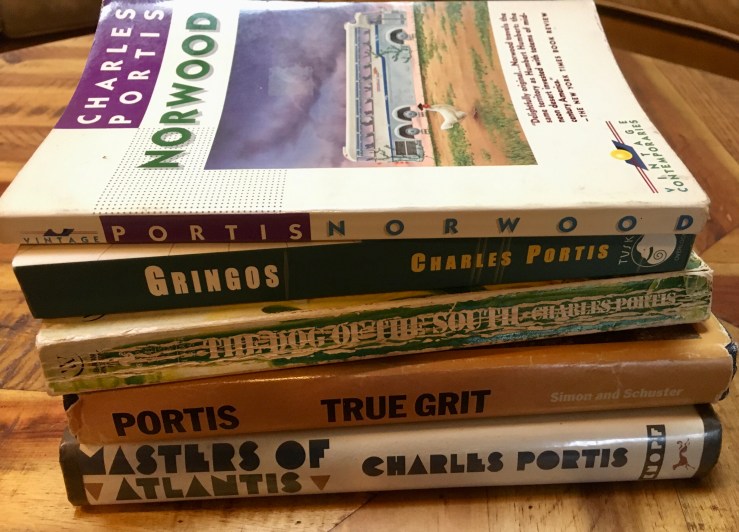
Masters of Atlantis by Charles Portis. 1985 first-edition hardback from Knopf. Jacket design by Sara Eisenman; jacket illustration by Dagmar Frinta.

2019-11-10_152719_2

The Dog of the South by Charles Portis. 1985 trade paperback from Windstone Trade. Cover art by Linda Bordelon; no designer credited.

2019-11-10_152719_1

True Grit by Charles Portis. 1968 hardback Book Club from Simon & Schuster. Jacket design by Paul Davis.

I picked up a 1985 Vintage Contemporaries edition of Charles Portis’s first novel Norwood this summer and promptly snorted the thing up my brain. I then sought out the rest of Portis, and read most of it, with the exception of Gringos, which I’m, I don’t know, saving, if that makes sense.

True Grit might be the best of the novels, from a technical standpoint. Walker Percy’s blurb on the back of my copy compares it to Adventures of Huckleberry Finn, and he’s not wrong. Mattie Ross’s is as achieved and engrossing and complex as Huck’s, a wonderful layering of author-narrator-speaker. The prose is beautiful and Mattie is an endearing American hero. I wish I had read it years ago. I’ll make sure my kids don’t repeat my error. Like Huck FinnTrue Grit seems like a book one returns to like an old friend, only to find the friend has changed in some deep way. (But of course it’s only you that’s changed you old bastard, reading now through older dimmer eyes.)

While True Grit is likely Portis’s best novel, my favorite in the quartet I’ve read is The Dog of the South, a road trip novel, shaggy, grotesque, and very, very funny. It reads like a novel that Barry Hannah was never quite sober enough to manage—or maybe that’s unfair (I love Hannah, godbless his soul)—maybe what I mean is that Portis’s loose ironic folk-blues ballad of a novel has more structure than Hannah’s jazz. Anyway, I loved Dog, but in spite of and because of its faults.

Masters of Atlantis is the strangest in the quartet. It’s a novel about con-men and poseurs, secret societies and secret scams, capitalism and the price of knowledge. Again, a very American novel, whatever that means. Atlantis has a Pynchonian paranoid vibe and a Pynchonian zaniness. It also belongs to the American tradition of grifter novels (think of Melville’s The Confidence-Man, or Baum’s Oz, or Adventures of Tom Sawyer, or Gatsby, etc.). Atlantis, told in a third-person voice, feels a bit more distant than the first-person immediacy of True Grit or The Dog of the South, or even the third-person voice of Norwood, which hovers around its protagonist’s brain pan and eye line, and doesn’t flit much farther. Atlantis also covers a hearty lifetime of secret society shenanigans. It’s a loose, shaggy epic, and seems to sprawl beyond its 250-odd pages. In any case, I ate it up, just like I ate up the other three. I waited far too long for Charles Portis, but I suppose late is better than never. Highly recommended.

A review of Alfred Döblin’s turbulent, encyclopedic riot of a novel, Berlin Alexanderplatz

2019-10-06_172844

“Unbe-fucking-lievable,” interjects the ominvalent narrator of Alfred Döblin’s 1929 novel  Berlin Alexanderplatz at one point. I’m not sure if the original German (Ist gar nicht zu glauben) conveys the amazed profanity here in Michael Hofmann’s 2018 translation, but “Unbe-fucking-lievable” nevertheless captures the raucous spirit and mutable form of Berlin Alexanderplatz. The novel is a polyglossic spree, an encyclopedic riot, a tragicomic masterpiece of syntax and diction, chopped and screwed, twisted and turned.

What is it about?

The first italicized page summarizes the entire novel in nine neat paragraphs, beginning with this one:

The subject of this book is the life of the former cement worker and haulier Franz Biberkopf in Berlin. As our story begins, he has just been released from prison, where he did time for some stupid stuff; now he is back in Berlin, determined to go straight.

For further clarification: It is the 1920s in Berlin, that slim decadent wedge between those two big wars, and the Weimar capital buzzes with working-class resentment and political unrest. (And drinking. Lots and lots of drinking.)

We soon find out the “stupid stuff” Biberkopf did that landed his ass in jail, and find that the stuff wasn’t so much stupid as stupid and horrific. But by the time we’ve discovered the crimes of Biberkopf, it’s too late: the narrator’s got his sharp teeth sunk into the bit of our brain that pumps sympathy for the supposed hero of the story.

But again: What is it about?

Well:

Biberkopf tries to play it straight, but life on the Alexanderplatz and its seedy environs ain’t easy. He slings newspapers, mixes it up with communists and Nazis alike, and tries to keep his nose clean. But, this being a picaresque tale, he falls in with old associates, falls into old petty crimes, and eventually loses his arm. (Like, literally.) He takes to pimping, thinking it easy, but pimping presents its own problems. There’s love, lust, murder, and betrayal. (And drinking. Lots and lots of drinking.)

What is it about? is not really the right question for Berlin Alexanderplatz. Instead: What is it?

Berlin Alexanderplatz is a literary montage, a vicious collage, an explosion of colors, a carnival of noise and chaos and entropy, told by a narrator who occasionally tries to sort the pieces out for the reader, but usually is more content to drop a metaphorical bomb on us and then spend a dozen or so pages explaining how the bomb got there and who planted it and why the saboteur was so hellbent on destruction in the first place.

Our narrator is a ventriloquist, popping into the consciousnesses and throats of characters major, minor, and peripheral (at best) alike. There’s a cinematic orality to the novel, a shuffling, skipping, vamping voiceyness to Döblin’s prose that Hofmann’s translation renders as a kind of cackling cockney English. It sparks and hoots and howls.

Döblin’s narrator might wander around in Biberkopf’s brain, and then end up in the voice of his girlfriend Mitzi (whom he pimps), or his friend and enemy Reinhold, or just some random cafe sitter or beer drinker at a bar. Döblin’s camera goes anywhere it likes; indeed, Berlin Alexanderplatz is crammed with flights into history, mythology, books of the Bible, math, industry, science. A riff on the First Newtonian Law? Sure. A lengthy treatise on industrial pork butchery? Why not. A retelling of the Book of Job? Of course. Ever wondered why berries sweeten in the cold of winter? Let Döblin’s narrator explain the relationship of temperature, starch, and sugar for you. 

Berlin Alexanderplatz is voluminous, exhausting, exhaustive, ecstatic. Döblin’s narrator grabs a hold of a subject, picks at it, puts it down, picks up later. Sometimes these threads coalesce (the Books of Job and Ecclesiastes became refrains); other riffs seem to be included for no reason other than Döblin’s narrator finds them interesting. He gleefully steals from newspapers, injecting the narrative with tangential-at-best stories of the day: murders and plane crashes and invasions and assassination attempts and failures and successes and crimes, large and small. Döblin’s novel aims to be about everything, about both the small and the big worlds his petty criminal antihero Franz Biberkopf is a citizen of. 

With its voracious, swirling, omnidirectional scope and undulating stylistic turns, Berlin Alexanderplatz readily recalls James Joyce’s big book Ulysses. Döblin’s novel seems less beholden to a series of correspondences than Joyce’s, however—it’s freer, more anarchic really, roiling around in its own entropy. Both novels are bawdy, smart, and very funny of course. With its celebratory attention to Berlin’s seedier side, Berlin Alexanderplatz also recalls the paintings of Otto Dix, Rudolf Schlichter, and George Grosz (whose 1919 painting Panorama adorns the cover of my NYRB edition). There are also notes of Kubrick here—there’s something of both A Clockwork Orange and Barry Lyndon to Berlin Alexanderplatz: the former’s energetic, horrific violence and pastiche-slang; the latter’s ironic and affecting treatment of the traditional bildungsroman. Döblin’s technique of stealing freely from newspapers also reminds me of Félix Fénéon’s Novels in Three Lines, as well as Doris Lessing’s The Golden Notebook, and segments of William Gaddis’s JR and The Recognitions. (All of these work belong in what the protagonist of William Gass’s novel Middle C dubbed “The Inhumanity Museum.”)

General comparisons of other works to Döblin’s great big fat novel don’t really do Berlin Alexanderplatz justice of course. There is simply no substitute for reading it. It is a novel about itself; it is a novel that one doesn’t so much read for plot (or worse, to learn something); rather, it is a novel that produces waves of feelings, confusions, problems in its reader. It is a novel packed with grotesquerie and excess, yes, and the turbulent humor does not leaven the novel’s core meanness. Berlin Alexanderplatz’s spine is a spike of ice, but lots of wonderful juicy rich fat hangs from that icy spine.

And through its meanness, the novel pushes its hero to a strange redemption of sorts, announced on the novel’s very first page: “The terrible thing that was his life acquires a purpose.”

And do I spoil the final line?

Why not: “We know what we know, we had to pay dearly enough for it.”

I did not pay dearly for Berlin Alexanderplatz, either in my money or in my time. I was rewarded. Very highly recommended.

Three Books

2019-10-13_181512

Don Quixote by Kathy Acker. Grove Press trade paperback, 1986. Cover design by Neil Stuart. Cover illustration by Catherine Denvir.

A messy punkpostmodern cartoon, a big long jazz howl at the moon.

2019-11-03_163857

The Egghead Republic by Arno Schmidt; English translation by Michael Horowitz. Marion Boyars trade paperback, 1982. Cover design by Imre Reiner, who likely drew the illustration (although he is not explicitly credited).

I found the first 50 pages utterly exhausting, and there were 100 more. I tried. The cover designer Imre Reiner is most famous for his font designs, but he also illustrated many many books, including a 1941 edition of Cervantes’ Don Quixote.

2019-11-03_163857_1

Sanatorium under the Sign of the Hourglass by Bruno Schulz; English translation by Celina Wieniewska. Cover design by Neil Stuart. Cover illustration by Bruno Schultz. (The novel includes thirty black and white illustrations by Schultz.)

A gross, surreal, dispiriting nightmare. I recall “enjoying” it.