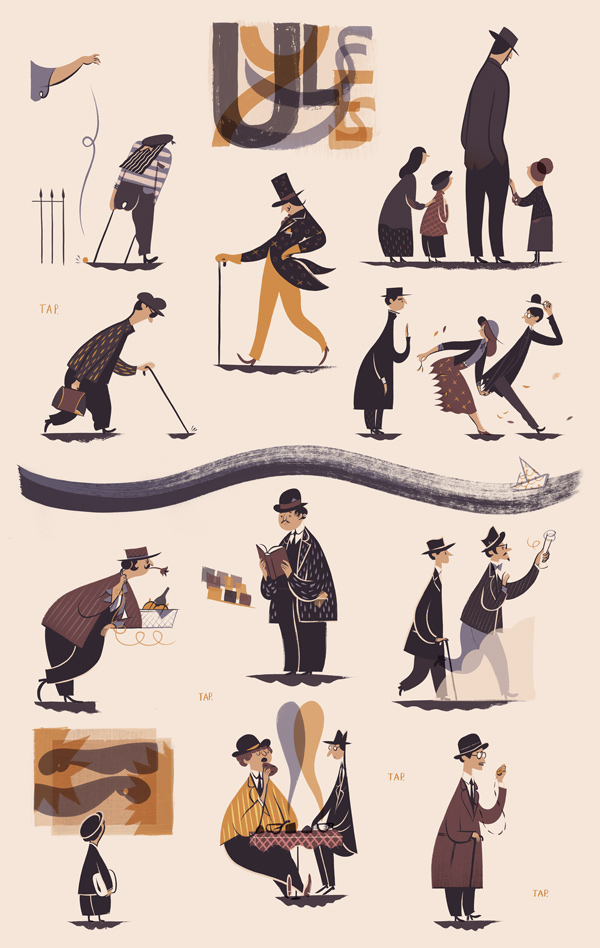
Ulysses (Wandering Rocks) — Roman Muradov

ulysses

Ulysses, 2013 by Roman Muradov


What in water did Bloom, waterlover, drawer of water, watercarrier, returning to the range, admire?

What in water did Bloom, waterlover, drawer of water, watercarrier, returning to the range, admire?

Its universality: its democratic equality and constancy to its nature in seeking its own level: its vastness in the ocean of Mercator’s projection: its unplumbed profundity in the Sundam trench of the Pacific exceeding 8000 fathoms: the restlessness of its waves and surface particles visiting in turn all points of its seaboard: the independence of its units: the variability of states of sea: its hydrostatic quiescence in calm: its hydrokinetic turgidity in neap and spring tides: its subsidence after devastation: its sterility in the circumpolar icecaps, arctic and antarctic: its climatic and commercial significance: its preponderance of 3 to 1 over the dry land of the globe: its indisputable hegemony extending in square leagues over all the region below the subequatorial tropic of Capricorn: the multisecular stability of its primeval basin: its luteofulvous bed: its capacity to dissolve and hold in solution all soluble substances including millions of tons of the most precious metals: its slow erosions of peninsulas and islands, its persistent formation of homothetic islands, peninsulas and downwardtending promontories: its alluvial deposits: its weight and volume and density: its imperturbability in lagoons and highland tarns: its gradation of colours in the torrid and temperate and frigid zones: its vehicular ramifications in continental lakecontained streams and confluent oceanflowing rivers with their tributaries and transoceanic currents, gulfstream, north and south equatorial courses: its violence in seaquakes, waterspouts, Artesian wells, eruptions, torrents, eddies, freshets, spates, groundswells, watersheds, waterpartings, geysers, cataracts, whirlpools, maelstroms, inundations, deluges, cloudbursts: its vast circumterrestrial ahorizontal curve: its secrecy in springs and latent humidity, revealed by rhabdomantic or hygrometric instruments and exemplified by the well by the hole in the wall at Ashtown gate, saturation of air, distillation of dew: the simplicity of its composition, two constituent parts of hydrogen with one constituent part of oxygen: its healing virtues: its buoyancy in the waters of the Dead Sea: its persevering penetrativeness in runnels, gullies, inadequate dams, leaks on shipboard: its properties for cleansing, quenching thirst and fire, nourishing vegetation: its infallibility as paradigm and paragon: its metamorphoses as vapour, mist, cloud, rain, sleet, snow, hail: its strength in rigid hydrants: its variety of forms in loughs and bays and gulfs and bights and guts and lagoons and atolls and archipelagos and sounds and fjords and minches and tidal estuaries and arms of sea: its solidity in glaciers, icebergs, icefloes: its docility in working hydraulic millwheels, turbines, dynamos, electric power stations, bleachworks, tanneries, scutchmills: its utility in canals, rivers, if navigable, floating and graving docks: its potentiality derivable from harnessed tides or watercourses falling from level to level: its submarine fauna and flora (anacoustic, photophobe), numerically, if not literally, the inhabitants of the globe: its ubiquity as constituting 90 % of the human body: the noxiousness of its effluvia in lacustrine marshes, pestilential fens, faded flowerwater, stagnant pools in the waning moon.

From James Joyce’s Ulysses. 

Blog about some recent reading

img_2962-2

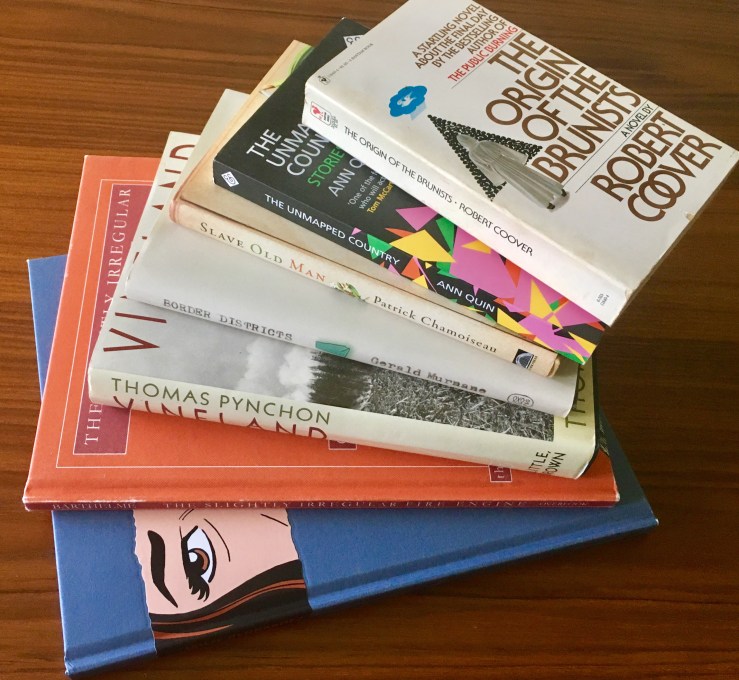
It’s been pretty busy around Biblioklept World Headquarters this week. It’s the first week of my kids’ summer vacation, and they both had birthdays this week, as did I. I managed to read but not write that much—so here’s this lazy post.

I finally finished Robert Coover’s 1966 debut novel The Origin of the Brunists this morning, which I had started with a huge wave of enthusiasm way back at the end of February. The novel has one of the finest second chapters I can remember, a long description of a mine’s implosion, and the rest of the book simply never matches its intensity. Coover conjures a mining town called West Condon, and explores the fallout of the disaster and how it affects seemingly every citizen. The central conflict is between a doomsday cult (the Brunists) and the rest of the town. There are some wonderful moments, but there’s a maudlin streak to the novel that Coover’s later work would satirize. The Origin of the Brunists suffers from the strains of First Novel Syndrome—Coover overstuffs the beast, and doesn’t leaven his unwieldy monster with enough humor. It’s a shaggy read, which, like, fine—I love shaggy novels!—but shagginess should correlate with theme, and Coover’s theme is decidedly unshaggy. You could probably cull a dozen short stories from Origin and end up with a finer book. I ended up reading it out of a sense of duty to the author. Maybe the sequel, which came out a few years ago, is a better affair.

I should have a review of Ann Quin’s first novel Berg out next week, but here is a short review: Go read Berg. It’s extraordinary. It’s so extraordinary that upon finishing it I immediately needed more Quin. I’ve been reading the collection of fragments and stories The Unmapped Country slowly, interspersing them with other reads. Good stuff.

I picked up Linda Coverdale’s translation of Patrick Chamoiseau’s novel Slave Old Man this Friday as I browsed my favorite bookstore as a birthday treat for myself. I read the first two chapters that afternoon. The language is extraordinary, strange, poetic, bracing. More thoughts to come.

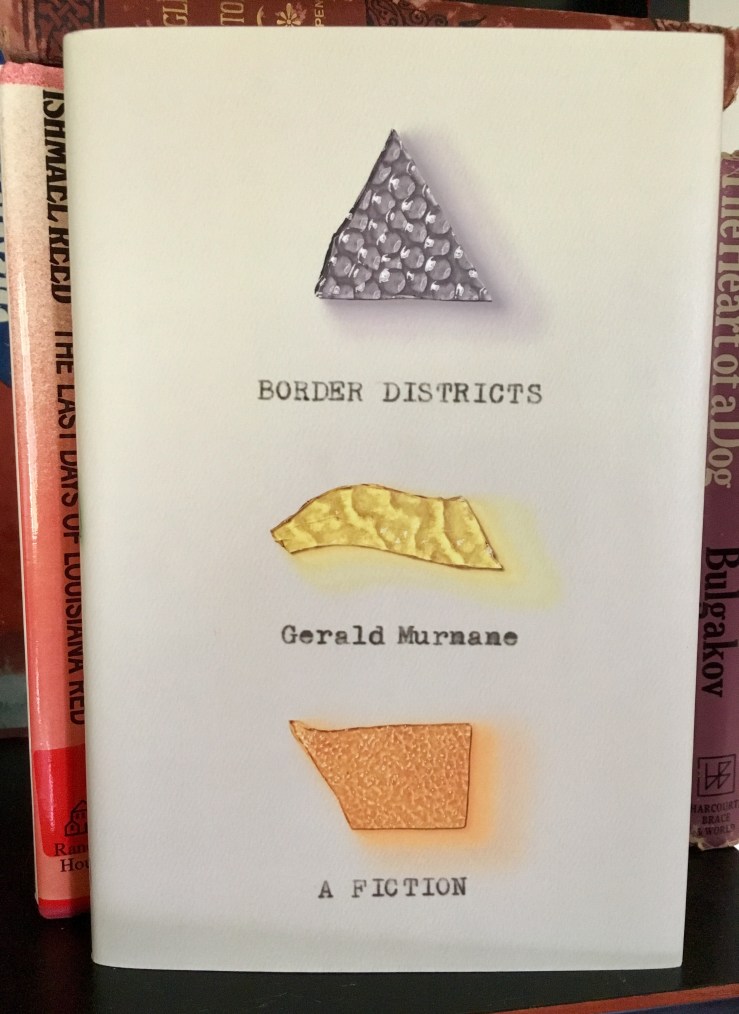
I read Gerald Murnane’s Border Districts over the course of three mornings. I then immediately reread it, finding it even more precise and accomplished than I had realized the first time. Murnane’s “fiction” is a compelling meditation on seeing and trying to see what can’t be seen. It’s about place, memory, image, and color—the colors of marbles, of liveries, of racing flags and stained glass windows. It’s also a strange and ironic exercise in literary criticism—but ultimately, it’s about waiting for the epiphanies our stories promise us, and perhaps waiting in vain. Very highly recommended.

I had hoped to write Something Big on Thomas Pynchon’s Vineland but found myself a bit too exhausted at the end of it to muster anything. I know among Pynchon fans it has a certain cult status, but I’d rather pick up Gravity’s Rainbow or Against the Day or Mason & Dixon again than reread Vineland. The book is a shaggy mess, really, with some excellent bits that never properly cohere. (It is possible that the book doesn’t cohere on purpose—there’s a narratological implication that the entire book is simply a film treatment, or, a few characters riffing over a film treatment.) Vineland features characters from other Pynchon novels, notably the Traverse family from Against the Day, as well as folks from Gravity’s Rainbow and The Crying of Lot 49, suggesting that there is of course a Pynchonverse. The book is an indictment on the baby boomers selling out in the seventies and really the eighties, and attack on Nixonia and the rise of Reagan. The indictment could be stronger. Vineland’s also an extended attack on television, but also a love letter to The Tube. (There’s also a motif about cars and driving that I didn’t fully understand.) And there are all the usual Pynchon themes: zeros and ones, preterite and elect, visible and invisible, paranoia, paranoia, paranoia. Probably the weirdest thing about Vineland is that its “B” plot about a ninja and her partner and their strange adventures actually seems to take up way more of the book than the “A” plot (about a daughter and her estranged mother reuniting). I liked the “B” plot a lot better. I’m sure I’ll reread all of Pynchon at some point, but for now, I’d put it at the bottom of this list.

I finally found a copy of Donald Barthelme’s children’s book The Slightly Irregular Fire Engine: Or, the Hithering Thithering Djinn. My kids seem a little too old for it but I dig it, and the collage work (by Barthelme himself) is fun, if not exactly Une Semaine de Bonté.

img_2964-2

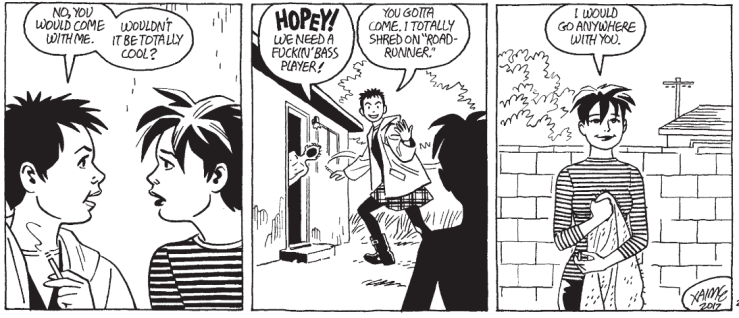
I actually did muster a review of Jaime Hernandez latest Love & Rockets book, Is This How you See Me? The review is at The Comics Journal.

Not pictured in the stack above (because I have it out as a digital loan from my local library) is Maria Gainza’s novel (is it a novel?) Optic Nerve, in translation by Thomas Bunstead. I’m a little over half way through, and just really digging it. It’s kinda like a life story told through paintings and art history, but it’s also very much about aesthetics and ways of seeing. It reminds me a lot of  W.G. Sebald, Roberto Bolaño Claire-Louise Bennett, Lucia Berlin, and David Markson, but also really original. Good stuff.
A review of Jaime Hernandez’s latest Love & Rockets graphic novel, Is This How You See Me?

Screenshot 2019-05-23 at 12.24.58 PM

My review of Jaime Hernandez’s latest Love & Rockets graphic novel, Is This How You See Me?, is up now at The Comics Journal. First few grafs—

Can you ever really go home again?

This is the central question of Jaime Hernandez’s Is This How You See Me? Collecting serialized comics from the past five years into a cohesive graphic novel, Is This How You See Me? is a moving tale of friendship, aging, and how the past shapes how we see the present.

Is This How You See Me? takes place over a single weekend in the mid-2010s. Best friends Maggie and Hopey return to their childhood hometown Huerta (or “Hoppers,” in Love & Rockets slang) for a punk rock reunion party and concert.

Read the whole review. 

Screenshot 2019-05-23 at 12.52.36 PM

All of David Markson’s references in The Last Novel to Walt Whitman

All of David Markson’s references in The Last Novel to Walt Whiman:

I am he that aches with amorous love.            Wrote Whitman.

Walter, leave off.

Wrote D. H. Lawrence.


Walt Whitman’s claim — never in any way verified — that he had fathered at least six illegitimate children.


Gerard Manley Hopkins, on realizing that he feels a certain kinship with Whitman:

As he is a very great scoundrel this is not a very pleasant confession.


A writer of something occasionally like English — and a man of something occasionally like genius.

Swinburne called Whitman.


Future generations will regard Bob Dylan with the awe reserved for Blake, Whitman, Picasso and the like.

Said an otherwise seemingly rational writer named Jonathan Lethem.


Before the Euro, the portrait of Yeats on Ireland’s twenty-pound note.

America’s Whitman twenty-dollar bill, when?

The Melville ten?


Twenty-five years after his death, Poe’s remains were disinterred from what had been little better than a pauper’s grave and reburied more formally.

Walt Whitman, who made the journey from Camden to Baltimore in spite of being disabled from a recent stroke, was the only literary figure to appear at the ceremonies.

Errors on Walt Whitman (Jorge Luis Borges)

whitman

Never was there more hollowness at heart than at present (Walt Whitman)

I say we had best look our times and lands searchingly in the face, like a physician diagnosing some deep disease. Never was there, perhaps, more hollowness at heart than at present, and here in the United States. Genuine belief seems to have left us. The underlying principles of the States are not honestly believ’d in, (for all this hectic glow, and these melodramatic screamings,) nor is humanity itself believ’d in. What penetrating eye does not everywhere see through the mask? The spectacle is appaling. We live in an atmosphere of hypocrisy throughout. The men believe not in the women, nor the women in the men. A scornful superciliousness rules in literature. The aim of all the littérateurs is to find something to make fun of. A lot of churches, sects, &c., the most dismal phantasms I know, usurp the name of religion. Conversation is a mass of badinage. From deceit in the spirit, the mother of all false deeds, the offspring is already incalculable. An acute and candid person, in the revenue department in Washington, who is led by the course of his employment to regularly visit the cities, north, south and west, to investigate frauds, has talk’d much with me about his discoveries. The depravity of the business classes of our country is not less than has been supposed, but infinitely greater. The official services of America, national, state, and municipal, in all their branches and departments, except the judiciary, are saturated in corruption, bribery, falsehood, mal-administration; and the judiciary is tainted. The great cities reek with respectable as much as non-respectable robbery and scoundrelism. In fashionable life, flippancy, tepid amours, weak infidelism, small aims, or no aims at all, only to kill time. In business, (this all-devouring modern word, business,) the one sole object is, by any means, pecuniary gain. The magician’s serpent in the fable ate up all the other serpents; and money-making is our magician’s serpent, remaining to-day sole master of the field.

From Walt Whitman’s Democratic Vistas (1871).

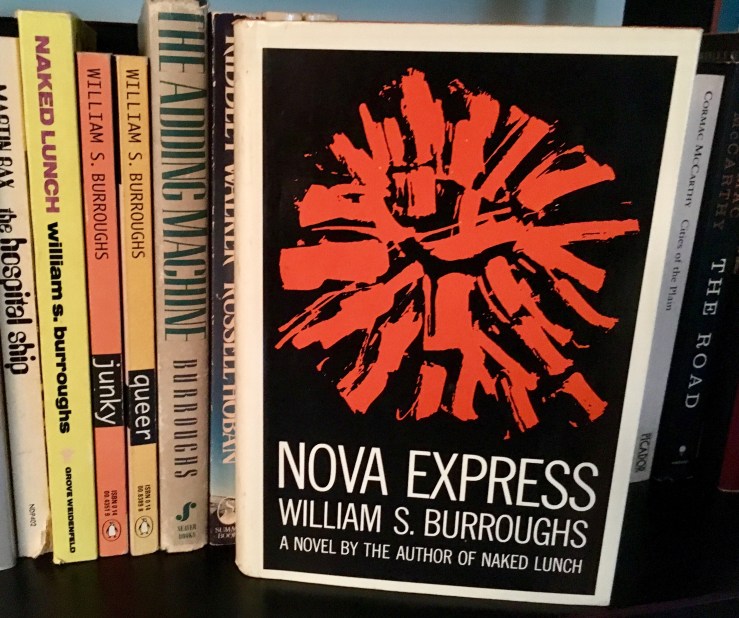
William Burroughs’ Nova Express (Book acquired sometime last week)

img_2863

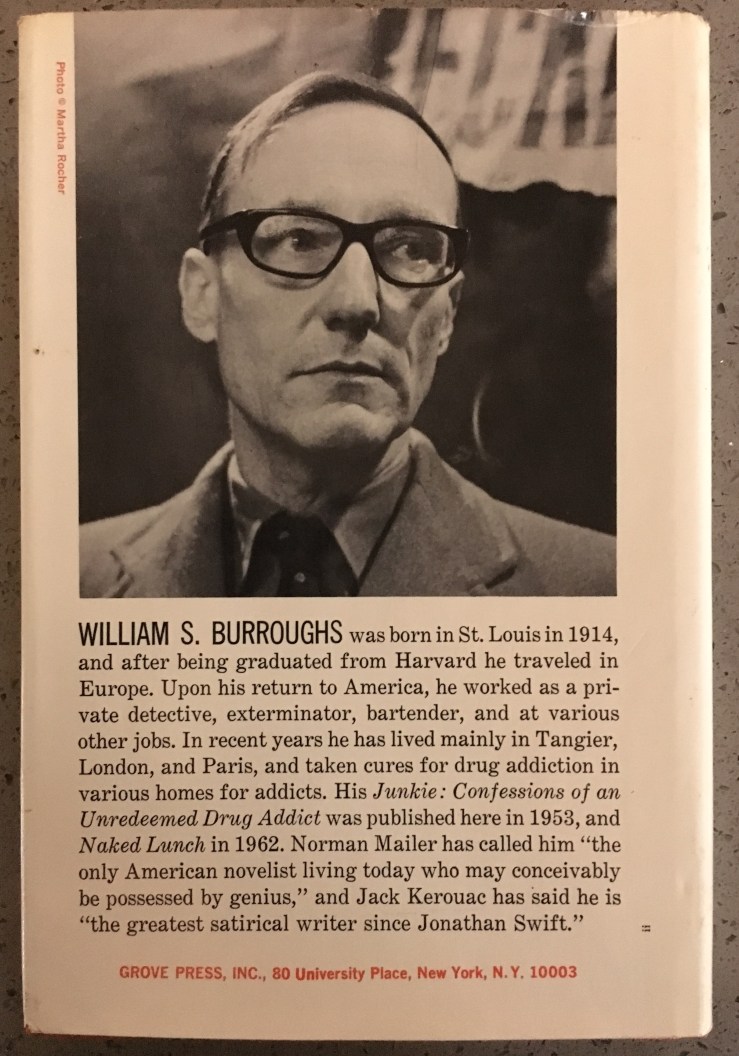
So I couldn’t pass up this first edition hardback Grove Press edition of William Burroughs’ 1964 novel Nova Express (with cover design by Grove Press stalwart Roy Kuhlman) that I found a few hot days ago, wandering decomposing stacks of pressed leaves here in North Florida. It ate up half of my credit at this particular used bookstore and yet was still cheaper than a new hardback NYT bestseller. Haven’t read the damn thing since college, and don’t own a copy so. Here’s the back cover with an author photo of Burroughs in which he looks like a goddamn baby (how did he live so long?):

img_2866

“[T]he greatest satirical writer since Jonathan Swift”! I’m sure Jack Kerouac wouldn’t like hyperbolize even a smidge. What was Burroughs satirizing? Like modernism, modern machine life, etc. Control, as in all Burroughs.

Biologic Agent K9 called for his check and picked up supersonic imitation blasts of The Death Dwarfs — “L’addition — Laddition — Laddittion — Garcon — Garcon — Garcon” — American tourist accent to the Nth power — He ordered another coffee and monitored the café — A whole table of them imitating word forms and spitting back at supersonic speed — Several patrons rolled on the floor in switch fits — These noxious dwarfs can spit out a whole newspaper in ten seconds imitating your words after you and sliding in suggestion insults — That is the entry gimmick of The Death Dwarfs: supersonic imitation and playback so you think it is your own voice — (do you own a voice?) they invade The Right Centers which are The Speech Centers and they are in the right — in the right — in thee write — “RIGHT” — “I’m in the right — in the right — You know I’m in the right so long as you hear me say inside your right centers ‘I am in the right’” — While Sex Dwarfs tenderize erogenous holes — So The Venusian Gook Rot flashed round the world —

Read the rest of the death dwarf routine.

Judge Holden holds forth on war (Blood Meridian)

From Chapter XVII of Cormac McCarthy’s novel Blood Meridian

They grew gaunted and lank under the white suns of those days and their hollow burnedout eyes were like those of noctambulants surprised by day. Crouched under their hats they seemed fugitives on some grander scale, like beings for whom the sun hungered. Even the judge grew silent and speculative. He’d spoke of purging oneself of those things that lay claim to a man but that body receiving his remarks counted themselves well done with any claims at all. They rode on and the wind drove the fine gray dust before them and they rode an army of gray-beards, gray men, gray horses. The mountains to the north lay sunwise in corrugated folds and the days were cool and the nights were cold and they sat about the fire each in his round of darkness in that round of dark while the idiot watched from his cage at the edge of the light. The judge cracked with the back of an axe the shinbone on an antelope and the hot marrow dripped smoking on the stones. They watched him. The subject was war.

The good book says that he that lives by the sword shall perish by the sword, said the black.

The judge smiled, his face shining with grease.

What right man would have it any other way? he said.

The good book does indeed count war an evil, said Irving. Yet there’s many a bloody tale of war inside it.

It makes no difference what men think of war, said the judge. War endures. As well ask men what they think of stone. War was always here. Before man was, war waited for him. The ultimate trade awaiting its ultimate practitioner. That is the way it was and will be. That way and not some other way.

He turned to Brown, from whom he’d heard some whispered slur or demurrer. Ah Davy, he said. It’s your own trade we honor here. Why not rather take a small bow. Let each acknowledge each.

My trade?

Certainly.

What is my trade?

War. War is your trade. Is it not?

And it aint yours?

Mine too. Very much so.

What about all them notebooks and bones and stuff?

All other trades are contained in that of war.

Is that why war endures?

No. It endures because young men love it and old men love it in them. Those that fought, those that did not.

That’s your notion.

The judge smiled. Men are born for games. Nothing else. Every child knows that play is nobler than work. He knows too that the worth or merit of a game is not inherent in the game itself but rather in the value of that which is put at hazard. Games of chance require a wager to have meaning at all. Games of sport involve the skill and strength of the opponents and the humiliation of defeat and the pride of victory are in themselves sufficient stake because they inhere in the worth of the principals and define them. But trial of chance or trial of worth all games aspire to the condition of war for here that which is wagered swallows up game, player, all.

Suppose two men at cards with nothing to wager save their lives. Who has not heard such a tale? A turn of the card. The whole universe for such a player has labored clanking to this moment which will tell if he is to die at that man’s hand or that man at his. What more certain validation of a man’s worth could there be? This enhancement of the game to its ultimate state admits no argument concerning the notion of fate. The selection of one man over another is a preference absolute and irrevocable and it is a dull man indeed who could reckon so profound a decision without agency or significance either one. In such games as have for their stake the annihilation of the defeated the decisions are quite clear. This man holding this particular arrangement of cards in his hand is thereby removed from existence. This is the nature of war, whose stake is at once the game and the authority and the justification. Seen so, war is the truest form of divination. It is the testing of one’s will and the will of another within that larger will which because it binds them is therefore forced to select. War is the ultimate game because war is at last a forcing of the unity of existence. War is god. Brown studied the judge.

You’re crazy Holden. Crazy at last.

The judge smiled.


Selections from One-Star Amazon Reviews of Thomas Pynchon’s The Crying of Lot 49

[Editorial note: The following citations come from one-star Amazon reviews of Thomas Pynchon’s novel The Crying of Lot 49. To be clear, I’m a big Pynchon fanI’ve preserved the reviewers’ own styles of punctuation and spelling. More one-star Amazon reviews].


If it were better written, it might qualify as pretentious.

the prose was simultaneously confusing and boring

my first Pynchon novel and probably my last

I am really picky when it comes to reading.

I suppose if you like post modernist crap?

This novel just did not do it for me.

Opaque, muddled, and mindless.

Yuck! Had to read for class. :-(

the characters were unlikable

Reading shouldn’t be work…

If you’re an English major

What is this I don’t even

I didn’t finish it

insufferable

convoluted

No thanks.

overly complicated

gacked-up cartoon of a…thing

stupidest thing I’ve ever read

left confused about many things

deliberate manipulation of names

palpably viscerally nauseated and sick

Pynchon and Robbins can just go and get a room.

I love A LOT of post-modern experimental fiction, but

I managed to finish this novel only because it’s short

This is really the worst book I have ever read

loaded with pretentious intellectualism

I find the weirdness too weird

required too much effort

A Silly Word Salad

wacky hi-jinks

post-beatnik weirdoes

difficult, delirious writing style

pretentious intellectualism posing as literature

like Sacha Baron Cohen of the dreadful movie “Borat” fame

(modern life is uncertain; there is no guarantee of a happy ending)

Pynchon is a sad man with a rather warped and gloomy view of the world

a prose style that is going to either delight or dismay most readers

physics, Greek tragedies, postal history, drug culture

is bizarre like the author is high when he wrote it

hyperstylized game of literary three card monte

I was expecting a Victorian crime drama

nothing to interest a decent reader

he really should find a day job

the character names; silly

without the humor

Thankfully brief

chaos engine


I consider myself a student of colours and shades and hues and tints (From Gerald Murnane’s Border Districts)

I consider myself a student of colours and shades and hues and tints. Crimson lake, burnt umber, ultramarine … I was too clumsy as a child to paint with my moistened brush the scenery that I would have liked to bring into being. I preferred to leave untouched in their white metallic surroundings my rows of powdery rectangles of water-colours, to read aloud one after another of the tiny printed names of the coloured rectangles, and to let each colour seem to soak into each word of its name or even into each syllable of each word of each name so that I could afterwards call to mind an exact shade or hue from an image of no more than black letters on a white ground.

Deep cadmium, geranium lake, imperial purple, parchment … after the last of our children had found employment and had moved out of our home, my wife and I were able to buy for ourselves things that had previously been beyond our means. I bought my first such luxury, as I called it, in a shop selling artists’ supplies. I bought there a complete set of coloured pencils made by a famous maker of pencils in England: a hundred and twenty pencils, each stamped with gold lettering along its side and having at its end a perfectly tapered wick. The collection of pencils is behind me as I write these words. It rests near the jars of glass marbles and the kaleidoscope mentioned earlier. None of the pencils has ever been used in the way that most pencils are used, but I have sometimes used the many-striped collection in order to confirm my suspicion as a child that each of what I called my long-lost moods might be recollected and, perhaps, preserved if only I could look again at the precise shade or hue that had become connected with the mood – that had absorbed, as it were, or had been permeated with, one or more of the indefinable qualities that constitute what is called a mood or a state of feeling. During the weeks since I first wrote in the earlier pages of this report about the windows in the church of white stone, I have spent every day an increasing amount of time in moving my pencils to and fro among the hollow spaces allotted to them in their container. I seem to recall that I tried sometimes, many years ago, to move my glass marbles from place to place on the carpet near my desk with the vague hope that some or another chance arrangement of them would restore to me some previously irretrievable mood. The marbles, however, were too variously coloured, and each differed too markedly from the other. Their colours seemed to vie, to compete. Or, a single marble might suggest more than I was in search of: a whole afternoon in my childhood or a row of trees in a backyard when I had wanted back only a certain few moments when my face was brushed by a certain few leaves. Among the pencils are many differing only subtly from their neighbours. Six at least I might have called simply red if I had not learned long ago their true names. With these six, and with still others from each side of them, I often arrange one after another of many possible sequences, hoping to see in the conjectured space between some or another unlikely pair a certain tint that I have wanted for long to see.

From Gerald Murnane’s 2018 novel Border Districts.

I failed as a reader of fiction (From Gerald Murnane’s Border Districts)

Whenever I tried long ago to learn from books about the workings of minds, I was equally troubled whether I read fiction or non-fiction. In the same way that I struggled and failed to follow plots and to comprehend the motives of characters, so did I struggle to follow arguments and to understand concepts. I failed as a reader of fiction because I was constantly engaged not with the seeming subject-matter of the text but with the doings of personages who appeared to me while I tried to read and with the scenery that appeared around them. My image-world was often only slightly connected with the text in front of my eyes; anyone privy to my seeming-sights might have supposed I was reading some barely recognisable variant of the text, a sort of apocrypha of the published work. As a reader of texts intended to explain the mind, I failed because the words and phrases in front of my eyes gave rise only to the poorest sort of image. Reading about our minds or the mind, and about purported instincts or aptitudes or faculties, not to mention such phantasms as ego, id, and archetype, I supposed the endless-seeming landscapes of my own thoughts and feelings must have been a paradise by comparison with the drab sites where others located their selves or their personalities or whatever they called their mental territories. And so, I decided long ago to take no further interest in the theoretical and to study instead the actual, which was for me the seeming-scenery behind everything I did or thought or read.

From Gerald Murnane’s 2018 novel Border Districts.

img_2844

Way too cheap (From Thomas Pynchon’s Vineland)

“Whole problem ’th you folks’s generation,” Isaiah opined, “nothing personal, is you believed in your Revolution, put your lives right out there for it—but you sure didn’t understand much about the Tube. Minute the Tube got hold of you folks that was it, that whole alternative America, el deado meato, just like th’ Indians, sold it all to your real enemies, and even in 1970 dollars—it was way too cheap. . . .”

A critique (by Gen X punker Isaiah Two Four) of the Baby Boomers. From Thomas Pynchon’s 1990 novel Vineland.  The “Tube” is television, of course, but might be a placeholder for any passively-consumed entertainment.

I guess it’s over (From Thomas Pynchon’s Vineland)

Mucho blinked sympathetically, a little sadly. “I guess it’s over. We’re on into a new world now, it’s the Nixon Years, then it’ll be the Reagan Years—”

“Ol’ Raygun? No way he’ll ever make president.”

“Just please go careful, Zoyd. ’Cause soon they’re gonna be coming after everything, not just drugs, but beer, cigarettes, sugar, salt, fat, you name it, anything that could remotely please any of your senses, because they need to control all that. And they will.”

“Fat Police?”

“Perfume Police. Tube Police. Music Police. Good Healthy Shit Police. Best to renounce everything now, get a head start.”

“Well I still wish it was back then, when you were the Count. Remember how the acid was? Remember that windowpane, down in Laguna that time? God, I knew then, I knew. . . .”

They had a look. “Uh-huh, me too. That you were never going to die. Ha! No wonder the State panicked. How are they supposed to control a population that knows it’ll never die? When that was always their last big chip, when they thought they had the power of life and death. But acid gave us the X-ray vision to see through that one, so of course they had to take it away from us.”

“Yeah, but they can’t take what happened, what we found out.”

“Easy. They just let us forget. Give us too much to process, fill up every minute, keep us distracted, it’s what the Tube is for, and though it kills me to say it, it’s what rock and roll is becoming—just another way to claim our attention, so that beautiful certainty we had starts to fade, and after a while they have us convinced all over again that we really are going to die. And they’ve got us again.” It was the way people used to talk.

“I’m not gonna forget,” Zoyd vowed, “fuck ’em. While we had it, we really had some fun.”

“And they never forgave us.” Mucho went to the stereo and put on The Best of Sam Cooke, volumes 1 and 2, and then they sat together and listened, both of them this time, to the sermon, one they knew and felt their hearts comforted by, though outside spread the lampless wastes, the unseen paybacks, the heartless power of the scabland garrison state the green free America of their childhoods even then was turning into.

An elegiac passage from Thomas Pynchon’s 1990 novel Vineland.

The spilled, the broken world (From Thomas Pynchon’s Vineland)

So the bad Ninjamobile swept along on the great Ventura, among Olympic visitors from everywhere who teemed all over the freeway system in midday densities till far into the night, shined-up, screaming black motorcades that could have carried any of several office seekers, cruisers heading for treed and more gently roaring boulevards, huge double and triple trailer rigs that loved to find Volkswagens laboring up grades and go sashaying around them gracefully and at gnat’s-ass tolerances, plus flirters, deserters, wimps and pimps, speeding like bullets, grinning like chimps, above the heads of TV watchers, lovers under the overpasses, movies at malls letting out, bright gas-station oases in pure fluorescent spill, canopied beneath the palm trees, soon wrapped, down the corridors of the surface streets, in nocturnal smog, the adobe air, the smell of distant fireworks, the spilled, the broken world.

A description of the postmodern Preterite world from Thomas Pynchon’s 1990 novel Vineland. 

Strugatsky brothers/Mutis/Pynchon (Books acquired, 8 May 2019)

img_2805

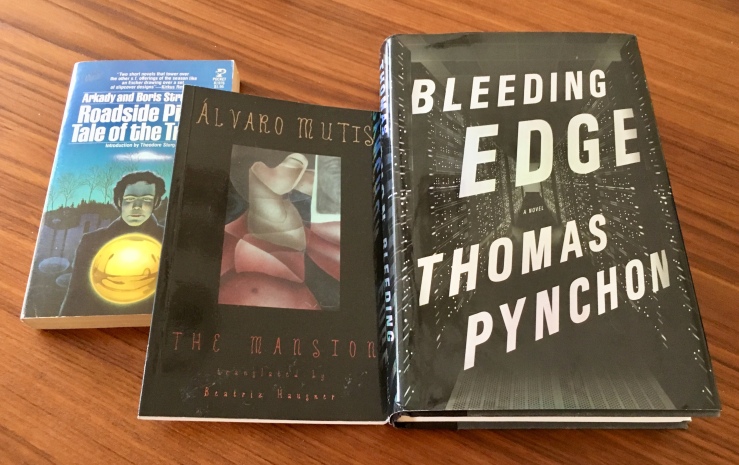
I went to the bookstore on Pynchon in Public Day, 2019 to pick up the only Thomas Pynchon novel I don’t own, Bleeding Edge. I’ve given the book a shot or three, checking it out from the library, but it’s never quite clicked for me. I’m reading Vineland right now though, the other Pynchon novel I haven’t previously read, and finally really digging it. So maybe I’ll read Bleeding Edge after (although I think I’ll probably immediately reread Vineland after reading Vineland).

img_2806

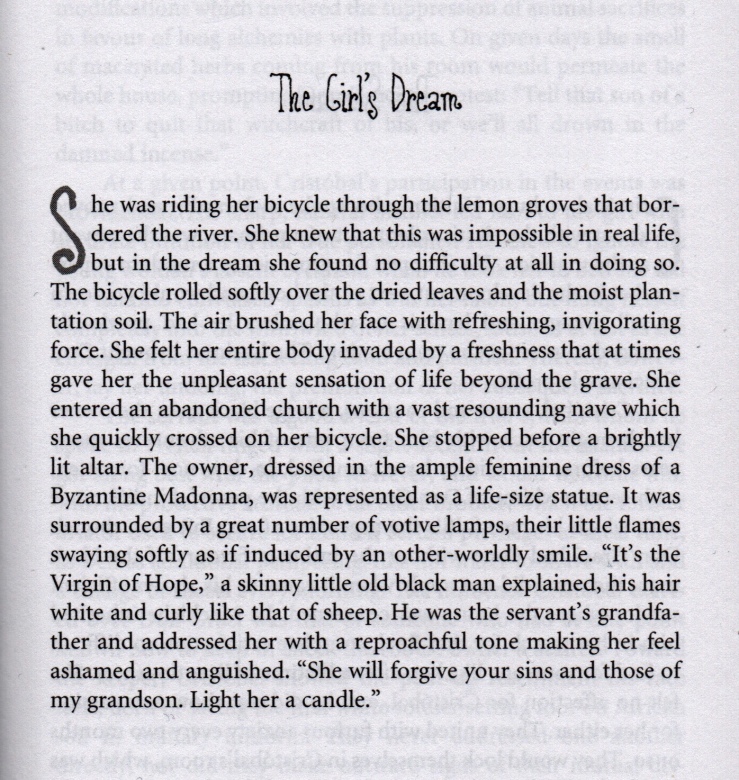
I have a little mental list of books and authors I look for while browsing, including the Australian writer Gerald Murnane whom I did not find a scrap by—but I did unexpectedly find The Mansion, a collection of early short stories and fragments by Colombian author Álvaro Mutis. Here’s one of those little sections (in translation by Beatriz Hausner):

img_2807

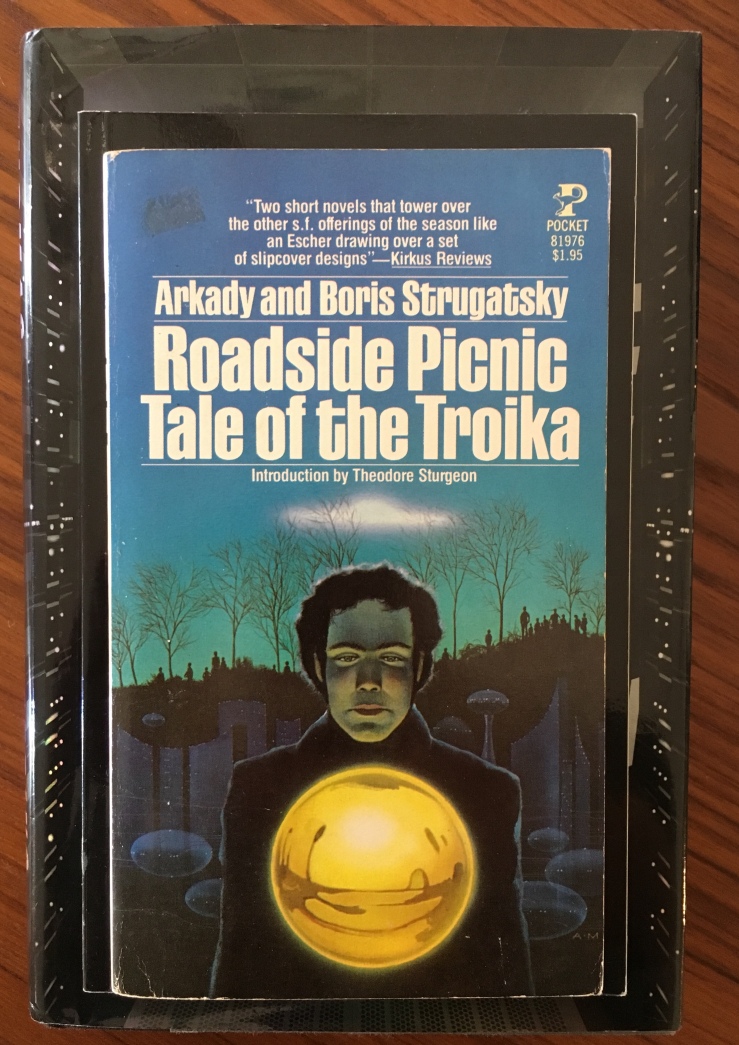
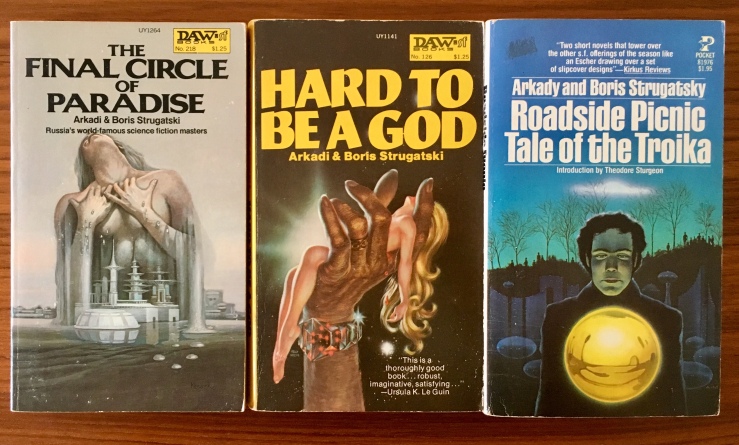
I also like to scan the massmarket scifi paperbacks at this particular used bookstore for original US editions of works by the Strugatsky Brothers. I’ve been a bit lucky lately, finding Hard to Be a God and The Final Circle of Paradise—and I was thrilled to find the Pocket edition of Roadside Picnic/Tale of the Troika. I read Olena Bormashenko’s 2012 translation of this book a few years ago, and loved it (I also really dug her translation of the Strugatsky’s superweird novel The Snail on the Slope). This translation is by Antonina W. Bouis, and includes an introduction by Theodore Sturgeon. I haven’t read Tale of the Troika, but Sturgeon describes it as a satire that evokes “Kafkaesque horror.” Sounds delightful.

img_2809

The Mother Conspiracy (Gravity’s Rainbow)

Otto is earnestly explaining his views on the Mother Conspiracy. It’s not often a sympathetic girl will listen. The Mothers get together once a year, in secret, at these giant conventions, and exchange information. Recipes, games, key phrases to use on their children. “What did yours use to say when she wanted to make you feel guilty?”

“‘I’ve worked my fingers to the bone!’” sez the girl.

“Right! And she used to cook those horrible casseroles, w-with the potatoes, and onions—”

“And ham! Little pieces of ham—”

“You see, you see? That can’t be accidental! They have a contest, for Mother of the Year, breast-feeding, diaper-changing, they time them, casserole competitions, ja—then, toward the end, they actually begin to use the children. The State Prosecutor comes out on stage. ‘In a moment, Albrecht, we are going to bring your mother on. Here is a Luger, fully loaded. The State will guarantee you absolute immunity from prosecution. Do whatever you wish to do—anything at all. Good luck, my boy.’ The pistols are loaded with blanks, natürlich, but the unfortunate child does not know this. Only the mothers who get shot at qualify for the finals.

Here they bring in psychiatrists, and judges sit with stopwatches to see how quickly the children will crack. ‘Now then, Olga, wasn’t it nice of Mutti to break up your affair with that long-haired poet?’ ‘We understand your mother and you are, ah, quite close, Hermann. Remember the time she caught you masturbating into her glove? Eh?’ Hospital attendants stand by to drag the children off, drooling, screaming, having clonic convulsions. Finally there is only one Mother left on stage. They put the traditional flowered hat on her head, and hand her the orb and scepter, which in this case are a gilded pot roast and a whip, and the orchestra plays Tristan und Isolde.

From Thomas Pynchon’s novel Gravity’s Rainbow.