Beyond these, illuminated by past summers, one summer remained that stayed the sun long into the night after you had watched the others; others with their fathers knee-deep, belly-button unconcerned, roly-poly mothers stretching out of the sea. Whiter than starch hands on bat and ball, you failed to catch. Tents, buckets, spades; others that went on digging barricades. You castle-bound, spying on princesses, honey-gold, singing against the blue, if touched surely their skin would ooze? Aware of own smell, skin-texture, sun in eyes, lips, toes, the softness underneath, in between, wondering what miracle made you, the sky, the sea. Conscious of sound, gulls hovering, crying, or silent at rarer intervals, their swift turns before being swallowed by the waves. Then no sound, all suddenly would be soundless, treading softly, dividing rocks with fins, and sword-fish fingers plucking away clothes, that were left with your anatomy, huddled like ruffled birds waiting. A chrysalis heart formed on the water’s surface, away from the hard-polished pebbles, sand-blowing and elongated shadows. Away, faster than air itself, dragon-whirled. Be given to, the sliding of water, to forget, be forgotten; premature thoughts—predetermined action. In a moment fixed between one wave and the next, the outline of what might be ahead. On your back, staring into space, becoming part of the sky, a speckled bird’s breast that opened up at the slightest notion on your part. But the hands, remember the hands that pulled your legs, that doubled you up, and dragged you down? Surprised at non-resistance. Voices that called, creating confusion. Cells tighter than shells, you spinning into spirals, quick-silver, thrashing the water, making stars scatter. Narcissus above, staring at a shadow-bat spreading out, finally disappearing into the very centre of the ocean. They were always there waiting by the edge, behind them the cliffs extended. Your head disembodied, bouncing above the separate force of arms and legs, rhythmical, the glorious sensation of weightlessness, moon-controlled, and far below your heart went on exploring, no matter how many years came between, nor how many people were thrust into focus. That had surely been the beginning, the separating of yourself from the world that no longer revolved round you, the awareness of becoming part of, merging into something else, no longer dependent upon anyone, a freedom that found its own reality, half of you the constant guardian, watching your actions, your responses, what you accepted, what you might reject.
Gene Wolfe was born in New York on May 7, 1931. He studied at Texas A&M for a few years before dropping out and fighting in the Korean War. After his return to the US he finished his degree at the University of Houston. He was an engineer, and worked as the editor of the professional journal Plant Engineering. He was also instrumental in inventing the machine that cooks Pringles potato chips.
…Wolfe went on to write over 30 novels, with his best best-known work, The Book of The New Sun, spanning 1980-1983. The series is a tetralogy set in the Vancian Dying Earth subgenre, and follows the journey of Severian, a member of the Guild of Torturers, after he is exiled for the sin of mercy.
Last night, I fell asleep listening to Chapter 15 of the audiobook version of Gene Wolfe’s 1980 novel The Shadow of the Torturer, the first book in The Book of the New Sun.I have been falling asleep to Chapter 15 of this particular audiobook for about three nights now. Before that, I was falling asleep to Chapter 14. There is nothing particularly boring about the book. I put headphones in my ears take sleeping pills and fall asleep to an audiobook every night. There’s something about plugging into a narrative that’s not my own life that takes me out of all the anxieties that creep out at bedtime. I get through 15, maybe 20 minutes, and I’m out. I restart a few minutes before the last bit I remember. Anyway, I fell asleep to Chapter 15 — “Baldanders” — last night. I might’ve even made it a little bit into Chapter 16. I’ll find out tonight.
I first read The Shadow of the Torturer as a young teen. I was too young for the book—I don’t think I fully appreciated its scope. I read the next book in The Book of the New Sun series, but I don’t remember if I finished it out. In a year or two, I had abandoned fantasy, a mistake that I corrected years later. Youthful indiscretion. I reread a chunk of The Shadow of the Torturer again in my twenties and found it more complex than I remember. Then I mistakenly left the mass market paperback copy I was reading at a beach condo we had conned from someone’s friend’s grandmother for the weekend, and that was that—until this February, when a brief Twitter conversation prompted me to get the audiobook. I’ve been listening to it every night since, and at the rate I’m going through it I’ll probably be done by the end of the summer. I’m digging it.
Will Wolfe now gain a wider audience outside of the sci-fi/fantasy cult audience now that he has died? Maybe. I mean, that happens sometimes, right? His work is challenging though, employing strange diction and proffering only the smallest crumbs of exposition. Ultimately, it’s clear that Gene Wolfe was a writer’s writer, as evidenced by a 2015 profile of him in The New Yorkerwhich proclaimed him “sci-fi’s difficult genius”—
Wolfe has published more than twenty-five novels and more than fifty stories, and has won some of science fiction and fantasy’s most prestigious awards. But he has rarely, if ever, been considered fully within the larger context of literature. His books contain all of the nasty genre tropes—space travel, robots, even dragons—and he hasn’t crossed into the mainstream on the strength of a TV or movie adaptation. Wolfe himself sees the trappings of science fiction and fantasy, the spaceships and so on, as simply “a sketchy outline of the things that can be done.” But even within fantasy fandom, Wolfe’s work presents difficulties. His science fiction is neither operatic nor scientifically accurate; his fantasy works are not full of clanging swords and wizardly knowledge. But ask science-fiction or fantasy authors about Gene Wolfe and they are likely to cite him as a giant in their field. Ursula K. Le Guin once called Wolfe “our Melville.”
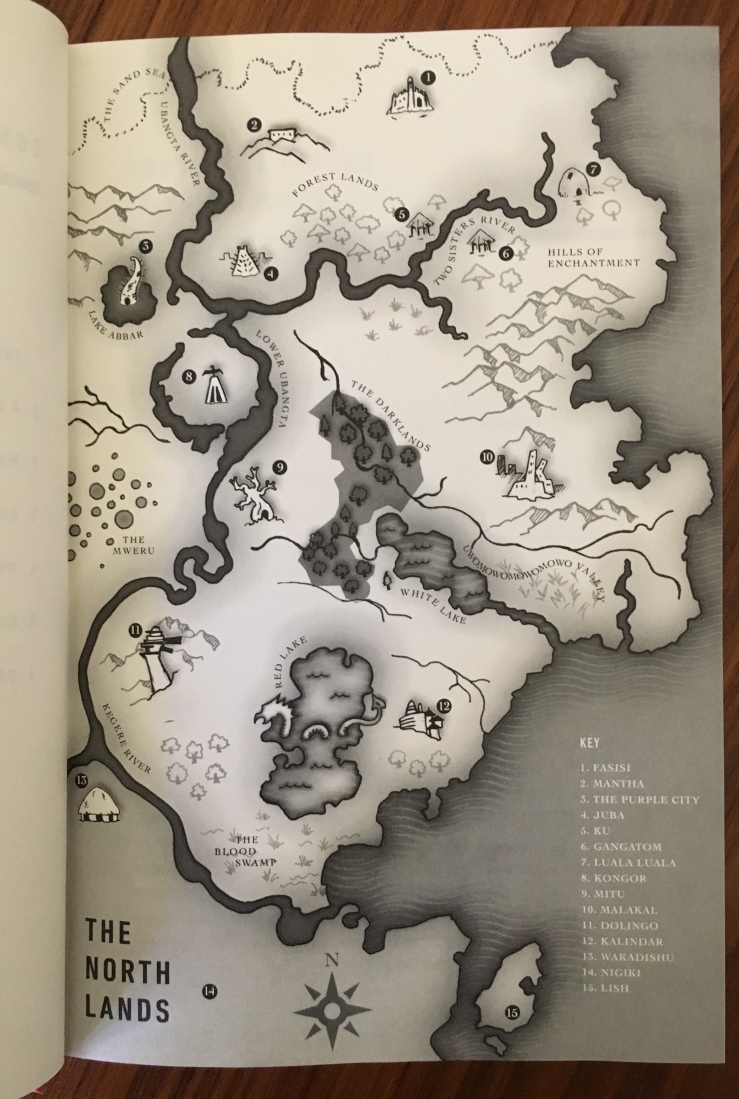
The big book I am reading is Marlon James’s surreal fantasy Black Leopard, Red Wolf. I am a little over half way through this long, long book, which is by turns rich, dazzling, baffling, and befuddling. Black Leopard, Red Wolf is a fantasy-quest novel set in a mythical medieval Africa. The story is told by Tracker, a detective under magical protection who uses his magnificent nose to search for a missing boy, Tracker is aided (and sometimes stymied) on this quest by a strange and ever-shifting fellowship of superpowered heroes and antiheroes, including a sad, talkative giant, a mysterious witch, and the titular Leopard. Leopard is a shapeshifter, and Tracker’s erstwhile partner, both in adventures and in love. “Fantastic beasts, fantastic appetites,” he remarks at one point, summarizing the novel’s horny program. “The more you tell me, the less I know,” another character remarks, summarizing the novel’s shaggy structure. Black Leopard, Red Wolf unspools its plot in the most confounding way. Tracker is hardly a reliable narrator, but we are not even sure if he is the primary narrator. He’s telling his tale to an Inquisitor, but the tale-telling spins ever on, each story a deferral. And those deferrals often open into other storytellers, who tell stories with their own embedded stories. James’s book is like a matryoshka doll full of blood and guts and fucking and surreal ceiling-walking demons. It’s as much a detective story as a fantasy, but for all its genre troping, it makes few concessions to its various genres’ conventional forms. Reading Black Leopard, Red Wolf often feels more like playing a really long game of very weird Dungeons & Dragons campaign with an inventive Dungeon Master making wild shit up as he goes along than it does a cohesive and coherent story. I’m digging the play so far.
The other long book I’m reading—crawling through, really—is Robert Coover’s The Origin of the Brunists. I loved the first 100 pages or so, but it’s turning into a slog. The novel’s climactic crisis, a mining disaster, occurs very early in the novel, an interesting gambit given that the novel is about an apocalyptic cult awaiting the end of the world. This apparent second crisis, a consequence of the first crisis, is then deferred. Coover explores this deferral and its consequences over a series of non-climaxes that we see through the eyes of the (many many too many) characters. There are little pockets of Origin that are fantastic, but too little humor to buoy the novel—it gets weighed down under its unwieldy cast and the authorial sense that This Is A Big Important Novel About Life. I will finish it though.
I loved loved loved Ann Quni’s novel Berg. I will do a full review of this marvelous weird claustrophobic novel when it comes out from And Other Stories in the U.S. this summer, but for now: Just amazing. The novel, originally published in 1964, begins like this: “A man called Berg, who changed his name to Greb, came to a seaside town intending to kill his father…” That, my friends, is basically the plot. Berg is a grisly Oedipal comedy that will make some readers’ skin crawl. Great stuff.
Anthony Howell’s Consciousness (with Mutilation) is another strange one. It’s part memoir, part collage, part family history, often told in a dreamlike prose, but also sometimes conveyed with reportorial simplicity. Check it out.
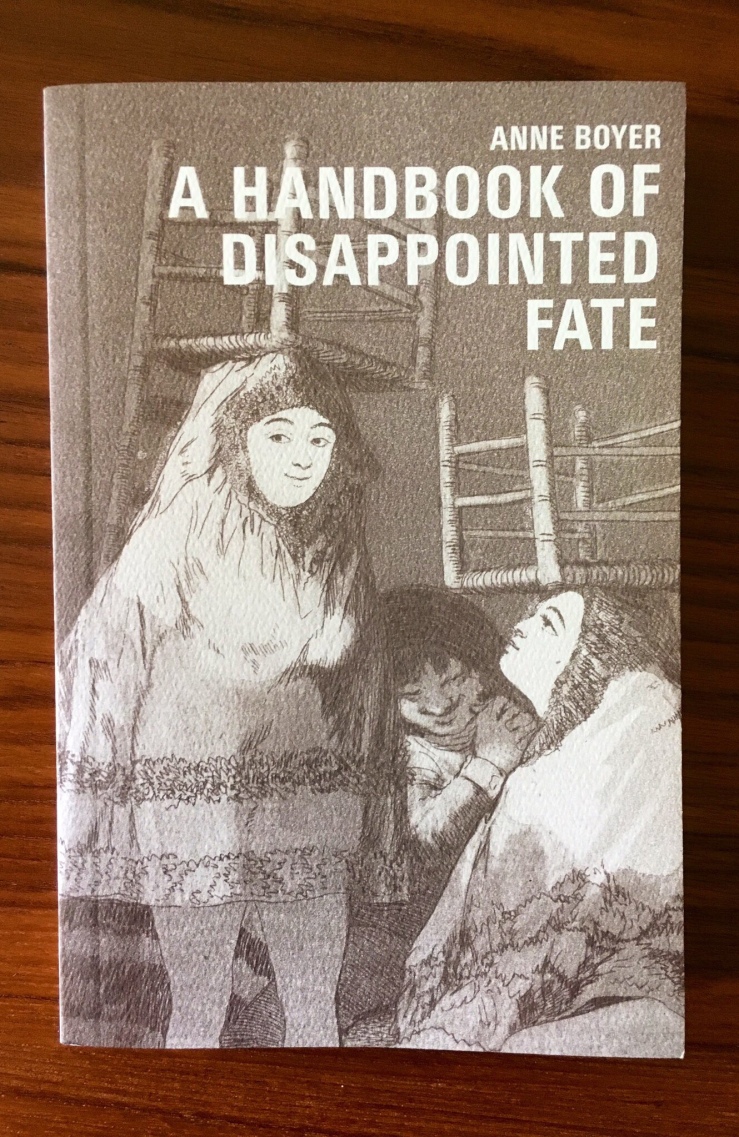
I’ve also been reading Anne Boyer’s A Handbook of Disappointed Fate, a discursive collection of essays, lists, little anti-poems, etc. More thoughts to come, but I really dig the feeling of reading it.
Finally, I picked up Leslie Fiedler’s 1964 book of criticism Waiting for the End this Friday. Fiedler begins with the (then-recent) deaths of Hemingway and Faulkner. Fiedler uses the deaths of these “old men” to riff on the end of Modernism, although he never evokes the term. Neither does he use the term “postmodernism” in his book, although he edges towards it in his critiques of kitsch and middlebrow culture, and especially in his essay “The End of the Novel.” In parts of the book, he gets close to describing, or nearing a description of, an emergent postmodernist literature (John Barth and John Hawkes are favorite examples for Fiedler), but ultimately seems more resigned to writing an elegy for the avant garde. Other aspects of Waiting for the End, while well-intentioned, might strike contemporary ears as problematic, as the kids say, but Fiedler’s sharp and loose style are welcome over stodgy scholarship. Ultimately, I find the book compelling because of its middle position in its take on American literature. It’s the work of a critic seeing the beginnings of something that hasn’t quite emerged yet—but his eye is trained more closely on what’s disappearing into the past.
A tremendous thank you to to BLCKDGRD for sending me a copy of Anne Boyer’s strange discursive book of essays-poems-critiques-I-do-not-know-whats A Handbook of Disappointed Fates. It showed up in the mail unexpectedly, and I figured it might be from him (he posted excerpts last week). I’m really digging the book so far, although I haven’t been reading it in a straight line. I did start at the beginning though, which starts like this:
(Bartleby prefers not to arrive in this essay on “No,” but it is nevertheless rather rich in its refusals).
This morning my dean told me that I needed to pack up my office over the summer as the building I’m in will be undergoing a renovation. Even though I knew this was coming, the prospect hit me as a series of big anxiety waves. My walls are covered with masks, art, pictures. I have file drawers of student work going back over a decade. And books. Lots and lots of books. Books and art and stuff that I don’t really have room for anywhere else, even for a season.
Three shelves in my office are doublestacked with old mass market paperbacks from my youth—-Vonnegut, Edgar Rice Burroughs, Hemingway, Jack London, Philip K. Dick, Richard Adams, Stephen Crane, etc. Shabby books, well worn, glue splitting. Over the years I’ve acquired nicer versions of the ones I want to reread, but my sentimental attachment to this small library of paperbacks doesn’t quite fade. When I taught high school, they were the bulk of my classroom library. I insisted on their return, and was always disappointed in students who seemed interested in certain novels but never quite managed to steal them. I was always thrilled when a student would ask to borrow one “over the summer” and then forget to return it.
This sorry shabby mass-market library has been depleted over my past decade teaching community college. Every semester, a few students ask if they can borrow something they see on the shelves when they stop by to chat. It is the most wonderful feeling to give a young person a copy of Brave New World (“I’ve heard it’s good”) or Cat’s Cradle (“Is it as good as Slaughterhouse Five?”) of Studies in Classic American Literature and then insist that they keep it and not worry about returning it.
This morning, a young man approached me after class and told me he’d noticed I had a copy of Do Androids Dream Electric Sheep? in my office—could he maybe borrow it? He made a point of calling it Do Androids Dream Electric Sheep? and not Blade Runner, despite the fact that it’s a movie tie-in. He seemed so happy when I repeated that the book was his now.
Earlier that morning I gave another student my copy of Howard Zinn’s A People’s History of the United States. He’s taken a couple of classes with me, and based on our conversations and his writing, I thought he could us the book more than I could. Again—young kid so happy to get a book, to think that someone thought he should read a particular book—I recall the feeling so vividly, from the other side. I love watching the old library dwindle away. Maybe I can give away more before I have to pack it up again.
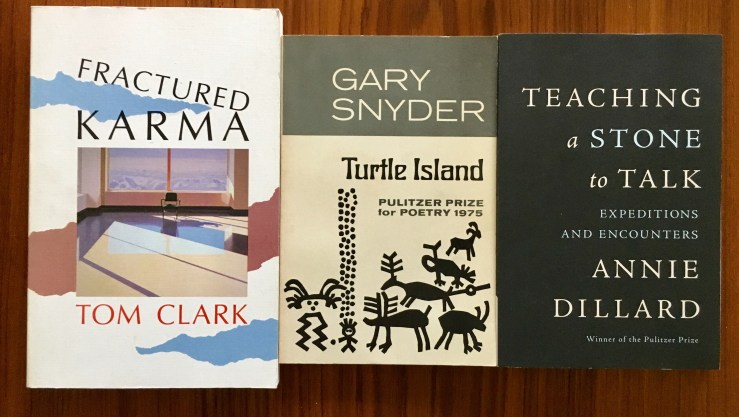
After classes and office hours I swung by my beloved bookstore. I do this a lot on Fridays, in the spare hour that I have between work and picking up kids. I had a little mission this time—buying some books for a great old friend who turns forty this weekend. He loves hiking and camping and poetry—more than I love those things, I think—so I asked twitter to throw out some recommendations, which they did. I had fun browsing the “Nature” section. I ended up getting three: Tom Clark’s Fractured Karma (a favorite of mine), Gary Snyder’s Turtle Island (I had never heard of it until today), and Annie Dillard’s Teaching a Stone to Walk (I dug a few of the short essays I read in the store). I enjoyed buying books for my friend. I am almost 100% he never reads this blog so I’m sure my posting this will not spoil his present, and, if not, Happy Birthday.
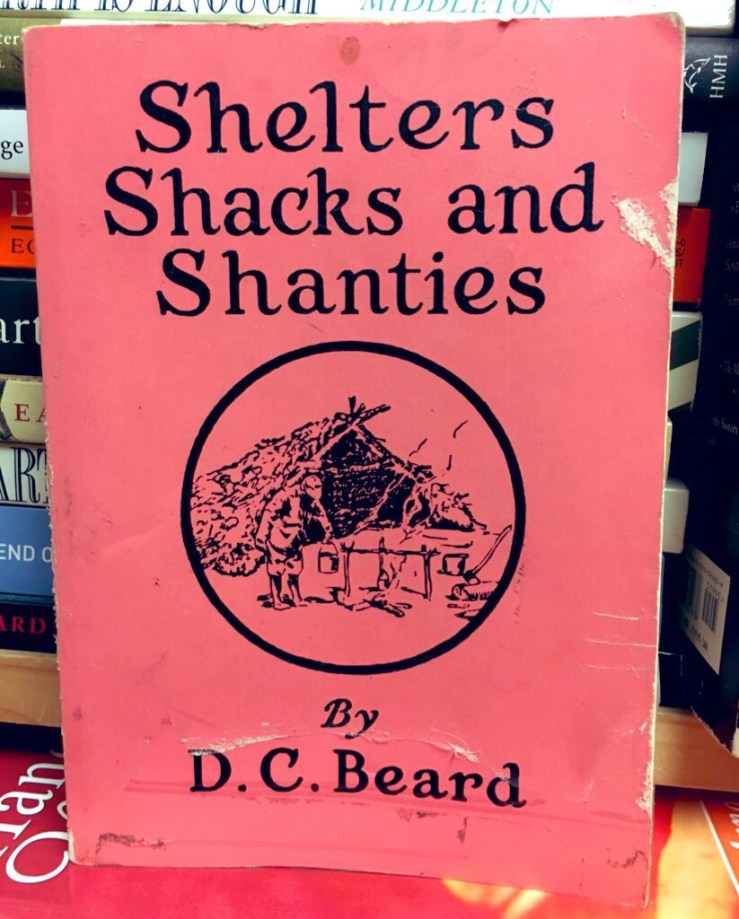
While browsing the “Nature” section, I resisted Shelters Shacks and Shanties—for now. Apologies to D.C. Beard, whose hut diagrams are exquisite:
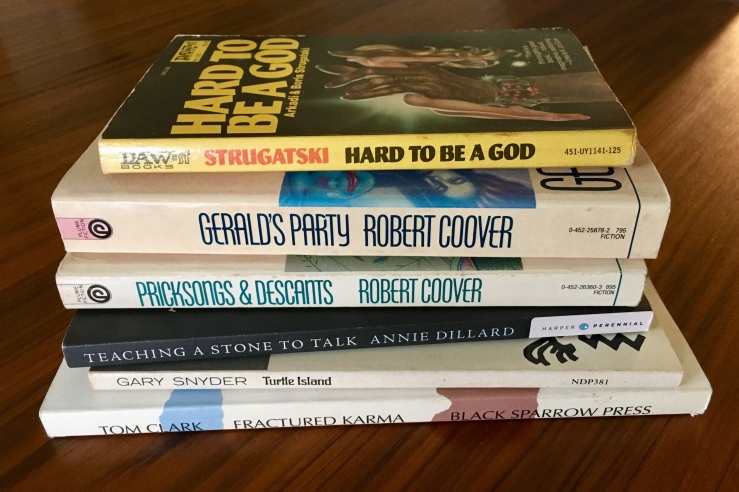
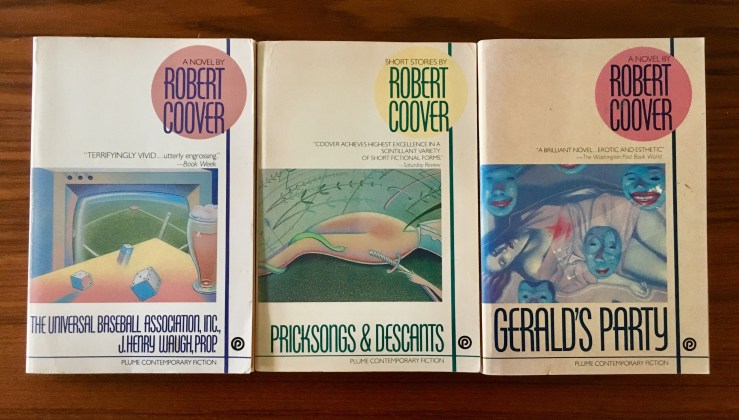
I of course selfishly picked up books for myself, although I didn’t browse for myself. I keep a silly geeky list of names to check in on, including Robert Coover. Even though I’m slogging my way through his first novel, The Origin of the Brunists, I still have a desire to read its sequel, The Brunist Day of Wrath. No wrath, but I picked up Plume editions of Pricksongs & Descants (which I’ve read but didn’t own) and Gerald’s Party (which I haven’t read and now own). The editions match the copy of TheUniversal Baseball Association, Inc., J. Henry Waugh, Prop. I picked last summer (and no I have not read goddamn it).
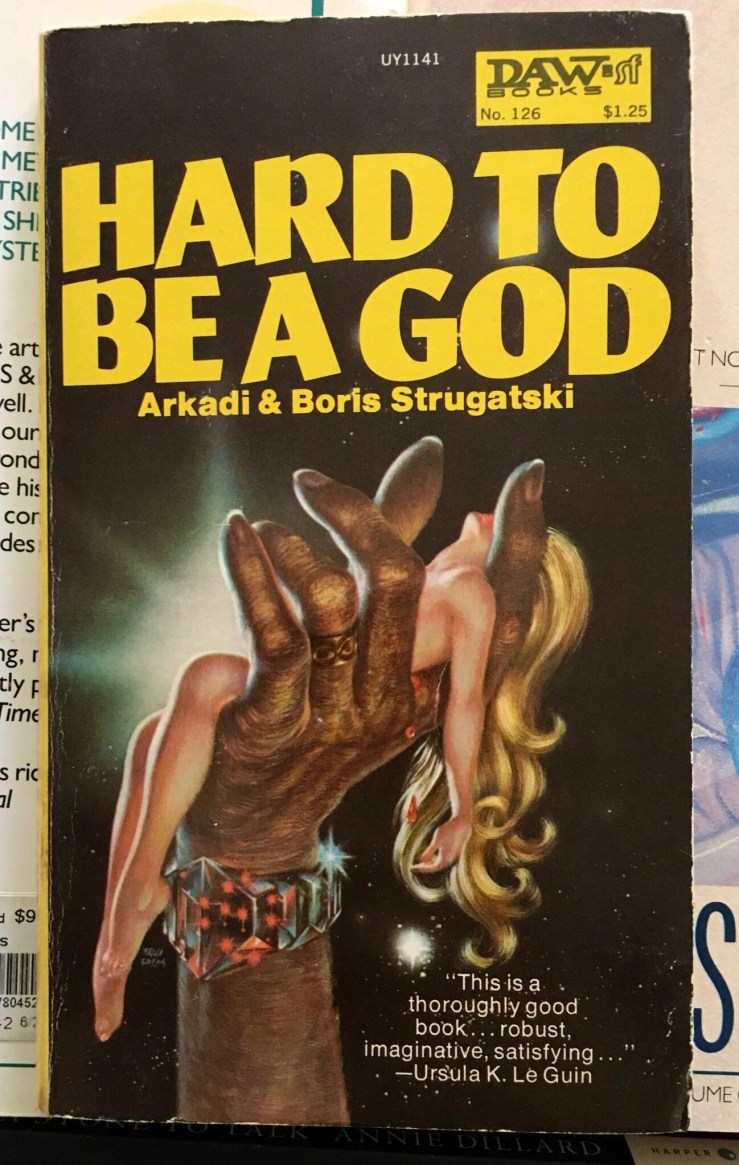
This copy of Hard to Be a God, blurbed by Ursula K. Le Guin, will end up in a stack on my shelf of massmarket paperbacks, cheap pulp editions with colorful, zany, vibrant covers. Lovely unroughed, somehow pristine copies of Philip K. Dick and Stanislaw Lem and Ishmael Reed and Ursual K. Le Guin and J.G. Ballard and etcetera that’s been building up over the years, a private collection—but another library I’m sure I’ll eventually end up giving away.
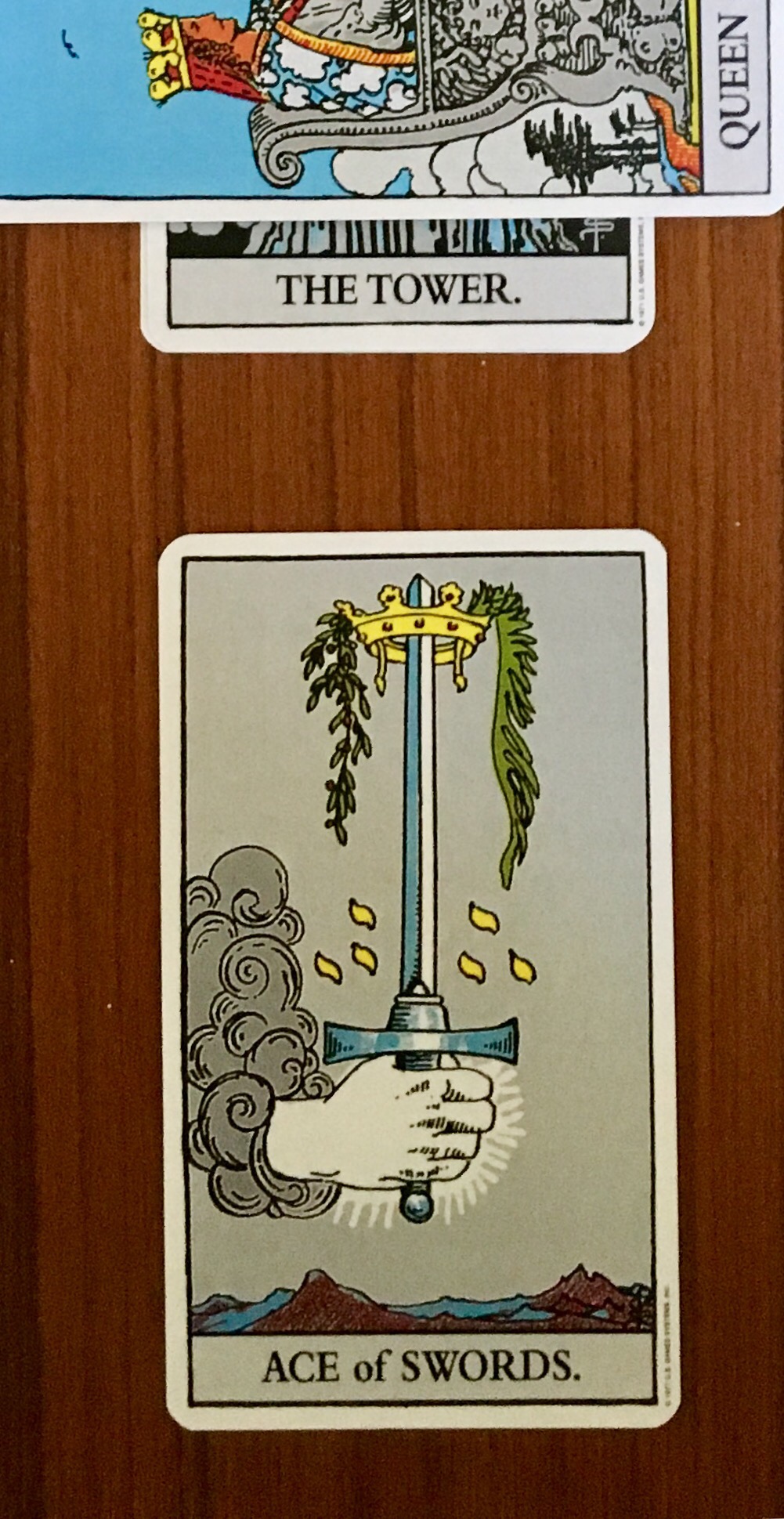
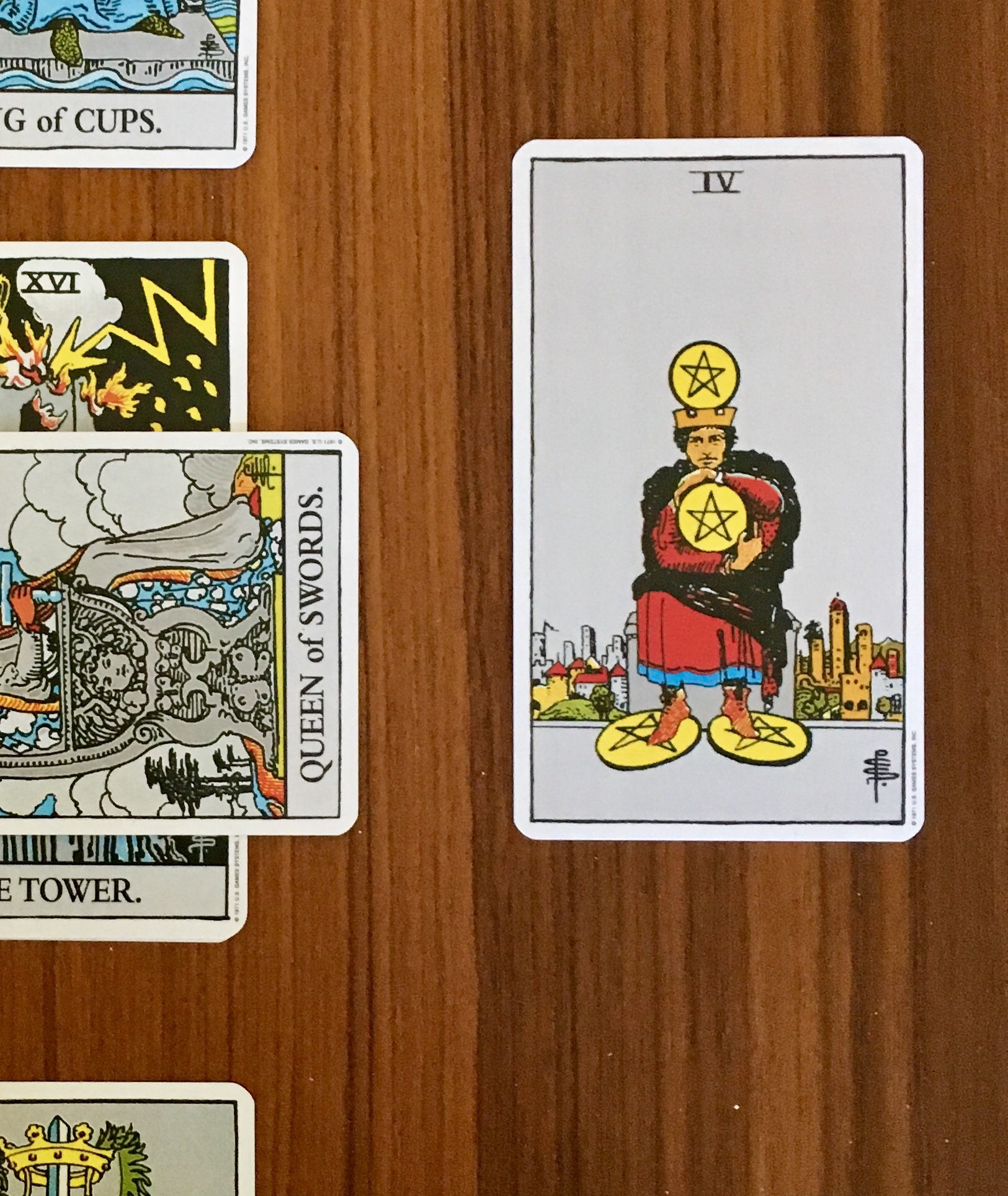
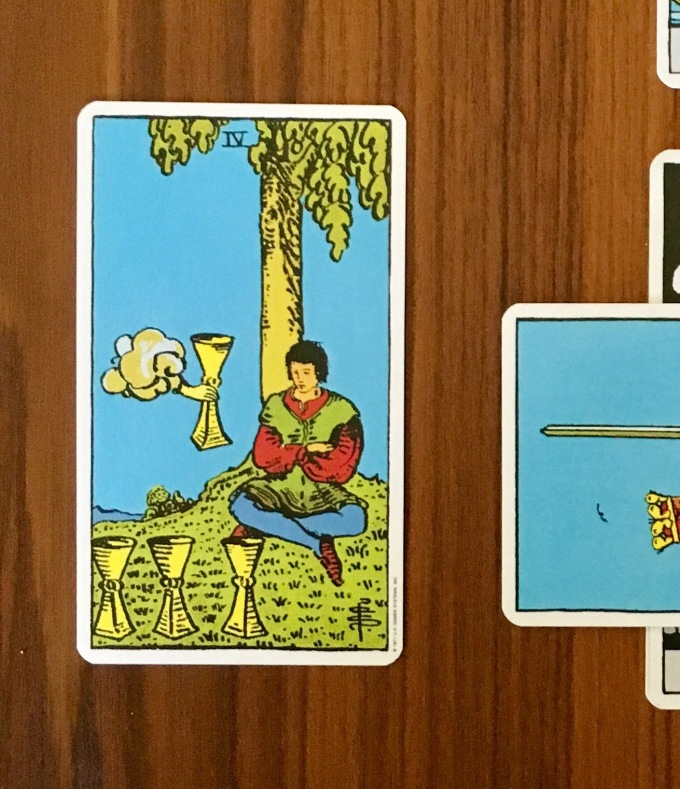
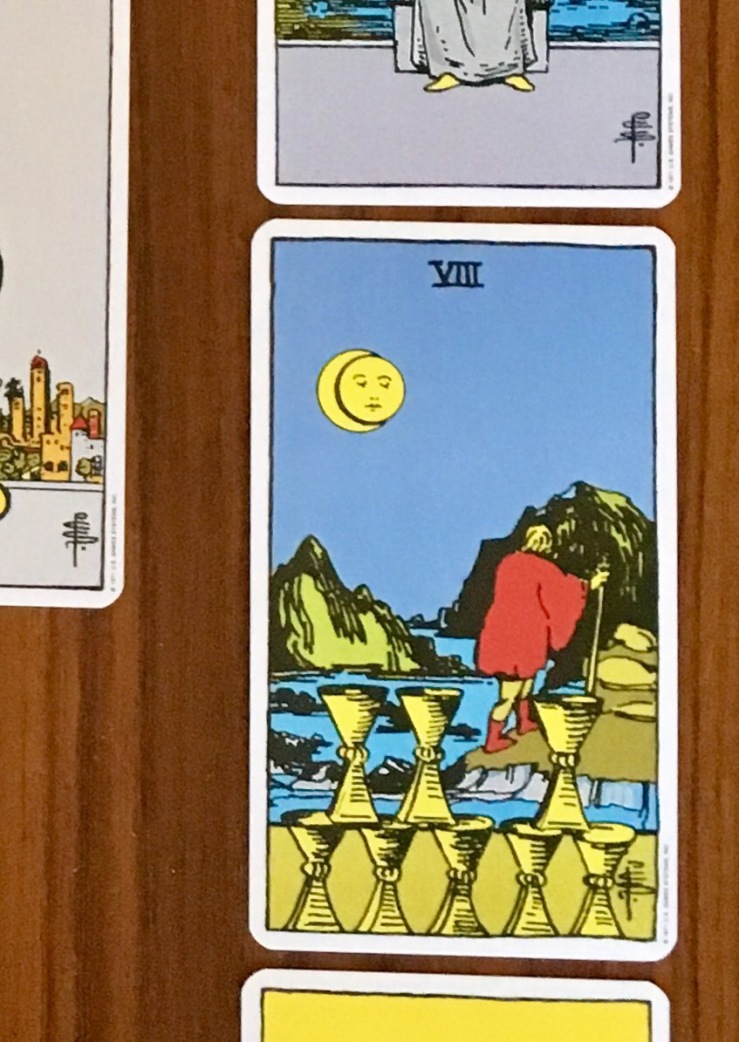
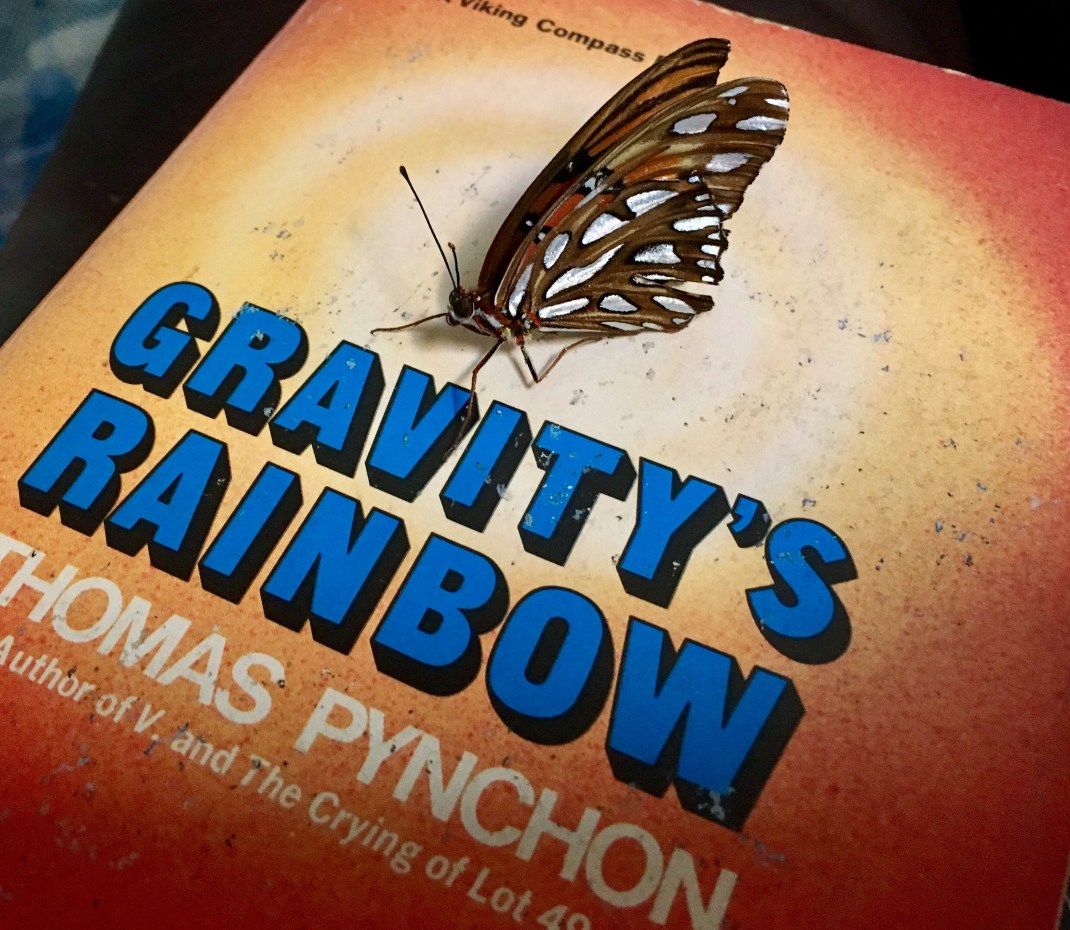
Weissmann’s Tarot is better than Slothrop’s. Here are the real cards, exactly as they came up.
Significator: Knight of Swords
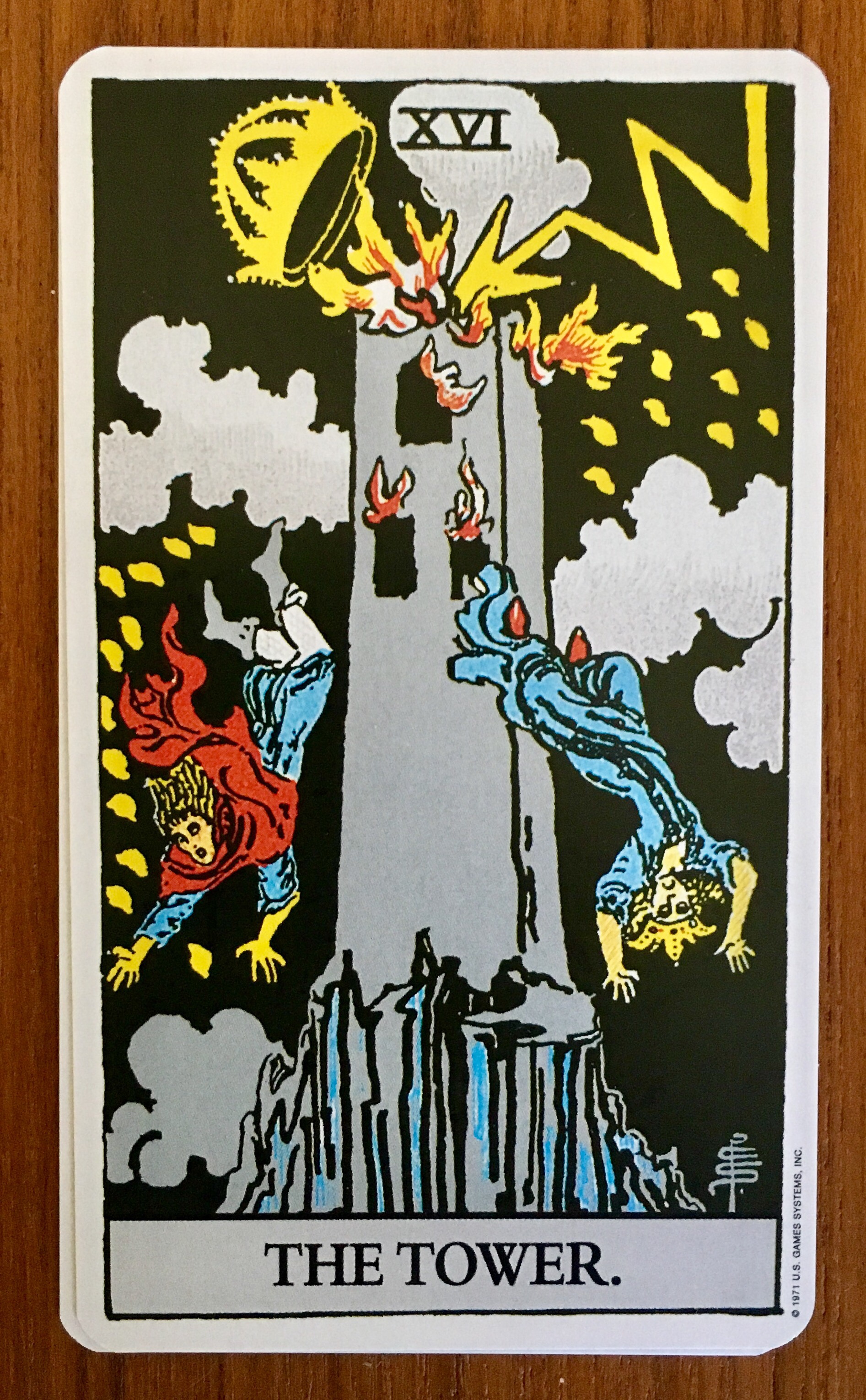
Covered by: The Tower
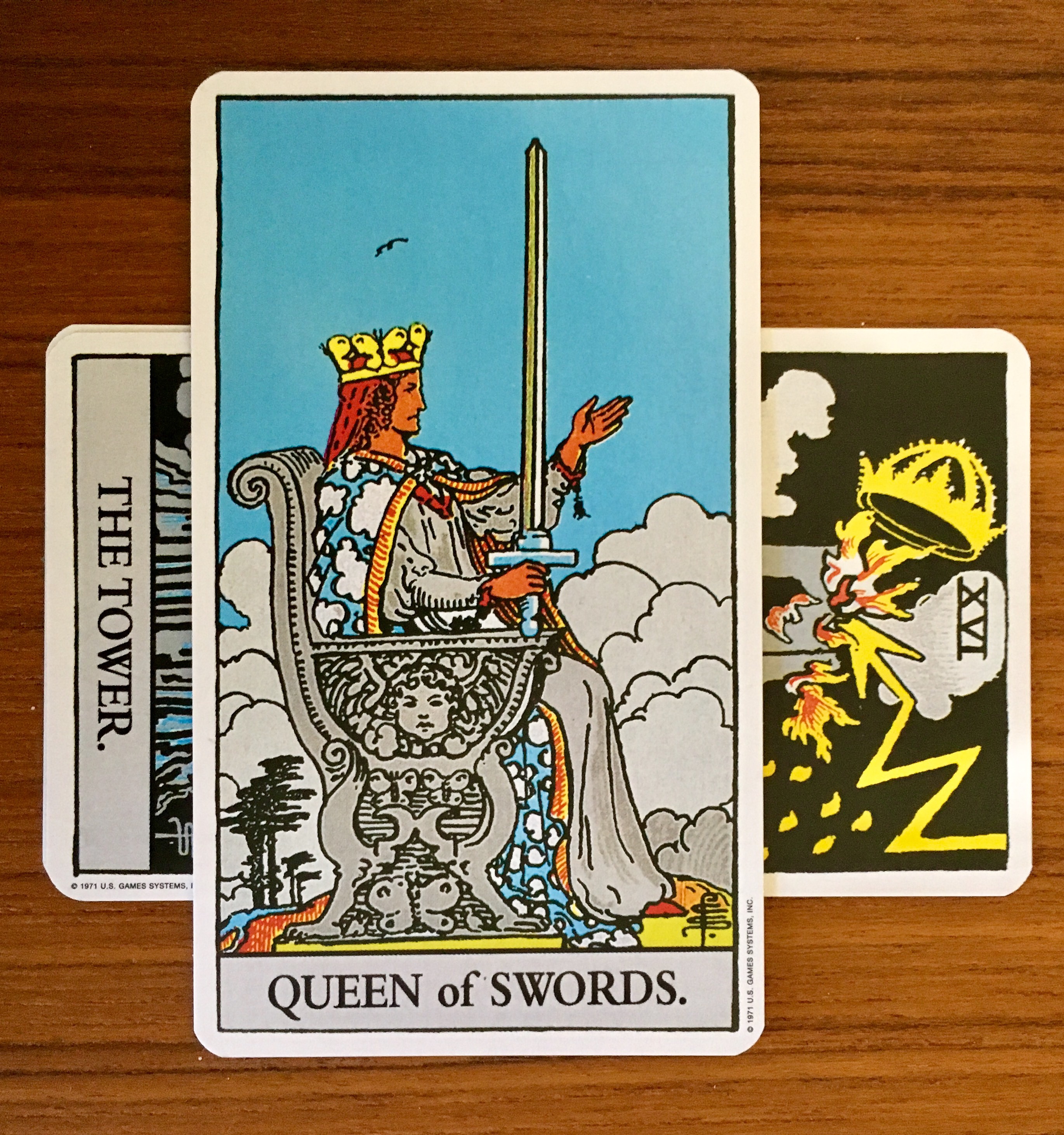
Crossed by: Queen of Swords
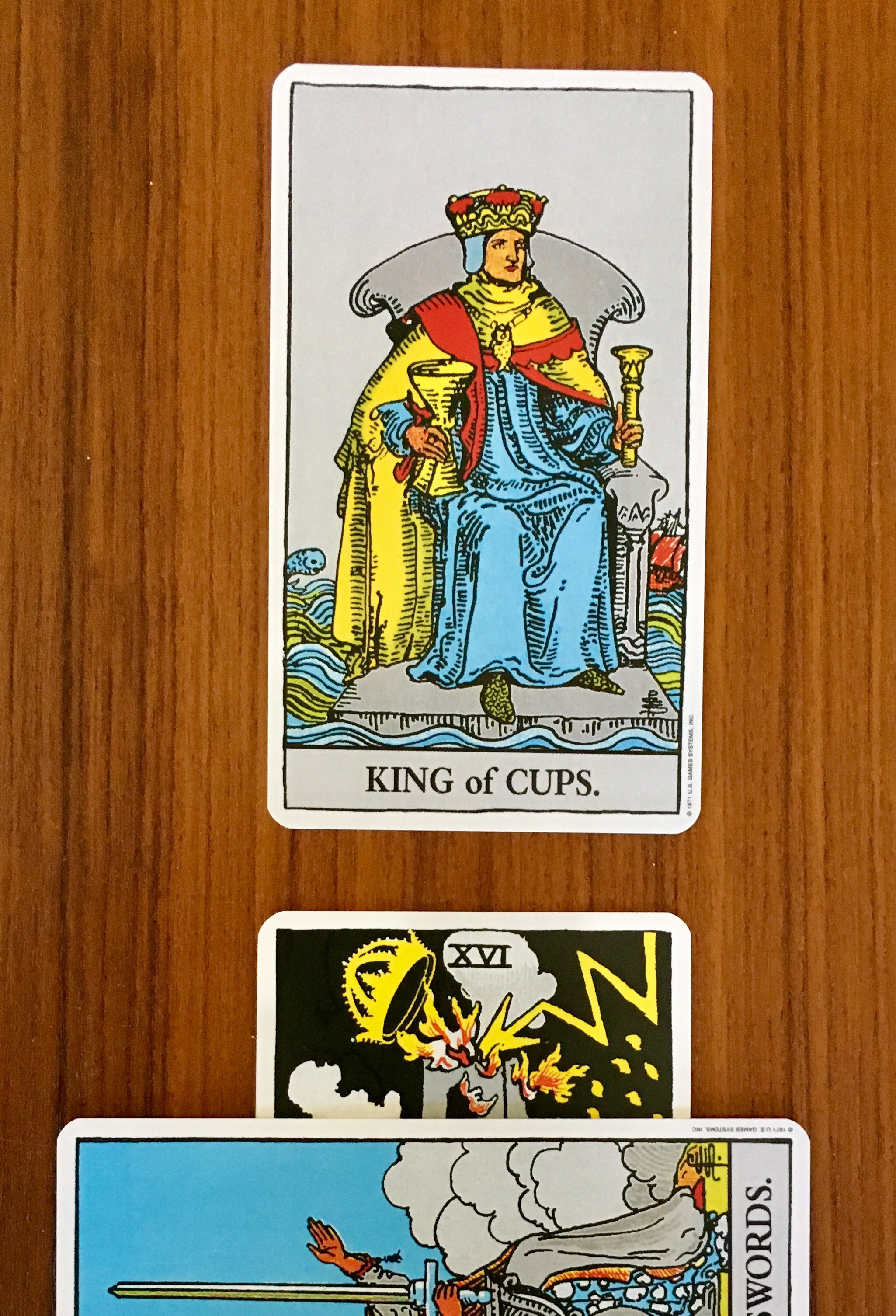
Crowning: King of Cups
Beneath: Ace of Swords
Before: 4 of Cups
Behind: 4 of Pentacles
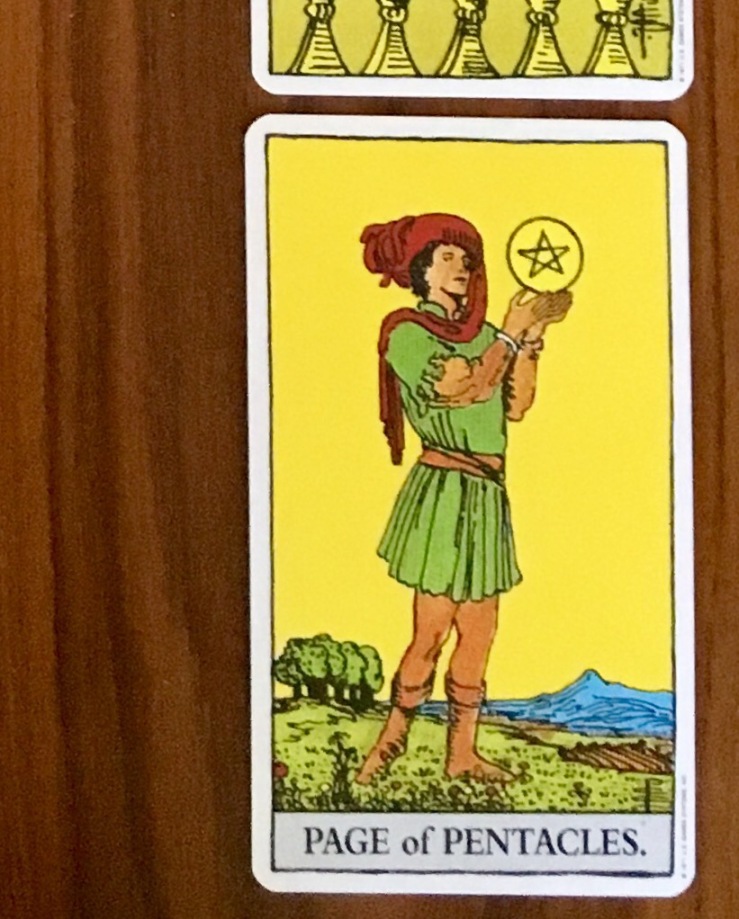
Self: Page of Pentacles
House: 8 of Cups
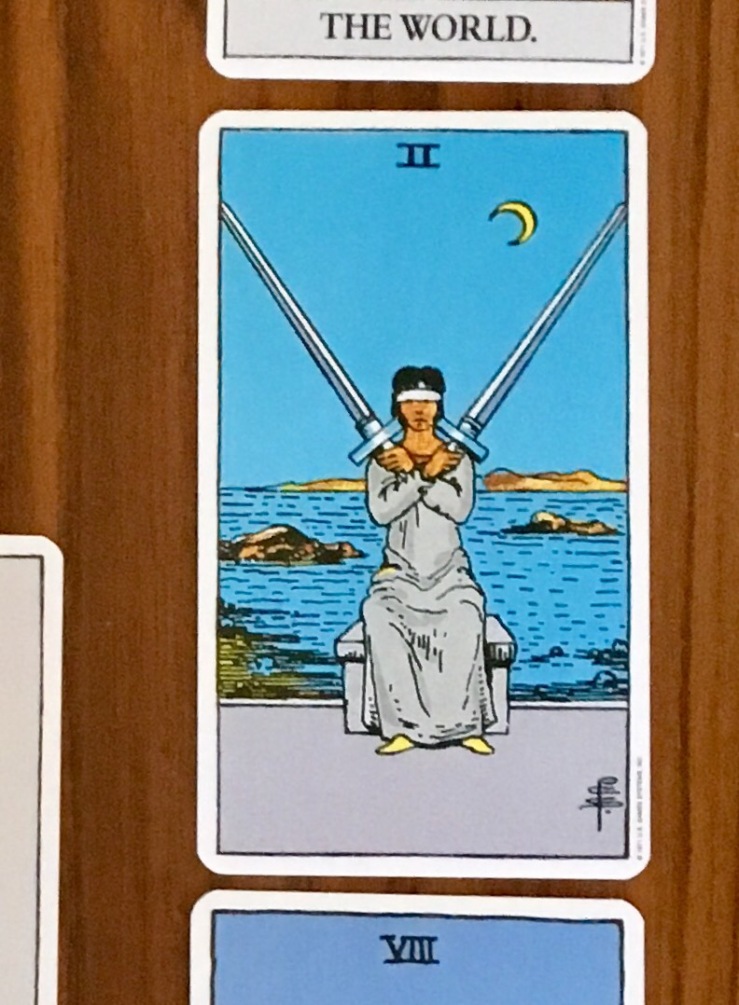
Hopes and Fears: 2 of Swords
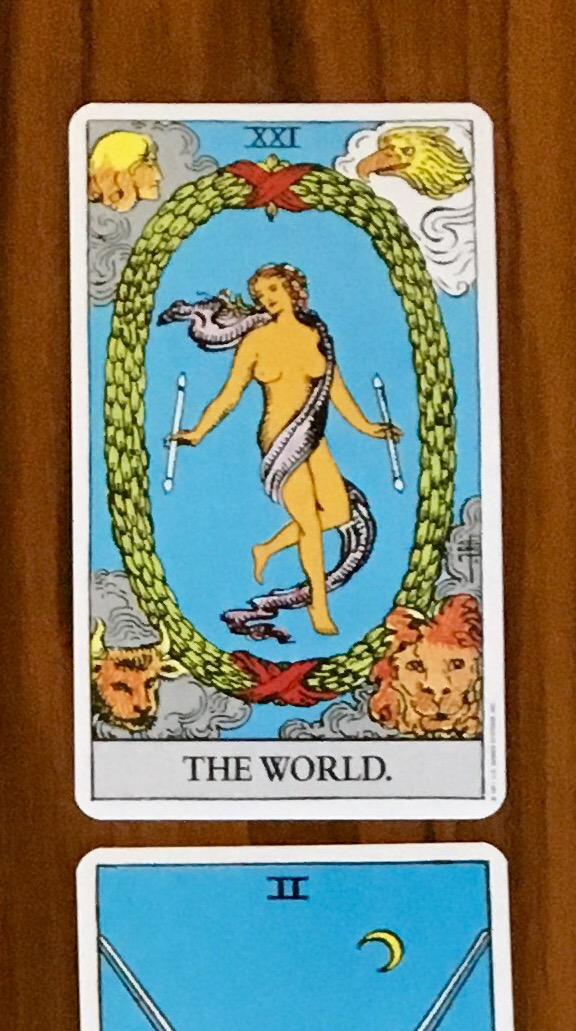
What will come: The World
From page 746 of Gravity’s Rainbow.
A diagram of the Celtic cross spread that Pynchon uses for Blicero’s tarot. From A.E. Waite’s The Pictorial Key to the Tarot (1910). The tarot cards I’ve used in this post were illustrated by Pamela Colan Smith.
He appears first with boots and insignia shining as the rider on a black horse, charging in a gallop neither he nor horse can control, across the heath over the giant grave-mounds, scattering the black-faced sheep, while dark stands of juniper move dreamily, death-loving, across his path in a parallax of unhurrying fatality, presiding as monuments do over the green and tan departure of summer, the dust-colored lowlands and at last the field-gray sea, a prairie of sea darkening to purple where the sunlight comes through, in great circles, spotlights on a dancing-floor.
He is the father you will never quite manage to kill. The Oedipal situation in the Zone these days is terrible. There is no dignity. The mothers have been masculinized to old worn moneybags of no sexual interest to anyone, and yet here are their sons, still trapped inside inertias of lust that are 40 years out of date. The fathers have no power today and never did, but because 40 years ago we could not kill them, we are condemned now to the same passivity, the same masochist fantasies they cherished in secret, and worse, we are condemned in our weakness to impersonate men of power our own infant children must hate, and wish to usurp the place of, and fail… . So generation after generation of men in love with pain and passivity serve out their time in the Zone, silent, redolent of faded sperm, terrified of dying, desperately addicted to the comforts others sell them, however useless, ugly or shallow, willing to have life defined for them by men whose only talent is for death.
Of 77 cards that could have come up, Weissmann is “covered,” that is his present condition is set forth, by The Tower. It is a puzzling card, and everybody has a different story on it. It shows a bolt of lightning striking a tall phallic structure, and two figures, one wearing a crown, falling from it. Some read ejaculation, and leave it at that. Others see a Gnostic or Cathar symbol for the Church of Rome, and this is generalized to mean any System which cannot tolerate heresy: a system which, by its nature, must sooner or later fall. We know by now that it is also the Rocket.
Members of the Order of the Golden Dawn believe The Tower represents victory over splendor, and avenging force. As Goebbels, beyond all his professional verbalizing, believed in the Rocket as an avenger.
On the Kabbalist Tree of Life, the path of The Tower connects the sephira Netzach, victory, with Hod, glory or splendor. Hence the Golden Dawn interpretation. Netzach is fiery and emotional, Hod is watery and logical. On the body of God, these two Sephiroth are the thighs, the pillars of the Temple, resolving together in Yesod, the sex and excretory organs.
But each of the Sephiroth is also haunted by its proper demons or Qlippoth. Netzach by the Ghorab Tzerek, the Ravens of Death, and Hod by the Samael, the Poison of God. No one has asked the demons at either level, but there may be just the wee vulnerability here to a sensation of falling, the kind of very steep and out-of-scale fall we find in dreams, a falling more through space than among objects. Though the different Qlippoth can only work each his own sort of evil, activity on the path of The Tower, from Netzach to Hod, seems to’ve resulted in the emergence of a new kind of demon (what, a dialectical Tarot? Yes indeedyfoax! A-and if you don’t think there are Marxist-Leninist magicians around, well you better think again!). The Ravens of Death have now tasted of the Poison of God… but in doses small enough not to sicken but to bring on, like the Amanita muscaria, a very peculiar state of mind… . They have no official name, but they are the Rocket’s guardian demons.
Weissmann is crossed by the Queen of his suit. Perhaps himself, in drag. She is the chief obstacle in his way.
At his foundation is the single sword flaming inside the crown: again, Netzach, victory. In the American deck this card has come down to us as the ace of spades, which is a bit more sinister: you know the silence that falls on the room when it comes up, whatever the game.
Behind him, moving out of his life as an influence, is the 4 or Four of Pentacles, which shows a figure of modest property desperately clutching on to what he owns, four gold coins—this feeb is holding two of them down with his feet, balancing another on his head and holding the fourth tightly against his stomach, which is ulcerous. It is the stationary witch trying to hold her candy house against the host of nibblers out there in the dark.
Moving in, before him, comes a feast of cups, a satiety. Lotta booze and broads for Weissmann coming soon.
Good for him—although in his house he is seen walking away, renouncing eight stacked gold chalices. Perhaps he is to be given only what he must walk away from.
Perhaps it is because in the lees of the night’s last cup is the bitter presence of a woman sitting by a rocky shore, the Two of Swords, alone at the Baltic edge, blindfolded in the moonlight, holding the two blades crossed upon her breasts… the meaning is usually taken as “concord in a state of arms,” a good enough description of the Zone nowadays, and it describes his deepest hopes, or fears.
Himself, as the World sees him: the scholarly young Page of Pentacles, meditating on his magic gold talisman. The Page may also be used to stand for a young girl. But Pentacles describe people of very dark complexion, and so the card almost certainly is Enzian as a young man. And Weissmann may at last, in this limited pasteboard way, have become what he first loved.
The King of Cups, crowning his hopes, is the fair intellectual-king.
If you’re wondering where he’s gone, look among the successful academics, the Presidential advisers, the token intellectuals who sit on boards of directors. He is almost certainly there. Look high, not low.
His future card, the card of what will come, is The World.
The papers of Gass seemed immaculate, each box like a freshly dug pool. By comparison, the papers of Whitman and Woolf and David Foster Wallace are filled with scraps and sheets that bear the odor from yesterday’s hands. I had already done my due diligence with The Reader, weeks of close reading and margin scribbling through its nine hundred pages; I had read a good portion of the secondary scholarship; and now here was a chance to sight some of Gass’s unresolved thoughts written overleaf.
I began by casually picking over the correspondence—incoming letters and postcards and telegrams. In the sixties, following the publication of his first novel, Omensetter’s Luck, there was Susan Sontag dishing up high praise (and slyly complimenting herself in the same stroke), Robert Silvers at The New York Review of Books begging again and again for another tipple of his prose (remarkable considering how remote the Midwestern Gass was from the flame of literary New York), and Stanley Elkin prodding “Bill” to leave Indiana for an open philosophy professorship in Saint Louis (the job he would ultimately hold for the rest of his working life). There was also a small scrap of torn notebook paper, a request for an out-of-print edition of a book by Gass—a subtle sort of fan letter written tenderly by a twenty-three-year-old man, now a sexagenarian who presides over the books section of a major American publication. Gass’s silence, the lack of corresponding responses in the archive, was odd, like a refrigerator that stops humming one afternoon. Gass, the ever-voluble (the—how to avoid it—ever-gassy), is a quiet center in the letters, a silhouette whose contours are limned only in the words of others.
I extracted box 66 from a cart and dipped into the late late juvenilia—college essays and his 1954 philosophy dissertation at Cornell—waxen pages that amounted to an incidental encyclopedia of fields, concepts, and fascinations that held sway over Gass’s writing for the next sixty years. The subject of the dissertation, “A Philosophical Investigation of Metaphor,” was importantly not a grad-school penance but the idée fixe that Gass fitted on mantels and stashed under rugs and cushions of every story and essay. For Gass, the ultimate metaphor was the relationship between the world and written language. Just as chairs could be moved around a house, words could be arrayed and rearranged in the syntactic space of a sentence—untold combinations of selfsame units, accommodating varieties of mood and meaning.
Gass suggested that literary language, specifically, required an additional metaphor. Proustian prose had a more exalted status than the demotic word-stuff on the back of soup cans. It was not made of chairs; it was conscious. In a riff on Cartesian dualism, Gass argued that a book was a body and a literary text was a conscious mind. When great writers fashioned a world of words, they supplanted the consciousness of the reader with another one, a self-sustaining construction of rich sound and sense, a new mind “musiked deep with feeling.” This conceit, the book as a “container of consciousness,” was a metaphor—Gass wasn’t a paranoid animist—but nonetheless it was a metaphor underwritten by what Gass believed was a genuine ontological shift. From soup can to Proust, words were transmogrified into literature.
…Lord is an abject and surreal tale of madness. Madness is perhaps not the correct term, although it does point towards Lord’s gothic and abject modes. Perhaps it’s more accurate to say that in Lord, Noll gives us a consciousness dissolving and reconstituting itself, a first-person voice shifting from one reality to the next with absurdly picaresque energy.
Ishmael Reed’s 1974 novel The Last Days of Louisiana Red is a sharp, zany satire of US culture at the end of the twentieth century. The novel, Reed’s fourth, is a sequel of sorts to Mumbo Jumbo (1972), and features that earlier novel’s protagonist, the Neo-HooDoo ghost detective Papa LaBas.
In Mumbo Jumbo, Reed gave us the story of an uptight secret society, the Wallflower Order, and their attempt to root out and eradicate “Jes’ Grew,” a psychic virus that spreads freedom and takes its form in arts like jazz and the jitterbug. The Last Days of Louisiana Red also employs a psychic virus to drive its plot, although this transmission is far deadlier. “Louisiana Red” is a poisonous mental disease that afflicts black people in the Americas, causing them to fall into a neo-slave mentality in which they act like “Crabs in the Barrel…Each crab trying to keep the other from reaching the top.”
…enduring, patient love is unusual in Taking Care, where friendships splinter, marriages fail, and children realize their parents’ vices and frailties might be their true inheritance. These are stories of domestic doom and incipient madness, alcoholism and lost pets. There’s humor here, but the humor is ice dry, and never applied as even a palliative to the central sadness of Taking Care. Williams’ humor is something closer to cosmic absurdity, a recognition of the ambiguity at the core of being human, of not knowing. It’s the humor of two girls eating chips on a beach, unable to decide if the people they are gazing at are drowning or just having a good time.
Octavia Butler’s 1993 novel Parable of the Sower imagines what a radical affirmation of life might look like set against a backdrop of impending extinction. Set between 2024 and 2027, Parable of the Sower conjures a crumbling America. Hyperinflation abounds, infrastructure is falling apart, water is scarce, environmental collapse is imminent, and the social institutions that bind the nation have all but frayed.
Not much happens in Jon McNaught’s latest graphic novel Kingdom. A mother takes her son and daughter to Kingdom Fields Holiday Park, a vacation lodge on the British coast. There, they watch television, go to a run-down museum, play on the beach, walk the hills, and visit an old aunt. Then they go home. There is no climactic event, no terrible trial to endure. There is no crisis, no trauma. And yet it’s clear that the holiday in Kingdom Fields will remain forever with the children, embedded into their consciousness as a series of strange aesthetic impressions. Not much happens in Kingdom, but what does happen feels vital and real.
“Life, friends, is boring,” the poet John Berryman wrote in his fourteenth Dream Song, before quickly appending, “We must not say so / After all, the sky flashes, the great sea yearns.” In Kingdom, McNaught creates a world of flashing sky and yearning sea, natural splendor populated by birds and bats, mice and moths. In Kingdom Fields, waves crash in gorgeous dark blues, the sun rises in golden pinks, rain teems down in violet swirls, and the wind breezes through meadows of grass. It’s all very gorgeous, and the trio of main characters spend quite a bit of the novel ignoring it. The narrator of John Berryman’s fourteenth Dream Song understood the transcendental promise of nature’s majesty, yet also understood that “the mountain or sea or sky” alone are not enough for humans—that we are of nature and yet apart from it.
Promised wombat:
The Invalid – Cheyne Walk 1869, 2017 by Walton Ford (b. 1960)
I was skeptical about Marlon James’s new novel Black Leopard, Red Wolf when it came out earlier this year in hardback. The novel had plenty of buzz and a big blurb from Neil Gaiman on the back—two things that often turn me off. I was also a bit skeptical about some of the novel’s marketing hype. James referred to his novel as an “African Game of Thrones,” and a lot of folks ranwith that tag. James has since professed in an interview that this comparison was a joke.
Just look at that! Amazon stats for big publisher/big buzz books tend to be suspiciously positive, but here I saw a sign of something that intrigued me—a book that a lot of people either loved or hated. And some of those one-star reviews?
Filled with gratuitous and rampant cursing, sexuality, violence and brutality. Too much even for fans of dark fantasy. I could not finish it.
…Confusing, nasty, all-over-the-place, just plain LOST. Sorry, but this needs a particular kind of person to stomach or understand.
…If you don’t mind being confused and unsure of the direction of a story, this book is for you. You must have patience to read this book.
…sounds like it was written by someone on hallucinogens.
I knew at this point I wouldn’t wait for the paperback.
If James’s comparing Black Leopard, Red Wolf to Game of Thrones was a joke, it’s a pretty good one, the kind of joke that could sell a lot of copies of his novel to fantasy fans who want a plot-driven tale. From the four baffling, surreal, vivid (and often lurid) chapters I’ve read so far, Black Leopard, Red Wolf isn’t really like Game of Thrones at all. There’s an opaqueness to James’s prose, a distancing effect to the language that alienates the reader in the most wonderful way. It’s all so terribly strange! Fans of plot-centric fantasy where the author explains and explicates what’s happening will likely be very quickly bothered by what James is doing here.
So far, Black Leopard, Red Wolf is first-person narrative of a man who may or may not be named Tracker, who is telling his story—or rather, many, many stories—to someone called Inquisitor (shades of One Thousand and One Nights?). These stories flow and roil into and out of each other. The minute James lets us find our bearings a bit, we’re out into new territory—one moment fighting “Omoluzu…Roof walkers” who seem to exist on a tangential plane to our own, and not long after running through a jungle of giant trees with a shapeshifting Leopard who leads us to a village of cursed children. Black Leopard, Red Wolf overflows with energy: the novel is kinetic, bright, and sharp, but also dark, eerie, and upsetting—it’s abject, puzzling, slippery. I love it so far.
The novel completely won me over on its tenth page, with this wild episode:
I kept walking until I came to an old woman by a river with a tall stick sitting at the banks. Her hair white at the sides, her head bald at the top. Her face had lines like paths in the forest and her yellow teeth meant her breath was foul. The stories say she rises each morning youthful and beautiful, blooms full and comely by midday, ages to a crone by nightfall, and dies at midnight to be born again the next hour. The hump in her back was higher than her head, but her eyes twinkled, so her mind was sharp. Fish swam right up to the point of the stick but never went beyond.
“Why have you come to this place?” she asked.
“This is the way to Monono,” I said.
“Why have you come to this place? A living man?”
“Life is love and I have no love left. Love has drained itself from me, and run to a river like this one.”
“It’s not love you have lost, but blood. I will let you pass. But when I lay with a man I live without dying for seventy moons.”
So I fucked the crone. She lay on her back by the bank, her feet in the river. She was nothing but bones and leather, but I was hard for her and full with vigor. Something was swimming between my legs that felt like fishes. Her hand touched my chest and my white clay stripes turned into waves around my heart. I thrust in and out of her, unnerved by her silence. In the dark I felt she was getting younger even though she was getting older. Flame spread inside me, spread to the tips of my fingers and the tip of me inside her. Air gathered around water, water gathered around air and I yelled, and pulled out, and rained on her belly, her arms, and her breasts. A shudder ran through me five times. She was still a crone, but I was not angry. She scooped my rain off her chest and flicked it off in the river. At once fish leapt up and dived in, leapt up again. This was a night when dark ate the moon, but the fishes had a light within them. The fishes had the head, arms, and breasts of women.
“Follow them,” she said.
I followed them through day and night, and day again. Sometimes the river was as low as my ankle. Sometimes the river was as high as my neck. Water washed all the white from my body, leaving just my face. The fish- women, womenfish, took me down the river for days and days and days until we came to a place I cannot describe. It was either a wall of river, which stood firm even though I could push my hand through it, or the river had bent itself downward and I could still walk, my feet touching the ground, my body standing without falling.
Cover art for Parable of the Sower by John Jude Palencar
Octavia Butler’s 1993 novel Parable of the Sower imagines what a radical affirmation of life might look like set against a backdrop of impending extinction. Set between 2024 and 2027, Parable of the Sower conjures a crumbling America. Hyperinflation abounds, infrastructure is falling apart, water is scarce, environmental collapse is imminent, and the social institutions that bind the nation have all but frayed.
When we first meet our narrator Lauren Olamina, she is one of the lucky few who has a life of moderate comfort, stability, and security. Lauren lives in a gated community in a sort of compound with her brothers, stepmother, and father, an academic/preacher. Lauren’s father is the ersatz leader of this community, He leads the neighborhood’s shooting practices, trains them in survival skills, and organizes a perimeter watch against the thieves and arsonists that constantly threaten their survival. He is the central role model for Lauren, who takes his lessons to heart. When the community finally fragments under an attack it can’t endure, Lauren is the only one of her family to survive. She even has the presence of mind to grab her bug-out bag.
After this initial staging of events, Parable of the Sower turns into a road novel. Lauren and two other survivors of the compound head north along the California freeways, slowly gathering followers. Lauren’s leadership drives the novel and inspires those around her. She offers her followers an alternative to the predation around them, a predation most strongly figured in the roving bands of arsonists that prey on travelers and communities alike. She offers her followers the prospect of belonging to a We—an interracial, inter-generational collective.
Lauren’s leadership capability derives from two strands. The first strand is the religion she is creating, an idea she calls “Earthseed.” The basic premise of Earthseed (one that the novel repeats ad nauseum) is that “God is Change.” Another tenet is that people are the seeds of the earth (like, uh, Earthseed—get it?). Lauren’s long-term vision is that humanity might seed a new planet. The post-WW2 dream of NASA and the futurity of exploration—a Manifest Destiny of the stars—glows in the background of Sower, and often points to a more interesting conclusion than the novel finally musters.
The second source of Lauren’s drive comes from a condition she suffers called hyperempathy or “sharing,” a mutation that’s the result of her birth-mother’s drug addiction during pregnancy. Simply put, when Lauren witnesses another person’s injury, she feels their pain. This affliction is a devastating weakness in a predatory, violent (non)society: for Lauren, self-defense entails self-harm. At the same time, Lauren’s hyperempathy is a strength—it makes her understand, at the most visceral level, the need for a community to work together in order to thrive in a world that seems to be dying.
Perhaps the greatest strength of Butler’s novel is that she shows her readers what Lauren can never quite see—namely that Lauren’s hyperempathy is a strength. Sower assumes the form of a journal, Lauren’s first-person recollections scrawled out in rare moments of respite from the terrors of the road. While her first-person perspective is generously broad (she seems to see a lot), she still never quite realizes that her hyperempathy contributes to her strength as a leader. Lauren’s hyperempathy necessitates imaginative forethought; it also entails a need to act decisively in times of crisis. And Parable of the Sower is all crisis, all the time.
Lauren’s journal style mixes the high with the low. She cribs the poetry of her Earthseed religion from the King James Version of the Bible, with often corny results. (I am pretty sure the corniness is unintentional). She’s also occasionally psychologically introspective, going through thought experiments to better understand those around her.
Despite its Earthseed flights into poetical musings and boldly-declared profundities, most of Lauren’s narrative is strangely mundane in its accounting of a slow apocalypse though. There are seemingly-endless lists of supplies to be bought or scavenged, survival chores to be checked off, and California roads to be traversed (sections of Parable of the Sower often reminded me more of the SNL recurring sketch “The Californians” than, say, Cormac McCarthy’s The Road). The bulk of Butler’s book hovers around disaster prepping, finding temporary shelter, and looting bodies, motifs that won’t seem strange to contemporary audiences reared on cable television and addicted to battle royale video games.
Lauren is 15 at the novel’s outset in 2024, yet she seems fully mature. If this was a coming-of-age novel, I missed it—Lauren, while far from perfect, is generally self-assured in her powers of decision making. At a quite literal level, she commands the narrative, propelling it forward without any of the wishy-washiness we might get from the narrator of, say, The Handmaid’s Tale. If Lauren second-guesses herself, she doesn’t bother to second-guess her second guesses. Butler seems to envision her rather as a hero-model for the coming disaster the novel anticipates. Much of Parable of the Sower reads like a checklist of What To Do After the End of Civilization.
The novel’s biggest weakness is that it can’t quite articulate just how bad things have gotten. Is this actually The End of Civilization? Butler paints a bleak picture. Drought is the new norm. Most Americans are illiterate. Work is hard to find. The roads are too dangerous to travel at night. Packs of feral dogs hunt down humans. Packs of feral children eat humans. Women live with the constant threat of rape. Overt racism is fully normalized. Company towns make a comeback, issuing scrip instead of currency, leading to indentured servitude. Water is a commodity to literally kill for, the police are essentially an organized gang, and a large portion of the population are addicted to a drug that makes setting fires better than sex. Murder is an open business, and there is no recourse to any established justice.
And at the same time that it evokes all of these apocalyptic images and themes, Butler’s novel points to tinges of normalcy—a presidential election carried out sans violence, the sense that a university system is still in play, various notations of different regulatory bodies. Parable of the Sower often reads like The Walking Dead or The Road, but then it might turn a weird corner to uncanny normalcy, where characters shop in a Walmart-like (if hyperbolized) superstore. As one character puts it,
Federal, state, and local governments still exist— in name at least— and sometimes they manage to do something more than collect taxes and send in the military. And the money is still good. That amazes me. However much more you need of it to buy anything these days, it is still accepted. That may be a hopeful sign— or perhaps it’s only more evidence of what I just said: We haven’t hit bottom yet.
Perhaps what I perceive here is simply Butler showing her narrator’s essential naivete, a naivete that doesn’t evince on the surface of the first-person narration. Lauren doesn’t know what she doesn’t know. She doesn’t fully understand how bad things have gotten because she doesn’t fully understand the potential in America that existed before her own life. But she does intuit how bad things are. Despite her intuition, she’s hopeful. This hope, and the despair that foregrounds it, evinces strongly in the final moments of the book. Lauren has finally made it to a kind of promised-land, a frontier-space where she can create a new life with a new love, a much-older man named Bankole. Bankole was a doctor in his old life, but now he’s a survivor. At the end of the novel, he mourns the American dream, the American we, and mourns that Lauren cannot mourn it with him:
He said nothing for a while. Then he stopped and put his hand on my shoulder to stop me. At first he only stood looking at me, almost studying my face. “You’re so young,” he said. “It seems almost criminal that you should be so young in these terrible times. I wish you could have known this country when it was still salvageable.”
“It might survive,” I said, “changed, but still itself.”
“No.” He drew me to his side and put one arm around me. “Human beings will survive of course. Some other countries will survive. Maybe they’ll absorb what’s left of us. Or maybe we’ll just break up into a lot of little states quarreling and fighting with each other over whatever crumbs are left. That’s almost happened now with states shutting themselves off from one another, treating state lines as national borders. As bright as you are, I don’t think you understand—I don’t think you can understand what we’ve lost. Perhaps that’s a blessing.”
Banokole’s summary of America in the late 2020s seems like a dire if hyperbolic prognostication of our current trajectory. More than a quarter century ago, Butler knew what was up. Butler also offered an answer to the problem in her mouthpiece Lauren, who replies to her (way-too-much older) lover Bankole, “We’ve got work to do.”
Parable of the Sower is not a particularly fun novel, although of course, it never intends to be. The dour tone is appropriate to its subject matter, I suppose, but that grim tone can become exhausting. The novel’s trajectory and moral vision keep it from falling into an exercise in nihilism or apocalypse porn, like, say, The Walking Dead. But like The Walking Dead, Butler’s novel often plods along. Maybe this is a rhetorical feature—maybe Butler intends her reader to feel just as weary and depressed as Lauren.
Parable of the Sower was published just a year after a superficially-similar novel, Neal Stephenson’s Snow Crash, which also presciently envisions a fragmenting America where like-groups seal themselves off from each other. In contrast though, Stephenson’s novel is zany and vibrant, a cartoon world devoid of any hyperempathy that might get in the way of anarchic fun. Over 25 years old now, many of the tropes in both Snow Crash and Parable of the Sower have so fully infiltrated our media—books and video games, films and television shows—that their initial vital strangeness is hard to detect.
The dystopian tropes of Parable of the Sower don’t feel particularly fresh in 2019, but the novel’s prescience still has an alarming bite. (Her sequel, Parable of the Talents, features a right-wing Presidential candidate who runs on the promise to “Make America great again”). Sower works best as an extended thought experiment on what might happen to society—to democracy in particular—when impending ecological collapse threatens our very existence. And Butler proposes a solution to the problems posed in her thought experiment: “We’ve got work to do.”
“We’ve got work to do” not only summarizes Parable of the Sower’s central message, it also describes current zeitgeist. Lauren would have been born in 2009; my daughter was born in 2007 and my son in 2010. She could be one of their classmates; she could be my own daughter. The novel’s vision of hyperempathy in the face of brutality and creeping fascism points back to that phrase — “We’ve got work to do” — which of course, requires a We. The we here is a radical affirmation, an echo even of the We the People that so boldly engendered a U.S. America. But Butler’s vision, conveyed through Lauren, is far more pluralistic and diverse than the We the framers evoked in the Preamble to the Constitution. Butler’s we names the namelessness of a coming society, a society that seems impossible and yet is possible, its possibility instantiated in the simple proof that it can be imagined. Parable of the Sower ultimately points toward the seeds of that imagining.
Unless we are willing to accept our artists as they are, the answer to the question, “Who speaks for America today?” will have to be: the advertising agencies. They are entirely capable of showing us our unparalleled prosperity and our almost classless society, and no one has ever accused them of not being affirmative. Where the artist is still trusted, he will not be looked to for assurance. Those who believe that art proceeds from a healthy, and not from a diseased, faculty of the mind will take what he shows them as a revelation, not of what we ought to be but of what we are at a given time and under given circumstances; that is, as a limited revelation but revelation nevertheless.
From Flannery O’Connor’s essay “The Fiction Writer and His Country,” collected in Mystery and Manners.
Here’s the section on “The Inedible,” which includes notes on two of my favorite scenes from Gravity’s Rainbow—–
The Inedible
“A lot of people who think they’re cooks but are clinically deluded,” says a mess hall manager in Vineland. Pynchon includes a lot of their misguided creations in his books, relishing the gross and inedible—the places where “even [the] Jell-O salads have scum on them.”
Maybe the most memorable example is the “English Candy Drill,” in which a parade of disgusting sweets are sampled, unwillingly, by Tyrone Slothrop, the protagonist (sorta) in Gravity’s Rainbow: rhubarb creams, cherry-quinine petit fours, eucalyptus-flavored fondant, and pepsin-flavored nougat, licorice drops with a “dribbling liquid center, which tastes like mayonnaise and orange peels” and “a hard sour gooseberry shell into a wet spurting unpleasantness of, he hopes it’s tapioca, little glutinous chunks of something all saturated with powdered cloves.”
Gravity’s Rainbow includes another scene that’s hard to stomach: As a culinary prank, Bodine and Roger hold a dinner party with an intentionally revolting menu: “snot soup,” “sum soufflé,” “vomit vichyssoise” and “wart waffles.” Needless to say, “A general loss of appetite reigns, not to mention overt nausea.”
It’s a fun article, like I said, but there are a few things missing. It notes Against the Day’scult of mayonnaise but leaves out all the ketchup (ketjap) stuff in Mason & Dixon, as well as Mason & Dixon’s important core distinction between Grape People and Grain People:
“If this is as bad as it gets, why I can abide thah’. As long as the Spirits don’t run out.”
“Nor the Wine.”
“Wine.” Dixon is now the one squinting. Mason wonders what he’s done this time. ” ‘Grape or Grain, but ne’er the Twain,’ as me Great- Uncle George observ’d to me more than once,— ‘Vine with Corn, beware the Morn.’ Of the two sorts of drinking Folk this implies, than’ is, Grape People and Grain People, You will now inform rne of Your membership in the Brotherhood of the, eeh, Grape…? and that You seldom, if ever, touch Ale or Spirits, am I correct?”
“Happily so, I should imagine, as, given a finite Supply, there’d be more for each of us, it’s like Jack Sprat, isn’t it.”
“Oh, I’ll drink Wine if I must…?— and now we’re enter’d upon the Topick,— ”
“— and as we are in Portsmouth, after all,— there cannot lie too distant some Room where each of us may consult what former Vegetation pleases him?”
Dixon looks outside at the ebbing wintry sunlight. “Nor too early, I guess…?”
“We’re sailing to the Indies,— Heaven knows what’s available on Board, or out there. It may be our last chance for civiliz’d Drink.”
“Sooner we start, the better, in thah’ case…?”
Again, a fun article—but what other food bits are missing? (We can leave the coprophagia and urolagnia in Gravity’s Rainbow out, though).
What you felt stirring across the land… it was the equinox… green spring equal nights… canyons are opening up, at the bottoms are steaming fumaroles, steaming the tropical life there like greens in a pot, rank, dope-perfume, a hood of smell… human consciousness, that poor cripple, that deformed and doomed thing, is about to be born. This is the World just before men. Too violently pitched alive in constant flow ever to be seen by men directly. They are meant only to look at it dead, in still strata, transputrefied to oil or coal. Alive, it was a threat: it was Titans, was an overpeaking of life so clangorous and mad, such a green corona about Earth’s body that some spoiler had to be brought in before it blew the Creation apart. So we, the crippled keepers, were sent out to multiply, to have dominion. God’s spoilers. Us. Counterrevolutionaries. It is our mission to promote death. The way we kill, the way we die, being unique among the Creatures. It was something we had to work on, historically and personally. To build from scratch up to its present status as reaction, nearly as strong as life, holding down the green uprising. But only nearly as strong.
Only nearly, because of the defection rate. A few keep going over to the Titans every day, in their striving subcreation (how can flesh tumble and flow so, and never be any less beautiful?), into the rests of the folksong Death (empty stone rooms), out, and through, and down under the net, down down to the uprising.
In harsh-edged echo, Titans stir far below. They are all the presences we are not supposed to be seeing—wind gods, hilltop gods, sunset gods—that we train ourselves away from to keep from looking further even though enough of us do, leave Their electric voices behind in the twilight at the edge of the town and move into the constantly parted cloak of our nightwalk till
Suddenly, Pan—leaping—its face too beautiful to bear, beautiful Serpent, its coils in rainbow lashings in the sky—into the sure bones of fright—
Don’t walk home at night through the empty country. Don’t go into the forest when the light is too low, even too late. Don’t go into the forest when the light is too low, even too late in the afternoon—it will get you. Don’t sit by the tree like this, with your cheek against the bark.
From Thomas Pynchon’s Gravity’s Rainbow, pages 720-21.
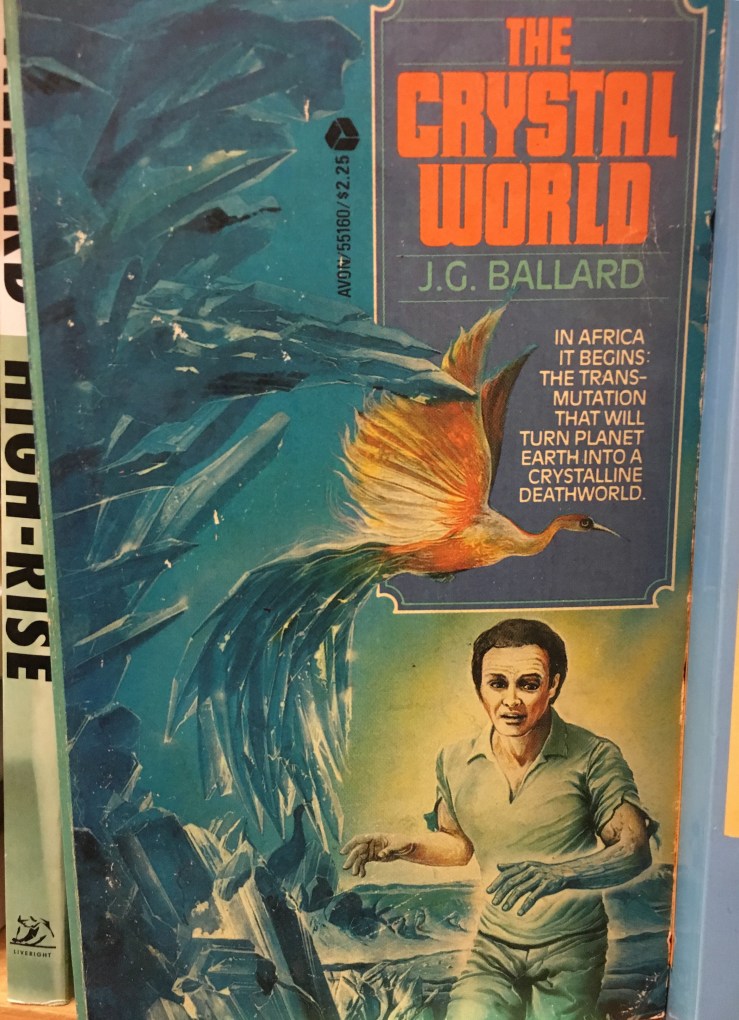
On Friday, I went to my trusty local used bookstore to look, once again, for a copy of Octavia Butler’s novel Parable of the Sower. They had four new copies, all of Grand Central Publishing’s 2000 edition, the cover of which is frankly awful. I know I shouldn’t be so shallow, but…I’ll end up checking out the ebook from my library I guess. I like sci-fi books to look like sci-fi books, not like bland approximations of “literary fiction.” I like sci-fi covers like this edition of J.G. Ballard’s novel The Crystal World which I took a pic of in the shop (I already have a mass market paperback copy of the Ballard and couldn’t bring myself to get another one)—
I unexpectedly picked up Anne Hébert’s novel Kamouraska. I’d heard P.T. Smith drop Hébert’s name a couple of times on Twitter, and she sounds interesting. (He wrote about Kamouraska here). The movie tie-in cover is awful, but for two bucks what the hell.
I also finally found another copy of Alasdair Gray’s novel Lanark. I’ve been wanting to re-read Gray’s novel ever since I first read it five years ago. I lent my copy of the novel to someone who never gave it back. One of Gray’s illustrations for Lanark—
The previous week, I got two weird ones in the mail, Anthony Howell’s Consciousness (with Mutilation) and 99 Practical Methods of Utilizing Boiled Beef, an 1893 cookbook reprinted by Cow Eye Press as a kind of in-joke on indie publishing.
Originally published in 1893 as a cookbook for the American housewife, 99 Practical Methods of Utilizing Boiled Beef: With a new Preface from the Publisher has been revised, adapted, and reissued as a new work of fiction celebrating the principles of independent publishing.
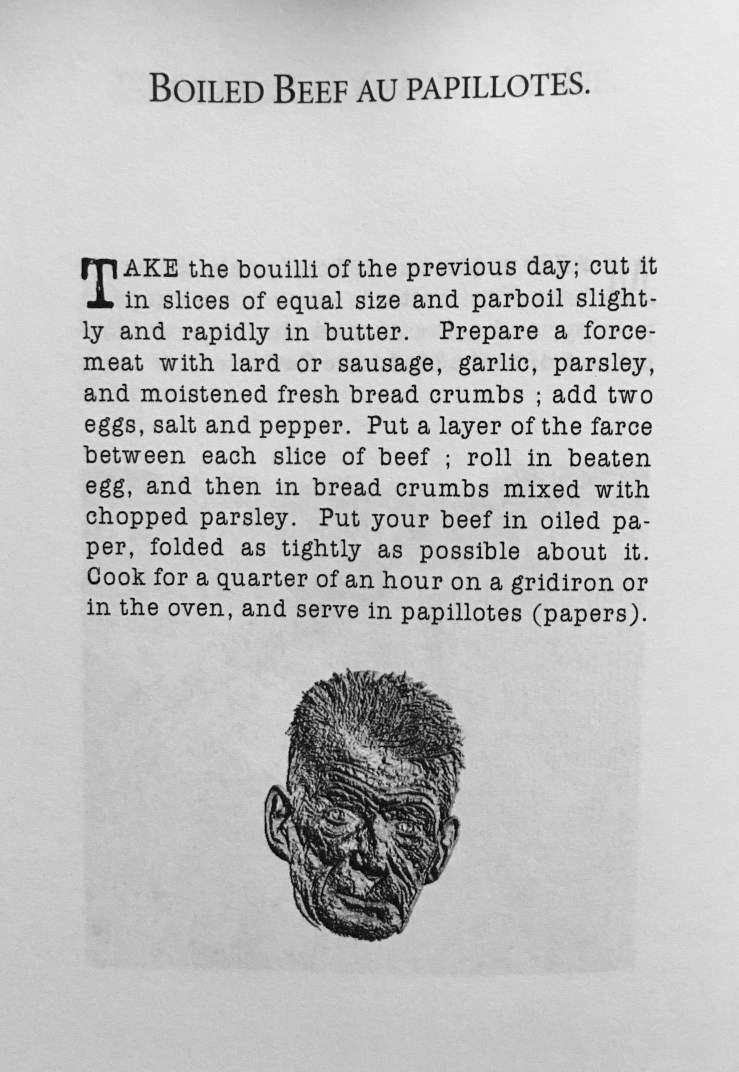
The original 99 Practical Methods was by a pseudonymous author named “Babet,” and purported to be translated from the French by one “A.R.” After reading publisher Natalie Zeldner’s preface and the “New Preface from the Intern,” I wasn’t quite sure that Babet’s original book ever existed. It turns out it does exist, but the prefaces by Zeldner and the (now-supposedly-ex-)intern point to the project as something closer to an aburdist joke about publishing than a recipe book. There are recipes here, though—100 of them, actually—like this one:
Cow Eye’s edition includes pictures, like this one of Samuel Beckett, with each recipe, that are often little oblique jokes, I guess. The edition does not include King Henry the Fourth’s Recipe for Stewed Chicken, which is included in the 1893 edition.
In her preface, publisher Zeldner laments that,
All anyone cares about anymore, it seems, is boiled beef. Boiled beef with the satisfying plot arc. Boiled beef with a light dash of novelty. Boiled beef prepared by celebrity chefs. Boiled beef with a titillating message and eminently discoverable hashtag.
So here you go, my friends: here’s your boiled beef.
Indeed.
Poet Anthony Howell’sConsciousness is another strange one. It actually includes another narrative in it, a novella by Mamdouh Adwan called Mutilation. In an author’s note, Howell points to Burroughs’ Naked Lunch as his work’s predecessor, and the collage technique has led me quite randomly through the book. Here’s Howell’s blurb:
Consciousness (with Mutilation) is a non-fiction novel. Every sentence that begins any paragraph within it also serves as the concluding sentence of another paragraph. The trigger for the text is an epileptic seizure the author experienced in April 2018. This event prompted an investigation of the meaning of continuity in individuals, families and states. Could we have been somebody else yesterday, or become somebody else tomorrow? Consciousness annexes a Syrian novella – Mutilation – within its pages; a novella by Mamdouh Adwan, first published in Damascus in 1971. Reading this book is to be drawn into whirlpools, perhaps to drown. It is self-analysis, but, since the author’s lineage is both Jewish and Quaker, it evolves into an analysis of Zionism, of which Howell’s grandfather was a proponent, and of the role of the British in the Middle East. Having experienced sudden lapses of consciousness, the author senses that “life is not a river. Life is a collage.” This book takes The Naked Lunch by William Burroughs and Jealousy by Alain Robbe-Grillet for its literary forbears. In the way of ancient tragedy, the dilemma of the individual becomes the dilemma of the state, in this case Israel, and the author carries the reader into a world of smoke and mirrors, sustained by collage mediated through its formal constraint.
The Cow Eye Press people may wish to know that there is some small mention of cows in Consciousness, including the theft of an Arnesby Brown painting.
“The Incredible and Sad Tale of Innocent Eréndira and Her Heartless Grandmother”
by
Gabriel García Márquez
translation by
Gregory Rabassa
Erendira was bathing her grandmother when the wind of her misfortune began to blow. The enormous mansion of moon like concrete lost in the solitude of the desert trembled down to its foundations with the first attack. But Erendira and her grandmother were used to the risks of the wild nature there, and in the bathroom decorated with a series of peacocks and childish mosaics of Roman baths they scarcely paid any attention to the caliber of the wind.
The grandmother, naked and huge in the marble tub, looked like a handsome white whale. The granddaughter had just turned fourteen and was languid, soft-boned, and too meek for her age. With a parsimony that had something like sacred rigor about it, she was bathing her grandmother with water in which purifying herbs and aromatic leaves had been boiled, the latter clinging to the succulent back, the flowing metal-colored hair, and the powerful shoulders which were so mercilessly tattooed as to put sailors to shame.
“Last night I dreamt I was expecting a letter,” the grandmother said.
Erendira, who never spoke except when it was unavoidable, asked:
“What day was it in the dream?”
“Thursday.”
“Then it was a letter with bad news,” Erendira said, “but it will never arrive.”
When she had finished bathing her grandmother, she took her to her bedroom. The grandmother was so fat that she could only walk by leaning on her granddaughter’s shoulder or on a staff that looked like a bishop’s crosier, but even during her most difficult efforts the power of an antiquated grandeur was evident. In the bedroom, which had been furnished with an excessive and somewhat demented taste, like the whole house, Erendira needed two more hours to get her grandmother ready. She untangled her hair strand by strand, perfumed and combed it, put an equatorially flowered dress on her, put talcum powder on her face, bright red lipstick on her mouth, rouge on her cheeks, musk on her eyelids, and mother-of-pearl polish on her nails, and when she had her decked out like a larger than life-size doll, she led her to an artificial garden with suffocating flowers that were like the ones on the dress, seated her in a large chair that had the foundation and the pedigree of a throne, and left her listening to elusive records on a phonograph that had a speaker like a megaphone. Continue reading ““The Incredible and Sad Tale of Innocent Eréndira and Her Heartless Grandmother” — Gabriel García Márquez”→
There’s an interesting review of Roberto Bolaño’s posthumous novel The Spirit of Science Fiction in the The New Yorker The review’s author, editor and translator Valerie Miles, read Bolaño’s novel through/against the work of the American Beats—William S. Burroughs and Jack Kerouac, specifically. From Miles’ review:
From 2008 to 2014, during the charged emergence of Bolaño in translation, I worked behind the scenes with the writer’s estate, reading through roughly fourteen thousand six hundred papers in his archive and helping to prepare his posthumous work. Bolaño, it should be said, saved everything. His archive includes notebooks, diaries, letters, magazines, war games, postcards, photos, typescripts, newspaper clippings, and an extensive library. (“I even found one of those paper napkins from a bar in Mexico,” his widow, Carolina López, has said, at a press conference.) The wealth of material makes it easy to locate Bolaño’s fixations at a given time, and much of my efforts involved establishing a chronology of when his work was written—a chronology that became a central part of the first exhibition dedicated to his papers, which I curated together with the Centre de Cultura Contemporània de Barcelona, in 2013.
That chronology also shed light on just how much “The Spirit of Science Fiction” was informed by poetry, and specifically by Bolaño’s reading of the Beats. In 1978, around the time Bolaño first began writing fiction in earnest, he wrote in his diary, “I write verses, dream of a novel.” During that time, he read William S. Burroughs daily and often commented on the writer’s work. (Burroughs was the “ice shard that would never melt,” he writes in his essay collection “Between Parentheses,” “the eye that never closes.”) In an early version of “The Spirit of Science Fiction,” Burroughs was the contact person for the young Chileans. Bolaño was also influenced by Burroughs’s approach to structure; he was fascinated by “Naked Lunch” and by the collage-like experimentation of “Nova Express.” He even borrowed some of Burroughs’s methods, riffing on Burroughs’s “cut-up” technique in his own verse.
He was a blonde. He lay in the bed, tossing turning. his room. What was that odor? The pungent odor of middle-class perfume making the air misty. He didn’t feel right. His hair. What on earth was the matter with his hair? It was long and was covering the pillow. The pillows? They had a flower print and were pink. Pink? He rose in his bed and his breasts jiggled. BREASTS? THE BREASTS?? He looked back into the mirror next to the bed and his mouth made a black hollow hole of horror. “O MY GOD. MY GOD.” He was a woman. You know what he said next, don’t you, reader? He’s from New York and so . . . you guessed it! “Kafka. Pure Kafka,” he said. A feeling crept over him. Tingly. What could he do? He felt like screaming, but he couldn’t scream. Was that someone coming coming down the hall? He ran and jumped back into the bed, pulled the covers up to his neck and pretended to be asleep.
From Ishmael Reed’s 1974 novel The Last Days of Louisiana Red.