Blog about Denis Johnson’s story “The Largesse of the Sea Maiden”

img_0381

I finished reading Denis Johnson’s posthumous collection of short stories The Largesse of the Sea Maiden a few weeks ago. I felt a bit stunned by the time I got to the fourth story in the collection, “Triumph Over the Grave,” which ends with these words: “It’s plain to you that at the time I wrote this, I’m not dead. But maybe by the time you read it.”

Denis Johnson died just over a year ago, of course, a fact that haunts any reading of Sea Maiden (at least for fans, and I am a fan). The collection was released just half a year after his death, and I managed to avoid reading any reviews of it. I held out on picking it up for reasons I don’t really know how to explain, but I when I finally read it, I consumed it in a greedy rush.

Anyway, since I finished the book I’ve tried a few times to put together a “review,” but each time I get some words down I find myself sprawling out all over the place, rereading bits of the stories, picking out new motifs, new questions, new parallels between Johnson’s life and the lives of his narrators. Very short review: The Largesse of the Sea Maiden is one of Johnson’s best books, a perfect gift to his readers—his own tragicomic obituary in fictional form. It’s a book about death and writing and art and commerce and regret and salvation, and each time I go back to it I find more in there than I saw the first time–more order, more threads, more design. So instead of a full long review, I’ll offer instead a series of blogs about each of the five stories in the collection. (Perhaps this form is simply an excuse to reread The Largesse of the Sea Maiden).

The first story is the title track, “The Largesse of the Sea Maiden.” First published in The New Yorker back in 2014, this long short story (it runs to not-quite 40 pages) introduces the major themes and tones of the entire collection. “Largesse” is told by a first-person narrator in ten titled vignettes. Some of the titles, like “Widow,” “Orphan,” “Farewell,” and “Memorial,” directly name the themes of both the story and the book.

The narrator of “The Largesse of the Sea Maiden” is a writer—but not a writer of literature or fiction—of art—but of commercials. Although “Largesse” shows him somewhat comfortable in his life in San Diego with his third wife, the narrator nevertheless is melancholy, even dour at times. In the beginning of the vignette “Ad Man,” he declares:

This morning I was assailed by such sadness at the velocity of life—the distance I’ve traveled from my own youth, the persistence of the old regrets, the new regrets, the ability of failure to freshen itself in novel forms—that I almost crashed the car.

(Is there a subtle nod there to one of Johnson’s most well-known stories, “Car-Crash While Hitchhiking”? I think so. If not, I find a thread).

“Ad Man” initiates the major plot trajectory of “Largesse”: Our narrator has won an award for an advertisement he wrote and directed decades ago, and he will have to return to New York City to be given the award at a special dinner. Floating through the vignettes is the ad man’s anxiety about his own legacy of work against the backdrop of the finer arts. We learn in “Accomplices” that he cares enough about the arts to object that his host has hung a Mardsen Hartley oil landscape above a lit fireplace—but he doesn’t prevent the man from burning the painting—his “property”—in a moment where Johnson subtly critiques the relationship between art and commerce. The narrator turns the burning of the painting into a new art though—storytelling.

The narrator later tells us that “looking at art for an hour or so always changes the way I see things afterward,” and “Largesse” is riddled with encounters with art and artists, like the outsider painter Tony Fido, whom the narrator meets at a gallery. The artist offers, unprompted, a scathing critique of a Edward Hopper’s painting Gas:

“You’re a painter yourself.”

“A better painter than this guy,” he said of Edward Hopper.

“Well, whose work would you say is any good?”

“The only painter I admire is God. He’s my biggest influence.”

That attribution — “he said of Edward Hopper” — is a lovely example of Johnson’s sharply-controlled wit.

Tony Fido plays a major minor role in “Largesse.” Fido tells the narrator the story of his encounter with a widow—one of several widows in both “Largesse” and Largesse, and his own suicide—Fido’s—becomes a strange moment for the narrator to realize how little he actually knows about his friend. And of course, all of these plot points give Johnson a chance to riff on the themes of death, loss and regret.

“Largesse” is loaded with thoughts on regret and forgiveness. Talking with a friend, the narrator muses that “we wandered into a discussion of the difference between repentance and regret. You repent the things you’ve done, and regret the chances you let get away.” The vignette “Farewell” stages a chance for the narrator to repent his past sins; his ex-wife, dying of cancer, calls him up to (possibly) forgive him:

In the middle of this I began wondering, most uncomfortably, in fact with a dizzy, sweating anxiety, if I’d made a mistake—if this wasn’t my first wife Ginny, no, but rather my second wife, Jennifer, often called Jenny. Because of the weakness of her voice and my own humming shock at the news, also the situation around her as she tried to speak to me on this very important occasion—folks coming and going, and the sounds of a respirator, I supposed—now, fifteen minutes into this call, I couldn’t remember if she’d actually said her name when I picked up the phone and I suddenly didn’t know which set of crimes I was regretting, wasn’t sure if this dying farewell clobbering me to my knees in true repentance beside the kitchen table was Virginia’s, or Jennifer’s.

I’ve quoted at such length because the moment is an example of Johnson’s tragicomic genius—a sick punchline that disconnects crime from punishment and punishment from forgiveness. The narrator ends up making the connections himself in the end: “after all, both sets of crimes had been the same.” And yet Johnson keeps pushing his character past reconciliation into a midnight walk to clear his conscience:

I wonder if you’re like me, if you collect and squirrel away in your soul certain odd moments when the Mystery winks at you, when you walk in your bathrobe and tasseled loafers, for instance, well out of your neighborhood and among a lot of closed shops, and you approach your very faint reflection in a window with words above it. The sign said “Sky and Celery.”

Closer, it read “Ski and Cyclery.”

“Farewell” ends on this note of a winking Mystery—on the profound insight that we are always susceptible to misreading the signs in front of us.

“The Largesse of the Sea Maiden” is very much a story about trying to put together a cohesive narrative from the strands and fragments around us. Indeed, its very form points to this—the fractured vignettes have to be pieced together by the reader. Johnson fractures not just form but tone. The deadpan, tragicomic, pathos-laden humor that’s run throughout Johnson’s oeuvre dominates in “Largesse,” yes, but there are strange eruptions of sentimental fantasy, particularly in “Mermaid,” a vignette that reads like the narrator’s own imaginative construction, and not the (often banal) reality that most of the narrative is grounded in. After receiving his award in New York, the narrator makes his way to a bar, and here conjures a scene like something from a film noir:

I couldn’t see the musician at all. In front of the piano a big tenor saxophone rested upright on a stand. With no one around to play it, it seemed like just another of the personalities here: the invisible pianist, the disenchanted old bartender, the big glamorous blonde, the shipwrecked, solitary saxophone…And the man who’d walked here through the snow…And as soon as the name of the song popped into my head I thought I heard a voice say, “Her name is Maria Elena.” The scene had a moonlit, black-and-white quality. Ten feet away at her table the blond woman waited, her shoulders back, her face raised. She lifted one hand and beckoned me with her fingers. She was weeping. The lines of her tears sparkled on her cheeks. “I am a prisoner here,” she said. I took the chair across from her and watched her cry. I sat upright, one hand on the table’s surface and the other around my drink. I felt the ecstasy of a dancer, but I kept still.”

The ecstasy here—internalized and “still”—is the ecstasy of storytelling, imagination, art. This is the gift of the mermaid, the largesse of the sea maiden. The minor moment is the real award for our ad man hero, who finds no real transcendence in commercial writing.

I’ve been using “the narrator” in this riff, but our hero has a name, which he reveals to us in the final vignette, “Whit.” It’s here that he describes the ad he’s (not exactly) famous for, an “animated 30-second spot [where] you see a brown bear chasing a gray rabbit.” The chase ends when the rabbit gives the bear a dollar bill.” Narrator Whit explains that this ad for a bank “referred, really, to nothing at all, and yet it was actually very moving.” He goes on:

I think it pointed to orderly financial exchange as the basis of harmony. Money tames the beast. Money is peace. Money is civilization. The end of the story is money.

And yet our ad man, despite his commercial interpretation of his own writing, recognizes too that this work “was better than cryptic—mysterious, untranslatable.” The word “untranslatable” is one of several clues that link the final section of “Largesse” to the final section of Walt Whitman’s long poem, Song of Myself. Whitman’s narrator (“Walt Whitman, a kosmos”) claims that he is, like the spotted hawk who swoops to disturb his reverie, “untranslatable.” Bequeathing himself to us—a gift for our good graces—he reminds us that “You will hardly know who I am,” a line that Johnson echoes in the beginning of “Whit”: “My name would mean nothing to you, but there’s a very good chance you’re familiar with my work.” And then of course, there’s the big tell—Johnson’s narrator is Bill Whitman, a pun that works on several levels. Walt Whitman’s language has seeped into the language of advertising—in a way it is the genesis of a new commercial American idiom—and here Johnson slyly pushes it back into the realm of art.

Just as the conclusion of Song of Myself builds to a self-penned elegy for its self-subject, “The Largesse of the Sea Maiden” reads like Johnson’s elegy for an alter-ego. We learn in the final paragraphs that Bill Whitman is “just shy of sixty-three” — roughly the same age as Johnson would’ve been when the story was published. (We learn that the narrator of “Doppelgänger, Poltergeist,” the final story in The Largesse of the Sea Maiden, is also the same age as Johnson. That narrator was born on “July 20, 1949.” Johnson’s birthday was July 1, 1949).

Narrator Whit reflects on his life in the story’s melancholy penultimate paragraph:

I note that I’ve lived longer in the past, now, than I can expect to live in the future. I have more to remember than I have to look forward to. Memory fades, not much of the past stays, and I wouldn’t mind forgetting a lot more of it.

However, there’s still a restlessness to his spirit, a questing desire to answer the final lines of Song of Myself, perhaps, where Whitman writes:

Failing to fetch me at first keep encouraged,
Missing me one place search another,
I stop somewhere waiting for you

The last paragraph of “The Largesse of the Sea Maiden” is Johnson’s narrator’s implicit response to these lines, and as I cannot improve upon his prose, they will be my last lines as well:

Once in a while, I lie there as the television runs, and I read something wild and ancient from one of several collections of folktales I own. Apples that summon sea maidens, eggs that fulfill any wish, and pears that make people grow long noses that fall off again. Then sometimes I get up and don my robe and go out into our quiet neighborhood looking for a magic thread, a magic sword, a magic horse.

Riff on finishing Middlemarch, George Eliot’s novel of consciousness

Screenshot 2018-06-12 at 8.35.14 PM
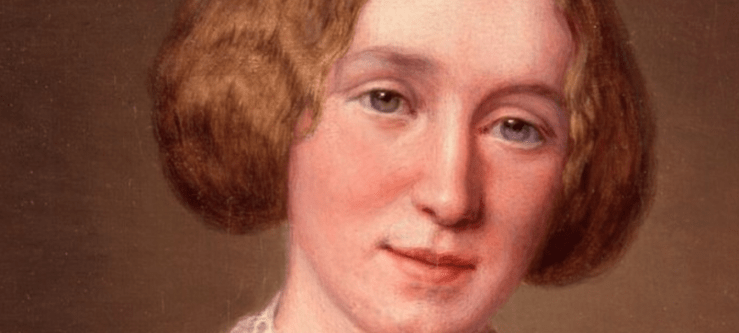
Detail of a portrait of Mary Ann Evans (George Eliot) at age 30 by François d’Albert Durade (1804–1886)

I finally finished George Eliot’s long and marvelous 1872 novel Middlemarch.

When I wrote about reading Middlemarch last month, from not-quite-the-middle of the book, I lamented that I’d rather be rereading the book than reading it. Rich and dense, it’s the kind of big book that clearly offers more on repeat readings. And yes, I will reread Middlemarch, but I’ll give it a year or three to mellow in the back of my consciousness.

Middlemarch is a novel about consciousness, and what the novel does best in my estimation is show how different kinds of consciousness mediate and are mediated by the social forces they inhabit (and are inhabited by).

(The word consciousness appears 90 times in Middlemarch. If we include similar iterations, like consciousconsciouslyunconscious, and unconsciously, the count grows to a total of 172 times. In contrast, iterations of the word conscience appear only 38 times).

Dorothea Brooke remained my favorite consciousness throughout the novel, and I missed her when she wasn’t there, when Eliot had us hovering around or even fully inhabiting another consciousness.

I’ll admit that in the final quarter of Middlemarch I found myself a bit weary of the Bulstrode disgrace plot—and yet I appreciate how Eliot inhabited that consciousness as well. Bulstrode provides Eliot a sharp tool to show how consciousness is blind, or even self-blinding—how consciousness massages conscience in order to survive. In a passage that illustrates this process, Eliot writes,

Bulstrode shrank from a direct lie with an intensity disproportionate to the number of his more indirect misdeeds. But many of these misdeeds were like the subtle muscular movements which are not taken account of in the consciousness, though they bring about the end that we fix our mind on and desire. And it is only what we are vividly conscious of that we can vividly imagine to be seen by Omniscience.

Consciousness cannot lay claim to conceiving of an absolute omniscient conscience, an absolute and ever-present moral consciousness. Too, earlier in the novel, Eliot’s narrator observes,

For the egoism which enters into our theories does not affect their sincerity; rather, the more our egoism is satisfied, the more robust is our belief.

Egoism is a central problem in Middlemarch; indeed, Eliot seems to posit egoism as the greatest threat to how individual consciousnesses navigate social reality. Here is here narrator again:

Will not a tiny speck very close to our vision blot out the glory of the world, and leave only a margin by which we see the blot? I know no speck so troublesome as self.

I cannot improve upon “no speck so troublesome as self” and will not adventure an attempt.

But back to the consciousness I liked best in Middlemarch: Dorothea.

Dorothea is a kind of genius of intention, and Eliot harnesses that genius—she shows us Dorothea’s consciousness-in-action. Eliot doesn’t just tell us what’s happening in Dorothea’s head; she makes that consciousness live in our own heads.

Dorothea’s life, like all lives, is beset with foiled plans and terrible mistakes. Still, Middlemarch grants Dorothea something of a happy ending in her marriage to Will Ladislaw, and yet refuses the conclusion of a classical comedy. There is no wedding scene. Indeed, the last time Dorothea speaks in the novel it is to reconcile with her sister Celia—a conclusion that confirms their love story the equal to that of Dorothea and Ladislaw’s love story.

Eliot’s novel is too sophisticated and too realistic for a simplistic happy or tragic conclusion, of course. In the novel’s “Finale,” the narrator reminds us that,

Every limit is a beginning as well as an ending…the fragment of a life, however typical, is not the sample of an even web.

The narrator then gives us broad details of the fates of the novel’s principal couples: Lydgate and Rosamond, skewing depressive; Mary and Fred, skewing comic; and finally Ladislaw and Dorothea. We learn of Ladislaw’s success as a reform politician and understand that Dorothea is an instrumental force in this success.

Eliot’s conclusion for this final pair skews neither comic nor tragic, but is something more complex—more realistic. Dorothea becomes a cautionary tale in the town of Middlemarch; her legacy is one of misspent potential in the eyes of society. The novel ends without indicating that any of the grand plans of Dorothea’s youth have been achieved. And yet the novel concludes with an oblique revelation about Dorothea’s misunderstood legacy.

In the second-to-final paragraph of Middlemarch, Eliot writes that,

those determining acts of [Dorothea’s] life were not ideally beautiful. They were the mixed result of young and noble impulse struggling amidst the conditions of an imperfect social state, in which great feelings will often take the aspect of error, and great faith the aspect of illusion. For there is no creature whose inward being is so strong that it is not greatly determined by what lies outside it.

Eliot refuses a simple happy ending here; her heroine is still a consciousness subject to the social forces around it. Dorothea’s great utopian ambitions are ultimately tempered by the cultural constraints her consciousness would otherwise seek to transcend.

But then the final paragraph of the novel points towards transcendence:

Her finely touched spirit had still its fine issues, though they were not widely visible. … But the effect of her being on those around her was incalculably diffusive: for the growing good of the world is partly dependent on unhistoric acts; and that things are not so ill with you and me as they might have been, is half owing to the number who lived faithfully a hidden life, and rest in unvisited tombs.

Dorothea—and, more significantly, the spirit of Dorothea—did real grand good in the world, an immeasurable good, “incalculably diffusive.” Even if she lived ultimately a “hidden life,” Eliot insists that it is people like Dorothea who have made the world better for “you and me.”

While “hidden life” and “unvisited tombs” may harbor negative connotations, these phrases are ultimately ironic: Eliot’s novel itself is the key to the hidden life of Dorothea Brooke. Middlemarch is a vivid and vivifying tomb for Dorothea, and we readers are the lucky visitors.

Roberto Bolaño’s novel The Spirit of Science Fiction will debut in English translation in 2019

Roberto Bolaño’s novel The Spirit of Science Fiction will be published in English translation next year. The translation is by Natasha Wimmer (who translated 2666 and The Savage Detectives, among other Bolaño works). Bolaño began The Spirit of Science Fiction in 1984 but apparently never finished it. The novel was first published in 2016 by the Spanish publishing house Alfaguara. Based on the blurb, The Spirit of Science Fiction sounds like a prototype for The Savage Detectives (much as Woes of the True Policeman is a prototype of 2666).

Here is the blurb from the publisher, Penguin Random House—

This schedule in effect July 5th, 1922

In Chapter 4 of F. Scott Fitzgerald’s The Great Gatsby, narrator Nick Carraway recounts the names of the rich, shallow, parasitic guests who attended Gatsby’s parties. Nick tells us the list comes from “an old time-table” of names he originally recorded in July 5th—significantly, the day after Independence Day: the day after the hopes and dreams of a new country. From the chapter—-

Once I wrote down on the empty spaces of a time-table the names of those who came to Gatsby’s house that summer. It is an old time-table now, disintegrating at its folds, and headed “This schedule in effect July 5th, 1922.” But I can still read the gray names, and they will give you a better impression than my generalities of those who accepted Gatsby’s hospitality and paid him the subtle tribute of knowing nothing whatever about him.

From East Egg, then, came the Chester Beckers and the Leeches, and a man named Bunsen, whom I knew at Yale, and Doctor Webster Civet, who was drowned last summer up in Maine. And the Hornbeams and the Willie Voltaires, and a whole clan named Blackbuck, who always gathered in a corner and flipped up their noses like goats at whosoever came near. And the Ismays and the Chrysties (or rather Hubert Auerbach and Mr. Chrystie’s wife), and Edgar Beaver, whose hair, they say, turned cotton-white one winter afternoon for no good reason at all.

Clarence Endive was from East Egg, as I remember. He came only once, in white knickerbockers, and had a fight with a bum named Etty in the garden. From farther out on the Island came the Cheadles and the O. R. P. Schraeders, and the Stonewall Jackson Abrams of Georgia, and the Fishguards and the Ripley Snells. Snell was there three days before he went to the penitentiary, so drunk out on the gravel drive that Mrs. Ulysses Swett’s automobile ran over his right hand. The Dancies came, too, and S. B. Whitebait, who was well over sixty, and Maurice A. Flink, and the Hammerheads, and Beluga the tobacco importer, and Beluga’s girls.

From West Egg came the Poles and the Mulreadys and Cecil Roebuck and Cecil Schoen and Gulick the state senator and Newton Orchid, who controlled Films Par Excellence, and Eckhaust and Clyde Cohen and Don S. Schwartze (the son) and Arthur McCarty, all connected with the movies in one way or another. And the Catlips and the Bembergs and G. Earl Muldoon, brother to that Muldoon who afterward strangled his wife. Da Fontano the promoter came there, and Ed Legros and James B. (“Rot-Gut.”) Ferret and the De Jongs and Ernest Lilly — they came to gamble, and when Ferret wandered into the garden it meant he was cleaned out and Associated Traction would have to fluctuate profitably next day.

A man named Klipspringer was there so often and so long that he became known as “the boarder.”— I doubt if he had any other home. Of theatrical people there were Gus Waize and Horace O’donavan and Lester Meyer and George Duckweed and Francis Bull. Also from New York were the Chromes and the Backhyssons and the Dennickers and Russel Betty and the Corrigans and the Kellehers and the Dewars and the Scullys and S. W. Belcher and the Smirkes and the young Quinns, divorced now, and Henry L. Palmetto, who killed himself by jumping in front of a subway train in Times Square.

Benny McClenahan arrived always with four girls. They were never quite the same ones in physical person, but they were so identical one with another that it inevitably seemed they had been there before. I have forgotten their names — Jaqueline, I think, or else Consuela, or Gloria or Judy or June, and their last names were either the melodious names of flowers and months or the sterner ones of the great American capitalists whose cousins, if pressed, they would confess themselves to be.

In addition to all these I can remember that Faustina O’brien came there at least once and the Baedeker girls and young Brewer, who had his nose shot off in the war, and Mr. Albrucksburger and Miss Haag, his fiancee, and Ardita Fitz-Peters and Mr. P. Jewett, once head of the American Legion, and Miss Claudia Hip, with a man reputed to be her chauffeur, and a prince of something, whom we called Duke, and whose name, if I ever knew it, I have forgotten.

All these people came to Gatsby’s house in the summer.

“July Stories” — Roberto Bolaño

July has been a strange month. The other day I went to the beach and I saw a woman of about thirty, pretty, wearing a black bikini, who was reading standing up. At first I thought she was about to lie down on her towel, but when I looked again she was still standing, and after that I didn’t take my eyes off her. For two hours, more or less, she read standing up, walked over to the water, didn’t go in, let the waves lap her shins, went back to her spot, kept reading, occasionally put the book down while still standing, leaned over a few times and took a big bottle of Pepsi out of a bag and drank, then picked up the book again, and, finally, without ever bending a knee, put her things away and left. Earlier the same day, I saw three girls, all in thongs, gorgeous, one of them had a tattoo on one buttock, they were having a lively conversation, and every once in a while they got in the water and swam and then they would lie down again on their mats, basically a completely normal scene, until all of a sudden, a cell phone rang, I heard it and thought it was mine until I realized it had been a while since I had a cell phone, and then I knew the phone belonged to one of them. I heard them talking. All I can say is that they weren’t speaking Catalan or Spanish. But they sounded deadly serious. Then I watched two of them get up, like zombies, and walk toward some rocks. I got up too and pretended to brush the sand off my trunks. On the rocks, I watched them talk to a huge, hideously ugly man covered in hair, in fact one of the hairiest men I’ve ever seen in my life. They knelt before him and listened attentively without saying a word, and then they went back to where their friend was waiting for them and everything went on as before, as if nothing had happened. Who are these women? I asked myself once it was dark and I had showered and dressed. One drank Pepsi. The others bowed down to a bear. I know who they are. But I don’t really know.

From Roberto Bolaño’s Between Parentheses: Essays, Articles and Speeches, 1998-2003.

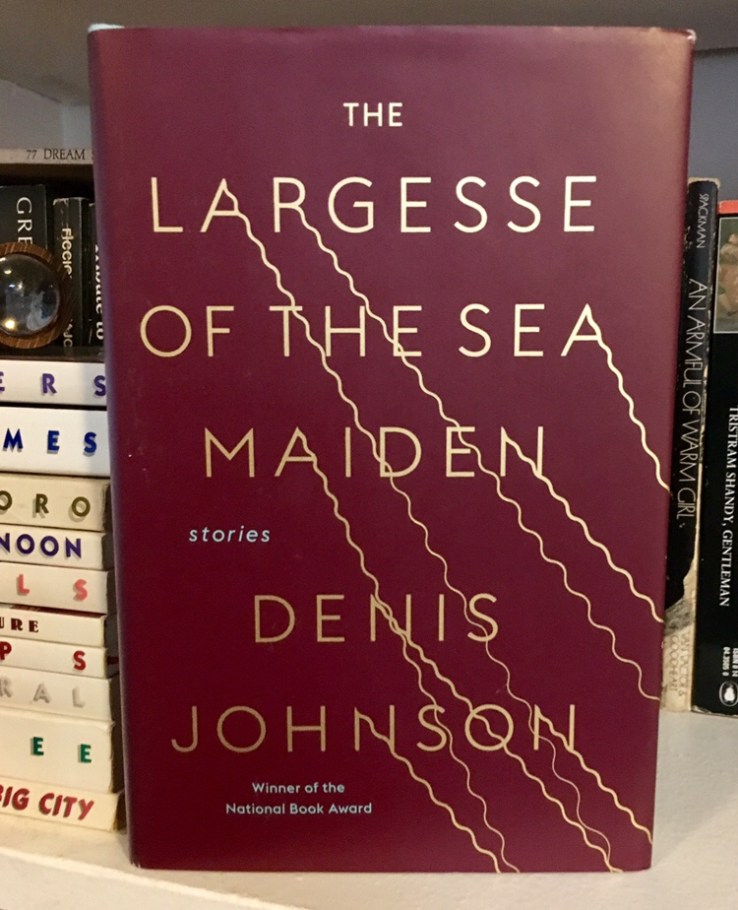
Denis Johnson’s The Largesse of the Sea Maiden (Book acquired, 27 June 2018)

img_0214

I had no intention of getting another book when I went to the bookstore yesterday. Swear. I had a few boxes of books my uncle gave me, and I was going to trade most of them in. Even this Carl Hiaasen novel that had a cool Charles Burns cover:

dguye4vuyaan9yq

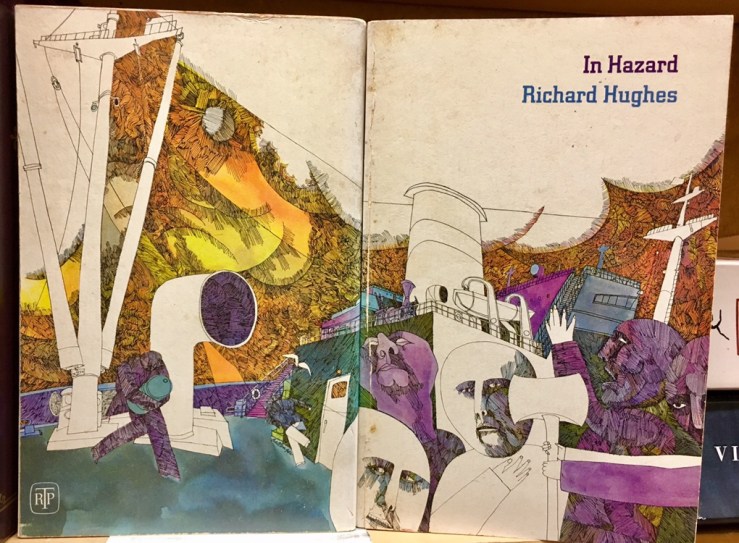
Anyway, I browsed the store a bit, killing half an hour before I had to pick my kids up, and I was tempted by a Richard Hughes’ novel called In Hazard simply because of its magnificent cover (here, I put two copies together—the back is on the left, the front is on the right):

img_0205

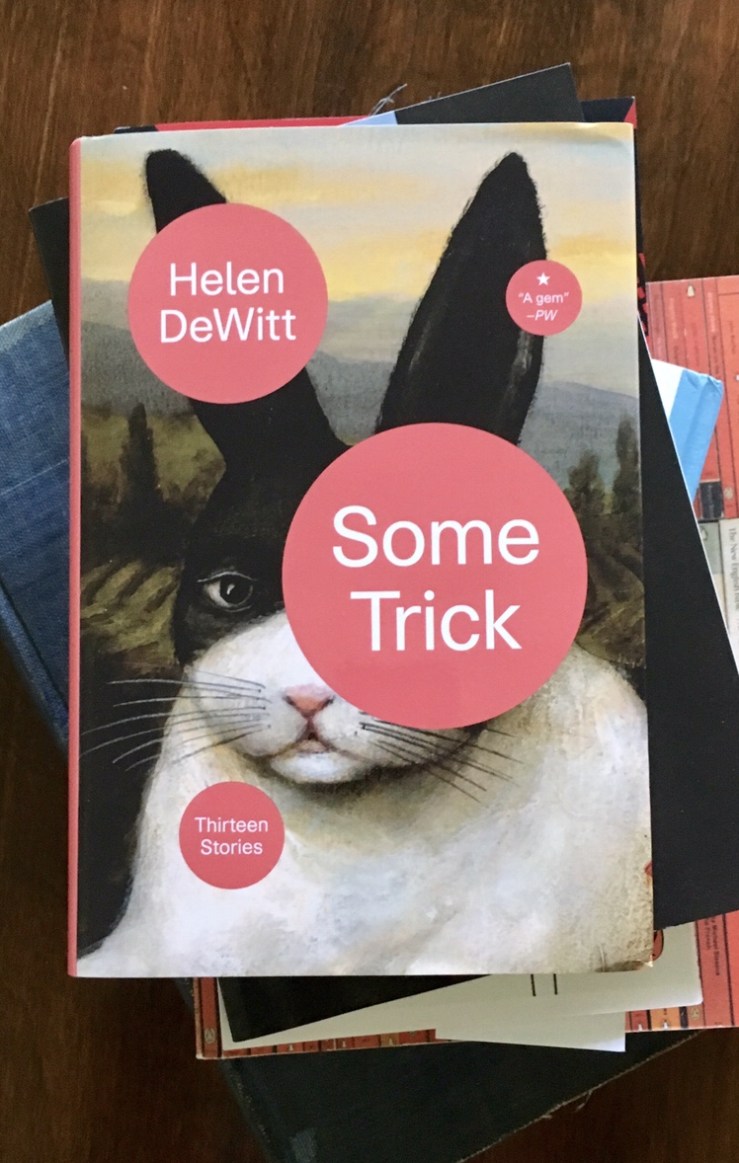
As an afterthought, I went through the new fiction section—something I hardly ever do—looking for Helen DeWitt’s new collection Some Trick, just to thumb through it. They didn’t have it, but they did have Denis Johnson’s posthumous collection The Largesse of the Sea Maiden (in hardback and for half price). I ended up reading the first little vignette in the first story in the collection, and then remembered that I’d read the story (the title track) a few years ago in The New Yorker. In particular I remembered the vignette called “Accomplices,” a near-perfect two-paragraph punch that features a Mardsen Hartley painting and too much bourbon. Here it is:

“Accomplices”

by

Denis Johnson


Another silence comes to mind. A couple of years ago, Elaine and I had dinner at the home of Miller Thomas, formerly the head of my agency in Manhattan. Right—he and his wife, Francesca, ended up out here, too, but considerably later than Elaine and I—once my boss, now a San Diego retiree. We finished two bottles of wine with dinner, maybe three bottles. After dinner, we had brandy. Before dinner, we had cocktails. We didn’t know one another particularly well, and maybe we used the liquor to rush past that fact. After the brandy, I started drinking Scotch, and Miller drank bourbon, and, although the weather was warm enough that the central air-conditioner was running, he pronounced it a cold night and lit a fire in his fireplace. It took only a squirt of fluid and the pop of a match to get an armload of sticks crackling and blazing, and then he laid on a couple of large chunks that he said were good, seasoned oak. “The capitalist at his forge,” Francesca said.

At one point we were standing in the light of the flames, I and Miller Thomas, seeing how many books each man could balance on his out-flung arms, Elaine and Francesca loading them onto our hands in a test of equilibrium that both of us failed repeatedly. It became a test of strength. I don’t know who won. We called for more and more books, and our women piled them on until most of Miller’s library lay around us on the floor. He had a small Marsden Hartley canvas mounted above the mantel, a crazy, mostly blue landscape done in oil, and I said that perhaps that wasn’t the place for a painting like this one, so near the smoke and heat, such an expensive painting. And the painting was masterful, too, from what I could see of it by dim lamps and firelight, amid books scattered all over the floor. . . . Miller took offense. He said he’d paid for this masterpiece, he owned it, he could put it where it suited him. He moved very near the flames and took down the painting and turned to us, holding it before him, and declared that he could even, if he wanted, throw it in the fire and leave it there. “Is it art? Sure. But listen,” he said, “art doesn’t own it. My name ain’t Art.” He held the canvas flat like a tray, landscape up, and tempted the flames with it, thrusting it in and out. . . . And the strange thing is that I’d heard a nearly identical story about Miller Thomas and his beloved Hartley landscape some years before, about an evening very similar to this one, the drinks and wine and brandy and more drinks, the rowdy conversation, the scattering of books, and, finally, Miller thrusting this painting toward the flames and calling it his own property, and threatening to burn it. On that previous night, his guests had talked him down from the heights, and he’d hung the painting back in its place, but on our night—why?—none of us found a way to object as he added his property to the fuel and turned his back and walked away. A black spot appeared on the canvas and spread out in a sort of smoking puddle that gave rise to tiny flames. Miller sat in a chair across the living room, by the flickering window, and observed from that distance with a drink in his hand. Not a word, not a move, from any of us. The wooden frame popped marvellously in the silence while the great painting cooked away, first black and twisted, soon gray and fluttering, and then the fire had it all.

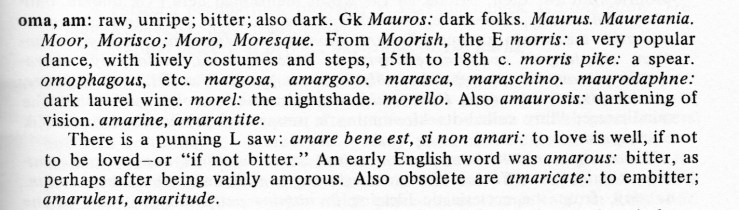
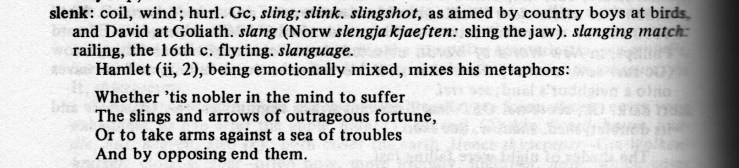
slenk: coil, wind; hurl,

img_9945

From Joseph T. Shipley’s The Origin of English Words: A Discursive Dictionary of Indo-European Roots.

On Doing Nothing (Book acquired, 12 June 2018)

img_0051

Roman Muradov’s On Doing Nothing is new from Chronicle Books. Instead of the blurb, here’s the intro:

img_0071

Molly’s suitors

If he had smiled why would he have smiled?

To reflect that each one who enters imagines himself to be the first to enter whereas he is always the last term of a preceding series even if the first term of a succeeding one, each imagining himself to be first, last, only and alone whereas he is neither first nor last nor only nor alone in a series originating in and repeated to infinity.

What preceding series?

Assuming Mulvey to be the first term of his series, Penrose, Bartell d’Arcy, professor Goodwin, Julius Mastiansky, John Henry Menton, Father Bernard Corrigan, a farmer at the Royal Dublin Society’s Horse Show, Maggot O’Reilly, Matthew Dillon, Valentine Blake Dillon (Lord Mayor of Dublin), Christopher Callinan, Lenehan, an Italian organgrinder, an unknown gentleman in the Gaiety Theatre, Benjamin Dollard, Simon Dedalus, Andrew (Pisser) Burke, Joseph Cuffe, Wisdom Hely, Alderman John Hooper, Dr Francis Brady, Father Sebastian of Mount Argus, a bootblack at the General Post Office, Hugh E. (Blazes) Boylan and so each and so on to no last term.

A passage from the penultimate episode of James Joyce’s Ulysses.


The sentence is itself an odyssey | William H. Gass analyzes a sentence from Joyce’s Ulysses

Stephen Dedalus and Leopold Bloom have stopped at a cabman’s shelter, a small coffeehouse under the Loop Line Bridge, for a cuppa and a rest on their way home. And the hope that the coffee will sober Stephen up. After an appropriate period of such hospitality, Bloom sees that it is time to leave.

James Joyce. Ulysses, (1921).

To cut a long story short Bloom, grasping the situation, was the first to rise to his feet so as not to outstay their welcome having first and foremost, being as good as his word that he would foot the bill for the occasion, taken the wise precaution to unobtrusively motion to mine host as a parting shot a scarcely perceptible sign when the others were not looking to the effect that the amount due was forthcoming, making a grand total of fourpence (the amount he deposited unobtrusively in four coppers, literally the last of the Mohicans) he having previously spotted on the printed price list for all who ran to read opposite to him in unmistakable figures, coffee ad., confectionary do, and honestly well worth twice the money once in a way, as Wetherup used to remark.

Commonplaces     Narrative Events

1. to cut a long story short     authorial intervention

2. grasp the situation     subjective interpretation

3. rise to his feet     narrative action

4. don’t outstay your welcome     rationale or justification

5. first and foremost     subjective evaluation

6. good as his word     characterization

7. foot the bill promise, therefore     a prediction

8. take the wise precaution     subjective evaluation

9. mine host     authorial archness

10. parting shot     subjective evaluation

11. scarcely perceptible sign     narrative action

12. to the effect that     subjective interpretation

13. amount due is forthcoming     subjective interpretation

14. grand total     characterization

15. literally the last of the Mohicans     authorial intervention, allusion

16. previously spotted     subjective interpretation

17. all who run can read     authorial intervention, allusion

18. honestly (in this context)     subjective interpretation

19. well worth it     subjective interpretation

20. worth twice the money     subjective interpretation

21. once in a waysubjective     allusion

22. as [Wetherup] used to [remark] say     attribution

The sentence without its commonplaces:

To be brief, Bloom, realizing they should not stay longer, was the first to rise, and having prudently and discreetly signaled to their host that he would pay the bill, quietly left his last four pennies, a sum—most reasonable—he knew was due, having earlier seen the price of their coffee and confection clearly printed on the menu.

Bloom was the first to get up so that he might also be the first to motion (to the host) that the amount due was forthcoming.

The theme of the sentence is manners: Bloom rises so he and his companion will not have sat too long over their coffees and cake, and signals discreetly (unobtrusively is used twice) that he will pay the four pence due according to the menu. The sum, and the measure of his generosity, is a pittance.

The sentence is itself an odyssey, for Bloom and Dedalus are going home. They stop (by my count) at twenty-two commonplaces on their way. Other passages might also be considered for the list, such as “when others were not looking.” Commonplaces are the goose down of good manners. They are remarks empty of content, hence never offensive; they conceal hypocrisy in an acceptable way, because, since they have no meaning in themselves anymore they cannot be deceptive. That is, we know what they mean (“how are you?”), but they do not mean what they say (I really don’t want to know how you are). Yet they soothe and are expected. We have long forgotten that “to foot the bill,” for instance, is to pay the sum at the bottom of it, though it could mean to kick a bird in the face. Bloom, we should hope, is already well above his feet when he rises to them. The principal advantage of the commonplace is that it is supremely self-effacing. It so lacks originality that it has no source. The person who utters a commonplace—to cut a long explanation short—has shifted into neutral.

From William H. Gass’s essay “Narrative Sentences.” Collected in Life Sentences.

What in water did Bloom, waterlover, drawer of water, watercarrier, returning to the range, admire?

What in water did Bloom, waterlover, drawer of water, watercarrier, returning to the range, admire?

Its universality: its democratic equality and constancy to its nature in seeking its own level: its vastness in the ocean of Mercator’s projection: its unplumbed profundity in the Sundam trench of the Pacific exceeding 8000 fathoms: the restlessness of its waves and surface particles visiting in turn all points of its seaboard: the independence of its units: the variability of states of sea: its hydrostatic quiescence in calm: its hydrokinetic turgidity in neap and spring tides: its subsidence after devastation: its sterility in the circumpolar icecaps, arctic and antarctic: its climatic and commercial significance: its preponderance of 3 to 1 over the dry land of the globe: its indisputable hegemony extending in square leagues over all the region below the subequatorial tropic of Capricorn: the multisecular stability of its primeval basin: its luteofulvous bed: its capacity to dissolve and hold in solution all soluble substances including millions of tons of the most precious metals: its slow erosions of peninsulas and islands, its persistent formation of homothetic islands, peninsulas and downwardtending promontories: its alluvial deposits: its weight and volume and density: its imperturbability in lagoons and highland tarns: its gradation of colours in the torrid and temperate and frigid zones: its vehicular ramifications in continental lakecontained streams and confluent oceanflowing rivers with their tributaries and transoceanic currents, gulfstream, north and south equatorial courses: its violence in seaquakes, waterspouts, Artesian wells, eruptions, torrents, eddies, freshets, spates, groundswells, watersheds, waterpartings, geysers, cataracts, whirlpools, maelstroms, inundations, deluges, cloudbursts: its vast circumterrestrial ahorizontal curve: its secrecy in springs and latent humidity, revealed by rhabdomantic or hygrometric instruments and exemplified by the well by the hole in the wall at Ashtown gate, saturation of air, distillation of dew: the simplicity of its composition, two constituent parts of hydrogen with one constituent part of oxygen: its healing virtues: its buoyancy in the waters of the Dead Sea: its persevering penetrativeness in runnels, gullies, inadequate dams, leaks on shipboard: its properties for cleansing, quenching thirst and fire, nourishing vegetation: its infallibility as paradigm and paragon: its metamorphoses as vapour, mist, cloud, rain, sleet, snow, hail: its strength in rigid hydrants: its variety of forms in loughs and bays and gulfs and bights and guts and lagoons and atolls and archipelagos and sounds and fjords and minches and tidal estuaries and arms of sea: its solidity in glaciers, icebergs, icefloes: its docility in working hydraulic millwheels, turbines, dynamos, electric power stations, bleachworks, tanneries, scutchmills: its utility in canals, rivers, if navigable, floating and graving docks: its potentiality derivable from harnessed tides or watercourses falling from level to level: its submarine fauna and flora (anacoustic, photophobe), numerically, if not literally, the inhabitants of the globe: its ubiquity as constituting 90 percent of the human body: the noxiousness of its effluvia in lacustrine marshes, pestilential fens, faded flowerwater, stagnant pools in the waning moon.

From the penultimate episode of James Joyce’s Ulysses.

Ulysses fragment

ulysses

A handwritten fragment from the “Circe” episode of James Joyce’s Ulysses. Via/more.

Blog about reading Middlemarch (and wishing I was rereading Middlemarch)

Screenshot 2018-06-12 at 8.35.14 PM
Detail of a portrait of Mary Ann Evans (George Eliot) at age 30 by François d’Albert Durade (1804–1886)

There should be a word in some language (perhaps not yet invented—word or language) to describe the feeling of Having pushed far enough into a very long novel (a novel that one has cracked into more than once) to the point that one now feels one can finally finish it.

I have felt this specific feeling a number of times in my life after finally sinking into long novels like Moby-DickGravity’s Rainbow, and Infinite Jest. There’s a sort of relief mixed into this (as-yet-unnamed?) feeling, a letting go even, where the reader (me, I mean) surrenders to the novel’s form and content. Finally freed from the idea of reading the novel, I am able to read the novel.

There are 86 numbered chapters in George Eliot’s 1872 novel Middlemarch (not counting a “Prelude” and a “Finale”). I have just finished Chapter XXXV—not exactly a half-way point, but far enough in to finally feel like the story and the style are sticking with me. I’ve been reading a public domain copy on my iPad, after having abandoned my 1977 Norton Critical Edition—the Norton’s print is too cramped (and maybe my eyes are starting to go as I approach 40). Also, the Norton annotations are useful but too intrusive for a first read. I found myself utterly distracted by the Norton footnotes after about 50 pages; switching to a footnote-free version has alleviated a lot of the anxiety I initially felt about trying to fully comprehend Eliot’s novel in its own historical context. Dispensing with the footnotes allowed me to finally sink into Middlemarch and appreciate its wonderful evocation of consciousness-in-action.

So far, my favorite character in Middlemarch is Dorothea Brooke. In part my allegiance to her is simply a matter of the fact that she initially appears to be the novel’s central character—until Eliot swerves into new narratives near the end of Book I (Book I of VIII, by the way). But beyond traditional formal sympathies, it’s the way that Eliot harnesses Dorothea’s consciousness that I find so appealing. Eliot gives us in Dorothea an incredibly intelligent yet palpably naive young woman who feels the world around her a smidge too intensely. Dorothea is brilliant but a bit blind, and so far Middlemarch most interests me in the way that Eliot evokes this heroine’s life as a series of intellectual, emotional, and aesthetic revelations. We see Dorothea seeing—and then, most remarkably, we see Dorothea seeing what she could not previously see.

There are other intriguing characters too, like Dr. Tertius Lydgate, the wastrel Fred Vincy, and the would-be-Romantic Will Ladislaw (who has like, totally smoked opium, just so you know). I’m particularly fond of Dorothea’s goofy uncle Arthur Brooke.

I won’t bother summarizing the plot thus far of the novel, which is really a bunch of plate spinning, but rather offer this sentence from the novel itself:

Scenes which make vital changes in our neighbors’ lot are but the background of our own, yet, like a particular aspect of the fields and trees, they become associated for us with the epochs of our own history, and make a part of that unity which lies in the selection of our keenest consciousness.

There’s also another self-summarizing passage a few chapters before this one, worth citing here:

Your pier-glass or extensive surface of polished steel made to be rubbed by a housemaid, will be minutely and multitudinously scratched in all directions; but place now against it a lighted candle as a centre of illumination, and lo! the scratches will seem to arrange themselves in a fine series of concentric circles round that little sun. It is demonstrable that the scratches are going everywhere impartially and it is only your candle which produces the flattering illusion of a concentric arrangement, its light falling with an exclusive optical selection. These things are a parable. The scratches are events, and the candle is the egoism of any person now absent…

Each of us is a reader reading other lives as scratches on a mirror or trees in the distance, and in our reading we incorporate them into our own consciousness, our own narrative. Middlemarch is very good at evoking this social reality.

I started this blog post by trying to describe a very specific feeling for which I don’t have a word—namely, and again: Having pushed far enough into a very long novel to the point that one now feels one can finally finish it. I suspect that this is a not-uncommon feeling. I’m not so sure though of how common the other feeling I have while reading Middlemarch is. I keep feeling (feeling, not thinking): I wish that I was rereading Middlemarch and not reading Middlemarch. If I were rereading Middlemarch I could make much more sense of those mirror scratches and those trees in the distance; if I were rereading Middlemarch, I could feel the feeling of reading Middlemarch more. There is an obvious answer to this desire, of course. I can finish reading Middlemarch. Then I can reread Middlemarch. 

Robert Coover/Barry Hannah/Antoine Volodine (Books acquired, 7 June 2018)

img_0040

I had ordered Antoine Volodine’s Minor Angels through my favorite bookstore, and it came in yesterday. It’s slim but expensive (ah! university presses!) and ate up all of my store credit, but still I picked up used copies of Robert Coover’s second novel The Universal Baseball Association, Inc., J. Henry Waugh, Prop. and Barry Hannah’s Boomerang b/w Never Die (some of the only Hannah I’ve yet to read). I was tempted also by the title and cover of Daniel Hoffman’s 1971 Poe Poe Poe Poe Poe Poe Poe—but I was not tempted enough to acquire it.

dfg3rjnwaaay2nl

Even your ugly furniture (From Eliot’s Middlemarch)

An eminent philosopher among my friends, who can dignify even your ugly furniture by lifting it into the serene light of science, has shown me this pregnant little fact. Your pier-glass or extensive surface of polished steel made to be rubbed by a housemaid, will be minutely and multitudinously scratched in all directions; but place now against it a lighted candle as a centre of illumination, and lo! the scratches will seem to arrange themselves in a fine series of concentric circles round that little sun. It is demonstrable that the scratches are going everywhere impartially and it is only your candle which produces the flattering illusion of a concentric arrangement, its light falling with an exclusive optical selection. These things are a parable. The scratches are events, and the candle is the egoism of any person now absent…

From George Eliot’s novel Middlemarch.

Reviews, riffs, anti-reviews, and interviews of Jan 2018-May 2018 (and an unrelated fruit bat)

DP167067

These are links to some of the longer pieces I’ve written so far this year. The painting of the great Indian fruit bat (c. 1777-1782) is attributed to Bhawani Das or one of his followers.

The Last Jedi and the anxiety of influence

A review of Paul Thomas Anderson’s film Phantom Thread

A review of Paul Kirchner’s underground comix collection Awaiting the Collapse (at The Comics Journal)

A review of The Paris Review’s overproduced podcast

A review of Stanisław Ignacy Witkiewicz’s collection Narcotics

A few paragraphs on beginning Iris Murdoch’s novel The Bell

On a compelling Stephen Crane character

A review of Iris Murdoch’s novel The Bell

On a particular Gordon Lish sentence

On rereading Nathaniel Hawthorne’s The Blithedale Romance

Screenshot 2018-05-31 at 3.59.41 PM

On Goya’s painting The Straw Man

On Don DeLillo’s novel The Names

On the radical postmodernism of Ursula K. Le Guin’s short story “Schrödinger’s Cat” 

Polygamy as a metaphor in Nathaniel Hawthorne’s The Blithedale Romance

On Nathaniel Hawthorne’s “silvery veil” — and David Foster Wallace’s Madame Psychosis

An analysis of William Carlos Williams’s ekphrastic poem “The Wedding Dance in the Open Air”

A close reading of Lydia Davis’s very short story “Happiest Moment”

On a passage from Gerald Murnane’s short story “Stream System”

Something on a scene from Nathaniel Hawthorne’s The Blithedale Romance

Screenshot 2018-05-31 at 3.59.29 PM

On John Berryman’s Dream Song 265

On making a literary cocktail, the sherry cobbler

On Robert Coover’s short story “The Brother”

On Claire-Louise Bennett’s short story “Stir-Fry”

On Balthus’s portraits of young girls reading 

On the postmodern comedy-horror axis of Martin Scorsese’s The King of Comedy

An interview with the editors of Egress, a new literary magazine devoted to innovative writing

A completely subjective and thoroughly unnecessary ranking of Thomas Pynchon’s novels

Screenshot 2018-05-31 at 3.58.43 PM

Antoine Volodine’s Writers blows me away

A review of Dave Cooper’s queasy abject comic Mudbite (at The Comics Journal)

On Michael Radford’s film adaptation of 1984

Is The Running Man a good film?

On William Friedkin’s paranoid, claustrophobic horror flick Bug

Mary and the Witch’s Flower, a love letter to Studio Ghibli from director Hiromasa Yonebayashi

On Hayao Miyazaki’s film Porco Rosso

A review of Zora Neale Hurston’s Barracoon

A review of Lady Macbeth

Screenshot 2018-05-31 at 3.59.03 PM

“Walter, leave off” | D.H. Lawrence on Walt Whitman

From D.H. Lawrence’s chapter on Whitman in Studies in Classic American Literature (more):

POST-MORTEM effects?

But what of Walt Whitman?

The ‘good grey poet’.

Was he a ghost, with all his physicality?

The good grey poet.

Post-mortem effects. Ghosts.

A certain ghoulish insistency. A certain horrible pottage of human parts. A certain stridency and portentousness. A luridness about his beatitudes.

DEMOCRACY! THESE STATES! EIDOLONS! LOVERS, ENDLESS LOVERS!

ONE IDENTITY!

ONE IDENTITY!

I AM HE THAT ACHES WITH AMOROUS LOVE.

Do you believe me, when I say post-mortem effects ?

When the Pequod went down, she left many a rank and dirty steamboat still fussing in the seas. The Pequod sinks with all her souls, but their bodies rise again to man innumerable tramp steamers, and ocean-crossing liners. Corpses.

What we mean is that people may go on, keep on, and rush on, without souls. They have their ego and their will, that is enough to keep them going.

So that you see, the sinking of the Pequod was only a metaphysical tragedy after all. The world goes on just the same. The ship of the soul is sunk. But the machine-manipulating body works just the same: digests, chews gum, admires Botticelli and aches with amorous love.

I AM HE THAT ACHES WITH AMOROUS LOVE.

What do you make of that? I AM HE THAT ACHES. First generalization. First uncomfortable universalization. WITH AMOROUS LOVE! Oh, God! Better a bellyache. A bellyache is at least specific. But the ACHE OF AMOROUS LOVE!

Think of having that under your skin. All that!

I AM HE THAT ACHES WITH AMOROUS LOVE.

Walter, leave off. You are not HE. You are just a limited Walter. And your ache doesn’t include all Amorous Love, by any means. If you ache you only ache with a small bit of amorous love, and there’s so much more stays outside the cover of your ache, that you might be a bit milder about it.

I AM HE THAT ACHES WITH AMOROUS LOVE.

CHUFF! CHUFF! CHUFF!

CHU-CHU-CHU-CHU-CHUFF!

Reminds one of a steam-engine. A locomotive. They’re the only things that seem to me to ache with amorous love. All that steam inside them. Forty million foot-pounds pressure. The ache of AMOROUS LOVE. Steam-pressure. CHUFF!

An ordinary man aches with love for Belinda, or his Native Land, or the Ocean, or the Stars, or the Oversoul: if he feels that an ache is in the fashion.

It takes a steam-engine to ache with AMOROUS LOVE. All of it.

Walt was really too superhuman. The danger of the superman is that he is mechanical.