People have always distrusted the classics (William H. Gass)

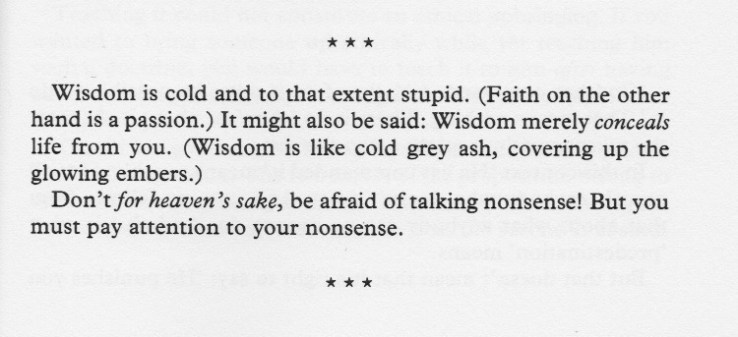
Oddly enough, people have always distrusted the classics, but it is now publicly acceptable to take pride in such distrust. We all dislike intimidation, so we worry about being overwhelmed by these tomes above which halos hover as over the graves of the recently sainted, because we wrongly believe they are fields full of esoteric knowledge worse than nettles, of specialized jargon, seductive rhetoric, and swarms of stinging data, and that the purpose of all this unpleasantness is to show us up, put us in our place, make fun of our lack of understanding; but the good books are notable for their paucity of information—a classic is as careful about what it picks up as about what it puts down; it introduces new concepts because fresh ideas are needed; and only if the most ordinary things are exotic is it guilty of a preoccupation with the out-of-the-way, since the ordinary, the everyday, is their most concentrated concern: What could be more familiar than a child rolling for fun down a grassy slope—that is, when seen by Galileo, a body descending an inclined plane? What could be more commonplace than Bertrand Russell’s penny, lying naked on an examining table, awaiting the epistemologist’s report on the problems of its perception? What could be less distinguished a subject for Maynard Keynes’s ruminations on the source of its value than such a modest coin? Why should the question—What good is that?—alarm us, or why, in an age when most of the world worships money but calls its chosen God Father instead of Chairman, Lord instead of Coach, Most High instead of Star, should we shy from the same questions Plato asked, and not ask them about our business, about our love affairs, about our lip-served gods, about democracy?

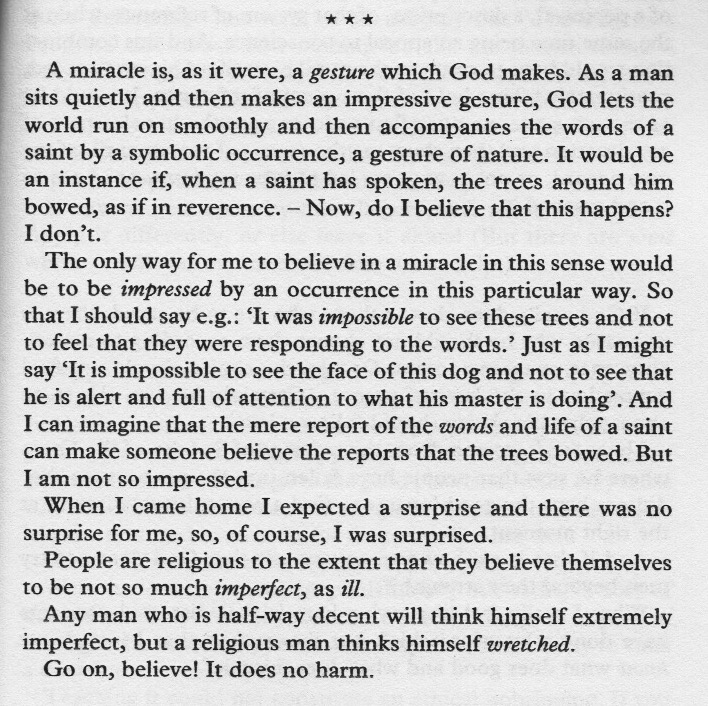
From William H. Gass’s “To A Young Friend Charged with Possession of the Classics”; collected in A Temple of Texts (Knopf, 2006). For fun, pretend you are the young friend in the title.

Crossing the Sea with Syrians on the Exodus to Europe (Book acquired, 2.22.2016)

wimg_1652

Crossing the Sea with Syrians on the Exodus to Europe by Wolfgang Bauer (in English translation by Sarah Prybus) is new in hardback this month from And Other Stories. Their blurb:

Award-winning journalist Wolfgang Bauer and photographer Stanislav Krupař were the first undercover reporters to document the journey of Syrian refugees from Egypt to Europe. Posing as English teachers in 2014, they were direct witnesses to the brutality of smuggler gangs, the processes of detainment and deportation, the dangers of sea-crossing on rickety boats, and the final furtive journey through Europe. Combining their own travels with other eyewitness accounts in the first book of reportage of its kind, Crossing the Sea brings to life both the systemic problems and the individual faces behind the crisis, and is a passionate appeal for more humanitarian refugee policies.

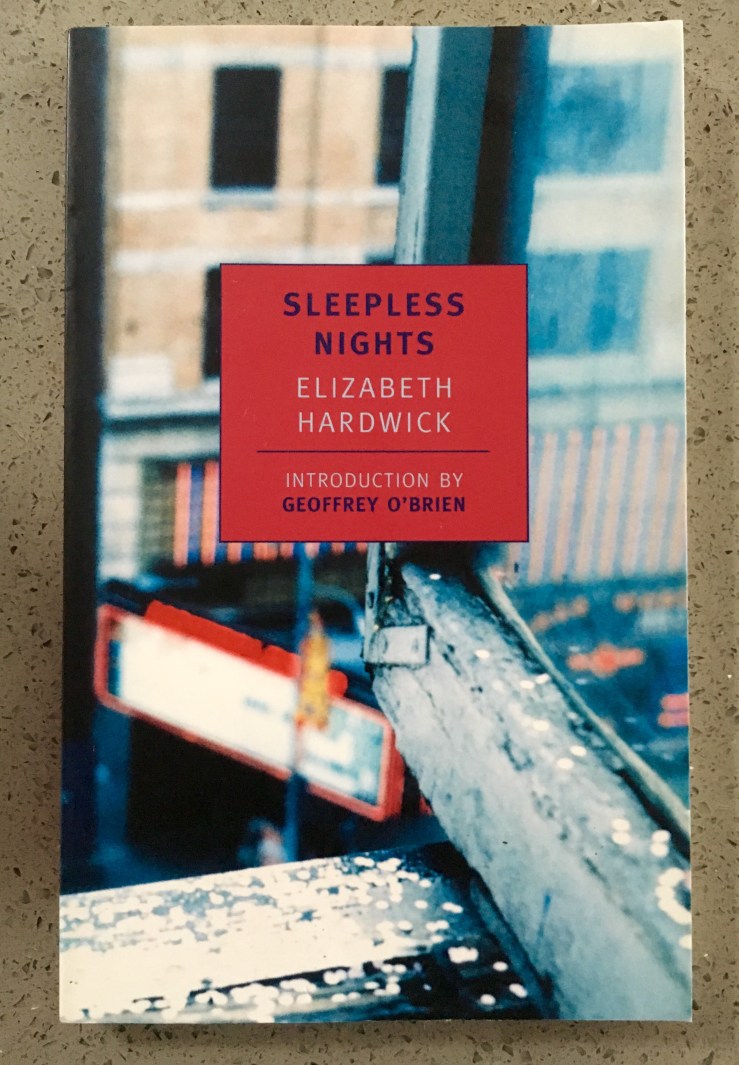
Elizabeth Hardwick’s Sleepless Nights (Book acquired, 3.07.2016)

img_1676

 I picked up Elizabeth Hardwick’s Sleepless Nights yesterday. (I was browsing the “H, classics” for something else, which I did not find, but I found this). Here’s the beginning of Joan Didion’s 1979 review in The New York Times:

“I have always, all of my life, been looking for help from a man,” we are told near the beginning of Elizabeth Hardwick’s subtle new book. “It has come many times and many more than not. This began early.” . . . “Sleepless Nights” is a novel, but it is a novel in which the subject is memory and to which the “I” whose memories are in question is entirely and deliberately the author: we recognize the events and addresses of Elizabeth Hardwick’s life not only from her earlier work, but from the poems of her husband, the late Robert Lowell. We study in another light the rainy afternoons and dyed satin shoes and high-school drunkenness of the Kentucky adolescence, the thin coats and yearnings toward home of the graduate years at Columbia, the households in Maine and Europe and on Marlborough Street in Boston and West 67th Street in New York. We are presented the entire itinerary, shown all the punched tickets and transfers. The result is less a “story about” or “of” a life than a shattered meditation on it, a work as evocative and difficult to place as Claude Levi-Strauss’s “Tristes Tropiques,” which it oddly recalls. The author observes of her enigmatic narrative: “It certainly hasn’t the drama of: I saw the old, white-bearded frigate master on the dock and signed up for the journey. But after all, ‘I’ am a woman.”

This strikes an interesting note, a balance of Oriental diffidence and exquisite contempt, of irony and direct statement, that exactly expresses the sensibility at work in “Sleepless Nights.” “But after all, ‘I’ am a woman.” Triste Tropique indeed. By way of suggesting his own intention, Levi-Strauss quoted Chateaubriand: “Every man carries within himself a world made up of all that he has seen and loved, and it is to this world that he returns, incessantly.” In certain ways, the mysterious and somnambulistic “difference” of being a woman has been, over 35 years, Elizabeth Hardwick’s great subject, the tropic to which she has returned incessantly: it colored both of her early novels, “The Ghostly Lover” in 1945 and “The Simple Truth” in 1955, as well as many of the essays collected in 1962 as “A View of My Own” and all of those published in 1974 as “Seduction and Betrayal: Women and Literature.”

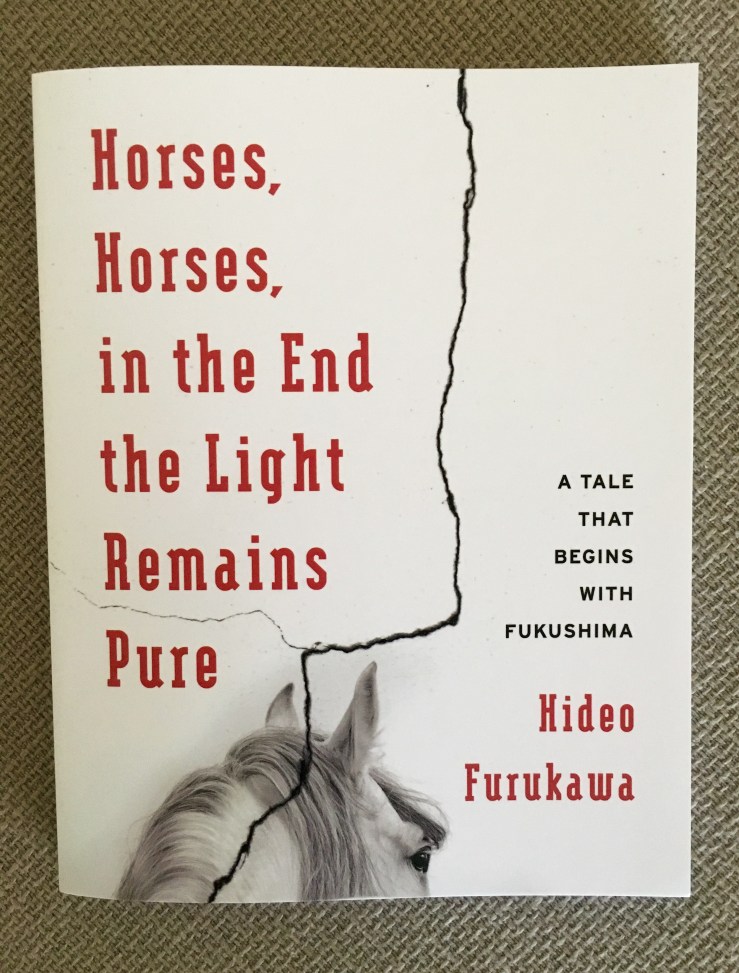
Horses, Horses, in the End the Light Remains Pure (Book acquired, 2.22.2016)

img_1653

I’m pretty excited about Hideo Furukawa’s Horses, Horses, in the End the Light Remains Pure (new this month from Columbia University Press in English translation by Doug Slaymaker with Akiko Takenaka). Columbia UP’s blurb:

Horses, Horses, in the End the Light Remains Pure is a multifaceted literary response to the earthquake, tsunami, and nuclear meltdown that devastated northeast Japan on March 11, 2011. The novel is narrated by Hideo Furukawa, who travels back to his childhood home near Fukushima after 3/11 to reconnect with a place that is now doubly alien. His ruminations conjure the region’s storied past, particularly its thousand-year history of horses, humans, and the struggle with a rugged terrain. Standing in the morning light, these horses also tell their stories, heightening the sense of liberation, chaos, and loss that accompanies Furukawa’s rich recollections. A fusion of fiction, history, and memoir, this book plays with form and feeling in ways reminiscent of Vladimir Nabokov’s Speak, Memory and W. G. Sebald’s The Rings of Saturn yet draws its own, unforgettable portrait of personal and cultural dislocation.

Read an excerpt here.

Three Books

img_1668

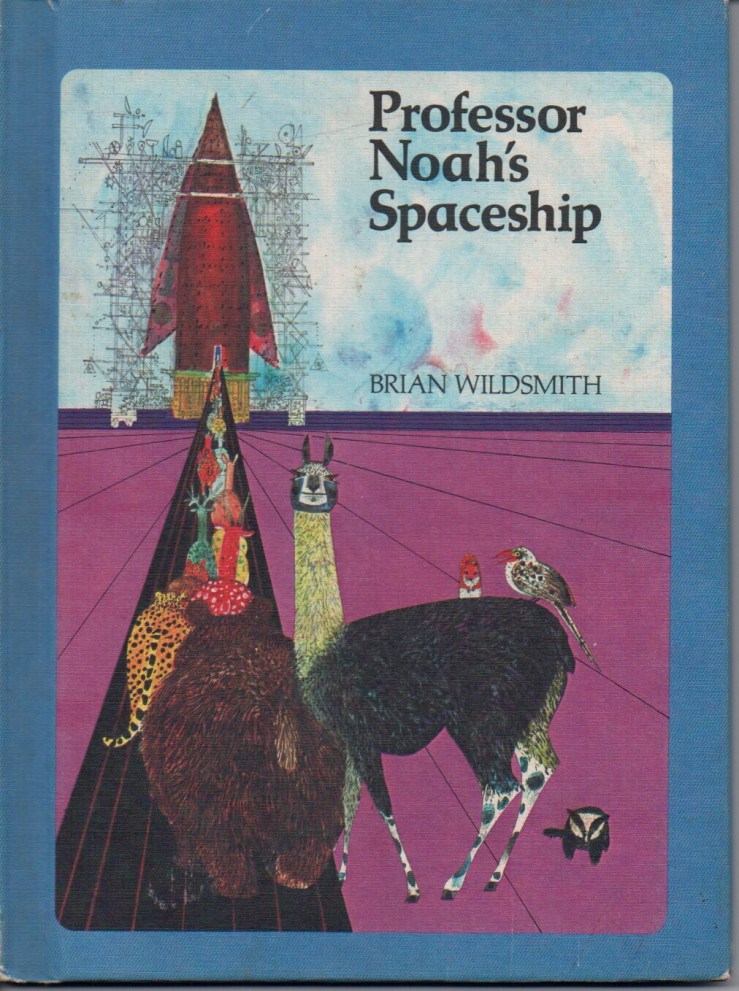
Professor Noah’s Spaceship by Brian Wilsdsmith. First edition hardback by Oxford University Press, 1980; distributed through Macmillan Book Clubs. Design, cover, and art by Brian Wildsmith. This book is too beautiful.

img_1666

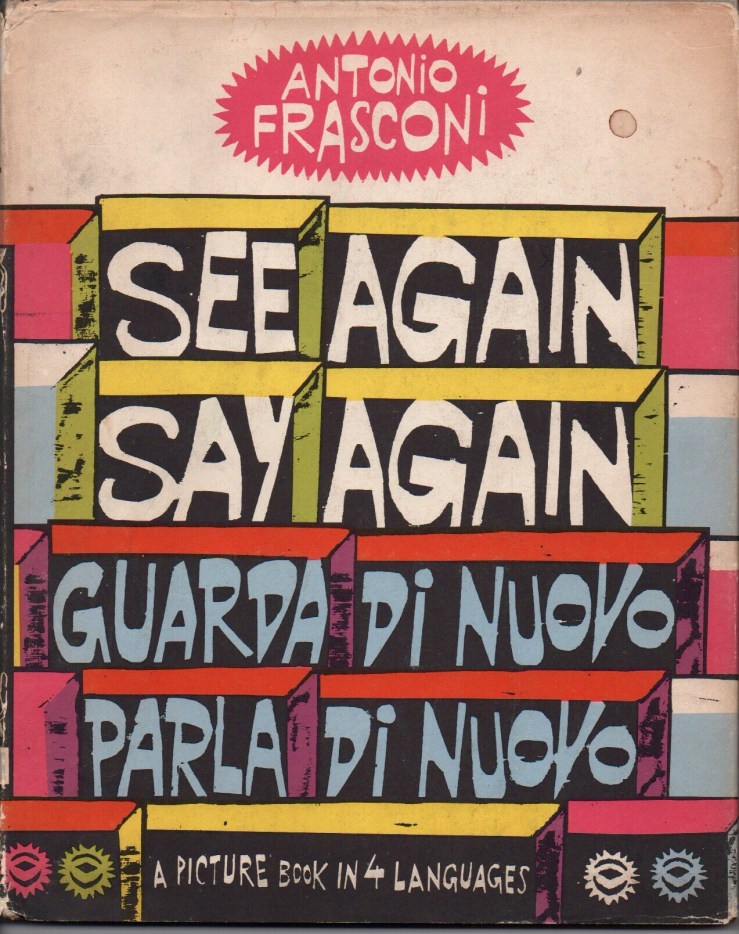
See Again, Say Again by Antonio Frasconi. First edition oversized hardback published by Hacourt, Brace and World, 1964. Cover design, fonts, and woodcuts by Antonio Frasconi.

img_1667

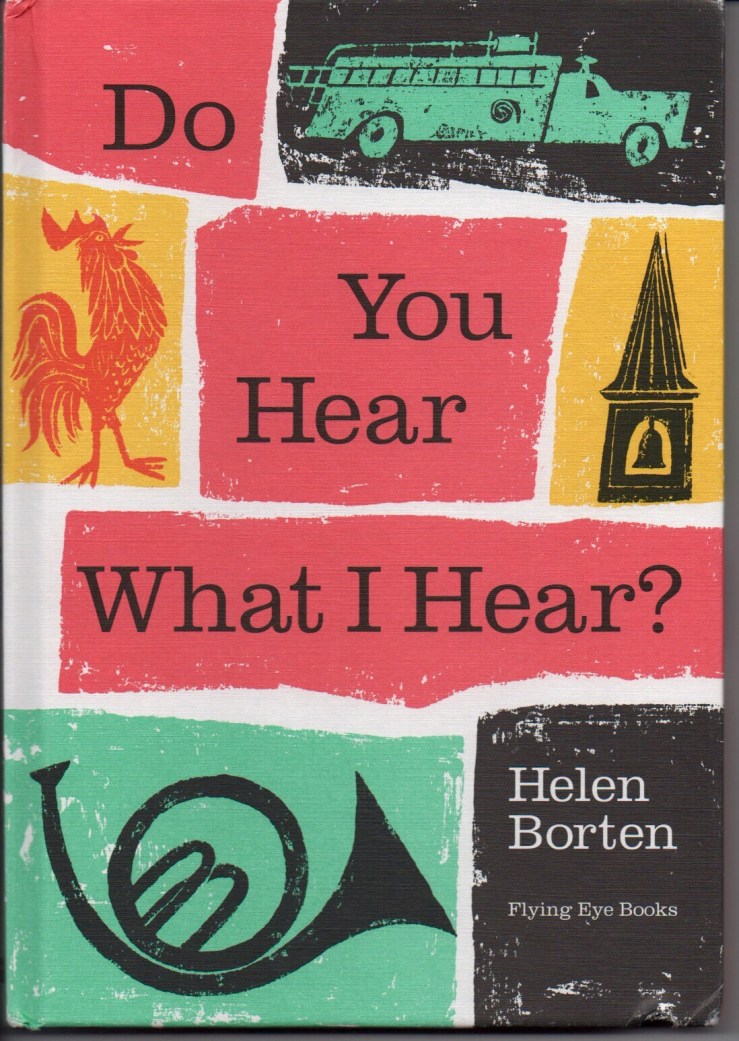
Do You Hear What I Hear? by Helen Borten. First edition hardback reprint by Flying Eye Books, a division of Nobrow; the book was originally published in 1960. Illustration and design by Helen Borten. Nowbrow kindly sent me a copy of Do You Hear What I Hear?—the book is beautiful, the text is lovely—Borten’s technique is to represent sound—or rather the feeling of sound (which is to say, the feeling of the feeling of sound) through language and art. Like any great children’s book, Do You Hear What I Hearis best read out loud, and my five-year-old son loved it so much that I had to read it again to him immediately after the first reading. We’ve read it a few times since then. Great stuff.

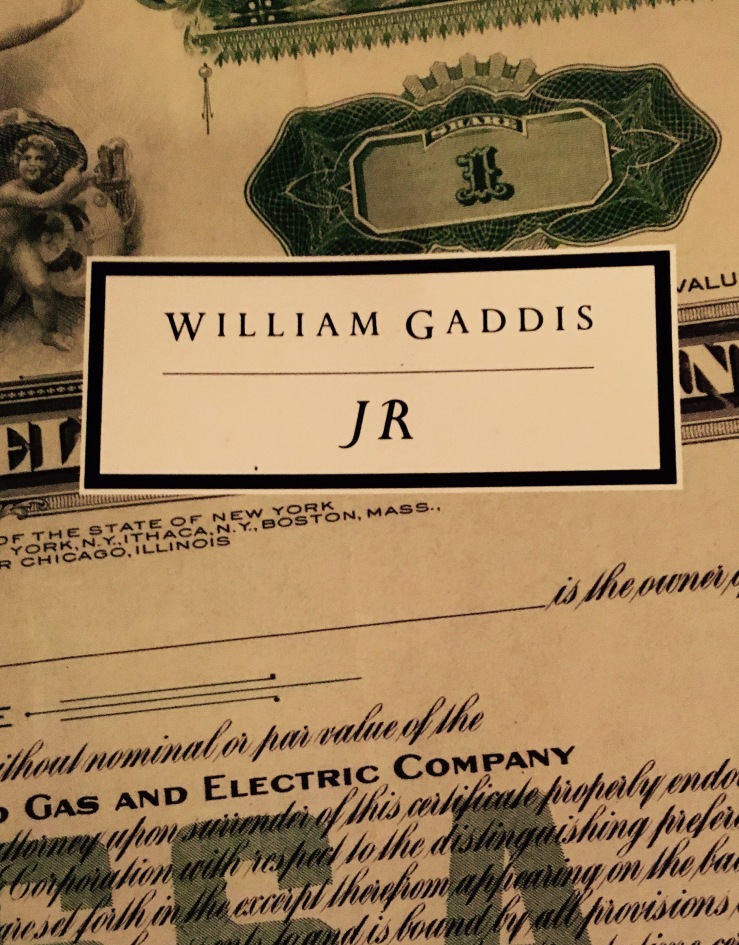
William Gaddis’s J R (A short riff on a long book)

img_1659

1.

I reread William Gaddis’s 1975 novel J R this February and, as is usually the case with a reread, I was pleasantly unsurprised by all its unremembered surprises—the jokes and japes, riffs and routines that had oozed from my brain-sieve since that first read back in 2012.

How could I forget about a scheme to freeze sound, or an art theft subplot, or the Indian uprising? How could I forget that in J R, Gaddis anagrammatically parodies the critical rejections of his first novel The Recognitions? (I did remember the stuffed Eskimo).

2.

What I was surprised surprised surprised about in my rereading of J R was how much of the first reading had stuck. And stuck hard, soaked in, saturated—the sign of a great grand thing, the em-word thing, the masterpiece thing.

3.

Only a handful of novels are so perfectly simultaneously comic and tragic. Moby-Dick? Yes. Gravity’s Rainbow? Absolutely. (G R and J R, a duo published two years apart, spiritual twins, massive American novels that maybe America hardly deserves (or, rather: theses novels were/are totally the critique America deserves). I guess maybe what I’m saying is J  R is the Great American Novel to Come (The Recognitions is perhaps overpraised and certainly not Gaddis’s best novel; J R is. The zeitgeist has been caught up to J R, the culture should (will) catch up).

4.

So I already wrote on J R on this blog: A misfire of sorts from halfway through (in which I offer more description of the novel’s plot and form than I intend to here, maybe), and a thing I wrote after finishing it which (this thing I wrote before, I mean) might be better than anything I can muster here, in terms of analysis, of like, theme. I’ll limit myself to, I don’t know, eleven points in this riff, yes? (Why 11? Why not? Why not go to 11? 11 for Chapter 11, for bankruptcy, for the moral artistic intellectual bankruptcy that the novel J R skewers). So, having limited myself to eleven points, and having not gotten to the damn point yet, which is—

5.

J R is so good, y’all. The book is a performance, an opera, an essay on America, a howl, a condemnation, a farce, a romance, a tragedy. When I read it in 2012 I couldn’t believe how prescient it was, a feeling reconfirmed with force four years later. J R diagnoses and describes and ridicules American corporatism, the industrial-military-entertainment-banking-education-etc. -complex. And then it weeps.

6.

But wait—what I wanted to say is J R is so good—so, uh, entertaining. It’s fucking funny. And sweet.

7.

(And bitter).

8.

And J R’s not as hard a read as some dudes would have you believe. Sure, it’s composed almost entirely in unattributed dialogue—and that can be tough, to start, but you can learn to hear it very quickly.

In his essay “William Gaddis and His Goddamn Books,” William Gass writes that, “J R takes time. J R takes patience. J R takes faith.” But Gass also points out the payoff of J R “unlike other faiths…is immediately and continuously redeeming.”

It is redeeming (continuously), and I don’t just echo Gass here as some kind of rhetorical flourish—reading J R again was a reminder that the novel posits redemption through Bast’s call to action, to his resolve to, as the failed writer (or stymied writer) Eigen puts it, “go do what [he has] to do” to make real art—or, in our hero Bast’s own terms: “…until a performer hears what I hear and can make other people hear what hears it’s just trash isn’t it…”

9.

And in J R the reader becomes the performer, making the voices, singing the voices, (muttering the voices), navigating all the trash, the entropy—J R is a novel of unraveling, where art trips over commercial trash and literal trash–old ads, betting tickets, stock ticker tape, phone book pages, train tickets, scraps. Is there another American novel so aware of its own textuality, its own metatextuality—I mean one that doesn’t goddamn wink all the time at its readers like so much clever postmodern slop?

Gass again: “[J R] is written in speech scraps, confetti-like wiggles of brightly colored cliché. As a medium, it would appear to be as unpromising as might be imagined. And the reader has to ride in the parade and organize all that fluttering that’s come down from on high.” High and low.

10.

And all the heroes of J R—Bast and Gibbs and Amy Joubert, but also the titular J R his own goddamn self (and maybe, if we’re feeling charitable examining this novel of capitalism, Eigen)–they’re falling apart and trying to put themselves back together (even their clothes unraveling, their shoes falling apart). Chaos, entropy.

The whole deal is best summed up in an early episode in which Gibbs rants against the modern education system: “Order is simply a thin, perilous condition we try to impose on the basic reality of chaos…”

Or maybe it’s best summed up (not the right phrasal verb—maybe described by the chaos of, but gee-dee that’s clunky) in the scraps Gibbs keeps wadded in his pocket or in his folders, scraps toward something bigger

img_1658

Gibbs’s novel is Agapē Agape, which is also Gaddis’s last novel. And to go back to whatever thrust this riff had re: rereading—J R coheres, perhaps (it doesn’t have to cohere) after a reading of Agapē Agape (which also, Agapē Agape, works to dismantle coherence, or to emphasize the chaos of thought, or to highlight entropy, or to you know what goddamn it pick your own phrase). What I mean to say is I think it’s a good move to read Agapē Agape after J R.

(What I mean to say is that I care and cry for Jack Gibbs, and find in Agapē Agape for him a redemption and resurrection (and dissolution, of course…)).

11.

So I get to point 11 and fail to say so many things I intended to say—about the novel’s sexiness (it’s sexy!)—about its wit (goddamn!)—

——-about its repetition of phrases like god damn and its unrelenting use of forms of the verb threaten—and ——– and

—–and here I see/read/hear that I’ve been referring to the novel as its own agency, its own its, as if it were its own beast independent of its master Gaddis—

—-which I guess, like any Great Novel (American or otherwise), it is.

Independent, I mean.

And great, I mean.

And, <enthusiasm> You should read read it! </enthusiasm>.

I mean, I love it.

No great book is explicable (William Gass)

No great book is explicable, and I shall not attempt to explain this one. An explanation–indeed, any explanation–would defile it, for reduction is precisely what a work of art opposes. Easy answers, convenient summaries, quiz questions, annotations, arrows, highlight lines, lists of its references, the numbers of its sources, echoes, and influences, an outline of its design–useful as sometimes such helps are–nevertheless seriously mislead. Guidebooks are useful, but only to what is past. Interpretation replaces the original with the lamest sort of substitute. It tames, disarms. “Okay, I get it,” we say, dusting our hands, “and that takes care of that.” “At last I understand Kafka” is a foolish and conceited remark.

From “William Gaddis and His Goddamn Books” by William Gass. Originally published as the introduction to the Penguin Classics edition of The Recognitions, and also published (and repurposed and expanded) in A Temple of Texts—which is where I went looking for it—or rather, went looking for some of Gass’s language on J R, which I re-read last month, and was going to, I don’t know, try to write about (something beyond: J R is not nearly as difficult as you may think it is, and it is a very funny and important and tragic and entertaining novel). Anyway, this section leapt out at me—Yes, how wonderful!, thought I. And as I went to transcribe it here, to share, reader, I realized that of course I had done so already back in 2009. Ah! Why not share again. Isn’t J R about recycling, about language as a kind of detritus, redirected, repurposed? Isn’t it?

He Wants (Book acquired, some time in February 2016)

img_1651

British author Alison Moore’s novel He Wants is getting a release on this side of the Atlantic from Canadian publisher Biblioasis.

From novelist Rachel Cusk’s review of He Wants two years ago in The Guardian:

Following her Booker-shortlisted The Lighthouse, Alison Moore’s artistically pleasing second novel is a sort of Midlands Death in Venice, a story of ageing and thwarted desire in which a man drifts away from his moorings into Dionysian impulses, after a lifetime spent serving the values of the humdrum contemporary community in which he lives.

He Wants evokes a world that is purposefully pedestrian – the Dionysian impulses pertain to halves of shandy and the desire to taste a Swiss liqueur called Goldschläger – but its themes of self-realisation, identity and mortality are grand enough. Moore’s protagonist, a widower RE teacher who is approaching retirement, is intimately captured in the midst of a disintegration brought about by the loss of the structures that have thus far formed and maintained his personality: work, marriage and certain relationships that have created or reinforced his sense of existence.

Three Books

img_1640

The Adventures of Huckleberry Finn by Mark Twain. Mass market paperback by Bantam, 10th ed., 1986. No designer credited, but the cover illustration is a 1981 painting by Doug Johnson, and it is the sole reason that I’ve held onto this copy for over a decade now, since I first used it as part of a class set for an eleventh grade English class I used to teach. Perhaps from a technical standpoint, I stole this book.

img_1642

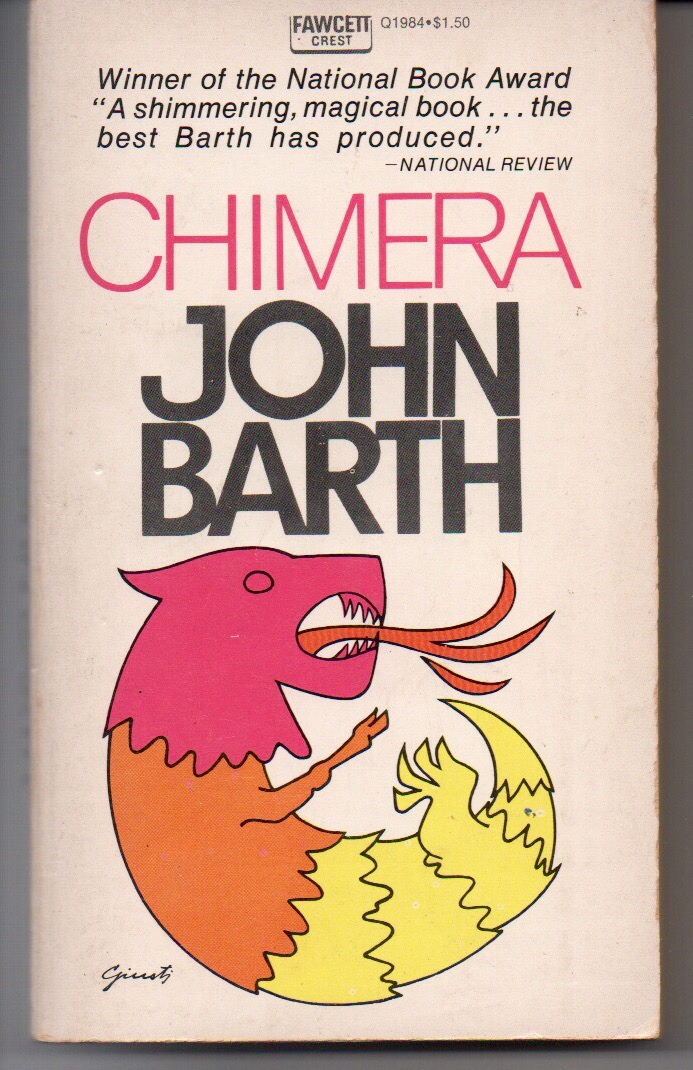
Chimera by John Barth. Mass market paperback by Fawcett Crest, 1973.  No designer credited, and the cover artist isn’t named in the colophon or on the back–but the cover is signed. Perhaps the original hardback, which shares this illustration, credited the artist. I read this book in the right place and at the right time—I was a junior or senior in college, obsessed with postmodernism as a technique (rather than postmodernism as a description), and Chimera’s intense gamesmanship enchanted me. I’m pretty sure I read it after Lost in the Funhouse, and that after Wallace’s Westward the Course of Empire Takes Its Way. I bought this copy eight or nine years ago (having read it first as a library book), and attempted a reread and was…less impressed. Still, it would be hard for me to overstate how much Chimera did for me—how much it showcased the possibilities of literature and storytelling.

img_1639

The Ballad of the Sad Cafe and Other Stories by Carson McCullers. Mass market paperback edition by Bantam. No designer or cover artist credited—which is too bad because I love the image. The most recent date on the colophon is 1971 but I am pretty sure the book was published in 1996. I bought it in 1997. It was assigned reading for a creative writing class, and that—along with Johnson’s Jesus’ Son—were the only good things to come out of that misery. (My instructor would not shut the fuck up about “craft,” and he singled out the simile I was most proud of in one of my stories as “a bit much”).

Today’s Three Books’ mass market paperbacks are part of a small cadre of a once-large selection, winnowed away over the years, usually given away to students, etc. (I have an extra copy of Adventures of Huckleberry Finn in my car, should you need one).

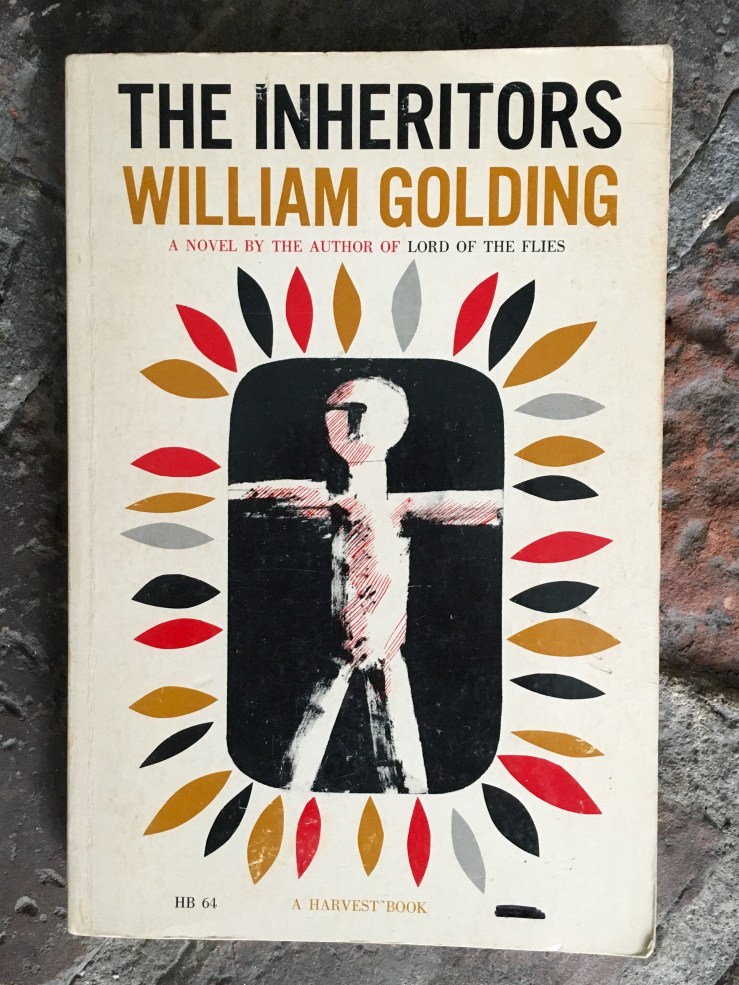
William Golding’s The Inheritors (Book acquired, 2.19.2016, and pretty much finished this week)

img_1633

I picked up William Golding’s 1955 novel The Inheritors last week on a colleague’s recommendation. It’s the story of a band of Neanderthals and their eventual encounter with predatory Homo sapiens. Golding’s Neanderthals seem to possess a near-telepathic power–they share “pictures,” comprising memory, sentiment, words, and ideas. The Neanderthals live fully in the moment, often struggling to recall “pictures” of past events. The viewpoint character Lok is something of a holy fool. His quest to retrieve a missing comrade often finds him laughing in terror.

Golding’s prose is, for the most part, an evocation of concrete contours—sure, there’s a metaphysical dimension to these Neanderthals (they worship Oa, a female spirit)—but Golding’s concern is primarily with capturing how the physical world might be understood through the senses and then converted into “pictures.” A longish passage to showcase Golding’s technique:

The bushes twitched again. Lok steadied by the tree and gazed. A head and a chest faced him, half-hidden. There were white bone things behind the leaves and hair. The man had white bone things above his eyes and under the mouth so that his face was longer than a face should be. The man turned sideways in the bushes and looked at Lok along his shoulder. A stick rose upright and there was a lump of bone in the middle. Lok peered at the stick and the lump of bone and the small eyes in the bone things over the face. Suddenly Lok understood that the man was holding the stick out to him but neither he nor Lok could reach across the river. He would have laughed if it were not for the echo of the screaming in his head. The stick began to grow shorter at both ends. Then it shot out to full length again.

The dead tree by Lok’s ear acquired a voice.

“Clop!”

His ears twitched and he turned to the tree. By his face there had grown a twig: a twig that smelt of other, and of goose, and of the bitter berries that Lok’s stomach told him he must not eat. This twig had a white bone at the end. There were hooks in the bone and sticky brown stuff hung in the crooks. His nose examined this stuff and did not like it. He smelled along the shaft of the twig. The leaves on the twig were red feathers and reminded him of goose. He was lost in a generalized astonishment and excitement.

Lok encounters a new kind of being (a human) wielding a new technology (a bow and poisoned arrows), and tries to fit them into his schema—but his “pictures” are insufficient. The concrete, sense-driven passage concludes in the abstraction of “astonishment and excitement.”

I’m about forty pages from the end of The Inheritors, and I’ve enjoyed it so far. It’s something like a sci-fi novel, really, or even something in the mode of Robbe-Grillet’s nouveau roman. Good stuff.

Three Books

img_1571

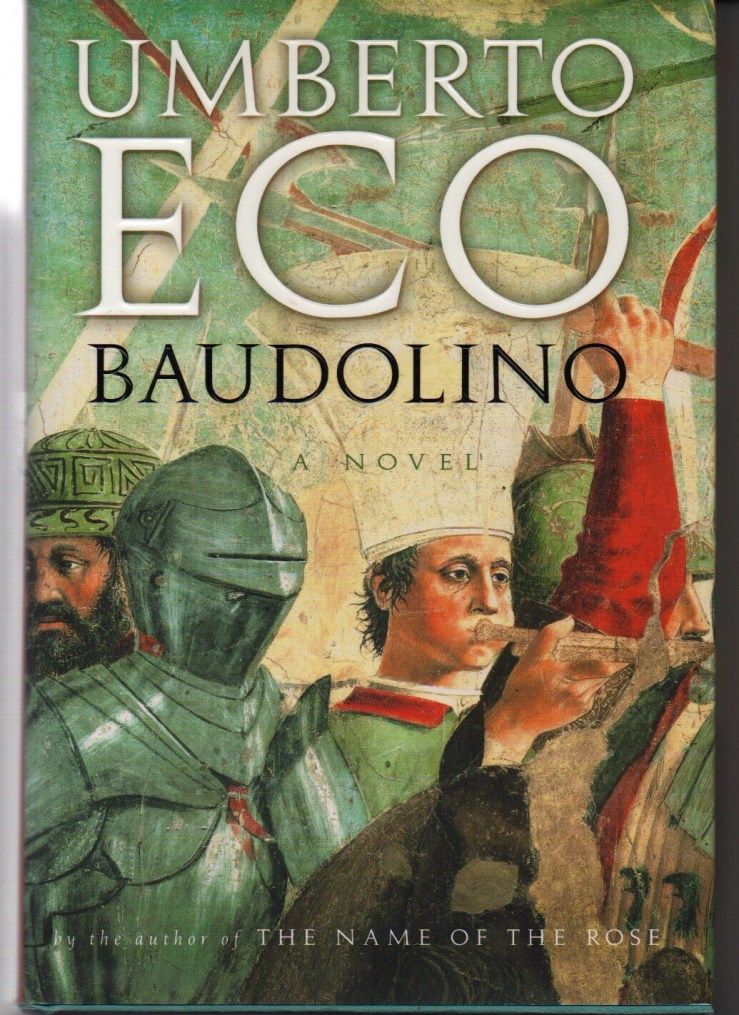
Baudolino by Umberto Eco. First edition hardback by Harcourt, 2002. English trans. by William Weaver. Jacket design by Vaughn Andrews, featuring a detail from the lefts side of Piero  della Francesco’s fresco Battle between Heraclius and Chosroes

I bought this in the last days of 2002 from the dollar table at the Barnes & Noble store near my parents house. I was 23 and had just moved home after living in Japan. I had no plans and was kind of depressed. I really can’t remember what I read around that time, but I know it wasn’t Baudolino. I didn’t get to it until the summer of 2011. It’s a fun, propulsive, sloppy quest narrative—bawdy, rich, a picaresque take on the (not-so-secret) mythological backgrounding of medieval Europe. It kind of unravels at the end.

I had initially planned this Sunday’s Three Books post to feature three Eco titles as a sort of tribute to our deceased semiotician, but alas I only have two here at the house (The Name of the Rose is the other one). I lost my copy of Foucault’s Pendulum over a decade ago, and I gave a colleague my copy of Misreadings just a few months ago (she had expressed a certain distaste for The Prague Cemetery). My copy of On Literature is in my office (although if I’m being honest, I use a samizdat digital copy more often as a reference point). Eco was a sort of gateway drug though to his spiritual brothers, Calvino and Borges. I actually read both of them before Eco, but understood them better when approached after Eco. I don’t know if that makes any sense (and I don’t think it has to make any sense).

img_1572

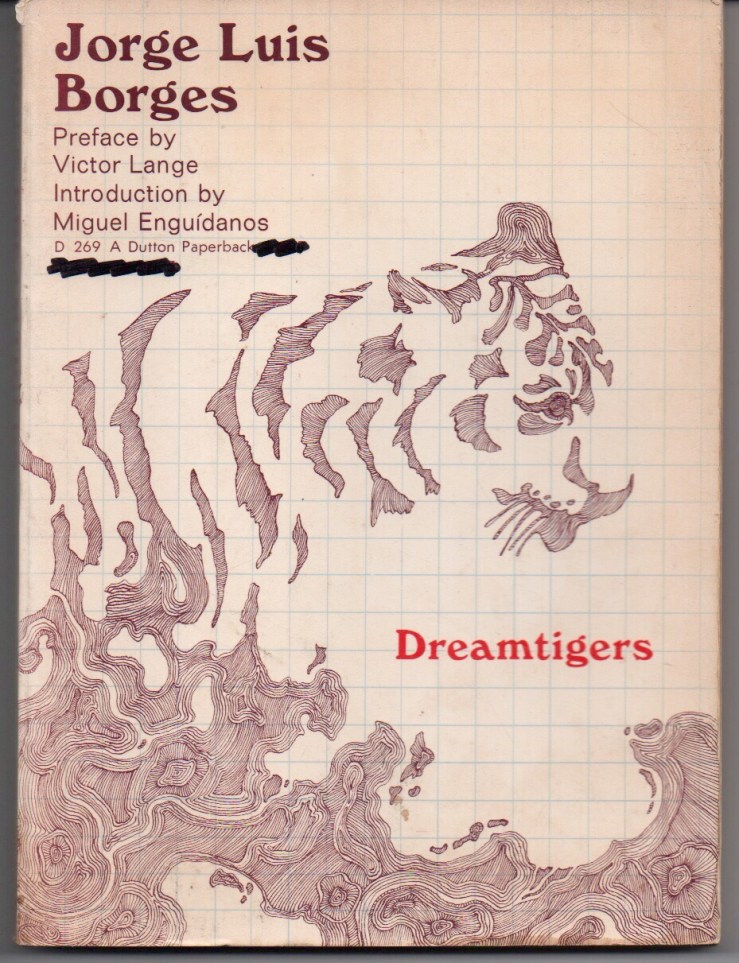
Dreamtigers by Jorge Luis Borges. An irregularly shaped trade paperback by E.P. Dutton & Co., 1970. English translation by Mildred Boyer (prose) and Harold Morland (poetry). Cover design by James McMullan. I love the cover and hate that a bookseller decided to mark out the original pricing with ugly Sharpie ink.

img_1574

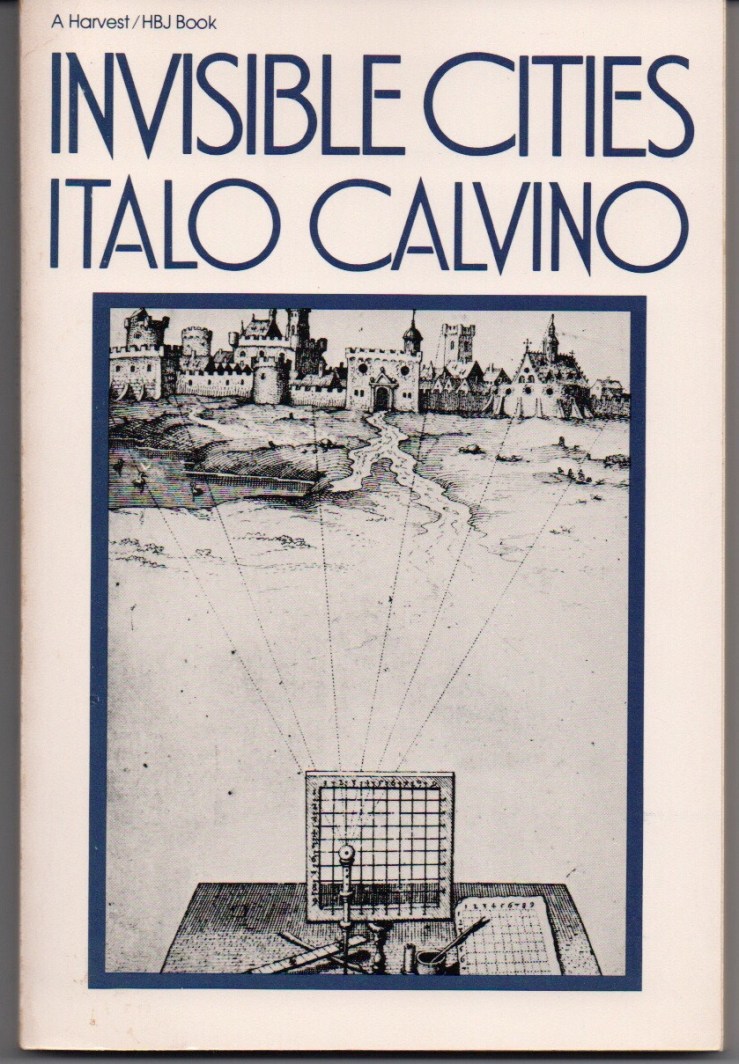
Invisible Cities by Italo Calvino. Harvest/HBJ trade paperback; no year given. English trans. by (Eco’s translator) William Weaver. Cover design by Louise Fili, employing a 17th-c. woodcut of a drawing screen. I first read Invisible Cities in 2002, in spots and places around Thailand. I read my friend’s copy; he had brought it with him to meet me there. He was the same guy who took my copy of Foucault’s Pendulum and never returned it.