Order is simply a thin, perilous condition we try to impose on the basic reality of chaos (William Gaddis)

Before we go any further here, has it ever occurred to any of you that all this is simply one grand misunderstanding? Since you’re not here to learn anything, but to be taught so you can pass these tests, knowledge has to be organized so it can be taught, and it has to be reduced to information so it can be organized do you follow that? In other words this leads you to assume that organization is an inherent property of the knowledge itself, and that disorder and chaos are simply irrelevant forces that threaten it from the outside. In fact it’s the opposite. Order is simply a thin, perilous condition we try to impose on the basic reality of chaos . . .

So I’m going through William Gaddis’s novel J R again (via Nick Sullivan’s amazing audiobook recording-performance)…

Some fine thoughts

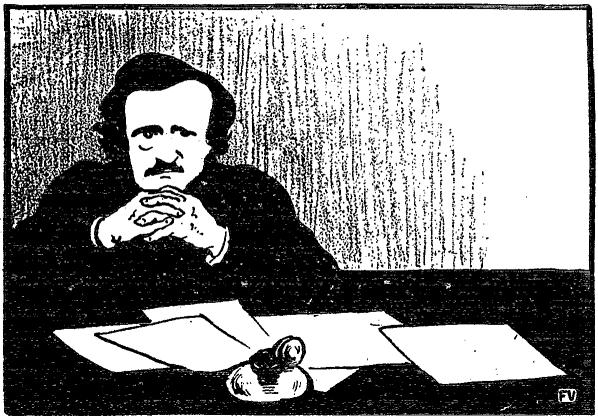
Edgar Allan Poe — Felix Vallotton

edgar-allan-poe-1895

A riff on Ursula K. Le Guin’s Hainish novels


img_1190

“Are we not Men?”

— The Island of Dr. Moreau, H.G. Wells (1896)

“A country, a people…Those are strange and very difficult ideas.”

— Four Ways to Forgivenss, Ursula K. Le Guin (1995)

—Each of the novels in Ursula K. Le Guin’s so-called Hainish cycle obliquely addresses Wells’s question by tackling those strange and very difficult ideas of “a country, a people.” The best of these Hainish books do so in a manner that synthesizes high-adventure sci-fi fantasy with dialectical philosophy.

—What am I calling here “the best”? Well—

The Left Hand of Darkness

Planet of Exile/City of Illusions (treat as one novel in two discursive parts)

The Dispossessed

—(How oh how oh how dare I rank The Dispossessed—clearly a masterpiece, nay?—so low on that little list? It’s too dialectical, maybe? Too light on the, uh, high adventure stuff, on the fantasy and romance and sci-fi. Its ideas are too finely wrought, well thought out, expertly cooked (in contrast to the wonderful rawness of Rocannon’s World, for example). None of this is to dis The Dispossessed—it’s probably the best of the Hainish books, and the first one casual readers should attend to. (It was also the first one I read way back when in high school)).

—The novels in Le Guin’s so-called Hainish cycle are

Rocannon’s World (1966)

Planet of Exile (1966)

City of Illusions (1967)

The Left Hand of Darkness (1969)

The Dispossessed (1974)

The Word for World is Forest (1976)

Four Ways to Forgiveness (1995)

The Telling (2000)

—Okay, so I decided to include For Ways to Forgiveness in the above list even though most people wouldn’t call it a “novel” — but its four stories (novellas, really) are interconnected and tell a discrete story of two interconnected planets that are part of the Hainish world. And I pulled a quote from it above. So.

—I read, or reread, Le Guin’s so-called Hainish cycle close to the chronological order proposed by the science fiction writer Ian Watson. I don’t necessarily recommend this order.

—(I keep modifying “Hainish cycle” with “so-called” because the books aren’t really a cycle. Le Guin’s world-building isn’t analogous to Tolkien’s Middle Earth or Faulkner’s Yoknapatawpha County. (Except when her world-building is analogous). But let us return to order).

Le Guin on the subject:

People write me nice letters asking what order they ought to read my science fiction books in — the ones that are called the Hainish or Ekumen cycle or saga or something. The thing is, they aren’t a cycle or a saga. They do not form a coherent history. There are some clear connections among them, yes, but also some extremely murky ones. And some great discontinuities (like, what happened to “mindspeech” after Left Hand of Darkness? Who knows? Ask God, and she may tell you she didn’t believe in it any more.)

OK, so, very roughly, then:

Rocannon’s World, Planet of Exile, City of Illusions: where they fit in the “Hainish cycle” is anybody’s guess, but I’d read them first because they were written first. In them there is a “League of Worlds,” but the Ekumen does not yet exist.

—I agree with the author. Read this trilogy first. Read it as one strange book.

—(Or—again—pressed for time and wanting only the essential, read The Dispossessed and The Left Hand of Darkness—but you already knew that, no?).

Continue reading “A riff on Ursula K. Le Guin’s Hainish novels”

Three Books

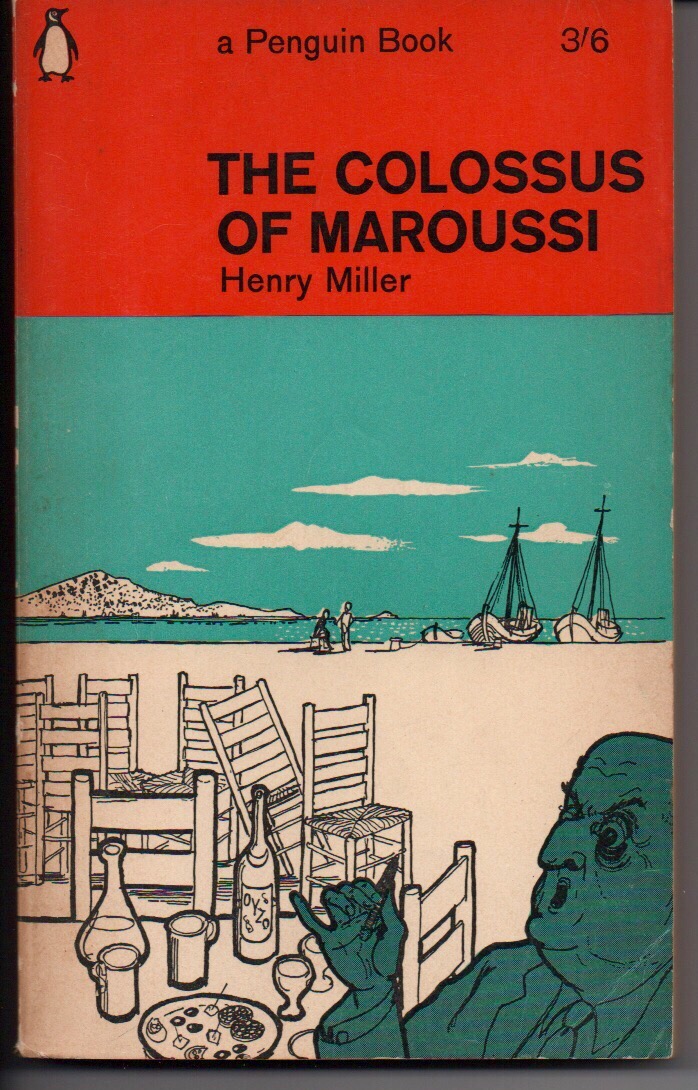
The Colossus of Maroussi by Henry Miller. 1964 paperback by Penguin Books. Cover drawing by the English cartoonist and art critic Osbert Lancaster.

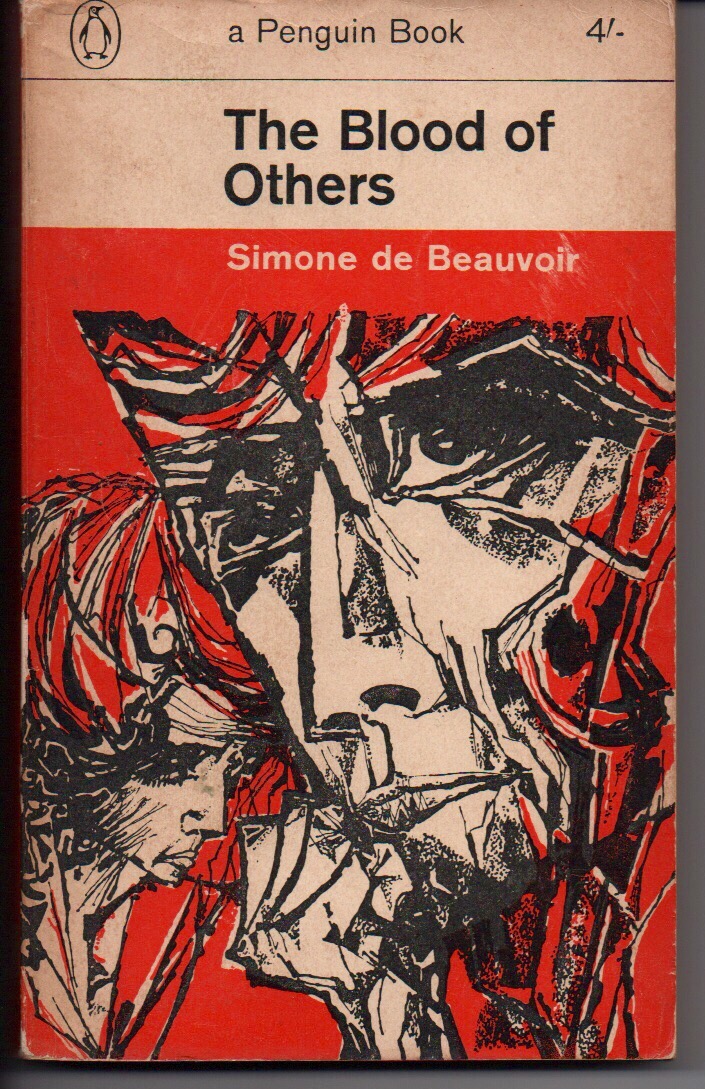
The Blood of Others by Simone de Beauvoir. 1964 paperback by Penguin Books. Cover art by Anthony Common.

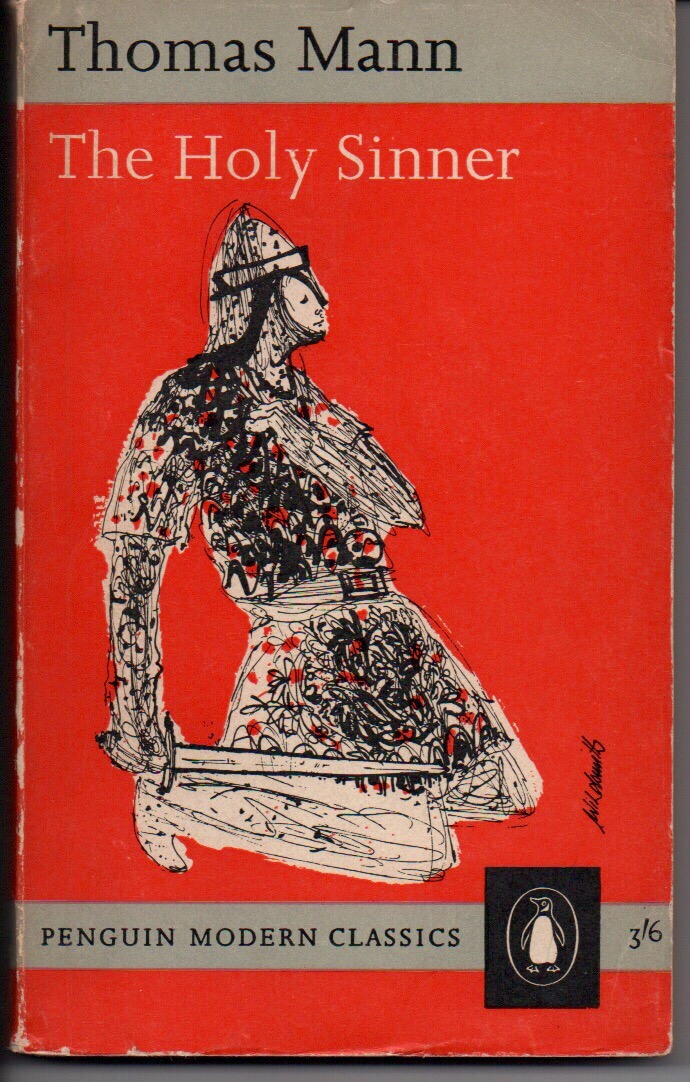
The Holy Sinner by Thomas Mann. 1961 paperback by Penguin Books. Cover art by the English artist Brian Wildsmith, who is perhaps most famous for his marvelous children’s book illustrations.

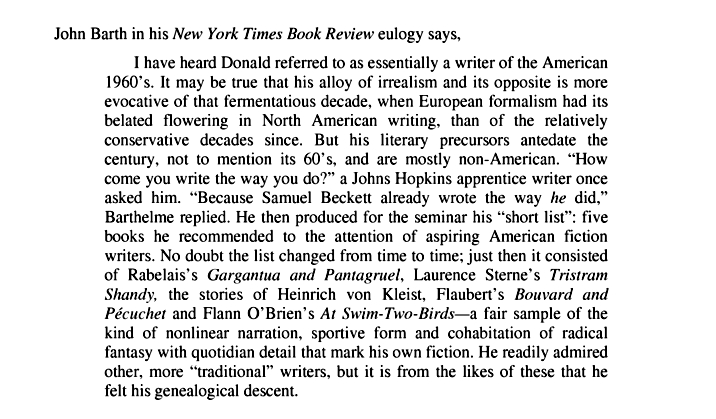
Donald Barthelme’s short list

Screenshot 2016-01-17 at 4From Michael Thomas Hudgens’s Donald Barthelme, Postmodernist American Writer

Pushkin Girl — John Currin


pushkin girl

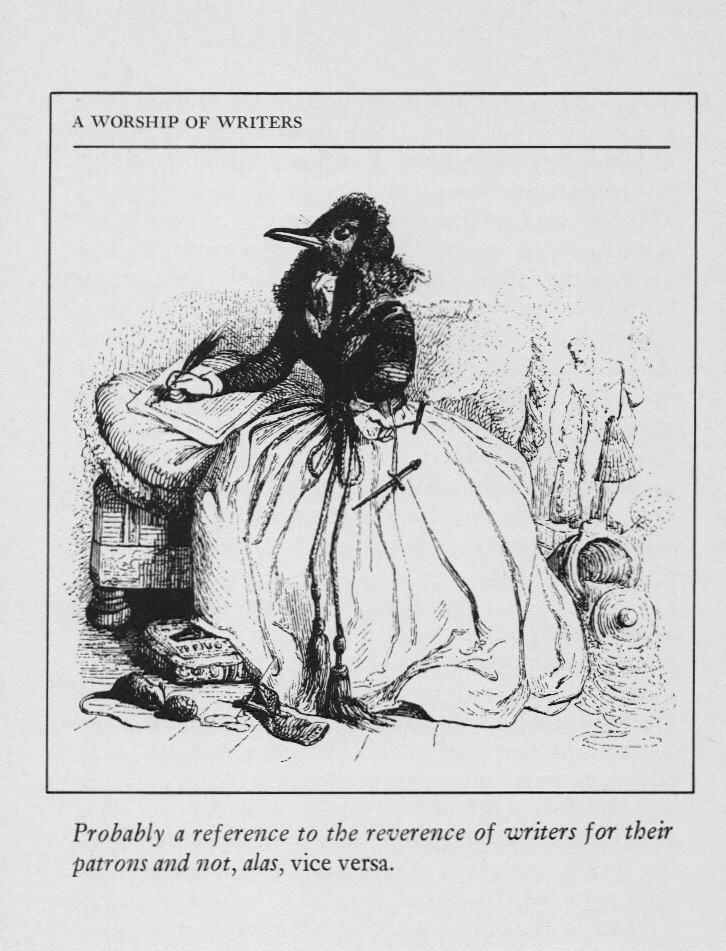
A Worship of Writers

img_1344

From James Lipton’s An Exaltation of Larks.

The Punctuation of Moby-Dick

tumblr_o10crsB51L1qz6f9yo4_1280

(Design by Nicholas Rougeuxvia).

“What’s Friday got to do with the mockin’ bird?” (Zora Neale Hurston)

“What’s de matter, Ah don’t hear no birds?” complained Eugene Oliver. “It don’t seem natural.”

Everybody looked up at one time like cows in a pasture.

“Oh you know how come we don’t hear no birds. It’s Friday and de mocking bird ain’t here,” said Big Sweet after a period of observation.

“What’s Friday got to do with the mockin’ bird?” Eugene challenged.

“Dat’s exactly what Ah want to know,” said Joe Wiley.,

“Well,” said Big Sweet. “Nobody never sees no mockin’ bird on Friday. They ain’t on earth dat day.”

“Well, if they ain’t on earth, where is they?”

“They’s all gone to hell on Friday with a grain of sand in they mouth to help out they friend.” She continued:

Once there was a man and he was very wicked. He useter rob and steal and he was always in a fight and killin’ up people. But he was awful good to birds and mockin’ birds was his favorite. This was a long time ago before de man first started to buildin’ de Rocky Mountains. Well, ‘ way after while somebody kilt him, and being he had done lived so bad, when he died he went straight to hell.

De birds all hated it mighty bad when they seen him in hell, so they tried to git him out. But the fire was too hot so they give up–all but de mockin’ birds. They come together and decided to tote sand until they squenched de fire in hell. So they set a day and they all agreed on it. Every Friday they,totes sand to hell. And that’s how come nobody don’t never see no mockin’ birds on Friday.


Entries under “H” from Captain Grose’s Dictionary of the Vulgar Tongue (1811)

The following definitions are from the “H” section of Captain Grose’s Dictionary of the Vulgar Tongue (1811).

HABERDASHER OF PRONOUNS. A schoolmaster, or
usher.

HACKNEY WRITER. One who writes for attornies or
booksellers.

HACKUM. Captain Hackum; a bravo, a slasher.

HAD’EM. He has been at Had’em, and came home by Clapham; said of one who has caught the venereal disease.

HAIR SPLITTER. A man’s yard.

HALBERT. A weapon carried by a serjeant of foot. To get a halbert; to be appointed a serjeant. To be brought to the halberts; to be flogged a la militaire: soldiers of the infantry, when flogged, being commonly tied to three halberts, set up in a triangle, with a fourth fastened across them. He carries the halbert in his face; a saying of one promoted from a serjeant to a commission officer.

HALF A HOG. Sixpence.

HALF SEAS OVER. Almost drunk.

HAMLET. A high constable. Cant.

HAMS, or HAMCASES Breeches. Continue reading “Entries under “H” from Captain Grose’s Dictionary of the Vulgar Tongue (1811)”

RIP David Bowie

img_1322

I don’t remember the first time I heard David Bowie because I was born in 1979 and he was always there, ahead of me. Always on.

I don’t remember the first time I heard David Bowie, but I do remember my uncle and my cousin would riff this routine on Bowie and Jagger’s video for “Dancing in the Streets,” which I knew even as a child (the video; the routine) was campy fun. Maybe I didn’t know the fun was camp. Maybe I learned the camp from Bowie.

I don’t remember the first time I heard David Bowie, but I do remember the first time I saw Labyrinth.

I don’t remember the first time I heard David Bowie, but I do remember my babysitter, who I believed I was in love with—I was nine, a mature (?!) , impressionable nine—declaring, “David Bowie is my hero” in a dreamy voice. I didn’t that was an option, that a singer could be a hero. I hadn’t heard “Heroes” yet.

I don’t remember the first time I heard David Bowie, but I do remember being utterly bewildered as Macauly Culkin introduced Tin Machine on Saturday Night Live. This was in 1991. I was in, what, seventh, sixth grade? Why weren’t they David Bowie and Tin Machine? My father couldn’t tell me.

I don’t remember the first time I heard David Bowie, but I do remember the first Bowie tape I bought on my own, Diamond Dogs. I think I paid $7.99 for it at the Camelot in the mall. I was in the ninth grade. Then Ziggy Stardust—they were like novels, like sci-fi novels. (I think I tried The Man Who Sold the World next and didn’t quite understand its blues).

I don’t remember the first time I head David Bowie, but I do remember not understanding what the hell was going on in the beginning of Fire Walk With Me.

I don’t remember the first time I heard David Bowie, but I do remember the first time I head Earthling and I thought it wasn’t half bad.

I don’t remember the first time I heard David Bowie, but I do remember my first real Bowie phase, in my freshman year of college: Low“Heroes,” Lodger. And later: Young Americans. Although all you needed for a real proper dance part was Changesbowie (even “Fame ’90” was a jam). You could (you can!) sweat and grind and flop and writhe with others to Bowie; you could (you can!) sit in your room and listen to Bowie on big headphones. Drive to Bowie.

I don’t remember the first time I heard David Bowie, but I do remember that my friend Nick was always ahead of me on Bowie, always sort of leading me into and through Bowie. That Bowie was and is somehow mixed into our friendship.

I don’t remember the first time I heard David Bowie, but I do remember coming home from college one weekend to discover my father had bought ‘Hours…’. This perplexed me. The old man was never a big Bowie fan. “I liked ‘Thursday’s Child.'”

I don’t remember the first time I heard David Bowie, but I do remember the first time I saw The Man Who Fell to Earth. And the next few times.

I don’t remember the first time I heard David Bowie, but I do remember the first time I heard Adrian Belew’s guitar playing on “Boys Keep Swinging.”

I don’t remember the first time I heard David Bowie, but I do remember his evocation of Andy Warhol in Basquiat. And how appropriate, now, I suppose: Bowie does Warhol. That Bowie extended Warhol was a given—Bowie transcended Warhol, and Bowie performing Warhol is a perfect trick, given the relationship of both artists to authenticity and art. Bowie intuited—and then exemplified and engendered and practiced—that authenticity is a performance, that authentic authenticity must be performed. This is why David Bowie was the signal artist of the emerging 21st century.

I don’t remember the first time I heard David Bowie, but I do remember a few months after I graduated college, on the way to work, sleepy, maybe a bit hungover, breaking down in tears at “Space Oddity” for no good reason.

I don’t remember the first time I heard David Bowie, but I do remember the first time I heard David Bowie at a wedding.

I don’t remember the first time I heard David Bowie, but I do remember drunkenly demanding that my best friend blast “Blue Jean” at a party he was having.

I don’t remember the first time I heard David Bowie, but I do remember my son asking who John was re: “John, I’m Only Dancing.”

I don’t remember the first time I heard David Bowie, but I do remember the first time I heard Blackstar. How?

I don’t remember the first time I heard David Bowie, but I do remember how sad I felt the day Lou Reed died—was he not immortal? If Lou Reed could die anybody could die. But not David Bowie. David Bowie is too immortal to die.

The intimacy we feel with our heroes. They sing for us. They sing loud and public, or privately for us. We sweat to them or fall asleep or space out or more. We jam them into our ear. We know that they wrote those songs for usAbout us. How ridiculous to think, Well of course you didn’t know David Bowie! Of course I knew David Bowie.

I don’t remember the first time I heard David Bowie, but I do remember pulling out David Bowie records and playing tracks from them all afternoon.

I don’t remember the first time I heard David Bowie, but I do remember that there’s a lot I’m forgetting, but I’m just riffing and ranting and maybe you loved him too. I bet you did.


Three Books

Last week on Three Books, I featured three books I kinda sorta maybe plan to read in 2016. Here are three more:

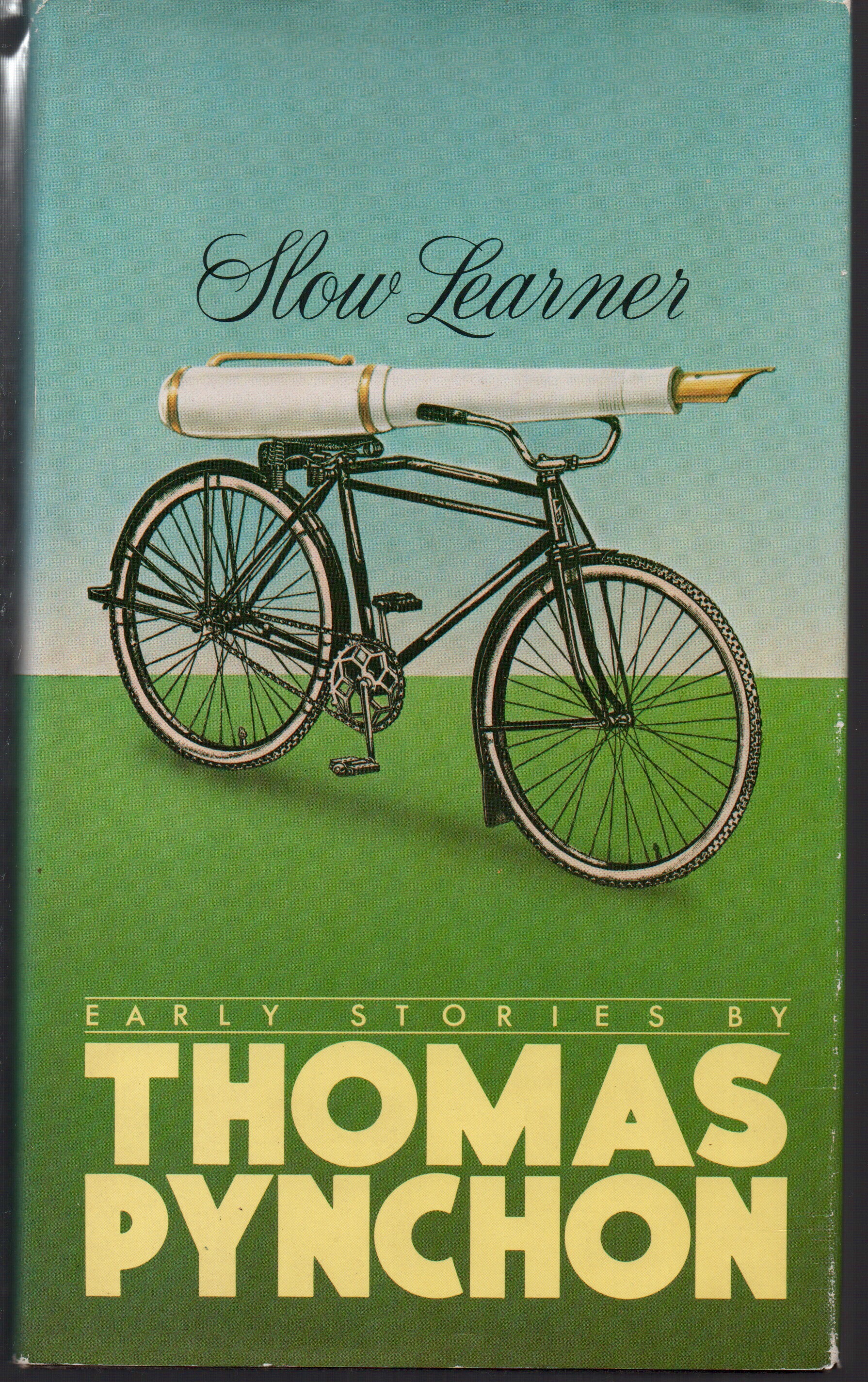
Slow Learner by Thomas Pynchon. First edition hardback by Little, Brown (1984). Jacket design by Fred Marcellino. I’ve only read “Entropy” from this collection so far. (I actually tried to use it in my Intro American Lit class—it’s in The Norton Anthology of American Literature, Vol. E, somehow—and no, it didn’t go over well, but hey).

The Weight of Things by Marianne Fritz; English translation by Adrian Nathan West. First edition trade paperback from Dorothy (2015). Cover art is Anonymous by Hella van ‘t Hof. Book design by Danielle Dutton. I started this as the chaser to Ishmael Reed’s The Free-Lance Pallbearers—proved to be a false start (went on a Le Guin jag instead). Feels like a one-sitting read.

The Easy Chain by Evan Dara. First edition trade paperback from Aurora (2008). Cover and design by Todd Michael Bushman. Does anyone want to read The Easy Chain with me?

Good or bad codes/good or bad deaths (Lucia Berlin)

While the staff members think in terms of good or bad codes – how well everyone did what they were supposed to do, whether the patient responded or not – I think in terms of good or bad deaths.

Bad deaths are ones with the manager of a hotel as next of kin, or the cleaning woman who found the stroke victim two weeks later, dying of dehydration. Really bad deaths are when there are several children and in-laws I have called in from somewhere inconvenient and none of them seem to know each other or the dying parent at all. There is nothing to say. They keep talking about arrangements, about having to make arrangements, about who will make arrangements.

Gypsies are good deaths. I think so. . .  the nurses don’t and security guards don’t. There are always dozens of them demanding to be with the dying person, to kiss them and hug them, unplugging and screwing up the TVs and monitors and assorted apparatus. The best thing about gypsy deaths is they never make their kids keep quiet. The adults wail and cry and sob but all the children continue to run around, playing and laughing, without being told they should be sad or respectful.

Good deaths seem to be coincidentally good Codes – the patient responds miraculously to all the life-giving treatment and then just quietly passes away.

From Lucia Berlin’s short story “Emergency Room Notebook, 1977.”

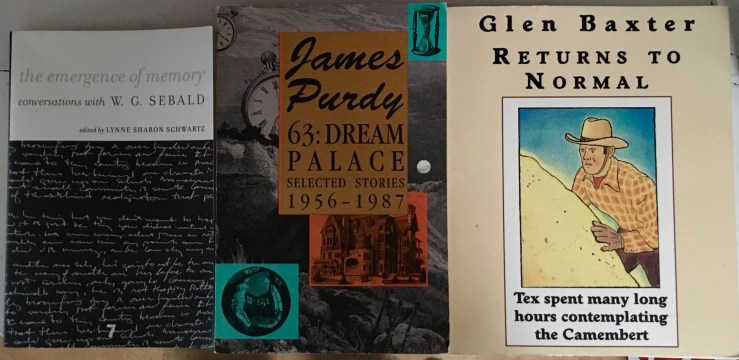
Sebald/Purdy/Baxter (Books acquired, 1.05.2016)

img_1288

“We’ve Only Just Begun,” more new fiction from Anne Carson

They got into our car at a stoplight. It was cold. We never lock the doors in back. There were two of them. At the apartment they terrorized us. It took all day, most of the night. There was beating and thrashing and scorn and damage and fear. Sounds I didn’t know could come out of us. Above all it was boring. In the sense that it was all actions and all bad; there is no life of the mind available amid beating and thrashing and scorn and damage and fear, no space at the back of oneself to go to and think anything else. Long stretches of boredom that fill up with something like thinking but there is nothing to think except what it is, what it is to be in this, and what it is to be in this is simply and utterly nothing but what it is, no volume around it, no beach, no reverie. At one point Washington raised his arms to me and blood ran down both arms to the floor. I watched it hit the tiles, it would have been something to think about, cleaning blood off tiles. Sometimes it’s better to just replace them. Eventually in fact that’s what we would do, replace the white ones. We kept the black ones, which were sort of speckled anyway. But “eventually” is not a concept of mind that exists amid beating and thrashing and scorn and damage and fear. Even when they had Washington dance in the red-hot shoes, I wasn’t imagining analogies, Snow White, I was soaked into Washington’s dread, it had no edge. That is what boredom is, the moment with no edge.

To survive you need an edge.

Read the rest of “We’ve Only Just Begun” at Harper’s.