“October” — Tom Clark

october

What a dolt am I to obtrude my counsel | Nathaniel Hawthorne’s journal entry for September 14th, 1841

Salem, September 14th.–. . . Master Cheever is a very good subject for a sketch, especially if he be portrayed in the very act of executing judgment on an evil-doer. The little urchin may be laid across his knee, and his arms and legs, and whole person indeed, should be flying all abroad, in an agony of nervous excitement and corporeal smart. The Master, on the other hand, must be calm, rigid, without anger or pity, the very personification of that immitigable law whereby suffering follows sin. Meantime the lion’s head should have a sort of sly twist on one side of its mouth, and a wink of one eye, in order to give the impression that, after all, the crime and the punishment are neither of them the most serious things in the world. I could draw the sketch myself, if I had but the use of —-‘s magic fingers.

Then the Acadians will do very well for the second sketch. They might be represented as just landing on the wharf; or as presenting themselves before Governor Shirley, seated in the great chair. Another subject might be old Cotton Mather, venerable in a three-cornered hat and other antique attire, walking the streets of Boston, and lifting up his hands to bless the people, while they all revile him. An old dame should be seen, flinging water, or emptying some vials of medicine, on his head from the latticed window of an old-fashioned house; and all around must be tokens of pestilence and mourning,–as a coffin borne along,–a woman or children weeping on a doorstep. Can the tolling of the Old South bell be painted?

If not this, then the military council, holden at Boston by the Earl of Loudon and other captains and governors, might be taken,–his lordship in the great chair, an old-fashioned, military figure, with a star on his breast. Some of Louis XV.’s commanders will give the costume. On the table, and scattered about the room, must be symbols of warfare,–swords, pistols, plumed hats, a drum, trumpet, and rolled-up banner in one heap. It were not amiss to introduce the armed figure of an Indian chief, as taking part in the council,–or standing apart from the English, erect and stern.

Now for Liberty Tree. There is an engraving of that famous vegetable in Snow’s History of Boston. If represented, I see not what scene can be beneath it, save poor Mr. Oliver, taking the oath. He must have on a bag-wig, ruffled sleeves, embroidered coat, and all such ornaments, because he is the representative of aristocracy and an artificial system. The people may be as rough and wild as the fancy can make them; nevertheless, there must be one or two grave, puritanical figures in the midst. Such an one might sit in the great chair, and be an emblem of that stern, considerate spirit which brought about the Revolution. But this would be a hard subject.

But what a dolt am I to obtrude my counsel, . . .

Nathaniel Hawthorne’s journal entry for September 14th, 1841. From Passages from the American Note-Books.

I saw only one tower standing to the south, and that one ringed with fire | Denis Johnson

At the moment, I was heading anywhere at all for breakfast, but when I heard the desk clerk’s radio playing news that an aircraft, I assumed a sightseeing plane, had struck Tower Two of the World Trade Center, I decided to jump on the number 3 subway half a block west, and go have a look.

As I headed toward Eighth Avenue I tried calling Mark Ahearn about lunch, but my cellphone only hammered out a rapid-fire beep. Please don’t ask me how this can be true: I traveled through the busy lobby and walked for half a long block on a crowded Manhattan street and then boarded the World Trade Center subway completely unaware that I was participating in a citywide disaster, and moving toward its center.

The World Trade Center station came a few stops south of Twenty-Third Street, but we didn’t get there. After Christopher Street the train halted in the tunnel and waited, humming. It gave a screech, lurched backward slightly, and stopped again. Somehow the general news had infiltrated the sealed subterranean environment that something historically enormous was happening very nearby, and it got quiet in our compartment, and almost everybody entered into a small, desperate battle with a worthless cellphone. The train moved forward and gained speed, but began braking long before Houston Street, the next station, where it halted with several rear cars sticking out behind into the tunnel. For a tense minute, whoever spoke only whispered. Then came a shout—“Tell us what’s going on!” and others raised the same cry until we heard the conductor’s PA saying something about the tracks, the tracks…“Due to the catastrophe, this train will not go farther. Please exit out the forward cars onto the platform. Do not go onto the tracks.” We were all on our feet, maneuvering selfishly, angling for the doors. But the doors didn’t open. The engine stopped. “Open the doors! Open the doors!” The engine started. A man shouted, “Just everybody stand still!” People from the car behind had pried their way into ours, and somebody almost went down. A woman said, “Stop that, you fool!” A man in front of me pushed a teenage boy beside him. With the meat of his fist he began beating the back of the boy’s head. And I jumped into the fray, didn’t you, Harrington, like a monkey, yes you did, and got yourself an elbow in the eye. The doors to the compartment flew open and people clambered out onto the station’s platform, where a dreadlocked man in a crimson athletic suit jumped up and down on a bench as if it were a trampoline, screaming “God, see what we’re doing to each other down here.” When I came up into the street, dizzy and one-eyed, I couldn’t get my bearings. I saw only one tower standing to the south, and that one ringed with fire. I asked a man nearby—“Where are we? I can’t see the other tower.” He said, “It fell” and I said, “No it didn’t.” He didn’t argue. We stood in the middle of the street with thousands of other people, all of us motionless, like a frozen parade, all silent. I began to believe the man. We watched the flames spreading through the building’s upper stories over the course of about twenty minutes, and then the eighteen-hundred-foot structure seemed to curtsy and dip left, and then it went down.

I turned around and looked at the people behind me. I saw shocked laughter, weeping, horror, bewilderment. The young man next to me bawled at the top of his lungs. I was afraid to ask him if he had a loved one in the buildings afraid to talk to him at all, but he raised his agonized, Christly face to me and suddenly laughed, saying, “Buddy, you are working on one heck of a black eye.” We stood far from the buildings—at least a mile, I’d say—far enough that we didn’t feel the ground shake, and we heard nothing but sirens, and official-sounding voices screaming, “Get out of the street! Stay out of the street!” and others too—“They’re attacking the Capitol!—the Pentagon!—the White House!”

Cop cars and ambulances heaped with dust and chunks of concrete came at us out of the south. I started walking that direction, I don’t know why, but I soon realized I was the only person heading downtown, and then the tide of panic pressing toward me was too heavy to go against, and I turned around and let it take me north.

From Denis Johnson’s short story “Doppelgänger, Poltergeist.” Collected in The Largesse of the Sea Maiden, 2017.


“Ex Cathedra” — Joaquim Maria Machado de Assis

“Ex Cathedra”

by

Joaquim Maria Machado de Assis

translated by

Rhett McNeil


“Godfather, you’ll go blind from that, sir.”

“What?”

“You’re going to go blind. Reading is so sad. No sir, give me that book.”

Caetaninha took the book out of his hands. Her godfather paced around and then went into his study, where there was no lack of books. He closed the door behind him and kept reading. That was his vice. He read excessively; he read morning, noon, and night, during lunch and dinner, before going to sleep, after bathing; he read as he walked, read standing up, read in his house and in his barn; he read before reading and he read after reading; he read all sorts of books, but especially books on law (in which he’d received his degree), mathematics, and philosophy. Lately, he’d also been reading up on the natural sciences.

Worse than going blind, he went crazy. It was near the end of 1873, in Tijuca, when he started to show signs of mental disturbance; but, since the episodes were minor and few, his goddaughter only started to notice the difference in March or April of 1874. One day, over lunch, he interrupted his reading to ask her:

“What’s my name again?”

“What’s your name, godfather?” she repeated, astonished. “Your name is Fulgencio.”

“From this day forth, my name will be Fulgencius.”

And, burying his face in the book, he went on reading. Caetaninha mentioned the episode to the slave women, who admitted that they’d had their doubts about him for some time, that he hadn’t seemed well. Just imagine how fearful she was; but her fear soon passed, leaving only compassion behind, which increased her affection for him. His mania was also limited and docile, and was only related to books. Fulgencio lived for the written word, the printed word, doctrines, abstract thought, principles, and formulas. He eventually passed from mere superstition to true hallucination of the theoretical. One of his maxims was that liberty would not die, so long as there was a single piece of paper on which to declare it. So one day, waking up with the idea of improving the condition of the Turks, he wrote a constitution for them and sent it to the British diplomat in Petrópolis as a gift. On another occasion, he set about studying the eyes in anatomy books to verify whether they were really able to see, and concluded that they were.

Tell me, readers, whether, under such conditions, Caetaninha’s life could have been a happy one? It’s true that she wanted for nothing, because her godfather was rich. He had been the one who’d raised her, from the age of seven, when he lost his wife. He had taught her to read and write, French, and a little bit – so as not to say almost nothing – of history and geography, and had charged the domestic slaves with teaching her embroidery, lace-making, and sewing. There’s no denying any of that. But Caetaninha had turned fourteen and, if, in the early years, her toys and the slaves were enough to entertain her, she was now at an age when toys go out of style and slaves hold no interest, when no amount of reading or writing can transform a solitary house in Tijuca into a paradise. She went out sometimes, but rarely, and always in a rush. She never went to the theater or to dances, never made or received visits. Whenever she saw a cavalcade of men and women on horseback out in the street, her soul would ride pillion on one of the horses and ride off with them, leaving only her body behind, right next to her godfather, who kept on reading. Continue reading ““Ex Cathedra” — Joaquim Maria Machado de Assis”

Read “Damn!” an early short story by Charles Portis

“Damn!”

by

Charles Portis


If Sanford T.’s daddy hadn’t got killed that night I guess we’d still be with the carnival. What we was doing was hauling old man McClerkin around the country claiming he was Jesse James and charging fifty cents a head to come in and see him. We had to pay Mr Mooney thirty per cent of the take to travel around with his carnival but we was making good money anyway. That all come to an end the night Jesse got drunk and fell out of the Ferris wheel on top of a cotton candy stand. We tried for awhile having Sanford T. billed as Bob Ford but he wasn’t old enough to fool anybody and we had to close up. Mr Mooney kept us on to bark for the freak show but you talk about some hard folks to get along with, that’s freaks. We was about ready to quit anyhow when the alligator boy busted Sanford T.’s leg with a crow bar, something you might or might not expect out of a alligator boy. The carnival left us stranded in Montezuma, Arkansas, where Sanford T. was in the hospital and I guess that was the best thing that ever happened to us. The reason for that initial is that he’s got an older brother named Sanford too. His folks just liked the name I guess.

I was setting on a bench in front of the courthouse reading Billboard when this old, weasel-eyed man comes up and sets down beside me.

“I hear you’re a carny,” he said.

“Well, you hear right, old man. Only I’m not working right now.”

“You got any money?”

I reached in my pocket and held out a half-dollar.

“Naw, naw,” he said, “I didn’t mean nothing like that. I’m the one what ought to be giving you a half. I want to talk business.”

“All right, start talking.”

“You innarested in making some money?”

“Now look, if you’re some kind of con man you ain’t talking to no farmer.’’

I finally pulled it out of him. He had a little place just outside of town where he bottled patent medicine and he wanted to sell out because his health was failing him and his doctor told him he better move out west if he wanted to live.

“How come you don’t take this medicine and save yourself a trip?” I asked him.

“Well, you see, that’s what’s wrong with me now. This is liver emulsifier, that’s what I call it, ‘Bethel Liver Emulsifier’, and my liver is so stout now that it’s overworking my other organs. I’ve got the liver of a 21-year-old boy, believe it or not. Of course you’re a layman and wouldn’t understand all about how it works. Has to do with bile flow and all that.”

“You got me there all right,” I said.

“And besides, my daughter out in California is about to worry me to death to move in with her. I’m willing to take a big loss on a quick deal.”

Read the rest of “Damn!” at Bookanista

Seven story ideas from Nathaniel Hawthorne’s journal entry for August 22nd, 1838

A young man and girl meet together, each in search of a person to be known by some particular sign. They watch and wait a great while for that person to pass. At last some casual circumstance discloses that each is the one that the other is waiting for. Moral,–that what we need for our happiness is often close at hand, if we knew but how to seek for it.

The journal of a human heart for a single day in ordinary circumstances. The lights and shadows that flit across it; its internal vicissitudes.

Distrust to be thus exemplified: Various good and desirable things to be presented to a young man, and offered to his acceptance,–as a friend, a wife, a fortune; but he to refuse them all, suspecting that it is merely a delusion. Yet all to be real, and he to be told so, when too late.

A man tries to be happy in love; he cannot sincerely give his heart, and the affair seems all a dream. In domestic life, the same; in politics, a seeming patriot; but still he is sincere, and all seems like a theatre.

An old man, on a summer day, sits on a hill-top, or on the observatory of his house, and sees the sun’s light pass from one object to another connected with the events of his past life,–as the school-house, the place where his wife lived in her maidenhood,–its setting beams falling on the churchyard.

An idle man’s pleasures and occupations and thoughts during a day spent by the seashore: among them, that of sitting on the top of a cliff, and throwing stones at his own shadow, far below.

A blind man to set forth on a walk through ways unknown to him, and to trust to the guidance of anybody who will take the trouble; the different characters who would undertake it: some mischievous, some well-meaning, but incapable; perhaps one blind man undertakes to lead another. At last, possibly, he rejects all guidance, and blunders on by himself.

From Nathaniel Hawthorne’s journal entry for August 22nd, 1837. From Passages from the American Note-Books. The full journal entry contains a description of a walk, a note on Hawthorne’s ancestors, and a description of a portrait gallery in the Essex Historical Society.

“Helping,” a short story by Robert Stone

“Helping”

by

Robert Stone


One gray November day, Elliot went to Boston for the afternoon. The wet streets seemed cold and lonely. He sensed a broken promise in the city’s elegance and verve. Old hopes tormented him like phantom limbs, but he did not drink. He had joined Alcoholics Anonymous fifteen months before.

Christmas came, childless, a festival of regret. His wife went to Mass and cooked a turkey. Sober, Elliot walked in the woods.

In January, blizzards swept down from the Arctic until the weather became too cold for snow. The Shawmut Valley grew quiet and crystalline. In the white silences, Elliot could hear the boards of his house contract and feel a shrinking in his bones. Each dusk, starveling deer came out of the wooded swamp behind the house to graze his orchard for whatever raccoons had uncovered and left behind. At night he lay beside his sleeping wife listening to the baying of dog packs running them down in the deep moon-shadowed snow.

Day in, day out, he was sober. At times it was almost stimulating. But he could not shake off the sensations he had felt in Boston. In his mind’s eye he could see dead leaves rattling along brick gutters and savor that day’s desperation. The brief outing had undermined him.

Sober, however, he remained, until the day a man named Blankenship came into his office at the state hospital for counselling. Blankenship had red hair, a brutal face, and a sneaking manner. He was a sponger and petty thief whom Elliot had seen a number of times before.

“I been having this dream,” Blankenship announced loudly. His voice was not pleasant. His skin was unwholesome. Every time he got arrested the court sent him to the psychiatrists and the psychiatrists, who spoke little English, sent him to Elliot. Continue reading ““Helping,” a short story by Robert Stone”

We proceeded through wood-paths to Walden Pond | Nathaniel Hawthorne’s journal entry for August 15th, 1842

August 15th.–George Hillard and his wife arrived from Boston in the dusk of Saturday evening, to spend Sunday with us. It was a pleasant sensation, when the coach rumbled up our avenue, and wheeled round at the door; for I felt that I was regarded as a man with a household,–a man having a tangible existence and locality in the world,–when friends came to avail themselves of our hospitality. It was a sort of acknowledgment and reception of us into the corps of married people,–a sanction by no means essential to our peace and well-being, but yet agreeable enough to receive. So we welcomed them cordially at the door, and ushered them into our parlor, and soon into the supper-room. . . . The night flitted over us all, and passed away, and up rose a gray and sullen morning, . . . and we had a splendid breakfast of flapjacks, or slapjacks, and whortleberries, which I gathered on a neighboring hill, and perch, bream, and pout, which I hooked out of the river the evening before. About nine o’clock, Hillard and I set out for a walk to Walden Pond, calling by the way at Mr. Emerson’s, to obtain his guidance or directions, and he accompanied us in his own illustrious person. We turned aside a little from our way, to visit Mr. —-, a yeoman, of whose homely and self-acquired wisdom Mr. Emerson has a very high opinion. We found him walking in his fields, a short and stalwart and sturdy personage of middle age, with a face of shrewd and kind expression, and manners of natural courtesy. He had a very free flow of talk; for, with a little induction from Mr. Emerson, he began to discourse about the state of the nation, agriculture, and business in general, uttering thoughts that had come to him at the plough, and which had a sortof flavor of the fresh earth about them. His views were sensible and characteristic, and had grown in the soil where we found them; . . . and he is certainly a man of intellectual and moral substance, a sturdy fact, a reality, something to be felt and touched, whose ideas seem to be dug out of his mind as he digs potatoes, beets, carrots, and turnips out of the ground.

After leaving Mr. —-, we proceeded through wood-paths to Walden Pond, picking blackberries of enormous size along the way. The pond itself was beautiful and refreshing to my soul, after such long and exclusive familiarity with our tawny and sluggish river. It lies embosomed among wooded hills,–it is not very extensive, but large enough for waves to dance upon its surface, and to look like a piece of blue firmament, earth-encircled. The shore has a narrow, pebbly strand, which it was worth a day’s journey to look at, for the sake of the contrast between it and the weedy, oozy margin of the river. Farther within its depths, you perceive a bottom of pure white sand, sparkling through the transparent water, which, methought, was the very purest liquid in the world. After Mr. Emerson left us, Hillard and I bathed in the pond, and it does really seem as if my spirit, as well as corporeal person, were refreshed by that bath. A good deal of mud and river slime had accumulated on my soul; but these bright waters washed them all away.

We returned home in due season for dinner, . . . To my misfortune, however, a box of Mediterranean wine proved to have undergone the acetous fermentation; so that the splendor of the festival suffered some diminution. Nevertheless, we ate our dinner with a good appetite, and afterwards went universally to takeour several siestas. Meantime there came a shower, which so besprinkled the grass and shrubbery as to make it rather wet for our after-tea ramble. The chief result of the walk was the bringing home of an immense burden of the trailing clematis-vine, now just in blossom, and with which all our flower-stands and vases are this morning decorated. On our return we found Mr. and Mrs. S—- , and E. H—-, who shortly took their leave, and we sat up late, telling ghost-stories. This morning, at seven, our friends left us. We were both pleased with the visit, and so, I think, were our guests.

From Nathaniel Hawthorne’s American Note-Books.


Master among these queer magicians | Nathaniel Hawthorne’s journal entry for August 9th, 1857

Chorlton Road, August 9th.–We have changed our lodgings since my last date, those at Old Trafford being inconvenient, and the landlady a sharp, peremptory housewife, better fitted to deal with her own family than to be complaisant to guests. We are now a little farther from the Exhibition, and not much better off as regards accommodation, but the housekeeper is a pleasant, civil sort of a woman, auspiciously named Mrs. Honey. The house is a specimen of the poorer middle-class dwellings as built nowadays,–narrow staircase, thin walls, and, being constructed for sale, very ill put together indeed,–the floors with wide cracks between the boards, and wide crevices admitting both air and light over the doors, so that the house is full of draughts. The outer walls, it seems to me, are but of one brick in thickness, and the partition walls certainly no thicker; and the movements, and sometimes the voices, of people in the contiguous house are audible to us. The Exhibition has temporarily so raised the value of lodgings here that we have to pay a high price for even such a house as this.

Mr. Wilding having gone on a tour to Scotland, I had to be at the Consulate every day last week till yesterday; when I absented myself from duty, and went to the Exhibition. U– and I spent an hour together, looking principally at the old Dutch masters, who seem to me the most wonderful set of men that ever handled a brush. Such lifelike representations of cabbages, onions, brass kettles, and kitchen crockery; such blankets, with the woollen fuzz upon them; such everything I never thought that the skill of man could produce! Even the photograph cannot equal their miracles. The closer you look, the more minutely true the picture is found to be, and I doubt if even the microscope could see beyond the painter’s touch. Gerard Dow seems to be the master among these queer magicians. A straw mat, in one of his pictures, is the most miraculous thing that human art has yet accomplished; and there is a metal vase, with a dent in it, that is absolutely more real than reality. These painters accomplish all they aim at,–a praise, methinks, which can be given to no other men since the world began. They must have laid down their brushes with perfect satisfaction, knowing that each one of their million touches had been necessary to the effect, and that there was not one too few nor too many. And it is strange how spiritual and suggestive the commonest household article–an earthen pitcher, for example–becomes, when represented with entire accuracy. These Dutchmen got at the soul of common things, and so made them types and interpreters of the spiritual world.

Afterwards I looked at many of the pictures of the old masters, and found myself gradually getting a taste for them; at least they give me more and more pleasure the oftener I come to see them. Doubtless, I shall be able to pass for a man of taste by the time I return to America. It is an acquired taste, like that for wines; and I question whether a man is really any truer, wiser, or better for possessing it. From the old masters, I went among the English painters, and found myself more favorably inclined towards some of them than at my previous visits; seeing something wonderful even in Turner’s lights and mists and yeasty waves, although I should like him still better if his pictures looked in the least like what they typify. The most disagreeable of English painters is Etty, who had a diseased appetite for woman’s flesh, and spent his whole life, apparently, in painting them with enormously developed busts. I do not mind nudity in a modest and natural way; but Etty’s women really thrust their nudity upon you with malice aforethought. . . . and the worst of it is they are not beautiful.

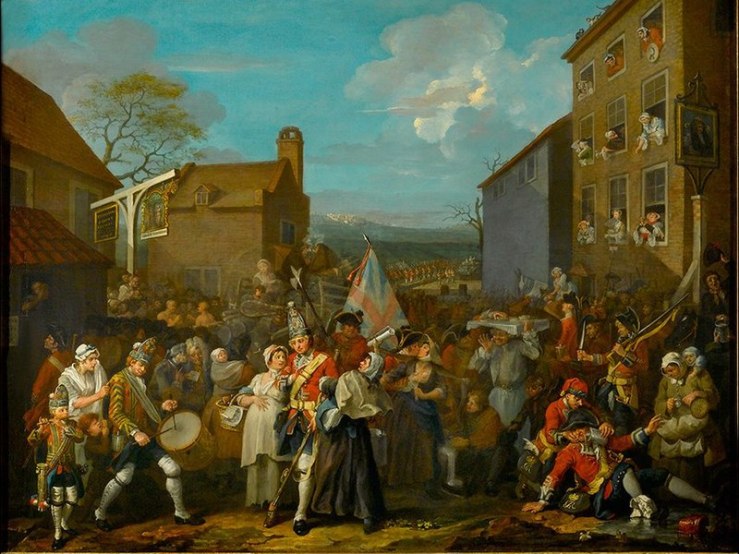
Among the last pictures that I looked at was Hogarth’s March to Finchley; and surely nothing can be covered more thick and deep with English nature than that piece of canvas. The face of the tall grenadier in the centre, between two women, both of whom have claims on him, wonderfully expresses trouble and perplexity; and every touch in the picture meant something and expresses what it meant.

The price of admission, after two o’clock, being six-pence, the Exhibition was thronged with a class of people who do not usually come in such large numbers. It was both pleasant and touching to see how earnestly some of them sought to get instruction from what they beheld. The English are a good and simple people, and take life in earnest.

Nathaniel Hawthorne’s journal entry for August 9th, 1857. From Passages from the English Note-Books.

artist-in-his-studio-1632
Artist in His Studio, 1632 by Gerrit Dou (Gerard Dow; 1613-1675)
a082d1b6e44bb6567c88b2d1fb9b0dc2
The Three Graces by William Etty (1787–1849)
800px-william_hogarth_007
The March of the Guards to Finchley1750 by William Hogarth (1697-1764)

“Bartleby” is the first great epic of modern Sloth (Thomas Pynchon)

By the time of “Bartleby the Scrivener: A Story of Wall-Street” (1853), acedia had lost the last of its religious reverberations and was now an offense against the economy. Right in the heart of robber-baron capitalism, the title character develops what proves to be terminal acedia. It is like one of those western tales where the desperado keeps making choices that only herd him closer to the one disagreeable finale. Bartleby just sits there in an office on Wall Street repeating, “I would prefer not to.” While his options go rapidly narrowing, his employer, a man of affairs and substance, is actually brought to question the assumptions of his own life by this miserable scrivener — this writer! — who, though among the lowest of the low in the bilges of capitalism, nevertheless refuses to go on interacting anymore with the daily order, thus bringing up the interesting question: who is more guilty of Sloth, a person who collaborates with the root of all evil, accepting things-as-they-are in return for a paycheck and a hassle-free life, or one who does nothing, finally, but persist in sorrow? “Bartleby” is the first great epic of modern Sloth, presently to be followed by work from the likes of Kafka, Hemingway, Proust, Sartre, Musil and others — take your own favorite list of writers after Melville and you’re bound sooner or later to run into a character bearing a sorrow recognizable as peculiarly of our own time.

From Thomas Pynchon’s 1993 essay “Sloth; Nearer, My Couch, to Thee.”

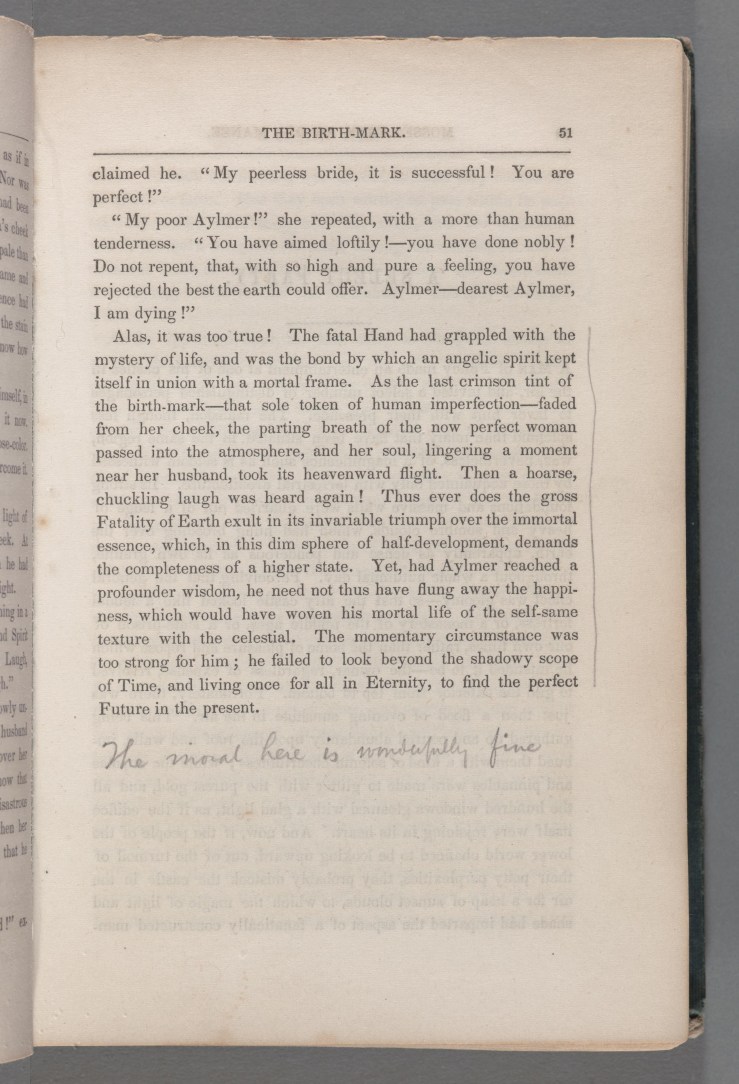
The moral here is wonderfully fine | Melville annotates Hawthorne

Herman Melville’s markings and annotations on the last page of Nathaniel Hawthorne’s short story “The Birth-mark.” From Melville’s Marginalia Online.

The problems of Bartleby

What are the problems of Herman Melville’s story “Bartleby, the Scrivener: A Story of Wall Street”?

This question seems like a bad starting place.

Let me share an anecdote instead.

—I was in the tenth grade the first time I read “Bartleby.”

At the time, I thought I was a teacher’s dream—a sharp reader, someone who loved English class, someone with opinions about the texts we read. Lots and lots of opinions. In retrospect, I realize that I was a nightmare for poor Ms. Hall, a wonderful teacher who I’m sure dreaded our meetings (there were like 15 guys in the class, all unruly).

Simply put, I didn’t want to do things her way.

So she gave me a copy of Billy Budd, Sailor and Other Stories and told me to read “Bartleby,” suggesting that there was something I might learn from it.

I don’t know if backfired is exactly the right term for the results of this experiment. I do know that “Bartleby” offered me a brilliant retort—a literary allusion!—to refuse any task I didn’t feel like undertaking in 10th grade English:

“I would prefer not to.”

—While we’re here—

“I would prefer not to”

So, this is clearly one of the problems of “Bartleby,” if not the core problem condensed into one utterance: Why would? Why the conditional?

Consider, vs. I prefer not to, a constative (or maybe even performative) utterance.

But Bartleby “would prefer not to.”

Contrast this with the imperative must that the narrator employs:

At the expiration of that period, I peeped behind the screen, and lo!
Bartleby was there.

I buttoned up my coat, balanced myself; advanced slowly towards him, touched his shoulder, and said, “The time has come; you must quit this place; I am sorry for you; here is money; but you must go.”

“I would prefer not,” he replied, with his back still towards me.

“You must.”

He remained silent.

Now I had an unbounded confidence in this man’s common honesty. He had frequently restored to me sixpences and shillings carelessly dropped upon the floor, for I am apt to be very reckless in such shirt-button affairs. The proceeding then which followed will not be deemed extraordinary.

“Bartleby,” said I, “I owe you twelve dollars on account; here are thirty-two; the odd twenty are yours.—Will you take it?” and I handed the bills towards him.

These brief lines perhaps serve to summarize Melville’s tale.

We see here the basic plot—our titular scrivener will not leave the lawyer’s office after weeks of refusing (although refusing is not quite the right word) to work.

We also see here what I take to be the theme of “Bartleby,” the strange ethical position Bartleby’s (conditional) would prefer not to places the narrator’s (imperative) must set against the moral backdrop of do unto others: namely, an impossible ethical position for a Wall Street lawyer especially and most of us in general.

And “Bartleby,” as you’ll no doubt recall, is in some ways Melville trying to work out the problems of Matthew 25:35-39—

For I was an hungred, and ye gave me meat: I was thirsty, and ye gave me drink: I was a stranger, and ye took me in:

Naked, and ye clothed me: I was sick, and ye visited me: I was in prison, and ye came unto me.

Then shall the righteous answer him, saying, Lord, when saw we thee an hungred, and fed thee? or thirsty, and gave thee drink?

When saw we thee a stranger, and took thee in? or naked, and clothed thee?

Or when saw we thee sick, or in prison, and came unto thee?

Perhaps our narrator tries to do these things—tries to feed and clothe and help this stranger Bartleby—but he can’t. Because Bartleby won’t give him an agency to relate to.

Because Bartleby’s utterance “I would prefer not to” denies the performative or constantive or declarative—indeed, it suspends or disrupts its own conditionality, the relation of the subject to its predicate verb.

Or consider one of Bartleby’s only other lines: “What is wanted?” His grammar again suspends agency, disrupts the notion of a stable I (let alone objective case me) that the narrator can interface with, dictate to, interrogate, see his own narcissistic reflection in).

—Hang on though, I was telling an anecdote. It was about the first time I read “Bartleby,” when I was fourteen or fifteen. This is the book:

20121112-150751.jpg

I stole it of course, or never returned it. Yes, that’s duct tape on its side. It is more or less falling apart. Here’s the back, barcode and all.

20121112-150740.jpg

Over the years, like many readers, I returned many times to “Bartleby,” reading it again in high school, then in college, then in grad school. I read it unassigned too, of course—when I read Kafka and it recalled itself to me, and when I read Moby-Dick for the first time. I read it when compelled. And then I read it with my own students. (I read most of the other stuff in the collection too, of course — Billy Budd and then later (why so much later?!) Benito Cereno).

I scrawled through so much of the book that my annotations are basically worthless, virtually everything underlined or circled:

20121112-151659.jpg

So we butt up against the problems of “Bartleby”—the problems of interpretation. How to figure an eponymous “hero” who is no more than a phantom, a trace, a lack? How to hash out a narrator who presents himself in relatively admirable terms and yet is so clearly an ethical failure? Why oh why would Bartleby prefer not to? Is the story a tragedy or a comedy? Does it present a world with rules, codes, ethics, or is all absurd here—nihilistic even? Is Bartleby a Christ figure? An ascetic monk? A ghost? Is the story just about Melville’s own anger over the poor reception of Pierre? How much of contemporary transcendentalist thought can we find in the story?

—Slight shift:

The kind people of Melville House were sporting enough to send a copy of “Bartleby” my way. The book is part of their HybridBooks project; these books offer “digital illuminations” along with traditional (uh, paper) books.

I’d requested a HybridBook—any one of them, really—because I now read about half the time on a Kindle Fire—so I was particularly interested in what a “hybrid” had to offer. What is the reading experience like?

First, the book itself is part of Melville House’s Art of the Novella series—beautiful, minimal design with French flaps. I read it on my porch the afternoon it arrived, enjoying its pristine, white, unmarked pages. Then, I checked out the “Digital Illuminations.”

The illuminations are available in several device-specific options, all easy to download with the QRC that comes with the book. I read most of the illuminations on my Kindle, but I also put them on my iPhone and my laptop. I had originally intended this post to be specifically about the digital illuminations, but hell, “Bartleby” is just too damn freighted a read for me at this point. Anyway, there’s a lot of good stuff in there, including “The Transcendentalist” by Ralph Waldo Emerson, selections from Jonathan Edwards and Joseph Priestly, Thoreau’s “Civil Disobedience,” and several excerpts from Melville himself, including letters, other books, and reviews. What I found must, uh, illuminating was “Of Some of the Sources of Poetry Amongst Democratic Nations” from Democracy in America by Alexis de Tocqueville. There are also illustrations, including a map; there’s even a recipe for ginger nuts. I wish that MH had included a digital copy of the book though. From a practical, concrete standpoint, I found it easier to switch between the free public domain version of “Bartleby” on my Kindle and MH’s illuminations than it would have been to pick up the physical book.

Now, to shift back (perhaps):

Do the digital illuminations help to answer or solve or address some of the problems of “Bartleby,” some of the issues posed above?

Should they?

—I suppose the hedging answer is yes and no.

The additional material illuminates some of the philosophical, political, historical, and even personal context for “Bartleby.” The material is edited with minimal intrusion, but with enough explication to clearly connect the various selections to Melville’s story. If I’m reading with my teacher hat on (this is a metaphor; there is no literal hat), I’d say you probably couldn’t do better than what Melville House has put together here. The digital illuminations provide a strong foundation for an informed reading, a range of texts that speak (obliquely or otherwise) to “Bartleby.”

Does it all add up to a deeper or richer understanding of “Bartleby”?

Should it?

—Well. No. And then no.

I mean, would we want a series of essays that would provide the missing pieces that would allow us to puzzle out “Bartleby”? Could we even trust such pieces, let alone trust ourselves to trust such pieces? Isn’t this strange uncertainty why “Bartleby” endures—and endures apart from Moby-Dick or Billy Budd, strange texts themselves, but also not nearly as confounding?

“Bartleby” simultaneously wriggles and plays dead; it burns with apparent wit but then reminds us that we might not be in on the joke. It is Kafkaesque thirty years before Kafka was even born. It shakes off its allegorical idiom the minute we think we might limn its contours. It makes us read it again because we cannot pin it down.

—But maybe you want to pin it down, tickle it, torture it, make it solve its problems (or at least respond, damn it!).

And maybe I claimed that “Bartleby” was about something—that it was about ethical relations, about duty to one’s fellows—especially when a fellow isn’t a fellow but rather the trace of a fellowthe idea of a fellowa ghost.

So, look, here’s a take on it:

The narrator—let’s call him Lawyer—Lawyer, see he’s a dick, in the parlance of our times. He’s a dick because he doesn’t know that he’s a dick, which is one of the constituting factors of the ontological state of being a dick. He also does not want to see himself as being a dick (this is another factor in the ontological state of being a dick). He wants to see himself as a good guy, this Wall Street dickhead, but Bartleby won’t let him do that. Bartleby won’t even let him see himself at all: Bartleby doesn’t reflect back. He prefers not to.

Our Lawyer, see, he’s all buttoned up, he’s snug (these are his words). He tells us upfront that he possesses “a profound conviction that the easiest way of life is the best”; he repeatedly points out the way that people are “useful” to him (or to others). He sees no possibility of an ethics outside of usefulness; on top of that, he cannot see that he cannot see any possibility of an ethics based on anything but “usefulness” (or the negative economy of obstruction figured in Bartleby).

And ah Bartleby, ah humanity: One time model employee, once apparently free from the eccentricities that plague the Lawyer’s other scriveners, Turkey and Nippers. Machinelike.

Bartleby mechanically completes large quantities of copies without comment or complaint.  But when asked to simply read in unison with Lawyer and his scriveners, Bartleby replies: “I would prefer not to.” Bartleby will not read with others—he is literally not on the same page as his colleagues.

Lawyer confronts Bartleby with his noncompliance; Bartleby repeats his mantra. Fuck mantra though because it’s not a mantra. It’s only repeated for Lawyer, to Lawyer, really, who can’t schematize/name/pin down Bartleby’s response. In fact, I would prefer not to so startles Lawyer that he says he’s  “unmanned” by the words. So he rationalizes Bartleby’s odd response, internalizes it, paraphrases it, if you like.

And then Bartleby ceases to even do his copying work. Oh the anarchy! But wait, there’s not even anarchy. There’s not even protest. There’s just big nothing. But not even big nothing—instead the smallest nothing (which proves that big nothing is possible).

So Lawyer attempts to “help” Bartleby. Lawyer believes doing so is his “Christian duty.” And to know that this duty has been met, Lawyer needs Bartleby to be his echo. But Bartleby’s I prefer not to denies this narcissistic exchange. He empties his I of ego (shades of Emerson’s Transparent Eyeball).

Confused, Lawyer tries to pay off Bartleby. When that doesn’t work, Lawyer actually packs up and moves to a new office. But even here he can’t cut off Bartleby. The office’s landlord comes to Lawyer to remove Bartleby.

And when Bartleby refuses to leave the office he is taken to “the Tombs”—prison.

Here, Lawyer tries to provide comfort for Bartleby (hearken ye back to Matthew 25:35-39). He arranges for Bartleby to receive good food in the prison. Bartleby prefers not to eat though, and dies curled up in the fetal position during a visit by Lawyer.

Lawyer is the first reader of Bartleby. But like many readers of “Bartleby,” he is confused.

Lawyer’s confusion results from his need for safety—for ease, for comfort, for a snug, buttoned-upness—and that safety is bought through an affirmation of first-person experience: namely, in the affirmation of the self in the other. That security is bought through assimilating another person’s first-person perspective. But Bartleby is empty of I, of self, of ego.

Bartleby would prefer not to: He will not be ventriloquized: He will not echo: He will not read from the same script: He will not be “of use,” as Lawyer puts it.

So Bartleby dissipates and dissolves: He goes down in the Tombs: a ghost, and impossibility, presence coupled with absence.

— And the epilogue:

We all recall the epilogue, yes?

Lawyer offers up “one little item of rumor,” a morsel, a “vague report . . . that Bartleby had been a subordinate clerk in the Dead Letter Office at Washington.” The idea tears the narrator up inside: “Dead letters! does it not sound like dead men?”

For Lawyer, Bartleby is a dead letter, a failed letter.

Did Melville worry that “Bartleby” would be a failed letter? That it would not find an audience? That his work would not be delivered? If he did, it seems too then that Bartleby’s negations foreclose or reject this concern. Not sure of how to wrap up this riff, I’ll retreat to the safety of my title.

We find the final problems (in basic narrative chronology, that is) of “Bartleby” in its final line. Has Lawyer learned from his experience? Can he empathize, finally feel something for Bartleby beyond the confines of a perceived ethical duty? Is Bartleby a place holder for all humanity? Or is Bartleby in opposition to humanity? What does it mean—-

Ah Bartleby! Ah humanity!

?

[Ed. note–Biblioklept originally posted this riff in November of 2012. I’m running it again for Herman Melville’s 200th birthday.]

No writer has produced such inconsistent characters as nature herself has (From Melville’s The Confidence-Man)

…it may be urged that there is nothing a writer of fiction should more carefully see to, as there is nothing a sensible reader will more carefully look for, than that, in the depiction of any character, its consistency should be preserved. But this, though at first blush, seeming reasonable enough, may, upon a closer view, prove not so much so. For how does it couple with another requirement—equally insisted upon, perhaps—that, while to all fiction is allowed some play of invention, yet, fiction based on fact should never be contradictory to it; and is it not a fact, that, in real life, a consistent character is a rara avis? Which being so, the distaste of readers to the contrary sort in books, can hardly arise from any sense of their untrueness. It may rather be from perplexity as to understanding them. But if the acutest sage be often at his wits’ ends to understand living character, shall those who are not sages expect to run and read character in those mere phantoms which flit along a page, like shadows along a wall? That fiction, where every character can, by reason of its consistency, be comprehended at a glance, either exhibits but sections of character, making them appear for wholes, or else is very untrue to reality; while, on the other hand, that author who draws a character, even though to common view incongruous in its parts, as the flying-squirrel, and, at different periods, as much at variance with itself as the butterfly is with the caterpillar into which it changes, may yet, in so doing, be not false but faithful to facts.

If reason be judge, no writer has produced such inconsistent characters as nature herself has. It must call for no small sagacity in a reader unerringly to discriminate in a novel between the inconsistencies of conception and those of life as elsewhere. Experience is the only guide here; but as no one man can be coextensive with what is, it may be unwise in every ease to rest upon it. When the duck-billed beaver of Australia was first brought stuffed to England, the naturalists, appealing to their classifications, maintained that there was, in reality, no such creature; the bill in the specimen must needs be, in some way, artificially stuck on.

But let nature, to the perplexity of the naturalists, produce her duck-billed beavers as she may, lesser authors some may hold, have no business to be perplexing readers with duck-billed characters. Always, they should represent human nature not in obscurity, but transparency, which, indeed, is the practice with most novelists, and is, perhaps, in certain cases, someway felt to be a kind of honor rendered by them to their kind. But, whether it involve honor or otherwise might be mooted, considering that, if these waters of human nature can be so readily seen through, it may be either that they are very pure or very shallow. Upon the whole, it might rather be thought, that he, who, in view of its inconsistencies, says of human nature the same that, in view of its contrasts, is said of the divine nature, that it is past finding out, thereby evinces a better appreciation of it than he who, by always representing it in a clear light, leaves it to be inferred that he clearly knows all about it.

But though there is a prejudice against inconsistent characters in books, yet the prejudice bears the other way, when what seemed at first their inconsistency, afterwards, by the skill of the writer, turns out to be their good keeping. The great masters excel in nothing so much as in this very particular. They challenge astonishment at the tangled web of some character, and then raise admiration still greater at their satisfactory unraveling of it; in this way throwing open, sometimes to the understanding even of school misses, the last complications of that spirit which is affirmed by its Creator to be fearfully and wonderfully made.

At least, something like this is claimed for certain psychological novelists; nor will the claim be here disputed. Yet, as touching this point, it may prove suggestive, that all those sallies of ingenuity, having for their end the revelation of human nature on fixed principles, have, by the best judges, been excluded with contempt from the ranks of the sciences—palmistry, physiognomy, phrenology, psychology. Likewise, the fact, that in all ages such conflicting views have, by the most eminent minds, been taken of mankind, would, as with other topics, seem some presumption of a pretty general and pretty thorough ignorance of it. Which may appear the less improbable if it be considered that, after poring over the best novels professing to portray human nature, the studious youth will still run risk of being too often at fault upon actually entering the world; whereas, had he been furnished with a true delineation, it ought to fare with him something as with a stranger entering, map in hand, Boston town; the streets may be very crooked, he may often pause; but, thanks to his true map, he does not hopelessly lose his way. Nor, to this comparison, can it be an adequate objection, that the twistings of the town are always the same, and those of human nature subject to variation. The grand points of human nature are the same to-day they were a thousand years ago. The only variability in them is in expression, not in feature.

But as, in spite of seeming discouragement, some mathematicians are yet in hopes of hitting upon an exact method of determining the longitude, the more earnest psychologists may, in the face of previous failures, still cherish expectations with regard to some mode of infallibly discovering the heart of man.

From Herman Melville’s novel The Confidence-Man.

List of smutty-sounding Moby-Dick chapters

The Spouter-Inn.

A Bosom Friend.

Nightgown.

Wheelbarrow.

The Mast-Head.

Moby Dick.

The First Lowering.

The Spirit-Spout.

The Gam.

The Town-Ho’s Story.

Of the Monstrous Pictures of Whales.

The Dart.

The Crotch.

Cutting In.

The Battering-Ram.

The Nut.

The Pequod Meets The Virgin.

Pitchpoling.

The Fountain.

The Tail.

Fast-Fish and Loose-Fish.

Heads or Tails.

The Pequod Meets The Rose-Bud.

A Squeeze of the Hand.

Leg and Arm.

The Needle.

The Log and Line.

The Cabin.

The Pequod Meets The Delight.

The Chase.

Moby-Dick | A short riff on a long book

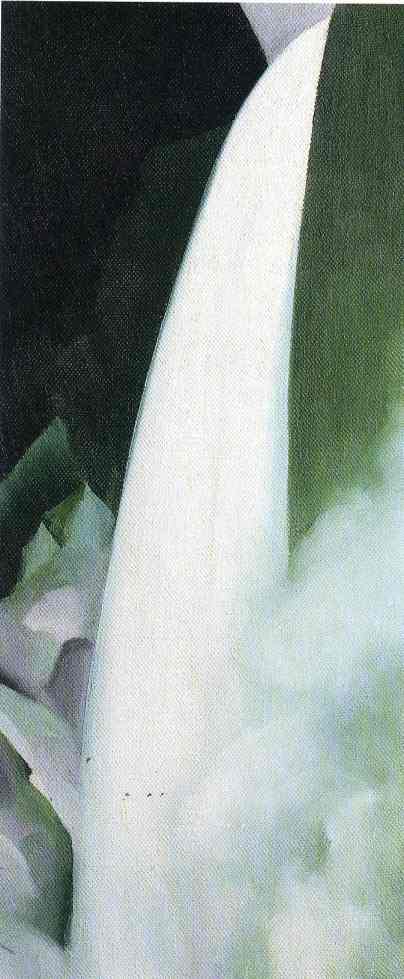
Green and White, Georgia O'Keeffe
Green and White, Georgia O’Keeffe

Prompted by Call Me Ishmael, Charles Olson’s marvelous study of Moby-Dick, I took a fifth trip through Melville’s massive opus this past month.

Every time I read Moby-Dick it seems funnier and sadder. Richer. Thicker.

I cobbled together my reading over different media and spaces: I listened to William Hootkins‘ outstanding unabridged audiobook version, and then reread on my Kindle key passages I’d mentally underlined; I then checked those passages against the copy of Moby-Dick I annotated the hell out of in grad school. As I read, I posted some of my favorite excerpts on this blog.

I posted some of my favorite excerpts of Moby-Dick here on Biblioklept because I knew that I wouldn’t be able to write about the book—not really—that I wouldn’t be able to handle all of its language. (My riff on Olson’s book obsesses over Olson’s ability to write after Melville and Melville’s ability to write after Shakespeare).

Really, in posting so many fragments of Moby-Dick, I suppose that I’ve attempted to abrogate any kind of critical duty to describe the book under discussion in terms of its own language.

The above is really a way of saying: Moby-Dick, like any sublime work of literature, is a self-defining, self-describing, and even self-deconstructing text.

Or, another way of making such a claim: Let me (mis)appropriate Samuel Beckett’s description of Finnegans Wake and contend that the description fits Moby-Dick just as aptly: 

Here form is content, content is form. You complain that this stuff is not written in English. It is not written at all. It is not to be read – or rather it is not only to be read. It is to be looked at and listened to. His writing is not about something, it is that something itself.

So here circumnavigate back to my own recent reading and auditing of the book: Hootkins’ audio recording would make a great starting point for anyone (unnecessarily) daunted by Melville’s big book. He performs the book, commanding his audience’s attention. He unpacks the humor that might otherwise hide from untuned 21st century ears; he communicates the book’s deep, profound sorrow. His Ishmael is perceptive, clever, generous. His Stubb, hilarious. His Ahab a strange philosophical terror.

After listening to Hootkins on my commute, I’d return to key passages on my Kindle, and then finally review the notes I wrote in the cheap hardback Signet edition I read in grad school.

But why bring this up?

I don’t know.

Maybe: Unpacking Moby-Dick is too hard, too much—would require its own book, a book that would cite the entirety of Melville’s book.

But discussing the book this way seems a disservice to potential readers; it’s as if we would cloak the book in a mystic veil.

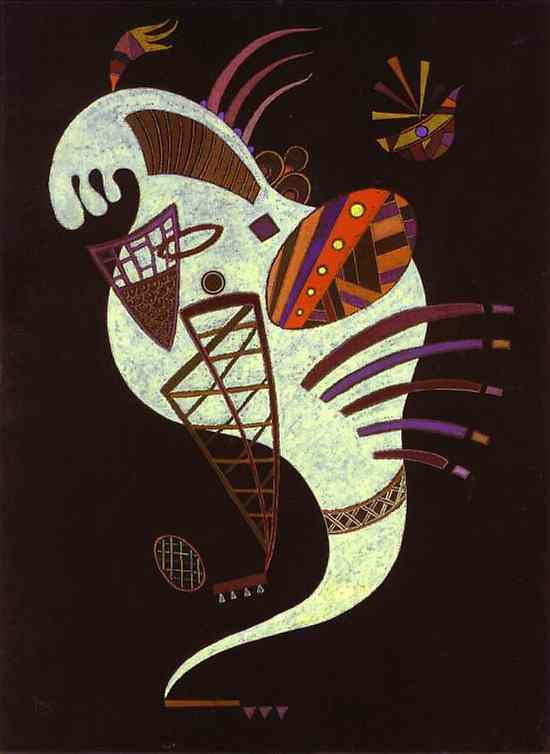
White Figure, Wassily Kandinsky

If I have a point to all of this: Moby-Dick is wonderful, funny, moving, engaging; a genre-bender that tackles philosophy, history, science; an adventure tale; a psychological novel brimming with ideas, allusions—but one delivered in sonorous, poetic language. It’s good, great, grand. Read it, if you haven’t. Reread it.

So I’ve failed to even try to begin to attempt to pretend to describe the plot.

Here: Ishmael, depressed, suicidal perhaps, decides to go to sea. To go whaling.

He tries to measure the whale, and by measuring the whale, maybe measure the world. But this is not really possible, certainly not in language. Certainly not in first-person perspective.

In Chapter 86, “The Tail,” Ishmael tells us:

The more I consider this mighty tail, the more do I deplore my inability to express it. At times there are gestures in it, which, though they would well grace the hand of man, remain wholly inexplicable. … Dissect him how I may, then, I but go skin deep. I know him not, and never will. But if I know not even the tail of this whale, how understand his head? much more, how comprehend his face, when face he has none? Thou shalt see my back parts, my tail, he seems to say, but my face shall not be seen. But I cannot completely make out his back parts; and hint what he will about his face, I say again he has no face.

(I don’t suppose I need to remark that Melville here lets one mighty tail stand in for another mighty tale—a tale he cannot face).

Call me Ishmael”: our protagonist hails us.

But these famous opening lines aren’t really the beginning of the book. First we have the section titled “Extracts,” and before that “Etymology.” The first entry on the etymology of the whale, from  Hackluyt, warns us not to leave out “the letter H, which almost alone maketh up the signification of the word.”

Whaling. Hailing. Wailing.

The whiteness of the whale.

The witness of the wail.

How, just how, does Ishmael witness? How does he manage to tell this story? Did I obsess over this in earlier readings? I don’t think so—I was too concerned with absorbing the what and the why of the story to closely attend the how of its telling.

The novel begins in standard first-person point-of-view territory, Ishmael guiding us through Manhattan, New Bedford, Nantucket—but by the time he’s boarded the Pequod and set out into the wide watery world, this first-person perspective transcends the limits of physics: Our narrator not only attends the private conversations of Ahab, his mates, his harpooners, his men—but also the very interior of those men, their minds, their dreams, their imaginations.

Is Ishmael a ghost?

Leviathan-Job 40-21, Salvador Dali

And to return to Ahab for a moment: My godwhat a voice! His infecting, addicting insanity. His agon with Moby Dick, with the sun, with himself.

And Starbuck: Starbuck comes across weaker and weaker each time I read the book. We’re to believe he’s a man of convictions, but he moves in half-measures. In his final moments he tries to match or feign or approximate Ahab’s insanity: tragicomedy.

And Stubb: Despite his cruelties, he may be my favorite character in the book.

While I’m riffing: Is there a novel more phallic in the American canon than Moby-Dick? All that sperm: All that life-force.

This is maybe what Moby-Dick is about: Life-force. The attempt to to resurrect and die and resurrect again. The coffin that serves as life-buoy. The life-line that connects men that might also be their death. A counterpane to counter pain. A condensation of oppositions.

A yarn, a rope, a series of knots, layered, layering, self-contextualizing.

An attempt to put into language what cannot be put into language.

Have I reached my end? Maybe too long for the “short riff” promised in the title, but also surely too short to even begin to start to approach to pretend to say something adequate about the novel. So a parting thought: Moby-Dick is better—richer, fuller, deeper—each time I read it, and I look forward to reading it again.

[Ed. note—Biblioklept originally ran a version of this riff in February 2013. I’m running it again for Herman Melville’s 200th birthday. I haven’t read Moby-Dick in full since 2013.]

Perseus, whaleman (Melville/Sienkiewicz)

img_7584

From Bill Sienkiewicz’s adaptation of Herman Melville’s Moby-Dick. The Classics Illustrated edition (February 1990) is one of my favorite Moby-Dicks.

Selections from One-Star Amazon Reviews of Melville’s Moby-Dick

[Ed. note: The following citations come from one-star Amazon reviews of Herman Melville’s novel Moby-Dick. To be very clear, I think Moby-Dick is fantasticbut I also enjoy seeing what people compelled to write negative reviews of the book on Amazon had to say. What follows are selections of one-star Amazon reviews; I’ve preserved the reviewers’ unique styles of punctuation and spelling].


Yechh.

It made for a smashing movie.

If you want to read lots of meaningless whale trivia read the book.

Boy gets whale. Boy loses whale. Boy gets whale. Spawns yawns

I think if you made it into a short comic strip, you would have liked it.

I bought this book for a friend in jail. Alas, he was unable to read it because the font was too small.

Ray Bradbury, who wrote the screenplay for this novel, (a la Gregory Peck) couldn’t even finish the damn thing!

If you like a story with nonessential information and an author that is entirely to verbose, then this book is for you.

I am quite the fan of stories which involve man eating sea creatures, such as Jaws. Moby Dick is nothing compared to such classics, I fear.

Throughout the book, you may read one chapter with some action only to be followed by 5 or 6 chapters of tangents that are not necessary to understand the story.

Moby Dick, was a horrible waiste of time. Along with its wordy paragraphs, it also talked about uninteresting issues. It is also to long, and you don’t hear of them encountering the whale until the end of the book.

The only people who like this book are english teachers who derive a feeling of moral superiority from forcing others to read this incredibly bad novel.

First of all, classiflying it as fiction is a mistake. Probably a good 60% of the book is non-fiction – chapter after chapter dedicated to every imaginable detail of the biology of the whale and every imaginable nuance of whaling.

I love literatur just as much as the next guy but we must face it 100 years or so ago American literature was reall weak and lagging from the rest of the world, perhaps now they’re starting to catch up with writers like Ann Rice and them.

I have seen better writing in a Hallmark card! Boring! Give me a good ole copy of Elvis and Me! A true story that really tugs at your heart strings! I sleep with that one under my pillow! Keep Moby Dick away from my bed!

Those chapters about Ishmael sleeping with whatever his name was and Ishamel had such a good time with the other guy’s arm over him and leg over him that he didn’t know if he was straight or gay any more.

i personally didn’t enjoy the philosophical or deep side of the book, i have read much much better books in that regard.

There is no suspense, and I find the idea of people hunting whales offensive. Offensive with a capital O.

Honestly, Over 400 pages devoted to killing a whale because it ate your hand? Come on.

It is hard to read. like work. Doubt he could get published today.

What is the whales motivation? You dont know.

It is 540somepages of boring whaling details.

No wonder Melville flopped as a writter.

OMG, this is tedious and torture to read.

I HATE this book. Why? It’s BORING!

Moby Ick’s more like it.