Men will the laws of nature (From Stanley Elkin’s novel The Franchiser)

They drove up to the Broadmoor, a pink Monaco castle at the foot of the Rockies, and he showed her the hotel in a proprietary way, taking her through the nifty Regency public rooms with their beautiful sofas, the striped, silken upholstery like tasteful flags. He showed her huge tiaras of chandelier, soft plush carpets. “Yes,” she said, “carpets were our first floors, our first highways.”

“I didn’t know that.”

“We call the rug in the hall a ‘runner.’ It’s where the runners or messengers waited in the days of kings and emperors.”

“I never made the connection.”

“It’s an insight. Chandeliers must have come in with the development of lens astronomy at the beginning of the seventeenth century. I should think it was an attempt to mimic rather than parody the order of the heavens, to bring the solar system indoors.”

“Really?”

“Well, where, to simple people, would the universe seem to go during the daylight hours, Ben?”

“But chandeliers give light.”

“Not during the daytime. The chandelier is a complex invention—a sculpture of the invisible stars by day, a pragmatic mechanism by night. But a much less daring device finally than carpeting.”

“Why, Patty?”

“Because carpeting—think of Oriental rugs—was always primarily ornamental and decorative. It was a deliberate expression of what ground—our first flooring, remember, and incidentally we have to regard tile, too, as a type of carpeting—ought to be in a perfect world. Order, symmetry, design. And since rugs came in before lens telescopy, how could they know? Oh, carpeting’s much more daring. A leap of will.”

“Of will?”

“Men will the laws of nature.”

From Stanley Elkin’s 1976 novel The Franchiser.


Reviews and riffs of February-May, 2016 (and an unrelated stag)

Hey, wow. Haven’t done one of these in a while.


I reread William Gaddis’s big big novel J R, writing

Only a handful of novels are so perfectly simultaneously comic and tragic. Moby-Dick? Yes. Gravity’s Rainbow? Absolutely. (G R and J R, a duo published two years apart, spiritual twins, massive American novels that maybe America hardly deserves (or, rather: theses novels were/are totally the critique America deserves). I guess maybe what I’m saying is J  R is the Great American Novel to Come (The Recognitions is perhaps overpraised and certainly not Gaddis’s best novel; J R is. The zeitgeist has been caught up to J R, the culture should (will) catch up).


I also read and wrote about Ashley Dawson’s Extinction: A Radical History, a scary little primer that argues mass species extinction is

…the product of a global attack on the commons, the great trove of air, water, plants and creatures, as well as collectively created cultural forms such as language, that have been regarded traditionally as the inheritance of humanity as a whole…capital of course depends on continuous commodification of this environment to sustain its growth.

My reading of Extinction—and hence my writing about it—is/was inextricably bound up in a viewing of Hayao Miyazaki’s 1997 eco-fable 1997 , Mononoke-hime. (The film’s title is usually rendered in English as Princess Mononoke, but I think Spirit-Monster Wolfchild is a more fitting translation). I also linked the book to Gilgamesh and Easter. And I used this gif:

tumblr_inline_o1qoyqk5ln1t6t6sv_500


I wrote a post about listening to audiobook versions of “difficult novels,” taking my lead and license from this big quote from William H. Gass’s essay “The Sentence Seeks Its Form”:

Breath (pneuma) has always been seen as a sign of life . . . Language is speech before it is anything. It is born of babble and shaped by imitating other sounds. It therefore must be listened to while it is being written. So the next time someone asks you that stupid question, “Who is your audience?” or “Whom do you write for?” you can answer, “The ear.” I don’t just read Henry James; I hear him. . . . The writer must be a musician—accordingly. Look at what you’ve written, but later … at your leisure. First—listen. Listen to Joyce, to Woolf, to Faulkner, to Melville.


99 reasons I didn’t read your novel.


tumblr_o71467dk931s4y9aso1_1280

I reviewed Mahendra Singh’s marvelous satire American Candide. Far better than my measly review is a long interview I did with Singh, who is just a damn genius. I’m most grateful for the final exchange of our review, which was not really a part of the official q & a type thing we were doing—rather, I was bemoaning my ability to write anything lately, and Mahendra offered me the following, which I edited into the interview:

The hidden contempt that our culture harbors towards art will drive you nuts if you think about it … so don’t think too much … write instead! And if you can’t write, read smartly. I find great solace in the classics and have devoted most of my life to trying in whatever way I can to perpetuate the classical tradition (in concealment) and create situations where young people can gain access to the eternal truths and beauty of the classical world tradition. We are living in a time of imperial decline and must preserve the best of the past as our ancestors did in similar times of trouble. The pendulum will swing the other way in a few centuries.


Prince died.

I wrote about him in a Three Books post.

The three books had nothing to do with Prince.


Despite some fascinating images, I was not impressed by Ben Wheatley’s film adaptation of Ballard’s High-Rise. I concluded that,

While the High-Rise adaptation delivers Ballardian style, that Ballardian style only points at itself, and not at our Ballardian present, our Ballardian future.


And I wrote about Ferrante, Knausgaard, and their good/bad/ironic book covers.


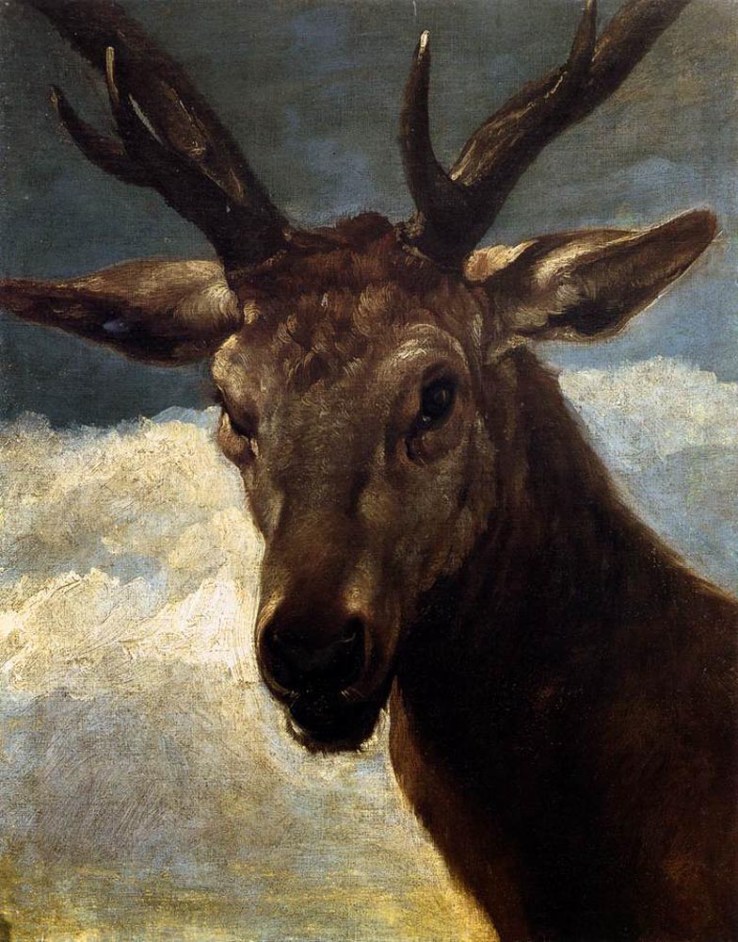
Here’s that promised stag (by Diego Velazquez):

reproduction_painting5cspain5cvelc3a1zquez20diego20rodriguez20de20silva20159920-2016605chead20of20a20stag

Read a short story by Witold Gombrowicz

Witold Gombrowicz’s (very) short story “The Tragic Tale of the Baron and His Wife” is up at The Paris Review (translation by Tul’si Bhambry). First section of the story—

The Baroness was a charming creature. The Baron had taken her from a family of high principles and had no reason to mistrust her, despite the fact that the tooth of time had already gnawed into him quite deeply . . . And yet a disquieting element of grace and charm lay dormant within her, which could easily complicate the practical application of the Baron’s imponderabilia (since the Baron was a bit of a stickler). One day, after a period of conjugal life graced with the quiet bliss of marital duty, the Baroness came running to her husband and threw her arms around his neck. “I think I ought to tell you this. Henryk has fallen in love with me . . . Yesterday he declared himself to me, so quickly and suddenly that I had no time to stop him.”

“And are you in love with him, too?” he asked.

“No, I don’t love him, because I have pledged my love to you,” she replied.

“Very well then,” he said. “If you are in love with him but do not love him because it is your duty to love me, then my esteem for you doubles and I love you twice as much. And the young chap’s suffering is a well-­deserved punishment for his weakness of character—losing his heart to a married woman! Principles, my dear! Should he ever make another declaration of love, tell him that you also have a declaration to make—but of principles. A man of unshakable principles can walk through life with his head held high.”

Read the rest of “The Tragic Tale of the Baron and His Wife.”

The hoary periwigs of dandelions gone to seed | Nathaniel Hawthorne’s journal entry for May 23, 1851

May 23d.–I think the face of nature can never look more beautiful than now, with this so fresh and youthful green,–the trees not being fully in leaf, yet enough so to give airy shade to the woods. The sunshine fills them with green light. Monument Mountain and its brethren are green, and the lightness of the tint takes away something from their massiveness and ponderosity, and they respond with livelier effect to the shine and shade of the sky. Each tree now within sight stands out in its own individuality of hue. This is a very windy day, and the light shifts with magical alternation. In a walk to the lake just now with the children, we found abundance of flowers,–wild geranium, violets of all families, red columbines, and many others known and unknown, besides innumerable blossoms of the wild strawberry, which has been in bloom for the past fortnight. The Houstonias seem quite to overspread some pastures, when viewed from a distance. Not merely the flowers, but the various shrubs which one sees,–seated, for instance, on the decayed trunk of a tree,–are well worth looking at, such a variety and such enjoyment they have of their new growth. Amid these fresh creations, we see others that have already run their course, and have done with warmth and sunshine,–the hoary periwigs, I mean, of dandelions gone to seed.

Nathaniel Hawthorne’s journal entry for May 23, 1851. From Passages from the American Note-Books.

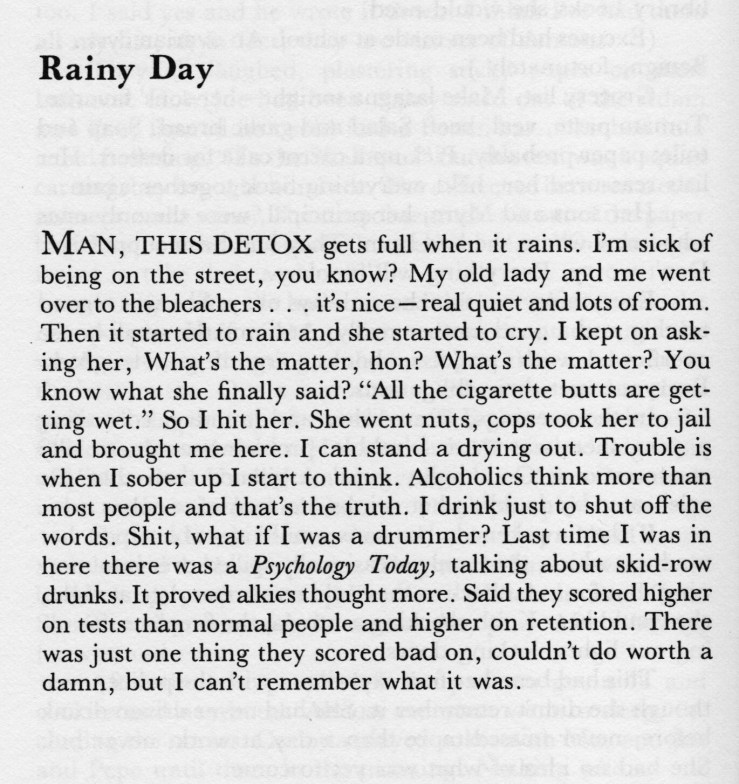
“Rainy Day” — Lucia Berlin

img_2376-1

No possibility of transcendence (Elena Ferrante)

I’m always surprised when someone points out as a flaw the fact that my stories contain no possibility of transcendence. Here I’d like to move on to a statement of principle: since the age of fifteen, I haven’t believed in the kingdom of any God, in Heaven or on Earth—in fact, wherever you place it, it seems dangerous to me. On the other hand, I share the opinion that most of the concepts we work with have a theological origin. Theology helps us understand the origins of the dregs we even now resort to. As for the rest, I don’t know what to tell you. I’m comforted by stories that emerge through horror to a turning point, stories in which someone is redeemed as confirmation that peace and happiness are possible, or that one can return to a private or public Eden. But I tried to write a story like that, long ago, and I discovered that I didn’t believe in it. I’m drawn, rather, to images of crisis, to seals that are broken. When shapes lose their contours, we see what most terrifies us, as in Ovid’s “Metamorphoses,” Kafka’s “Metamorphosis,” and Clarice Lispector’s extraordinary “Passion According to G.H.” You don’t go beyond that; you have to take a step back and, to survive, reënter some good fiction. I don’t believe, however, that every fiction we orchestrate is good. I cling to those that are painful, those that arise from a profound crisis of all our illusions. I love unreal things when they show signs of firsthand knowledge of the terror, and hence an awareness that they are unreal, that they will not hold up for long against the collisions. Human beings are extremely violent animals, and the violence they are always ready to use in order to impose their own eternal, salvific life vest, while shattering those of others, is frightening.

Elena Ferrante in conversation with novelist Nicola Lagioia. English translation by Ann Goldstein. The full exchange between Lagioia and Ferrante will be published in Frantumaglia: An Author’s Journey Told Through Letters, Interviews, and Occasional Writings this fall. Read a longer (and fascinating) excerpt at The New Yorker. 

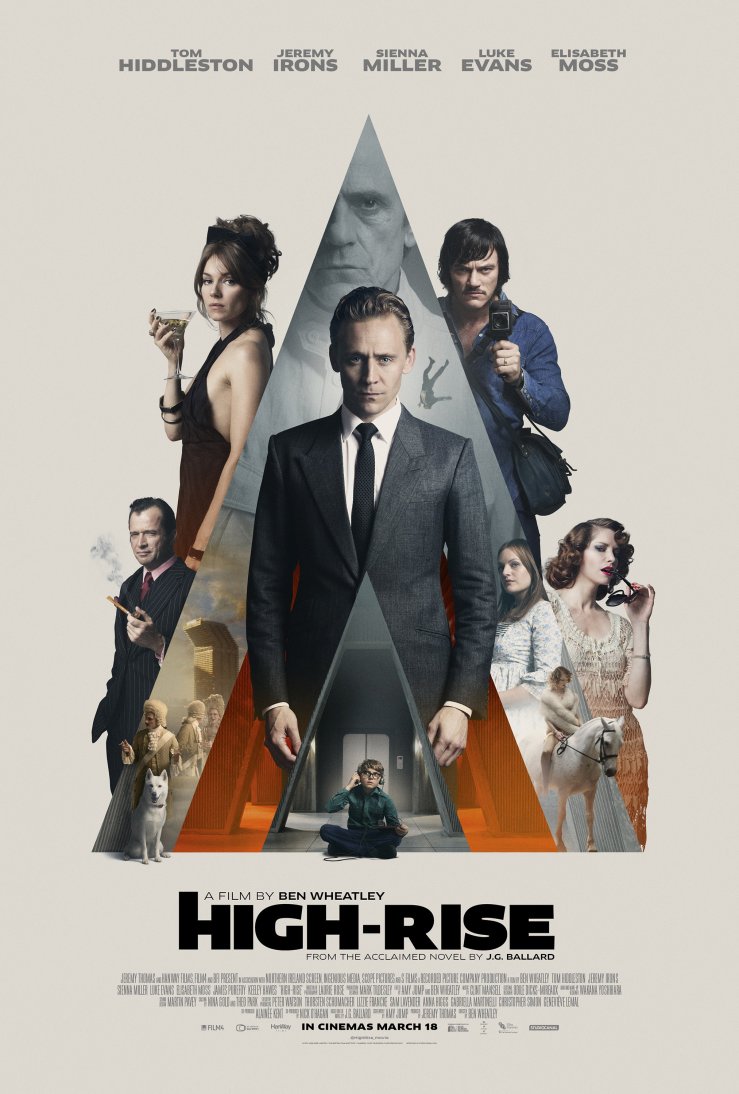
Despite our Ballardian present, the High-Rise film adaptation is a nostalgia piece

high-rise-poster

  1. Our present is utterly Ballardian.
  2. Our present is so utterly Ballardian that our present is actually our (unevenly distributed) future.
  3. Like, what is the 2016 U.S. presidential election but a short story Ballard might have written in 1983 (and hopefully thrown in the trash)?
  4. Ballard’s 1975 novel High-Rise is particularly concerned with this present-future condition: the phrase to come (as in a future to come) repeats throughout the novel, a key dissonant note.
  5. Near the end of the novel, Ballard’s free indirect style drifts into the mind of protagonist Robert Laing:

    ...he found it difficult not to believe that they were living in a future that had already taken place, and was now exhausted.

  6. A version of this line shows up in the first minutes of director Ben Wheatley’s 2015 film adaptation of High-Rise.
  7. While Ballard’s satire evokes the post-future’s psychological (ir)reality, Wheatley’s film adaptation feels like a nostalgic period piece for a future that came and skedaddled. Perhaps he (and his fellow filmmakers—screenwriter Amy Jump, the editor, the set designers and costumers, etc.) found it impossible to do more than stylistically recapitulate the Modernist contours that Ballard transcended.
  8. Critic Tasha Robinson lays it out neatly in her proper review at The Verge:

    The retro cars, suits, and architecture all put High-Rise more in a quaint, remote past than a dystopian future. They also add to the sense of otherworldliness that hangs over the film.

    And so does the sense that High-Rise is driven more by Wheatley’s poster-ready striking images —€” a suicide falling from a high balcony in ultra slow motion, Laing expressionless and spattered with paint — than by any sort of human drives.

  9. (I modify “review” in the above with “proper” because Robinson wrote a real review; I’m not doing that here. I think her take on the film is far more detailed and broad than what I’m doing here, and certainly attends more to the, like, plot of the film—even as she acknowledges that the plot basically gets put on the back-burner for long stretches).
  10. So probably my biggest quibble with the High-Rise film adaptation is its nostalgia, its obsession with midcentury modernism and Brutalism and style—by which I mean the idea of style—over, like, ideas. 
  11. Those ideas: Ballard’s central critiques of capitalism, consumerism, and class do come through in the film, but Wheatley and his team resist giving them any air to breathe, let alone room to stretch their legs. (My god. Forgive me these metaphors, this terrible personification).
  12. There are very, very few scenes in the film where people exchange ideas.
  13. Instead, ideas are wedged in, often in snippets lifted directly from the book, crammed quickly into a frame that will surely veer back into the film’s main technique: Montage!
  14. The first chapter of Ballard’s novel is titled “Critical Mass.” As I pointed out in my review of the novel, “Ballard dispenses with any simmering in his tale of depraved debauchery,” and gets his pot boiling in a hurry.
  15. In contrast, Wheatley’s film gets a slower—but strong—start. (The first 50 or so minutes are actually pretty great).
  16. At its midway point though, the High-Rise film tries to pick up the pace—dramatically. The solution is montage after montage.
  17. Indeed, the final hour of the film slips into a state of near-constant montage. The big set piece scenes (y’know—dance parties and food riots and orgies and the like) dissolve into the film’s frenetic technique. It often feels as if Wheatley is more interested in making a bunch of cool music videos than a film. While this jumpy method might have been the filmmakers’ intention—y’know, to evoke paranoia, anxiety, exhaustion, claustrophobia, etc.—the result, at least for me, was a kind of paradoxical lethargy, a creeping dullness.
  18. Key moments, like the first encounter between Wilder and Royal for example, fly by in rushed blips. It’s as if Wheatley was afraid that if he let two people talk on-screen for more than 30 seconds the viewers would not, y’know, pick up on the fact that we are witnessing the thin veneer of society crack open revealing an abject tumult of sex and violence underneath.
  19. (Wilder—the Id man! Royal the Superego. So much of Ballard’s psychological stuff gets lost in the film, which foregrounds class hierarchy instead of synthesizing the two. But that’s a separate quibble).
  20. What were likely great performances (and much potential for humor) get lost in all the short cuts and montage.
  21. Still:  Sienna Miller is great as Charlotte Melville, and Tom Hiddleston is charming enough.
  22. But best in the film—at least for me—is Elizabeth Moss as Wilder’s pregnant wife Helen.
  23. Still, the filmmakers insist on mining her pregnancy for cheap nostalgic jokes—she’s always smoking, always finishing a drink or pouring a new one.
  24. Which brings me back to: Why a period piece? Why not update High-Rise—or, even better take it outside of time completely?
  25. (It will be interesting to look at the film in twenty years: Oh! These were the aesthetic obsessions of the 2010’s, these were the nostalgic totems of that silly decade).
  26. (And while I’m wedging points in parenthetically in a rush: The ending. I read the novel’s conclusion ironically—the high-rise is a phallic failure, and as its patriarchy devolves into chaos and death, a matriarchy arises (or maybe coalesces is the verb I want). But the film concludes more ambiguously—sure, it points to the idea of a matriarchy (or harem)—but it leaves Laing in the kind of alpha male position that the novel had sought to ironize).
  27. And, to return to point 24: Did the filmmakers underestimate the currency of Ballard’s satire? We live in an era of radical wealth inequality, where the richest in our society are rapidly establishing their own private greenzones away from the plebeians. High-Rise is more timely now than ever.
  28. (A short list of (non-)adaptations of J.G. Ballard’s High-Rise: Pete Travis’s Dredd (2012), Matteo Garrone’s Gomorra (2008), and George Romero’s Land of the Dead (2005)).
  29. (And re: point 27 w/r/t adaptations—in a sense, Ballard adapted/revised the novel himself in his 2003 novel Millennium People).
  30. Reading back over this riff, briefly, I see that there’s so much I left out—on stuff the filmmakers left out (why change the key plot point of Laing’s sister?)—on stuff I should’ve praised more (great soundtrack; good cinematography)—but most of all, what doesn’t come through is my admiration that the filmmakers tried. And they tried hard, successfully evoking a Ballardian style. But while the High-Rise adaptation delivers Ballardian style, that Ballardian style only points at itself, and not at our Ballardian present, our Ballardian future.

In American Candide, Mahendra Singh reboots Voltaire’s classic satire

tumblr_o71467dk931s4y9aso1_1280

About halfway through Mahendra Singh’s American Candide, our omniscientish (yet beguiled) narrator slows down for a moment to offer an internal critique (and useful summary) of the novel thus far:

If Candide could address the reader right now, he would probably apologize for both the breakneck pace and pixelated tenor of his adventures so far. Modern literature evolved beyond that sort of thing long ago, and an easy-to-swallow plot enlivened with a soupçon of ironic handwringing is all the rage today. The idea of a fictional hero running afoul of angry fathers, jihadi terrorists, secret police, corporate mercenaries, a cable TV network, and a secret cabal of global warmers simply boggles the reader’s mind, an authorial fate worse than death.

And yet of course many readers enjoy a good mind boggling every now and then.

I do, anyway.

Our narrator’s little condensation of the novel thus far reminds us that stylistically and formally, American Candide is a true heir to Voltaire’s Candide. Both novels offer a “breakneck pace and pixelated tenor”; both novels pulse with picaresque energy; both novels drip with delightfully venomous satiric acid; both novels are basically one-damn-thing-happening-after-another. Both novels are funny as fuck all.

Our narrator’s quick summary also jabs at the limitations of contemporary socially-conscious-realistic fiction—you know, “serious literature”—which limitations American Candide dispenses with in favor of frenzied fun. Instead of a soupçon of ironic handwringing, we get full-blown glorious agitation.

What’s all the agitation over?

American Candide’s full title is American Candide; or Neo-Optimism, a direct nod to Voltaire’s full title, Candide; or Optimism. But Singh’s subtitular prefix points to other connotations: Neoliberalism, neoconservatism—hell, neofascism—but most of all, the irony that very little of human nature really has changed in three centuries. The big ideals of the Enlightenment continue to radiate too radically for some folks.

tumblr_o6f5s07t9a1s4y9aso1_1280

To wit, American Candide carves sharply into the last two decades, synthesizing the dangerous follies of the Bush Gang (and the subsequent fallout of their crimes) into a kind of mythical transposition. Singh offers a cruel fun satire of the neo-optimism that underwrites blind belief in “the better-than-best of all possible worlds, 21st-century America”. The novel’s satirical sting is simultaneously sweetened by intense humor and painfully amplified by the cruel realism underneath Singh’s zany hyperbole. Tell all the truth but tell it slant, as the poet advised.

And so American Candide is terribly terribly funny but also terribly terribly sad.

For example, Singh’s take on Hurricane Katrina shows American Candide’s capacity to condense historical critique into sharp moments that bristle with anger leavened in caustic humor:

The offending hurricane was clearly an act of god, and the Freedonian government prided itself on its special relationship with god.

Another snippet (“Hooterville” is New Orleans’s Freedonian stunt double):

The winds howled, the clouds unleashed a torrential rain, and the fetid waters of an entire ocean climbed over the heads of those surviving Hootervillains too patently lazy to live on higher ground.

Just a page or two later, Candide and Pangloss mistake armed and uniformed authorities for civil peacekeepers:

Rah! Ooh! We’re better than best police! … We’re Tender-Mercynaries® from Baron Incorporated, booyah, and this is a federally-restricted emergency disaster area, yoot-yoot rah booh!

Instead of helping our heroes, the mercenaries abduct, torture, and interrogate them. Candide and Pangloss find themselves in black hoods at a black site, and even though our young hero “had been lightly sodomized and beaten and even urinated upon…his innermost Freedonian convictions had not been too badly shaken.”

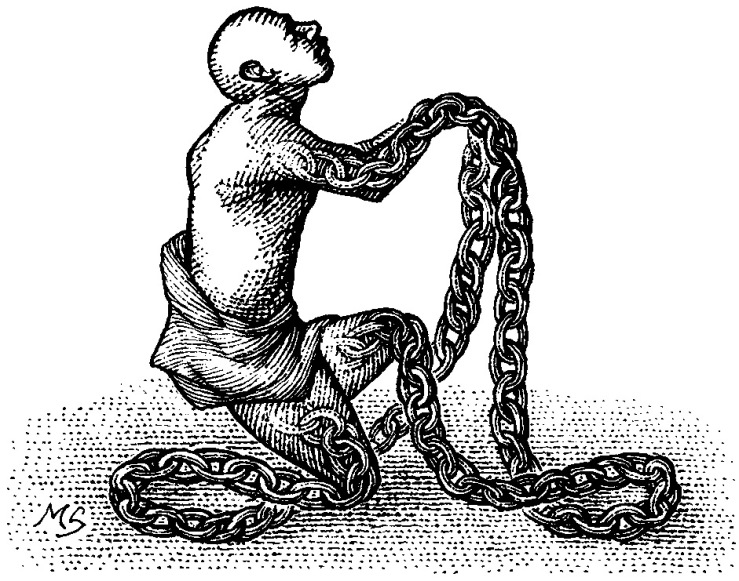
It’s the reader who shakes, in a mix of laughter and rage. The world of American Candide is simply our own world dressed up in a satirical frock that somehow reveals, rather than covers over, our society’s garish ugliness, our addictions to binding illusions. Man is born free, and everywhere he is in chains, commented Rousseau (Voltaire hated Rousseau).

tumblr_o70wqo1hoq1s4y9aso1_1280

American Candide’s  blurb warns that, “College-boy sissies will call it a Juvenalian satire upon America’s penchant for mindless optimism and casual racism.” Hooray for college-boy sissies! But no, really, I think that’s a fair assessment—as is Singh’s Candide’s assessment from the aforementioned blurb: “rage against the rage, Voltaire-dude!”

But it’s not just rage: Laughter—laughter in the all-seeing eye of absurdity—it’s laughter that undergirds American Candide.

img_1468

In a review of Lowell Blair’s translation of Voltaire’s Candide, I suggested:

The book’s longevity might easily be attributed to its prescience, for Voltaire’s uncanny ability to swiftly and expertly assassinate all the rhetorical and philosophical veils by which civilization hides its inclinations to predation and evil. But it’s more than that. Pointing out that humanity is ugly and nasty and hypocritical is perhaps easy enough, but few writers can do this in a way that is as entertaining as what we find in Candide.

Singh’s update-reboot-translation of Candide fittingly answers Voltaire’s pessimistic prescience with not just bitter affirmations of contemporary predation and evil, but also with an eye toward entertainment—to the affirmations of laughter.

[Note: All the illustrations in this review are by Mahendra Singh, and are part of American Candide].

From this darkness packs of mad dogs will emerge, vipers, scorpions, enormous sea serpents (From Ferrante’s The Story of a New Name)

I made the dark descent. Now the moon was visible amid scattered pale-edged clouds; the evening was very fragrant, and you could hear the hypnotic rhythm of the waves. On the beach I took off my shoes, the sand was cold, a gray-blue light extended as far as the sea and then spread over its tremulous expanse. I thought: yes, Lila is right, the beauty of things is a trick, the sky is the throne of fear; I’m alive, now, here, ten steps from the water, and it is not at all beautiful, it’s terrifying; along with this beach, the sea, the swarm of animal forms, I am part of the universal terror; at this moment I’m the infinitesimal particle through which the fear of every thing becomes conscious of itself; I; I who listen to the sound of the sea, who feel the dampness and the cold sand; I who imagine all Ischia, the entwined bodies of Nino and Lila, Stefano sleeping by himself in the new house that is increasingly not so new, the furies who indulge the happiness of today to feed the violence of tomorrow. Ah, it’s true, my fear is too great and so I hope that everything will end soon, that the figures of the nightmares will consume my soul. I hope that from this darkness packs of mad dogs will emerge, vipers, scorpions, enormous sea serpents. I hope that while I’m sitting here, on the edge of the sea, assassins will arrive out of the night and torture my body. Yes, yes, let me be punished for my insufficiency, let the worst happen, something so devastating that it will prevent me from facing tonight, tomorrow, the hours and days to come, reminding me with always more crushing evidence of my unsuitable constitution. Thoughts like that I had, the frenzied thoughts of girlish discouragement. I gave myself up to them, for I don’t know how long.

From Elena Ferrante’s 2012 novel The Story of a New Name. English translation by Ann Goldstein.

“God to Hungry Child” — Langston Hughes

god to hungry child

Beckett critique (From Elena Ferrante’s novel The Story of a New Name)

“Have you ever been to the theater?”

“A few times.”

“Did you like it?”

“It was all right.”

“I’ve never been, but I’ve seen it on television.”

“It’s not the same thing.”

“I know, but better than nothing.”

And at that point she took out of her bag the book I had given her, the volume of Beckett’s plays, and showed it to him.

“Have you read this?”

Nino took the book, examined it, admitted uneasily, “No.”

“So there is something you haven’t read.”

“Yes.”

“You should read it.”

Lila began to talk to us about the book. To my surprise she was very deliberate, she talked the way she used to, choosing the words so as to make us see people and things, and also the emotion she gave them, portraying them anew keeping them there, present, alive. She said that we didn’t have to wait for nuclear war, in the book it was as if it had already happened. She told us at length about a woman named Winnie who at a certain point announced, another happy day, and she herself declaimed the phrase, becoming so upset that, in uttering it, her voice trembled slightly: another happy day, words that were insupportable, because nothing, nothing, she explained, in Winnie’s life, nothing in her gestures, nothing in her head, was happy, not that day or the preceding days. But, she added, the biggest impression had been made on her by a Dan Rooney. Dan Rooney, she said, is blind but he’s not bitter about it, because he believes that life is better without sight, and in fact he wonders whether, if one became deaf and mute, life would not be still more life, life without anything but life.

“Why did you like it?” Nino asked.

“I don’t know yet if I liked it.”

“But it made you curious.”

“It made me think. What does it mean that life is more life without sight, without hearing, even without words?”

“Maybe it’s just a gimmick.”

“No, what gimmick. There’s a thing here that suggests a thousand others, it’s not a gimmick.”

From Elena Ferrante’s 2012 novel The Story of a New Name. English translation by Ann Goldstein.

Ferrante’s so-called Neapolitan Novels do at least two things successfully that so many contemporary novels of “literary” fiction attempt and fail to do:

One, Ferrante harnesses and demonstrates the intellectual force of her two protagonists/antagonists. Many contemporary novelists insist on the brilliance of a particular character, but fail to capture and convey any sense of brilliance.

Two, Ferrante uses metatextual literary references adroitly and meaningfully, where other contemporary writers often clunkily throw in references to greater works of literature as a means to offer ballast to an otherwise-lite offering.

Nathaniel Hawthorne’s journal entry for May 11, 1838

May 11, 1838.–At Boston last week. Items:–A young man, with a small mustache, dyed brown, reddish from its original light color. He walks with an affected gait, his arms crooked outwards, treading much on his toes. His conversation is about the theatre, where he has a season ticket,–about an amateur who lately appeared there, and about actresses, with other theatrical scandal.–In the smoking-room, two checker and backgammon boards; the landlord a great player, seemingly a stupid man, but with considerable shrewdness and knowledge of the world.– F—-, the comedian, a stout, heavy-looking Englishman, of grave deportment, with no signs of wit or humor, yet aiming at both in conversation, in order to support his character. Very steady and regular in his life, and parsimonious in his disposition,–worth $50,000, made by his profession.–A clergyman, elderly, with a white neck-cloth, very unbecoming, an unworldly manner, unacquaintance with the customs of the house, and learning them in a childlike way. A ruffle to his shirt, crimped.–A gentleman, young, handsome, and sea-flushed, belonging to Oswego, New York, but just arrived in port from the Mediterranean: he inquires of me about the troubles in Canada, which were first beginning to make a noise when he left the country,–whether they are all over. I tell him all is finished, except the hanging of the prisoners. Then we talk over the matter, and I tell him the fates of the principal men,–some banished to New South Wales, one hanged, others in prison, others, conspicuous at first, now almost forgotten.–Apartments of private families in the hotel,–what sort of domesticity there may be in them; eating in public, with no board of their own. The gas that lights the rest of the house lights them also, in the chandelier from the ceiling.–A shabby-looking man, quiet, with spectacles, at first wearing an old, coarse brown frock, then appearing in a suit of elderly black, saying nothing unless spoken to, but talking intelligently when addressed. He is an editor, and I suppose printer, of a country paper. Among the guests, he holds intercourse with gentlemen of much more respectable appearance than himself, from the same part of the country.–Bill of fare; wines printed on the back, but nobody calls for a bottle. Chairs turned down for expected guests. Three-pronged steel forks. Cold supper from nine to eleven P.M. Great, round, mahogany table, in the sitting-room, covered with papers. In the morning, before and soon after breakfast, gentlemen reading the morning papers, while others wait for their chance, or try to pick out something from the papers of yesterday or longer ago. In the forenoon, the Southern papers are brought in, and thrown damp and folded on the table. The eagerness with which those who happen to be in the room start up and make prize of them. Play-bills, printed on yellow paper, laid upon the table. Towards evening comes the “Transcript.”

Nathaniel Hawthorne’s journal entry for May 11, 1848. From Passages from the American Note-Books.

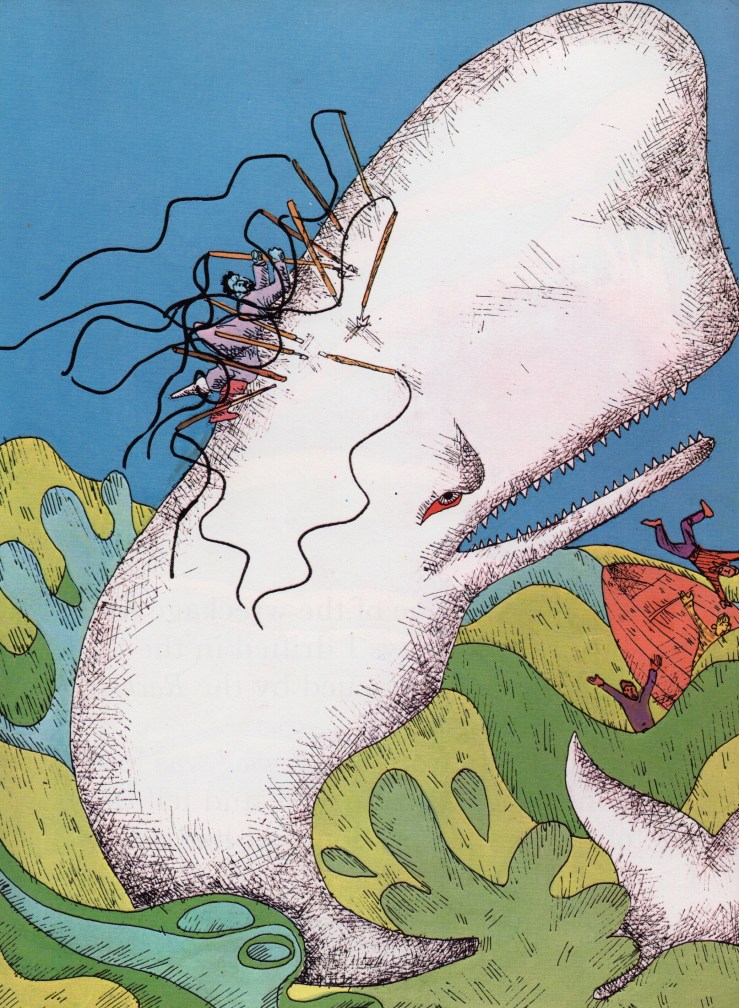
Moby Dick — Hieronimus Fromm

img_2273

The body of the bride Lila appeared cruelly shredded (From Elena Ferrante’s novel The Story of a New Name)

It was a beautiful warm evening; the brilliant lights of the shop’s interior spread their glow into the square. The gigantic image of Lila in her wedding dress could be seen at a distance, leaning against the center wall. Stefano parked, we went in, making our way among the boxes of shoes, piled up haphazardly, cans of paint, ladders. Marcello, Rino, Gigliola, and Pinuccia were visibly irritated: for varying reasons they had no wish to submit yet again to Lila’s caprices. The only one who greeted us cordially was Michele, who turned to my friend with a mocking laugh. “Lovely signora, will you let us know, at last, what you have in mind or do you just want to ruin the evening?”

Lila looked at the panel leaning against the wall, asked them to lay it on the floor. Marcello said cautiously, with the dark timidity that he always showed toward Lila, “What for?”

“I’ll show you.”

Rino interrupted: “Don’t be an idiot, Lina. You know how much this thing cost? If you ruin it, you’re in trouble.”

The Solaras laid the image on the floor. Lila looked around, with her brow furrowed, her eyes narrowed. She was looking for something that she knew was there, that perhaps she had bought herself. In a corner she spied a roll of black paper, and she took a pair of big scissors and a box of drawing pins from a shelf. Then, with that expression of extreme concentration which enabled her to isolate herself from everything around her, she went back to the panel. Before our astonished and, in the cases of some, openly hostile eyes, she cut strips of black paper, with the manual precision she had always possessed, and pinned them here and there to the photograph, asking for my help with slight gestures or quick glances.

I joined in with the devotion that I had felt ever since we were children. Those moments were thrilling, it was a pleasure to be beside her, slipping inside her intentions, to the point of anticipating her. I felt that she was seeing something that wasn’t there, and that she was struggling to make us see it, too. I was suddenly happy, feeling the intensity that invested her, that flowed through her fingers as they grasped the scissors, as they pinned the black paper.

Finally, she tried to lift the canvas, as if she were alone in that space, but she couldn’t. Marcello readily intervened, I intervened, we leaned it against the wall. Then we all backed up toward the door, some sneering, some grim, some appalled. The body of the bride Lila appeared cruelly shredded. Much of the head had disappeared, as had the stomach. There remained an eye, the hand on which the chin rested, the brilliant stain of the mouth, the diagonal stripe of the bust, the line of the crossed legs, the shoes.

Gigliola began, scarcely containing her rage: “I cannot put a thing like that in my shop.”

“I agree,” Pinuccia exploded. “We have to sell here, and with that grotesque thing people will run away. Rino, say something to your sister, please.”

Rino pretended to ignore her, but he turned to Stefano as if his brother-in-law were to blame for what was happening. “I told you, you can’t reason with her. You have to say yes, no, and that’s it, or you see what happens? It’s a waste of time.”

Stefano didn’t answer, he stared at the panel leaning against the wall and it was evident that he was looking for a way out. He asked me, “What do you think, Lenù?”

I said in Italian, “To me it seems very beautiful. Of course, I wouldn’t want it in the neighborhood, that’s not the right place for it. But here it’s something else, it will attract attention, it will please. In Confidenze just last week I saw that in Rossano Brazzi’s house there is a painting like this.”

Hearing that, Gigliola got even angrier. “What do you mean? That Rossano Brazzi knows what’s what, that you two know everything, and Pinuccia and I don’t?”

At that point I felt the danger. I had only to glance at Lila to realize that, if when we arrived at the shop she had really felt willing to give in should the attempt prove fruitless, now that the attempt had been made and had produced that image of disfigurement she wouldn’t yield an inch. Those minutes of work on the picture had broken ties: at that moment she was overwhelmed by an exaggerated sense of herself, and it would take time for her to retreat into the dimension of the grocer’s wife, she wouldn’t accept a sigh of dissent. In fact, while Gigliola was speaking, she was already muttering: Like this or not at all. And she wanted to quarrel, she wanted to break, shatter, she would have happily hurled herself at Gigliola with the scissors.

From Elena Ferrante’s 2012 novel The Story of a New Name. English translation by Ann Goldstein. I’m not sure how well the passage stands free of any context—I know there are a lot of characters here with backgrounds that won’t be clear to anyone who hasn’t read Ferrante’s novel (read it!)—but I love this passage, where brilliant friends Lila and Lenù collaborate to turn advertising into art, to artistically—and violently, perhaps—erase Lila’s body from the patriarchal order into which she has been inscribed.

William T. Vollmann talks sex and death; reads from Last Stories and Other Stories

Completely cleansed of the dross of speech (From Elena Ferrante’s novel My Brilliant Friend)

I stuck my head out the window, the postman said there was a letter for Greco. I ran down with my heart pounding. I ruled out the possibility that my parents had written to me. Was it a letter from Lila, from Nino? It was from Lila. I tore open the envelope. There were five closely written pages, and I devoured them, but I understood almost nothing of what I read. It may seem strange today, and yet it really was so: even before I was overwhelmed by the contents, what struck me was that the writing contained Lila’s voice. Not only that. From the first lines I thought of The Blue Fairy, the only text of hers that I had read, apart from our elementary-school homework, and I understood what, at the time, I had liked so much. There was, in The Blue Fairy, the same quality that struck me now: Lila was able to speak through writing; unlike me when I wrote, unlike Sarratore in his articles and poems, unlike even many writers I had read and was reading, she expressed herself in sentences that were well constructed, and without error, even though she had stopped going to school, but—further—she left no trace of effort, you weren’t aware of the artifice of the written word. I read and I saw her, I heard her. The voice set in the writing overwhelmed me, enthralled me even more than when we talked face to face: it was completely cleansed of the dross of speech, of the confusion of the oral; it had the vivid orderliness that I imagined would belong to conversation if one were so fortunate as to be born from the head of Zeus and not from the Grecos, the Cerullos. I was ashamed of the childish pages I had written to her, the overwrought tone, the frivolity, the false cheer, the false grief. Who knows what Lila had thought of me. I felt contempt and bitterness toward Professor Gerace, who had deluded me by giving me a nine in Italian. The first effect of that letter was to make me feel, at the age of fifteen, on the day of my birthday, a fraud. School, with me, had made a mistake and proof was there, in Lila’s letter.

From Elena Ferrante’s 2011 novel My Brilliant Friend. English translation by Ann Goldstein. I love this novel, and what I perhaps love most about it is how Ferrante’s narrator conveys the titular brilliance of her friend Lila. My Brilliant Friend might be summarized in one of its own sentences: “She was trying to understand, we were both trying to understand, and understanding was something that we loved to do.”

I conclude now I have no inner resources (Reading/Have Read/Should Write About)

img_2152

For twenty years now Berryman’s line I conclude now I have no inner resources has been plinking around the inside of my dumb skull. The line is plinking like crazy lately, as I shuffle final exam essays into some kind of order (what order?) that might align with my ability to offer the student, the writer, some meaningful note, some suggestion for improvement, some revelatory remark. Plink plink plink. No inner resources.

It is bad to start with a complaint so I will dress up the preceding paragraph (I dress it mentally) as an apologia. (Why the hell did I decide to write about books online?!).

I’ve been reading some really great books lately, folks. People, yes, you, listen. It’s not true that I have no inner resources. I am unstuck as a reader. I’m all gummed up with what I’ve read. Well-fed. And yet I go to scribble out a, like, review and plink plink plink. Nothing.

But like I said, the reading’s been really good. From the bottom up:

Let me strongly recommend American Candide by Mahendra Singh. I recommend this book for people who enjoy laughing at tragedies that should otherwise make them weep. You can and should purchase this book from Rosarium.

tumblr_o6f5s07t9a1s4y9aso1_1280
Illustration to American Candide by Mahendra Singh

Above American Candide in the stack so lazily pictured above is Yuri Herrera’s neon noir novella The Transmigration of Bodies, which I also highly recommend. I managed a few words on it here.

If you were to describe Henri Michaux’s Miserable Miracle 1956 book to me, I might politely decline with a small gesture of my hand. It’s about a guy who takes mescaline and writes about the experience and he draws these pictures and then he later takes “Indian hemp” and compares it— you might say to me, you, knowing as you know that I dig weird books, but I would cut you off at with an em dash, polite but firm, Not interested in drug novels these days (and besides dude, you know that Aldous Huxley did kinda the same thing at kinda the same time). And then you, having the book with you might press it into my hand, declaring, No, look

img_2156 img_2154 img_2155 img_2158

—and I would say Thanks and consume the book in two sittings.

And so after a few years of false starts, I finally broke through the second chapter of Stanley Elkin’s satire The Franchiser. The many years of recommendations, exhortations (and scoldings) to read The fucking Franchiser were correct and good and now appreciated, as I work my way into the novel’s rich fat middle—but I admit it was Mr. William Gass who finally sold me on a commitment. I read his introduction published elsewhere—in A Temple of Texts—and that was that.

Thanks to Jon for sending me Ursula K. Le Guin’s essay collection The Language of the Night. The collection collects the collective introductions to Le Guin’s so-called Hainish collection, which I read this winter, and wrote about here. Not one of my editions featured the reflections Le Guin (or more likely her editors) called “Introductions” in later essays, and reading the Hainish intros is, in a very slight sense, like rereading those books. Lovely.

Last and never least: Tom Clark’s The Last Gas Station and Other Stories. I’ve thought often of Clark’s poems as stories pretending to be poems so maybe these are poems pretending to be stories. Or maybe I have no idea what the fuck I’m talking about. (Plink plink plink). I read most of them except for the longest one, “Incident at Basecamp,” which I will save save save for the future, an old habit, maybe a bad habit, that, to read all but one story in a collection, to maybe keep the collection afresh somehow or not wholly discovered—eh? Plink plink plink. Wag.