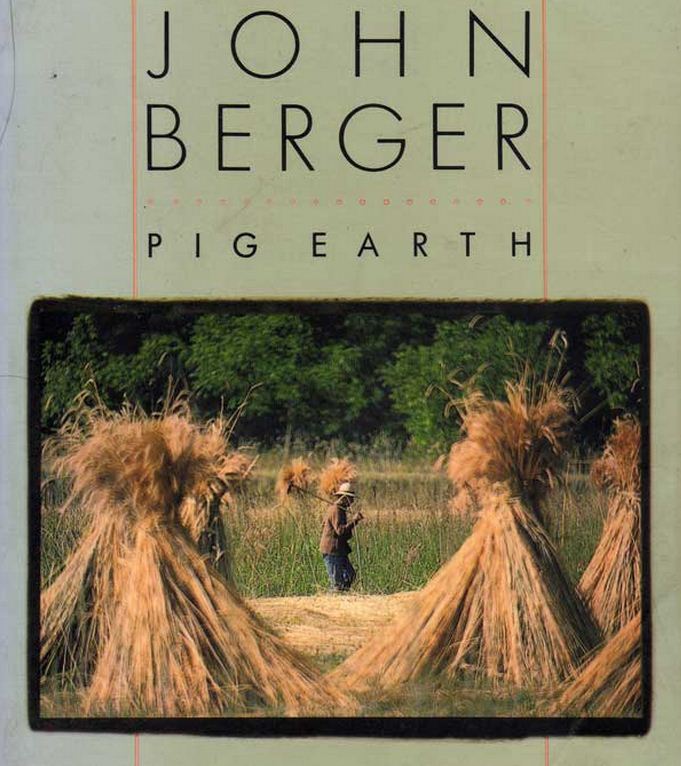
Pig Earth — John Berger

People exaggerate the changes in nature so as to make nature seem lighter. Nature resists change. If something changes, nature waits to see whether the change can continue, and it it can’t, it crushes it with all its weight!  Ten thousand years ago the trout in the stream would have been exactly the same as today.

Stasis and disruption and the relation between people and their natural and urban surroundings are the themes John Berger writes about in his 1979 collection of essays, poems and short stories, Pig Earth.  Having moved from England, where he enjoyed considerable renown as an art critic and fiction writer, to the peasant villages of the French Alps, Berger settled into his role as an active participant in rural life, not only turning hay but observing and documenting the disappearance of a way of a once-pervasive mode of life.  Pig Earth was one result of his labors, the first book of a trilogy that took some fifteen-odd years to complete, a moving but not uncritical account of humanity’s struggle to conquer nature by symbiosis.

Maybe symbiosis isn’t the proper term if we agree that humanity is part of nature’s whole, but Berger juxtaposes the frailty of humanity with the earth’s uncaring and often violent strength.  Survival for the family of the subsistence farmer depends upon that family’s ability to tend to the needs of the plant and animal world (as well as more than a little bit of luck).  In the collection’s first true story, “A Calf Remembered,” a baby cow is delivered on a dark winter’s night. Here, Berger stresses the protections that nature and man have designed to ensure the survival of a young, vulnerable animal:  mucus, barn, salt, and sense.  The human spends his night in the barn protecting his property because it provides him not only with sustenance in the forms of milk and meat, but also companionship and a sense of duty.  When daily living requires acts that might mean life or death, the conscious and the instinct converge.

He sat on a milking stool in the dark.  With his head in his hands, his breathing was indistinguishable from that of the cows. The stable itself was like the inside of an animal.  Breath, water, cud were entering it:  wind, piss, shit were leaving.

Pig Earth is a book worth studying as people attempt to make sense of a world transitioning from one type of living to another and fuss over the sources of their own limited strength and vitality. Berger may not have been looking to pioneer a slow-living locavore lifestyle, but his subjects worry about their increasing isolation from the circles of power and industry.  They fret over the pointlessness of passing their knowledge to their children who need entirely different skills to survive in the rapidly encroaching urban wage economy.  In “The Value of Money” a father refuses a tractor, branded “The Liberator” by the manufacturer, that his son has purchased for him because it will render his faithful work-horse obsolete.  This same farmer kidnaps local tax officials because they want to confiscate the products of his labor without compensation for value that he exclusively created.  Unable to make them understand their wrongdoing, he sets them free because “you can only take revenge on those who are your own.”

The final story, “The Three Lives of Lucy Cabrol,” is the lengthiest and perhaps most poignant narrative in the book. It follows the life of a bright, tenacious, physically stunted woman as she grows from young girl to town outcast.  While Berger admired much of the life in the peasant village, he would fail in his duty as critic and chronicler if he ignored its darker sides. Berger often sets the title character’s pluck against the resignation and superstition endemic to village life. When life requires struggle, most people choose to hoard.  When poor choices may lead to death or family hardship, capitulation to those in power, whether those rulers be the town’s big man or Nazi collaborators, can often seem the only obvious choice.  Lucy shows us that cowardice, no matter the circumstances, only seems easy. Pig Earth is highly recommended.

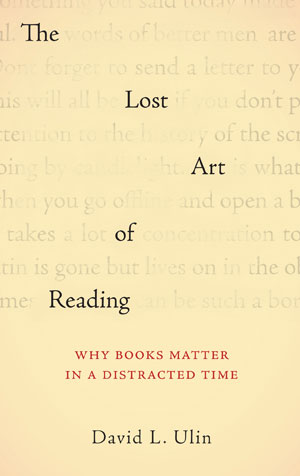
The Lost Art of Reading — David L. Ulin

“One evening not long ago, my fifteen-year-old son, Noah, told me that literature was dead,” begins David L. Ulin’s new book-length essay, The Lost Art of Reading. Noah is not enjoying The Great Gatsby; or, perhaps more accurately, he’s not enjoying how his English teacher is having him analyze the book. Noah’s experience with Gatsby is probably not too different from many young readers who are told that they must appreciate a book, break it down, reckon and account for all of its subtleties — all in the context of a classroom, for a grade. Reading literature is just a means to an end then, a way to pass a class; unlike Ulin, who “frame[s] the world through books,” Noah’s “inner-life is entwined within the circuits of his laptop.” Noah’s pronouncement that literature is dead is fraught with cultural and technological significance. And while such declarations are hardly new, the idea that books — literary works in particular — not only do not hold the place they once did in our society, but now cannot hold a place of significance seems to hold more water than it did even ten years ago. Books are no longer the dominant media. Discourse is frenetic, fractured, shallow. Accordingly, Ulin subtitles his book Why Books Matter in a Distracted Time.

Gatsby — and Ulin’s conversations with his son about it — become organizing touchstones throughout the essay, along with Frank Conroy’s memoir Stop-Time, Faulkner’s obsession with time, and Thomas Paine’s Common Sense — a tract that Ulin points out might be “the most important book ever published in America.” It’s this consideration of Common Sense, along with his son’s declaration that lit is dead, that prompts Ulin to ask, “Could a book, any book, have this kind of impact in contemporary society? What about a movie or a website?” The questions continue–

How do things stick to us in a culture where information and ideas flare up so quickly that we have no time to assess one before another takes place? How does reading maintain its hold on our imagination, or is that question even worth asking anymore?

Ulin sets out to address these questions, drawing examples and analyses from a dizzying pool of books, websites, movies, and other media to do so. One of the highlights of The Lost Art of Reading is its confidence in defining reading as a meaningful art. Ulin tells us that–

Reading is an act of contemplation, perhaps the only act in which we allow ourselves to merge with the consciousness of another human being. We possess the books we read, animating the waiting stillness of their language, but they possess us also, filling us with thoughts and observations, asking us to make them part of ourselves.

And a few pages later–

This is what literature, at its best and most unrelenting, offers: a slicing through of all the noise and the ephemera, a cutting to the chase. There is something thrilling about it, this unburdening, the idea of getting at a truth so profound that, for a moment anyway, we become transcendent in the fullest sense. I’m not talking here about posterity, which is its own kind of fantasy, in which we regard books as tombstones instead of souls. No, I’m thinking more of literature as a voice of pure expression, a cry in the dark.

And yet Ulin admits to becoming, increasingly, a distracted reader, a reader who too quickly puts down his book to pick up his laptop or smart phone. This distraction seems endemic, environmental, even professionally necessary — and admittedly very, very familiar. The costs are also familiar–

. . . to read, we need a certain kind of silence, an ability to filter out the noise. That seems increasingly elusive in our overnetworked society, where every buzz and rumor is instantly blogged and tweeted, and it is not contemplation we desire but an odd sort of distraction, distraction masquerading as being in the know. In such a landscape, knowledge can’t help but fall prey to illusion, albeit an illusion that is deeply seductive, with its promise that speed can lead us to more illumination, that it is more important to react than to think deeply, that something must be attached to every bit of time. Here, we have my reading problem in a nutshell, for books insist we take the opposite position, that we immerse, slow down.

It’s key to note that Ulin is hardly a Luddite or a reactionary; when he writes “my reading problem” this is not a generalization — he is referring to his first-person experience as a reader. He is also open to the ways in which new media enhances literature. He writes, for example, of the ways in which Facebook and other websites create virtual platforms in which to honestly engage literature. He also discusses times when one habit of distraction — stopping to reference what he’s reading on YouTube or elsewhere on the net (a habit I fully identify with) — genuinely enriches his reading. However, Ulin’s greater fear is not so much his own personal distraction, but the costs of a permanently distracted populace–

This is how we interact now, by mouthing off, steering every conversation back to our agendas, skimming the surface of each subject looking for an opportunity to spew. We see it on blogs and in e-mails, on television talk shows, in public meetings and community forums; we are a culture that seems unable to concentrate, to pursue a line of thought or tolerate a conflicting point of view.

Wallowing through the comments section of any politicized news story is pretty much a recipe for depression, or at least a loss of faith in Americans’ ability, as Fitzgerald says ” to hold two opposed ideas in the mind at the same time, and still retain the ability to function.”

I should admit my bias — Ulin had little work to do to convince me that a decline in “deep” reading — and meaningful, reflective discussion about that reading — can only further contribute to an increasingly shallow, trivial, and openly anti-intellectual society. So what is at stake here?–

Stories, after all — whether aesthetic or political — require sustained concentration; we need to approach them as one side of a conversation in which we play a part. If we don’t, we end up susceptible to manipulation, emotional or otherwise. In February 1946, Hermann Goering told the judges of the Nuremberg tribunal, ‘Naturally the common people don’t war . . . But, after all, it is the leaders of a country who determine policy, and it is always a simple matter to drag people along, whether it is a democracy, or a fascist dictatorship, or parliament, or a communist dictatorship. All you have to do is tell them they are being attacked, and denounce the pacifists for lack of patriotism and exposing the country to danger. It works the same in every country.’ Such a statement is chilling on all sorts of levels, but nowhere more than in its recognition of the fact that we are complicit in our fate.

One solution for Ulin (and I’m apt to agree) is reading, “an act of resistance in a landscape of distraction, a matter of engagement in a society that seems to want nothing more than for us to disengage.” Best of all, Ulin’s book is the act of criticism — both cultural and literary — that makes one want to read. He reminds us that the currency of ideas is always open to us if we put in the effort, and that the moments of enlightenment, of transcendence that we might gain from literature are part of what makes a life worth living. Recommended.

The Lost Art of Reading is available now from Sasquatch Books.

The Adventures of Huckleberry Finn: One of Our Favorite Challenged Books

E.W. Kemble's frontispiece to the original 1884 edition
E.W. Kemble’s frontispiece to the original illustrated edition

The Adventures of Huckleberry Finn by Mark Twain, undoubtedly one of the Great American Novels, ranks a healthy #5 on the ALA’s list the 100 Most Frequently Challenged Books. Young Huck’s casual colloquial use of the word “nigger” and the cruel hijinks Huck and Tom play on Jim at the novel’s end are two reasons that many have sought to suppress Twain’s masterpiece, including educator and critic John Wallace, who famously called it “the most grotesque example of racist trash ever given our children to read.” Wallace went so far as to suggest that “Any teacher caught trying to use that piece of trash with our children should be fired on the spot, for he or she is either racist, insensitive, naive, incompetent or all of the above.”

I guess I should’ve been fired on the spot, as I’ve used Huck Finn in my classroom a number of times, almost always in conjunction with excerpts from Olaudah Equiano’s Interesting Narrative, some Philis Wheatley poems, and a UN report on modern human trafficking. Context is everything.

While I can concede readily that Huck, the voice of the novel, says some pretty degrading things about Jim, often meant (on Twain’s part) to create humor for the reader, to expect Twain’s treatment of race to be what we in the 21st century want it to be is to not treat the material with any justice. And while Huck Finn may be insensitive at times, it handles the issues of race, slavery, class, and escape from the dominant social order with the complexity and thought that such weighty issues deserve. Ultimately, the novel performs a critique on the hypocrisy of a “Christian,” “democratic” society that thought it was okay to buy and sell people. This critique shows up right in the second page. Consider these lines (boldface mine):

The widow rung a bell for supper, and you had to come to time. When you got to the table you couldn’t go right to eating, but you had to wait for the widow to tuck down her head and grumble a little over the victuals, though there warn’t really anything the matter with them,—that is, nothing only everything was cooked by itself. In a barrel of odds and ends it is different; things get mixed up, and the juice kind of swaps around, and the things go better.

After supper she got out her book and learned me about Moses and the Bulrushers, and I was in a sweat to find out all about him; but by and by she let it out that Moses had been dead a considerable long time; so then I didn’t care no more about him, because I don’t take no stock in dead people.

Huck’s dream is of a delicious mix, a swapping of juices — integration. Additionally, his disregard for the dead Bible heroes reveals that the white Christian society’s obsession with the ancient past comes at the expense of contemporary value. Huck, an orphan, and Jim, separated from his family, will symbolically echo Moses in the bulrushes as they use the great Mississippi as a conduit for escape, for freedom. Huck (or Twain, really) here points out that it’s not enough to look at dead words on a page, on old dead lawgivers–we have to pay attention to the evils and wrongs and hypocrisies that live today.

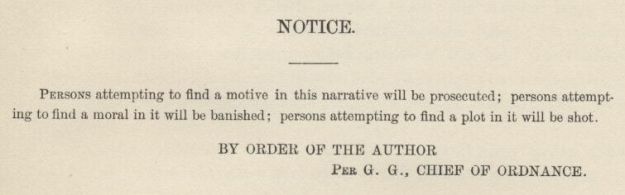
Twain even tells us how to read his book from the outset:

Now, it’s impossible to read a book–a good book–without finding its plot, searching for its moral, or caring about its characters, and Twain knows this. His “Notice” is tantamount to saying “don’t think about an elephant”–he uses irony to tell us we must find motive, moral, and plot here, and that we must do so through this lens of irony.

But of course, you have to read closely for all these things. I suppose it’s technically easier to call something trash, throw it in the garbage, and not have to devote time and energy to thinking about it. Who knows? You might learn something–and we wouldn’t want that, would we?

[Editorial note: Biblioklept originally published this piece in September of 2008].

A Kidnapping in Milan: The CIA on Trial — Steve Hendricks

Steven Hendricks’s A Kidnapping in Milan: The CIA on Trial details the story of radical imam Abu Omar. Omar, an Egyptian radical who sought political asylum in Italy, was the focus of an investigation by the Milan police force, who, via wiretaps and other forms of surveillance, were building a case against Omar for recruiting a network of Islamist terrorists. In early 2003, the Milanese case fell apart when Omar was disappeared in what turned out to be one of the most conclusively documented cases of the CIA’s “extraordinary renditions.” Omar was kidnapped, relocated to Germany, and then returned to Egypt, where he was tortured and held by Egypt’s SSI–under the watchful eyes of the CIA. Italian prosecutor Armando Spataro, erstwhile protagonist of Kidnapping, reconstructed the evidence of the CIA’s extraordinary (and extra-legal) rendition, leading to the prosecution of twenty-six CIA operatives for kidnapping; twenty-three were convicted.

Hendricks combines journalistic clarity with the structure of a detective novel in Kidnapping, giving his book the urgency of a modern thriller, all the more striking for its cold reality. The book is well-researched; Hendricks interviewed, among others, Spataro, Omar, and even some of the indicted CIA agents–but Kidnapping never reads as a dry recitation of facts or a ponderous series of analyses. Additionally, Hendricks fleshes out his story with a consideration of the CIA’s history in Italian politics, with an emphasis on why Milan is such a hotbed for clandestine activities. Guiding the narrative is a refined sense of moral outrage against the idea that dark deeds done in the dark make our world somehow safer. While there are some that will remain unmoved by his descriptions of Omar’s torture — the cleric is a “bad guy,” in the Bush admin’s parlance, after all — Hendricks builds a clear case that the “outsourcing of torture” is a vile practice, and one antithetical to the spirit of our Constitution. And, even if the Obama administration is unwilling to shed further light on such crimes, it is good to know that there are writers who will.

A Kidnapping in Milan is new in hardback from W.W. Norton.

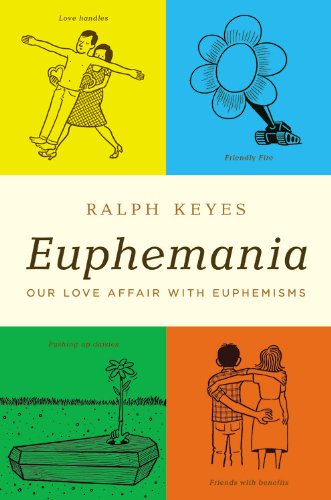
Euphemania — Ralph Keyes


In his new book Euphemania, a cultural history of euphemisms, Ralph Keyes takes a frank and often bawdy look at why we use euphemisms in social and political discourse, even when such evasions can degrade communication. “We all rely on euphemisms to tiptoe around what makes us uneasy, and have done so for most of recorded history,” writes Keyes, adding that “Euphemisms are a function of their times.” As such, Euphemania surveys different euphemisms throughout different cultures and times, from ancient Greece to the Roman republic, to Shakespeare’s England and the Victorian era (a treasure trove of euphemisms), to our modern age–which Keyes argues is not nearly as frank and open as we might like to think; indeed, one of his most intriguing arguments points out that modern discourse has simply opened up more topics to euphemism, including medicine, politics, and advertising.

Keyes doesn’t intend his book to be a straightforward history or dictionary of euphemisms; rather, he writes “it’s a consideration of the ways euphemisms enter our conversations and how they reflect their time and place. Euphemizing most often results from an excess of politeness and prudery, but it can also demonstrate creativity and high good humor.” Although Keyes always has a keen eye on the prudish mores of which ever age he’s discussing, he balances this analysis with plenty of humorous examples. His tone is fun and earthy, drawing examples from literature, film, TV, advertising, and political rhetoric. Between discussions of the Bowdlerization of Shakespeare, W.C. Fields’s difficulties with censors, or dialog from The Wire, Keyes also holds forth on the strange etymologies of our words. The root of the word bear (the mammal, not the verb) simply means “brown” or “the brown one” — the word bear is an unexpected euphemism, a refusal to name a lethal wild animal. Such examples can often magnify one’s awareness of how indebted our language is to euphemisms. Even when we reach for one of those Latinate technical words, we’ve really just picked up another culture’s euphemism. Our medical standby penis, for example, comes from the Latin word for “tail.” Vagina was a Roman synonym too–it means “sheath” or “scabbard.”

Euphemania is best when Keyes is riffing on naughty bits like these–or sex, or excretions, or violence, or all those things we’d like to otherwise gloss over. Most readers will likely gravitate to chapters like “Anatomy Class” or “Speaking of Sex.” Although Keyes is never dull (if anything, he’s at times too effervescent), his book is less convincing when discussing why we use euphemisms, simply because, at least to this reader, the answers are so obvious–euphemisms are part of the intrinsic codes of our culture. They make it easier to discuss unpleasant things; they build a sense of shared knowledge; they alleviate anxieties of race, place, and gender. At the same time, the cost of euphemisms–particularly in contemporary political discourse–can be astounding, leading to the evasion or outright denial of dramatic problems. Keyes doesn’t offer a pat solution to this problem, which is really better, if one thinks about it, because after all, wouldn’t an overly simplified, self-satisfied answer be just another dodge, another evasion, another euphemism? Good stuff.

Euphemania is new in hardback from Hatchette/Little, Brown and Company.

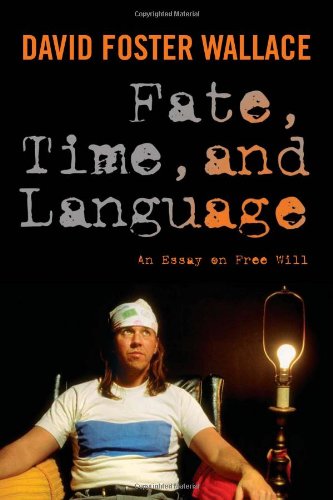
Fate, Time, and Language: An Essay on Free Will — David Foster Wallace

Sometime last year, during a rare visit to a big chain bookstore, I was disgusted to see what had happened to David Foster Wallace’s amazing Kenyon College commencement speech, “This Is Water.” Wallace’s speech, about 3,815 words, give or take (maybe twelve standard typed pages), was being sold as a 144 page hardback volume with only a sentence or two printed per page. The book was (and is) a nakedly commercial attempt to turn a text that is widely available on the web into the sort of thing that well-meaning uncles give to their nephews or nieces as graduation gifts. Of course, hardcore Wallace fans might want such a book — and I’d never begrudge them that — but it’s hard to imagine that Wallace would have been comfortable with how his book was marketed.

Which brings us to Fate, Time, and Language: An Essay on Free Will, new from Columbia University Press this week. The book publishes the 1985 honors thesis that Wallace submitted to the Amherst College’s Department of Philosophy, “Richard Taylor’s ‘Fatalism’ and the Semantics of Physical Modality.” The essay’s title alone signals a prohibitive level of academic specialization. In his introductory essay to the volume, “A Head That Throbbed Heartlike,” New York Times Magazine editor James Ryerson points out, “Its obscurity is easy to appreciate. A highly specialized, seventy-six page work of logic, semantics, and metaphysics, it is not for the philosophically faint of heart.” Ryerson then warns his reader to “Brace yourself for a sample sentence,” before offering a sample from Wallace’s essay that I do not have the patience or fortitude to type out (it would take me too long to locate all the diacritical marks and special logic symbols). Ryerson concludes the paragraph with this wry remark: “There are reasons that he’s better known for an essay about a cruise ship.”

Fortunately, the editors of Fate, Time, and Language make every effort to contextualize Wallace’s essay in a way that explains its aims, strengths, and even shortcomings. There’s Ryerson’s lengthy introduction, which provides an overview to Wallace’s life in philosophy. Then there’s Taylor’s “Fatalism” of course, a short, provocative argument combining six presuppositions that led Taylor to declare that humans have no control — none, whatsoever — over any future event. The volume collects four other essays by Taylor on fatalism, as well as eight other essays responding to his arguments, before delivering Wallace’s essay (the longest in the collection). Here’s Wallace—

So Taylor’s central claim, the Taylor problem, is that just a few basic logical and semantic presuppositions, regarded as uncontroversially true by most philosophers, lead directly to the metaphysical conclusion that human beings, agents, have no control over what is going to happen.

I ain’t even gonna front–pretty much everything that Wallace says after this was lost on me; if you want to read and comprehend the details of his argument you will need to have a grasp on the basics of Montague grammar and tensed modal logic. If you lack these skills, there will be skimming. Lots and lots of skimming. So, in short, I have no ideawhether Wallace’s logic is sound, although I find his conclusion (minus all the modal evidence) quite compelling—

This essay’s semantic analysis has shown that Taylor’s proof doesn’t “force” fatalism on us at all. We should now recall that Taylor was offering a very curious sort of argument: a semantic argument for ametaphysical conclusion. In light of what we’ve seen about the semantics of physical modality, I hold that Taylor’s semantic argument does not in fact yield his metaphysical conclusion.

After Wallace’s honors thesis, there’s a wonderful little memoir essay by his adviser on the project, Jay L. Garfield, who offers up this nugget—

I knew at the time, as I mention above, that David was also writing a novel as a thesis in English. But I never took that seriously. I though of David as a very talented young philosopher with a writing hobby, and did not realize that he was instead one of the most talented fiction writers of his generation who had a philosophy hobby.

These little pockets of insight appeal to me most in Fate, Time, and Language, and as such, Ryerson’s essay “A Head That Throbbed Heartlike” is the highpoint of the book. It weaves together Wallace’s personal life, writing career, and academic pursuits into a moving elegy of sorts, although one more rooted in ideas than feelings. He also spells out the book’s mission quite clearly—

For all its seeming inscrutability, though, the thesis is lucidly argued and–with some patience and industry on the part of the lay reader–ultimately accessible, which is welcome news for those looking to deepen their understanding of Wallace. The paper offers a point of entry into an overlooked aspect of his intellectual life: a serious early engagement with philosophy that would play a lasting role in his work and thought, including his ideas about the purpose and possibilities of fiction.

Many of us might shudder at the idea of our college essays being published posthumously. Of course, most of us aren’t Wallace, but there are undoubtedly critics out there who will cry foul at this publication. Fortunately, the team behind Fate, Time, and Language has produced a book of remarkable integrity, one that understands why it exists, readily acknowledges its obscurity without trying to gloss over that obscurity, and makes every effort to communicate with and engage its readers without sacrificing erudition. To return to my opening anecdote, this is not the naked commercialism that motivated a gimmicky edition This Is Water; rather, this is a book delivered by people who genuinely care about Wallace and his ideas. Make no mistake–it’s very dry and very specialized, but fanatics will no doubt want it.

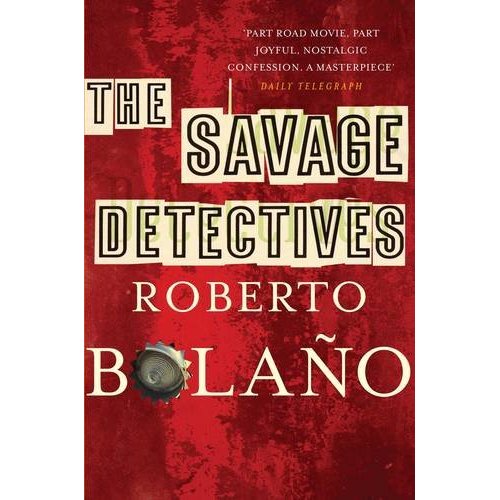
The Savage Detectives — Roberto Bolaño

Roberto Bolaño’s “other” masterwork The Savage Detectives has been previously reviewed on this website, but my view is that the previous writeup was unfair and premature.  Perhaps those of us who love this book are not “serious” readers.

The plot was accurately diagrammed in the earlier post. The Savage Detectives is made up of three sections. The first section consists of the diary of seventeen year-old Visceral Realist poet Juan Garcia Madero, his record of his literary ambition and dawning appreciation of beauty and words. The second, lengthy section is a series of interviews, seemingly conducted by a single, unknown interviewer in an attempt to uncover the history of the Visceral Realist movement, a group of iconoclastic poets that lived in Mexico City in the early part of the 1970s. The third section revisits Garcia Madero’s diary as he and Arturo Belano and Ulises Lima, the nominal leaders of the Visceral Realists, scour the unforgiving Sonora desert in search of their own lost heroes.

Bolaño revisits familiar themes in this novel by asking what drives people to create, and what happens to those people when the things they create are pushed, like themselves, to the margins of society.  Garcia Madero’s drive to write forces him to confront his everyday existence as he attempts to shed his innocence.  He loses friends, quits school, moves in with a waitress, falls in love, has his heart broken.  He writes when he eats, he writes when he should be doing something else, he writes about writing.  He assumes that he and his comrades are on the verge of fame and that others are aware that everything the Visceral Realists do is bold and profound.  Why then, Bolaño asks, is Garcia Madero satisfied with reading his poems to others when he dreams of placing his work in well-regarded anthologies?  What happens when we realize that immortality is ultimately an illusion?  Where does the spirit go when the ghost leaves only a sheet behind?

The answers to the questions posed in the first book are addressed in the second, but there is no sense that the unknown interviewer is close to mythologizing the Visceral Realists in the same manner as the scholars who made a hero of Hans Reiter in the first book of 2666.  At least at the time the interviews were conducted, the Visceral Realists’ body of work is unknown to most, but to those with knowledge of their oeuvre, the Visceral Realists are remembered as hacks or kids from the wrong side of the tracks who preferred the commission of petty misdemeanors to dedication to their craft.  The reality, as usual, is located somewhere in the middle. The Visceral Realists are shown to be like any other group of talented, excitable and intelligent young people because they’re bound to be disappointed.  Their failure of their movement can be blamed on their own choices as well as on barriers erected by those ensconced in the Mexican literary establishment whose notions of where ideas ought to come from are not easily refuted.  Especially by those demanding entry to their small but exclusive club.

Mr. Biblioklept’s first review was essentially right when he stated that The Savage Detectives “is an epic about the banal, ordinary things that fill our lives: jobs and eating and getting to places and having one’s friendships sour and being disappointed and so on.”  Yes, sadness pervades the book.  The Visceral Realists put down their pens, or they move to America, or they run and hide from the things that they cannot control at home.  The Visceral Realists succumb to disease, lose their minds, attempt to cope, and they die.  An early friend of Arturo Belano’s recounts–

I imagined him lost in a white space, a virgin space that kept getting dirtier and more soiled despite his best efforts, and even the face I remembered grew distorted, as if while I was talking to his sister his features melded into what she was describing, ridiculous feats of strength, terrifying, pointless rites of passage into adulthood so distant from what I thought would become of him.

Although the young poets suffer defeat, they enjoy small but significant triumphs, the most important of which is the existence of the book being argued about in this space.  For Bolaño, whose business is the veneration of creators and their creation, the perseverance of the questions raised by the mere existence of the Visceral Realists and their permanent embodiment in a physical object capable of transmission in perpetuity is the ultimate victory. If the author is right that “the search for a place to live and a place to work [is] the common fate of all humanity,” then the young poets transitioning to adulthood don’t fare so poorly.  Most of them, despite their backgrounds, become citizens with some stake in the places they live.  They find work, they have children, they find adventure.  Some, like Arturo Belano, continue to write at an immense personal cost.  A man without a country, he’s the shadow who forms the substance of the book and allows his alter ego to demonstrate his remarkable narrative powers.

But what makes The Savage Detectives a complete work is that, like the characters of Borges and Cortazar, who so many in this novel profess to admire, the poets realize, sometimes too late, that brief and startling connections between people are always possible and love may be found anywhere.  La Maga and Oliviera meet on strange bridges in Paris, condemned men revisit their lives in the moment between gunshot and blackness, and poor, unlettered poets will continue to read, and despite derision and hardship, will continue to express their own vision of hope and possibility.

The Best Books We Read in 2010 That Were Published Before 2010

The best books that we read in 2010 that were published before 2010:

Nazi Literature in the Americas by Roberto Bolaño (2008, English translation) — Bolaño’s fake encyclopedia of right-wing writers is a tragicomic crash course in misanthropy, failure, and fated violence. Francisco Goldman’s blurb on the back of the book is spot on–the book is a “key cosmology to Bolaño’s literary universe.” Nazi Literature is like an index for the Bolañoverse–creepy, steeped in dread, deeply, caustically funny, and bitterly poignant.

Butterfly Stories by William T. Vollmann (1993) Adventures in the Southeast Asian sex trade. Bleakly funny, often depressing, and filled with erudite asides on Nobel prizewinners, transvestites, and the benefits of whiskey and benadryl. Plenty of grotesque sex. Not for everyone. In fact, not for most people.

The Friends of Eddie Coyle by George V. Higgins (1970) — Higgins throws his audience into the deep end of gritty urban Boston on the wrong side of the sixties in this crime noir classic. There’s little exposition to spell out Coyle’s intricate and fast-paced plot, but there is plenty of machine-gun dialogue, rendered very true and very raw. Higgins trusts the reader to sort out the complex relationships between hustlers and dupes, cops and finks from their conversations alone. The imagery is straight out of a Scorcese film, and like that director, Higgins has a wonderful gift for showing his audience action without getting in the way.

Home Land (2004) and Venus Drive (2000) by Sam Lipsyte — Is there a better stylist working today than Lipsyte? Does anyone write better sentences? Of course, sentences alone don’t matter much if you don’t have a story worth telling, and both Homeland and Venus Drive deliver. They are seething, funny, poignant books, with characters tipped toward some redemption, awful or otherwise, despite their myriad sins.

Steps by Jerzy Kosinski (1968) — One of the many small vignettes that comprise Steps begins with the narrator going to a zoo to see an octopus that is slowly killing itself by consuming its own tentacles. The piece ends with the same narrator discovering that a woman he’s picked up off the street is actually a man. In between, he experiences sexual frustration with a rich married woman. The piece is less than three pages long. You will either hate or love this book.

Cloud Atlas (2004) and Black Swan Green (2006) by David MitchellCloud Atlas is a postmodern puzzle piece of six nested narratives (each a smart take on some kind of genre fiction), informed by Nietzsche’s idea of eternal recurrence; Black Swan Green (which for some reason we forgot to review here) is a funny and heartwarming coming-of-age story of a boy who copes with his terrible stutter and his parents’ crumbling marriage in early 1980’s England. The books have little in common save their brilliance–which seems kinda sorta unfair. It also seems unfair that Mitchell put them out so quickly. Damn him.

Angels by Denis Johnson (1983) — Angels begins as a small book about not very much and ends as a small book about pretty much everything. Johnson has a keen eye and keener ear for the kinds of marginal characters many of us would rather overlook all together, people who live and sweat and suffer in the most wretched, unglamorous, and anti-heroic vistas of a decayed America. The great achievement of the novel (beyond Johnson’s artful sentences) is in staging redemption for a few–not all, but a few–of its hopeless anti-heroes.

Suttree by Cormac McCarthy (1979) — A beautiful, rambling riff on American literature — Suttree picks up on Emerson and Twain, Faulkner and Whitman, and flows into a new, wild territory that is pure McCarthy. Is it his best novel? Could be. Read it.

Books of 2010 — Noteworthy, Notorious, and Neglected

Biblioklept already busted out our Best Books of 2010 list, selecting ten of our favorite novels of the year. Such limitations help to generate lists, which internet folks love to circulate–you know the ritual–but those limitations can also prohibit a discussion of some of the other important books of 2010. So, without further ado–

Jonathan Franzen’s Freedom has, for some reason, topped all kinds of year-end lists already, and been hailed by writers, critics, and readers as book of the year, decade, and even century. We pretty much hated it, saying–

Franzen is deeply intelligent, even wise, and his analysis of the past decade is perhaps brilliant. It’s also incredibly easy to read, but this is mostly because it requires so little thought from the reader. Franzen has done all the thinking for you. The book has a clear vision, a mission even, but it lacks urgency and immediacy; it is flaccid, flabby, overlong. It moans where it should howl.

Still, we felt the need to defend Franzen when he caught flak for, gasp!, getting attention. Other writers had to work hard to get noticed, including Tao Lin, whose novel Richard Yates we found baffling. Lin smartly hijacked Franzen’s Time cover, parlaying it into the kind of media attention a young novelist needs in this decade to get noticed.

David Shields also garnered a lot of attention after publishing his ridiculous “manifesto” Reality Hunger, a book that cobbled together citations from superior writers to make a point that Henry Miller made over half a century ago and every novelist worth his salt has always known: great writers steal. Although Shields’s points about copyright laws and who can “own” stories are salient in world two point oh, his call for the death of the novel is absurd and offensive.

Lee Rourke’s brilliant début novel The Canal is as good an answer as any to Shields–The Canal is a thoroughly modern reconsideration of existentialism in the post-9/11 world, a new kind of novel in the nascent tradition of Tom McCarthy’s The Remainder (of course, as McCarthy–and David Shields–would point out, these novels are “plugging into” other novels). Similarly, Adam Langer’s witty novel The Thieves of Manhattan pointed to the ways that novels can still be meaningful; Thieves jauntily riffs on adventure and mystery genre fictions, squaring them against a parody of literary fiction and the hermetic world that produces it.

Langer’s novel tracks the quick rise and fall of more than one literary star; Yann Martel might have felt such a falling sensation in 2010–Beatrice and Virgil, his follow-up to the wildly successful book club classic Life of Pi, received mostly scathing reviews. He’ll have to console himself with the piles of money that Ang Lee’s film adaptation of Life of Pi will likely generate. In our review of Beatrice and Virgil we declared the book “a page turner, engaging, propulsive, and quite easy to read. It injects the philosophical and artistic concerns of literary fiction into the frame and pacing of a book designed for broader audiences.” We think too many folks mistook Martel’s aims for something higher.

Martel wasn’t the only big name writer whose 2010 novel found critical disfavor. Don DeLillo’s Point Omega was met with a mix of critical shrugs and outright dismissals, with very few champions. We seemed to like it better than most. In our review we said that “Point Omega takes an oblique, subtle, and unnerving tackle at themes of time, perception, family, and, ultimately, personal apocalypse. It’s not a particularly fun book nor does it yield any direct answers, but it’s also a rewarding, engaging, and often challenging read.”

DeLillo’s friend Paul Auster also received mixed reviews for his novel Sunset Park. We loved Auster’s winding syntax and his keen observations on high and middle culture, but found his take on twentysomethings in Brooklyn unrealistic and perhaps a bit pandering (Picador’s updated version of his Collected Prose that came out this year was a far more satisfying read).

The worst novel we read in 2010 though was quite easily Justin Cronin’s The Passage, a calculated attempt to make money, not literature. We have no problem with writers making money, of course–we don’t even mind writers ripping off other writers’ ideas to make money–but Cronin’s book is a shallow, sprawling laundry list of clichés and stolen-set pieces, a failed synthesis of post-apocalypse tropes, and a naked grab at commercial appeal. It seems to have been written expressly to be sold as a series of franchise movies. Because of Cronin’s earlier literary fictions, many critics mistook The Passage for a work of literature; indeed, many praised it. They were wrong.

Of course, our targeting of The Passage feels like backlash of some kind, common to both the internet and the book world. If we’re hating on Cronin for his overexposure, it might be because we feel that there are a host of neglected and overlooked books out there. We put two on our Best Books list: Imre Kertész’s The Union Jack and Nanni Balestrini’s Sandokan are both novellas in translation, not the sort of thing that usually tops critics’ year end lists (let alone get read by the public). We could add Yoko Ogawa’s bizarre, slim novel Hotel Iris to the list. Available for the first time in English this year, Ogawa’s novel is effectively a reverse-Lolita, a David Lynchian-riff on BDSM in a small Japanese coastal town. Not for everyone, but strange, disturbing stuff.

Critics also seemed to roundly ignore the full publication of Ralph Ellison’s second, unfinished novel, Three Days Before the Shooting . . . , which we wrote about twice (here and here) but never managed to finish, which doesn’t really matter because he didn’t finish it either. A much shortened version of the novel was published as Juneteenth in the ’90s to mixed reviews, but it seems strange that this version, collecting all of Ellison’s manuscripts and notes, should go so unremarked upon (still, it’s a big long sucker of a book; perhaps someone out there is still unpacking it all).

So what did we miss? What other books of 2010 remain thus-far neglected? What books did you love? Hate? Let us know.

The Best Books of 2010

Here are our favorite books published in 2010 (the ones that we read–we can’t read every book, you know).

Sandokan — Nanni Balestrini

A dark, elliptical treatise on the mundane and inescapable violence wrought by the Camorra crime syndicate in southern Italy.

Everything Ravaged, Everything Burned — Wells Tower (trade paperback)

Tower’s world is a neatly drawn parallel reality populated by down-on-their-luck protagonists who we always root for, despite our better judgment, even as they inadvertently destroy whatever vestiges of grace are bestowed upon them.

The Union Jack — Imre Kertész

Kertész’s slim novella explores a storyteller’s inability to accurately and properly communicate spirit and truth against the backdrop of an oppressive Stalinist regime.

BodyWorld — Dash Shaw

Shaw’s graphic novel is sardonically humorous in its psychoanalytic/post-apocalyptic visions. It’s a sweet and sour subversion of 1950’s comics and contemporary conformist groupthink politics. Witty and poignant, it advances its medium.

The Thousand Autumns of Jacob de Zoet — David Mitchell

An unexpected historical romance from postmodern poster boy David Mitchell. Thousand Autumns is a big fat riff on storytelling and history and adventure–but mostly, Mitchell’s Shogunate-era Japan is a place worth getting lost in.

C — Tom McCarthy

“I see what I’m doing as simply plugging literature into other literature,” McCarthy said in an interview this year. “For me, that’s what literature’s always done.” C, our favorite novel of 2010, seems plugged into the past and the present, pointing to the future.

Wolf Hall — Hilary Mantel (trade paperback)

Who knew that we needed to hear the Tudor saga again? Who knew that Thomas Cromwell could be a good guy?

The Ask — Sam Lipsyte

A mean, sad, hilarious novel that simultaneously eulogizes, valorizes, and mocks the American Dream.

X’ed Out — Charles Burns

Charles Burns does Tintin in William Burroughs’s Interzone. ‘Nuff said.

The Collected Stories of Lydia Davis — Lydia Davis

An epic compendium of, jeez, I don’t know, how do you define or explain what Davis does? Inspection, perception, mood, observation. Tales, fables, riffs, annotations, skits, jokes, japes, anecdotes, journals, thought experiments, epigrams, half-poems, and would-be aphorisms. Great stuff.

Suttree — Cormac McCarthy

In his 1992 interview with The New York TimesCormac McCarthy said, “The ugly fact is books are made out of books. The novel depends for its life on the novels that have been written.” McCarthy’s fourth novel, 1979’s Suttree is such a book, a masterful synthesis of the great literature — particularly American literature — that came before it. And like any masterful synthesis, Suttree points to something new, even as it borrows, lifts, and outright steals from the past. But before we plumb its allusions and tropes and patterns, perhaps we should overview the plot, no?

The novel rambles over several years in the life of Cornelius Suttree. It is the early 1950s in Knoxville, Tennessee, and Suttree ekes out a mean existence on the Tennessee River as a fisherman, living in a ramshackle houseboat on the edge of a shantytown. This indigent life is in fact a choice: Suttree is the college-educated son of an established, wealthy family. His choice is a choice for freedom and self-reliance, those virtues we like to think of, in our prejudicial manner, as wholly and intrinsically American. Suttree then is both Emersonian and Huck Finnian, a reflective and insightful man who finds his soul via a claim to agency over his own individuality, an individuality poised in quiet, defiant rebellion against the conforming forces of civilization. These forces manifest most pointedly in the Knoxville police, a brutal, racist organization, but we also see social constraint in the form of familial duty. One thinks of the final lines of Huckleberry Finn: “I reckon I got to light out for the Territory ahead of the rest, because Aunt Sally she’s going to adopt me and sivilize me and I can’t stand it. I been there before.”

Like Huck, Suttree aims to resist all forces that would “sivilize” him. His time on the river and in the low haunts of Tennessee (particularly the vice-ridden borough of McAnally) brings him into close contact with plenty of other outcasts, but also his conscience, which routinely mulls over its place in the world. Suttree is punctuated by–perhaps even organized by–several scenes of hallucination. Some of these psychotrips result from drunkeness, one comes from accidentally ingesting the wrong kind of mushrooms (or, the right kind, if that’s your thing), and the final one, late in the novel, sets in as Suttree suffers from a terrible illness. In his fever dream, a small nun–surely a manifestation of the guilt that would civilize us–accuses him–

Mr. Suttree it is our understanding that at curfew rightly decreed by law in that hour wherein night draws to its proper close and the new day commences and contrary to conduct befitting a person of your station you betook yourself to various low places within the shire of McAnally and there did squander several ensuing years in the company of thieves, derelicts, miscreants, pariahs, poltroons, spalpeens, curmudgeons, clotpolls, murderers, gamblers, bawds, whores, trulls, brigands, topers, tosspots, sots and archsots, lobcocks, smellsmocks, runagates, rakes, and other assorted and felonious debauchees.

The passage is a marvelous example of McCarthy’s stream-of-consciousness technique in Suttree, moving through the various voices that would ventriloquize Suttree, into the edges of madness, strangeness, and the sublimity of language. The tone moves from somber and portentous into bizarre imagery that blends humor and pathos. This is the tone of Suttree, a language that gives voice to transients and miscreants, affirming the dignity of their humanity even as it details the squalor of their circumstance.

It is among these criminals and whores, transvestites and gamblers that Suttree affirms his own freedom and humanity, a process aided by his comic foil, Gene Harrogate. Suttree meets Harrogate on a work farm; the young hillbilly is sent there for screwing watermelons. After his release, Harrogate moves to a shantytown in Knoxville. He’s the country mouse determined to become the city rat, the would-be Tom Sawyer to Suttree’s older and wiser Huck Finn. Through Harrogate’s endless get-rich-quick schemes, McCarthy parodies that most-American of tales, the Horatio Alger story. Simply put, the boy is doomed, on his  “way up to the penitentiary” as Suttree constantly admonishes. In one episode, Harrogate tries to buy arsenic from “a grayhaired and avuncular apothecary” to poison bats he hopes to sell to a hospital (don’t ask)–

May I help you? said the scientist, his hands holding each other.

I need me some strychnine, said Harrogate.

You need some what?

Strychnine. You know what it is dont ye?

Yes, said the chemist.

I need me about a good cupful I reckon.

Are you going to drink it here or take it with you?

Shit fire I aint goin to drink it. It’s poisoner’n hell.

It’s for your grandmother.

No, said Harrogate, craning his neck suspectly. She’s done dead

Suttree, unwilling father-figure, eventually buys the arsenic for the boy against his better judgment. The scene plays out as a wonderful comic inversion of William Faulkner’s “A Rose for Emily,” from which it is so transparently lifted. McCarthy borrows liberally from Faulkner here, of course, most notably in the language and style of the novel, but also in scenes like this one, or a later episode that plays off Faulkner’s comic-romantic story of a man and a woman navigating the aftermath of a flood, “Old Man.” Unpacking the allusions in Suttree surpasses my literary knowledge or skill, but McCarthy is generous, if oblique, with his breadcrumb trail. Take, for example, the following sentence: “Suttree with his miles to go kept his eyes to the ground, maudlin and muttersome in the bitter chill, under the lonely lamplight.” The forced phrase “miles to go” does not immediately present itself as a reference to Robert Frost’s famous poem, yet the direction of the sentence retreats into the history of American poetry; with its dense alliteration and haunted vowels, it leads us into Edgar Allan Poe territory. Only a few dozen pages later, McCarthy boldly begins a chapter with theft: “In just spring the goatman came over the bridge . . .” The reference to e.e. cummings explicitly signifies McCarthy’s intentions to play with literature. Later in the book, while tripping on mushrooms in the mountains, Suttree is haunted by “elves,” the would-be culprits in Frost’s poem “Mending Wall.” The callback is purposeful, but tellingly, McCarthy’s allusions are not nearly as fanciful as their surface rhetoric might suggest: the goatman does not belong in Knoxville–he’s an archaic relic, forced out of town by the police; the elves are not playful spirits but dark manifestations of a tortured psyche.

Once one spots the line-lifting in Suttree it’s hard to not see it. What’s marvelous is McCarthy’s power to convert these lines, these riffs, these stories, into his own tragicomic beast. An early brawl at a roadhouse recalls the “Golden Day” episode of Ralph Ellison’s Invisible Man; a rape victim’s plight echoes Hubert Selby’s “Tralala”; we find the comic hobos of John Steinbeck’s Cannery Row–we even get the road-crossing turtle from The Grapes of Wrath. A later roadhouse chapter replays the “Circe/Nighttown” nightmare in James Joyce’s Ulysses. Ulysses is an easy point of comparison for Suttree, which does for Knoxville what Joyce did for Dublin. Suttree echoes Ulysses’s language, both in its musicality and appropriation of varied voices, as well as its ambulatory structure, its stream-of-consciousness technique, its rude earthiness, and its size (nearly 600 pages). But, as I argued earlier, there’s something uniquely American about Suttree, and its literary appropriations tend to reflect that. Hence, we find Mark Twain, Herman Melville, Ernest Hemingway, Walt Whitman, Emerson and Thoreau, Emily Dickinson, and William Carlos Williams, to name just a few writers whose blood courses through this novel (even elegant F. Scott Fitzgerald is here, in an unexpected Gatsbyish episode late in the novel).

Making a laundry list of writers is weak criticism though, and these sources–all guilty of their own proud plagiarisms–are mentioned only as a means to an end, to an argument that what McCarthy does in Suttree is to synthesize the American literary tradition with grace and humor, while never glossing over its inherent dangers and violence. So, while it appropriates and plays with the tropes of the past, Suttree is still pure McCarthy. Consider the following passage, which arrives at the end of a drunken, awful spree, Suttree locked up for the night–

He closed his eyes. The gray water that dripped from him was rank with caustic. By the side of a dark dream road he’d seen a hawk nailed to a barn door. But what loomed was a flayed man with his brisket tacked open like a cooling beef and his skull peeled, blue and bulbous and palely luminescent, black grots his eyeholes and bloody mouth gaped tonguless. The traveler had seized his fingers in his jaws, but it was not alone this horror that he cried. Beyond the flayed man dimly adumbrate another figure paled, for his surgeons move about the world even as you and I.

Suttree’s dark vision points directly toward the language of McCarthy’s next novel, 1985’s Blood Meridian, roundly considered his masterpiece. Critics who disagree tend to point to Suttree as the pinnacle of McCarthy’s writing. I have no interest at this time in weighing the books against each other, nor do I think that doing so would be especially enlightening. For all of their sameness, they are very different animals: Suttree provides us intense access to its hero’s consciousness, where Blood Meridian always keeps the reader on the outside of its principals’ souls (if those grotesques could be said to have souls). And while Blood Meridian does display some humor, it is the blackest and driest humor I’ve ever read. Suttree is broader and more compassionate; it even has a fart joke. Blood Meridian, at least in my estimation (and many critics will contend this notion) has no flawed episodes; much of this results from the book’s own internal program–it resists love, compassion, and even human dignity. In contrast, Suttree is punctuated by two deaths the audience is meant to read as tragic, yet I found it impossible to do so. The first is the death of Suttree’s child, whom he has abandoned, along with its mother. As such, he is not permitted to take part in the funeral, observing the process rather from its edges. The second tragedy is the death of Suttree’s young lover in a landslide. The book begs us to empathize with Suttree, just as he often empathizes with the marginal figures in the novel, but ultimately these tragedies are a failed ploy. They underwrite a sublime encounter with death for Suttree, an encounter that deepens and enriches his character while paradoxically freeing him from the burdens of social duty and familial order. McCarthy is hardly alone in such a move; indeed, it seems like the signature trope of American masculine literature to me. It’s the move that Huck Finn wishes to make when he promises to light out for the Territory to escape the civilizing body of Aunt Sally; it’s the ending that Hemingway was compelled to give to Frederic Henry at the end of A Farewell to Arms; it’s all of Faulkner, with his mortification of fatherhood and the dramatic responsibility fatherhood entails. It is a cost analysis that neglects any potential benefits.

But these are small criticisms of a large, beautiful, benevolent novel, a book that begs to be reread, a rambling picaresque of comic and tragic proportions. “I learned that there is one Suttree and one Suttree only,” our hero realizes, but this epiphany is set against a larger claim. Near the end of the novel, Suttree goes to check on an old ragman who he keeps a watchful eye on. He finds the man dead, his shack robbed, his body looted. Despairing over the spectacle’s abject lack of humanity, Suttree cries, “You have no right to represent people this way,” for “A man is all men. You have no right to your wretchedness.” Here, Suttree’s painful epiphany is real and true, an Emersonian insight coded in the darkest of Whitman’s language. If there is one Suttree and one Suttree only, he is still beholden to all men; to be anti-social or an outcast is not to be anti-human. Self-hood is ultimately conditional on others and otherness. To experience the other’s wretchedness is harrowing; to understand the other’s wretchedness and thus convert it to dignity is life-affirming and glorious. Suttree is a brilliant, bold, marvelous book. Very highly recommended.

Sex, Drugs, and Harry Potter

[Editorial note–We originally ran this post in the summer of 2009 when Harry Potter and the Half-Blood Prince was in theaters. We run it again now to celebrate the premiere of Harry Potter and the Deathly Hallows, Part I (we also are running it again ’cause we’re lazy)].

First thing’s first: if you’re looking for Harry Potter slash fiction, you’ll have to check out our original Harry Potter Sex Romp post for links, you dirty dawg (you’re weird but you’re welcome). Just like that post a few years ago, this post’s title is really kinda sorta mostly irrelevant to what this post is about. What is it about? I want to take a look at some of the homoerotic tension in the new Harry Potter movieHarry Potter and the Half-Blood Prince. If you want to find a proper review of the film, with plot summary and insight, shop around. That’s not gonna happen here.

Also, there will be SPOILERS, okay? Fair warning.

INTL_HarryDumbledore (Large)

Okay. So, I saw the new film last night (henceforth HP6). And it was pretty good or whatever. But I noticed a subtext that cracked me up quite a bit, an underlying motif that might be lost on most summer blockbuster audiences. I’m talking about the implicit love between men and boys in this film.

At the beginning of the film, in an apparently insignificant scene, young Harry makes a date with an attractive young girl. However, old man Dumbledore shows up and dashes any hopes for a late sumer romance. Instead of meeting up with this lithe young thing, Harry has to grip hard to Dumbledore’s stiff arm to be apparated away to meet Horace Slughorn, an old potions master. Dumbledore uses Harry as fresh young bait for Slughorn, who has something the old wizard needs–a key memory about the development of Tom Riddle–Voldemort–a former protégé of Horace’s (lots of mentors and mentees here). Much of the narrative’s conflict revolves around the task Dumbledore has given Harry; it’s almost as if Dumbledore is pimping out the young wizard. These multiple man-boy relationships are doubled darkly in the failing bond between Snape and emo Draco.

In contrast, heterosexual relationships between the teens are treated with a lightness and even frivolity that codes such romances as ephemeral, or perhaps even inessential. Although the film solidifies the groundwork for the long-term relationships between the series’ principals (Harry-Ginny/Ron-Hermione), the real love story here is between older men and their young apprentices. HP6 depicts teen romance as silly without coloring any of its fragility with pathos. What the film really argues for is a sort of Greek or Platonic ideal of love; that love exists as a conduit for wisdom, passed from an older, experienced man to a younger boy in exchange for some of that youth’s beauty and vitality. Although moments of teenage adventure punctuate the film, the real scope of heroic encounters are shared between older men and their attendant lads (particularly Dumbledore and Harry, although even Snape, through the annotations of his old textbook, manages to plant part of himself into Harry).

The film reaches its climax with a lot of phallic wand waving and a bit of indecision over who gets to shoot off at whom. The climactic scene encodes the strange aggressions and series of shifting allegiances between the male wizards present. Dumbledore becomes the tragic figure; his death allows for Harry’s maturation, enacting a definitive arc in Harry’s Oedipal complex, where Dumbledore is both father figure and secret sex object. The weight of this tragedy initiates Harry into the adult world and adult responsibilities.

So why bother to write about this? No reason really, and I’m sure plenty of readers will find my analysis insupportable, silly, offensive, or just plain wrong. That’s fine. I guess I mostly find it remarkable that this motif should prevail so heavily in a summer blockbuster. There was also a whole drug motif going on–so many of the film’s plot development hinge on the ingestion of mind-altering substances–so maybe I just like the idea that the film is kinda sorta subversive.

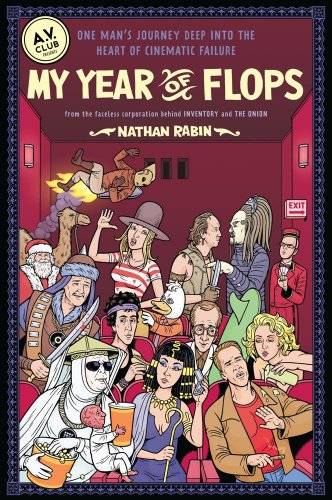
My Year of Flops — Nathan Rabin

Let me admit biases up front: for the past few years, I’ve looked forward every Wednesday to Nathan Rabin’s regular column at the AV Club,“My Year of Flops,” where he reviews–and reappraises–some of the worst-received films of all time. I’m also a fan of Rabin’s other columns, “THEN! That’s What They Called Music!” and “Nashville or Bust,” as well as the general tone of the AV Club, which he no doubt helps set as its head writer. I also thought Rabin’s memoir The Big Rewind was pretty good. So, I’m probably not the most objective person to review Rabin’s new book My Year of Flops, which comprises 35 of Rabin’s past columns, 15 new entries, and interview snippets with some of the actors who had the (mis)fortune to turn up in these flops. I’ll do my best to assess how well these columns–most of which were written for the internet–hold up as a book.

So, what, exactly, constitutes a flop?  There are the biggies here, of course, infamous studio-busting career-killers like Heaven’s Gate, Battlefield Earth, and Ishtar;  the batshit crazy weirdfests that were destined to become cult classics, like Southland Tales, Howard the Duck, and The Apple; the disposable movies made to be forgotten, like Bratz: The Movie; there are forgotten and overlooked oddballs, like Robert Altman’s teen sex comedy, O.C. and Stiggs, and Gospel Road, where Johnny Cash tells the life story of Jesus. All of these films share disappointing (or non-existent) box office results as well as general critical disapproval (or at least bewilderment). As part of his revisionist project, Rabin ends each entry by declaring the re-appraised film a “Secret Success,” a “Fiasco,” or a “Failure.” Tellingly, most of the time Rabin finds his subject to be a “Fiasco.” He’s willing to take each film on its own terms; he’s also incredibly open to viewing each film in a way that transcends the trappings of its marketing to an intended audience.

Take, for example Tough Guys Don’t Dance, a film macho novelist Norman Mailer thought it would be a totally sound idea to not only write but direct. Rabin’s initial analysis derides the film for its cardboard characters, debased gimmickry, and embarrassing dialog. By the end of his reassessment, however, Rabin has given the would-be thriller a new life as “a darkly comic, horror-tinged melodrama about the emptiness of excess and the soul-crushing costs of pursuing endless pleasure.” His review rests not on a personal ironic vision, but rather on a willingness to see Mailer’s own ironic vision at work behind (and in front of) the camera.

In the same way, Rabin is able to put aside–even while acknowledging–the dreadful reputations surrounding films like Ishtar and Heaven’s Gate. Even though the latter film essentially destroyed both its studio and the maverick filmmaking style of the 1970s, Rabin finds in it more than a slight redemption–he finds a flawed masterpiece, a gorgeous treatise on Manifest Destiny that doesn’t deserve its reputation. Similarly, Rabin would have us believe that Istar actually is funny. Both of these entries are remarkable not just in their clear revisionist goal, but also for how instructive they are. In both write-ups, Rabin reveals much of how movies are made, and how movies are made flops–the ways that infighting, firings, and studio expectations can damn a film before it even premieres.

While My Year of Flops is instructive in its criticism, it’s also very entertaining. Rabin has a keen sense of satire, and if he occasionally tips into snark, it’s always earned (and if you have a problem with a writer being snarky at the expense of Battlefield Earth, well, you’re probably a prig anyway). A great illustration of how Rabin combines his sense of humor with his instructive criticism in his coinage of the term “Manic Pixie Dream Girl”–

The Manic Pixie Dream Girl exists solely in the fevered imaginations of sensitive writer-directors, who use them to teach broodingly soulful young men to embrace life. The Manic Pixie Dream Girl serves as a means to an end, not a flesh-and-blood human being. Once life lessons have been imparted, the Manic Pixie Dream Girl might as well disappear in a poof! for her life’s work is done.

Cameron Crowe is particularly guilty of employing the MPDG trope, but you can find her pretty much everywhere you look–at least in the domain of rom-coms. Rabin proposes the term in his first entry in the series (also the first entry in the book) a review of Crowe’s much maligned Elizabethtown. Rabin finds it to be a Fiasco. In a move that sums up both Rabin’s program and his generous spirit, Rabin concludes My Year of Flops by re-reassessing Elizabethtown–he now dubs it a Secret Success. While I don’t subscribe to the idea that a critic should-be a starry-eyed optimist who finds the best of all possible worlds in each work, I do think that it has become far too easy to outright dismiss someone’s hard work. We live in a hyper-mediated age that moves too fast: all propositions are disposable, including the arts. Rabin, in taking each work on its own terms, does a service to both criticism and creativity.

Rabin’s own columns might, of course, fall prey to this disposable age. Today’s columns and blog posts are meant to be consumed quickly; although the best might find a life of new clicks in cyberspace, most are tomorrow’s virtual bird-cage liners. The blog-book is thus a tenuous grasp at some permeability–or at least respectability. My Year of Flops is fun, energetic, and insightful, but it does not bear sustained reading. The entries are best consumed one at time, probably between other tasks (or other books). It’s a great book for the john. Still, in an ideal library, My Year of Flops would stand squarely along side any other work of film criticism (it’s certainly sharper than anything by Leonard Maltin or Gene Shalit). Ultimately, Rabin does here what all great critics do–he makes a case for the works he’s appraising. He makes you want to see his Secret Successes and even the Fiascos (and, at times, even the Failures). I’ll even forgive him for making me watch The Apple. Recommended.

The Collected Stories of Lydia Davis

The Collected Stories of Lydia Davis compiles all 198 of Davis’s short stories in one handsome volume. That’s all four of Davis’s exceptional short story collections: Break It Down, Varieties of Disturbance, Samuel Johnson Is Indignant, and Almost No Memory. FS&G debuted the hardback edition a year ago, and this month Picador offers up a lovely (and more affordable) trade paperback version; it sports deckle edge pages and French flaps, and runs over 700 pages.

I front-load my review with this data to make it obvious that, if you have any interest in Lydia Davis, this is a book to pick up. It’s a wonderful collection, a tidy brick of words that begs for immersion, the kind of book you float around in, flipping pages at random to find and enjoy yet another strange little gem. Go get it.

If you’re not sure why you should be interested in Davis, read on.

Most of Davis’s stories are very short; many are just a paragraph or two, and some a mere sentence in length. They are not stories in the traditional sense: don’t look for sweeping character development or grand plot arcs. These stories thrive rather on tone, a keen sense of inspection, perception, and mood, and an intensity of observation on matters large and small. They are tales, fables, riffs, annotations, skits, jokes, japes, anecdotes, journals, thought experiments, epigrams, half-poems, and would-be aphorisms.

“In a House Besieged,” from her first collection Break It Down (1986) reveals much about the Davis program. Here it is in full–

In a house besieged lived a man and a woman. From where they cowered in the kitchen the man and woman heard small explosions. “The wind,” said the woman. “Hunters,” said the man. “The rain,” said the woman. “The army,” said the man. The woman wanted to go home, but she was already home, there in the middle of the country in a house besieged.

“In a House Besieged” illustrates a number of the themes and motifs that run throughout Davis’s oeuvre: unnamed protagonists identified only as “the man” and “the woman” (later stories might call them “the husband” and “the wife”) who are at once allegorical placeholders and at the same time singular individuals; a domestic setting (with family members as protagonists); an unknowable and perhaps unidentifiable threat; a pervasive sense of alienation balanced by an ironic sense of humor. The story’s brevity also shows that, from the outset of her publishing career, Davis was already working toward something wholly different from the Carveresque stories that dominated MFA fiction in the 80s.

The domestic settings of Break It Down–spaces often haunted by mothers and fathers–rear up again and again throughout the collection. 1997’s Almost No Memory kicks off with “Meat, My Husband,” a story about a wife who is trying to get her husband to eat healthier–a difficult prospect considering his affection for beef. The tale should be utterly banal, but instead it is humorous and even oddly moving; the wife, who narrates the piece, concludes by realizing that her husband would really just prefer to cook for himself. The insight transcends the particular domestic scenario: it seems applicable to the reader’s own life (or to this reader’s, anyway). “How He Is Often Right,” also from the same collection, is a short paragraph where the narrator concludes that the titular “he” is often wrong, “but wrong for circumstances different from the circumstances as they actually were, while [his decision] was right for circumstances I clearly did not understand.” The story captures the way that we impart great meaning to the smallest arguments, dwelling on them, connecting them to our sense of identity. We see the same analysis at work in “The Outing” (also from Almost No Memory). In full–

An outburst of anger near the road, a refusal to speak on the path, a silence in the pine woods, a silence across the old railroad bridge, an attempt to be friendly in the water, a refusal to end the argument on the flat stones, a cry of anger on the steep bank of dirt, a weeping among the bushes.

Davis’s sentence might be telescopic, but it also, paradoxically, puts the relationship in the story under a microscope. The reader can fill in the gaps with his or her own background: we’ve all experienced this anger, this silence, this refusal. We’ve been there. The story is real. It’s true.

The truth of Davis’s stories is what unites them; it’s the reader’s recognition of their truth that makes them so pleasurable. Take “Boring Friends” from 2001’s Samuel Johnson Is Indignant (again, in full)–

We know only four boring people. The rest of our friends we find interesting. However, most of the friends we find interesting find us boring: the most interesting find us the most boring. The few who are somewhere in the middle, with whom there is reciprocal interest, we distrust: at any moment, we feel, they may become too interesting for us, or we too interesting for them.

Davis’s treatment on friendship consistently penetrates facades, exposes our competitive cores, and, at the same time, celebrates the joys we might take in others. This precarious line also evinces in Davis’s stories about taking care of young children. The short scene “Child Care” focuses on a grumpy father who’d rather watch TV than take his turn with the baby. Solution: “Together they watch The Odd Couple.” And perhaps it is because I have two young children, but I can’t recall a more accurate depiction of the simultaneous wonder and boredom of taking care of a new baby than “What You Learn About the Baby” (a lengthy treatise at six pages).

Not all of Davis’s stories focus on family and friends. There’s much here about academia: troubles with translation, grappling with tenure, the perils of teaching, and so on. There are at least three entries on grammar here. If not all readers can connect with these stories (although I certainly did), they need not worry–part of the joy of the book is its diversity. If a story doesn’t catch right away, flick to the next one, or one a hundred pages down the line. Perhaps you will alight on one of the collection’s imaginative historical biographies, like “Kafka Cooks Dinner” or “Marie Curie, So Honorable Woman,” positively epic at 18 pages. Davis’s histories fascinate; they seem utterly real and true and absurd and improbable, all at the same time.

Indeed, discursive movement is the core of Davis’s, but her digressions all point to a thematic analysis of truth, of an individual’s attempt to understand the world in terms other than the individual herself. They dwell on problems of self-consciousness, often employing literary distortion as an analytical tool. Davis’s literary distortions always point to a concrete reality, a livable, experiential reality; the fact that we should experience the real as surreal or absurd only makes her work more truthful.

It would be easy to park Davis with the postmodernist counter-tradition, but I think her work looks to something else, something post-postmodernist (I write this, I know, at the risk of falling into an abyssal loop).  Davis’s work presages contemporary “flash fiction”; her stories’ brevity reflect the simultaneous contraction of our attention spans and the expansion of our diverse interests. Her story “Samuel Johnson Is Indignant:” reads like a Facebook update. Here it is in full — “that Scotland has so few trees.” Davis transmutes an amusing annotation into a story that somehow brings the great critic back to life. The title of the story is also the title of the book; what follows then is a kind of meta-joke on reader expectations, subverting our expectations of Dr. Johnson’s (supposed) meta-commentary on the book-proper. But I fear I’m headed into a lit-crit navel-gazing snoozefest (in what has already been a long review). Far better to wrap things up, I think, by simply noting again how joyful it is to move through the book, to open at random and read. Very highly recommended.

“Self Portrait at Twenty Years” — Roberto Bolaño

“Self Portrait at Twenty Years,” a poem by Roberto Bolaño, from Laura Healy’s translation of The Romantic Dogs

I set off, I took up the march and never knew
where it might take me. I went full of fear,
my stomach dropped, my head was buzzing:
I think it was the icy wind of the dead.
I don’t know. I set off, I thought it was a shame
to leave so soon, but at the same time
I heard that mysterious and convincing call.
You either listen or you don’t, and I listened
and almost burst out crying: a terrible sound,
born on the air and in the sea.
A sword and shield. And then,
despite the fear, I set off, I put my cheek
against death’s cheek.
And it was impossible to close my eyes and miss seeing
that strange spectacle, slow and strange,
though fixed in such a swift reality:
thousands of guys like me, baby-faced
or bearded, but Latin American, all of us,
brushing cheeks with death.

New Books from Dinaw Mengestu, Stephen-Paul Martin, and Susan Straight

Dinaw Menestu’s new novel How to Read the Air tells the story of a family over two generations. The novel opens in the 1970s as Mariam and Josef, a young married couple from Ethiopia, take a road trip through the American heartland. The pair has been separated for over three years–after just one year of marriage–and they hope that the trip will help renew their bonds and in some way forge their new identities as Americans. But they don’t really know each other, and perhaps they can’t; the violence they sought to escape in Ethiopia’s communist revolution recapitulates in their own marriage, eventually sundering it. Nearly 30 years later, their son Jonas–the introspective, sensitive, and inventive narrator of this novel–tries to come to terms with his own crumbling marriage, job, and identity, by re-examining the past. By literally recreating his parents’ journey, Jonas tries to convert his father’s pain and fear into a stable identity in this moving novel about family, place, and the need to move both our bodies and our souls. How to Read the Air is new in hardback from Riverhead Books.
There’s a thread of vengeful anger that runs through Stephen-Paul Martin’s new collection of stories, Changing the Subject. Although a tidy portion of that anger is reserved for George W. Bush and his nefarious gang (the stories seem to have been composed under last decade’s regime), Martin’s various characters also aim their anger at scientists, whalers, cell phones, born-again Christians, college students, journalists, fast food restaurants, Americans, and all the people of the world. That anger works best when working in a reflective mode, especially when Martin blends his vitriol with humor. The opening paragraph of the first story “Safety Somewhere Else” provides a nice illustration of Martin at his finest–
The greatest mistake of all time took place thousands of years ago, when God let Noah’s family survive the flood. God’s plan was to start a new human race with a man he though he could trust, but the limits of Noah’s moral awareness were obvious right from the start. No sooner had God’s rainbow vanished into the clouds than Noah was getting drunk and cursing his grandson, declaring that Canaan’s descendants–one-third of the human race–would be the lowest of slaves, a monstrous over-reaction that would have tragic consequences for countless generations of innocent people. Clearly, Noah wasn’t the man God thought he was.

The story then shifts into a bizarre picaresque involving revenge against a scientist who uses animals as research subjects (there’s also an attack on a whaling vessel, a fascinating reading of The Odyssey, and a woman whose son was consumed by a bear). Great stuff, but I think I would have been just as happy to hear more of Martin’s thoughts (or, his narrator’s thoughts, to be fair) on the Old Testament. Changing the Subject is new in trade paperback from Ellipsis Press.


Susan Straight’s
new novel Take One Candle Light a Room explores the physical and psychic traumas that evince from America’s long, painful, complicated history of race relations. FX Antoine, the novel’s narrator, is an LA-based travel writer who found herself, as a young girl, transplanted from rural Louisiana to California at the end of the fifties, in order to escape the rapes perpetrated by a local plantation owner on three of her sisters. In 2005, FX–Fantine to her friends and family–watches over Victor, her godson, a recent community college graduate. Fantine encourages Victor to expand his unlikely success (he is the son of a crack-addicted murder victim, one of Fantine’s childhood friends) by applying to four-year schools; however, after Victor is implicated in a shooting (wrong place, wrong time), he runs away to Louisiana. Fantine follows, attempting to save the young man and find some sense of personal redemption as well. The novel’s climax is set against the devastating backdrop of Hurricane Katrina. For more on Take One Candle, read Francesca Mari’s review at The New York Times. Take One Candle Light a Room is new in hardback from Pantheon Books.

Historic Photos of Heroes of the Old West

In 200 black and white archival photos with accompanying captions by historian Mike Cox, Historic Photos of the Old West winds its way through almost two centuries of American history, tracing the exploration of the West from its earliest pathfinders like Lewis and Clark, through later generations who mythologized the practitioners of Manifest Destiny. Along the way, we’re treated to photos of lawmen and settlers, civilizers and politicians, along with plenty of roustabouts, rustlers, and rascals (admittedly, some of these “heroes” had no problem slipping from the former category to the latter and back). There are all the famous names you’d expect to see in here–Wild Bill Hickok, Calamity Jane, Pat Garrett, the Earp brothers, just to name a few–but its photos like this one, below, of a pioneer family in Nebraska that signal the less sensational (and perhaps more human) side of the Western migration.

Of course, those settlers needed land when they arrived out West, as well as protection from the Indians who had been there first (not to mention each other). The picture below shows the bureaucrats of the U.S. Land Office who doled out Indian land to white people, along with the armed U.S. marshals who enforced these actions. Are they heroes?

The following picture depicts a company of Texas Rangers, posing with their Winchesters in South Texas in the mid 1880s. Some tough-looking hombres.

Historic Photos of Heroes of the Old West, available now from Turner Publishing, makes a nice companion piece to Historic Photos of Outlaws of the Old West.