“Joyce” — Ezra Pound

“Joyce” by Ezra Pound

Despite the War, despite the paper shortage, and despite those old-established publishers whose god is their belly and whose god-father was the late F.T. Palgrave, there is a new edition of James Joyce’s “A Portrait of the Artist as a Young Man.”

It is extremely gratifying that this book should have “reached its fourth thousand,” and the fact is significant in just so far as it marks the beginning of a new phase of English publishing, a phase comparable to that started in France some years ago by the Mercure.

The old houses, even those, or even more those, which once had a literary tradition, or at least literary pretensions, having ceased to care a damn about literature, the lovers of good writing have “struck”; have sufficiently banded themselves together to get a few good books into print, and even into circulation. The actual output is small in bulk, a few brochures of translations, Eliot’s “Prufrock,” Joyce’s “A Portrait,” and Wyndham Lewis’ “Tarr,” but I have it on good authority that at least one other periodical will start publishing its authors after the War, so there are new rods in pickle for the old fat-stomached contingent and for the cardboard generation.

Joyce’s “A Portrait” is literature; it has become almost the prose bible of a few people, and I think I have encountered at least three hundred admirers of the book, certainly that number of people who, whether they “like” it or not, are wholly convinced of its merits. Continue reading ““Joyce” — Ezra Pound”

Thomas Pynchon Reviews Oakley Hall’s Novel Warlock

Tombstone, Arizona, during the 1880’s is, in ways, our national Camelot: a never-never land where American virtues are embodied in the Earps, and the opposite evils in the Clanton gang; where the confrontation at the OK corral takes on some of the dry purity of the Arthurian joust. Oakley Hall, in his very fine novel Warlock (Viking) has restored to the myth of Tombstone its full, mortal, blooded humanity. Wyatt Earp is transmogrified into a gunfighter named Blaisdell who, partly because of his blown-up image in the Wild West magazines of the day, believes he is a hero. He is summoned to the embattled town of Warlock by a committee of nervous citizens expressly to be a hero, but finds that he cannot, at last, live up to his image; that there is a flaw not only in him, but also, we feel, in the entire set of assumptions that have allowed the image to exist. It is Blaisdell’s private abyss, and not too different from the town’s public one. Before the agonized epic of Warlock is over with — the rebellion of the proto-Wobblies working in the mines, the struggling for political control of the area, the gunfighting, mob violence, the personal crises of those in power — the collective awareness that is Warlock must face its own inescapable Horror: that what is called society, with its law and order, is as frail, as precarious, as flesh and can be snuffed out and assimilated back into the desert as easily as a corpse can. It is the deep sensitivity to abysses that makesWarlock one of our best American novels. For we are a nation that can, many of us, toss with all aplomb our candy wrapper into the Grand Canyon itself, snap a color shot and drive away; and we need voices like Oakley Hall’s to remind us how far that piece of paper, still fluttering brightly behind us, has to fall.

Thomas Pynchon’s 1965 review of Oakley Hall’s novel Warlock. Via/more.


Charlie Kaufman Interview

“Wakefield” — Nathaniel Hawthorne

“Wakefield” by Nathaniel Hawthorne

In some old magazine or newspaper, I recollect a story, told as truth, of a man – let us call him Wakefield – who absented himself for a long time, from his wife. The fact, thus abstractedly is not very uncommon, nor – without a proper distinction of circumstances – to be condemned either as naughty or nonsensical. Howbeit, this, though far from the most aggravated, is perhaps the strangest instance, on record, of marital delinquency; and, moreover, as remarkable a freak as may be found in the whole list of human oddities. The wedded couple lived in London. The man, under presence of going a journey, took lodgings in the next street to his own house, and there, unheard of by his wife or friends, and without the shadow of a reason for such self-banishment, dwelt upwards of twenty years. During that period, he beheld his home every day, and frequently the forlorn Mrs. Wakefield. And after so great a gap in his matrimonial felicity – when his death was reckoned certain, his estate settled, his name dismissed from memory, and his wife, long, long ago, resigned to her autumnal widowhood – he entered the door one evening, quietly, as from a day’s absence, and became a loving spouse till death.

This outline is all that I remember. But the incident, though of the purest originality, unexampled, and probably never to be repeated, is one, I think, which appeals to the general sympathies of mankind. We know, each for himself, that none of us would perpetrate such a folly, yet feel as if some other might. To my own contemplations, at least, it has often recurred, always wonder, but with a sense that the story must be true, and a conception of its hero’s character. Whenever any subject so forcibly affects the mind, time is well spent in thinking of it. If the reader choose, let him do his own meditation; or if he prefer to ramble with me through the twenty years of Wakefield’s vagary, I bid him welcome; trusting that there will be a pervading spirit and a moral, even should we fail to find them, done up neatly, and condensed into the final sentence. Thought has always its efficacy, and every striking incident its moral. Continue reading ““Wakefield” — Nathaniel Hawthorne”

“The Tuft of Kelp” — Herman Melville

“The Tuft of Kelp” by Herman Melville—

All dripping in tangles green,
Cast up by a lonely sea
If purer for that, O Weed,
Bitterer, too, are ye?

Some Books I Plan to Read in 2013

20121228-105736.jpg

There are only a handful of forthcoming titles that I know about right now that I’m looking forward to reading next year: story collections from Sam Lipsyte (The Fun Parts) and George Saunders (Tenth of December), and a new novel from William Gass called Middle C. I’m also hoping Keith Ridgway’s Hawthorn and Child will finally get a US release, because I’d like to read it too.

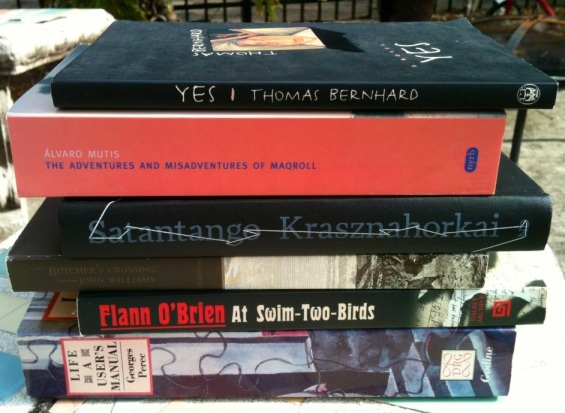
There are a few newish books that I didn’t read in 2012 that I’ll try to catch up to this year—Ben Marcus’s The Flame Alphabet, László Krasznahorkai’s Satantango, and Laurent Binet’s HHhH.

I do not currently possess any of these books.

I also look forward to reading Evan Lavender-Smith’s From Old Notebooks, back in print again from Dzanc (who I am sure will get the copy I ordered to me any day now).

At the top of my list though are the books I’m currently reading: Alvaro Mutis’s Maqroll novellas and Flann O’Brien’s At Swim-Two-Birds.

Stuff I’ve been saying I’ll read for a few years now that I hope to get to:

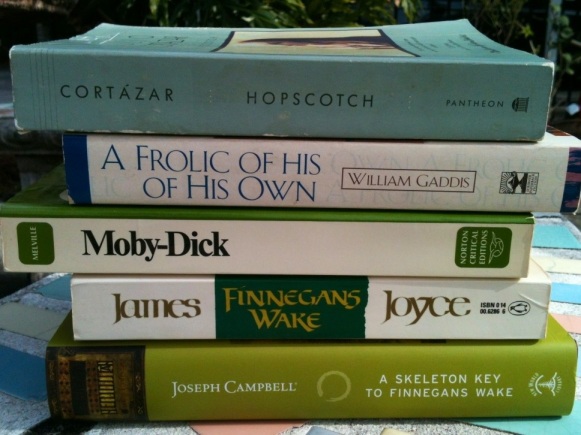
Cortazar’s Hopscotch, John Williams’s Butcher’s Crossing, Gombrowicz’s Ferdydurke, and, at the top of the heap, Georges Perec’s Life A User’s Manual.

20121228-111213.jpg

I have a few books by Thomas Bernhard that I’ll probably get into this year (when I feel called to a misanthropic monologue), and I’ll gobble up anything else by Barry Hannah that I can get my mitts on. I read William Gaddis’s “big books” last year, but I still haven’t read A Frolic of His Own, which I’ve heard is superior to Carpenter’s Gothic.

I’ll reread Moby-Dick this year (or at least listen to William Hootkins’s brilliant audio version) and I’ll probably end up rereading some book that I hadn’t planned to at all (this happened with 2666 and The Savage Detectives this year—who knows? I haven’t read Gravity’s Rainbow since college, and I haven’t reread Infinite Jest in full, and I’d love to go through Suttree again . . . ).

I dipped my toe into Finnegans Wake this year—I’ve found reading it on the Kindle late at night and then going through Joseph Campbell’s Skeleton Key the next morning is rewarding—and I’ll probably keep at it in 2013. Maybe I’ll make it to chapter 3.

But enough of my rambling—What books do you, dear reader, look forward to in 2013?

“The Lagoon” — Joseph Conrad

“The Lagoon” by Joseph Conrad

The white man, leaning with both arms over the roof of the little house in the stern of the boat, said to the steersman–

‘We will pass the night in Arsat’s clearing. It is late.’

The Malay only grunted, and went on looking fixedly at the river. The white man rested his chin on his crossed arms and gazed at the wake of the boat. At the end of the straight avenue of forests cut by the intense glitter of the river, the sun appeared unclouded and dazzling, poised low over the water that shone smoothly like a band of metal. The forests, somber and dull, stood motionless and silent on each side of the broad stream. At the foot of big, towering trees, trunkless nipa palms rose from the mud of the bank, in bunches of leaves enormous and heavy, that hung unstirring over the brown swirl of eddies. In the stillness of the air every tree, every leaf, every bough, every tendril of creeper and every petal of minute blossoms seemed to have been bewitched into an immobility perfect and final. Nothing moved on the river but the eight paddles that rose flashing regularly, dipped together with a single splash; while the steersman swept right and left with a periodic and sudden flourish of his blade describing a glinting semicircle above his head. The churnedup water frothed alongside with a confused murmur. And the white man’s canoe, advancing up stream in the short-lived disturbance of its own making, seemed to enter the portals of a land from which the very memory of motion had for ever departed.

The white man, turning his back upon the setting sun, looked along the empty and broad expanse of the sea-reach. For the last three miles of its course the wandering, hesitating river, as if enticed irresistibly by the freedom of an open horizon, flows straight into the sea, flows straight to the east – to the east that harbors both light and darkness. Astern of the boat the repeated call of some bird, a cry discordant and feeble, skipped along over the smooth water and lost itself, before it could reach the other shore, in the breathless silence of the world.

     The steersman dug his paddle into the stream, and held hard with stiffened arms, his body thrown forward. The water gurgled aloud; and suddenly the long straight reach seemed to pivot on its center, the forests swung in a semicircle, and the slanting beams of sunset touched the broadside of the canoe with a fiery glow, throwing the slender and distorted shadows of its crew upon the streaked glitter of the river. The white man turned to look ahead. The course of the boat had been altered at right-angles to the stream, and the carved dragon-head of its prow was pointing now at a gap in the fringing bushes of the bank. It glided through, brushing the overhanging twigs, and disappeared from the river like some slim and amphibious creature leaving the water for its lair in the forests. Continue reading ““The Lagoon” — Joseph Conrad”

“Literary Indecencies” — H.L. Mencken

The low, graceless humor of names! On my shelf of poetry, arranged by the alphabet, Coleridge and J. Gordon Cooglar are next-door neighbors! Mrs. Hemans is beside Laurence Hope! Walt Whitman rubs elbows with Ella Wheeler Wilcox; Robert Browning with Richard Burton; Rossetti with Cale Young Rice; Shelly with Clinton Scollard; Wordsworth with George E. Woodberry; John Keats with Herbert Kaufman!

Ibsen, on the shelf of dramatists, is between Victor Hugo and Jerome K. Jerome. Sudermann follows Harriet Beecher Stowe. Maeterlinck shoulders Percy Mackaye. Shakespeare is between Sardou and Shaw. Euripides and Clyde Fitch! Upton Sinclair and Sophocles! Aeschylus and F. Anstey! D’Annunzio and Richard Harding Davis! Augustus Thomas and Tolstoi!

More alphabetical humor. Gerhart Hauptmann and Robert Hichens; Voltaire and Henry Van Dyke; Flaubert and John Fox, Jr.; Balzac and John Kendrick Bangs; Ostrovsky and E. Phillips Oppenheim; Elinor Glyn and Théophile Gautier; Joseph Conrad and Robert W. Chambers; Zola and Zangwill!…

Midway on my scant shelf of novels, between George Moore and Frank Norris, there is just room enough for the two volumes of “Derringforth,” by Frank A. Munsey.

“Literary Indecencies,” a chapter from H.L. Mencken’s collection Damn!


William S. Burroughs Shoots at William S. Burroughs T-Shirts

“Desiree’s Baby” — Kate Chopin

“Desiree’s Baby” by Kate Chopin

As the day was pleasant, Madame Valmonde drove over to L’Abri to see Desiree and the baby.

It made her laugh to think of Desiree with a baby. Why, it seemed but yesterday that Desiree was little more than a baby herself; when Monsieur in riding through the gateway of Valmonde had found her lying asleep in the shadow of the big stone pillar.

The little one awoke in his arms and began to cry for “Dada.” That was as much as she could do or say. Some people thought she might have strayed there of her own accord, for she was of the toddling age. The prevailing belief was that she had been purposely left by a party of Texans, whose canvas-covered wagon, late in the day, had crossed the ferry that Coton Mais kept, just below the plantation. In time Madame Valmonde abandoned every speculation but the one that Desiree had been sent to her by a beneficent Providence to be the child of her affection, seeing that she was without child of the flesh. For the girl grew to be beautiful and gentle, affectionate and sincere – the idol of Valmonde.

It was no wonder, when she stood one day against the stone pillar in whose shadow she had lain asleep, eighteen years before, that Armand Aubigny riding by and seeing her there, had fallen in love with her. That was the way all the Aubignys fell in love, as if struck by a pistol shot. The wonder was that he had not loved her before; for he had known her since his father brought him home from Paris, a boy of eight, after his mother died there. The passion that awoke in him that day, when he saw her at the gate, swept along like an avalanche, or like a prairie fire, or like anything that drives headlong over all obstacles.

Monsieur Valmonde grew practical and wanted things well considered: that is, the girl’s obscure origin. Armand looked into her eyes and did not care. He was reminded that she was nameless. What did it matter about a name when he could give her one of the oldest and proudest in Louisiana? He ordered the corbeille from Paris, and contained himself with what patience he could until it arrived; then they were married. Continue reading ““Desiree’s Baby” — Kate Chopin”

Krapp’s Last Tape — Samuel Beckett (Full Performance)

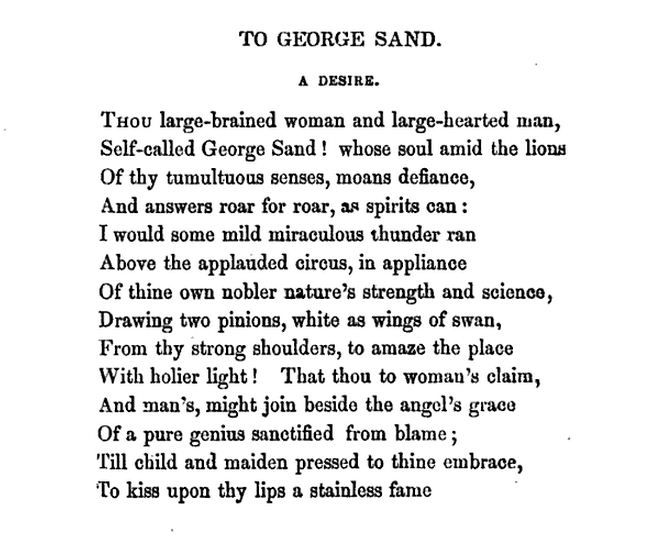
“To George Sand (A Desire)” — Elizabeth Barrett Browning

ebb

Map of the Moon — Johannes Hevelius

“It was Christmas night and the proper things had been done” (The Once and Future King)

It was Christmas night and the proper things had been done. The whole village had come to dinner in hall. There had been boar’s head and venison and pork and beef and mutton and capons—but no turkey, because this bird had not yet been invented. There had been plum pudding and snap-dragon, with blue fire on the tips of one’s fingers, and as much mead as anybody could drink. Sir Ector’s health had been drunk with “Best respects, Measter,” or “Best compliments of the Season, my lords and ladies, and many of them.” There had been mummers to play an exciting dramatic presentation of a story in which St. George and a Saracen and a funny Doctor did surprising things, also carol-singers who rendered “Adeste Fideles” and “I Sing of a Maiden,” in high, clear, tenor voices. After that, those children who had not been sick from their dinner played Hoodman Blind and other appropriate games, while the young men and maidens danced morris dances in the middle, the tables having been cleared away. The old folks sat round the walls holding glasses of mead in their hands and feeling thankful that they were past such capers, hoppings and skippings, while those children who had not been sick sat with them, and soon went to sleep, the small heads leaning against their shoulders. At the high table Sir Ector sat with his knightly guests, who had come for the morrow’s hunting, smiling and nodding and drinking burgundy or sherries sack or malmsey wine.

After a bit, silence was prayed for Sir Grummore. He stood up and sang his old school song, amid great applause—but forgot most of it and had to make a humming noise in his moustache. Then King Pellinore was nudged to his feet and sang bashfully:

“Oh, I was born a Pellinore in famous Lincolnshire. Full well I chased the Questing Beast for more than seventeen year. Till I took up with Sir Grummore here In the season of the year. (Since when) ’tis my delight On a feather-bed night To sleep at home, my dear.

“You see,” explained King Pellinore blushing, as he sat down with everybody whacking him on the back, “old Grummore invited me home, what, after we had been having a pleasant joust together, and since then I’ve been letting my beastly Beast go and hang itself on the wall, what?”

“Well done,” they told him. “You live your own life while you’ve got it.”

William Twyti was called for, who had arrived on the previous evening, and the famous huntsman stood up with a perfectly straight face, and his crooked eye fixed upon Sir Ector, to sing:

“D’ye ken William Twyti

With his Jerkin so dagged? D’ye ken William Twyti

Who never yet lagged? Yes, I ken William Twyti,

And he ought to be gagged With his hounds and his horn in the morning.”

“Bravo!” cried Sir Ector. “Did you hear that, eh? Said he ought to be gagged, my dear feller. Blest if I didn’t think he was going to boast when he began. Splendid chaps, these huntsmen, eh? Pass Master Twyti the malmsey, with my compliments.”

The boys lay curled up under the benches near the fire, Wart with Cavall in his arms. Cavall did not like the heat and the shouting and the smell of mead, and wanted to go away, but Wart held him tightly because he needed something to hug, and Cavall had to stay with him perforce, panting over a long pink tongue.

“Now Ralph Passelewe.”

“Good wold Ralph.”

“Who killed the cow, Ralph?”

“Pray silence for Master Passelewe that couldn’t help it.”

At this the most lovely old man got up at the furthest and humblest end of the hail, as he had got up on all similar occasions for the past half-century. He was no less than eighty-five years of age, almost blind, almost deaf, but still able and willing and happy to quaver out the same song which he had sung for the pleasure of the Forest Sauvage since before Sir Ector was bound up in a kind of tight linen puttee in his cradle. They could not hear him at the high table—he was too far away in Time to be able to reach across the room—but everybody knew what the cracked voice was singing and everybody loved it. This is what he sang:

“Whe-an/Wold King-Cole/was a /wakkin doon-t’street, H-e /saw a-lovely laid-y a /steppin-in-a-puddle. / She-a /lifted hup-er-skeat/ For to / Hop acrorst ter middle, / An ee /saw her /an-kel. Wasn’t that a fuddle? / Ee could’ernt elp it, /ee Ad to.”

There were about twenty verses of this song, in which Wold King Cole helplessly saw more and more things that he ought not to have seen, and everybody cheered at the end of each verse until, at the conclusion, old Ralph was overwhelmed with congratulations and sat down smiling dimly to a replenished mug of mead.

It was now Sir Ector’s turn to wind up the proceedings. He stood up importantly and delivered the following speech:

“Friends, tenants and otherwise. Unaccustomed as I am to public speakin’—”

There was a faint cheer at this, for everybody recognized the speech which Sir Ector had made for the last twenty years, and welcomed it like a brother.

“Unaccustomed as I am to public speakin'” it is my pleasant duty—I might say my very pleasant duty—to welcome all and sundry to this our homely feast. It has been a good year, and I say it without fear of contradiction, in pasture and plow. We all know how Crumbocke of Forest Sauvage won the first prize at Cardoyle Cattle Show for the second time, and one more year will win the cup outright. More power to the Forest Sauvage. As we sit down tonight, I notice some faces now gone from among us and some which have added to the family circle. Such matters are in the hands of an almighty Providence, to which we all feel thankful. We ourselves have been first created and then spared to enjoy the rejoicin’s of this pleasant evening. I think we are all grateful for the blessin’s which have been showered upon us. Tonight we welcome in our midst the famous King Pellinore, whose labours in riddin’ our forest of the redoubtable Questin’ Beast are known to all. God bless King Pellinore. (Hear, hear!) Also Sir Grummore Grummursum, a sportsman, though I say it to his face, who will stick to his mount as long as his Quest will stand up in front of him. (Hooray!) Finally, last but not least, we are honoured by a visit from His Majesty’s most famous huntsman, Master William Twyti, who will, I feel sure, show us such sport tomorrow that we will rub our eyes and wish that a royal pack of hounds could always be huntin’ in the Forest which we all love so well. (Viewhalloo and several recheats blown in imitation.) Thank you, my dear friends, for your spontaneous welcome to these gentlemen. They will, I know, accept it in the true and warmhearted spirit in which it is offered. And now it is time that I should bring my brief remarks to a close. Another year has almost sped and it is time that we should be lookin’ forward to the challengin’ future. What about the Cattle Show next year? Friends, I can only wish you a very Merry Christmas, and, after Father Sidebottom has said our Grace for us, we shall conclude with a singin’ of the National Anthem.”

The cheers which broke out at the end of Sir Ector’s speech were only just prevented, by several hush-es, from drowning the last part of the vicar’s Grace in Latin, and then everybody stood up loyally in the firelight and sang:

“God save King Pendragon,

May his reign long drag on,

God save the King.

Send him most gorious,

Great and uproarious,

Horrible and Hoarious,

God save our King.”

The last notes died away, the hall emptied of its rejoicing humanity. Lanterns flickered outside, in the village street, as everybody went home in bands for fear of the moonlit wolves, and The Castle of the Forest Sauvage slept peacefully and lightless, in the strange silence of the holy snow.

—From T.H. White’s The Once and Future King.


“The Dead” — James Joyce

“The Dead” by James Joyce

Lily, the caretaker’s daughter, was literally run off her feet. Hardly had she brought one gentleman into the little pantry behind the office on the ground floor and helped him off with his overcoat than the wheezy hall-door bell clanged again and she had to scamper along the bare hallway to let in another guest. It was well for her she had not to attend to the ladies also. But Miss Kate and Miss Julia had thought of that and had converted the bathroom upstairs into a ladies’ dressing-room. Miss Kate and Miss Julia were there, gossiping and laughing and fussing, walking after each other to the head of the stairs, peering down over the banisters and calling down to Lily to ask her who had come.

It was always a great affair, the Misses Morkan’s annual dance. Everybody who knew them came to it, members of the family, old friends of the family, the members of Julia’s choir, any of Kate’s pupils that were grown up enough and even some of Mary Jane’s pupils too. Never once had it fallen flat. For years and years it had gone off in splendid style as long as anyone could remember; ever since Kate and Julia, after the death of their brother Pat, had left the house in Stoney Batter and taken Mary Jane, their only niece, to live with them in the dark gaunt house on Usher’s Island, the upper part of which they had rented from Mr Fulham, the corn- factor on the ground floor. That was a good thirty years ago if it was a day. Mary Jane, who was then a little girl in short clothes, was now the main prop of the household for she had the organ in Haddington Road. She had been through the Academy and gave a pupils’ concert every year in the upper room of the Antient Concert Rooms. Many of her pupils belonged to better-class families on the Kingstown and Dalkey line. Old as they were, her aunts also did their share. Julia, though she was quite grey, was still the leading soprano in Adam and Eve’s, and Kate, being too feeble to go about much, gave music lessons to beginners on the old square piano in the back room. Lily, the caretaker’s daughter, did housemaid’s work for them. Though their life was modest they believed in eating well; the best of everything: diamond-bone sirloins, three-shilling tea and the best bottled stout. But Lily seldom made a mistake in the orders so that she got on well with her three mistresses. They were fussy, that was all. But the only thing they would not stand was back answers.

Of course they had good reason to be fussy on such a night. And then it was long after ten o’clock and yet there was no sign of Gabriel and his wife. Besides they were dreadfully afraid that Freddy Malins might turn up screwed. They would not wish for worlds that any of Mary Jane’s pupils should see him under the influence; and when he was like that it was sometimes very hard to manage him. Freddy Malins always came late but they wondered what could be keeping Gabriel: and that was what brought them every two minutes to the banisters to ask Lily had Gabriel or Freddy come. Continue reading ““The Dead” — James Joyce”

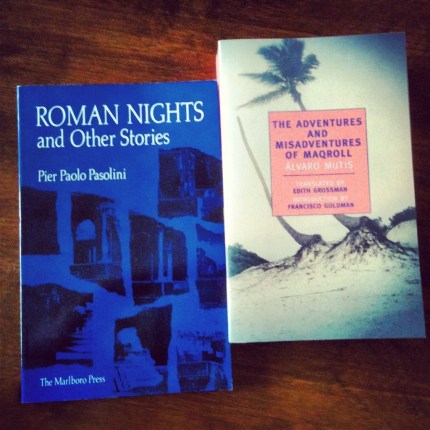
Pier Paolo Pasolini / Alvaro Mutis (Books Acquired, 12.21.20212)

20121223-132457.jpg

The edition I had of Mutis’s Maqroll only holds the first three novellas, so I ordered the NYRB seven-story volume. It’s like 700 pages and very attractive.

I also found this collection of Pier Paolo Pasolini short stories.

Read “The Honored Dead,” a Story by Breece D’J. Pancake

“The Honored Dead” by Breece D’J. Pancake

Watching little Lundy go back to sleep, I wish I hadn’t told her about the Mound Builders to stop her crying, but I didn’t know she would see their eyes watching her in the dark. She was crying about a cat run down by a car—her cat, run down a year ago, only today poor Lundy figured it out. Lundy is turned too much like her momma. Ellen never worries because it takes her too long to catch the point of a thing, and Ellen doesn’t have any problem sleeping. I think my folks were a little too keen, but Lundy is her momma’s girl, not jumpy like my folks.

My grandfather always laid keenness on his Shawnee blood, his half-breed mother, but then he was hep on blood. He even had an oath to stop bleeding, but I don’t remember the words. He was a fair to sharp woodsman, and we all tried to slip up on him at one time or another. It was Ray at the sugar mill finally caught him, but he was an old man by then, and his mind wasn’t exactly right. Ray just came creeping up behind and laid a hand on his shoulder, and the old bird didn’t even turn around; he just wagged his head and said, “That’s Ray’s hand. He’s the first fellow ever slipped on me.” Ray could’ve done without that because the old man never played with a full deck again, and we couldn’t keep clothes on him before he died.

I turn out the lamp, see no eyes in Lundy’s room, then it comes to me why she was so scared. Yesterday I told her patches of stories about scalpings and murders, mixed up the Mound Builders with the Shawnee raids, and Lundy chained that with the burial mound in the back pasture. Tomorrow I’ll set her straight. The only surefire thing I know about Mound Builders is they must have believed in a god and hereafter or they never would have made such big graves.

Continue reading “Read “The Honored Dead,” a Story by Breece D’J. Pancake”