Book Acquired, 2.03.2012 — Edward St. Aubyn Edition

20120205-164456.jpg

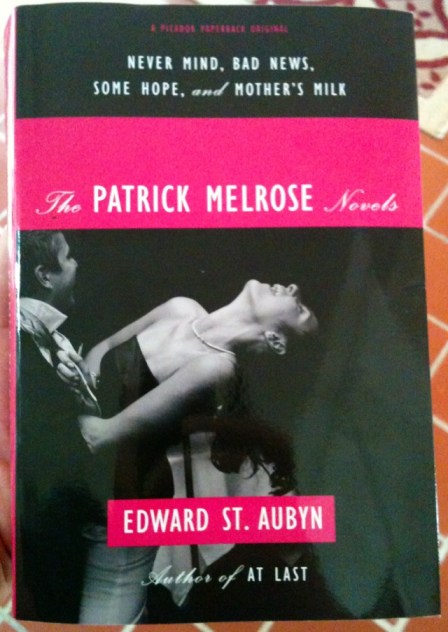
Picador has put together all four of Edward St. Aubyn’s Patrick Melrose novels in anticipation of the final novel, At Last, which debuts later this month from FS&G. I haven’t read St. Aubyn’s stuff, which hasn’t been widely available in the US until now, but I do know that Open City put some of it out, and they put out stuff by heroes of mine like David Berman and Sam Lipsyte (who blurbs the book). Anyway, here’s a short description from Picador:

For more than twenty years, acclaimed author Edward St. Aubyn has chronicled the life of Patrick Melrose, painting an extraordinary portrait of the beleaguered and self-loathing world of privilege. This single volume collects the first four novels—Never Mind, Bad News,Some Hope, and Mother’s Milk, a Man Booker finalist—to coincide with the publication of At Last, the final installment of this unique novel cycle.

By turns harrowing and hilarious, these beautifully written novels dissect the English upper class as we follow Patrick Melrose’s story from child abuse to heroin addiction and recovery. Never Mind,the first novel, unfolds over a day and an evening at the family’s chateaux in the south of France, where the sadistic and terrifying figure of David Melrose dominates the lives of his five-year-old son, Patrick, and his rich and unhappy American mother, Eleanor. From abuse to addiction, the second novel, Bad News opens as the twenty-two-year-old Patrick sets off to collect his father’s ashes from New York, where he will spend a drug-crazed twenty-four hours. And back in England, the third novel, Some Hope, offers a sober and clean Patrick the possibility of recovery. The fourth novel, the Booker-shortlisted Mother’s Milk, returns to the family chateau, where Patrick, now married and a father himself, struggles with child rearing, adultery, his mother’s desire for assisted suicide, and the loss of the family home to a New Age foundation.

Edward St. Aubyn offers a window into a world of utter decadence, amorality, greed, snobbery, and cruelty—welcome to the declining British aristocracy.

I haven’t had much time to dip into this, even though it intrigues, because my wife immediately snapped it up. I had to go find it in her night stand to do this post. At the risk of mangling this completely though (and correct me if I’m wrong), it seems like a little bit like a contemporary Henry James shot through with Bret Easton Ellis (and maybe a touch of Downton Abbey). I will ask my wife to report.

Biblioklept Talks to Daniel Nayeri About Capturing Voice, Being a YA Gatekeeper, and Writing His Novella Quartet on an iPhone

Daniel Nayeri was born in Iran and spent a couple of years as a refugee before immigrating to Oklahoma at age eight with his family. He is the author of Straw House, Wood House, Brick House, Blow, a collection of four novellas; Kirkus called it, “Provocative and deeply satisfying,” Bookpage named it “a delightful amalgam of the high and the low, the silly and the sublime,”and the BCCB mentioned the “breathtakingly vivid word smithery” in its starred review.

In addition to his writing, Daniel is an editor of picture books, novels, and graphic novels at Houghton Mifflin Harcourt, an accomplished filmmaker, and a professional pastry chef.

Daniel was kind enough to talk to us about his work via email.

Biblioklept: Your book was composed entirely on an iPhone. Can you tell us a bit about that process? How did you start? How intentional was the process in the beginning? Did you use a specific program? Did you edit on the iPhone at all?

Daniel Nayeri: Several years ago, I was reading an article about the “cell phone novel” phenomenon in Japan. The tone of the article was basically, “check out this super popular thing in Japan that all the literary folks hate.” It described the authors as these quiet teen girls, and early-twenty-something women, who would dash off a few chapters on the subway and email them to a website service. The authors didn’t do themselves any favors by saying they disliked reading “real” books, and the critics didn’t do themselves any favors by flipping out and wondering out loud if this trend meant the “death of the author.”

For me, the fascinating tidbit came from a few comments that noted the possible effects of writing on a cell phone. Every undergrad discusses the interplay of form and content (Dickens’s serialized form, the oral iterations of the Iliad, etc). I got really excited about forcing my imagination to live in an incredibly small space. The Japanese authors discussed that when they moved to computers, their vocabulary became “richer” and their “sentences have also grown longer.” I wanted to see if I could push those boundaries out a little (maybe I’m the crazy person who tries to paint the Mona Lisa on an Etch-a-Sketch).

As for the program I used. I bought the first-gen iPhone, so I was using the notepad app that comes with the phone (without cut and paste). To edit, I got very tired of deleting sentences and retyping them three pages down, so I created a code system. For example, if I wanted to move a paragraph up by two pages, I would bracket off the section I wanted and place a symbol next to it. Then I would go up two pages and just place the same symbol. By the end of my editing, there would be pages of work that were nothing but symbols, connected with various prepositions.

Biblioklept: Did you always have the idea to write a quartet of novellas over different genres? How did the idea come about?

DN: I think in general, novels have gotten fatter. As an editor, my first pass on nearly every manuscript is to ask for major cuts. I’m actually kind of petulant about it. My position is that if a book isn’t going to be as good as Anna Karenina, then it probably shouldn’t be as long.

It’s a reactionary position to take, so I thought I would challenge myself with telling stories and building worlds as large and as complex as I could possibly make them, with the limitation of 35-45 thousand words. Obviously, I sort of cheated by connecting some of my thoughts and themes in a collection of four. Hypocrisy and petulance—that’s the sort of delightful company you’ll get if you find yourself working with me.

(Another reason was that I’m still young, and I’d like to learn a lot more before I start demanding the attention of readers for five hundred pages at a time).

Biblioklept: What challenges did you face when working in the variety of genres you worked in?

DN: Presenting four very different voices (to whatever extent one might think it succeeded) is the aspect of this project I am most proud of, actually. The nicest thing anyone has said about the book so far has been to say it is, “the literary equivalent of a singer with a four-octave range.”

To me, it represents the ability to assimilate—a quality any first-generation immigrant valorizes at one point or another. When I first came to the states, I quickly took up the Texas/Oklahoma speech patterns. I was a voracious cataloguer of idioms. When I moved to New York, I did the same. I picked up “kitchen Spanish” in my years as a pastry chef. I love local parlance. As a kid struggling with English, having a proficient knowledge of colloquial expressions represented mastery over the language.

So to me, genres and forms with heavy use of lingo (sports writing, noir, poetry) were the height literary achievement. It sounds backwards, but if you learned the queen’s English first, then you value Huckleberry Finn’s jargon highest of all.

Biblioklept:  Straw House, Wood House, Brick House, Blow is being marketed as a YA book. There’s been some debate in the past few years about a perceived sense of darkness or violence in YA. What place do dark or violent themes have in YA fiction?

DN: I almost never think about this as a writer. I almost never stop thinking about it in my capacity as an editor at Houghton Mifflin Harcourt. My personal interests keep me PG-13, generally. But geez, people send me some crazy-inappropriate material—even for general consumption. Lots of incest. Lots of racial hang-ups. Lots of creepy.

I believe strongly in an editor’s responsibility to put out well-written work (whether or not it’s politically or ethically aligned with one’s self). The old Voltaire quote -– “I disapprove of what you say, but will defend to the death your right to say it” –- has difficult implications for “gatekeepers” in any media.

But just because there is an ethical challenge to acquire broadly, doesn’t mean the public can’t resist-—meaning that the marketplace often creates pressure to move material toward the unobjectionable. When minors are involved, however, I would hope there are adults who will curate the material. I think the majority of adults agree that there is such a thing as “age appropriateness.” I think both sides of the argument are often concern-trolling-—one side saying kids shouldn’t hear the f-word, and the other side screaming censorship to the culling of anything short of snuff-porn.

The conversation seems to dance around a rating system (as with the MPAA for films, or the ESA for video games), but that has a ton of complications. I’m not sure what I think of a rating system, personally. I just think the discussion would be more interesting than making fun of people over Twitter.

Biblioklept:  What are you working on next?

DN: Straw House has four very western genres, so I’m working on another set of four stories, but this time in eastern genres. I’m from Iran and immigrated to Oklahoma, so collections about the East West interaction have always fascinated me (Rushdie wrote a great essay collection call East West).

There’s an Ibn Battuta travelogue, a 1001 Nights tale, a parable, etc. I’m about halfway finished.

Biblioklept: Have you ever stolen a book?

DN: I’ve never stolen from a retailer, but when I was in middle school, I volunteered at the local library. When I forgot to return books after a long time, the head librarian would let me go into the database and erase my fine, as well as the book itself. That’s how I got my first copy of The Fellowship of the Ring, a CD of Boston’s greatest hits, and a book on juggling. So basically what I’m saying is that I was pretty hardcore.

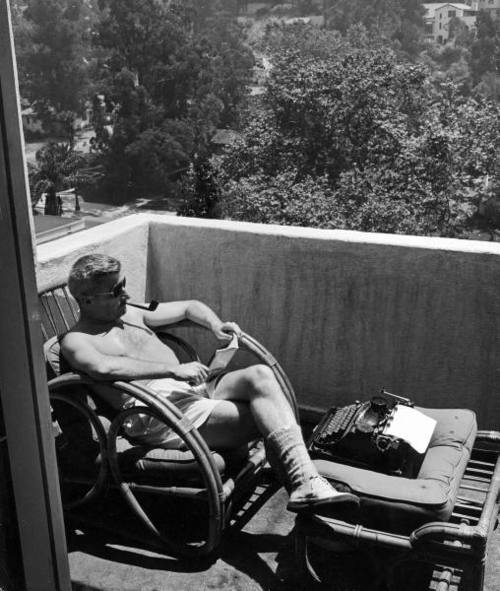
Hemingway Goes Topless

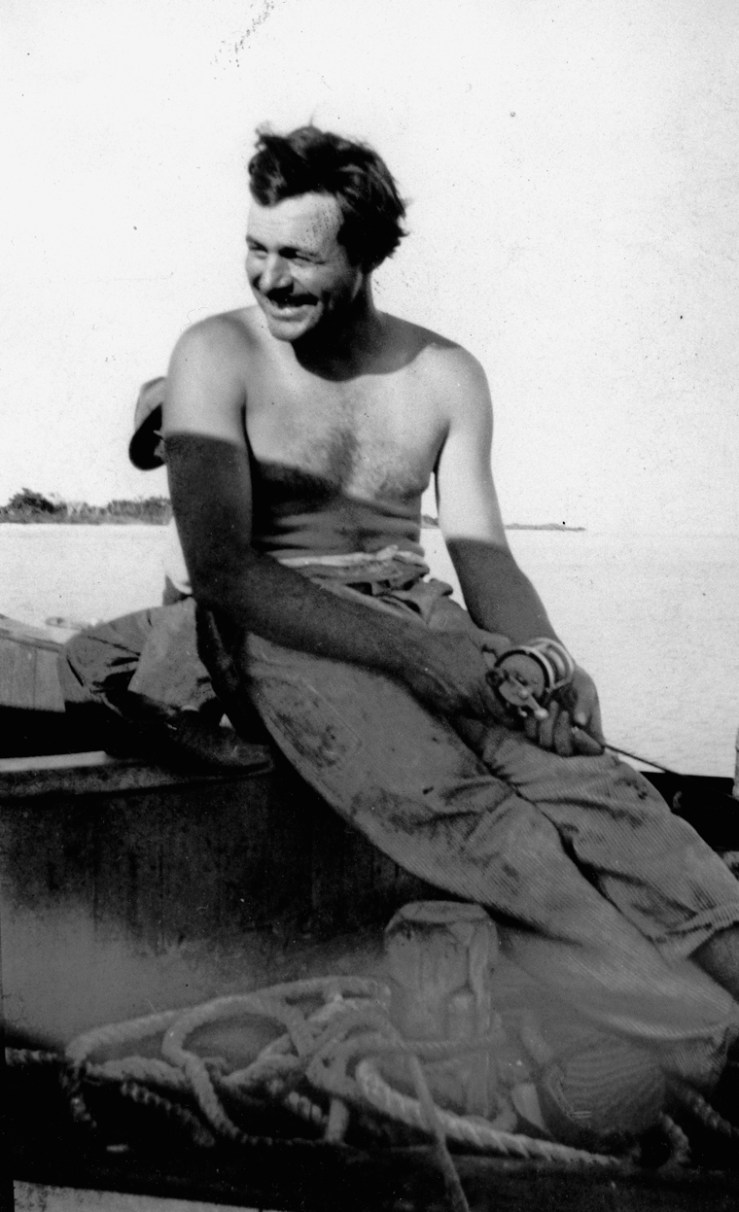
Ernest Hemingway fishing, Key West, 1928.

Book Shelves #6, 2.05.2012

Book shelves series #6, sixth Sunday of 2012: In which we dig into the comix inside the book shelf we looked at last week.

20120205-102013.jpg

When I was 13, I sold a fairly large collection of superhero comic books and earned enough money to buy an electric guitar—a weird mutant by Fender called the Bullet—and a small practice amp. It was the early nineties, and Marvel was about to burst the comic book bubble big time by flooding the market with gimmicky covers, hologram cards, and other nonsense.

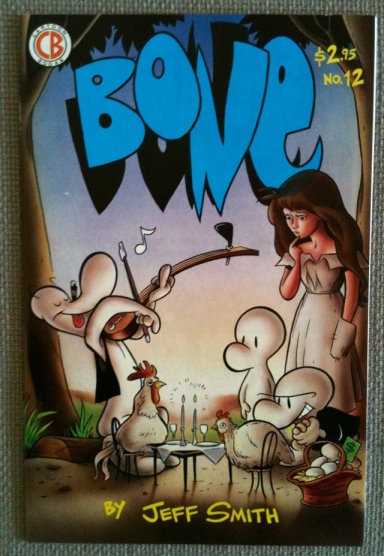
I continued to buy comics (or comix, if you prefer) over the years, although eventually economic concerns led me to just wait for graphic novel editions. Anyway, the book shelf above now contains most of the “underground” comix that I own. A few samples:

20120205-102552.jpg

20120205-102601.jpg

20120205-102611.jpg

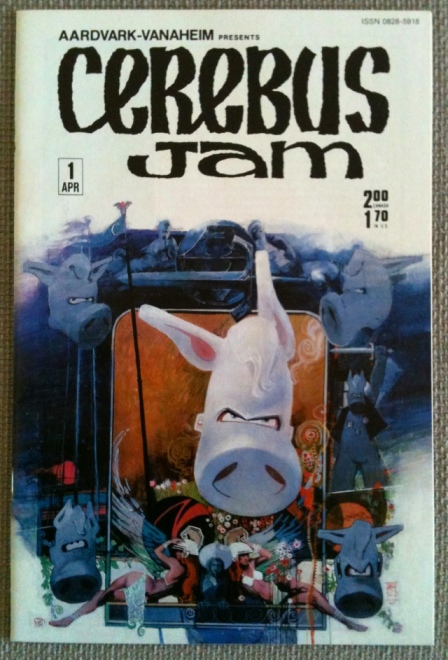
Most of the comix in this unit though are issues of Dave Sim’s epic (and insane) series Cerebus. I bought issues of Cerebus intermittently for years at a time, usually getting frustrated and then waiting for the “phone book” graphic novel editions of the series. Sim, along with background artist Gerhard, produced 300 issues of Cerebus over 25 years. The issues from the early ’80s to the early ’90s are brilliant; eventually Sim cracked though and went on an insane, reactionary (and arguably deeply misogynistic) bent. He created his own religion, a mix of hardline Judaism, Islam, and Christianity, and the later books in the series suffered greatly, as the book detoured to chronicle projects that seemed far outside its original scope (including strange, long satires of Hemingway and Fitzgerald). Anyway, some issues:

20120205-102641.jpg

Cerebus Jam, a one-off collaboration with a cover by one of my favorite artists Bill Sienkiewicz (I still have his entire run on Marvel’s The New Mutants in a box somewhere):

20120205-102651.jpg

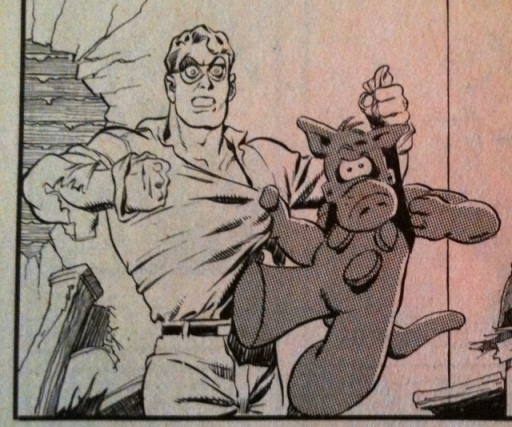
A panel from the issue’s collaboration with comic book legend Will Eisner, featuring his seminal character The Spirit:

20120205-102658.jpg

Gertrude Stein Talks American Football, American Indians

In a 1934 radio interview, Gertrude Stein talks American football:

INTERVIEWER: You saw the Yale-Dartmouth game a week ago Saturday didn’t you? Did you understand that in the American way or the football way or how?

STEIN: IN the American way. The thing that interested me was that the Modern American in his movements and his actions in a football game so resembled the red Indian dance and it proves that the physical country that made the one made the other and that the red Indian is still with us. They just put their heads down solemnly together and then double over, while on the sidelines the substitutes move in a jiggly way just like Indians. Then they all get down on all fours just like Indians.

INTERVIEWER: But those jiggles are just warming-up exercises.

STEIN: It doesn’t make any difference what they are doing it for, they are just doing it, like the way the Indian jiggles in the Indian dance and then there is that little brown ball they all bend down and worship.

INTERVIEWER: But the ideas in that is to get the ball across the goal line.

STEIN: But don’t you suppose I know that, and don’t you suppose the Indians had just as much reason and enjoyed their dancing just as much?

Books Acquired, 1.27.2012

20120204-134620.jpg

Frances Brody’s Dying in the Wool is a mystery from Minotaur/St. Martin’s. Their description:

Take one quiet Yorkshire village

Bridgestead is a peaceful spot: a babbling brook, rolling hills and a working mill at its heart.  Pretty and remote, nothing exceptional happens…

Add a measure of mystery

Until the day that Master of the Mill Joshua Braithwaite goes missing in dramatic circumstances, never to be heard of again.

A sprinkling of scandal

Now Joshua’s daughter is getting married and wants one last attempt at finding her father.  Has he run off with his mistress, or was he murdered for his mounting coffers?

And Kate Shackleton—amateur sleuth extraordinaire!

Kate Shackleton has always loved solving puzzles.  So who better to get to the bottom of Joshua’s mysterious disappearance? But as Kate taps into the lives of the Bridgestead dwellers, she opens cracks that some would kill to keep closed…

20120204-134647.jpg

Jane Vows Vengeance is the third (and final?) in a series by Michael Thomas Ford where Jane Austen is a vampire. I covered the first book here (and was perhaps way kinder to the book than its conglomeration of trends deserved) and the second here. Let me cannibalize text from both previous write ups (the second write up cannibalized the first!):

In the past few years we’ve seen a spate of books where public domain characters and historical figures feature in supernatural tales, usually written in an ironic, or at least parodic mode. It seems like a heavy percentage of these books are mixed up somehow with Jane Austen, whose legacy has become grist for a literary cottage industry, with a new “re-imagining” of Pride and Prejudice or Sense and Sensibility coming out every season. Last year, Michael Thomas Ford offered the public the mix of Jane Austen and vampires we had been so desperately clamoring for,Jane Bites Back. By way of a little more context (and pure laziness), I’ll quote Biblioklept’s review of Ford’s novel–

Jane Bites Back reveres its subject, Jane Austen, even as it blatantly cashes in on the very trend that it satirizes. The book’s program shouldn’t be confused with the absurdity behind Sense and Sensibility and Seamonsters (which we liked) or the wackiness of Pride and Prejudice and Zombies (which we didn’t like), but it does adhere to the same sense of fun. Ford seems to delight in corny, over the top passages, and we’ll take it for granted that his literary tongue is in his cheek . . .

Trout’s Tomb — Kurt Vonnegut

20120203-163607.jpg

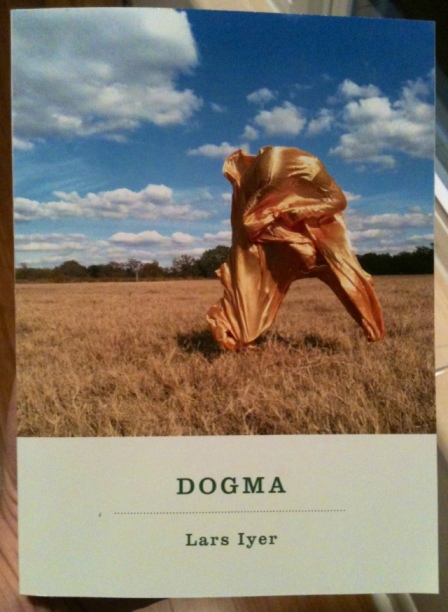
Book Acquired, 1.30.2012 — Dogma, Lars Iyer’s Sequel to Spurious

20120202-195422.jpg

Lars Iyer’s novel (or anti-novel, if you swing that way) Spurious was one of the better books I read last year. From my review:

Lars Iyer’s début novel Spurious is about two would-be intellectuals, W., the book’s comic hero, and his closest friend, our narrator Lars. They bitch and moan and despair: it’s the end of the world, it’s the apocalypse; they find themselves incapable of original thought, of producing any good writing. The shadow of Kafka paralyzes them. They travel about Europe, seeking out knowledge and inspiration — or at least a glimpse of some beautiful first editions of Rosenzweig. They attend dreadful academic conferences; they write letters. They flounder and fail.

Iyer was also kind enough to talk with me in a long, detailed interview.

So like basically I’m a fan, and I’ve been eager for Dogma, so I was psyched when an ARC showed up in Monday’s mail. Dogma is new from Melville House at the end of this month; more coverage to come.

Topless Faulkner, Part III

(See also).

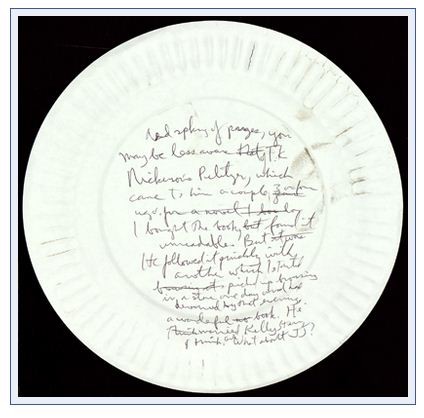
Denis Johnson’s Notes for The Name of the World, as Recorded on a Paper Plate

A Riff on the Kindle Fire

20120131-201536.jpg

1. I got a Kindle Fire for Christmas this year, and have been using it for about a month now. I’m not sure how to go about “reviewing” this product, so I’m going to riff a bit.

2. Let’s get the whole Amazon-as-Evil-Empire thing out of the way up front: Yes, Amazon’s business practices are unsavory; yes, attempting to decimate the publishing industry as it currently exists is Not Good; yes, their practices threaten brick-and-mortar stores (the kind that actually pay local and state taxes!); yes their practices work to undermine key figures in the publishing industry—y’know, people like editors.

3. Picking up on that last clause: self-publishing (and the self-publishing “revolution” that e-readers like the Kindle Fire entail) may seem fine and dandy cotton candy, but there’s a reason that editors (and publishers and publicists, etc.) exist. These people make books better. These people make books. (And no, by the way, I’m not interested in reading your self-published ebook, so quit sending me email blasts).

4. Seems like I’m riffing out a lot of context, so let’s keep going: Perhaps you read whinypants Jonathan Franzen decrying the impending moral failures/societal breakdown that will result from ebooks replacing print editions. Franzen’s position is, of course, reactionary and conservative, and deeply rooted in the fear that the perfect Platonic permanence of books will be subverted or decimated.

5. Franzen’s reaction is rooted in part against a (common, teleological, utopian) misconception about the longevity and stability of digital content. Simply put, many people are operating under a dramatic misunderstanding of just how unstable digital content is. Where will all these books be stored, and in what format? Who will be responsible for archiving these materials?

6. A simple thought experiment, germane to item 5 above: Think back on all the obsolete media that you have used in your lifetime. I am in my thirties; my list would include cassette tapes, VHS tapes, laser disks, floppy disks, minidiscs, CDRs . . . (I don’t include vinyl records in this list. I still own hundreds of them and play them regularly).

7. To recontextualize: Printed books are a far more stable format than ebooks.

8. To wit: Ursula LeGuin in her essay “Staying Awake” from a 2008 issue of Harper’s:

The book itself is a curious artifact, not showy in its technology but complex and extremely efficient: a really neat little device, compact, often very pleasant to look at and handle, that can last decades, even centuries. It doesn’t have to be plugged in, activated, or performed by a machine; all it needs is light, a human eye, and a human mind. It is not one of a kind, and it is not ephemeral. It lasts. It is reliable. If a book told you something when you were fifteen, it will tell it to you again when you are fifty, though you may understand it so differently that it seems you’re reading a whole new book.

9. Points 2-8 seem like so much hemming and hawing, so much reticence to discuss what I seemed to promise at the outset: Some sense of what reading on the Kindle Fire is like.

10. Some things I like very much about reading on the Kindle Fire:

It creates its own light for night reading.

It’s easy to highlight and annotate passages (and then open up a new screen to look at just those highlights and annotations, isolated from the text proper).

It’s lightweight and ergonomic and, when I read with it over my head, my wrists don’t constrict and go tingly.

It holds a lot of books.
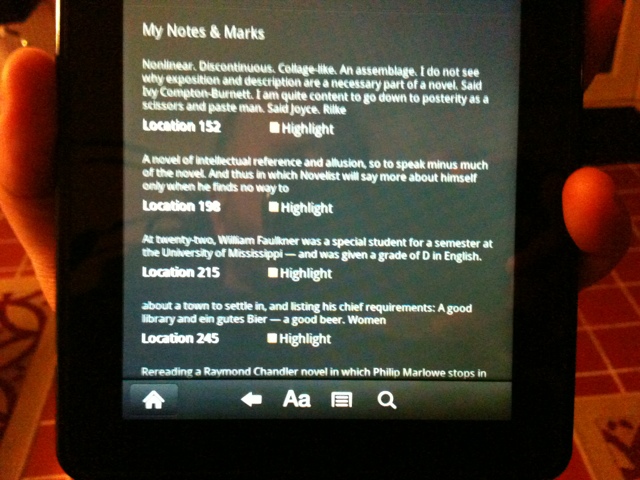
20120131-194740.jpg

11. Some things I like about the Kindle Fire that I would think I wouldn’t like about the Kindle Fire, were I to read such a list from another person:

I can determine how far I have read into a book as a percentage.

I can stop and browse the internet in the middle of reading.

I can look up words or even wikis as I go by simply hovering a finger over a word or phrase.

12. My daughter loves the thing. Loves loves loves it. She is probably the primary user. She is four and a half. I think the interactive books she adores are marvelous.

13. Some things I don’t like about the Kindle Fire:

No book smell.

One texture for all books: This is probably the biggest problem I can see with the Kindle Fire.

It requires a battery charge, so there’s a built in level of accessibility; a sense that one must needs “prepare” ahead of time to read, perhaps (unlike our old friend the print book, which only requires a light source).

No bath time reading.

I can’t read it around my daughter, because she will attempt to take it, or, at minimum, curl up in my lap.

It is not possible to have like three or four books open at once.

Can’t read .cbr files. Why? Why?

I had to buy a USB micro B cable to connect the Kindle to the computer that I use to store digital content. Why not include this cable, Amazon? (It’s almost as if the company wants consumers to be solely reliant on Amazon’s services as a content provider . . .)

14. I’ve found it nearly impossible to read an electronic book on the Kindle that I started as a print book. For example, I’m about half-way through Teju Cole’s novel Open City; the kind publicist who sent it to me also sent me an electronic version of the text. I began the print copy in earnest, but the other night, after reading a bit of Hawthorne on the Kindle, I found myself wanting to sink back into Cole’s Sebaldian orbit. When I found my place in the text though, I felt alienated, bleak even, as if I were not reading the definitive version of Cole’s book but instead its cheap ghost. There is no intellectual or objective justification for this feeling. Call it a vibe or a habit.

20120131-194747.jpg

15. Books that I enjoy reading on the Kindle Fire:

David Markson’s The Last Novel, which perhaps begs to be read on such a device.

Anything by Nietzsche, but his aphoristic works especially.

A .pdf version of Luigi Serafini’s rare and expensive book The Codex Seraphinianus (one of many verboten tomes on my Kindle, but remember the name of this site if you please . . .)

Anything by Whitman, especially letters and other non-essentials that I would not normally pursue.

Ditto Hawthorne.

Ditto Dickinson.

Ditto Melville.

Oh, and beyond the overlooked and underfamous works of certain American Renaissance faves: Moby-Dick too, which seems looser, freer, more aphoristic on the Kindle. (Why?)

Neal Stephenson’s novel Snow Crash, which seems simultaneously dated and futuristic. Like William Gibson with a strong streak of Pynchonian sillies.

And Gibson: Rereading Burning Chrome. Had forgotten how good some of these shorts are.

Houellebecq’s Whatever: its brevity, its succinctness gels with my nascent Kindle habits, or perhaps instructs my Kindle habits, or more likely creates my Kindle habits.

16. To return to a point in #13 above: The Kindle Fire necessarily imposes a uniform texture on every book that one reads on it; this would be true of any e-reader. Sure, you can change the background (white, black, or a sepia color, which is what I prefer), fonts, sizes, spacing, etc. — but there is no sense of physicality, of individual identity, of, dare I say it, specialness, to the texts. I am aware that these are terribly subjective and overtly Romantic terms, but hell, I like physical books. I like their covers and their smells and their discolorations. I like leaving bookmarks in every book that I finish or abandon—I almost always find a new bookmark for every book that I read (the autobookmark on the Kindle is useful, but how can it compare with a photograph of my son or drawing by my daughter or a postcard from a stranger or a scrap of poetry from a discontinued textbook or an old grocery list of my wife’s from years before we were married?).

17. I titled this post “A Riff on the Kindle Fire,” but that’s a bit ambiguous I suppose: I did not compose the post on the Kindle Fire, which I find awkward re: blogging/wordprocessing. I used a laptop (with some help from an iPhone). Maybe the preposition “about” would be more suitable.

18. By way of closing, after four weeks with the thing:

It’s light.

It’s convenient for night reading, but you probably shouldn’t take it in the bath.

No book smell.

William Gaddis on Hipsters: “An Ill-dressed, Underfed, Overdrunken Group of Squatters with Minds So Highly Developed That They Were Excused from Good Manners”

gaddis_large

Love this passage from William Gaddis’s The Recognitions. Mocking “hipsterism” has been around forever (or at least 50 years):

And by now they were at the door of the Viareggio, a small Italian bar of nepotistic honesty before it was discovered by exotics. Neighborhood folk still came, in small vanquished numbers and mostly in the afternoon, before the two small dining rooms and the bar were taken over by the educated classes, an ill-dressed, underfed, overdrunken group of squatters with minds so highly developed that they were excused from good manners, tastes so refined in one direction that they were excused for having none in any other, emotions so cultivated that the only aberration was normality, all afloat here on sodden pools of depravity calculated only to manifest the pricelessness of what they were throwing away, the three sexes in two colors, a group of people all mentally and physically the wrong size.

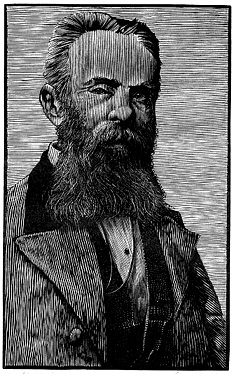
Herman Melville (Portrait) — Barry Moser

Cormac McCarthy, Unchallenged King of Literary Mule Carnage

In his essay “The Dead Mule Rides Again,” Jerry Leath Mills argues

. . . there is indeed a single, simple, litmus-like test for the quality of southernness in literature, one easily formulated into a question to be asked of any literary text and whose answer may be taken as definitive, delimiting, and final. The test is: Is there a dead mule in it?

Mills’s convincing textual evidence draws on over thirty authors, but declares Cormac McCarthy “unchallenged king of literary mule carnage.” Some proof:

4. Decapitation by irate opera singer. Cormac McCarthy, who far surpasses even Faulkner in the mayhem he visits upon literary mules (see #s 5, 6, 7, 9, 14, 15), includes in his recent novel The Crossing (1994) the following dialogue about a mule whose recalcitrance proves insufferable to the artistic temperament of a singer assigned to tend him in a road company:

What was it he done to the mule?

He tried to cut off the head with a machete. . . .

I wouldn’t have thought you could cut off a mule’s head with a machete.

Of course not. Only a drunken fool would attempt such a feat. When the hacking availed not he began to saw. . . .

What happened to the mule?

The mule? The mule died. Of course

5. Drowning. This is Faulkner’s most commonly employed means of dispatch for the mules in his works. In the flood scenes he renders so effectively, we inevitably find drowned mules floating down river. As opposed to the train-struck animals in “Mule in the Yard” (see # 3), which are instrumental in developing motive and plot, Faulkner’s drowned mules tend to fall into the decorative or ornamental category, employed chiefly for drama, mood, and atmosphere. In As I Lay Dying (1930), for example, Darl recreates a wagon disaster in the surging stream: “Between two hills I see the mules once more. They roll up out of the water in succession, turning completely over, their legs stiffly extended as when they had lost contact with the earth”. In the “Old Man” sections of The Wild Palms (1939), the flood throws forth its “charging welter of dead cows and mules and outhouses and cabins and hencoops,” and Faulkner’s prose strikes an elegiac note as the convict’s skiff rides “even upon the backs of the mules as though even in death they were not to escape that burden-bearing doom with which their eunuch race was cursed”. Before the ordeal ends, the accumulation of mule carcasses reaches almost cosmic proportions as the stranded convict remembers “that other wave, the second wall of water full of houses and dead mules building up behind him in the swamp”.

Robert Morgan’s story “Poinsett’s Bridge” (1989) picks up the drowned mule topos in distinctly Faulknerian terms: “The body of a mule shot by in the current, and then a chicken coop”; but Cormac McCarthy (see #s 4, 6, 7, 9, 14, 15) varies it in Blood Meridian (1985) by having a mule drowned intentionally: “The Yumas were swimming the few sorry mules . . . across the river. . . . Downriver they’d drowned one of the animals and towed it ashore to be butchered”. (On recurrent uses of mules as culinary items see # 14.)

That the image of the drowned mule also occupies a subliterary folk status in the South is perhaps attested by a common simile in which a wealthy person is said to have “enough money to burn up a wet mule.”

6. Falls from cliffs. The novel Blood Meridian (1985) establishes Cormac McCarthy as unchallenged king of literary mule carnage. No fewer than fifty-nine specific mules die in the book, plus dozens more that are alluded to in groups and bunches. Mules are shot, roasted, drowned, knifed, and slain by thirst; but the largest number, 50 out of a conducta of 122 mules carrying quicksilver for mining, plummet from a single cliff during an ambush, performing an almost choreographic display of motion and color, “the animals dropping silently as martyrs, turning sedately in the empty air and exploding on the rocks below in startling bursts of blood and silver as the flasks broke open and the mercury loomed wobbling in the air in great sheets and lobes and small trembling satellites. . . . Half a hundred mules had been ridden off the escarpment”. (See also #s 4, 5, 7, 9, 14, 15.)

. . .

7. Fall into subterranean cavity. Near the conclusion of Cormac McCarthy’s Child of God (1973), “Arthur Ogle was plowing an upland field one evening when the plow was snatched from his hands. He looked in time to see his span of mules disappear into the earth taking the plow with them” (195). These doomed mules qualify as highly functional in the story, since a search for their bodies leads to the discovery of a number of human corpses stored in the caves underground for sexual use by the necrophiliac Lester Ballard. (See also #s 4, 5, 6, 9, 14, 15.)

. . .

9. Gunshot wounds. The high quotient of gunplay in southern fiction quite naturally extends to some of the mules that grace its pages. . . .

Mules absorb lead throughout much of Cormac McCarthy’Blood Meridian (1985), one providing a shield against incoming fire: “He . . . crouched under the ribs of a dead mule and recharged the pistol”.

. . .

14. Stab wounds. . . .

But mules are consumed readily by man, beast, and fowl in Cormac McCarthy‘s Blood Meridian (1985), and a character in Bernice Kelly Harris’s Purslane (1939) finds the practice a perfectly acceptable topic for mealtime conversation: “Uncle Millard near the foot of the table was telling about the Christmas dinner he ate in the pesthouse years ago, declaring it was fried dog and mouse stew with a slice of boiled mule”.

15. Thirst. Alkali flats in Cormac McCarthy‘s Blood Meridian (1985) yield no shortage of “the black and desiccated shapes of horses and mules. . . . These parched beasts had died with their necks stretched in agony in the sand”

. . .

18. Submersion in domestic metaphor. Once again, Cormac McCarthy creates an exclusive category (see # 4) with a scene in Cities of the Plain (1998):

When he turned around Billy [Parham] was standing in the doorway watching him [John Grady Cole].

This the honeymoon suite? he said.

You’re lookin at it.

He leaned in the doorframe and took his cigarettes from his shirtpocket and shucked one out and lit it.

The only thing you ain’t got here is a dead mule in the floor.

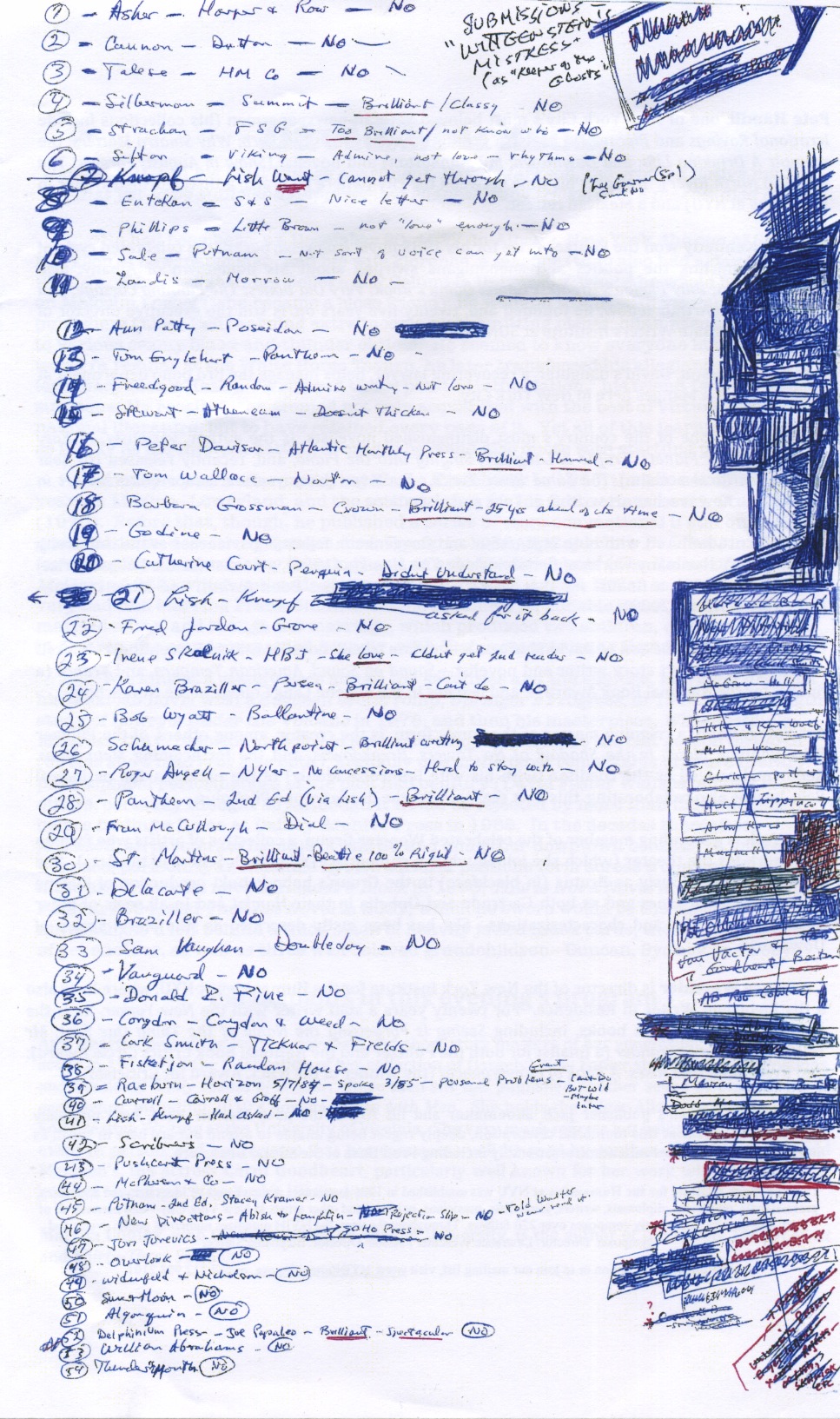
List of Rejections of Wittgenstein’s Mistress — David Markson

(Via/cheers).

“A Well-Meaning, Sincere Hypocrite” — William Gaddis on His Title Character, JR (And Capitalism)

More from William Gaddis’s 1986 Paris Review interview:

INTERVIEWER

Is JR’s story something you extrapolated from life only, or did you rely on sociologies devoted to how the corporate world works upon social values, human qualities, and relationships in American culture?

GADDIS

The boy himself is a total invention, completely sui generis. The reason he is eleven is because he is in this prepubescent age where he is amoral, with a clear conscience, dealing with people who are immoral, unscrupulous; they realize what scruples are, but push them aside, whereas his good cheer and greed he considers perfectly normal. He thinks this is what you’re supposed to do; he is not going to wait around; he is in a hurry, as you should be in America—get on with it, get going. He is very scrupulous about obeying the letter of the law and then (never making the distinction) evading the spirit of the law at every possible turn. He is in these ways an innocent and is well-meaning, a sincere hypocrite. With Bast, he does think he’s helping him out. As for the corporate world, I do read the newspapers, clip things, ideas, articles, and just use them as fodder. But all that hardly requires a text in sociology. And this may be the place to make a further point. I’m frequently seen in the conservative press as being out there on the barricades shouting: Down with capitalism! I do see it in the end as really the most workable system we’ve produced. So what we’re talking about is not the system itself, but its abuses, I don’t mean criminal but the abundant abuses just within the letter of the law. The essential question is whether it can survive these abuses given free rein and whether these abuses are inherent in the system itself. I should think it is perfectly clear in my work—calling attention, satirizing these abuses—that our best hope lies in bringing things under better and more equitable control, cutting back the temptations to unmitigated greed and bemused dishonesty . . . in other words that these abuses the system has fostered are not essential, but running out of moral or ethical control can certainly threaten its survival.

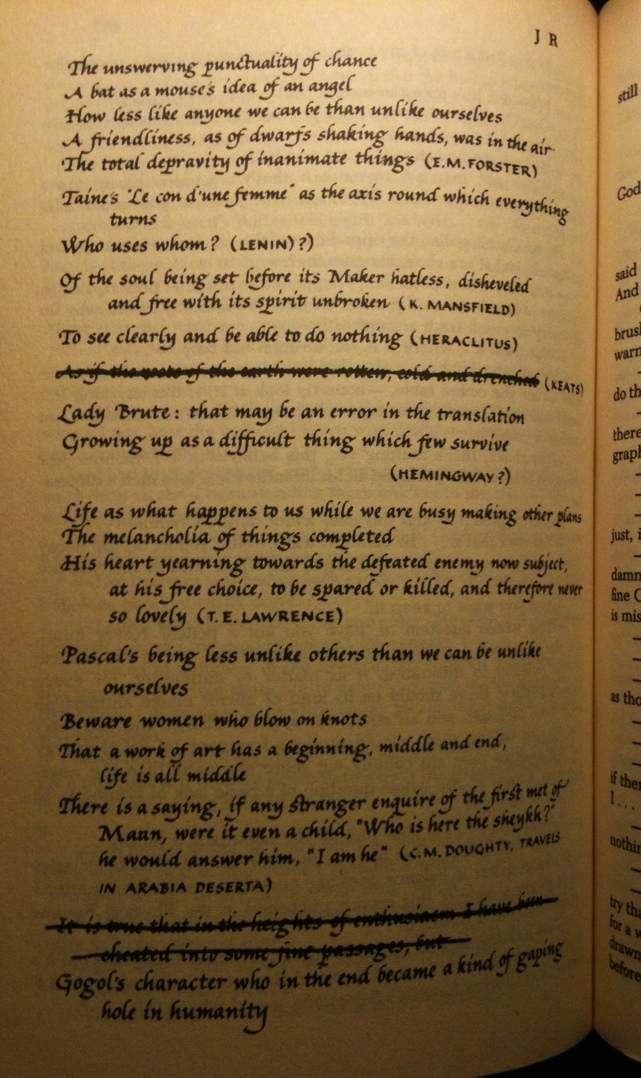
“The Unswerving Punctuality of Chance” (And Other Citations from William Gaddis’s Novel JR)

20120128-185406.jpg

In JR, the sprawling novel of capitalism and art by William Gaddis, Jack Gibbs loads his pockets with crumpled newspaper clippings, racing forms, and citations for a book he’s working on. “More trash,” he mutters about this list (which appears on page 486 of my Penguin Twentieth Century Classics Edition).