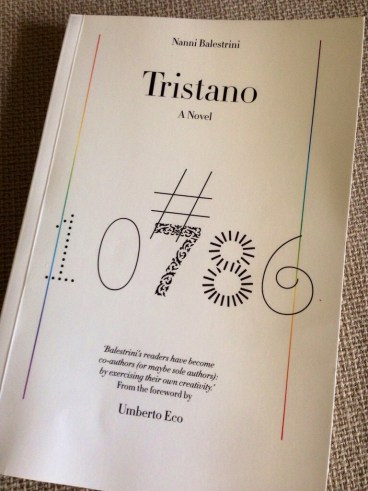
I Review (Version #10786 of) Nanni Balestrini’s Novel Tristano

20140318-103552.jpg

Let’s start with some facts:

Nanni Balestrini originally composed Tristano in the 1960s with the aid of an algorithm supplied to an IBM computer.

There are ten chapters in the novel.

Each chapter is comprised of twenty paragraphs.

Balestrini’s algorithm shuffles fifteen of those paragraphs within each chapter.

There are thus 109,027,350,432,000 possible versions of Tristano.

Tristano was published in 1966 by the Italian press Feltrinelli, but in only one of those 109,027,350,432,000 possible versions.

Now, Verso Books has published 4,000 different versions of Tristano in English.

They sent me #10786 to review.

Maybe a few more facts, and then some opinions—and citations from the novel—no?

Umberto Eco spends the first five pages of his six page introduction to Tristano situating Balestrini’s project in its proper literary-historical context. (He names some names: Pascal, Georg Philipp Harsdörffer, Christopher Clavius, Pierre Guldin, Mersenne, Leibniz, Borges, Queneau, Mallarmé, Manzoni, Joyce. There is no mention of Cortázar’s Hopscotch or Bantam’s Choose Your Own Adventure series).

Mike Harakis translated Tristano into English.

Harakis preserves Balestrini’s spare (and often confusing) style of punctuation.

The book is exactly 120 pages.

In his contemporary “Note on the Text” of Tristano, Balestrini says that the book is “an ironic homage to the archetype of the love story.”

The title of course alludes to the legend of Tristan and Iseult.

In his note, Balestrini uses the term “experiment” at least three times, suggesting that “to experiment with a new way of conceiving literature and novels” can make it more “possible to represent effectively the complexities and unpredictability of contemporary reality.”

Balestrini’s 2004 novel Sandokan is in my estimation one of the finest books of the past decade: A poetic examination of criminal brutality told in a bold voice, its syntactical experiments not experiments at all, but rather the base of a strong, strange tone that perfectly synthesizes plot and voice.

Okay. Opinions and citations:

In chapter 2 of my edition of Tristano—on page 19 of version #10786—we get a paragraph that begins: “To be one-sided means not to look at problems all-sidedly.”

Does Tristano, through its formal, discursive, algorithmic structure seek to approach an all-sided perspective? Significantly, we can’t be sure who says the line. There are two characters, male and female, both named C (an algebraic variable?).

There seems to be an argument here, an investigation. A crime, a love affair. But Tristano is a dialectic without synthesis. Or maybe that failure is mine. Maybe I’ve failed as the reader. Neglected my part. “Treat life as if it were a game,” we’re told in the aforementioned paragraph (page 19 of version #10786, if you’re keeping score). Or maybe we’re not told. Maybe C is telling C to treat life as a game (and not just telling the reader), but the context is not (cannot) be clear.

But again, that’s probably maybe almost certainly but okay maybe not quite the point of Tristano. From paragraph 18 of chapter 6 (page 71 of version #10786): “First of all one must have a fairly clear idea of the content of the text.” And a few lines down: “Her story weaves and unweaves like the tapestry she was working on.” And: “It’s the unconditional loss of language that starts.” And: “It might never have an end.” Freeing these lines from the sentences around them ironically stabilizes them.

Tristano isn’t just line after line of Postmodernism 101 though. There is actual imagery here, content. In fairness, let me share entire paragraph (from page 69  of version #10786):

In the internal part of the cave along with an abundance of Pleistocene fauna a human Neanderthaloid tooth was recovered. You’ve already told me this story. The cave is divided into two levels one upper and one lower that host a subterranean lake which can be visited by boat. It might even be another story. They had warned him it wouldn’t be a walk in the park. Inside you can go down into a great cavern in the centre of which there is a rock surmounted by a giant stalagmite. We’ll stay and look for another thirty seconds then we’ll leave. All the stories are different one from the other. On returning he found that C had bought herself a new blue silk dress. C remained standing while he explained to her how it had gone. She ran a finger over his lips to wipe the lipstick off them. I have to go. It’s still early. I’ll be away all day perhaps tomorrow too. He gave her a long kiss on the lips.

This paragraph is maybe almost kind of sort of a synecdoche of the entire book—sentences that seem to belong to other paragraphs, story threads that seem part of another tapestry. Let us pull a thread from another paragraph, another chapter (chapter 9, paragaph 8, page 102 of  of version #10786):

All imaginable pathways of the line that represents a direct connexion to the objective are equally impracticable and no adjustment of the shape of the body to the spatial forms of the surrounding objects can allow the objective to be reached.

Do you believe that? Did Balestrini? Or did it just allow him a neat little piece of rhetoric to gel with the concept of his experiment? The verbal force, dexterity, and dare I claim truth of Sandokan, composed a few decades later, suggests that yes, language can be shaped to mean.

And this, I think, is the big failure of Tristano—it’s a text afraid to mean, to even take a shot at meaning. Content to be simply an experiment, its sections adding up to nothing more than the suggestion that its sections could never add up to anything, Tristano offers little beyond its concept and a few observations on storytelling that dwell on paralysis instead of freedom. The whole experiment strikes me as the set up for a joke played on the reader: Look at all this possibility, look at all these iterations—and what’s at the core? Nothing.

I hate to end on such a negative note. I’m thankful that Verso published Tristano, which I think shows courage as well as a commitment to literature that you just aren’t going to see from a corporate house.  I’m thankful that I got to read (version #10786 of) Tristano, and I plan to order his novel The Unseen via my local bookstore. The expectations that I brought to the book were huge: Loved the concept, loved the last book I’d read by the author—and I want to read more by the author. Indeed, it’s entirely possible that failed Tristano’s experiment. But I would’ve been happier to learn something or feel something from that failure other than disappointment.

“Contingency (vs. Necessity)” — Lydia Davis

davis

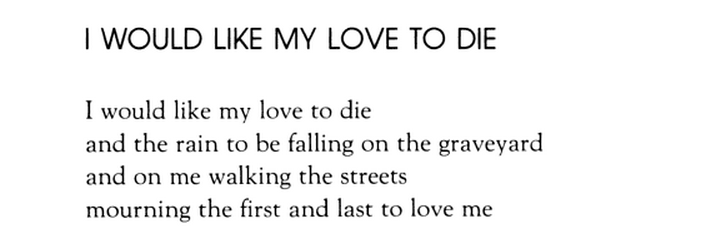
“I Would Like My Love To Die” — Samuel Beckett

Capture

“We Need Cruel Comedy” | A Lars Iyer Interview

I first interviewed Lars Iyer in 2011, after the publication of his novel Spurious, the beginning of a trilogy that concluded with Exodus (my favorite of the three). I asked Lars to talk with me about his trilogy for an email interview, and we ended up discussing failure, comedy, optimism, academia, American writing, Britain in the mid-eighties, and his forthcoming novel Wittgenstein Jr.

You can get Lars Iyer’s trilogy from publisher Melville House, check out his blog, and find him on Twitter.

Biblioklept: Why a trilogy? Was that by design? Is it a trilogy?

Lars Iyer: Spurious was only a beginning. I wanted to historicise my characters, to present their friendship as part of a larger social, economic and political context. Otherwise, I risked merely contributing belatedly to the literature of the absurd.

Biblioklept: I want to talk about the end of Exodus but that seems like bad form for an interview. Spoilers, etc. Can you comment on where you leave your protagonists, or how you leave them, or why you leave them?

LI: I leave my protagonists roughly where they were at the beginning of the trilogy: rudderless, rather lost, full of a sense of their failure, but with their friendship, such as it is, intact. ‘No hugs, no lessons’: my characters haven’t learned anything…

larsBiblioklept: Why can’t they learn? Why the repetition? Why not a heroic arc? Why not a saving grace?
LI: Perhaps because learning implies a kind of resolution that I think is inappropriate for the characters. Kundera says something apposite about Don Quixote. Cervantes makes his would-be knight-errant set off in search of battles, ready to sacrifice his life for a noble cause, ‘but tragedy doesn’t want him’. Kundera goes on:

since its birth, the novel is suspicious of tragedy: of its cult of grandeur; of its theatrical origins; of its blindness to the prose of life. Poor Alonzo Quijada. In the vicinity of his mournful countenance, everything turns into comedy.

So it is with my trilogy. No tragedy! No heroism! No tragic catharsis, that would see the tragic hero being dragged back into line. And no comic catharsis either, in which the older norms of a traditional societal system are reaffirmed. So much comedy is self-congratulatory, self-reassuring: the humour of good cheer, of port and cigars. It shores up things as they are. This is why I can never bear to watch comedy on television. It’s so rare to see comedians turn the joke on themselves. We need cruel comedy. Black comedy, which laughs at itself laughing…

Why the use of repetition in my novels? Because I want to portray the breakdown of things as they are, not once, but again and again. Failure, without amelioration. Serio-comic breakdown, without restitution. Anomie. Helplessness. Crushed hope. How else to acknowledge the prose of our lives?

Much of the humour of Don Quixote, depends on the contrast between lofty ideals and the concrete, everyday, corporeal life. The humour of my trilogy is analogous – but, of course, our everyday is utterly changed! A generalised precarity, un- and under-employment, free-floating anxiety, consumerism, the emphasis on self-representation, the sense that history is over, that politics is all played out, that financial and climatic catastrophe loom…

The tragedy of everyday life is that it’s not even tragic. It never reaches the lofty heights of tragic grandeur. Well, nor do my characters. When W. is at his most wretched, he cannot even die – that’s the end of Dogma. When W. is at his most revolutionary, participating in his own version of the Occupy movement, as at the end of Exodus … well, I won’t spoil the story, but it won’t surprise readers of previous books in the trilogy that there is neither a heroic arc nor a saving grace. Continue reading ““We Need Cruel Comedy” | A Lars Iyer Interview”

“Certain Cheeses are converted into Stones, and many Wicked Men are drowned” (St. Patrick assassination attempt)

“Certain Cheeses are converted into Stones, and many Wicked Men are drowned”

(From The Life and Acts of St. Patrick by Jocelin).

And certain wicked and envious men, who lived in the country of Ferros, contriving to destroy the life of the saint, offered unto him poisoned cheeses, as if for his benediction; the which he blessed, and immediately converted into stones, to the admiration of many, the honor of God, the veneration of himself, and the confusion of the poisoners. And unto this day remain these stones in the place where the miracle was done, and show the virtue of Patrick, though mute, because they underwent mutation. Then did these poisoners, seeing that their machinations redounded to the glory of the saint and to the shame of themselves, gather together fifty armed men to spill the blood of this just one. And they, being assembled against him, entered the ford of a certain river, journeying along the bank whereof the man of God met them; and when he beheld their countenances, he understood their thoughts, and raising against them his left hand, with a clear voice he cried out, “Ye shall not come unto us, nor shall ye return unto your own people, but in this river shall your bodies remain, even to the day of judgment.” Then, according to the word of the man of God, immediately they sank as lead in the mighty waters; nor even to this day were their bodies found, though long and often sought. Thus, at the divine mandate, did the water punish them who conspired the death of Saint Patrick, as erewhile the fire from heaven punished them which were sent by King Achab to the prophet. And the place wherein they sank in the waters is called even to this day the Ford of the Drowned Men.

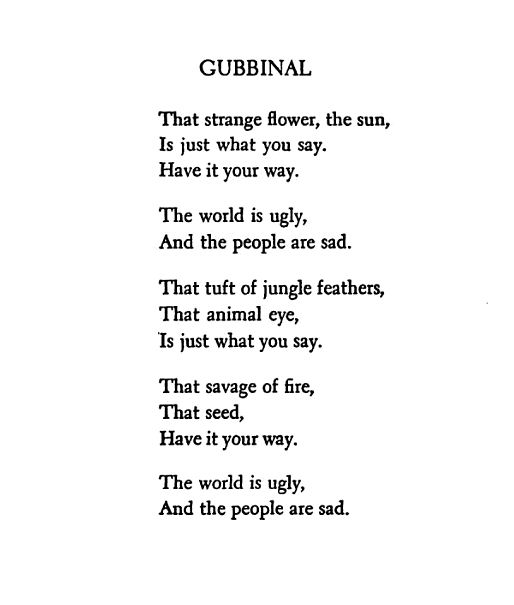
“Gubbinal” — Wallace Stevens

Capture

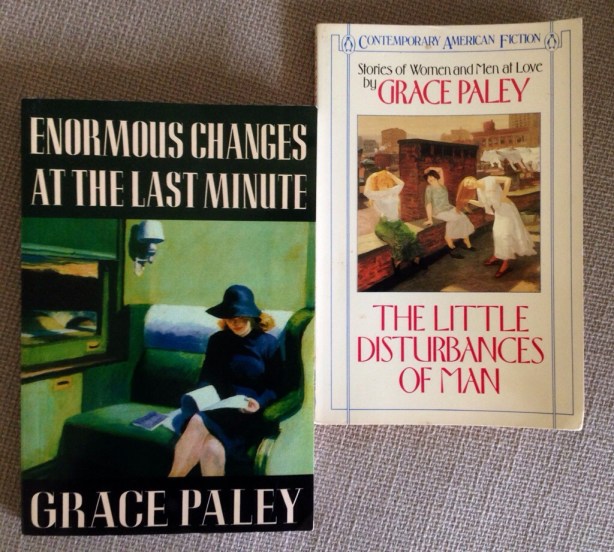
Two by Grace Paley (Books Acquired, 3.07.2014)

20140316-144125.jpg

I’d been wanting to pick up a collection of Grace Paley’s stories for awhile now. I wasn’t sure whether or not to pick up Enormous Changes at the Last Minute or The Little Disturbances of Man, so I just got both. The covers helped convince me, I’ll admit—I’m a sucker for Hopper, and John French Sloan is no slouch either. (I’m tempted here to launch into some vague critique of the covers that books by women get but nah).

I’ve already read most of Enormous Change, ingesting most of the tales while sitting in my car, waiting to pick my kids up after school, which seems like a perfect place to read it. Smart, odd, often sharp, scathing, precise, etc.—great stuff. I’ll try to do a full review but I’ve got a huge backlog. In the meantime, check out “Wants.”

The Essential Short Stories of J.G. Ballard

jgb_complete_ss4003111

I. “Manhole 69” (1957)

II. “Chronopolis” (1960)

III.  “The Voices of Time” (1960)

IV. “The Overloaded Man” (1961)

V. “Billennium” (1961)

VI. “Thirteen to Centaurus” (1962)

VII. “The Subliminal Man” (1963)

VIII. “End-Game” (1963)

IX. “Time of Passage” (1964)

X. “The Lost Leonardo” (1964)

XI. “The Terminal Beach” (1964)

XII. “The Drowned Giant” (1964)

XIII. “The Beach Murders” (1966)

XIV.  “The Assassination of John Fitzgerald Kennedy Considered as a Downhill Motor Race” (1966)

XV. “Why I Want to Fuck Ronald Reagan” (1968)

XVI. “Notes Towards a Mental Breakdown” (1976)

XVII. “The Index” (1977)

XVIII. “The Dead Time” (1977)

XIX. “News from the Sun” (1981)

XX. “Myths of the Near Future” (1982)

XXI. “Memories of the Space Age” (1982)

XXII. “Answers to a Questionnaire” (1985)

XXIII. “A Guide to Virtual Death” (1992)

At 1200 pages and just under 100 stories, The Complete Short Stories is frankly too complete—but I read them all anyway. The list above is my suggestion for a volume I’d call The Essential Short Stories of J.G. Ballard. Each selection on the list is linked to a riff I wrote; in several cases, links to the full text of the story can be found at the riff.

“Toys” — Roland Barthes

“Toys”

by

Roland Barthes

(From Mythologies. Translation by Annette Lavers)

French toys: one could not find a better illustration of the fact that the adult Frenchman sees the child as another self. All the toys one commonly sees are essentially a microcosm of the adult world; they are all reduced copies of human objects, as if in the eyes of the public the child was, all told, nothing but a smaller man, a homunculus to whom must be supplied objects of his own size.

Invented forms are very rare: a few sets of blocks, which appeal to the spirit of do-it-yourself, are the only ones which offer dynamic forms. As for the others, French toys always mean something, and this something is always entirely socialized, constituted by the myths or the techniques of modern adult life: the Army, Broadcasting, the Post Office, Medicine (miniature instrument-cases, operating theaters for dolls), School, Hair-Styling (driers for permanent-waving), the Air Force (Parachutists), Transport (trains, Citroens, Vedettes, Vespas, petrol-stations), Science (Martian toys).

The fact that French toys literally prefigure the world of adult functions obviously cannot but prepare the child to accept them all, by constituting for him, even before he can think about it, the alibi of a Nature which has at all times created soldiers, postmen and Vespas. Toys here reveal the list of all the things the adult does not find unusual: war, bureaucracy, ugliness, Martians, etc. It is not so much, in fact, the imitation which is the sign of an abdication, as its literalness: French toys are like a Jivaro head, in which one recognizes, shrunken to the size of an apple, the wrinkles and hair of an adult. There exist, for instance, dolls which urinate; they have an oesophagus, one gives them a bottle, they wet their nappies; soon, no doubt, milk will turn to water in their stomachs. This is meant to prepare the little girl for the causality of house-keeping, to ‘condition’ her to her future role as mother. However, faced with this world of faithful and complicated objects, the child can only identify himself as owner, as user, never as creator; he does not invent the world, he uses it: there are, prepared for him, actions without adventure, without wonder, without joy. He is turned into a little stay-at-home householder who does not even have to invent the mainsprings of adult causality; they are supplied to him ready-made: he has only to help himself, he is never allowed to discover anything from start to finish. The merest set of blocks, provided it is not too refined, implies a very different learning of the world: then, the child does not in any way create meaningful objects, it matters little to him whether they have an adult name; the actions he performs are not those of a user but those of a demiurge. He creates forms which walk, which roll, he creates life, not property: objects now act by themselves, they are no longer an inert and complicated material in the palm of his hand. But such toys are rather rare: French toys are usually based on imitation, they are meant to produce children who are users, not creators.

The bourgeois status of toys can be recognized not only in their forms, which are all functional, but also in their substances. Current toys are made of a graceless material, the product of chemistry, not of nature. Many are now moulded from complicated mixtures; the plastic material of which they are made has an appearance at once gross and hygienic, it destroys all the pleasure, the sweetness, the humanity of touch. A sign which fills one with consternation is the gradual disappearance of wood, in spite of its being an ideal material because of its firmness and its softness, and the natural warmth of its touch. Wood removes, from all the forms which it supports, the wounding quality of angles which are too sharp, the chemical coldness of metal. When the child handles it and knocks it, it neither vibrates nor grates, it has a sound at once muffled and sharp. It is a familiar and poetic substance, which does not sever the child from close contact with the tree, the table, the floor. Wood does not wound or break down; it does not shatter, it wears out, it can last a long time, live with the child, alter little by little the relations between the object and the hand. If it dies, it is in dwindling, not in swelling out like those mechanical toys which disappear behind the hernia of a broken spring. Wood makes essential objects, objects for all time. Yet there hardly remain any of these wooden toys from the Vosges, these fretwork farms with their animals, which were only possible, it is true, in the days of the craftsman. Henceforth, toys are chemical in substance and color; their very material introduces one to a coenaesthesis of use, not pleasure. These toys die in fact very quickly, and once dead, they have no posthumous life for the child.

Beware

beware

“Nouns” — Tom Clark

nouns

“Form the habit of taking some of your solitude with you into society” (Schopenhauer)

When you find human society disagreeable and feel yourself justified in flying to solitude, you can be so constituted as to be unable to bear the depression of it for any length of time, which will probably be the case if you are young. Let me advise you, then, to form the habit of taking some of your solitude with you into society, to learn to be to some extent alone even though you are in company; not to say at once what you think, and, on the other hand, not to attach too precise a meaning to what others say; rather, not to expect much of them, either morally or intellectually, and to strengthen yourself in the feeling of indifference to their opinion, which is the surest way of always practicing a praiseworthy toleration. If you do that, you will not live so much with other people, though you may appear to move amongst them: your relation to them will be of a purely objective character. This precaution will keep you from too close contact with society, and therefore secure you against being contaminated or even outraged by it. Society is in this respect like a fire—the wise man warming himself at a proper distance from it; not coming too close, like the fool, who, on getting scorched, runs away and shivers in solitude, loud in his complaint that the fire burns.

From Counsels and Maxims by Arthur Schopenhauer (translation by T. Bailey Saunders).


“How to recognize a work of art” (Roberto Bolaño on translation)

How to recognize a work of art? How to separate it, even if just for a moment, from its critical apparatus, its exegetes, its tireless plagiarizers, its belittlers, its final lonely fate? Easy. Let it be translated. Let its translator be far from brilliant. Rip pages from it at random. Leave it lying in an attic. If after all of this a kid comes along and reads it, and after reading makes it his own, and is faithful to it (or unfaithful, whichever) and reinterprets it and accompanies it on its  voyage to the edge, and both are enriched and the kid adds an ounce of value to its original value, then we have something before us, a machine or a book, capable of speaking to all human beings; not a plowed field but a mountain, not the image of a dark forest but the dark forest, not a flock of birds but the Nightingale.

From Roberto Bolaño’s essay “Translation Is an Anvil” (collected in Between Parentheses).

New in Translation from New Vessel Press (Books Acquired Some Time Earlier This Month)

20140313-175305.jpg

Some handsome titles from indie New Vessel Press:

First, Marek Hlasko’s Killing the Second Dog (translation by Tomaasz Mirkowicz). Blurb:

Robert and Jacob are two down-and-out Polish con men living in Israel in the early 1960s. They’re planning to run a scam on an American widow visiting the country. Robert, who masterminds the scheme, and Jacob who acts it out, are tough, desperate men, exiled from their native land and adrift in the hot, nasty underworld of Tel Aviv. Robert arranges for Jacob to run into the woman, who has enough trouble with her young son to keep her occupied all day. Her heart is open though, and the men are hoping her wallet is too. What follows is a story of love, deception, cruelty and shame, as Jacob pretends to fall in love with the American. But it’s not just Jacob who seems to be performing a role; nearly all the characters are actors in an ugly story, complete with parts for murder and suicide. Hlasko’s writing combines brutal realism with smoky, hardboiled dialogue, in a bleak world where violence is the norm and love is often only an act.

I’m gonna crack into this one next week.

The Good Life Elsewhere by Vladimir Lorchenkov (translation by Ross Ufberg):

The Good Life Elsewhere is a very funny book. It is also a very sad one. Moldovan writer Vladimir Lorchenkov tells the story of a group of villagers and their tragicomic efforts, against all odds and at any cost, to emigrate from Europe’s most impoverished nation to Italy for work. This is a book with wild imagination and heartbreaking honesty, grim appraisals alongside optimistic commentary about the nature of human striving. In Lorchenkov’s uproarious tale, an Orthodox priest is deserted by his wife for an art-dealing atheist; a rookie curling team makes it to an international competition; a mechanic redesigns his tractor for travel by air and sea; thousands of villagers take to the road on a modern-day religious crusade to make it to the promised land of Italy; meanwhile, politicians remain politicians. Like many great satirists from Voltaire to Gogol to Vonnegut, Lorchenkov makes use of the grotesque to both horrify us and help us laugh. It is not often that stories from forgotten countries such as Moldova reach us in the English-speaking world. A country where 25 percent of its population works abroad, where remittances make up nearly 40 percent of the GDP, where alcohol consumption per capita is the highest in the world, and which has the lowest per capita income in all of Europe – this is a country that surely has its problems. But, as Lorchenkov vividly shows, it’s a country whose residents don’t easily give up.

“I Am in Danger—Sir—” — Adrienne Rich

“I Am in Danger—Sir—” by Adrienne Rich

“Half-cracked” to Higginson, living,
afterward famous in garbled versions,
your hoard of dazzling scraps a battlefield,
now your old snood

mothballed at Harvard
and you in your variorum monument
equivocal to the end—
who are you?

you, woman, masculine
in single-mindedness,
for whom the word was more
than a symptom—

a condition of being.
Till the air buzzing with spoiled language
sang in your ears
of Perjury

and in your half-cracked way you chose
silence for entertainment,
chose to have it out at last
on your own premises.

“Company” — Les Murray

Capture

I Never Stopped Loving You — Chris Ware