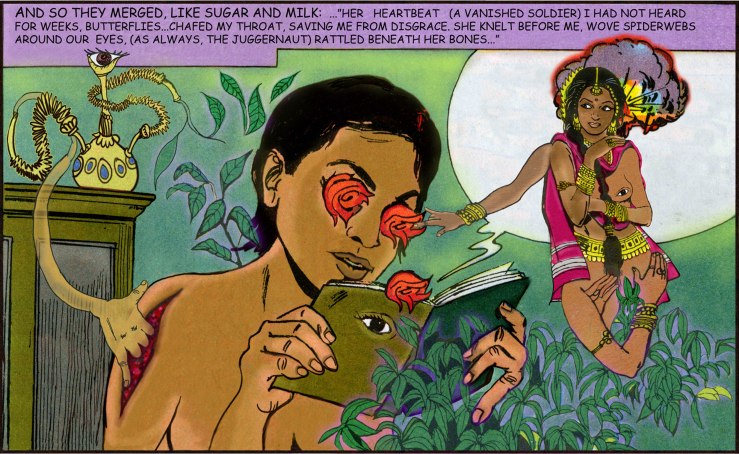
Sugar and Milk — Chitra Ganesh

11.-sugar-and-milk-26-x-41.5-trimmedcomp

Sugar and Milk, from Her Nuclear Waters by Chitra Ganesh (b. 1975)

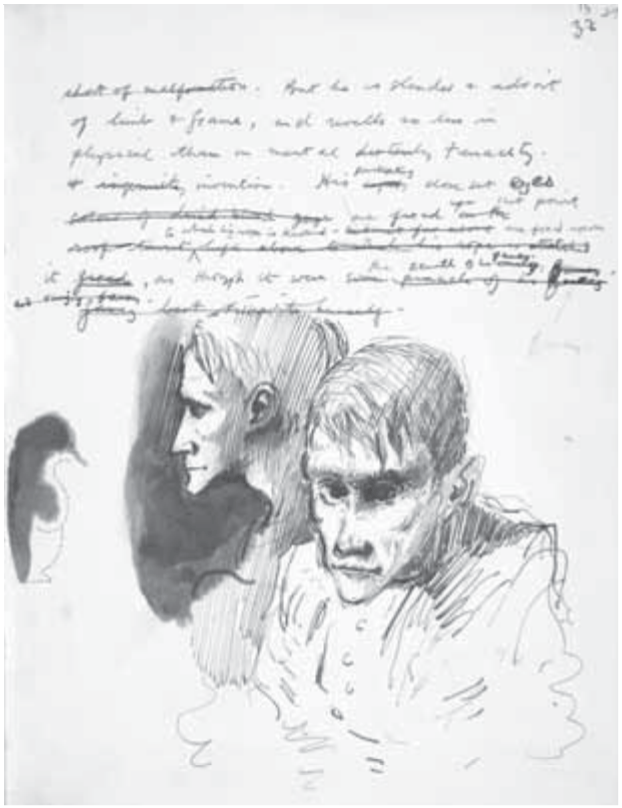
Two Studies for Steerpike — Mervyn Peake

steerpike

“Abecedary” — Tom Disch

“Abecedary”

by

Tom Disch


A is an Apple, as everyone knows.
But B is a …. What do you suppose?
A Bible? A Barber? A Banquet? A Bank?
No, B is this Boat, the night that it sank.
C is its Captain, and D is its Dory,
While E – But first let me tell you a story.
There once was an Eagle exceedingly proud
Who thought it would fly, in the Form of a cloud —
Yes, E is for Eagle, and F is for Form,
And G is the Grass that got wet in the storm
When the cloud that the Egale unwisely became
Sprinkled our hero and all of his fame
Over ten acres of upland plateau.
So much for that story. Now H. Do you know?
H is the Hay that was made from the Grass,
And I’s the Idea of going to Mass,
Which is something that only a Catholic would do.
Jews go to Synagogue. J is a Jew.
K is for Kitchen as well as for Kiss,
While L is for all of the black Licorice
You can eat in an hour without feeling ill.
M is for Millipede, Millet, and Mill.
The first is an insect, the second a grain,
The third grinds the second: it’s hard to explain
Such a process to children who never have seen it —
So let’s go to the country right now! YEs, I mean it.
We’re leaving already, and N is the Night
We race through to reach it, while P is the Plight
Of the people (Remember?) who sailed in that Boat
That is still, by a miracle, somehow afloat!
(Oh dear, I’ve just nocied I’ve overlooked O:
O’s an Omission and really should go
In that hole – do you see it? – between N and P.
No? It’s not there now? Dear O, pardon me.)
Q is the Question of how far away
A person can travel in one single day,
And whether it’s worth it, or might it be better
To just stay at home and write someone a letter?
R’s are Relations, a regular swarm.
Now get out of the car – we’ve arrived at their farm!
S is the Sight of a Thanksgiving feast,
And T is the Turkey, which must weight at least
Thirty pounds. U is Utopia. V …
V simply Vanishes – where, we can’t see –
While W Waves from its Westernmost isle
And X lies exhausted, attempting to smile.
There are no letters left now but Y and then Z.
Y is for You, dear, and Z is for me.

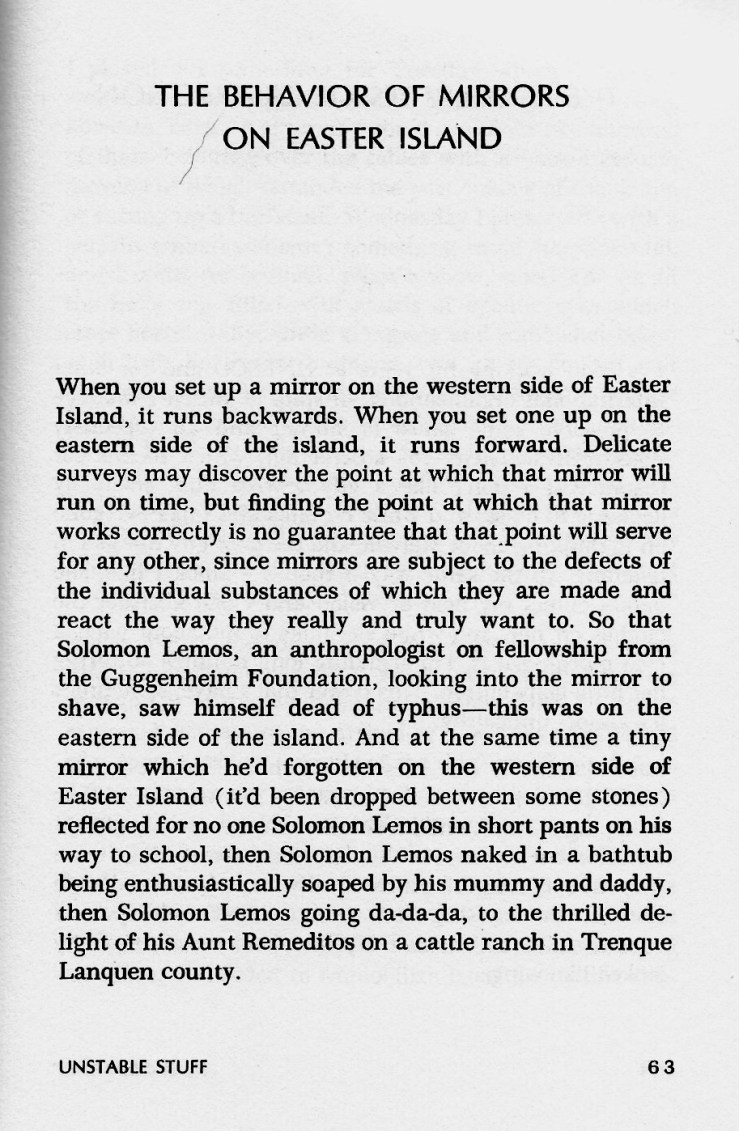
“The Behavior of Mirrors on Easter Island” — Julio Cortázar

2020-03-06_151902_3

(English translation by Paul Blackburn)

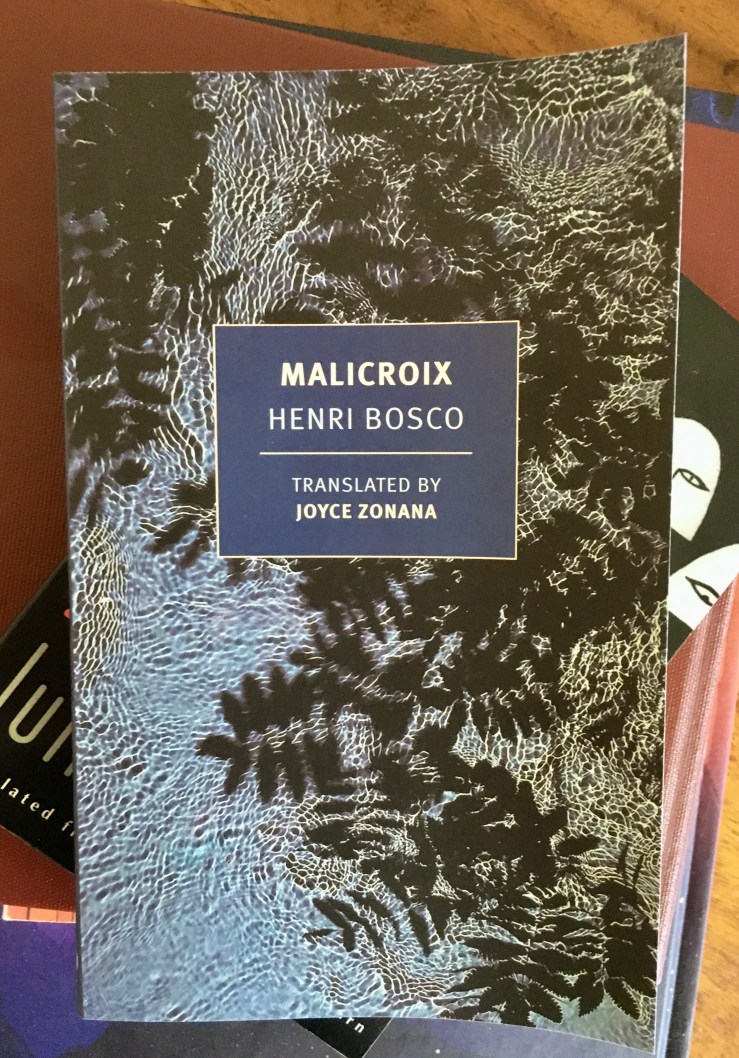
Henri Bosco’s Malicroix (Book acquired, 9 March 2020)

img_5152

Henri Bosco’s novel Malicroix (in English translation by Joyce Zonana) is one of NYRB’s new titles. Their blurb:

Henri Bosco, like his contemporary Jean Giono, is one of the regional masters of modern French literature, a writer who dwells above all on the grandeur, beauty, and ferocious unpredictability of the natural world. Malicroix, set in the early nineteenth century, is widely considered to be Bosco’s greatest book. Here he invests a classic coming-of-age story with a wild, mythic glamour.

A nice young man, of stolidly unimaginative, good bourgeois stock, is surprised to inherit a house on an island in the Rhône, in the famously desolate and untamed region of the Camargue. The terms of his great-uncle’s will are even more surprising: the young man must take up solitary residence in the house for a full three months before he will be permitted to take possession of it. With only a taciturn shepherd and his dog for occasional company, he finds himself surrounded by the huge and turbulent river (always threatening to flood the island and surrounding countryside) and the wind, battering at his all-too-fragile house, shrieking from on high. And there is another condition of the will, a challenging task he must perform, even as others scheme to make his house their own. Only under threat can the young man come to terms with both his strange inheritance and himself.

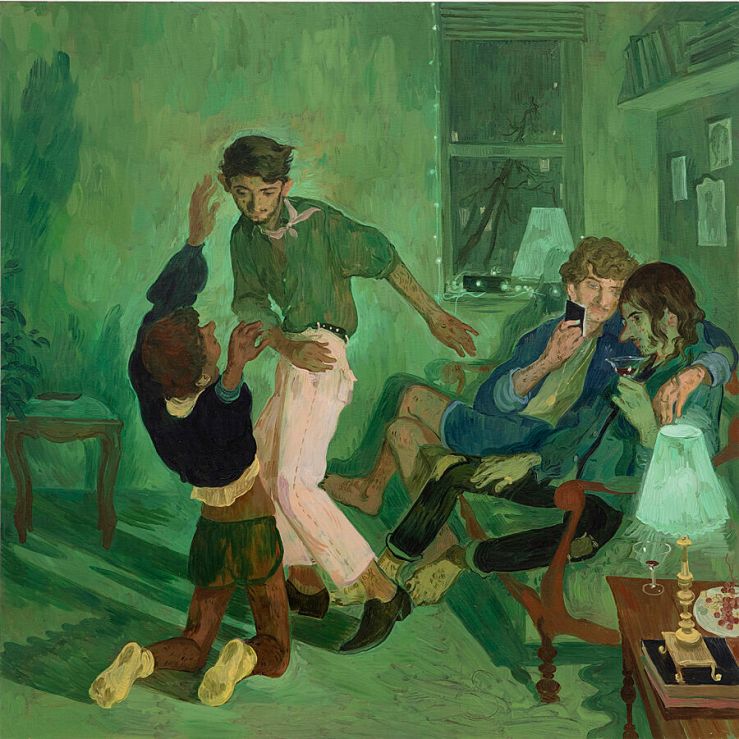
Four Friends — Salman Toor

large_four_friends_

Four Friends, 2019 by Salman Toor (b. 1983)

It hadn’t been murder, the courts decided. It was only a happening | From Charles Wright’s novel The Wig

I remembered Abraham Lincoln, who had died for me. I remembered the Negro maid who had walked from Grapetree, Mississippi, to Cold Spring Harbor, Long Island, and was flogged for being too maidenly fair. I remember the young man who, competing for the title “Blacker the Berry, Sweeter the Juice,” was killed during an avant-garde happening in a Washington Mews carriage house. The killing did not take place during a Black Mass, as was first reported. The Negro youth had committed a sexual outrage, according to Confidential Magazine in its exclusive interview with the hostess and the hostess, who were famous for their collection of Contemporary Stone Art. Their sexual safaris were legendary too. Inspired by childhood tales of lynchings (ah, the gyrations the moans, the sweat, the smell of fresh blood, the uncircumcised odor), the couple had explored Latin rice-and-bean delights, European around-the-world-scootee-roots, Near Eastern lamb, flip-flop, and it’s-all-in-the-family.

Hoping to avoid the press, which arrived by helicopter, fifty miles from shore, exhausted, jaded, they returned to their native land on a luxury liner but in steerage class, with seventy pieces of Louis Vuitton luggage.

“It was off-season,” the hostess had jokingly told reporters. The host added with great dignity: “We are returning to our native land, where fornication is pure and simple. We’re returning to the womb of nature.” They went into seclusion in their Greenwich Village carriage house until the night of the celebrated “happening,” the night that was to reestablish their worldly reputation. The gleaming, white-toothed young Negro with the rough but carefully-combed kinky hair (if one ran one’s hand through his hair, one trembled and saw Venus and Mars) displayed a rosebud instead of a penis! The effrontery—a Negro and nipped in the bud! Certainly a shock that could drive anyone to murder, only it hadn’t been murder, the courts decided. It was only a happening.

From Charles Wright’s fantastic 1966 novel The Wig. 

img_5057

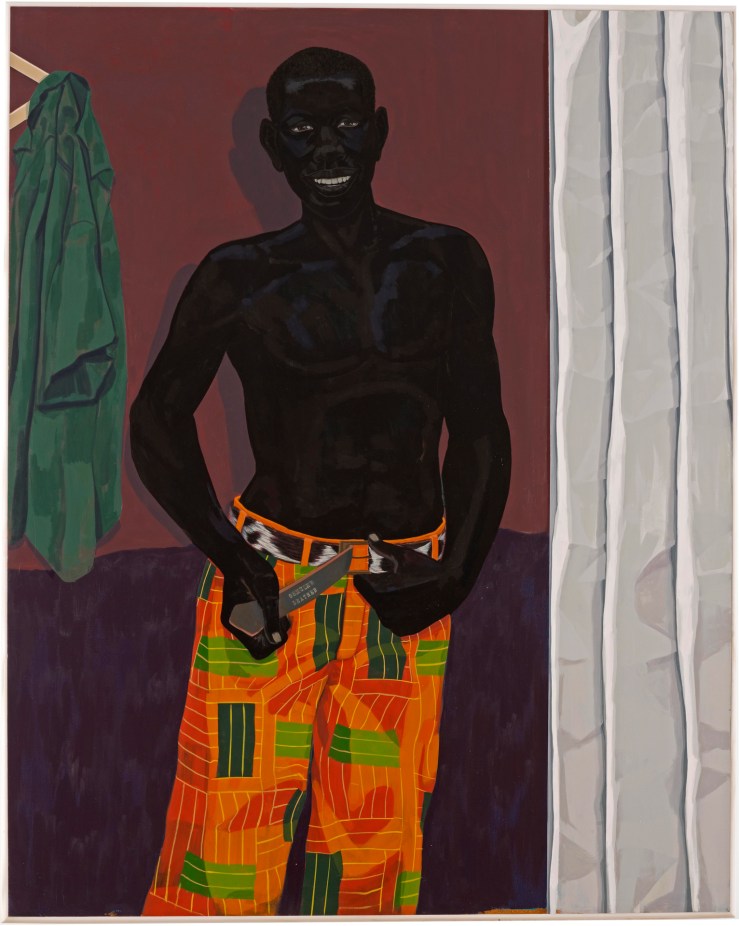
Untitled (Orange Pants) — Kerry James Marshall

marshall_orangepants

Untitled (Orange Pants), 2014 by Kerry James Marshall (b. 1955)

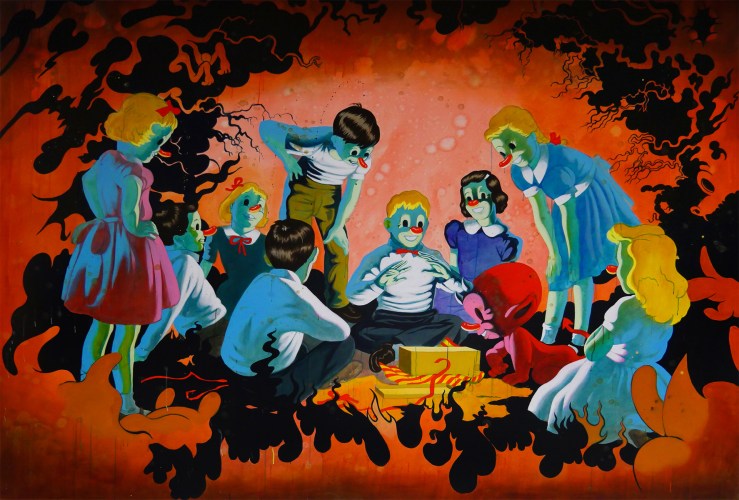
The Gift — Victor Castillo

victor-castillo-the-gift-low

The Gift, 2017 by Victor Castillo (b. 1973)

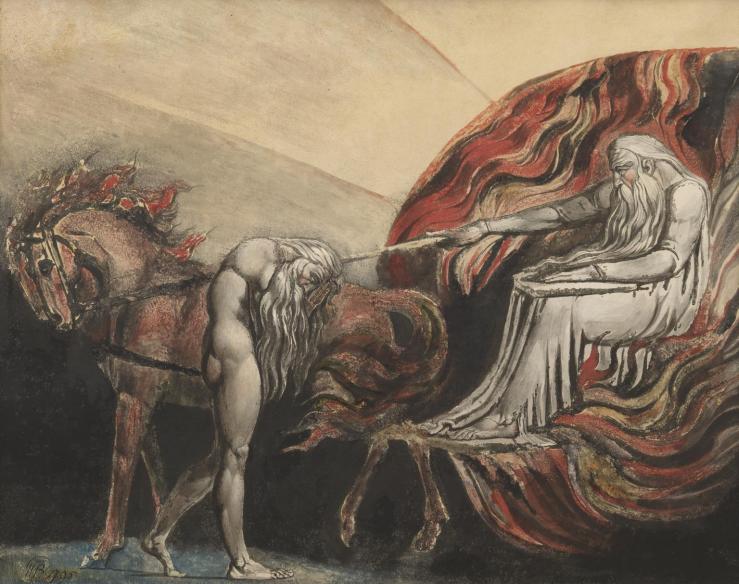
God Judging Adam — William Blake

God Judging Adam 1795 by William Blake 1757-1827

God Judging Adam, 1795 by William Blake (1757-1827)

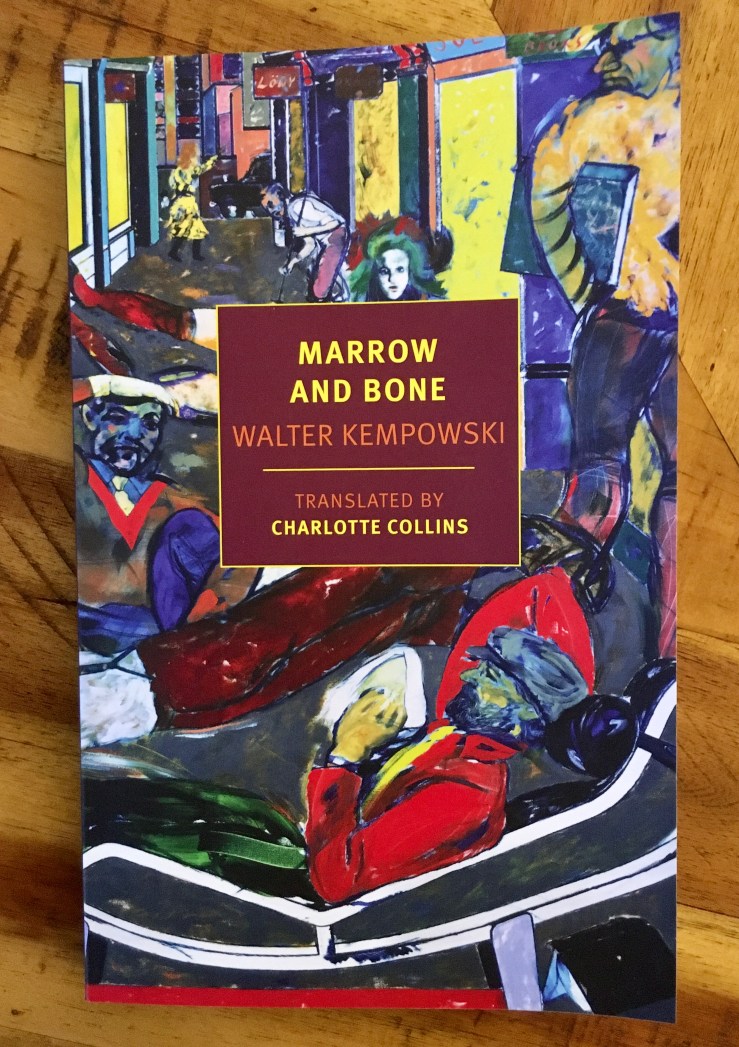
Walter Kempowski’s Marrow and Bone (Book acquired, sometime in February 2020)

img_5060

Walter Kempowski’s Marrow and Bone is new from NYRB in English translation by Charlotte Collins. NYRB’s blurb:

West Germany, 1988, just before the fall of the Berlin Wall: Jonathan Fabrizius, a middle-aged erstwhile journalist, has a comfortable existence in Hamburg, bankrolled by his furniture-manufacturing uncle. He lives with his girlfriend Ulla in a grand, decrepit prewar house that just by chance escaped annihilation by the Allied bombers. One day Jonathan receives a package in the mail from the Santubara Company, a luxury car company, commissioning him to travel in their newest V8 model through the People’s Republic of Poland and to write about the route for a car rally. Little does the company know that their choice location is Jonathan’s birthplace, for Jonathan is a war orphan from former East Prussia, whose mother breathed her last fleeing the Russians and whose father, a Nazi soldier, was killed on the Baltic coast. At first Jonathan has no interest in the job, or in dredging up ancient family history, but as his relationship with Ulla starts to wane, the idea of a return to his birthplace, and the money to be made from the gig, becomes more appealing. What follows is a darkly comic road trip, a queasy misadventure of West German tourists in Communist Poland, and a reckoning that is by turns subtle, satiric, and genuine. Marrow and Bone is an uncomfortably funny and revelatory odyssey by one of the most talented and nuanced writers of postwar Germany.

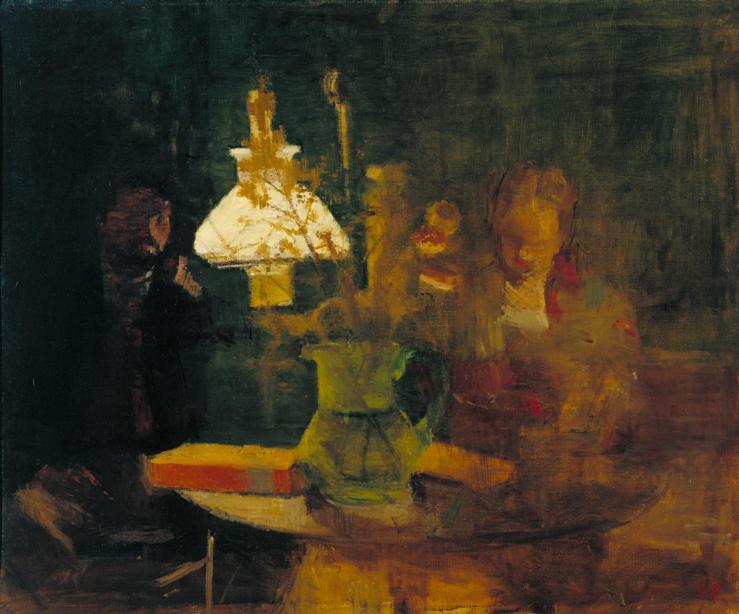
Lamplight — Victor Pasmore

Lamplight 1941 by Victor Pasmore 1908-1998

Lamplight, 1941 by Victor Pasmore (1908–1998)

Blog about some books acquired, 13 March 2020

img_5049

After one week of abstinence I drove the mile or so to the used bookstore I go to too often and browsed.

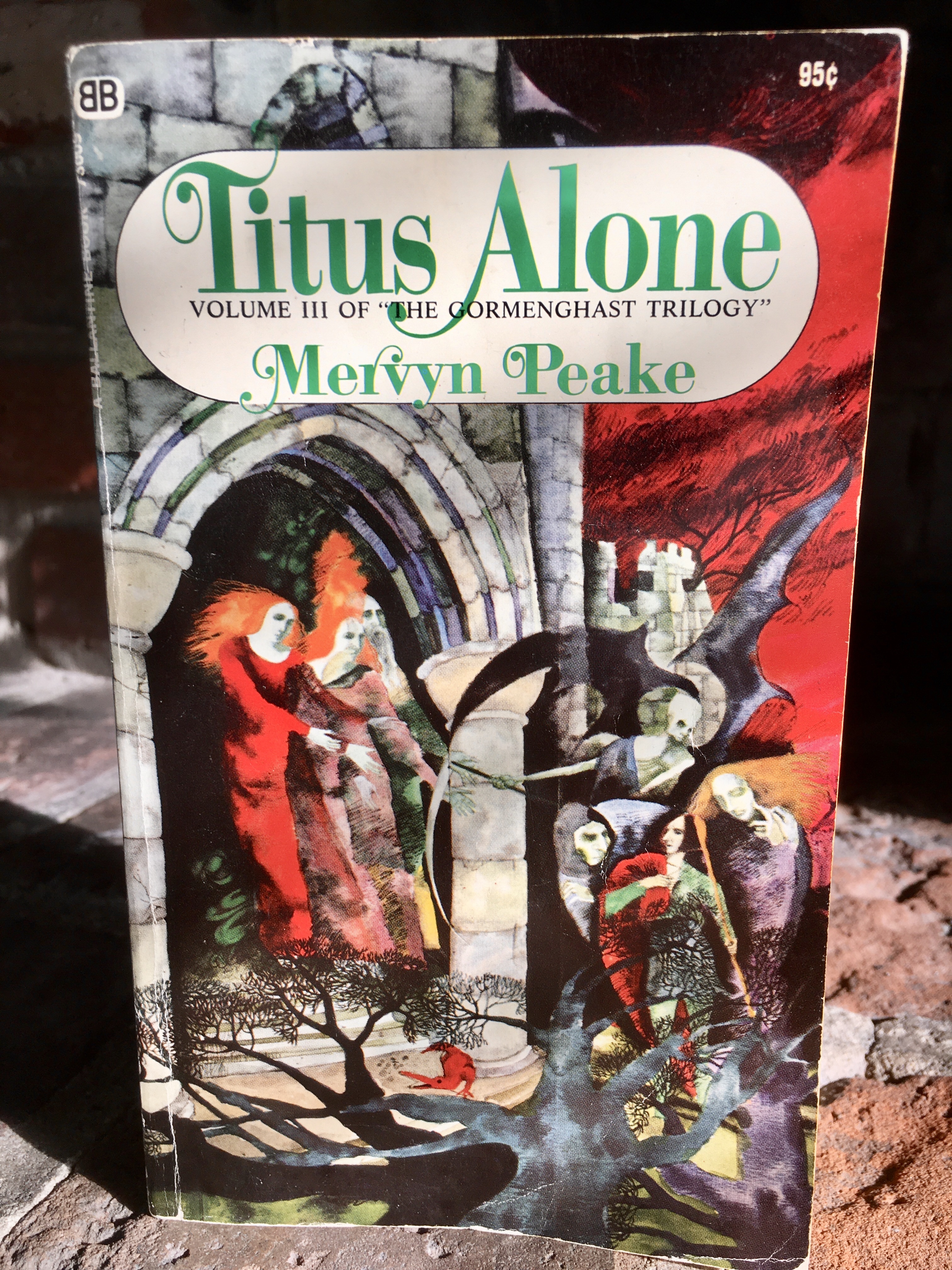
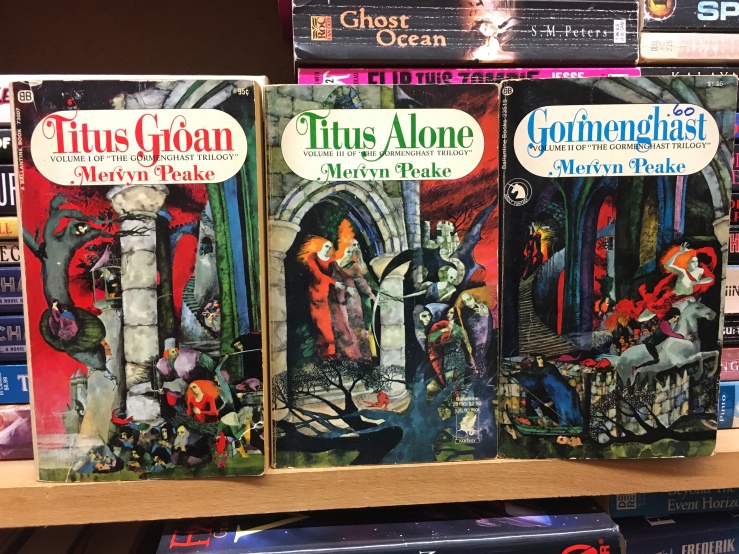
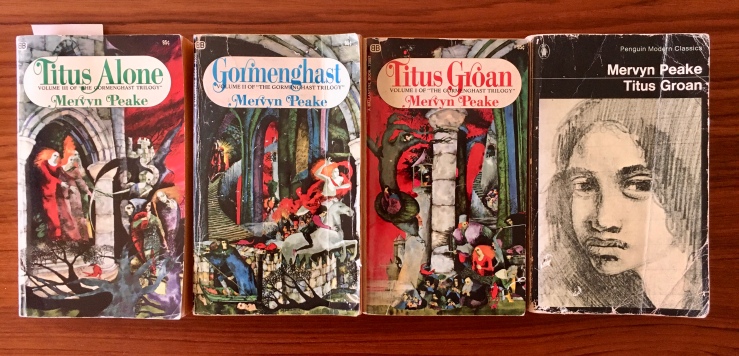
I was specifically looking for the other Gormenghast books by Mervyn Peake, the 1956 novella Boy in Darkness, and the unfinished Titus Awakes, completed by Peake’s wife Maeve after his death. I’m in the last few pages of Titus Alone, and I guess I don’t want to exit his proseworld just yet. Anyway, I went to this bookstore almost every week of February looking for Peake books with no luck after having picked up Gormenghast there on a lark a while back. I ended up buying the first and third of the Gormenghast trilogy online, because I couldn’t find them there, but today I found the complete trilogy in matching Ballantine editions. I did not find the other Gormenghast books though.
img_5048

As much as I hated to break up the triplets pictured above, I picked up the Ballantine Titus Groan and adopted it to fit my other Ballantine editions. There is a specific student I have in mind whom I think will love the Penguin edition of Titus Groan I’ll give him next week (even though my dog bit it).
img_5050

I’m obviously a sucker for covers, as any one who’s followed this blog for a while probably knows, and the Ballantine covers are better, I think—the Penguin editions of Peake’s trilogy are great, but they shy away from the bizarre nature of the narratives, tilting toward respectability.

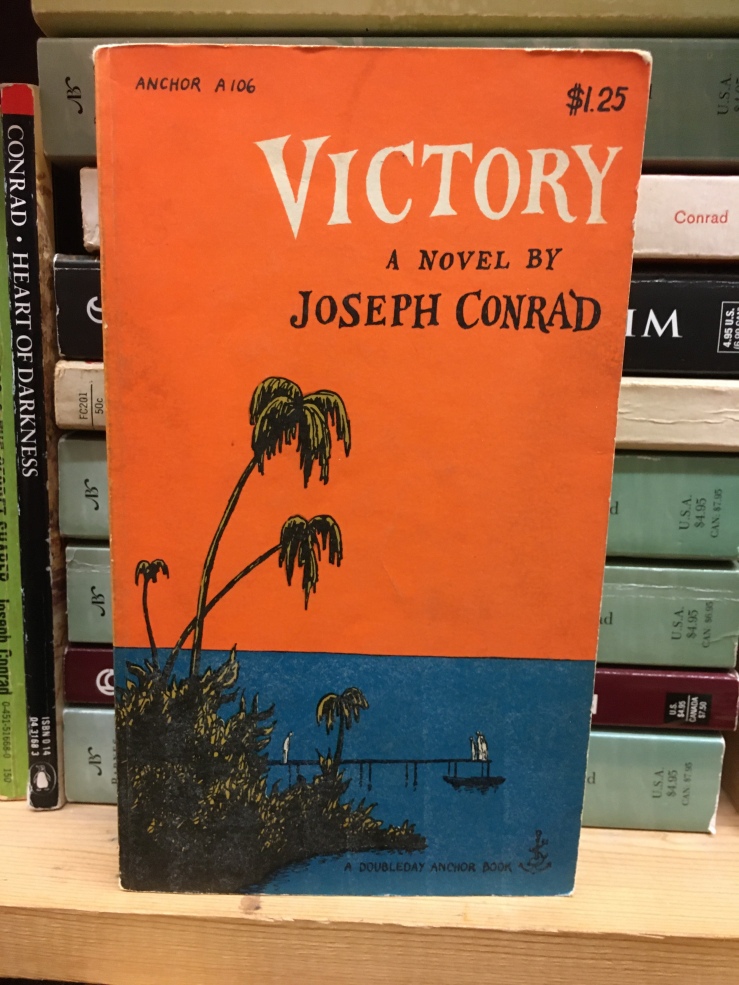
Indeed, I like browsing in large part because I like the aesthetics of books, particularly older books. I absolutely loved this Edward Gorey cover for a 1957 edition of Joseph Conrad’s Victory—but I settled for a picture. I mean, I doubt I’ll read lesser-known Conrad at this point. But I love the orange and the blue, and Gorey’s handlettering:
img_5045

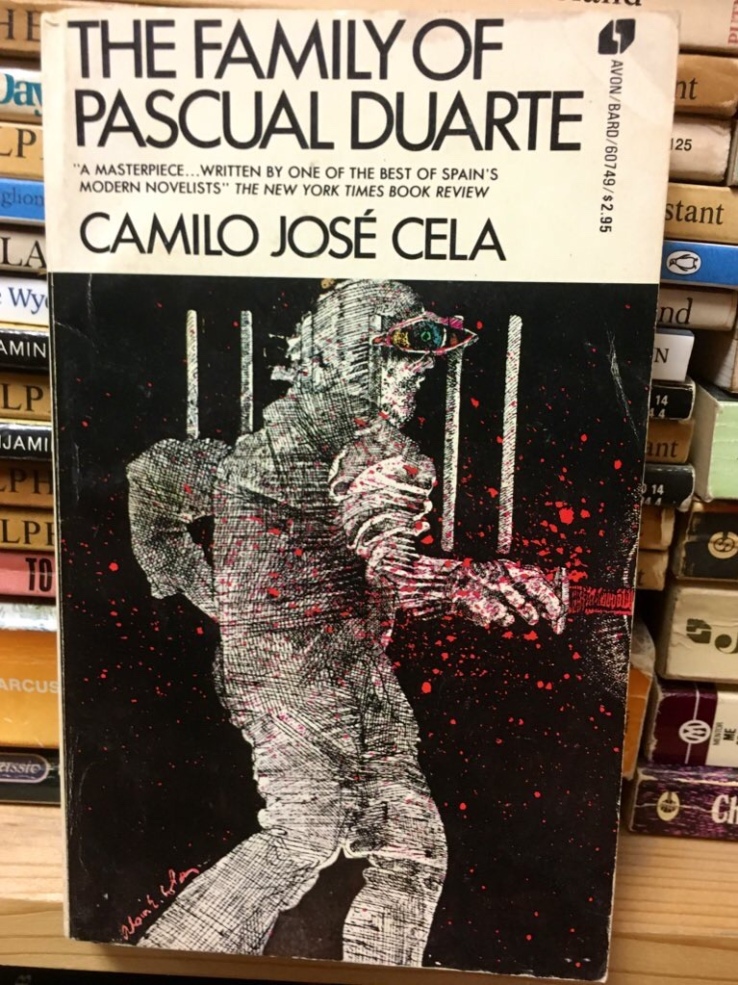
I often settle for just a snapshot of a beautiful cover, like this bizarre one for The Family of Pascual Duarte by Camilo José Cela. I didn’t pick it up a few weeks ago, but then wished I had.
img_5004

I had left it on the shelf like this, face outward. It wasn’t there today, and I wished that I had picked it up. Apparently it is brutal and was banned for a few years in its native Spain.

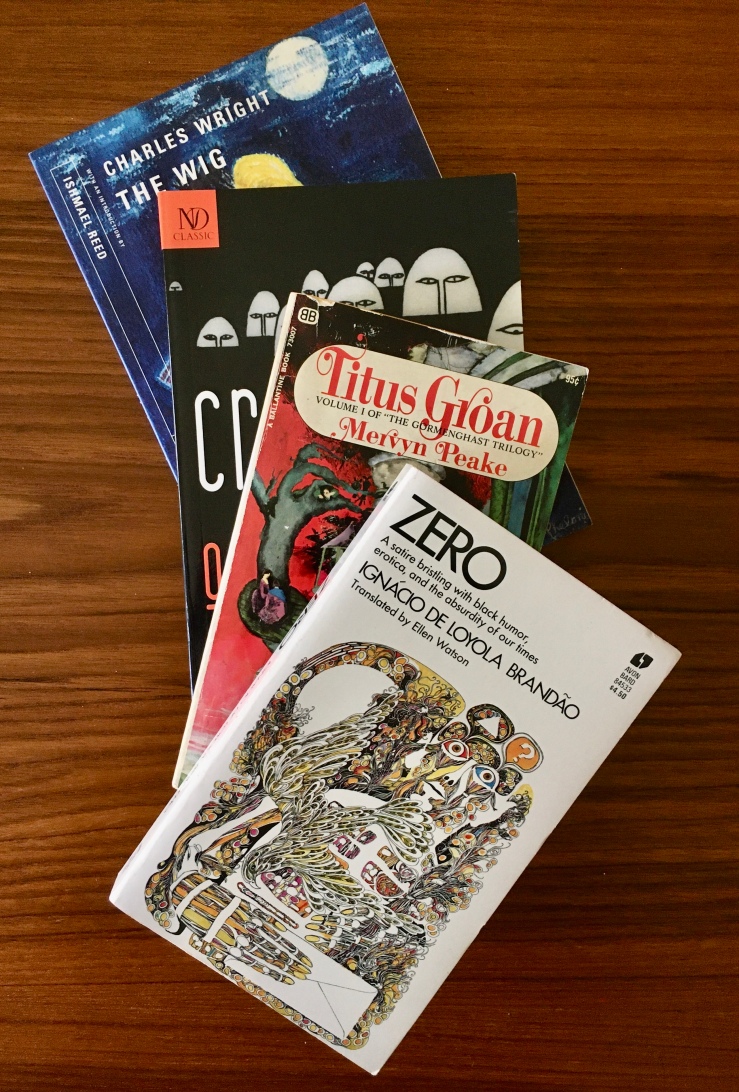
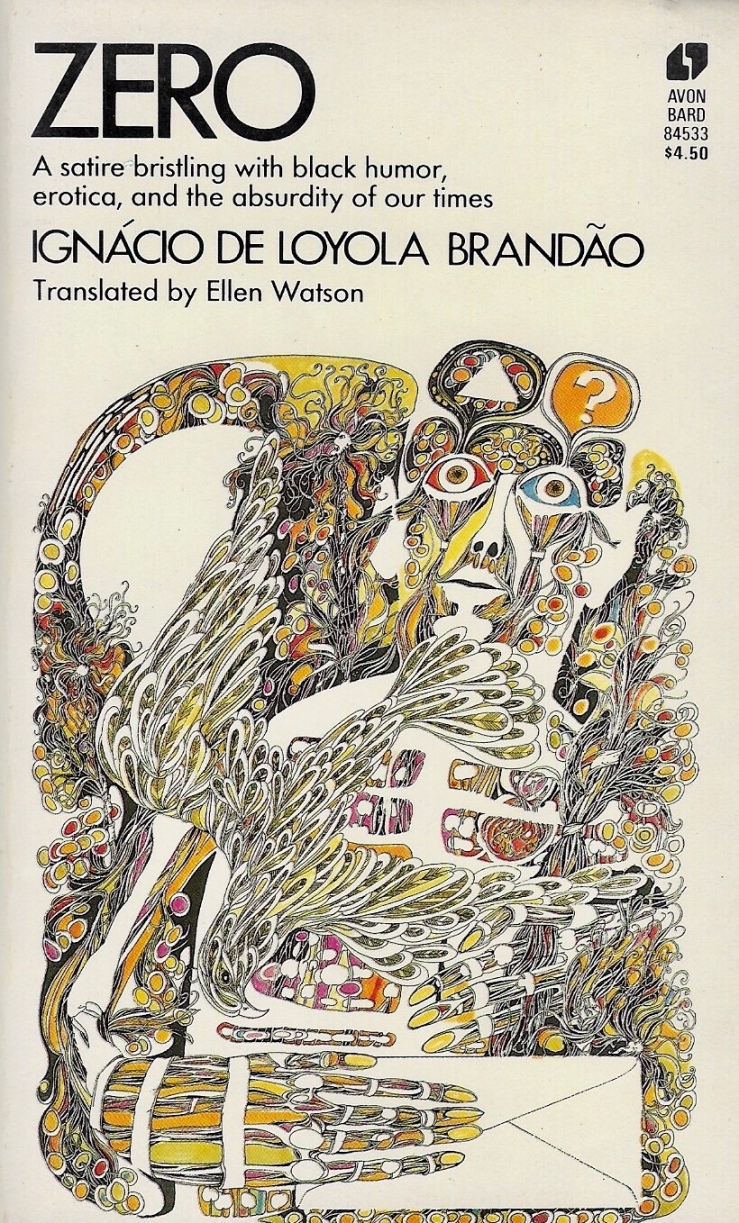
So well and anyway when I spied another Avon-Bard spine with a strange title I pulled it out, wowed at the cover, and dove in. Brazilian author Ignácio de Loyola Brandão’s Zero instantly struck a chord with me. The book is typographically all over the place, with text offset in boxes or laid out in columns. There are diagrams, enormous fonts, glypsh, citations, footnotes, etc. The book is a dystopian satire that seems to be written in its own idiom. The translation is by Ellen Watson. The wonderful cover art is uncredited (as far as I can tell).
2020-03-06_151902

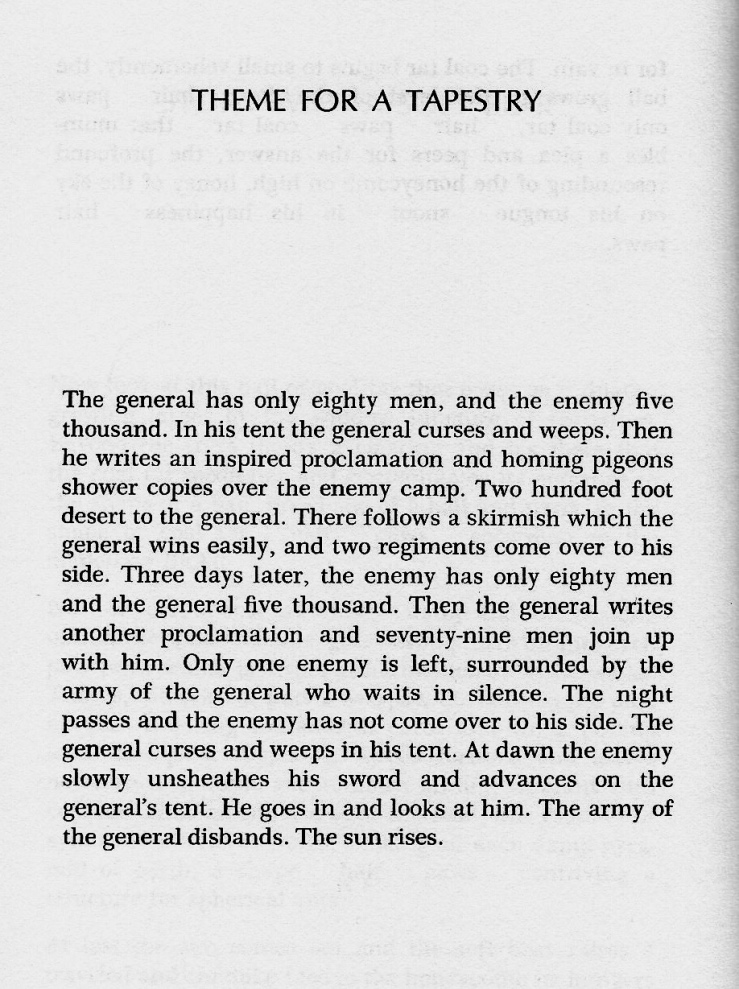
I’ve never been able to get through Julio Cortázar’s famous book Hopscotch (despite many attempts), but I liked the short stories by him that I’ve read. I’m also a sucker for anything supershort, so when I saw his collection Cronopios and Famas (translated by Paul Blackburn), I was intrigued. I love a book in slices and morsels that I can snack on for a while (I’m really digging Gary Lutz’s The Complete Gary Lutz for the same reason). Most of the stuff in here is under three pages; much of it is much shorter too, like “Theme for a Tapestry”:
2020-03-06_151902_5

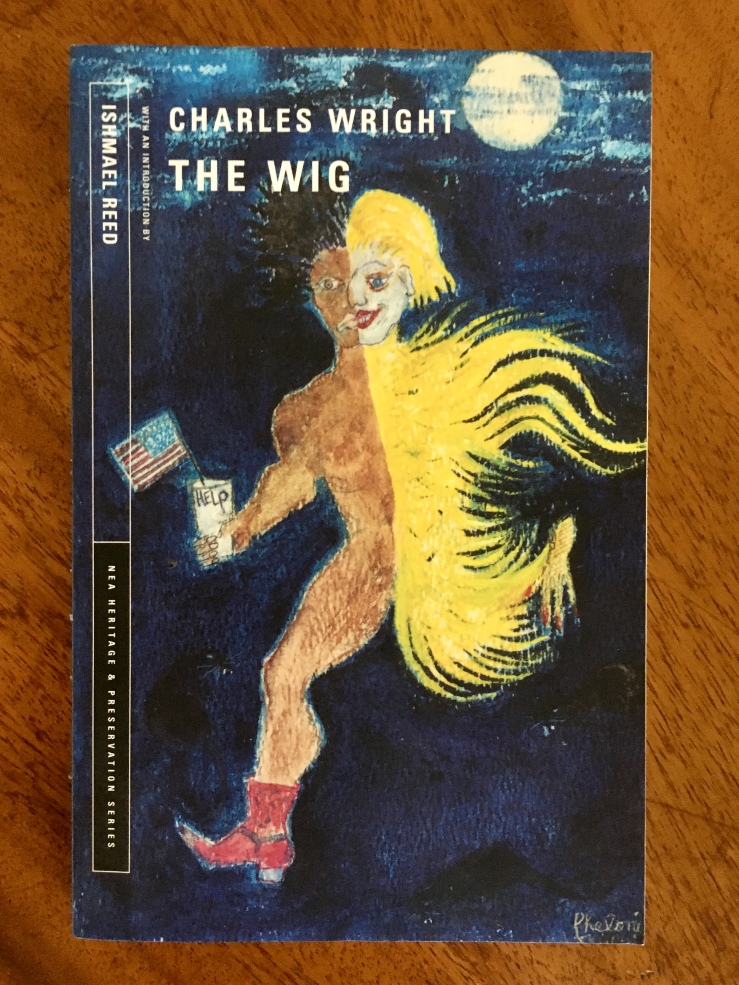
While scanning for anything by Rudolph Wurlitzer (no dice), I spied the spine of Charles Wright’s The Wig. Wright has been on my radar for a while now, mostly due to Ishmael Reed’s consistent endorsement of him (in both fiction and nonfiction alike), and when I pulled the volume to reveal its beautiful cover, I saw Reed’s name on the margin (and on the blurb on the back), and had to have it. The cover art is by Phelonise Willie; design by Scott di Giolamo:
img_5057

The dreamers and the scum of the earth

So the grey arena formed itself and the crowd grew, while the domed ceiling of the dark place dripped, and the lamps were re-filled and some held candles, some torches, while others had brought mirrors to reflect the light, until the whole place swam like a miasma.

Were his shoulder not hurting from the grip it had sustained Titus might well have wondered whether he was asleep and dreaming.

Around him, tier upon tier (for the centre of the arena was appreciably lower than the margin, and there was about the place almost the feeling of a dark circus) were standing or were seated the failures of earth. The beggars, the harlots, the cheats, the refugees, the scatterlings, the wasters, the loafers, the bohemians, the black sheep, the chaff, the poets, the riff-raff, the small fry, the misfits, the conversationalists, the human oysters, the vermin, the innocent, the snobs and the men of straw, the pariahs, the outcasts, rag-pickers, the rascals, the rakehells, the fallen angels, the sad-dogs, the castaways, the prodigals, the defaulters, the dreamers and the scum of the earth.

My kind of people.

A wonderful view of the preterite underworld in Mervyn Peake’s Titus Alone.

img_5041

Robota I — Susanne Kühn

gross_2pages_robota-i-2018-1

Robota I, 2018 by Susanne Kühn (b. 1969)

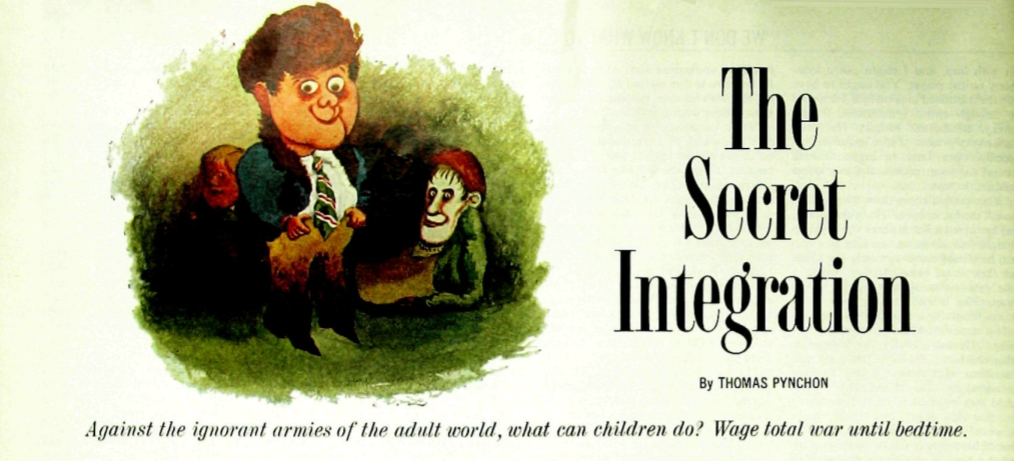
Arnold Roth’s original illustrations for Thomas Pynchon’s 1964 short story “The Secret Integration” (and a link to the full text of the story)

ar 2

Thomas Pynchon’s short story “The Secret Integration” was first published in a December issue of The Saturday Evening Post, and later published again as part of Pynchon’s first and only short story collection, Slow Learner.

In a 2018 article published at The Yale Review, Terry Reilly suggested that by publishing “The Secret Integration” in The Saturday Evening Post,

…Pynchon uses the form of an apparently simple, entertaining adolescent boys’ story to engage and then to manipulate the Post readers; to invoke various features of the publication history of The Saturday Evening Post while simultaneously calling attention to the magazine’s limited scope and conservative bias concerning issues of civil rights and racial integration in 1964.

ar 3

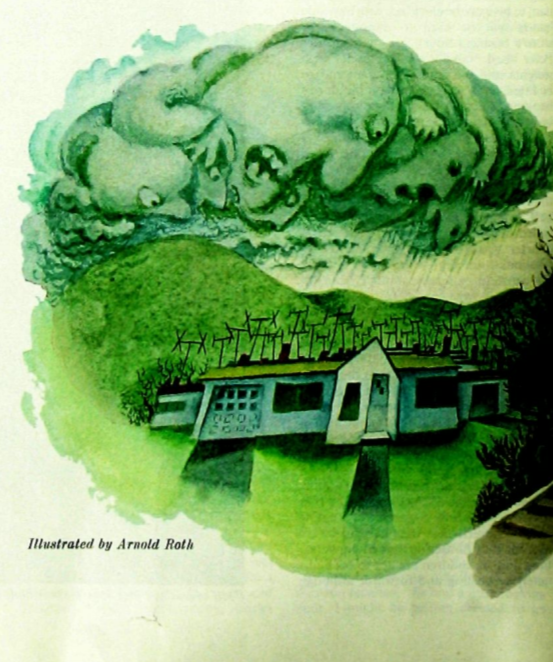
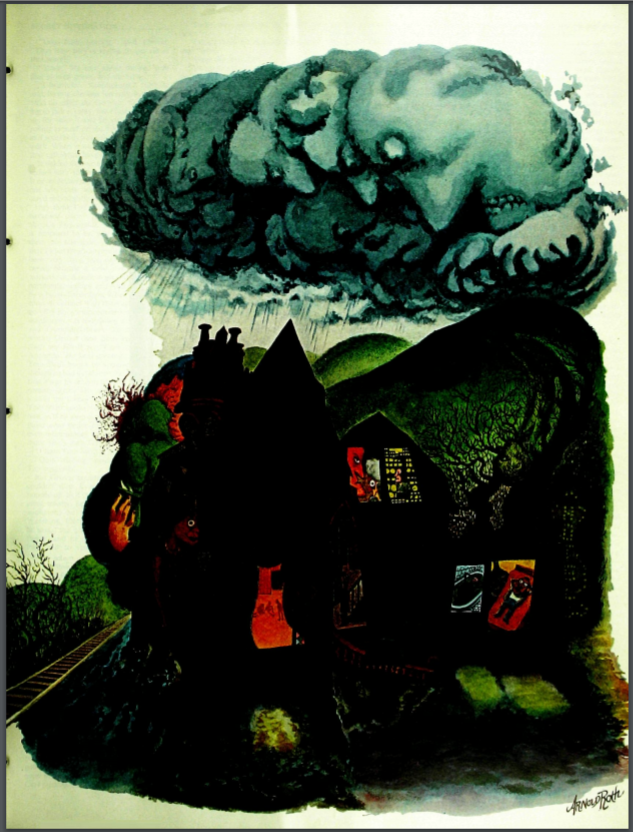
Pynchon’s story was accompanied by three illustrations by the cartoonist Arnold Roth, including a header, a small illustration, and this full page illustration below:

ar

The first page of the story:

“The Secret Integration”

by

Thomas Pynchon


OUTSIDE it was raining, the first rain of October, end of haying season and of the fall’s brilliance, purity of light, a certain soundness to weather that had brought New Yorkers flooding up through the Berkshires not too many weekends ago to see the trees changing in that sun. Today, by contrast, it was Saturday and raining, a lousy combination. Inside at the moment was Tim Santora, waiting for ten o’clock and wondering how he was going to get out past his mother. Grover wanted to see him at ten this morning, so he had to go. He sat curled in an old washing machine that lay on its side in a back room of the house; he listened to rain going down a drainpipe and looked at a wart that was on his finger. The wart had been there for two weeks and wasn’t going to go away. The other day his mother had taken him over to Doctor Slothrop, who painted some red stuff on it, turned out the lights and said, “Now, when I switch on my magic purple lamp, watch what happens to the wart.” It wasn’t a very magic-looking lamp, but when the doctor turned it on, the wart glowed a bright green. “Ah, good,” said Doctor Slothrop. “Green. That means the wart will go away, Tim. It hasn’t got a chance.” But as they were going out, the doctor said to Tim’s mother, in a lowered voice Tim had learned how to listen in on, “Suggestion therapy works about half the time. If this doesn’t clear up now spontaneously, bring him back and we’ll try liquid nitrogen.” Soon as he got home, Tim ran over to ask Grover what “suggestion therapy” meant. He found him down in the cellar, working on another invention. Continue reading “Arnold Roth’s original illustrations for Thomas Pynchon’s 1964 short story “The Secret Integration” (and a link to the full text of the story)”

Tasting the First Oyster — George Frederic Watts

Watts, George Frederic, 1817-1904; Tasting the First Oyster

Tasting the First Oyster, c. 1883 — George Frederic Watts (1817–1904)