A riff on my favorite ghost story, Roberto Bolaño’s “The Return”

spectrum
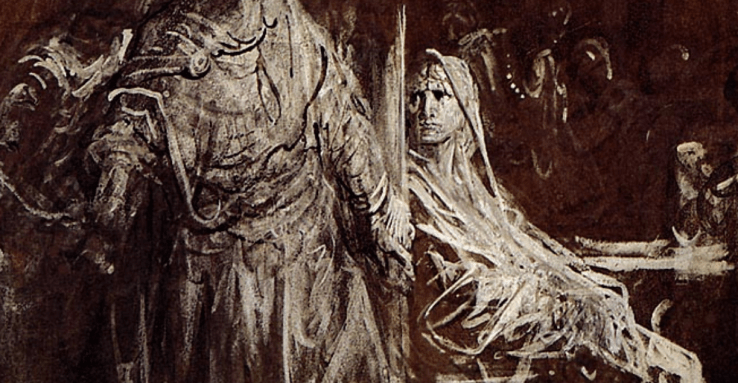
Detail from Spectrum Appearance of Banquo by Gustave Doré.

Roberto Bolaño’s short story “The Return” is so good that it has two perfect opening paragraphs:

I have good news and bad news. The good news is that there is life (of a kind) after this life. The bad news is that Jean-Claude Villeneuve is a necrophiliac.

That’s a hell of a way to start a story! Bolaño lays out his two themes—the afterlife and necrophilia—in a jovial, almost cavalier, but dare I say sweet, even charming way. And then this paragraph:

Death caught up with me in a Paris disco at four in the morning. My doctor had warned me, but some things are stronger than reason. I was convinced, mistakenly (and even now it’s something I regret), that drinking and dancing were not the most hazardous of my passions. Another reason I kept going out every night to the fashionable places in Paris was my routine as a middle manager at Fracsa; I was after what I couldn’t find at work or in what people call the inner life: the buzz that you get from a certain excess.

Those are the first two paragraphs, and maybe they’ll entice you to read the story. However, the following riff includes what some people might consider spoilers; my hope is that if you’ve never read it before, you’ll take it on faith that “The Return” is a great, great story and you’ll go read it and stop reading this riff now. (Maybe come back later though after you’ve read it).

“The Return” is a ghost story that transmutes the horror of death and the abjection of the corpse into love, empathy, and communication—and art. It’s a beautiful ghost tale in the Romantic, Gothic tradition of Edgar Allan Poe, from whom Bolaño drew heavily. However, while Poe’s tales of necrophilia (like the poem “Annabel Lee,” “The Fall of the House of Usher,” and “Berenice” to name just a few) obsess over repression, loss, burial, and imperfect and violent attempts at restoration, Bolaño’s “The Return” offers its readers a peaceful reconciliation with death. It’s collected in The Return (New Directions, English translation by Chris Andrews), which is a perfect introduction to Bolaño—so many great stories there (“Buba,” “Clara,” “William Burns,” etc.). So go read it.

So but and anyway: a close reading continued for those inclined.

Our narrator is a ghost, a man who died on the dance floor. Bolaño’s next move is so ridiculous that it almost seems unbelievable at first:

Like just about everyone else, I went to see Ghost, I don’t know if you remember it, a box office hit, with Demi Moore and Whoopi Goldberg, the one where Patrick Swayze gets killed and his body is left lying on a Manhattan street, or in an alley, maybe, on a dirty pavement anyway, while in a special-effects extravaganza (they were special for the time, anyway) his soul comes out of his body and stares at it in astonishment. Well, apart from the special effects, I thought it was idiotic. A typical Hollywood cop-out, inane and unbelievable.

But when my turn came, that’s exactly what happened.

The narrator is quick to accept the conceit—he’s quick to accept a lot in this story. He concedes of Hollywood artifice that there’s “more to American naiveté than meets the eye; it can hide something that we Europeans can’t or don’t want to understand.” This acceptance quickly turns into a new affect: strange joy: “Once I was dead, I felt like bursting out laughing.” (Forgive me, but it’s impossible for me not to note that “The Return” was composed very late in Bolaño’s too-short life, that its composition strikes me as a kind of love letter to his audience, more than a consolation prize: a gift).

Our ghost-narrator, not quite sure what to do, follows his corpse to the morgue: “What a paltry thing it seemed, my body or my ex-body (I’m not sure how to put it), confronted with the labyrinthine bureaucracy of death.” The labyrinthine bureaucracy of death!

The (metaphysical) narrator then starts to reflect on metaphysical matters:

The feeling of dizziness gradually abated, although at one point I got to thinking about heaven and hell, reward and punishment, and I had a panic attack, but that bout of irrational fear was soon over. And, in fact, I was starting to feel better.

Bolaño’s narrator quickly overcomes a religious tradition of “irrational fear” and guilt; here, death–by which I mean ghosthood—is life anew. In his new life|death, the narrator comes to understand the “insomnia and pervasive insecurity” (note here the language of Poe) he once felt over his “being a toy (or less than a toy) for [his lover] Cécile.” The ghost-narrator can find a certain grace in his one-time desire to be desired, his desire for solidity.

So. The plot, yes? Well, Bolaño’s already announced his theme of necrophilia, yes? How do we get there?

Two orderlies from the morgue sneak the body away, transporting it to the most beautiful house (mansion!) that the narrator has ever seen. The orderlies are described variously as hipsters, poseurs, and (significantly) “pseudo-artists.” Despite employing these terms, the narrator is ultimately sympathetic to the orderlies. (As an aside, I can’t help reading the two as figurations of those romantic dogs Ulises Lima and Arturo Belano, strivers, would-be greats, youth).

The orderlies deliver the body to a famous fashion designer, Jean-Claude Villeneuve. And:

I didn’t know what his intentions were—I’ve always been an innocent. If I’d known, I would have been nervous. But I didn’t, so I sat down in one of the comfortable leather armchairs in the room and waited.

Our narrator is again identified with innocence and naïveté (one senses that it preceded his rebirth)—but Bolaño lets his tale play out in an unexpected way. The abjection that follows doesn’t corrupt innocence; rather, it allows for empathetic communication.

But, reader, thou art forewarned—Bolaño literalizes the necrophilia that is merely metaphorical in Poe:

…after a quarter of an hour of cuddling in the semi-darkness I noticed that he had an erection. My god, I thought, now he’s going to sodomize me. But that’s not what happened. To my surprise, the designer rubbed himself against one of my thighs till he came. I would have liked to shut my eyes at that point but I couldn’t. My reactions were contradictory; I felt disgusted by what I was seeing, grateful for not having been sodomized, surprised to discover Villeneuve’s secret, angry at the orderlies for having rented out my body, and even flattered to have served, unwillingly, as an object of desire for one of the most famous men in France.

What a paragraph!—shocking, humorous, human. 

Our narrator immediately judges the taboo-breaking that has occurred as abject: “You should be ashamed, I said.”

But then something supernatural happens—the designer responds to the ghost.

I knew at once that he had heard me. It seemed like a miracle. Suddenly I felt so happy that I forgave him his act of depravity.

Human recognition—contact—becomes a “miracle” here (recalling the word “grace” from before), transmuting abject depravity into radical forgiveness. And then the narrator declares aloud:

It’s not a problem, I said in a conciliatory tone, You’re forgiven.

These are the words so many of us long to hear—but maybe most of all we wish to hear them when we are most wrapped up in our private abject sins. It’s as if Bolaño here absolves all the mad aesthetes of the Gothic tradition in one empathetic quip.

But of course, our necrophiliac-designer must worry that he’s going mad, mustn’t he? He searches for speakers, bugs—any physical explanation for that metaphysical voice. Again, our narrator is empathetic; again the language here points to Poe, but also to a reversal of Poe’s abject pain:

From experience I know that trying to wrench yourself out of a nightmare is futile and simply adds pain to pain or terror to terror.

The narrator then sets about proving that he’s real (or if not “real,” then at least that the narrator isn’t insane) by describing the various beautiful objects in the designer’s home. Aesthetic sensation confirms shared perception.

This tour of proof concludes in the style of Poe, in a tomb-space, all aesthetic objects removed, like something from “Usher”:

…we came to a little room, covered inside with a layer of cement, in which there was nothing, not one piece of furniture, not a single light, and we shut ourselves in that room, in the dark. An embarrassing situation, on the face of it, but for me it was like a second or a third birth; that is, it was like hope beginning and with it the desperate awareness of hope.

The abject embarrassment of the human body in close contact with a stranger is converted into rebirth and hope.

As the story ends, the fake-artist orderlies arrive in the morning to retrieve the narrator’s corpse. He realizes that he could continue haunting his body, but makes the choice to let it go:

But I mustn’t give in to sentimentality, I thought, and when the orderlies’ car left the garden and vanished down that elegant, tree-lined street, I didn’t feel the slightest twinge of nostalgia or sadness or melancholy.

In accepting the loss of his body without “nostalgia or sadness or melancholy,” our narrator affirms his new life.

The tale concludes with the narrator returning to the designer’s living room to discover that the man has been talking aloud—to the narrator, whom he believed was still with him. The story ends with this beautiful line:

I let him go on talking as long as he liked.

Reconciliation and acceptance rule in the end. Bolaño turns Gothic horror and abject pain into human empathy here.

Am I reading too much into the tale if I find in it a declaration of Bolaño’s acceptance of his own impending death? Perhaps. In any case, those who’ve formed an opinion of the man’s work based solely on the grisly reputation of 2666 would do well to check out “The Return.”

[Ed. note–Biblioklept originally ran this review in October of 2015].

The Head of John the Baptist — Francesco Cairo

the-head-of-st-john-the-baptist

The Head of John the Baptist by Francesco Cairo (1607 – 1665)

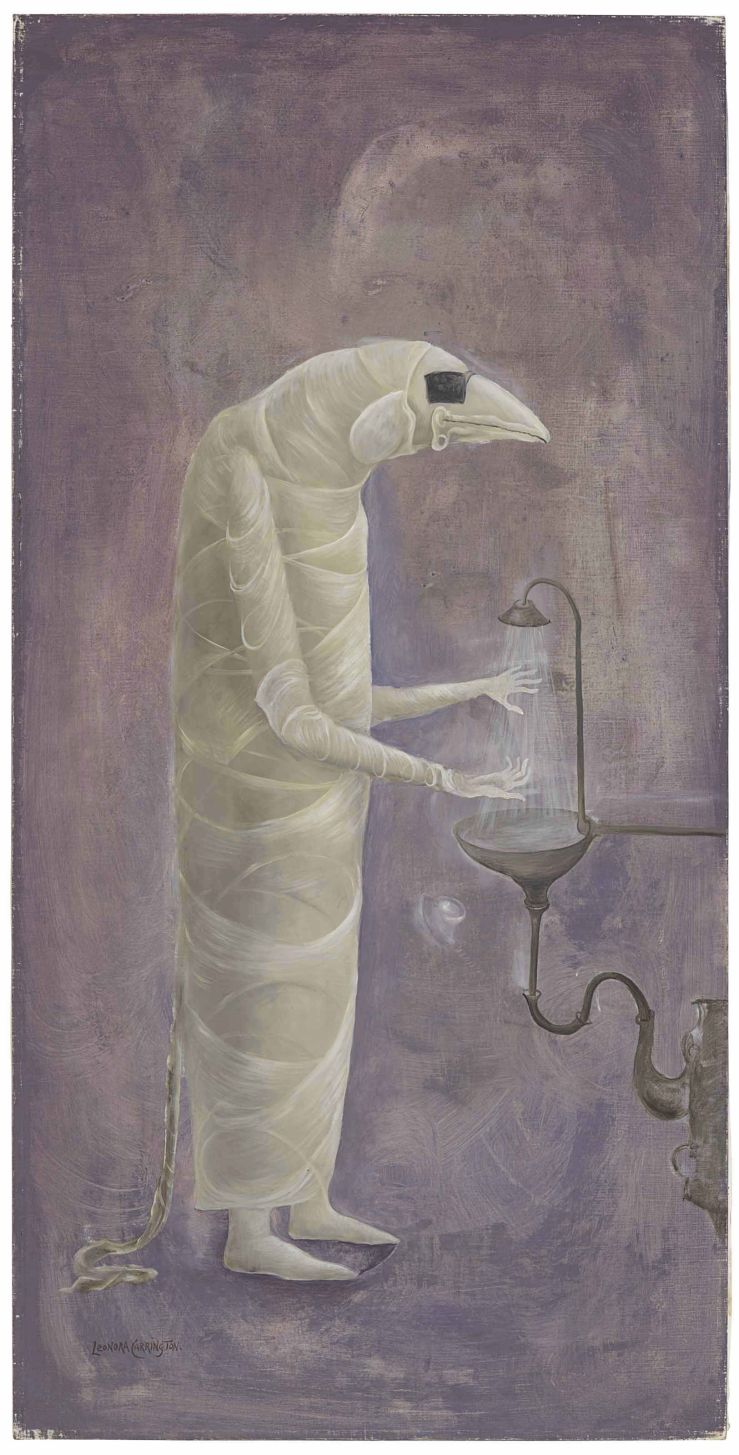
Surgeon — Leonora Carrington

9f3f6d6953acc7db7769ddaaa838a876

Surgeon, 1978 by Leonora Carrington (1917-2011)

Dulle Griet (detail) — David Ryckaert III

Screenshot 2018-10-14 at 5.33.54 PM

Dulle Griet, 1658 by David Ryckaert III (1612-1661)

Blog about some recent reading

img_1305

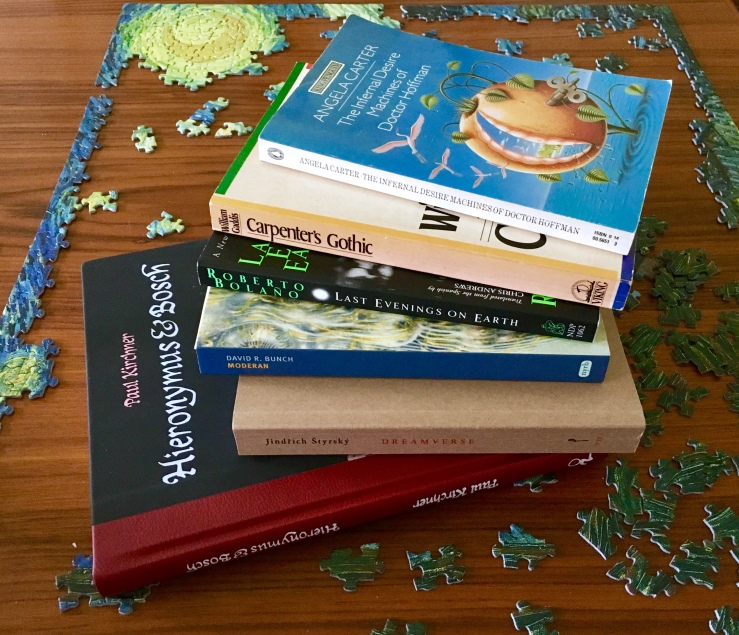
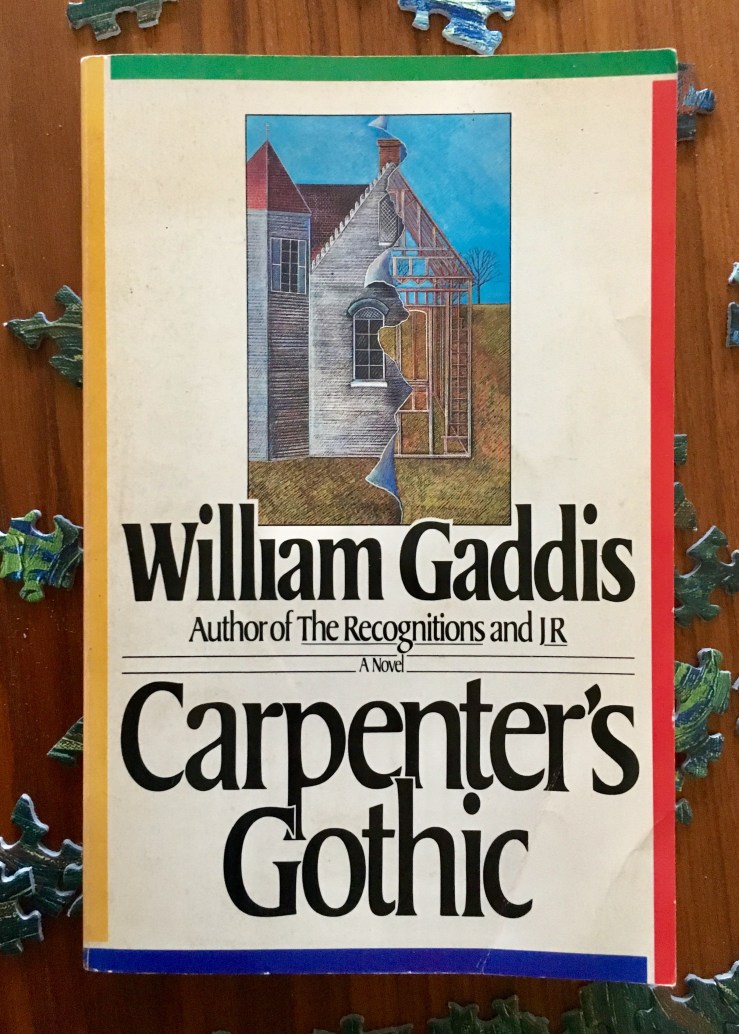
I ended up reading the last two chapters of William Gaddis’s novel Carpenter’s Gothic a few times, trying to figure out exactly what happened. I then read Steven Moore’s excellent essay on the novel, “Carpenter’s Gothic or, The Ambiguities.” (If you have library access to the Infobase database Bloom’s Literature, you can find the essay there; if not, here’s a .pdf version). Moore offers a tidy summary of Carpenter’s Gothic—a summary which should be avoided by anyone who wants to read the novel. Because Carpenter’s Gothic isn’t so much about what happens but how it happens. Moore writes:

As is the case with any summary of a Gaddis novel, this one not only fails to do justice to the novel’s complex tapestry of events but also subverts the manner in which these events are conveyed. Opening Carpenter’s Gothic is like opening the lid of a jigsaw puzzle: all the pieces seem to be there, but it is up to the reader to fit those pieces together. …Even after multiple readings, several events remain ambiguous, sometimes because too little information is given, sometimes because there are two conflicting accounts and no way to confirm either.

Moore then lays out the novel’s theme in clear, precise language:

Such narrative strategies are designed not to baffle or frustrate the reader but to dramatize the novel’s central philosophic conflict, that between revealed truth versus acquired knowledge. Nothing is “revealed” by a godlike omniscient narrator in this novel; the reader learns “what really happens” only through study, attention, and the application of intelligence.

Quite frankly, Moore has written an essay that I wish I had written myself. I had been sketching parallels between Carpenter’s Gothic and Leslie Fiedler’s classic study Love and Death in the American Novel all throughout my reading; Moore ends up citing Fiedler a few times in his essay, in particularly working from Fiedler’s idea of how Gothicism manifests in American writing. (Moore does not bring up Fiedler’s critique of masculinity though, which opens up an occasion for me to write—once I’ve reread the puzzle though).

Anyway—I loved loved loved Carpenter’s Gothic, and I read it at just about the right time: It’s a Halloween novel. Great stuff.

In line with the Halloween theme: I had been working on a post about horror, about how I love scary films, grotesque literature, and weird art, because fantasy evocations of terror offer a reprieve from anxiety, from true dread, etc. Like, you know, a climate change report—I mean, that’s genuinely horrifying. But scary films and scary stories almost never really scare me. So I was thinking about literature that does produce dread in me, anxiety in me, and listing out examples in my draft, and so well anyway I reread Roberto Bolaño’s short story “Last Evenings on Earth.” I wrote about the collection named for the story almost a decade ago on this blog, focusing on the “ebb and flow between dread and release, fear and humor, ironic detachment and romantic idealism” in the tales:

In “Last Evenings on Earth,” B takes a vacation to Acapulco with his father. Bolaño’s rhetoric in this tale is masterful: he draws each scene with a reportorial, even terse distance, noting the smallest of actions, but leaving the analytical connections up to his reader. Even though B sees his holiday with his dad heading toward “disaster,” toward “the price they must pay for existing,” he cannot process what this disaster is, or what paying this price means. The story builds to a thick, nervous dread, made all the more anxious by the strange suspicion that no, things are actually fine, we’re all just being paranoid here. (Not true!)

I’m not sure if I’ll get the essay I was planning together any time soon, but I’m glad I reread “Last Evenings.”

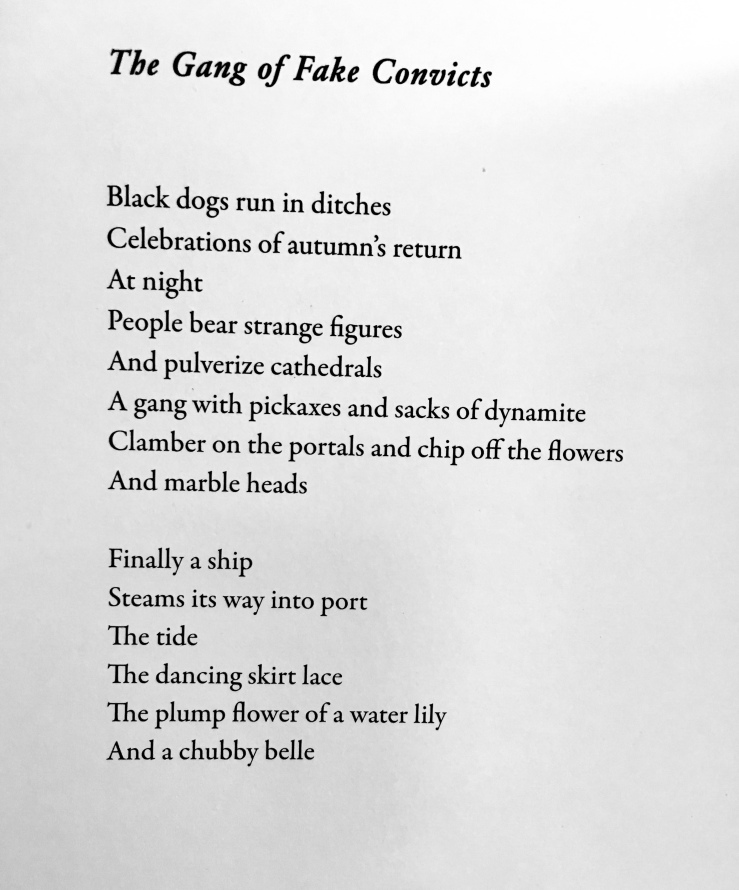
There’s a strange background plot in “Last Evenings” in which Bolaño’s stand-in “B” dwells over a book of French surrealist poets, one of whom disappears mysteriously. Jindřich Štyrský isn’t French—he’s Czech—but he was a surrealist poet (and artist and essayist and etc.), so I couldn’t help inserting him into Bolaño’s story. I’ve been reading Dreamverse, which ripples with sensual horror. I wrote about it here. Here’s one of Štyrský’s poems (in English translation by Jed Slast); I think you can get the flavor from this one:

img_1307

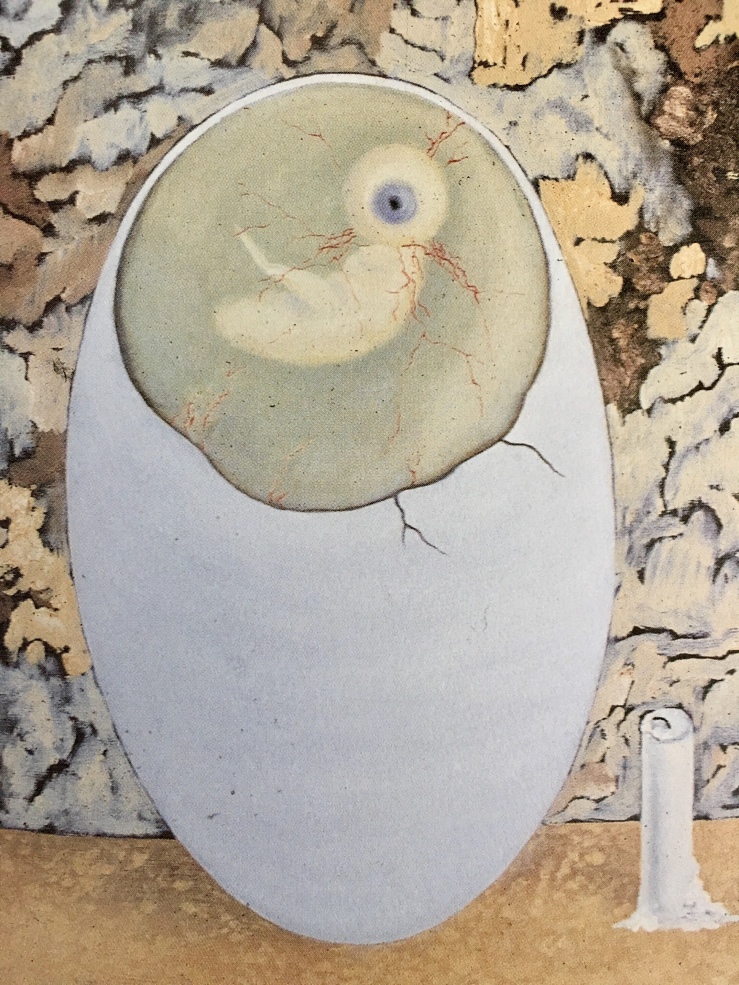
And here’s a detail from his 1937 painting Transformation:

img_1308

I’ve finished the first section of David Bunch’s Moderan, which is a kind of post-nuke dystopia satire on toxic masculinity. While many of the tropes for these stories (most of which were written in the 1960s and ’70s) might seem familiar—cyborgs and dome homes, caste systems and ultraviolence, a world of made and not born ruled by manunkind (to steal from E.E. Cummings)—it’s the way that Bunch conveys this world that is so astounding. Moderan is told in its own idiom; the voice of our narrator Stronghold-10 booms with a bravado that’s ultimately undercut by the authorial irony that lurks under its surface. I will eventually write a proper review of Moderan, but the book seems equal to the task of satirizing the trajectory of our zeitgeist.

I started Angela Carter’s novel The Infernal Desire Machines of Doctor Hoffman last night and the first chapter is amazing.

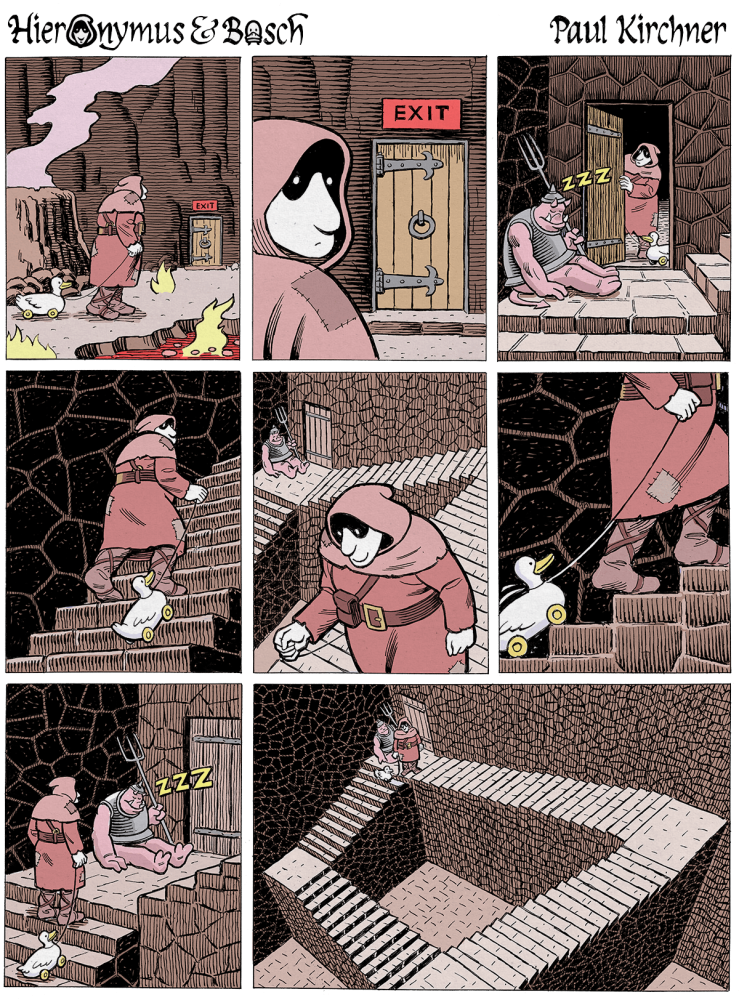
Finally, I got a hard copy of Paul Kirchner’s new collection, Hieronymus & Bosch which finds humor in the horror of hell. The collection is lovely—I should have a post about it here later this week and hopefully a review at The Comics Journal later this month. For now though, a sample strip:

hieronymus26bosch-angels-laugh36

Zeppelin — Hans Deuss

zeppelin-14x16-w1000

Zeppelin, 2014 by Hans Deuss (1948)

Untitled — Zdzisław Beksiński

untitled-263large

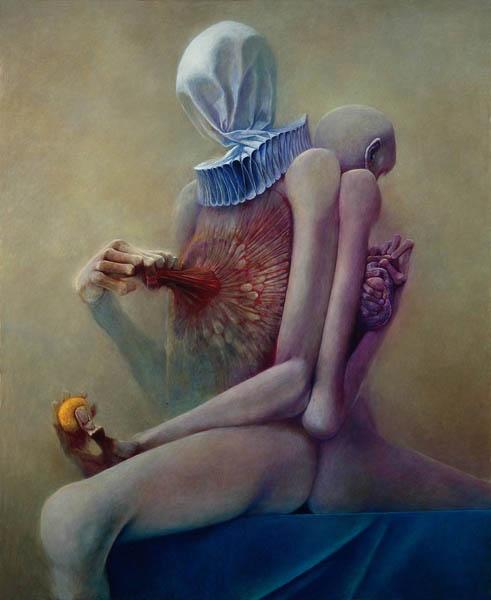
Untitled by Zdzisław Beksiński (1929–2005)

Read Anne Carson’s short story “Flaubert Again”

Objects would suddenly fall or fall apart, cars go off course, dogs drop to their knees. The Army was doing sound experiments at a nearby desert in those days. I was nervous all the rest of my life, she wrote. She was a novelist and enjoyed some success. But always she had the fantasy of a different kind of novel, and although gradually realizing that all novelists share this fantasy, she persisted in it, without knowing what the novel would be except true and obvious while it was happening. Now I’m writing, she would be able to say.

She broke off.

Where would you put a third arm? is a question asked in creativity-assessment tests, or so I have heard. Will this different kind of novel be like that, like a third arm? I hate creativity, she said. Certainly not like a third arm. It would be less and less and less, not more. Barthes died, he never got there. She named other attempts—Flaubert, etc. Other renunciators, none of them clear on what to renounce. This chair I’m sitting in, she thought. Its fantastic wovenness, a wicker chair, old, from the back porch, brought in for winter. Me sitting here, by a lamp, wrapped in a quilt, beside the giant black windows, this December blackness, this 4:30 a.m. kitchen as it reflects on the glass. The glass too cold to touch. The loudness of the silence of a kitchen at night. The small creak of my chair.

The first three paragraphs of “Flaubert Again,” a new short story by Anne Carson. You can read the whole story (all eight paragraphs of it) at The New Yorker.

Unknown — Kenne Grégoire

18-onbekende-30x24-acr-pan-w1000

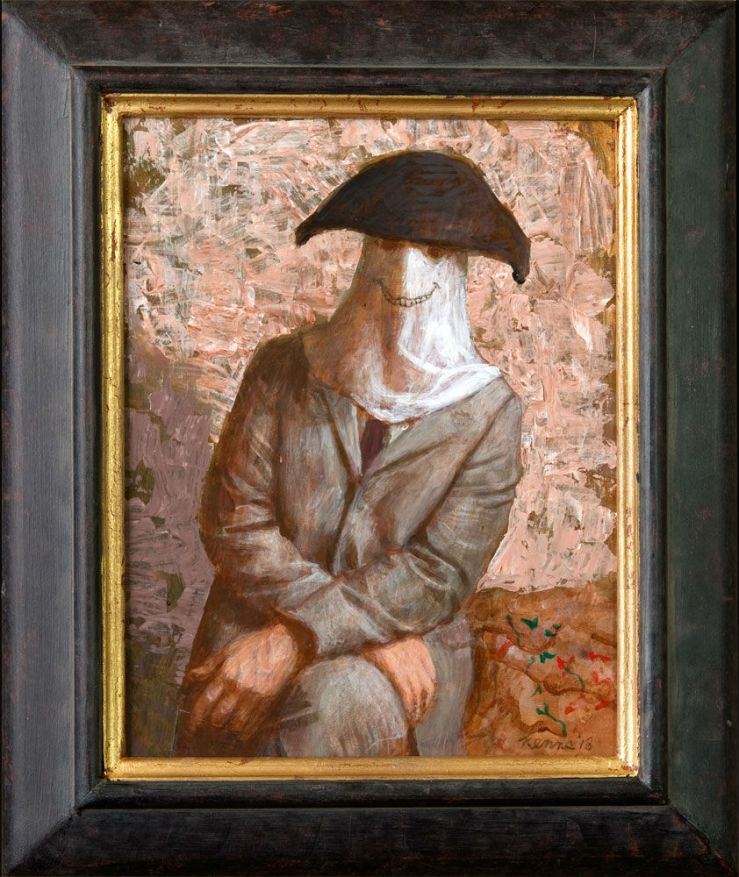
Onbekende (Unknown), 2018 by Kenne Grégoire (b. 1951)

Dulle Griet (detail) — David Ryckaert III

Screenshot 2018-10-14 at 5.34.15 PM

Dulle Griet, 1658 by David Ryckaert III (1612-1661)

The Messenger — Michael Cline

cline_in7146_themessenger_2017_58x50_1500px-897x1024

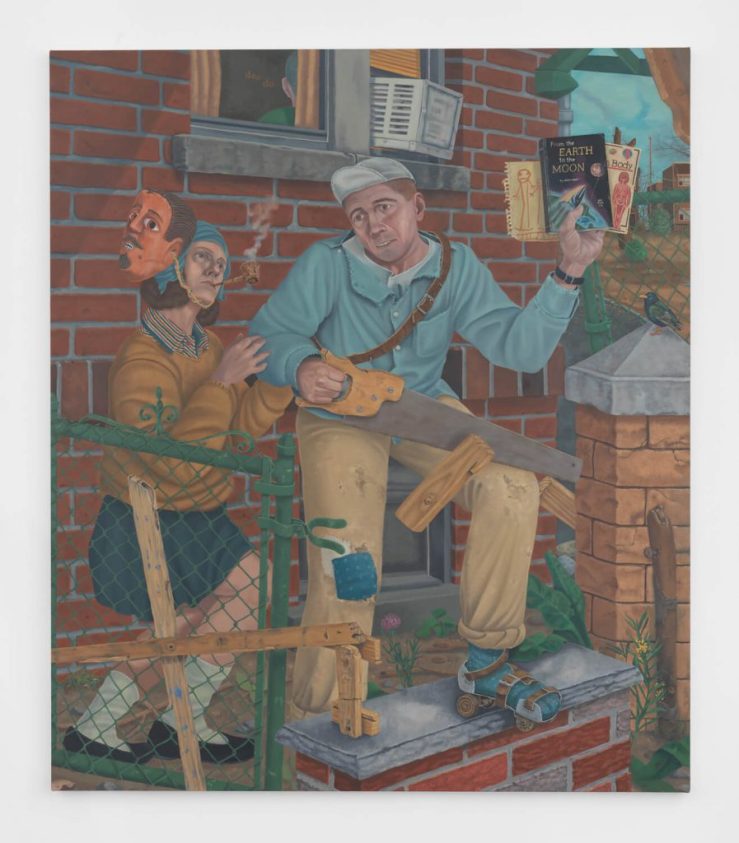
The Messenger, 2017 by Michael Cline (b. 1973)

“Trees” — William Carlos Williams

Dulle Griet (detail) — David Ryckaert III

Screenshot 2018-10-14 at 5.34.54 PM

Dulle Griet, 1658 by David Ryckaert III (1612-1661)

Flower of Catherine Emily Stringer — Georgiana Houghton

8170c8eae38fb9cbd22f8ca3e39b61bb

Flower of Catherine Emily Stringer, 1866 by Georgiana Houghton (1814-1884)

Blog about Jindřich Štyrský’s Dreamverse

img_1161

I have to admit that I had never heard of the Czech artist Jindřich Štyrský (1899-1942) until a review copy of something called Dreamverse arrived at Biblioklept World Headquarters a week or so ago. I was excited when I saw the package though—the book is from Twisted Spoon Press, and their books are always gorgeous and strange and fascinating. Dreamverse is no exception, collecting Štyrský’s paintings, collages, sketches, poems, essays, and prose in a baffling (and yet simultaneously accessible) compendium translated by Jed Slast. Here is Twisted Spoon’s blurb:

Published posthumously in 1970 as Dreams, Štyrský’s dream journal spanning the interwar years comprises prose, sketches, collages, and paintings. The present volume includes the complete series of texts and full-color and halftone images based on Štyrský’s layout for its publication in the 1940s, his sole volume of poetry (also published posthumously), as well as a selection of his most important essays, articles, manifestos, and assorted other texts. This edition presents in English for the first time the broad range of Štyrský’s contribution to the interwar avant-garde and Surrealism.

Dreamverse begins with an (overly academic) introduction by the Czech avant garde artist Karel Teige dated from 1948, which argues that the Štyrský is deeply underappreciated. Teige describes Štyrský’s gradual artistic shift into surrealism, an excursion Štyrský shared with his partner Toyen.

Teige writes like an art historian, fussily constructing a place for a displaced artist. Dreamverse really takes off when we get to Štyrský’s prose. Dreams (1925-1940) comprises about half of the book, and begins with this lucidly surreal self-description:

Work birthed in the wellsprings of hypnagogic mental models, via faithful representations of dream objects and authentic dream records.

Štyrský then offers a brief introduction in which he dedicates the work to “my CHIMERA, my PHANTOM OBJECT.” This particular chimera is a Freudian’s fantasy: Štyrský begins by discussing his prepubescent infatuation with “the image of a woman’s head, exquisite with golden hair” which he sees in a cheap magazine. This image somehow transmogrifies into “the head of Medusa, the whole of it in a pool of blood,” its hair a “cluster of vipers, erect, ready to penetrate the woman through her mouth, nose, and ears.” Štyrský then tells us that this “ghastly horror,” this “alluring horror” haunts his dreams, and he tries to “place the head” on his mother and sister. The head fits his sister: “So I was madly in love with her.” Štyrský then details his sister’s death in strange, alarmingly sensual language. (She died in 1905 when he was a young boy). His muse then, his chimera, foregrounds the dreamverse he creates: we get a mass media image reconverted into a mythological figure, then reconverted again, through creative imagination, into a sister, who is in turn transformed again into a mythic trope of some kind—a figure like Eurydice for Štyrský to play Orpheus to. Štyrský’s dreamverse is a writhing collage of contradictions. Hope and despair, sex and death, the beautiful and the lurid are all collapsed into surrealist expression.

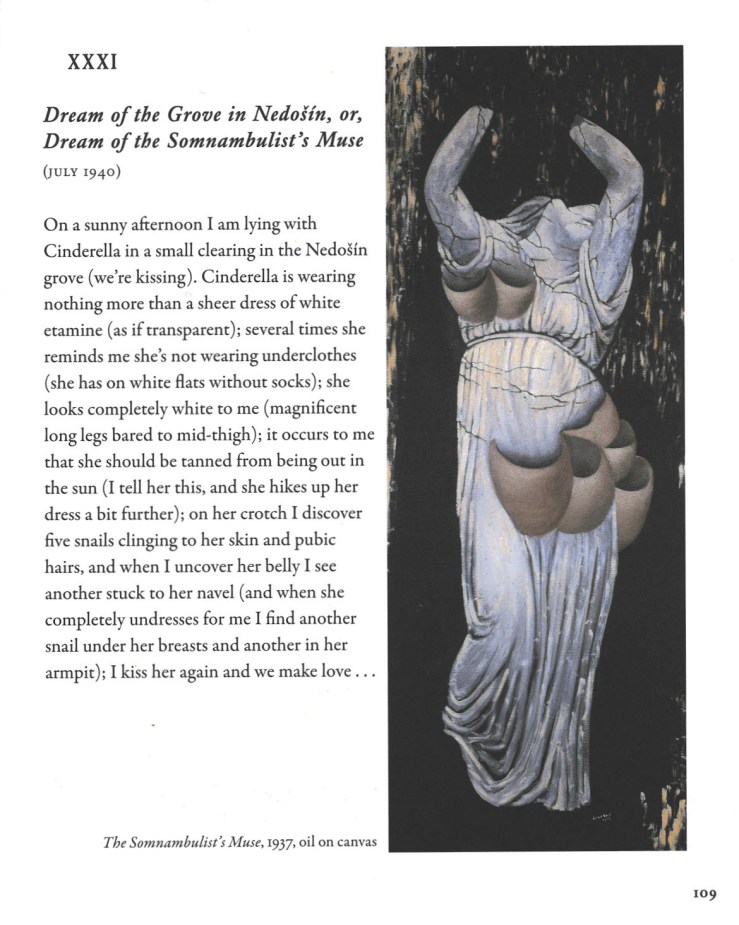
Take, for example, Dream XXXI:a

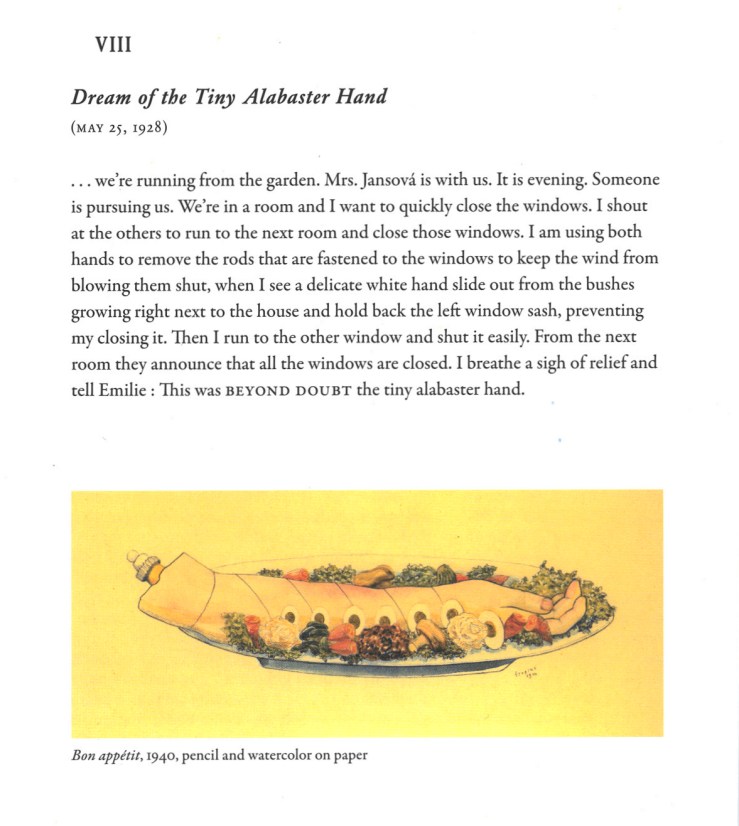
Štyrský’s dream—and its expression—excavates the sexuality suppressed just beneath the surface of our fairy tales. And while sexual abjection is typical in both Dreams (and in many of the poems collected in the Verse section of Dreamverse, sex is not always the dominant motif. Consider Dream VIII:


c

The vignette is a perfect slice of dread an horror, and the accompanying illustration—humorous and grotesque—is nightmare fuel.

I’ve been reading the Dreams somewhat slowly, a handful at a time, and then dipping deeper in the book, into the Verse, reading the Dreamverse as a sort of push-pull of image and word.

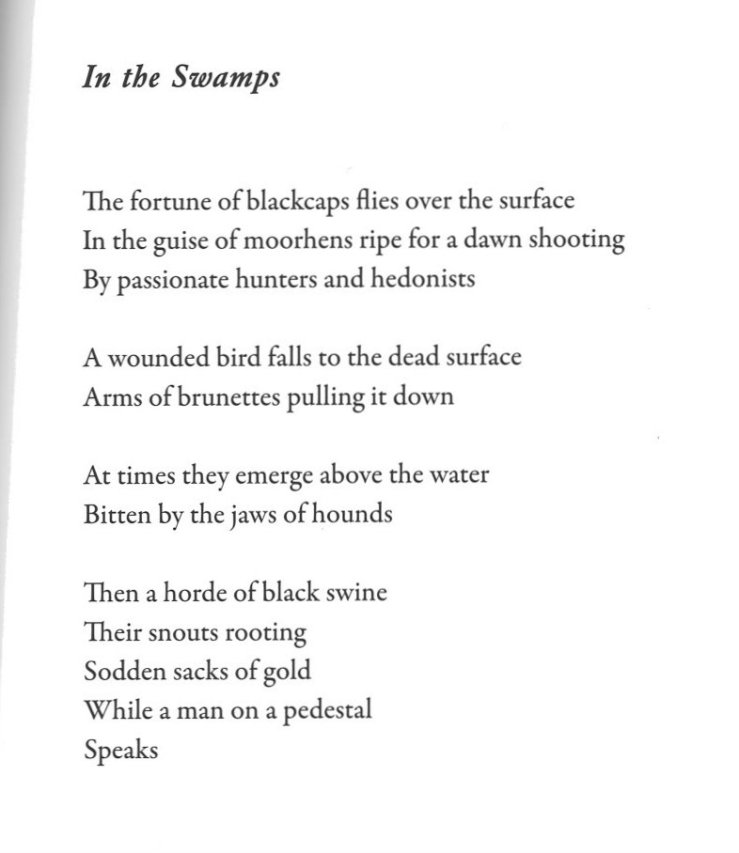
Štyrský’s writing is abject, evocative of a world that decays and regenerates at the same moment. A poem with the title “In the Swamps” of course stands out to me, a Florida boy always on the look out for abject images:

b

Štyrský’s imagery here is wonderful: The “fortune of blackcaps” pops out as an invented form of venery. Are the “blackcaps” actually little warblers—or just a surreal transformation of moorhens, the birds we would expect to find in the swamps? In either case, they are merely prey for “compassionate hunters,” susceptible to the arms of unseen brunettes and hunting dogs. The end of the poem is beautifully abject. The “horde of black swine” rumble in, neatly parallel to the “fortune of blackcaps” in the poems’s first line. These pigs slough through the swamp for “Sodden sacks of gold,” some kind of treasure there in the abject muck. Above it all is a speaker—a poet? Language hovers over the swamp.

Jed Slast deserves much praise for his translation, which seems tonally perfect and consistent over both the Dreams and the Verse sections. I’ll admit I haven’t gotten into any of the Writings at the end, which include lectures, essays, manifestos, and other fragments, but that gives me something to look forward to. So far though, Dreamverse has been an unexpected and strange joy, a dark and often perverse collection that plants its own dreamseeds in its reader.

A patchwork of conceits, a hodgepodge of good intentions, another blog about William Gaddis’s novel Carpenter’s Gothic

img_1155

In its sixth (and penultimate chapter), William Gaddis’s 1985 novel Carpenter’s Gothic includes a rare scene. Our heroine Elizabeth Booth exits the house she spends most of the book confined in and actually looks at it from the outside. With her is the house’s owner, the mysterious Mr. McCandless:

—I’ve never really looked at it.

—At what… looking where she was looking.

—At the house. From outside I mean.

Carpenter’s Gothic is a novel of utter interiority—the reader never makes it but a few feet out of the house, and only then on rare occasions. This postmodern Gothic novel tingles with a smothering claustrophobia, its insularity underscored by continual references to other spaces outside the house. The possibility of an outside world waiting for Elizabeth is realized through dialogue with her husband Paul, her brother Billy, and mysterious Mr. McCandless, as well as the non-stop (and, from the reader’s perspective, one-sided) telephone conversations that make up so much of the novel’s material. And yet with all its references to traveling away to California, Africa, New York City, Acapulco, etc., Carpenter’s Gothic keeps Elizabeth locked away in the old house, tethered to the umbilical phone cord at the novel’s center.

McCandless is off in his own interior space—the shifting tortured howl of his own consciousness—when Elizabeth remarks that she has never really seen the house from the outside. Her observation raises him “to the surface” of concrete reality:

—Oh the house yes, the house. It was built that way yes, it was built to be seen from outside it was, that was the style, he came on, abruptly rescued from uncertainty, raised to the surface —yes, they had style books, these country architects and the carpenters it was all derivative wasn’t it, those grand Victorian mansions with their rooms and rooms and towering heights and cupolas and the marvelous intricate ironwork.

The house is built in the Carpenter Gothic style (sometimes called Rural Gothic style), which essentially amounts to an American imitation of European Gothic’s forceful elegance. McCandless continues:

That whole inspiration of medieval Gothic but these poor fellows didn’t have it, the stonework and the wrought iron. All they had were the simple dependable old materials, the wood and their hammers and saws and their own clumsy ingenuity bringing those grandiose visions the masters had left behind down to a human scale with their own little inventions, those vertical darts coming down from the eaves? and that row of bull’s eyes underneath?

McCandless, stand-in for Gaddis, performs a metatextual interpretation for the reader. The Carpenter Gothic is Carpenter’s Gothic, the American postGothic reinterpreation of the European form—namely, the Gothic novel. The materials Gaddis uses to build his book are the materials of mass media and mass textuality. He condenses high literature, lurid newspaper clippings, mail, textbook pages, scraps of illegible notes, pornographic centerfolds, and every other manner of paper into a postGothic synthesis. And not just paper, but also the telephone (always ringing) and the radio (always on, always tuned to inhuman human voices). And the television too, tuned to Orson Welles as Mr. Rochester in Jane Eyre (dir. Robert Stevenson, 1943),  a film which weaves its way in and out of Elizabeth’s consciousness in the beginning of the novel, planting seeds of romance and locked rooms and secrets and fire.

But I’ve cut off McCandless, who was just about to give us another neat description of the Carpenter Gothic, which is to say another neat description of Carpenter’s Gothic:

He was up kicking leaves aside, gesturing, both arms raised embracing —a patchwork of conceits, borrowings, deceptions, the inside’s a hodgepodge of good intentions like one last ridiculous effort at something worth doing even on this small a scale, because it’s stood here, hasn’t it, foolish inventions and all it’s stood here for ninety years…

 Carpenter’s Gothic is more than just a hodgepodge or patchwork; it is more than a ridiculous effort; it is more than the sum of its foolish inventions. Gaddis gives us something new, a postmodern Gothic analysis of the end of the American century.

McCandless, Gaddis’s stand-in, wants to put all the pieces together. He echoes Jack Gibbs, the (anti-)hero (and fellow Gaddis stand-in) of J R, and he prefigures the narrator of Gaddis’s last novel, Agapē Agape, who, like Gibbs, strives to stitch together something from the atomized scraps and remnants of the 20th century.  Gaddis’s protagonists contend with entropy and attempt to get the detritus of the modern world “sorted and organized.” The push-pull of hope and despair drives these protagonists, but often drives them too far.

And McCandless’s reverie takes him too far, again into the interiority of his skull:

…breaking off, staring up where her gaze had fled back with those towering heights and cupolas, as though for some echo: It’s like the inside of your head McCandless, if that was what brought him to add —why when somebody breaks in, it’s like being assaulted, it’s the…

In a moment of self-speech, McCandless realizes that the Carpenter Gothic is “like the inside of [his] head,” underscoring his connection to his creator, Gaddis, as well as the connection between the house and the novel.

The (always) ringing phone punctures the scene:

—Listen! The phone had rung inside and she started up at the second ring, sank back with the third. —All I meant was, it’s a hard house to hide in…

Elizabeth’s lines here emphasize Carpenter’s Gothic’s central Gothicism—the Carpenter Gothic and Carpenter’s Gothic is a hard place to hide in. Secrets will out.

And so well where does our hodgepodge of good intentions lead?

Supermarket Ghost — Claudio Bravo 

bravo

Supermarket Ghost,1969 by Claudio Bravo (1936 — 2011)