On 1 Oct. 2018 on this foolish blog I foolishly wrote about my foolish “good intent to blog about something—books, film, art—every day or nearly every day.” I added, ” I’m not sure how it will go,” although I was a little bit sure about how it would go, which was, not great. Like, I knew that I would stumble in writing every day this month, which I have. October has snuck up (or sneaked up) on me like a thief or a serpent or a hobbit or a pick-your-simile—I even somehow missed taking my kid to her dentist appointment yesterday, and will almost surely get a bill from them over that. October sneaked/snuck up on me, and here we are 16 of 31 days in, and I have only managed 10 of these posts (including this one), which is like, 10 of 16, or 62.5%. (10/16 is also today’s date though, so like, uh, so like nothing).
Anyway.
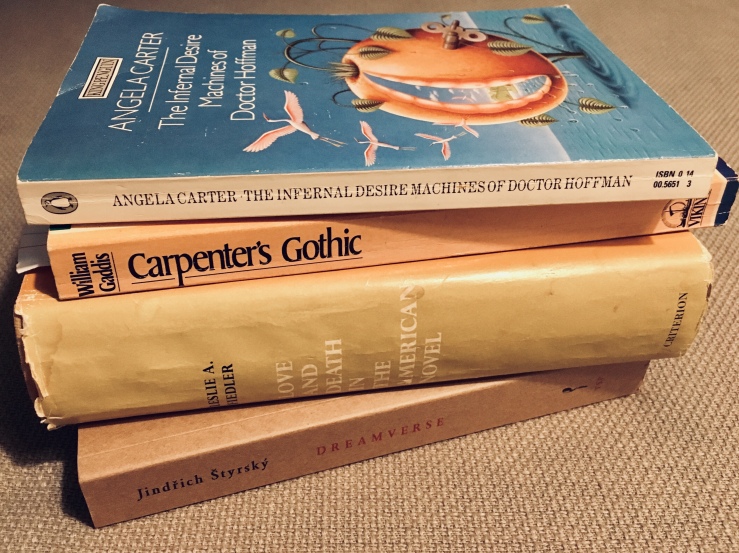
I have been reading, and the initial blog I wrote about even included some specific goals, along with this picture, which semi-summarized those goals:
From bottom to top—
I did, as I promised I would, return (and not steal) the Ravel book, Irony and Sound, which was frankly over my head.
I have not returned to Hoffman’s Poe book, but I haven’t shelved it.
I’ve been reading the Gordon Lish interviews. Like, the book is good—it’s sort of almost like a book of Lish stories. I blogged about it a bit even.
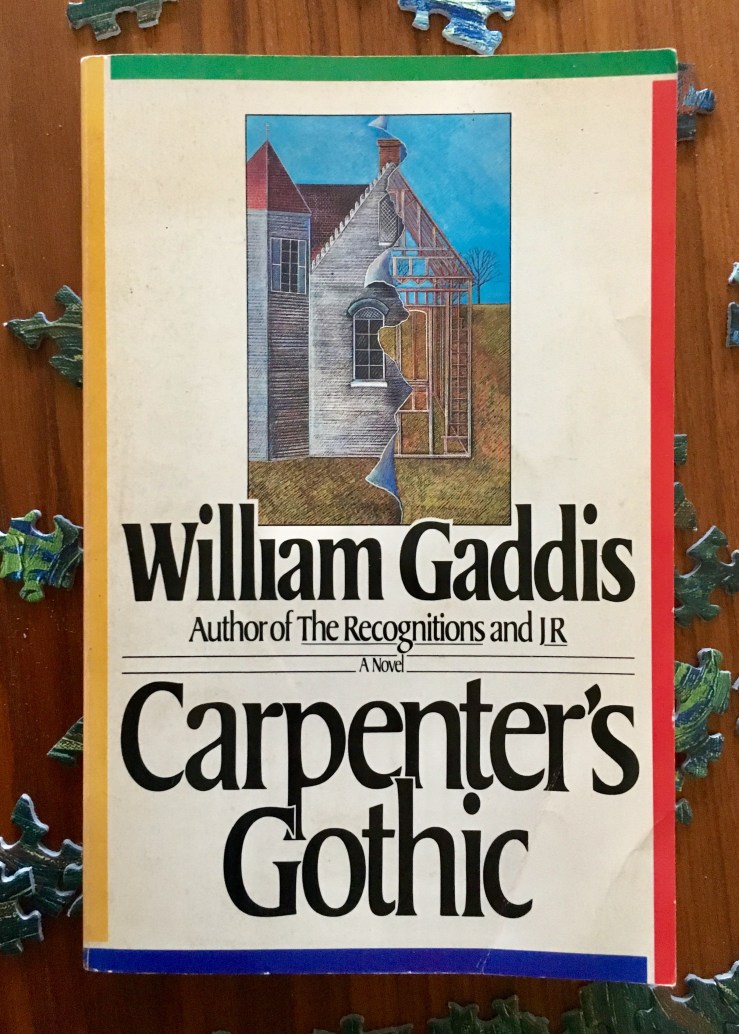
I’ve absolutely loved reading William Gaddis’s third novel Carpenter’s Gothic. It’s turned out to be a perfect Halloween novel, too. I’ll finish the last of its seven chapters tonight—I would’ve finished last night, but I got sidetracked by some lines that reminded me of Leslie Fiedler’s 1960 analysis of American literature, Love and Death in the American Novel. Gaddis’s book in many ways performs a similar analysis to Fiedler’s—they both trace the weight of American guilt. As if anticipating Gaddis’s postmodern postGothic Gothic novel, Fiedler writes, a quarter century before Carpenter’s Gothic’s publication,
…in the United States, certain special guilts awaited projection in the gothic form. A dream of innocence had sent Europeans across the ocean to build a new society immune to the compounded evil of the past from which no one else in Europe could ever feel himself free. But the slaughter of the Indians, who would not yield their lands to the carriers of utopia, and the abominations of the slave trade, in which the black man, rum, and money were inextricably entwined in a knot of guilt, provided new evidence that evil did not remain with the world that had been left behind—but stayed alive in the human heart, which had come the long way to America only to confront the horrifying image of itself.
(I have stalled out on writing a stupid “Blog about” blog post these past few days because I have been cobbling together notes on something about Fiedler and Gaddis. But, like, really—I need to finish Gaddis’s book first).
No dent in the Pirandello.
I’ll return to David Bunch’s Moderan after finishing Carpenter’s Gothic. Bunch’s work is, so far, a perfectly-pitched pitch black satire of toxic (like nuclearly-toxic) masculinity. Horror-as-comedy, weird and undelightful.
I finished George Eliot’s Silas Marner pretty quickly in October, and enjoyed it. I’m glad I read Middlemarch first though. What Eliot next, reader?
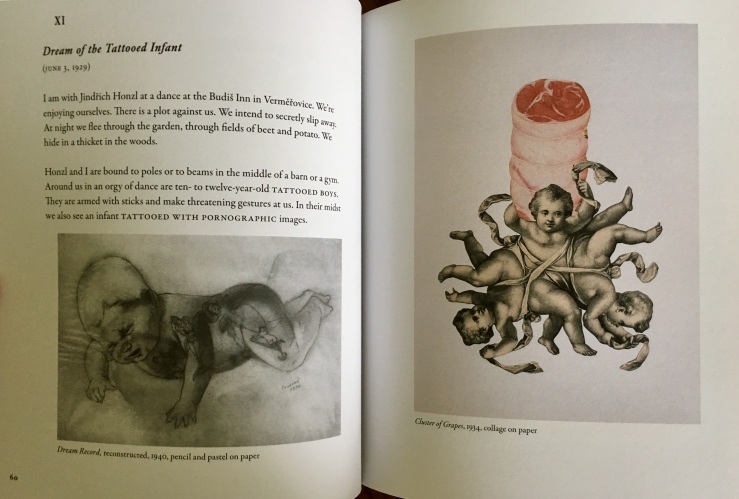
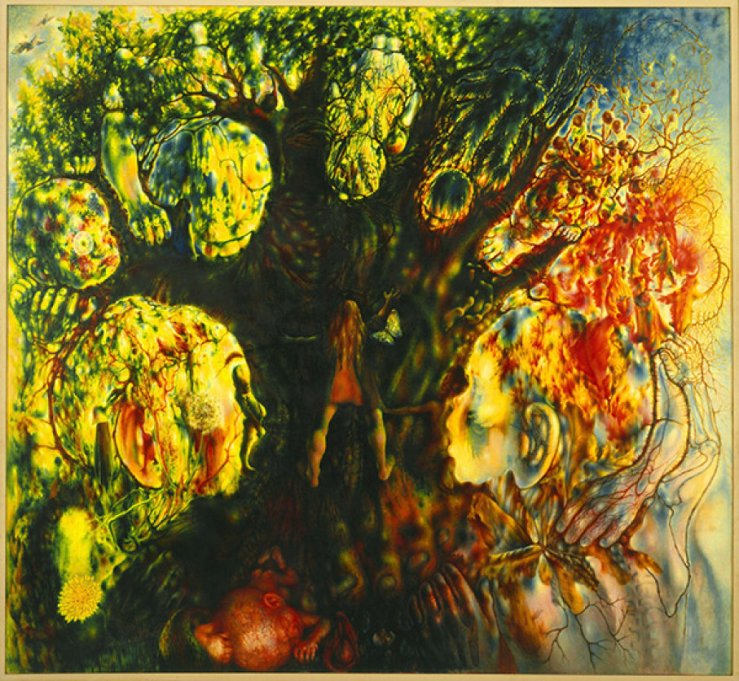
So—what next? The picture at the top is the stack I’ve been stacking and unstacking and restacking. Gaddis and Fiedler feel like the thing I really want to write about—gender roles, Gothic promises, domesticity vs. adventure, the house vs. the frontier, the collapse of self into fragments of language, etc. I’m also loving Dreamverse, a collection of poems, art, and prose by Jindřich Štyrský’ that Twisted Spoon Press has put together. Its insides look like this, at least in one place—
I think the next novel I will read will be Angela Carter’s The Infernal Machines of Doctor Hoffman.
The enemy of society on the run toward “freedom” is also the pariah in flight from his guilt, the guilt of that very flight; and new phantoms arise to haunt him at every step. American literature likes to pretend, of course, that its bugaboos are all finally jokes: the headless horseman a hoax, every manifestation of the supernatural capable of rational explanation on the last page—but we are never quite convinced. Huckleberry Finn, that euphoric boys’ book, begins with its protagonist holding off at gun point his father driven half mad by the D.T.’s and ends (after a lynching, a disinterment, and a series of violent deaths relieved by such humorous incidents as soaking a dog in kerosene and setting him on fire) with the revelation of that father’s sordid death. Nothing is spared; Pap, horrible enough in life, is found murdered brutally, abandoned to float down the river in a decaying house scrawled with obscenities. But it is all “humor,” of course, a last desperate attempt to convince us of the innocence of violence, the good clean fun of horror. Our literature as a whole at times seems a chamber of horrors disguised as an amusement park “fun house,” where we pay to play at terror, and are confronted in the innermost chamber with a series of inter-reflecting mirrors which present us with a thousand versions of our own face.
From the introduction to Leslie Fiedler’s Love and Death in the American Novel (1960).
Characteristics during the walk–Apple-trees with only here and there an apple on the boughs, among the thinned leaves, the relics of a gathering. In others you observe a rustling, and see the boughs shaking and hear the apples thumping down, without seeing the person who does it. Apples scattered by thewayside, some with pieces bitten out, others entire, which you pick up and taste, and find them harsh, crabbed cider-apples, though they have a pretty, waxen appearance. In sunny spots of woodland, boys in search of nuts, looking picturesque among the scarlet and golden foliage. There is something in this sunny autumnal atmosphere that gives a peculiar effect to laughter and joyous voices,–it makes them infinitely more elastic and gladsome than at other seasons. Heaps of dry leaves tossed together by the wind, as if for a couch and lounging-place for the weary traveller, while the sun is warming it for him. Golden pumpkins and squashes, heaped in the angle of a house till they reach the lower windows. Ox-teams, laden with a rustling load of Indian corn, in the stalk and ear. When an inlet of the sea runs far up into the country, you stare to see a large schooner appear amid the rural landscape; she is unloading a cargo of wood, moist with rain or salt water that has dashed over it. Perhaps you hear the sound of an axe in the woodland; occasionally, the report of a fowling-piece. The travellers in the early part of the afternoon look warm and comfortable as if taking a summer drive; but as eve draws nearer, you meet them well wrapped in topcoats or cloaks, or rough, great surtouts, and red-nosed withal, seeming to take no great comfort, but pressing homeward. The characteristic conversation among teamsters and country squires, where the ascent of a hill causes the chaise to go at the same pace as an ox-team,–perhaps discussing the qualities of a yoke of oxen. The cold, blue aspects of sheets of water. Some of the country shops with the doors closed; others still open as in summer. I meet a wood-sawyer, with his horse and saw on his shoulders, returning from work. As night draws on, you begin to see the gleaming of fires on the ceilings in the houses which you pass. The comfortless appearance of houses at bleak and bare spots,–you wonder how there can be any enjoyment in them. I meet a girl in a chintz gown, with a small shawl on her shoulders, white stockings, and summer morocco shoes,–it looks observable. Turkeys, queer, solemn objects, in black attire, grazing about, and trying to peck the fallen apples, which slip away from their bills.
—but did you ever think? She was up on that elbow again, turned to him so his hand fell still on the white of the sheet, —about light years?
—About what?
—I mean if you could get this tremendously powerful telescope? and then if you could get far enough away out on a star someplace, out on this distant star, and you could watch things on the earth that happened a long time ago really happening? Far enough away, he said, you could see history, Agincourt, Omdurman, Crécy… How far away were they she wanted to know, what were they, stars? constellations? Battles he told her, but she didn’t mean battles, she didn’t want to see battles, —I mean seeing yourself… Well as far as that goes he said, get a strong enough telescope you could see the back of your own head, you could —That’s not what I meant. You make fun of me don’t you.
—Certainly not, why would…
—I mean seeing what really happened back when…
—All right, set up a mirror on Alpha Centauri then, you’d sit right here with your telescope watching yourself four, about four and a half years ago is that what you…
—No.
—But I thought…
—Because I don’t want to see that! She pulled away, pulled up the sheet, staring up at the ceiling. —But you’d just see the outside though, wouldn’t you. You’d just see the mountain you’d see it go down and you’d see all the flames but you wouldn’t see inside, you wouldn’t see those faces again and the, and you wouldn’t hear it, a million miles away you wouldn’t hear the screams… What screams, he wanted to —No, no that one’s too close, find one further away… and he subsided, looking at the sheet clenched to her throat and the length of her gone under it, recommending Sirius, setting up business on the Dog Star, the brightest of them all, watching what happened eight and a half? nine years ago? —I told you what happened… the sheet clenched firm, —I told you last night no, twenty, twenty five years away when it was all still, when things were still like you thought they were going to be?
From the beginning of the fifth chapter of William Gaddis’s 1985 novel Carpenter’s Gothic. I’d never heard of this thought experiment until now.
I went to the book store this afternoon to pick up a copy of the latest graphic novel in by Kazu Kibuishi’s Amulet series for my kids, and of course I browsed a while. Looking for a copy of Anne Carson’s Plainwater, I ended up finding Angela Carter’s 1972 novel Infernal Desire Machines of Doctor Hoffman. It’s a British edition, 1985, Penguin, with a lovely Boschian cover by James Marsh. Here’s a detail from the cover:
I’ve wanted to pick up Carter’s novel since I read about it on a silly good dystopian fiction list last year, and I’m thrilled that I was able to get one with a Marsh cover. This particular cover, along with Marsh’s cover for The Bloody Chamber, are included in Phil Baines lovely book Penguin by Design.
Baines’s book doesn’t include any of Marsh’s fantastic covers of J.G. Ballard novels, opting instead to include Dave Pelham’s versions. I love both Pelham and Marsh’s Ballard covers, and would love to get my mitts on one at some point. I always browse for old mass market paperbacks of sci-fi authors I like — Philip K. Dick, Ursula K. LeGuin, the Strugatsky Brothers, J.G. Ballard — hoping to find an interesting cover, something inventive and fun, something from before their works were, under the cloak of awful respectability, given safe, boring literary covers. I didn’t find any Ballard editions with Marsh or Pelham covers, but I did come across this lovely pair of mass market paperback:
They’re US Vintage versions, 1985, with covers by Chris Moore. There’s like a proto-Cherry 2000 thing going on here that I kinda love, but I already own these novels, and I don’t love the covers quite enough. So instead, this post. Here are the covers of my copies of Crash and Concrete Island:
While Henry Sene Yee’s cover design for my copy of Concrete Island (using a photograph by Kevin Laubacher) isn’t terrible, it is a good example of what I mean by boring respectable literary covers. Still, this trade edition (Picador, 2001) is really readable—I mean, it’s easy to read. The pages are nice, the typeset is great, etc. (And the book is killer). I actually like the cover of my copy of Crash, a lot (design by Michael Ian Kaye and Melissa Hayden), but it’s also trying just a little too hard. (Again—very readable version from FS&G’s Noonday Press imprint, 1994).
While I had to pass today on the mass market copies of Crash and Concrete Island today—not because they would have set me back five bucks in store credit, but because I don’t need them, because I hope some kid goes in there and picks them up—while I had to pass on those lurid beauties, I did pick up a mass market 1967 copy of The Crystal World. Publisher Berkley Medallion didn’t bother to name the cover designer/artist, and I haven’t been able to track it down, but it is, I admit, a bit disappointing—an early pulp bid for literary respectability. At least I can be on the look out for a weirder one in the future.
The fourth of seven unnumbered chapters in William Gaddis’s Carpenter’s Gothic is set over the course of Halloween, moving from morning, into afternoon, and then night. Halloween is an appropriately Gothic setting for the midpoint of Gaddis’s postmodern Gothic novel, and there are some fascinating turns in this central chapter.
A summary with spoilers is not necessary here. Suffice to say that our heroine Elizabeth Booth is left alone on Halloween in the dilapidated Rural Gothic style house she and her awful husband Paul rent from mysterious Mr. McCandless. As Paul exits the house to go on one his many fruitless business trips, he notices that some neighborhood kids have already played their Halloween tricks:
He had the front door open but he stood there, looking out, looking up, —little bastards look at that, not even Halloween till tonight but they couldn’t wait… Toilet paper hung in disconsolate streamers from the telephone lines, arched and drooped in the bared maple branches reaching over the windows of the frame garage beyond the fence palings where shaving cream spelled fuck. —Look keep the doors locked, did this last night Christ knows what you’re in for tonight… and the weight of his hand fell away from her shoulder, —Liz? just try and be patient? and he pulled the door hard enough for the snap of the lock to startle her less with threats locked out than herself locked in, to leave her steadying a hand on the newel…
The kids’ Halloween antics take on a particularly sinister aspect here, set against the stark New England background Gaddis conjures. We get gloomy streamers, desolate trees, and the bald, ugly signification of one lone word: fuck. (Fuck and its iterations, along with Gaddis’s old favorite God damn, are bywords in Carpenter’s Gothic). Paul’s reading of this scene is also sinister; he underscores the Gothic motif in telling Elizabeth to “keep the doors locked” because she doesn’t know what she’s “in for tonight.” Tellingly, the aural snap of Paul’s exit shows us that Elizabeth is ultimately more paranoid about being locked in. Indeed, by the middle of the novel, we see her increasingly trapped in her (haunted) house. The staircase newel, an image that Gaddis uses repeatedly in the novel, becomes her literal support. Elizabeth spends the rest of the morning avoiding chores before eventually vomiting and taking a nap.
Then, Gaddis propels us forward a few hours with two remarkable paragraphs (or, I should say, two paragraphs upon which I wish to remark). Here is the first post-nap paragraph:
She woke abruptly to a black rage of crows in the heights of those limbs rising over the road below and lay still, the rise and fall of her breath a bare echo of the light and shadow stirred through the bedroom by winds flurrying the limbs out there till she turned sharply for the phone and dialed slowly for the time, up handling herself with the same fragile care to search the mirror, search the world outside from the commotion in the trees on down the road to the straggle of boys faces streaked with blacking and this one, that one in an oversize hat, sharing kicks and punches up the hill where in one anxious glimpse the mailman turned the corner and was gone.
What a fantastic sentence. Gaddis’s prose here reverberates with sinister force, capturing (and to an extent, replicating) Elizabeth’s disorientation. Dreadful crows and flittering shadows shake Elizabeth, and searching for stability she telephones for the time. (If you are a young person perhaps bewildered by this detail: This is something we used to do. We used to call a number for the time. Like, the time of day. You can actually still do this. Call the US Naval Observatory at 202-762-1069 if you’re curious what this aesthetic experience is like). The house’s only clock is broken, further alienating Elizabeth from any sense of normalcy. In a mode of “fragile care,” anxious Elizabeth glances in the mirror, another Gothic symbol that repeats throughout this chapter. She then spies the “straggle of boys” (a neat parallel to the “black rage of crows” at the sentence’s beginning) already dressed up in horrorshow gear for mischief night and rumbling with violence. The mailman—another connection to the outside world, to some kind of external and steadying authority—simply disappears.
Here is the next paragraph:
Through the festoons drifting gently from the wires and branches a crow dropped like shot, and another, stabbing at a squirrel crushed on the road there, vaunting black wings and taking to them as a car bore down, as a boy rushed the road right down to the mailbox in the whirl of yellowed rust spotted leaves, shouts and laughter behind the fence palings, pieces of pumpkin flung through the air and the crows came back all fierce alarm, stabbing and tearing, bridling at movement anywhere till finally, when she came out to the mailbox, stillness enveloped her reaching it at arm’s length and pulling it open. It looked empty; but then there came sounds of hoarded laughter behind the fence palings and she was standing there holding the page, staring at the picture of a blonde bared to the margin, a full tumid penis squeezed stiff in her hand and pink as the tip of her tongue drawing the beading at its engorged head off in a fine thread. For that moment the blonde’s eyes, turned to her in forthright complicity, held her in their steady stare; then her tremble was lost in a turn to be plainly seen crumpling it, going back in and dropping it crumpled on the kitchen table.
The paragraph begins with the Gothic violence of the crows “stabbing and tearing” at a squirrel. Gaddis fills Carpenter’s Gothic with birds—in fact, the first words of the novel are “The bird”—a motif that underscores the possibility of flight, of escape (and entails its opposite–confinement, imprisonment). These crows are pure Halloween, shredding small mammals as the wild boys smash pumpkins. Elizabeth exits the house (a rare vignette in Carpenter’s Gothic, which keeps her primarily confined inside it) to check the mail. The only message that has been delivered to her though is from the Halloween tricksters, who cruelly laugh at their prank. The pornographic image, ripped from a magazine, is described in such a way that the blonde woman trapped within it comes to life, “in forthright complicity,” making eye contact with Elizabeth. There’s an intimation of aggressive sexual violence underlying the prank, whether the boys understand this or not. The scrap of paper doubles their earlier signal, the shaving creamed fuck written on the garage door.
Elizabeth recovers herself to signify steadiness in return, demonstratively crumpling the pornographic scrap—but she takes it with her, back into the house, where it joins the other heaps of papers, scraps, detritus of media and writing that make so much of the content of the novel. Here, the pornographic scrap takes on its own sinister force. Initially, Elizabeth sets out to compose herself anew; the next paragraph finds her descending the stairs, “differently dressed now, eyeliner streaked on her lids and the
colour unevenly matched on her paled cheeks,” where she answers the ringing phone with “a quaver in her hand.” The scene that follows is an extraordinary displacement in which the phone takes on a phallic dimension, and Elizabeth imaginatively correlates herself with the blonde woman in the pornographic picture. She stares at this image the whole time she is on the phone while a disembodied male voice demands answers she cannot provide:
The voice burst at her from the phone and she held it away, staring down close at the picture as though something, some detail, might have changed in her absence, as though what was promised there in minutes, or moments, might have come in a sudden burst on the wet lips as the voice broke from the phone in a pitch of invective, in a harried staccato, broke off in a wail and she held it close enough to say —I’m sorry Mister Mullins, I don’t know what to… and she held it away again bursting with spleen, her own fingertip smoothing the still fingers hoarding the roothairs of the inflexible surge before her with polished nails, tracing the delicate vein engorged up the curve of its glistening rise to the crown cleft fierce with colour where that glint of beading led off in its fine thread to the still tongue, mouth opened without appetite and the mascaraed eyes unwavering on hers without a gleam of hope or even expectation, —I don’t know I can’t tell you!
Gaddis’s triple repetition of the verb burst links the phone to the phallus and links Elizabeth to the blonde woman. This link is reinforced by the notation of the woman’s “mascaraed eyes,” a detail echoing the paragraph’s initial image of Elizabeth descending the stairs with streaked eyeliner. The final identification between the two is the most horrific—Elizabeth reads those eyes, that image, that scrap of paper, as a work “without a gleam of hope or even expectation.” Doom.
Elizabeth is “saved,” if only temporarily, by the unexpected arrival of the mysterious Mr. McCandless, who quickly stabilizes the poor woman. Gaddis notes that McCandless “caught the newel with her hand…He had her arm, had her hand in fact firm in one of his.” When he asks why she is so upset, she replies, “It’s the, just the mess out there, Halloween out there…” McCandless chalks the mess up to “kids with nothing to do,” but Elizabeth reads in it something more sinister: “there’s a meanness.” McCandless counters that “it’s plain stupidity…There’s much more stupidity than there is malice in the world.” This phrase “Halloween out there” repeats three times in the chapter, suggesting a larger signification—it isn’t just Halloween tonight, but rather, as McCandless puts it, the night is “Like the whole damned world isn’t it.” It’s always Halloween out there in Carpenter’s Gothic, and this adds up to mostly malice of mostly stupidity in this world—depending on how you read it.
The second half of the chapter gives over to McCandless, who comes to unexpectedly inhabit the novel’s center. Elizabeth departs, if only for a few hours, leaving McCandless alone, if only momentarily. A shifty interlocutor soon arrives on the thresh hold of his Carpenter Gothic home, and we learn some of his fascinating background. It’s a strange moment in a novel that has focused so intently on the consciousness of Elizabeth, but coming in the novel’s center, it acts as a stabilizing force. I won’t go into great detail here—I think much of what happens when McCandless is the center of the narrative is best experienced without any kind of spoiler—but we get at times from him a sustained howl against the meanness and stupidity of the world. He finally ushers his surprise interlocutor out of his home with the following admonition: “It’s Halloween out there too.”













 Biblioklept