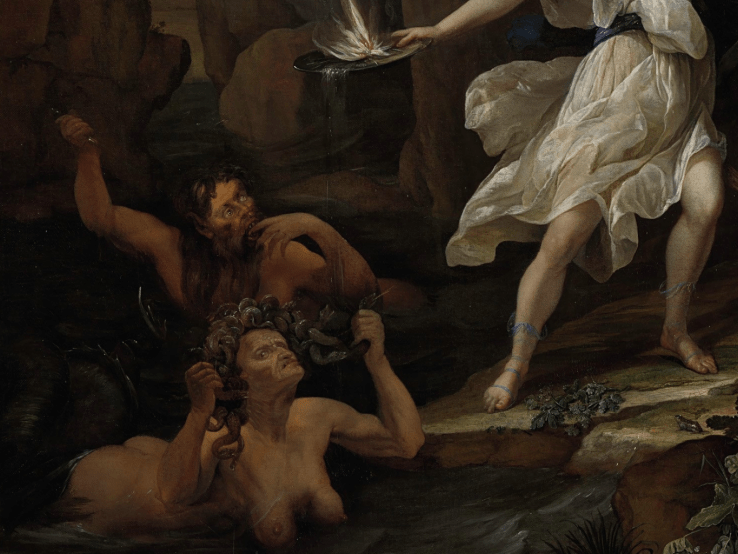
Detail from Circe Punishes Glaucus by Transforming Scylla into a Monster, 1695 by Eglon van der Neer (1636–1703)

Detail from Circe Punishes Glaucus by Transforming Scylla into a Monster, 1695 by Eglon van der Neer (1636–1703)
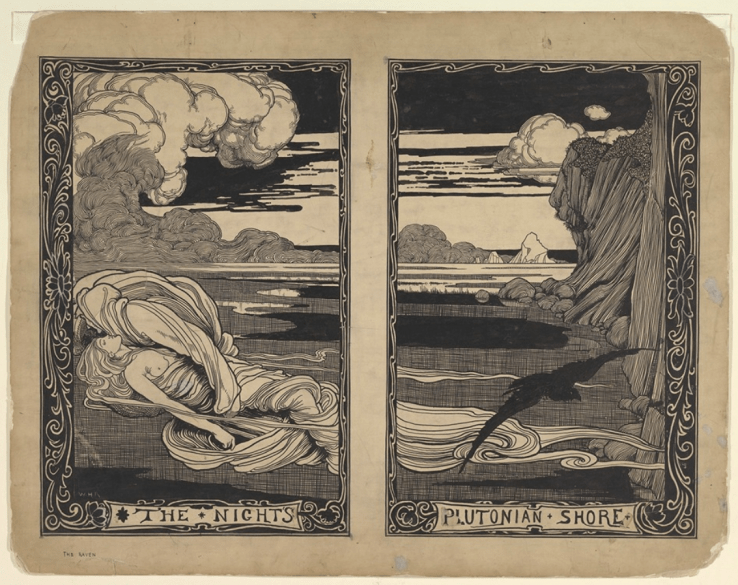
The Night’s Plutonian Shore, 1909 by William Heath Robinson (1872-1944)

This afternoon I was reading, or really, I now know, rereading Gordon Lish’s 1996 interview with Rob Trucks, and while reading (rereading) this interview, I experienced terrible déjà vu, the kind of déjà vu that upsets one like a bad itch tucked away and wriggling in an unscratchable little alcove in the back of one’s mind. Only of course now I know that I wasn’t necessarily experiencing what can rightfully be called déjà vu; rather, I was simply failing to fully remember having read something several years prior—in this case, Gordon Lish’s 1996 interview with Rob Trucks.
Early bits of the interview set me tingling. Stuff about Julia Kristeva’s Powers of Horror. Stuff about DeLillo. Lots of Lish’s anxiety about Blood Meridian. But my (non)déjà vu exploded when Lish shared the following story while discussing his (anxiety of) influences:
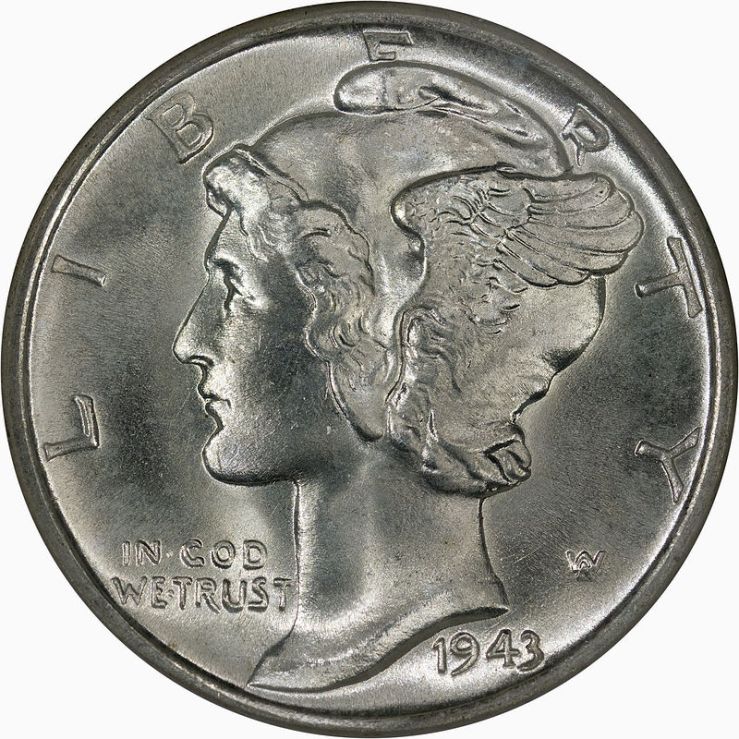
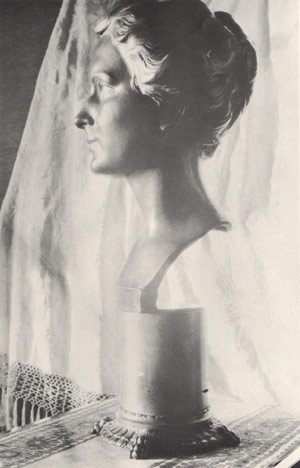
I read Wallace Stevens a lot, since you asked about influence. I read Stevens’s letters a lot. I’m eager to find all sorts of connections between Stevens’s life and my own, right down to, and I’ll put this to you, my extraordinary discovery not long ago that the face on the coin, on the half dollar coin, and on the dime that I gazed at so often as a child in honor o my idea of an American woman, since I come from an immigrant family, what a great American woman looked like, the one that you would have to bed in lieu of all other women you could not bed, turns out to have been modeled for a sculptor who was a landlord in Chelsea. he was, in fact, Stevens’s landlord when he and Elsie Kachel, his wife, were living in Chelsea, and the design on the coin was modeled by Stevens’s wife, so that it’s fair to make the claim that I was infatuated with Steven’s wife, or at least her profile, from the time I was five or six or seven years old. You looked at the dime, you looked at the half dollar, and you saw Stevens’s wife, amazingly.
When I read this amazingly amazing anecdote the déjà vu had passed pulsating—it was humming, whirring in the background, trying to attach to something, eventually coming up with, “David Markson? Is this something you read in a David Markson novel?” Instead of trying to search through Markson’s work (where I’m sure, or now not really sure, but rather somewhat sure, I read the anecdote of Wallace Stevens getting into a fistfight with a much younger Ernest Hemingway off the coast of Key West) for this Elsie Kachel Stevens reference, I simply did a basic internet search to get some more background on Lish’s claim that the poet Wallace Stevens’s wife served as the profile model on at least two coins of U.S. currency. The story more or less checks out (with a lot of passive voice).
Here is a photograph of the dime in question, which was designed by Adolph Weinman and minted in 1916:
And here is a photograph of Elsie Kachel Stevens:

And here is a photograph of the bust that Adolph Weinman made of Elsie Kachel Stevens:
Anyway. I went back to the interview, still tingling a little, but also a bit preoccupied—I needed to prepare our dinner of tacos, kids needed to get to piano lessons, the dog need walking, etc. And as I hurtled through the interview, I got to a moment when Lish tells his interlocutor, “I use my dick, mainly, to write the first time, and I’m using my brains to do the revisions. I mean, not my brain. I’m using rather practiced sequences of motions that have to do chiefly with mind or chiefly with know-how. I’m trying to stick it into the page the first time out.” And then, a few paragraphs later, this nugget:
Q: So Self-Imitation is still a dick book?
A: It’s a dick book. All my books are dick books.
And then I laughed out loud and then I remembered that I had not only read this interview, but I had even written about it years ago on this idiot blog of mine. And so my itch was scratched.
I read—by which I mean reread—Gordon Lish’s 1996 interview with Rob Trucks in Conversations with Gordon Lish (edited by David Winters and Jason Lucarelli), a collection chocked full of tingly bits and fat juicy morsels and etc.

Saint Bernard Crushing a Demon, 1563 by Marcello Venusti (1512–1579)

Breakfast, 2011 by Eteri Chkadua
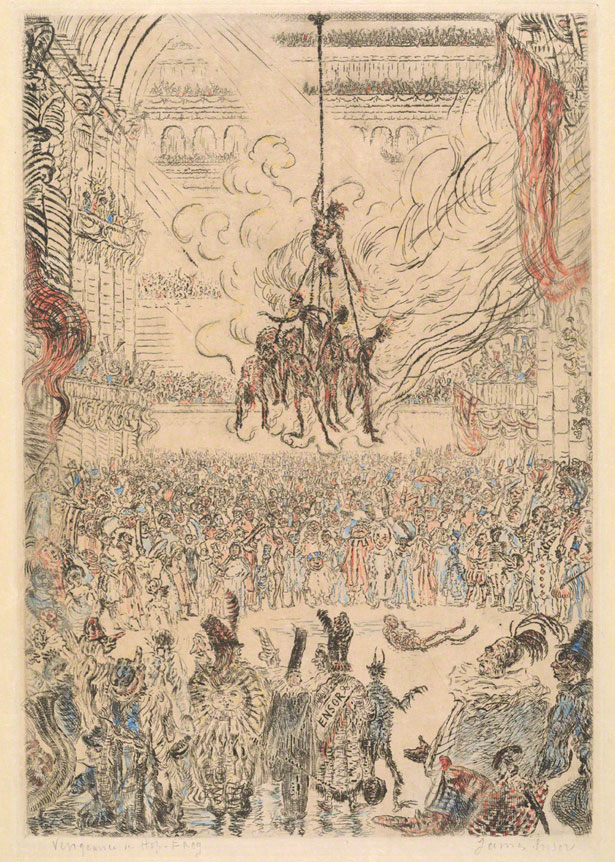
Hop-Frog’s Revenge, 1898 by James Ensor (1860-1949)
Ensor’s illustration was inspired by Edgar Allan Poe’s 1849 tale “Hop-Frog.”
“Hop-Frog”
by
Edgar Allan Poe
I NEVER knew anyone so keenly alive to a joke as the king was. He seemed to live only for joking. To tell a good story of the joke kind, and to tell it well, was the surest road to his favor. Thus it happened that his seven ministers were all noted for their accomplishments as jokers. They all took after the king, too, in being large, corpulent, oily men, as well as inimitable jokers. Whether people grow fat by joking, or whether there is something in fat itself which predisposes to a joke, I have never been quite able to determine; but certain it is that a lean joker is a rara avis in terris.
About the refinements, or, as he called them, the ‘ghost’ of wit, the king troubled himself very little. He had an especial admiration for breadth in a jest, and would often put up with length, for the sake of it. Over-niceties wearied him. He would have preferred Rabelais’ ‘Gargantua’ to the ‘Zadig’ of Voltaire: and, upon the whole, practical jokes suited his taste far better than verbal ones.
At the date of my narrative, professing jesters had not altogether gone out of fashion at court. Several of the great continental ‘powers’ still retain their ‘fools,’ who wore motley, with caps and bells, and who were expected to be always ready with sharp witticisms, at a moment’s notice, in consideration of the crumbs that fell from the royal table.
Our king, as a matter of course, retained his ‘fool.’ The fact is, he required something in the way of folly–if only to counterbalance the heavy wisdom of the seven wise men who were his ministers–not to mention himself. Continue reading “Hop-Frog’s Revenge — James Ensor”
So, in the work I’ve tried to do, in J R, especially the awful lot of description and narrative interference, as I see it now, in The Recognitions, where I am awfully pleased with information that I have come across and would like to share it with you-so I go on for two pages about, oh, I don’t know, the medieval Church,… the forgery, painting, theories of forgery and so forth, and descriptions, literally, of houses or landscapes. And when I got started on the second novel, which was J R, 726 pages, almost entirely my intention was to get the author out of there, to oblige the characters to create themselves and each other and their story, and all of it in dialogue.
An excerpt from William Gaddis’s New York State Writers Institute reading, April 4, 1990.
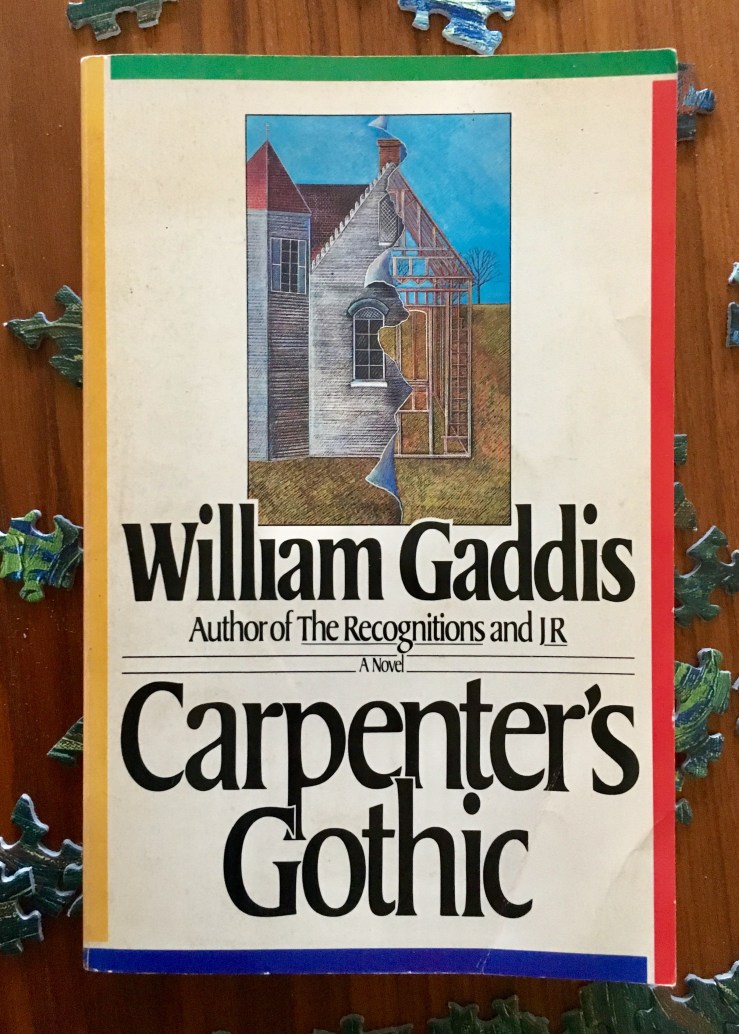
I have blazed through the first three (unnumbered) chapters of William Gaddis’s third novel Carpenter’s Gothic (1985) this weekend, consuming the prose with an urgency I did not expect. After all, Gaddis is (at least according to Jonathan Franzen) “Mr. Difficult,” right?
But Carpenter’s Gothic is not especially difficult, or does not feel that way to me, anyway—although I’m sure I find it so readable in large part because I’ve read Gaddis’s second novel J R twice already, and Carpenter’s Gothic is written in the same style as J R. The first time I read J R I did find its style tremendously challenging. Gaddis strips almost all exposition and scene-setting in J R. The novel’s 726 pages are comprised primarily in dialogue, often unattributed, leaving the reader to play director, producer, and cinematographer. Reading it a second time was, in a way, like reading it for the first time, revealing one of the best and arguably most important American novels of the second-half of the twentieth century.
In any case, reading J R has taught me how to read Carpenter’s Gothic, which is told in the same style. Carpenter’s Gothic is a smaller novel though, both literally (around 250 pages) and figuratively. While J R sports a large cast, sprawling and interlinked plots, divergent tones, and a wide array of themes, Carpenter’s Gothic is restrained to a few talking characters, whom Gaddis keeps confined to an isolated house somewhere in New England. (It is from this house’s architectural design that the novel gets its title).
The central character is Elizabeth Booth, 33, an heiress locked out of her inheritance. Elizabeth is married to an awful abusive man named Paul, a racist Vietnam Veteran who embodies almost every characteristic of what we now think of as toxic masculinity. Elizabeth is recovering from an as-yet-unspecified accident, and spends most of her time confined to her rented house, fielding phone calls. Some of these phone calls are from folks related to her husband’s latest scheme with a televangelist. Other calls are from her friend Edith who has run off to sunny Jamaica—a prospect of escape that entices Elizabeth. Even more calls come for the mysterious owner of the house, McCandless, who eventually shows up in the third chapter.
McCandless’s visit sparks something in Elizabeth. She gets to glance into his locked study, crammed with papers and books and even a piano, and she takes him for a writer, but he claims he’s a geologist. His short visit inspires Elizabeth to dig up the draft of a book, or something like a book, she’s been working on, and add a few notes. The romantic impulse is eventually punctured by her husband’s return.
Carpenter’s Gothic’s relentless interiority and inherent bitterness can give the novel a claustrophobic feeling, and reading it often reminds me of the scenes in J R that are set in the ramshackle 96th Street apartment shared by Bast and Gibbs. And yet its interiority always branches outward, evoking an exotic and pulsating world that Elizabeth might love to experience. There’s Montego Bay, there’s Orson Welles in Jane Eyre, there’s the nomadic Masai of central east Africa. Etc. But Elizabeth’s experiences are mediated by newspapers, magazine articles, phone calls, and old movies on television. It’s quite sad and frustrating.
Elizabeth thus far fits neatly into American literature’s motif of the confined woman: Walt Whitman’s 29th bather, Kate Chopin’s Mrs. Mallard, William Carlos Williams’ young housewife, Charlotte Perkins Gilman’s distressed and nervous heroine. There are many, many more, of course. I’m not quite half way through Carpenter’s Gothic–no spoilers from you please, readers!—and curious what Gaddis will do with his heroine. Will there be an escape? Freedom? A happy ending?
So many 19th and 20th century American writers seemed unsure of what to do with their heroines, even after they had freed them (Kate Chopin’s Edna Pontellier is a particularly easy go-to example, but again: there are more). Carpenter’s Gothic seems set on a tragic track, but Gaddis has a way of making his readers recognize the farcical contours in tragedy.
I haven’t given a taste of Gaddis’s prose yet. I will share, as a closing, the novel’s opening two-sentence paragraph, which I think is simply marvelous, and which I had to read at least three times before I could turn to the novel’s second page. Here it is:
The bird, a pigeon was it? or a dove (she’d found there were doves here) flew through the air, its colour lost in what light remained. It might have been the wad of rag she’d taken it for at first glance, flung at the smallest of the boys out there wiping mud from his cheeks where it hit him, catching it up by a wing to fling it back where one of them now with a broken branch for a bat hit it high over a bough caught and flung back and hit again into a swirl of leaves, into a puddle from rain the night before, a kind of battered shuttlecock moulting in a flurry at each blow, hit into the yellow dead end sign on the corner opposite the house where they’d end up that time of day.
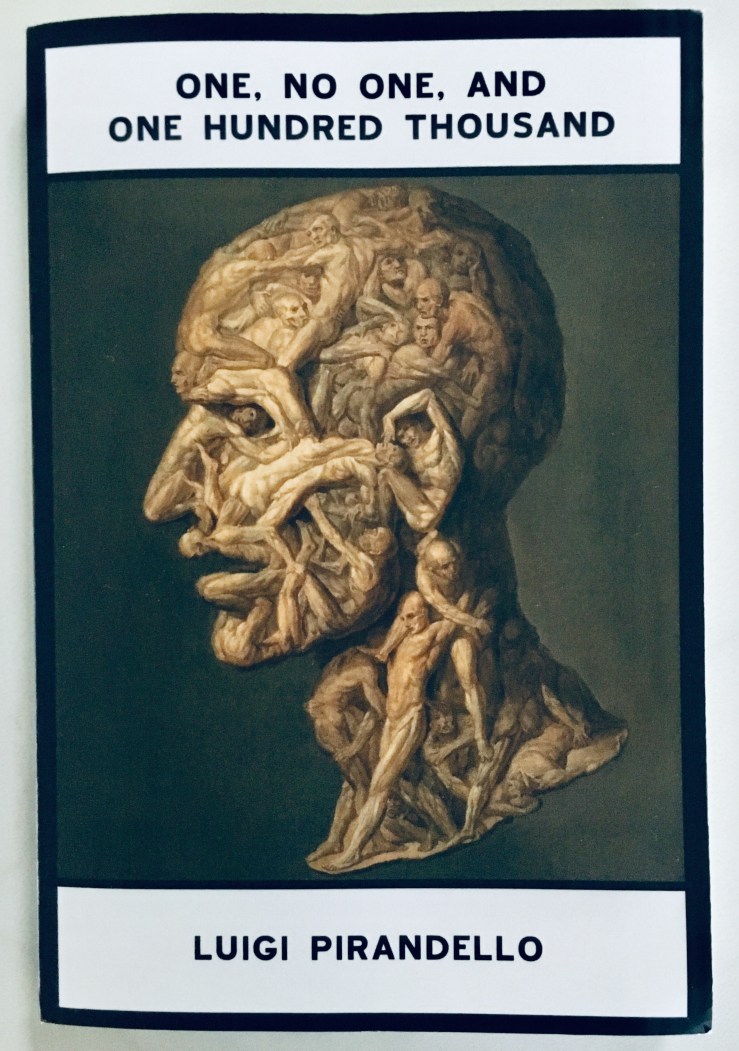
Luigi Pirandello’s One, No One, and One Hundred Thousand (English translation by William Weaver) is new in print again from Spurl Editions. Their blurb:
Translated from Italian by William Weaver, who wrote of One, No One, and One Hundred Thousand, “The definition of madness, the problem of identity, the impossibility of communicating with others and with being (or knowing) one’s self … Nowhere are these themes more intensely and wryly treated than in this spare, terse novel.”
Luigi Pirandello’s extraordinary final novel begins when Vitangelo Moscarda’s wife remarks that Vitangelo’s nose tilts to the right. This commonplace interaction spurs the novel’s unemployed, wealthy narrator to examine himself, the way he perceives others, and the ways that others perceive him. At first he only notices small differences in how he sees himself and how others do; but his self-examination quickly becomes relentless, dizzying, leading to often darkly comic results as Vitangelo decides that he must demolish that version of himself that others see.
Pirandello said of his 1926 novel that it “deals with the disintegration of the personality. It arrives at the most extreme conclusions, the farthest consequences.” Indeed, its unnerving humor and existential dissection of modern identity find counterparts in Samuel Beckett’s Molloy trilogy and the works of Thomas Bernhard and Vladimir Nabokov.

Via Peanuts on This Day on Twitter:

The Drawing Class, 2011 by Nicole Eisenman (b. 1965)

Evan Dara’s latest work is a two-act play called Provisional Biography of Mose Eakins. Set “c. 2015” on a stage “As bare as you can stand it,” Dara’s play follows Mose Eakins, “35-ish and spry,” as he becomes afflicted with a condition that “has come to be known as imparlence.”
Mose’s imparlence erodes his ability to communicate with others. He loses his job, his home, and eventually his girlfriend Zina, from whom he initially hides his condition. Though his life deteriorates, Mose eventually lands a job as the maitre d’ of an overpriced French restaurant. Here, his sympathies extend to the overworked kitchen staff, and he takes a stand against the unjust working conditions, trying to make meaning through his actions, even as his words fail to communicate.
Dara keeps Provisional Biography spare but active, using a device he calls “the swirl” as a kind of Greek Chorus to keep the play shuttling along, even as the narrative threatens to fall apart. And because Mose is our viewpoint character, and because Mose is afflicted with “imparlence,” the narrative of Provisional Biography is under constant threat of its own linguistic erasure. As the swirl helpfully informs the audience, “people with imparlence lose the capacity to infuse their words with intelligible significance.”
Provisional Biography’s opening lines are an especially baffling affront to “intelligible significance.” When we meet Mose, he’s already imparlent, although he does not know it yet. Consider the play’s opening lines:
MOSE: Tell me something, Jeff. Those numbers convincing to you?
(to someone else)
Bring me the swordfish. Not blackened. You got that? Not blackened. Go.
(to someone else, jauntily)
Well, you know what they say…
(to someone else)
Nice, Zina – the chart is really good. Zina, your students will love it!
(to someone else, laughing)
Tell him that and he’s totally going to have a kitten!
The first few pages of the play continue in this line, Mose’s utterances disconnected from any context that might anchor their meaning. A swirl member eventually appears on stage to push the narrative into more traditional territory:
SWIRL MEMBER 1: Hear it here! Mose Eakins (born June 10, 1978) is an American
field-risk analyst working for Concord Oil. Specializing in mid-level hard-soil
extractions, he won the Kamden Prize for his research into adjacent fauna protection and occasionally lectures in his field.
As Mose’s imparlence worsens, the tension between Mose and the world he cannot communicate with increases, erupting in moments both tragic and comic (and farcical and tragicomic). The swirl is often there to assuage him (and the audience), armed with a humorous (and occasionally ironic) quiver of quotes from the likes of Melanie Klein, William H. Gass, Jean Jacques Rousseau, St. Augustine, and television personality Doctor Oz.
The swirl advises our poor hero, suggesting treatments and support groups—and also offering up punchlines when there’s no real hope in sight:
SWIRL MEMBER: There is no known cure. Imparlence is untreatable—
MOSE: But the doctor – the doctor recommended medicine!
(Mose pulls out the paper given by Doctor Mazlane, shows it to the swirl.)
He told me to take this and come see him again! It’s a prescription…
(reads the paper)
…a prescription…to pay him five hundred and twenty dollars… And I thought bleeding patients went out in the nineteenth century.
SWIRL MEMBER: There’s been a strong return to traditional medicine.
(Other jokes don’t land so neatly—in a segment mocking TV drug commercials, a swirl member offers up an absolute groaner with the phrase “irregular vowel movements.” Who knows though? Maybe the joke plays well on the stage).
With all of its humor, Provisional Biography is ultimately a sad, even tragic story, and nowhere is it sadder than in Mose’s revelation that he can communicate to other humans through one medium: economic exchange. He takes to desperately buying Tic Tacs from street vendors simply to communicate intelligibly, and eventually resorts to buying phrases from a fellow homeless person.
And yet these purchased utterances are not true linguistic exchanges—they do not mean outside of their inherent economic content. Mose Eakins despairs:
MOSE: So – so that’s it? That’s it for me? I can only just flapgaggle by myself for the
rest of my days – flapgaggle and hope?SWIRL MEMBER: Perhaps inevitable. According to Robert Nozick of Harvard, imparlence is just the latest expression of the ownership society.
SWIRL MEMBER: Meaning has been privatized. It’s been made part of the private
sphere.SWIRL MEMBER: Significance is no longer a publicly-owned utility, a service
provided by a command and control center.SWIRL MEMBER: This will vastly increase our linguistic productivity—
SWIRL MEMBER: —liberate our potential as creators of meaning—
SWIRL MEMBER: —freeing us from the restrictions and inefficiencies of the nanny
dictionary!MOSE: But…
The swirl here satirizes the newspeak of late capitalism, imagining language—a thing that makes us inherently human—as yet another commodity to be consumed and sold back to us by a dehumanizing system that seems to operate on its own inscrutable logic. While there’s humor in the little scene, it’s also quite painful.
The idea that late capitalism reduces linguistic exchange to only an economic (and thus inauthentic) exchange is repeated again in a far more painful scene later in the play. Mose pleads for “Something real…A real response – something that speaks from the heart!” from the homeless man he has been buying phrases from, to which the man simply puts out his hand for a coin. “Is that the only thing left?” cries Mose. The swirl is there to offer an out to this existentialist despair: “Salvation–only through action! Guided by further philosophical slivers proffered by the swirl, Mose converts his despair into radical action by the end of the play. The conclusion is fittingly moving and movingly strange.
Provisional Biography of Mose Eakins, in showing a human communication dissolve, follows Dara’s 2013 novel Flee, which shows a town dissolve. Flee is an oblique but devastating address to the 2008 economic collapse in America, and Provisional Biography is a fitting follow-up, continuing Dara’s critique of the human position in the late-capitalist landscape.
Significantly, Dara’s critique of the relationship between language and commerce extends to accessing his play, which can be downloaded for free at his publisher Aurora’s website. You simply have to give them your email address. Under the “Download” button and above the PayPal button is the following message:
“If you please, reciprocation accepted only after reading. Thank you.”
And what would “reciprocation” mean, in the end? Write your own two-act play about the relationship between language and commerce in the early 21st century and send it to Evan Dara?
I PayPal’d Aurora $11.11.
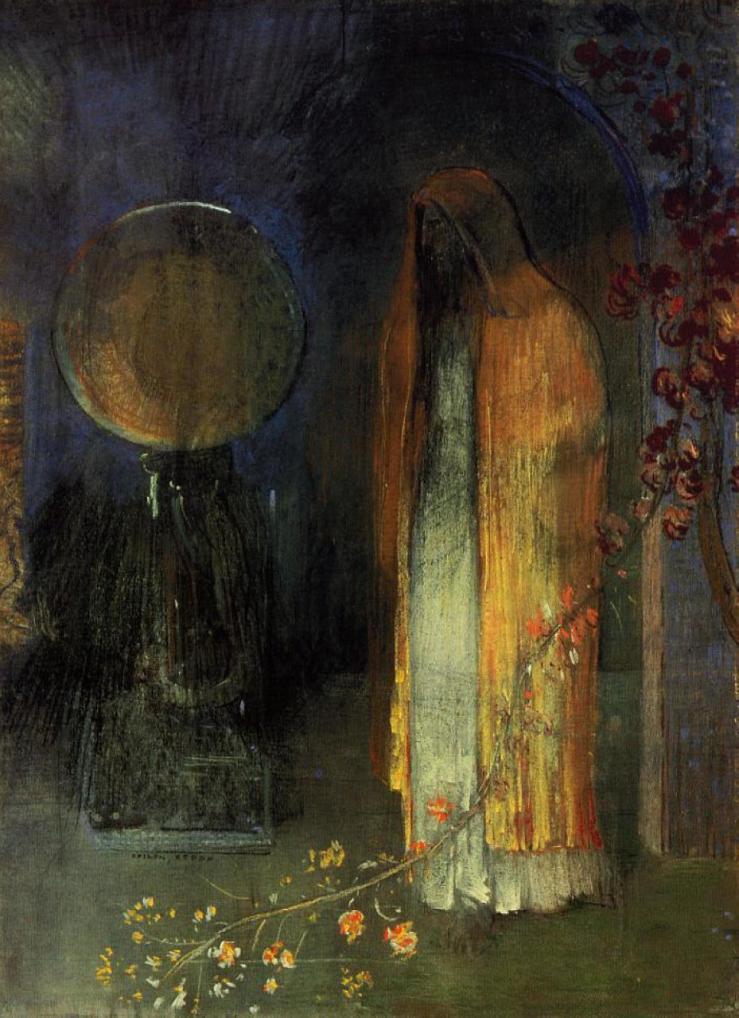
The Yellow Cape, 1895 by Odilon Redon (1840-1916)
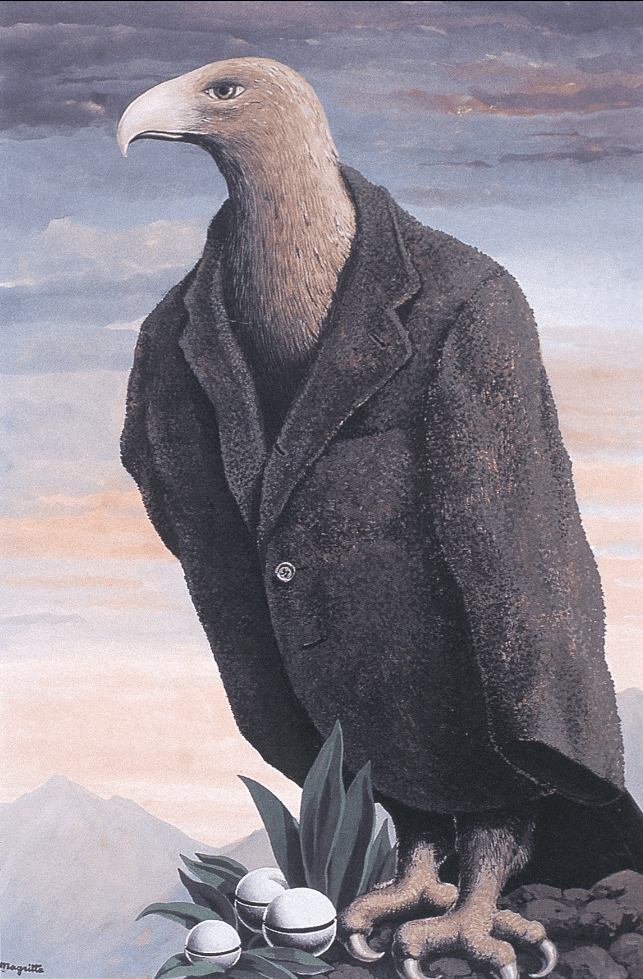
The Present, 1939 by Rene Magritte (1898-1967)

Antoine Volodine’s short story “The Theory of Image According to Maria Three-Thirteen” is collected in Writers, a book available in English translation by Katina Rogers from Dalkey Archive Press.
Writers is one of the best books I’ve read in the past few years: unsettling, bizarre, satirical, and savage, its stories focus on writers who are more than writers: they are would-be revolutionaries and assassins, revolting humans revolting against the forces of late capitalism.
Writers (which I wrote about here) functions a bit like a discontinuous novel that spins its own web of self-references to produce a small large gray electric universe—the Volodineverse, I guess—which we can also see in post-exotic “novels” like Minor Angels and Post-Exoticism in Ten Lessons, Lesson Eleven.
Volodine’s post-exotic project refers obliquely to the ways in which the late 20th century damns the emerging 21st century. And yet the trick of it all is that the stories and sketches and vignettes seem ultimately to refer only to themselves, or to each other—the world-building is from the interior. This native interiority is mirrored by the fact that many of his writer-heroes are prisoners communicating from their cells, often to interrogators, but just as often to an unresponsive void.
“The Theory of Image According to Maria Three-Thirteen” takes place in such a void, a kind of limbo into which the (anti-)hero Maria Three-Thirteen speaks herself into existence. It’s an utterly abject existence; Maria Three-Thirteen crouches naked like “a madwoman stopped before the unknown, before strangers and nothingness, and her mouth and her orifices unsealed after death…all that remains for her is to speak.” She speaks to a semi-human tribunal, a horrorshow, creatures “without self-knowledge.” After several paragraphs of floating abject abstraction, Maria eventually illustrates her thesis—an evocation of speech without language, speech in a deaf natural voice–to this audience.
Her illustration is a list of scenes from 20th-century films.
I found this moment of the story initially baffling—it seemed, upon first reading, an utter surrender to exterior referentiality on Volodine’s part, a move inconsistent with the general interiority of Writers. Even though the filmmakers alluded to made and make oblique, slow, often silent, often challenging (and always beautiful) films, films aesthetically similar to Volodine’s own project, I found Volodine’s gesture too on-the-nose: Of course he’s beholden to Bergman, Tarkovsky, Bela Tarr!
Rereading the story, and rereading it in the context of having read more of Volodine’s work, I take this gesture as the author’s recognition of his aesthetic progenitors. Volodine here signals that the late 20th-century narrative that most informs his work is cinema—a very specific kind of cinema—and not per se literature.
This reading might be a misreading on my part though. Maybe Volodine simply might have wanted to make a list of some of his favorite scenes from some of his favorite films, and maybe Volodine might have wanted to insert that list into a story. And it’s a great list. I mean, I like the list. I like it enough to include it below. I have embedded the scenes alluded to where possible, and in a few places made what I take to be worthy substitutions.
Here is Volodine; here is Volodine’s Maria Three-Thirteen, speaking the loud deaf voice—
And now, she begins again, to illustrate, I will cite a few images without words or almost without words, several images that make their deaf voice heard. You know them, you have certainly attended cinema showings during which they’ve been projected before you. These are not immobile images, but they are fundamentally silent, and they make their deaf voice heard very strongly.
The chess match with death in The Seventh Seal by Ingmar Bergman, with, in the background, a procession of silhouettes that undertake the arduous a scent of a hill.
The man on all fours who barks in the mud facing a dog in Damnation by Bela Tarr.
The baby that cries in a sordid and windowless apartment in Eraserhead by David Lynch.
The bare facade of an abandoned apartment building, with Nosferatu’s head in a window, in Nosferatu by Friedrich Murnau.
The boat that moves away from across an empty sea, overflowing with cadavers, at the end of Shame by Ingmar Bergman.
The desert landscape, half hidden by a curtain that the wind lifts in Ashes of Time by Wong Kar Wai.
The early morning travel by handcar, with the regular sound of wheels, in Stalker by Andrei Tarkovsky.
The old man with cancer who sings on a swing in Ikiru by Akira Kurosawa.
The blind dwarfs with their enormous motorcycle glasses who hit each other with canes in Even Dwarfs Started Small by Werner Herzog.
The train station where three bandits wait at the beginning of Once Upon a Time in the West by Sergio Leone.
The flares above the river in Ivan’s Childhood by Andrei Tarkovsky.
The prairie traveled over by a gust of wind in The Mirror by Andrei Tarkovsky.
She is quiet for a moment.
There are many others she thinks. They all speak. They all speak without language, with a deaf voice, with a natural and deaf voice.
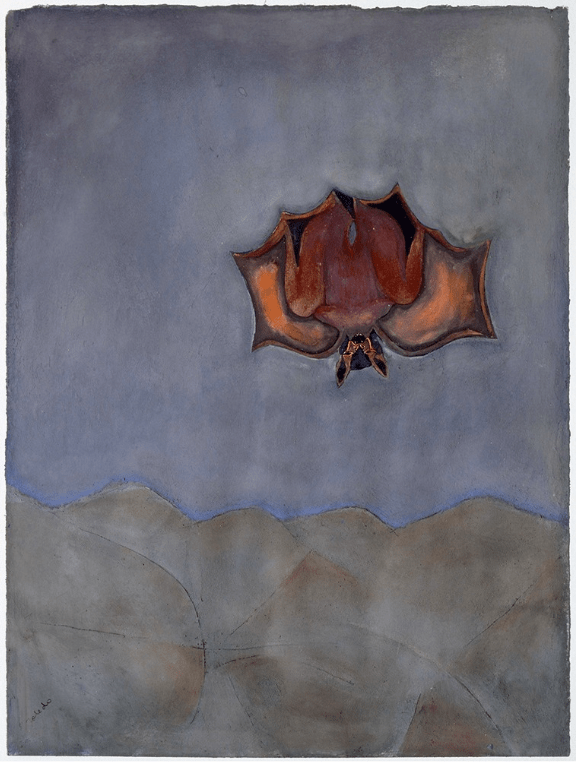
Bat, 1973 by Francisco Toledo (b. 1940)
 Biblioklept