“All art constantly aspires towards the condition of music”

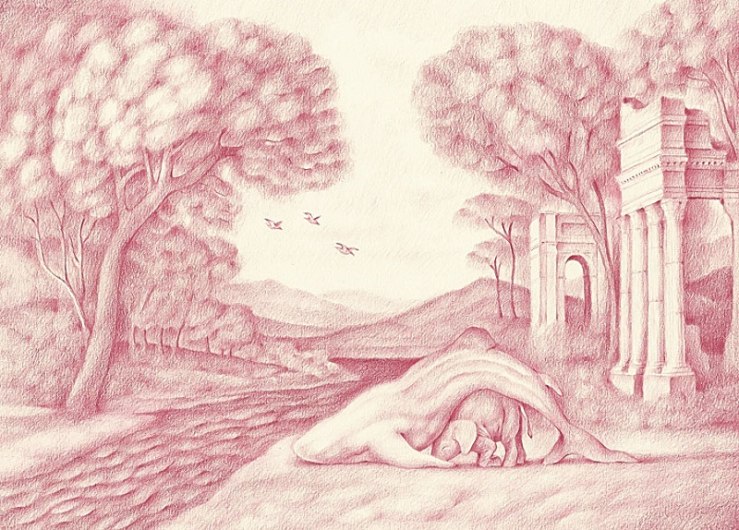
Elephant with Whale — Samuel Branton

sam-branton-13

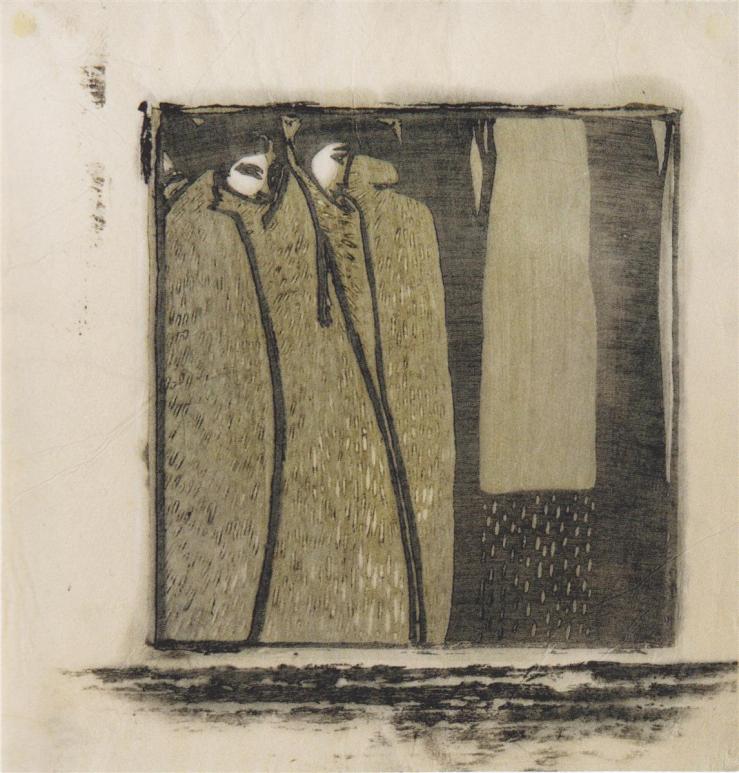
November — Koloman Moser

november-1902hd

Jack O’ Lantern, 2016

img_4119

Make Your Own Animal Mask

mask_www-scarfolk-blogspot-com

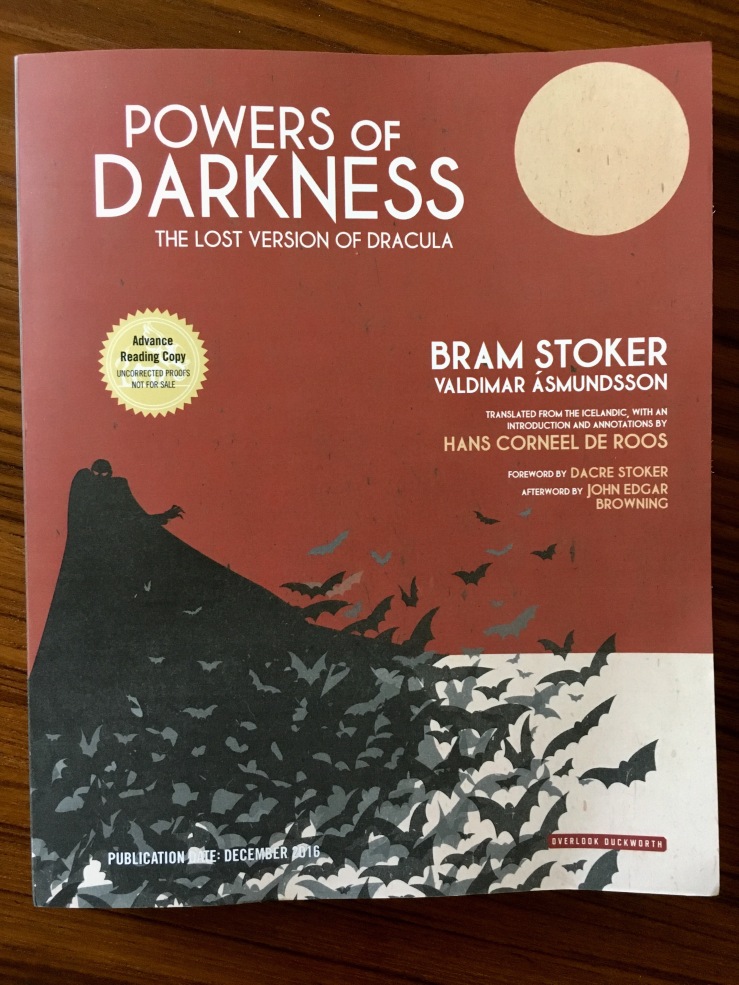
Powers of Darkness: The Lost Version of Dracula (Book required, appropriately, on Halloween, 2016)

img_4120

Ha! Look what showed up in today’s mail?

Powers of Darkness was Valdimar Ásmundsson’s 1901 Icelandic “translation” (Makt Myrkranna) of Stoker’s Dracula; however, translator Hand de Roos discovered that Ásmundsson had actually repurposed and added to the story.

Publisher Duckworth’s blurb:

Powers of Darkness is an incredible literary discovery: In 1900, Icelandic publisher and writer Valdimar Ásmundsson set out to translate Bram Stoker’s world famous 1897 novel Dracula. Called Makt Myrkranna (literally, “Powers of Darkness”), this Icelandic edition included an original preface written by Stoker himself. Makt Myrkranna was published in Iceland in 1901 but remained undiscovered outside of the country until 1986, when Dracula scholarship was astonished by the discovery of Stoker’s preface to the book. However, no one looked beyond the preface and deeper into Ásmundsson’s story.

In 2014, researcher Hans de Roos dove into the full text of Makt Myrkranna, only to discover that Ásmundsson hadn’t merely translated Dracula but had penned an entirely new version of the story, with all new characters and a totally reworked plot. The resulting narrative is one that is shorter, punchier, more erotic, and perhaps even more suspenseful than Stoker’s Dracula. Incredibly, Makt Myrkranna has never been translated or even read outside of Iceland until now.

Powers of Darkness presents the first ever translation into English of Stoker and Ásmundsson’s Makt Myrkranna. Powers of Darkness will amaze and entertain legions of fans of Gothic literature, horror, and vampire fiction.

The intro to the book is fascinating—lots of historical detail, newspaper clippings, and a thorough mapping of Castle Dracula. The text proper is riddled with comparative annotations. A sample:
img_4121

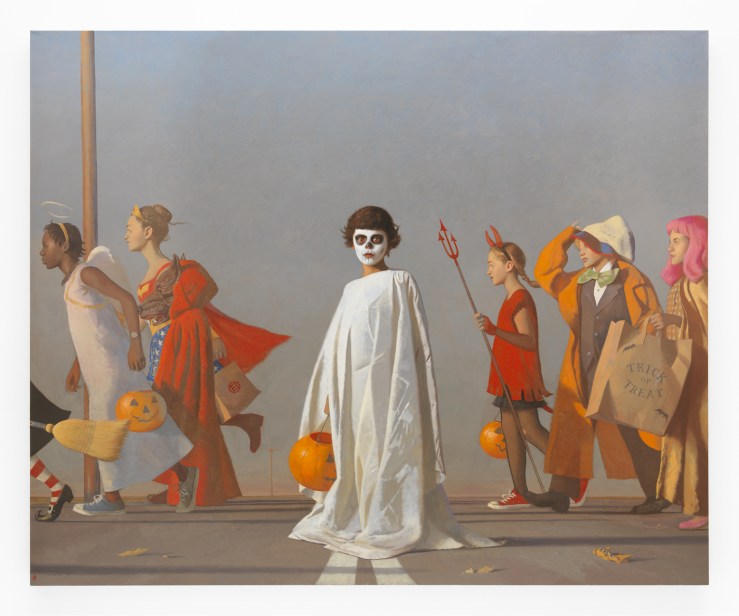
Halloween — Bo Bartlett

bb-halloween-28094

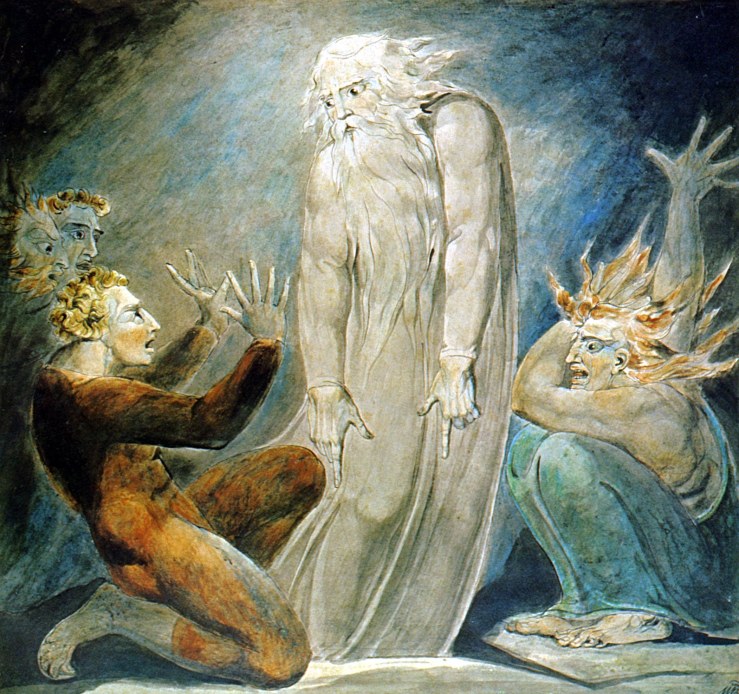
The Witch of Endor — William Blake

the_witch_of_endor_28william_blake29_2

Continue reading “The Witch of Endor — William Blake”

“How Jack O’Lanterns Came To Be” — Zora Neale Hurston

From Zora Neale Hurston’s novelization of folklore, Mules and Men:

It was slavery time, Zora, when Big Sixteen was a man. They called ‘im Sixteen  cause dat was de number of de shoe he wore. He was big and strong and Ole Massa looked to him to do everything.

One day Ole Massa said, “Big Sixteen, Ah b’lieve Ah want you to move dem sills Ah had hewed out down in de swamp.

“I yassuh, Massa.”

Big Sixteen went down in de swamp and picked up dem 12 X 12’s and brought ’em on up to de house and stack ,em. No one man ain’t never toted a 12 X 12 befo’ nor since.

So Ole Massa said one day, “Go fetch in de mules. Ah want to look ’em over.”

Big Sixteen went on down to, de pasture and caught dem mules by de bridle but they was contrary and balky and he tore de bridles to pieces pullin’ on ’em, so he picked one of ’em up under each arm and brought ’em up to Old Massa.

He says, “Big Sixteen, if you kin tote a pair of balky mules, you kin do anything. You kin ketch de Devil.”

“Yassuh, Ah kin, if you git me a nine-pound hammer and a pick and shovel!”

Ole Massa got Sixteen de things he ast for and tole ‘im to go ahead and bring him de Devil.

Big Sixteen went out in front of de house and went to diggin’. He was diggin’ nearly a month befo’ he got where he wanted. Then he took his hammer and went and knocked on de Devil’s door. Devil answered de door hisself.

“Who dat out dere?”

“It’s Big Sixteen.”

“What you want?”

“Wanta have a word wid you for a minute.”

Soon as de Devil poked his head out de door, Sixteen him over de head wid dat hammer and picked ‘im  up and carried ‘im back to Old Massa.

Ole Massa looked at de dead Devil and hollered, “Take dat ugly thing ‘way from here, quick! Ah didn’t think you’d, ketch de Devil sho ’nuff.”

So Sixteen picked up de Devil and throwed ‘im back down de hole.

Way after while, Big Sixteen died and went up to Heben. But Peter looked at him and tole ‘im to g’wan ‘way from dere. He was too powerful. He might git outa order and there wouldn’t be nobody to handle ‘im. But he had to, go somewhere so he went on to hell.

Soon as he got to de gate de Devil’s children was playin’ in de yard and they seen ‘im and run to de house, says, “Mama, mama! Dat man’s out dere dat kilt papa!”

So she called ‘im in de house and shet de door. When Sixteen got dere she handed ‘im a li’l piece of fire and said, “You ain’t comin’ in here. Here, take dis hot coal and g’wan off and start you a hell uh yo’ own.”

So when you see a Jack O’Lantern in de woods at night you know it’s Big Sixteen wid his piece of fire lookin’ for a  place to go.

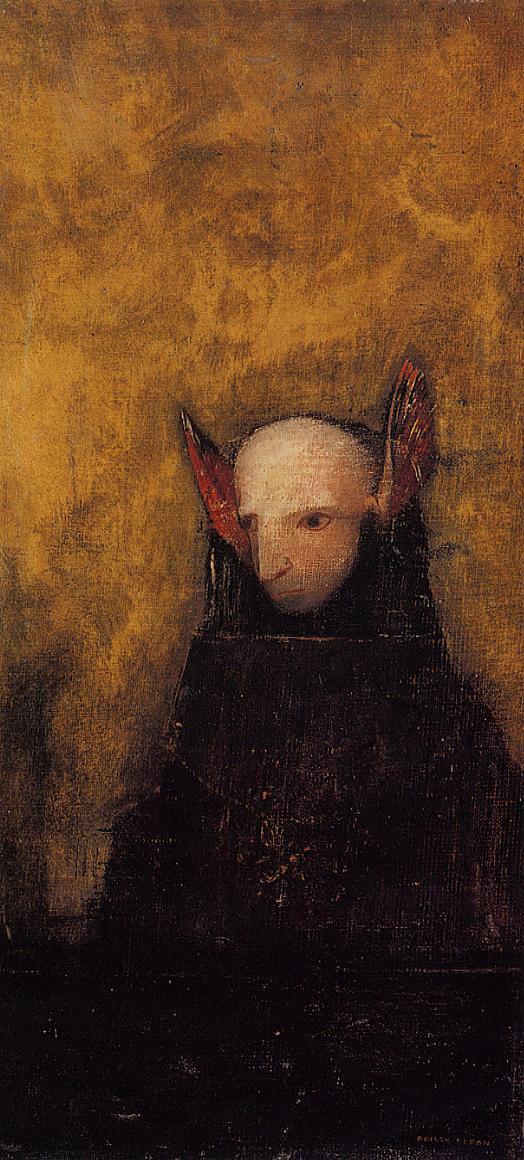
The Monster — Odilon Redon

the-monster

“The Weird Tradition in America,” H.P. Lovecraft’s analysis of American horror fiction

“The Weird Tradition in America”

by

H.P. Lovecraft

(from Supernatural Horror in Literature, 1927)


The public for whom Poe wrote, though grossly unappreciative of his art, was by no means unaccustomed to the horrors with which he dealt. America, besides inheriting the usual dark folklore of Europe, had an additional fund of weird associations to draw upon; so that spectral legends had already been recognised as fruitful subject-matter for literature. Charles Brockden Brown had achieved phenomenal fame with his Radcliffian romances, and Washington Irving’s lighter treatment of eerie themes had quickly become classic. This additional fund proceeded, as Paul Elmer More has pointed out, from the keen spiritual and theological interests of the first colonists, plus the strange and forbidding nature of the scene into which they were plunged. The vast and gloomy virgin forests in whose perpetual twilight all terrors might well lurk; the hordes of coppery Indians whose strange, saturnine visages and violent customs hinted strongly at traces of infernal origin; the free rein given under the influence of Puritan theocracy to all manner of notions respecting man’s relation to the stern and vengeful God of the Calvinists, and to the sulphureous Adversary of that God, about whom so much was thundered in the pulpits each Sunday; and the morbid introspection developed by an isolated backwoods life devoid of normal amusements and of the recreational mood, harassed by commands for theological self-examination, keyed to unnatural emotional repression, and forming above all a mere grim struggle for survival—all these things conspired to produce an environment in which the black whisperings of sinister grandams were heard far beyond the chimney corner, and in which tales of witchcraft and unbelievable secret monstrosities lingered long after the dread days of the Salem nightmare.

Poe represents the newer, more disillusioned, and more technically finished of the weird schools that rose out of this propitious milieu. Another school—the tradition of moral values, gentle restraint, and mild, leisurely phantasy tinged more or less with the whimsical—was represented by another famous, misunderstood, and lonely figure in American letters—the shy and sensitive Nathaniel Hawthorne, scion of antique Salem and great-grandson of one of the bloodiest of the old witchcraft judges. In Hawthorne we have none of the violence, the daring, the high colouring, the intense dramatic sense, the cosmic malignity, and the undivided and impersonal artistry of Poe. Here, instead, is a gentle soul cramped by the Puritanism of early New England; shadowed and wistful, and grieved at an unmoral universe which everywhere transcends the conventional patterns thought by our forefathers to represent divine and immutable law. Evil, a very real force to Hawthorne, appears on every hand as a lurking and conquering adversary; and the visible world becomes in his fancy a theatre of infinite tragedy and woe, with unseen half-existent influences hovering over it and through it, battling for supremacy and moulding the destinies of the hapless mortals who form its vain and self-deluded population. The heritage of American weirdness was his to a most intense degree, and he saw a dismal throng of vague spectres behind the common phenomena of life; but he was not disinterested enough to value impressions, sensations, and beauties of narration for their own sake. He must needs weave his phantasy into some quietly melancholy fabric of didactic or allegorical cast, in which his meekly resigned cynicism may display with naive moral appraisal the perfidy of a human race which he cannot cease to cherish and mourn despite his insight into its hypocrisy. Supernatural horror, then, is never a primary object with Hawthorne; though its impulses were so deeply woven into his personality that he cannot help suggesting it with the force of genius when he calls upon the unreal world to illustrate the pensive sermon he wishes to preach.

Hawthorne’s intimations of the weird, always gentle, elusive, and restrained, may be traced throughout his work. The mood that produced them found one delightful vent in the Teutonised retelling of classic myths for children contained in A Wonder Book and Tanglewood Tales, and at other times exercised itself in casting a certain strangeness and intangible witchery or malevolence over events not meant to be actually supernatural; as in the macabre posthumous novel Dr. Grimshawe’s Secret, which invests with a peculiar sort of repulsion a house existing to this day in Salem, and abutting on the ancient Charter Street Burying Ground. In The Marble Faun, whose design was sketched out in an Italian villa reputed to be haunted, a tremendous background of genuine phantasy and mystery palpitates just beyond the common reader’s sight; and glimpses of fabulous blood in mortal veins are hinted at during the course of a romance which cannot help being interesting despite the persistent incubus of moral allegory, anti-Popery propaganda, and a Puritan prudery which has caused the late D. H. Lawrence to express a longing to treat the author in a highly undignified manner. Septimius Felton, a posthumous novel whose idea was to have been elaborated and incorporated into the unfinished Dolliver Romance, touches on the Elixir of Life in a more or less capable fashion; whilst the notes for a never-written tale to be called “The Ancestral Footstep” shew what Hawthorne would have done with an intensive treatment of an old English superstition—that of an ancient and accursed line whose members left footprints of blood as they walked—which appears incidentally in both Septimius Felton and Dr. Grimshawe’s Secret. Continue reading ““The Weird Tradition in America,” H.P. Lovecraft’s analysis of American horror fiction”

Sunday Comics (From Hell)

img_4081

From Hell, Alan Moore and Eddie Campbell’s epic revision of the Jack the Ripper story, posits Sir William Gull, a physician to Queen Victoria, as the orchestrator of the Ripper murders that terrified Londoners at the end of the 19th century. The murders initially arise as a means to cover up an illegitimate son begat by foolish Prince Albert, Victoria’s grandson. However, for Gull the murders represent much more. The murders are part of the continued forces of “masculine rationality” that will constrain “lunar female power.” Gull is a high-level Mason; during a stroke, he experiences a vision of the Masonic god Jahbulon, one which prompts him to his “great work”–namely, the murders that will reify masculine dominance.
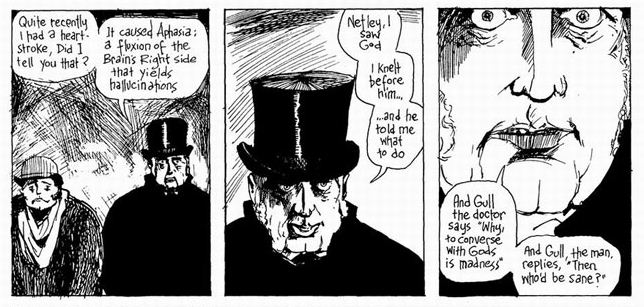
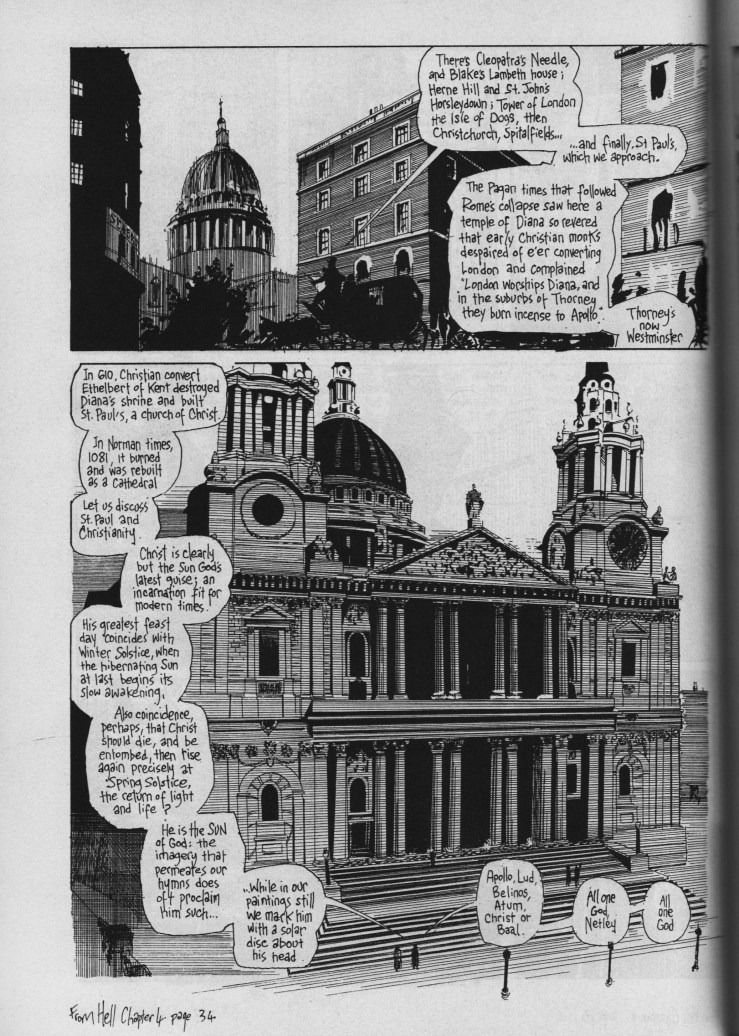
One of the standout chapters in the book is Gull’s tour of London, with his hapless (and witless) sidekick Netley. In a trip that weds geography, religion, politics, and mythology, Gull riffs on a barbaric, hermetic history of London, revealing the gritty city as an ongoing site of conflict between paganism and orthodoxy, artistic lunacy and scientific rationality, female and male, left brain and right brain. The tour ends with a plan to commit the first murder.
img_4080

From there, the book picks up the story of Frederick Abberline, the Scotland Yard inspector charged with solving the murders. Of course, the murders are unsolvable, as the hierarchy of London–from the Queen down to the head of police–are well aware of who the (government-commissioned) murderer is. The police procedural aspects of the plot are fascinating and offer a balanced contrast with Gull’s mystical visions–visions that culminate in a climax of a sort of time-travel. Gull goes backwards (William Blake sees him in a vision and turns that vision into Ghost of Flea) and Gull goes forwards: he sees London at the end of the twentieth century, and receives a guarantee that his murder plot has had its intended effect.

From Hell takes many of its cues from the idea that history is shaped not by random events, but rather by tragic conspiracies that force people to willingly give up freedom to a “rational” authority. The book points repeatedly to the 1811 Ratcliffe Highway murders, which led directly to the world’s first modern police force. In our own time, if we’re open to conspiracy theories, we might find the same pattern in the 21st century responses to terrorism.
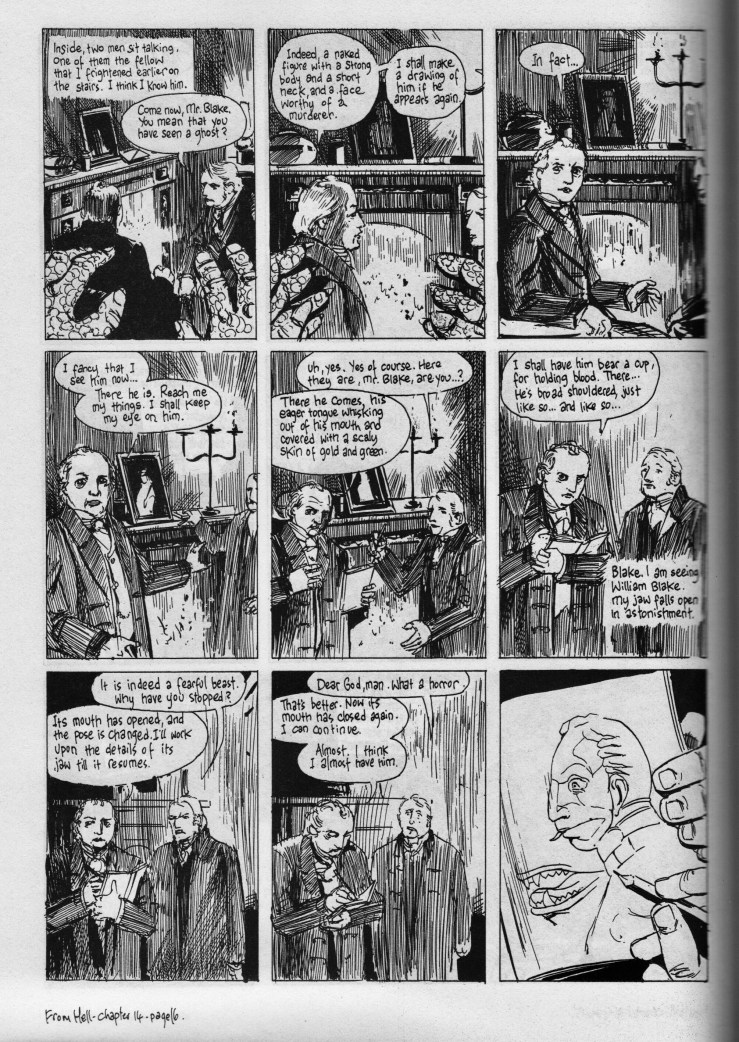
img_4083

Although From Hell features moments of supernatural horror in Gull’s mysticism, it is the book’s grimy realism that is far more terrifying. London in the late 1880s is no place you want to be, especially if you are poor, especially if you are a woman. The city is its own character, a labyrinth larded with ancient secrets the inhabitants of which cannot hope to plumb. Despite the nineteenth century’s claims for enlightenment and rationality, this London is bizarrely cruel and deeply unfair. Campbell’s style evokes this London and its denizens with a surreal brilliance; his dark inks are by turns exacting and then erratic, concentrated and purposeful and then wild and severe. The art is somehow both rich and stark, like the coal-begrimed London it replicates. Although Moore has much to say, he allows Campbell’s art to forward the plot whenever possible. Moore is erudite and fascinating; even when one of his characters is lecturing us, it’s a lecture we want to hear. His ear for dialog and tone lends great sympathy to each of the characters, especially the unfortunate women who must turn to prostitution to earn their “doss” money. And while Abberline’s frustrations at having to solve a crime that no higher-ups want solve make him the hero of this story, Gull’s mystic madness makes him the narrative’s dominant figure.

From Hell is a fantastic starting place for anyone interested in Moore’s work, more self-contained than his comics that reimagine superhero myths, like Watchmen or Swamp Thing, and more satisfying and fully achieved than Promethea or V Is for Vendetta. Be forewarned that it is a graphic graphic novel, although I do not believe its violence is gratuitous or purposeless. Indeed, From Hell aspires to remark upon the futility and ugliness of cyclical violence, and it does so with wisdom and verve. Highly recommended.

[Editorial note: Biblioklept published a version of this review on Halloween day in 2010].

Woman at Sink — Gregory Crewdson

crewd-2014-woman-at-sink-copy

“Dance of the Macabre Mice” — Wallace Stevens

screenshot-2016-10-03-at-6-32-58-pm

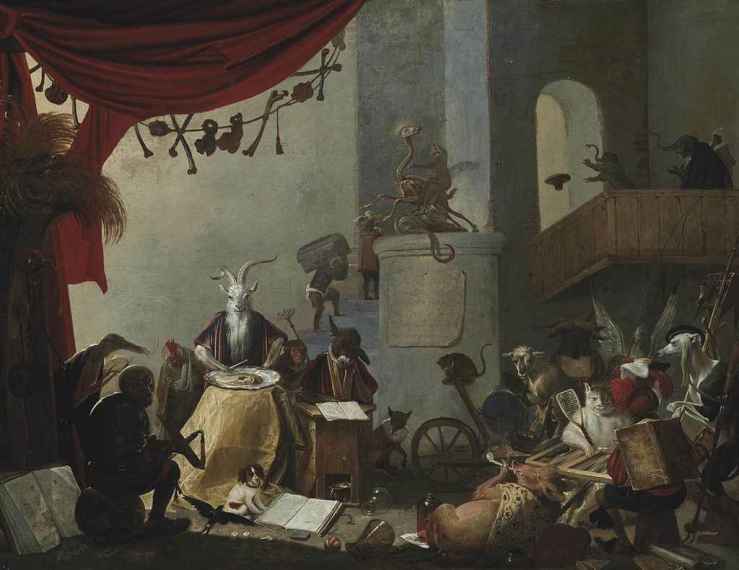
Interior with a Goat Eating an Oyster, a Donkey at a School Desk, a Cat Playing Tric-Trac, and Other Mythical Creatures — Cornelis Saftleven

cornelis_saftleven_an_interior_with_a_goat_eating_an_oyster_a_donkey_a_d5559323g

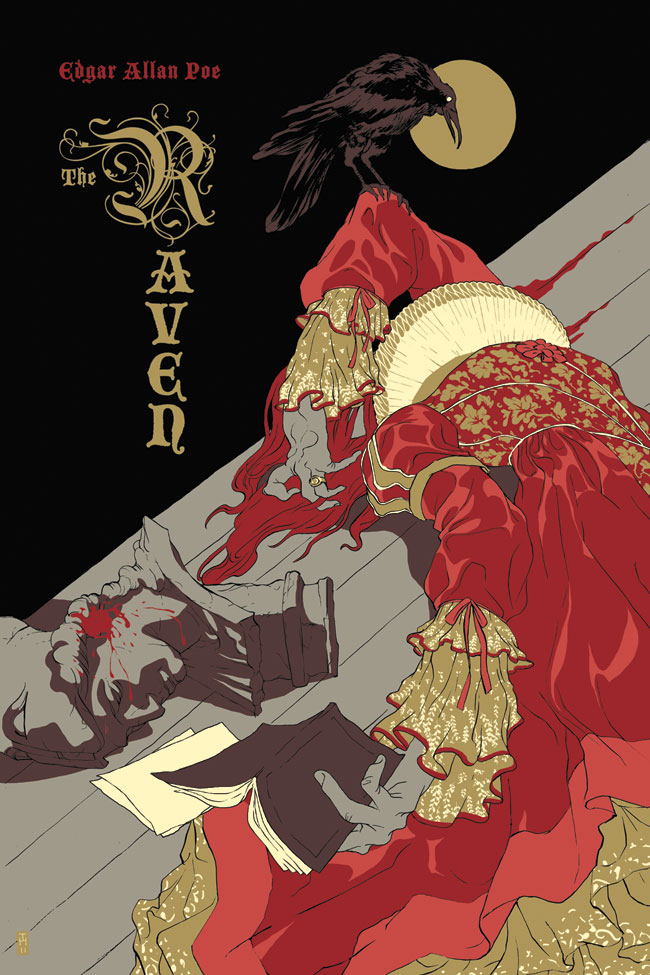
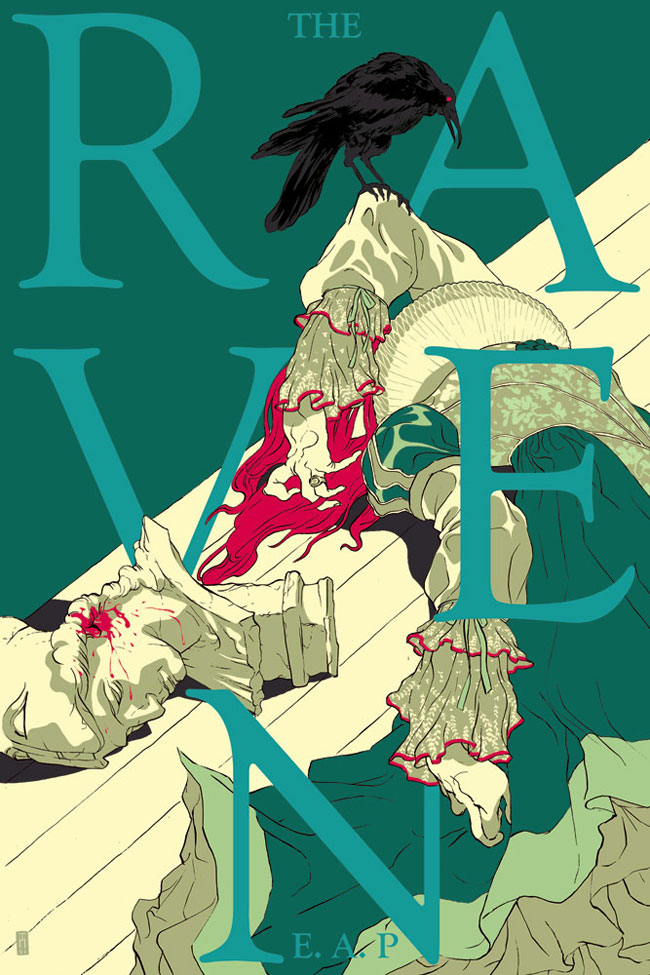
Tomer Hanuka’s illustrations for Poe’s poem “The Raven”

raven_850

raven_650

screenshot-2016-10-29-at-1