Zombies at the bad restaurant (Barry Hannah)

Raymond suddenly knew it was time to return to the bad restaurant and then his ache for visions would be satisfied. The bad restaurant would stay when only zombies prevailed. It served food for the dead, tired fishermen and humble vacationers worsened the instant they sat down and had the bad water. Thousands like it at state lines, watering holes in the great western deserts, far flung Idaho and Maine. Their owners say, “We just couldn’t help it, we were food people. We never said good food people.”

Raymond was in the pawnshop looking at a delightful saxophone and about to buy it when the feeling hit him. What he would see and be transformed by was right next door to his own cottage, not out in the fars, the wides, the bars or churches. He put the saxophone down and within seconds saw a shadow past the shop. It was a man hobbling and slurring of the few words he could manage, and Raymond was positive it was Mimi’s old ex, what was left of him after the suicide attempt in Vicksburg, rolling and pitching up Market and the pawns to find Raymond. He went out to the walk and saw nothing but a red car leaving. And he followed it in his own. Mimi it was in Miami singing with another band for a couple of weeks. He was alone. He knew this was right. He had not eaten for two days, for no good reason. The moment was pressing.

A zombie had just waited on him in the pawnshop, a man who stood there remarking on the history of this saxophone. In apparently good health, in decent clothes and well groomed, polite, but quite obviously dead and led by someone beyond. You could look at them and know they are spaces ahead into othernewss. Not at all adolescent either, that natural Teutonic drifting or the sullenness without content. They might still be people, but unlikely.

Everything about the zombie is ravaged except his obsessions, thought Raymond, following the red car. Dead to every other touch. They simply imitate when there is movement or sound. They imitate the conversations around them to seem human to one another. He had seen them in scores from the airports to the bandstands imitating one another, mimicking the next mimicker in no time, no space, no place, no history.

The bad restaurant even had bad-food loungers and loiterers, hard to shake when they got a good imitation of you going. The restaurant with its RESTAURANT sign. Its mimicking of the dining life, yet no edible food, bad water and a weak tea to go with that. Refill that beige for you, sir? Every dish served in contempt for what used to be human. Rations for an unannounced war.

From Barry Hannah’s 2001 novel Yonder Stands Your Orphan

Dogs are in space and time (Barry Hannah)

“Most animals live a short while,” said Ulrich, “but I had a revelation. That we cannot know the intensity of their lives, which is hundreds of times more attuned than ours. They don’t talk because they don’t need speech. A dog, when it puts its head out a car window, smells almost everything in a county, a world we never even suspect and have no description for. That is why I am daft. I have flown and smelled the smells, Carl Bob. I have known life by my nose. That’s why the dog looks so ecstatic sniffing in the wind. They smell a thousand times more than we do. We could only know it as hallucinatory sense. Dogs are in space and time. We can only know one or the other, plodding, toddling. Not to mention hearing. And taste. Water is fifty times more delicious to them. We must not pity them, a cheap passive hobby. They live huge lives before they die. Watch how happy sleep is to them, and right next to waking. They live both at once. We are predators not only of meat but of essence, my friend. We want to be them because they have spoken to us without speaking and we can hardly bear their superiority.”

From Barry Hannah’s 2001 novel Yonder Stands Your Orphan.

In the passive voice, something happened, somebody was killed and so on (Barry Hannah)

The sheriff was doing a five-minute commentary on the Weekend Review on television Saturday night. Both Dee and Melanie watched.

“The world is full of middle-aged men who seek revenge. The anger passes for most when they see there is no way. The rate of incarceration is very low for first-time offenders of sixty. For some, there is a bigger engine of hate even then, running at the red line and very vigilant toward what they might consider insults or even bossiness. They aren’t just having it, the engine, like the others. They are it. They have not been aware of this, and their acts confound them. Those are ones you see on television or in the newspapers discussing sodomy, rape, kidnapping and murder in the passive voice, something happened, somebody was killed and so on, sometimes even giggling. ‘Mistakes were made, yes, when she was killed. I can’t remember, really.’ Such as that.”

From Barry Hannah’s 2001 novel Yonder Stands Your Orphan.

Piss on Star Wars (Barry Hannah)

Last night at one of his homes, the big fifties-ranch-style one, he had watched on his large flat screen Phillips television the film clips and recitation of a minister. A curious breed of faith, perhaps not even Christian.

“Why do people look for science, science fiction and signs of the End? Why do they seek the Revelation of the Apocalypse here and there and chant the old chants of the coming Antichrist, the Four Horsemen? Science fiction has already been had, fools. It was the Battle of Kursk, German tanks against Russian tanks, fifty-seven years ago. It was Leningrad, Stalingrad, Moscow, Berlin, idiots! What does it take, a sock in the jaw for you to get it that the Forces of Darkness fought then? The Antichrist on both sides. Piss on Star Wars. Nothing touches WW Two for science fiction and wasteland.

From Barry Hannah’s 2001 novel Yonder Stands Your Orphan.

Everybody’s been futurized (Barry Hannah)

Ulrich had been quiet, painting on deck varnish. Now he spoke. “We don’t love each other as much as we used to. You can see the uncertain looks, the calculations, the dismissals. People are not even in the present moment. Everybody’s been futurized. You look in those eyes and see they’re not home, they’re some hours ahead at least. I hate to go into Vicksburg anymore. Anywhere, really. It’s all like meeting people who have just departed. Old men and women don’t look wise anymore. They are just aged children. And who gets the highest pay? Actors. Paid to mimic life because there is no life. You look at everybody and maybe they’re a little sad, some of ’em. They’re all homesick for when they were real.” Ulrich began painting again as the others tried to guess what could have prompted this.

From Barry Hannah’s 2001 novel Yonder Stands Your Orphan.

Two or three Barry Hannahs, depending on how you look at it (Books acquired, 14 and 18 Aug. 2017)

img_7707-1

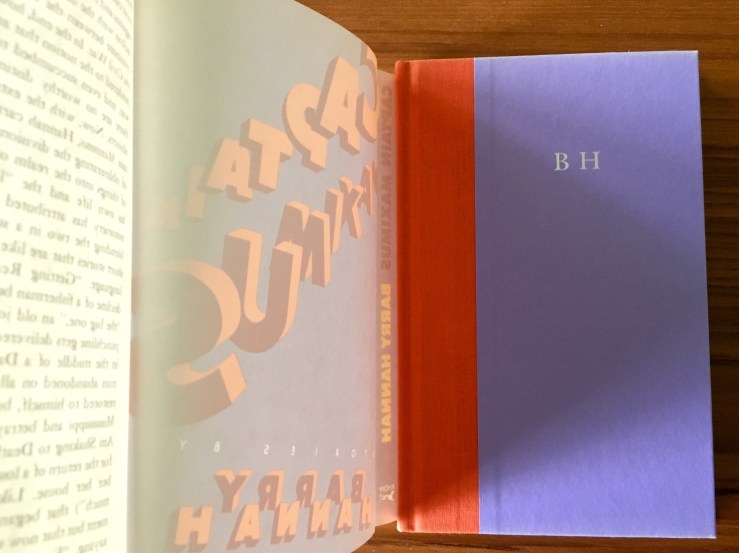
Earlier this summer I visited Alias East Books East in Los Angeles, where the clerk kindly let me handle a signed first edition of Barry Hannah’s novel RayIt was like sixty bucks, so I didn’t handle it too fondly. But somehow the image of the signature rattled around in my silly skull all summer—probably because I spent a big chunk of July slurping up Long, Last, Happy. I wanted to find out some info about Hannah’s last quartet of stories—the last four stories in L, L, H—and doing a search of his name in Twitter led me to a link for a signed first-edition hardback copy of his slim 1985 collection Captain Maximus. (The title is a joke on his then-editor, Gordon “Captain Fiction” Lish, who apparently Hannah referred to as “Captain Minimus” in some of their letters). I might have had a scotch or two, but I bid on the book (eighteen bucks). No one else bid on it, so it’s mine now.

The cover is lovely, purple and orange, designed by Fred Marcellino, and under the bright shiny jacket is this:

img_7709

I love the reserved arrogance of those initials!

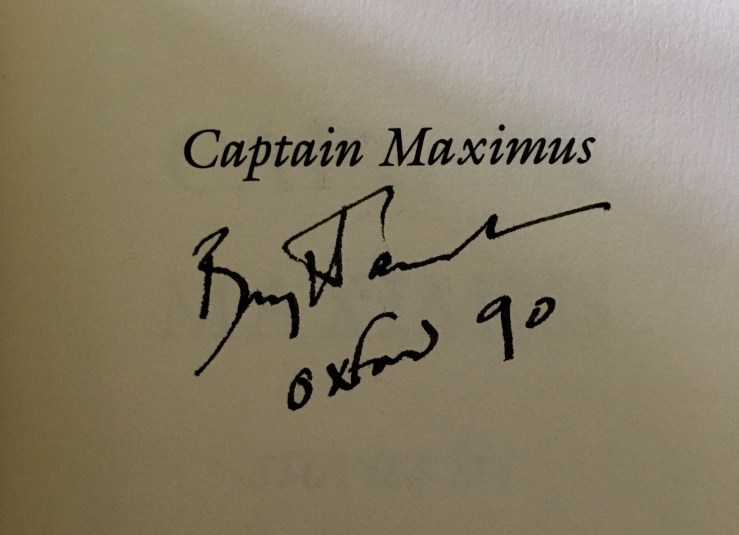
And of course the signature, dated five years after the book’s publication and geographically anchored to the town my grandfather and namesake attended college in—

img_7710

I didn’t actually own a copy of Captain Maximus beforehand, and I think the only stories from it included in Long, Last, Happy (which, by the way is a great starting place for Hannah) are “Fans,” “Ride, Fly, Penetrate, Loiter” and “Even Greenland” (you can read “Even Greenland” at Ben Marcus’s website). This particular copy has clearly never been read.  Which leads me to this afternoon. I went to my favorite used bookstore to pick up a copy of Ishmael Reed’s The Terrible Threes—I just finished The Terrible Twos, a novel that is too prescient and too funny and too cruel and you should read it read it read it—and well anyway, I went to see if maybe they had a copy of Yonder Stands Your Orphan, which they didn’t the last time I was there, but they did today. Under it was a well-thumbed 1986 Penguin paperback edition of Captain Maximus. I need to read Yonder (which hell by the way my god what a bad cover c’mon people) before I can write the Thing I want to write on the final stories in Long, Last, Happy (or at least I think I need to read it, or anyway, I want to). And the second copy of Captain Maximus, at three dollars in store credit, is something I don’t have to worry about cramming into a pocket or dropping into a bathtub or eventually giving away to a friend.

Anxiety of influence (Barry Hannah’s “ideal inner voices”)

The fact is I wanted to write long before I had anything to say. I don’t find this condition at all unusual in young writers, good or bad. A sort of attuned restlessness. Often it is simply an overriding need to talk. A sort of transcribed logorrhea, worse than decent gossip. I’ve taught these people, forever blasting away in wretched detail, solidly in love with their own noise. I must say, I was never infatuated with my own voice. It was the ideal inner voices that took me, and they came from everywhere, especially Hemingway, Joyce, Henry Miller, and later, Flannery O’Connor. Like many Mississippians, I shied away from Faulkner, who was at once remote and right there in your own backyard, the powerful resident alien. Having read a little of him, I sensed I would be overcome by him, and had a dread, in fact, that he might be the last word. That I would wind up a pining third-rate echo, like many another Southerner. Then T.S. Eliot, especially “Prufrock.” But the earliest great howler who made me want to make the team was the badly forgotten Dylan Thomas, whose voice seemed available everywhere in English departments in the ’50s and ’60s. It seemed to me a fine thing to get drunk and just start being Welsh and crowing surrealism, as I perceived it. Put that against the sullen bitchery of Holden Caulfield, which charmed almost everybody my age, and you would be cooking. Miles Davis might one day shake your hand. He was God, and that would be very nice.

From Barry Hannah’s essay “Why I Write”; read the whole thing at The Oxford American.

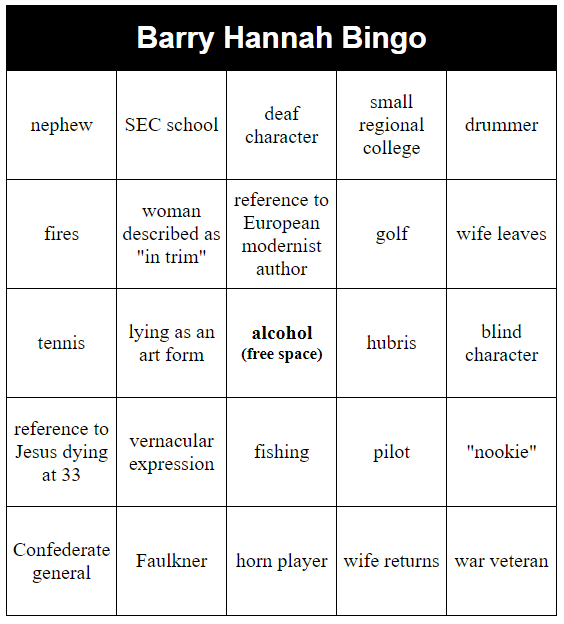
Barry Hannah Bingo

barry hannah bingo

The Nobel laureate William Faulkner died in the hot July preceding the September riots (Barry Hannah)

tooThe Nobel laureate William Faulkner died in the hot July preceding the September riots. It was good he didn’t have to watch. He was a racial moderate, read nigger lover in these parts then, and left much of his estate to the United Negro College Fund. I mention him only to place this story on the map and call to memory, now I’m an old man, that not all of us were rot. I did understand much of Faulkner’s greatest books. Personally I disliked him as a snob who with no effort at all could have been kinder to the neighbors in the village we were then. He was passing strange and spiteful to many. You had to reckon with some conceit as birthright, which made him contemptuous of the very humble folk he was celebrated for taking to his heart on the page. You will often see pure words and a great wash of self-atonement, no people necessary to them.

From one of Barry Hannah’s last short stories, “Lastword, Deputy James.” Published posthumously in the collection Long, Last, Happy, the story (often evocative of Cormac McCarthy, at least to me), along with the others in the last section of the collection, reads like part of a perhaps-unfinished novel, one that answers seriously to Southern history in a way that Hannah’s earlier work obliquely evades.

William Faulkner died 6 July 1962. He dropped out of the University of Mississippi–Ole Miss—as a young man, just like my grandfather.

The Ole Miss riot of 1962, sometimes styled “the Battle of Oxford,” began the night of 30 September 1962. The riots–a battle really—were the result of racist segregationists’ opposition to the James Meredith’s enrollment in the university. Meredith, a black man, served in the U.S. Air Force from 1951-1960. He graduated from Ole Miss on 18 August 1963, earning a bachelor’s degree in political science.

A review of Barry Hannah’s cult classic collection Airships

img_1423

In his 1978 collection Airships, Barry Hannah sets stories in disparate milieux, from the northern front of the Civil War, to an apocalyptic future, to the Vietnam War, to strange pockets of the late-twentieth century South. Despite the shifts in time and place, Airships is one of those collections of short stories that feels somehow like an elliptical, fragmentary novel. There are the stories that correspond directly to each other — the opener “Water Liars,” for instance, features (presumably, anyway), the same group of old men as “All the Old Harkening Faces at the Rail.” The old men love to crony up, gossip, tell tall tales. An outsider spoils the fun in “Water Liars” by telling a truth more terrible than any lie; in “Harkening,” an old man shows off his new (much younger) bride. These stories are perhaps the simplest in the collection, the homiest, anyway, or at least the most “normal” (whatever that means), yet they are both girded by a strange darkness, both humorous and violent, that informs all of Airships.

We find that humor and violence in an outstanding trio of Civil War stories (or, more accurately, stories set during the Civil War). The narrator of “Dragged Fighting from His Tomb,” a Confederate infantryman relates a tale of heroic slaughter with a hypberbolic, phallic force. Observe—

I knew the blueboys thought they had me down and were about ready to come in. I was in that position at Chancelorsville. There should be about six fools, I thought. I made the repeater, I killed four, and the other two limped off. Some histrionic plumehead was raising his saber up and down on the top of a pyramid of crossties. I shot him just for fun. Then I brought up another repeater and sprayed the yard.

Later, the narrator defects, switches to the Union, and claims he kills Jeb Stuart, a figure that towers over the Civil War tales. The narrator of “Dragged Fighting” hates Stuart; the narrator of “Knowing He Was Not My Kind Yet I Followed” is literally in love with the General. In contrast to the narrator of “Dragged Fighting,” the speaker in “Knowing” — an avowed “sissy” whom the other soldiers openly detest — hates the violence and madness of war—

We’re too far from home. We are not defending our beloved Dixie anymore. We’re just bandits and maniacal. The gleam in the men’s eyes tells this. Everyone is getting crazier on the craziness of being simply too far from home for decent return. It is like Ruth in the alien corn, or a troop of men given wings over the terrain they cherished and taken by the wind to trees they do not know.

He despairs when he learns of Jeb Stuart’s death. In the final Civil War story, “Behold the Husband in His Perfect Agony,” a Union spy is given the task to communicate news of Stuart’s death through enemy lines. Rather than offering further explication, let me instead point you, dear reader, to more of Hannah’s beautiful prose, of which I have not remarked upon nearly enough. From “Behold the Husband” —

Isaacs False Corn, the Indian, the spy, saw Edison, the Negro, the contact, on the column of an inn. His coat was made of stitched newspapers. Near his bare feet, two dogs failed earnestly at mating. Pigeons snatched at the pieces of things in the rushing gutter. The rains had been hard.

The short, descriptive passage rests on my ears like a poem. Hannah, who worked with Gordon Lish, evinces in his writing again and again that great editor’s mantra that writing is putting one sentence after another.

Although set in the Vietnam War, “Midnight and I’m not Famous Yet” seems an extension of the Civil War stories. In it, an officer from a small Southern town goes slowly crazy from all the killing, yet, like the narrator of “Dragged Fighting,” he presents himself as a warrior. Above all though, he laments that the war has robbed him of some key, intermediary phase of his late youth, a phase he can’t even name—

The tears were out of my jaws then. Here we shot each other up. All we had going was the pursuit of horror. It seemed to me my life had gone straight from teen-age giggling to horror. I had never had time to be but two things, a giggler and a killer.

This ironic sense of a “pursuit of horror” pervades Airships, particularly in the collection’s most apocalyptic visions. “Eating Wife and Friends” posits an America where food shortages and material scarcity leads people to eating leaves and grass — and then each other. In “Escape to Newark,” the environment is wildly out of balance—

In August it’s a hundred fifty degrees. In December it’s minus twenty-five and three feet of snow in Mississippi. In April the big trees explode.

A plan is made to “escape” these conditions via a rocket, but of course there’s not enough fuel to get past Newark. In Airships, modes of flight are transcendent but ultimately transient. Gravity’s pull is heavy stuff.

Just as Hannah’s war stories are not really war stories, his apocalypse tales are really about human relationships, which he draws in humor, pathos, and dark cynicism. In “Green Gets It,” an old man repeatedly attempts his suicide, only to fail again and again. His suicide note, written to his daughter, is scathing and shocking and sad and hilarious and wise–

My Beloved Daughter,

Thanks to you for being one of the few who never blamed me for your petty, cheerless and malign personality. But perhaps you were too busy being awful to ever think of the cause. I hear you take self-defense classes now. Don’t you understand nobody could take anything from you without leaving you richer? If I thought rape would change you, I’d hire a randy cad myself. I leave a few dollars to your husband. Bother him about them and suffer the curse of this old pair of eyes spying blind at the minnows in the Hudson.

Your Dad,

Crabfood

Although Hannah explores the darkest gaps of the soul in Airships, he also finds there a shining kernel of love in the face of waste, depravity, violence, and indifference. This love evinces most strongly perhaps in Airships trio of long stories. These tales, which hover around 30 pages, feel positively epic set against the other stories in the collection, which tend to clock in between five and ten pages. The first long story, “Testimony of Pilot,” details the development of a boyhood friendship over a few decades. It captures the strange affections and rivalries and unnameable bonds and distances that connect and disconnect any two close friends. The second of the long tales is “Return to Return,” a tragicomic Southern drama in the Oedipal vein (with plenty of tennis and alcoholism to boot). As in “Testimony of Pilot,” Hannah finds some measure of redemption, or at least solace, for his characters in their loving friendship, yet nothing could be more unsentimental. The final long story, which closes the collection, is “Mother Rooney Unscrolls the Hurt,” a daring work of stream of consciousness that seems to both respond to — and revise — Katherine Anne Porter’s “The Jilting of Granny Weatherall.” The story concludes (and of course concludes the volume) with a vision of love that corresponds to the imagery of The Pietà, a kind of selflessness that ironically confirms the self as an entity that exists in relation to the pain of others.

I could keep writing of course — I’ve barely touched on Hannah’s surrealism, a comic weirdness that I’ve never seen elsewhere; it is Hannahesque, I suppose. Nor have I detailed Hannah’s evocations of regular working class folk, fighting and drinking and divorcing and raising children (not necessarily in that order). Airships is a world too rich and fertile to unpack in just one review, and I’ve already been blathering too long, I fear, when what I really want  to do is just outright implore you, kind reader, to find it and start reading it immediately. Very highly recommended.

[Editorial note: Biblioklept published a version of this review on March 20th, 2011. I am currently listening to the audiobook of the Hannah omnibus Long, Last, Happy, and just finished the first section, which contains most of Airships. The audiobook is good, but I wish it was Hannah reading it himself.]

Three Books

img_1423

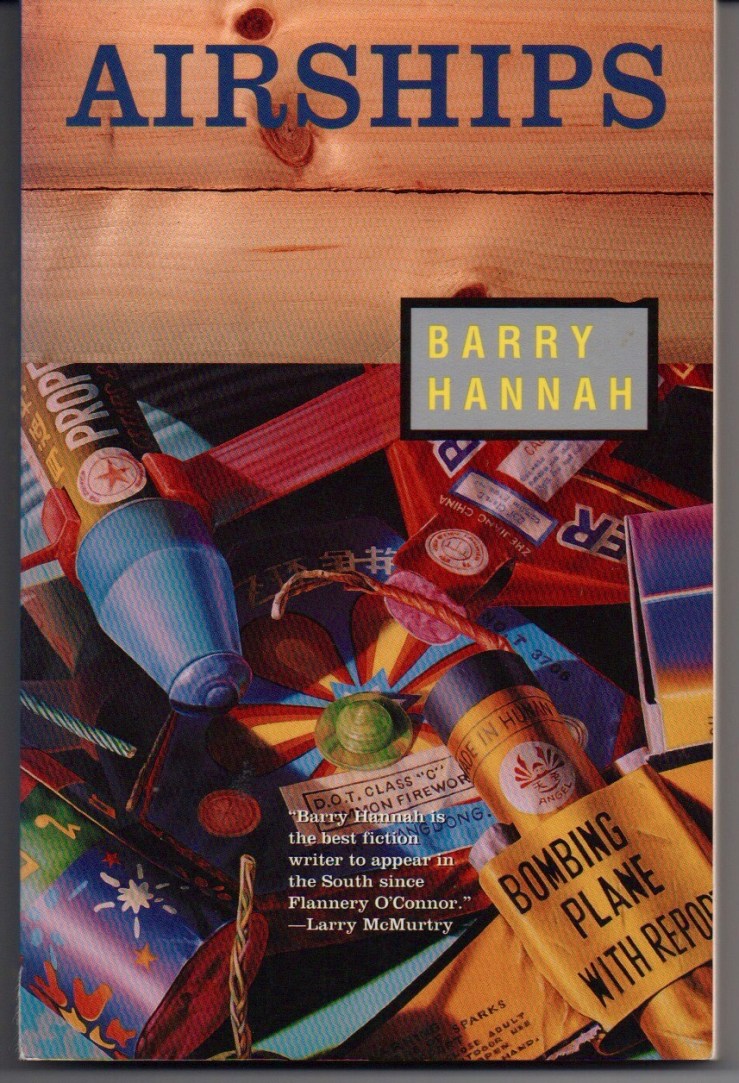
Airships by Barry Hannah. 1994 trade paperback by Grove Press. Cover design by Rick Pracher. The cover painting is Chrysanthemum by Hannah’s contemporary, the photorealist painter Glennray Tutor. Hannah wrote an essay about Tutor’s work called “Deep Pop,” declaring

Once one’s amazement at the astonishing precision in the paintings of Glennray Tutor has had time to sink in, the opportunity arises to contemplate the visual eloquence in his depictions of the small artifacts of life, and how such compositions can say profound things about the nature of our existence.

I reviewed Airships on this blog some years ago.

img_1421

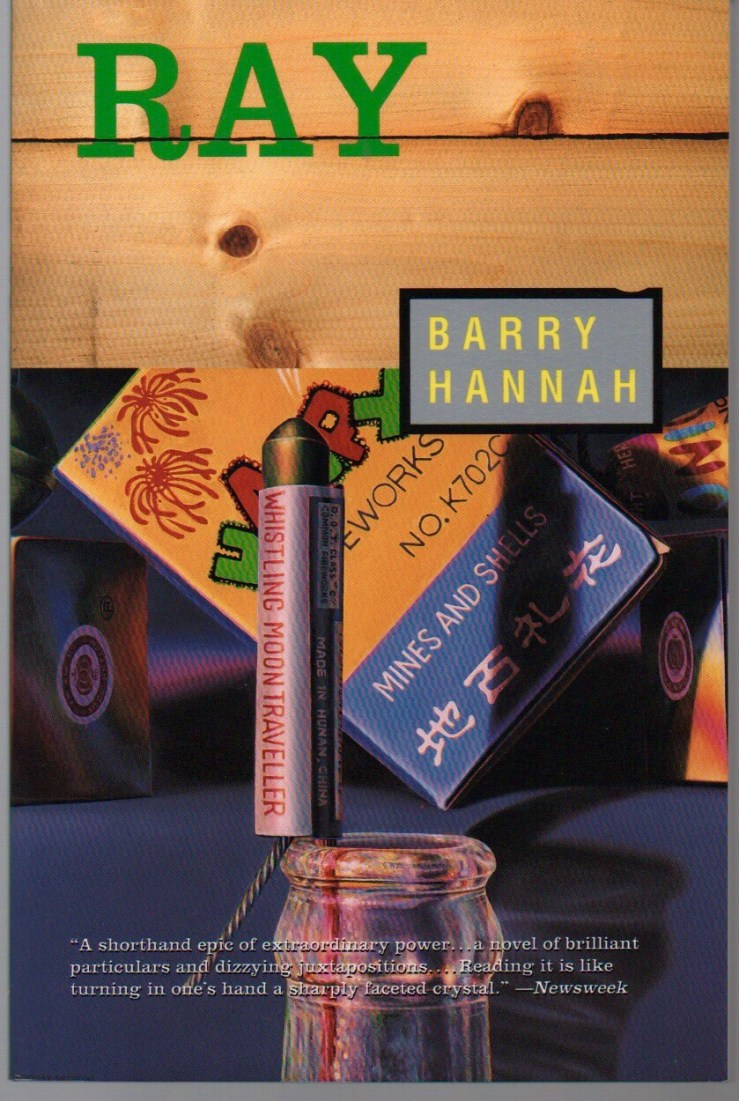
Ray by Barry Hannah. 1994 trade paperback by Grove Press.  Cover design by Rick Pracher. The cover painting is the center panel of Glennray Tutor’s triptych Whistling Moon Traveler. I reviewed Ray on this blog the same year I reviewed Airships.

img_1422

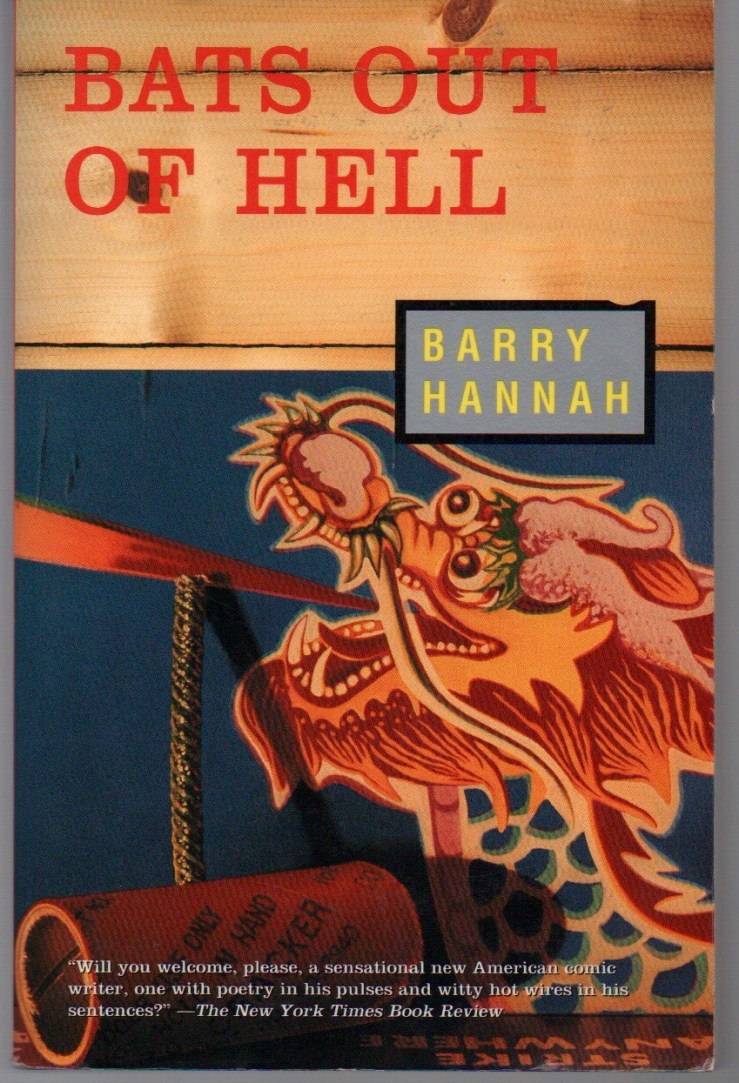
Bats out of Hell by Barry Hannah. 1994 trade paperback by Grove Press.  Cover design by Rick Pracher. The cover painting is the left panel of Glennray Tutor’s triptych Dragon Boat. I did not review Bats out of Hell, but some of the sketches contained therein appear in Hey Jack!, which I did review.

Categories are bad news (Barry Hannah)

 WT: Do you read magazines?

BH: If someone would rave about a story in the New Yorker, I’ll read it. But you get a lot of that Woody Allen–New Yorker–Hamptons fiction. My [students] have to send off to the little magazines. I get the sense that only grad students read those.

WT: Writer’s writers?

BH: I don’t like that term, because I wouldn’t buy somebody’s album on a dare if they called him a musician’s musician. I don’t write to be a writer’s writer. I don’t want to be like the little-magazine writer. I don’t want to be that.

Categories are bad news. Being Southern will just kill you sometimes. It’s not always a graceful adjective. Sometimes it means, don’t bother because it’s gonna be [sings a lick from dueling banjos]. It’s gonna be: porch, banjo, Negroes. There’s a canned dream of the South that a lot of people get into, and I’ve resisted that stuff my entire so-called career. Ready-made Southernism just disgusts me, just makes me nauseated. I mean, you can’t see a movie without hearing that goddamned slide guitar. Shit, I’m just so tired of it.


From Barry Hannah’s interview with Wells Tower in The Believer.

“A Christmas Thought” — Barry Hannah

Read Barry Hannah’s perfect short story “Even Greenland”

I was sitting radar. Actually doing nothing.

We had been up to seventy-five thousand to give the afternoon some jazz. I guess we were still in Mexico, coming into Mirimar eventually in the F-14. It doesn’t much matter after you’ve seen the curvature of the earth. For a while, nothing much matters at all. We’d had three sunsets already. I guess it’s what you’d call really living the day.

But then, “John,” said I, “this plane’s on fire.”

“I know it,” he said.

John was sort of short and angry about it.

“You thought of last-minute things any?” said I.

“Yeah. I ran out of a couple of things already. But they were cold, like. They didn’t catch the moment. Bad writing,” said John.

“You had the advantage. You’ve been knowing,” said I.

“Yeah. I was going to get a leap on you. I was going to smoke you. Everything you said, it wasn’t going to be good enough,” said he.

“But it’s not like that,” said I. “Is it?”

The wings were turning red. I guess you’d call it red. It was a shade against dark blue that was mystical flamingo, very spaceylike, like living blood. Was the plane bleeding?

“You have a good time in Peru?” said I.

“Not really,” said John. “I got something to tell you. I haven’t had a ‘good time’ in a long time. There’s something between me and a good time since, I don’t know, since I was was twenty-eight or like that. I’ve seen a lot, but you know I haven’t quite seen it. Like somebody’s seen it already. It wasn’t fresh. There were eyes that used it up some.”

“Even high in Mérida?” said I.

“Even,” said John.

“Even Greenland?” said I.

Read the rest of Barry Hannah’s short story “Even Greenland.”

That long long, bloated epicene tract “The Waste Land” by Eliot (Barry Hannah)

That long long, bloated epicene tract “The Waste Land” by Eliot—the slideshow of some snug librarian on the rag—was nothing, unworthy, in the notes that every sissy throws away. I would not talk to students about it. You throw it down like pickled eggs with nine Buds and move on to giving it to the preacher’s wife on a hill while she spits on a photograph of her husband.

From Barry Hannah’s short story “Ride, Fly, Penetrate, Loiter.” Collected in Captain Maximus. (Captain Maximus is the narrator here, by the bye).

Read Barry Hannah’s Short Story “The Spy of Loog Root”

THE OUTCAST NEPHEW was farhearinged. That is a difficult word and concept, but as with farsighted, his ear could not participate with sounds up close, only those far away, up to a quarter mile, a distance of course at which the rest of us townsmen can hear little at all except explosions and aircraft. It seemed to work that if voices were soft enough, faint enough, they could penetrate his tympana. One thought of the sound waves, but how, in his case? I don’t know, but imagine the tenderness of his ears, bent by the incredible bawling of noise he must have sensed up close, so that he ran away, holding both ears in agony, dispossessed of normal human intercourse.

He was one of those exceptional children, ghostly with long blond hair, to whom none of his family out at Loog Root Pass felt kin, except the mother. We never got, because of his affliction, a definite reckoning on his intelligence before he ran off, alone, into the hills.

Read the rest of Barry Hannah’s short story “The Spy of Loog Root” at The Oxford American.

“Dear Awful Diary” — Barry Hannah

dadbh