We — that is, my family of four — split a nice spring break between heatwaved Los Angeles and more temperate Santa Barbara last week. I managed to squeeze in a visit to The Last Bookstore, which I hadn’t visited since 2017.
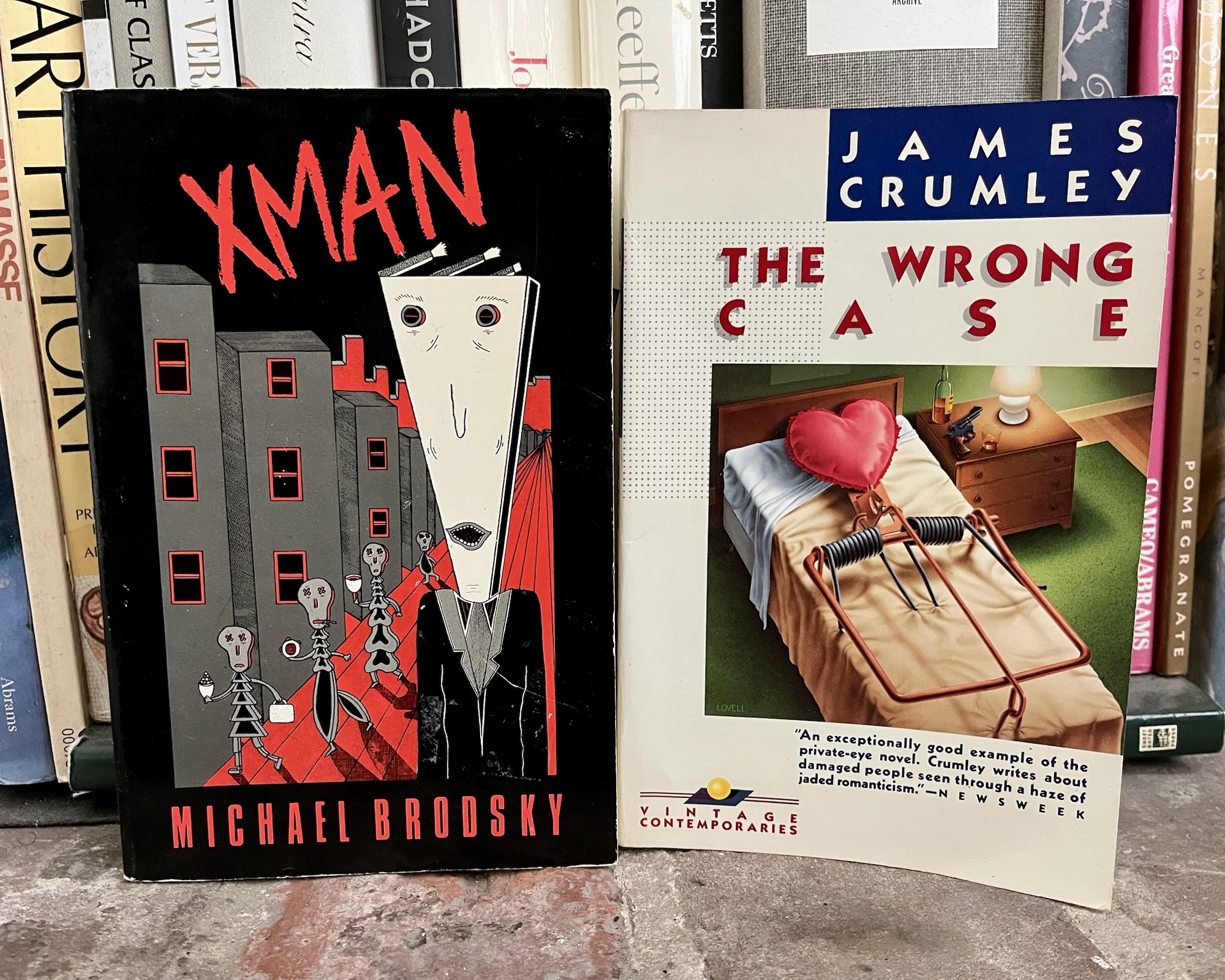
I keep a little list of books and authors to search for; one of these is the long-out-of-print 1987 cult novel Xman by Michael Brodsky. I found it about two minutes in, under “B” (duh) in gen fic for the steep steep price of five U.S. dollars. I also picked up another James Crumely novel, part of the Vintage Contemporaries series.
We — that is my son and I — also visited Skylight Books (after an unexpected pilgrimage to the Figure 8 wall on Sunset — the mural from the cover of that Elliott Smith record — we were just walking by it and my son who is a Fan lost his shit). Skylight Books is very very cool, with a great selection of comix, art books, zines, &c., but I failed to pick anything up, mostly because I was hungry and cranky.
We also visited LACMA, where I was disappointed that the many of the paintings I had seen on my previous visit were not currently on display (including Georges de la Tour’s Magdalen with Smoking Flame which knocked my socks off when I saw it up close all those years ago).
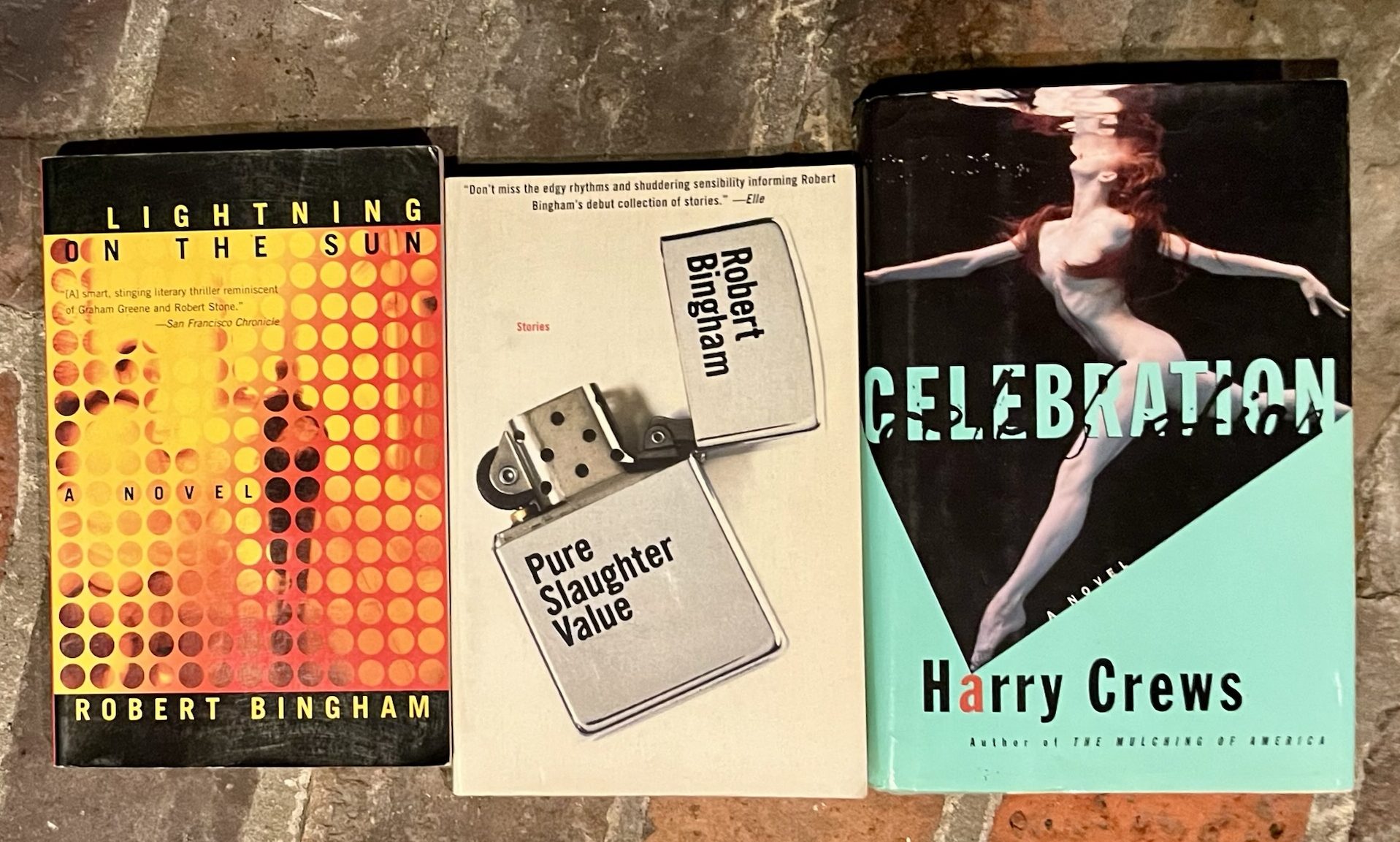
I finally gave in and picked up Robert Bingham’s books, the novel Lightning on the Sun and the collection Pure Slaughter Value.
Bingham was one of the founders of the literary magazine and press Open City. Open City published David Berman’s collection Actual Air in 1999. Bingham was friends with Berman and the Pavement boys. He was also the wealthy scion of an old Louisville family. He o.d.’d in ’99. Both Malkmus and Berman eulogized him in song — SM in “Church on White,” the Silver Jews in “Death of an Heir of Sorrows”:
I wish I had a rhinestone suit
I wish I had a new pair of boots
But mostly I wish
I wish I was with you
I think what really plugged the Bingham back into my brain was going through a July 1999 issue of SPIN magazine. I was looking for something else, but I found an old Pavement profile in which Bingham shows up early with bobo hockey tix. From the profile:
Pavement are standing outside Madison Square Garden, shouldering their way through tens of thousands of burly hockey fans. There’s a sold-out game about to start—the Rangers vs. the Mighty Ducks—and cops, peanut vendors, and entire families in matching red-white-and-blue Rangers jerseys mill about, blocking the sidewalk. “We’ve never gone to a hockey game together,” says bassist Mark Ibold. He is unceremoniously shoved aside by a squall of kids bearing cotton candy. “Usually we go see baseball games.”
Pavement pal Robert “Bingo” Bingham, a New York fiction writer, grows increasingly nervous as they approach the arena. He bought the band scalped tickets, an offense he’s been nailed for once before. “Should we come up with a fall-back strategy?” he says.
“Don’t sweat it, Bingo,” says bandleader Stephen Malkmus, still wearing the track suit and squash shoes he threw on this morning while awaiting clean laundry. The band is determined to get in, as percussionist Bob Nastanovich has already phoned his bookie to bet on the Rangers. “We don’t much care for the Ducks,” Nastanovich says.
“They’re all Steve Garveys,” adds the clean-cut Malkmus. Nastanovich takes a final drag from his Marlboro, then leads the group through the throngs to the ticket line. They cruise right in, home free—until a security squad catches up with them moments later.
“You aren’t going anywhere with those,” a guard says, motioning at the ticket stubs in Bingo’s hand. “They’re fakes.”
“Oh, please,” Bingo says. He knows they’re scalped, but fakes? A bit stunned, the band takes a look. “Well, yeah,” Ibold says. “I can see that.”
The printing is all faded and off-register.
“Mine looks like it was perforated with a cookie cutter,” says Nastanovich. Upon further inspection, they realize they all have the same seat.
Meanwhile, the Garden crowd is going ballistic. Christopher Reeve has just been wheeled onto the ice for the opening ceremony. Security hems and haws for a while, and finally takes pity on Pavement. A bearded fellow rests a cozy hand on Bingo’s arm. “You tell me who you bought these from,” he says, “and if he’s still out there, we’ll bust the fucker.”
Bingo hangs his head. “I don’t remember,” he mutters, and ambles off. Pavement trudge back to the street, reassuring their friend that the night is still young. They end up viewing the game at a nearby sports bar, and work on getting stinking drunk. Nedved is benched. Gretzky is checked. The once formidable Rangers lose handily, 4–1. Nastanovich looks up from his Bass Ale and shakes his head, laughing. He just lost $100.
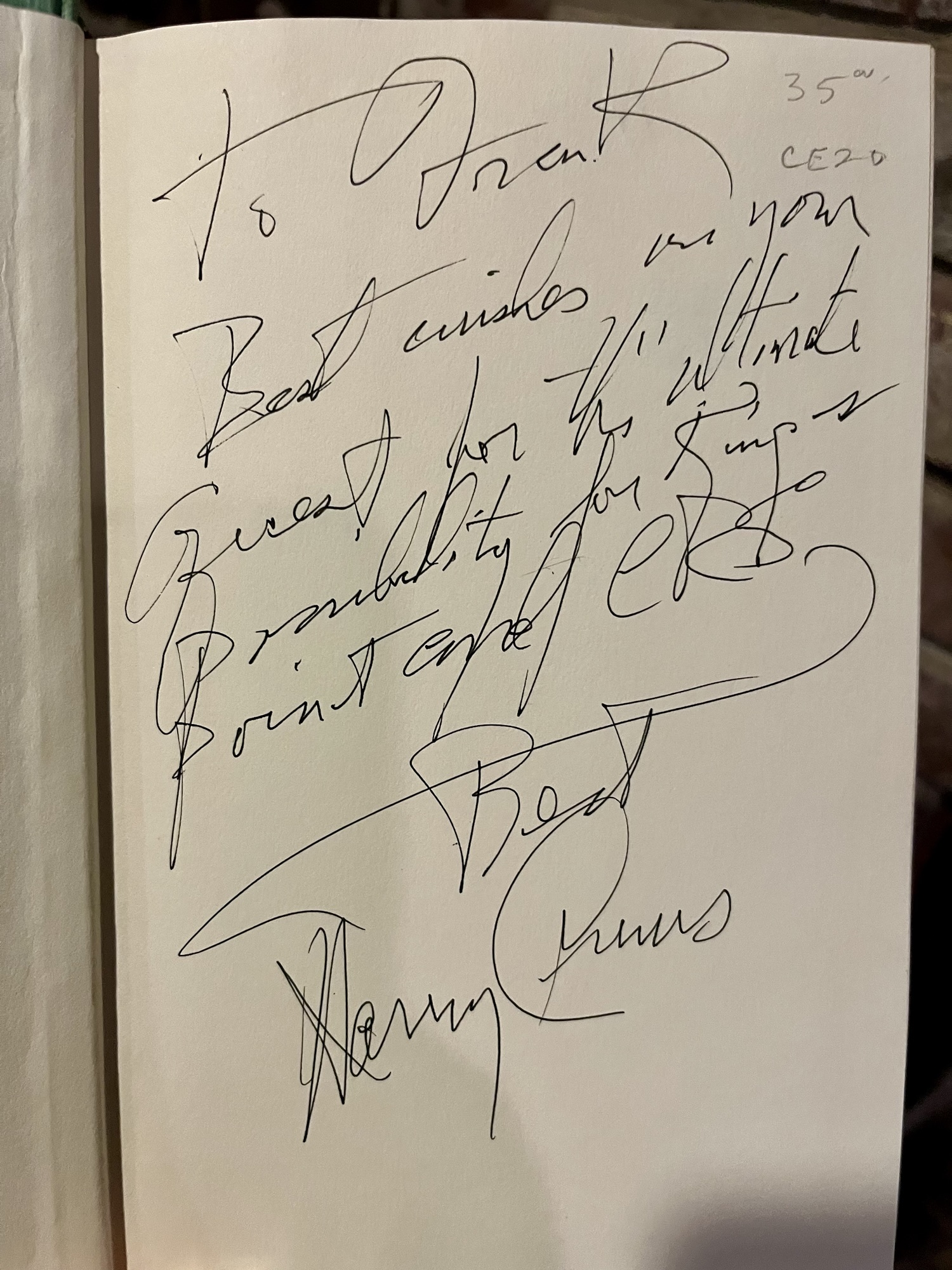
I also couldn’t resist a signed copy of Harry Crews’ 1998 novel Celebration.
If you can make out the inscription, let me know. I think it’s to Frank, who was on the ultimate quest for…?
Two new collections from NYRB’s Poets imprint: On the Slaughter by Hayim Nahman Bialik, translated by Peter Cole, and Fifty Poems by Rainer Maria Rilke, translated by Geoffrey Lehmann. NYRB’s Bialik blurb:
Few poets in the history of Hebrew have possessed the power and prescience of Hayim Nahman Bialik. Born in 1873 in a small Ukrainian village, he spent his most productive years in Odessa and in his fifties made his way to British Mandatory Palestine. He died in Vienna in 1934. His body of work opened a path from the traditional Jewish world of Eastern Europe into a more expansive Jewish humanism. In a line that stretches back to the Bible and the Hebrew poetry of Muslim and Christian Spain, he stands out—in the words of Maxim Gorky—as “a modern Isaiah.” He remains to this day an iconic and shockingly relevant poet, essayist, and tutelary spirit.
Translated and introduced by MacArthur-winning poet Peter Cole, On the Slaughter presents Bialik for the first time in English as a masterful artist, someone far more politically and psychologically unsettling than his reputation as the national poet of the Jewish people might suggest. This compact collection offers readers a panoramic view of Bialik’s inner and outer landscapes—from his visionary “poems of wrath” that respond in startling fashion to the devastations of pogroms and revolutionary unrest to quietly sublime lyrics of longing and withering self-assessment. The volume also includes a sampling of slyly sophisticated verse for children, and a moving introduction that bridges Bialik’s moment and our own.
And “The Grown-up,” a poem from Rilke in Lehmann’s translation:
“The Grown-up”
All stood on her, all that has ever been
and was the world, and stood, its fears and grace,
as trees stand straight and rooted in one place, and solemn, like the memory of a race
or Ark of God, all-seeing and not seen.
She carried it; knowledge of who they are,
the flyers, those who flee, the distant ones,
the monsters and the awkward, diffident sons,
casually like a brimming water jar
on her calm head. Then in the midst of play,
preparing, changing slowly, cell by cell,
she did not sense the first white veil that fell
across her open face, bland as the day,
almost opaque, never to lift again.
And she forgot the answers she once knew,
leaving some vagueness she could not explain:
in you, the child who you have been, in you.
NYRB is publishing new English language translations of works by Henrik Pontoppidan. The big boy is Pontoppidan’s opus A Fortunate Man; the much-slimmer The White Bear actually collects two novellas, The White Bear and The Rearguard. All three translations are the effort of Paul Larkin.
NYRB’s copy for The White Bear
The White Bear follows the fate of the odd, gangly, red-bearded Thorkild Müller. Born in rural Jutland and destined for the ministry, Thorkild proves to be a poor student and is assigned to a remote Inuit tribe in Greenland. There, with his mythic-looking staff and dogskin skullcap, he becomes known as the White Bear—a beloved legend among the locals and a freewheeling embarrassment to his fellow priests. Grown old, he returns to Denmark, where again his flock adores him while his fellow men of cloth try to tame the “whirling dervish in their midst.” In the end Thorkild mysteriously disappears, presumably back to the snow wilderness of Greenland.
And The Rearguard:
The Rearguard, on the other hand, is a marriage story. Newlyweds Jørgen Hallager and Ursula Branth are as different as night and day. The brash son of a poor village teacher, Jørgen is an avowed socialist whose revolutionary beliefs translate into his work as a painter of social realism; Ursula comes from a conservative, upper-middle-class family. At first, as they start their married life in Rome, they each try to change the other’s worldview with arguments and threats, but as time wears on and they wear each other down, it becomes clear there can be no reconciliation. It is a tragic tale of art and idealism, individuality and love.
And the big guy:
A Fortunate Man tells the story of Per Sidenius, a Lutheran pastor’s son who revolts against his family and flees the backwaters of Jutland for Copenhagen. Per is handsome, ambitious, and hungry for the technological future of the twentieth century. He studies engineering and draws up plans for a new port and new canals, for harnessing wind and wave energy to transform Denmark into a commercial giant. Fully persuaded of his own genius, Per first repels and then attracts Jakobe Salomon, a young Jewish woman whose family is eager to underwrite his plans. They fall in love and get engaged; gradually Jakobe opens Per’s eyes to the wider world. Meanwhile, he also falls under the spell of Dr. Nathan, a popular philosopher who rails against the conservative powers that be. But ultimately these powers win out, Per’s relationship with Jakobe founders, and he goes home to Jutland and marries a pastor’s daughter. Though fortunate, he is never happy.
One of the last great nineteenth-century novels and Henrik Pontoppidan’s masterpiece, A Fortunate Man anatomizes and skewers Danish society, from the small towns to the metropolis. Paul Larkin’s dazzing translation brings out the wide range and full force of a novel admired by Georg Lukács and praised by Ernst Bloch as “one of the foundational texts of world literature.”
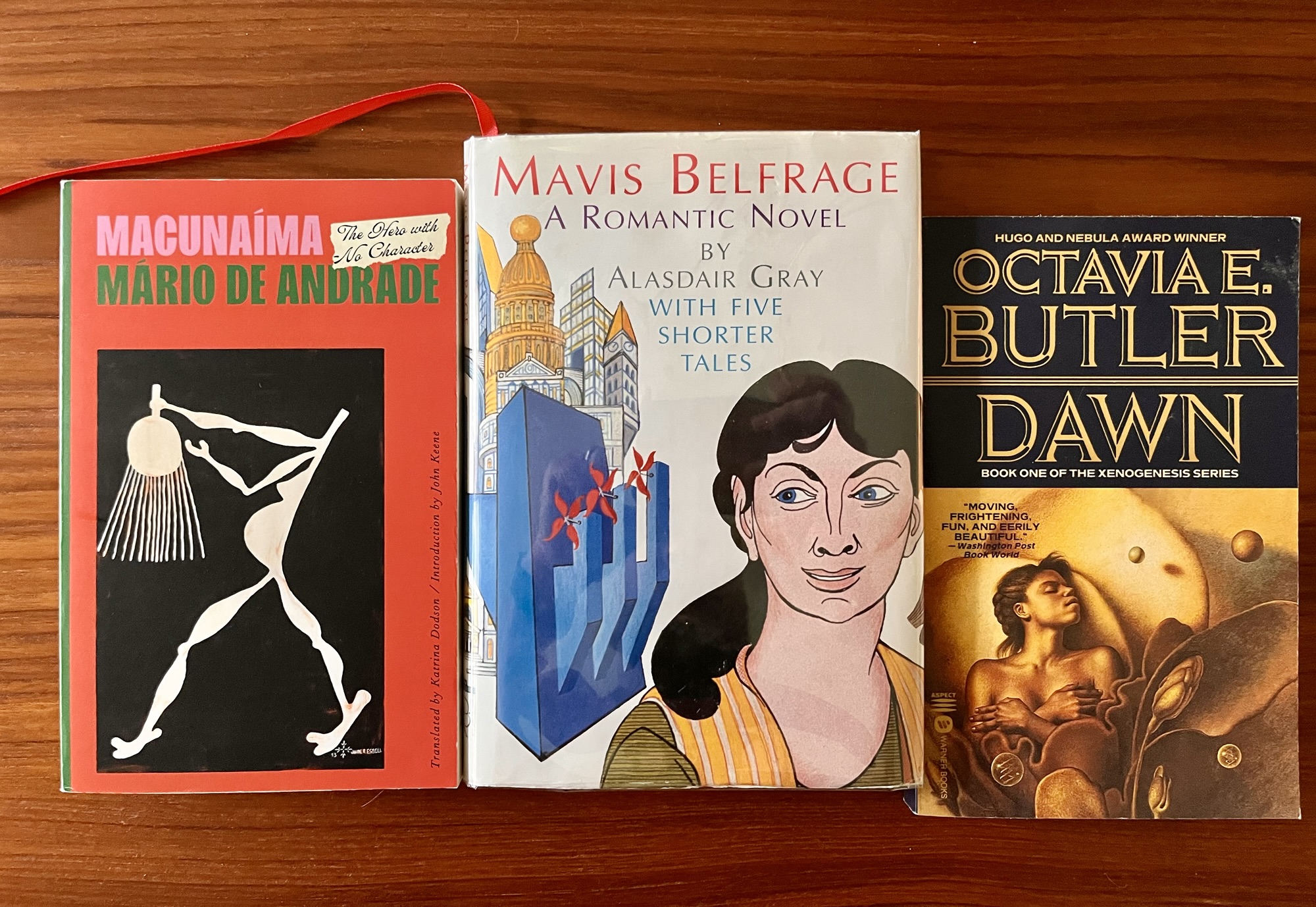
I pretty much will pick up any hardback Alasdair Gray book at this point, so I was happy to come across a pristine used copy of Mavis Belfrage last Friday. From The Complete Review’s review:
Strong, dark stuff, and well-presented. There are no happy ends here, but it reads true-to-life, and there is a certain satisfaction to the collection. The volume, artfully designed by Gray, is also aesthetically pleasing. Recommended.
I also picked up a copy of Octavia Butler’s Dawn, which my wife promptly snapped up when I got home. And the nice dude who works at the bookstore that I always chat with sold me on Brazilian author Mário de Andrade’s 1928 novel Macunaíma (in a new translation by Katrina Dodson).
I have this Gray line printed out and taped to a mirror in my office:
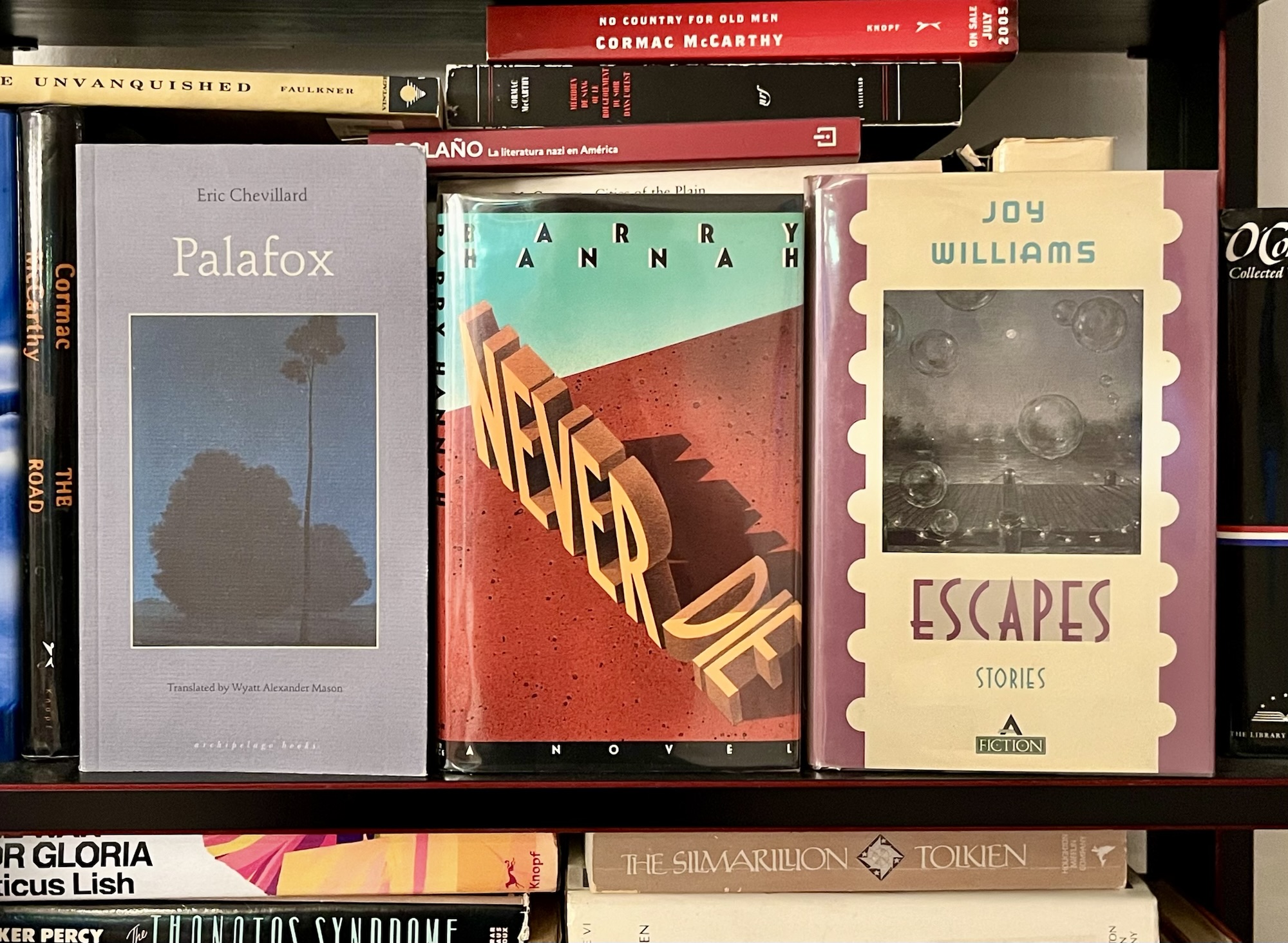
I dropped off a few books for trade credit and wound up with hardback first editions of Barry Hannah’s Never Die and Joy Williams’ 1990 collection Escapes. I also couldn’t pass up on Éric Chevillard’s Palafox in translation by Wyatt Mason. (I really dug Chris Clarke’s translation of Chevillard’s short novel The Posthumous Works of Thomas Pilaster.)
My mother was a drinker. Because my father left us, I assumed he was not a drinker, but this may not have been the case. My mother loved me and was always kind to me. We spent a great deal of time together, my mother and I. This was before I knew how to read. I suspected there was a trick to reading, but I did not know the trick. Written words were something between me and a place I could not go. My mother went back and forth to that place all the time, but couldn’t explain to me exactly what it was like there. I imagined it to be a different place.
As a very young child, my mother had seen the magician Houdini. Houdini had made an elephant disappear. He had also made an orange tree grow from a seed right on the stage. Bright oranges hung from the tree and he had picked them and thrown them out into the audience. People could eat the oranges or take them home, whatever they wanted.
How did he make the elephant disappear, I asked.
‘He disappeared in a puff of smoke,’ my mother said. ‘Houdini said that even the elephant didn’t know how it was done.’
Was it a baby elephant, I asked.
My mother sipped her drink. She said that Houdini was more than a magician, he was an escape artist. She said that he could escape from handcuffs and chains and ropes.
‘They put him in straitjackets and locked him in trunks and threw him in swimming pools and rivers and oceans and he escaped,’ my mother said. ‘He escaped from water-filled vaults. He escaped from coffins.’
I said that I wanted to see Houdini.
‘Oh, Houdini’s dead, Lizzie,’ my mother said. ‘He died a long time ago. A man punched him in the stomach three times and he died.’
Dead. I asked if he couldn’t get out of being dead.
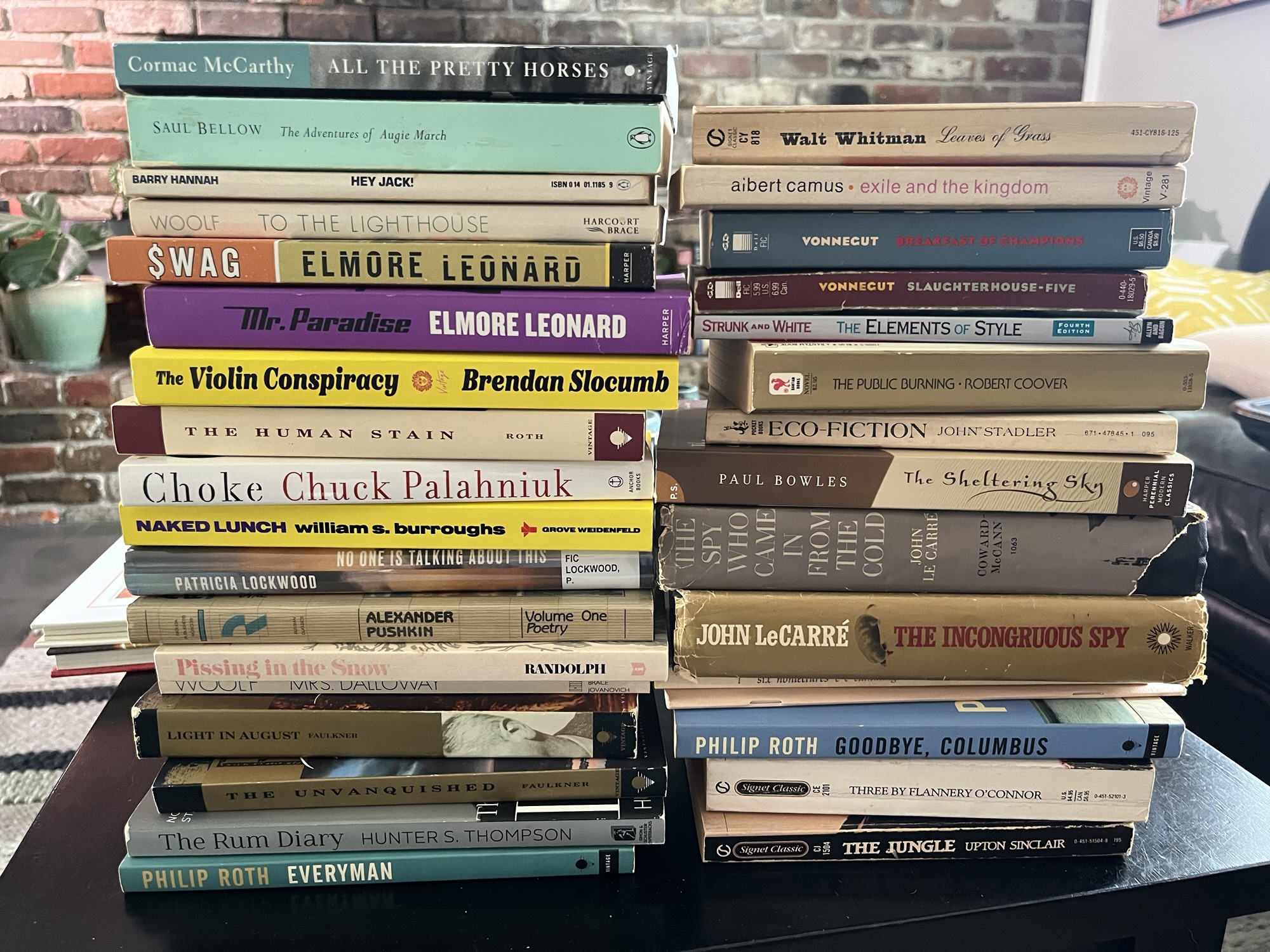
My move over the last few years when I go to a Friends of the Library Sale is to fill the ten dollar paper bag with a handful of pristine trade paperbacks I think will recoup the ten bucks in trade at my local used bookstore. I then pick through for titles to bolster my children’s growing personal libraries and for books that I might want to give away to friends, family, and students. And maybe I might get lucky with some overlooked gem — a first edition, a rarity, an oddity.
Most of what I picked up today was for my son to pick through. He took the Camus, Vonnegut, O’Connor, Palahniuk, and McCarthy. My daughter had zero interest in any of the haul.
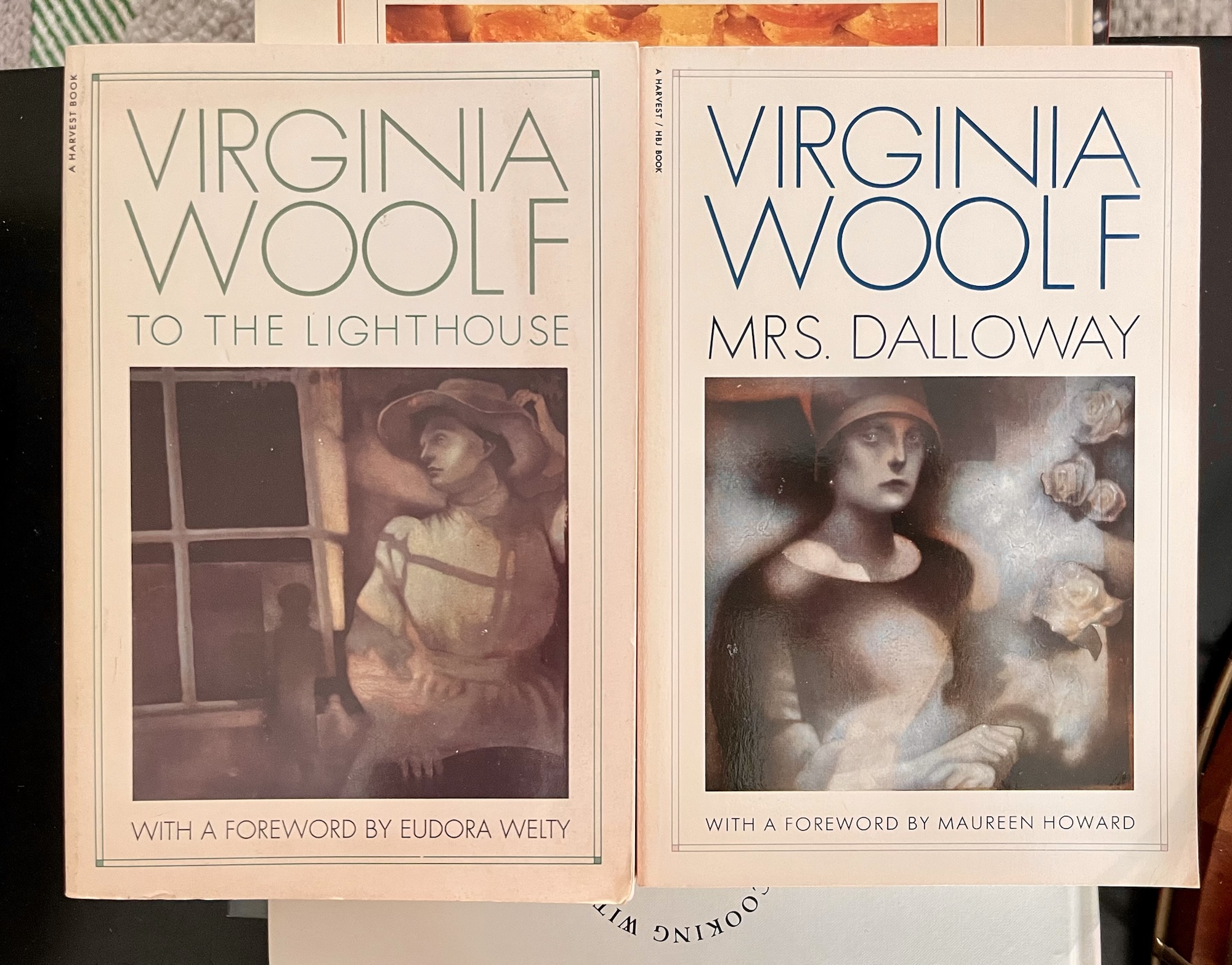
I wound up with several of the exact same editions of titles I already own (Camus’ Exile and Kingdom; Faulkner’s A Light in August; William Burroughs’ Naked Lunch) and lots of books we already have in other editions, most of which I’ll give away or trade. But I’ll be happy to trade out the cheap mass markets of Mrs. Dalloway and To the Lighthouse I’ve had forever in favor of these HBJ Woolfs (Wolves?):
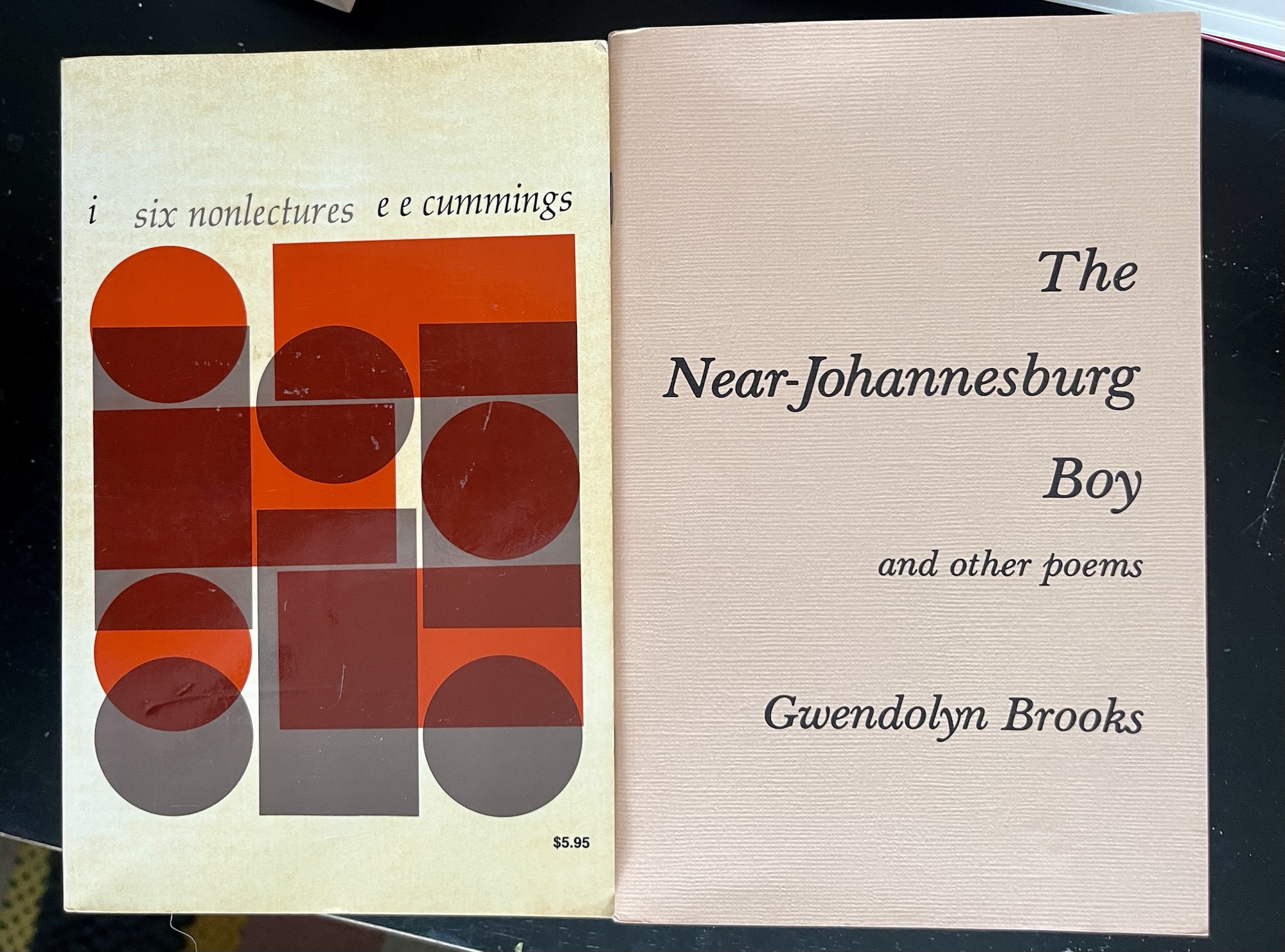
My two favorite finds today were cummings’ six nonlectures (the midcentury cover is lovely) and a Gwendolyn Brooks chapbook, The Near-Johannesburg Boy:
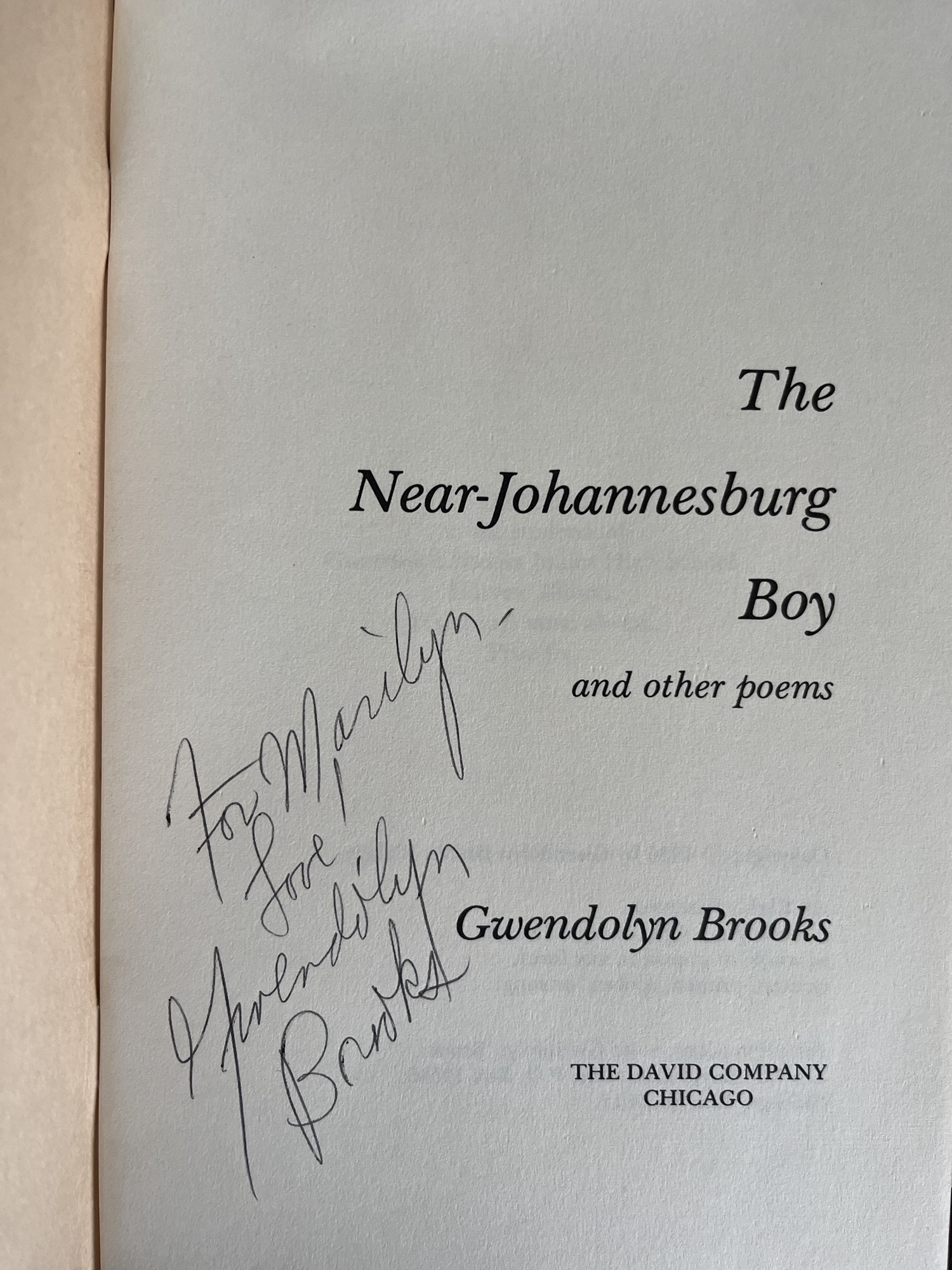
It wasn’t until I got home that I realized the Brooks’ chapbook was signed:
I had actually found two signed Brooks’ books at my favorite local used shop, also both inscribed to “Marilyn” (one was Blacks; I can’t remember the other one; they were both priced a bit beyond my casual range).
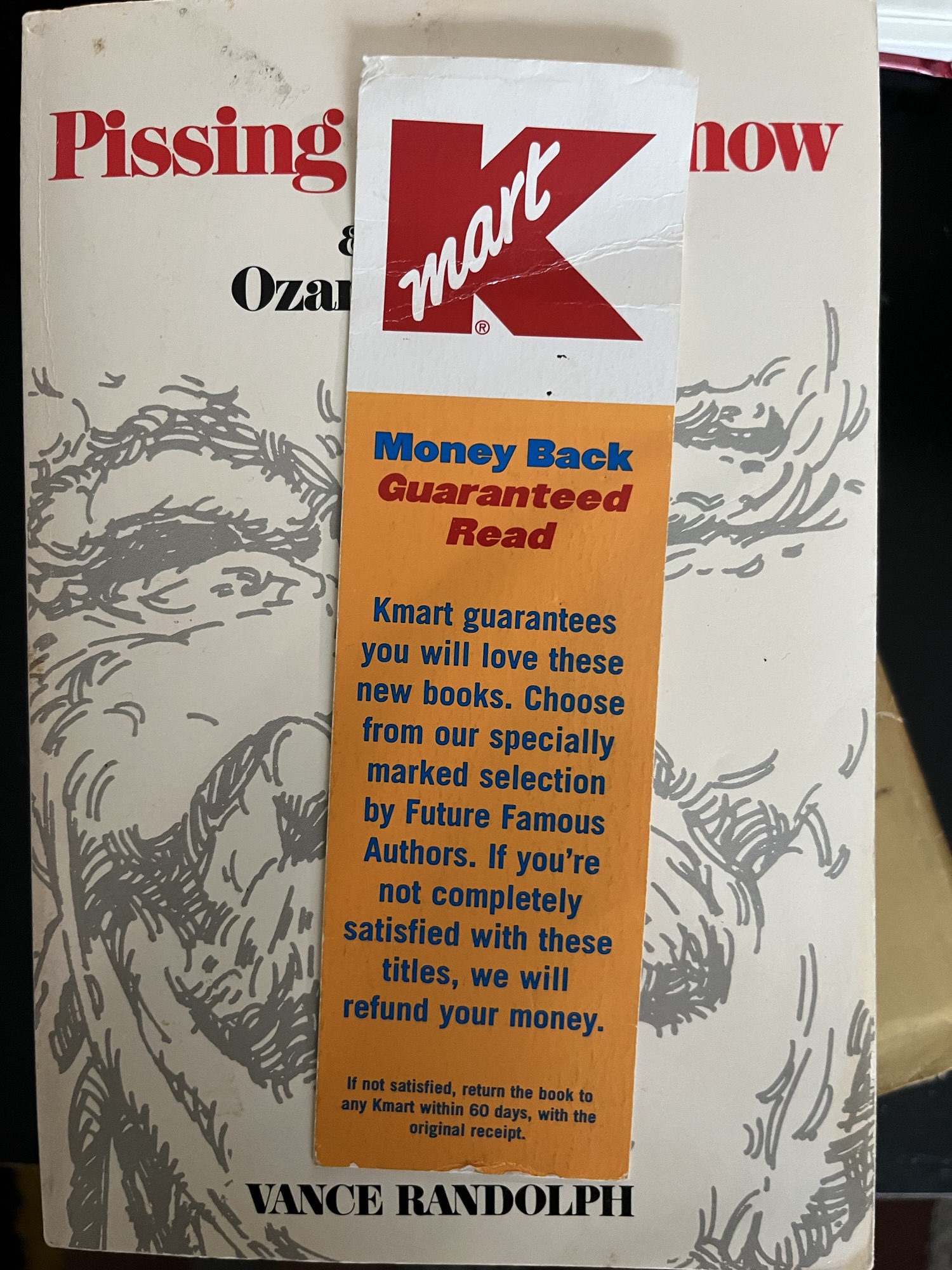
But maybe my favorite find was this Kmart bookmark:
The Kmart bookmark was tucked into a trade paperback University of Illinois Press copy of Randolph’s Pissing in the Snow. I doubt the collection of Ozark folktales was originally purchased at Kmart. But who knows.
Pissing in the Snow was one of the first books I wrote about on this blog, nearly twenty years ago. I look forward to passing it on to a student sooner or later.
I’ve been lucky over the last decade or so that my little college’s spring break almost always coincides with my children’s spring break. We aimed again this year at Georgia, spending a few days in a cabin outside the unfortunately named Whitesburg. Spring had not yet really sprung there yet. There was very little green about, but the hikes along and around Snake Creek through 20th century ruins were pleasant enough, and the kids enjoyed ziplining and aerial obstacle courses. In one of their sessions, I sneaked away to Harvey’s House of Books.
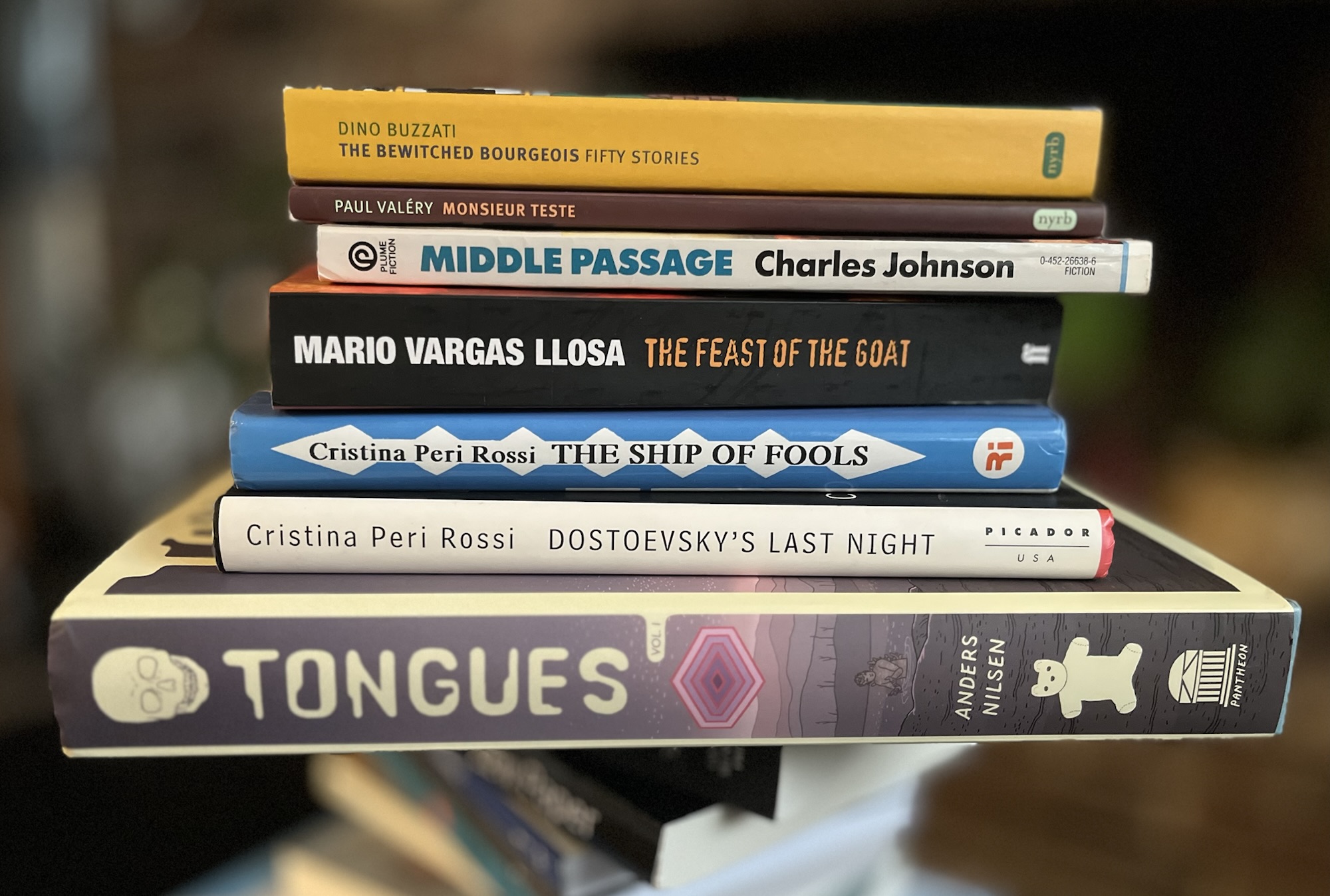
Harvey’s is, as far as I can tell, a Friends of the Library venture run by volunteers. I didn’t expect much, but the fiction section was surprisingly well populated. For around five bucks I picked up Charles Johnson’s Middle Passage, Mario Vargas Llosa’s The Feast of the Goat, and two by Cristina Peri Rossi — The Ship of Fools and Dostoevsky’s Last Night.
I was happy and surprised to find Rossi’s The Ship of Fools (in translation by Psiche Hughes); I’ve had it on a mental list for a few months now. I started it that night and it’s really odd–reminds me a bit of Ann Quin’s stuff, very odd but fun. More thoughts to come.
The Ship of Fools proved a nice antidote to the books I’d brought with me, Paul Valéry’s Monsieur Teste, (in translation by Charlotte Mandell) and a Dino Buzzati collection translated by Lawrence Venuti, called The Bewitched Bourgeois. I’ve enjoyed the Buzzati stories, but piled up there’s a sameness here that cries for interruption. I love Borgesian riffs on “Before the Law” as much as the next nerd, but too many in a row (six, in my case this week) feels, I dunno, like, I get it. But to be clear, I’ve really liked most of The Bewitched Bourgeois. I think it’s better parceled out though. Monsieur Teste on the other hand…look, I don’t know, maybe I misunderstood the book entirely, but I really kinda sorta hated it. Was I supposed to hate the central persona, Mister Teste, who aims for precision in language but comes off as a bore? At least it was short.
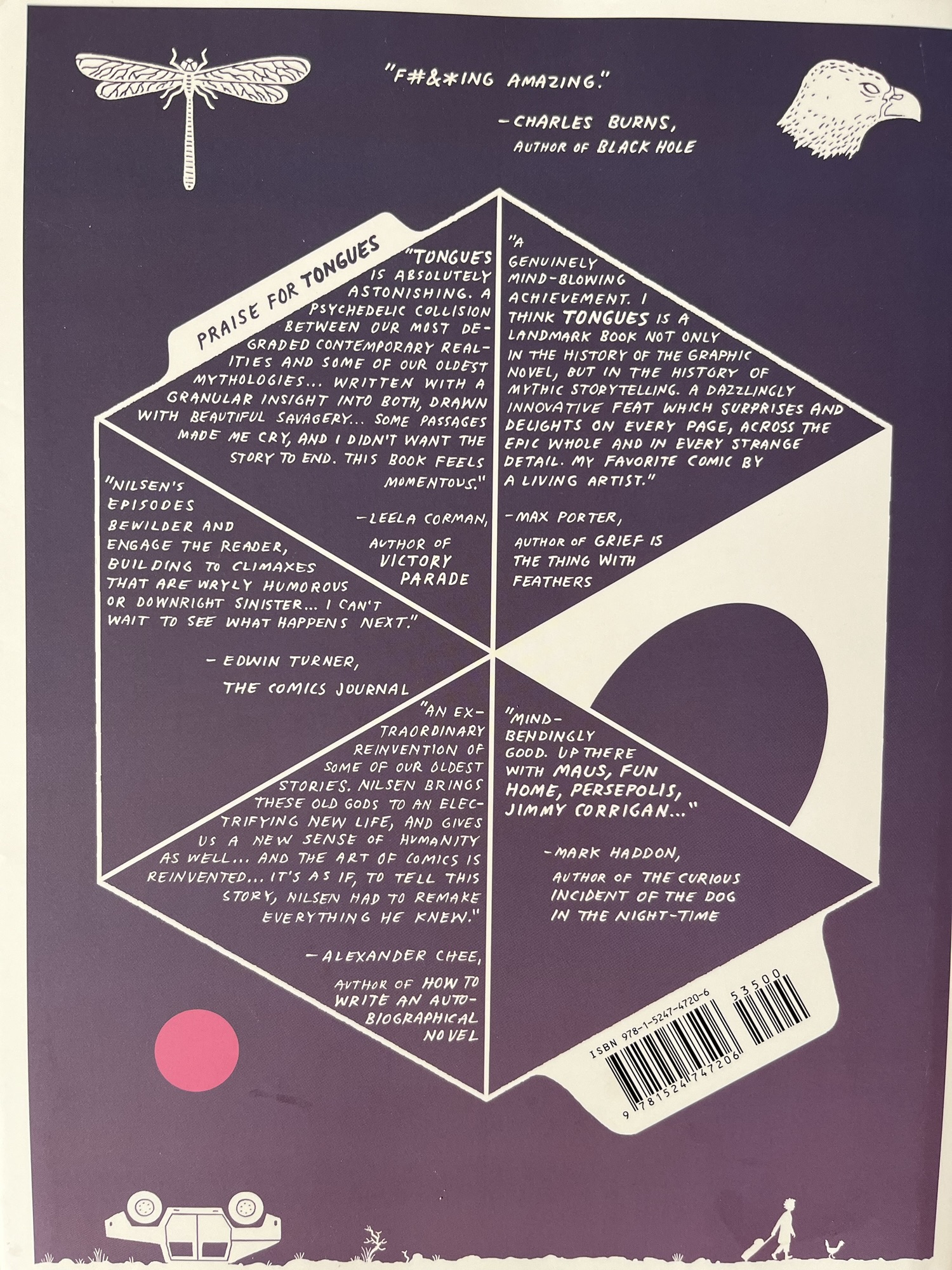
While I didn’t have the time in Atlanta to hit multiple bookstores (like in past trips), I made a point to hit up A Capella Books, a well stocked indie joint with a great used collection. I didn’t score anything there, although I was thrilled to see Anders Nilsen’s Tongues prominently featured in the graphic novel section. The book is great — I got a review copy right before we left. Some asshole named Edwin Turner landed a blurb on the back under his hero Charles Burns’s much shorter, pithier, better blurb:
Our spring break culminated Saturday night at the Variety Playhouse in Little Five Points, where we saw the so-called indie supergroup The Hard Quartet play all of their songs. I really dig The Hard Quartet’s self-titled debut, and dragged my wife and son along. (My daughter declined but played taxi driver.) Some interesting looking children were exiting the theater (really more of a club, let’s be honest) as we were entering, assuring the concerned security guard that they’d be right back, they just needed to get some Gatorade at a corner store. These were Sharp Pins, or The Sharp Pins, or Thee Sharp Pins, a Chicago power pop trio fronted by a kid named Kai Slater. They played a tight thirty minute set (including a Byrds cover); young Slater knows how to tuck away middle eight. The band’s youth invigorated the crowd of indie oldheads, and if Sharp Pins were occasionally a little out of tune or a step behind on the count, what came through was a true joy for the pop song. My son went bananas from them, saying something like, I know that they aren’t as good at playing their instruments as the Hard Quartet guys, but I liked their songs more. He bought their album and their t-shirt.
I liked The Hard Quartet’s live show very much — these are some old, or let’s just say older guys — look, pretty much everyone at the show was old, older, etc., except the Sharp Pins, my son, and some other teens there with their folks — these guys, the HQ, are veterans of disorder, coming up in club shows and theaters and big stages and big big stages and so on. They seemed very comfortable in the quasi-theater club. It was a joy to watch and listen to them.
They are, as I mentioned before, a so-called “supergroup.” Stephen Malkmus was the sideman for David Berman in The Silver Jews; Matt Sweeney, a popular YouTube influencer, was a member of another infamous supergroup — David Pajo’s short-lived side project Zwan; Emmett Kelly is a former gang member and circus performer; Jim White is the best drummer I’ve ever seen live (I have no stupid joke here; he is amazing and I listened to Ocean Songs every night for two years in a row when I was 22 and that’s not an exaggeration.)
The Hard Quartet are clearly a “real” band and not anyone’s side project. Sonics live were richer, fuller, more expansive than on disc. Emmett Kelly sang his new song, which, as far as I can tell, is the only update to their setlist in the past year — basically the record played straight through — but they seemed to never remember who was playing bass on which song when. No one used a pick, ever, as far as I could tell. Sweeney broke a string and then claimed he’d never broken a string on stage, ever. (Dubious.) Malkmus said he was thinking about “The Devil Went Down to Georgia,” but, what if it was, like, “The Devil Went Down on George.” Sweeney jokingly referred to Charlie Daniels as Chuck Daniels and at least two Atlanta audience members hissed foolish rejoinders. (Could’ve been those big beers, bald boys!) Jim White is both a gentle percussionist and a rawk gawd drummer. Malkmus’s, Kelly’s, and Sweeney’s singing in unison were some of the finest moments of the night, as in “Rio’s Song” and “Heel Highway.” The band’s weathered implementation of silence and space was also delicious and judicious in numbers like “Six Deaf Rats,” “Action for the Military Boys,” and “Hey.” Skronk and noodling were measured but never mannered. (Or the manners were there but they weren’t bad, unless they were meant to be bad.) Matt Sweeney’s left foot was the boss of the band, the bandleader, the clapper clopping down the count in a leopard print.
The Hard Quartet finished before eleven, having played all their songs. I think we all had a good time.
Jim WhiteMatt SweeneyStephen “SM” MalkmusEmmett Kelly
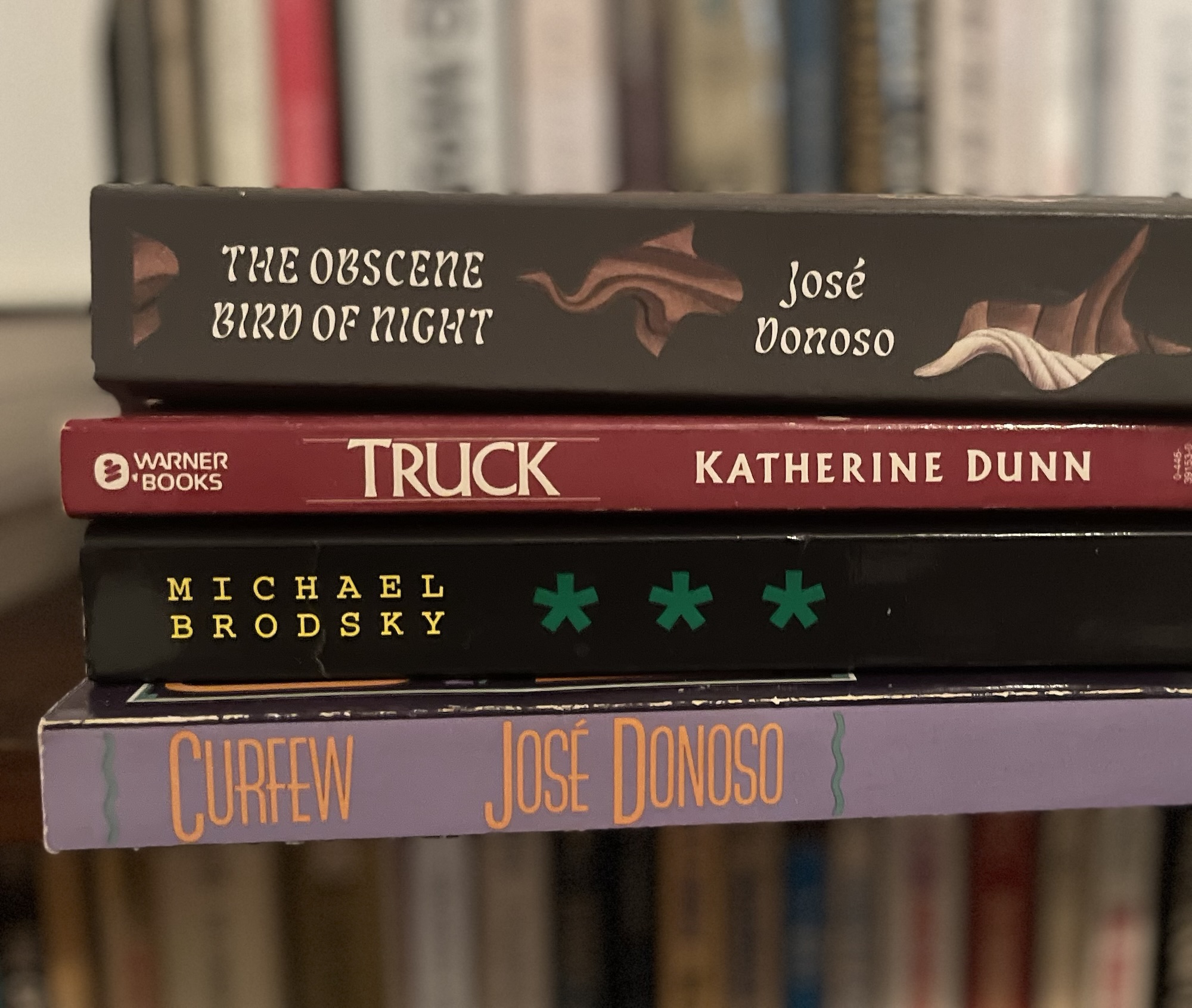
Picked up some books this weekend: Two from José Donoso: Megan McDowell’s “revision” of Hardie St. Martin and Leonard Mades’ translation of The Obscene Bird of Night, and Alfred MacAdam’s translation of Curfew: the first I had to order, the second was a lucky find. As was Michael Brodsky’s *** (send me a copy of Xman, someone), and Katherine Dunn’s Truck, which can twin with the copy of Attic I found this summer.
I ducked out of work maybe a little bit early on Friday and filled a brown paper bag with books at a Friends of the Library sale.
I picked up some hardback first editions of books I already own in cheaper formats–Lucia Berlin’s A Manual for Cleaning Women, Denis Johnson’s The Laughing Monsters, P.D. James’s The Children of Men, and Ben Marcus’s Leaving the Sea. I also got hardcover editions of Rachel Cusk’s Second Place, Amy Hempel’s Sing to It, Atticus Lish’s The War for Gloria, and Eugenio Corti’s The Red Horse.
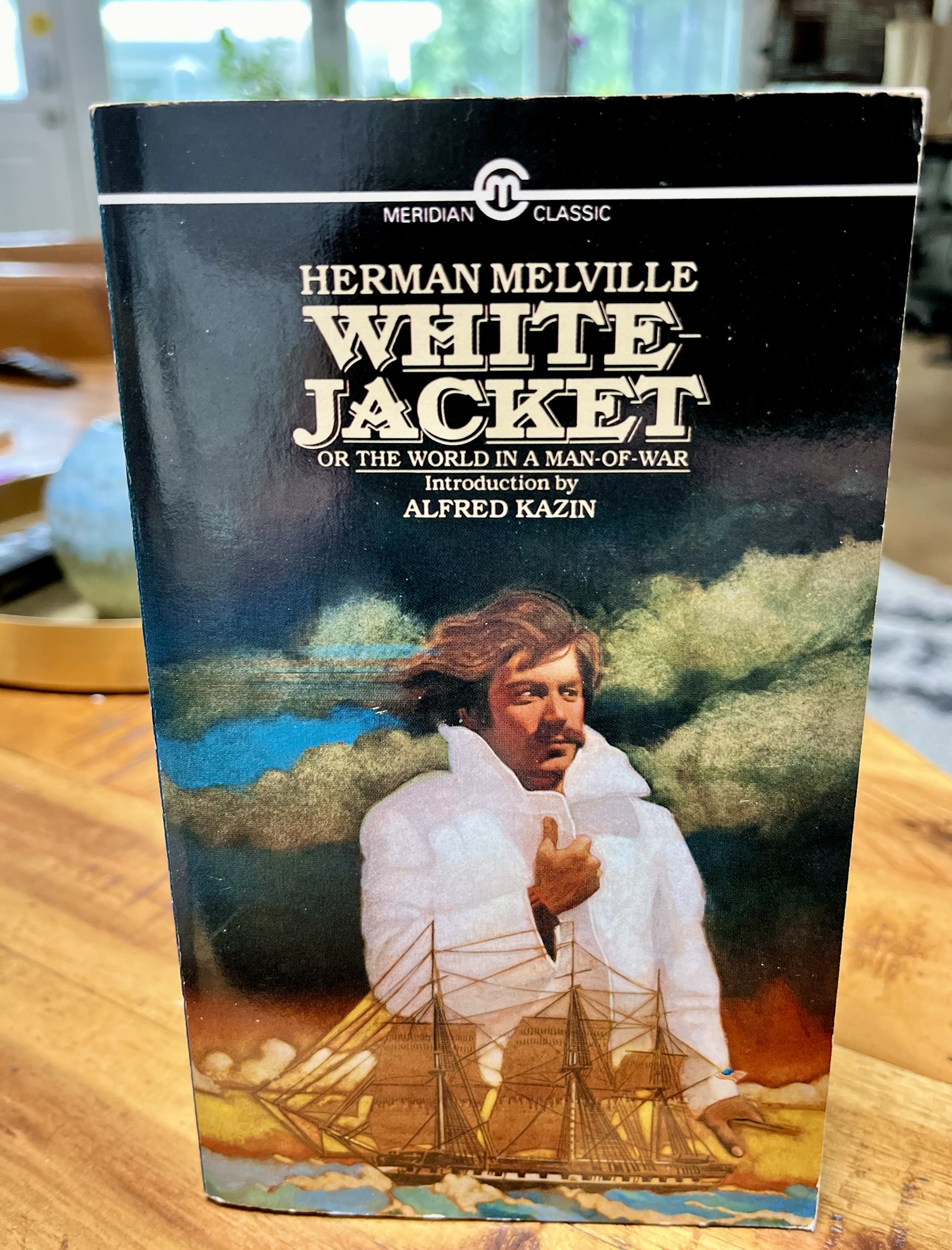
I also grabbed some duplicates or alternate paperback editions of books I already own, including an academically-oriented edition of Gertrude Stein’s Three Lives, Italo Calvino’s If on a winter’s night a traveler, and William Faulkner’s Light in August. I gave the Calvino to my son; the Stein is for a colleague. I’ll give Light in August to a student. (I got the same edition of the Faulkner at the last Friends of the Library sale I went to; my son claimed it.) I’ll also probably offer the Bourdain memoir to a student. I’m pretty sure we have a copy of Kitchen Confidential somewhere around the house. I couldn’t pass up on the cheap mass-market copy of Melville’s White Jacket. I mean, just look at this cover—dude’s wearing a white jacket—
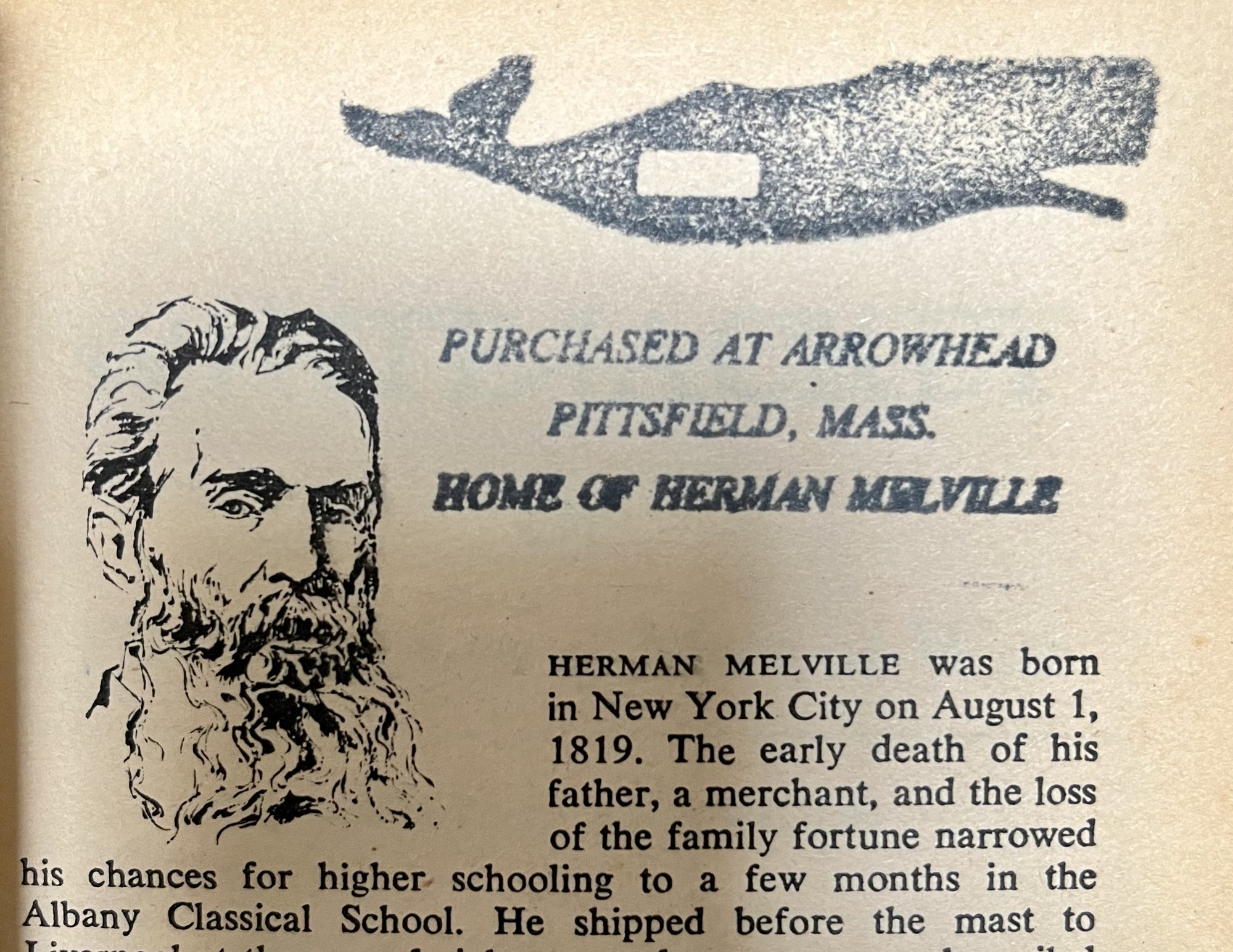
The book also bears a stamp claiming it originated (in a sense) at the old Melville Manse, Arrowhead:
I also couldn’t resist letting a paperback copy of Lucy Ellmann’s Ducks, Newburyport take up a lot of real estate in my paper grocery bag. The hype has died down enough for me to perhaps eventually sink into it. The edition of Alan & John Lomax’s American Ballads & Folk Songs is kinda beat up, but it’s got a lovely cover:
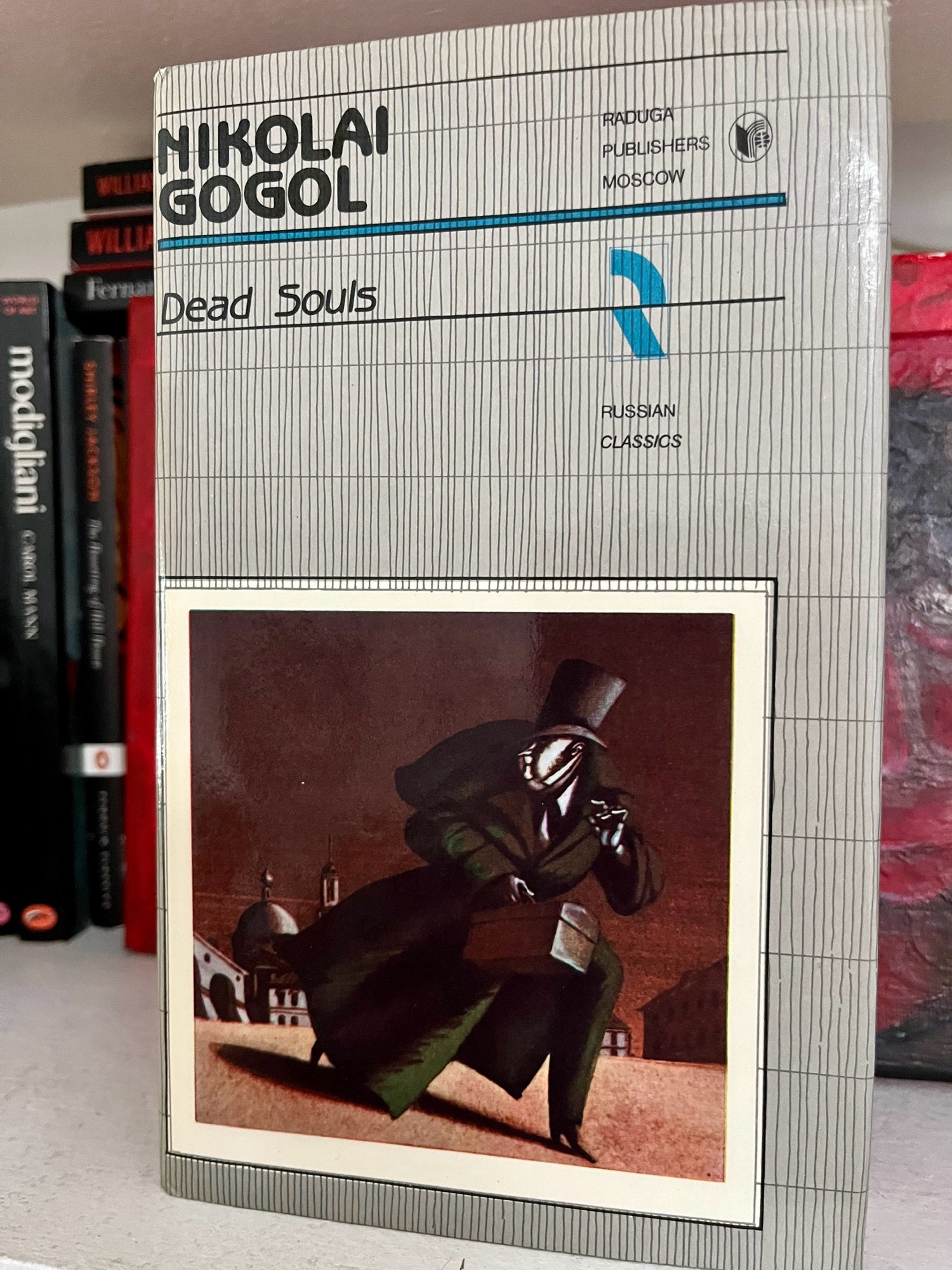
I was also attracted to this strange edition of Nikolai Gogol’s Dead Souls. It’s a 1987 hardback from the Soviet house Raduga Publishers, featuring a full-color portrait of Gogol and blue (?) page headings. The translation is by Christopher English and the book was printed in the U.S.S.R.—I’m not really sure who the intended audience was.
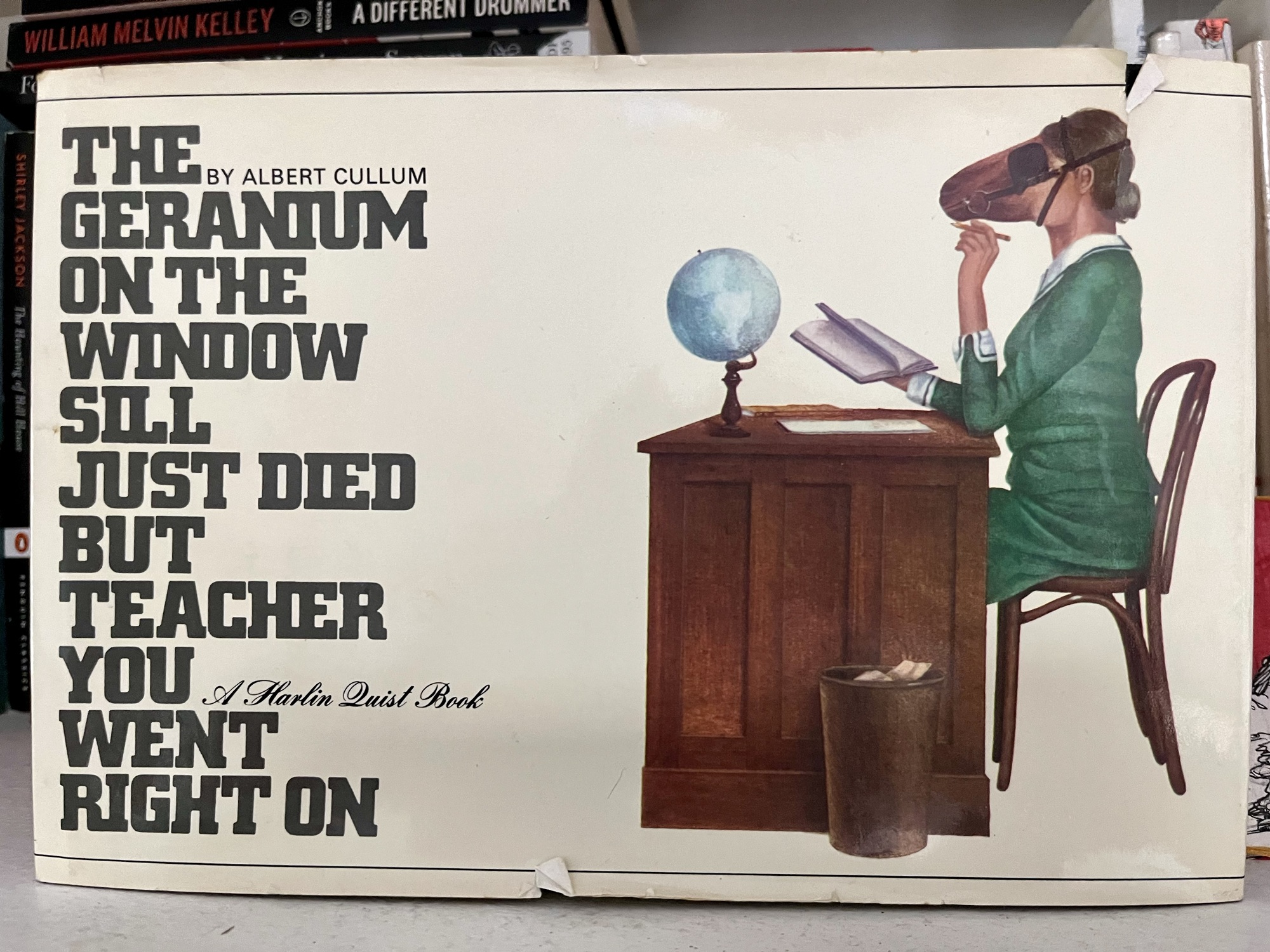
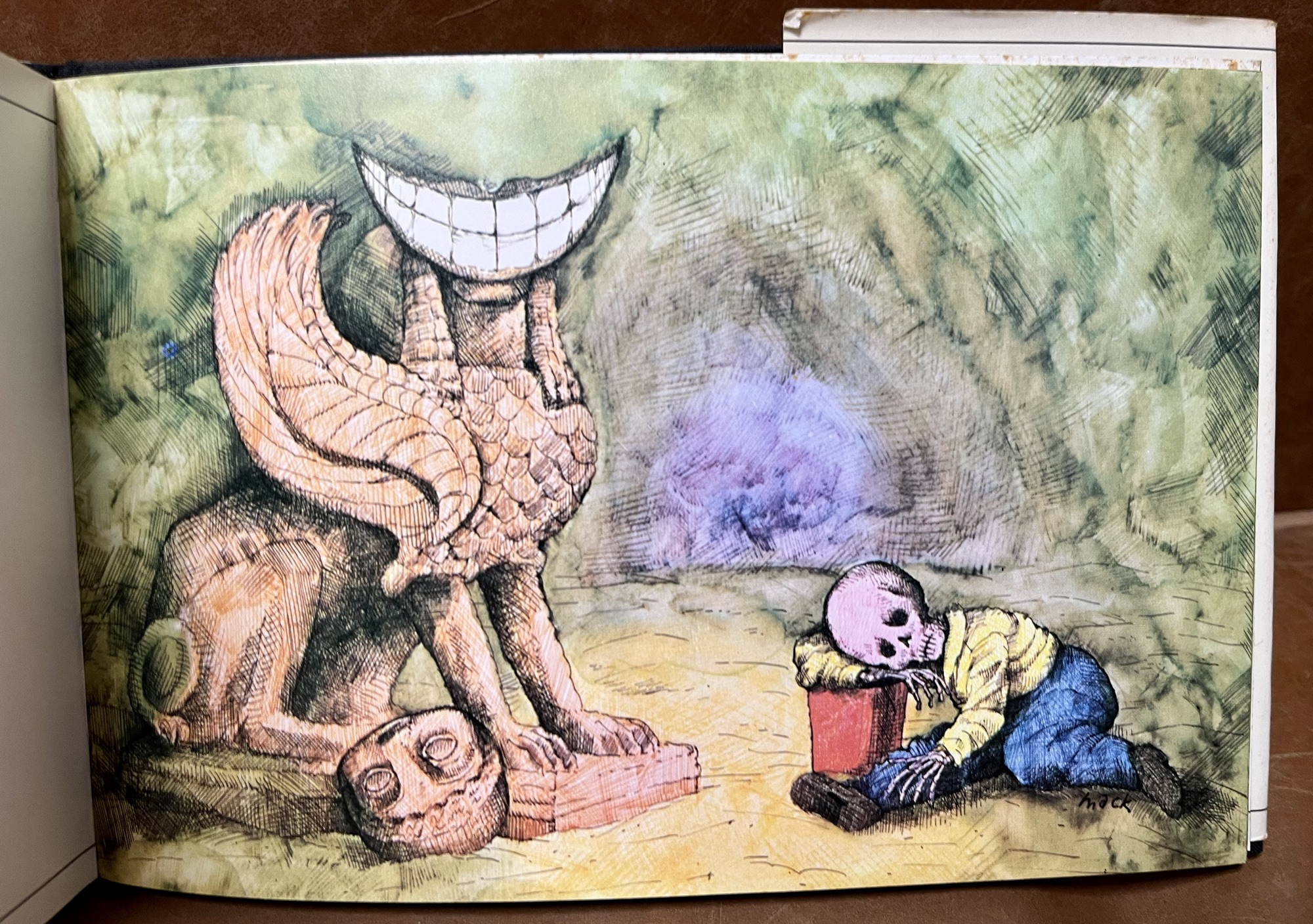
Albert Cullum’s The Geranium in the Window Sill Just Died But Teacher You Went Right Onwas another oddity I came across. Ostensibly a children’s book, The Geranium ultimately seems aimed at teachers. It features illustrations on every other page, each one by a different artist; many are remarkable, like this one by Stanley Mack–
There were a few titles, not pictured in the image at the top of this post, that I grabbed to cram into my bag simply because I had extra room at the end. I can usually offset the ten dollar bag fee by identifying a handful of pristine trade paperbacks that my local used bookstore will take for trade credit. So maybe I’m not, like, really offsetting the ten dollar fee so much as redirecting it toward obtaining more books.
There were plenty of titles at this particular sale that I would’ve crammed into the bag maybe ten or fifteen years ago—lots of books by Haruki Marukami, who has never been my guy, Jonathan Lethem (who I once really loved), Michael Chabon, Irvine Welsh, and even Chuck Palahniuk (there was a time when I was younger and had a broader range of friends that I could’ve given Palahniuk titles away easily). But I ended up imagining some younger person showing up to the sale, maybe today, Saturday, filling up a bag with titles that promised something beyond the YA formula stuff that makes up their current literary diet.
And if I imagined a younger person growing their library, I also imagined some of the older people whose collections had clearly ended up at the sale. Beyond the obvious airport thrillers and glut of titles by fiction factory Authors™, there were sets of strange, off-brand looking fantasy series in hardback, a seemingly-full run of Agatha Christie mysteries (also in hardback), Westerns no one will read again. Other people’s oddities ended up here; their children had no place for them, having subscribed to their own burdensome addictions.
I’ll have to give away all these books I’ve acquired at some point. But there’s joy in that too.
The last two weeks flew by. My kids went back to school this week; they are attending the same school for the first time since elementary school, high school,my own dear mother, that school, and I am relieved, if only temporarily from driving duties. We are making pizzas in an hour or two to celebrate the first Friday of their school year (we make pizzas every Friday as a nifty fridge clearing activity, but let’s not ruin the sparkle). My own semester starts the week after next and I realize that I need to do something more with my summers now that my children are so much older than they were when they were little children, when I was with them all summer, or if I wasn’t exactly right there with them I was hovering in the background.
I am on track to read fewer novels, or books, or whatever, than I read in July of this year. I finished Mauro Javier Cárdenas’s third novel American Abductions and liked it very much, or liked the experience or feeling of reading it, whatever that means, and I owe it a proper review. In July I read Katherine Dunn’s debut novel Attic and loved it. I couldn’t find her 1971 follow-up Truck in any of the used bookstores I frequent, so I ended up listening to it on audiobook. Maybe it was the narrator’s narration but I found it disappointing, but I still appreciate its grime and its abjection and its picaresque energy. I also checked out some Stephen Dixon e-books from my library; I read a handful of fucked up stories (a piece called “The Intruder” was especially weird) before digging into his 1988 novel Garbage. I read the first half of Garbage last night and I don’t even know how to describe it—it’s sort of like wandering upon some forgotten gritty 1970s American exploitation film made by an insane but focused auteur. But it’s also very normal in a way I will not explain. It’s uncanny.
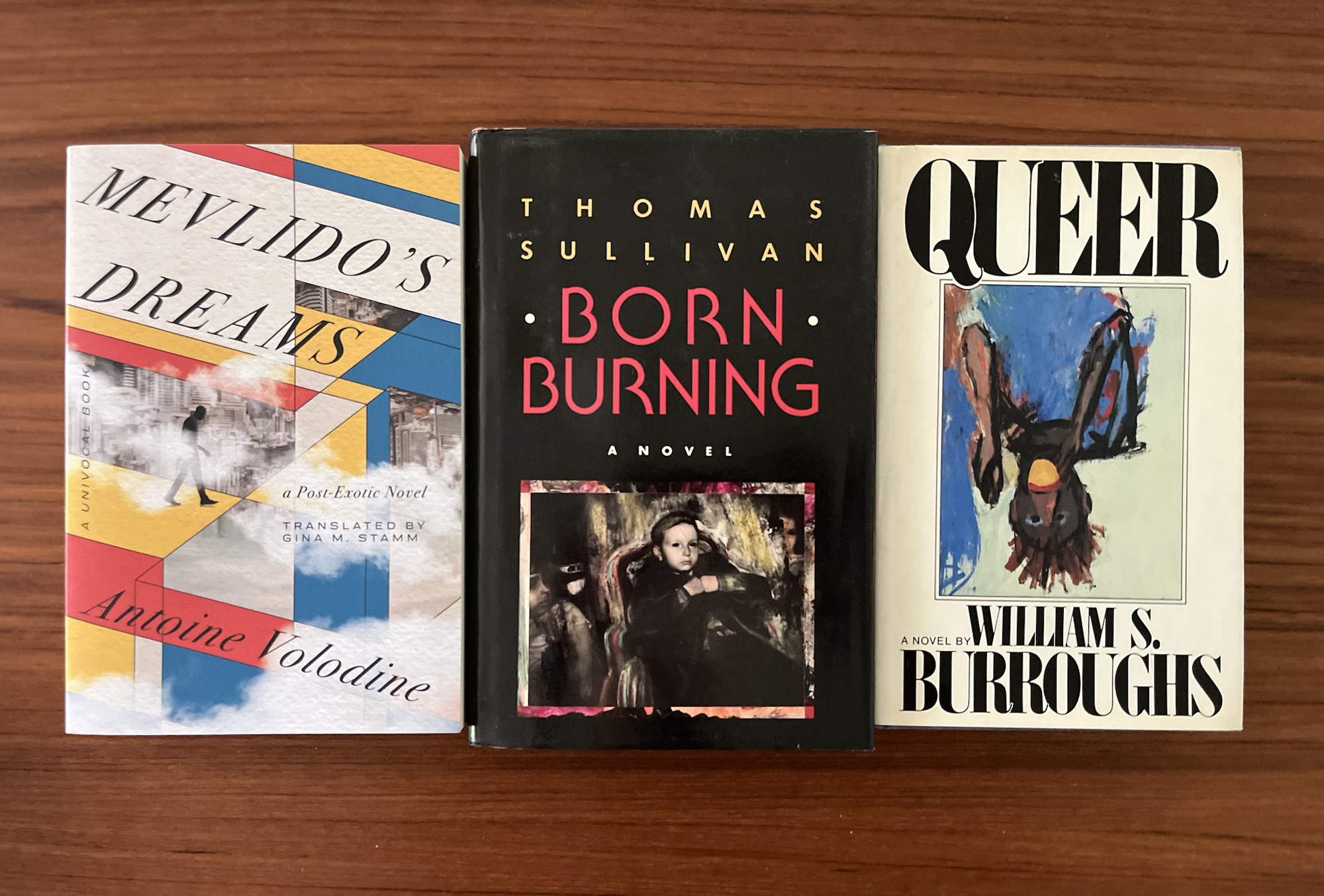
I purged about thirty paperbacks last week at my local used bookstore and ordered a copy of the latest Antoine Volodine novel, Gina M. Stamm’s translation of Mevlido’s Dreams. A recent reading of Volodine’s Radiant Terminus left me hungry for more of that sweet gross post-exotic flavor. I went to pick up the Volodine today and ended up with two hardbacks. I admit that the blurb on the back of Thomas Sullivan’s 1989 novel Born Burning sold me; it compared his previous novel to William Gaddis, John Barth, and Kurt Vonnegut. I also snapped up a first-edition hardback 1985 edition of William S. Burroughs’s novel Queer, which I fear was quite underpriced, although I don’t fear that too much. (All my sweet purged paperback credit is gone!)
Last week, the wife and I drove five hours north to Atlanta, Georgia where we stayed five days in the Cabbagetown neighborhood. Our ostensible purpose was an anniversary trip focused around a Slowdive concert last Friday, but I think we really went to just hang out and eat and drink away from our kids for a few nights. It was famous times.
The Slowdive concert itself was excellent, despite the best efforts of the awful opening band, a dubious and I must assume ironic project called Drab Majesty, and the sound system at the The Eastern. The venue seemed ill-equipped to handle the tonality of either band. I don’t want to sound like a very old man but it was Too Fucking Loud. Opener Drab Majesty, whose sound came from a single guitar, a single synth, and, I’m guessing, a few loop pedals, seemed to have plugged directly into the PA system. It was the absolute worst sound I’ve ever heard. (Earlier that day, driving in awful Atlanta traffic, we listened to a seventeen-minute Merzbow song on the alternate band of Georgia Tech’s WREK radio station; although Merzbow is “noise” music, that song had more musicality, tonality, and depth of rhythm than Drab Majesty.)
Slowdive was excellent live–much more of a rock sound than I’d expected; I’ve really enjoyed their two newer records, particularly the self-titled one from a few years back, but the songs from Souvlaki sounded particularly fierce live. The setlist was great, and they closed with a cover of Syd Barrett’s “Golden Hair” that might have gone on for 10 or 12 minutes; it was hypnotic. Here is the single picture I took during the show:
But books—
Without children about and with my wife having to work half days from the rented garage apartment, I had enough time to indulge going to pretty much any bookstore I wanted to in Atlanta. I ended up sticking mostly to East Atlanta where we were staying though.
I had been to A Capella Books a few years ago and had somehow entirely missed their used book annex, which had some really great stuff in it, including a first edition of Blood Meridian and Joseph McElroy’s Women and Men. I ended up chatting with the owner Frank for a bit; a very nice guy, he showed me his personal collection of Vintage Contemporaries and we talked in general about our shared sickness of book collecting. I left with Mauro Javier Cárdenas’s new novel American Abductions and a first-edition hardback of McCarthy’s Cities of the Plain. This second purchase seems to have initiated the trip’s theme of buying editions of books I already own—but now I have all three Knopf editions of The Border Trilogy, so everyone can sleep easier.
I stopped by Criminal Records in Little Five Points and didn’t pick anything up, although I’m happy to see that CDs have made such a comeback. (I almost certainly would have bought the new Gastr del Sol box set if it was out yet.) I then made my way to Bibliotech Books in Candler Park. The proprietor assured me that he was in the process of reorganizing, but the store was frankly a mess. One bookcase was organized by the color of the book’s spines. The inventory seemed to be someone’s childhood and adolescent books.
I headed to Virginia Highland Books, a perfectly-respectable book shop in the perfectly-respectable Virginia Highland neighborhood. The perfectly-respectable inventory was not particularly interesting, although I imagine it perfectly suits the perfectly-respectable clientele. On the way to Virginia Highland Books, at a red light, I found myself stopped next to something called Videodrome, so of course I pulled in. I got dizzy in Videodrome a DVD-rental shop stuffed with thousands and thousands of cult films, non-English language films, art films, concert films…amazing stuff. The only thing I could compare it to were some of the rental shops I’d gone to decades ago when I lived in Tokyo. I mean, this place had the Cannibal Ferox soundtrack on vinyl. I spoke to the proprietor for a while. He gave me a sticker. I saw him at the Slowdive show the next night but left him alone.
My last bookshop visit that day was to Bookish, a small indie spot specializing in books by women. I liked the store but was honestly too tired to look around much after two tallboys at a PBR-themed bar in Virginia Highland.
Over the next few days, I visited three more bookshops, all more or less by chance. We went to Decatur, simply to check it out, and parked in Decatur Square right in front of Little Shop of Stories. Framed original artwork by visiting authors adorns the walls of this children’s bookshop, and there’s a life-sized reproduction of the room from Margaret Wise Brown’s classic Good Night Moon that one can hang out in. I felt a little melancholy that our children have outgrown children’s books.
On the way back to Atlanta, we swung by Eagle Eye Books, a Decatur spot specializing in used books (with a large collection of vintage sci-fi hardbacks in a back room). They have several carts of dollar books that are supposedly accessible 24/7—there are lock boxes to slide your dollars into. I ended up picking up different editions of two books I already own: Wells Tower’s Everything Ravaged, Everything Burnedin hardback and the 1985 Elisabeth Sifton Books/Penguin Books printing of William Gaddis’s J R. The J R is basically falling apart and is crammed with annotations; I love it. I gave three crumpled dollars over for these two books and then drove back to our garage apartment so we could walk to tacos and then the concert.
The mid-morning after the Slowdive concert we hung out for a while at the Virginia Highland Porchfest. We parked at the Ponce City Market to walk to Porchfest and on the way back stopped at Posman Books. I’d been there before, and while it’s basically a gift shop, its literature section is surprisingly robust, and it even offers a decent number of Spanish-language novels. The vibe at Porchfest was more frat-boys-drinking-sixers and sunburned golf dads than it was hippies and freaks. The neighborhood is Nice, with plenty of In This House signs declaring Attested Beliefs. We felt more at home in Cabbagetown, with its murals and ambivalence, even if our own presence as fucking tourists made us balk at times. But in a plant shop in Virginia Highland, we did meet an interesting clerk who let me take a photograph of their Pynchon tattoo. So that was pretty cool.
Margaret told me via email that On Homo rodans and Other Writings “includes a few new stories and other interesting things that [she] found in the archive in Mexico City in 2022, and also has a rearranged presentation of everything (as requested by the estate).” I hope to have a second interview with Margaret on this new collection soon; in the meantime, check out our conversation from 2019.
April is always a weird month for me, the last few weeks of the spring semester when I try to corral my students (and myself) toward our Grand Project of Just Damn Finishing (while also Learning and Growing as Humans), when the magic of spring break has burned off to memories, scents, traces, when the Florida weather is glorious and perfect, but for only just long enough to get out in the garden before Summer Hell commences.
It’s been a lot of cleaning and clearing out and reorganizing for me, along with meetings with students—and not as much reading as I’d like. I devoured Percival Everett’s novel James early in the month, reading it in just a few days and loved it, but failed to write The Thing I Wanted to Write about it—about Twain’s Huckleberry Finn, about lighting out for the Territory, about Leslie Fiedler, about Robert Coover’s Huck Out West. I did manage to shoehorn bits of it into meetings with an American lit class I particularly liked this semester (we’d read Huckleberry Finn back in January). I also read/am reading Max Lawton’s novel-in-progress, The Abode, and reread Max’s translation of Vladimir Sorokin’s novel Blue Lard. I’ve actually done a lot of re-rereading of Blue Lard, as my project of posting about it seems to get delayed by, like, time constraints and/or exhaustion–
–is this the part where I also rant about my eyes going to seed, my eyes of forty-five years, stalwart fellows for most of those years, but now fading? eyes now needing nose-bridge-irritating lenses to be able to read finer print at first and now not-so-fine print? eyes that will need a new set of so-called readers with a higher rate of magnification simply to comprehend the little marks on the huge copy of RSS’s A Bended Circuity I obtained way back in November of last year? my eyes that are also having a hard time with Dalkey’s reissue of Marguerite Young’s Miss Macintosh, My Darling, not included in this riff and pic of books acquired in April because it is new, a new printing? I guess that was the eye rant, so—
Oh and so anyway to the used books I picked up this month, mostly over a series of Friday-afternoon-special-treat browsings, their purchase entirely subsidized by trade credit from so, so many books I read my children when they were little and cute, books that they no longer wish to place on their shelves (ever the sentimentalist, I found space in my tiny Florida attic for a box or two for the future—and made an agreement with my son to shelve the Maurice Sendak titles in his room for at least the next few years). Those books–
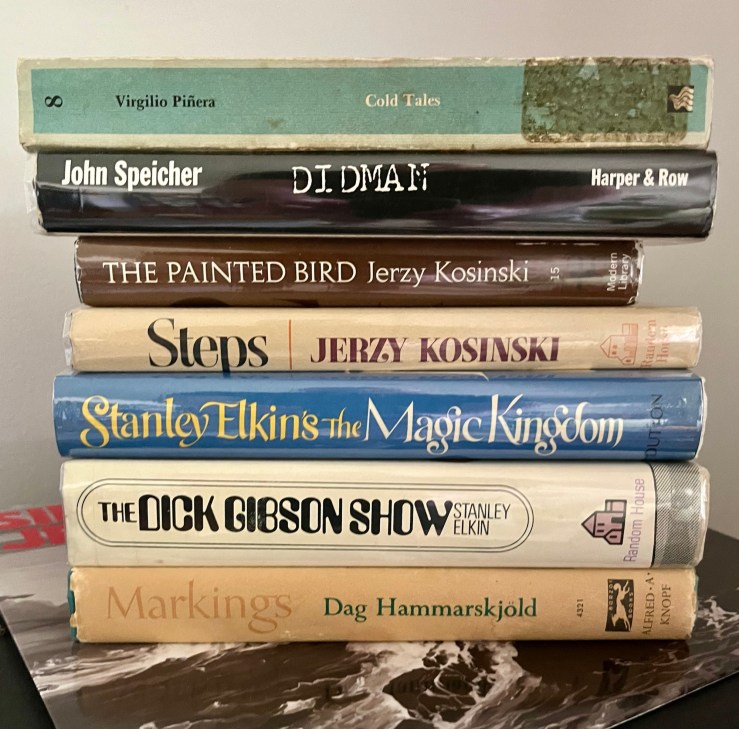
A collection of Virgilio Piñera short stories translated by Mark Schaffer. I admit I was unaware of the Cuban author’s existence until I came across this edition of Cold Tales (once property of the University of Washington Libraries). The spine attracted me, the cover, bearing a reproduction of Goya’s Saturn Snacking enticed me, and I opened, reading a few of the very short stories within, knowing it’d leave with me.
I picked up John Speicher’s 1971 novel Didman because Thomas Pynchon blurbed it; haven’t opened it since.
I picked up first-edition hardbacks of books I already own and have read, books by Stanley Elkin and Jerzy Kosinski—books I already own, in a few cases, in beautiful trade paperback editions (a Vintage Contemporaries edition of Steps; Elkin novels with covers by my favorite, Janet Halverson)—do I need them? Of course not. But I have so few hobbies, reader; my herbs are in good order; my guitars hold their tunings—and I have more regrets about the first editions I let go by years ago.
Perhaps the oddest one stacked here is a first edition of Dag Hammarskjöld’s posthumous 1963 Markings (translated by Leif Sjöberg and W. H. Auden), which collects the Swedish diplomat’s diary entries from 1925 up through his death in 1961. I found it very much at random (in the literary criticism section, where I don’t think it belongs), picked it up, and kept reading. A brief excerpt:
To be “sociable” —to talk merely because convention forbids silence, to rub against one another in order to create the illusion of intimacy and contact: what an example of la condition humaine. Exhausting, naturally, like any improper use of our spiritual resources. In miniature, one of the many ways in which mankind successfully acts as its own scourge-in the hell of spiritual death.
Picked up Christine Brooke-Rose’s 1984 postmodern novel Amalgamemnon and the Grove Press collection of Three Exemplary Novels by Miguel de Unamuno the other day. Those three exemplary novels are Marquis of Lubria; Two Mothers; and Nothing Less Than a Man, in translation by Angel Flores. It’s an older edition; Grove Press’s contemporary copy offers the following:
In Two Mothers, the demonic will of a woman runs amok in a whirlwind of maternal power, and in The Marquis of Lumbria, another unforgettable heroine steers a violent course through the dense sea of tradition. By contrast, Nothing Less Than a Man, Unamuno’s most forceful piece of writing, focuses on a truly Nietzchean hero, a man who embodies human will deprived of spiritual strength.
While the title signals possible mythic revisions of Aeschylus’s play Agamemnon, such anticipations on the reader’s part prove to be utterly unfounded. To begin with, there is no “story” as such, there are no “characters,” no “plot,” no “conflict,” and certainly no “climax.” In addition, the fiction is cast entirely in the future and conditional tenses with a few imperatives and subjunctives thrown in. Although Amalgamemnon exhibits few remnants of a traditional narrative desire for unity, presence, psychological accuracy, closure, and so forth, it does do what most innovative writing should do: it challenges the audience in terms of accustomed modes of perception, interpretation, and reading strategies – in short, challenges readerly ideology. In part, this text enacts such a challenge by performing itself, by “being about” language, by being a performance. The text becomes a space in which a cacophony of voices, or discursive amplifications, or babble, or little stories – whichever term best suits — enact their own sounding.
Last week I got physical copies of two forthcoming Vladimir Sorokin books, both translated by Max Lawton and both published by NYRB.
Sorokin’s 1999 novel Blue Lard is one of the strangest and most daring books I’ve ever read—simultaneously compelling and repulsive, confounding and rewarding, a novel that twists from scenario to scenario, occasionally looking back at its reader to holler, Hey, catch up! Its English-language translator Max Lawton was kind enough to share his manuscript for Blue Lard with me during a long and enjoyable interview we undertook in the summer of 2022 (around the time of the publication of his translation of Sorokin’s 2014 novel Telluria). While Max was, on one hand, trying to help me better understand Sorokin in context by sharing Blue Lard with me, on the other, I think he was mostly trying to share a really fucking great book with someone who might like it—which is the kind of love one could only hope for from a translator. From our first interview:
BIBLIOKLEPT: Blue Lard might benefit from a brief introduction, so I’ll offer my unasked-for services: “This shit is wild. Just go for it. Don’t try to make it do what you think a novel should be doing. Just go with it.”
ML: BLUE LARD is about that state of confusion—ontological and linguistic—as it unfurls. To introduce the text beyond something like your pithy statement above might be a disservice to the book. The reader should be confused and it should hurt—then feel fucking good ….when reading Sorokin, we’re fucking nostrils with forked dicks (or—getting our nostrils fucked by the same).
The book’s real introduction is the Nietzsche quote at the beginning.
Does FINNEGANS WAKE need an introduction? Is one even possible?
I loved BLUE LARD when I first read it precisely because I had no point of reference for understanding it
Hey but so well guess what! I have another interview with Max on deck! Here’s a bit of a teaser from that interview, again on Blue Lard:
Like TELLURIA, BLUE LARD is all about textures: literary, historical, ideological… However, unlike TELLURIA, BLUE LARD has a telos to it—an endpoint. I am firmly of the belief that BLUE LARD is Vladimir’s best novel. He had taken a long break from prose (about 7 years) before writing it, so this text simply burst forth from him and ended up as a neat showcase of all of his aesthetic preoccupations, but lorded over by an edifice that has proportions none too short of classically harmonious. What should readers expect… hmm.. the first section is rather challenging. One needs to surf its wave and not expect full comprehension. There is a glossary of Chinese words and neologisms at the back of the book, but I’m not sure it’s worth consulting in the expectation of further understanding. The middle section of the book—characterized by a faux-archaic language—is also terribly strange, but with fewer neologisms. The last section of the book—an alternate iteration of Post-WWII Europe—is formally very smooth, but insanely transgressive in terms of content. And I haven’t even mentioned the rather unorthodox parodies of Russian classics in the novel’s first section! What should readers expect? In short: to have their minds blown!
Red Pyramid offers an overview of Sorokin’s development as a writer, collecting stories composed between 1981 and 2018. From Will Self’s introduction:
Fundamental to the fiction of Vladimir Sorokin is not the pornography his detractors accuse him of producing but the paradoxical topologies his carefully spun tales evoke. Each of his stories is a sort of mutant Möbius strip, in which to follow the narrative is to experience the real and the fantastic as simultaneously opposed and coextensive. There comes a point—it may be early on; it may be comparatively late-when the strictures of orthodox plotting seem to overwhelm its author, such that idiom and plain speech converge even as events spiral ineluctably out of human control.
And here’s Joy Williams’ blurb:
Extravagant, remarkable, politically and socially devastating, the tone and style without precedent, the parables merciless, the nightmares beyond outrance, the violence unparalleled, these stories, translated with fearless agility by Max Lawton, showcase the great novelist Vladimir Sorokin at his divinely disturbing best.
(Williams deploys the word outrance here, which was new to me, and I think it fits.)
Last Friday, I drove across a bridge to a library on the other side of the city for a Friends of the Library sale. I was hoping for a nice leisurely afternoon browse, figured I’d find a few titles worth my efforts, and I’d fill out the 10 dollar brown paper grocery bag with books I could trade for store credit elsewhere. I ended up filling the bag almost immediately, mostly with heavy hardbacks, resulting in my weak arm quickly settling into a painful fatigue that killed my browsing vibe.
Here are the books I picked up:
–A paperback copy of Thomas S. Klise’s cult classic The Last Western. It was in the “nonfiction” section, which I didn’t really browse that studiously, but its cover nevertheless stood out to me. I bought a copy of it from an online used bookseller online six years ago (and was very disappointed that the seller had appended a retail barcode sticker to its cover).
–A paperback omnibus of Salem Kirban’s early seventies “prophecy” apocalypse novels 666 and its sequel 1000. I’d thumbed through a worn copy of 666 sometime last year—the title of and its cracked spine calling to me from the shelf of the sci-fi section. Kirban’s “novel” is a millennialist screed conveyed in a tawdry postmodern manner, and it didn’t seem worth the eight bucks the used bookstore was asking at the time—but I didn’t mind snuggling it into the paper bag last Friday, oddity that it is.
–A hardback copy of Don DeLillo’s novel Zero K. I skipped it when it came out, and I don’t think DeLillo’s done anything good since Point Omega.
–A hardback copy of John Barth’s novel Every Third Thought. I think that Barth’s best work is decades behind him, but every now and then I try something newer, and this 2011 novel is one of his shorter recentish efforts.
–A hardback copy of Leni Zumas’ novel Red Clocks. I had never heard of this book, but the spine enticed me enough to pick it up when I was browsing the “sci fi” section at the booksale, and the premise–America has outlawed and criminalized abortion–seemed depressingly dystopian enough to take it with me.
–A hardback copy of Sven Birkert’s collection of literary criticism, An Artificial Wilderness. Includes chapters on Thomas Bernhard, Umberto Eco, Borges, and “The School of Gordon Lish” among many, many others.
–A Vintage Contemporaries Edition of Raymond Carver’s Where I’m Calling From, a collection I have not read in over two decades.
–A hardback copy of Jesse Ball’s novel How to Set a Fire and Why. I liked his 2011 novel The Curfew, so maybe I’ll like this?
–A hardback copy of Jeanette Winterson’s novel Frankisstein; reviews of this 2019 novel intrigued me at the time it was published (and I do like a good Frankenstein riff).
–A hardback copy of Robert Coover’s novel Huck Out West. An amazing sequel to Twain’s novel; I reviewed it on this site years ago. This handsome edition shall replace the ugly advance copy I got years ago. I might need to revisit it in anticipation of Percival Everett’s take on Twain’s Huck’s Jim—James.
–A Library of America edition of The Complete Novels of Eudora Welty. I hate to admit what I will now admit: I love love love Welty’s short stories, but have never read one of her novels.
–A hardback copy of Walker Percy’s Thanatos Syndrome. Again, a late-period work by old master, likely not his finest stuff, but hey. I burned through his first four novels a few years ago—Lancelot was my favorite.












 Biblioklept