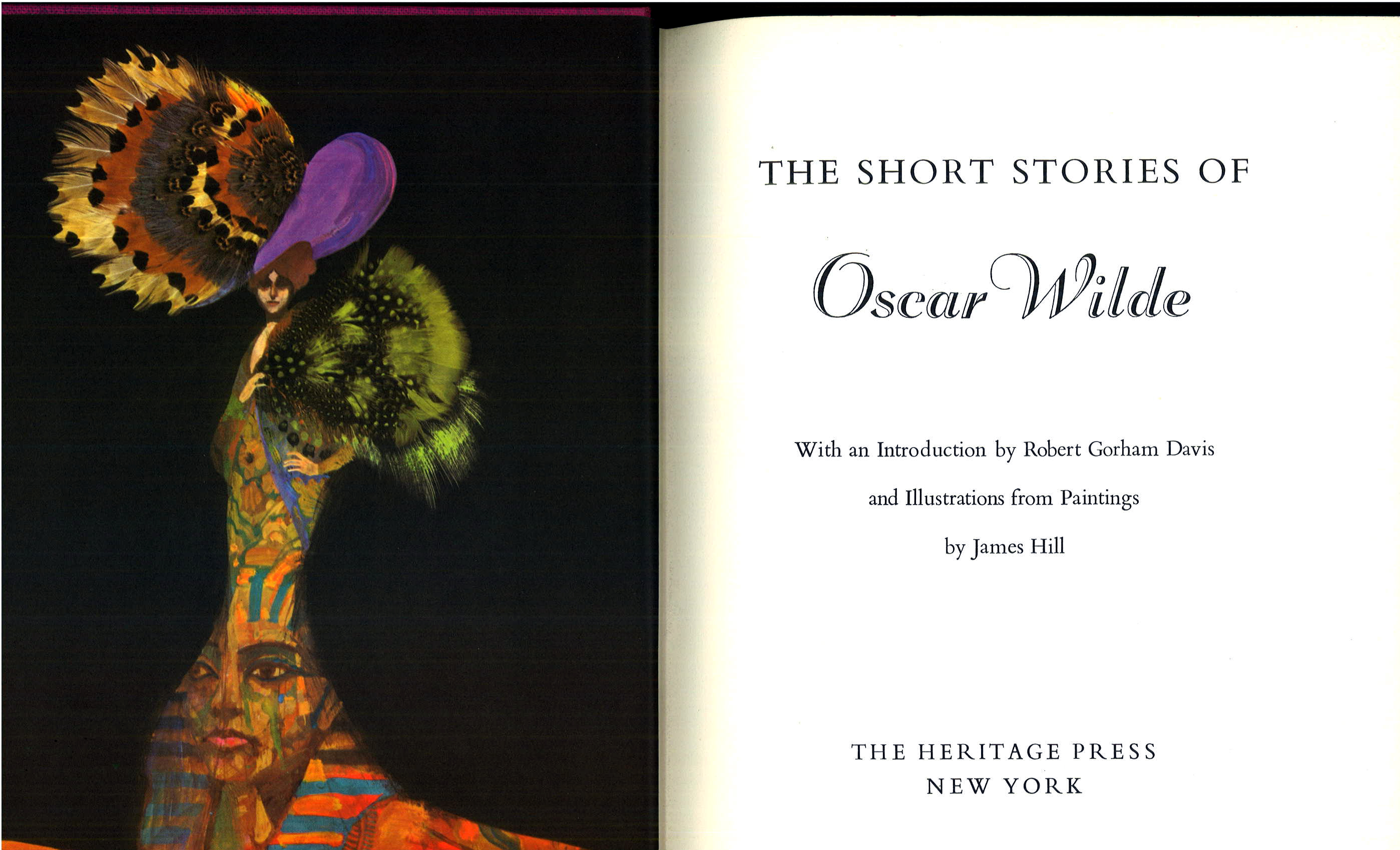
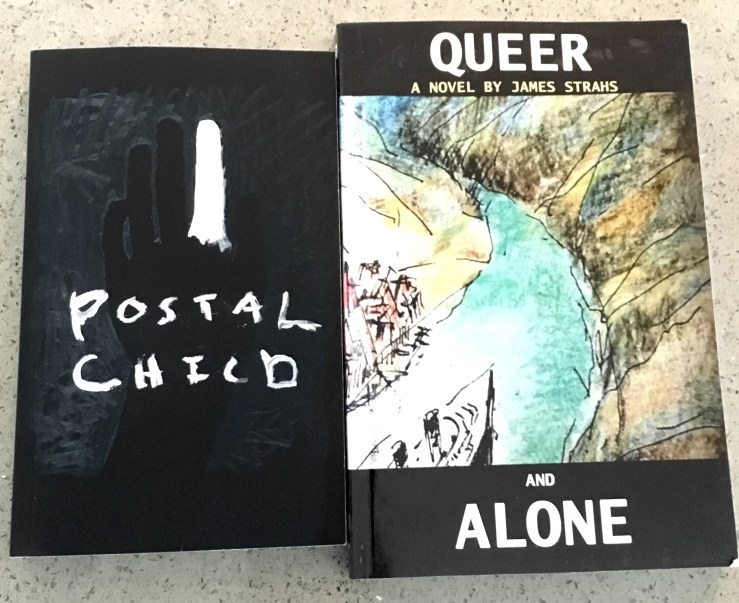
I love the covers of these two new titles from new indie Whisk(e)y Tit.
Here’s the not-blurb for Joey Truman’s Postal Child:
Whitey Whitlock had an ear for the birds. He could whistle their songs as well as they could. He did so on his route. He talked to the birds.The birds talked back.
Whitey was a black man. He was called Whitey because the index finger on his left hand was white. A birthmark. His first name was Esmerelda. Middle name Torno. His last name was Whitlock because his mom’s last name was Whitlock.
His mom was high when Whitey was born. She was also high when she named him. Esmerelda was the name of her sister, the only person in the world who ever treated her decently, and Torno was short for tornado, because that’s how it felt when Whitey came out.
Whitey’s mom had a penchant for the cocaine.
She was a good mom though. Albeit an inconsistent mom.Whitey learned how to deal with her mood swings and her ever-present hangovers. By the time he was three he could make his own breakfasts. By the time he was eight he could get himself to school. By the time he was ten he was doing all the shopping and housework. By the time he was twelve he could do all the paperwork that allowed him and his mom not to starve or be homeless. On one of the pubescent days leading up to his thirteenth birthday he woke up to find his mom dead on the couch.
And the blurb-blurb for James Strah’s Queer and Alone (which about, by the way, Whisk(e)y Tit publisher Miette threatens/offers to “tattoo the entire text to your torso while smoking clove cigarettes” (not sure who’s doing the smoking there)):
Monrovia. Bali. Bombay. Cayman Islands. Hollywood. The names of faraway places dot the pages of Queer and Alone like thousands of islands in a deep blue sea. Indeed, the hero – or is he an ironic anti-hero? – of this novel is a man literally at sea. He is Desmond Farrquahr who boards a steamer bound for Hong Kong by way of the Cape of Good Hope. Looking for experience, taking in the sights, hoping. For what?
Queer and Alone is a wildly exuberant travelogue as monologue, an eccentric American’s view of tourism. One might call it a “scatalogical romance,” with a story and a girl in every port. “It’s all part of the novel experience of being there,” Farrquahr wordplays with the reader. As narrator of the novel he shows off incredibly sly linguistic gifts that turn even the slightest image or sound into the dazzling rhythms of word magic.
Whether it’s describing racial fantasy films in Africa, investigating murder in Bombay, or seducing stately women in staterooms, Farrquahr manages to have the most ingenious takes on culture. In one of the most funny scenes in the novel the narrator is seen eating several (dis)courses of a chopstick dinner that makes the ideologies of both East and West seem like entangled sesame noodles. Tourism moves closer to zany anthopology whenever Farrquahr acts as guide.
Desmond Farrquahr is a very queer fellow if judged by any conventional standards. But isn’t the world itself a queer place these days?
For twenty years now Berryman’s lineI conclude now I have no inner resources has been plinking around the inside of my dumb skull. The line is plinking like crazy lately, as I shuffle final exam essays into some kind of order (what order?) that might align with my ability to offer the student, the writer, some meaningful note, some suggestion for improvement, some revelatory remark. Plink plink plink. No inner resources.
It is bad to start with a complaint so I will dress up the preceding paragraph (I dress it mentally) as an apologia. (Why the hell did I decide to write about books online?!).
I’ve been reading some really great books lately, folks. People, yes, you, listen. It’s not true that I have no inner resources. I am unstuck as a reader. I’m all gummed up with what I’ve read. Well-fed. And yet I go to scribble out a, like, review and plink plink plink. Nothing.
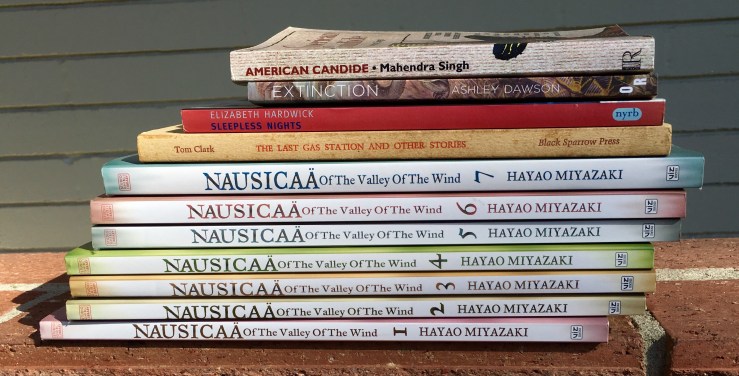
But like I said, the reading’s been really good. From the bottom up:
Let me strongly recommend American Candide by Mahendra Singh. I recommend this book for people who enjoy laughing at tragedies that should otherwise make them weep. You can and should purchase this book from Rosarium.
Illustration to American Candide by Mahendra Singh
Above American Candide in the stack so lazily pictured above is Yuri Herrera’s neon noir novella The Transmigration of Bodies, which I also highly recommend. I managed a few words on it here.
If you were to describe Henri Michaux’s Miserable Miracle 1956 book to me, I might politely decline with a small gesture of my hand. It’s about a guy who takes mescaline and writes about the experience and he draws these pictures and then he later takes “Indian hemp” and compares it— you might say to me, you, knowing as you know that I dig weird books, but I would cut you off at with an em dash, polite but firm, Not interested in drug novels these days (and besides dude, you know that Aldous Huxley did kinda the same thing at kinda the same time). And then you, having the book with you might press it into my hand, declaring, No, look—
—and I would say Thanks and consume the book in two sittings.
And so after a few years of false starts, I finally broke through the second chapter of Stanley Elkin’s satire The Franchiser. The many years of recommendations, exhortations (and scoldings) to read The fucking Franchiser were correct and good and now appreciated, as I work my way into the novel’s rich fat middle—but I admit it was Mr. William Gass who finally sold me on a commitment. I read his introduction published elsewhere—in A Temple of Texts—and that was that.
Thanks to Jon for sending me Ursula K. Le Guin’s essay collection The Language of the Night. The collection collects the collective introductions to Le Guin’s so-called Hainish collection, which I read this winter, and wrote about here. Not one of my editions featured the reflections Le Guin (or more likely her editors) called “Introductions” in later essays, and reading the Hainish intros is, in a very slight sense, like rereading those books. Lovely.
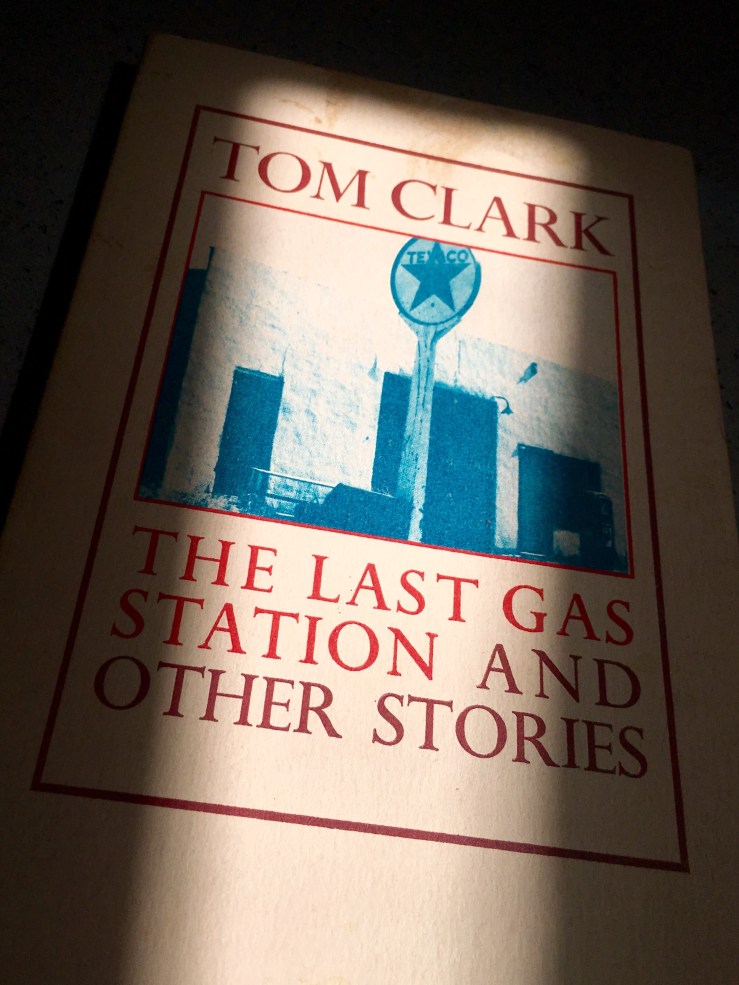
Last and never least: Tom Clark’s The Last Gas Station and Other Stories. I’ve thought often of Clark’s poems as stories pretending to be poems so maybe these are poems pretending to be stories. Or maybe I have no idea what the fuck I’m talking about. (Plink plink plink). I read most of them except for the longest one, “Incident at Basecamp,” which I will save save save for the future, an old habit, maybe a bad habit, that, to read all but one story in a collection, to maybe keep the collection afresh somehow or not wholly discovered—eh? Plink plink plink. Wag.
“How crowded is the universe,” his godfather said and moved the plasma arm vaguely. “How stuffed to bursting with its cargo of crap. Consider, Ben. You could have been a pencil or the metal band that holds the eraser to the wood, the wire of lead that runs through it. The black N in ‘Number 2’ stamped along one of its six sides. Or one of its six sides. Or the thin paint on another. You might have been a vowel on a typewriter or a number on a telephone dial or a consonant in books. There are thousands of languages, millions of typewriters, billions of books. You might have been the oxygen I breathe or the air stirred by this sentence. It is a miracle that one is not one of these things, a miracle that one is not a thing at all, that one is animal rather than mineral or vegetable, and a higher animal rather than a lower. You could have been a dot on a die in a child’s Monopoly set. There are twenty-one dots on each die, forty-two in a pair. Good God, Ben, think of all the dice in the world. End to end they’d stretch to the sun. Then there are the rich, the blooded with their red heritage like a thoroughbred’s silks. You might have been a stitch in those silks, a stitch in any of the trillions of vestments, pennants, gloves, blankets, and flags that have existed till now. Let me ask you something. How many people live? Consider the size of their wardrobe over the years. A button you could be, a pocket in pants, a figure on print.
“—I was discussing the rich. There are many wealthy. More than you think. I’m not just talking beneficiaries either, next of kin, in-laws, distant cousins, the King’s mishpocheh, the Emperor’s. But the rich man himself, the wage earner, the founder. Fly in an airplane in a straight line across one state. You couldn’t count the mansions or limousines, you couldn’t count the swimming pools. So many, Ben. You’re not one of them, and not one of the family, and still you exist. I am talking the long shot of existence, the odds no gambler in the world would take, that you would ever come to life as a person, a boy called Ben Flesh.
From Stanley Elkin’s 1975 novel The Franchiser. After a few false starts, I finally got into the rhythm and voices in this strange and very funny novel of Ben Flesh, who “patrolled America” as, well, a franchiser. It was when Ben’s (fairy)godfather goes on a rant about the, uh, miracle of existence that I fell for the novel.
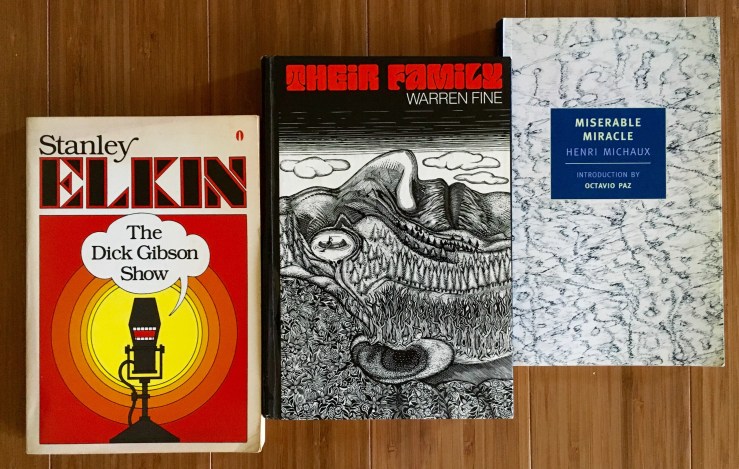
I swung by my favorite used bookstore this afternoon; it’s right near the grocery store and I needed to pick up some mint and some ricotta. I was hoping to pick up Elena Ferrante’s novel My Brilliant Friend at the bookstore. I started the audiobook of My Brilliant Friend today, after finishing the audiobook of Adrian Jones Pearson’s novel Cow Country this weekend. (Full review of Cow Country forthcoming but a real quick review: great performance/reading of a very strange book which I enjoyed very much, but which I also suspect will have very limited appeal. Cow cult classic to come). But so anyway, I’m really digging the Ferrante, and decided I wanted to obtain a physical copy to reread passages (and maybe share some on this blog). My store had several copies of four of Ferrante’s novels–but no Friend. While scanning the F section, my eye alighted (alit?) on a strange-looking hardback spine—Warren Fine’s Their Family. I turned it around and the cover…well, I knew I was gonna leave with it. Knopf, 1972—a few years before Gordon Lish was to become editor there, sure, but interesting bona fides I suppose. Fine does not seem to be beloved by anyone on the internet, and his books seem to have failed to go into second printings of any kind. The Fs are near the Es, and I glanced over the works of Mr. Stanley Elkin, who has his own section there, somehow. I finally broke through the second chapter of his novel The Franchiser this weekend (it’s all unattributed dialog, that chapter, sorta like Gaddis’s JR); I’m really digging The Franchiser now that I’ve tuned into the voice. (It also helps to not try reading it exclusively at night after too many bourbons or wines). Again, the spine of the novel looked interesting so I flipped The Dick Gibson Show around and, again, I knew I was gonna leave with it. Henri Michaux’s Miserable MiracleI found in the “Drugs” section—which I was not perusing (because I am no longer 19)—well I guess I was perusing it, but that’s only because it happens to be right next to this particular bookshop’s collection of Black Sparrow Press titles, which I always scan over. Anyway, the Michaux’s Miserable Miracle was turned face out; NYRB titles always deserve a quick scan, and the cover reminded me of a Cy Twombly painting. Flicking through it revealed a strange structure, full of marginal side notes and doodles and diagrams and drawings. And oh, it’s about a mescaline trip, I think. You can actually read it here, but this version is missing all the drawings and sidenotes.
Oh, and so then I forgot to go pick up the ricotta and the mint.
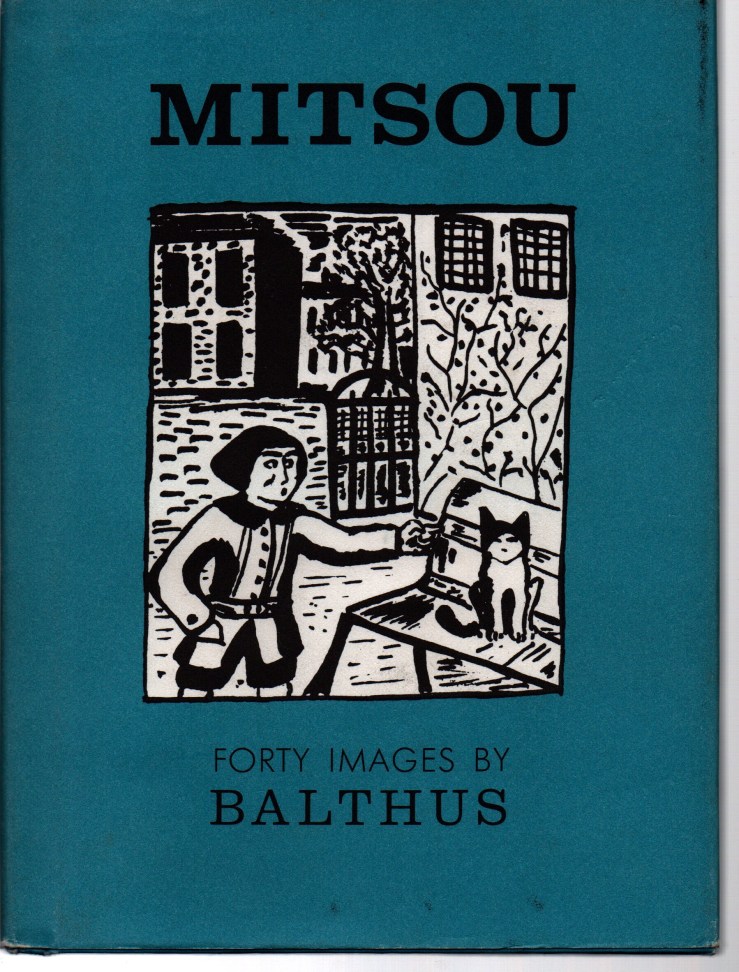
Mitsou by Balthus. Preface by Rainer Maria Rilke (English translation by Richard Miller). Small first edition hardback published by The Metropolitan Museum of Art, 1984. Design credited to Peter Oldenburg; the cover illustration is by Balthus. Mitsou is Balthus’s story of loving (and losing) his titular pet cat. He was thirteen when he composed the story in 40 ink drawings (the drawings resemble woodblock prints, but aren’t). He gave the illustrations to his mother’s lover, Rainer Maria Rilke, who got them published. My wife gave me this book as a gift before we were married, and I love it. It’s sad.
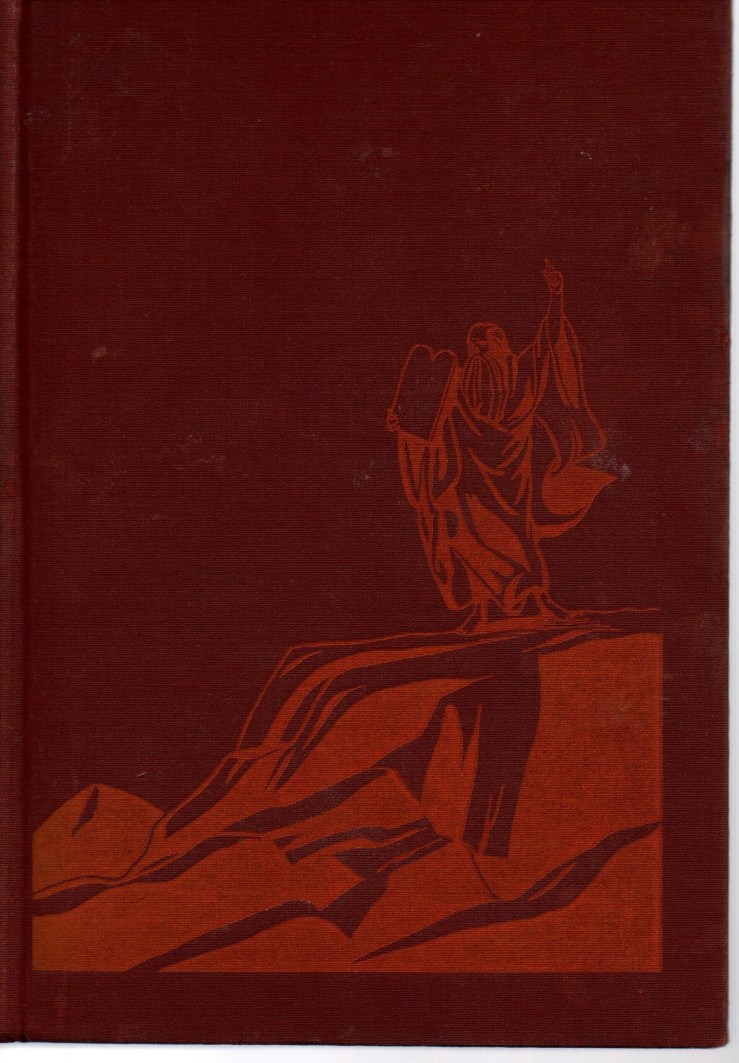
Moses, Man of the Mountain by Zora Neale Hurston. First edition hardback by J.B. Lippincott, 1939. No illustrator or designer credited, by my edition is missing the original jacket. A retelling of the Exodus story.
Man after Man by Dougal Dixon with illustrations by Philip Hood. First edition hardback from St. Martin’s Press, 1990. Book design by Ben Cracknell; cover art by Philip Hood. It’s Hood’s illustrations that make Dixon’s “future anthropology” of the human race so fascinating. A discursive sci-fi novel of sorts, posing as a textbook.
I just spent the past hour reading from Tom Clark’s 1980 short story collection The Last Gas Station and Other Stories. Is this the only collection of short stories by Clark? I don’t know. Maybe I prefer not knowing. I was excited to find this at the bookstore yesterday so maybe I’ll be excited to find some other phantom collection in some eventual phantom future. Stories that are like poems, or infused by poems—or dialogues, or spirit rants, ersatz music reviews for bands that may or may not exist. Heidegger complains to Hitler; Ty Cobb gets turned on to Little Orphan Annie. Tales of sex and love and other things. Find it if you can get it.
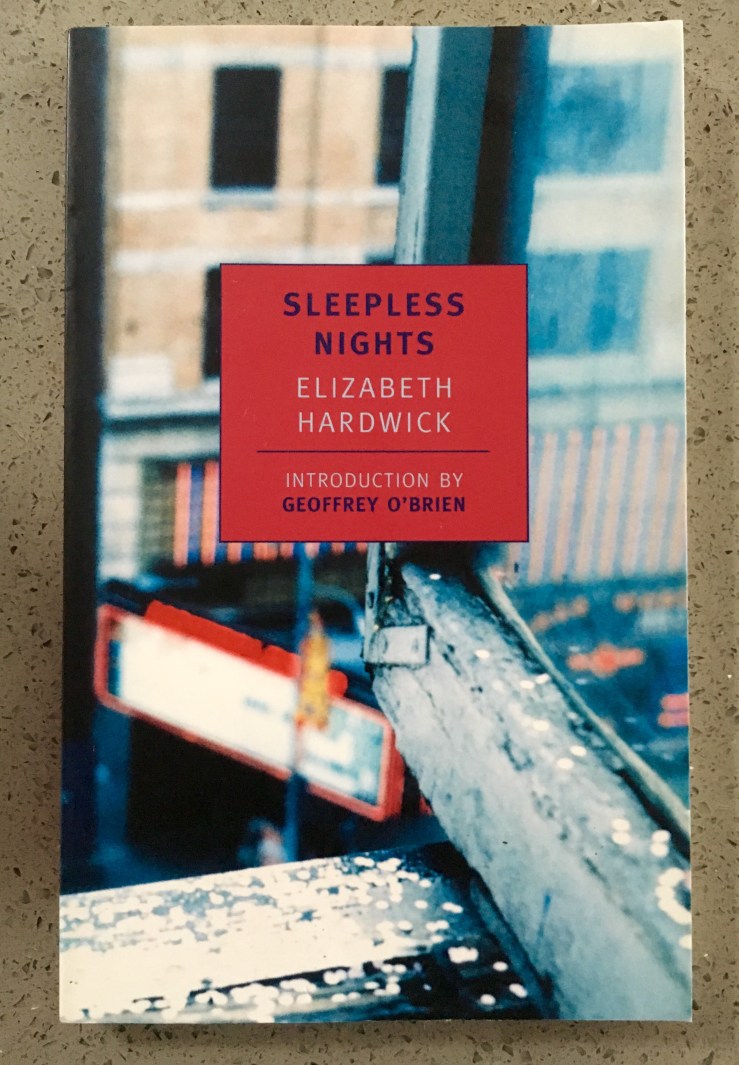
Sleepless Nights by Elizabeth Hardwick is a riff-novel, or a thought-novel, or an I-don’t-know-what, I mean. Is it about memory? Or is it memory? “If only one knew what to remember or what to pretend to remember”—If I remember correctly, this is the first sentence of the novel’s second paragraph.
Mahendra Singh’s American Candide is forthcoming from Rosarium. It is funny and sad and even cruel, but also sweet (and bitter and very very funny). I’ll have a full review forthcoming closer to its pub date, but the short review is: Buy it.
I wrote about Ashley Dawson’s Extinction a week or two ago…finished it since then and it’s a good, sad, angrifying read. I read Extinction with/against a viewing of Miyazaki’s Princess Mononoke, and then I got sick, like, the next week, which led to a big re-read of Nausicaä of the Valley of the Wind. I’m better now, thanks to fantasy and manga.
Has Man a Future? by Bertrand Russell. 1961 Penugin U.S. paperback. Cover design by Richard Hollis, using a photo credited to USIS.
I’m Not Stiller by Max Frisch. English translation by Michael Bullock. 1961 Penguin paperback (Great Britain). Cover by John Griffiths.
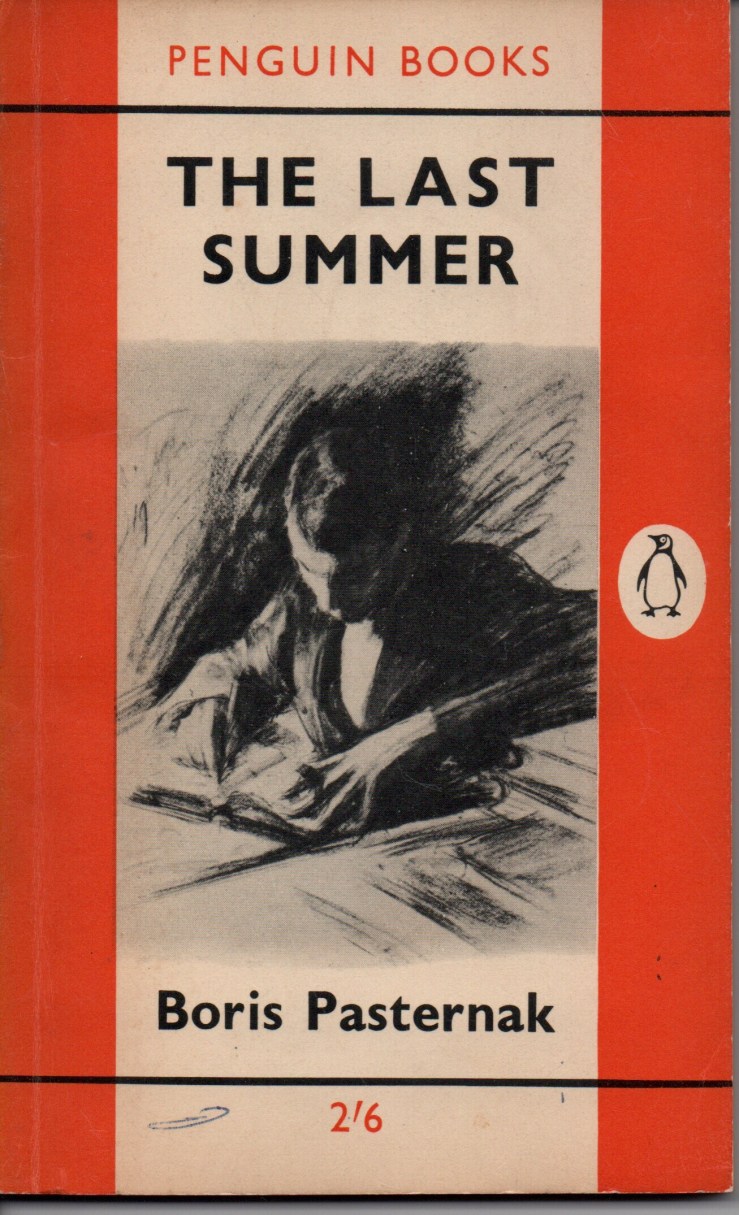
The Last Summer by Boris Pasternak. English translation by George Reavey. 1961 Penguin paperback (Great Britain). Cover illustration of the author by his father, Leonid Pasternak.
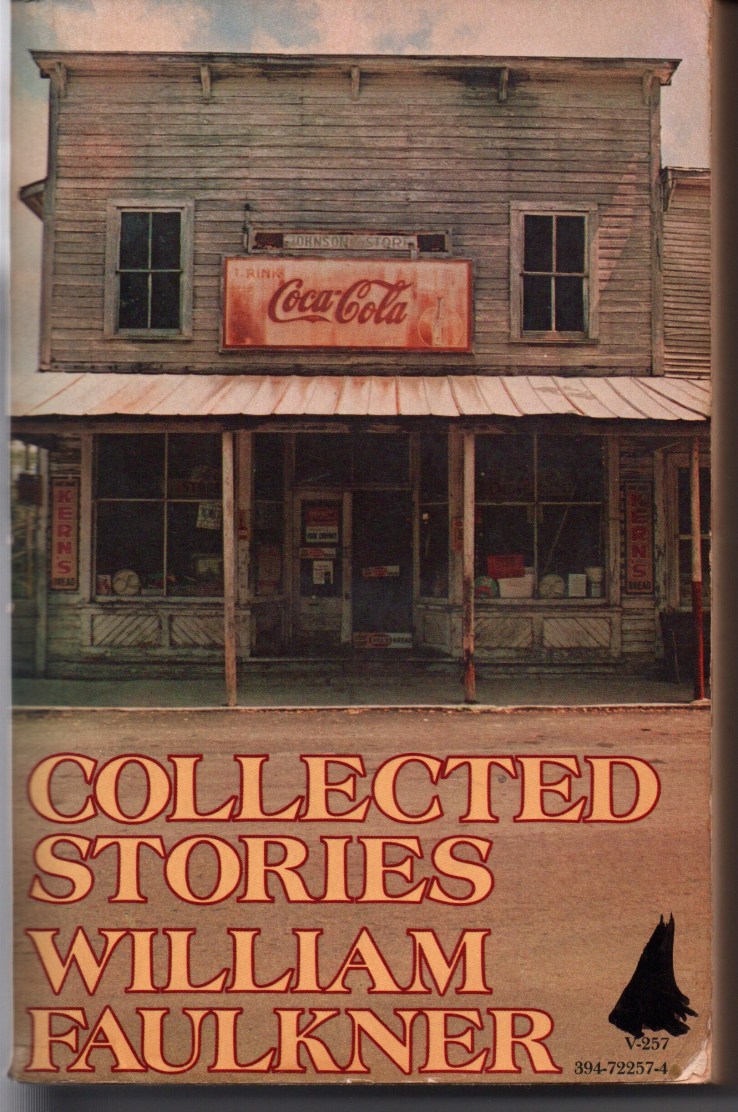
Collected Stories by William Faulkner. 1977 first edition trade paperback from Vintage. This book is 900 pages, exactly, not including the ancillary pages that detail publication dates and rights, as well as Vintage’s back catalog—and yet not one of those pages manages to credit the cover designer or photographer.
I’ve been reading/re-reading this very slowly, with the loose goal of finishing this year.
Nausicaä of the Valley of the Wind, Vol. 4 by Hayao Miyazaki. English translation by David Lewis and Toren Smith. Studio Ghibli Library edition by Viz Media, 2010. No designer credited, but the cover is by Miyazaki and I imagine we can probably credit Studio Ghibli with the design.
I started rereading Nausicaä this week after revisiting Princess Mononokethis week. Then I got horribly ill, and the only stuff I can really read when I’m really sick are comics. I scanned Vol. 4 for this week’s Three Books post; I finished it pretty late last night. Vol 5-7 remain.
Junkets on a Sad Planet by Tom Clark. First edition trade paperback by Black Sparrow Press, 1994. Cover design by Barbara Martin. The image is of Benjamin Robert Haydon’s life mask for John Keats (from a photo by Christopher Oxford).
I awoke around 1am in the middle of last week, and unable to sleep, I wandered to our den and randomly took this from the shelf to begin reading/rereading. The book (its title is a pun) is difficult to explain, a beautiful experience, rich. Here’s Clark’s own description: “…an extended reflection on the modern poet’s life, as Keats lived it. The book may be read by turns as poetic novel, biography in verse, allegorical masque, historical oratorio for several voices.”
October 3rd. — A strange occurrence has taken place today. I got up fairly late, and when Mawra brought me my clean boots, I asked her how late it was. When I heard it had long struck ten, I dressed as quickly as possible.
To tell the truth, I would rather not have gone to the office at all today, for I know beforehand that our department-chief will look as sour as vinegar. For some time past he has been in the habit of saying to me, “Look here, my friend; there is something wrong with your head. You often rush about as though you were possessed. Then you make such confused abstracts of the documents that the devil himself cannot make them out; you write the title without any capital letters, and add neither the date nor the docket-number.” The long-legged scoundrel! He is certainly envious of me, because I sit in the director’s work-room, and mend His Excellency’s pens. In a word, I should not have gone to the office if I had not hoped to meet the accountant, and perhaps squeeze a little advance out of this skinflint.
A terrible man, this accountant! As for his advancing one’s salary once in a way — you might sooner expect the skies to fall. You may beg and beseech him, and be on the very verge of ruin — this grey devil won’t budge an inch. At the same time, his own cook at home, as all the world knows, boxes his ears.
I really don’t see what good one gets by serving in our department. There are no plums there. In the fiscal and judicial offices it is quite different. There some ungainly fellow sits in a corner and writes and writes; he has such a shabby coat and such an ugly mug that one would like to spit on both of them. But you should see what a splendid country-house he has rented. He would not condescend to accept a gilt porcelain cup as a present. “You can give that to your family doctor,” he would say. Nothing less than a pair of chestnut horses, a fine carriage, or a beaver-fur coat worth three hundred roubles would be good enough for him. And yet he seems so mild and quiet, and asks so amiably, “Please lend me your penknife; I wish to mend my pen.” Nevertheless, he knows how to scarify a petitioner till he has hardly a whole stitch left on his body. Continue reading ““Memoirs of a Madman” — Nikolai Gogol”→
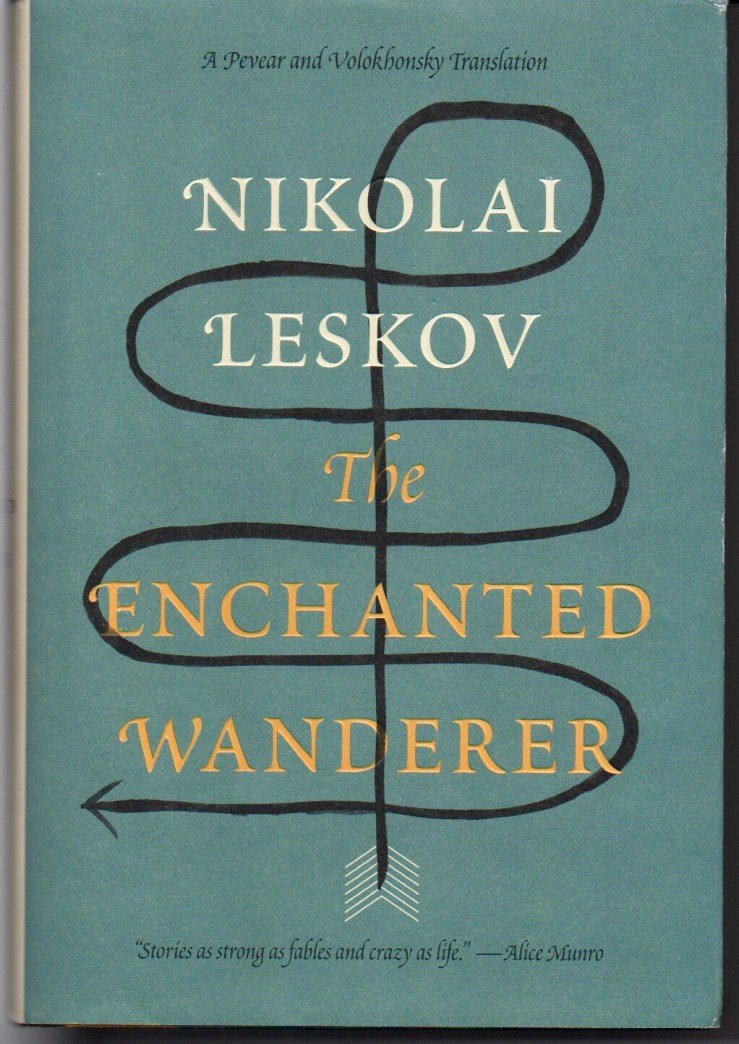
The Enchanted Wanderer and Other Stories by Nikolai Leskov. English translation by Richard Pevear and Larissa Volokhonsky. First edition hardback from Knopf’s Borzoi imprint. Jacket design by Peter Mendelsund. There are still a few tales in here that I haven’t read, most notably the titular novella.
The Silmarillion by J.R.R. Tolkien (and arguably, Christopher Tolkien, whose edits gave the book shape and form). 1983 first American edition trade paperback by Houghton Mifflin. No designer credited, which is a damn shame because I love this book cover. This is maybe the first book I recall buying with my own money.
Miruna, A Tale by Bogdan Suceavă. Translated from the Romanian by Alistair Ian Blyth. 2014 trade paperback by Twisted Spoon Press. Cover design by Dan Myer. A strange and remarkable novella set in the Carpathians that moves time and history into fantasy storytelling.
Crossing the Sea with Syrians on the Exodus to Europe by Wolfgang Bauer (in English translation by Sarah Prybus) is new in hardback this month from And Other Stories. Their blurb:
Award-winning journalist Wolfgang Bauer and photographer Stanislav Krupař were the first undercover reporters to document the journey of Syrian refugees from Egypt to Europe. Posing as English teachers in 2014, they were direct witnesses to the brutality of smuggler gangs, the processes of detainment and deportation, the dangers of sea-crossing on rickety boats, and the final furtive journey through Europe. Combining their own travels with other eyewitness accounts in the first book of reportage of its kind, Crossing the Sea brings to life both the systemic problems and the individual faces behind the crisis, and is a passionate appeal for more humanitarian refugee policies.
I picked up Elizabeth Hardwick’s Sleepless Nights yesterday. (I was browsing the “H, classics” for something else, which I did not find, but I found this). Here’s the beginning of Joan Didion’s 1979 review in The New York Times:
“I have always, all of my life, been looking for help from a man,” we are told near the beginning of Elizabeth Hardwick’s subtle new book. “It has come many times and many more than not. This began early.” . . . “Sleepless Nights” is a novel, but it is a novel in which the subject is memory and to which the “I” whose memories are in question is entirely and deliberately the author: we recognize the events and addresses of Elizabeth Hardwick’s life not only from her earlier work, but from the poems of her husband, the late Robert Lowell. We study in another light the rainy afternoons and dyed satin shoes and high-school drunkenness of the Kentucky adolescence, the thin coats and yearnings toward home of the graduate years at Columbia, the households in Maine and Europe and on Marlborough Street in Boston and West 67th Street in New York. We are presented the entire itinerary, shown all the punched tickets and transfers. The result is less a “story about” or “of” a life than a shattered meditation on it, a work as evocative and difficult to place as Claude Levi-Strauss’s “Tristes Tropiques,” which it oddly recalls. The author observes of her enigmatic narrative: “It certainly hasn’t the drama of: I saw the old, white-bearded frigate master on the dock and signed up for the journey. But after all, ‘I’ am a woman.”
This strikes an interesting note, a balance of Oriental diffidence and exquisite contempt, of irony and direct statement, that exactly expresses the sensibility at work in “Sleepless Nights.” “But after all, ‘I’ am a woman.” Triste Tropique indeed. By way of suggesting his own intention, Levi-Strauss quoted Chateaubriand: “Every man carries within himself a world made up of all that he has seen and loved, and it is to this world that he returns, incessantly.” In certain ways, the mysterious and somnambulistic “difference” of being a woman has been, over 35 years, Elizabeth Hardwick’s great subject, the tropic to which she has returned incessantly: it colored both of her early novels, “The Ghostly Lover” in 1945 and “The Simple Truth” in 1955, as well as many of the essays collected in 1962 as “A View of My Own” and all of those published in 1974 as “Seduction and Betrayal: Women and Literature.”




 Man after Man by Dougal Dixon with illustrations by Philip Hood. First edition hardback from St. Martin’s Press, 1990. Book design by Ben Cracknell; cover art by Philip Hood. It’s Hood’s illustrations that make Dixon’s “future anthropology” of the human race so fascinating. A discursive sci-fi novel of sorts, posing as a textbook.