In 2018—six years ago—on Thomas Pynchon’s 81st birthday, I put together a thoroughly unnecessary ranking of his eight novels. I’m somewhat ashamed of the post, as I included two novels I had abandoned a few times—Vineland and Bleeding Edge. Three years ago, on Pynchon’s 84th birthday, I wrote a few sentences on each of Pynchon’s novels, having, at that point, made my way through all of them. The first post, perhaps because it contains the word “ranking” in its title gets far more traffic to this day than the more thoughtful and finished post from 2021. Indeed, the “ranking” post regularly shows up in the top ten percentile of my weekly and monthly stats on Biblioklept, which, I guess, has bothered me enough to write this (thoroughly unnecessary still) “ranking.”
I know that if I were to approach Pynchon’s eight novels on eight different days, I’d likely end up with a consistent #1, #2, #3, and #8—but the other spots would shift depending on my memory or fancy or whatever spell I’d fallen under, chemical, metaphysical or otherwise. But here’s the list I came up with today.
8. Vineland (1990)
In my 2018 post (where I ranked Vineland at number 7) I noted that “Vineland seems to have a strange status for Pynchon cultists—its a cult novel in an oeuvre of cult novels,” and I’ve found that intuition confirmed over the years. I stick by my assertion in my 2021 post in which I asserted that “Vineland is ultimately depressing and easily my least-favorite Pynchon novel, but it does have some exquisite prose moments.” I’m sure I’ll revisit it before seeing Paul Thomas Anderson’s film adaptation though.
7. Inherent Vice (2009)
Speaking of Paul Thomas Anderson—I think I like his film adaptation of Inherent Vice more than I like the novel. And I love Inherent Vice. But I think PTA provides an emotional ballast that gives the narrative a center that’s missing from Pynchon’s novel (which is, likely, the point, or at least the byproduct of Pynchon’s shaggy dogging it). (I originally ranked Inherent Vice at number 6).
6. Bleeding Edge (2013)
So I finally found my way into Bleeding Edge in the earliest weeks of the COVID-19 lockdown. I’d stuck the book at the bottom of my 2018 list. I’m not really sure why I stalled out on—maybe it feels the closest to my own timeline of any Pynchon novel. Anyway, it’s one I want to revisit again soon. I riffed on it some in 2020, writing “Pynchon captures a time in America during which I was, at least theoretically, becoming an adult (a becoming which may or may not have happened yet). Reading Bleeding Edge helped evoke all the weirdness the 2000s were about to lay out for us. It made me angry again, or reminded me of the anger that I’d sustain for most of the decade. It reminded me of our huge ideological failure after 9/11, an ideological failure we are watching somehow fail even more today. But I also loved the novel’s unexpectedly sweet domestic plot, and found a kind of solace even in its affirmation of family, even as its final image pointed to the kind of radical inconclusiveness at the heart of being a parent.”
5. V. (1963)
So from here on out my rankings are identical to my stupid 2018 list, with that big caveat that I would easily swap, say, V. and 49 here. I’ll repeat my endorsement that “V. makes a good starting place for anyone new to Pynchon” and recommend that anyone interested in Pynchon but daunted by the scope check out the book from their library and read the ninth chapter, the story of of Kurt Mondaugen.
4. The Crying of Lot 49 (1966)
The Crying of Lot 49 is probably a better novel than V. but I think I like V. better. 49 is very funny and showcases Pynchon’s tonality of paranoia/hope wrapped up in zaniness/horror. It’s an excellent sophomore novel, but also dense, claustrophobic even. I guess I like the Pynchon sprawl a bit better.
3. Against the Day (2006)
Speaking of sprawl: Against the Day is Pynchon’s biggest novel, just fat and giddy and overstuffed with goodies. I think this novel would make an excellent American history textbook. Its thesis: resist the military-industrial-entertainment-complex. Start here!
2. Mason & Dixon (1997)
A measurement of the world and a story about friendship. It would be Pynchon’s best novel if he hadn’t written—
1. Gravity’s Rainbow (1973)
The best book. I reread it earlier this summer and it’s roomier and stranger and more rewarding each time.
I experienced the middle weeks of July 2024 as simultaneously rapid and static. Doldrums should never be so frenetic. If this decade were a novel I would’ve put it down several chapters back. I try not to obsess over things I cannot control. I try to get away from screens. I try to go outside, but the feels like heat index here in north Florida goes over a hundred and five every day. (At least it’s raining again and nothing is on fire.) So I try to read more (and actually write more).
This July I read some great stuff.
I finished Katherine Dunn’s first novel Attic a couple of days ago. The book is seriously fucked up—like William Burroughs-Kathy Acker fucked up—an abject rant from a woman in prison in the mode of Ginsberg’s Howl. The narrator seems to be an autofictional version of Dunn herself, which is perhaps why Eric Rosenblum, in his 2022 New Yorker review described it as “largely a realist work in which Dunn emphasizes the trauma of her protagonist’s childhood.” Rosenblum uses the term realism two other times to describe Attic and refers to it at one point as a work of magical realism. If Attic is realism then so is Blood and Guts in High School. I need to read her second and third novels (Truck, 1971 and the posthumous Toad) and then go back and reread Geek Love, which I remember as being Gothic and gross but also whimsical. (I don’t sniff any whimsy in Attic.)
There are eight stories in Oğuz Atay’s story collection Waiting for the Fear (in translation by Ralph Hubbell); I’ve read the first five this summer, including the long title story, which is especially good, as is the opener “Man in a White Overcoat.” Atay’s heroes (I use the term loosely) find their antecedents in Kafka’s weirdos. Or Paul Bowles. Or Jane Bowles. I should have a proper review up near the end of October when NYRB publishes Waiting for the Fear.
I had picked up Mauro Javier Cárdenas’s third novel American Abductionsearlier this summer and finally started it a few nights ago after finishing Attic. Each chapter is a run-on sentence that has made me want to keep reading and reading, running on with it. The novel is, at least so far, both challenging and entertaining; it is not difficult, exactly, but rather engrossing. Sometimes I’ll find myself a bit lost in the layered consciousnesses, layers (layerings) of speech in Cárdenas’s sentences—especially when I find myself startled by an image or a joke or idea—and then I’ll wade backwards again and pick up the rhythm and keep going. The plot? I’ll steal from the Dalkey Archive’s blurb: “American Abductions opens in a near-future United States whose omnipresence of data-harvesting and algorithms has enabled the mass incarceration and deportation of Latin Americans—regardless of citizenship.” But that’s not really the plot; I mean, this isn’t a third-person dystopian world-building YA thing. The novel, at least its first half, is about a family, daughters Ada and Eva and their father Antonio, a novelist who was abducted by the titular abductors (the Pale Americans!). It’s also about writing, how we construct memory in a surveillance state, and, I suppose, love.
I reviewed Jean-Baptiste Del Amo’s latest novel The Son of Man(in translation by Frank Wynne) in the middle of July, although I think I probably read it in late June. In my review I suggested that The Son of Man “is ultimately a novel about the atavistic transmission of violence from generation to generation.” I also highly recommended it.
I went on a big Antoine Volodine binge a couple of years ago which stalled out before I got to (what I believe is) his longest novel in English translation, Radiant Terminus. I finally started into it a few weeks ago (in translation by Jeffrey Zuckerman), and I think it might be Volodine’s best work. In my longish review, I declared Radiant Terminus “an astounding novel, a work that will haunt any reader willing to tune into its strange vibrations and haunted frequencies. Very highly recommended.” I think it’s a perfect starting place for anyone interested in Volodine’s so-called post-exotic project.
Denis Johnson’s The Stars at Noon was one of two novels I revisited via audiobook this month (the other is Portis’s Gringos, which we’ll get to in a moment). I honestly didn’t remember much about The Stars at Noon other than its premise and the fact that its narrator was an alcoholic journalist-cum-prostitute in Nicaragua. It hadn’t made the same impression on me as other Johnson novels had when I went through a big Johnson jag in the late nineties and early 2000s, and I think that assessment was correct—it’s simply not as strong as Angels, Fiskadoro, or Jesus’ Son. As an audiobook though I enjoyed it, especially in Will Patton’s reading. (His narration of Johnson’s perfect novella Train Dreams is the perfect audiobook.) I guess the audiobook came out in conjunction with Claire Denis’ 2022 adaptation of the film, which I still haven’t seen.
I picked up Dinah Brooke’s “lost” novel Lord Jim at Home in late June, and then read it in something of a sweat over a few days. In my review, I wrote that
Lord Jim at Home is squalid and startling and nastily horrific. It is abject, lurid, violent, and dark. It is also sad, absurd, mythic, often very funny, and somehow very, very real for all its strangeness. The novels I would most liken Lord Jim at Home to, at least in terms of the aesthetic and emotional experience of reading it, are Ann Quin’s Berg, Anna Kavan’s Ice, Mervyn Peake’s Gormenghast novels, Virginia Woolf’s Mrs. Dalloway, and James Joyce’s Portrait (as well as bits of Ulysses).
Gringos is the other book I “reread” via audiobook this July. Charles Portis wrote five novels and all of them are perfect—but I think Gringos might be my favorite. David Aaron Baker’s reading of the novel is excellent. He conveys the dry humor of narrator Jimmy Burns as well as the cynical sweet pathos at the core of Portis’s last novel. Highly recommended.
So well I guess July is over; the kids will be back in school again soon, and so will I. The air here will remain swamp thick, humidity that starts cooking you the minute you venture out of the desiccating AC that licensed growth on this weird peninsula. It might let up by November. Maybe because I’ve spent my entire adult career as a teacher I have always thought of August as the end of the year, not December. And some years I feel melancholy at this end, this pivot away from freer hours. But writing this on the last day of July, I think I want a return to routine, to something I can think of as a return to normalcy, the kind of normalcy that makes me appreciate the weird fucked up oddball novels that I do so love to hang out inside of.
In the five-and-dime can’t see over the counters with her—see
the red thimble—plastic knobby—just fits—put it on and tap things with it—lips and teeth and wish I had two to click against each other—wander out with her—why where did you get that you little thief march right back in there and give it to the man and apologize—penny thimble—I didn’t even notice I’d taken it—big noise and hits—the shame…
Drugstore book racks—need a book a day at least—three thin ones—too far to the library—heavy—always overdue—little ladies in pale green uniforms inventory hair spray—perfume—Kotex while I’m putting books in my purse—in my armpits—Agatha Christie—Nero Wolfe—James Bond—candy bars in pockets—have to lay off M & Ms—they rattle too much—an extra eyebrow pencil up my sweater sleeve and buy a deodorant—go out to the car and drop the stuff—back into the supermarket for cookies and cigarettes and chocolate-covered cherries—buy milk and then tool back home to turn the heat up and sit with the rain outside—with my feet up reading trash—eating trash—drinking milk straight from the carton only pouring it into a glass when I want to dunk cookies in it…
Girls League Cake Sale—high school cakes by girls in coordinated sweaters and skirts—ribbons holding their hair—dozens of pairs of shoes—their proud bras and girdles mocking my brother’s cast-off tee shirts in the locker room—they study typing with old Birdsing and wear ribbons in their hair—bake cakes for the cake sale from scratch with boiled frosting that slump in the middle and cave on the side—patch it up with frosting and candy drops—hide them on mother’s best cake plates behind screens in the cafeteria—I ducking class as usual—hiding stink bombs behind the encyclopedias in the library—sneaking through the halls with my five-button Levi’s swishing between my legs a cake under each arm—stacking them carefully in my locker on top of stolen books behind the Life Magazine picture of Bertrand Russell like a baby eagle his fierce fuzzy face on the scrawny neck—hide for the rest of the afternoon in the conference rooms in the library listening to Jake in his chemistry room gas mask searching for the stink bombs and cursing—thinking of him fumbling with the pear-assed librarian from the grade school—all the time rehearsing my lines for if I’m caught—when the final bell rings parading down to the boys’ locker room with a dozen cakes on a book cart to wait for the wrestling team to finish weighing in and come out famished after a month of making weight…
Five years ago, I was fortunate enough to interview Margaret Carson about her translation of a collection of the artist Remedios Varo’s written work. Margaret has since expanded on that collection, adding new material from her dive into Varo’s archives, resulting in On Homo rodans and Other Writings, new this summer from Wakefield Press.On Homo rodans and Other Writings offers readers a fascinating trip through Varo’s imagination. Brimming with impossible images, surreal jokes, and dreamy fragments, the work is more than just an addendum to Varo’s career as an artist. I highly recommend it to those interested in surrealist writing in general. Margaret was kind (and patient!) enough to talk with me again over the course of a few weeks via email. I am grateful for her generosity and for her work in bringing Varo’s words to monoglots such as myself.
In addition to her Varo books, Margaret Carson’s translations include Sergio Chejfec’s Baroni, A Journeyand My Two Worlds. She is Associate Professor in the Modern Languages Department at Borough of Manhattan Community College, The City University of New York.
Photograph of Margaret Carson by Beowulf Sheehan.
Biblioklept: Margaret, congratulations on the publication of On Homo rodans and Other Writings, the expanded edition of your English translation of Remedios Varo’s writings! Many of our readers might be familiar with Varo’s wonderful paintings but not know about her writing. How would you characterize the prose collected in On Homo rodans and Other Writings?
Margaret Carson: Thanks, it’s great to have the translation back in print! It’s mainly writings found after Remedios Varo’s death in notebooks and on loose pages. The writings are quite varied: several odd and delightful stories (three of them new to this edition), a fairy tale, letters to friends and strangers, her famous recipe “To Provoke Erotic Dreams,” a poem that invokes the moon, dream narratives, and a few other gems, such as the title piece, “On Homo rodans,” a faux anthropological treatise that accompanied her sculpture of a human-like torso on a giant wheel, made out of chicken, turkey and fish bones.
Homo rodans sculpture in its glass case. Photograph by Margaret Carson.
Varo’s extraordinary creativity and weird sense of humor come across just as much in her writings as in her paintings. I think readers fascinated by Varo, the artist, will also be won over by her gifts as a writer. Simply put, she’s as clever a writer as she is a painter.
Biblioklept: So, let’s get into the stories and other material new to this edition and how you came to translate it into English. Some of this material hasn’t been published before, even in Spanish. If my understanding is correct, Walter Gruen, Varo’s last life partner, donated a significant collection of her works to the Museo de Arte Moderno in Mexico City in 2000. In 2018—after the publication of your translated collection Letters, Dreams & Other Writings—the Varo estate bequeathed more of Varo’s writings to the Museo de Arte Moderno. Is that right?
MC: Yes. In the early 2000s Walter Gruen and his wife Anna Alexandra Varsoviano (a friend of Varo’s who he married after the artist’s death) donated about thirty-eight of her works to the Museo de Arte Moderno (MAM), making it the largest repository of paintings by Varo in the world. Walter Gruen died in 2008, and Anna Alexandra Varsoviano in 2015. (I was lucky enough to meet them both in person: Walter Gruen in 2000 and Anna Alexandra Varsoviano some years later.) In her will, Anna Alexandra bequeathed a trove of Varo’s notebooks, letters, preparatory drawings, photos, and other items to MAM, many of which were displayed in 2018 in an exhibition celebrating the donation: Adictos A Remedios Varo: Nuevo Legado 2018. It was at that exhibition that I first saw Varo’s notebooks, open to pages containing narratives, letters and other pieces, in Varo’s own handwriting. I could instantly recognize them because I’d translated the same texts for Letters, Dreams and Other Writings, except for that book I used a collection of Varo’s writings published in Mexico in the 1990s, Cartas, sueños y otros textos, edited by the Spanish scholar Isabel Castells.
Because the new Wakefield edition mostly uses archival materials as its source, and isn’t a direct translation of texts from an existing book, the estate requested that we give it a new title. So, thinking about Varo’s tour-de-force anthropological spoof, we renamed it On Homo rodans and Other Writings.
A page from the Homo rodans manuscript. Photograph by Margaret Carson.
Biblioklept: What kind of access did the museum give you to the manuscript materials?
MC: When I requested an appointment to consult the archive at MAM, I indicated my area of interest: Varo’s notebooks and any stray papers relating to her writings. So when I visited for a few days in July 2022, an archivist assisted me by bringing out her notebooks one at a time as well as folders containing loose papers. You can’t imagine how excited I was not only to see but to touch these old, faded composition books and to turn their pages to discover what Varo had written or drawn on them. There are about a dozen notebooks in all, mostly school composition books for children. I was snapping photos right and left! I’m very grateful to the Museo and to their archivists for guiding me through the notebooks and for their interest in the project.
Cover of one of Varo’s notebooks. Photograph by Margaret Carson.
Biblioklept: Varo was born in Spain, and her painting career sparked in earnest in France, but she really flourished as a painter in Mexico. Her work seems to find a growing audience in the USA; do you have a sense of her reputation in Mexico?
MC: Remedios Varo came into her own as an artist in Mexico City; when she began to exhibit, she was an immediate success. Her first solo show, in 1956 at the Galería Diana, was a sell-out, as was a subsequent solo show in 1961. Sadly, Varo suddenly died in 1963. Her posthumous reputation is in large part due to Walter Gruen and his efforts to keep her in the public eye. The first catalog of her work, whose publication was overseen by Gruen and funded by Varo’s friend and patron Eva Sulzer, came out just three years after her death, in 1966, with contributions by some heavy hitters: the poet Octavio Paz, the French intellectual Roger Caillois, and the Mexican philosopher Juliana González, a personal friend of Varo’s. Since then, four editions of Varo’s catalogue raisonné have been published in Mexico, the last in 2008. (Alas, all are now out of print but available in many research libraries.) People are deeply fascinated by Varo’s paintings. Special exhibitions of her work at the Museo de Arte Moderno always draw record crowds (as they do in other cities as well, for example, the recent Remedios Varo: Science Fictions exhibition in Chicago, which was one of their best attended shows ever).
Biblioklept: Gruen seems to have led a fascinating life.
MC: Yes, but not without its tragedies. The little I know comes from Janet Kaplan’s biography of Varo, his obituary in the Mexican daily La Jornada, and from the Adictos a Remedios Varo catalog. Like Varo, he was fortunate to get out of war-torn Europe, but only after he experienced the worst. He was born in Austria, started medical school in the 1930s, got kicked out because he was Jewish, was arrested by the Gestapo and sent to Dachau and then Buchenwald. After liberation, he made his way to Mexico City with his wife Klari Willner and it was there that he met Varo and others in the European refugee community. His wife died in Mexico in a drowning accident in the late 1940s, while Varo was living in Venezuela. It was some time after Varo’s return to Mexico that she and Gruen got together. Gruen had established his record store by then, the Sala Margolín, which for decades was the essential go-to place for classical music fans in Mexico City.
A year after Varo’s death, in 1964, Gruen organized an exhibition of her work at the Palacio de Bellas Artes, and it’s at that show that Thomas Pynchon, on a trip to Mexico City, saw Embroidering the Earth’s Mantle /Bordando el manto terrestre, which was immortalized in the novel The Crying of Lot 49. Together with Anna Alexandra Varsoviano, Gruen worked to secure Varo’s legacy as an artist and to safeguard what she left behind. From the perspective of Varo’s writings, it was crucial that her notebooks and papers remain as a single cache of documents and not dispersed. After Varsoviano’s death, the entire archive including this collection of writings passed to the Museo de Arte Moderno.
Embroidering the Earth’s Mantle, 1961, Remedios Varo
Biblioklept: This new edition of Varo’s writings includes three stories that were previously unpublished, even in Spanish. Do you know why they weren’t published before now?
MC: No, I don’t know why. The stories are unquestionably in Varo’s handwriting, and they’re marvelous. It would be a good question to ask Walter Gruen or Anna Alexandra.
Biblioklept: Speaking of her handwriting—did you revise any of the material you’d already translated after seeing it in her manuscript?
MC: To some extent, yes. As I mentioned before, for Letters, Dreams …. (2018), I used as my source text a collection that had already been published in Mexico. As I was translating, I’d occasionally come across bracketed ellipses [. . .], and I wasn’t sure what was being signaled. Had a word or sentence in the original been cut, or was it illegible at that point? I found no editorial explanation, so I simply carried over the bracketed ellipses into the English.
In preparing this new edition, I made sure to look for those same bracketed passages in the manuscripts to see if I could discover what Varo had actually written. I found some wonderful things. All the ellipses in the Mistress Thrompston story, for example, were places where Varo had drawn weird mathematical formulas meant to be read as proper names. So now, instead of “[. . .] Magazine,” you’ll see that its name is “WTrons – X√yl Magazine.” The Marquis of Ornitobello’s daughter, whose name had been dropped completely, returns to the story: she’s called √Ax8. These are the little touches where you see Varo being Varo. She loved playing with math. In Disobedient Plant/Planta insumisashe even painted mathematical formulas into the hair of the scientist and into the tendrils of the plants. Happily, Wakefield Press was able to incorporate Varo’s mathematical doodles and other hand-drawn whimsies into the published book.
Disobedient Plant, 1958, Remedios Varo
Another kind of revision I made after seeing the manuscripts may seem trivial, but in all instances Varo wrote “etc.” not “et cetera,” so I restored “etc.” And in “On Homo rodans” she used the ligature “æ” in her invented Latin, so I restored that as well.
Something that surprised me on reading the original manuscripts was that Varo often wrote super-long sentences—what writing instructors would call “comma splices” or “run-ons.” I initially wanted to restore these sentences to their original length because in their raw state there’s a kind of fast-forward momentum. You get pulled along as she adds one thing after another to her narratives, almost breathlessly. But in the end, for the sake of readability, I normalized the punctuation a bit by breaking up some of the enormously long sentences.
There were maybe only one or two times when I changed the translation of a word after seeing that Varo had written something different from what the editor of the previous volume had transcribed. Nothing major. Of course, like all translators, I’m an obsessive reviser, so in preparing this new edition I couldn’t help but look over the previous translation to polish and tweak. I didn’t need the manuscripts for that. As they say, a translation is never finished….
Biblioklept: I’m curious if your “editor’s voice” clashed at all with your “translator’s voice” when it came to revising Varo’s comma splices and fused sentences. And were there clashes elsewhere, when it came to, say, new word choices?
MC: Hmm, I haven’t thought of the two roles clashing before. I think we worked pretty harmoniously together. The editor would have probably liked more time to revise the introduction and endnotes, and to think about the best way to order the texts within the book, while the translator, eager to get the translation back into print, was more like, “Let’s wrap up!”
Biblioklept: One section new to this edition are a handful of brief poemish texts collected as “Images in Words.” A few of these word-image-poem-texts (?!) contain strikethroughs and doodles, as you mentioned before. Many of these pieces feature phrases that correspond to motifs we see in Varo’s visual art (trees, pulleys, stars, knitters, etc.). To your knowledge, do these image fragments correspond to any of Varo’s paintings? Do you have a sense that these were “plans” for paintings–pieces of visual art that started in language first?
MC: It’s difficult to know with any certainty, but they do seem like plans for paintings that started off in language first. They could be Varo’s earliest ideas: flashes of images, possibly from dreams, that she developed as preliminary drawings and eventually, fully fleshed out in paintings.
When Varo was once asked if she was a writer as well as a painter, she replied, “I sometimes write as if I were making a sketch” (“A veces escribo como si trazase un boceto”).A lot has been made of that one sentence because it’s the only time we know of that Varo speaks of her writing. I used to think she was very modestly describing her writing as a whole, including her creative writing, but now I believe she was referring specifically to these poem-like fragments, these sketches in words. When an idea came to her, I imagine her grabbing her notebook and opening it to a blank page, sometimes to make a quick sketch, other times to jot down a few words. Sometimes she did both on the same page.
Do the fragments correspond to any paintings? Yes, if you’re familiar with her work, you can immediately make connections. For example, from the bottom of p. 131:
character from peeling wall participating in something with another character who is real
Metamorphosis
Mimicry
The abandoned room, someone inside the table, inside the armchair
as well, perhaps inside the wall — — — —
The first two lines seem to describe the painting Harmony / Armonía, in which there’s an ethereal figure emerging from a peeled-back wall to play with an object on a musical staff (a snail?). The other “real” character sits at a table across from the apparition and plays with a polyhedron-like object on the staff. Why did Varo cross the lines out? Walter Gruen speculated that it was because she had finished the painting.
Harmony, 1956, Remedios Varo
The next two lines refer to the well-known painting Mimesis / Mimetismo, in which she depicts a woman undergoing a metamorphosis – she’s taking on the characteristics of the chair she’s sitting in. (Side note: Varo’s catalogue raisonné translates the title of this painting as Mimesis, which isn’t wrong, but it makes me think more of the Erich Auerbach book and literary mimesis. I believe a better English translation would be “Mimicry,” as in insect mimicry, a phenomenon of particular interest to the surrealists. See Roger Caillois’s 1935 essay “Mimétisme et psychasthénie légendaire,” in the surrealist journal Minotaure).
They represent just one moment in the evolution of an artist’s idea. It’s said that Varo was very private in her studio practice. No one knows for sure, but it’s likely she used her notebooks (which also doubled as sketchbooks) at the earliest stages of a painting, when her ideas were hatching.
Biblioklept: Can you expand on how Varo was private in the studio?
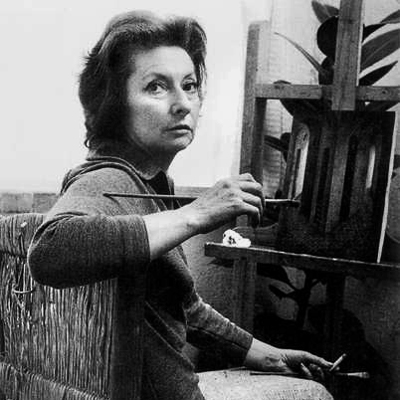
MC: I can only talk about her studio in a limited way, from clues provided in photos and in a few accounts. I also talked a bit about Varo’s apartment-studio with Xabier Lizarraga Cruchaga, her godson, who as a boy used to visit Varo in her studio quite often (so she didn’t completely exclude visitors). Her studio was a room on the top floor of the building she lived in, accessible by a private flight of stairs. A wide doorway in the studio opened to a small, north-facing terrace where she kept plenty of plants. You can see the studio in a series of photos Kati Horna took of Varo for a magazine article that appeared in 1960. In the article, two photos show Varo at work, one at a drafting table and the other at her easel. The painting on the easel is Farewell /La despedida, with only the architectural elements of the painting in place (she would later add the departing lovers, their shadows, and the cat that looks on). Observe the white lump on the left side of the easel. That’s a piece of quartz. She apparently used quartz to incise fine lines into her paintings to expose the gesso underneath. Quartz comes up a few times in her writings as well. Let’s say she had an affinity for quartz and its mysterious qualities.
She also mentions her studio in one of her dream narratives, which begins like this:
“I dreamed I was asleep in my bedroom and a loud noise woke me up. The noise came from upstairs, from the studio, and it was as if someone were dragging a chair. I thought that this meant someone was trying to get in from the terrace and was pushing the armchair that was against the door.” (p. 100)
She goes on to narrate a terrifying dream, but note that she’s indirectly giving the basic layout of her apartment-studio.
As to her practices while at work in her studio, more and more is being written in English. In fact, for the first time ever, an in-depth investigation of her paintings by art conservators was done in connection with the recent Remedios Varo: Science Fictionsexhibition at the Art institute of Chicago. For an excellent overview of Varo’s approaches as an artist, and for descriptions of some of her techniques, check out this blog post by members of the AIC curatorial team.
Biblioklept: Varo didn’t strongly pursue exhibiting her art, and she didn’t publish any of her writing in her lifetime, right? Why do you think that was?
MC About her artwork, that’s not true. Varo was totally out there as an artist and very much interested throughout her career in exhibiting her work. As an emerging artist in the 1930s, she didn’t sit back and wait for things to happen. In the 1930s she moves to Barcelona, the home of the avant-garde in Spain, and joins artists who were radically breaking with whatever the conventions were back then. She’s on the map as an artist of note as early as 1936, when her paintings are included in the landmark Exposició Logicofobista in Barcelona. Later, after the Spanish Civil War breaks out and she moves to Paris, she’s in the 1938 Exposition Internationale du Surréalisme and images of her work are published in important Surrealist journals such as Minotaure and Trajectoire du rêve. After the Nazi invasion of France, she flees Europe for Mexico City in 1941 and there’s a pause in her exhibitions (she turned to commercial art to make a living) until 1955, when she exhibits new paintings in a group show of women artists that includes Leonora Carrington and Alice Rahon.
Announcement for “Seis pintoras.” Photograph by Margaret Carson.
This is Varo’s breakthrough show in Mexico City. The following year she is offered her first solo show, which is a great success, leading to new commissions and to (among other things) the magazine article I mentioned above with photos by Kati Horna. In no way did she have a secret life as a painter.
Remedios Varo Wearing a Mask by Leonora Carrington, 1957. Photograph by Kati Horna.
We don’t know as much about her ambitions as a writer, but she wasn’t secretive about that, either. She definitely collaborated with Leonora Carrington on some writings—for example, they have a collaborative play, El santo cuerpo grasoso, not translated yet into English. In this new edition there’s Varo’s part of what I believe was an exquisite corpse novel written with Carrington. Another “public” writing is the title piece of the collection, On Homo rodans. It’s a handwritten manuscript that was never published in the marketplace sense of the word. But Varo certainly intended for others to read it, if only a small audience of friends. (After her death On Homo rodans would be published in a small facsimile edition of 250 copies, put out by a small press in Mexico City in 1970.)
The surprise is that Varo’s excellence as a writer and storyteller still goes unmentioned. It’s a small body of writings, but some of these stories are remarkable. For example, the first three: “In a field in the state of Morelos…,” “Dear friend, I believe it’s necessary to tell you…” “One day when Maria was coming back from school…” (They have no titles, so they’re identified by their opening lines.) I was astounded, amused, captivated when I first read them….talk about the pleasures of the text! Who knew she was such a talented writer? I’m hoping that people who are passionate about Varo, the artist, will be curious about her writings and will find some powerful connections there to her art—and that they’ll also stay with her for her writing alone.
We visited Seattle over the fourth week of June 2024, our first time there.
We met up with some old friends and took our son to see his favorite band play at the Woodland Park Zoo. Unlike my last getaway (to Atlanta) I was carless and a bit more encumbered (kids, friends, friends’ kids, etc.), so I wasn’t able to get to as many bookstores as I would have liked to—but I still got to quite a few.
We stayed in the Belltown neighborhood. Full of restaurants, bars, and independent shops, Belltown’s about a ten or fifteen minute walk to the famous and touristy Pike Place Market, which, despite being famous and touristy also boasts some really cool little shops—including Left Bank Books which features “anti-authoritarian, anarchist, independent, radical and small-press titles.” They also have a section devoted to “Transgressive Literature/Weird Shit.”
Left Bank’s collection of used stuff is impressive, as are the myriad and diverse offering of zines. My son picked up a bunch of art zines and comix and I left with anarcho-surrealist Ron Sakolsky’s prose mixtape Scratching the Tiger’s Belly.
Also impressive at Pike Place is BLMF Literary Saloon, brimming with towers of reasonably-priced used books. Lionheart Bookstore is a bit less chaotic than BLMF and sells newer titles, with fewer used books. (Less chaotic is not a knock on BLMF, by the way.) I didn’t succumb to picking up a first-(US)-edition of J.G. Ballard’s The Day of Creation there, maybe because I was already carrying around some LPs my son bought at Holy Cow Records. We also stopped by Chin Music Press. They make some beautiful books.
I think my favorite spot at Pike Place though was Lamplight Books. There was a nice collection of used literature (including a lot of so-called weird shit). The proprietor patiently let me handle first editions of Ballard, Barthelme, Borges, and Burroughs books (among other non-B titles). They were happy when I picked up Jacob Siefring’s translation of Rabelais’s Doughnuts by Pierre Senges, proudly letting me know that I was supporting not just a local indie bookshop but a local indie press, Sublunary Editions.
Despite the crowds of tourists in Pike Place lining up to go into the world’s oldest Starbucks (which, as my pal pointed out, is no different than lining up to gawk at the first CVS or first Harbor Freight), Pike Place has some nice niche shops. (Our lunch at the terrace of The Pink Door was lovely, too.)
While thrifting and record shopping in the so-called “hipster” Capitol Hill neighborhood, my crew indulged me in a too-long browse at The Elliot Bay Book Company. I’m generally a used-bookstore guy–I tend to order new titles from my local used bookshop, and I’m mostly out looking for the weird shit–but I’m always impressed by stores like Elliot Bay, which features the kind of odd and out of the way stuff you won’t find at a Barnes & Noble. I have silly little “tests” I like to do in stores that sell new books, checking to see if they stock certain authors, and, if so, which titles, and Elliot Bay excelled. (No Antoine Volodine, though, but I assume someone picked up the last copy of Radiant Terminus.) There, I picked up Lord Jim at Home by Dinah Brooke. The lovely evocative cover was facing outward and appended with a bookseller’s note. The flap copy notes that when “Lord Jim at Home, was first published in 1973, it was described as ‘squalid and startling,’ ‘nastily horrific,’ and a ‘monstrous parody’ of upper-middle class English life” so I figured I could get down with that.
I suppose I could remark more on Seattle itself.
We were there for six days and seven nights, which is clearly not long enough to take the measure of any major city. The weather was wonderful—sunny with maximum temps of around 80 degrees Fahrenheit, a relief after weeks of a Florida heatwave mired in a humid and insufferable drought. Even a day hiking on Mt. Ranier was warmer than we expected. (We had a nice early dinner in Enumclaw that day; a charming town, we all agreed. Curious about this quaint hamlet, I read the Enumclaw Wikipedia page aloud to my crew as we drove back to our Belltown digs before stopping, aghast, thinking of the children.) Seattle itself was more touristy than I expected, and perhaps a bit more depressing. In both Belltown and Capitol Hill we witnessed far more addicts nodding than I might have expected, although no one bothered us. Most of the patrons in the bars, restaurants, and shops we visited in these neighborhoods seemed like they were from Some Other Place, transplants to this big city who might also move at any time to Some Other Place. Even in the warm weather it was a bit cold.
We did some of the touristy things, too: The Museum of Pop Culture (the Nirvana exhibit was depressing; I loved looking at their guitar collection and jamming with my wife and son in their Sound Lab space. The stop-motion-animation exhibit was cool); the Chihuly Garden and Glass museum was unexpectedly beautiful and curated in a way that made me appreciate the glass anew (we saw a baby rabbit, wholly unafraid, snacking in the garden); the Space Needle views were amazing (its history, an optimistic ideal of American progression, brought me down before I got on the fast elevator up). I’m not sure if any of it really cohered for me into the kernel of angst I get when I fall in love with a city—a city like Mexico City or New Orleans or Tokyo or Los Angeles—but that’s fine. We shouldn’t be falling in love all the time.
The show at the zoo provides a nice addendum to what I’ve written (even if it happened in the middle of the week). My son loved seeing the band with the awful name that I am Too Old to really get and I loved seeing him get to see them and loving them. What I loved was seeing the crowd of freaks and weirdos and nerds and normies, all so unconcerned, it seemed to me, with being hip or being seen as hip, so unconcerned with doing anything aside from taking the sensual summer solstice air. Everyone seemed so chill, so unuptight.
Maybe it was the overpriced zoo beers coursing in my ugly veins, but I loved the city a little bit right then, forgiving it for any of the ways it had failed to live up to the imaginary picture of Seattle that my twelve-year-old brain had manifested over three decades ago. Maybe I was seeing the fruition of the dream I’d latched onto, so so long ago, a dream for a place where people didn’t have to struggle so hard just to like, be who they are. I think I remember, for maybe a good half hour or so then, loving Seattle.
Redburn, Herman Melville. Doubleday Anchor Books (1957). Cover art by Edward Gorey. 301 pages.
Redburn is as good a place as any to start with Melville, I suppose. From Elizabeth Hardwick’s essay “Melville in Love,” which prompted me to finally read Redburn:
Melville’s state of mind is revealed…with a purity of expressiveness in the novel Redburn, one of his most appealing and certainly the most personal of his works. He is said to have more or less disowned the book, more rather than less, since he claimed it was only written for tobacco. Whether this is a serious misjudgment of his own work or a withdrawal, after the fact, from having shown his early experience of life without his notable reserve and distance is, of course, not clear. For a contemporary reader, Redburn, the grief-stricken youth, cast among the vicious, ruined men on the ship, walking the streets of Liverpool in the late 1830s, even meeting with the homosexual hustler Harry Bolton might have more interest than Typee’s breadfruit and coconut island and the nymph, Fayaway. But it is only pertinent to think of Redburn on its own: a novel written after Typee, Omoo, and Mardi in the year 1849, ten years after he left Lansingburgh to go on his first voyage.
The following discussion of Vladimir Sorokin’s novel Blue Lard (in translation by Max Lawton) is intended for those who have read or are reading the book. It contains significant spoilers; to be very clear, I strongly recommend entering Blue Lard cold.
I’ve had too many false starts with this last (for now) riff on Blue Lard that I’ve ended up rereading the last 100 or so pages maybe four times now. When I first started this ridiculous series of riffs–way back in February!–I promised to surf Blue Lard’s wave; I have not done that. I’ve bogged myself down in summarizing. I’ve found myself reading Wikipedia entry after Wikipedia entry of the various Soviet luminaries–politicians, artists, writers, scientists, etc.–who lard the end of the novel. I’ve tried to figure out the ending by going back to the epistolary beginning. I’ve tried, I suppose, to flesh out the thesis I arrived at in the last riff I did, where I suggested that “Blue Lard is hypersurreal, shocking, deviant. But it’s also more balanced and nuanced than a first go-through might suggest, not just absurdist shit-throwing and jabberwocky, but an accomplished analysis of the emerging post-Soviet era.”
So well where were we? Or rather, where are we? The novel’s final section begins with Hitler loading his family, his bodyguard, his lover Khrushchev and a retinue of ninjas into his private plane. They abscond with the cache of blue lard and make their way to Germany to meet up with their old pal Hitler, irking Beria and his murderous allies.
On route to Hitler’s Berghof, Stalin’s wife Nadezhda reads aloud the first act of a new play by Konstantin Simonov, A Glass of Russian Blood. The play seems to be an allegory framing the Soviet intelligentsia as literal bloodsuckers, vampires feasting on the proletariat. Khrushchev dismisses the play’s subject as “fashionable rancor”; Stalin is more charitable, remarking that “Every writer has his ups and downs.” As usual, I found myself going down a rabbit hole, trying to glean a possible critique of the Simonov’s journal Novy Mir in particular and Soviet literature in general. This is not the way to read Blue Lard. Meanwhile, unconcerned with absurd theater, Stalin’s daughter is hungry; she declares she’d like to eat a unicorn. (In one of the earlier translations of Blue Lard I read, Max includes a footnote explaining that he’s substituted unicorn for the original tyanitolkai (тяни-Толкай) in the interest of readability.)
Back in Moscow, Beria is trying to track down Stalin and the missing blue lard. He’s also ordered the torture of Andrei Sakharov who’s been condemned for, as his torturer notes, suggesting that “Time is a head of cabbage and all events are just aphids eating their way through it” — a complete rejection of Soviet communism’s teleological conception of historical materialism.
Sakharov’s torturer is Alexander Khvat, who the narrator informs us was “the lead investigator on the case of the sinister saboteur Vavilov who’d devoted his life to cultivating ‘quick ergot’ and using it to infect Kuban wheat.” The historical Vavilov, which is to say our historical Vavilov, was an agrinomical geneticist who tried to use science to feed the world.
But Sorokin’s critique doesn’t seem to be aimed at Soviet communism alone; rather, he seems to condemn the brutal stupidity and close-mindedness of those who fear what they do not comprehend. Blue Lard’s absurdity and violence critiques power—and the fear of loss of power that consumes those who hold power.
Stalin’s crew passes over the great Prague Wall which separates the West from the East, the Third Reich and its partner the USSR, and soon arrive at the Berghof:
The long, unusually smooth tarmac of the airfield was reminiscent of a frozen mountain lake and ran up against a granite statue of Hitler’s head, carved from an entire mountain by the efforts of Arno Breker and six thousand French and British prisoners.
The Hitlers (the führer has married mistress Eva in this reality) and the Stalins kiss their hellos and with their accompanying entourages head to yet another of Blue Lard’s many, many feasts. (The narrator notes that “Meanwhile, in the plane, Ajooba, Sisul, and the ninjas were quickly and professionally strangling the airplane’s crew” — the adverb professionally there is marvelous.)
Just as he does with Stalin, Sorokin renders Hitler in kitschy pop-glam strokes:
Hitler put his unfinished glass down on a tray held up to him by an SS servant, then, opening his long arms in the narrow sleeves of a dark-blue frock coat, lace cuffs spilling out of them, walked over to Stalin, his high-heeled shoes with their golden spurs loudly knocking against the marble. Eva followed him, her thin body nestled snugly into a leopard dress.
Tacky-glam of Hitler of Blue Lard is also a bit of a carnivore, unlike the vegetarian of our own historical record. “The table was covered primarily in meat-based hors d’oeuvres, as the Führer couldn’t stand fruits and vegetables,” the narrator notes. But he’s still an animal lover. When he pets his dog Blondie, his hands sparkle and crackle with electric energy. This Hitler shoots electrical beams from his fingertips, a talent that helps him win WW2.
Blue Lard’s final sequence in Hitler’s Berghof is full of depravities and (soap) operatics. Hitler essentially rapes Vesta, while her mother Nadezdha watches through a keyhole. Stricken, Nadezdha makes a call to her on-again-off-again lover Boris Leonidovich—presumably Boris Pasternak (we encountered his clone, author of the thirteen-stanza poem “Pussy” in the first section of Blue Lard), who chastises her for the sin of “pleonasm” (!) after she accuses him of cheating on her with “that jester… that clown… that idiot” Shklovsky (presumably the literary theorist Viktor Shklovsky).
Then all kinds of shit goes down. I’ve gotten bogged down in over-summarizing again; not my intention. The final strands of Blue Lard twist about like fragments of old spy films or war films—double crosses, unclear intentions. Heinrich Himmler shows up with just a few pages left in the novel, a thousand-pound mutant (Jabba to Hitler’s Emperor? Did Sorokin, like, get mad coked up and watch Return of the Jedi and write Blue Lard?)
It all ends, or doesn’t end, with Stalin injecting blue lard into his brain, which then expands and expands and expands:
Iosif Stalin’s brain gradually filled up the entire universe, absorbing its planets and stars. After 126,407,500 years, the brain turned into a black hole and began to shrink. After 34,564,007,330 years, the brain had shrunk back to the original size of Iosif Stalin’s brain. But the mass of the leader’s brain was 345,000 times greater than the mass of the sun. Then Stalin remembered about the pear.
And opened his eyes.
And now we are back where we started, a hundred years or so from Stalin’s then-present. An old, old man with a thick rural accent, he attends to the bratty recipient of Boris Gloger’s letters. In fact, he gives the brat the missive from Gloger dated 2 January (2048) that initiates Blue Lard—we are in a strange loop. (Is this an endorsement or refutation of the aphids-in-a-head-of-cabbage theory of time?) The letter’s recipient, Gloger’s “tender bastard,” tosses it to the ground after just a few sentences or two.
He’s more interested in the outfit he’ll wear to the Easter ball, a special outfit Stalin has apparently tailored: a mantle composed of blue lard. So rise again.
Titus Groan, Mervyn Peake. Ballantine Books (1968). No cover artist credited. 543 pages.
The uncredited cover artist is Bob Pepper, who also provided the covers for Ballantine editions of the other two novels in Peake’s Gormenghast trilogy, Gormenghast and Titus Alone. The covers are actually segments from one painting:
The edition also includes black and white illustrations by Peake (including eight glossy inset pages).
I have no idea how I had never even heard of Mervyn Peake’s Gormenghast trilogy until some point late in 2019. I grew up reading fantasy and yet somehow never encountered these strange, dense books. I consumed them in 2020, pressing extra copies on my son.
The first of Mervyn Peake’s strange castle (and then not-castle trilogy (not really a trilogy, really)), Titus Groan is weird wonderful grotesque fun. Inspirited by the Machiavellian antagonist Steerpike, Titus Groan can be read as a critique of the empty rituals that underwrite modern life. It can also be read for pleasure alone.
Gormenghast, Mervyn Peake
Probably the best novel in Peake’s trilogy, Gormenghast is notable for its psychological realism, surreal claustrophobia, and bursts of fantastical imagery. We finally get to know Titus, who is a mute infant in the first novel, and track his insolent war against tradition and Steerpike. The novel’s apocalyptic diluvian climax is amazing.
Titus Alone, Mervyn Peake
A beautiful mess, an episodic, picaresque adventure that breaks all the apparent rules of the first two books. The rulebreaking is fitting though, given that Our Boy Titus (alone!) navigates the world outside of Gormenghast—a world that doesn’t seem to even understand that a Gormenghast exists (!)—Titus Alone is a scattershot epic. Shot-through with a heavy streak of Dickens, Titus Alone never slows down enough for readers to get their bearings. Or to get bored. There’s a melancholy undercurrent to the novel. Does Titus want to get back to his normal—to tradition and the meaningless lore and order that underwrote his castle existence? Or does he want to break quarantine?
I listened to One Hundred Years of Solitude on audiobook (narrated by John Lee) last week while undertaking a largish home project. I had read the novel maybe twelve years ago, after several false starts, and enjoyed the audiobook very much, even if the story was much, much sadder than I’d remembered. I had registered One Hundred Years of Solitude in my memory as rich and mythic, its robust humor tinged with melancholy spiked with sex and violence. That memory is only partially correct—García Márquez’s novel is darker and more pessimistic than my younger-reader-self could acknowledge.
You emerge from this marvelous novel as if from a dream, the mind on fire. A dark, ageless figure at the hearth, part historian, part haruspex, in a voice by turns angelic and maniacal, first lulls to sleep your grip on a manageable reality, then locks you into legend and myth. One Hundred Years of Solitude is not only the story of the Buendia family and the Colombian town of Macondo. It is also a recapitulation of our evolutionary and intellectual experience. Macondo is Latin America in microcosm: local autonomy yielding to state authority; anticlericalism; party politics; the coming of the United Fruit Company; aborted revolutions; the rape of innocence by history. And the Buendias (inventors, artisans, soldiers lovers, mystics) seem doomed to ride biological tragi‐cycle in circles from solitude to magic to poetry to science to politics to violence back again to solitude.
The following discussion of Vladimir Sorokin’s novel Blue Lard (in translation by Max Lawton) is intended for those who have read or are reading the book. It contains significant spoilers; to be very clear, I strongly recommend entering Blue Lard cold.
When I started this series of posts, I was rereading the print edition of Blue Lard after having read Max’s manuscript translation a few years ago. I have gotten so behind in this post series that I am now re-rereading. After having read the book essentially three times now, I find that it is far more precise and controlled than my initial impression–which I guess makes sense. Blue Lard is hypersurreal, shocking, deviant. But it’s also more balanced and nuanced than a first go-through might suggest, not just absurdist shit-throwing and jabberwocky, but an accomplished analysis of the emerging post-Soviet era.
We left off our Blue Lard riffs with the pop art glamour and swagger of the Stalin family, drawn in bold but neat caricature. Stalin departs the dramatic inner circle/family circle on his way first to lieutenant Beria’s and then to his part-time lover Khrushchev’s, but as he’s on his way, “a fat woman dressed in rags hurl[s] herself toward the motorcade with a mad cry.” Stalin’s guards draw their weapons, but Our Boy is quicker: “‘Don’t shoot!’ Stalin ordered. ‘It’s Triple-A! Stop!'”
Triple-A is the poet Anna Akhmatova (who we first met via reincarnation as the kindaclone Akhmatova-2 back in the future). She’s fat gross and happy, pregnant with an aesthetic revelation of abjection:
Her wide, round face with its broken nose was flat and her small eyes shone with madness; tiny rotten teeth stuck out from beneath her formless wet lips; her unbelievably tattered rags adorned a squat body that widened freakishly as it went down; her dirty gray hair stuck out from beneath a ragged woolen kerchief; her bare feet were black with filth.
AAA is one of Sorokin’s fouler concoctions, proclaiming proclamations like
“Did you know that Kharms feeds canaries with his worms?” Stalin asks AAA. (The absurdist poet and children’s author Daniil Kharms died in a Soviet prison in his mid-thirties. “Send him to the deepest north!” Sorokin’s Akhmatova advises Sorokin’s Stalin.) The conversation over Soviet writing continues: “‘I have an active dislike for Fadeyev’s Young Guard,'” declares Stalin.” A paragraph or two later, AAA licks the soles of his boots. I don’t know nearly enough about Soviet and Russian literature to figure out what or if Sorokin is satirizing here, but I think I know enough about the relationship of aesthetics and power to take a big hint.
Stalin’s motorcade drove up to Arkhangelskoye. Here, in a magnificent palace built during the reign of Catherine II, lived the count and previous member of the Politburo and of the Central Committee of the CPSU Nikita Aristarkhovich Khrushchev, who had been removed from his state duties by the October Plenum of the Central Committee.
There is a famous infamous horny sensual sex scene between Stalin and Khrushchev coming up, one that has made Blue Lard famously infamous—but let’s set that aside for now. Sorokin’s Khrushchev’s patronymic Aristarkhovich doesn’t gel with our historical Khrushchev’s patronymic Sergeyevich. Is the “new” patronymic “Aristarkhovich” an allusion to the avant-garde painter Aristarkh Lentulov?
And if you want to get into Barthelme but aren’t sure of where to start, you could do far worse than to hear him read his classic, “The Indian Uprising”:
The following discussion of Vladimir Sorokin’s novel Blue Lard (in translation by Max Lawton) is intended for those who have read or are reading the book. It contains significant spoilers; to be very clear, I strongly recommend entering Blue Lard cold.
The first hundred or so pages of Sorokin’s Blue Lard switch between Boris Gloger’s letters to his lover and the narratives of seven cloned Russian writers (the clone-narratives are, textually speaking, included in Boris’s letters).
The shifts between these layered texts are initially quite disarming. Boris’s letters are filled with invented futurese, neologisms, and Chinese slang; the clone-narratives each impose their own linguistic taxes (and rewards) on the reader.
However, these first hundred pages do establish some of the baselines one might expect of a traditional novel: setting (a futuristic laboratory in frozen northeast Siberia), characters (scientists with a military guard—and seven clones), and a basic mission (cloning Russian writers who, in writing their compositions, produce an enigmatic substance called blue lard).
That mission is a clear success by the time we get to Boris’s last letter (dated 8 April for those keeping track), and our team, “the arbiters of the BL-3 Project, have total L-rights to relax.” So they decide to throw a cocktail party. (“It’s sometimes necessary to drink cocktails all day. Not, of course, for L-harmony, rips ni ma de, but JUST ‘CAUSE,” bold Boris boasts boldly.)
As in some of the previous scenes of hard-drinking downtime, the BL-3 Project’s futuristic cocktail party feels like something from a pop sci-fi film. Much of the dialogue seems inscrutable in a first run through the novel, but the jargon and bickering and bantering over political and cultural circumstances alien to the reader are simply texture–verbal adornment to fill out the scene.
Sorokin does bolster his futurese with occasional asides of historical analysis though:
Everything is working out for the Chinese now, just as it did for the Americans in the twentieth century, the French in the nineteenth century, the English in the eighteenth century, the Germans in the seventeenth century, the Italians in the sixteenth century, the Russians in the fifteenth century, the Italians in the fourteenth century, and the Jews in the first (I think) century.
That “I” is Boris, although the style of the party section has subtly but significantly shifted from the flirtatious and gossipy tone of his love letters home.
But enough with style! Back to the party!
There is drinking and dancing and drinking and drinking and drinking. The ol’ fashioned colonel whips up a batch of whiskey sours (“A drink for lonely men who test AEROSEX once a month and prefer books to holo-bubbles,” a geneticist opines), and from there, the BL-3 Project crew goes to town in inventing ever-more daring cocktails.
Here is the recipe for Fan Fei’s CHINA 21:
5 measures of tomato juice
3 measures of spiritus vini
2 measures of red ants
1 measure of salty ice
1 pod of red pepper
Our party is in full drunken swing, abject sweat flung from the dancefloor, another round of cocktails called for, when all of a sudden the novel’s perspective upends itself (again).
The disruptive narrative event here would, again, not be out of place in a sci-fi actioner. A band of rebels (the “Brothers,” as they refer to themselves) breach the laboratory’s bunker, exchange gunshots with the soldiers, and kill everyone but our heretofore main character, Boris.
But the stylistic shift is intense—we go from the strange comfort of Boris’s letters to a new style, one utterly outside of Boris’s consciousness. Indeed, it’s through the eyes of these invading “Brothers” that we actually see Boris for the first time: The Brothers-centered narrator informs us he is “rail-thin… His face was narrow and swarthy skin clung to the bones of his skull. Metal plates in complicated shapes were visible beneath the skin of his temples.” He is the last living witness to the BL-3 Project—but not for long.
Again, the scene plays out as a cinematic trope, the scientist interrogated before his death. Boris isn’t much use explaining just what the blue lard is for or how it works. But he does tell us there’s
something called the MINOBO Project. I don’t know the details… [but] they’re building a reactor on the moon, a constant-energy reactor. They’re building it in the shape of pyramids… pyramids made of fifth-generation superconductors and blue lard… layers… layers and layers of it… and that allows them to plus-directly solve the problem of perpetual energy.
Our one-time narrator is then summarily executed, his brains ironically sprayed over a safety placard.
We are now firmly in the narrative purview of the Brothers. They harvest the blue lard from the bodies of the clones and head back to their lair, mumbling about their poor diet and their ever-constant war with “the whorish” who populate the surface of the earth. They are of the Earth-Fuckers, a bizarre monastic sect dwelling in a strange hierarchical series of underground caverns that seem to descend infinitely into the earth.
The narrative too moves with these earth-fucking brothers, as does the blue lard, a vibrant constant in a constantly-changing scene. Along the way we are treated to ever-stranger rituals and routines. Sorokin, in Lawton’s deft translation, gives us a surreal but limpid portrait of this subterrestrial monastery, where sacred cloister gives way to another sacred cloister:
The descent was quick––the staircase led into a large, dusky hall with a marble floor and marble walls. In the hall, there were ten marble desks, at which bald men in black suits were sitting. Green lamps were burning atop their desks. On the wall, a sigil made of rock crystal, jasper, and granite was illuminated in green light: a man copulating with the earth.
The blue lard slowly makes its way down to “the magister” who informs the reader that when he looks at his hands, he sees tiny golden children’s hands on his wrist. These tiny golden children’s hands speak to him through a language based on wrist rotations. He has transcribed some of these communications, including something called “The Swim,” a very short story about a group of military swimmers who hold torches aloft to create a constellation of language. They are swimming raft of lighted language, passing by crowds who read from afar the quotations they have created—quotations that the swimmers themselves cannot rightly read. They are, quite literally, marks. The story “The Swim” is actually a version of an older Sorokin short story, underscoring the intertextual nature of Blue Lard’s internal and external composition. This is a novel about writing; or, a novel about writing writing.
The Earth-Fuckers section of Blue Lard is probably where, on first reading, I truly gave into the novel’s strange wave and just went with it. After all, my dear epistolarian Boris Gloger was now deceased and I found myself far from the false stability of the BL-3 Project’s base. The section plays out as a series of wonderful deferrals, stories that descend into new stories as one Earth-Fucker descends to a new level of their strange subterranean labyrinth. There’s the infanticidal Nadelina, who gives birth to a child by a different father every year–twenty-six children in total in Max’s translation (one for each letter of the English-language alphabet?). She sacrifices the children so that she might always be able to “water the earth with her milk.” There are three mischievous “babes” — devilishly horny little cherubs who float around in what could be the set of a nightmarish technicolor Hollywood musical. There’s the history lesson of the great schism between the Northern and Southern Earth-Fuckers. There are enormous genitals.
The Earth-Fuckers section is larded with surreal episodes (all anchored in precise, clear imagery), but a re-read reveals that Sorokin is not solely interested in throwing bizarre satirical scenarios at his reader. Traditional novel-making elements are in play here, even if it’s easy to miss them in a dazzled first read. As Sorokin prepares to transition to a new sequence, he offers his readers a recap of the story so far, a blunt summary from an Earth-Fucker’s perspective. After declaring the blue lard an “eternal substance” that will never burn or freeze but “shall forever be exactly as warm as the blood of man,” we get this exchange:
And how did the whorish manage to produce this substance?
By accident, oh my father. They were doing whorish experiments restoring and regrowing people from the memories in their bones. These were people of various professions. But only those people who had at some point written down their fantasies on paper turned out to be capable of producing blue lard.
Again, Blue Lard is writing about writing (about writing about writing…). And, soon, another writer will enter the text and deliver the textual tissue between Blue Lard’s lobes: “The Indigo Pill.”
I keep hoping the corporations will realize that publishing is not, in fact, a sane or normal business with a nice healthy relationship to capitalism. The practices of literary publishing houses are, in almost every way, by normal business standards, impractical, exotic, abnormal, insane.
Parts of publishing are, or can be forced to be, successfully capitalistic: the textbook industry is all too clear a proof of that. And how-to books and that kind of thing have good market predictability. But inevitably some of what publishers publish is, or is partly, literature: art. And the relationship of art to capitalism is, to put it mildly, vexed. It is seldom a happy marriage. Amused contempt is about the pleasantest emotion either partner feels for the other. Their definitions of what profiteth a man are too different.
So why don’t the corporations drop the literary publishing houses, or at least the literary departments of publishers they have bought, with amused contempt, as unprofitable? Why don’t they let them go back to muddling along making just enough, in a good year, to pay the printers, the editors, modest advances and crummy royalties, and plowing most profits back into taking chances on new writers? There’s no hope of creating new readers other than the kids coming up through the schools, who are no longer taught to read for pleasure and anyhow are distracted by electrons; not only is the relative number of readers unlikely to see any kind of useful increase, it may well keep shrinking. What’s in this dismal scene for you, Mr. Corporate Executive? Why don’t you just get out of it? Why don’t you dump the ungrateful little pikers and get on with the real business of business, ruling the world?
Is it because you think if you own publishing you can control what’s printed, what’s written, what’s read? Well, lotsa luck, sir. It’s a common delusion of tyrants. Writers and readers, even as they suffer from it, regard it with amused contempt.
A few years ago, spurred by a conversation with a colleague, I decided to blog about the best books from half a century ago. I enjoyed riffing on the possible “Best Books of 1972” so much that I did repeated the project last year with the possible “Best Books of 1973.”
As in the previous two posts, I’m again primarily interested in novels here, or books of a novelistic/artistic scope. I’ve also focused on books published in English in 1974, and will not be including books published in their original language in 1974 that did not appear in English translation until years later. (For example, while Georges Perec’s excellent Species of Spaces was first published in 1974, it was not published in English translation until the late nineties, and thus will not appear in this blog post, other than in this parenthetical example.)
I also will not be counting English-language books published before 1974 that were published that year in the U.S. So, for example, Richard Adams’s wonderful novel Watership Down dominated The New York Times bestsellers list in the summer of 1974, when it was released in U.S.—but the book was first published in the U.K. in 1972 (and thus appears in my “Best Books of 1972” post). Richard Adams’s follow-up Shardik was released in 1974 though. I tried reading it in my teens and never finished.
I brought up the NYT bestsellers list. I think it’s an interesting barometer to consider a book’s value fifty years after publication. Just four titles dominated the 1974 list: Gore Vidal’s Burr (published in the previous year), followed by Watership Down, then John le Carré’s Tinker, Tailor, Soldier, Spy, and finally James Michener’s Centennial. Two of these titles I think have made their case over the decades.
While the four novels essentially split the NYT fiction bestsellers list by season, the nonfiction list was dominated by Carl Bernstein and Bob Woodward’s All the President’s Men, a work that still remains culturally important (despite Woodward’s best efforts to ruin his legacy).
In their year-end round up of 1974, the editors of The New York Times include plenty of titles that didn’t sniff the bestsellers list, like John Hawkes’s Death, Sleep & the Traveler, Donald Barthelme’s collection Guilty Pleasures (“Barthelme’s easiest book,” the editors suggest), Grace Paley’s collection Enormous Changes at the Last Minute. The English translation of Italo Calvino’s Invisible Cities makes the list, but translator William Weaver is left out. James Baldwin’s If Beale Street Could Talk makes the cut, as do Patrick White’s The Eye of the Storm, Iris Murdoch’s The Sacred and Profane Love Machine, and Joseph Heller’s Catch-22 follow-up, Something Happened. My favorite pick from their list is Robert Stone’s Dog Soldiers. (The editors also include Toni Morrison’s Sula, which was actually published in 1973—likely a make-up call for its absence from the previous year’s round-up.)
Some of the strongest entries from the NYT 1974 notables list come in the “Young Readers” section, which boast three bona fide classics: Robert Cormier’s The Chocolate War, Virginia Hamilton’s M.C. Higgins the Great, and Shel Silverstein’s Where the Sidewalk Ends.
In his personal round-up at the NYT, critic John Leonard discusses how the book review section came to their selections before adding some of his favorites, including works by his critical brethren (Elizabeth Hardwick’s Seduction and Betrayal, Irving Howe’s The Critical Point, and Dwight Macdonald’s Discriminations). For fiction, Leonard includes heavy hitters like Vladimir Nabokov (Look at the Harlequins) and Philip Roth’s My Life as a Man, two novels I haven’t ever heard of until now. He also praises James Welch’s Winter in the Blood and Gail Godwin’s The Odd Woman.
Godwin’s The Odd Woman also appears on the American Library Associations’s list of notable books for 1974, along with other titles duplicated in the NYT list. The ALA list also includes Wendell Berry’s The Memory of Old Jack in their slim fiction selection, and Robert M. Pirsig’s Zen and the Art of Motorcycle Repair in their nonfiction selection. (I don’t think we would count Zen as a work of nonfiction today, right?)
The Booker Prize winners and finalists for 1974 offer a less USAcentric list: Nadine Gordimer (The Conservationist) and Stanley Middleton (Holiday) split the prize for the first time ever. The shortlist included Kingsley Amis’s Ending Up, Beryl Bainbridge’s The Bottle Factory Outing, and C.P. Snow’s In Their Wisdom.
In other literary prize news of the day, Michael Shaara’s 1974 Civil War novel The Killer Angels won the Pulitzer for Fiction in 1975. In 1974, no Pulitzer was awarded; infamously, the Pulitzer board opted not to follow the jury’s recommendation to give the prize to Thomas Pynchon’s 1973 novel Gravity’s Rainbow.
Like the Booker, the 1975 National Book Award split its fiction prize as well: Robert Stone’s Dog Soldiers shared the prize with Thomas Williams’ The Hair of Harold Roux. Virginia Hamilton’s M.C. Higgins, The Great won the NBA for children’s literature. Hamilton’s book also won the Newberry Medal that year.
The Nebula Awards short list for the best novels of 1974 included Philip K. Dick’s Flow My Tears, The Policeman Said, T.J. Bass’s The Godwhale, and Ursula K. Le Guin’s The Dispossessed—which won top honors. (I am likely to give The Dispossessed top honors too by the time I get to the end of this post.)
J.G. Ballard’s 1974 novel Concrete Island did not make Nebula’s short list, but to be fair it’s not really sci-fi. But it is pretty good. (Also, not a sci-fi, but an island book, Gary Snyder’s Turtle Island was published in 1974). Leonora Carrington’s excellent surrealist novel The Hearing Trumpet also is sci-fi adjacent, but is again overlooked. Oddball novels in general I suppose have to find their way to a cult—fifty years later, novels like Gerald Murnane’s Tamarisk Row, Ishmael Reed’s The Last Days of Louisiana Red, and Fran Ross’s Oreo have all found wider and more dedicated audiences in the last half century.
Speaking of cult books: Vincent Bugliosi’s Helter Skelter: The True Story of the Manson Murders was published in 1974. Bugliosi’s book was part of a select library we passed surreptitiously around in high school (along with Stephen Davis’s Led Zeppelin biography Hammer of the Gods, William Burroughs’ Naked Lunch, Go Ask Alice, and Thompson’s Fear and Loathing in Las Vegas—the aforementioned Zen and the Art of Motorcycle Repair and Kerouac’s On the Road were part of the underground informal book loan, but I never really cottoned to them). Eve Babitz’s Eve’s Hollywood—published too in 1974—could have been in that secret library if we had known about it.
And 1974 spit out some books would-be hipsters would likely eschew, Peter Benchley’s beach read Jaws and Stephen King’s Carrie. (Both novels spawned fantastic films.)
As I mentioned above, 1974 was a standout year it seems for children and adolescent literature–Robert Cormier’s The Chocolate War, Virginia Hamilton’s M.C. Higgins the Great, and Shel Silverstein’s Where the Sidewalk Ends, of course, but also James Lincoln Collier’s My Brother Sam Is Dead, Madeleine L’Engle’s A Wind in the Door, and Judy Blume’s Blubber. I loved all of these.
A few other books of note: J. M. Coetzee’s debut Dusklands (haven’t read it), Muriel Spark’s The Abbess of Crewe by Muriel Spark (read it when I was devouring Spark in 2020), Annie Dillard’s Pilgrim at Tinker Creek (haven’t read it), and James Herbert’s The Rats (guess who read their mom’s copy of this novel in secret when he was about ten years old?).
I have undoubtedly missed many, many books of note that were published in 1974. I wonder how available, say in 1999 at the 25-year mark, a novel like Ross’s Oreo or Carrington’s The Hearing Trumpet might have been. Again, my fun in this project comes down to a basic idea I have about literature—we really don’t know what books will retain their importance (or gain importance) until decades after their publication. None of this is to discount year-end lists of new books—I had four on my list this year!—I just aim to say something like: Books aren’t time capsules, they are time machines.
My list of the best books of 1974:
Blubber, Judy Blume
The Chocolate War, Robert Cormier
Concrete Island, J.G. Ballard
The Dispossessed, Ursula K. Le Guin
Dog Soldiers, Robert Stone
Enormous Changes at the Last Minute, Grace Paley
Flow My Tears, The Policeman Said, Philip K. Dick
Guilty Pleasures, Donald Barthelme
The Hearing Trumpet, Leonora Carrington
Invisible Cities, Italo Calvino, trans. William Weaver
I read Alasdair Gray’s 1992 novel Poor Things. It was the second time I’d read the novel. I first read it close to ten years ago, after I read Gray’s superior but more flawed cult novel Lanark (1981).
II. What I remembered from that first reading
The basic contours of the plot; the postmodernist matryoshka-doll structure; the typography; the engravings; the art.
III. Why I reread it
Director Yorgos Lanthimos has adapted Poor Things into a film. The four films I have seen by him (Dogtooth, 2009; The Lobster, 2015; The Killing of a Sacred Deer, 2017; The Favourite, 2018) are formally daring, horrific, hallucinatory, and darkly funny.
I had the good fortune to see all of these films cold, with no awareness of plot or structure, and I have extended this gift to myself again with Lanthimos’ adaptation of Gray’s novel: I have avoided watching any of the trailers for the film or reading any reviews or other bright clippings. I do know the identity of some of the actors involved, but do not know which characters they play. (I assume Emma Stone is Bella.)
Of course, in rereading the source novel, I have perhaps primed myself to a first viewing of Lanthimos’ Poor Things by setting Lanthimos’ vision against its literary and visual antecedent. This might be a way of saying I am not going into his film cold.
IV. About the plot of Alasdair Gray’s Poor Things
Poor Things riffs on Shelley’s Frankenstein.
It is also a passionate defense for rationality, sexuality, feminism, and humanism. It is set primarily in the nineteenth century and in Glasgow, Scotland, but it is also set elsewhen and elsewhere.
There are three primary characters: Archibald McCandless, Bella Caledonia, and Godwin Baxter. They are depicted rather allegorically on Gray’s wonderful cover for his novel, Archie and Bella cuddled up to God:
Godwin is not a mad scientist, but he does undertake some radical experiments.
Bella is the chiefest of those experiments. I will not spoil all the details. The narrative hints too that Godwin himself, surgeon son of a famous surgeon, might himself be an experimental creation.
Archibald McCandless, who narrates most of the novel, is of poorer stock than rich Godwin Baxter. A rural bastard with a chip on his shoulder, McCandless finds himself out of sync with his fellow medical students, rich boys all. But he finds a fellow to his liking in weirdo Godwin, through whom he meets Bella. He quickly falls deeply in love with the strange creature.
There are engagements, elopements, entanglements; there are dialectics, debates, debaucheries.
The rest of the plot of Poor Things should not be recounted in too much detail. It draws from Marys Shelley and Wollstonecraft; from Candide and Gray’s Anatomy, from 18th and 19th c. travelogues and Fabian Society tracts.
I should let Bella offer her own (which is to say Gray’s ironic metareflexive) dissection of the novel’s sources. In a letter that appends the narrative proper, she suggests that the “story positively stinks of all that was morbid in that most morbid of centuries, the nineteenth,” cribbing
…episodes and phrases to be found in Hogg’s Suicide’s Grave with additional ghouleries from the works of Mary Shelley and Edgar Allan Poe. What morbid Victorian fantasy has he NOT filched from? I find traces of The Coming Race, Dr. Jekyll and Mr. Hyde, Dracula, Trilby, Rider Haggard’s She,The Case-Book of Sherlock Holmes and, alas, Alice Through the Looking-Glass; a gloomier book than the sunlit Alice in Wonderland. He has even plagiarized work by two very dear friends: G. B. Shaw’s Pygmalion and the scientific romances of Herbert George Wells.
The “he” in the text above is Archibald McCandless (although it is also of course Alasdair Gray).
V. About the structure of Alasdair Gray’s Poor Things
The narrative structure of Gray’s Poor Things is indissoluble from the plot, images, and themes. I have used the word structure in the above; perhaps presentation of events would be better. Nevertheless.
The bulk of the novel consists of a “lost” vanity-press memoir entitled Episodes from the Early Life of Archibald McCandless M.D., Scottish Public Health Officer. This narrative includes the ostensible etchings of one “William Strang” (the illustrations are of course by Gray himself).
Inside McCandless’ Episodes are nested other episodes, purportedly by other authors. First, there’s the letter from Duncan Wedderburn, once a lustful rake, now reduced to lunacy after his entanglement with Bella (his riff on Scotland and The Book of Revelations is a wonderful moment of true crankery).
Then, McCandless’s narrative gives way for quite some time to the purported letters of Bella herself, off adventuring away from Father God and Betrothed Archie. These letters are the philosophical backbone of Poor Things; the moral meat of its plot. McCandless then regains his Episodes; it ends with wonderful gothic violence.
But the novel Poor Things continues. We have another letter from Bella, now much advanced in age, herself a famous doctor, having taken up the family trade. Her silly husband Archie is dead and she’s destroyed all but a single copy of his memoir Episodes—the single copy we’ve just read. Her letter is addressed to the possible future heirs who have failed to materialize, and who thus have been spared the scandal of their antecedent’s apparent lunacy. Bella’s letter seeks to undo the gothic fantasies that preceded it, puncturing McCandless’s swollen fancies with surgical rationality while at the same time reasserting the essential feminist qualities of that precursor text. The effect is somewhat deflationary—but the novel is not yet complete!
Gray’s Poor Things is framed by two bookends, both attributed to “Alasdair Gray.”
The initial frame is “Introduction,” in which Gray explains how a friend found McCandless’s Episodes in a pile of documents that were set to be destroyed, read it, and passed it along to Gray. Gray then explains how he edited together the volume we are about to read (he “unfortunately” managed to lose the original volume in the process), cribbing it together along with Bella’s letter and some other visual materials—an assemblage, a lovely literary Frankenstein’s creature.
The final bookend is “Notes Critical and Historical.” In this section, Gray simultaneously bolsters and undermines all the narrative material that’s come before it. As one might expect from “historical” end notes, Gray (or “Gray”) lards this section with other narrative materials—anecdotes, citations, bibliographies, and interviews, among other apparent ephemera. And yet this conclusion is hardly ephemeral—indeed, the material Gray includes serves to again puncture the narratives that precede it.
Gray’s bookending gambit pays dividends in the last paragraph of the novel, by which I mean the last paragraph of “Notes Critical and Historical.” Again, I will not spoil the content here, but rather suggest that Gray has covered all his bets. The real fun in the novel is to immediately re-read the beginning: flip the frames around. Maybe fan the book about. Facts and fancies may fall out of it.
VI. An anticipation of Yorgos Lanthimos’ film adaptation of Poor Things
I have no strong emotional investment in the quality of a film adaptation of an Alasdair Gray novel. (I’m far more aesthetically invested in a possible video game adaptation of his cult classic Lanark.)
I don’t mean the previous unparantheticalized sentence to sound dismissive; to be very clear, I don’t think I’d object to any novel I loved being adapted to film or any other medium. The filmmaker might fuck up their own adaption but they could never truly affect the novel itself. At one point I think I’d have been aghast at someone’s attempt to adapt Gravity’s Rainbow or Blood Meridian; I’ve felt bad about film adaptations of Under the Volcano and Moby-Dick, no matter how grand their ambitions.
Now, I just don’t give a fuck. Go for it. Something interesting might happen, but you can’t hurt the text. At best, you’ll end up with a New Thing, which is what I expect and hope from Yorgos Lanthimos’ Poor Things. Who knows?
In rereading Gray’s Poor Things, I thought of what other filmmakers might do with the novel. Guillermo del Toro would fuss over its visuals too much at the expense of characterization. (Maybe Matteo Garrone could reign him in.) Jane Campion could likely channel its gothicism, its wit, its intellect. Peter Greenaway in his prime could have made a brilliant series of tableaux from Gray’s material. Gaspar Noé could explode a few pages of its essence over a few hours without ever getting to its core. Wes Anderson might have skillfully arranged its nested narratives, but perhaps too cleanly, too precisely even. Lars Von Trier might lean into the dirt. I suppose I could go on.
But really, while rereading Poor Things the thought that kept coming back to life was, Hey, how will Lanthimos adapt this to film?
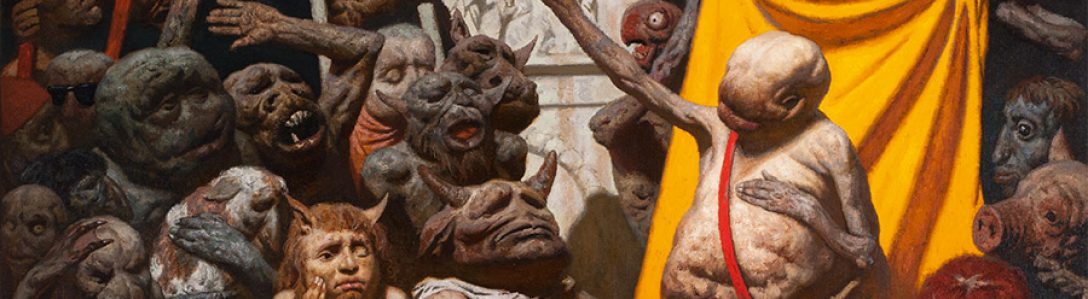


 Previously on Blue Lard…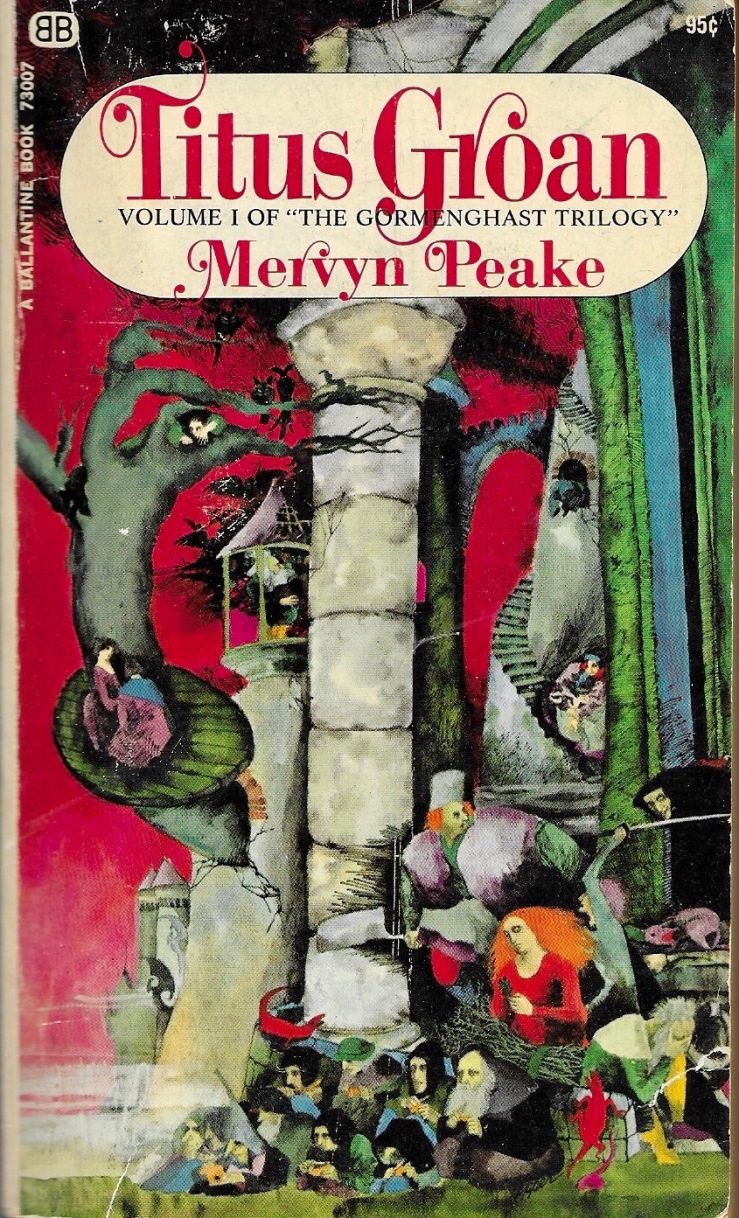
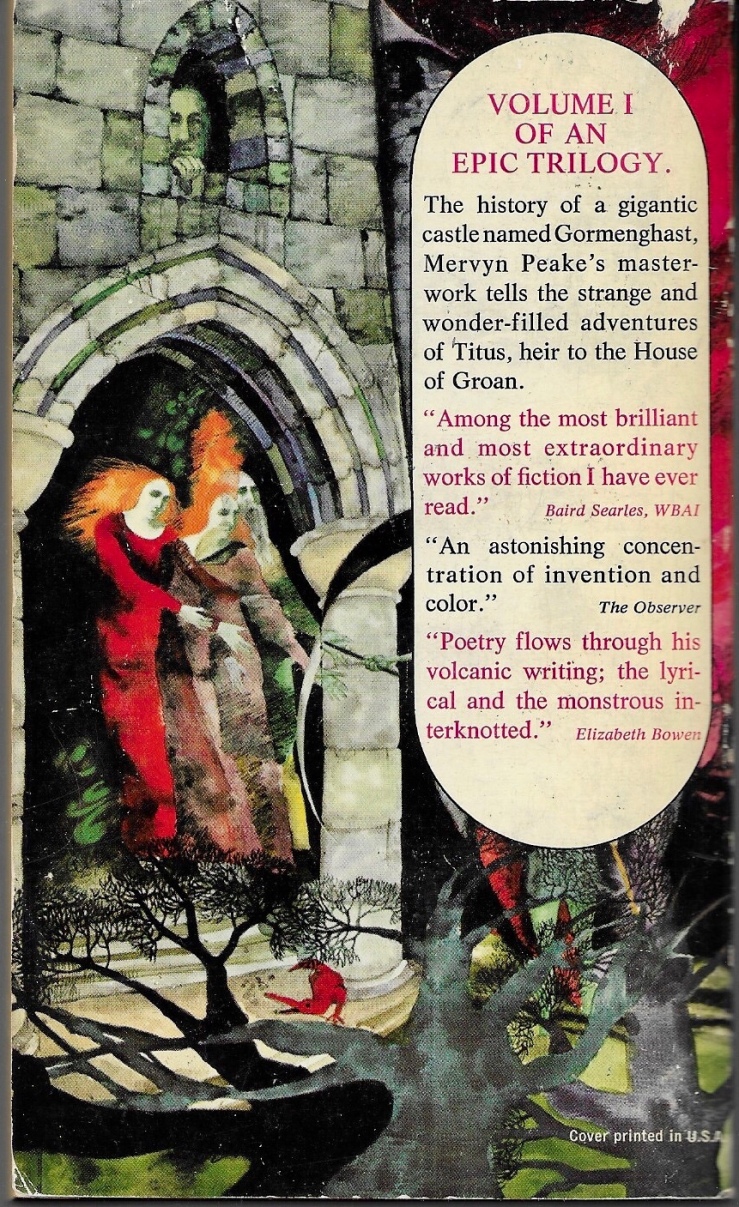
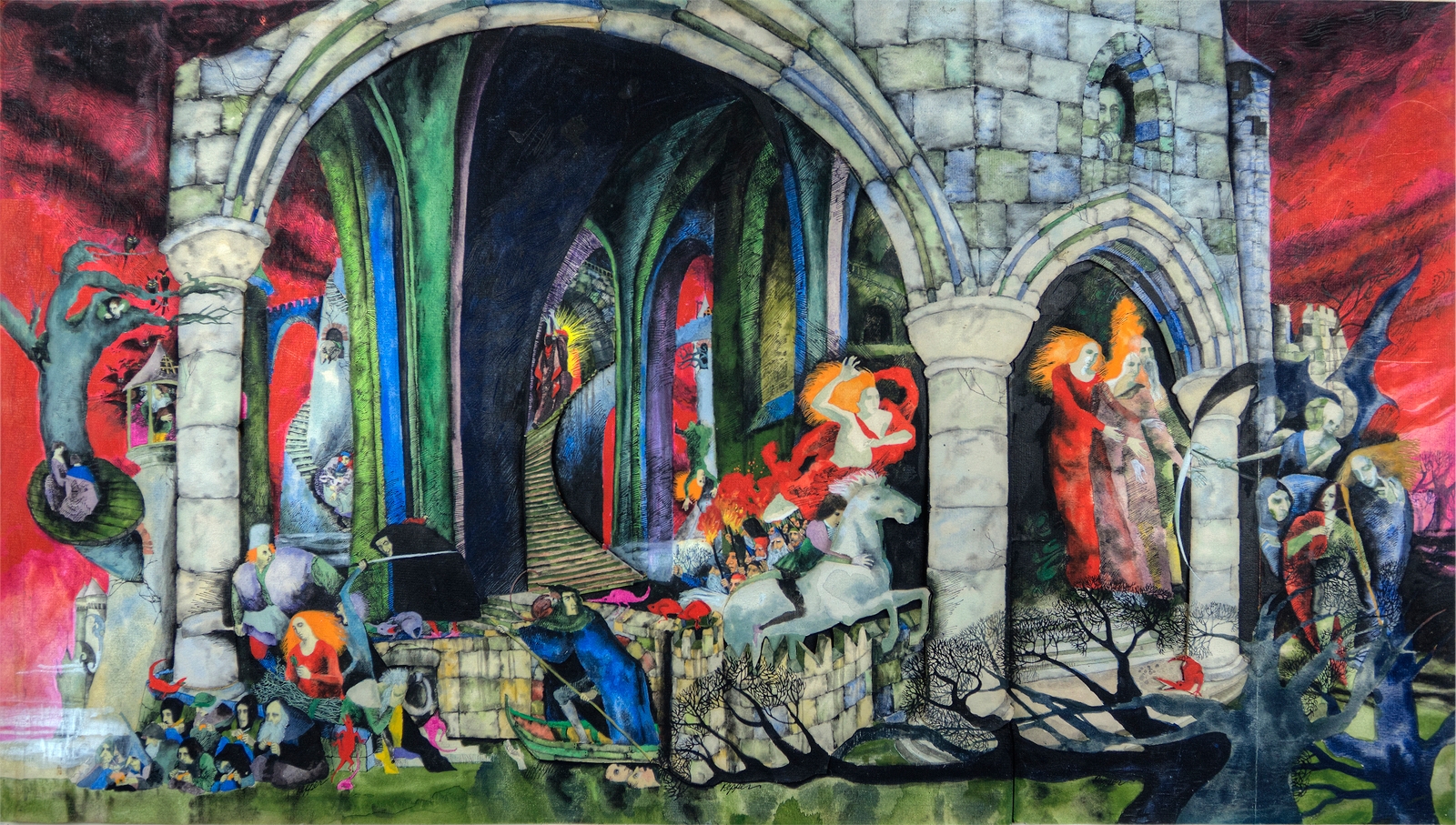


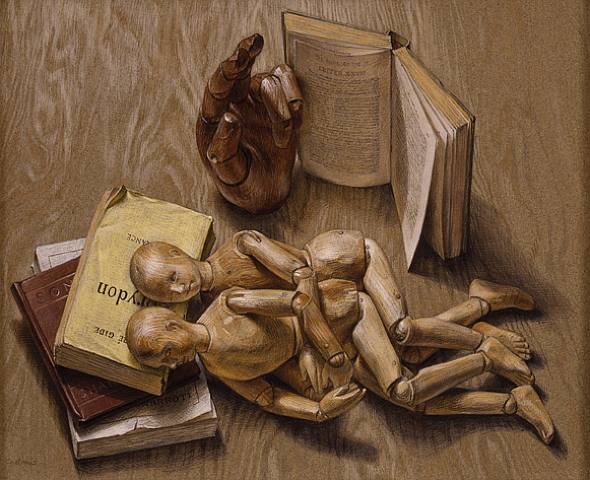
 Previously on Blue Lard…
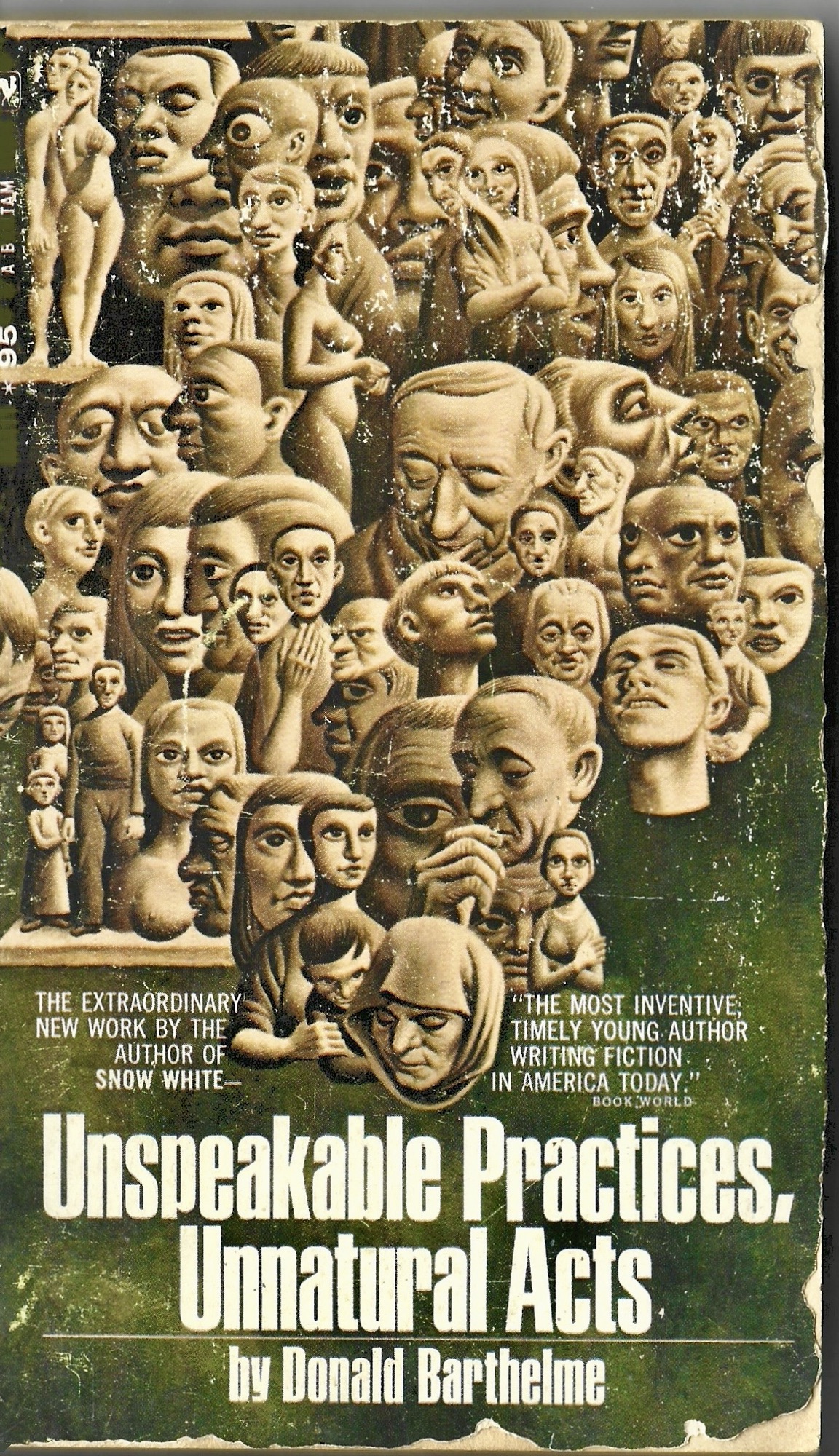
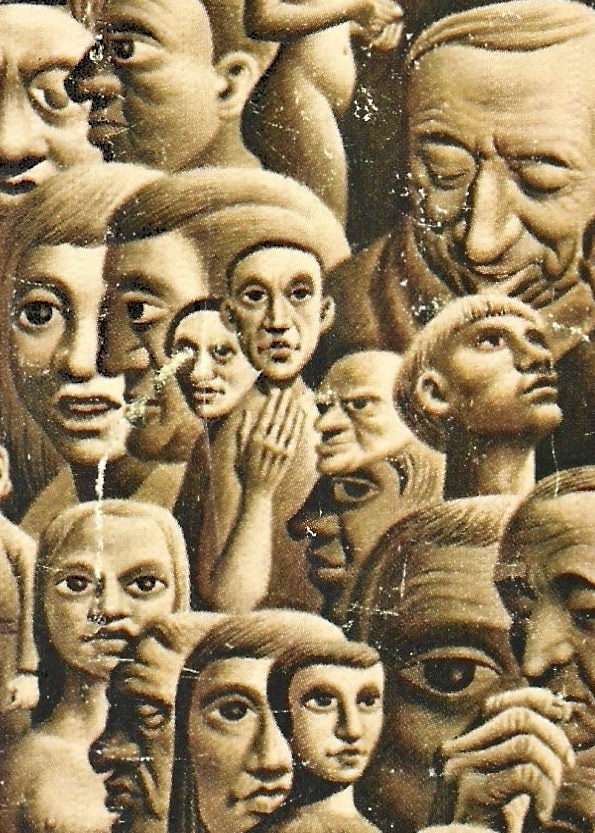

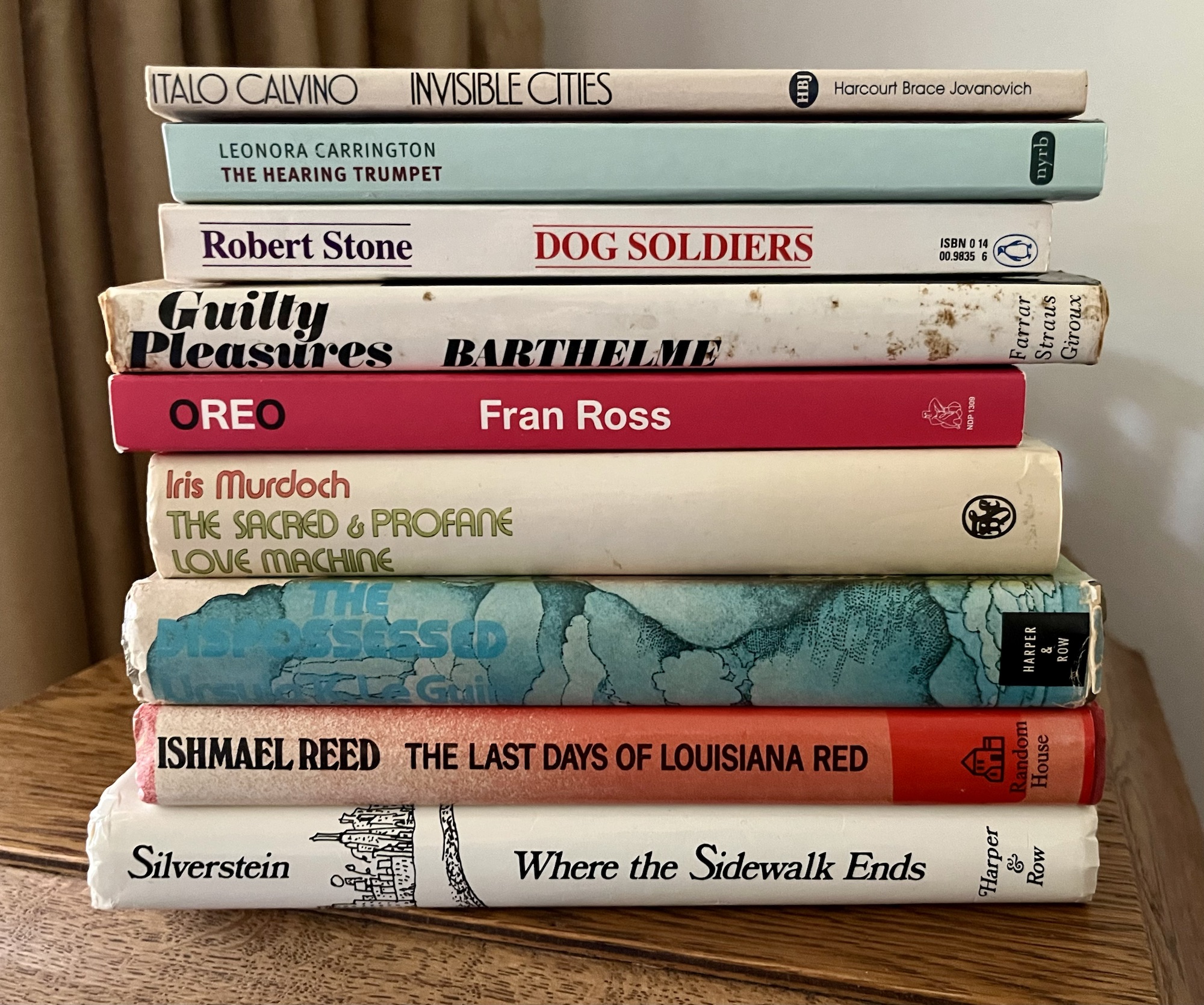


 Biblioklept