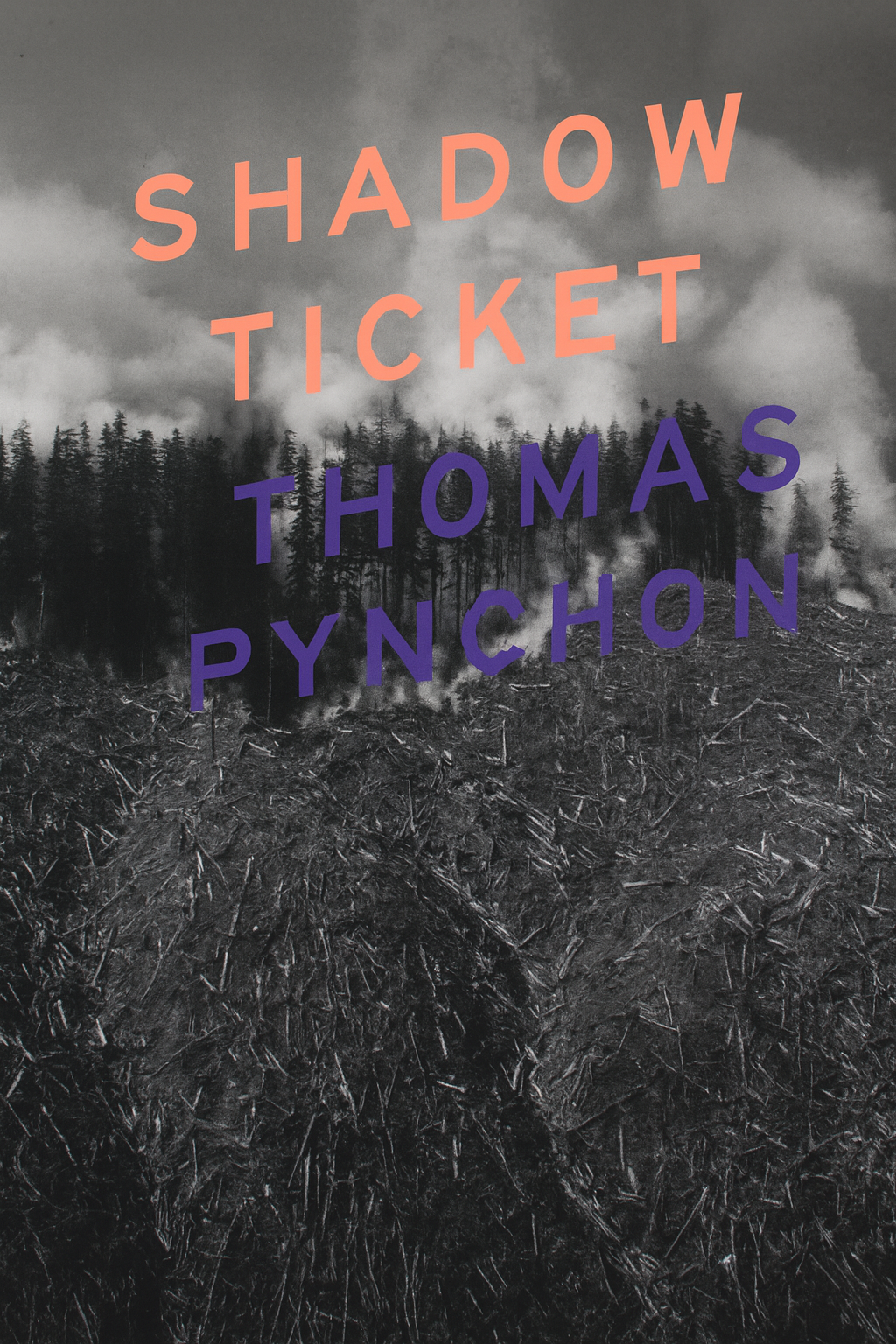
Sunsets to chase | Notes on Ch. 39, the last chapter of Thomas Pynchon’s Shadow Ticket

Notes on Chapters 1-7 | Glows in the dark.

Notes on Chapters 8-14 | Halloween all the time.

Notes on Chapters 15-18 | Ghostly crawl.

Notes on Chapters 19-20 | The needs of cold capitalist reality and those of adjoining ghost worlds come into rude contact.

Notes on Chapters 21-23 | Phantom gearbox.

Notes on Chapters 24-26 | Idiots get respect out here, they’re believed to be in touch with invisible forces.

Notes on Chapters 27-29 | We’re in for some dark ages, kid.

Notes on Chapters 30-32 | Some occult switchwork.

Notes on Chapters 33-34 | The dead ride fast.

Notes on Chapters 35-36 | Ghost city.

Notes on Chapters 37-38 | Our racket happens to be exile.


The last chapter of Shadow Ticket has three movements: one for Bruno, the novel’s erstwhile villain; one for Hicks, its anti-hero finding his way to becoming a hero; and one for Hicks’s young protege Skeet, who’s been sidelined Stateside and not present in the novel’s second, European half.

We begin the finale on the phantom submarine the Vampire Squid, “Somewhere out beyond the western edge of the Old World.” Shadow Ticket will end with the promise of a new edge of the New World.

Bruno Airmont, one-time dairy gangster, believes he’s headed home. The sub encounters a bizarre behemoth, “a statue hundreds of meters high, of a masked woman draped in military gear less ceremonial than suited to action in the field [wearing] an openwork visor of some darkly corroded metal protecting, some say hiding, her identity.” The full description of this statue is beautiful and strange, and culminates with the melancholic note that her visage recalls “somebody we knew once a long time ago.” 

“Statue of Liberty,” guesses Bruno, which, okay. I mean, that’s a reasonable guess I guess.

The image Pynchon conjures of a surreal, armed Lady Liberty recalls the opening of Franz Kafka’s unfinished first novel Amerika, which begins with its hero entering the New York Harbor and encountering “the Statue of Liberty, which he had been observing for some time, as if in a sudden burst of sunlight. The arm with the sword now reached aloft, and about her figure blew the free winds” (trans. Mark Harman).

In the Pynchonverse, “It’s the U.S. but not exactly the one you left. There’s exile and there’s exile” for Bruno: “There is no Statue of Liberty, Bruno, no such thing, not where you’re going.”

Bruno’s episode–and the Vampire Squid’s—ends with a Dickinson dash: “Whatever counter-domain of exile this is they have wandered into, they will be headed not back into any sunrise but west, toward a frontier as yet only suspected, as the days sweep over them—”

The Vampire Squid is another bilocated ghost ship, like the Stupendica on which Hicks voyaged to Europe. In Against the Day, the Stupendica splits into two ships — its shadow double the Emperor Maximilian is off to war. Recall that the Vampire Squid is a reformed U-boat, set out on a “new career of nonbelligerence.” Shadow Ticket might be cynical about redemption, but it also posits second chances — even if those chances take the quester into unknown counter-domains of exile.


Ch. 39’s second movement is a scant few lines. Hicks, exiled to Europe, panics a bit and realizes “that what he thought mattered to him is now foreclosed.” Terike pulls up on her bike, teaches him the Hungarian phrase csókolj meg, and our boy is on another adventure, another romance. It’s a nice conclusion for Hicks — who, it’s worth noting, has not committed a single act of violence in the novel.


The real conclusion of Shadow Ticket is epistolary, a letter to “Hicksie” from his old pal Skeet Wheeler. Skeet’s “On the hop,” staying clear of “Paddy wagons, dogcatcher nets, arrest warrants, the works,” lamenting that there are “Not so many places to hide as there were.” Here again is a theme of Shadow Ticket: there’s only freedom on foot, on the run, on the hop. To escape the net, Skeet plans to head West with Zinnia, the gal who gave him a glow-in-the-dark watch back in Chapter 1: “There’s supposed to be plenty of work out on the Coast.” That would be the West Coast of course.

Skeet offers a wrap-up of the Wisconsin cast of Shadow Ticket, including Against the Day’s hero Lew Basnight, who agrees to give Skeet and “Zin the fare out to California.” Basnight advises the young couple in a mode that’s not so much benediction as it is ominous prophecy, warning of “forks in the road, close shaves, mistakes he wished he didn’t make.”

Basnight warns Skeet of California’s American promises: “Eternal youth, big Hollywood playpen, whatsoever—but someday they’ll lose that innocence. They’ll find out.”

“Maybe they’ll keep finding new ways to be innocent,” rejoins Skeet, to which Basnight replies: “Better if somebody tells you now—innocent and not guilty ain’t always the same.”

Skeet concedes he’s not sure what that riddle means, but figures he’ll solve it in time; for now, he writes to Hicks, it’s “Time to put them street kiddie days behind me.” Time to grow up, or at least to make a motion towards it.

The novel ends with Skeet en route to California via the Santa Fe Chief: “Right now, we’ve got a couple of sunsets to chase.” Like the crew of the Vampire Squid, Skeet and Zin are headed “not back into any sunrise but west, toward a frontier as yet only suspected.” 

And while Pynchon’s conclusion follows a signal trope of US American literature — namely the promise of a new start Out West — I think there’s more here than the urge that Huck expresses at the end of Adventures of Huckleberry Finn, when he promises to “light out for the Territory ahead of the rest” to avoid the “sivilizin'” domesticity represented by Aunt Sally. Skeet’s Westward movement isn’t pure escapism or the fantasy of Manifest Destiny. It isn’t a rejection of domestic responsibility in lieu of a new frontier but rather a utopian dream of “finding new ways to be innocent,” even as he puts those “kiddie days behind.”

Lew Basnight, veteran of Against the Day‘s fantasia/nightmare of nineteenth-century history, provides a tempering wisdom to cool Skeet’s American Dream: “innocent and not guilty ain’t always the same.” Perhaps, like the narrator back in Ch. 35 documenting Hicks and Daphne’s last encounter, Basnight understands that the characters in Shadow Ticket are floating “in the last minutes of a break that will seem so wonderful and peaceable and carefree” before the horrors of WWII. Again, Shadow Ticket is a dance number, a chronological breeze floating between Pynchon’s titans Against the Day and Gravity’s Rainbow.

For me, the ending is sweet and then bittersweet and then bitter and then sweet again. We know Hicks will likely never see Skeet again — but he might. We know that this is probably Pynchon’s last novel — but maybe it isn’t.

And we know that Zoyd Wheeler is the hero of Pynchon’s California novel Vineland, and we know that Skeet’s last name is Wheeler. My presumption is that Skeet and Zinnia are Zoyd’s parents, and I presume it because I like to think that the Pynchonverse, although large and containing multitudes (and bilocations of every stripe) is somehow cozily discrete.

I should probably distill my thoughts on Shadow Ticket into a compact, “proper” review, but I’ve sat with the novel now for two months, reading it twice, and really, really enjoying it. I never expected to get another Pynchon novel; it’s a gift. I loved its goofy Gothicism; I loved its noir-as-red-herring-genre-swap conceit; I loved even its worst puns (even “sofa so good”). I loved that Pynchon loves these characters, even the ones he might not have had the time or energy to fully flesh out — this is a book that, breezy as it reads, feels like a denser, thicker affair. And even if he gives us doom on the horizon in the impending horrors of genocide and atomic death, Pynchon ends with the hopeful image of two kids chasing sunsets. Great stuff.
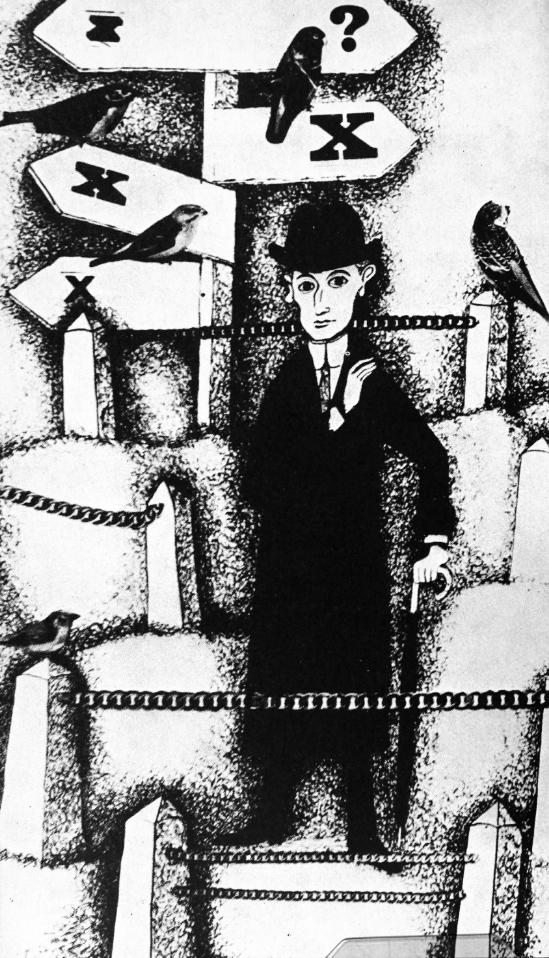
Portrait of Kafka — Adolph Hachmeister

Portrait of Kafka, c. 1967 by Adolph Hachmeister

No such thing as life and existence, but rather something that constituted them together and without separation | Werner Herzog

Werner Herzog: At night, when it gets really cold, at three or four o’clock in the morning, there are people in New York City who live like Neanderthals—they come out at three o’clock, when it gets so cold they can no longer bear it. People gather in an empty, totally deserted street and set the trash cans on fire just to warm themselves, and they do so without saying a word. That’s how it is there, only nobody sees it.

Kraft Wetzel: So all these years had little to do with globetrotting and wanderlust?

Werner Herzog: It’s really like a desperate search for . . . well, for some place I can exist. By existence I mean something different from life. I’ve become increasingly more aware that there’s a big difference between life and existence, and that it’s important to even have an existence. There are many people for whom life and existence diverge and apparently have nothing to do with each other. It’s easier to say it in biographical terms: Take [Franz] Kafka or Robert Walser. Kafka was just an employee of an insurance company. I also think there’s something like a modern tendency for life and existence to deviate more and more. That happened earlier as well, but on a much smaller scale than it does now. Now you have people without existence—that is, they have lives but no existence. Let me put it this way: I was recently in Brittany, where they have big old farm houses, each with just a single room, where the family and the cattle all live together. There are many legends and poems, which they sang, that come from there. I can imagine that for someone who lived back then in such a family community, there was no such thing as life and existence, but rather something that constituted them together and without separation.

From a 1976 interview of Werner Herzog.

Kafka diary entry, 19 July 1910

Sunday, 19 July, slept, awoke, slept, awoke, miserable life.

From Diaries, Franz Kafka; trans. by Joseph Kresh.

“A Society of Scoundrels” — Franz Kafka

“A Society of Scoundrels”

by

Franz Kafka

Translated by Michael Hofmann


There was once a society of scoundrels, or rather not scoundrels per se, just ordinary, average people. They always stuck together. When one of them had perpetrated some rascally act, or rather, nothing really rascally, just averagely bad, he would confess it to the others, and they investigated it, condemned it, imposed penalties, forgave him, etc. This wasn’t corrupt — the interests of the individual and the society were kept in balance and the confessor received the punishment he asked for. So they always stuck together, and even after their death they didn’t abandon their society, but ascended to heaven in a troop. It was a sight of childlike innocence to see them flying. But since everything at heaven’s gate is broken up into its component parts, they plunged down like so many rocks.

Continuously I receive it but do not accept it | Kafka’s diary, 18 Dec. 1910

18 December. If it were not absolutely certain that the reason why I permit letters (even those that may be foreseen to have insignificant contents, like this present one) to lie unopened for a time is only weakness and cowardice, which hesitate as much to open a letter as they would hesitate to open the door of a room in which someone, already impatient, perhaps, is waiting for me, then one could explain this allowing of letters to lie even better as thoroughness. That is to say, assuming that I am a thorough person, then I must attempt to protract everything pertaining to the letter to the greatest possible extent. I must open it slowly, read it, slowly and often, consider it for a long time, prepare a clean copy after many drafts, and finally delay even the posting. All this lies within my power, only the sudden receipt of the letter cannot be avoided. Well, I slow even that down in an artificial manner, I do not open it for a long time, it lies on the table before me, it continuously offers itself to me, continuously I receive it but do not accept it.

From Franz Kafka’s diary entry of 18 Dec. 1910. Translated by Joseph Kresh. (I feel the same way about email.)

“Not His Best” — Joy Williams

“Not His Best”

by

Joy Williams

from 99 Stories of God


Franz Kafka once called his writing a form of prayer.

He also reprimanded the long-suffering Felice Bauer in a letter: “I did not say that writing ought to make everything clearer, but instead makes everything worse; what I said was that writing makes everything clearer and worse.”

He frequently fretted that he was not a human being and that what he bore on his body was not a human head. Once he dreamt that as he lay in bed, he began to jump out the open window continuously at quarter-hour intervals.

“Then trains came and one after another they ran over my body, outstretched on the tracks, deepening and widening the two cuts in my neck and legs.”

I didn’t give him that one, the Lord said.

NOT HIS BEST

“The Unhappiness of Being a Single Man” — Franz Kafka

“The Unhappiness of Being a Single Man”

by

Franz Kafka

translation by

Alexander Starritt


It seems a terrible thing to stay single for good, to become an old man who, if he wants to spend the evening with other people, has to stand on his dignity and ask someone for an invitation; to be ill and spend weeks looking out of the corner of your bed at an empty room; always to say goodbye at the door; never to squeeze your way up the stairs beside your wife; to live in a room where the side doors lead only to other people’s apartments; to carry your dinner home in one hand; to be forced to admire children you don’t know and not to be allowed to just keep repeating, “I don’t have any”; to model your appearance and behaviour on one or two bachelors you remember from childhood.

That’s how it’s going to be, except that in reality both today and in the future you’ll actually be standing there yourself, with a body and a real head, as well as a forehead, which you can use your hand to slap.

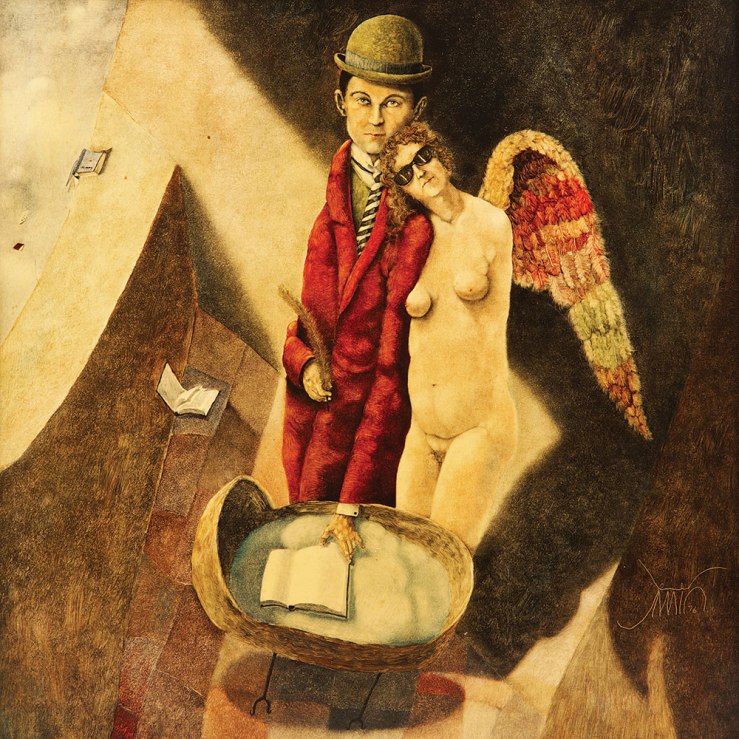
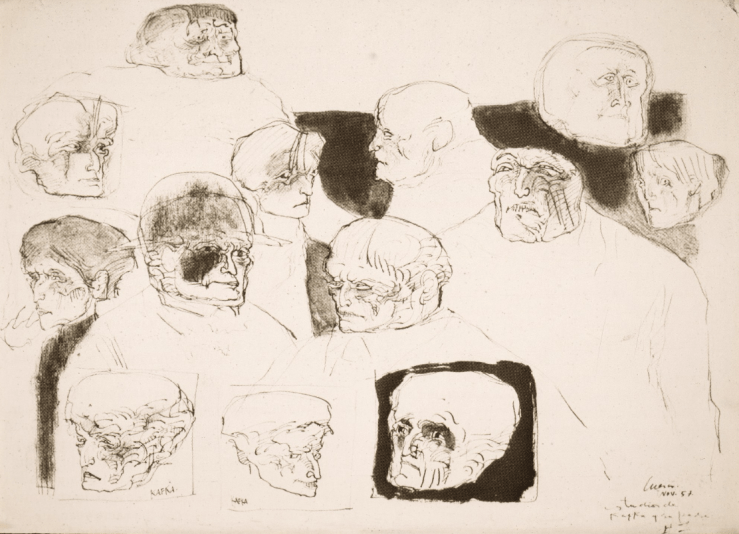
Portraits of Kafka and His Father — José Luis Cuevas

Portraits of Kafka and His Father, 1957 by José Luis Cuevas (1934–2017)

Pierre Senges takes on Kafka’s fragments in Studies of Silhouettes (Book acquired, 2 Aug. 2020)

I’ve enjoyed digging into Pierre Senges’s Studies of Silhouettes since its arrival last week. The book is forthcoming from Sublunary Editions thanks to a translation by Jacob Siefring. Here’s Siefring’s blurb, which explains Senges’s project here:

Each of the texts in this work proceed from the fragments and cryptic beginnings found scattered throughout the notebooks Max Brod took possession of after Kafka’s death. The results tend to be as variable as they are unexpected: outlines of tales, madcap soliloquies, fairy tale inversions, strange parables, comedic monologues. In some instances a single fragment of Kafka’s is reprised multiple times, yielding parallel but divergent texts. Other times, a unique fragment is driven to its logical extreme, or gives way to a dizzying cascade of ab absurdum speculation, and one marvels how the development could have been otherwise. As one might expect, all of Kafka’s familiar obsessions—the night and its terrors, the law, justice and its lack, bureaucracy, animals, et cetera—are here in force. Each passage begins in boldface to indicate the hand of the Prague lawyer, before giving way to Senges’s liberties.

I’ve been dipping in at random, between the other few books I’ve been reading, and it’s good stuff. Here’s a sample:

Read my review of Pierre Senges’s Geometry in the Dust here.

Kafka: Letters to Milena — Benjamin Cañas

78-benjamin-canas-ama-1

Kafka: Letters to Milena, 1976 by Benjamin Cañas (1933-1987)

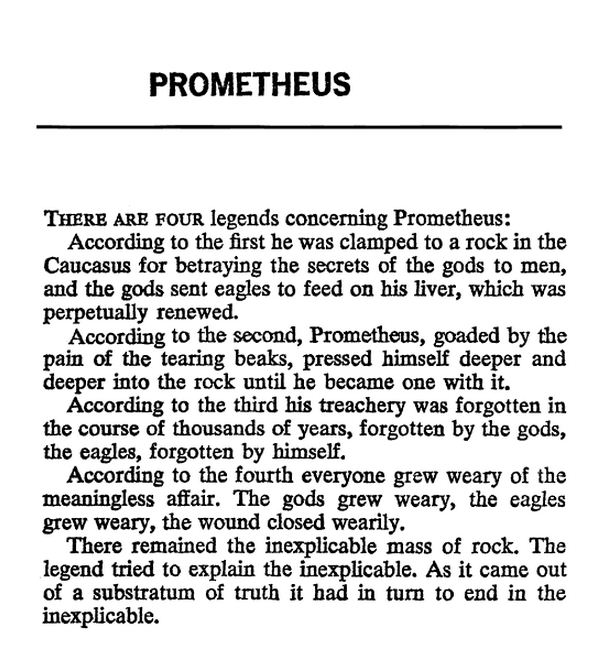
“Prometheus” — Franz Kafka


Camus, Eliot, and Kuper’s Kafka (Books acquired, 31 Aug. 2018)

img_0894

I went to my favorite used bookshop on Friday afternoon to browse, order another Gerald Murnane novel, and pick up a copy of George Eliot’s Silas Marner.

I spied a late fifties mass market copy of Albert Camus’ novel Exile and the Kingdom from Vintage Books. I fell in love with the cover (by George Giusti) and ended up picking it up, although I’ll admit I haven’t read a Camus novel since college (it was The Plague if memory serves).

Browsing copies of Silas Marner, I found this monstrosity:

img_0892

I don’t even know where to start with this cover. I mean, even the colors seem to clash. It doesn’t really come across in the photo, but this hardback has a cheap greasy feel to it. I initially assumed that it was some kind of TV or film tie in, but as far as I can tell…no. Horrifying. I ended up going with the Oxford edition with Ferdinand Hodler’s painting Unemployed on the cover.

When I got home, the mail had come. It included a copy of Peter Kuper’s Kafkaesque, which collects 14 of Kuper’s illustrated Kafka translations. Publisher Norton’s blurb:

Award-winning graphic novelist Peter Kuper presents a mesmerizing interpretation of fourteen iconic Kafka short stories.

Long fascinated with the work of Franz Kafka, Peter Kuper began illustrating his stories in 1988. Initially drawn to the master’s dark humor, Kuper adapted the stories over the years to plumb their deeper truths. Kuper’s style deliberately evokes Lynd Ward and Frans Masereel, contemporaries of Kafka whose wordless novels captured much of the same claustrophobia and mania as Kafka’s tales. Working from new translations of the classic texts, Kuper has reimagined these iconic stories for the twenty-first century, using setting and perspective to comment on contemporary issues like civil rights and homelessness.

Longtime lovers of Kafka will appreciate Kuper’s innovative interpretations, while Kafka novices will discover a haunting introduction to some of the great writer’s most beguiling stories, including “A Hunger Artist,” “In The Penal Colony,” and “The Burrow.” Kafkaesque stands somewhere between adaptation and wholly original creation, going beyond a simple illustration of Kafka’s words to become a stunning work of art.

A review of Blade Runner 2049

vumoudl
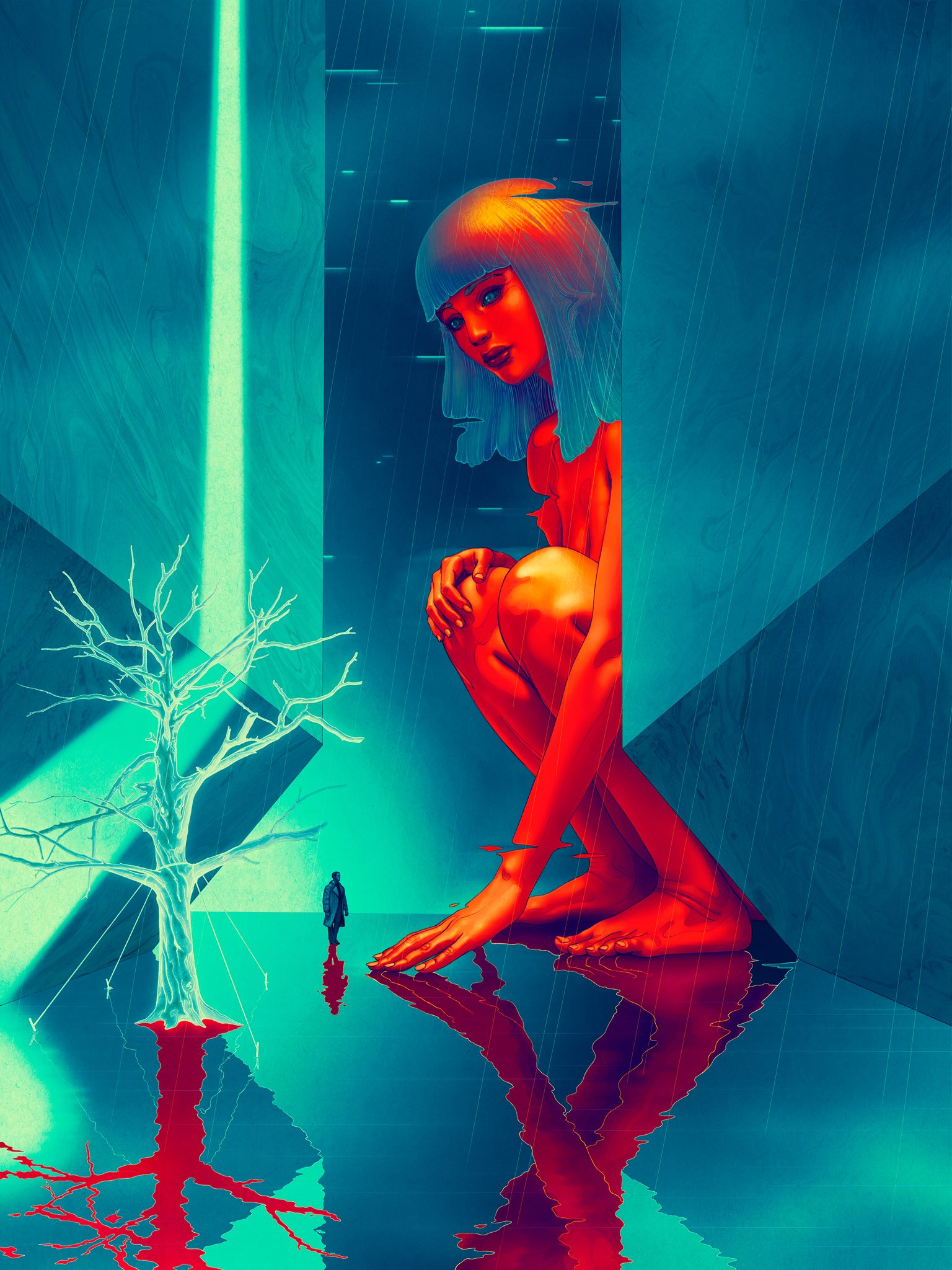
Film poster for Blade Runner 2049 by James Jean

I don’t remember how old I was the first time I saw Blade Runner (dir. Ridley Scott, 1982), but I do remember that it had an instant and formative aesthetic impact on me. Blade Runner’s dark atmosphere and noir rhythms were cut from a different cloth than the Star Wars and Spielberg films that were the VHS diet of my 1980’s boyhood. Blade Runner was an utterly perplexing film, a film that I longed to see again and again (we didn’t have it on tape), akin to Dune (dir. David Lynch, 1984), or The Thing (dir. John Carpenter, 1982)—dark, weird sci-fi visions that pushed their own archetypes through plot structures that my young brain couldn’t quite comprehend.

By the time Scott released his director’s cut of the film in 1993, I’d read Philip K. Dick’s source novel Do Androids Dream of Electric Sheep? and enough other dystopian fictions to understand the contours and content of Blade Runner in a way previously unavailable to me. And yet if the formal elements and philosophical themes of Blade Runner cohered for me, the central ambiguities, deferrals of meaning, and downright strangeness remained. I’d go on to watch Blade Runner dozens of times, even catching it on the big screen a few times, and riffing on it in pretty much every single film course I took in college. And while scenes and set-pieces remained imprinted in my brain, I still didn’t understand the film. Blade Runner is, after all, a film about not knowing.

Like its predecessor, Blade Runner 2049 (dir. Denis Villeneuve, 2017) is also a film about not knowing. Moody, atmospheric, and existentialist, the core questions it pokes at are central to the Philip K. Dick source material from which it originated: What is consciousness? Can consciousness know itself to be real? What does it mean to have–or not have—a soul?

Set three decades after the original, Blade Runner 2049 centers on KD6-3.7 (Ryan Gosling in Drive mode). K is a model Nexus-9, part of a new line of replicants created by Niander Wallace and his nefarious Wallace Corporation (Jared Leto, who chews up scenery with tacky aplomb). K is a blade runner, working for the LAPD to hunt down his own kind. At the outset of the film, K doesn’t recognize the earlier model Nexuses (Nexi?) he “retires” as his “own kind,” but it’s clear that the human inhabitants of BR ’49’s world revile all “skinjobs” as the same: scum, other, less human than human. K, beholden to his human masters, exterminates earlier-model replicants in order to keep the civil order that the corporate police state demands. This government relies on replicant slave labor, both off-world—where the wealthiest classes have escaped to—and back here on earth, which is recovering from a massive ecological collapse. The recovery is due entirely to Niander Wallace’s innovations in synthetic farming—and his reintroduction of the previously prohibited replicants.

Our boy K “retires” a Nexus-8 at the beginning of the film. This event leads to the film’s first clue: a box buried under a dead tree. This (Pandora’s) box is an ossuary, the coffin for a (ta da!) female replicant (a Nexus-7 if you’re counting). Skip the next paragraph if you don’t want any plot spoilers.

Continue reading “A review of Blade Runner 2049”

“The Invention of the Devil,” a short fable by Franz Kafka

PK Dick’s Martian Time-Slip/Kafka regret (Books acquired and not acquired, 12.28.2016)

Two bucks.

Cover art by Darrell Sweet.

Here’s my riff on Philip K. Dick’s Martian Time-Slip.

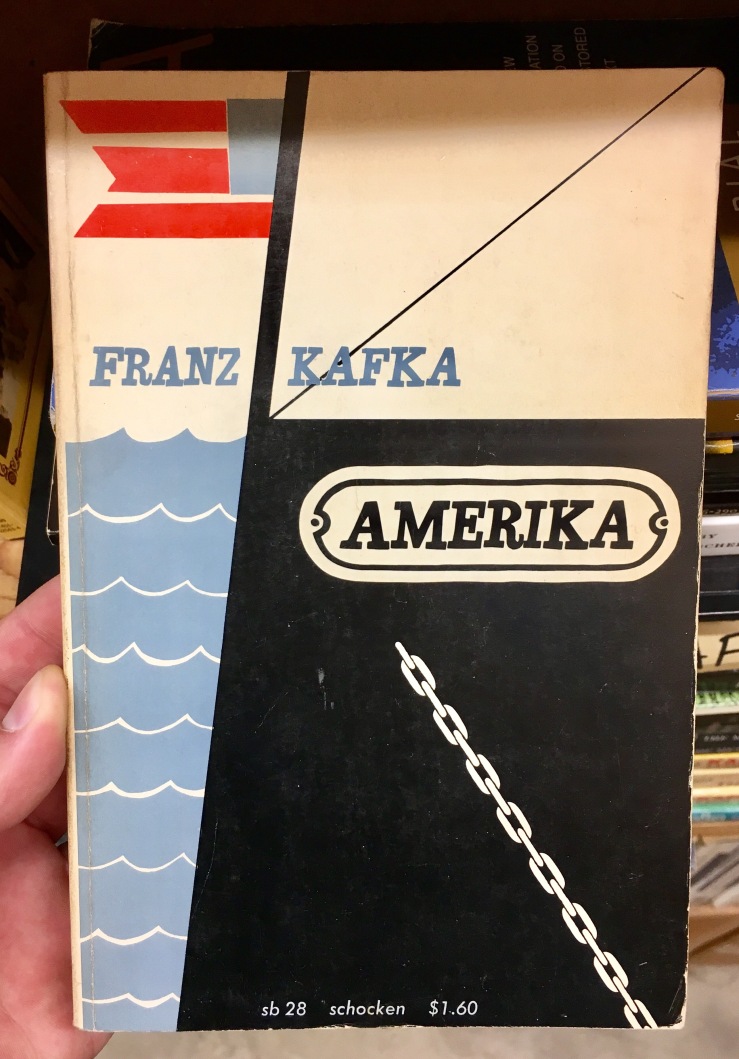
I regret not picking up this edition of Kafka’s Amerika that same day:

img_4639

I reviewed Schocken’s latest translation of Amerika (not the one above) on Biblioklept like over eight years ago. I still have the black hardback, but I’d maybe exchange it for this beauty.

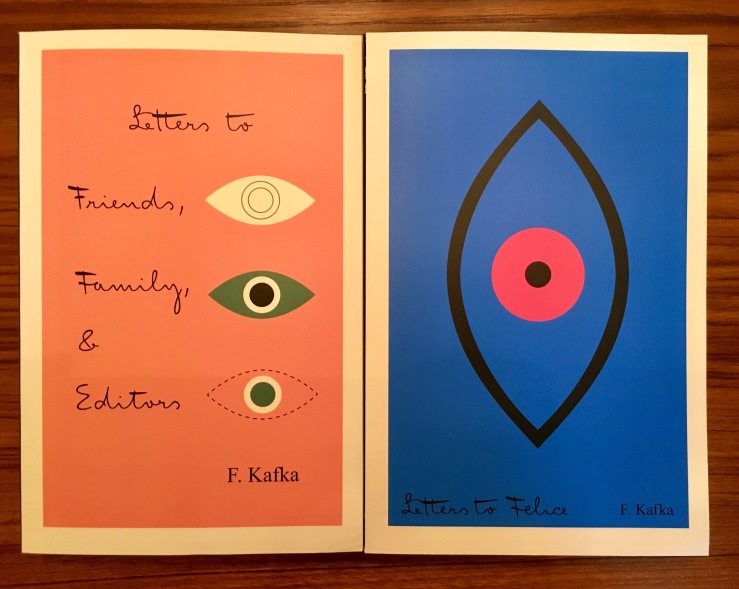
Two lovely Kafkas (Books acquired, 11.29.2016)

img_4365

Two volumes of Franz Kafka’s letters are forthcoming next month from SchockenLetters to Friends, Family, and Editors; and Letters to Felice.

Both covers are designed by Peter Mendelsund (as are all those lovely Schocken Kafka editions).

Schocken’s blurb for Friends, Family and Editors:

Collected after his death by his friend and literary executor Max Brod, here are more than two decades’ worth of Franz Kafka’s letters to the men and women with whom he maintained his closest personal relationships, from his years as a student in Prague in the early 1900s to his final months in the sanatorium near Vienna where he died in 1924.

Sometimes surprisingly humorous, sometimes wrenchingly sad, they include charming notes to school friends; fascinating accounts to Brod about his work in its various stages of publication; correspondence with his publisher, Kurt Wolff, about manuscripts in progress, suggested book titles, type design, and late royalty statements; revealing exchanges with other young writers of the day, including Martin Buber and Felix Weltsch, on life, literature, and girls; and heartbreaking reports to his parents, sisters, and friends on the declining state of his health in the last months of his life.

And Felice:

Franz Kafka met Felice Bauer in August 1912, at the home of his friend Max Brod. Energetic, down-to-earth, and life-affirming, the twenty-five-year-old secretary was everything Kafka was not, and he was instantly smitten. Because he was living in Prague and she in Berlin, his courtship was largely an epistolary one—passionate, self-deprecating, and anxious letters sent almost daily, sometimes even two or three times a day. But soon after their engagement was announced in 1914, Kafka began to worry that marriage would interfere with his writing and his need for solitude.

The more than five hundred letters Kafka wrote to Felice—through their breakup, a second engagement in 1917, and their final parting in the fall of that year, when Kafka began to feel the effects of the tuberculosis that would eventually claim his life—reveal the full measure of his inner turmoil as he tried, in vain, to balance his desire for human connection with what he felt were the solitary demands of his craft.