Semyon Ardalyonovitch said to me all of a sudden the day before yesterday: “Why, will you ever be sober, Ivan Ivano- vitch? Tell me that, pray.”
A strange requirement. I did not resent it, I am a timid man; but here they have actually made me out mad. An artist painted my portrait as it happened: “After all, you are a literary man,” he said. I submitted, he exhibited it. I read: “Go and look at that morbid face suggesting insanity.”
It may be so, but think of putting it so bluntly into print. In print everything ought to be decorous; there ought to be ideals, while instead of that…
Say it indirectly, at least; that’s what you have style for. But no, he doesn’t care to do it indirectly. Nowadays humour and a fine style have disappeared, and abuse is accepted as wit. I do not resent it: but God knows I am not enough of a literary man to go out of my mind. I have written a novel, it has not been published. I have written articles – they have been refused. Those articles I took about from one editor to another; everywhere they refused them: you have no salt they told me. “What sort of salt do you want?” I asked with a eer. “Attic salt?”
They did not even understand, For the most part I translate from the French for the booksellers. I write advertisements for shopkeepers too: “Unique opportunity! Fine tea, from our own plantations… ” I made a nice little sum over a panegyric on his deceased excellency Pyotr Matveyitch. I compiled the “Art of pleasing the ladies”, a commission from a bookseller. I have brought out some six little works of this kind in the course of my life. I am thinking of making a collection of the bons mobs of Voltaire, but am afraid it may seem a little flat to our people. Voltaire’s no good now; nowadays we want a cudgel, not Voltaire. We knock each other’s last teeth out nowadays. Well, so that’s the whole extent of my literary activity. Though indeed I do send round letters to the editors gratis and fully signed. I give them all sorts of counsels and admonitions, criticise and point out the true path. The letter I sent last week to an editor’s office was the fortieth I had sent in the last two years. I have wasted four roubles over stamps alone for them. My temper is at the bottom of it all.
I believe that the artist who painted me did so not for the sake of literature, but for the sake of two symmetrical warts on my forehead, a natural phenomenon, he would say. They have no ideas, so now they are out for phenomena. And didn’t he succeed in getting my warts in his portrait – to the life. That is what they call realism.
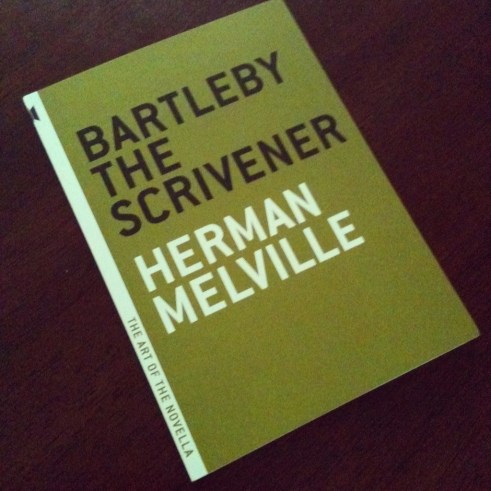
The good people at Melville House sent me their edition of Melville’s classic novella Bartleby the Scrivener. I’ve read it at least half a dozen times since the 10th grade, but the Melville House version is part of their Hybrid Books series, which features digital illuminations. I shall report in full in a week or two, focusing on what the illuminations add to the book, and what the reading experience is like.
“That wasn’t quite my contention,” he began simply and modestly. “Yet I admit that you have stated it almost correctly; perhaps, if you like, perfectly so.” (It almost gave him pleasure to admit this.) “The only difference is that I don’t contend that extraordinary people are always bound to commit breaches of morals, as you call it. In fact, I doubt whether such an argument could be published. I simply hinted that an ‘extraordinary’ man has the right… that is not an official right, but an inner right to decide in his own conscience to overstep… certain obstacles, and only in case it is essential for the practical fulfilment of his idea (sometimes, perhaps, of benefit to the whole of humanity). You say that my article isn’t definite; I am ready to make it as clear as I can. Perhaps I am right in thinking you want me to; very well. I maintain that if the discoveries of Kepler and Newton could not have been made known except by sacrificing the lives of one, a dozen, a hundred, or more men, Newton would have had the right, would indeed have been in duty bound… to eliminate the dozen or the hundred men for the sake of making his discoveries known to the whole of humanity. But it does not follow from that that Newton had a right to murder people right and left and to steal every day in the market. Then, I remember, I maintain in my article that all… well, legislators and leaders of men, such as Lycurgus, Solon, Mahomet, Napoleon, and so on, were all without exception criminals, from the very fact that, making a new law, they transgressed the ancient one, handed down from their ancestors and held sacred by the people, and they did not stop short at bloodshed either, if that bloodshed—often of innocent persons fighting bravely in defence of ancient law—were of use to their cause. It’s remarkable, in fact, that the majority, indeed, of these benefactors and leaders of humanity were guilty of terrible carnage. In short, I maintain that all great men or even men a little out of the common, that is to say capable of giving some new word, must from their very nature be criminals—more or less, of course. Otherwise it’s hard for them to get out of the common rut; and to remain in the common rut is what they can’t submit to, from their very nature again, and to my mind they ought not, indeed, to submit to it. You see that there is nothing particularly new in all that. The same thing has been printed and read a thousand times before. As for my division of people into ordinary and extraordinary, I acknowledge that it’s somewhat arbitrary, but I don’t insist upon exact numbers. I only believe in my leading idea that men are in general divided by a law of nature into two categories, inferior (ordinary), that is, so to say, material that serves only to reproduce its kind, and men who have the gift or the talent to utter a new word. There are, of course, innumerable sub-divisions, but the distinguishing features of both categories are fairly well marked. The first category, generally speaking, are men conservative in temperament and law-abiding; they live under control and love to be controlled. To my thinking it is their duty to be controlled, because that’s their vocation, and there is nothing humiliating in it for them. The second category all transgress the law; they are destroyers or disposed to destruction according to their capacities. The crimes of these men are of course relative and varied; for the most part they seek in very varied ways the destruction of the present for the sake of the better. But if such a one is forced for the sake of his idea to step over a corpse or wade through blood, he can, I maintain, find within himself, in his conscience, a sanction for wading through blood—that depends on the idea and its dimensions, note that. It’s only in that sense I speak of their right to crime in my article (you remember it began with the legal question). There’s no need for such anxiety, however; the masses will scarcely ever admit this right, they punish them or hang them (more or less), and in doing so fulfil quite justly their conservative vocation. But the same masses set these criminals on a pedestal in the next generation and worship them (more or less). The first category is always the man of the present, the second the man of the future. The first preserve the world and people it, the second move the world and lead it to its goal. Each class has an equal right to exist. In fact, all have equal rights with me—and vive la guerre éternelle—till the New Jerusalem, of course!”
From Chapter V of Part III of Dostoevsky’s novel Crime and Punishment.
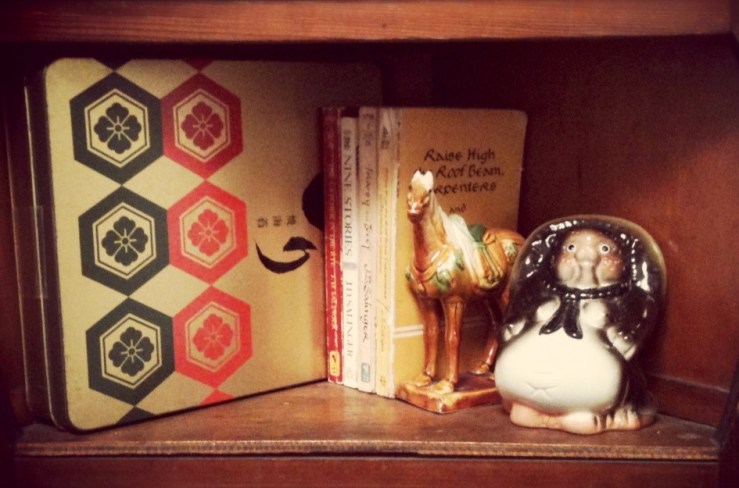
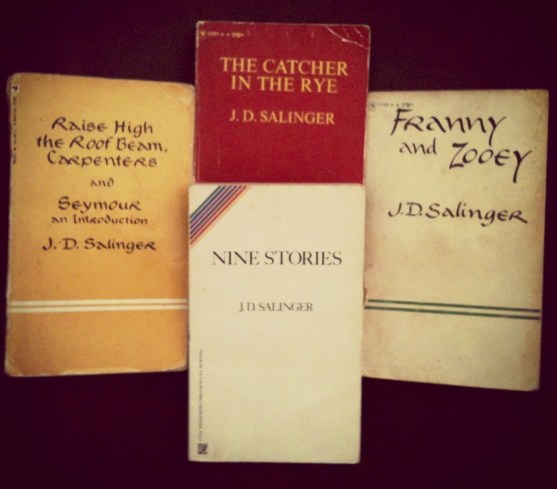
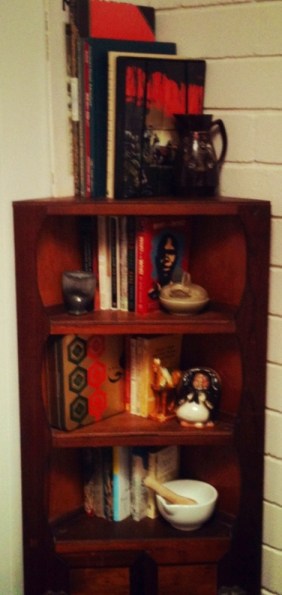
Book shelves series #38, thirty-eighth Sunday of 2012
The final entry on this corner piece.
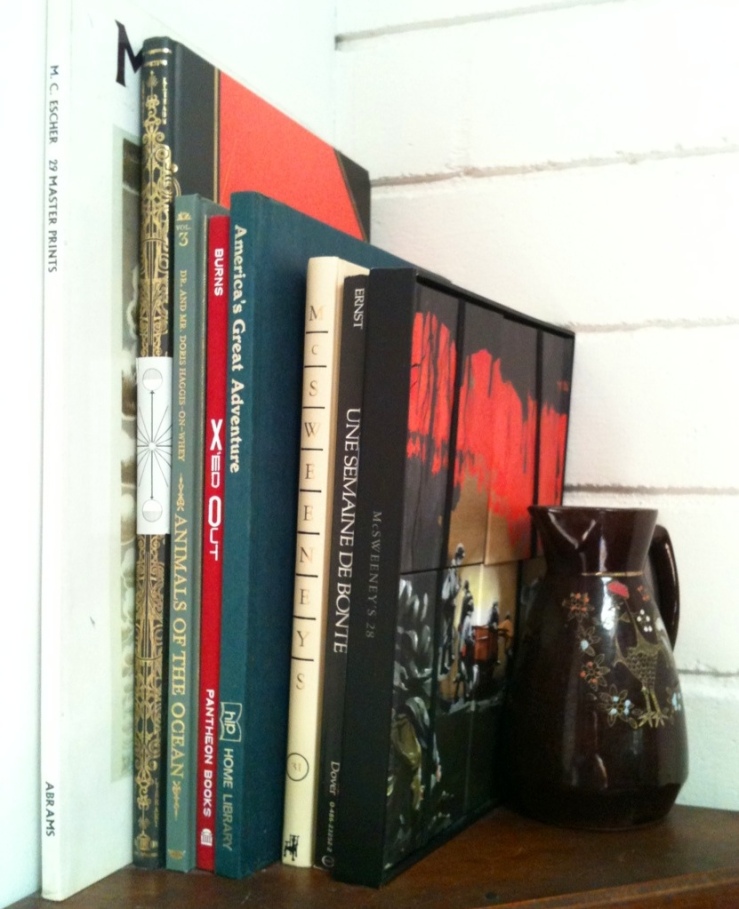
What have these volumes in common? They are all aesthetically pleasing.
They are all too tall to fit elsewhere comfortably.
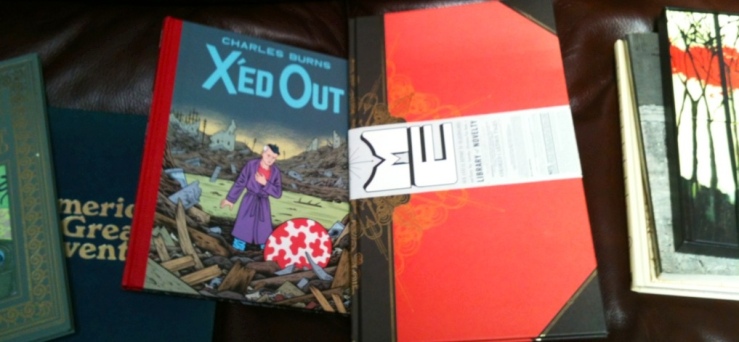
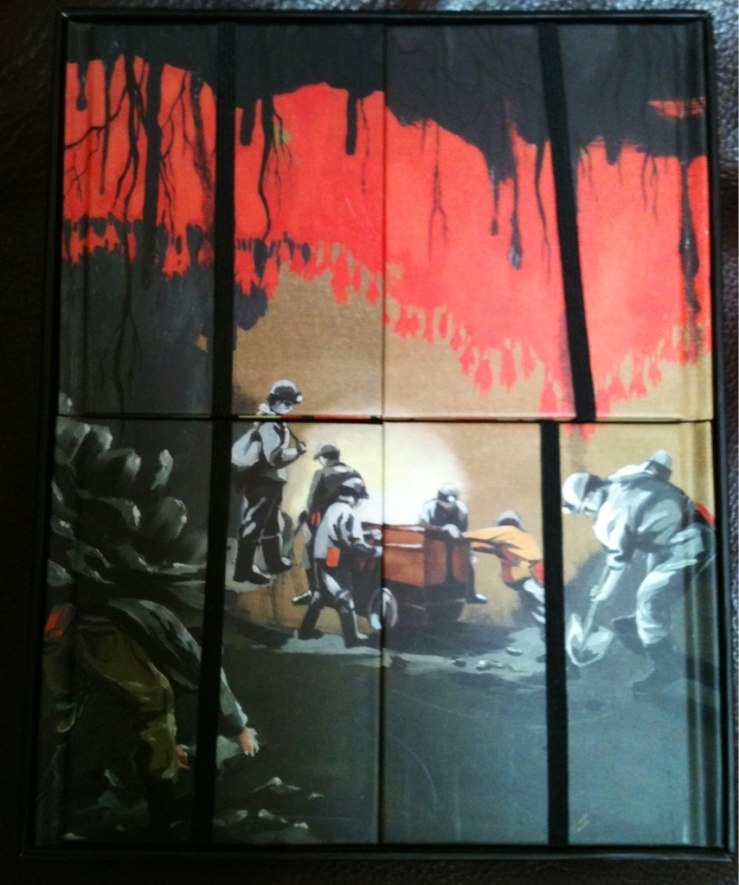
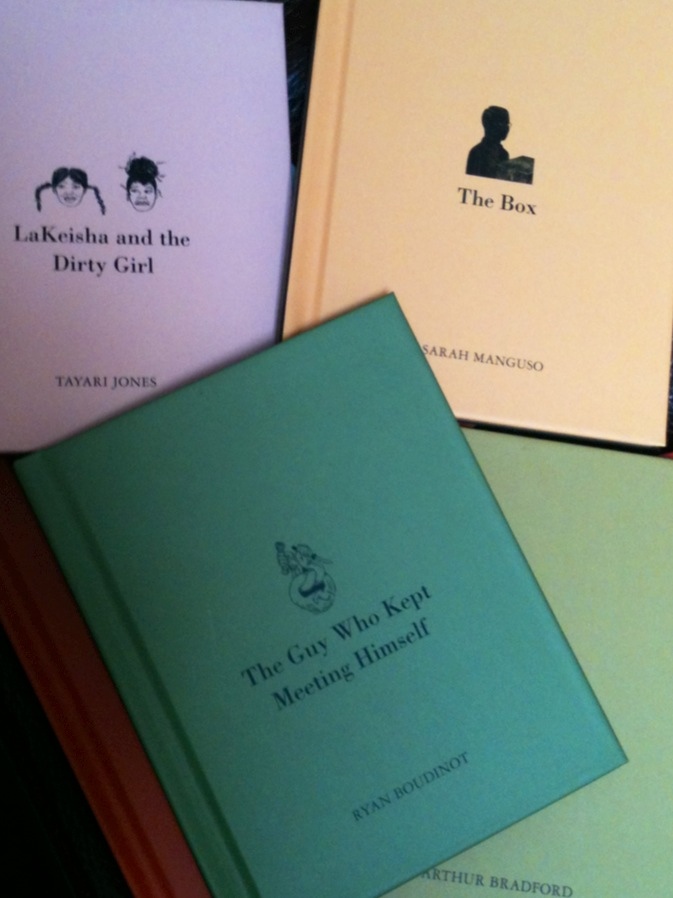
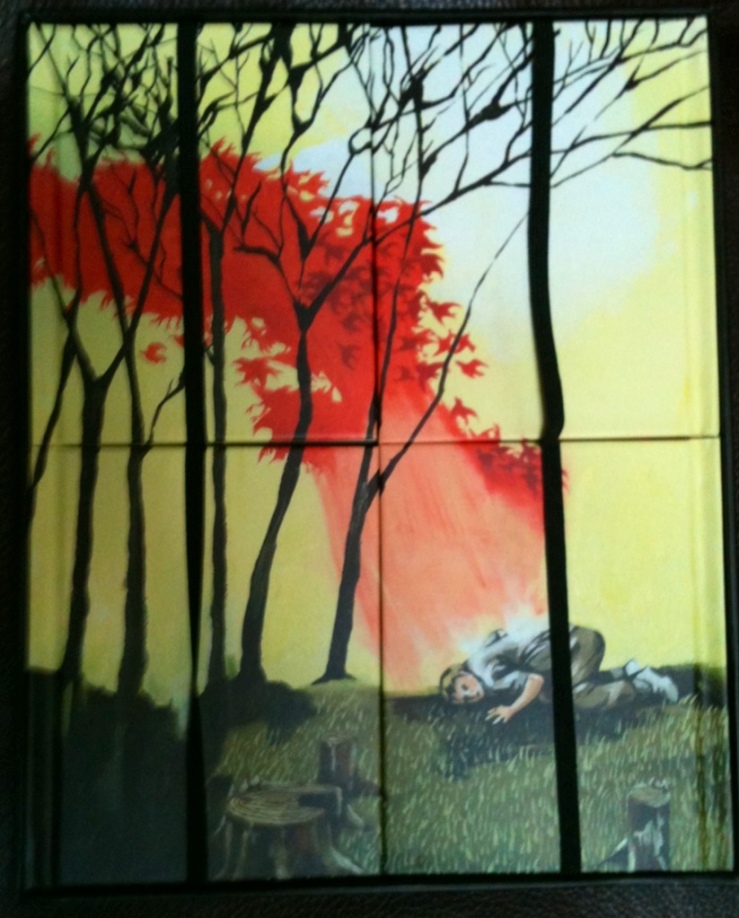
Several issues of McSweeney’s, some art books, and some graphic novels:
I’ve already expressed my strong enthusiasm for Charles Burns’s X’ed Out. The Acme Library pictured is part of Chris Ware’s series, and is beautiful and claustrophobic.
McSweeney’s #28 comprises eight little hardbacked fables that arrange into two “puzzle” covers:
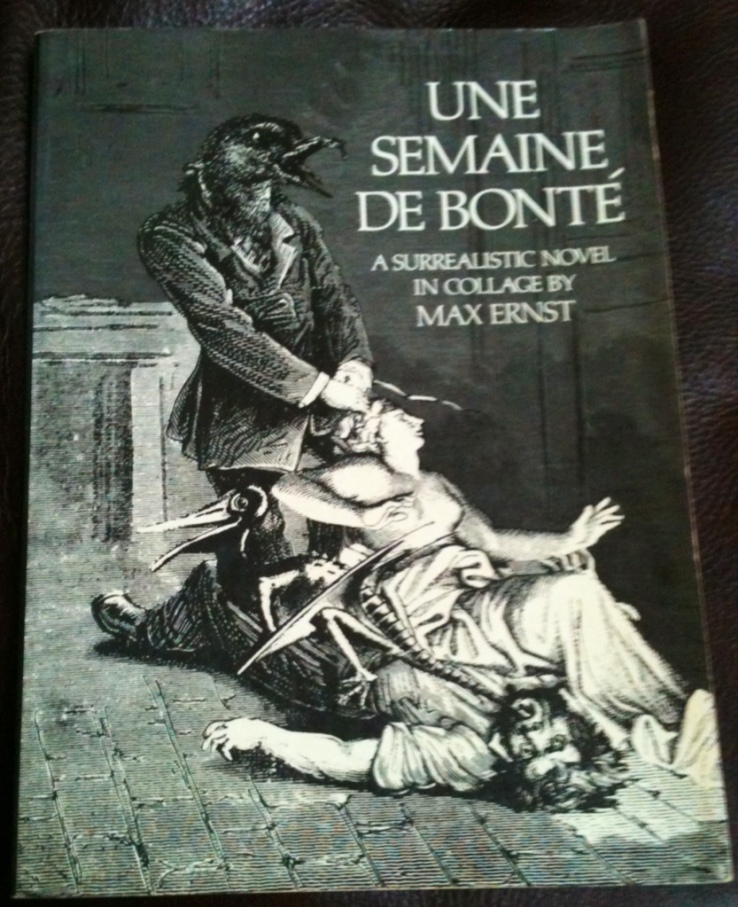
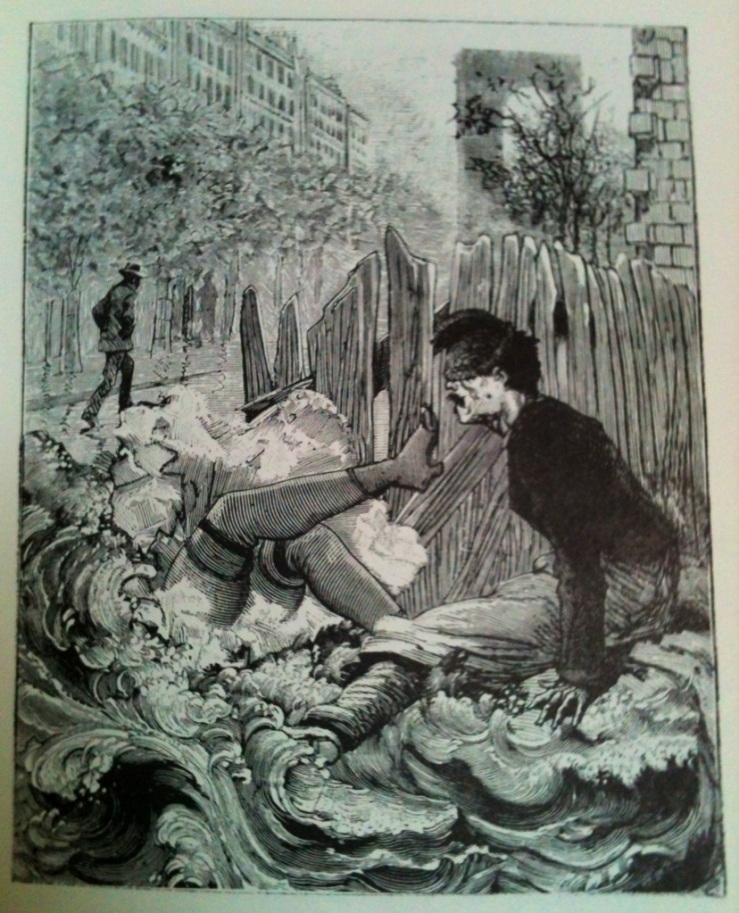
I’ve also written enthusiastically about Max Ernst’s surreal graphic novel, Une Semaine de Bonte:
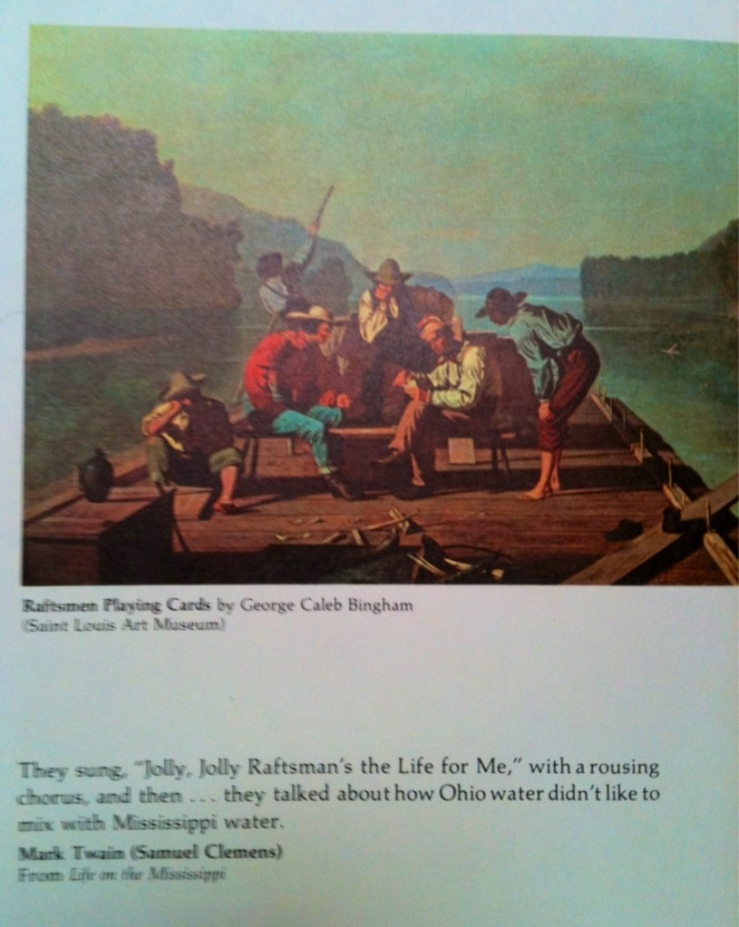
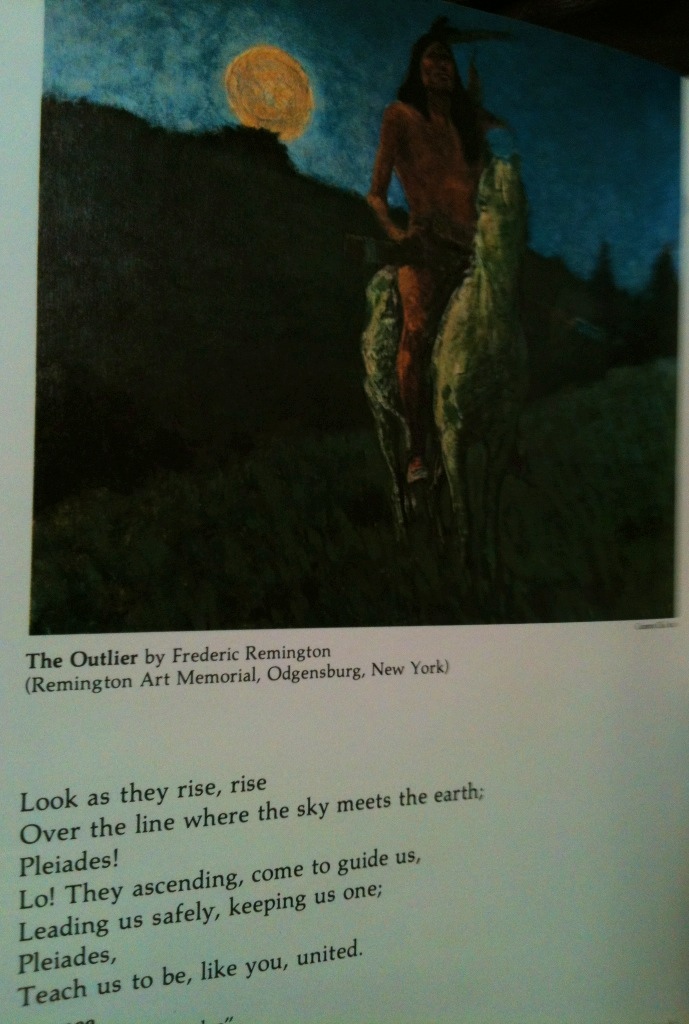
America’s Great Adventure is this wonderful book that pairs American writing (poems, songs, excerpts from novels and journals) with American paintings to tell a version of American history:
It probably deserves its own review. Short review: It’s a wonderful book if you can find it.
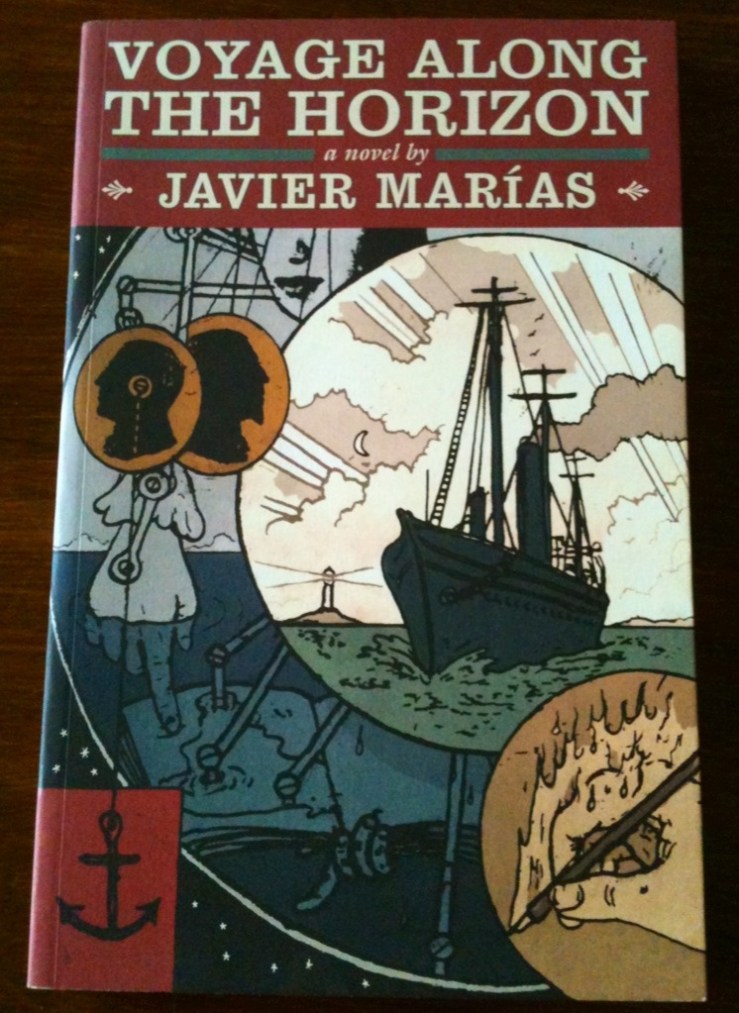
John Hawkes and Javier Marías. Was looking for something else, spotted the ND spine (Hawkes) and The Believer Books aesthetic (Marías).
From the back of the Hawkes:
No synopsis conveys the quality of this now famous novel about an hallucinated Germany in collapse after World War II. John Hawkes, in his search for a means to transcend outworn modes of fictional realism, has discovered a highly original technique for objectifying the perennial degradation of mankind within a context of fantasy… Nowhere has the nightmare of human terror and the deracinated sensibility been more concisely analyzed than in The Cannibal. Yet one is aware throughout that such analysis proceeds only in terms of a resolutely committed humanism. (Hayden Carruth)
Here’s a description, sort of, of a 2006 review of Voyage Along the Horizon (from the NYT):
To judge the Spanish novelist and essayist Javier Marías solely on the basis of “Voyage Along the Horizon” would be akin to imagining Flaubert only from “Salammbô” or Nabokov from “Transparent Things.” Though these works aren’t insignificant in their own right, to read them without recourse to their authors’ larger bodies of work is to comprehend a complex organism only from its vestigial limbs.
Here is a picture of a colorful moth doing something to a basil plant in my back yard:
She had big breasts, slim legs, and blue eyes. That’s how I like to remember her. I don’t know why I fell madly in love with her, but I did, and at the start, I mean for the first days, the first hours, it all went fine; then Clara returned to the city where she lived, in the south of Spain (she’d been on vacation in Barcelona), and everything began to fall apart.
One night I dreamed of an angel: I walked into a huge, empty bar and saw him sitting in a corner with his elbows on the table and a cup of milky coffee in front of him. She’s the love of your life, he said, looking up at me, and the force of his gaze, the fire in his eyes, threw me right across the room. I started shouting, Waiter, waiter, then opened my eyes and escaped from that miserable dream. Other nights I didn’t dream of anyone, but I woke up in tears. Meanwhile, Clara and I were writing to each other. Her letters were brief. Hi, how are you, it’s raining, I love you, bye. At first, those letters scared me. It’s all over, I thought. Nevertheless, after inspecting them more carefully, I reached the conclusion that her epistolary concision was motivated by a desire to avoid grammatical errors. Clara was proud. She couldn’t write well, and she didn’t want to let it show, even if it meant hurting me by seeming cold.
Dracula is a character in Roberto Bolaño’s dark opus 2666.
Specifically, I’m suggesting that Dracula (like, theCount Dracula) is the unnamed SS officer in “The Part About Archimboldi” who hosts a strange party in a Romanian castle.
2. I’m willing to concede that my idea is probably full of holes and more than a little silly, but I think there’s some textual support for such a claim.
3. I’ve already suggested on this blog that 2666 is full of lycanthropic transformations, and in that earlier essay, I linked werewolves to vampires (using the work of mythologist Sabine Baring-Gould).
It’s a work of mesmerism and transformation—vampire powers. Dracula showing up is a winking sick joke, a satire.
4. In his post “Castle Dracula” at Infinite Zombies, Daryl L. L. Houston connects the many strands of vampirism that run through 2666, suggesting that “Bolaño is using the vampirism in the story, and Dracula in particular, to tie together some of the threads he’s been unwinding pertaining to insiders and outsiders, parasitism and consumption of people, and a sort of larger parasitism of nations.” Hence Aztec blood rituals, the Holocaust, the murder of helpless, marginalized women in Santa Teresa . . .
5. Okay, so back to that thesis. Let’s start with the first appearance of the unnamed SS officer:
At midmorning they came to a castle. The only people there were three Romanians and an SS officer who was acting as butler and who put them right to work, after serving them a breakfast consisting of a glass of cold milk and a scrap of bread, which some soldiers left untouched in disgust. Everyone, except for four soldiers who stood guard, among them Reiter, whom the SS officer judged ill suited for the task of tidying the castle, left their rifles in the kitchen and set to work sweeping, mopping, dusting lamps, putting clean sheets on the beds.
Fairly banal, right? Also, “midmorning” would entail, y’know, sunlight, which is poison for most vampires. Let me chalk this up to the idea that the SS officer is inside the castle, which is sufficiently gloomy and dark enough to protect him (I’m not going to get into any vampire rules that might spoil my fun, dammit!). In any case, hardly noteworthy. Indeed, the SS officer—a butler commanding house chores—seems hardly a figure of major importance.
6. Next, we get the Romanian castle explicitly identified as “Dracula’s castle” and meet the actors for this milieu:
“And what are you doing here, at Dracula’s castle?” asked the baroness.
“Serving the Reich,” said Reiter, and for the first time he looked at her.
He thought she was stunningly beautiful, much more so than when he had known her. A few steps from them, waiting, was General Entrescu, who couldn’t stop smiling, and the young scholar Popescu, who more than once exclaimed: wonderful, wonderful, yet again the sword of fate severs the head from the hydra of chance.
(I love Popescu’s line here).
7. Our principals soon take a tour of castle and environs, led by the SS officer (boldface emphasis is mine):
Soon they came to a crypt dug out of the rock. An iron gate, with a coat of arms eroded by time, barred the entrance. The SS officer, who behaved as if he owned the castle, took a key out of his pocket and let them in. Then he switched on a flashlight and they all ventured into the crypt, except for Reiter, who remained on guard at the door at the signal of one of the officers.
So Reiter stood there, watching the stone stairs that led down into the dark, and the desolate garden through which they had come, and the towers of the castle like two gray candles on a deserted altar. Then he felt for a cigarette in his jacket, lit it, and gazed at the gray sky, the distant valleys, and thought about the Baroness Von Zumpe’s face as the cigarette ash dropped to the ground and little by little he fell asleep, leaning on the stone wall. Then he dreamed about the inside of the crypt. The stairs led down to an amphitheater only partially illuminated by the SS officer’s flashlight. He dreamed that the visitors were laughing, all except one of the general staff officers, who wept and searched for a place to hide. He dreamed that Hoensch recited a poem by Wolfram von Eschenbach and then spat blood. He dreamed that among them they had agreed to eat the Baroness Von Zumpe.
He woke with a start and almost bolted down the stairs to confirm with his own eyes that nothing he had dreamed was real.
When the visitors returned to the surface, anyone, even the least astute observer, could have seen that they were divided into two groups, those who were pale when they emerged, as if they had glimpsed something momentous down below, and those who appeared with a half smile sketched on their faces, as if they had just been reapprised of the naivete of the human race.
Bolaño concludes the crypt passage by highlighting an essential ambiguity that courses throughout the entire “Castle Dracula” episode, a strange axis of horror/humor, romance/banality. What has been revealed in the crypt? We don’t know, of course, but our surrogate Reiter allows us access to a few visions of what might have happened, including terror and fear and cannibalism. (He employs Hawthorne’s escape hatch too—it was all a dream).
The Knight of Death, Salvador Dali
8. Then, supper time:
That night, during dinner, they talked about the crypt, but they also talked about other things. They talked about death. Hoensch said that death itself was only an illusion under permanent construction, that in reality it didn’t exist. The SS officer said death was a necessity: no one in his right mind, he said, would stand for a world full of turtles or giraffes. Death, he concluded, served a regulatory function.
Clearly it’s easy to link any of the dinnertime comments about death to Dracula, but note that the SS officer’s idea that death is a “regulatory function” is terribly banal, is quite literally regular—this idea contrasts with Hoensch’s more poetic notion that death is an illusion (an illusion that the SS officer, if he is in fact Count Dracula, would realize in a perfectly mundane way that foreclosed the necessity of metaphor).
9. Dinner conversation turns to murder—obviously one of the central themes of 2666:
The SS officer said that murder was an ambiguous, confusing, imprecise, vague, ill-defined word, easily misused.
Again, ambiguity: on one hand, sure, an SS officer’s job was in large part about coordinating and executing mass murder. At the same time, we might appreciate that murder is a vague term if people are one’s lunch.
10. Then conversation turns to culture:
The SS officer said culture was the call of the blood, a call better heard by night than by day, and also, he said, a decoder of fate.
I’m pretty sure that this was the moment I started entertaining the fancy that the SS officer might be Dracula.
11. Popescu the intellectual also seems to reconsider the SS officer:
The intellectual Popescu remained standing, next to the fireplace, observing the SS officer with curiosity.
12. Then, they finally riff on Dracula. Significantly, the SS officer believes that Dracula is a good German (bold emphasis mine):
First they praised the assortment of little cakes and then, without pause, they began to talk about Count Dracula, as if they had been waiting all night for this moment. It wasn’t long before they broke into two factions, those who believed in the count and those who didn’t. Among the latter were the general staff officer, General Entrescu, and the Baroness Von Zumpe. Among the former were Popescu, Hoensch, and the SS officer, though Popescu claimed that Dracula, whose real name was Vlad Tepes, aka Vlad the Impaler, was Romanian, and Hoensch and the SS officer claimed that Dracula was a noble Teuton, who had left Germany accused of an imaginary act of treason or disloyalty and had come to live with some of his loyal retainers in Transylvania a long time before Vlad Tepes was born, and while they didn’t deny Tepes a real historical or Transylvanian existence, they believed that his methods, as revealed by his alias or nickname, had little or nothing to do with the methods of Dracula, who was more of a strangler than an impaler, and sometimes a throat slitter, and whose life abroad, so to speak, had been a constant dizzying spin, a constant abysmal penitence.
The SS officer is the noble Teuton. More importantly, we get language that connects Dracula to the murders in Santa Teresa, most of which are stranglings; we also get the idea that Dracula has had a “life abroad”—one outside of time—a life that might see his spirit inhabit and ventriloquize an industrial city in the north of Mexico. (Or not. I know. Look, I’m just riffing here).
We also get the idea of an abyss (this is the structure of 2666), as well as the idea of Dracula as a penitent of sorts.
So, let us recall that early in “The Part About the Crimes,” detective Juan de Dios Martinez is searching for a criminal dubbed The Penitent who desecrates churches and has committed a few murders in the process. He goes to psychologist Elvira Campos for help:
Sacraphobia is fear or hatred of the sacred, of sacred objects, especially from your own religion, said Elvira Campos. He thought about making a reference to Dracula, who fled crucifixes, but he was afraid the director would laugh at him. And you believe the Penitent suffers from sacraphobia? I’ve given it some thought, and I do. A few days ago he disemboweled a priest and another person, said Juan de Dios Martinez.
This is the first mention of Dracula in 2666, and he’s explicitly likened to the Penitent; later, as we see above, Dracula will be explicitly linked to penitence.
(I’m not suggesting that the Penitent is Dracula traveled to Mexico to piss in churches. What I want to say is that Dracula’s dark spirit ventriloquizes the text of 2666).
(I’m also suggesting, again, that 2666 be read intertextaully).
Riding with Death, Jean-Michel Basquiat
13. Our other principals continue to discuss Dracula, but I won’t belabor that discussion (I’d prefer you, dear reader, to return to the text).
I will summarize though: Popescu sees Dracula in nationalistic terms (“a Romanian patriot” who repels the Turks), and General Entrescu goes on a long rant about heroism and villainy and history, culminating in a lengthy digression on Jesus Christ (recall now that Entrescu will be crucified JC-style by his men).
One aside on the SS officer bears mentioning: we learn that “the fastidious SS officer” is the most sober conversant as he “scarcely wet his lips with alcohol.” (Because he’s a vampire who prefers blood! Muahahahaha!)
14. Fast forward a few hours. Our man Reiter, among fellow soldiers, sets out to explore the secret crannies and passageways of Castle Drac and play voyeur:
The room they came to was empty and cold, as if Dracula had just stepped out. The only thing there was an old mirror that Wilke lifted off the stone wall, uncovering a secret passageway.
Dracula’s spirit leaves the room, creating an opening, behind the ever-symbolic mirror. (Muahahahaha!). (2666: Mirror, tunnels, chambers, labyrinths).
They enter the passageway and come first upon our supposed Dracula, the SS officer:
And so they were able to look into the room of the SS officer, lit by three candles, and they saw the SS officer up, wrapped in a robe, writing something at a table near the fireplace. The expression on his face was forlorn. And although that was all there was to see, Wilke and Reiter patted each other on the back, because only then were they sure they were on the right path. They moved on.
15. Dracula, the epistolary novel. Count Dracula, troubled writer of letters, will author the following scenes, his spirit ventriloquizing the principals all: Here, we find Reiter and his homeboy Wilke, lurking in a secret passage, jerking off to werewolf-cum-Jesus-Christ-figure Gen. Entrescu screwing the lovely Baroness Von Zumpe and reciting poetry (emphasis per usual mine):
Then Wilke came on the wall and mumbled something too, a soldier’s prayer, and soon afterward Reiter came on the wall and bit his lips without saying a word. And then Entrescu got up and they saw, or thought they saw, drops of blood on his penis shiny with semen and vaginal fluid, and then Baroness Von Zumpe asked for a glass of vodka, and then they watched as Entrescu and the baroness stood entwined, each with a glass in hand and an air of distraction, and then Entrescu recited a poem in his tongue, which the baroness didn’t understand but whose musicality she lauded, and then Entrescu closed his eyes and cocked his head as if to listen to something, the music of the spheres, and then he opened his eyes and sat at the table and set the baroness on his cock, erect again (the famous foot-long cock, pride of the Romanian army), and the cries and moans and tears resumed, and as the baroness sank down onto Entrescu’s cock or Entrescu’s cock rose up into the Baroness Von Zumpe, the Romanian general recited a new poem, a poem that he accompanied by waving both arms (the baroness clinging to his neck), a poem that again neither of them understood, except for the word Dracula,which was repeated every four lines, a poem that might have been martial or satirical or metaphysical or marmoreal or even anti-German, but whose rhythm seemed made to order for the occasion, a poem that the young baroness, sitting astride Entrescu’s thighs, celebrated by swaying back and forth, like a little shepherdess gone wild in the vastness of Asia, digging her nails into her lover’s neck, scrubbing the blood that still flowed from her right hand on her lover’s face, smearing the corners of his lips with blood, while Entrescu, undeterred, continued to recite his poem in which the word Dracula sounded every four lines, a poem that was surely satirical, decided Reiter (with infinite joy) as Wilke jerked off again.
I contend that the poem is the work of the SS officer, psychic mesmerist, the poet Dracula, a poem no one in the scene can understand, a dark satire that might also be a war poem or a love poem or an elegy, but definitely a dark satire, written in violence and sex and blood, a poem that ventriloquizes not only Entrescu, phallic delivery device, but also the baroness, and also Reiter and Wilke. And perhaps the reader.
16. Where to go after such a climax? Maybe point out that Dracula infects Reiter and Wilke, of whom we learn:
Some of their battalion comrades dubbed them the vampires.
(But better to return I think to our strange figure, the SS officer).
17. Here, his last appearance:
The next morning the detachment left the castle after the departure of the two carloads of guests. Only the SS officer remained behind while they swept, washed, and tidied everything. Then, when the officer was fully satisfied with their efforts, he ordered them off and the detachment climbed into the truck and headed back down to the plain. Only the SS officer’s car—with no driver, which was odd—was left at the castle. As they drove away, Reiter saw the officer: he had climbed up to the battlements and was watching the detachment leave, craning his neck, rising up on tiptoe, until the castle, on the one hand, and the truck, on the other, disappeared from view.
Dracula stays in Dracula’s castle; his spirit, his seed, his blood seeps out.
6. I suppose I could spend a few paragraphs parsing the delicate distinctions between literary criticism and book reviews and awarding fucking stars on Amazon or Goodreads, but I think you, gentle reader, probably get all that already.
7. (I consider myself an amateur book reviewer with an interest in but no pretension to literary criticism. I don’t intend to write about myself, but I do feel like I should clarify this).
8. (I know I just said that I don’t intend to write about myself, but again, perhaps germane:
I don’t read a lot of book reviews, especially contemporary book reviews. I mean, I hardly ever read contemporary book reviews. If I’m planning to review the work, a contemporary review may poison any pretense of objectivity I have.
With the occasional new major release, it’s almost impossible not to get a fix on some critical consensus—and I always scan of course.
I usually read a handful of reviews of a book I’m reading after I’ve drafted a review.
And I read lots of old reviews. Lots.
Again, maybe germane to all of this).
9. But I’m riffing out all over the place. Let me get to the point. Let’s return to the second part of Point 2:
The traditional position of the serious book critic is perhaps being undermined via social media in the hands of well-meaning amateurs.
Is this true? I don’t know, exactly. A few points to consider:
Literary criticism has existed via two more-or-less stable forms for about a century now: Academic scholarship and popular media.
Academic scholarship tends to be highly-specialized and literally inaccessible for most people. I think academic scholarship and research about literature is important and I don’t want to knock it all—but most of it simply isn’t exposed to, let alone absorbed by, a reading public.
Popular media—magazines and newspapers—is clearly in a transitional phase. A lot of this boils down to the dissemination of new technologies, the advent of the so-called “citizen journalist,” and the oligarchization of mass media. Journalism, as taught in journalism school, prescribed a set of methods and ethics that seem frankly quaint when set against the internet and 24hr cable networks. How book reviews fit—if they fit at all—into the emerging paradigm of popular media is hard to say.
10. Obviously, one model for how book reviews/lit crit fits into the emerging paradigm of popular media is Goodreads, which I really don’t know much about to be honest. Another is Amazon, which has so many problems I don’t even begin to know how to start. Both of these sites use star ratings though, which has always struck me as probably the worst critical model available.
11. (I got an email recently about Riffle, a new service “powered by the Facebook social graph and loaded with expert curated recommendations.” I mean, how’s that for a shudder down the metaphorical spine?)
12. (Re: Point 11—What is it with this term “curator”? Is it synonymous with: “I produce no original content”?)
13. So, to return to the pretense that I have a point:
I’ve written about 300 reviews on this site. Most for books, some movie reviews, and a few other things as well (uh, malt liquor). I didn’t really know what I was doing in the beginning—I mean, I wasn’t even intending to review books. I was just writing about books I’d pilfered, pinched. Stolen. (The name of the site was its mission statement). At some point I started making critical judgments, trying to, you know, recommend books that I loved to people who I hoped would love them also.
I’m not an Updike fan—wasn’t then, amn’t now—but his rules resonated with me, and I made a point of reading his criticism, which is generally excellent.
In short, I’ve tried to follow his rules.
14. (To clarify: A simple thesis for this whole riff: I think book reviewers need to follow some kind of aesthetic, ethical rubric, one that accounts for subjectivity in an objective way—and I think Updike’s list is great).
15. Updike’s first rule is his best:
Try to understand what the author wished to do, and do not blame him for not achieving what he did not attempt.
(I might have abused Updike’s first rule myself, but I’m not going to ransack the archives for self-incrimination).
16. Updike’s first rule is so graceful because it allows for a sliding scale of sorts, a range of possibilities beyond the critic’s own highly-subjective taste.
Put another way, it’s very easy to say, “I loved it” or “I hated it,” but Updike’s first rule places the onus of critical imagination on the reviewer. The responsible reviewer has to understand his or her audience (or at least has to try to understand his or her audience).
17. The subjective can’t be removed from reviews of course—nor should it be. I think the balancing act here might be described as taste.
18. I’ve occasionally broken some of Updike’s rules, especially when I super hated a book (usually #s 2 &3–didn’t bother to cite text—actually, I’ve done this repeatedly),
19. Sometimes a book confuses my approach to criticism.
20. Hence, Adam Johnson’s novel The Orphan Master’s Son, which I reviewed in hardback a few months ago, and which is now available in trade paperback, and which I will use now as some sort of loose illustration for whatever point there is in this ramble:
21. (Okay. So, normally I photograph reader copies (and other books I obtain) and run a little blurb—usually the publisher’s copy or another review—and I was gonna do this with The Orphan Master’s trade paperback (citing my own review in this case), but the post lingered, thoughts accrued around it as I glommed onto all the ideas reverberating around my little echo chamber re: this whole riff. I bring this up in the recognition that a post purporting to address in some way the ethics of book reviewing should point out that the publisher in question (e.g. this blog, e.g. me) regularly posts what amounts to a kind of advertisement for forthcoming books).
22. So why The Orphan Master’s Son?
I use it as example (barring info re: Point 21 for a moment) of a bookthat didn’t do what I wanted the book to do.
Here’s the end of my review:
Toward the end of The Orphan Master’s Son, I began imagining how the novel might read as a work divorced from historical or political reality, as its own dystopian blend—what would The Orphan Master’s Son be stripped of all its North Korean baggage? (This is a ridiculous question, of course, but it is the question I asked myself). I think it would be a much better book, one that would allow Johnson more breathing room to play with the big issues that he’s ultimately addressing here—what it means to tell a story, what it means to create, what it means to love a person who can not just change, but also disappear. These are the issues that Johnson tackles with aplomb; what’s missing though, I think, is a genuine take on what it means to be a North Korean in search of identity.
I think my review of The Orphan Master’s Son was/is fair, but it didn’t—couldn’t—exactly capture how I felt about the book: a mix of disappointment and admiration.
23. To be clear, I took pains to clarify that I thought highly of Johnson’s prose and that I thought most readers would really dig his book.
I gave it, I suppose, a mixed review, which is almost like giving it a negative review.
24. But I didn’t give it a mixed review to be nice—I tempered my criticisms with the knowledge that any attack I made on The Orphan Master’s Son was really a way of defining my own aesthetic tastes. Let me cite Updike’s fifth rule:
If the book is judged deficient, cite a successful example along the same lines, from the author’s ouevre or elsewhere. Try to understand the failure. Sure it’s his and not yours?
Ultimately, my problem with The Orphan Master’s Son boils down to me wanting Johnson to have written a different book. I feel like I have plenty of reasonable reasony reasons for wanting a different book—first and foremost Johnson’s prowess as proser and storyteller—but that’s no way to review a book. From my review:
I should probably clarify that I think many people will enjoy this novel and find it very moving and that the faults I found in its second half likely have more to do with my taste as a reader than they do Johnson’s skill as a writer, which skill, again I’ve tried to demonstrate is accomplished.
25. Let me end here in repetition (and, perhaps, here in the safety of these parentheses point to how riffing in a rambling wine-soaked list somehow frees me from actually coherently writing about any of the things I promised to—or maybe it doesn’t—which is of course its own ethical ball of worms) by restating a basic answer to some of the basic problems of amateurism:
Book reviewers need to follow some kind of aesthetic, ethical rubric, one that accounts for subjectivity in an objective way.
“The Yellow Paint,” a short fable by Robert Louis Stevenson—
In a certain city there lived a physician who sold yellow paint. This was of so singular a virtue that whoso was bedaubed with it from head to heel was set free from the dangers of life, and the bondage of sin, and the fear of death for ever. So the physician said in his prospectus; and so said all the citizens in the city; and there was nothing more urgent in men’s hearts than to be properly painted themselves, and nothing they took more delight in than to see others painted. There was in the same city a young man of a very good family but of a somewhat reckless life, who had reached the age of manhood, and would have nothing to say to the paint: “Tomorrow was soon enough,” said he; and when the morrow came he would still put it off. She might have continued to do until his death; only, he had a friend of about his own age and much of his own manners; and this youth, taking a walk in the public street, with not one fleck of paint upon his body, was suddenly run down by a water-cart and cut off in the heyday of his nakedness. This shook the other to the soul; so that I never beheld a man more earnest to be painted; and on the very same evening, in the presence of all his family, to appropriate music, and himself weeping aloud, he received three complete coats and a touch of varnish on the top. The physician (who was himself affected even to tears) protested he had never done a job so thorough.
Some two months afterwards, the young man was carried on a stretcher to the physician’s house.
“What is the meaning of this?” he cried, as soon as the door was opened. “I was to be set free from all the dangers of life; and here have I been run down by that self-same water-cart, and my leg is broken.”
“Dear me!” said the physician. “This is very sad. But I perceive I must explain to you the action of my paint. A broken bone is a mighty small affair at the worst of it; and it belongs to a class of accident to which my paint is quite inapplicable. Sin, my dear young friend, sin is the sole calamity that a wise man should apprehend; it is against sin that I have fitted you out; and when you come to be tempted, you will give me news of my paint.”
“Oh!” said the young man, “I did not understand that, and it seems rather disappointing. But I have no doubt all is for the best; and in the meanwhile, I shall be obliged to you if you will set my leg.”
“That is none of my business,” said the physician; “but if your bearers will carry you round the corner to the surgeon’s, I feel sure he will afford relief.”
Some three years later, the young man came running to the physician’s house in a great perturbation. “What is the meaning of this?” he cried. “Here was I to be set free from the bondage of sin; and I have just committed forgery, arson and murder.”
“Dear me,” said the physician. “This is very serious. Off with your clothes at once.” And as soon as the young man had stripped, he examined him from head to foot. “No,” he cried with great relief, “there is not a flake broken. Cheer up, my young friend, your paint is as good as new.”
“Good God!” cried the young man, “and what then can be the use of it?”
“Why,” said the physician, “I perceive I must explain to you the nature of the action of my paint. It does not exactly prevent sin; it extenuates instead the painful consequences. It is not so much for this world, as for the next; it is not against life; in short, it is against death that I have fitted you out. And when you come to die, you will give me news of my paint.”
“Oh!” cried the young man, “I had not understood that, and it seems a little disappointing. But there is no doubt all is for the best: and in the meanwhile, I shall be obliged if you will help me to undo the evil I have brought on innocent persons.”
“That is none of my business,” said the physician; “but if you will go round the corner to the police office, I feel sure it will afford you relief to give yourself up.”
Six weeks later, the physician was called to the town gaol.
“What is the meaning of this?” cried the young man. “Here am I literally crusted with your paint; and I have broken my leg, and committed all the crimes in the calendar, and must be hanged tomorrow; and am in the meanwhile in a fear so extreme that I lack words to picture it.”
“Dear me,” said the physician. “This is really amazing. Well, well; perhaps, if you had not been painted, you would have been more frightened still.”









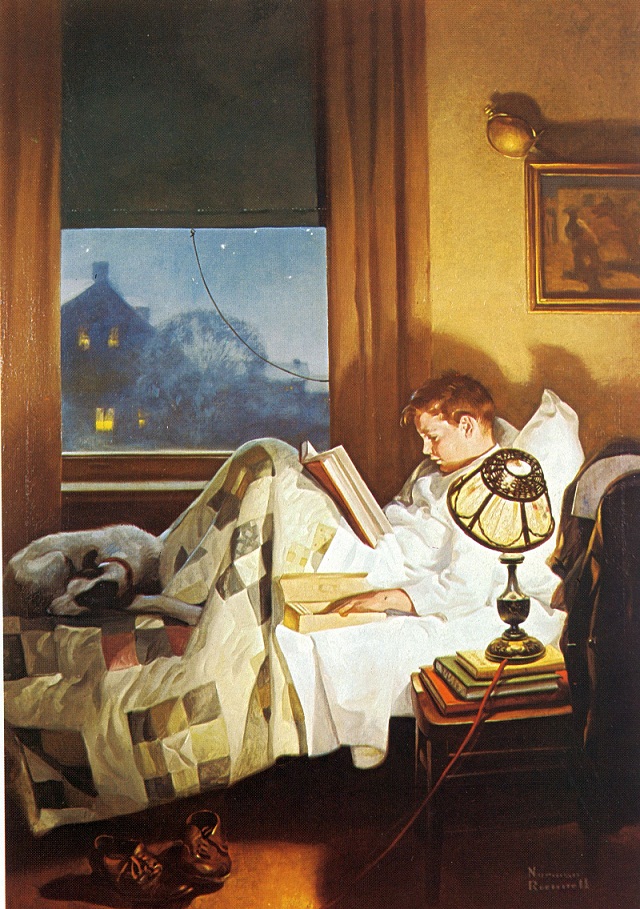
 Biblioklept