Blog about some books acquired, other stuff

My family and I took our Florida asses to the West Coast for a wonderful week earlier this month. We flew into LA, stayed in Santa Monica for a few days and nights, riding bikes up and down the beautiful coast and visiting proximal neighborhoods. We later drove east to Joshua Tree, where we stayed in a lovely little house for a few days, visiting the National Park as well as nearby towns and sites, like Twentynine Palms, Palm Springs, and Mt. San Jacinto State Park. We saw coyotes and roadrunners and lots of little desert cottontails. Famous times.

While in Santa Monica, I could not convince my family (or frankly myself) to trek the hour or so south to visit Thomas Pynchon’s old apartment in Manhattan Beach. We did, however, stop by Small World Books in Venice Beach. Small World is right across from the Venice Beach Skatepark, where we watched kids of all ages skate for almost an hour while someone blasted nineties hip-hop from a boombox (one of the nicest hours of the trip for me).

Small World is a well-stocked bookshop with an emphasis on literature and the arts; it carries plenty of indie titles and a handsome stable of standards. There was a nice cat in there too. Founded in 1969 by Mildred Gates and Mary Goodfader, Small World seems to retain some of the older vibes of Venice Beach, which is generally pretty touristy (in a fun, tacky way). It seems a bit out of place among the keychains and bad art and nasty tee shirts of Venice, what with its stock of NYRB translations, poetry zines, and novels by indie imprints like And Other Stories. But it’s clear that locals come to buy books there.

I picked up three: Lydia Davis’s Our Strangers, June-Alison Gibbons’s The Pepsi-Cola Addict, and Ann Quin’s Three. I’d been looking to buy Davis’s collection for a while now–you can buy it online, but I wanted to get it from an indie bookshop, per Davis’s intentions. Three is the only Ann Quin book I haven’t read yet; I loved her novels Berg and Passages, and I guess I wanted to leave something in the Quin take for later. The highlight purchase though for me has been Gibbons’s The Pepsi-Cola Addict, which was Small World’s featured book (I think they did a book club on it this month). I had never heard of the book or its author, but the pop art cover and goofy title caught my attention, followed by an even goofier blurb which started by describing the Pepsi-Cola Addict as the “legendary lost novel in which fourteen-year-old Preston Wildey-King must choose between his all-consuming passion for Pepsi Cola and his love for schoolmate Peggy.” The novel is not goofy though—it’s abject and odd and distressing and also very well-written, somehow naive and sophisticated, raw and refined, resoundingly truthful and plainly artificial. Here’s the full blurb:

Written by June-Alison Gibbons when she was only 16, The Pepsi Cola Addict is considered one of the great works of twentieth-century outsider literature. More than just a literary curiosity, however, this tale of a teenager whose passion for a well-known cola drink threatens to ruin his life is the uniquely vivid expression of a young woman trying to make sense of the confusing, often brutal world she in which found herself.

Published in 1982 by a vanity press who took £500 from its young author and gave her only a single book in return, it’s thought that fewer than ten original copies still exist in the world.

Shortly after its publication, June-Alison and her sister Jennifer would become infamous as “The Silent Twins” and find themselves cruelly incarcerated for over a decade in Broadmoor Hospital. This author-approved edition makes June-Alison Gibbon’s remarkable vision widely available for the first time.

I hope to have a full review to come. I read The Pepsi-Cola Addict in Joshua Tree and absolutely loved it (even though (and I guess because) it made me feel odd and ill).

Unfortunately, I didn’t make it to Angel City Books & Records in Santa Monica. I had also wanted to visit Space Cowboy Books in Joshua Tree, but didn’t realize it was closed midweek. I did drop by The Best Bookstore in Palm Springs, and was again pleasantly surprised by the rich stock of titles, which eschewed the bestseller list stuff I might have expected for a somewhat touristy area. My son conned me into buying him a Taschen volume of Michelangelo drawings and studies; he’s been copying them into his notebooks for days now.

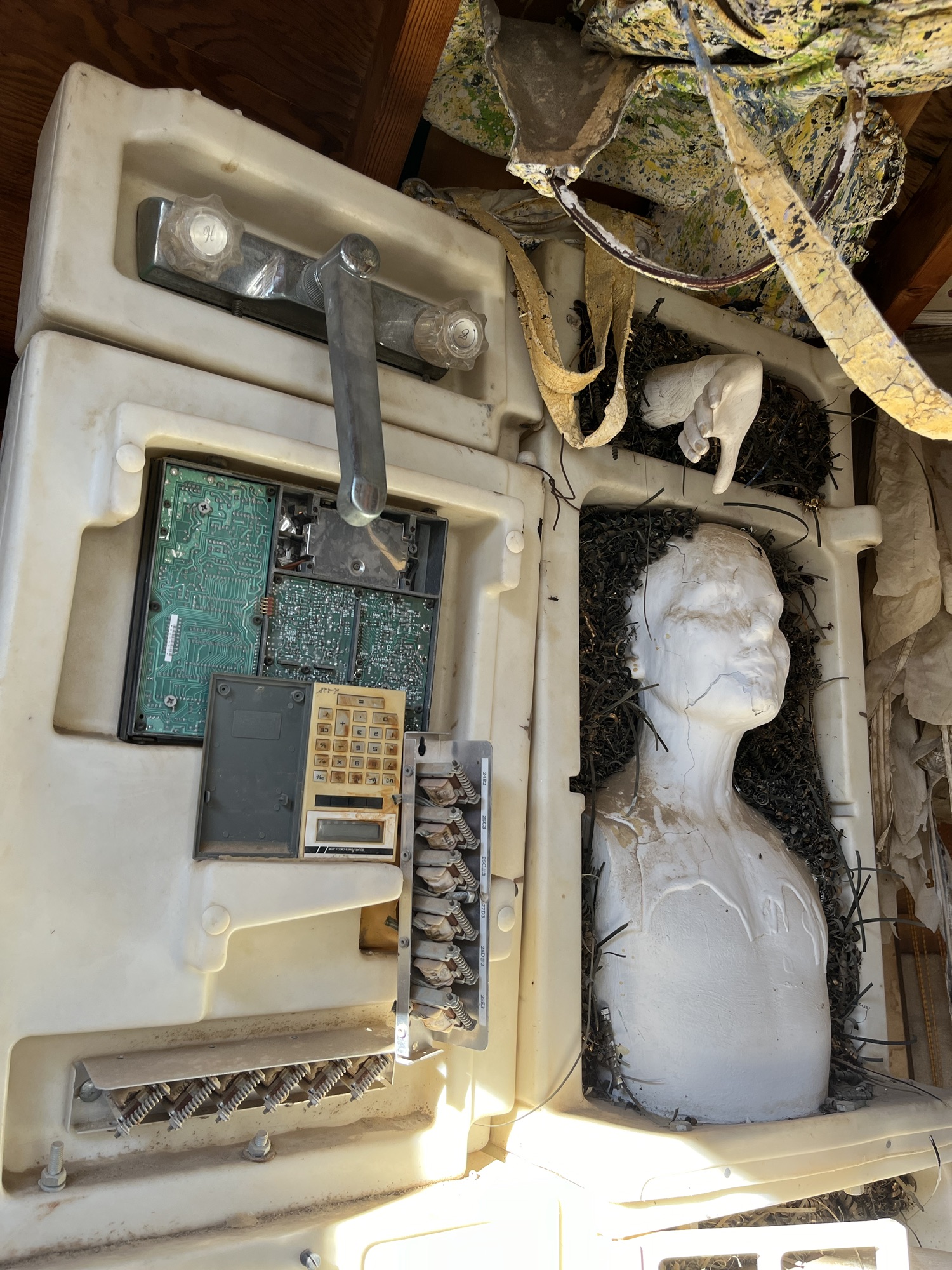
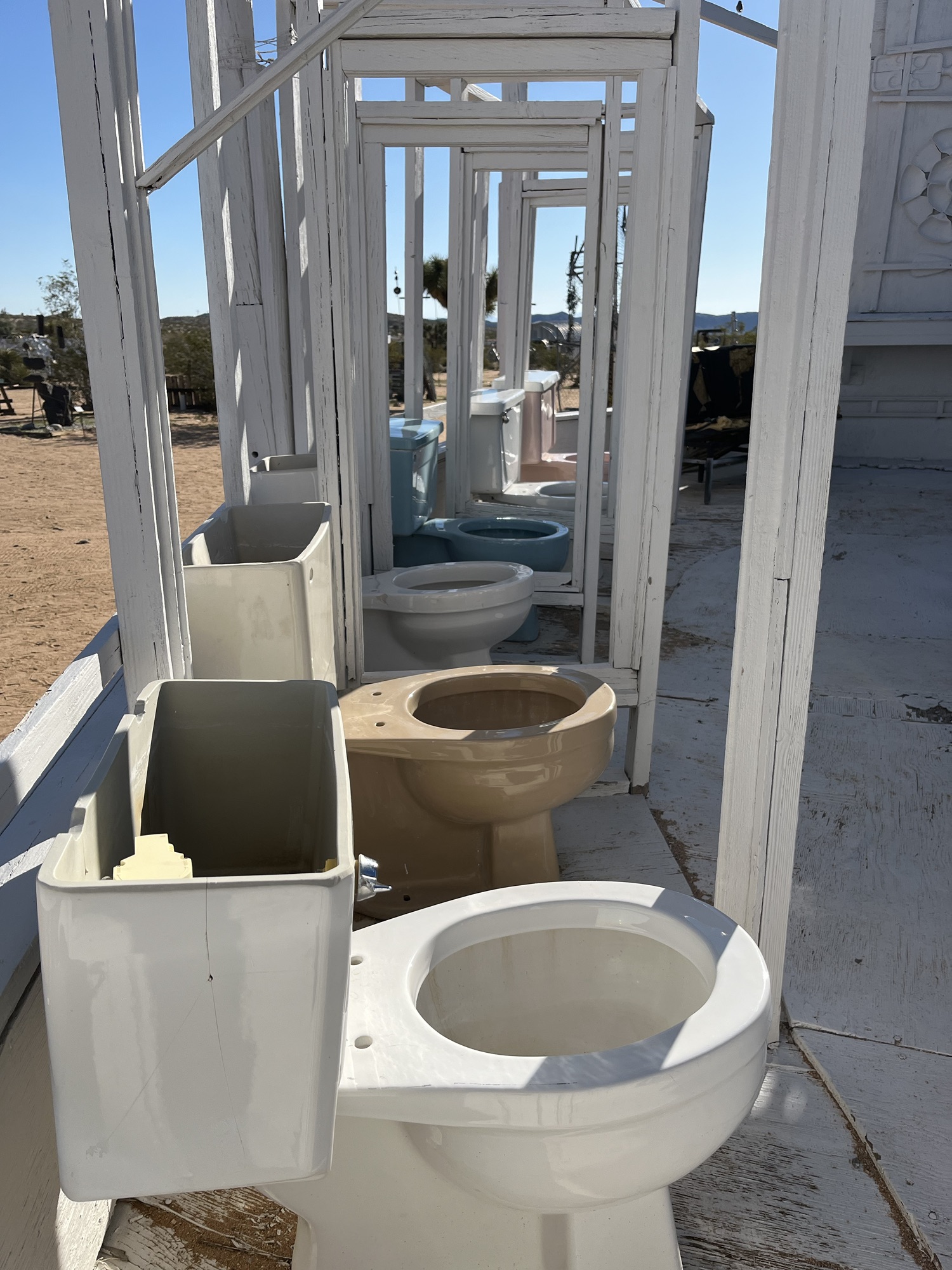
We loved Joshua Tree (park and city), and one highlight was the Noah Purifoy Outdoor Museum, a loose, sprawling collection of sculptures, installations, and buildings cobbled together out of the detritus of the twentieth century. Walking through the Museum is kind of like being on the disused set of a post-apocalyptic film, under the beautiful clear California sun filled sky. Cottontails and roadrunners hopped about as we wandered among Purifoy’s deconstructed constructions, sometimes apprehensive to enter or touch, before the sun and wind and arid sky itself reminded us that the whole tableau was naked, exposed, raw on the earth, open for contact.

“From Below, as a Neighbor” — Lydia Davis

“From Below, as a Neighbor”

by

Lydia Davis


If I were not me and overheard me from below, as a neighbor, talking to him, I would say to myself how glad I was not to be her, not to be sounding the way she is sounding, with a voice like her voice and an opinion like her opinion. But I cannot hear myself from below, as a neighbor, I cannot hear how I ought not to sound, I cannot be glad I am not her, as I would be if I could hear her. Then again, since I am her, I am not sorry to be here, up above, where I cannot hear her as a neighbor, where I cannot say to myself, as I would have to from below, how glad I am not to be her.

 “A Note on the Word Gubernatorial” — Lydia Davis

“A Note on the Word Gubernatorial”

by

Lydia Davis


Gubernatorial: Even though I have never used it in a story, and probably never will, this word has always fascinated and pleased me because of its odd divergence from its noun, governor. Why did the noun and the adjective develop in different directions? The adjective is actually closer to the origin of both, which was the Latin gubernator, “governor,” and gubernare, “to steer.” The original, primary meaning of “to govern” was “to steer.” In fact, there is a maritime word in French, gouvernail, that means “rudder,” or “helm”—what we need to steer a boat. The Latin gubernator evolved into the Old French gouverneur and hence, eventually, into our English governor—our governor is one who steers the metaphorical ship of state. (The Latin also evolved into the Spanish gobernador—keeping the b—and the Italian governatore.)

But of course it is all more complicated, as the development of language always is: the English word gubernator, meaning “ruler,” was also in use starting in the 1520s, though it was rare—and so was gubernatrix, meaning a female ruler. Gubernator disappeared from use and governor remained. I do not know why our adjective did not evolve in the same way as our noun. Why did it not turn into governatorial or governorial? Simply because it was not spoken as often?

I have always enjoyed pronouncing gubernatorial, as though its rather crude sound, incorporating two voiced plosives and the word “goober,” is concealing its more elegant, softer, silkier cousin, “govern.” Gubernatorial swings us closer to our Spanish friends, governor to our Italian. During the U.S. presidency of Jimmy Carter, former governor of Georgia, there was much talk of his association with the cultivation of peanuts (colloquially known as “goobers”); thus, goober-natorial, as applied to the office of the governor of the Peanut State, was doubly appropriate.

James Grieve’s translation of Proust’s Swann’s Way (Book acquired, 19 March 2023)

This May, NYRB will publish a “new” translation of the first volume of Marcel Proust’s longassed novel In Search of Lost Time.

The translation, by James Grieve, is not actually new. It’s actually like half a century old.

The NYRB jacket copy states that “James Grieve began his career as a translator of Proust in the early 1970s, driven by his dismay at how many readers deemed In Search of Lost Time to be too difficult for them to take on. Grieve’s artful and celebrated version of Swann’s Way—only now available outside his native Australia—shows that this is hardly the case.” 

I was unfamiliar with Grieve’s translation. As I admitted on Twitter, I’m not really a Proust Guy. I read Lydia Davis’s translation of Swann’s Way a decade ago, and thought it was Okay and decided it was also Enough. Many, many people replied to my tweet that C.K. Scott Moncrieff’s translation was the way to go. Author and translator Daniel Mendelsohn told me that I’d “read the wrong translation!”  — but I’m okay with that.

Here is the I-guess famous opening line of Moncrieff’s 1922 translation:

For a long time I used to go to bed early.

Here is the Modern Library’s 1992 translation, crediting Moncrieff and Terence Kilmartin, revised by D.J. Enright:

For a long time I would go to bed early.

Here is Lydia Davis’s translation (2002) of the opening line:

For a long time, I went to bed early.

And here is James Grieve’s translation:

Time was when I always went to bed early.

There were a lot of opinions on Grieve’s rendering of this particular line floating around Twitter.

I have no dog in this race, but the voicing here strikes me as, I dunno, very, uh, colloquial? Almost like Huck Finn or something?

Proust’s original, by the way:

Longtemps, je me suis couché de bonne heure.

I muddled my way through a few years of college French, and have no real strong opinions here, but the phrase bonne heure is the most interesting to me. When I read it in French, I read it as something like, “a good hour,” or “the right time.”

Translation is about feeling and tone and vibe and mood as much it is about (the attempt for) precision, so I suppose each translator brings their own sense of the narrator’s voice to their translation, a voice that may or may not sync with what those other translators, the readers, hear in their mind’s ear.

“This Condition” — Lydia Davis

“This Condition”

by

Lydia Davis


In this condition: stirred not only by men but by women, fat and thin, naked and clothed; by teenagers and children in latency; by animals such as horses and dogs; by certain vegetables such as carrots, zucchinis, eggplants, and cucumbers; by fruits such as melons, grapefruits, and kiwis; by certain plant parts such as petals, sepals, stamens, and pistils; by the bare arm of a wooden chair, a round vase holding flowers, a little hot sunlight, a plate of pudding, a person entering a tunnel in the distance, a puddle of water, a hand alighting on a smooth stone, a hand alighting on a bare shoulder, a naked tree limb; by anything curved, bare, and shining, as the limb or bole of a tree; by any touch, as the touch of a stranger handling money; by anything round and freely hanging, as tassels on a curtain, chestnut burrs on a twig in spring, a wet tea bag on its string; by anything glowing, as a hot coal; anything soft or slow, as a cat rising from a chair; anything smooth and dry, as a stone, or warm and glistening; anything sliding, anything sliding back and forth; anything sliding in and out with an oiled surface, as certain machine parts; anything of a certain shape, like the state of Florida; anything pounding, anything stroking; anything bolt upright, anything horizontal and gaping, as a certain sea anemone; anything warm, anything wet, anything wet and red, anything turning red, as the sun at evening; anything wet and pink; anything long and straight with a blunt end, as a pestle; anything coming out of anything else, as a snail from its shell, as a snail’s horns from its head; anything opening; any stream of water running, any stream running, any stream spurting, any stream spouting; any cry, any soft cry, any grunt; anything going into anything else, as a hand searching in a purse; anything clutching, anything grasping; anything rising, anything tightening or filling, as a sail; anything dripping, anything hardening, anything softening.

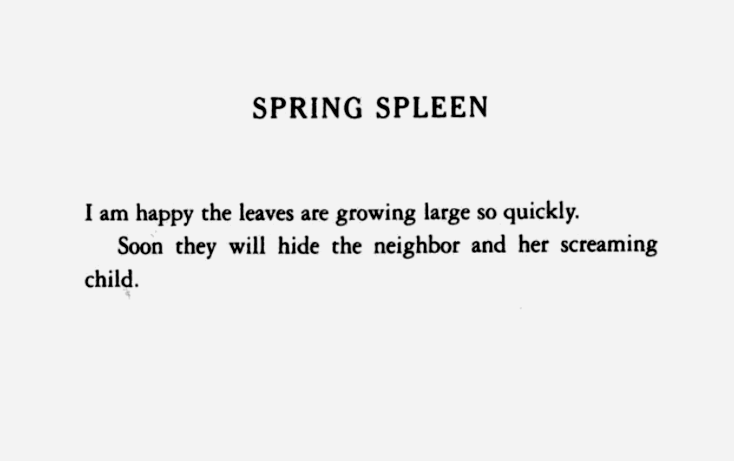
“Spring Spleen” — Lydia Davis

Read a new Lydia Davis story, “How He Changed over Time”

“How He Changed over Time” is a new Lydia Davis story in the fall issue of VQR

Here are the first two paragraphs:

He used to play the violin, but then, as his fingers thickened and lost some of their agility, he became frustrated by trying to play, and then bored by it. He put the violin away in its case for good, had the case removed to a storeroom, and, instead, invited others in to play for him and his family in the evenings. In time, this playing by others, too, wearied him with its incessant sound and he no longer invited musicians into his home or willingly listened to any music, except, perhaps, at long intervals, from a distance, a patriotic march.

He used to provide what was needed in the way of food, equipment, and guides for parties of men to go off exploring. They would bring him not only reports of what they had seen but also handsome artifacts, such as feathered tribal headdresses and small handmade axes and other tools. These he would display in his roomy front hall, and visitors waiting for a private audience would pass the time studying the artifacts and learning about the indigenous tribes of the country. He had had exactly this in mind, to educate the public, when he directed that the artifacts be displayed thus on the walls and in cabinets. But then he tired of the artifacts and lost interest in what they signaled of other cultures, and no longer cared about educating the public. He had everything in the front hall taken off the walls and out of the house and sold to a museum. The bare walls, a relief to his eyes, were then to be painted gold. He no longer sent parties of men out to explore the wilderness, for he no longer had any interest in other landscapes or the wildlife or primitive peoples that inhabited them. Geography now confused him.

Read the rest of the “story” (really, it’s something closer to a poetic (and critical) essay on Thomas Jefferson). 

Blog about Lydia Davis’s short story “Happiest Moment”

happiest

I’m not sure exactly how many nested layers there are to Lydia Davis’s short story “Happiest Moment.” Sometimes I count as many as nine frames to the tale, sometimes only four or five. Sometimes the story seems its own discrete entity.  A matryoshka doll could look like one thing or lots of things, I guess, and this matryoskha doll points back at herself: When you open the final doll, the minutest level of narrative, you find that you’ve found the source of the story. The biggest doll is there nesting in the belly of the smallest doll.

But I’m getting ahead, maybe. Break it down:

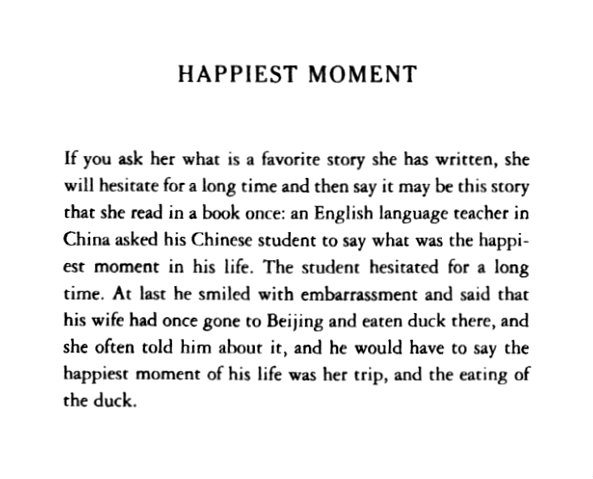
“Happiest Moment”

The title is the first frame, the big doll that declares: This is a story.

If you

The second-person pronoun here is general, sure, but also points directly at you, you reader you. We have here another frame, one outside of the story (because you are the reader) but also bounded inside of it (as the character you).

ask her what is a favorite story she has written,

We’re not into the next frame yet, but we’ve got a new character, a her—a story writer! Like Lydia Davis! The author of this particular story!

she will hesitate for a long time

Still no new frame, but rather the space between layers, the hesitation, the drawing together of thought, judgment, analysis, reflection—Davis doesn’t make the reader feel any of that rhetorically, instead snappily snapping to the point of this whole deal.

and then say

Okay here’s the next frame. I’m not counting though.

it may be this story that she read in a book once:

Good lord, where to start here. Okay, so, we have another frame, but even more significantly, we have this verbal shift: Our her, our she, our hero-author, who has been asked (hypothetically by interlocutor you) about a favorite story she’s written avers that the favorite story she’s written is a story that she read in a book once.

(To save me the trouble of coming back later: Of course our hero-author is writing the story she read in a book once now; “Happiest Moment” is this performance, kinda, sorta, kindasorta).

an English language teacher in China

There’s a frame.

asked his Chinese student

Another frame (and a second ask).

to say what was the happiest moment in his life.

The student, like the hero-author-has to say his answer (not write it).

The student hesitated for a long time.

(Like the hero-author—note the precise repetition of verbs in this tale).

At last he smiled with embarrassment

(God I love this guy).

and said that his wife had once gone to Beijing and eaten duck there,

(We’re getting to our climax folks).

and she often told him about it,

Another frame, another telling.

and he would have to say

Our verb, our answer—

that the happiest moment of his life was her trip and the eating of the duck.

What a sweet, sweet ending.

The Chinese English language student’s wife’s enjoyment of duck in Beijing is his favorite memory, despite it not being a memory at all, but rather the story of a memory, not his own, but his beloved’s. He relays this memory of someone else’s to his English teacher and the memory somehow ends up in a book, which the hero-author of “Happiest Moment” somehow reads, and then attests to be the most favorite story she has written, despite the fact that she makes it clear that this is a story she read and didn’t write—although of course, she wrote it, because it is the story “Happiest Moment.”

“Happiest Moment” — Lydia Davis

happiest

And then here was Beckett and the drama was all about that he dropped his pencil (Lydia Davis)

Lydia Davis’s “In a House Beseiged,” visually adapted by Roman Muradov

housebeseiged1-1

Enjoy the rest of Roman Muradov’s visual adaptation of Lydia Davis’s microfiction at The Paris Review.

The reader is dreaming (Robert Walser/Karl Walser/Lydia Davis)

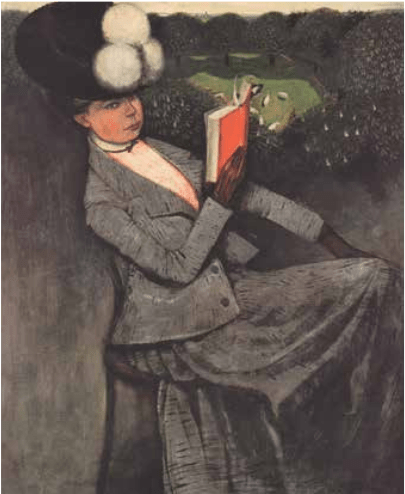
A young lady, a girl of perhaps twenty, is sitting in a chair and reading a book. Or she has just been diligently reading, and now she is reflecting on what she has read. This often happens, that someone who is reading must pause, because all sorts of ideas having to do with the book keenly engage him. The reader is dreaming; perhaps she is comparing the subject matter of the book to her own experiences hitherto; she is thinking about the hero of the book, while she fancies herself almost its heroine.

screenshot-slack-files-com-2015-11-03-15-19-11

Read the rest of Robert Walser’s microessay “Portrait of a Lady” (trans. by Lydia Davis) at The Offing. The painting–Portrait of a Lady—is by Karl Walser, Robert’s older brother.

Lydia Davis on using found materials in her stories

INTERVIEWER

More and more you seem to use found materials in your stories.

DAVIS

Back in the early eighties, I realized that you could write a story that was really just a narration of something that had happened to you, and change it slightly, without having really to fictionalize it. In a way, that’s found ­material. I think it’s hard to draw the line and say that something isn’t found material. Because if a friend of mine tells me a story or a dream, I guess that’s found material. If I get an e-mail that lends itself to a good story, that’s found material. But then if I notice the cornmeal making little condensations, is that found material? It’s my own, I’m not using text, but I am using a situation that exists. I’m not making it up. I find what happens in reality very interesting and I don’t find a great need to make up things, but I do like retelling stories that are told to me.

INTERVIEWER

The last time I was here you mentioned that you jot things down on scraps of paper. What happens to those scraps?

DAVIS

They pile up in my study. And then I use them. Sometimes when I’m just sort of tidying up, I go through them and type them onto the computer and then either do something with them right away or else I just leave them there for later. When I travel, I carry around a notebook with me. I use notebooks a lot because my brain tends to live in the moment. I’m always afraid of forgetting something.

From the Spring 2015 issue of Paris Review. Lydia Davis’s full interview is now online. She discusses her fiction and translation, recalls taking Grace Paley’s writing class when she was 19, and trying to run away from school after reading Walden.

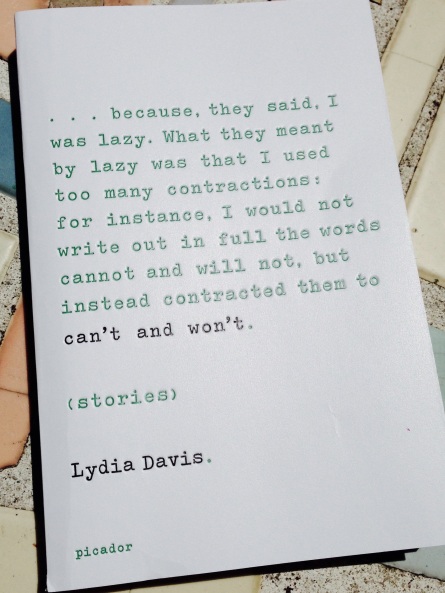
This is not a review of Lydia Davis’s Can’t and Won’t

This is the part of the not-review where I include a picture I took of the book to accompany the not-review:

image

This is the part of the not-review where I briefly restage Lydia Davis’s publishing history to provide some context for readers new to her work.

This is the part of the not-review where I submit that anyone already familiar with Lydia Davis’s short fiction is likely to already hold an opinion on it that won’t (but could) be changed by Can’t and Won’t.

This is the part of the not-review where I dither pointlessly over whether or not the stories in Can’t and Won’t are actually stories or something other than stories.

This is the part of the not-review where I state that I don’t care if the stories in Can’t and Won’t are actually stories or something other than stories.

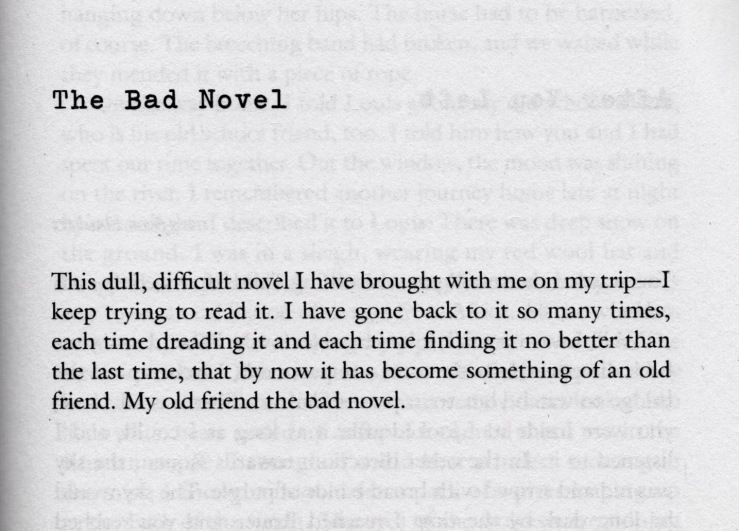
This is the part of the not-review where I explain that I have found a certain precise aesthetic pleasure in most of Can’t and Won’t that radiates from the savory contradictory poles of identification and alienation.

This is the part of the not-review where I cite an example of identification with Davis’s narrator-persona-speaker:

IMG_6074

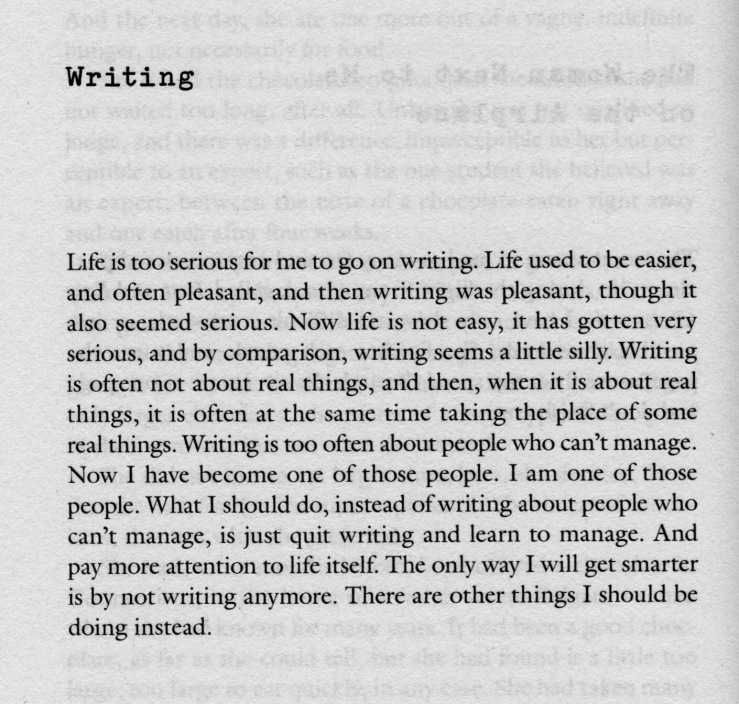
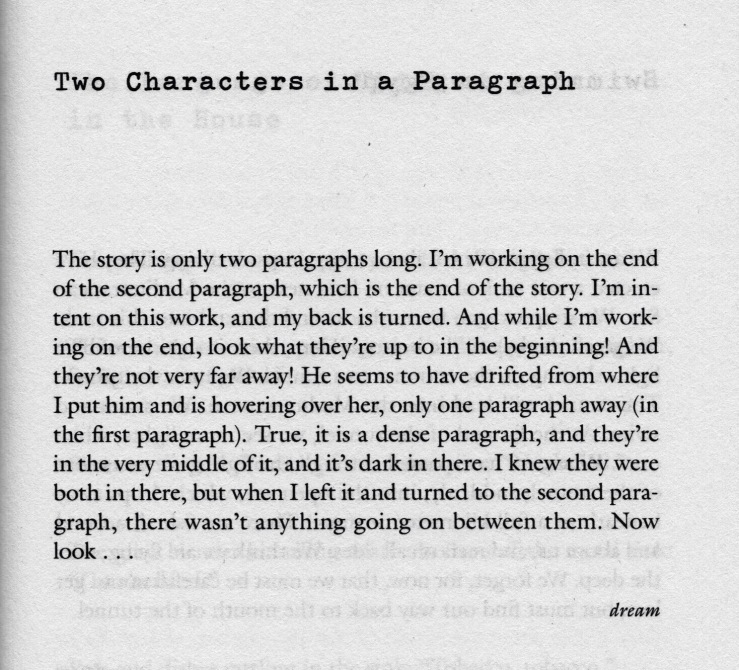
This is the part of the not-review where I claim that I used scans of the text to preserve the look and feel of Lydia Davis’s prose on the page.

This is the part of the not-review where I say that some of my favorite moments in Can’t and Won’t are Davis’s expressions of frustrated boredom with literature (or do I mean publishing?), like in the longer piece “Not Interested.”

This is the part of the not-review where I point out that Davis’s speaker-narrator-persona expresses frustration with the act of writing itself:

IMG_6072

This is the part of the not-review where I dither pointlessly over distinctions between Davis the author and Davis the persona-speaker-narrator.

This is the part of the not-review where I point out that (previous dithering and frustration-with-writing aside) writing itself is a major concern of Can’t and Won’t:

IMG_6070

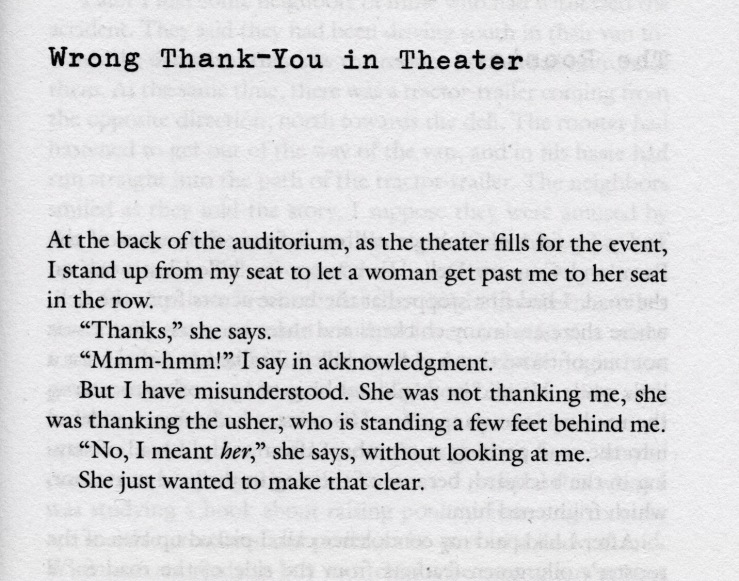
This is the part of the not-review where I say that many of the stories in Can’t and Won’t are labeled dream, and I often found myself not really caring for these dreams (although I like the one above), but maybe I didn’t really care for the dreams because of their being tagged as dreams. (This is the part of the not-review where I point out that our eyes glaze over when anyone tells us their literal dreams).

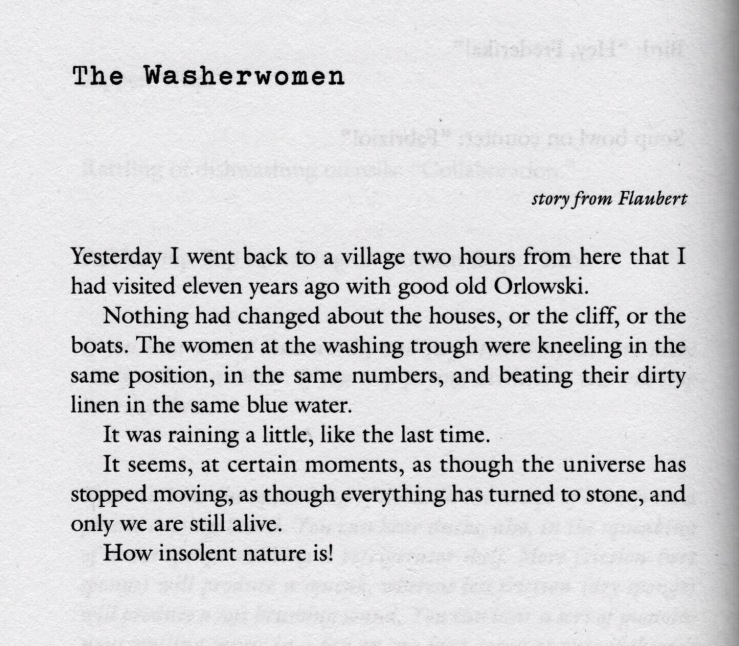
This is the part of the not-review where I transition from stories tagged dream to stories tagged story from Flaubert, like this one:

IMG_6076

This is the part of the not-review where I say how much I liked the stories from Flaubert stories in Can’t and Won’t.

This is the part of the not-review where I mention Davis’s translation work, but don’t admit that I didn’t make it past the first thirty pages of her Madame Bovary. 

This is the part of the not-review where I needlessly reference my review of The Collected Stories of Lydia Davis and point out that that collection is not so collected now.

This is the part of the not-review where I pointlessly dither over post-modernism, post-postmodernism, and Davis’s place in contemporary fiction. (This is the part of the not-review where I needlessly cram in the names of other authors, like Kafka and Walser and Bernhard and Markson and Adler and Miller &c.).

This is the part of the not-review where I claim that nothing I’ve written matters because Davis makes me laugh (this is also the part of the not-review where I use the adverb “ultimately,” a favorite crutch):

IMG_6077

This is the part of the not-review where I point out that Can’t and Won’t is not for everybody, but I very much enjoyed it.

This is the part of the not-review where I mention that the publisher is FS&G/Picador, and that the book is available in the usual formats.

Lydia Davis on Thomas Pynchon

A rather appealing specimen of early Pynchon is the last story in his collection Slow Learner. The story, “The Secret Integration”—first published in the Saturday Evening Post more than forty years ago (three years after V. appeared)—involves a gang of young practical jokers and a rich childhood setting of an old town with a new development, a sprawling estate with a derelict mansion, and a downtown, complete with seedy hotel. In one deftly described scene, the boys coast on their bikes down a long hill in the early evening toward the hotel, “leaving behind two pages of arithmetic homework and a chapter of science” and, on the TV, “a lousy movie, some romantic comedy.” Because all the televisions in town receive only one channel, the boys, as they fly by, are able to follow the movie’s progress from house to house, through doors and windows “still open for the dark’s first coolness.”

In his introduction to Slow Learner, Pynchon, who somewhat preempts our reactions to the story, remarks that he likes it more than he dislikes it. In fact it is so likable that one envies the boys their comfortable society and the fields, streams, and town of their games. Their collaboration and apportioning of assignments is charming (to develop an arsenal for sabotaging the railroad; to enlist malcontent first-graders to destroy the boys’ latrine; to infiltrate PTA meetings); the elaborateness of their schemes, and the number that succeed, is impressive; and the animation of the central character, Grover the boy genius—with his enormous vocabulary, fund of information, and flights of hilarity—is particularly savory. The pranks the boys plan are potentially devastating to the community, yet, as Pynchon says in a lovely bit of writing, the boys would never actually take “any clear or irreversible step,” because “everybody on the school board, and the railroad, and the PTA and paper mill had to be somebody’s mother or father, whether really or as a member of a category; and there was a point at which the reflex to their covering warmth, protection, effectiveness against bad dreams, bruised heads and simple loneliness took over and made worthwhile anger with them impossible.”

There is a lyrical humanity in this story, an almost unapologetic gentleness, inviting and inclusive, that contrasts with the weightier, complex pessimism and bravura of Pynchon’s later works, in which perhaps it is more difficult for the characters to go home and be comforted at the end of the day.

From the Summer 2005 issue of Bookforum.

Read “The Dreadful Mucamas” by Lydia Davis

“The Dreadful Mucamas”

by

Lydia Davis

They are very rigid, stubborn women from Bolivia. They resist and sabotage whenever possible.

They came with the apartment. They were bargains because of Adela’s low IQ. She is a scatterbrain.

In the beginning, I said to them: I’m very happy that you can stay, and I am sure that we will get along very well.

This is an example of the problems we are having. It is a typical incident that has just taken place. I needed to cut a piece of thread and could not find my six-inch scissors. I accosted Adela and told her I could not find my scissors. She protested that she had not seen them. I went with her to the kitchen and asked Luisa if she would cut my thread. She asked me why I did not simply bite it off. I said I could not thread my needle if I bit it off. I asked her please to get some scissors and cut it off – now. She told Adela to look for the scissors of la Señora Brodie, and I followed her to the study to see where they were kept. She removed them from a box. At the same time I saw a long, untidy piece of twine attached to the box and asked her why she did not trim off the frayed end while she had the scissors. She shouted that it was impossible. The twine might be needed to tie up the box some time. I admit that I laughed. Then I took the scissors from her and cut it off myself. Adela shrieked. Her mother appeared behind her. I laughed again and now they both shrieked. Then they were quiet. Continue reading “Read “The Dreadful Mucamas” by Lydia Davis”

Lydia Davis’s Can’t and Won’t (Book acquired, 3.6.2015)

IMG_5568 Almost finished with this bad boy, or as “finished” as one can be with Davis’s stuff, which I tend to linger on, return to. Full review forthcoming.
IMG_5570