Infinite Map Depicts the Geography of David Foster Wallace’s Infinite Jest


A description of Infinite Map from artist/creator William Beutler’s site, Infinite Boston:

A geographic infographic poster depicting the “territorially reconfigured North America” of the novel and identifying 250 of the most interesting locations with a color-coded dot and corresponding footnote. As you can see from the acromegalic thumbnail above, the 24”x36” print includes four telescoping map insets: O.N.A.N.’s North America, Northeast U.S. & Canada, Greater Boston and Metro Boston. The red shading represents my own painstaking, overdetermined conclusions about the most probable outline of the Great Concavity. In the upper right corner is the Great Seal of O.N.A.N., based on the description from page 153, and the map labels throughout include sometimes-obscure references to the novel’s the text. This image is the principal result of a long-term collaboration between myself and the Los Angeles-based creative design agency JESS3, whose technical ability and patience with yrstruly knows no bounds.

Biblioklept will run an interview with Beutler about his graphic work with David Foster Wallace’s Infinite Jest next week.

Has Man a Future? — Bertrand Russell Penguin Edition (Book Acquired, 9.14.2012)

20120914-170814.jpg

Unable to resist this1961 first edition Penguin of Russell’s essay for peace, Has Man a Future?

In a strange coincidence, I showed this 1959 clip of Russell to a few of my classes this week—I know others have shared it before, but it seems more relevant than ever:

Who saw him die? / I, said the Fly

From Death and Burial of Poor Cock Robin by H.L. Stephens, 1865.

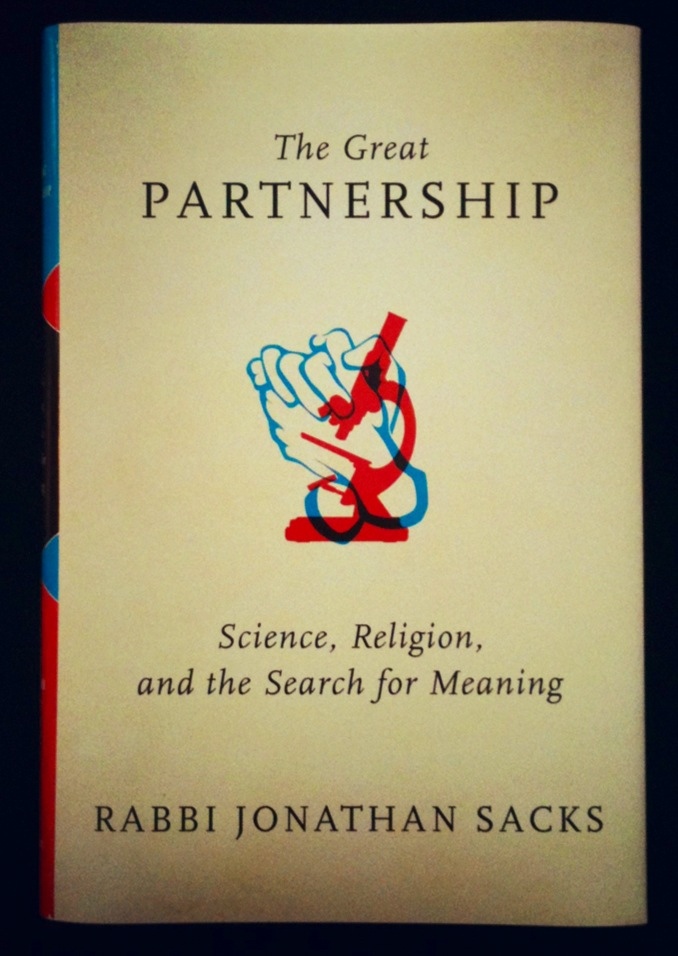
The Great Partnership (Book Acquired, Some Time Last Week)


20120902-141543.jpg

Jonathan Sacks’s The Great Partnership: Science, Religion, and the Search for Meaning is getting a hardback release in the US from Random House (it’s been out in the UK for a while now). RH’s blurb:

An impassioned, erudite, thoroughly researched, and beautifully reasoned book from one of the most admired religious thinkers of our time that argues not only that science and religion are compatible, but that they complement each other—and that the world needs both.

“Atheism deserves better than the new atheists,” states Rabbi Jonathan Sacks, “whose methodology consists of criticizing religion without understanding it, quoting texts without contexts, taking exceptions as the rule, confusing folk belief with reflective theology, abusing, mocking, ridiculing, caricaturing, and demonizing religious faith and holding it responsible for the great crimes against humanity. Religion has done harm; I acknowledge that. But the cure for bad religion is good religion, not no religion, just as the cure for bad science is good science, not the abandonment of science.”

Rabbi Sacks’s counterargument is that religion and science are the two essential perspectives that allow us to see the universe in its three-dimensional depth. Science teaches us where we come from. Religion explains to us why we are here. Science is the search for explanation. Religion is the search for meaning. We need scientific explanation to understand nature. We need meaning to understand human behavior. There have been times when religion tried to dominate science. And there have been times, including our own, when it is believed that we can learn all we need to know about meaning and relationships through biochemistry, neuroscience, and evolutionary psychology. In this fascinating look at the interdependence of religion and science, Rabbi Sacks explains why both views are tragically wrong.

Look, I’ll be frank—I’m hardly a fan of the so-called “new atheists,” but that’s not what this book is really about. It’s really about trying to restore an anchoring metaphysical center—a god, namely, Sacks’s god—despite the progress made by science and philosophy. What I find repellent about Sacks’s book is the idea that only religion can provide a logical, meaningful answer to “why we are here.” I have no problem with the coexistence of religion and science, but that’s not what Sacks wants. He wants religion to dominate. Anyway, clearly I’m not enthusiastic, but if you’re interested, here’s a proper review.


“The Five Boons of Life” — Mark Twain


“The Five Boons of Life,” a short fable from Mark Twain:

CHAPTER I

In the morning of life came a good fairy with her basket, and said:”Here are gifts. Take one, leave the others. And be wary, chose wisely; oh, choose wisely! for only one of them is valuable.”The gifts were five: Fame, Love, Riches, Pleasure, Death. The youth said, eagerly:”There is no need to consider”; and he chose Pleasure.He went out into the world and sought out the pleasures that youth delights in. But each in its turn was short-lived and disappointing, vain and empty; and each, departing, mocked him. In the end he said: “These years I have wasted. If I could but choose again, I would choose wisely.

CHAPTER II

The fairy appeared, and said:”Four of the gifts remain. Choose once more; and oh, remember-time is flying, and only one of them is precious.”The man considered long, then chose Love; and did not mark the tears that rose in the fairy’s eyes.After many, many years the man sat by a coffin, in an empty home. And he communed with himself, saying: “One by one they have gone away and left me; and now she lies here, the dearest and the last. Desolation after desolation has swept over me; for each hour of happiness the treacherous trader, Love, as sold me I have paid a thousand hours of grief. Out of my heart of hearts I curse him.”

CHAPTER III

“Choose again.” It was the fairy speaking.”The years have taught you wisdom — surely it must be so. Three gifts remain. Only one of them has any worth — remember it, and choose warily.”

The man reflected long, then chose Fame; and the fairy, sighing, went her way.Years went by and she came again, and stood behind the man where he sat solitary in the fading day, thinking. And she knew his thought:”My name filled the world, and its praises were on every tongue, and it seemed well with me for a little while. How little a while it was! Then came envy; then detraction; then calumny; then hate; then persecution. Then derision, which is the beginning of the end. And last of all came pity, which is the funeral of fame. Oh, the bitterness and misery of renown! target for mud in its prime, for contempt and compassion in its decay.”


CHAPTER IV

“Choose yet again.” It was the fairy’s voice.”Two gifts remain. And do not despair. In the beginning there was but one that was precious, and it is still here.””Wealth — which is power! How blind I was!” said the man. “Now, at last, life will be worth the living. I will spend, squander, dazzle. These mockers and despisers will crawl in the dirt before me, and I will feed my hungry heart with their envy. I will have all luxuries, all joys, all enchantments of the spirit, all contentments of the body that man holds dear. I will buy, buy, buy! deference, respect, esteem, worship — every pinchbeck grace of life the market of a trivial world can furnish forth. I have lost much time, and chosen badly heretofore, but let that pass; I was ignorant then, and could but take for best what seemed so.”Three short years went by, and a day came when the man sat shivering in a mean garret; and he was gaunt and wan and hollow-eyed, and clothed in rags; and he was gnawing a dry crust and mumbling:”Curse all the world’s gifts, for mockeries and gilded lies! And miscalled, every one. They are not gifts, but merely lendings. Pleasure, Love, Fame, Riches: they are but temporary disguises for lasting realities — Pain, Grief, Shame, Poverty. The fairy said true; in all her store there was but one gift which was precious, only one that was not valueless. How poor and cheap and mean I know those others now to be, compared with that inestimable one, that dear and sweet and kindly one, that steeps in dreamless and enduring sleep the pains that persecute the body, and the shames and griefs that eat the mind and heart. Bring it! I am weary, I would rest.”

CHAPTER V

The fairy came, bringing again four of the gifts, but Death was wanting. She said:     “I gave it to a mother’s pet, a little child. It was ignorant, but trusted me, asking me to choose for it. You did not ask me to choose.””Oh, miserable me! What is left for me?””What not even you have deserved: the wanton insult of Old Age.”


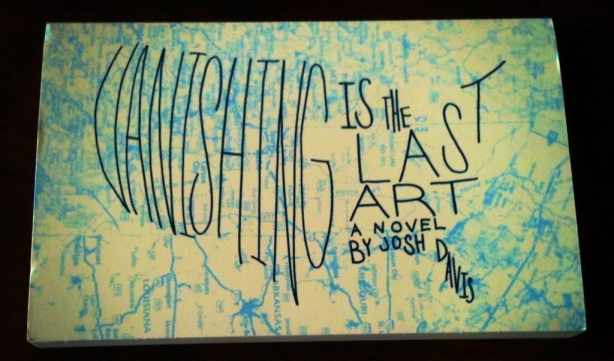
Vanishing Is the Last Art (Book Acquired, Some Time in the Past Two Weeks)

20120818-174148.jpg

Josh Davis’s novel Vanishing Is the Last Art. Blurb:

Charlie Fell sells baseball cards with seemingly hallucinogenic properties out of his bedroom, takes road trips to places he loves (New York City) and loathes (Southern California), and trips over a series of romantic entanglements. When the young writer releases his first novel, his life begins to unravel as the fallout from his published inner-monologues drive him back inside his already frail mind

Unknown Pleasures (I Riff a Bit on Marcel Proust’s Swann’s Way)

20120809-105603.jpg

1. I was an undergrad in college when I first tried to read Marcel Proust. It was one of those things I did on my own, which is another way of saying that none of his writing was ever assigned to me; neither do I recall any of his writings even appearing in any of the anthologies I was assigned in high school; neither do I recall any of his writings appearing in any of the anthologies I’ve used as a teacher.

2. My initial interest in Proust, late in high school, when the name alone seemed so damn romantic, was aroused, like most people I’ll bet, by the fact that this guy basically wrote one long book, a book that seemed to have at least three names, not counting the names of the individual books and book-length chapters in those individual books.

3. But, like I said, I didn’t try to read Proust until college when I checked out the first volume from the university library. I think it might have actually been a compendium of two or more books that make up the Recherche. Anyway, I can’t recall much, except that I slugged it out through that interminable first chapter, “Combray,” getting absolutely nothing out of it.

4. Since then I’ve read a lot about Proust and his writing, enough to perhaps understand that my first foray into Swann’s Way was probably not from the best angle. I was into decidedly different stuff then—lots of the American postmodernists, English and Irish modernists, etc.—and Proust’s modernism was totally lost on me.

5. Re: Point 4: Perhaps a better way to put it would be to borrow Harold Bloom’s notion that strong/strange writers so assimilate their readers that the readers can no longer see the strangeness/strength. I was assimilated.

6. Wandering through the used book store I frequent, I spotted Lydia Davis’s translation of Swann’s Way and snapped it up, not because of any real interest in trying Proust again but because of a fannish devotion to Davis, or the idea that Davis would make Proust accessible.

7. (A brief fantasy I had as my hand hovered over the book, before my hand touched the book:

I imagined that Davis had turned Swann’s Way into a series of her own vignettes, that she had parsed and ventriloquized Proust, that her translation would be akin to “Ten Stories from Flaubert.”

This is not the case).

8. (While I’m being parenthetical: This riff started as a “books acquired” post, a post where I take a lousy photograph to document a new book that somehow arrives at Biblioklept World Headquaters. But I read so much of Swann’s Way that the original idea riffed out into this thing. Actually, go ahead and skip Point 8, if you haven’t already. Sorry).

9. The day after buying Davis’s translation I read “Combray” over two short airline trips.

10. Or should it be Combray?—it seems like a self-contained novel.

11. The opening paragraphs of “Combray” are an amazing and strange meditation on sleeping, or rather going to sleep, filled with wonderful little digressions. They are a simultaneously alienating and inviting way to open a book.

Proust writes—

Sometimes, as Eve was born from one of Adam’s ribs, a woman was born during my sleep from a cramped position of my thigh. Formed from the pleasure I was on the point of enjoying, she, I imagined, was the one offering it to me. My body, which felt in hers my own warmth, would try to find itself inside her, I would wake up.

Such a lovely set of images.

I marked it and moved on without trying to figure out exactly what it might mean.

12. Other moments are more lucid, penetrating, insightful:

Even the very simple act that we call “seeing a person we know” is in part an intellectual one. We fill the physical appearance of the individual we see with all the notions we have about him, and of the total picture that we form for ourselves, these notions certainly occupy the greater part.

“Combray” is full of these wonderful, subtle moments, and it includes some of the finest passages on reading and the transformative powers and pleasures of reading that I’ve encountered.

13. The phrase “unknown pleasures” pops out early in the book—is this where Joy Division got the album name?

14. Proust seems to hit on the idea of unknown pleasures again and again, speculative pleasures, idealized pleasures.

15. Introduced to the writer Bergotte by Swann and Bloch, the young narrator muses:

One of these passages by Bergotte, the third or fourth that I had isolated from the rest, filled me with a joy that could not be compared to the joy I had discovered in the first one, a joy I felt I was experiencing  in a deeper, vaster, more unified region of myself, from which all obstacles and partitions had been removed.

The passage concludes with the narrator deciding that he has accessed the “‘ideal passage’ by Bergotte,” an idealization through which he finds his mind “enlarged.”

16. Cataloging the meditations on unknown pleasures in the book would take forever though, and I’m just riffing here.

17. (Although I do love and will thus bring up a late passage where the narrator longs to walk in the woods with “a peasant girl,” one like a “local plant” (!), through which he will access new and individual and unknown pleasures, “Obscurely awaited, immanent and hidden. . . “).

18. Stray note: Swann is described as having a “Bressant-style” haircut, which the end notes describe as “a crew cut in front and longer in the back.” Is this not known colloquially as a mullet? Am I to understand that Swann sports a Kentucky waterfall?

19. Proust’s greatest strength in “Combray” seems to be his ability to move from the physical to the metaphysical, from object to memory. And then back again.

20. An empty statement: The writing is beautiful.

21.  Still, there’s something irksome about the narrator (Marcel?): I stopped writing “mama’s boy” in the margin after the third such notation.

22. Re: Point 21: Is this why I never stuck it out with Proust? Is this why, despite acknowledging “The writing is beautiful,” I am not particularly inclined to see what happens next? (And next and next and next . . .)

23. Re: Point 22: I think here of Cormac McCarthy’s assertion in a 1992 New York Times interview that Proust is “not literature” because it doesn’t “deal with issues of life and death.” McCarthy’s quote may or may not be out of context (not here; here it’s in perfectly sound context. I’m talking about proper context in the interview, which is to say that he may or may not have been riffing off the cuff).

24. Okay, from the McCarthy interview:

 His list of those whom he calls the “good writers” — Melville, Dostoyevsky, Faulkner — precludes anyone who doesn’t “deal with issues of life and death.” Proust and Henry James don’t make the cut. “I don’t understand them,” he says. “To me, that’s not literature. A lot of writers who are considered good I consider strange.”

25. Maybe I bring it up because I’ve read so much of McCarthy and the heroes on his list above and find them so compelling, find the protagonists and antagonists so compelling, and while Proust’s narrator is hardly repellent, I find myself occasionally wanting to give him a wedgie.

26. (Never having had the desire to give Ishmael a wedgie, or the underground man a wedgie, or Lucas Beauchamp a wedgie, or Cornelius Suttree a wedgie).

27. Okay. The sentiment I’ve just expressed seems cruel.

28. The same sensitivity I find occasionally overbearing in the narrator is exactly what makes so many of the passages and insights in the text so extraordinary.

29. The narrator is some kind of specialized receptive organic instrument, a psyche keenly attuned to the physical world who mediates that world through emotion, memory, psychological projection—language.

30. The narrator is some kind of membrane but also a self, his articulations winding from reader to self through memory to the natural world, to its phenomena, and back through desire, thought, anticipation, idealization, all back through memory again, back to the reader again. And if tracing these articulations is exhausting, the process also undeniably yields unknown pleasures.

Brown and the Farrier — A Vignette from Cormac McCarthy’s Blood Meridian


A self-contained episode from late in Cormac McCarthy’s Blood Meridian; this little vignette captures the book’s strange mix of menace and humor:

Noon he was red-eyed and reeking before the alcalde’s door demanding the release of his companions. The alcalde vacated out the back of the premises and shortly there arrived an American corporal and two soldiers who warned him away. An hour later he was at the farriery. Standing warily in the doorway peering into the gloom until he could make out the shape of things within.

The farrier was at his bench and Brown entered and laid before him a polished mahogany case with a brass nameplatebradded to the lid. He unsnapped the catches and opened the case and raised from their recess within a pair of shotgun barrels and he took up the stock with the other hand. He hooked the barrels into the patent breech and stood the shotgun on the bench and pushed the fitted pin home to secure the forearm. He cocked the hammers with his thumbs and let them fall again. The shotgun was English made and had damascus barrels and engraved locks and the stock was burl mahogany. He looked up. The farrier was watching him.

You work on guns? said Brown.

I do some.

I need these barrels cut down.

The man took the gun and held it in his hands. There was a raised center rib between the barrels and inlaid in gold the maker’s name, London. There were two platinum bands in the patent breech and the locks and the hammers were chased with scrollwork cut deeply in the steel and there were partridges engraved at either end of the maker’s name there. The purple barrels were welded up from triple skelps and the hammered iron and steel bore a watered figure like the markings of some alien and antique serpent, rare and beautiful and lethal, and the wood was figured with a deep red feather grain at the butt and held a small springloaded silver capbox in the toe.

The farrier turned the gun in his hands and looked at Brown. He looked down at the case. It was lined with green baize and there were little fitted compartments that held a wadcutter, a pewter powderflask, cleaning jags, a patent pewter capper.

You need what? he said.

Cut the barrels down. Long about in here. He held a finger across the piece.

I cant do that.

Brown looked at him. You cant do it?

No sir. He looked around the shop. Well, he said. I’d of thought any damn fool could saw the barrels off a shotgun.

There’s something wrong with you. Why would anybody want to cut the barrels off a gun like this?

What did you say? said Brown.

The man tendered the gun nervously. I just meant that I dont see why anybody would want to ruin a good gun like this here. What would you take for it?

It aint for sale. You think there’s something wrong with me?

No I dont. I didnt mean it that way.

Are you goin to cut them barrels down or aint ye?

I cant do that.

Cant or wont?

You pick the one that best suits you.

Brown took the shotgun and laid it on the bench. What would you have to have to do it? he said.

I aint doin it.

If a man wanted it done what would be a fair price?

I dont know. A dollar.

Brown reached into his pocket and came up with a handful of coins. He laid a two and a half dollar gold piece on the bench. Now, he said. I’m payin you two and a half dollars.

The farrier looked at the coin nervously. I dont need your money, he said. You cant pay me to butcher that there gun.

You done been paid.

No I aint.

Yonder it lays. Now you can either get to sawin or you can default. In the case of which I aim to take it out of your ass.

The farrier didnt take his eyes off Brown. He began to back away from the bench and then he turned and ran.

When the sergeant of the guard arrived Brown had the shotgun chucked up in the benchvise and was working at the barrels with a hacksaw. The sergeant walked around to where he could see his face. What do you want, said Brown.

This man says you threatened his life.

What man?

This man. The sergeant nodded toward the door of the shed.

Brown continued to saw. You call that a man? he said.

I never give him no leave to come in here and use my tools neither, said the farrier.

How about it? said the sergeant.

How about what?

How do you answer to this man’s charges?

He’s a liar.

You never threatened him?

That’s right.

The hell he never.

I dont threaten people. I told him I’d whip his ass and that’s as good as notarized.

You dont call that a threat?

Brown looked up. It was not no threat. It was a promise. He bent to the work again and another few passes with the saw and the barrels dropped to the dirt. He laid down the saw and backed off the jaws of the vise and lifted out the shotgun and unpinned the barrels from the stock and fitted the pieces into the case and shut the lid and latched it.

What was the argument about? said the sergeant.

Wasnt no argument that I know of.

You better ask him where he got that gun he’s just ruined. He’s stole that somewheres, you can wager on it.

Where’d you get the shotgun? said the sergeant.

Brown bent down and picked up the severed barrels. They were about eighteen inches long and he had them by the small end. He came around the bench and walked past the sergeant. He put the guncase under his arm. At the door he turned. The farrier was nowhere in sight. He looked at the sergeant.

I believe that man has done withdrawed his charges, he said. Like as not he was drunk.


“Bachelor’s Ill Luck” — Franz Kafka


Bachelor’s Ill Luck

It seems so dreadful to stay a bachelor, to become an old man struggling to keep one’s dignity while begging for an invitation whenever one wants to spend an evening in company, to lie ill gazing for weeks into an empty room from the corner where one’s bed is, always having to say good night at the front door, never to run up a stairway beside one’s wife, to have only side doors in one’s room leading into other people’s living rooms, having to carry one’s supper home in one’s hand, having to admire other people’s children and not even being allowed to go on saying: ‘I have none myself,’ modeling oneself in appearance and behavior on one or two bachelors remembered from one’s youth.

That’s how it will be, except that in reality, both today and later, one will stand there with a palpable body and a real head, a real forehead, that is, for smiting on with one’s hand.

“Bachelor’s Ill Luck” by Franz Kafka.


I Review Neal Stephenson’s Zany, Prescient Novel Snow Crash (And Comment on the Impending Film Adaptation)

Neal Stephenson’s 1992 novel Snow Crash opens with an extended scene in which the book’s protagonist races to deliver a pizza on time for the mafia. The scene is thrilling and ridiculous, establishing the book’s frenetic, ironic tone and painting a rough outline of Snow Crash’s milieu. Like  many sprawling works of speculative fiction, Snow Crash is more interested in rendering its milieu in vibrant, hyperkinetic color than it is concerned with delivering plot and character development. Snow Crash’s plot is the sort of joyfully convoluted careening mess that makes a reviewer (okay, this reviewer) shudder at the thought of having to successfully paraphrase, so I’m not even going to make an earnest effort. Let’s get to that milieu and the cartoon characters who inhabit it.

Snow Crash is set in the early 21st century, primarily in Los Angeles, which is no longer part of the United States. Actually, there isn’t much of a United States to speak of, really—and not even a municipal Los Angeles, per se. Instead, the terrain is totally privatized. Privatized roads, privatized spaces. People (who can afford to) live in franchised burbclaves protected by hired mercenaries or private militias or robots that keep out the undesirables. (The white folks who live in New South Africa want “racial purity,” while some franchise nations, like Mr. Lee’s Greater Hong Kong are open to anyone who can trade information). Authority is for sale. Conditions are so laissez-faire that the Mafia is truly a Legitimate Business now (complete with their own CosaNostra Pizza University). In fact, all business is legitimate; several times in Snow Crash, a character will refer to “the old days when they had laws.” Without regulation, hyperinflation is the norm; the homeless use trillion-dollar bills to light their campfires.

There’s a hard-edged griminess to the world Stephenson conjures in Snow Crash, but the book is never grim or dour, and instead embraces the anarchic-capitalism it proposes. Perhaps this is because Stephenson’s heroes are such radically exceptional people. The book’s hero is named Hiro Protagonist, the kind of Pynchonian goof that characterizes Snow Crash’s zany tone. Hiro meets the book’s other protagonist, a fifteen year old blonde who goes by Y.T. (“Yours Truly,” although most of the folks tend to hear “whitey”). Y.T. is a Kourier, a skateboarding delivery person who harpoons vehicles to catch a free ride. She helps Hiro deliver that pizza in the opening scene and the two team up after Hiro gives her his business card. It reads: “Last of the Freelance Hackers  / Greatest swordfighter in the world  / Stringer, Central Intelligence Corporation. Specializing in Software related Intel. (Music, Movies & Microcode.)” Did I neglect to mention that Hiro carries two samurai swords with him wherever he goes?

Hiro’s pretty handy with those swords, but his real skill is hacking, and he spends a good deal of time in the Metaverse, a virtual reality-based internet space where avatars go to bars and chat and sell &c. It’s sort of like a mix between Facebook and World of War Craft. In 1992 (earlier, I suppose), Stephenson’s way ahead of the curve. Here, he describes avatars:

Your avatar can look any way you want it to, up to the limitations of your equipment.  If you’re ugly, you can make your avatar beautiful.  If you’ve just gotten out of bed, your avatar can still be wearing beautiful clothes and professionally applied makeup.  You can look like a gorilla or a dragon or a giant talking penis in the Metaverse.  Spend five minutes walking down the Street and you will see all of these.

There are plenty of passages like this, where Stephenson pegs some aspect of internet culture ten years before it actually happens. (I couldn’t help but think about Wikipedia during Hiro’s conversations with a program called Librarian). It’s probably fair to say that the Wachowskis lifted as much from Snow Crash as they did from William Gibson’s cyberpunk trilogies.

While I’m there, I might as well lazily point out that Snow Crash would fit neatly at home on a shelf with Neuromancer or Mona Lisa Overdrive. There’s also a heavy dose of Philip K. Dick weirdness in Snow Crash, particularly when the book settles into its major metaphysical plot about ancient Sumerian gods and goddesses and linguistic viruses and the Tower of Babel. Stephenson’s Snow Crash is zanier than William Gibson’s dark depictions or Dick’s mindmelted milieux, and it would hardly do to call what he does here light—but there is something joyful, playful about his satire. I invoked Pynchon earlier and I’ll do it again; parts of Snow Crash also reminded me of David Foster Wallace’s opus Infinite Jest. Both IJ and SC obsess over the minutest details of speculative technologies and how people might react to such technologies. This is often what sets Snow Crash heads and shoulders above run of the mill cyberpunk. In just one instance, Stephenson parodies the language of bureaucratic speech at length; Y.T.’s mom, who works for what’s left of the Federal Government, is subjected to a memo about toilet paper usage that goes on for pages. The passage is hilarious, and adds absolutely nothing to the plot development—it simply helps to flesh out the contours of the world that Stephenson has imagined.

All of this detailed imagining unfortunately comes at the expense of a plot that only coheres through massive exposition dumps. About a third of the way into the novel, the major conflict is finally established, but only through a dialog between Hiro and the Librarian that reads almost like a catechism. As the book reaches its climax, Hiro actually explains what’s going on to a few of the other major characters—and the reader, of course. It’s a cringe-worthy moment, the sort of rhetorical weakness that smacks of genre fiction; even worse, the plot’s action ultimately hangs on some fairly basic hoary old tropes that wouldn’t be unfamiliar to anyone who’s ever played a video game. The book lags under a juvenile obsession with weapons and badassery in general. And the book’s resolution . . . well, let’s just say that Stephenson sticks the ending, but it all feels too pat and too slight after the dazzling weight of the world that he’s established. Still, at its finest, Stephenson’s prose is zippy, shining, hilarious stuff, and his employment of multiple character perspectives moves the book with an addictive energy. Snow Crash is beach reading for folks who like some humor with their dystopia.

A film adaptation of Snow Crash is supposedly going into production soon, with British director Joe Cornish taking charge. I liked Cornish’s last film Attack the Block, and Snow Crash clearly has a highly-imagistic, cinematic feel to it—but I think a film is not the way to go. Simply put, Snow Crash is too big, too larded with characters and details (so many that I failed to touch on in this review) to translate well onscreen. I think an eight part miniseries on HBO (or a similar network) would be perfect, even if it came at the expense of special effects—-a miniseries would give the filmmakers time to build Stephenson’s nuanced world. I’m afraid otherwise we’ll get a travesty like the adaptation of The Golden Compass, or something like The Hunger Games film, where all but the most basic plot points are elided. But I suppose a miniseries is not as lucrative as a blockbuster film. I hope the filmmakers at least split the book in two. In any case, I’ll be interested to check out the results.

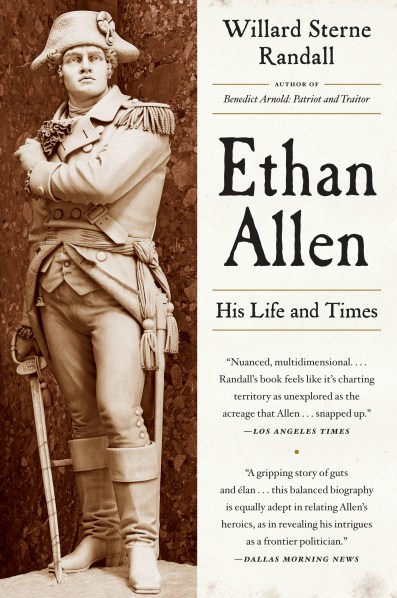
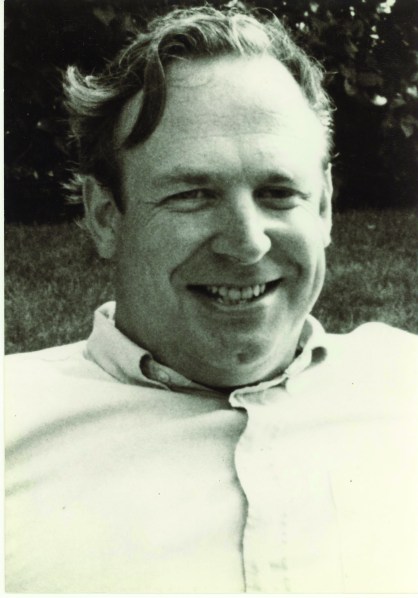
Historian Willard Sterne Randall Talks to Biblioklept About His New Biography of Ethan Allen

Ethan Allen is perhaps most noted for leading the Green Mountain Boys on a daring raid to take Fort Ticonderoga from the British. Willard Sterne Randall’s biography Ethan Allen: His Life and Times reveals and explores much more to the Vermont statesman than many fans of American history are likely aware of. Randall also makes good on the promise of the second part of his book’s subtitle, painting the Revolutionary and post-Revolutionary years in keen detail. Randall was kind enough to talk to me about his book (which is new in a trade paperback edition from Norton) via email.

Randall has written many books on the American colonial and Revolutionary periods, including biographies of Thomas Jefferson, George Washington, Alexander Hamilton, and Benedict Arnold.  He lives in Vermont, where he teaches American history at Champlain College. Check out his website.

Biblioklept: You’ve written books about George Washington and Thomas Jefferson, figures who obviously bear considerable influence on American history. Ethan Allen is a less-remarked upon figure. What made you want to tell his story?

Will Randall: When I moved to Vermont thirty years ago after a journalism career, I ran into Ethan Allen’s name everywhereon a ferry, a federal firing range, an old cavalry fort, streets and highways, a bowling alleybut if you asked people what they knew about him, invariably it was with a chuckle and a sign of tippling or a wink and they’d say, “Ole Ethan, that drunk” or “that scoundrel.” Other than that, he knew he had captured a fort with the Green Mountain Boys (their names and his were always run together), but beyond one day at the beginning of the Revolution, they knew nothing.

As I worked on other biographies of more patrician and recognizable revolutionaries, I kept running into Allen’s name. The editors of a new compendium on the American Enlightenment asked me to do a profile of Allen as philosopher: turned out Allen was the first published American Deist philosopher. My son wrote a thesis in college on the precedents of the Union’s treatment of POW’s in the Civil War: turned out it was the treatment of Ethan Allen as a prisoner of the British in the Revolution. Treatment of the British: turned out Allen wrote a memoir of his captivity under horrible conditions for nearly three years as he was shunted by ship from Canada to England to Bermuda to Halifax to New York, etc., while George Washington laid down the law that, as Allen was treated, so would be British prisoners. That narrative turned out to be the second-best-selling book of the Revolution, only behind Tom Paine. And so it went, with virtually every Founding Father in one way or another interacting with Allen while he beat off, with four
volumes and scores of pamphlets of highly-charged words and weapons from clubs and daggers to the heavy artillery that drove the British out of Boston and saved Washington’s army, anyone who tampered with Vermont, which was virtually his creation. That, I decided, warranted a book.

Biblioklept: Allen often comes across as a sort of mythical frontiersman—you note in your prologue that he “projects himself as a populist frontier philosopher on horseback.” How accurate is this reputation?

WR: I think he fills his own bill. He was so popular that some 10,000 people braved February weather in Vermont to come to his funeral (out of a population of 80,000. He spoke for the poor who couldn’t make it in other more hierarchical New England colonies and, after revolting in Massachusetts, fled to Vermont, where he protected them. All his adult life, he took on, in person and in writing, the Puritan theocracy, selling virtually everything he had to attack their Old Testament religion in publishing 1,500 copies of a book, of which only about 200 copies survived the flames of a suspicious fire. While most other Founders prospered from the RevolutionMonticello, Mount Vernon, etc.Allen chose to live out his days in a one-and-a-half story log house with the best view of his beloved Green Mountains and Lake Champlain. There, giving Voltaire’s name to one of his sons, he raised cattle and scribbled away, signing himself, “Clodhopper Philosopher” that the philosophes of Paris read in their salons on the eve of the French Revolution. And what finally killed him: according to a toxicologist I consulted, too much applejack mixed with rum in a “flowing bowl” of punch he consumed liberally in one last party with his Green Mountain Boys.

Biblioklept: At the beginning of Ethan Allen, you point out that there are few books or credible biographies of your subject. I’m curious how this impacted the composition of the book—was it frustrating? Liberating?

WR: Actually, it was liberating. It forced me to employ all the investigative techniques I had learned and made me read as widely as I have with any other Founding Father, following the research wherever it led me.

Biblioklept: Have you ever stolen a book?

WR: Not yet, but they’re getting expensive!

Books Acquired, 6.25.2012—Or, Here’s What’s New from Picador This Month

20120711-100508.jpg

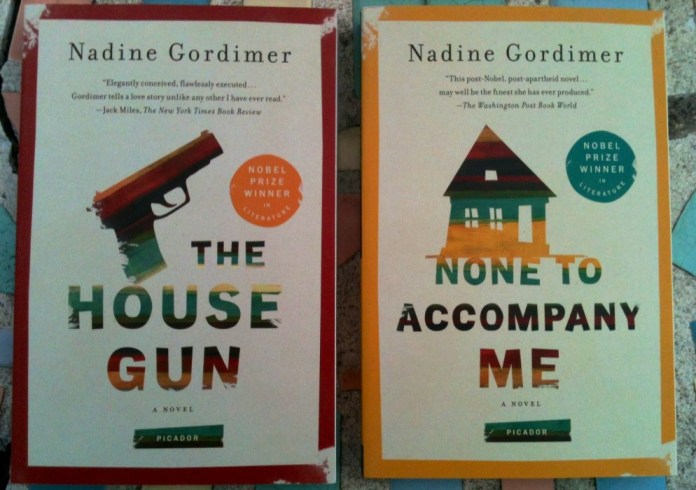
A nice stack from the good folks at Picador this month, including two new entries in their ongoing Nadine Gordimer reissues. I like the design on the series:

20120711-100530.jpg

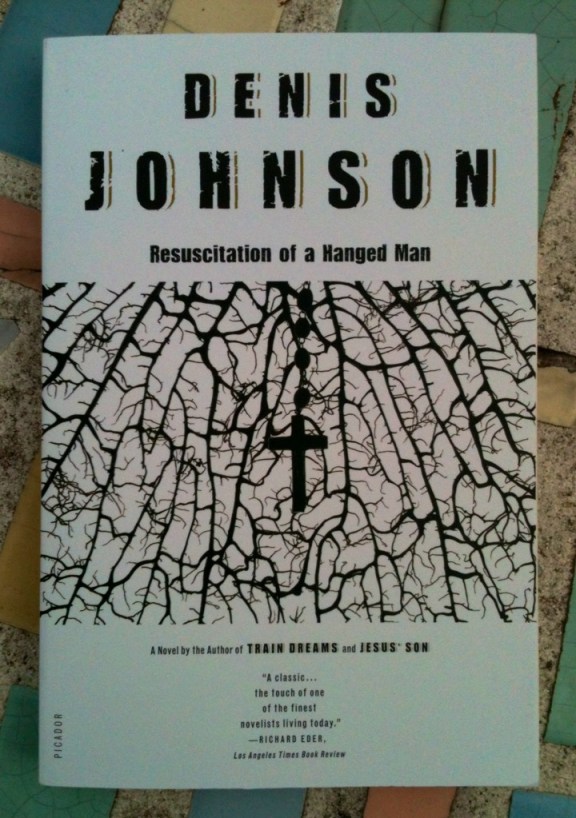
There’s also a reissue of Denis Johnson’s 1991 novel Resuscitation of a Hanged Man, which I haven’t read, but will read soon, because Johnson is just one of those writers I’ll end up reading everything by eventually. From a 1991 NYT review of the novel:

There has never been any doubt about Denis Johnson’s ability to write a gorgeous sentence. The author of “Angels,” “Fiskadoro” and “The Stars at Noon” has become increasingly musical in his prose, and his latest novel, “Resuscitation of a Hanged Man,” depends on such sentences as the primary unit of narrative motion. The novel seems, like a poem, to be written line to line. It is very much a book about one man, one sensibility.

At the outset of the novel, Leonard English, driving to the tip of Cape Cod in the off season, stops for a drink, then spins out of control, running his car onto a traffic island. He ends up taking a taxi to his destination, which is Provincetown. He has attempted suicide before the book’s beginning; now he is moving to the Cape to work for Ray Sands, a private investigator who also owns a small radio station. When we can see him most clearly, English seems very similar to the narrator of the short story — drifting, guilty, in a world of strangers, striving to connect with another person and with his God.

20120711-100537.jpg

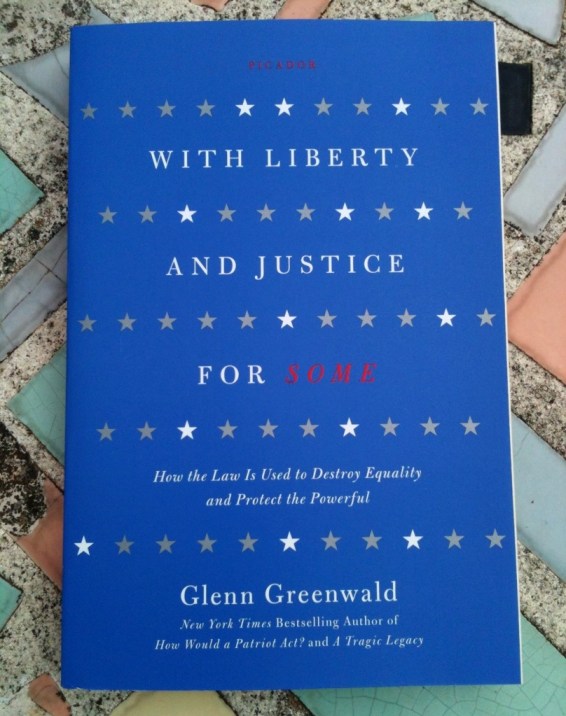
Last year’s With Liberty and Justice for Some is out now in trade paperback. If you are even slightly familiar Glenn Greenwald’s columns at Salon, you’ll likely know what to expect. For those of us predisposed to agree with his analyses, With Liberty and Justice for Some is likely to inspire outrage and a certain kind of fatigue.

20120711-100545.jpg

Here’s an excerpt from an interview between Harper’s Scott Horton and Greenwald:

American history is suffused with violations of equality before the law. The country was steeped in such violations at its founding. But even when this principle was being violated, its supremacy was also being affirmed: resoundingly and unanimously in the case of the founders. That the rule of law—not the rule of men—would reign supreme was one of the few real points of agreement among all the founders. Arguably it was the primary one.

There’s an obvious element of hypocrisy in this fact; espousing a principle that one simultaneously breaches in action is hypocrisy’s defining attribute. But there’s also a more positive side: the country’s vigorous embrace of the principle of equality before law enshrined it as aspiration. It became the guiding precept for how “progress” was understood, for how the union would be perfected.

And the most significant episodes of progress over the next two centuries—the emancipation of slaves, the ending of Jim Crow, the enfranchisement and liberation of women, vastly improved treatment for Native Americans and gay Americans—were animated by this ideal. That happened because “blind justice”—equality before law—was orthodoxy in American political culture. The principle was sacrosanct even when it was imperfectly applied.

The Ford pardon of Nixon changed that, radically and permanently. When President Ford went on national television to explain to an angry, skeptical citizenry why the most powerful political actor would be fully immunized for the felonies he got caught committing, Ford expressly rejected the rule of law. He paid lip service to its core principle—the “law is no respecter of persons”—but then tacked on a newly concocted amendment designed to gut that principle: “but the law is a respecter of reality.”

In other words, if—in the judgment of political leaders—it’s sufficiently disruptive, divisive, or distracting to hold powerful political officials accountable under the law on equal terms with ordinary Americans, then they should be exempt and the rule of law suspended, all in the name of political harmony, of “moving on.” But of course, it willalways be divisive and distracting, by definition, to prosecute the most powerful political leaders, so Ford’s rationale, predictably, created a template for elite immunity.

The rationale for Ford’s pardon of Nixon was subsequently legitimized, and it created a precedent for shielding the most powerful elites from the consequences of their lawbreaking. The arguments Ford offered are the same ones now hauled out over and over whenever it is time to argue why the most powerful among us should not be held accountable: It’s not just for the good of the immunized criminal, but in the common good, to Look Forward, Not Backward. This direct assault on the rule of law was pioneered by the pardon of Richard Nixon.

20120711-100609.jpg

Steve Sem-Sandberg’s The Emperor of Lies is a Swedish novel in English Translation by Sarah Death. Look, I’m generally dismissive of Holocaust fiction because 1) the sheer number of books that come in to Biblioklept World Headquarters that use the Holocaust as a milieu and 2) the tacky and generally lazy way that such books often attempt to manipulate their audiences. Still, The Emperor of Lies seems like it’s probably a sight better than most such books, and it’s gotten generally good reviews, including this one from The Independent (UK), which apparently thinks that a book review of five sentences is fine:

Any writer – let alone one from neutral Sweden – who sets out to place another brick in the vast wall of Holocaust fiction must be deluded or inspired. Astonishing to report: Sem-Sandberg belongs in the tiny second band.

Utterly involving, morally scrupulous, written with a verve and pace that belie its dreadful setting, The Emperor of Lies – in Sarah Death’s masterly translation – really does renew the genre.

Its portrait of resistance and survival in the ghetto of Lodz between 1940 and 1944 focuses on the monstrous enigma of Chaim Rumkowski, despotic overlord of his fellow-Jews. Sem-Sandberg catches his capricious charisma. Other characters, who record their fate or fight it, also shine, while their tragic destiny moves on at mesmerising speed.

Paul Auster’s Winter Journal (Book Acquired Some Time Over the July 4th Holiday)

20120711-100349.jpg

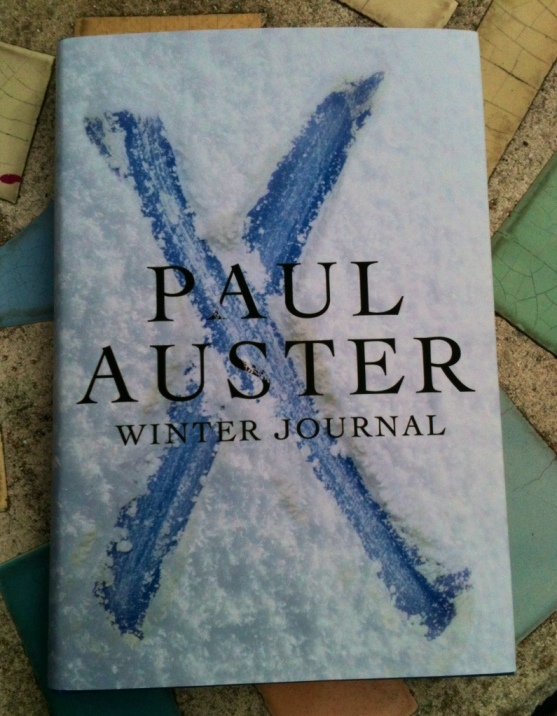
I was pleasantly surprised to find Paul Auster’s forthcoming memoir Winter Journal in the mail after being away for a week. I had mixed feelings about Auster’s last novel Sunset Park, but I dig his nonfiction, and I opened Winter Journal randomly to an episode where the adolescent Auster loses his virginity to a hooker in a passage that’s both tender and funny, so this one seems promising. (It’s also written entirely in the second person pronoun).

Publisher Henry Holt’s blurb:

Facing his sixty-third winter, internationally acclaimed novelist Paul Auster sits down to write a history of his body and its sensations—both pleasurable and painful.

Thirty years after the publication of The Invention of Solitude, in which he wrote so movingly about fatherhood, Auster gives us a second unconventional memoir in which he writes about his mother’s life and death. Winter Journal is a highly personal meditation on the body, time, and memory, by one of our most intellectually elegant writers.

Apostle Islands/Another Country (Books Acquired, Some Time Last Week)

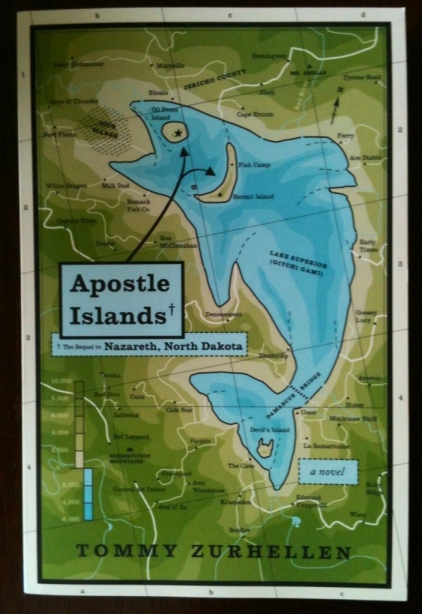
20120624-101945.jpg

Tommy Zurhellen’s Apostle Islands is forthcoming from indie Atticus. Their write up:

It’s not easy for a messiah to grow up in the Badlands of North Dakota. And it’s even harder for him to share his message when radical ideas and so-called “miracles” are the surest way to get the FBI breathing down your neck. The sequel to Nazareth, North DakotaApostle Islandsfollows Sam Davidson and his group of roughneck followers as they save wedding receptions, cure cancer patients, and boost a flagging fishing season, all while breaking bread and laws and making peace and enemies.

On a mission to change one botched up world, Sam knows he will one day be called to make the ultimate sacrifice, and indeed he sees the writing on the shores of Lake Superior when one of his inner circle betrays him. A playful and delightfully irreverent take on the New Testament, Apostle Islands reveals what it takes to shake up the status quo while paying the price to save the ones you love.

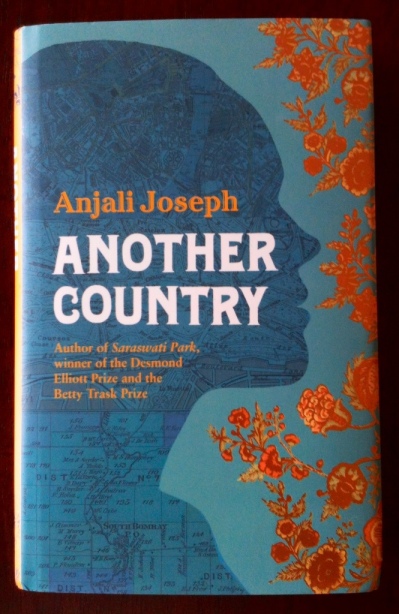
20120624-101953.jpg

Anjali Josephs’s Another Country also has a map on its cover. This one got a bit of a scathing review in The Guardian last week; the first few pages seem well written though. Blurb:

Paris, London, Bombay: three cities form a backdrop to a journey through Leela’s twenties at the dawn of the new millennium, as she learns to negotiate the world, work, relationships and sex, and find some measure of authenticity. Sharp, funny, and melancholy, Another Country brings a cool eye to friendship, love, and the idea of belonging in its movements through old and new worlds. As with her debut, Saraswati Park (2010), which won the Desmond Elliott Prize, the Betty Trask Prize and India’s Vodafone Crossword Prize, Anjali Joseph’s beautiful, clear writing captures exactly both emotions and surroundings.

Charles Frazier’s Nightwoods (Book Acquired, 6.14.2012)

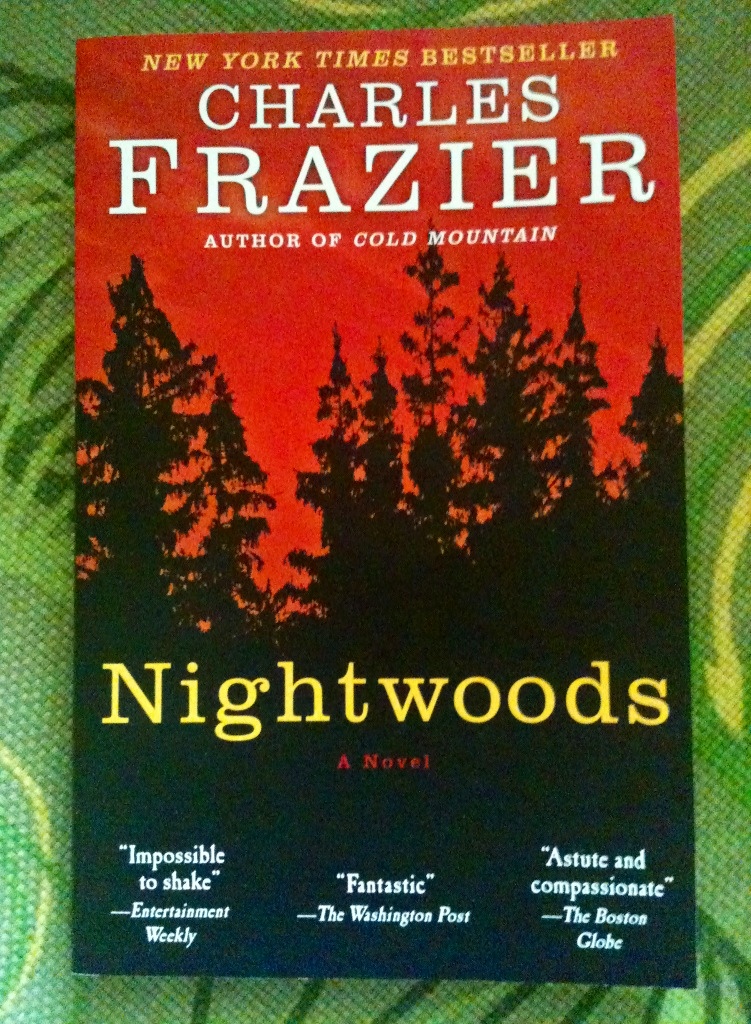
20120622-100218.jpg

Charles Frazier’s Nightwoods, new in trade paperback. From Randy Boyagoda’s NY Times review:

“Nightwoods,” Frazier’s new novel, is a departure from its predecessors in some respects. It’s set in the early 1960s rather than the 19th century, and it involves no literary or historical elements of comparable grandeur and gravity. Indeed, based on its premise, the new book feels remarkably stripped down: a young woman named Luce, the caretaker of an old lodge in small-town North Carolina, becomes the guardian of the twin children of her murdered sister. In turn, she must defend them from Bud, their former stepfather, who killed their mother while they watched, and who believes the traumatized children know the location of some stolen money. As a setup, this promises suspense and mystery, to which Frazier adds family tension (when Luce’s lawman-cum-drug-addict father buddies up with Bud) and romance (after the shy, handsome grandson of the lodge’s deceased owner visits his inheritance and falls for Luce).

Josh Henkin Talks to Biblioklept About His New Novel, The World Without You

Joshua Henkin’s new novel, The World Without You, tells the story of the Frankels, a large Jewish American family who gather over the Fourth of July weekend to mourn the death of their son Leo, a journalist who was kidnapped and then murdered in Iraq. The World Without You is Henkin’s third novel after Matrimony and Swimming Across the Hudson. Henkin directs the MFA program in Fiction Writing at Brooklyn College. The World Without You is new in hardback from Pantheon. You can learn more about Henkin at his website. He was gracious enough to talk to me over a series of emails about writing, teaching, verb tense, sympathy, and his new novel.

Biblioklept: There’s a lot going on in The World Without You, but it seems to be essentially a novel about a family—what it means to be a family, what it means to be in a family, what it means to be in conflict with a family—where did the Frankels come from?

Josh Henkin: The most simple answer is, My imagination.  The Frankels aren’t based on anyone I know, and like all characters in fiction (at least the kind of fiction I write), they developed slowly over time; I discovered them in the writing process over the course of quite a number of years.  What I would say is that I think that in the same way that people speak of “rebound relationships,” I think of my novels as “rebound novels.”  Matrimony took place over twenty years and focuses on a small cast of characters, and I wanted to write something different this time.  So, whether consciously or not, I set out to write a book that was more compressed, on one hand (it takes place over 72 hours instead of over 20 years), and more spacious, on the other hand (there are many more characters, and we go into many points of view).  If you’re asking where the inspiration for the book came from, I’d say it came mostly from the following.  I had a first cousin who died of Hodgkin’s disease when he was in his late twenties. I was only a toddler at the time, but his death hung over my extended family for years. At a family reunion nearly thirty years later, my aunt, updating everyone on what was happening in her life, began by saying, “I have two sons….” Well, she’d once had two sons, but her older son had been dead for thirty years at that point. It was clear to everyone in that room that the pain was still raw for her and that it would continue to be raw for her for the rest of her life. By contrast, my cousin’s widow eventually remarried and had a family. This got me thinking how when someone loses a spouse, as awful as that is, the surviving spouse eventually moves on; but when a parent loses a child they almost never move on. That idea was the seed from which The World Without You grew. Although there are many tensions in the novel (between siblings, between couples, between parents and children), the original tension was between mother-in-law and daughter-in law, caused by the gulf between their two losses, by the different ways they grieve.

Biblioklept: You mention the compression of The World Without You, which here strikes me as form of realism. The book takes place over the July 4th holiday—why did you choose this setting? Was the Independence Day setting always part of your design?

JH: I knew I wanted a compressed period of time–mostly because Matrimony took place over twenty years and I think of books like relationships:  one book is a rebound from the previous one.  I also knew that I wanted the book to be told in many points of view; this, too, makes it different from Matrimony, which was told only in Julian and Mia’s points of view.  In terms of Independence Day, I think that was a little more unconscious, though probably intentional as well.  Part of the issue was a practical one:  how do you get a large, disperse family together in one place?  You need an occasion for the telling, and a holiday like July 4th provides one.  Though of course the real occasion for the telling is Leo’s memorial.  But I think even there Independence Day is relevant because although the book is obviously about the specific characters (I think all fiction worth its salt is always first and foremost about the particular, not the general), I do think this novel in its own indirect way is a novel about America more broadly, and certainly about a certain segment of America, of which I consider myself a part.  The Frankels are a political family, with strong opinions about Bush and about the Iraq War, but they’re also privileged.  They’ve really known no one who has fought in the war, have been insulated from it in their day-to-day lives–and then, with Leo’s death, it comes and touches them in the most horrific and personal way.  And I wondered what that’s like–to be mourning while the rest of the country is celebrating, to be commemorating the independence of a country that has sent its young men and women to war, a country that’s responsible for their son and brother’s death.

Biblioklept: You mention the Frankels’s privileged background. They are, for the most part, liberal, secular, refined. Leo dies in Iraq, but, significantly, he’s a journalist, not a soldier. Do you worry that not all readers will connect to these characters? How do you make your characters sympathetic—or does sympathy even matter in fiction?

JH: My feeling is that people are people, and they merit as little or as much sympathy as they merit whether they’re rich or poor, healthy or sick, beautiful or ugly.  There’s a strand of anti-elitism in American culture  (one can see it every day, tirelessly, in our politics), and one sees it, too, in certain attitudes toward literature–the idea being that only the humble, the uneducated are worthy of our fiction.  But I find the idea pretentious; it smacks of a kind of reverse snobbery.  And tell it, in any case, to Fitzgerald, or Cheever, or Yates.  One of the things good literature does is it humanizes people we might not otherwise be drawn to.  And (this is at least as important) it allows us to enjoy the company of people on the page whose company we might not enjoy off the page.  Which is another way of saying that sympathy doesn’t matter in fiction, at least not sympathy narrowly construed.  In fiction, as in life, some people are likable and some people aren’t likable, and the world would be boring if everyone were likable.  The fiction writer’s job is to make his characters complex, interesting, fully human, not (or at least not necessarily) likable.

Biblioklept: The World Without You is conveyed in the present tense. I’m curious what led you to compose in the present tense, or if you drafted parts of the novel in the past tense—what advantages can the present tense offer the writer and reader? What are its limitations?

JH: I think about tense a lot, probably because I teach fiction writing and, more specifically, because I direct Brooklyn College’s Fiction MFA program, and so I end up reading 500 application manuscripts a year, a good number of which are written in the present tense.  It’s said that present tense makes the story feel more immediate, yet year after year I notice among our graduate applications that the present-tense stories are usually the least immediate, most inert stories in the bunch.  Why is that?  I think it’s because some writers use present tense as a substitute for narrative, as a way of hiding that nothing is happening in their stories.  They think that if they write in present tense their stories will feel immediate.

I also think that present tense is deceptive because it’s easy in present tense to slip out of scene and into general/habitual time.  In the past tense, you would write “She went to the store on Tuesday” to suggest that the character is going to the store at a specific time.  If, on the other hand, you wanted to indicate repeated or habitual action, you would write, “She would go to the store on Tuesday.”  But in the present tense there generally isn’t such a distinction between the specific and the habitual.  “She goes to the store on Tuesday” can mean either that she’s going to the store right now on Tuesday or that she’s a habitual store-goer on Tuesdays.  I think what happens in present tense is that a lot of writers end up slipping into the habitual, and so what seems immediate is actually not at all immediate.

The other thing I’d say is that it’s very hard to write a present-tense novel that takes place over ten years because it’s likely to feel artificial for all that time to be in present tense.  Present tense works best, then, in novels and stories told in compressed time.

The World Without You simply came to me in present tense.  That was the tense that felt right for the book.  This may be true, in part, because I’d been influenced by Richard Ford’s Independence Day, another novel told over a single July 4th holiday that’s told in present tense.  But I think it’s more than that.  The World Without You takes place over 72 hours, so it’s ideally suited for present tense, and it’s also told in confined space; most of the book is situated in the Frankel family home and the streets that surround it in Lenox, Mass.  One thing I was trying to do was balance the sprawling quality of the book (there are many characters and lots of different points of view) with the more focused time and space that I just mentioned, and I think present tense allowed me to do that.  But all this is post-facto, a case of me looking back at what I did.  I proceeded intuitively, which is what I always do, and present tense simply felt right (it was the right sound, the right voice) for this book.

Biblioklept: You bring up your position as Brooklyn College’s MFA fiction program director—I’m curious if reading so many manuscripts affects your own writing.

JH: I love teaching, and that’s in large part because I get to teach some of the most talented young writers out there.  In the last few months alone, five of our recent MFA graduates have gotten book contracts.  There are writers who wouldn’t know how to teach; for them, writing is an intuitive process and they aren’t fully conscious of what they’re doing.  For me, it was the opposite.  I could read someone else’s short story and figure out what wasn’t working long before I could make things work in my own stories.  I needed to learn how to become a more intuitive writer, and critiquing other people’s stories helped me do that; it still helps me.  I’ve been at this process longer than my students have, but we’re all struggling with the same thing—how to write convincing stories; how to make our characters comes so deeply to life they feel as real as, even realer than, the actual people in our own lives; how to use language in a way that’s precise and beautiful and utterly true.  That never changes.  So in a way, even though I’m the instructor, we’re all students in the room.  Also, I’m a fairly social person, and writing is incredibly solitary, so teaching gives me the chance to be with other people and to talk about the work I love.

Biblioklept: Are there manuscripts that come in where you just kind of slap your forehead and go, “Not another story about ______ again!”

JH: Absolutely.  Many of my graduate students are in their mid-twenties, and so they write about the concerns of people in their mid-twenties.  How to find love in the big city, that kind of thing.  That’s okay.  If it’s done well, just about any subject matter can make for compelling fiction, and in any case, my students won’t be in their mid-twenties forever.  That’s one of the nice things about being a writer.  You mature; you get better over time.  Writing is different from figure skating.  It’s even different from playing the violin.  You can be in your late forties and still be a young writer.  At least that’s what I like to tell myself!

Often it’s less a similarity of subject matter that I see than a similarity of voice or sensibility.  For a time I saw a lot of Lorrie Moore imitators.  Then I saw a lot of George Saunders imitators.  If you’re going to imitate someone, those are two pretty good choices, though in a lot of ways Moore and Saunders are inimitable.  But that’s fine.  Imitation is part of the maturing process.  It’s how a writer achieves her own voice.

Biblioklept: Do you have any upcoming writing projects? What are you working on next?

JH: My most immediate project is a trip to Hawaii! Writing a novel takes a lot out of you. Right now, I’m trying to figure out what comes next. I promised myself I would go back to writing short stories. It’s weird, I’ve spent the last nearly twenty years writing novels, when in so many ways I think of myself as a short-story writer. It was certainly my first love, and because I teach MFA students, I spend a lot of time reading and thinking about short stories. So last fall, when I finished the final draft of The World Without You, I immediately sat down to write a short story, and what happened? The draft I wrote was 113 pages along! And then the second short story I wrote was over 200 pages long! I still think I’m capable of writing a regular old twenty-to-thirty-page short story, but we’ll have to see. In the meantime, I’m tossing around some ideas for a new novel, but it’s still in the very early, incubating stages, so I’m not saying anything more than that.

Biblioklept: Have you ever stolen a book?

JH: Alas, I have not.  But I’m working on it.
Denis Johnson’s Train Dreams Is a Perfect Novella

With blunt grace, Denis Johnson navigates the line between realism and the American frontier myth in his perfect novella Train Dreams. In a slim 116 pages, Johnson communicates one man’s life story with a depth and breadth that actually lives up to the book’s blurb’s claim to be an “epic in miniature.”  I read it in one sitting on a Sunday afternoon, occasionally laughing aloud at Johnson’s wry humor, several times moved by the pathos of the narrative, and more than once stunned at the subtle, balanced perfection of Johnson’s prose, which inheres from sentence to paragraph to resonate throughout the structure of the book.

The opening lines hooked me:

In the summer of 1917 Robert Grainier took part in an attempt on the life of a Chinese laborer caught, or anyway accused of, stealing from the company stores of the Spokane International Railway in the Idaho Panhandle.

Three of the railroad gang put the thief under restraint and dragged him up the long bank toward the bridge under construction fifty feet above the Moyea River. A rapid singsong streamed from the Chinaman voluminously. He shipped and twisted like a weasel in a sack, lashing backward with his one free fist at the man lugging him by the neck.

The matter-of-fact violence here complicates everything that follows in many ways, because Grainier it turns out is pretty much that rare thing, a good man, a simple man who tries to make a life in the Idaho Panhandle at the beginning of the 20th century. The rest of the book sees him trying—perhaps not consciously—to somehow amend for the strange near-lynching he abetted.

Grainier works as a day laborer, felling the great forests of the American northwest so that a network of trains can connect the country. Johnson resists the urge to overstate the obvious motifs of expansion and modernity here, instead expressing depictions of America’s industrial growth at a more personal, even psychological level:

Grainier’s experience on the Eleven-Mile Cutoff made him hungry to be around other such massive undertakings, where swarms of men did away with portions of the forest and assembled structures as big as anything going, knitting massive wooden trestles in the air of impassable chasms, always bigger, longer, deeper.

Grainier’s hard work keeps him from his wife and infant daughter, and the separation eventually becomes more severe after a natural calamity, but I won’t dwell on that in this review, because I think the less you know about Train Dreams going in the better. Still, it can’t hurt to share a lovely passage that describes Grainier’s courtship with the woman who would become his wife:

The first kiss plummeted him down a hole and popped him out into a world he thought he could get along in—as if he’d been pulling hard the wrong way and was now turned around headed downstream. They spent the whole afternoon among the daisies kissing. He felt glorious and full of more blood than he was supposed to have in him.

The passage highlights Johnson’s power to move from realism into the metaphysical and back, and it’s this precise navigation of naturalism and the ways that naturalism can tip the human spirit into supernatural experiences that makes Train Dreams such a strong little book. In the strange trajectory of his life, Grainier will be visited by a ghost and a wolf-child, will take flight in a biplane and transport a man shot by a dog, will be tempted by a pageant of pulchritude and discover, most unwittingly, that he is a hermit in the woods. In Johnson’s careful crafting, these events are not material for a grotesque picaresque or a litany of bizarre absurdities, but rather a beautiful, resonant poem-story, a miniature history of America.

Train Dreams is an excellent starting place for those unfamiliar with Johnson’s work, and the book will rest at home on a shelf with Steinbeck’s naturalist evocations or Cormac McCarthy’s Border Trilogy. I have no idea why the folks at FS&G waited almost a decade to publish it (Train Dreams was originally published in a 2002 issue of The Paris Review), but I’m glad they did, and I’m glad the book is out now in trade paperback from Picador, where it should gain a wider audience. Very highly recommended.