“I Suppose You Become Addicted to a Certain Kind of Writing” — David Markson on Lowry, Joyce, and Gaddis

David Markson talked with Joseph Tabbi about (among many other things) his friendship with Malcolm Lowry, his love for William Gaddis’s The Recognitions, and how James Joyce teaches us to read. Read the entire interview at the Dalkey Archive:

JT: You mention your critical study of “Volcano.” But you did a master’s thesis on it at Columbia much earlier?

DM: While we were in touch, but before I’d actually met him, yes. In 1951.

JT: Which means it was only four years after the novel had been published. Isn’t that rare, an academic paper on an entirely “new” writer with no body of criticism to verify his status?

DM: As a matter of fact I had to wander around the English department knocking on doors looking for someone to approve the project. I remember Lionel Trilling’s dismissal in particular: “What is all this drunkenness all about?” My whole object was to explain just that, obviously, but I decided to find less of a current to buck. Finally William York Tindall gave me a go-ahead.

JT: That brings up a question of a different sort, however. “Volcano” is scarcely your everyday traditional novel. What sort of training or background did you have that let you feel able to confront the challenge of interpreting something that difficult?

DM: To tell the truth, I’m not sure if I had any real idea what I was getting into, or if any of us do, the first time we’re seduced by a book of that sort. Though Joyce certainly teaches us, for starters. By which I mean that we all learn quickly with “Ulysses” that we cannot simply read the novel itself but have to lean on some of the critical crutches.

JT: But you had no crutches at all?

DM: Oh, well, but there are always clues in the text itself—this reference to that which leads to patterns you begin to trace out. On one level I impressed the hell out of myself, surprised at what I did know. And evidently I impressed a few other creatures as well, since I kept hearing that the thesis was being stolen from by students all over the place. The again when I sat down years later to turn that early stuff into a full length book I was almost embarrassed at how little I’d seen after all.

JT: Not long after that original Lowry thesis you were proselytizing fairly extensively for “The Recognitions” too?

DM: I suppose you become addicted to a certain kind of writing. There’s little enough of it extant, God knows. I’m not sure how much actual “proselytizing” I did for Gaddis, however. Except of course for practically button-holing friends on street corners.

JT: But I understand you were very directly responsible for the first reissue of the book, also?

DM: Evidently I was. It’s a funny story, actually. I was living in Mexico, and someone—well, old Aiken, in fact—gave my address to Aaron Asher, who was the editor of Meridian Books at the time. I picked him and his wife Linda up at their hotel and brought them out to where Elaine and I were living—outside Mexico City—for dinner and then spent approximately three solid hours talking nonstop about Gaddis. Finally Aaron threw up his hands in despair, telling me, “Please, please, I promise I’ll read the darned thing as soon as I get home! But now tell us something about where to go and what to see in Mexico, for heaven’s sake!”

JT: And then he did publish it. Did Gaddis himself know about the impetus?

DM: That’s fairly funny too, as it happens. “The Recognitions” came out in 1955. I’d read it twice when it did, and then wrote Gaddis a letter. It’s perhaps the only other letter I’ve written to an author I didn’t know, but it was completely different from the one I wrote to Lowry. In this case I’d just been infuriated by the rotten reviews and simply wanted to tell the man the hell with them all, that there were some few of us out there who did see what he’s accomplished. I didn’t get an answer, though I eventually heard secondhand that Gaddis had been too depressed at the time to send one. Or that he’d ultimately decided it was too late. But then sometime in 1961, not long after the Asher incident, I did hear. Six years after the fact, this was, a long letter beginning with something like, “Dear David Markson, if I can presume to answer yours of June whatever, 1955!” Which went on to say that Asher was in fact about to do a first reprint.

Read (And Not Read) in 2011

[Our West Coast correspondent A King at Night weighs in on the books he read—and didn’t read—in 2011. Where they fit, I’ve linked book titles to my own reviews, or Noquar’s, our Brooklyn correspondent. –Ed.]

All of the books I did read in 2011:

1. The Recognitions – William Gaddis

If more people were able/interested in surmounting this 960 page giant I think it would be roundly considered possibly the best American novel. But as it is Gaddis sabotaged himself by writing a book that is almost literally too good.

2. City of Glass – Paul Auster

I think this one was my favorite of the New York Trilogy, except that I didn’t think of separating them until I made this list. So really I read three books as three parts of the same novel. One which I loved and adored fully. It was my first Auster and a the beginning of a beautiful friendship.

3. Ghosts – Paul Auster

See above.

4. The Locked Room – Paul Auster

See above.

5. Bright Lights Big CityJay McInerny

Not sure why I read this one. I think I just had it sitting around and it read fast enough to keep me engaged. I’m also not sure why this was as apparently popular as it was upon release. I know he was friends with Bret Ellis, but it just seems like Ellis but kind of declawed. So maybe that’s a good thing for some people. The use of second person narration was cool, I guess you don’t see that very often.

6. Blood Meridian  – Cormac McCarthy

There is almost literally nothing I can say about this that will have any value. I should mention that it fully lived up to the years and years of personal hype I had built up for it.

7. Powr Mastrs vol. 2, 3  – C.F.

This is a weird comic book series a friend introduced me to. Apparently it is ongoing and I think I would like to continue reading it.

8. Point Omega – Don DeLillo

This was my first attempt at DeLillo and I’m pretty sure I chose it because of its minuscule length and awesome cover art. I was totally enthralled and blown away. So much so in fact that Point Omega gets the distinction of the being, so far, the first and only book I have actually read twice in a row. As in I finished it and then flipped back to page one and read it a second time and it was brilliant again.

9. In The Country of Last Things – Paul Auster

I didn’t fully love this as much as I did the NY Trilogy, but I think that is due to a certain lack of detectives and the New York setting. This book kind of reminds me of a big, sad Terry Gilliam movie. Auster is in my opinion the unquestioned master of that meta-text device where what you are reading is actually being written by the character in the book. (I’m sure there is a name for that, but I don’t know it).

10. The Pale King – David Foster Wallace

I’ll try and cut the hyperbole on this one. I don’t care what any people are saying about this book or the man who wrote it. My enjoyment of this and other DFW books is entirely a personal experience. He may in fact be the smartest novelist who ever lived or whatever but I’m not going to browbeat you into believing me, and somehow trying to make myself look good by extension. This book did things for me that no book (including Infinite Jest) has ever done and for that I am grateful. I’ll say no more.

11. Day of The Locust – Nathaniel West

What a weird, dark, little book this is. And why have I never been told that the name Homer Simpson is used prominently throughout? The end of this book was basically jaw-dropping and could be the best sequence Fellini never filmed. I hear there was a movie made based on this, but I think it supposedly wasn’t very good.

12. The Time Machine Did It – John Swartzwelder

This is the first book in a series written following Detective Frank Burly. And the ONLY reason I haven’t immediately read each and every one of them is because they are self-published by the author and therefore impossible to find used. And since I almost never buy books new it would be a huge price adjustment for me. So I’ll take them slow, but if the rest are as fun as this is I predict I will love all of them.

13. Ubik – Phillip K. Dick

Very enjoyable, packed full of ideas (as usual for Dick) and with a pretty engaging plot to tie it all together.

14. Carpenter’s Gothic – William Gaddis

Last time I was home visiting my family I discovered that a copy of this book in my mom’s bathroom. Apparently she had seen me post about Gaddis on Facebook and decided to take my word for it. She was about a third of the way through this relatively slim book but confessed to having a hard time reading it. She asked what about it appealed to me so much and I told her that I view Gaddis as maybe the greatest American writer who ever lived, but that of the three books I’ve read of his Carpenter’s Gothic is the weakest, (or the least amazing, maybe) but that, you know, good luck telling anyone to read a 700 page book written entirely in unattributed dialogue (JR) or a 960 pager about classical art. So yeah CG is more of a little experiment in storytelling (the goal was to tell a massive sociopolitical epic, but done entirely in one location, a house in the country outside new york) than it is an essential work. But if you want to wet yr feet in regards to Gaddis but won’t/can’t commit to his larger, better books, then this is a decent starting point.

15. Child of God – Cormac McCarthy

Totally awesome. I started reading it late at night after finishing the previous book and ended up sitting on the couch until 4:30am and did the whole thing in one sitting. That doesn’t happen too often with me and I can’t really account for why it happened this time . . . but yeah this is the most readable McCarthy I’ve read since The Road.

16. The Transmigration of Timothy Archer – Phillip K. Dick

This is the (sort of) conclusion to PKD’s VALIS trilogy, which I started reading last year. It was the last book he wrote and is I think a pretty wonderful swan song for a guy as freakishly imaginative as him. It isn’t even really sci-fi even, but more like “spi-fi” (the term I just made up for Spiritual Fiction) which is sort of what all of his latter work was I guess, and is a thing that really resonates with me personally.

17. Leviathan – Paul Auster

My fifth Auster of the year: I picked this up because it had a cool cover and I read it mostly on flights to and from a wedding I attended in Wisconsin. This is totally wonderful and probably my second favorite Auster novel (behind NY3). I think if I were to write a longer piece on PA I would probably use this book to talk about his interest in choosing protagonists who are frequently less interesting than a supporting character whom they idolize. And also his interesting views on marriage and adultery. It’s worth noting that the book is dedicated to Don DeLillo and upon seeing that I was inspired to pick up some more of his books and finally some of the others that were piling up on my shelf.

18. White Noise – Don DeLillo

I’ve had a copy for this for like ten years and somehow could never make it past the first two pages, even though they are a really good two pages. Honestly in this case I think it was the edition. I had one of those scholarly ones with all the annotation and stuff that make the book look twice as long and 10x more boring. And then I found the newly printed Penguin paperback and burned through it in like a week. It’s one of the funniest things I’ve read and was really a gateway drug into a binge of DeLillo that was incredibly fulfilling.

19. Running Dog – Don DeLillo

This was probably the least mind-blowing (and the earliest) of the DeLillo I read this year. But still a good time, slightly Pynchonian (Pynchonesque?) probably as a result of DD still finding his own voice at that point. I probably wouldn’t recommend it to anyone who wasn’t already pretty well-into DeLillo but for fans of his I think it would be a good read.

20. Libra – Don DeLillo

Two things in life constantly threaten to destroy me: The Zodiac Killer and JFK. There is always this looming sense that if I were to ever really, fully commit to researching either case I would be entering rabbit-hole I’d never find my way out of. This book was simultaneously the most tempting experience but also the most satisfying. Because even if DD had to invent some of this he still presents a version of the story that is totally plausible. So maybe it’s a placebo but at least I can sleep at night.

21. Underworld – Don DeLillo

It was all a rehearsal for this one though. This big guy had been taking up space on my night stand for months and I’d had a number of friends basically begging me to read it for years. When I finally got around to reading it I was pleased to discover that it is NOT difficult at all, it’s just long. There is a sort of genre of these “big, complex, post-modern(?)” type of books. It’s a thing that I have a weakness for: Gravity’s Rainbow, Mason & Dixon, Against The Day, The Tunnel, The Recognitions, JR, Infinite Jest, etc. And I mean while Underworld has some things in common with these books I would actually characterize it as almost more like a Norman Mailer book or something. Yeah, I’d put it somewhere between a more-sober Thomas Pynchon and a less-horny Norman Mailer. Does that make sense at all?

22. The Orchard Keeper – Cormac McCarthy

I was hoping for a repeat of my Child of God experience with this one. And while that didn’t quite happen I still enjoyed this book a lot. Major props to McCarthy for mentioning Melungeons in the first chapter, being descended from that obscure ethnic group myself, with my dad’s family from east Tennessee, I can tell you that that is exactly the type of super-esoteric, colloquial reference that he later got a lot of praise for utilizing in his more-celebrated western novels. I guess it’s just neat to see that as a part of his style so early and is further proof that he is not in fact a writer of westerns at all, but just possibly the best writer of any region, just wherever he decides to dedicate his interest.

23. Train Dreams – Denis Johnson

I love Denis Johnson so much. I don’t usually buy hardback books but when I saw this cute little book I knew I had to have it. It reads super fast and is really just a great little character piece, telling basically the whole life of this one particular guy. Johnson could write two dozen of these things and I would read every one of them. But he won’t because he’s busy doing whatever other random thing he decides to write brilliantly—-

24. Nobody Move  – Denis Johnson

—-Like this little crime novel he wrote. I don’t think anyone who was around when his first few books would ever have thought he would end up trying to write a pulp novel. I certainly wouldn’t have. But boy am I glad he did. This book was so totally fun to read, with some of the most enjoyable dialogue I’ve ever read in my life. It isn’t as tightly plotted as any of the Coen bros. movies that it reminds me of, but for sentence-by-sentence writing it was one of the best things I read all year.

25. Wild at Heart – Barry Gifford

I had seen the movie a few times and knew I wanted t try the book. I heard that Lynch wrote the script in six days and having read it now I can say that I completely believe that is true. It’s probably one of the closest adaptations I’ve ever seen and really I’m just stunned by how Lychian Gifford’s book already was. It makes so much sense that these two collaborated on Lost Highway and my only wish is that they would work together again sometime.

26. Travels in The Scriptorium – Paul Auster

So I guess with this one Auster officially beat DeLillo for the most-read author of the year prize. I wasn’t even intending to buy another one until I saw the cover of this and instantly knew I had to. Anything that is this visually reminiscent of Twin Peaks has to be good right? It ended up being a great, easy read, which I am learning is typical of PA.

27. The Bailbondsman – Stanley Elkin

This is the first novella is book of three called Searches and Seizures that I just bought the other day. I was sold when I saw that William Gass had a blurb on the back cover saying something like “the three books contained in this volume are among the greatest in our literature” to which I mentally responded “well jeez Bill, I guess we’re going for the hard sell today, fine, I’ll buy it, say no more.” So I’m not ready to agree or disagree with Gass on this one, but I can see why he would like Elkin’s style, which sort of reminds me of a funnier more playful version of what Gass does.

28. The Making of Ashenden – Stanley Elkin

The second novella in Searches and Seizures is shorter and packs a bigger punch than the first. It’s one of these things where if I told you what happens in the story you would probably want to read it, but knowing what happens would reduce the impact when it does happen, so just trust me and read it. The writing is just terrific and it’s really funny. Humor isn’t really a quality that I value in visual entertainment as much, but when someone can write literary fiction that actually has me laughing out loud I tend to think it’ s worth mentioning.

29. No One Belongs Here More Than You – Miranda July

So I was fully ready to finish the third novella in that Elkin collection until I found myself at a friend’s apartment cat-sitting on Christmas Eve and this book was sitting on the shelf. So in keeping with the name of this blog I just went ahead and stole it. I proceeded to read it very quickly and I laughed out loud more than I expected to (remember when I mentioned literary fiction that elicits laughter? This was like that too). I confess that I don’t read a ton of short stories, (a truth this list will generally attest to) but I found this whole collection just wonderful. It might also be that this is the only book written by a woman that I read all year. In the past few years I have generally been on a strict diet of books that fit loosely to the idea of “American Post-Modern Novels” but generally means “Books published after the 60s by white guys mostly from new york.” And while I am proud of the big reading accomplishments this focus has helped me attain, (how else does one read Gaddis if not through sheer force of will?) this slight, sad, funny, collection of contemporary short fiction written by a young-ish female writer has shown me that I definitely need to broaden my palate.

Some of the books I did not read in 2011:

1. Freedom – Jonathan Franzen

Yeah yeah yeah yeah yeah yeah blah blah blah blah blah blah glasses glasses glasses glasses glasses smug smug smug smug smug smug smug. I think I’ll let this one age a bit more before I attempt to read it. Granted his short “Breakup Stories” may literally be my favorite piece of fiction to appear in the new yorker in the past ten or twenty years… but, I have read the first page of The Corrections on three separate occasions (in three different sized editions, so now I know the physical copy is in fact NOT the problem) and each time I woke up in the spring, without having read the book. If I ever did decide to crack this one it would probably be in audio form, and maybe as part of a long road trip alone, specifically without a cell phone or cigarettes so that I would have nothing else I could possibly do.

2. 2666 – Roberto Bolano

I’m sorry Ed. I really am. It will happen, I swear it. But every time I pick this book up I am baraged by random four-part spanish sounding names that are indistinguishable for me, sample sentence: “What Jaun-Carlos Hernandez Jr. admired most about the poetry of Jullio Valdez-Herrara was the tactility of words. They leapt off the page with such precision and style that Jaun-Carlos was transported from the dusty villa where he sat to candlelit hut with a thatched roof, where revolutions are planned. He tried in vain to explain the power of the work to his professor Guillermo-Carlos Nunez but he scoffed at the work of Veldez-Herrara, calling it unworthy of the literary crown of the great Gabriell Marco San Flores.”

3. Suttree – Cormac McCarthy

After all the other McCarthy I read this year, I kind of thought I might just push on through with this one. I’ve been told by a number of people that it is one of his best. But the first page just stopped me dead in my tracks and I instantly knew it wasn’t the right time. No big deal, I’ll get around to it and then the border trilogy afterward.

4. Ulysses – James Joyce

Yes another year busy not-reading Ulysses. I feel I’m in good company on this though so oh well. It can’t really be that difficult can it? I enjoyed both Gravity’s Rainbow and Infinite Jest so my hope is that when I finally do get around to this big guy it will somehow seem quaint and easy. I’m sure that’s an exaggeration though.

5. Anything by David Mitchell

Because seriously fuck this guy. That Cloud Atlas movie adaptation is going to be a huge pile of shit too.

6. Middlesex – Jeffrey Euginides

This book has been haunting me for years, seemingly begging to be read and for some reason I am just 100% uninterested. But it has this weird habit of managing to show up on the bookshelves of people I like and trust, oftentimes sitting very close to other books I like. And sometimes these people tell me to read it. But it never seems very dire does it? No one is rapterous about this book and that makes me think that the Whatever-Prize sticker on the front is causing more people to read it than the actual urgency of the content. Somehow though last year Middlesex managed to get itself into a thrift store in the 50 cent bin, atop a pile of romance novels and pamphlets about Mormons. So now it sits on my shelf, tucked away on that hard to reach, shitty corner next to Cloud Atlas and whatever Dave Eggers books people insist I borrow but that I will never read (because: fuck that guy too). Sometimes though I hear a noise at night and when I wake up Middlesex is lying next to me on the pillow. So I’m pretty much going to have to read it at some point . . . not this year though.

7. Zodiac – Robert Greysmith

Bought it at the Farmer’s Market book stand and held it like a dark version of Willy Wonka’s golden ticket or some kind of box that when opened unleashes Chaos and Evil into the otherwise peaceful world. Right now I have a wife and an apartment and two cats, but I’m pretty sure I would somehow lose all of that the moment I cracked this book. Part of me is delusionally convinced that if I just dedicate my life to the cause that I could solve the Zodiac mystery. NOT reading this book has kept me from indulging that dark obsession for another year.

8. The Beckett Trilogy

Read ten pages or so and just felt like I wasn’t smart enough. Give me a few years and I’ll try it again.

9. Anything by Dennis Cooper

This dude sounds intense and disturbing, but also maybe really awesome. I heard about him first while googling interviews with the band Whitehouse and found Cooper’s blog and a massive post he did on them. Anyone who likes Whitehouse has to be okay right? Well at least I can’t say I wasn’t warned. I plan to get ahold of some of his books but I have no idea where to start, or where to find a bookstore that will give them to me in a plain brown paper bag so I don’t feel weird taking the bus home, as though by holding a Dennis Cooper book I’m sending some strange signal to all the secret sexual deviants around me every day.

10. Crime Wave – James Ellroy

Because I thought it was a novel when I bought it and since I have never read Ellroy I didn’t want to start with a collection of essays.

11. Paradise – Donald Barthelme

I am thrilled to still have a rainy day Barthelme novel left. So as much as it sounds hilarious I am going to hold off reading it for as long as I can.

12. Infinite Jest – David Foster Wallace

Granted I read it three years ago, but every year that I don’t re-read it I get sort of sad. I live vicariously through the one friend every year who reads it for the first time, and every time I listen to them rave for an hour I get it in my head that I’ll snatch it up and give it a quick once over. But when faced with the actual commitment involved I never do it. One day, one day.

Eleven Encyclopedic Books, Overstuffed with References, That Compel Compulsive Reading

Eleven Encyclopedic Books, Overstuffed with References, That Compel Compulsive Reading

1. Moby-Dick, Herman Melville

2. Finnegans Wake, James Joyce

3. Expelled from Eden, A WilliamVollmann Reader

4. Species of Spaces and Other Pieces, Georges Perec

5. Wittgenstein’s Mistress, David Markson

6. The Silmarillion, J.R.R. Tolkien

7. Foucault’s Pendulum, Umberto Eco

8. The Rings of Saturn, W.G. Sebald

9. The Recognitions, William Gaddis

10. Between Parentheses, Roberto Bolaño

11.  The Architecture of the Arkansas Ozarks, Donald Harrington


“The Best Reader Is One Who Is Most Open to Human Possibility” — Don DeLillo

From a 1982  NYT profile of Don DeLillo. DeLillo talks Pynchon, Gaddis, and reader responsibility.

THE writer to whom Mr. DeLillo has most often been likened and for whom he has great respect is Thomas Pynchon. ”Somebody quoted Norman Mailer as saying that he wasn’t a better writer because his contemporaries weren’t better,” he says. ”I don’t know whether he really said that or not, but the point I want to make is that no one in Pynchon’s generation can make that statement. If we’re not as good as we should be it’s not because there isn’t a standard. And I think Pynchon, more than any other writer, has set the standard. He’s raised the stakes.”

Mr. DeLillo also praises William Gaddis for extending the possibilities of the novel by taking huge risks and making great demands on his readers. Yet many readers complain about the abstruseness of much contemporary writing.

”A lot of characters,” Mr. DeLillo says, ”have become pure act. The whole point in certain kinds of modern writing is that characters simply do what they do. There isn’t a great deal of thought or sentiment or literary history tied up in the actions of characters. Randomness is always hard to absorb.”

Mr. DeLillo believes that it is vital that readers make the effort. ”The best reader,” he says, ”is one who is most open to human possibility, to understanding the great range of plausibility in human actions. It’s not true that modern life is too fantastic to be written about successfully. It’s that the most successful work is so demanding.” It is, he adds, as though our better writers ”feel that the novel’s vitality requires risks not only by them but by readers as well. Maybe it’s not writers alone who keep the novel alive but a more serious kind of reader.”

William Gaddis — A 1986 Filmed Interview

“Style and Content Must Match” — William Gaddis on Voice and Risk in His Novels

From a brief  1982 interview with William Gaddis

Q: The pervasive and distinctive authorial voice of The Recognitions gives way in J R to a self-effacing voice that seems to serve only functional purposes. Also in J R there is an increased dependence on dialogue. For verisimilitude in Lolita, Nabokov “travelled in school buses to listen to the talk of schoolgirls.” Did you take any special measures to hear and note the speech patterns of any of the wide variety of people who speak in “J R”?

William Gaddis: Style and content must match, must be complementary, accounting in part for a difference between the two books, though the lack of a conventional narrative style had already jarred a good many readers of The Recognitions when it appeared, as its hapless reviews show. J R was started as a story which quickly proved unsatisfactory, inspired- here’s the legitimate gossip—-by the postwar desecration of the Long Island village of Massapequa where my family had had property since around 1910, take a look at it now and you’ll see all the book’s worst hopes realized. In approaching J R as a novel, I was at pains to remove the author’s presence from the start as must be obvious. This was partly by way of what I mentioned earlier, obliging the thing to stand on own, take its own chances. But it was also by way of setting up a problem, a risk, in order to sustain my own interest, especially since the largely uninterrupted dialogue raised the further risk of presenting a convincing sense of real time without the conventional chapter breaks, white spaces, such narrative intrusions as “A week later . . .” How some of the writers I come across get through their books without dying of boredom is beyond me. As for what you call speech patterns, one is always listening and has got an ear or hasn’t, and without one, unless perhaps in dealing with an unfamiliar language and culture, no amount of your special measures like riding around on school buses will get you out of the swamp.

Books I Will (Make Every Reasonable Attempt to) Read in 2011

If you’re looking for a comprehensive “Books to Look Forward to in 2011” kind of list, The Millions has you covered. This post is not about books that are coming out in 2011, although some books mentioned here will come out in 2011. This post is really just about books I’d like to/plan to read in 2011 (it’s also kind of a dare to myself).

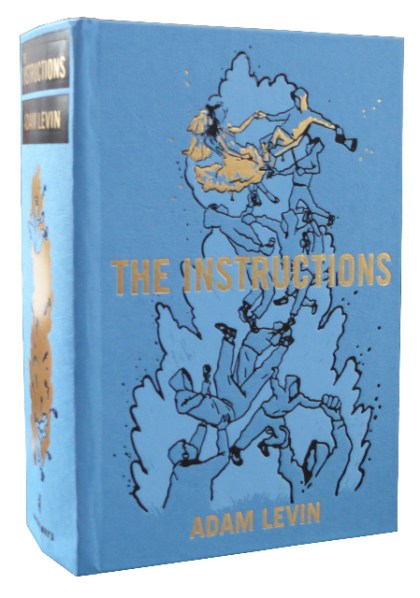
First up, I will finish the books I’m reading/listening to now. This means Adam Levin’s The Instructions (reading; McSweeney’s) and Lydia Millet’s Oh Pure and Radiant Heart (listening; Iambik Audio). I’m on page 342 of The Instructions; there are 1030 pages; a calculator tells me that that is 33.2%. It’s easy reading, often entertaining, but it’s hard to see, even a third of the way in, how Levin can justify taking up this much space. Oh, what is it about? Okay, this kid Gurion Maccabee may or may not be the Messiah. In the meantime, he rules the special ed program at his suburban Chicago school, writes scripture, and gets in lots of fights. The best parts of the book (so far, anyway) are Gurion’s comments on Torah (I would’ve written “the Torah,” but this book seems to suggest that the definite article is pretty Gentile).

Oh Pure and Radiant Heart has been enjoyable, sardonic — funny but sad — and I’m coming up to the end soon. Basically, a trinity of scientists who helped invent the atom bomb (Robert Oppenheimer is the famous one) come back from the dead (sort of) to . . . I don’t know yet. It’s unclear. To hang out with a quiet librarian and her gardener husband as their marriage slowly dissolves? To lead our nation to world wide peace? To take part in a movable circus of weirdos and End Times prophets? Not sure. Full review forthcoming.

I already wrote about one of the Tintin collections I picked up late last year; I will read the other three collections (and likely hunt down more). I’ll also read (hopefully; that is, hopefully it will come out) the next installment in Charles Burns’s X’ed Out trilogy.

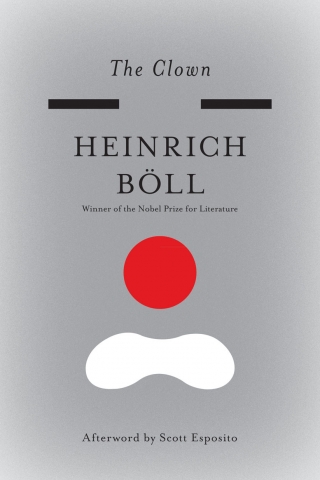
Also on the proverbial plate, non-illustratedwise, is Heinrich Böll’s The Clown, the story of a clown in post-Reich Germany who can smell through the phone (I think there’s more to it than that). Melville House is actually releasing several new editions of Böll’s novels this year, and they have a pretty excellent track record with the Germans, what with Hans Fallada and all, so hey, why not.

On the I-will-read-everything-Sam-Lipsyte-writes front, Picador is putting out a new edition of his first novel The Subject Steve (perhaps in concordance with The Ask coming out in paperback?). I will read The Subject Steve.

Books I bought this year and didn’t read but will make every reasonable attempt to read this year—

William Gaddis’s JR was, I think anyway, the last book I picked up in 2010. It’s really long, seems to be written entirely as a dialog, and hey, I read 2/3rds of The Recognitions and then didn’t even finish it (yet?) which is kinda remarkable/totally lazy. Maybe I should just finish The Recognitions. I just feel like “I get it already.” Lazy, lazy, lazy.

Loved the first chapter of Katherine Dunn’s Geek Love, even though it was really silly. Stay tuned, folks.

I read the first two stories in Barry Hannah’s Airships and then a few galleys bombed my doorstep and then I got distracted, but these things have Spring Break written all over them, so, yes, look for the Airships report in the future (or be a hipster douchebag and write in to tell me how awesome you already know Hannah is now that he’s dead blah blah blah).

I remember that I bought Renata Adler’s Speed Boat the same day I bought Airships (because, y’know, the titles). I read the first 30 or so pages and then read them again and then read them again a week or so ago. Kind of dumbfounding stuff. It’s been hovering around the coffee table, the nightstand; it’s been jammed in briefcases, wedged in coat pockets. What is it? What is she doing?

After slowing down my consumption in 2010, I’m ready to feed the addiction again in 2011: Bolaño, Bolaño, Bolaño. I need to read Amulet; I’ll also read The Insufferable Gaucho and probably something else.

And:

The Pale King

But everyone’s buzzing about that already, right?

“There Must Be Some Level of Indignation” — William Gaddis

Back To School

I think I did a similar post two years ago. I teach, I gotta go back to school, the fall, the kids, blah, blah, blah. Anyway. I’ll try to get one proper book review out per week. I’ve got seven or eight really choice looking promo copies and galleys stacked up here, including new trade paperback editions of Marilynne Robinson’s Home and Per Petterson’s To Siberia. Vintage also has a really cool original by Patrick Alexander coming out in September; it’s called Marcel Proust’s Search for Lost Time and its subtitle, A Reader’s Guide to The Remembrance of Things Past pretty much sums it up. I’ve read the first 100 pages and it’s really great, and let’s face it, unless some kinda windfall happens where I can just read books all day, I’m never gonna get around to Proust, so, yeah, this’ll have to do. Proper reviews forthcoming, blah, blah, blah. (Even though William Gaddis’s The Recognitions ain’t gettin’ no shorter).

Waltz Rulz
Waltz Rulz

While I’m doing lazy reviews, let me just say that Quentin Tarantino’s latest film, Inglourious Basterds is a glorious bastard of a mixed-up masterpiece. Christoph Waltz steals the show as SS Col. Hans Landa, but the real star, as usual, is Tarantino’s sense of cinema (whatever that means; c’mon, I was upfront, this is lazy reviewing). Plenty of folks have kinda sorta hated on (or outright hated on) this film, but I loved it. A revenge film about cinema posing as a Western faking as a WWII flick. Great stuff.

steampunk_12

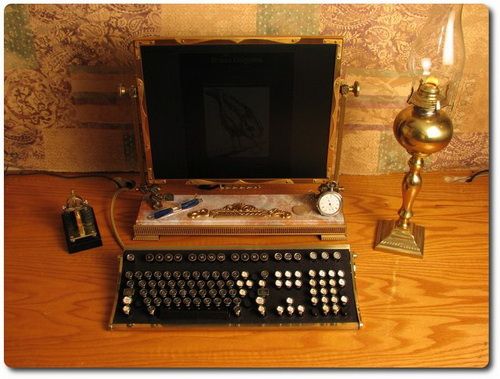
The last time I did one of these hacky “Back To School” posts, I brought up William Gibson for some reason–which gives me a good transition to this excellent steampunk photoset. While Gibson’s novel The Difference Engine (with co-author Bruce Sterling) is often cited as a progenitor of steampunk, many of the images in the set correspond to ideas Gibson put forth in his “Bridge Trilogy” — he envisioned a future of “organic” computers that some of these folks have gone out and made. I’d like one. Jeez, this is really bad writing, but, hey, back to school right. Like that Deftone’s song (yeah, I know the Deftones aren’t cool or hip or whatever, and I’ve never heard one of their albums, but M2 used to play that video all the time when I was in college 10 years ago and I thought it was pretty great).Cheers.

An Ill-dressed, Underfed, Overdrunken Group of Squatters with Minds So Highly Developed That They Were Excused from Good Manners

gaddis_large

I just love this passage from William Gaddis’s The Recognitions. Mocking “hipsterism” has been around forever (or at least 50 years):

And by now they were at the door of the Viareggio, a small Italian bar of nepotistic honesty before it was discovered by exotics. Neighborhood folk still came, in small vanquished numbers and mostly in the afternoon, before the two small dining rooms and the bar were taken over by the educated classes, an ill-dressed, underfed, overdrunken group of squatters with minds so highly developed that they were excused from good manners, tastes so refined in one direction that they were excused for having none in any other, emotions so cultivated that the only aberration was normality, all afloat here on sodden pools of depravity calculated only to manifest the pricelessness of what they were throwing away, the three sexes in two colors, a group of people all mentally and physically the wrong size.

The Recognitions (Part I) — William Gaddis

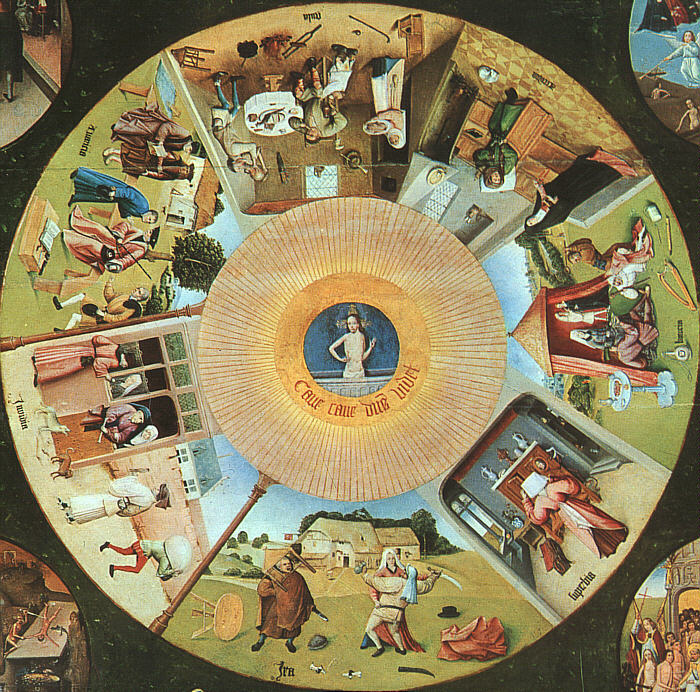
In William Gaddis‘s massive first novel, The Recognitions, Wyatt Gwyon forges paintings by master artists like Hieronymous Bosch, Hugo van der Goes, and Hans Memling. To be more accurate, Wyatt creates new paintings that perfectly replicate not just the style of the old masters, but also the spirit. After aging the pictures, he forges the artist’s signature, and at that point, the painting is no longer an original by Wyatt, but a “new” old original by a long-dead genius. The paintings of the particular artists that Wyatt counterfeits are instructive in understanding, or at least in hoping to understand how The Recognitions works. The paintings of Bosch, Memling, or Dierick Bouts function as highly-allusive tableaux, semiotic constructions that wed religion and mythology to art, genius, and a certain spectacular horror, and, as such, resist any hope of a complete and thorough analysis. Can you imagine, for example, trying to catalog and explain all of the discrete images in Bosch’s triptych, The Garden of Earthly Delights? And then, after creating such a catalog, explaining the intricate relationships between the different parts? You couldn’t, and Gaddis’s novel is the same way. I’ve finished the first of the novel’s three parts, 277 of 956 pages, and I’m going to go out on a limb and guess that the Gaddis has structured the novel as a triptych. The first part, like Bosch’s painting, The Seven Deadly Sins, is comprised of seven sections.

bosch16
The Seven Deadly Sins – Hieronymous Bosch

Early in The Recognitions, teenage Wyatt copies The Seven Deadly Sins–his father owns the original, a painted table top he purchased in Europe. Wyatt replaces the original with his own and gets away with this strange crime–no small feat considering the genius of his father, the Rev. Gwyon, a New England priest who, after the death of his wife at sea, comes to reject the austere puritanism of his order and embrace (much to the consternation of his dwindling congregation) a pluralistic religious world view. In one of many stunning passages centering on Gwyon and religion, the congregation is “stirred with indignant discomfort after listening to the familiar story of virgin birth on December twenty-fifth, mutilation and resurrection, to find they had been attending, not Christ, but Bacchus, Osiris, Krishna, Buddha, Adonis, Marduk, Balder, Attis, Amphion, or Quetzalcoatl.” This series of substitutions enacts a chain of recognitions, and, in a sense, compartmentalizes much of the thematic material of the novel: What is it to be a hero, a redeemer, a savior? What is originality, and how does one recognize it? Who originates whom? What does it mean to create? How is art separate from religion? Clearly, these are not simple questions, and The Recognitions is not a simple book.

Triptych with the Martyrdom of St. Hippolytus -- Dierck Bouts and Hugo van der Goes
Triptych with the Martyrdom of St. Hippolytus — Dierck Bouts and Hugo van der Goes

In order to pose (and perhaps offer varying answers to) these questions, Gaddis employs daring, richly detailed prose, larded with esoteric (and not so esoteric) references to mythology, religion, art, music, and literature. Like the discrete sections of Bosch’s Sins, each of the chapters of the first section of The Recognitions has its own distinct idiom, comportment, and rhythm; yet, even as Gaddis’s approaches seem discontinuous from chapter to chapter, these coalesce to a larger picture.

The first chapter is the best first chapter of any book I can remember reading in recent years. It tells the story of Rev. Gwyon looking for solace in the Catholic monasteries of Spain after his wife’s death at sea under the clumsy hands of a fugitive counterfeiter posing as a doctor (already, the book posits the inherent dangers of forgery, even as it complicates those dangers by asking who isn’t in some sense a phony). There’s a beautiful line Gaddis treads in the first chapter between pain, despair, and melancholy and caustic humor, as Gwyon slowly realizes the false limits of his religion. The chapter continues to tell the story of young Wyatt, growing up under the stern care of his puritanical Aunt May, whose religious attitude is confounded by the increasingly erratic behavior of Wyatt’s often-absent father. While deathly ill, Wyatt teaches himself to paint by copying masterworks. He also attempts an original, a painting of his dead mother, but he cannot bear to finish it because, as he tells his father, “There’s something about . . . an unfinished piece of work . . . Where perfection is still possible. Because it’s there, it’s there all the time, all the time you work trying to uncover it.” This problem of originality, of Platonic perfection guides much of the novel’s critique on Modernism.

memling_oordeel
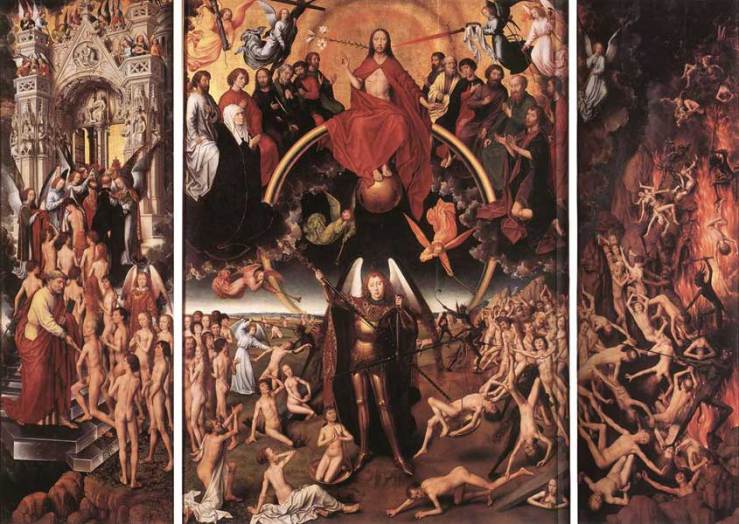
The Last Judgment – Hans Memling

Wyatt studies but ultimately rejects the ministry, opting instead to become an artist. The second chapter finds him in Paris, attempting to sell his original work. The chapter is a bravura shift into the sounds, sights, and consciousness of another world, another distinct mythology–ex-patriot Paris, Hemingway’s Paris, Woolf’s Paris. Gaddis shows a heavy debt to James Joyce‘s innovations in Ulysses here (and throughout the book, of course), although it would be a mistake to reduce the novel to a mere aping of that great work. Rather, The Recognitions seems to continue that High Modernist project, and, arguably, connect it to the (post)modern work of Pynchon, DeLillo, and David Foster Wallace. (In it’s heavy erudition, numerous allusions, and complex voices, the novel readily recalls both W.G. Sebald and Roberto Bolaño as far as I’m concerned). By the third chapter we find Wyatt married, quite unhappily, producing hack work, copies he lets his boss put his name on. The chapter is painful and often ugly, as we see his marriage disintegrate. In this chapter he meets Recktall Brown, the Mephistophelean business man who will arrange Wyatt’s future career as a counterfeiter of original paintings. As the chapter ends, Wyatt is no longer referred to by his name, a device that continues throughout the rest of part one (and perhaps the whole book). It’s as if he’s lost something intrinsic, some core originality in exchange for the ability to “become” the artist he is emulating. Wyatt now disintegrates into the background of the narrative, and is exchanged for a young Harvard grad named Otto. Otto follows Wyatt around like a puppy, writing down whatever he says, absorbing whatever he can from him, and eventually sleeping with his wife. Otto is the worst kind of poseur; he travels to Central America to finish his play only to lend the mediocre (at best) work some authenticity, or at least buzz. He fakes an injury and cultivates a wild appearance he hopes will give him artistic mystique among the Bohemian Greenwich Villagers he hopes to impress. In the fifth chapter, at an art-party, Otto, and the reader, learn quickly that no one cares about his play–everyone’s busy making their own original art. Gaddis’s evocation of a Village party in the late forties/early fifties here is wonderful, fly-on-the-wall stuff. His rhetoric captures the buzzing musicality of a raucous house party, and even if his mockery of the assembled artists, critics, and wannabes is savage, it’s also loving. Gaddis has an astute ear for the mid-twentieth century, where gossip infiltrates debate on aesthetics, and commercials punctuate classical scores on the radio.

Wyatt (unnamed) returns for the seventh (and longest) chapter of part one. He’s been very successful at his work, although he seems not to care at all for the money he’s making. Instead, he seems obsessed with channeling these ancient masters, for only in this pre-modern world is originality possible. Of course, the levels of irony are confounding here: Wyatt’s only access to originality is to pretend to be another person. The originality of the paintings he creates is subject to the condition that they be not original to him (their creator) but to another. While this attack on Modernity–namely, that originality is impossible–is severe, it’s also worth noting that Gaddis’s writing enacts originality, even as it cobbles together disparate sources. This is what makes the novel such an addictive pleasure to read. While I cannot make any final claims about a novel before finishing it, I will go out on another limb and suggest that those who already own this novel and have not yet made a crack at it for fear of its massive size and allusive structure should go ahead and take it up: it’s dark, erudite, sad, and very, very funny. It’s also not that hard to read, and if the allusions get too dense, there’s always Steven Moore‘s fantastic resource, A Reader’s Guide to William Gaddis’s The Recognitions, now available in its entirety online. Have at it. More when I finish Part II.

No Great Book Is Explicable

About the same time I was finishing up James Wood’s How Fiction Works, I was also beginning William Gaddis‘s massive tome The Recognitions. So far the book is fantastic–I’m about 180 pages in–but it’s (very, very) long and there’s a big stack of upcoming releases here that needs to be digested for review, so who knows if I’ll finish it anytime soon. Anyway, I thought this notation from William H. Gass‘s brilliant introduction does a fantastic job of speaking to both the limits of literary criticisms (like Wood’s) as well as underscoring the value of reading–and rereading:

No great book is explicable, and I shall not attempt to explain this one. An explanation–indeed, any explanation–would defile it, for reduction is precisely what a work of art opposes. Easy answers, convenient summaries, quiz questions, annotations, arrows, highlight lines, lists of its references, the numbers of its sources, echoes, and influences, an outline of its design–useful as sometimes such helps are–nevertheless seriously mislead. Guidebooks are useful, but only to what is past. Interpretation replaces the original with the lamest sort of substitute. It tames, disarms. “Okay, I get it,” we say, dusting our hands, “and that takes care of that.” “At least I understand Kafka” is a foolish and conceited remark.

Philip Guston Literally Paints Gass
Philip Guston Literally Paints William H. Gass