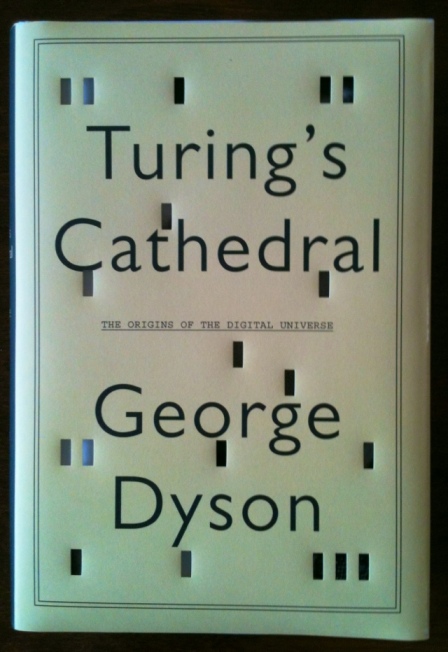
Turing’s Cathedral — George Dyson Explores the Origins of the Digital Universe (Book Acquired, 2.17.2012)

20120225-111107.jpg

George Dyson’s Turing’s Cathedral looks pretty cool. Here’s some copy from publisher Pantheon:

“It is possible to invent a single machine which can be used to compute any computable sequence,” twenty-four-year-old Alan Turing announced in 1936. In Turing’s Cathedral, George Dyson focuses on a small group of men and women, led by John von Neumann at the Institute for Advanced Study in Princeton, New Jersey, who built one of the first computers to realize Alan Turing’s vision of a Universal Machine. Their work would break the distinction between numbers that mean things and numbers that do things—and our universe would never be the same.

Using five kilobytes of memory (the amount allocated to displaying the cursor on a computer desktop of today), they achieved unprecedented success in both weather prediction and nuclear weapons design, while tackling, in their spare time, problems ranging from the evolution of viruses to the evolution of stars.

Dyson’s account, both historic and prophetic, sheds important new light on how the digital universe exploded in the aftermath of World War II. The proliferation of both codes and machines was paralleled by two historic developments: the decoding of self-replicating sequences in biology and the invention of the hydrogen bomb. It’s no coincidence that the most destructive and the most constructive of human inventions appeared at exactly the same time.

How did code take over the world? In retracing how Alan Turing’s one-dimensional model became John von Neumann’s two-dimensional implementation, Turing’s Cathedral offers a series of provocative suggestions as to where the digital universe, now fully three-dimensional, may be heading next.

I spent an hour with the book this morning and found it engrossing. (It was also a reminder that I don’t read enough nonfiction).

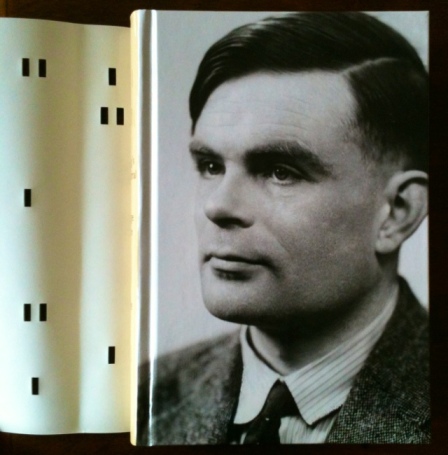
Regular readers will know I despise dust jackets—I’d rather see publisher’s put their efforts into handsome but simple hardback covers. Three out of the last four hardbacks to come in have done so, including Turing’s Cathedral:

20120225-111151.jpg

Still, the design concept for these books (Alain de Botton’s Religion for Atheists and Thomas Mallon’s Watergate are the other two) still involve an integration with the dust jacket. I’d like to see the dust jacket dusted, done away with, expired.

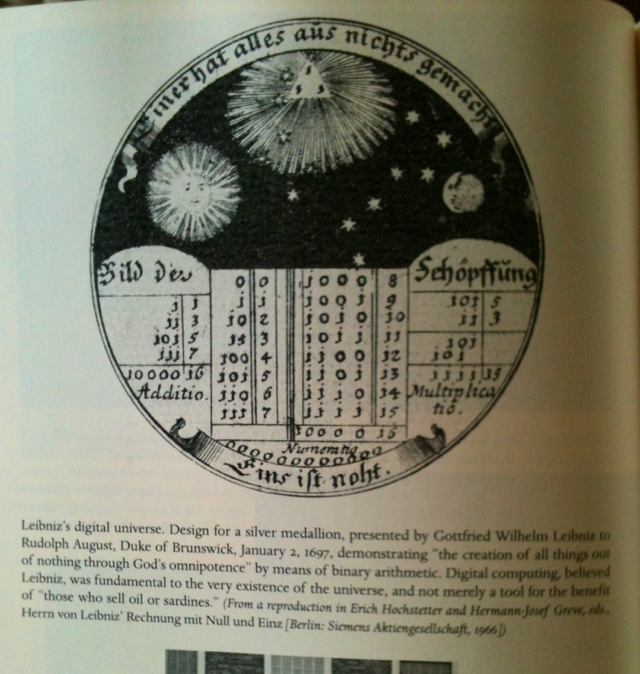
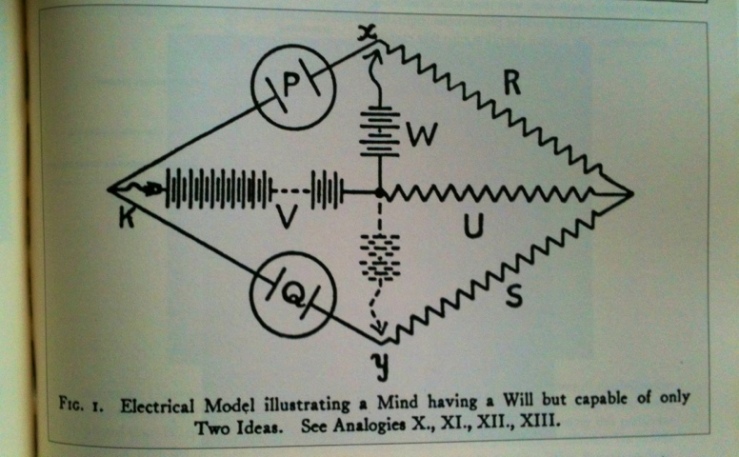
Some cool pics from the Dyson:

20120225-111159.jpg

20120225-111207.jpg

A Model Toward Helping Children Read Better

Umberto Eco’s Semiotic Schema for the Word “Neanderthal”

20120221-174318.jpg

(From The Role of the Reader by Umberto Eco) 

Alain de Botton’s Religion for Atheists: A Facile Self-Help Book that Entirely Misses the Point of Free Thinking

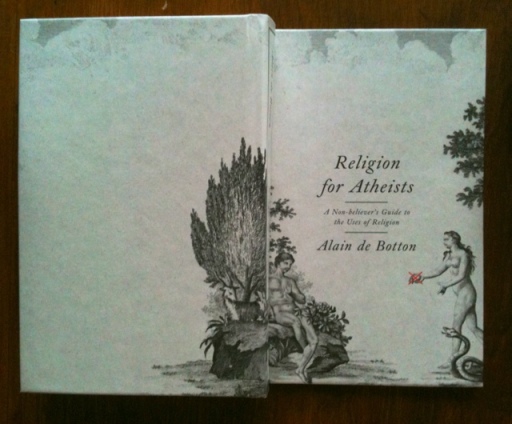
I’m slightly familiar with Alain de Botton’s work, and I’ve taken something of an interest in the so-called “New Atheist” movement — Hitchens, Dawkins, et al — so when a review copy of Religion for Atheists showed up a few weeks ago, it piqued my interest. I found its cover playfully annoying—a hole in the holy book—and its subtitle—A Non-believer’s Guide to the Uses of Religion—downright obnoxious. Still, I gotta give props to the design team at Pantheon for the book that’s under the horrid jacket: 

20120218-101910.jpg

Unfortunately, an attractive hardback design sans jacket is the best this book has to offer.

By way of explication (and my own laziness and indifference on this volume) here’s some copy on the book from de Botton’s website:

What if religions are neither all true or all nonsense? The boring debate between fundamentalist believers and non-believers is finally moved on by Alain’s inspiring new book, which boldly argues that the supernatural claims of religion are of course entirely false – and yet that religions still have some very important things to teach the secular world.

Religion for Atheists suggests that rather than mocking religions, agnostics and atheists should instead steal from them – because they’re packed with good ideas on how we might live and arrange our societies. Blending deep respect with total impiety, Alain (a non-believer himself) proposes that we should look to religions for insights into, among other concerns, how to:

– build a sense of community

– make our relationships last

– overcome feelings of envy and inadequacy

– escape the twenty-four hour media

– go travelling

– get more out of art, architecture and music

– and create new businesses designed to address our emotional needs.

For too long non-believers have faced a stark choice between either swallowing lots of peculiar doctrines or doing away with a range of consoling and beautiful rituals and ideas. At last, in Religion for Atheists, Alain has fashioned a far more interesting and truly helpful alternative.

The tone of the copy gives one a sense of the utter glibness of de Botton’s pamphlet. The book smacks of crude self-helpery, a hodgepodge of faux-intellectual poses for those who can smugly dismiss the history of philosophy. It’s like The Purpose Driven Life for atheists. There is a picture or graphic on every other page; de Botton seems to include these in lieu of, say, providing verbal imagery, or meaningful context, or simply trusting the intellect of his audience.

I suppose that I am fundamentally at odds with de Botton. I agree that religion has done much to initiate and facilitate (and in fairness, perhaps at times mitigate) atrocity; I agree that many (if not most) of the Big Problems in the world stem from the herd-mentality that organized religions impose on the people they indoctrinate. But de Botton would like to replace one herd with another.

Here is the Swiss writer suggesting that the academy (which he too-readily identifies as a bastion of atheist mores) follow the practices of black Southern Baptist churches:

The contrast with the typical lecture in the humanities could hardly be more damning. And unnecessary. What purpose can possibly be served by the academy’s primness? How much more expansive the scope of meaning in Montaigne’s essays would seem if a 100-strong and transported chorus were to voice its approval after every sentence. How much longer might Rousseau’s philosophical truths linger in our consciousness if they were structured around rhythmical verses of call-and-response. Secular education will never succeed in reaching its potential until humanities lecturers are sent to be trained by African-American Pentecostal preachers.

What we see here is a romanticization and idealization of a particular part of a culture that I think de Botton in no way understands. What’s even more disturbing here is his elevation of groupthink and indoctrination practices (I hear, “Oh no, I don’t want to play with Delta children” humming in the background). We see here the same teleological thinking that marks much of religious dogma, the sense that truth has been attained; the search is over—we just need to repeat it rhythmically enough, soak our young in it, until they think just like we do. This position strikes me as potentially dangerous as any organized religion’s attempts at indoctrination.

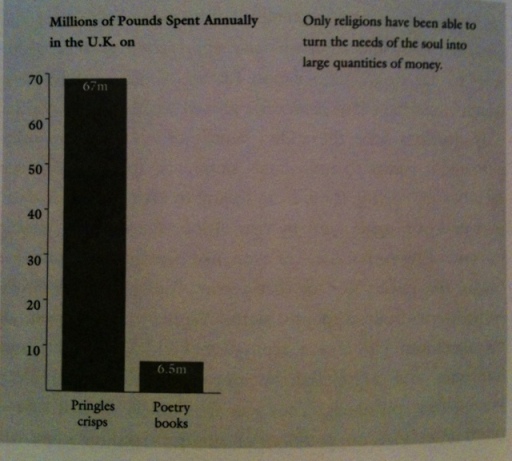
Religion for Atheists is full of sloppy logic gussied up in rushed anecdotes and glossed over with barely-connected pictures and silly graphs. Look at the following example, a visual non sequitur masquerading as meaningful information:

20120223-180200.jpg

Are we supposed to be horrified that the British spend more on potato chips than poetry books? Apples and oranges, bro. But what’s really ridiculous is the stinky pious claim that “Only religions have been able to turn the needs of the soul into large quantities of money.” This claim is plain silly, or at least predicated on a too-singular definition for “needs of the soul.”

Religion for Atheists seems to miss the point that many (if not most) atheists and agnostics are at heart free thinkers. De Botton romanticizes the mystery, awe, and grace of religion, even as he suggests that there is no metaphysical center from which these attributes emanate. His most basic argument really boils down to something like, “Hey, there is no God, no spirit, but religion does a good job of consoling people and keeping them in moral order, so, instead of TV and junk food, we should use the aesthetics of religion as consolation.” There is nothing revolutionary about this idea.

Religion for Atheists is a smug little tract, the sort of book that a supermarket would sell along with Chicken Soup for the Soul if supermarkets had the guts to sell self-help books for atheists. Readers should not be duped into thinking that de Botton has taken any real stance or said anything new here. Instead, hiding behind the pasteboard mask of utility, he offers a crass dodge away from meaningful inquiry. Get thee to Nietzsche instead.

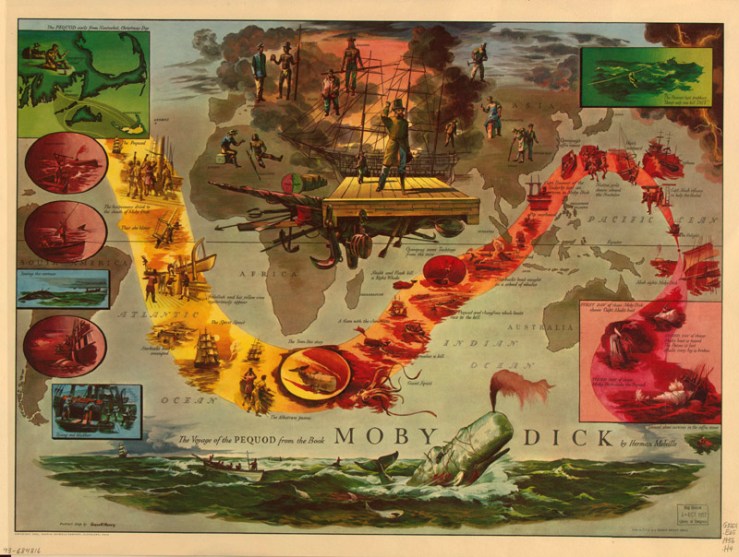
Voyage of the Pequod — A Map of Moby-Dick by Everett Henry

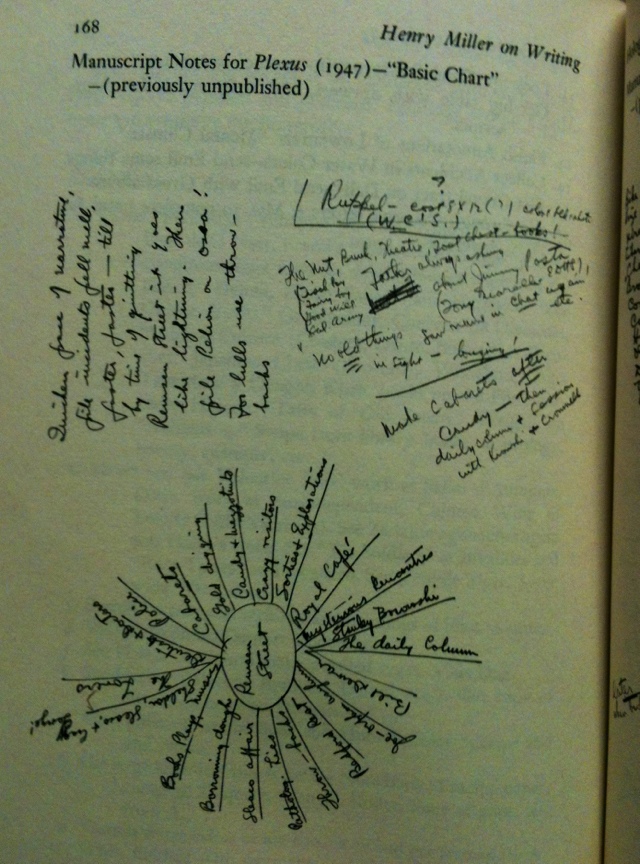
Henry Miller’s Basic Chart of Plexus

20120125-160448.jpg

(From Henry Miller on Writing, New Directions).

Buckminster Fuller Rambles Beautifully About Death

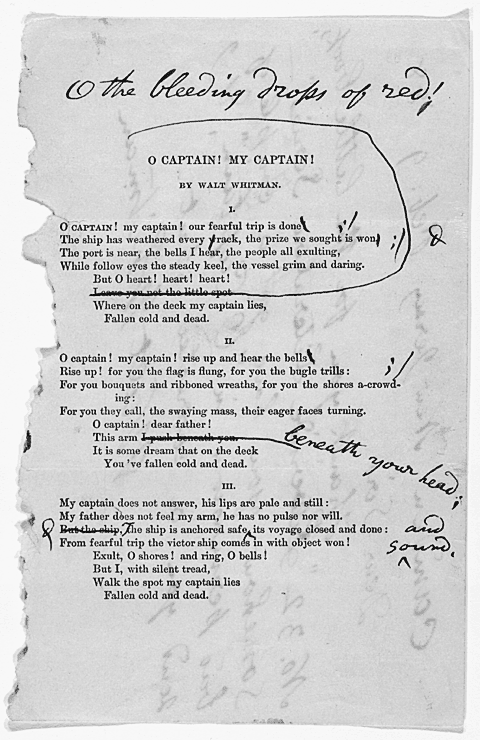
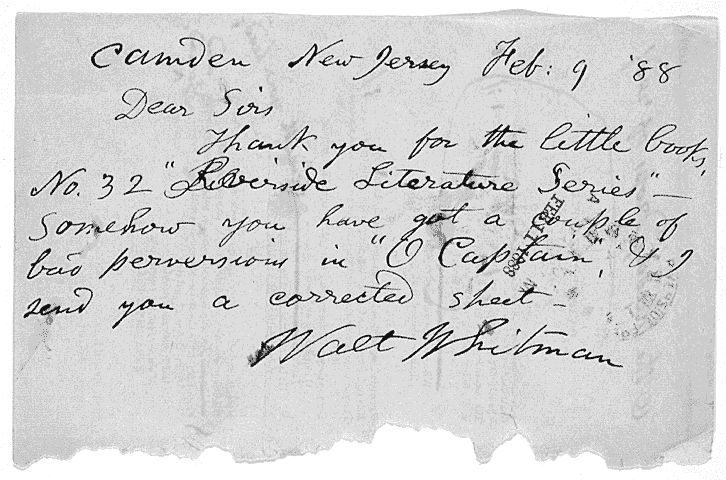
Letter and Corrected Reprint of Walt Whitman’s “O Captain, My Captain” with Comments by Author

(Via/more).

Ned Flanders Reads Harry Potter

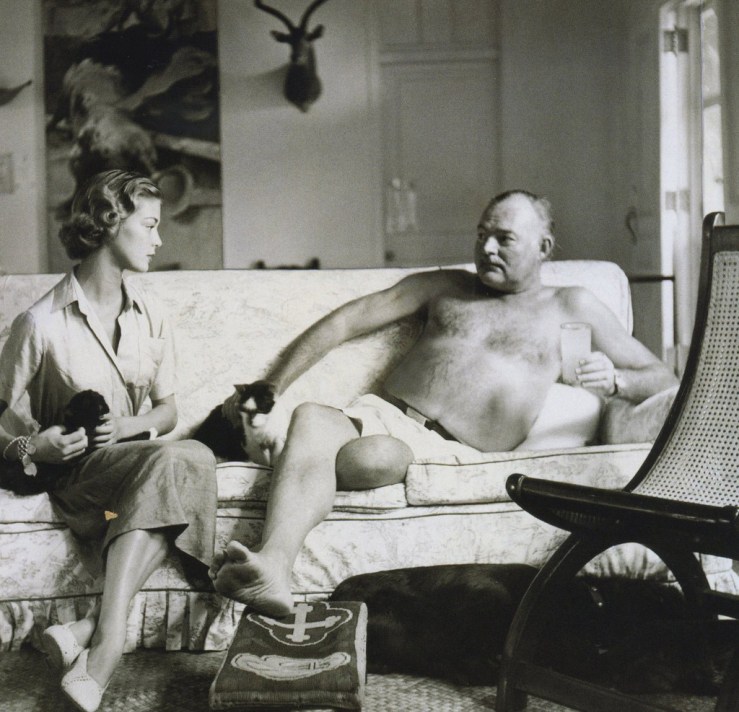
Topless Hemingway, Part IV

Pictured with Jean Patchett, Cuba, 1950

Siphonophorae — Ernst Haeckel

Alan Moore Talks Apocalypse (Video)

“My Tone Is Not Meant to Be Obnoxious. I Am in a State of Shock” — Flannery O’Connor Responds to an English Professor

From a 1961 letter by Flannery O’Connor to an English professor, who wrote her asking for an interpretation of her story “A Good Man Is Hard to Find.” In his letter, the professor concludes that the second half of the story is imaginary, an interpretation that seems to give Ms. O’Connor the vapors:

   The interpretation of your ninety students and three teachers is fantastic and about as far from my intentions as it could get to be.  If it were a legitimate interpretation, the story would be little more than a trick and its interest would be simply for abnormal psychology.  I am not interested in abnormal psychology.

There is a change of tension from the first part of the story to the second where the Misfit enters, but this is no lessening of reality.  This story is, of course, not meant to be realistic in the sense that it portrays the everyday doings of people in Georgia.  It is stylized and its conventions are comic even though its meaning is serious.

Bailey’s only importance is as the Grandmother’s boy and the driver of the car.  It is the Grandmother who first recognized the Misfit and who is most concerned with him throughout.  The story is a duel of sorts between the Grandmother and her superficial beliefs and the Misfit’s more profoundly felt involvement with Christ’s action which set the world off balance for him.

The meaning of a story should go on expanding for the reader the more he thinks about it, but meaning cannot be captured in an interpretation.  If teachers are in the habit of approaching a story as if it were a research problem for which any answer is believable so long as it is not obvious, then I think students will never learn to enjoy fiction.  Too much interpretation is certainly worse than too little, and where feeling for a story is absent, theory will not supply it.

My tone is not meant to be obnoxious.  I am in a state of shock.

Kurt Vonnegut on Story Shapes (Video)

I’d seen the diagrams, which I’ve used in the classroom for a few years now (along with Margaret Atwood’s excellent short short “Happy Endings”) but never seen this video (metaphorical hat tip to ‘klept reader ccllyyddee, who says he saw it at Curiosity Counts—cheers!).

Teju Cole’s Open City Is a Strange, Marvelous Novel That Captures the Post-9/11 Zeitgeist

“And so when I began to go on evening walks last fall . . .” begins Julius, the perspicacious narrator of Teju Cole’s admirable and excellent début Open City. That opening “And” is significant, an immediate signal to the reader that this novel will refuse to align itself along (or even against) traditional arcs of plot and character development. We will meet Julius in media res, and we will leave him there, and along the way there will be learning and suffering and compassion and strange bubbles of ambiguity that threaten to burst out of the narrative.

As noted, Open City begins with Julius’s peripatetic voyages; he walks the night streets of New York City to ostensibly relieve the “tightly regulated mental environment of work.” Julius is completing his psychiatry fellowship at a hospital, and the work takes a toll on him, whether he admits it or not. In these night walks—and elsewhere and always throughout the novel—Julius shares his sharp observations, both concrete and historical. No detail is too small for his fine lens, nor does he fail to link these details to the raw information that rumbles through his mind: riffs on biology, history, art, music, philosophy, and psychology interweave the narrative. Julius maps the terrain of New York City against its strange, mutating history; like a 21st century Ishmael, he attempts to measure it in every facet—its architecture, its rhythms, its spirit. And if there is one thread that ties Julius’s riffs together it is the nightmare of history:

But atrocity is nothing new, not to humans, not to animals. The difference is that in our time it is uniquely well organized, carried out with pens, train carriages, ledgers, barbed wire, work camps, gas. And this late contribution, the absence of bodies. No bodies were visible, except the falling ones, on the day America’s ticker stopped.

Open City is the best 9/11 novel I’ve read, but it doesn’t set out to be a 9/11 novel, nor does it dwell on that day. Instead, Cole captures something of the post-9/11 zeitgeist, and at the same time situates it in historical context. When Julius remarks on the recent past, the concrete data of history writhes under the surface. He remarks that the 9/11 attack on the World Trade Center “was not the first erasure on the site,” and goes on to detail the 1960s cityscapes that preceded the WTC. Before those, there was Washington Market. Then Julius embarks, via imagination, into the pre-Colombian space of the people we now call Indians or Native Americans. “I wanted to find the line that connected me to my own part in these stories,” he concludes, peering at the non-site that simultaneously anchors these memory-spaces.

Julius’s line, like the lines that comprise New York City (and perhaps, if we feel the spirit of its democratic project, America itself) is a mixed one, heterogeneous and multicultural. Julius’s father, now dead, was an important man in Nigeria, where Julius enjoyed a relatively privileged childhood. Julius’s mother—they are now estranged—is German. He remarks repeatedly about his German grandmother’s own displacements during WWII, reflecting at one point that, from a historical perspective, it was likely impossible that she escaped Cossack rape.

Even though he sometimes seems reticent to do so, Julius delves into the strange violence that marks his lineage. He recalls a childhood fascination with Idi Amin; as a boy, he and his cousins would watch the gory film The Rise and Fall of Idi Amin repeatedly: ” . . . we enjoyed the shock of it, its powerful and stylized realism and each time we had nothing to do, we watched the film again.”

Fascinated horror evinces repeatedly in Open City. In just one example, Julius believes he sees “the body of a lynched man dangling from a tree”; as he moves closer to inspect, he realizes that it is merely canvas floating from a construction scaffold. Perhaps so attuned to history’s grand catalog of spectacular atrocity, Julius finds it lurking in places where it does not necessarily evince.

In turn, despite his profession as psychiatrist, Julius is wary of human sympathy. Throughout the novel, dark-skinned men engage him by calling him “brother.” He almost always deflects these attempts at connection, and internally remarks them as fatuous, or naïve, or false. This is not to say though that Julius doesn’t make significant (if often transitory) connections.

One of the organizing principles of Open City comes in the form of Julius’s infrequent visits to the home of his former English professor, Dr. Saito, who is slowly dying. Saito’s own memories float into Julius—this technique repeats throughout the novel—and we learn that he was interned as a young man during WWII; the sad fact is another ugly kink in the line of American history that Julius attempts to trace.

Julius also befriends Dr. Maillotte, an aging surgeon on a flight to Brussels, where he spends a few weeks of Christmas vacation, ostensibly looking for his oma (a task he performs half-heartedly at best). As Julius daydreams, Dr. Maillotte, European émigré, finds a place within his vision of family members and friends:

I saw her at fifteen, in September 1944, sitting on a rampart in the Brussels sun, delirious with happiness at the invaders’ retreat. I saw Junichiro Saito on the same day, aged thirty-one or thirty-two, unhappy, in internment, in an arid room in a fenced compound in Idaho, far away from his books. Out there on that day, also, were all four of my own grandparents: the Nigerians, the Germans. Three were gone by now, for sure. But what of the fourth, my oma? I saw them all, even the one I had never seen in real life, saw all of them in the middle of that day in September sixty-two years ago, with their eyes open as if shut, mercifully seeing nothing of the brutal half century ahead and better yet, hardly anything at all of all that was happening in their world, the corpse-filled cities, camps, beaches, and fields, the unspeakable worldwide disorder that very moment.

In Brussels, Julius meets Farouq, an angry young man with intellectual, Marxist tendencies. Farouq believes in a theory of “difference” and finds himself at odds with both the dominant Belgian culture and with Western culture in general. Julius’s conversations with Farouq are a highlight of the novel; they help to further contextualize the drama of diaspora in the post-9/11 world. Later, Julius finds a counterweight to some of Farouq’s extreme positions over a late lunch with Dr. Maillotte, who suggests that “For people to feel that they alone have suffered, it is very dangerous.” There’s a sense of reserved moderation to her critique—not outright dismissal nor condemnation, but simply a recognition that there are “an endless variety of difficulties in the world.”

Julius seems to tacitly agree with Maillotte’s assessment. His reluctance to accept brotherhood based on skin color alone speaks to a deeper rejection of simplicity, of tribe mentality, of homogeneity; it also highlights his essential alienation. At the same time, he’s acutely aware of how skin color matters, how identity can be thrust upon people, despite what claims to agency we might make. In search of the line that will connect him to his part of the American story, Julius finds unlikely “brothers” in Farouq, Maillotte, and Saito.

But let us not attribute to Julius a greater spirit than Cole affords him: Open City is a novel rich in ambiguity, with Julius’s own personal failures the most ambiguous element of all. While this is hardly a novel that revolves on plot twists, I hesitate to illustrate my point further for fear of clouding other readers’ perceptions; suffice to say that part of the strange, cruel pleasure of Open City is tracing the gaps in Julius’s character, his failures as a professional healer—and his failures to remark or reflect upon these failures.

But isn’t this the way for all of us? If history is a nightmare that we try to awake from—or, more aptly in a post-9/11 world, a nightmare that we awake to, to paraphrase Slavoj Žižek—then there is also the consolation and danger that time will free us from the memory of so much atrocity, that our collective memory will allow those concrete details to slip away, replaced with larger emblems and avatars that neatly smooth out all the wrinkles of ambiguity. “I wondered if indeed it was that simple, if time was so free with memory, so generous with pardons, that writing well could come to stand in the place of an ethical life,” Julius wonders at one point; later, Saito points out that “There are towns whose names evoke a real horror in you because you have learned to link those names with atrocities, but, for the generation that follows yours, those names will mean nothing; forgetting doesn’t take long.” Julius’s mission then is to witness and remark upon the historical realities, the nitty-gritty details that we slowly edge out of the greater narrative. And Cole? Well, he gives us a novel that calls attention to these concrete details while simultaneously exploring the dangerous subjectivity behind any storytelling.

If it needs to be said: Yes, Open City recalls the work of W.G. Sebald, who crammed his books with riffs on history and melancholy reflections on memory and identity. And yes, Open City is flâneur literature, like Sebald (and Joyce, and Bolaño, perhaps). But Cole’s work here does not merely approximate Sebald’s, nor is it to be defined in its departures. Cole gives us an original synthesis, a marvelous and strange novel about history and memory, self and other. It’s a rich text, the sort of book one wants to immediately press on a friend, saying, Hey, you there, read this, we need to talk about this. Very highly recommended.

Open City is new in trade paperpack from Random House.

Gertrude Stein Next to Her Portrait (Portrait by Picasso; Photo by Man Ray; Commentary by David Markson)

In The Last NovelDavid Markson offers the following citations re: Picasso, Stein, Man Ray (citations not in Markson’s (anti-)order):

Gertrude Stein once delighted Picasso by reporting that a collector had been dumbfounded, years afterward, to hear that Picasso had given her her portrait as a gift, rather than asking payment.

Not understanding that that early in Picasso’s career, the difference had been next to negligible.

Among the many paintings in her Paris flat, Gertrude Stein had two exceptional Picassos.

If there were a fire, and I could save only one picture, it would be those two. Unquote.

Picasso. Cézanne. Matisse. Braque. Bonnard. Renoir.

All of whom painted portraits of Ambroise Vollard.

Cartier-Bresson. Brassaï. Man Ray. Lee Miller. Robert Doisneau. Robert Capa. David Douglas Duncan. Cecil Beaton.

All of whom photographed Picasso.

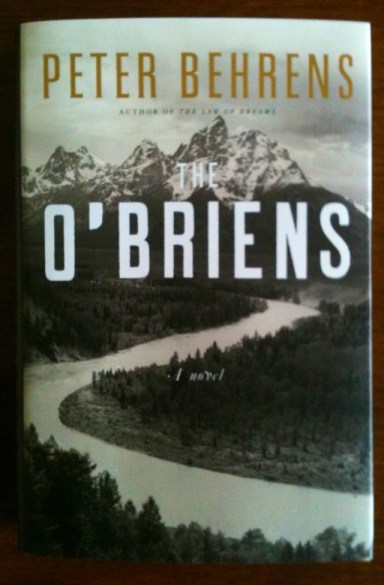
Book Acquired, 2.15.2012

20120218-101830.jpg

Peter Behren’s The O’Briens. 

An unforgettable saga of love, loss, and exhilarating change spanning half a century in the lives of a restless family, from the author of the acclaimed novel The Law of Dreams.
 
The O’Briens is a family story unlike any told before, a tale that pours straight from the heart of a splendid, tragic, ambitious clan. In Joe O’Brien—grandson of a potato-famine emigrant, and a backwoods boy, railroad magnate, patriarch, brooding soul—Peter Behrens gives us a fiercely compelling man who exchanges isolation and poverty in the Canadian wilds for a share in the dazzling riches and consuming sorrows of the twentieth century.

When Joe meets Iseult Wilkins in Venice, California, the story of their courtship—told in Behrens’s gorgeous, honed style—becomes the first movement in a symphony of the generations. Husband and wife, brothers, sisters-in-law, children and grandchildren, the O’Briens engage unselfconsciously with their century, and we experience their times not as historical tableaux but as lives passionately lived. At the heart of this clan—at the heart of the novel—is mystery and madness grounded in the history of Irish sorrow. The O’Briens is the story of a man, a marriage, and a family, told with epic precision and wondrous imagination.