“Smile” (O Lucky Man!)

“Authenticity’s Wiped Out” — A Passage from William Gaddis’s Last Novel, Agapē Agape

William Gaddis’s last novel Agapē Agape is a bitter, funny rant, a monologic stream-of-consciousness that, through its extreme powers of synthesis, spills over into heteroglossic eruptions, a carnival of erudite voices. Driven by terrible physical pain, hints of madness, and, most of all, the need to “explain all this” before he dies, the voice of the novel (surely Gaddis himself) channels cultural historian Johan Huizinga and philosopher Walter Benjamin into a conversation about the conflict of art and commerce set against the backdrop of the rise of mass culture:

. . . falls right into line doesn’t it, collapse of authenticity collapse of religion collapse of values what Huizinga called one of the most important phases in the history of civilization, and Walter Benjamin picks it up in his Art in the Age of Mechanical Reproduction in this heap somewhere, the authentic work of art is based in ritual he says, and wait Mr. Benjamin, got to get in there the romantic mid-eighteenth century aesthetic pleasure in the worship of art was the privilege of the few. I was saying, Mr. Huizinga, that the authentic work of art had its base in ritual, and mass reproduction freed it from this parasitical dependence. Ah, quite so Mr. Benjamin quite so, turn of the century religion was losing its steam and art came in as its substitute would you say? Absolutely Mr. Huizinga, and I’d add that this massive technical reproduction of works of art could be manipulated, changed the way the masses looked at art and manipulated them. Inadvertently Mr. Benjamin you might say that art now became public property, for the simply educated Mona Lisa and the Last Supper became calendar art to hang over the kitchen sink. Absolutely Mr. Huizinga, Paul Valery saw it coming, visual and auditory images brought into homes from far away like water gas and electricity and finally, God help us all, the television. Positively Mr. Benjamin, with mechanization, advertising artworks made directly for a market what America’s all about. Always has been, Mr. Huizinga. Always has been, Mr. Benjamin. Everything becomes an item of commerce and the market names the price. And the price becomes the criterion for everything. Absolutely Mr. Huizinga! Authenticity’s wiped out when the uniqueness of every reality is overcome by the acceptance of its reproduction, so art is designed for its reproducibility. Give them the choice, Mr. Benjamin, and the mass will always choose the fake. Choose the fake, Mr. Huizinga! Authenticity’s wiped out, it’s wiped out Mr. Benjamin. Wiped out, Mr. Huizinga. Choose the fake, Mr. Benjamin. Absolutely, Mr. Huizinga! Positively Mr. Benjamowww! Good God! a way to find a sharp pencil just sit still avoid stress stop singing what, anybody heard me they’d think I was losing my, that I’d lost it yes maybe I have . . .

A Pictorial Chart of English Literature

(Via the Library of Congress).

Book Acquired, 4.14.2012

20120417-113551.jpg

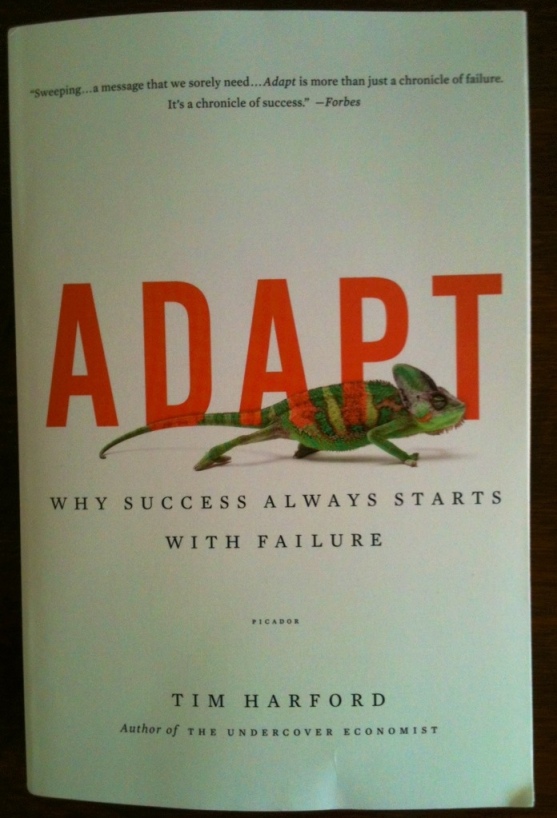
Adapt by Tim Harford. New from Picador. Their description:

In this groundbreaking book, Tim Harford, the Undercover Economist, shows us a new and inspiring approach to solving the most pressing problems in our lives. When faced with complex situations, we have all become accustomed to looking to our leaders to set out a plan of action and blaze a path to success. Harford argues that today’s challenges simply cannot be tackled with ready-made solutions and expert opinion; the world has become far too unpredictable and profoundly complex. Instead, we must adapt.

Deftly weaving together psychology, evolutionary biology, anthropology, physics, and economics, along with the compelling story of hard-won lessons learned in the field, Harford makes a passionate case for the importance of adaptive trial and error in tackling issues such as climate change, poverty, and financial crises—as well as in fostering innovation and creativity in our business and personal lives.

Taking us from corporate boardrooms to the deserts of Iraq, Adapt clearly explains the necessary ingredients for turning failure into success. It is a breakthrough handbook for surviving—and prospering— in our complex and ever-shifting world.

“Mount Hood” (Live) — Hauschka

“A Wounded Deer—leaps highest— ” — Emily Dickinson

A poem by Emily Dickinson:

A Wounded Deer—leaps highest—
I’ve heard the Hunter tell—
‘Tis but the Ecstasy of death
And then the Brake is still!

The Smitten Rock that gushes!
The trampled Steel that springs!
A Cheek is always redder
Just where the Hectic stings!

Mirth is the Mail of Anguish
In which it Cautious Arm,
Lest anybody spy the blood
And “you’re hurt” exclaim!

The Head Drifts Toward the Bottom (Fletcher Hanks)

(More/via).

“A Snake Is Afraid of a Man That Is Naked,” and Other Great Occult Tips on Animals (Heinrich Cornelius Agrippa von Nettesheim)

From Heinrich Cornelius Agrippa von Nettesheim’s Three Books of Occult Philosophy or Magic, (1533)

The bird called bustard flies away at the sight of a horse, and a hart runs away at the sight of a ram, as also of a viper.

An elephant trembles at the hearing of the grunting of a hog, so doth a lion at the sight of a cock; and panthers will not touch them that are anointed all over with the broth of a hen, especially if garlic hath been boiled in it.

There is also enmity betwixt foxes and swans, bulls and jackdaws.

Amongst birds, also, some are at perpetual strife one with another, as also with other animals, as jackdaws and owls, the kite and crows, the turtle and ring-tail, egepis and eagles, harts and dragons.

Also amongst water animals there is enmity, as betwixt dolphins and whirlpools, mullets and pikes, lampreys and congers.

Also the fish called pourcontrel makes the lobster so much afraid that the lobster, seeing the other but near him, is struck dead.

The lobster and conger tear one the other.

The civet cat is said to stand so in awe of the panther that he hath no power to resist him or touch his skin; and they say that if the skins of both of them be hanged up one against the other, the hairs of the panther’s skin fall off.

And Orus Apollo saith in his hieroglyphics, if any one be girt about with the skin of the civet cat that he may pass safely through the middle of his enemies and not at all be afraid.

Also the lamb is very much afraid of the wolf and flies from him. And they say that if the tail or skin or head of a wolf be hanged upon the sheep-coate the sheep are much troubled and cannot eat their meat for fear.

And Pliny makes mention of a bird, called marlin, that breaks crows’ eggs, whose young are so annoyed by the fox that she also will pinch and pull the fox’s whelps, and the fox herself also; which when the crows see, they help the fox against her, as against a common enemy.

The little bird called a linnet, living in thistles, hates asses, because they eat the flowers of thistles.

Also there is such a bitter enmity betwixt the little bird called esalon and the ass that their blood will not mix together, and that at the braying of the ass both the eggs and young of the esalon perish.

There is also such a disagreement betwixt the olive-tree and a wanton, that if she plant it, it will either be always unfruitful or altogether wither.

A lion fears nothing so much as fired torches, and will be tamed by nothing so much as by these; and the wolf fears neither sword nor spear, but a stone—by the throwing of which, a wound being made, worms breed in the wolf.

A horse fears a camel so that he cannot endure to see so much as his picture.

An elephant, when he rageth, is quieted by seeing of a cock.

A snake is afraid of a man that is naked, but pursues a man that is clothed.

A mad bull is tamed by being tied to a fig-tree.

(NB: I took the editorial liberty of turning Agrippa’s marvelous paragraphs into a list, which I think reads a bit better, or at least more absurdly).

Bill Plympton’s Simpsons Couch Gag

Keith Miller’s The Book on Fire, A Tale of Biblioklepts, Bibliophiles, and Bibliomania

Balthazar, the hero of Keith Miller’s agile and trippy novel The Book on Fire, is a biblioklept. He comes to Alexandria to rob the famous library, a cavernous, labyrinthine complex that still exists–under heavy guard—in Miller’s mystical version of that ancient Egyptian city. Miller’s Alexandria is a byzantine maze, humming with a turn-of-the-century buzz, a kaleidoscope world that strongly reminded me of the strange cityscapes of William Gibson or William Burroughs. Here, Balthazar describes his attraction to Alexandria:
This is the city of books, where children are admonished if they don’t bring a book to the breakfast table, where they’re ordered by their mothers to drop their books and go play on the street, where bedtime tales sometimes continue, chapter after chapter, till well after midnight, parents pinching their children to keep them awake. This is a city where men beat their wives with books, the women shielding their heads with books. A city of book-whores, who fuck for books, and their bibliogiglios. A city of book-beggars, who spit on your money, gesturing with their stumps to the paperback in your hand.

What a town for a book thief! Balthazar plans to rob the Library of Alexandria, but he spends his early months stealing rare books from private homes. Soon, he’s trailed by Zeinab, a book prostitute who burns each volume she’s paid with. After a sexual interlude (“like fucking a wounded ferret,” Balthazar tells us), Zeinab introduces our hero to a guild of thieves and helps guide him through Alexandria’s frenetic underworld. In time, Balthazar breaches the forbidden, intoxicating library:

I read impossibly gorgeous scripts. Scripts in which each hieroglyph filled a page and took a day to write, but could express an entire philosophy. Scripts in which each letter stood for a notion, so the writing dictated thought patterns rather than words. Scripts that had no meaning at all, or that started out meaningfully but then, as the author was caught up in the physical act of writing, became relationships of lines and shapes on paper, beautiful and abstract. Private scripts, the authors long dead, so the script stood isolated, unreadable precious nonetheless. Rainforest scripts of samara and turaco crest. Marine scripts of shark tooth and sand dollar. I passed through rooms of books the size of doors, each cover the death of an eland, and rooms of books dainty as ladybirds. Books written on communion wafers, grains of rice, sheets of ice.

For Balthazar, books are a drug, and the Library of Alexandria is the heady nexus point for his addiction. No wonder then that he becomes obsessed with the young librarian Shireen, whom he plots to free (or perhaps steal) from the library—a plan that comes into conflict with Zeinab’s own designs. And while The Book of Fire does have the strong, page turning plot of a thriller, that plot exists mostly as the bones for Miller to hang rapturous descriptions of reading and books and, best of all, his strange Alexandria, a city of marvels. Good stuff.

“Hitler and Nietzsche” — Ricky Gervais

People in the Sun — Edward Hopper

“Well, the evening began at the Gentleman’s club, where we were discussing Wittgenstein over a game of backgammon”

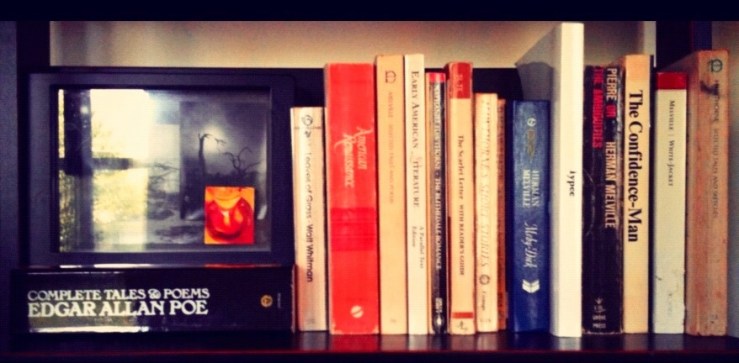
Book Shelves #16, 4.15.2012

20120415-113741.jpg

Book shelves series #16, sixteenth Sunday of 2012.

It’s hard to photograph books, and using an iPhone 3gs probably doesn’t help. Lots of glare. Anyway: This shelf houses mostly Melville, with some Hawthorne, Poe, and Whitman, as well as some critical works on the American Renaissance movement. (Henry James and F.O. Matthiessen). I have other versions of a lot of these books, including a fraternal twin in my office, a bit bulkier (Emerson, Dickinson, Thoreau, etc.), although these days I’m apt to go to the Kindle for American Renaissance stuff. Here’s a better angle, perhaps:

20120415-113756.jpg

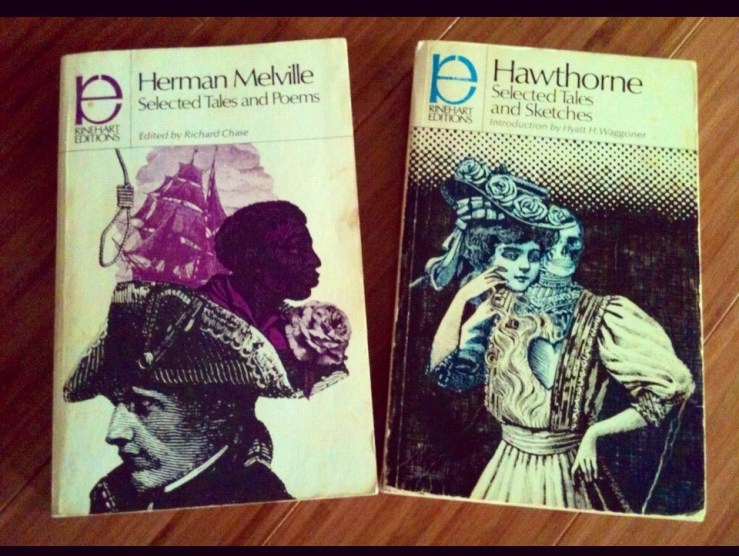
The version of Typee is bizarre: no colophon, no publisher info, just text. I love these midcentury Rinehart Editions of Hathorne and Melville stuff:

20120415-113807.jpg

“Rhetoric” — A Page from James Joyce’s Notebooks

This page is from a notebook that contains some of Joyce’s preparatory notes for Ulysses—there are notes for characters (“Stephen,” “Simon,” “Leopold,” etc.) as well as lists (“Books,” “Recipes”) and general ideas (“Theosophy”). This particular page, “Rhetoric,” seems to be part of the material that went into the “Aeolus” chapter of Ulysses, which plays with the windiness of rhetorical figures. From the National Library of Ireland, via UbuWeb.

Roberto Bolaño’s The Secret of Evil (Book Acquired, 4.09.2012)

20120414-140951.jpg

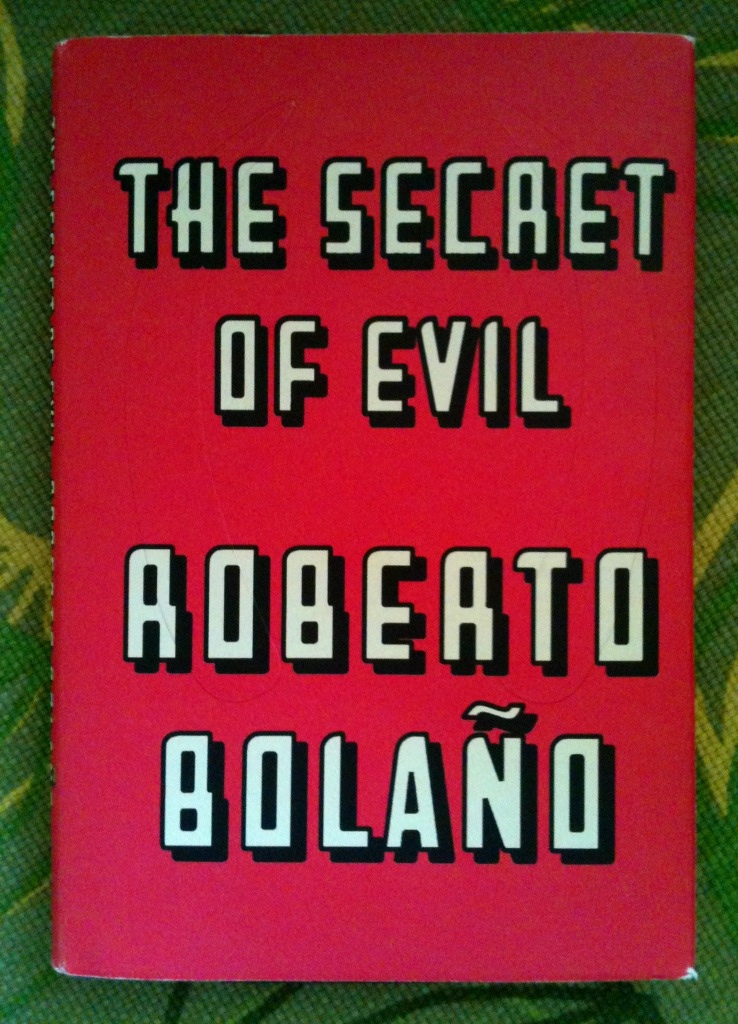
How you react to a “new” book by Roberto Bolaño at this point is probably dependent on how much you love or loathe his work—although I imagine those indifferent to or unfamiliar with his writing might be unduly put off by this point at the volume of material that this writer drops posthumously [insert Tupac joke here].

I’m a fan though, so I’m excited about The Secret of Evil, even if the material collected here is in part unfinished . . . although, as Ignacio Echevarria points out in his introduction, all of Bolaño’s “narratives, not just The Secret of Evil, seem to be governed by a poetics of inconclusiveness.” A few of the pieces in Evil have already been excerpted, and I read a few this weekend (who can resist a Bolaño text called “Crimes”?), and while some pieces here are sketchier than others, there’s that preponderance of life force that we expect from late period Bolaño, from a man who seemed to pour what was left of himself into his words and sentences.

From publisher New Directions’ website:

Opening this book is like being granted access to the Chilean master’s personal files. Included in this one-of-a-kind collection is everything Roberto Bolaño was working on just before his death in 2003, and everything that he wanted to share with his readers. Fans of his writing will find familiar characters in new settings, and entirely new stories and styles, too.

A North American journalist in Paris is woken at 4 a.m. by a mysterious caller with urgent information. Daniela de Montecristo (familiar to readers of Nazi Literature in the Americas and 2666) recounts the loss of her virginity. Arturo Belano returns to Mexico City and meets the last disciples of Ulises Lima, who play in a band called The Asshole of Morelos. Belano’s son Gerónimo disappears in Berlin during the Days of Chaos in 2005. Memories of a return to the native land; Argentine writers as gangsters; zombie schlock as allegory…and much more.

“Fluck you fluck you fluck you” — Tangier Transmission from William Burroughs, 1964

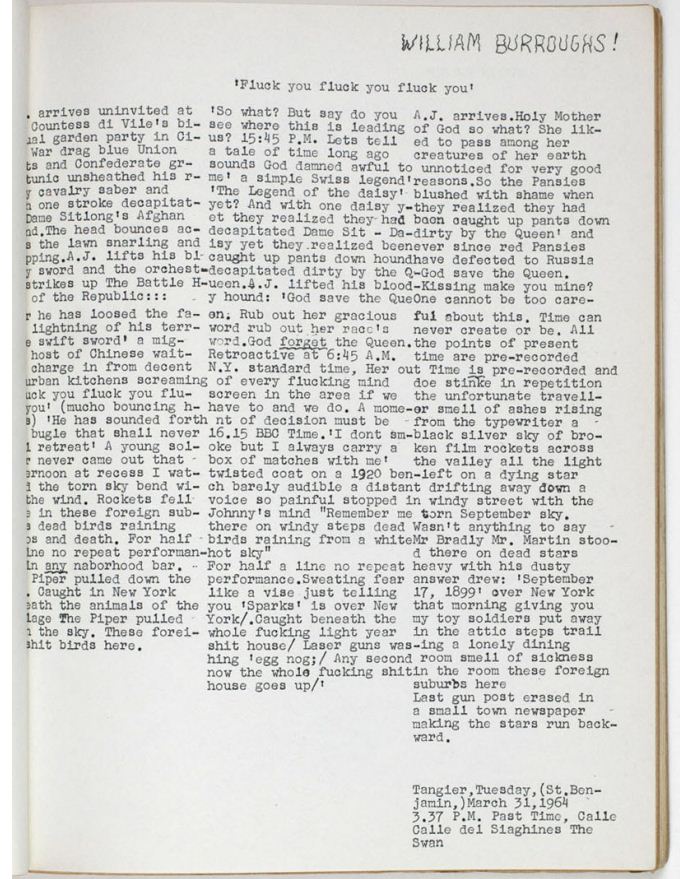
From Number 5, Vol. 7 of Fuck You, (1964) a mimeograph magazine from editor Ed Sanders. The magazine featured Allen Ginsberg, Tuli Kupferberg, Frank O’Hara and more. There’s a fantastic visual archive of Fuck You at Reality Studio, which is where I got this Burroughs layout.