
Category: Books
Consider Gérard de Nerval’s Pet Lobster
I’ve been reading Michel Houellebecq’s latest novel The Map and the Territory on my Kindle Fire, which is handy because I can easily hover my index over an unknown reference and figure out what Mich-dawg is getting at. Anyway, near the beginning of Part III, H-bomb drops a reference to French Romantic poet and essayist Gérard de Nerval, whom I will cop to not recognizing. But the detail seemed significant, so let my index finger hover I did, but, no dice, Nervs wasn’t in the preloaded dictionary—so I went to the next option: Le Wikipedia. And here’s a snapshot of what I saw:
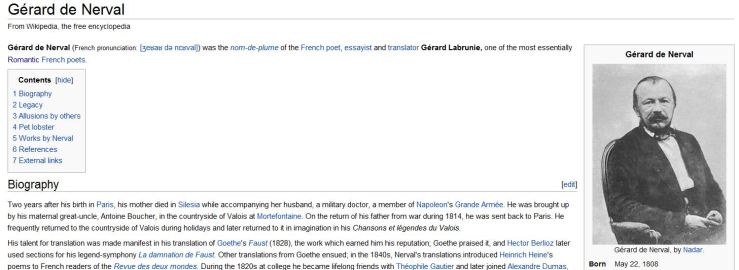
The man’s life is divided into seven neat sections there on Wikipedia, and what’s right square in the middle? Pet lobster. Holmes had a pet lobster:

I’m guessing if you know about Nerval you probably know about his lobsterkins, but I didn’t. Harper’s ran a piece about Nerval and his lobster back ’08. From the piece:
With all due respect for cats, however, let us consider the case for the humble lobster. The poet Gérard de Nerval had a penchant for lobsters, or at least for one lobster. Nerval was seen one day taking his pet lobster for a walk in the gardens of the Palais-Royal in Paris. He conducted his crustacean about at the end of a long blue ribbon. As word of this feat of eccentricity spread, Nerval was challenged to explain himself. “And what,” he said, “could be quite so ridiculous as making a dog, a cat, a gazelle, a lion or any other beast follow one about. I have affection for lobsters. They are tranquil, serious and they know the secrets of the sea.” (The episode is captured by Guillaume Apollinaire in a collection of anecdotes from 1911). Was there any basis to this story? A generation of Nerval scholars attempted to debunk it, but then a letter to his childhood friend Laura LeBeau was discovered. Nerval had just returned from some days at the seaside at the Atlantic coastal town of La Rochelle: “and so, dear Laura, upon my regaining the town square I was accosted by the mayor who demanded that I should make a full and frank apology for stealing from the lobster nets. I will not bore you with the rest of the story, but suffice to say that reparations were made, and little Thibault is now here with me in the city…” Nerval, it seems, had liberated Thibault the lobster from certain death in a pot of boiling water and brought him home to Paris. Thus we know that it was Thibault, and not just “some lobster,” who went for that celebrated promenade in the gardens of the Palais-Royal.
Book Shelves #11, 3.11.2012

Book shelves series #11, eleventh Sunday of 2012. DeLillo, Denis Johnson, Pynchon (no, I have not read Against the Day nor finished Mason & Dixon). There’s also a hardback copy of Bolaño’s Between Parentheses; I have an ARC of the same shelved with the other Bolaños, which are on the shelf under—but the finished copy won’t fit on the shelf and it fits here. For now.
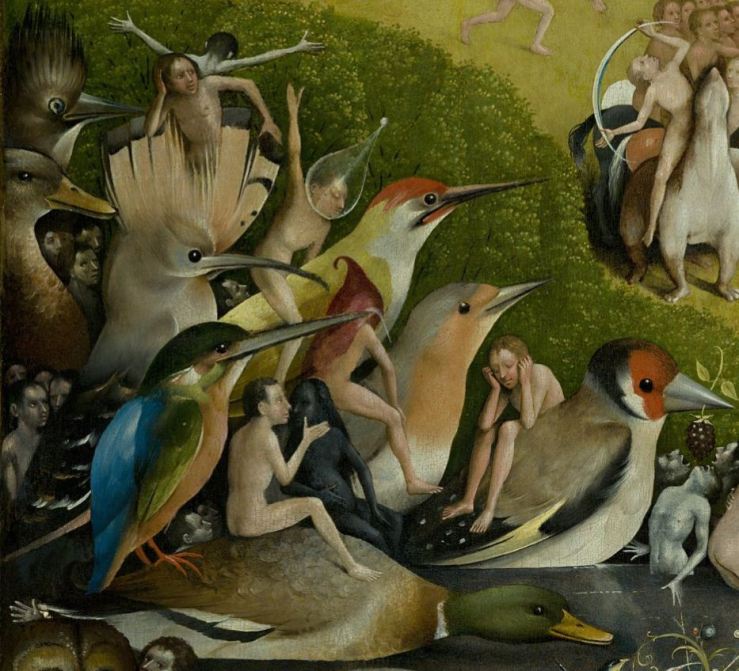
Bosch Birds
When General Grant Expelled the Jews (Book Acquired, 3.06.2012)

When General Grant Expelled the Jews is new from historian Jonathan D. Sarna (and Shocken books). From Harold Holzer’s review at The Washington Post:
. . . no historian has been able to fully understand — much less justify — why, on Dec. 17, 1862, Grant issued his notorious General Orders No. 11 deporting Jewish citizens. “The Jews, as a class violating every regulation of trade,” went the chilling text, “. . . are hereby expelled from [his command in the West] within twenty-four hours.” Those returning would be “held in confinement until an opportunity occurs of sending them out as prisoners.” Just two weeks before Abraham Lincoln was scheduled to extend freedom to one minority group with the Emancipation Proclamation, his most promising general thus initiated a virtual pogrom against another.
In the end, as the gifted and resourceful historian Jonathan D. Sarna points out in this compelling page-turner, General Orders No. 11 uprooted fewer than 100 Jews. But for a few weeks, he suggests, it terrorized and infuriated the Union’s entire Jewish population. It also inspired one of the community’s first effective lobbying campaigns. Jewish newspapers compared Grant to Haman, the infamous vizier of Persia in the Book of Esther. A delegation of Jewish leaders traveled to the White House to protest directly to the president, who quickly but quietly had the order revoked, eager to right a wrong but reluctant to humiliate a valuable military commander. As Lincoln carefully put it, “I do not like to hear a class or nationality condemned on account of a few sinners.” He never mentioned the episode publicly.
Moebius Penciling and Inking Blueberry (Video)
RIP Jean Giraud aka Moebius

French comic book legend Jean Giraud, also known as Moebius, died today in Paris at 73.

Although Giraud’s work is more famous in Europe, and particularly France and Belgium, where comics tend to get more of the artistic esteem they deserve, his influence on contemporary American comics and sci-fi film design should not be underestimated.
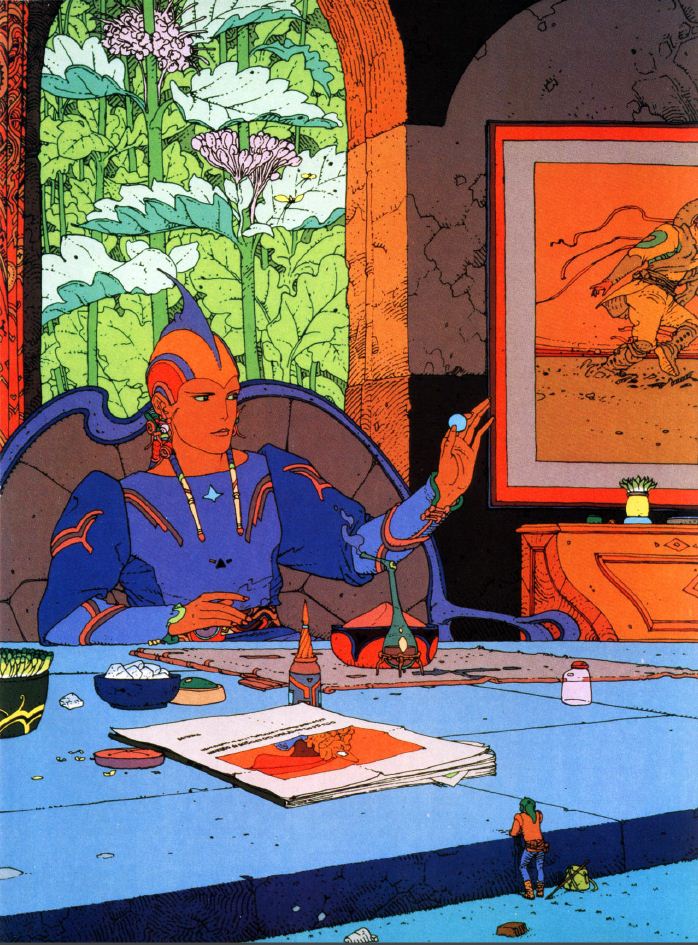
His take on Wild West culture is exemplified in what is likely his largest body of work Blueberry, but folks new to Giraud might wish to start with The Airtight Garage (or just check out this cool gallery).
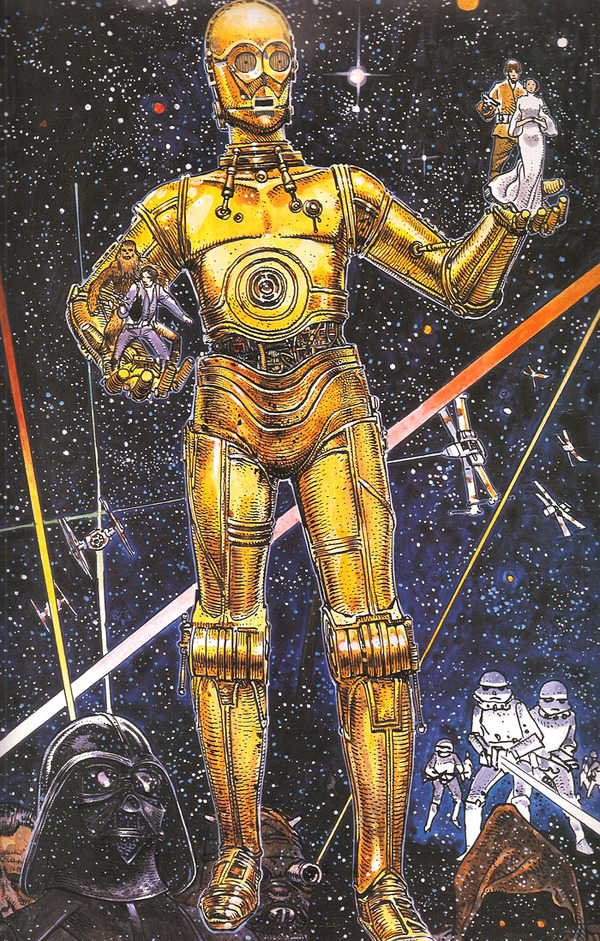
Giraud/Moebius was never simply a genre artist; instead, his work taps into the mythological, exploring themes that seem at once both strangely familiar but also wildly divergent from our expectations. His imaginative disruptions made him a key partner for film directors like Alejandro Jodorowsky; he also worked on the art team behind Alien, among other films, like The Abyss, Willow, and Tron. Giraud was also close friends with Hayao Miyazaki.
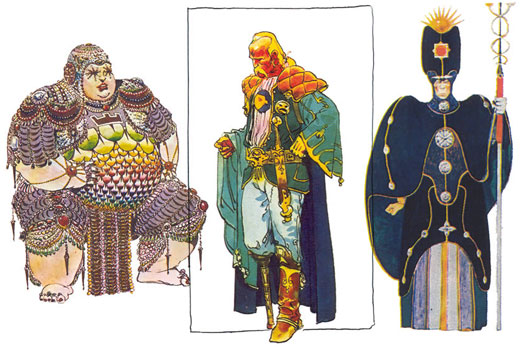
Giraud leaves a rich, vibrant legacy. The imaginative spaces of his worlds will undoubtedly captivate generations to come.
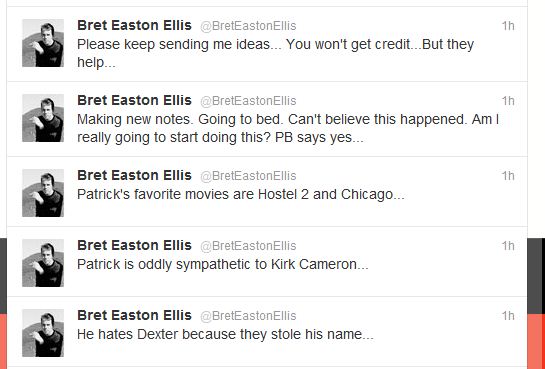
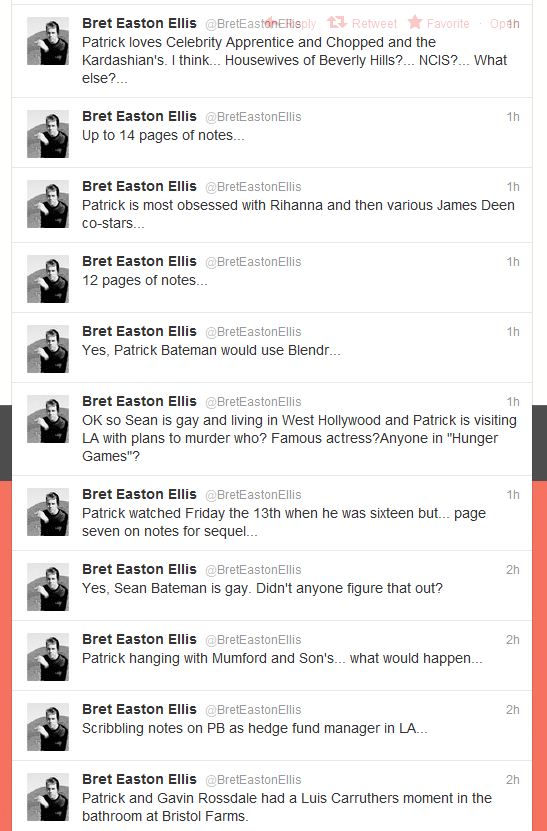
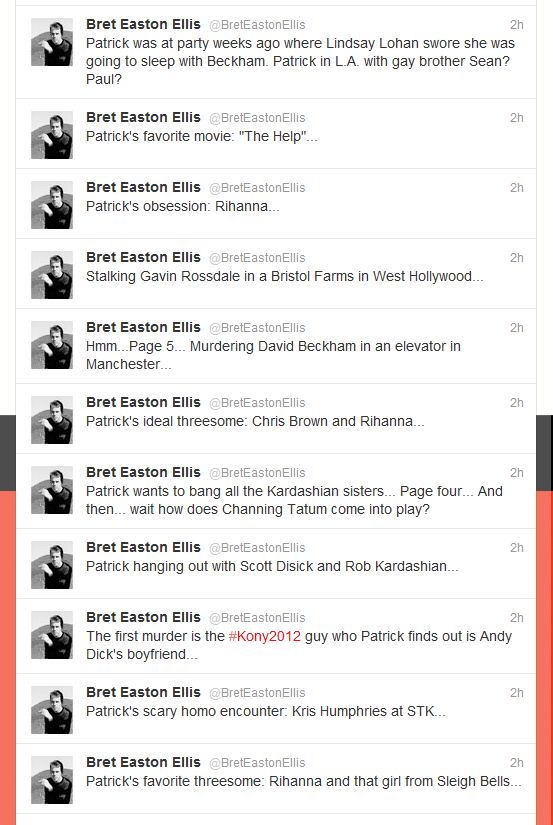
Bret Easton Ellis’s Notes for an American Psycho Sequel (From Twitter, Of Course)


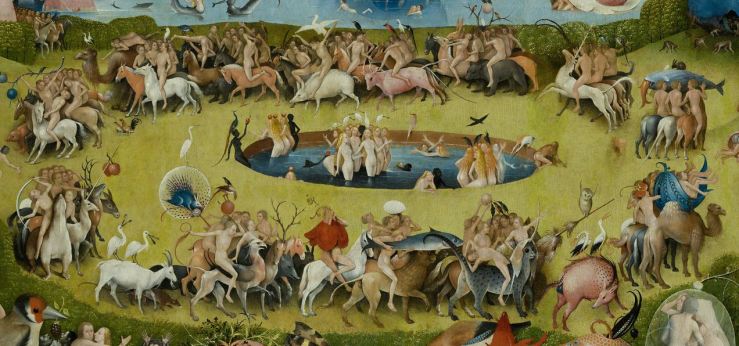
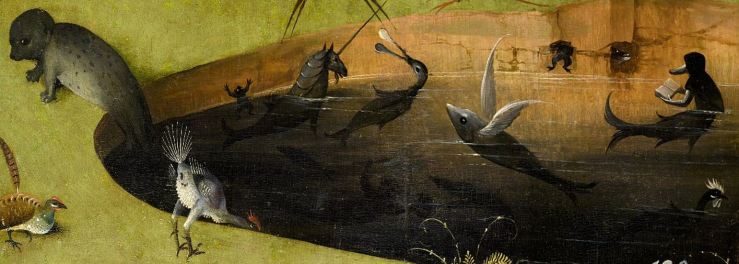
Mermaid Reading (Detail from Bosch’s Garden of Earthly Delights)
Natural Bridge Tale
From Charles M. Skinner’s Myths And Legends of Our Own Land (1896):
Though several natural bridges are known in this country, there is but one that is famous the world over, and that is the one which spans Clear Creek, Virginia—the remnant of a cave-roof, all the rest of the cavern having collapsed. It is two hundred and fifteen feet above the water, and is a solid mass of rock forty feet thick, one hundred feet wide, and ninety feet in span. Thomas Jefferson owned it; George Washington scaled its side and carved his name on the rock a foot higher than any one else. Here, too, came the youth who wanted to cut his name above Washington’s, and who found, to his horror, when half-way up, that he must keep on, for he had left no resting-places for his feet at safe and reachable distances—who, therefore, climbed on and on, cutting handhold and foothold in the limestone until he reached the top, in a fainting state, his knife-blade worn to a stump. Here, too, in another tunnel of the cavern, flows Lost River, that all must return to, at some time, if they drink of it. Here, beneath the arch, is the dark stain, so like a flying eagle that the French officer who saw it during the Revolution augured from it a success for the united arms of the nations that used the eagle as their symbol. The Mohegans knew this wonder of natural masonry, for to this point they were pursued by a hostile tribe, and on reaching the gulf found themselves on the edge of a precipice that was too steep at that point to descend. Behind them was the foe; before them, the chasm. At the suggestion of one of their medicine-men they joined in a prayer to the Great Spirit for deliverance, and when again they looked about them, there stood the bridge. Their women were hurried over; then, like so many Horatii, they formed across this dizzy highway and gave battle. Encouraged by the knowledge that they had a safe retreat in case of being overmastered, they fought with such heart that the enemy was defeated, and the grateful Mohegans named the place the Bridge of God.
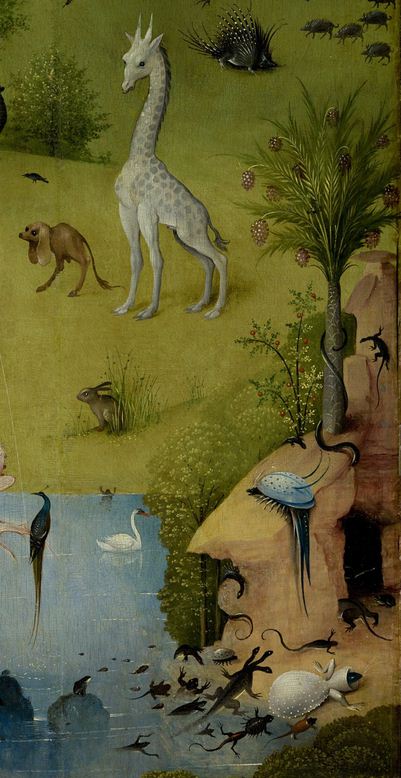
Detail from The Joining of Adam and Eve — Hieronymous Bosch
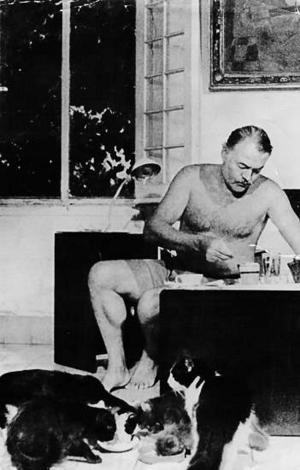
Topless Hemingway, Part VII
“Of the Foure Elementes Where They Shoulde Sone Be Founde” (A Tale from The Old-English Jest Book)
A tale of the four elements from The Old-English Jest Book, a volume supposedly owned and used by William Shakespeare:
In the old world when all thyng could speke, the iiii elementys mette to geder for many thynges whych they had to do, because they must meddell alway one wyth a nother, and had communicacion to gyder of dyuers maters; and by cause they coulde not conclude all theyr maters at that season, they appoyntyd to breke communicacion for that tyme and to mete agayne another tyme. Therfore eche one of them shewed to other where theyr most abydyng was and where theyr felows shoulde fynde them, yf nede shuld requyre; and fyrste the erthe sayde: bretherne, ye knowe well as for me I am permanent alway and not remouable; therfore ye may be sure to haue me alway whan ye lyste. The wather sayde: yf ye lyst to seke me, ye shall be sure to haue me under a toft of grene rushes or elles in a womans eye. The wynde sayde: yf ye lyst to speke wyth me, ye shall be sure to haue me among aspyn leuys or els in a womans tong. Then quod the fyre: yf any of you lyst to seke me, ye shall euer be sure to fynd me in a flynt stone er elles in a womans harte.
By thys tale ye may lerne as well the properte of the iiii elementys as the properteis of a woman.
All of David Markson’s References in The Last Novel to Walt Whitman
All of David Markson’s references in The Last Novel to Walt Whiman:
I am he that aches with amorous love. Wrote Whitman.
Walter, leave off.
Wrote D. H. Lawrence.
Walt Whitman’s claim — never in any way verified — that he had fathered at least six illegitimate children.
Gerard Manley Hopkins, on realizing that he feels a certain kinship with Whitman:
As he is a very great scoundrel this is not a very pleasant confession.
A writer of something occasionally like English — and a man of something occasionally like genius.
Swinburne called Whitman.
Future generations will regard Bob Dylan with the awe reserved for Blake, Whitman, Picasso and the like.
Said an otherwise seemingly rational writer named Jonathan Lethem.
Before the Euro, the portrait of Yeats on Ireland’s twenty-pound note.
America’s Whitman twenty-dollar bill, when?
The Melville ten?
Twenty-five years after his death, Poe’s remains were disinterred from what had been little better than a pauper’s grave and reburied more formally.
Walt Whitman, who made the journey from Camden to Baltimore in spite of being disabled from a recent stroke, was the only literary figure to appear at the ceremonies.
Salvador Dali & Amanda Lear (French TV,1967)
I Review House of Holes, Nicholson Baker’s Ovidian Raunchfest

In his Paris Review interview, Nicholson Baker says that “one of the questions House of Holes is trying to answer” is: is “there still a point to writing words about sex when you can see anything you want, and a lot of things you don’t want to see, on the Web?” The book answers a goofy, gooey, bright-hearted “yes” to this question, unfolding its pornographic vignettes in a surreal Ovidian holiday, a midsummer’s night sexfest that sails lusty and smiling over the borders of morality, social convention, and plain old biology. Baker creates an organic, oozing world where genitalia is swapped freely between lovers, where one might exchange an arm for a bigger dick, where old tattoos get fucked away, where a woman and a tree can make sweet, sweet love:
She looked out from her high-splayed vantage and she said, “I’m a treefucking woman!” Dappled sunlight shone and emptied itself onto her. She squeezed her Kegeling love muscle around the smooth, thickened branch within, and when the wind came up again all the leaves twittered and shook. The tree itself shuddered: It was having some kind of orgasm.
If it seems like I’m getting ahead of myself, citing text before outlining plot, I assure you I’m not: There really isn’t much of a plot to House of Holes. Well, if there is one, it’s something like this: Lila, a large-breasted madame runs The House of Holes, an equal-opportunity brothel/fantasy factory that can only be accessed through portals that appear in strange spaces. This pornographic Arcadia operates on slippery wet-dream logic in which strangers cheerfully and eagerly engage in all sorts of raunch. Characters of varying physical attributes screw their way through a surreal holiday. There are a few conflicts, most of which are too light to touch on (this is a light book, for sure).
Two conflicts stand out with some (slight) weight though:
First, there’s the Pornmonster, “a personification of polymorphousness unlike anything the world of human suck-fuckery has ever known.” The Pornmonster is the mutant offspring of all the bad porn slurry collected on a pornsucking mission (don’t ask). The Pornmonster is typical of Baker’s tone throughout House of Holes, and its polymorphousness embodies the book’s depictions of sexual metamorphoses. This monster is tamed through playful, loving lust, and becomes a good guy, its raw sexual energy redirected for the forces of good (i.e., good sex). This is a book full of good guys.
Second, there’s the Pearloiner, an embittered, sexually-jealous TSA agent who steals clitorises (two of our heroines are afflicted by this heinous crime). The Pearloiner is a product of post-Homeland Security draconian measures, and her inclusion is about as close to contemporary culture criticism that House of Holes approaches. Sexy fun times interest Baker more.
Like the Pornmonster, the Pearloiner finds herself redeemed at the end of the book; moral shifts of allegiance are as easy as physical transformations in House of Holes. The Pearloiner and the Pornmonster alike atone their sins with a facile simplicity that fits the ludic silliness of Baker’s book. They are invited to participate in the handjob contest that (quite literally) climaxes the book. It’s an easy, orgasmic end to an easy, orgasmic book.
In some ways, House of Holes is more remarkable for what it’s not. Most of the so-called pornographic literature (or literature of pornography, if you prefer) that I’ve read has a darker streak. (I’m thinking of Anaïs Nin, Henry Miller, de Sade,The Story of O, Alan Moore’s The Lost Girls, etc.). Holes shares Willliam Burroughs’s sense of surreal transmogrification and picaresque rambling and J.G. Ballard’s infatuation with the bizarre intersections of sex and technology, but it’s never sinister or cruel, or honestly, even disturbing.
“House of Holes is a fundamentally good-natured book,” suggests Baker in his Paris Review interview, also pointing out that it’s a work of “crazy joy”—and he’s absolutely right: The book is joyous, good-natured, affable even. When Baker approaches a remotely Sadean cuckold fantasy he punctures it with a politeness that’s humorous—but he also dramatically lowers any stakes that may have been in play. In short, this is a novel of pure fun, of infinite gain and no loss (quite literally—Lose an arm? Get it back. Lose a clit? Get it back). Holes is silky and slippery and light, more ephemeral than ethereal in the end.
But shame on me. I seem to be faulting the book for not doing something it never sets out to do (namely, I seem to be faulting Holes for a lack of depravity and depth and darkness, three “d’s” the book’s rubric never sets out to register). It’s pure fantasy stuff, reminiscent of the partner-swapping exercise A Midsummer Night’s Dream (I am not saying Baker is Shakespeare) or the erotic shifts in Metamorphoses (ditto: Baker is no Ovid) or the voluptuous Victorian serial The Pearl: dreamy, and perhaps (small r) romantic, but not turbulent—sure, Holes will ruffle unwitting feathers (let’s be clear, it’s pointedly sexually graphic), but it’s unlikely to damage anyone’s soul. (If you’re worried about soul-damage, check out the editorial style-sheet for Holes, which lays out Baker’s invented porn-lexicon).
Is House of Holes a novel or a flimsy pornographic riff? Baker is less interested in ideas than he is in sensations, or rather representations of sensations (which is the most literature can do anyway, I suppose). Holes is unwilling to offer any answers or explications about the deep mysteries behind human desire, but it does pose questions about those desires, and it poses those questions with shameless glee. A fun, breezy read.
“It Must Be Done in a Way It Cannot Be Taught” — John Cage
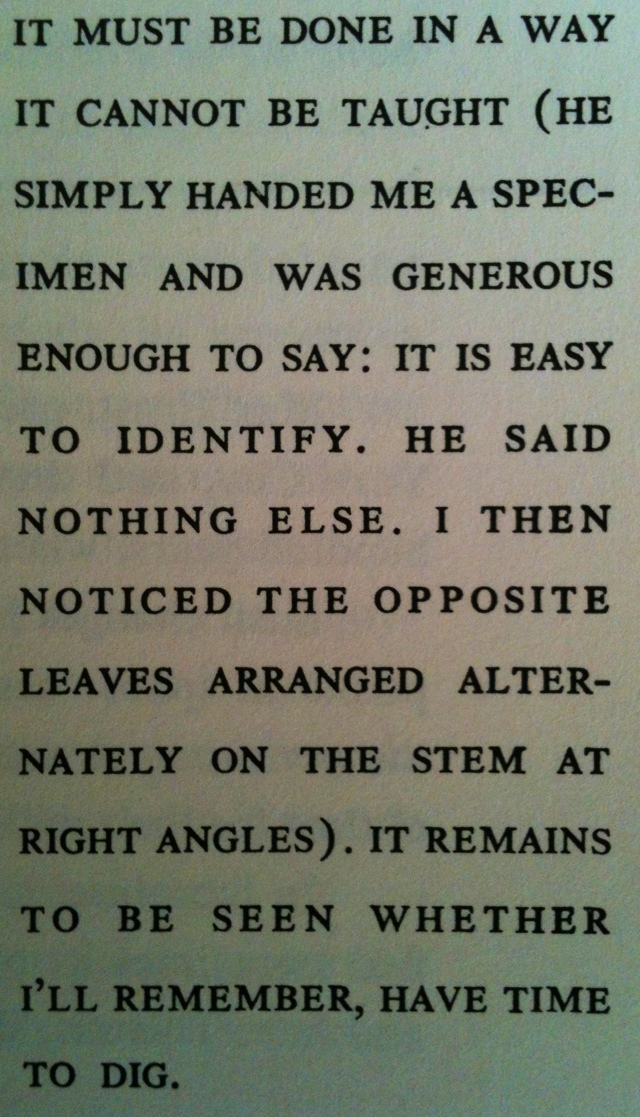
(From John Cage’s A Year from Monday).
 Biblioklept