
Cormac McCarthy and Werner Herzog, along with physicist Lawrence Krauss on NPR’s Science Friday with Ira Flatow, in case you missed it. Which I did.
Category: Books
Public Library: American Commons — Robert Dawson’s Images of American Libraries
 Check out Robert Dawson’s images of American libraries at Places. Evocative and even poignant in an age when libraries are under threat in this country, Dawson’s images remind us that libraries are, on one hand a monument to our culture and civilization, and, on the other hand, often the outposts of that civilization.
David Foster Wallace, Slavoj Žižek, and Scatological Ideology
I came across this clip of Slavoj Žižek discussing the different types of toilets that one finds across Europe the other day, and his riff immediately reminded me of David Foster Wallace’s novella The Suffering Channel (or “The Suffering Channel,” if you prefer to think of it as a long short story). Here’s a version of the riff in English, which seems to approach a stand-up comedy routine at times—
“You go to the toilet and you sit on ideology,” says Žižek, arguing that “Disgust . . . is not necessarily, immediately characterized by its object” — disgust is when you confront something from your inside on your outside (Žižek is likely working in part from Julia Kristeva’s theory of the abject here). His inventory and analysis of the differences between French, English, and German toilets immediately recalled this passage from The Suffering Channel—
She had also at some point spent a trimester at Cambridge, and still spoke with a slight British accent, and asked generally now whether anyone else who traveled abroad much had noticed that in German toilets the hole into which the poop is supposed to disappear when you flush is positioned way in front, so that the poop just sort of lies there in full view and there’s almost no way you can avoid looking at it when you get up and turn around to flush. Which she observed was so almost stereotypically German, almost as if you were supposed to study and analyze your poop and make sure it passed muster before you flushed it down
Of course, pretty much every page of The Suffering Channel concerns the scatological: it is literally about a man who shits out art. Wallace seems to be exploring the ways in which we are unable to reconcile what is inside us — that is, what makes us us — with its final form. For Kristeva, the ultimate abject is the corpse. Žižek, less mordant perhaps, seems to be signalling (in the short clip anyway) the relatively straightforward idea that ideology is always operating, always a force conditioning our identity.
Near the end of the clip (around 5:25 or so), Žižek brings up the example of saliva, pointing out that we are constantly swallowing it, producing it and absorbing it back into ourselves, yet to fill a glass with it and then try to drink it would be revolting, horrific. Compare this with another passage from The Suffering Channel—
‘Your own saliva,’ said Laurel Manderley. ‘You’re swallowing it all the time. Is it disgusting to you? No. But now imagine gradually filling up a juice glass or something with your own saliva, and then drinking it all down.’
‘That really is disgusting,’ the editorial intern admitted.
‘But why? When it’s in your mouth it’s not gross, but the minute it’s outside of your mouth and you consider putting it back in, it becomes gross.’
‘Are you suggesting it’s somehow the same thing with poo?’
‘I don’t know. I don’t think so. I think with poo, it’s more like as long as it’s inside us we don’t think about it. In a way, poo only becomes poo when it’s excreted. Until then, it’s more like a part of you, like your inner organs.’
‘It’s maybe the same way we don’t think about our organs, our livers and intestines. They’re inside all of us —‘
‘They are us. Who can live without intestines?’
‘But we still don’t want to see them. If we see them, they’re automatically disgusting.’
Wallce lards his novella with example after example of this kind, of the ways in which abject encounters with the borders of self — shit, saliva, menstrual blood, farts — confer identity through a kind of ritual shame. I doubt that Wallace is following, overtly anyway, any post-Lacanian figures in The Suffering Channel, and the concordance of examples used by Wallace and Žižek is probably ultimately not that remarkable. What I do find worth remarking upon, I suppose, are the ways in which Wallace and Žižek were/are so adept at discussing those areas of humanity we’re often happy to overlook.
“My Father Had Two Domestic Obligations” — A Scene from Tristram Shandy: A Cock and Bull Story (NSFW)
“A Kind of Kafka Steeped in LSD and Rage” — Roberto Bolaño on Philip K. Dick
Here’s Roberto Bolaño on Philip K. Dick (from New Directions’ forthcoming collection of Bolaño’s newspaper columns, forewords, and other ephemera Between Parentheses)—
Dick was a schizophrenic. Dick was a paranoiac. Dick is one of the ten best American writers of the 20th century, which is saying a lot. Dick was a kind of Kafka steeped in LSD and rage. Dick talks to us, in The Man in the High Castle, in what would become his trademark way, about how mutable reality can be and therefore how mutable history can be. Dick is Thoreau plus the death of the American dream. Dick writes, at times, like a prisoner, because ethically and aesthetically he really is a prisoner. Dick is the one who, in Ubik, comes closest to capturing the human consciousness or fragments of consciousness in the context of their setting; the correspondence between what he tells and the structure of what’s told is more brilliant than similar experiments conducted by Pynchon or DeLillo.
Amulet — Roberto Bolaño
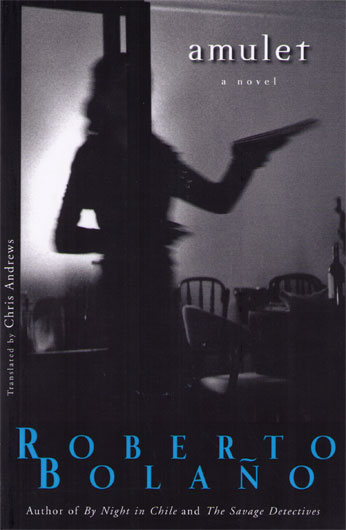
When one takes on the project of reading the novels of Roberto Bolaño — and 2666 is the sort of beast that is likely to hook a reader into such an endeavor — it becomes increasingly impossible to separate and compartmentalize his fictions. Instead, the reader becomes ever more entangled in a labyrinthine Bolañoverse, a chilling, dreadful mirror-maze world that discharges its echoes across continents and epochs. In a fascinating essay at The Quarterly Conversation, Javier Moreno attempts to map out this world. I’d read the essay (and commented on it) a few years ago, but I revisited it after finishing Amulet, mostly because I was pretty sure Moreno had already succinctly stated a key idea that I wanted to bring up in my review. He writes—
Amuleto, which tells the story of an Uruguayan poet that claims herself to be the mother of all Mexican writers, may be seen both as an extra chapter to Los Detectives or as a short introduction to 2666—or both at the same time.
Readers of 2666 and The Savage Detectives will find in Amulet a channel between Bolaño’s “big books,” just as Nazi Literature in the Americas serves as a strange, ironic connective tissue for the violence and chaos of the rest of Bolañoverse. Amulet is narrated by Auxilio Lacouture, and her story appears in a much shorter form in The Savage Detectives. I’ll let her summarize Amulet’s plot (such that it is)—
I am the mother of Mexico’s poets. I am the only one who held out in the university in 1968, when the riot police and the army came in. I stayed there on my own in the Faculty, shut up in the a bathroom, with no food, for more than ten days, for more than fifteen days, from the eighteenth to the thirtieth of September, I think, I’m not sure anymore.
I stayed there with a book by Pedro Garfias and my satchel, wearing a little white blouse and a pleated sky-blue skirt, and I had more than enough times to think things over. But couldn’t think about Arturo Belano , because I hadn’t met him yet.
In these two short paragraphs, late in the book, we get so many of the motifs that populate Bolaño’s world: the self-naming poet, the influence of violence in Latin America, the horrors inherent in resisting this violence, exile, hints of madness. We even get Bolaño’s elusive alter-ego, Arturo Belano, who floats through Amulet and the rest of the Bolañoverse like an unknowable specter.
The fact that Auxilio couldn’t think about Belano when she was stuck in the bathroom in 1968 does not actually stop her from doing so. She is, to borrow a phrase from Vonnegut, a woman unstuck in time. It is as if the entire novel, that is to say her narrative, her telling of her story, is tenuously anchored in the those traumatic days of September, 1968. She tells us, echoing Stephen Dedalus perhaps, that “History is a horror story”; unlike Dedalus, she can’t awake from the nightmare. Here’s a relatively early passage that describes what Auxilio can never really explain—
I don’t know why I remember that afternoon. That afternoon of 1971 or 1972. And the strangest thing is that I remember it prospectively, from 1968. From my watchtower, my bloody subway carriage, from my gigantic rainy day. From the women’s bathroom on the fourth floor of the Faculty of Philosophy and Literature, the timeship from which I can observe the entire life and times of Auxilio Lacouture, such as they are.
The life and times of Auxilio Lacouture, such as they are, will be somewhat familiar to anyone who’s read some of Bolaño’s other novels: plenty of dread, lots of sinister shadows, and many, many drunk poets. The anecdotes and small set pieces that fill Amulet seem culled from Bolaño’s own life (real or imagined), and can be alternately thrilling, dull, or even maddening. For my taste, the novel works itself into its finest moments when Auxilio’s grip on reality — both temporal and spacial — is at its weakest. At one point she tells us—
I don’t know if I’m in 1968 or 1974 or 1980, gliding, finally, like the shadow of a sunken ship, toward the blessed year 2000, which I shall not live to see.
Auxilio’s sanity both unravels and compresses, and Bolaño codes these movements in images of descent and ascension. Auxilio moves through fever dreams and nightmares, memories and prognostications, alternate realities and astral projections. Near the end of the novel, still in the bathroom, starving, probably in shock, she experiences her ordeal as a difficult climb up a frozen mountain. Along the way, she begins casting bizarre literary prophecies. A quick taste—
Virginia Woolf shall be reincarnated as an Argentinian fiction writer in the year 2076. Louis-Ferdinand Celine shall enter Purgatory in the year 2094. Paul Eluard shall appeal to the masses in the year 2101.
These pronouncements continue for a few pages. Underneath the madness, one can sense Bolaño’s goofy joy, but there’s more here than just list-making: Auxilio is pointing toward metempsychosis, suggesting her own soul’s migration, perhaps—here we find a way in which literature might transcend the violence and horror of history. And yet there’s also a sense of doom, of repeated violence and exile. Late in the novel Auxilio finds herself cast in the role of Erigone, daughter Aegisthus and Clytemnestra, forced from home by her half-brother, Orestes. There’s a sense that tragedy capitulates throughout time; that even if Auxilio can survive the army’s occupation, it will nevertheless scar her forever. Cycles of violence are bound to recur indefinitely.
This recurrence evinces in what might be the book’s most famous passage. Auxilio is walking home with some friends—
Then we walked down the Avenida Guerrero; they weren’t stepping so lightly any more, and I wasn’t feeling too enthusiastic either. Guerrero, at that time of night, is more like a cemetery than an avenue, not a cemetery in 1974 or in 1968, or 1975, but a cemetery in the year 2666, a forgotten cemetery under the eyelid of a corpse or an unborn child, bathed in the dispassionate fluids of an eye that tried so hard to forget one particular thing that it ended up forgetting everything else.
The passage names Bolaño’s opus: there is no mention of “2666” in 2666. The reference rests outside the book; or, perhaps Bolaño demands that we read his books intertextually. In any case, 2666 has its graveyards and its corpses, its own demanding geometry of memory. One gets the sense that this oblique reference to “2666” is really part of Bolaño crafting his own canon, an internal canon of the Bolañoverse, almost as if he were J.R.R. Tolkien or even Philip K. Dick. I think again of Auxilio’s prophecies, of her list of writers who will be reborn or forgotten, where we find Bolaño securing a historical place for the writers he loves and values.
Looking over this review, I realize that it might not be helpful for readers new to Bolaño: mea culpa. Amulet is a very fine novel, but not the right starting point. That would be 2666 or, if that prospect is too daunting, Last Evenings on Earth. To me, Amulet reads like the “Mexico” chapter in a trilogy about violence and exile in Latin America; the other two parts would be Distant Star (which I enjoyed more) and By Night in Chile. But perhaps I’m simply reaching for evidence to support this idea that Bolaño’s books are best read together. I’m sure that one can enjoy them on their own—only, at this point, I’m not sure how to do that.
Amulet, translated by Chris Andrews, is available now from New Directions.
On the Feeling of Being In-between Books
Like most bibliophiles, I have a big ole stack of books — multiple stacks, really — lying around the house; that is, I have unshelved books in little intermediary piles that I am either always reading or planning to read “next,” which is to say, sometime in the near future. I’ve written before about books I’m always reading (and re-reading), so I’ll set that aside for the moment; also, there are those books of a somewhat fragmentary nature that I like to read slowly (fodder for a future post, perhaps) — but let’s set those aside as well, because they are not what I’m speaking of here.
I found a few years ago that the best way to finish a book, especially a challenging book, but really any novel worth reading, is to simply give it as much undivided attention as you can — to do your best to not let all those other books jump the queue. And for the most part, I’m pretty good at doing this.
So well anyway.
I finished Roberto Bolaño’s Amulet the night before last. I’ve had the book for a while, and though I had desired to read it, I hadn’t had the feeling of wanting to commit to this particular book; so, what I’m doing now, gentle reader, is distinguishing between these two things. We, that is bibliophiles, we all desire to read certain books (lots of certain books, no doubt), but that’s not the same as the feeling of wanting to commit to the particular book. Because generally a bibliophile knows that a great book, or at least a book worth reading, requires a certain level of commitment.
I picked Amulet out of the stack after reading Malcolm Lowry’s Under the Volcano. I don’t know why. There was no intellectual impulse in the choice, although a connection might easily be made between the two novels, both set in Mexico; indeed, Bolaño opens The Savage Detectives with a quote from Under the Volcano, and the heroine of Amulet shows up in The Savage Detectives — so there is some connection. But again, the decision to read Amulet next, instead of, say, Giuseppe Tomasi di Lampedusa’s The Leopard or Heinrich Böll’s The Train Was on Time or any of the other dozens of books cluttering up Biblioklept International Headquarters, was, or at least I believe was, more a matter of intuition and feeling than intellect.
So, as I mentioned, I finished Amulet the other night, and, during the course of reading that novel, another dead literary darling’s novel came out, David Foster Wallace’s The Pale King. Which I’ve been greatly anticipating. Which I’ve been very much desiring to read. Which I have absolutely no desire to commit to reading now, which is to say in that moment between books. Which is strange, I suppose, but perhaps easy to account for on several fronts. First, every day seems to bring some new, fully realized review of The Pale King to the internet, or some piece about Wallace’s “legacy” and The Pale King, or, even worse, some coverage about coverage of The Pale King (which, yes, I realize this post is now threatening to become). Another reason that might account for the fact that I have no feeling to commit to reading The Pale King now may be that it is Wallace’s last novel; maybe I want to wait a bit, give myself a bit of distance from the internet buzz, let anticipation build again. Divorce myself from the idea of having to read the book — especially in the context of Biblioklept, a maybe-literary blog.
To go back to my earlier point, the point of all of this (if this rambling can be said to have a point) is that I realize that I rarely choose to read the “next” book in an intellectual way — that is, the choice is almost always intuitive, born from some feeling that I don’t know how to name, except to say that it’s the feeling that I have when I’m in-between books. It’s a wonderful feeling, exhilarating and freeing and full of possibility, as corny as that sounds, but also a kind of anxiety, a feeling paradoxically tempered by the temporal messiness of being a reader, which is to say being a human, as if the limited time we have to read dampens — and thus defines — the edges of this particular exhilaration. I love the feeling because it opens a seemingly illimitable range of possibilities — the possibilities of new books, new narratives — even as the choice forecloses the possibility of another choice. Etymologically, the word “decide” means “to cut off.” But enough dithering. Time to riffle through the stack.
In Brief — New Books from Gabrielle Hamilton, Meg Howrey, and Frances Stonor Saunders
 The memoir-in-food is something of a cliché at this point, but Gabrielle Hamilton’s new book Blood, Bones & Butter came with enough accolades (including a glowing blurb from Anthony Bourdain) and positive early reviews (like Kakutani’s at The NYT) for me to spend a few hours thumbing through it. Much has been made of Hamilton’s writing bona fides (an MFA in fiction writing from University of Michigan), and while she can put a sentence together without relying on the stock phrases and tropes that lard most memoirs these days, that skill wouldn’t really matter if she didn’t have a tale to tell. Blood, Bones & Butter follows a strange culinary career (it’s subtitled The Inadvertent Education of a Reluctant Chef), complete with drug abuse, theft, and, of course cooking. Only I wish there was more cooking, more time in the kitchen, the butcher’s, the market. Instead, Hamilton seems to channel her (often mean-spirited) energy on her family; her parents’ divorce hangs over the narrative like a Greek tragedy, and her own attitude toward her husband is bizarre, to say the least. The results are mixed, but fans of food-writing à la Bourdain’s Kitchen Confidential will likely enjoy Blood, Bones & Butter. New in hardback from Random House.
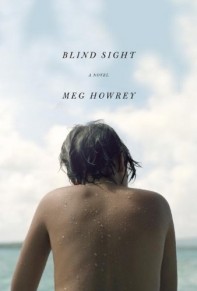 Meg Howrey’s new novel Blind Sight tells the story of Luke Prescott, a bright, introspective seventeen year old obsessed with brain biology. Raised by a hippie mother and two half-sisters, Luke gets the opportunity to the summer before college with his estranged father, a famous television star. In Los Angeles, Luke gets to know his father better, sorting out the difference between public persona and private truth; this process in turn leads Luke to re-evaluate his own sense of identity. There’s also some pot-smoking and sex. Howrey moves the narrative between Luke’s first-person voice (in the past tense) to a third person present tense narrator. At times this disjunction seems like a lazy shorthand to allow the reader to see something Luke can’t see (or doesn’t want the reader to see), but it works nicely on the whole, underlining the gaps between truth and belief that the novel seeks to explore. Blind Sight is new in hardback from Pantheon.
 In The Woman Who Shot Mussolini, Frances Stonor Saunders plays historical detective, reconstructing the story of Violet Gibson, who fired on Mussolini in April of 1926 (she grazed his nose). Gibson, the daughter of the Lord Chancellor of Ireland, was 50 when she shot Mussolini, and perhaps more than a little crazy. She was almost lynched after shooting Il Duce, but the not-so-benevolent dictator pardoned her, and she was quickly returned to England, where she spent the rest of her life in an insane asylum. Saunders’s book explores whether Gibson’s attack was the motivation of an insane woman or part of a bigger conspiracy theory, illustrating her mystery with poignant black and white photos. And although Saunders focuses on the little-known Gibson, she works to draw parallels between the would-be assassin and Mussolini. Saunders’s exploration of an otherwise unremarked upon episode balances historical scholarship with the pacing and rhythm of an historical thriller. New in trade paperback edition from Picador.
Roberto Bolaño on William Burroughs
Here’s Roberto Bolaño on William Burroughs (from New Directions’ forthcoming collection of Bolaño’s essays, newspaper columns, and other ephemera Between Parentheses)—
For some of those of my generation, William Burroughs was the affectless man, the shard of ice that never melted, the eye that never closed. They say he possessed every vice there was, but I think he was a saint who attracted all the sinners in the world because he was gracious and unwise enough never to shut his door. Literature, his livelihood for the last thirty years, interested him, but not too much, and in that regard he was like other classic American figures who focused their efforts on observing life or on experience. When he talked about what he read one got the impression that he was remembering vague stretches of time in prison.
“I Learn as Much from Painters About How to Write as from Writers” — Hemingway on His Literary Forebears
Ernest Hemingway describes his influences in his 1958 interview with George Plimpton at The Paris Review—
INTERVIEWER
Who would you say are your literary forebears—those you have learned the most from?
HEMINGWAY
Mark Twain, Flaubert, Stendhal, Bach, Turgenev, Tolstoy, Dostoyevsky, Chekhov, Andrew Marvell, John Donne, Maupassant, the good Kipling, Thoreau, Captain Marryat, Shakespeare, Mozart, Quevedo, Dante, Virgil, Tintoretto, Hieronymus Bosch, Brueghel, Patinir, Goya, Giotto, Cézanne, Van Gogh, Gauguin, San Juan de la Cruz, Góngora—it would take a day to remember everyone. Then it would sound as though I were claiming an erudition I did not possess instead of trying to remember all the people who have been an influence on my life and work. This isn’t an old dull question. It is a very good but a solemn question and requires an examination of conscience. I put in painters, or started to, because I learn as much from painters about how to write as from writers. You ask how this is done? It would take another day of explaining. I should think what one learns from composers and from the study of harmony and counterpoint would be obvious.
Jerome Kuhl’s Cool Henry IV Covers
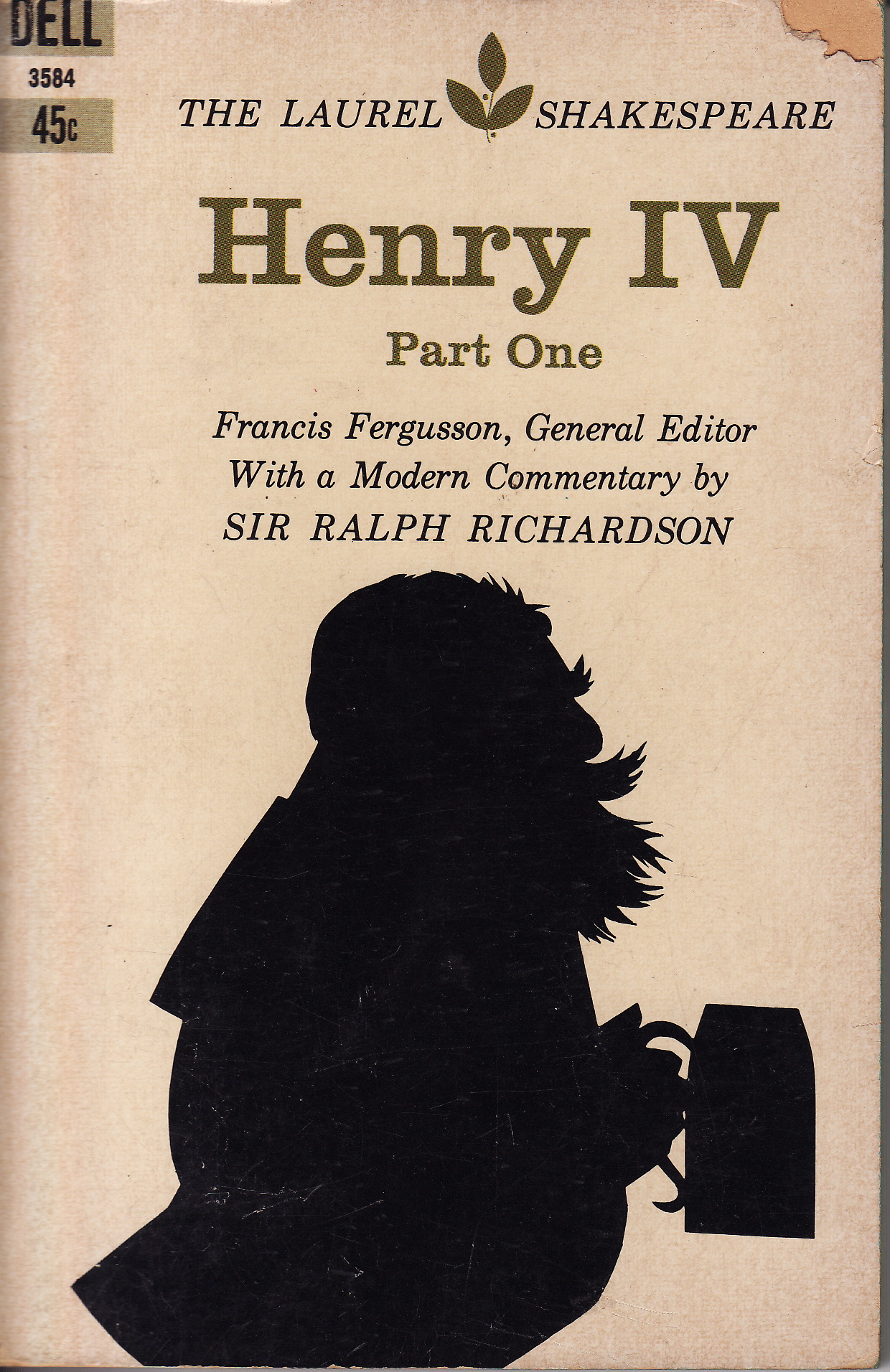
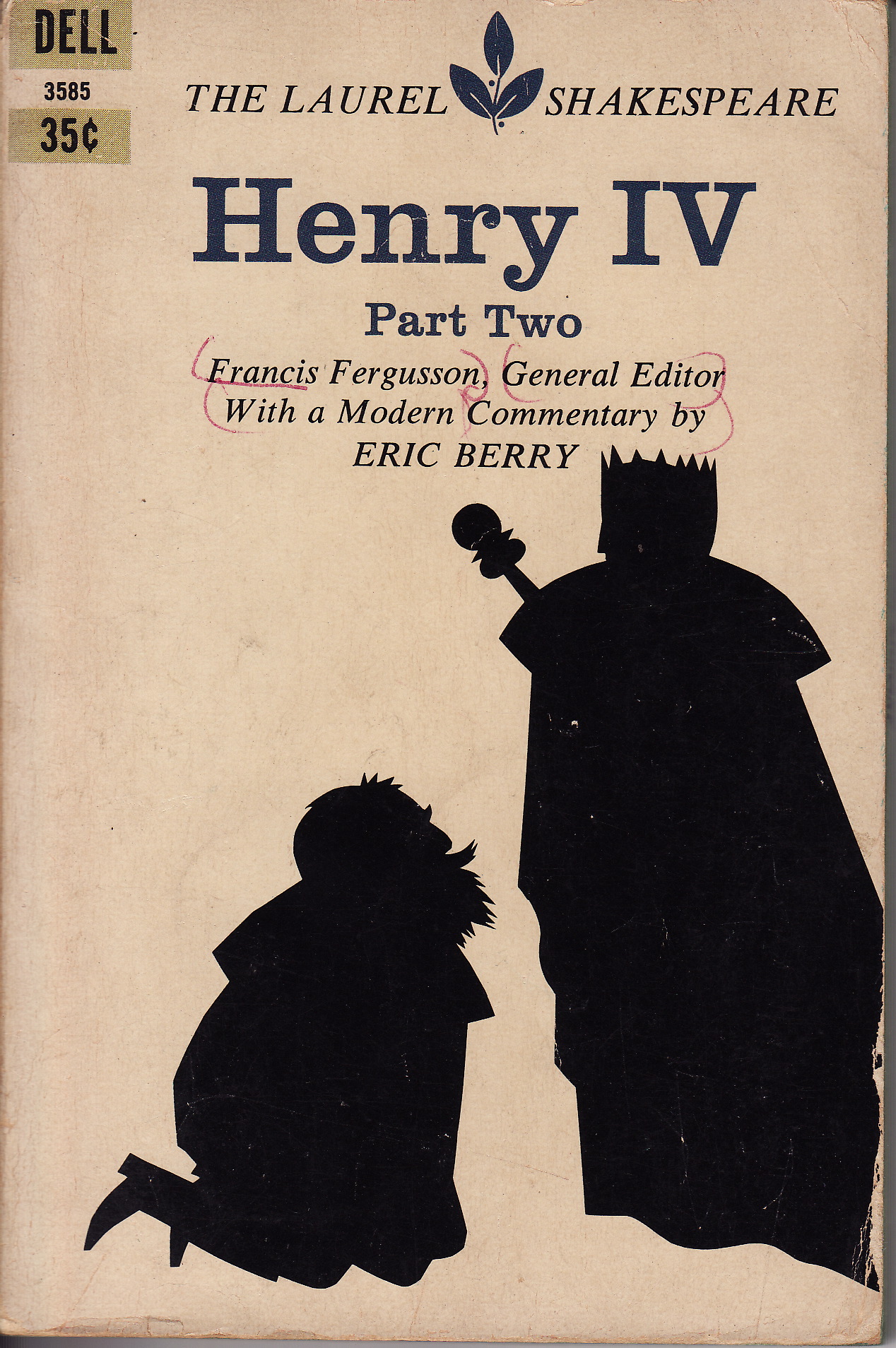
I recently moved, which means that there’s been a great deal of shuffling around of books. Anyway, I came across these late 1950s Dell editions of Shakespeare’s Henry IV plays with these fantastic covers designed by Jerome Kuhl. The image of Falstaff on the cover of Part One strikes me as both humorous and iconic; the kneeling scene on the cover of Part Two is poignant and even a little sad. Makes me want to reread them.
How to Stop Living and Start Worrying — Simon Critchley
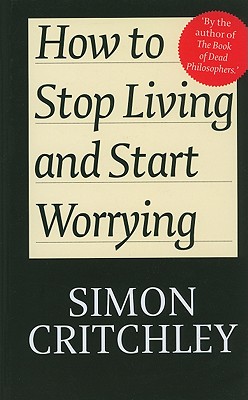
Simon Critchley’s latest book How to Stop Living and Start Worrying picks up where his last work, The Book of Dead Philosophers, left off. Both works explore what Critchley contends to be the signal problem of all philosophy; namely, how one might live a meaningful life against the backdrop of inevitable death. In Dead Philosophers, Critchley plumbed this question by surveying the deaths of dozens of famous philosophers, ultimately affirming a positive reality in death (both our own deaths and the deaths of others), and arguing that philosophies (and religions) that advocate the idea of a spiritual afterlife ultimately negatively disrupt human existence and lead to inauthentic lives. How to Stop Living reiterates these themes in a new form, essentially arguing that in asking “how to live,” we must also ask “how to die” — and also how to love and how to laugh. How to Stop Living takes form as a series of conversations between Critchley and Carl Cederström, an Associate Professor at the Institute of Economic Research at Lund University in Sweden. There’s a warm rapport between the pair, and although Critchley does most of the talking, there’s a genuine dialog in play, not merely a flat interview. The book unfolds over six chapters. The first, “Life,” is a discussion of, well, Critchley’s life, both personal and academic. I originally thought I’d be doing a lot of skimming here, but it’s actually kind of fascinating; more importantly, though, it establishes Critchley’s contention that a philosopher’s work cannot be divorced from his biography. To philosophize is to live. This idea is reiterated succinctly at the beginning of the second chapter, “Philosophy,” when Critchley states—
The first thing to say is that philosophy is not a solely professional or academic activity for me. Philosophy is not a thing, it’s not an entity; it’s an activity. To put it tautologically: philosophy is the activity of philosophizing, an activity which is conducted by finite, thinking creatures like us. Now, my general view of philosophy is that this activity must for part of the life of a culture. Philosophy is the living activity of critical reflection in a specific context; it always has a radically local character.
What follows in “Philosophy” is a somewhat discursive overview of the philosophers who will pop up again and again in the book: Heidegger, Husserl, Kant, Nietzsche, and, of course, Derrida. While I’m laundry listing, I might as well add Freud, Lacan, Beckett, and Hegel as key figures in How to Stop Living. In the third chapter, “Death,” Critchley discusses how many of these philosophers frame a subject’s individual relationship to his or her personal death. In a particularly enlightening passage, Critchley explains Heidegger’s “possibility of impossibility,” the idea that to be authentic, to lead an authentic life, one must internalize and master the finitude of a personal death. The chapter continues, working through other conceptions of death, including those of Freud, Beckett, and Derrida. Perhaps because of its dialogic structure, How to Stop Living often feels like a rap session, a big brainstorm, a work in process, and nowhere is this more evident in a chapter called “Love,” where Critchley moves from Hannah Arendt to The Song of Solomon to Lacan and Freud to a story about his marriage proposal. It’s all a bit messy, a bit watery, a bit undefined, and therefore difficult to summarize, so I’ll let Critchley dish on love in his own words—
Love is the attempt to break the logic of masochism that defines the subject, and to behave in a different way. That’s something that has to be wound up everyday . . . and it’s something with no end; and it requires a constant experience of faith. That’s the only sense I can make of love.
The next section, “Humour,” is better defined—and one of the highlights of the book. Critchley discusses jokes against a backdrop of psychoanalysis and anthropology, ultimately arguing that humor has the power to disrupt an individual’s relation to time or place, and thus reconstitute that relation in some meaningful way. Critchley’s book itself is indeed a meta-joke, a play against the sophistry of New Age self-help books. Indeed, the very name of the book is an inversion of Dale Carnegie’s 1948 “classic” of the genre, How to Stop Worrying and Start Living. If you find the cover of Critchley’s book as off-putting and cheesy as I do, just remind yourself that it’s a parody of Carnegie’s cover. And yet Critchley’s sense of humor is not ultimately black irony, but rather a humor of affirmation of — and confrontation of — the absurdity of contemporary life. It’s not irony but authenticity he wants. “Authenticity” is thus the final chapter of this relatively short book, and here Critchley invites his friend (and partner in the International Necronautical Society) novelist Tom McCarthy to participate in the conversation. The chapter is lively, almost frenetic, and frankly all over the place, as Critchley and McCarthy rocket from subject to subject — Finnegans Wake, the Challenger explosion, Terrence Malick, J.G. Ballard, Levinas, A Midsummer Night’s Dream, McCarthy’s first novel Remainder — each reference seems to slip into the next, reined in occasionally by Cederström, who steers the conversation back to its center (leave it to deconstructionists to get off center). Good stuff.
How to Stop Living and Start Worrying, despite its tongue in cheek title and cover, and its discursive flow, is serious (if playful) about philosophy. Those interested in the thinkers and topics I’ve mentioned in this review may be interested, but it’s not necessary for one to have a working knowledge of Continental philosophy to enjoy Critchley’s latest. Recommended.
How to Stop Living and Start Worrying is available now from Polity Books.
April Fools: Seven Literary Hoaxes
J.T. LeRoy, James Frey, Herman Rosenblat, Margaret Seltzer . . . recent years have seen an explosion of memoirists lying, faking, or otherwise hoaxing the public–but this is hardly anything new. In honor of April Fool’s Day we present seven April Fools.
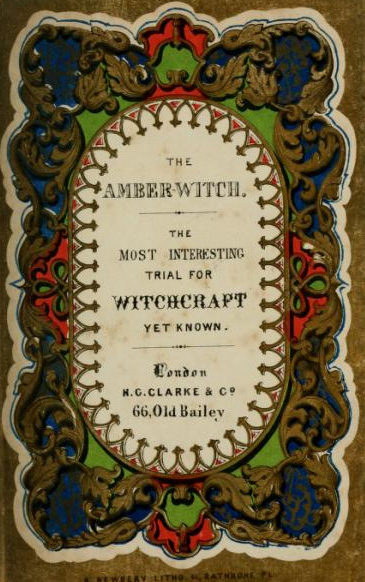
The Amber Witch — Johannes Wilhelm Meinhold (1844)
Meinhold pretended that The Amber Witch was the true story of a seventeenth-century minister’s daughter falsely accused of witchcraft. Meinhold claimed he found the minister’s manuscript in the refuse of an old church. When the book received critical attention, Meinhold admitted to the hoax, but audiences didn’t believe him at first.

“Geraint the Blue Bard” aka Iolo Morganwg aka Edward Williams (1747-1826)
Welshman Edward Williams was widely considered a leading antiquarian and expert on the antiquities of the British Isles. After his death, however, many of his manuscripts were revealed to have been forgeries, including those produced by “Geraint the Blue Bard,” supposedly a ninth-century composer. Oh well.
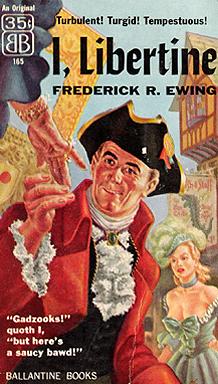
I, Libertine — Frederick R. Ewing (1956)
Proto-shock jock Jean “Shep” Shepherd perpetrated I, Libertine as a purposeful hoax. He told his radio audience to demand the (non-existent) book by the (non-existent) author “Frederick R. Ewing” from their local booksellers, and even fabricated a basic plot for listeners to in turn relate (he even included the salacious detail that the book had been banned in Boston). Publisher Ballantine hired sci-fi scribe Theodore Sturgeon to write the book from Shepherd’s outline, and the book was published very soon after. All proceeds went to charity.
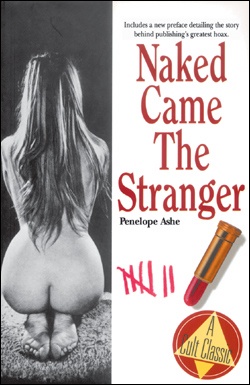
Naked Came the Stranger — Penelope Ashe (1969)
To prove that American culture was smutty and degraded, Newsday columnist Mike McGrady enlisted 24 of his fellow writers to write a smutty and degraded novel that they believed would top the bestseller list in spite of its lack of literary value. By the time “Penelope Ashe” had put out Naked Came the Stranger, the hoax had leaked, and it was unclear if this is what led to the book actually topping the New York Times bestseller list (for one slim week). The book later became the basis of a porno film.
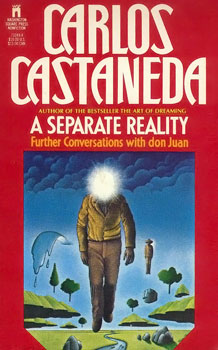
A Separate Reality — Carlos Castaneda (1971)
The debate around Castaneda’s series of “memoirs” in some ways gets to the heart of the problems of truth and invention, facts and authenticity, experience and memory. Castaneda claimed that he trained under Don Juan Matus, a Yaqui Indian sorcerer. Part of that training included taking massive amounts of psychotropic drugs like peyote as a means to “see” the energy of the universe. Don Juan Matus’s actual existence is questionable at best, but hey, when you’re doing large quantities of peyote, who knows what, like, truth is, man.
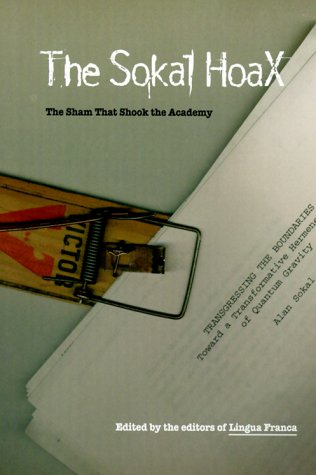
“Transgressing the Boundaries: Towards a Transformative Hermeneutics of Quantum Gravity”– Alan Sokal (1996)
Disgusted with a perceived slackness and ineptitude in modern academia, Dr. Alan Sokal published a paper full of nonsensical gibberish in Duke University’s cultural studies journal Social Text. The same day the essay was published, he announced the hoax in the journal Lingua Franca. Ouch. Biblioklept wrote a post about the incident a few years ago, if you’re interested.

The Songs of Bilitis — Pierre Louÿs (1894)
Louÿs claimed that the erotic poems he fabricated were the work of “Bilitis,” one of Sappho’s lovers; he even invented a biography of the woman, citing a fictional archaeologist named Herr G. Heim with discovering her tomb. (“Herr G. Heim” translates roughly to “Lord S. Ecret”). Despite the hoax, many critics consider it a work of literary merit, and it’s become something of a cult book among queer theory enthusiasts.
[Biblioklept originally published this post in 2010].
“Joyce Maims Words” — William Carlos Williams on James Joyce
William Carlos Williams on James Joyce (from Our Exagmination Round His Factification for Incamination of Work in Progress, a symposium on Finnegans Wake)—
Joyce maims words. Why? Because meanings have been dulled, then lost, then perverted by their connotations (which have grown over them) until their effect on teh mind is no longer what it was when they were fresh, but grows rotten as poi — though we may get to like poi.
Meanings are perverted by time and chance — but kept perverted by academic observance and intention. At worst they are inactive and get only the static value of anything, which retains its shape but is dead. All words, all sense of being is gone out of them. Or trained into them by the drill of the deadly minded. Joyce is restoring them.
Biblioklept Interviews Camelia Elias, Editor-in-Chief of EyeCorner Press
Camelia Elias is the founder and editor-in-chief of EyeCorner Press, an independent publisher devoted to printing a host of difficult-to-classify writings, including creative academic writing, and poetic fragments and aphorisms. EyeCorner publishes works in English, Danish, and Romanian, as well as bilingual editions. This multilingual approach gels with the publishing house’s fragmentary philosophy, as well as its origins as a collaborative venture between universities in three nations. In addition to her editorial duties, Elias is also one of EyeCorner’s authors; her latest work Pulverizing Portraits is a monograph on the poetry of Lynn Emanuel. Elias is Associate Professor of American Studies at Roskilde University in Denmark and she blogs at FRAG/MENTS. Elias was kind enough to talk with me over a series of emails; in our discussion she defines creative criticism, discusses the value in being open to error, accounts for hostility against deconstruction and post-structuralism in academia, and explains why it doesn’t hurt to throw the word “fuck” into a textbook now and then.
Biblioklept: EyeCorner Press is somewhat unusual, even for an indie publisher — a joint venture between universities in Denmark, Finland, and the US that focuses on creative criticism. How did the press come into being?
Camelia Elias: The press came into being as an act of anarchism, if you like, a form of resistance against the idea that academic work must be measured not only against its own standard, but also against the standard that idiotic governments sets for measuring, and hence controlling, intelligence, creativity, and freedom. In 2007 I was editing new research papers written by colleagues and associates of the Institute of Language and Culture at Aalborg University with view to publication by the Faculty of Humanities at AU. A new change in leadership also brought about a new set of ideas. These were rigidly formulated along the newly established injunction passed down by the Danish government, which dictated that all Danish academics must now prioritize publishing with Oxford and Harvard. Without getting into the silly and imbecilic arguments produced for the sustainability of such a demand in reality, the fact remains that many heads of department throughout our Danish universities tried to implement the new regulations literally. The good publishing folks at Aalborg were told that Research News (the publishing venue) was going to close, and no, as the justification for it ran, this was not because the papers were not good enough, but 1) because publishing new research under the aegis of the department was likely to have the undesirable effect of preventing the researchers from expanding their range of publishing possibilities – and hence not consider Oxford and Harvard – and 2) there will be no money for it anymore. Few of us tried to make obvious the stupidity pertaining to the first argument – bad idea, as bosses generally don’t want to be told that they have limited visions – and as to the second argument, pertaining to the precarious, or rather by then non-existent financial support, a few of us also tried to suggest that we could go ‘on demand’ and even work ‘con amore’ for it, which would involve no expenses. The answer was still no. So, there we were, with a few manuscripts in the pipeline and no possibility of getting them out. As the editor of these papers, I felt a responsibility not only towards the writers but also towards the readers who had bothered to peer-review the works. I decided to start EyeCorner Press in my own name, but retain the ties we had in terms of publishing jointly with a few other partner universities. With Brenau University in Gainesville, Georgia, we had just finalized a volume on transatlantic relations (aesthetics and politics) within Cultural Text Studies Series published by Aalborg University Press. We are happy to call them our close allies. University of Georgia, Gwinnett, and Oulu University in Finland followed suit and so did Roskilde University, which became my new working place not long after the Aalborg ‘situation’.
Continue reading “Biblioklept Interviews Camelia Elias, Editor-in-Chief of EyeCorner Press”
Barry Hannah on Cormac McCarthy
From The Paris Review’s interview with Barry Hannah—
INTERVIEWER
Some writers turn away completely from their origins, though. Like Cormac McCarthy.
HANNAH
Right, he turned western when he went out to El Paso. He’s one of my favorites. He invests a region. Learns it so thoroughly it’s as if God visited that place and made no mistakes about the botany, flora, fauna. He has about three thousand books, I hear. He had so many books on this upper story of this little concrete house he has, the floor was about to cave in. So the man reads everything there is about the place and you can tell that. Nobody else like him.
Barry Hannah Addresses the Whole “Pointing a Gun at a Student” Rumor
From The Paris Review’s interview with Barry Hannah—
INTERVIEWER
But about the guns. When you left Alabama, there was an incident . . .
HANNAH
Yes, I was a tenured professor there, and I was fired. I had just been voted in, but I was too heavily into drinking. I was holding class at home or in my studio and they said, Don’t hold any more classes in your studio. And I said, Well, I will. I brought in an empty pistol once and, as I recall, twirled the chambers to explain six movements in a short story. And that is where the gun—pointing a gun at a student—rumor started, but I never pointed a loaded gun at anybody in my life. Even dead drunk. Never, never. I really don’t like that rumor now because of the school shootings. The world has changed so much. I still love my old .22’s from my youth, for shooting beer cans and rats in the city dump. I love the instrument. It’s just a beautiful, clean instrument—and the history —but I have never had any interest in pointing a gun at a person.
INTERVIEWER
Do you remember what the six movements were?
HANNAH
No. I could make up something, but it would be untrue. There’s just three, anyway: beginning, middle, and end. I was com-plicating something that didn’t need to be any more complicated. At one time I’m sure I had six points in my head and they may have been decent, but I refuse to remember them because they’re not necessary now.
INTERVIEWER
The rumor about pointing the gun was that you were playing your trumpet, trying to get their attention. When that didn’t work, you brought out the gun.
HANNAH
I did play my trumpet in class at Alabama. And at the University of Chicago. Blues solo. Ta da na tee. And I was pretty good sober but real loud and inappropriate in a small chamber. The people at Chicago enjoyed it, but a student complained at Alabama. Still, the trumpet’s a much better idea than bringing a pistol. It’s all alcoholism.
 Biblioklept