Why are works of art so socially important? Not for the messages they may contain, not because they expose slavery or cry hurrah for the worker, although such messages in their place and time might be important, but because they insist more than most on their own reality; because of the absolute way in which they exist. Certainly, images exist, shadows and reflections, fakes exist and hypocrites, there are counterfeits (quite real) and grand illusions – but it is simply not true for the copies are as real as their originals, that they meet all of the tests which I suggested earlier. Soybean steak, by God, is soybean steak, and a pious fraud is a fraud. Reality is not a matter of fact, it is an achievement; and it is rare – rarer, let me say – than an undefeated football season. We live, most of us, amidst lies, deceit, and confusions. A work of art may not utter the truth, but it must be honest. It may champion a cause we deplore, but like Milton’s Satan, it must in itself be noble; it must be all there. Works of art confront us the way few people dare to: completely, openly, at once. They construct, they comprise, our experience; they do not deny or destroy it; and they shame us, we fall so short of the quality of their Being. We live in Lafayette or Rutland – true. We take our breaths. We fornicate and feed. But Hamlet has his history in the heart and none of us will ever be as real as vital, as complex and living as he is – a total creature of the stage.
From William H. Gass’s essay “The Artist and Society” (1968). Collected in Fiction and the Figures of Life.
The aim of the artist ought to be to bring into the world objects which do not already exist there, and objects which are especially worthy of love. We meet people, grow to know them slowly, settle on some to companion our life. Do we value our friends for their social status, because they are burning in the public blaze? do we ask of our mistress her meaning? calculate the usefulness of our husband or wife? Only too often. Works of art are meant to be lived with and loved, and if we try to understand them, we should try to understand them as we try to understand anyone—in order to know them better, not in order to know something else.
–From William H. Gass’s essay “The Artist and Society” (1968). Collected in Fiction and the Figures of Life.
TURKEY REMAINS AND HOW TO INTER THEM WITH NUMEROUS SCARCE RECIPES
At this post holiday season the refrigerators of the nation are overstuffed with large masses of turkey, the sight of which is calculated to give an adult an attack of dizziness. It seems, therefore, an appropriate time to give the owners the benefit of my experience as an old gourmet, in using this surplus material. Some of the recipes have been in my family for generations. (This usually occurs when rigor mortis sets in.) They were collected over years, from old cook books, yellowed diaries of the Pilgrim Fathers, mail order catalogues, golfbags and trash cans. Not one but has been tried and proven—there are headstones all over America to testify to the fact.
Very well then: Here goes:
1. Turkey Cocktail
To one large turkey add one gallon of vermouth and a demijohn of angostura bitters. Shake.
2. Turkey at la Francais.
Take a large ripe turkey, prepare as for basting and stuff with old watches and chains and monkey meat. Proceed as with cottage-pudding.
3. Turkey and Water
Take one turkey and one pan of water. Heat the latter to the boiling point and then put in the refrigerator When it has jelled drown the turkey in it. Eat. In preparing this recipe it is best to have a few ham sandwiches around in case things go wrong.
4. Turkey Mongole
Take three butts of salami and a large turkey skeleton from which the feathers and natural stuffing have been removed. Lay them out on the table and call up some Mongole in the neighborhood to tell you how to proceed from there.
5. Turkey Mousee
Seed a large prone turkey, being careful to remove the bones, flesh, fins, gravy, etc. Blow up with a bicycle pump. Mount in becoming style and hang in the front hall.
6. Stolen Turkey
Walk quickly from the market and if accosted remark with a laugh that it had just flown into your arms and you hadn’t noticed it. Then drop the turkey with the white of one egg-well, anyhow, beat it.
7. Turkey a la Creme.
Prepare the creme a day in advance, or even a year in advance. Deluge the turkey with it and cook for six days over a blast furnace. Wrap in fly paper and serve.
8. Turkey Hash
This is the delight of all connoisseurs of the holiday beast, but few understand how really to prepare it. Like a lobster it must be plunged alive into boiling water, until it becomes bright red or purple or something, and then before the color fades, placed quickly in a washing machine and allowed to stew in its own gore as it is whirled around.
Only then is it ready for hash. To hash, take a large sharp tool like a nail-file or if none is handy, a bayonet will serve the purpose—and then get at it! Hash it well! Bind the remains with dental floss and serve.
And now we come to the true aristocrat of turkey dishes:
9. Feathered Turkey.
To prepare this a turkey is necessary and a one pounder cannon to compell anyone to eat it. Broil the feathers and stuff with sage brush, old clothes, almost anything you can dig up. Then sit down and simmer. The feathers are to be eaten like artichokes (and this is not to be confused with the old Roman custom of tickling the throat).
10. Turkey at la Maryland
Take a plump turkey to a barber’s and have him shaved, or if a female bird, given a facial and a water wave. Then before killing him stuff with with old newspapers and put him to roost. He can then be served hot or raw, usually with a thick gravy of mineral oil and rubbing alcohol. (Note: This recipe was given me by an old black mammy.)
11. Turkey Remnant
This is one of the most useful recipes for, though not, “chic”, it tells what to do with the turkey after the holiday, and extract the most value from it.
Take the remants, or if they have been consumed, take the various plates on which the turkey or its parts have rested and stew them for two hours in milk of magnesia. Stuff with moth-balls.
12. Turkey with Whiskey Sauce.
This recipe is for a party of four. Obtain a gallon of whiskey, and allow it to age for several hours. Then serve, allowing one quart for each guest.
The next day the turkey should be added, little by little, constantly stirring and basting.
13. For Weddings or Funerals. Obtain a gross of small white boxes such as are used for bride’s cake. Cut the turkey into small squares, roast, stuff, kill, boil, bake and allow to skewer. Now we are ready to begin. Fill each box with a quantity of soup stock and pile in a handy place. As the liquid elapses, the prepared turkey is added until the guests arrive. The boxes delicately tied with white ribbons are then placed in the handbags of the ladies, or in the men’s side pockets.
There I guess that’s enough turkey to talk. I hope I’ll never see or hear of another until—well, until next year.
At the beginning of Zora Neale Hurston’s novel Their Eyes Were Watching God, Janie returns from the Everglades to Eatonville in ragged overalls to a gossipy and unwelcoming town. The one exception is her best friend Phoeby, who brings Janie a “heaping plate of mulatto rice.” Janie gobbles up the simple, delicious meal, even as Phoeby notes that it “ain’t so good dis time. Not enough bacon grease.” She does however concede that “it’ll kill hongry.” No doubt.
We’ve always been intrigued by mulatto rice. What could it be? Is the dish still around today, but under a new name? Although the term “mulatto” has fallen into disuse, and perhaps distaste (just ask Larry David if you don’t believe us), organizations like mulatto.org have also taken a certain ownership of it. For Hurston, mulatto rice is a positive thing. Hurston could have had Phoeby bring any number of dishes to her friend Janie, so it’s telling that she chooses “mulatto rice” as a homecoming meal. The dish represents a communion, an admixture that reflects Janie’s multiracial identity as well as her resistance to gender-typing. “Mulatto” is also probably etymologically akin to the word “mule,” and if you’ve read Eyes, you know that mules are a major motif in the story. But enough literazin’.
Down to the nitty-gritty–we made up a mess of mulatto rice tonight thanks to a recipe from The Savannah Cook Book by Harriet Ross Colquitt. Not that we found this 1933 cookbook ourselves. No, the real merit here goes to the very cool website Take One Cookbook, which explores the history and culture and sociology behind old, weird cookbooks–all while making the recipes. Colquitt’s recipe, via Wendy at Take One Cookbook (see Wendy’s versionhere):
Mulatto Rice
This is the very chic name given to rice with a touch of the tarbrush.
Fry squares of breakfast bacon and remove from the pan. Then brown some minced onion (one small one) in this grease, and add one pint can of tomatoes. When thoroughly hot, add a pint of rice to this mixture, and cook very slowly until the rice is done. Or, if you are in a hurry, cold rice may be substituted, and all warmed thoroughly together.
The rice is very easy to make and very, very tasty. We substituted green onions for a small onion, and used a hickory-smoked bacon that infused the rice with a lovely sweetness (we also included a tablespoon of brown sugar right after the tomatoes). We served the dish, pictured above, with ham steaks and fried green tomatoes with a spicy yogurt sauce. Hearty and rich and satisfying–just the sort of thing one wants to eat after a soul-searching quest (or maybe just a long day). Recommended.
In Cormac McCarthy’s novel Suttree, an Indian named Michael prepares a turtle soup for Suttree. First, catch the turtle. Then, kill the turtle, making sure to discard its head–
The Indian braced his feet and swung it up dripping from the river and onto the rocks and it squatted there watching them, its baleful pig’s eyes blinking. It was tied through the lower jaw with a section of wire and the Indian took hold of the wire and tugged at it. The turtle bated and hissed, its jaws gasped. The Indian had out his pocketknife and now he opened it and he pulled the turtle’s obscene neck out taut and with a quick upward motion of the blade severed the head. Suttree involuntarily drew back. The turtle’s craggy head swung from the wire and what lay between the braced forefeet was a black and wrinkled dog’s cunt slowly pumping gouts of near black blood. The blood ran down over the stones and dripped in the water and the turtle shifted slowly on the rock and started toward the river. The Indian undid the wire and flung the head into the river . . .
Appetizing, no? Now that you’ve thrown the bloody head in the river (or your garbage can or wherever you throw turtle heads), it’s time to dress the beast–
Suttree laid the turtle on the rock and the Indian scouted about him until he came up with a goodsized stone.
Watch out, he said.
Suttree stepped back.
The Indian raised the stone and brought it down upon the turtle’s back. The shell collapsed with a pulpy buckling sound.
I never saw a turtle dressed before, said Suttree. But the Indian had knelt and was cutting away the broken plates of shell with his pocketknife and pitching them into the river. He pulled the turtle’s meat up off the plastron and gouged away the scant bowels with his thumb. He skinned out the feet. What hung headless in his grip as he raised it aloft was a wet gray foetal mass, a dim atavism limp and dripping.
Plenty of meat there, said the Indian. He laid it out on the rock and bent and swished the blade of his knife in the river.
Okay. Now that you’ve removed the shell and gouged away the scant bowels with your thumbs, it’s time to prepare the wet gray foetal mass.
Put him in a pot and cook him slow. Lots of vegetables. Lots of onions. I got my own things I put in.
Got it? Lots of onions. Slow cook that dim, limp, dripping atavism. The fact that the Indian has his “own things” that he puts in implies a call to the reader to experiment with the recipe. And how did Suttree like his turtle?
He spooned up a piece of the meat and cradled it in his mouth to cool it. He chewed it. It was succulent and rich, a flavor like no other.
At the beginning of Thomas Pynchon’s massive tome Gravity‘s Rainbow, Captain Geoffrey “Pirate” Prentice cooks up a bodacious banana breakfast for a bunch of hungover army officers—
Routine: plug in American blending machine won from some Yank last summer, some poker game, table stakes, B.O.Q. somewhere in the north, never remember now….Chop several bananas into pieces. Make coffee in urn. Get can of milk from cooler. Puree ‘nanas in milk. Lovely. I would coat all the booze-corroded stomachs of England. . . . Bit of marge, still smells all right, melt in the skillet. Peel more bananas, slice lengthwise. Marge sizzling, in go long slices. Light oven whoomp blow us all up someday oh, ha, ha, yes. Peeled whole bananas to go on broiler grill soon as it heats. Find marshmallows. . . .
Here’s how it all turns out–
With a clattering of chairs, upended shell cases, benches, and ottomans, Pirate’s mob gather at the shores of the great refectory table, a southern island well across a tropic or two from chill Corydon Throsp’s mediaeval fantasies, crowded now over the swirling dark grain of its walnut uplands with banana omelets, banana sandwiches, banana casseroles, mashed bananas molded into the shape of a British lion rampant, blended with eggs into batter for French toast, squeezed out a pastry nozzle across the quivering creamy reaches of a banana blancmange to spell out the words C’est magnifique, mais ce n’est pas la guerre (attributed to a French observer during the Charge of the Light Brigade) which Pirate has appropriated as his motto . . . tall cruets of pale banana syrup to pour oozing over banana waffles, a giant glazed crock where diced bananas have been fermenting since the summer with wild honey and muscat raisins, up out of which, this winter morning, one now dips foam mugsfull of banana mead . . . banana croissants and banana kreplach, and banana oatmeal and banana jam and banana bread, and bananas flamed in ancient brandy Pirate brought back last year from a cellar in the Pyrenees also containing a clandestine radio transmitter. . . .
Another entry in our ongoing series of literary recipes to celebrate Thanksgiving.
Leopold Bloom, hero of James Joyce’s Ulysses likes kidneys for breakfast. In fact–
Mr Leopold Bloom ate with relish the inner organs of beasts and fowls. He liked thick giblet soup, nutty gizzards, a stuffed roast heart, liverslices fried with crustcrumbs, fried hencods’ roes. Most of all he liked grilled mutton kidneys which gave to his palate a fine tang of faintly scented urine.
Okay, so there’s not much to this recipe. First, you’ve gotta buy the kidney–
A kidney oozed bloodgouts on the willowpatterned dish: the last. He stood by the nextdoor girl at the counter. Would she buy it too, calling the items from a slip in her hand? Chapped: washingsoda. And a pound and a half of Denny’s sausages.
Then you cook it with some butter in a frying pan (don’t forget to share with the cat, and don’t forget the pepper)–
While he unwrapped the kidney the cat mewed hungrily against him. Give her too much meat she won’t mouse. Say they won’t eat pork. Kosher. Here. He let the bloodsmeared paper fall to her and dropped the kidney amid the sizzling butter sauce. Pepper. He sprinkled it through his fingers ringwise from the chipped eggcup.
Then take your lazy adulterous wife her breakfast that you’ve lovingly prepared for her (she’ll need her strength for later). Oh, and don’t forget about the kidney that’s still cooking for you (unless you’re making some kind of subconscious symbolic burnt offering or something)–
—There’s a smell of burn, she said. Did you leave anything on the fire?
—The kidney! he cried suddenly.
He fitted the book roughly into his inner pocket and, stubbing his toes against the broken commode, hurried out towards the smell, stepping hastily down the stairs with a flurried stork’s legs. Pungent smoke shot up in an angry jet from a side of the pan. By prodding a prong of the fork under the kidney he detached it and turned it turtle on its back. Only a little burnt. He tossed it off the pan on to a plate and let the scanty brown gravy trickle over it.
Enjoy with gravy, toast, and a cup of tea–
Cup of tea now. He sat down, cut and buttered a slice of the loaf. He shore away the burnt flesh and flung it to the cat. Then he put a forkful into his mouth, chewing with discernment the toothsome pliant meat. Done to a turn. A mouthful of tea. Then he cut away dies of bread, sopped one in the gravy and put it in his mouth. What was that about some young student and a picnic? He creased out the letter at his side, reading it slowly as he chewed, sopping another die of bread in the gravy and raising it to his mouth.
He sopped other dies of bread in the gravy and ate piece after piece of kidney.
In Chapter LXIV of Herman Melville’s Moby-Dick, Stubb, second mate of the Pequod, demands whale steaks for dinner. He’s not happy with how the cook has prepared the steaks though, complaining they are too tender and overdone — his taste is closer to the sharks who are making a racket outside the ship–
“Cook,” said Stubb, rapidly lifting a rather reddish morsel to his mouth, ” don’t you think this steak is rather overdone? You’ve been beating this steak too much, cook; it’s too tender. Don’t I always say that to be good, a whalesteak must be tough? There are those sharks now over the side, don’t you see they prefer it tough and rare? What a shindy they are kicking up! Cook, go and talk to ’em; tell ’em they are welcome to help themselves civilly, and in moderation, but they must keep quiet. Blast me, if I can hear my own voice. Away, cook, and deliver my message. Here, take this lantern,” snatching one from his sideboard; ” now, then, go and preach to ’em! “
Stubb then instructs the cook on the best way to prepare whale steaks, a process involving a hot live coal. Oh, and he likes his fins pickled and his flukes soused–
“Well then, cook, you see this whale-steak of yours was so very bad, that I have put it out of sight as soon as possible; you see that, don’t you? Well, for the future, when you cook another whale-steak for my private table here, the capstan, I’ll tell you what to do so as not to spoil it by overdoing. Hold the steak in one hand, and show a live coal to it with the other; that done, dish it; d’ye hear? And now to-morrow, cook, when we are cutting in the fish, be sure you stand by to get the tips of his fins; have them put in pickle. As for the ends of the flukes, have them soused, cook. There, now ye may go.”
In Roberto Bolaño’s sprawling opus 2666 (specifically, in “The Part About Fate”), founding member of the Black Panthers/cookbook author Barry Seaman offers the following recipe during a lecture at a Detroit church–
The name of the recipe is: Brussels Sprouts with Lemon. Take note, please. Four servings calls for: two pounds of brussels sprouts, juice and zest of one lemon, one onion, one sprig of parsley, three tablespoons of butter, black pepper, and salt. You make it like so. One: Clean sprouts well and remove outer leaves. Finely chop onion and parsley. Two: In a pot of salted boiling water, cook sprouts for twenty minutes, or until tender. Then drain well and set aside. Three: Melt butter in frying pan and lightly sauté onion, add zest and juice of lemon and salt and pepper to taste. Four: Add brussels sprouts, toss with sauce, reheat for a few minutes, sprinkle with parsley, and serve with lemon wedges on the side. So good you’ll be licking your fingers, said Seaman. No cholesterol, good for the liver, good for the blood pressure, very healthy.
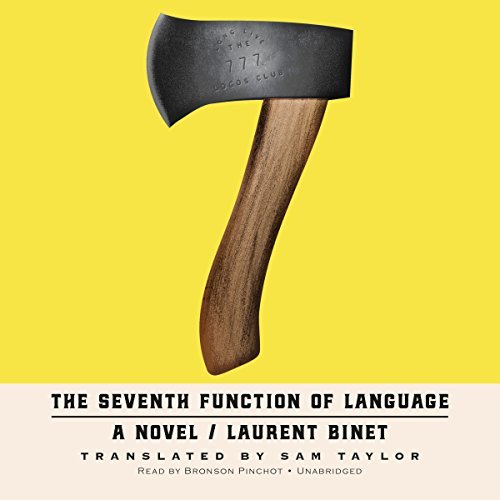
I was a big a fan of Laurent Binet’s novel HHhH, so I was excited when I heard about his follow up, The Seventh Function of Language. I was especially excited when I learned that The Seventh Function took the death of Roland Barthes as its starting point and post-structuralism in general as its milieu. I audited the audiobook (translated by Sam Taylor and read with dry wry humor by Bronson Pinchot).
The audiobook is twelve hours. If it had been six hours I might have loved it. But twelve hours was a bit too much.
Wait. Sorry. What is the novel about though? you may ask. This is not a review and I am feeling lazy and not especially passionate about the book, so here is the publisher’s-blurb-as-summary:
Paris, 1980. The literary critic Roland Barthes dies – struck by a laundry van – after lunch with the presidential candidate François Mitterand. The world of letters mourns a tragic accident. But what if it wasn’t an accident at all? What if Barthes was murdered?
In The Seventh Function of Language, Laurent Binet spins a madcap secret history of the French intelligentsia, starring such luminaries as Jacques Derrida, Umberto Eco, Gilles Deleuze, Michel Foucault, and Julia Kristeva – as well as the hapless police detective Jacques Bayard, whose new case will plunge him into the depths of literary theory. Soon Bayard finds himself in search of a lost manuscript by the linguist Roman Jakobson on the mysterious “seventh function of language.”
Kristeva! Eco! Derrida! All my childhood heroes are here!
So of course, y’know, I was interested. And I’m sure that the twenty-year-old version of me would have flipped out over Binet’s pastiche of postmodern theory and detective pulp fiction. But almost-forty me found the whole thing exhausting, a shaggy dog detective story with patches of the whole continental-philosophy-vs-analytical-philosophy debate sewn in with loose stitches.
The initial intellectual rush of what amounts to a Tel Quel fan fiction/murder-mystery/political thriller hybrid begins to wear thin about halfway through. Binet is smart and he’s writing about smart people, but the cleverness on display becomes irksome, especially when he’s drawing his characters’ big philosophical ideas in the broadest of strokes (Julia Kristeva arrives at her concept of abjection after a floating film on a glass of milk makes her ill).
Binet loves to cram his characters into social situations where they can wax philosophical (in the thinnest possible sense of that verb wax). The Seventh Function is larded with chatty cocktail parties where Kristeva and Foucault can toss out zinger after zinger. One of the novel’s centerpieces, an academic conference at Cornell, serves as an excuse for Binet to riff large (but shallow) on language philosophy. He even brings Chomsky and Searle to the conference to take on Derrida et al. (Binet also squeezes in a postmodern orgy here, in which Detective Bayard has a threesome with Hélène Cixous and Judith Butler). Such scenes are funny but baggy, overlong, and often feel like an excuse for Binet to show how clever he is. (And don’t even get me started on the fact that the novel’s central protagonist worries that he might be a character in a novel).
Binet is more successful at channeling his characters’ intellects during the high-risk debates of a secret society called the Logos Club. The best of these debates showcase thought-in-action, as Binet’s characters deconstruct various topics. Still, as engaging as some elements of the Logos Club debates are, they drag on too long, and the Club’s connection to the political-thriller aspect of the plot is pretty tenuous. Indeed, the novel is so loose that a minor character has to show up at the end and explain how all the elements connect for both the reader and detectives alike.
What’s probably most remarkable about The Seventh Function (despite the fact that it features a who’s-who of postmodern theory for its cast) is just how one-note the novel is. After all, it’s a mashup. As Anthony Domestico puts it in his (proper and insightful) review at The San Francisco Chronicle, “The novel is three parts Tom Clancy to two parts Theory SparkNotes to one part sex romp.” The Seventh Function of Language should be a lot more fun than it is. And it is fun at times, but not enough fun to sustain, say, twelve hours of an audiobook or 359 pages in hardcover.
As HHhH showed, Binet is a talented author, and even though The Seventh Function didn’t work for me, I’m interested to see what he does next. It’s possible that The Seventh Function didn’t float my proverbial boat precisely because I’m the ideal audience for the novel. If anything, it made me want to reread Umberto Eco’s Foucault’s Pendulum—but The Seventh Function also reminded me that I read Eco’s semiotics-detective story as a much younger man—as a kid in my early twenties who probably would’ve loved Binet’s novel. So maybe I should leave well enough alone.
Eddie Campbell’s book Alec: How to Be an Artist (Eddie Campbell Comics, 2001) covers the “rise and fall of the graphic” over the course of a few decades. Alec combines memoir with art history and art criticism, all told through scratchy inks and spidery lettering (and plenty of pastiche–Campbell literally pastes the work of other comic artists of the last century throughout the book, along with “serious” artwork ). While Campbell’s autobiographical stand-in “Alec MacGarry” is obviously central to the story, other figures loom here, including Bill Sienkiewicz (“Billy the Sink”), Art Spiegelman, Stephen Bissette, Dave Sim, Eastman and Laird—and especially Campbell’s From Hell partner, Alan Moore.
How to Be an Artist offers a fascinating and personal look at the time before (and immediately after) comic books reached a tipping point into (gasp!) serious artistic respectability. Witty, warm, and occasionally cruel, Campbell’s book explores the intersection of commerce and art in a very particular place and a very particular time.
The book was especially revelatory for me, I suppose: I transitioned from super hero comics to, like comix in the early nineties, a transition helped by works championed in How to Be an Artist, like Neil Gaiman and Dave McKean’s Sandman books and Dave Sim’s Cerebus. Indeed, the backpages of Cerebus in the late eighties and early nineties operated like a long messy ranty meditation on the theme of “How to be an (independent, successful, self-publishing) artist”—and it was also in the backpages of an issue of Cerebus that I first saw Campbell’s work (the prologue of From Hell was published in Cerebus #124).
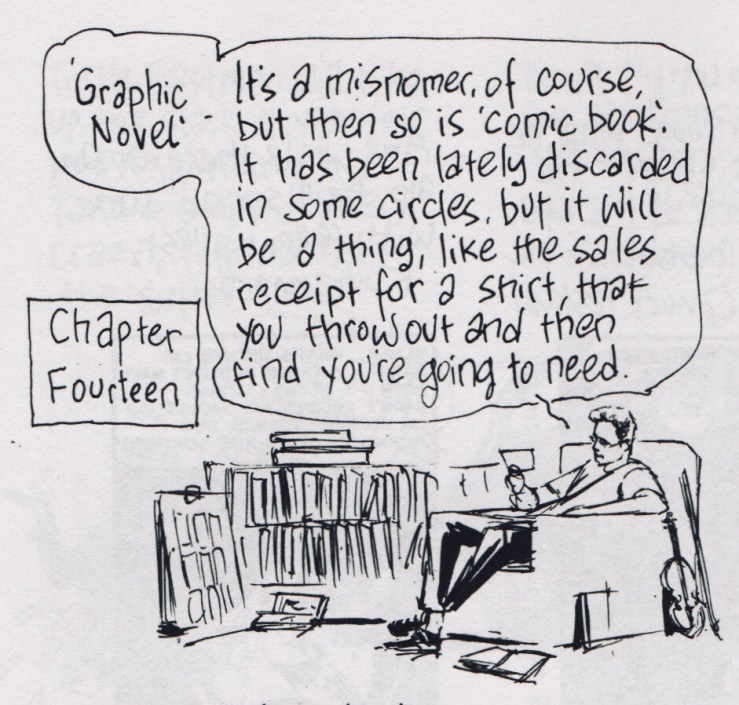
How to Be an Artist’s final chapter sees Campbell offer up a canon of “graphic novels” from 1977 to 2001 (I’ve typed out the full list at the bottom of this post). Campbell (or, properly, Campbell’s persona Alec) begins the chapter by dwelling on the problematic term “graphic novel”:
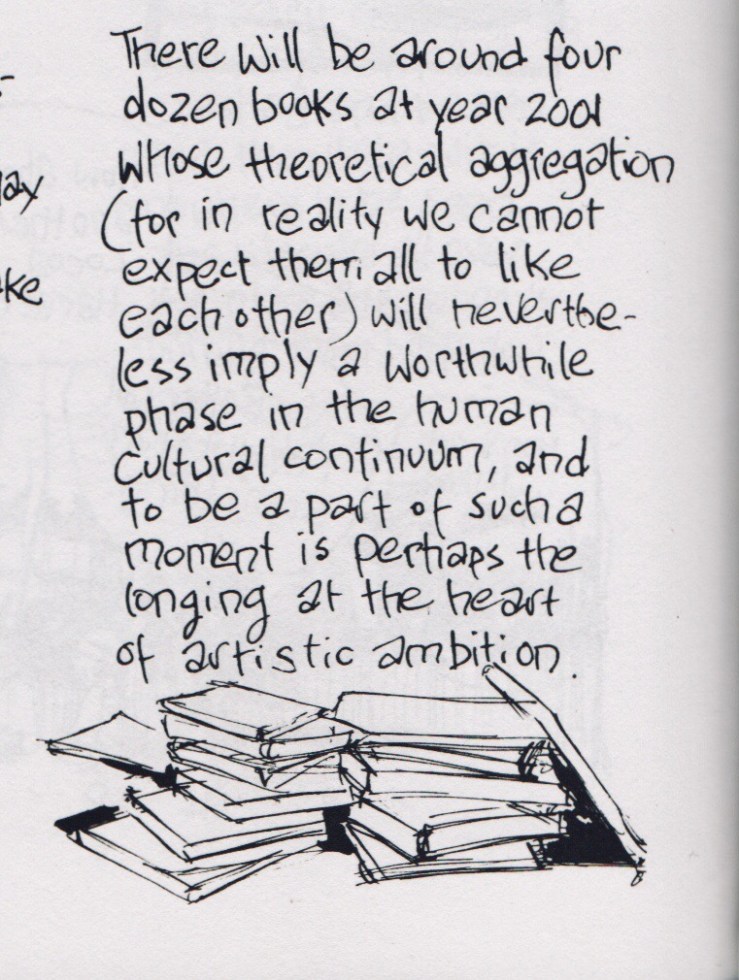
After resolving to use the term, despite whatever problems might be attached to it, Campbell goes on to point out that, after the success of works like Watchmen and Maus, a glut of so-called “graphic novels” flooded the market place. He then goes about naming the best, those works that represent a “worthwhile phase in the human cultural continuum”:
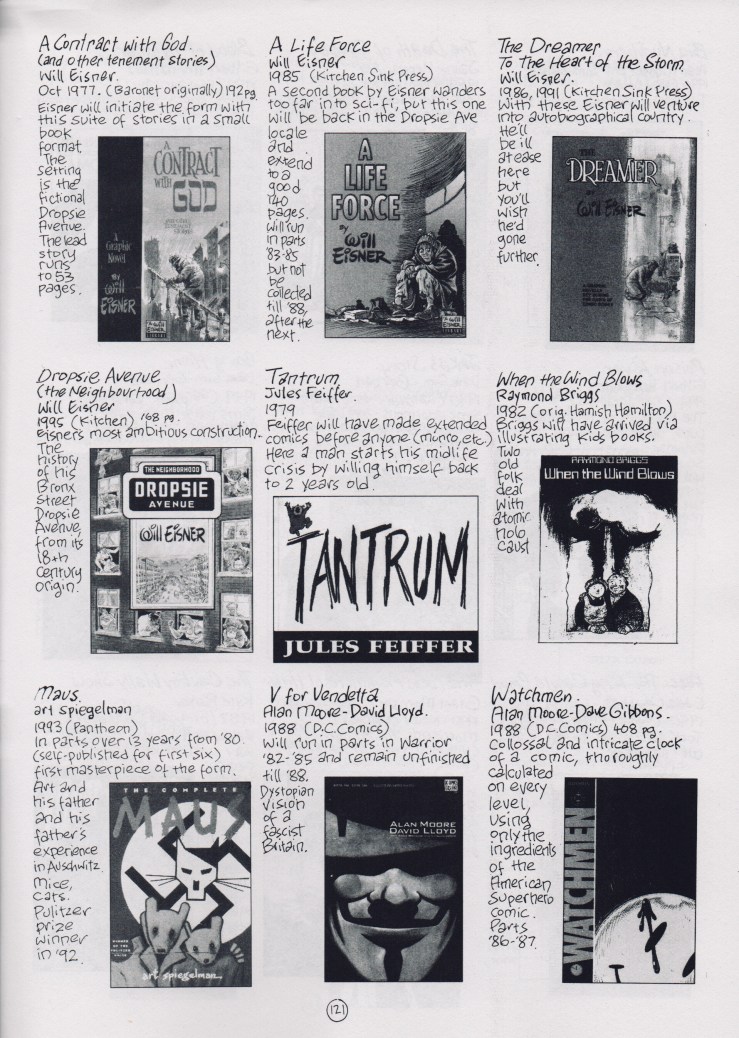
The list is organized semi-chronologically; Campbell groups works in a series together, as with Will Eisner’s DropsieAve books. Here’s the first page of the canon, to give you an idea of its form and layout (note that the list, like the entire book, is written in the future tense):
I’ve never read When the Wind Blows.
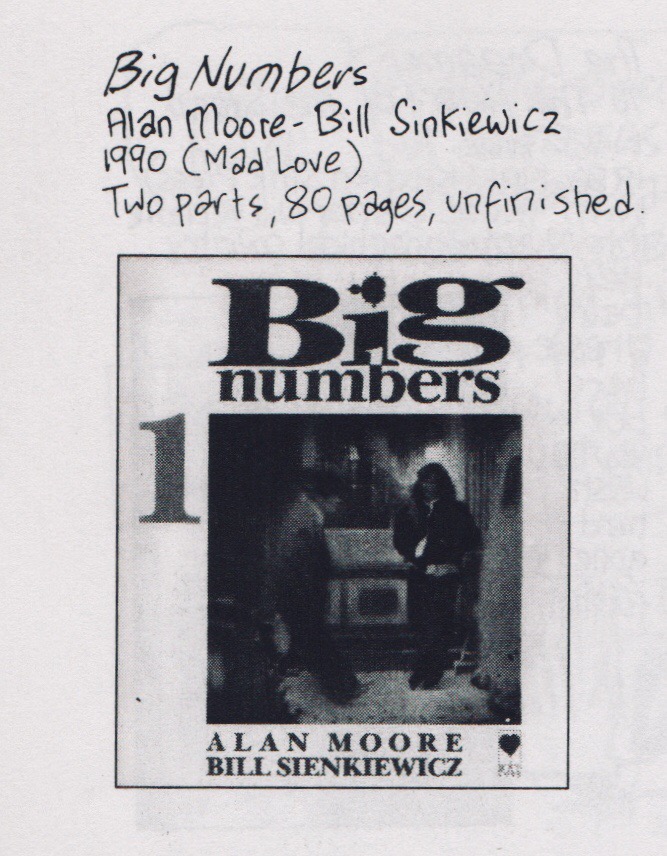
I’ve also never read, to my shame, the unfinished project Big Numbers (by Alan Moore and Bill Sienkiewicz). Campbell details the drama surrounding why the project was never finished in How to Be an Artist. I’ll have to track it down.
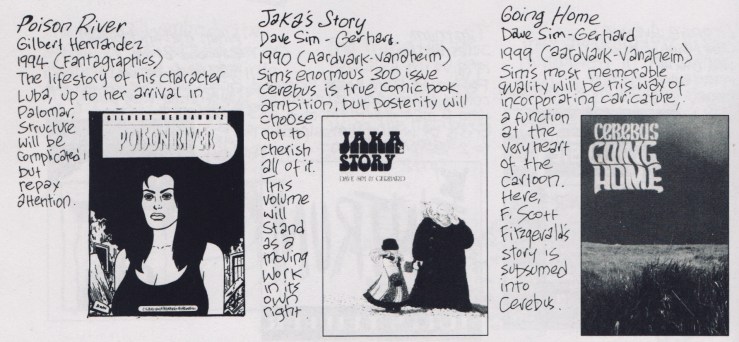
Campbell includes a trio of Love & Rockets novels. Poison River is the first one I read. I was a junior in high school; I checked it out from the public library. Somehow my mother saw it, flicked through it, and was mortified.
Campbell seems to split the difference on Dave Sim’s Cerebus, including critical favorite Jaka’s Story along with the later novel Going Home (which sees Sim trying to reign in the project and steer it toward a conclusion). (Nobody asked me but I would’ve included Church & State and Church & State II).
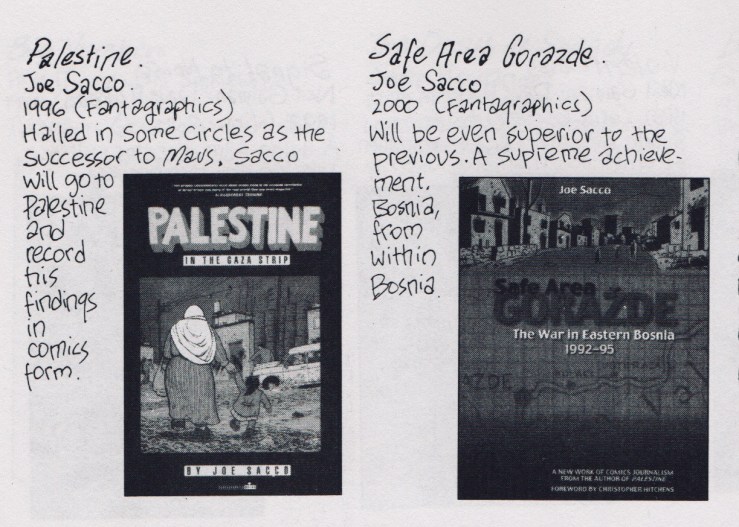
Joe Sacco’s comix-journalism is excellent, and Campbell includes both Palestine and Safe Area Gorazde. These “graphic novels” (they aren’t really graphic novels, except that they are) expanded what was possible not just in comics, but also in journalism.
From Hell isn’t the only one of his own works that Campbell includes on his list—he also includes another Alec novel, The King of Canute Crowd. I love the gesture—an artist fully assured of the qualities in his best work. For the record, if pressed to name “the best graphic novel” I would probably immediately say, “Oh, it’s From Hell of course” (and then hem and haw and hedge, bringing up Chris Ware’s Building Stories, the first half of Sim’s Cerebus project, David Mazzucchelli’s Asterios Polyp, Love & Rockets, etc.).
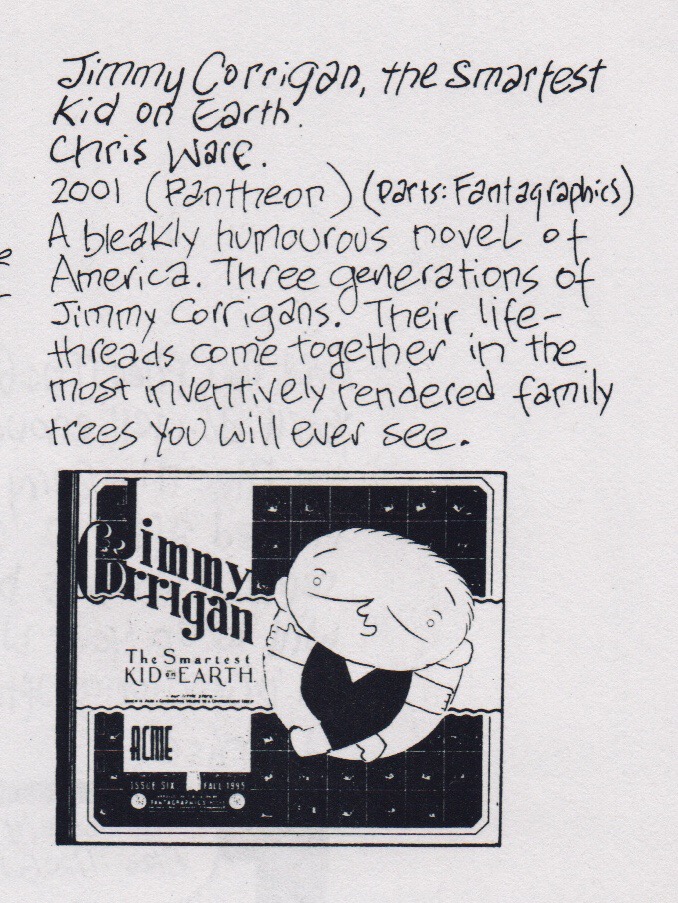
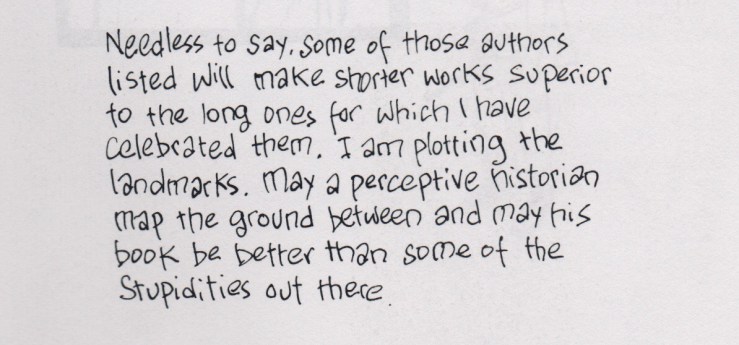
Chris Ware’s Jimmy Corrigan shows up on the list, of course. I’m sure Building Stories would be on here too—along with dozens of others—if the list were updated. Indeed, Campbell’s canon (my term, not his), ends with this disclaimer:
Here’s the full list:
A Contract with God, Will Eisner, 1977
A Life Force, Will Eisner, 1985
The Dreamer, Will Eisner, 1986/1991
Dropsie Avenue, Will Eisner, 1995
Tantrum, Jules Feiffer, 1979
When the Wind Blows, Raymond Briggs, 1982
Maus, Art Spiegleman, 1991
V for Vendetta, Alan Moore and David Lloyd, 1988
Watchmen, Alan Moore and Dave Gibbons, 1988
Big Numbers, Alan Moore and Bill Sienkiewicz, 1990
The Death of Speedy, Jaime Hernandez, 1989
Blood of Palomar, Gilbert Hernandez, 1989
Poison River, Gilbert Hernandez, 1994
Jaka’s Story, Dave Sim and Gerhard, 1990
Going Home, Dave Sim and Gerhard, 1999
Alec: The King Canute Crowd, 1990
The New Adventures of Hitler, Grant Morrison and Steve Yeowell, 1990
The Cowboy Wally Show, Kyle Baker, 1987
Why I Hate Saturn, Kyle Baker, 1990
Violent Cases, Neil Gaiman and Dave McKean, 1987
Signal to Noise, Neil Gaiman and Dave McKean, 1992
Mr. Punch, Neil Gaiman and Dave McKean, 1995
Casanova’s Last Stand, Hunt Emerson, 1993
Tale of One Bad Rat, Bryan Talbot, 1995
City of Glass, Paul Auster/David Mazzucchelli, 1994
The Playboy/I Never Liked You, Chester Brown, 1991/1994
Stuck Rubber Baby, Howard Cruse, 1995
Palestine, Joe Sacco, 1996
Safe Area Gorazde, Joe Sacco, 2000
Ghost World, Daniel Clowes, 1997/2000
It’s a Good Life If You Don’t Weaken, Seth, 1997
Ethel and Ernest, Raymond Briggs, 1998
Gemma Bovery, Posy Simmonds, 1999
Cages, Dave McKean, 1998
Uncle Sam, Steve Darnall and Alex Ross, 1998
From Hell, Alan Moore and Eddie Campbell, 1999
Hicksville, Dylan Horrocks, 1998
The Jew of New York, Ben Katchor, 1998
Jimmy Corrigan, the Smartest Kid on Earth, Chris Ware, 2001
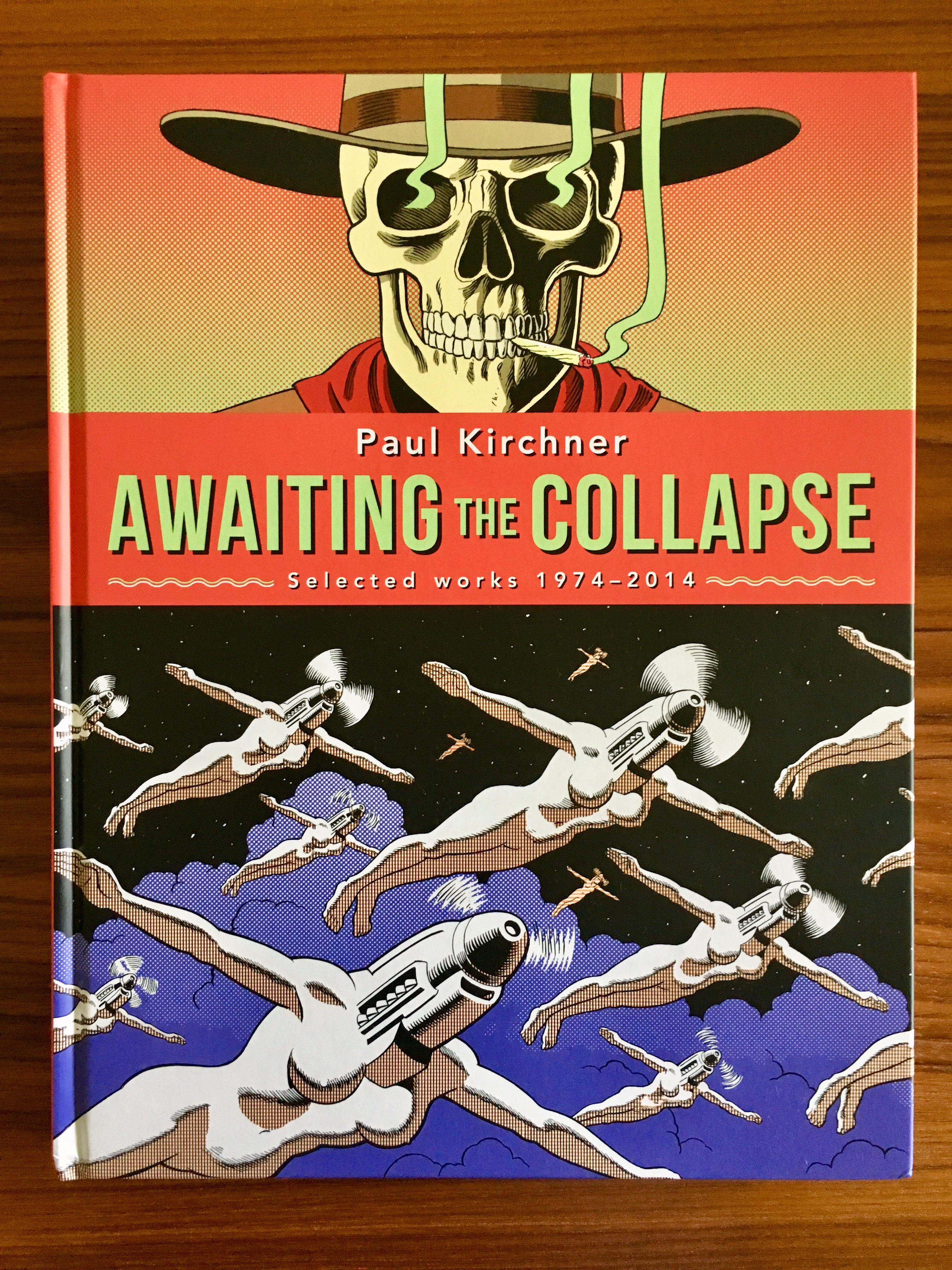
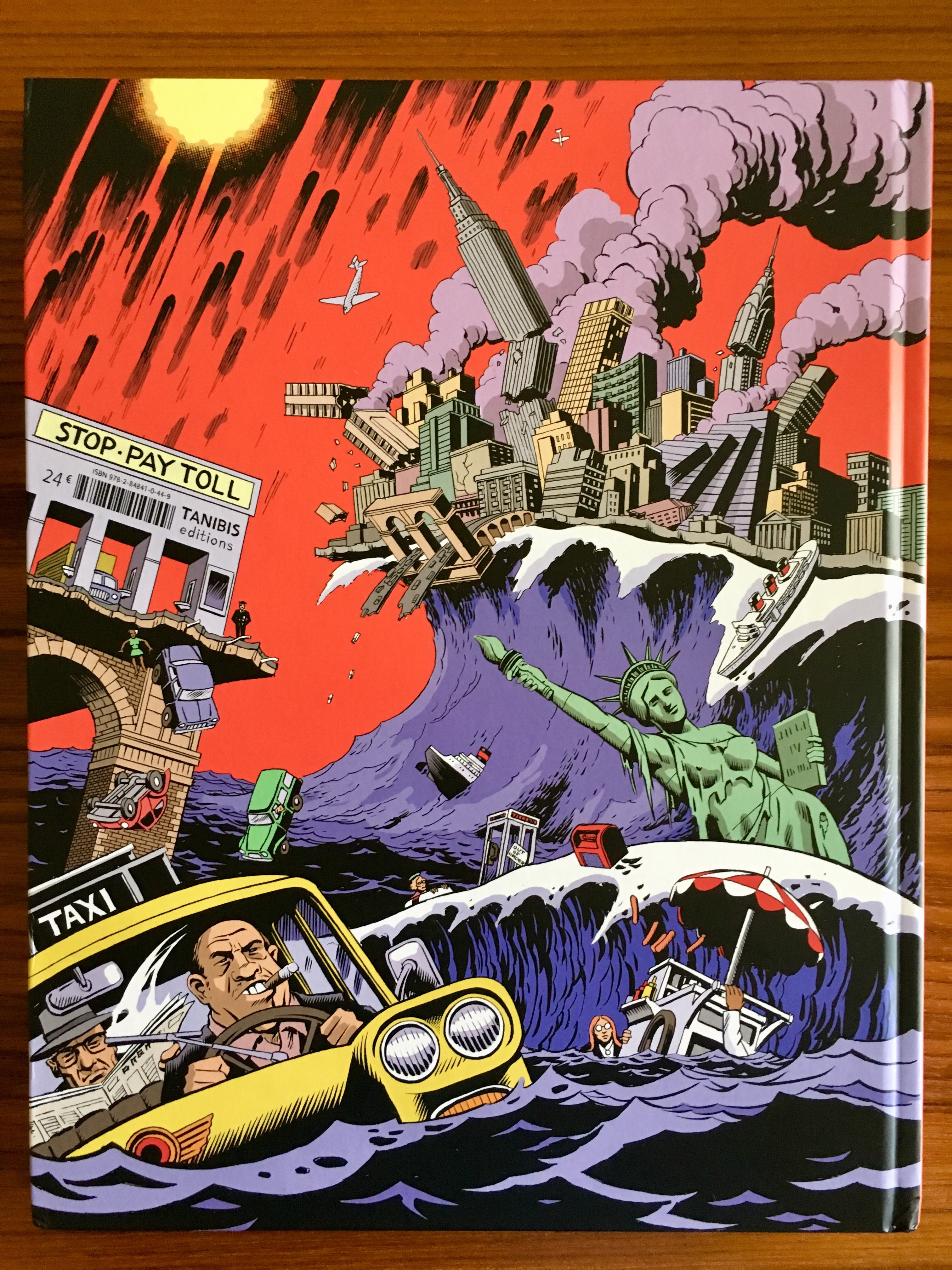
Awaiting the Collapse collects some of the finest and most surreal comix from Paul Kirchner, from the 1970s up through this decade. The book is big and bold and gorgeous. Here’s the back cover:
Awaiting the Collapse is new in hardback from Tanibis Editions, the same good people who brought us hardback editions of The Bus (which I reviewed here), and The Bus 2 (which I reviewed here).A large portion of Collapse features Kirchner’s surreal western Dope Rider strips, which have been hard to find on the internet. It also collects the covers that Kirchner did for Screw magazine, as well as dozens of other one-offs and vignettes, comix in different modes, moods, and manners.
The collection ends with a nice long essay (including numerous photographs, strips, and illustrations) by Kirchner called “Sex, Drugs & Public Transportation: My Strange Trip Through Comics.” I haven’t gotten to it yet because I’m trying to restrain myself from gobbling the collection up all at once.
Here’s Tanibis’s blurb:
This third collaboration between French publishing house Tanibis and comic book artist Paul Kirchner is a collection of the artist’s works, most of them initially published in counter-culture magazines in the 1970s and the 1980s and some dating from his return to comics in the 2010s.
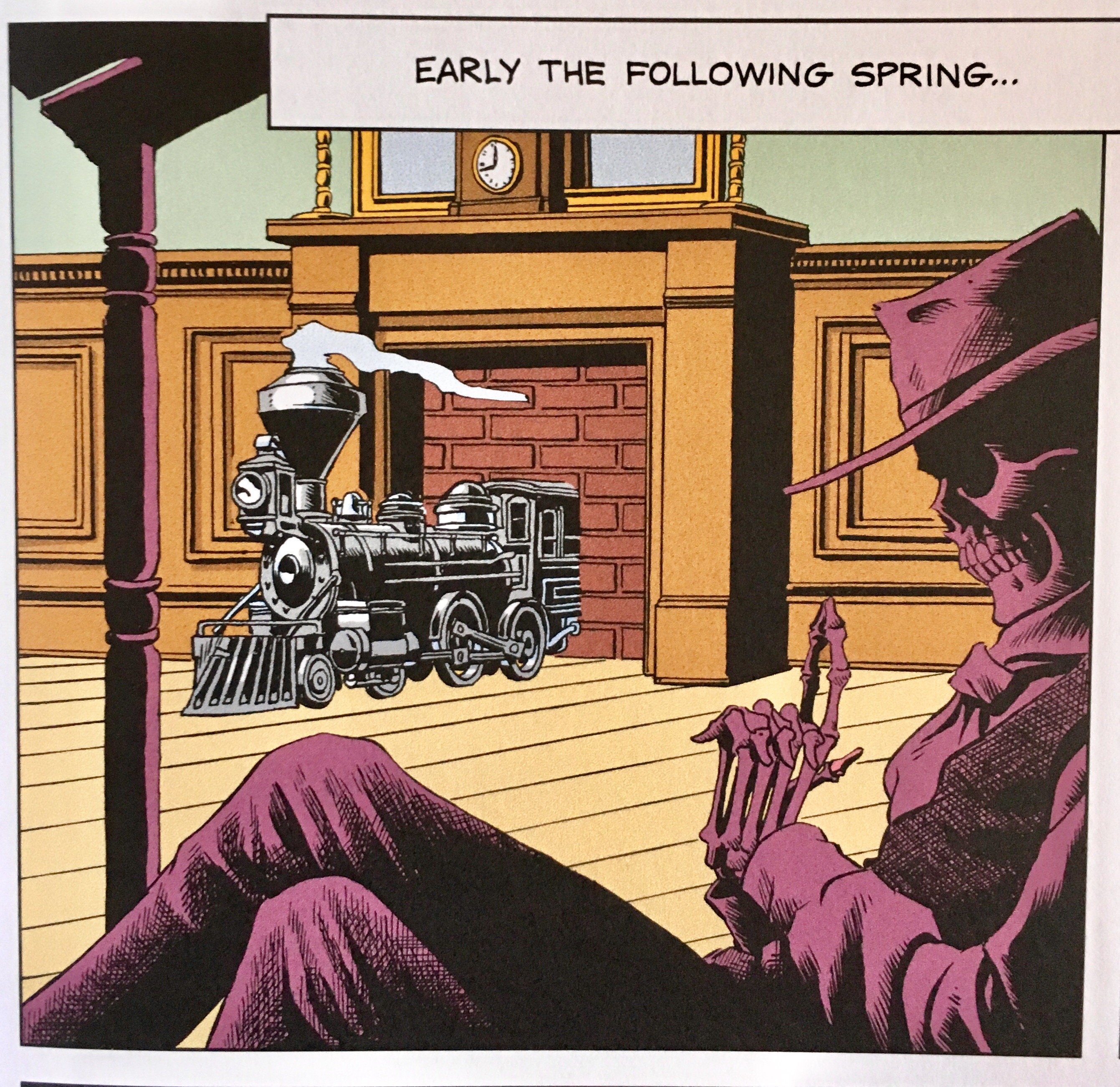
Roughly a third of the stories star Dope Rider, the pot-smoking skeleton whose psychedelic adventures take him through colorful vistas equally reminiscent of Sergio Leone’s spaghetti western films and of the surrealistic paintings of René Magritte and Salvador Dalí. These stories were originally drawn for the marijuana-themed magazine High Times but were also for Kirchner an excuse to create his very own brand of visual poetry.
An other third of the book is a miscellaneous collection of comics whose stories range from the loony (the sextraterrestrial invasion of Earth in “They Came from Uranus”) to the satirical (“Critical mass of cool”) and the outright subversive (if you ever wondered what games toys play at night, read “Dolls at Midnight”).
This book also features a broad selection of the covers Kirchner made for the pornographic tabloid Screw in the 1970s.
Awaiting the Collapse finally contains a previously unpublished essay by Paul Kirchner about his career and his influences, which helps put in perspective the works published in this book.
I promise I’ll have a review of Awaiting the Collapse up soon; for now, let me just underline my enthusiasm—it’s weird and wonderful and gorgeous stuff.
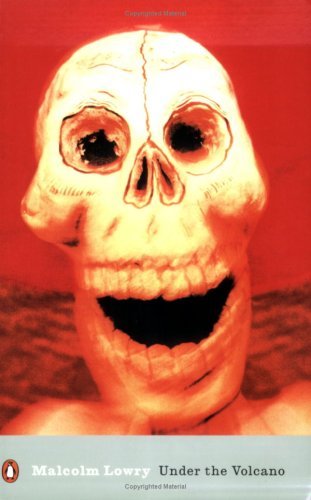
Most of Malcolm Lowry’s dense, depressing novel Under the Volcano takes place over the course of November 2nd, 1938, the Mexican Day of the Dead. Like a reticent, dour Virgil, Lowry guides the reader through the day’s tragic arc, floating between the minds of his novel’s three protagonists: Geoffrey Firmin, his half-brother Hugh, and Geoffrey’s estranged wife Yvonne. Geoffrey is British Consul to Mexico — ex-Consul, really, as British-Mexican relations sour against the backdrop of Spanish fascism and the rise of nationalism in Mexico — but he is almost always referred to as “the Consul,” a blackly ironic title. See, the Consul bears little authority aside from an extreme expertise on how to stay drunk (or “drunkly sober un-drunk”) 24/7. He’s ambassador to bar stools, a manager of mescal and little else (certainly not his own life; certainly not diplomatic affairs). The Consul is a wreck, an alcoholic to put Hemingway and Fitzgerald’s (and even Bukowski’s) alter-egos to shame.
After a first chapter that seems to derail all but the most patient readers, the narrative conflict arrives when Yvonne returns to Quauhnahuac, Mexico, a year after leaving (and divorcing) the Consul. She arrives to find the Consul (“Geoffrey,” as he’s called when the free indirect style inhabits her mind) drinking whiskey in a hotel bar in order to sober up (yep). It’s not immediately clear why Yvonne has returned to the Consul, but it seems that she hopes to save him from drowning in a drunken downward spiral. As the pair walks to the Consul’s house, they pass numerous advertisements for a boxing match; a child’s funeral proceeds down the avenue. These motifs of fighting, death, and futility permeate the novel.
During the walk we learn that Yvonne is not the only one concerned about the Consul’s health; his (much) younger brother Hugh has come to stay with him in the hopes of sobering him up. (Hugh employs a revolting and unsuccessful “strychnine cure”). That Hugh has also returned doubly complicates the plot. Much of Under the Volcano remains implicit, unnamed, hinted at, and this seems especially true of the implication that Yvonne cheated on the Consul with Hugh in the recent past (this implication may have been stated conclusively at some point in the novel, but I’ve only read the book once, which is perhaps like not having read it at all). What’s certainly clear is that Yvonne cheated on the Consul with a French filmmaker, Jacques Laruelle, a man whom the Consul, through sheer bizarre coincidence (but of course it isn’t sheer bizarre coincidence), spent a childhood summer with, an experience which bonded them as brothers in an Edenic holiday that eventually (inevitably) soured.
Despite her infidelities, Yvonne is generally present (I choose the verb “present” over “presented as” to highlight Lowry’s impeccable Modernist style) as a sympathetic character. Still, it is hard not to identify with the Consul (with “Geoffrey,” I suppose, if we are going to be familiar), the dark soul of this novel, and his complicated, painful feelings for Yvonne form the core of Volcano’s tragedy. He longs for her, pines for a complete life with her, yet resents her, cannot forgive her, hates her. For what? For leaving him. For betraying him. But perhaps foremost, he despises her inability to understand his alcoholism (he is particularly upset when she refuses to share a morning libation with him when they meet for the first time in a year). I’ll quote a passage at length now, one that showcases Lowry’s free indirect style, and one that reveals the strange indignities of the Consul’s sense of his own alcoholism. For context, dear reader, you must only know that Yvonne has suggested that she and the Consul might make long-term plans when he is sober “in a day or two”—
The Consul sat perfectly still staring at the floor while the enormity of the insult passed into his soul. As if, as if, he were not sober now! Yet there was some elusive subtlety in the impeachment that still escaped him. For he was not sober. No, he was not, not at this very moment he wasn’t! But what had that to do with a minute before, or half an hour ago? And what right had Yvonne to assume it, assume either that he was not sober now, or that, far worse, in a day or two he would be sober? And even if he were not sober now, by what fabulous stages, comparable indeed only to the paths and spheres of the Holy Cabbala itself, had he reached this stage again, touched briefly once before this morning, this stage at which alone he could, as she put it, “cope,” this precarious precious stage, so arduous to maintain, of being drunk in which alone he was sober! What right had she, when he had sat suffering the tortures of the damned and the madhouse on her behalf for fully twenty-five minutes on end without having a decent drink, even to hint that he was anything but, to her eyes, sober? Ah, a woman could not know the perils, the complications, yes, the importance of a drunkard’s life! From what conceivable standpoint of rectitude did she imagine she could judge what was anterior to her arrival? And she knew nothing whatever of what all too recently he had gone through, his fall in the Calle Nicaragua, his aplomb, coolness, even bravery there—the Burke’s Irish whiskey! What a world! And the trouble was she had now spoiled the moment.
The “fall in the Calle Nicaragua” the Consul references is quite literally a drunkard’s blackout (followed by the aforementioned fortifying whiskey, courtesy of a tourist), but it — falling — is perhaps the dominant motif in a novel crammed with motifs. In allegorical terms, if we want to ruin a good book (I don’t recommend this, of course), Volcano is pure Faust-stuff: end of innocence, fall of man, intractability of the human condition, ethical peril, moral inertia. While the Consul’s fall dominates the novel, Lowry brings this decline into dramatic relief in a late, climactic episode when his (anti-)heroic trio encounter a dying (dead?) man on the side of the road. Hugh tries to help, but the Darwinian venality of Mexican commonplace law makes his attempt impotent. Yvonne and the Consul are basically paralyzed.
Hugh’s attempt to save the man is a desperate call to action, an endeavor to perform some good in a world dominated by war and fascism. Hugh’s character fascinates. We learn of his past in one of the novel’s most intriguing episodes, a mini-bildungsroman that finds young Hugh working in the merchant marine as a calculated ploy to lend romance to his persona — he longs to prevail as a songwriter. He returns to find that no one cares about — has even heard — his guitar compositions; his publicity stunt fails. Although Hugh is only twenty-nine, he already seems himself as a failure, a fallen hero; he obsesses over the Battle of Ebro, daydreaming of helming a ship laden with hidden arms that he will deliver to the Loyalists who oppose the Fascists. Hugh’s greatest pain — and perhaps (only perhaps) Lowry’s greatest cruelty — is the awareness that the idealism of romantic heroism is intrinsically bound to a kind of selfish egoism. Hugh, perhaps with the visceral signal of his half-brother as a kind of radical prescience, can already see his own fall; his parts in Volcano are in a sense a constant meditation on falling. Hugh tries to save the dying man on the road, the cold double of his brother, whom he also tries to save — and yet it is all to little avail.
In Lowry’s world, in the volcano-world, there is only expulsion from the Eden. Lowry spells out this theme near the middle of his novel in a strange episode. The Consul wanders into his neighbor’s garden and reads a sign —
¿LE GUSTA ESTE JARDÍN?
¿QUE ES SUYO?
¡EVITE QUE SUS HIJOS LO DESTRUYAN!
The Consul stared back at the black words on the sign without moving. You like this garden? Why is it yours? We evict those who destroy! Simple words, simple and terrible words, words which one took to the very bottom of one’s being, words which, perhaps a final judgement on one, were nevertheless unproductive of any emotion whatsoever, unless a kind of colourless cold, a white agony, an agony chill as that iced mescal drunk in the Hotel Canada on the morning of Yvonne’s departure.
Significantly, either the sign is posted with improper punctuation, or (and?) the Consul’s translation is wrong — in either case a meaningful misreading occurs. We later receive the “proper” version of the sign: “¿Le gusta este jardín, que es suyo? ¡Evite que sus hijos lo destruyan! – “Do you like this garden that is yours? See to it that your children do not destroy it!” The Consul’s first reading is a corruption, a cruel misreading that questions humanity’s right to happiness, and, tellingly, he connects the sign to the end of his relationship with Yvonne. The second version of the sign, while still foreboding, perhaps signals a kernel of hope in Lowry’s bleak work — the idea that a garden might be preserved, might be tended to; that children might be raised who do not kill, cheat, steal, rape, enslave, or otherwise prey on each other. Still, Lowry refuses to imagine what such a world might look like for us. Did I mention that Volcano is really, really sad?
For all its bleak, bitter bile, Volcano contains moments of sheer, raw beauty, especially in its metaphysical evocations of nature, which always twist back to Lowry’s great themes of Eden, expulsion, and death. Lowry seems to pit human consciousness against the naked power of the natural world; it is no wonder then, against such a grand, stochastic backdrop, that his gardeners should fall. The narrative teems with symbolic animals — horses and dogs and snakes and eagles — yet Lowry always keeps in play the sense that his characters bring these symbolic identifications with them. The world is just the world until people walk in it, think in it, make other meanings for it.
In many ways, Under the Volcano is an antipodal response to Joyce’s Ulysses. Both novels stream through a number of consciousnesses over the course of one day; both novels invert and subvert mythical frameworks against diurnal concerns; both novels point to the ways that the smallest meannesses — and kindnesses — can color and affect our lives. And while there are many divergences (chiefest, I believe, the spirit of redemption in Ulysses that seems entirely absent from Volcano), the greatest similarity may be their difficulty. Simply put, Lowry, like Joyce, throws his readers into the deep end. The first chapter of the novel inhabits the mind of Jacques Laruelle and takes place exactly one year after the events of the rest of the novel. It is both overture and context for all that follows, and yet it is radically alienating; indeed, it only fully makes sense after one finishes the novel and goes back and reads it again, realizing it is the rightful coda, the sad epilogue of a sad story. Lowry leads with his conclusion, show us the fall-out up front, the splinters and shards of the narrative to come. Picking up these pieces is hardly easy and never joyful, but it is a rewarding experience. Very highly recommended.
[Editorial note: Biblioklept ran a version of this review in March of 2011; we run it again in honor of The Day of the Dead]
Dracula is a character in Roberto Bolaño’s dark opus 2666.
Specifically, I’m suggesting that Dracula (like, theCount Dracula) is the unnamed SS officer in “The Part About Archimboldi” who hosts a strange party in a Romanian castle.
II. I’m willing to concede that my idea is probably full of holes and more than a little silly, but I think there’s some textual support for such a claim.
III. I’ve already suggested on this blog that 2666 is full of lycanthropic transformations, and in that earlier essay, I linked werewolves to vampires (using the work of mythologist Sabine Baring-Gould).
It’s a work of mesmerism and transformation—vampire powers. Dracula showing up is a winking sick joke, a satire.
IV. In his post “Castle Dracula” at Infinite Zombies, Daryl L. L. Houston connects the many strands of vampirism that run through 2666, suggesting that “Bolaño is using the vampirism in the story, and Dracula in particular, to tie together some of the threads he’s been unwinding pertaining to insiders and outsiders, parasitism and consumption of people, and a sort of larger parasitism of nations.” Hence Aztec blood rituals, the Holocaust, the murder of helpless, marginalized women in Santa Teresa . . .
V. Okay, so back to that thesis. Let’s start with the first appearance of the unnamed SS officer:
At midmorning they came to a castle. The only people there were three Romanians and an SS officer who was acting as butler and who put them right to work, after serving them a breakfast consisting of a glass of cold milk and a scrap of bread, which some soldiers left untouched in disgust. Everyone, except for four soldiers who stood guard, among them Reiter, whom the SS officer judged ill suited for the task of tidying the castle, left their rifles in the kitchen and set to work sweeping, mopping, dusting lamps, putting clean sheets on the beds.
Fairly banal, right? Also, “midmorning” would entail, y’know, sunlight, which is poison for most vampires. Let me chalk this up to the idea that the SS officer is inside the castle, which is sufficiently gloomy and dark enough to protect him (I’m not going to get into any vampire rules that might spoil my fun, dammit!). In any case, hardly noteworthy. Indeed, the SS officer—a butler commanding house chores—seems hardly a figure of major importance.
VI. Next, we get the Romanian castle explicitly identified as “Dracula’s castle” and meet the actors for this milieu:
“And what are you doing here, at Dracula’s castle?” asked the baroness.
“Serving the Reich,” said Reiter, and for the first time he looked at her.
He thought she was stunningly beautiful, much more so than when he had known her. A few steps from them, waiting, was General Entrescu, who couldn’t stop smiling, and the young scholar Popescu, who more than once exclaimed: wonderful, wonderful, yet again the sword of fate severs the head from the hydra of chance.
(I love Popescu’s line here).
VII. Our principals soon take a tour of castle and environs, led by the SS officer (boldface emphasis is mine):
Soon they came to a crypt dug out of the rock. An iron gate, with a coat of arms eroded by time, barred the entrance. The SS officer, who behaved as if he owned the castle, took a key out of his pocket and let them in. Then he switched on a flashlight and they all ventured into the crypt, except for Reiter, who remained on guard at the door at the signal of one of the officers.
So Reiter stood there, watching the stone stairs that led down into the dark, and the desolate garden through which they had come, and the towers of the castle like two gray candles on a deserted altar. Then he felt for a cigarette in his jacket, lit it, and gazed at the gray sky, the distant valleys, and thought about the Baroness Von Zumpe’s face as the cigarette ash dropped to the ground and little by little he fell asleep, leaning on the stone wall. Then he dreamed about the inside of the crypt. The stairs led down to an amphitheater only partially illuminated by the SS officer’s flashlight. He dreamed that the visitors were laughing, all except one of the general staff officers, who wept and searched for a place to hide. He dreamed that Hoensch recited a poem by Wolfram von Eschenbach and then spat blood. He dreamed that among them they had agreed to eat the Baroness Von Zumpe.
He woke with a start and almost bolted down the stairs to confirm with his own eyes that nothing he had dreamed was real.
When the visitors returned to the surface, anyone, even the least astute observer, could have seen that they were divided into two groups, those who were pale when they emerged, as if they had glimpsed something momentous down below, and those who appeared with a half smile sketched on their faces, as if they had just been reapprised of the naivete of the human race.
Bolaño concludes the crypt passage by highlighting an essential ambiguity that courses throughout the entire “Castle Dracula” episode, a strange axis of horror/humor, romance/banality. What has been revealed in the crypt? We don’t know, of course, but our surrogate Reiter allows us access to a few visions of what might have happened, including terror and fear and cannibalism. (He employs Hawthorne’s escape hatch too—it was all a dream).
The Knight of Death, Salvador Dali
VIII. Then, supper time:
That night, during dinner, they talked about the crypt, but they also talked about other things. They talked about death. Hoensch said that death itself was only an illusion under permanent construction, that in reality it didn’t exist. The SS officer said death was a necessity: no one in his right mind, he said, would stand for a world full of turtles or giraffes. Death, he concluded, served a regulatory function.
Clearly it’s easy to link any of the dinnertime comments about death to Dracula, but note that the SS officer’s idea that death is a “regulatory function” is terribly banal, is quite literally regular—this idea contrasts with Hoensch’s more poetic notion that death is an illusion (an illusion that the SS officer, if he is in fact Count Dracula, would realize in a perfectly mundane way that foreclosed the necessity of metaphor).
IX. Dinner conversation turns to murder—obviously one of the central themes of 2666:
The SS officer said that murder was an ambiguous, confusing, imprecise, vague, ill-defined word, easily misused.
Again, ambiguity: on one hand, sure, an SS officer’s job was in large part about coordinating and executing mass murder. At the same time, we might appreciate that murder is a vague term if people are one’s lunch.
X. Then conversation turns to culture:
The SS officer said culture was the call of the blood, a call better heard by night than by day, and also, he said, a decoder of fate.
I’m pretty sure that this was the moment I started entertaining the fancy that the SS officer might be Dracula.
XI. Popescu the intellectual also seems to reconsider the SS officer:
The intellectual Popescu remained standing, next to the fireplace, observing the SS officer with curiosity.
XII. Then, they finally riff on Dracula. Significantly, the SS officer believes that Dracula is a good German (bold emphasis mine):
First they praised the assortment of little cakes and then, without pause, they began to talk about Count Dracula, as if they had been waiting all night for this moment. It wasn’t long before they broke into two factions, those who believed in the count and those who didn’t. Among the latter were the general staff officer, General Entrescu, and the Baroness Von Zumpe. Among the former were Popescu, Hoensch, and the SS officer, though Popescu claimed that Dracula, whose real name was Vlad Tepes, aka Vlad the Impaler, was Romanian, and Hoensch and the SS officer claimed that Dracula was a noble Teuton, who had left Germany accused of an imaginary act of treason or disloyalty and had come to live with some of his loyal retainers in Transylvania a long time before Vlad Tepes was born, and while they didn’t deny Tepes a real historical or Transylvanian existence, they believed that his methods, as revealed by his alias or nickname, had little or nothing to do with the methods of Dracula, who was more of a strangler than an impaler, and sometimes a throat slitter, and whose life abroad, so to speak, had been a constant dizzying spin, a constant abysmal penitence.
The SS officer is the noble Teuton. More importantly, we get language that connects Dracula to the murders in Santa Teresa, most of which are stranglings; we also get the idea that Dracula has had a “life abroad”—one outside of time—a life that might see his spirit inhabit and ventriloquize an industrial city in the north of Mexico. (Or not. I know. Look, I’m just riffing here).
We also get the idea of an abyss (this is the structure of 2666), as well as the idea of Dracula as a penitent of sorts.
So, let us recall that early in “The Part About the Crimes,” detective Juan de Dios Martinez is searching for a criminal dubbed The Penitent who desecrates churches and has committed a few murders in the process. He goes to psychologist Elvira Campos for help:
Sacraphobia is fear or hatred of the sacred, of sacred objects, especially from your own religion, said Elvira Campos. He thought about making a reference to Dracula, who fled crucifixes, but he was afraid the director would laugh at him. And you believe the Penitent suffers from sacraphobia? I’ve given it some thought, and I do. A few days ago he disemboweled a priest and another person, said Juan de Dios Martinez.
This is the first mention of Dracula in 2666, and he’s explicitly likened to the Penitent; later, as we see above, Dracula will be explicitly linked to penitence.
(I’m not suggesting that the Penitent is Dracula traveled to Mexico to piss in churches. What I want to say is that Dracula’s dark spirit ventriloquizes the text of 2666).
(I’m also suggesting, again, that 2666 be read intertextaully).
Riding with Death, Jean-Michel Basquiat
XIII. Our other principals continue to discuss Dracula, but I won’t belabor that discussion (I’d prefer you, dear reader, to return to the text).
I will summarize though: Popescu sees Dracula in nationalistic terms (“a Romanian patriot” who repels the Turks), and General Entrescu goes on a long rant about heroism and villainy and history, culminating in a lengthy digression on Jesus Christ (recall now that Entrescu will be crucified JC-style by his men).
One aside on the SS officer bears mentioning: we learn that “the fastidious SS officer” is the most sober conversant as he “scarcely wet his lips with alcohol.” (Because he’s a vampire who prefers blood! Muahahahaha!)
XIV. Fast forward a few hours. Our man Reiter, among fellow soldiers, sets out to explore the secret crannies and passageways of Castle Drac and play voyeur:
The room they came to was empty and cold, as if Dracula had just stepped out. The only thing there was an old mirror that Wilke lifted off the stone wall, uncovering a secret passageway.
Dracula’s spirit leaves the room, creating an opening, behind the ever-symbolic mirror. (Muahahahaha!). (2666: Mirror, tunnels, chambers, labyrinths).
They enter the passageway and come first upon our supposed Dracula, the SS officer:
And so they were able to look into the room of the SS officer, lit by three candles, and they saw the SS officer up, wrapped in a robe, writing something at a table near the fireplace. The expression on his face was forlorn. And although that was all there was to see, Wilke and Reiter patted each other on the back, because only then were they sure they were on the right path. They moved on.
XV. Dracula, the epistolary novel. Count Dracula, troubled writer of letters, will author the following scenes, his spirit ventriloquizing the principals all: Here, we find Reiter and his homeboy Wilke, lurking in a secret passage, jerking off to werewolf-cum-Jesus-Christ-figure Gen. Entrescu screwing the lovely Baroness Von Zumpe and reciting poetry (emphasis per usual mine):
Then Wilke came on the wall and mumbled something too, a soldier’s prayer, and soon afterward Reiter came on the wall and bit his lips without saying a word. And then Entrescu got up and they saw, or thought they saw, drops of blood on his penis shiny with semen and vaginal fluid, and then Baroness Von Zumpe asked for a glass of vodka, and then they watched as Entrescu and the baroness stood entwined, each with a glass in hand and an air of distraction, and then Entrescu recited a poem in his tongue, which the baroness didn’t understand but whose musicality she lauded, and then Entrescu closed his eyes and cocked his head as if to listen to something, the music of the spheres, and then he opened his eyes and sat at the table and set the baroness on his cock, erect again (the famous foot-long cock, pride of the Romanian army), and the cries and moans and tears resumed, and as the baroness sank down onto Entrescu’s cock or Entrescu’s cock rose up into the Baroness Von Zumpe, the Romanian general recited a new poem, a poem that he accompanied by waving both arms (the baroness clinging to his neck), a poem that again neither of them understood, except for the word Dracula,which was repeated every four lines, a poem that might have been martial or satirical or metaphysical or marmoreal or even anti-German, but whose rhythm seemed made to order for the occasion, a poem that the young baroness, sitting astride Entrescu’s thighs, celebrated by swaying back and forth, like a little shepherdess gone wild in the vastness of Asia, digging her nails into her lover’s neck, scrubbing the blood that still flowed from her right hand on her lover’s face, smearing the corners of his lips with blood, while Entrescu, undeterred, continued to recite his poem in which the word Dracula sounded every four lines, a poem that was surely satirical, decided Reiter (with infinite joy) as Wilke jerked off again.
I contend that the poem is the work of the SS officer, psychic mesmerist, the poet Dracula, a poem no one in the scene can understand, a dark satire that might also be a war poem or a love poem or an elegy, but definitely a dark satire, written in violence and sex and blood, a poem that ventriloquizes not only Entrescu, phallic delivery device, but also the baroness, and also Reiter and Wilke. And perhaps the reader.
XVI. Where to go after such a climax? Maybe point out that Dracula infects Reiter and Wilke, of whom we learn:
Some of their battalion comrades dubbed them the vampires.
(But better to return I think to our strange figure, the SS officer).
XVII. Here, his last appearance:
The next morning the detachment left the castle after the departure of the two carloads of guests. Only the SS officer remained behind while they swept, washed, and tidied everything. Then, when the officer was fully satisfied with their efforts, he ordered them off and the detachment climbed into the truck and headed back down to the plain. Only the SS officer’s car—with no driver, which was odd—was left at the castle. As they drove away, Reiter saw the officer: he had climbed up to the battlements and was watching the detachment leave, craning his neck, rising up on tiptoe, until the castle, on the one hand, and the truck, on the other, disappeared from view.
Dracula stays in Dracula’s castle; his spirit, his seed, his blood seeps out.
[Ed. note: This post was originally published in 2012].
[Editorial note: The following citations come from one-star Amazon reviews of Bram Stoker’s novel Dracula.I’ve preserved the reviewers’ original punctuation and spelling. More one-star Amazon reviews].
Crapula
hack author
Painfully verbose
he lives in a castle!
hard to understand
NOTHING is happening
find an abridged version
I have read many horror novels
may be the worst book ever written
being the avid vampire fan that I am
attempt to cash in on the vampire craze
cavort lasciviously with the sons of the devil
Watch the movie and save yourself some time
I’m always willing to read new vampire fiction
epistolary format is monotonous and repetitive
Turns out the vampire in this book is an old guy
It was so stupid and the movie was even stupider
If you’re like me, just tring this book to make yourself feel brave, forget it
I think I have been hacked or my late wife’s daughter is using our account
Any vampire fan knows that vampires roam the streets of upper middle class suburbia
Over the past couple years I’ve started a collection of vampire books which totals over 100 now
I’ll be returning this on my next trip to the library and sticking to the teen reading section for finding my next vampire novel
I fully realize that this is a fictional/fantasy tale containing elements that obviously require a certain amount of leeway and suspension of belief, but
Epostolary novel told from multiple perspectives about the vampire, Count Dracula, who is trying to invade London and turn everyone else into vampires. A bunch of rich guys and a chick decide to stop him.
no relationship between Lucy and the Count-which i suppose makes more sense as to why he bit her
up pops a homoerotic cover with naked men, one whose penis is exposed in the background
the book is down hill from the time Dracula is in London and it is decided that he must be destroyed
the method being used to advance the plot being in disuse since quite some time
he is not a suave romantic movie/play character but an angry stupid animal
Amazon markets this book not to children but homosexual adult men
The movie was so much better even with Keanu Reeves’ awful acting
what are the standards when it comes to classic books
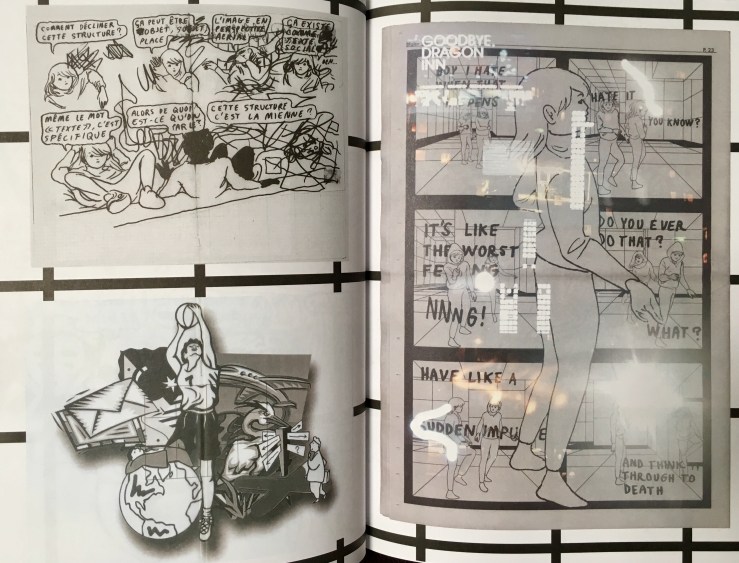
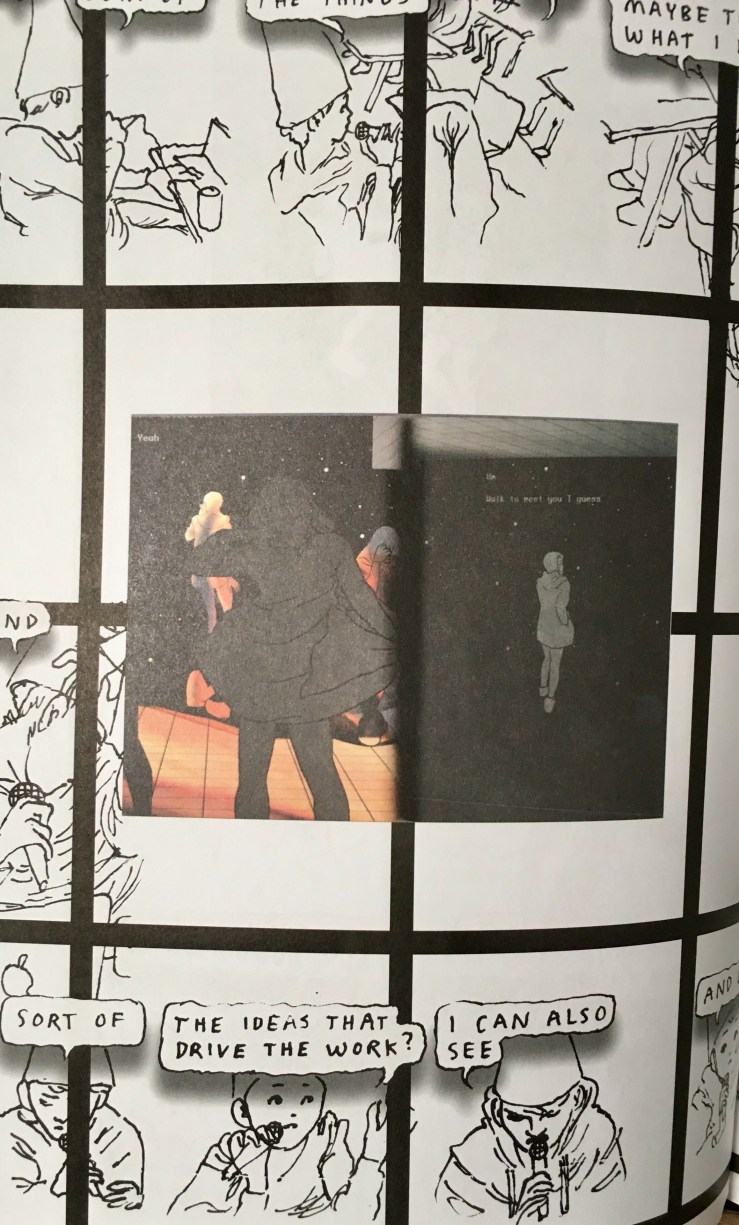
Blaise Larmee’s 2001 is new from 2dcloud. It showed up at the house a few weeks ago, its minimalist cover strange and intriguing.
I’m not sure what the book is—is it a sort of metatextual commentary on Larmee’s webcomic of the same name? A kind of autobiographical riff? A deconstruction of the graphic novel form?
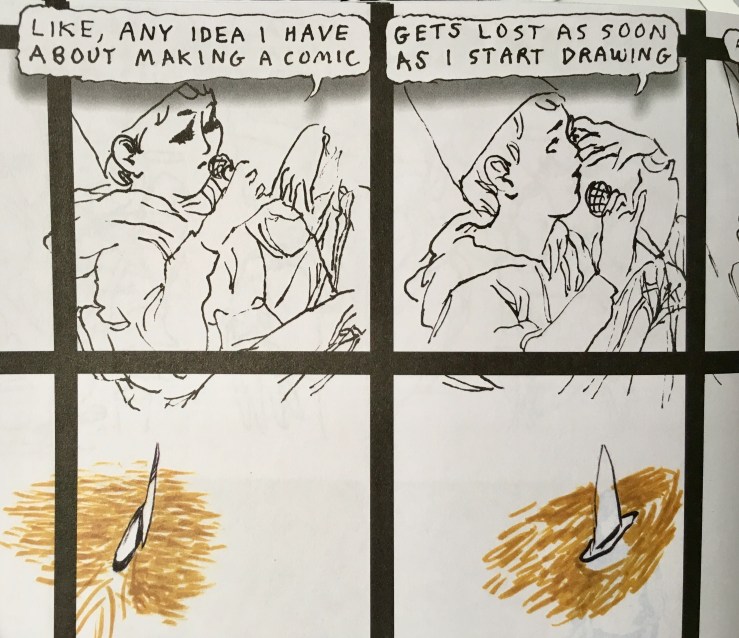
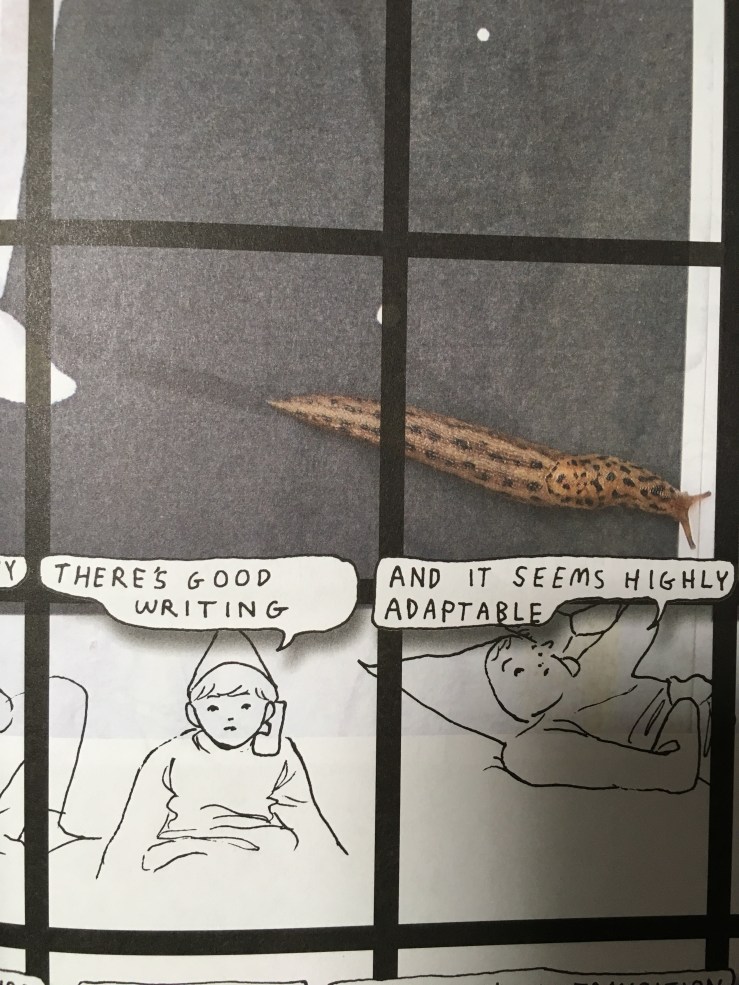
What Larmee’s book is is not as compelling, ultimately, as how it is—sketchy, loose, messy; littered with hi-res scans–receipts, crushed cans and bottles, a house key—scraps from the real that call attention to the narrative’s artifice.
2001 is strange and fascinating in its fragmentary, elusory nature. Check it out.