
Lucia Berlin/Ursula K. Le Guin (Books acquired, 12.11.2015)

IMG_1016

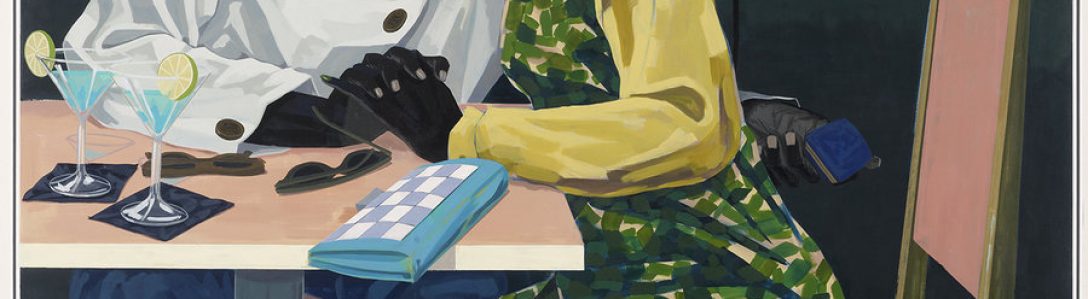
Went to the bookstore this afternoon to pick up the much-acclaimed collection of stories by Lucia Berlin, A Manual for Cleaning Women (typing out the title, I suddenly hear its ambiguities). My trusty local used bookshop didn’t have a copy, but they did have Homesick, and I love Black Sparrow editions, so hey, cool.
IMG_1017

I’ve been tearing through Ursula K. Le Guin’s Hainish novels lately after picking up Rocannon’s World at sorta-random. I’m in the middle of City of Illusion right now, having finished (a third read of) The Dispossessed (fantastic), The Word for World Is Forest (a bit too on-the-nose critique of the Vietnam War; also, James Cameron should send Le Guin some Avatar bucks), and Planet of Exile, which was great. (And oh: George R.R. Martin should send Le Guin some Game of Thrones bucks for that one: Planet of Exile has barbarian invaders from the north, seasons that last for decades, a constant fear that “winter is coming,” and its own white walkers (snow ghouls)).

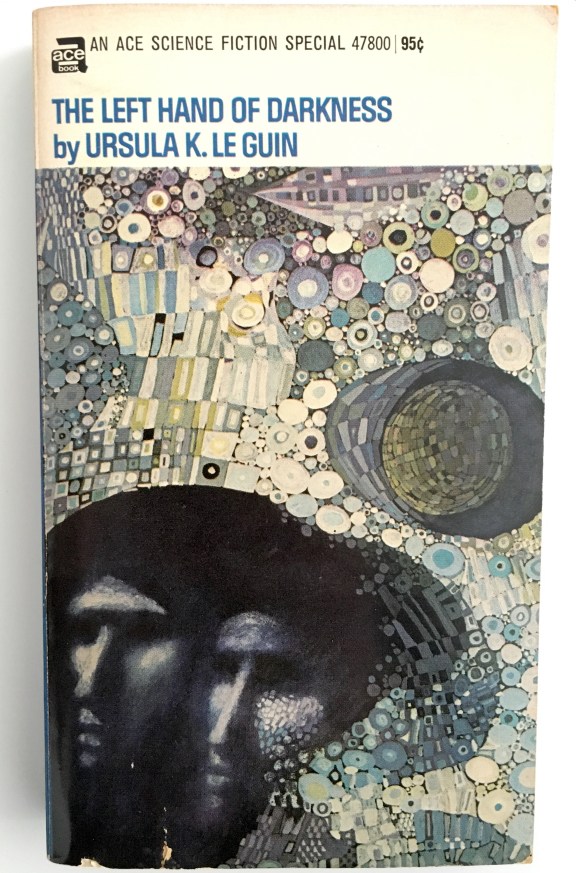
So well and anyway: I already have a copy of The Left Hand of Darkness, which is the next title in the sequence in which I’m reading the Hainish books. My pilfered copy isfrom years back, and I’ve read it a few times—but I just couldn’t pass up this first edition copy with its lovely Klimtesque cover art by Leo and Diane Dillon.

“A Psychological Shipwreck,” a story by Ambrose Bierce

“A Psychological Shipwreck”

by Ambrose Bierce


In the summer of 1874 I was in Liverpool, whither I had gone on business for the mercantile house of Bronson & Jarrett, New York.  I am William Jarrett; my partner was Zenas Bronson.  The firm failed last year, and unable to endure the fall from affluence to poverty he died.

Having finished my business, and feeling the lassitude and exhaustion incident to its dispatch, I felt that a protracted sea voyage would be both agreeable and beneficial, so instead of embarking for my return on one of the many fine passenger steamers I booked for New York on the sailing vessel Morrow, upon which I had shipped a large and valuable invoice of the goods I had bought.  The Morrow was an English ship with, of course, but little accommodation for passengers, of whom there were only myself, a young woman and her servant, who was a middle-aged negress.  I thought it singular that a traveling English girl should be so attended, but she afterward explained to me that the woman had been left with her family by a man and his wife from South Carolina, both of whom had died on the same day at the house of the young lady’s father in Devonshire – a circumstance in itself sufficiently uncommon to remain rather distinctly in my memory, even had it not afterward transpired in conversation with the young lady that the name of the man was William Jarrett, the same as my own.  I knew that a branch of my family had settled in South Carolina, but of them and their history I was ignorant.
Continue reading ““A Psychological Shipwreck,” a story by Ambrose Bierce” →

A review of Paul Kirchner’s surreal sequel, The Bus 2

couv-1

Paul Kirchner’s cult classic comic strip The Bus originally ran in Heavy Metal from 1979-1985. The (anti-)story of “a hapless commuter and a demonic bus” (as Kichner put it himself in a recent memoir at The Boston Globe), The Bus, at its finest moments, transcends our expectations for what a comic strip can and should do. Sure, Kirchner delivers the set-ups, gags, japes, and jests we expect from a cartoon—but more often than not The Bus surpasses the confines of its form and medium. Its protagonist The Commuter is an allegorical everyman, a passenger tripping through an absurd world. Kirchner’s strip often shows us ways to see that absurd world—which is of course our own absurd world—with fresh eyes.

Thanks in part to the internet (and, in particular, an album of scans posted at Imgur), Kirchner’s comic has found a new audience. Over the past few years, Kirchner’s produced more than 40 new strips, which are now collected in one handsome volume as The Bus 2 (or the bus 2 if you like) from French publisher Tanibis Editions. Tanibis also has collected the original run of The Bus in an edition that’s more complete (and polished) than the Imgur album. These books are fantastic stuff.

The Bus 2 picks up in full satirical mode with an intro that informs us that “the studio that produced ‘The Bus’ was forced to shut down” in 1985; “Its closing left over 70 talented employees jobless.” The intro unwinds over a few pages—we’re told the bus itself and the “commuter’s iconic overcoat” are now in museums, and that the role of the commuter in this sequel will be played by the son of the actor who played the original commuter. From the outset, Kirchner uses irony to draw our attention to the artificiality of his strip, highlighting The Bus as a performance, an entertainment focused on the utterly mundane topic of a daily commute. And even though the intro unfolds over four pages, Kirchner keeps it true to form—literally: Six equal black and white panels.

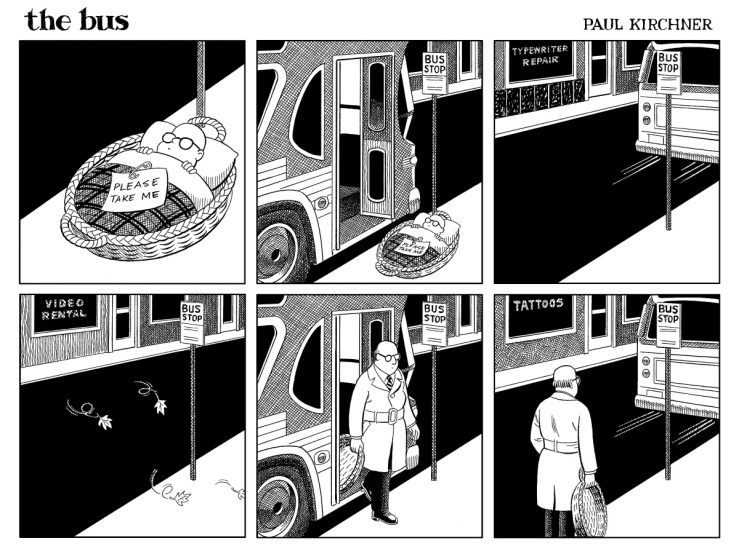
The first strip in the new collection positions The Commuter as an ironic hero, a foundling in a basket like Moses or Superman (note the signs that Kirchner employs to show the passage of time):

01 Continue reading “A review of Paul Kirchner’s surreal sequel, The Bus 2” →

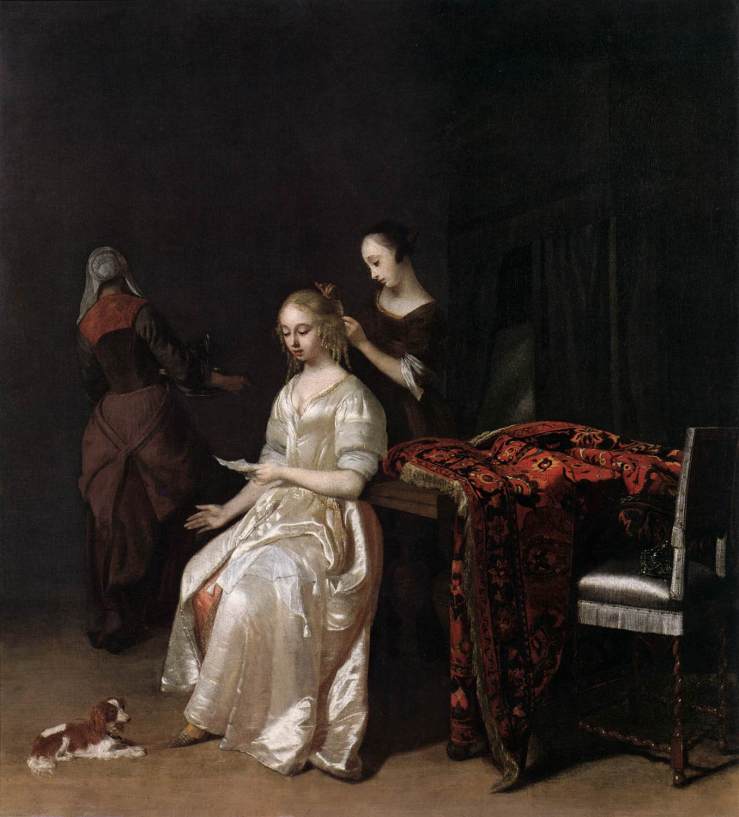
The Love Letter — Jacob Ochtervelt

lovelett

Hegel on Pooping from “The Philosophy of Nature”


The animal, because it behaves as actively different, in so doing becomes different within itself. In other words, because the animal is involved in a struggle with the outer world, its relation to the latter is untrue, since this outer world has already been transformed in principle (an sich) by the power of the animal lymph; the animal therefore in turning against this food, fails to recognize its own self. But the immediate result of this is simply that when the animal comes to itself and recognizes itself as this power, it is angry with itself for getting involved with external powers and it now turns against itself and its false opinion; but in doing so it throws off its outward-turned activity and returns into itself.


Bernard Sumner’s memoir, Chapter and Verse (Book acquired sometime in November of 2015)

IMG_0971

This afternoon, I finally got into Bernard Sumner’s memoir Chapter and Verse: New Order, Joy Division and Me. Actually, I obviously flicked through it when it showed up, looking at the glossy pictures, dabbling here and there (somehow read not one but two anecdotes about Seal (?)), and then reading the book’s first appendix, a transcript of a recording of Sumner’s hypnotizing Ian Curtis (excuse that mangled clause). The book has a U.S. Hardcover release from Thomas Dunne; their blurb:

Founding member and guitarist of Joy Division and the lead singer of New Order, Bernard Sumner has been famous over the years for his reticence. Until now . . .

An integral part of the Manchester, UK, music scene since the late 1970s, his is the definitive version of the events that created two of the most influential bands of all time.

Chapter and Verse includes a vivid and illuminating account of Bernard Sumner’s childhood, the early days of Joy Division, the band’s enormous critical and popular success, and the subsequent tragic death of Ian Curtis. Sumner describes the formation of New Order, takes us behind the scenes at the birth of classics such as “Blue Monday,” and gives his firsthand account of the ecstasy and the agony of the Haçienda days.

Sometimes moving, often hilarious, and occasionally completely out of control, this is a tale populated by some of the most colorful and creative characters in music history, such as Ian Curtis, Tony Wilson, Rob Gretton, and Martin Hannett. Others have told parts of the story, in film and book form. Now, for the first time, Bernard Sumner gives you chapter and verse.

Around the Moon — Émile-Antoine Bayard and Alphonse de Neuville

tumblr_na6dmatLlu1rtynt1o1_1280.jpg

Three Books

IMG_0950

Speedboat by Renata Adler. 1988 trade paperback edition by Perennial Fiction Library (Harper & Row). No designer credited, but the cover illustration is by Steve Guarnaccia. A strange and funny (anti-)novel.

IMG_0953

The Uses of Literature by Italo Calvino (trans. Patrick Creagh). 1986 trade paperback by Harvest/HBJ. Design by Kaelin Chappell, with a cover illustration by Saul Steinberg. A book to never finish.


IMG_0951

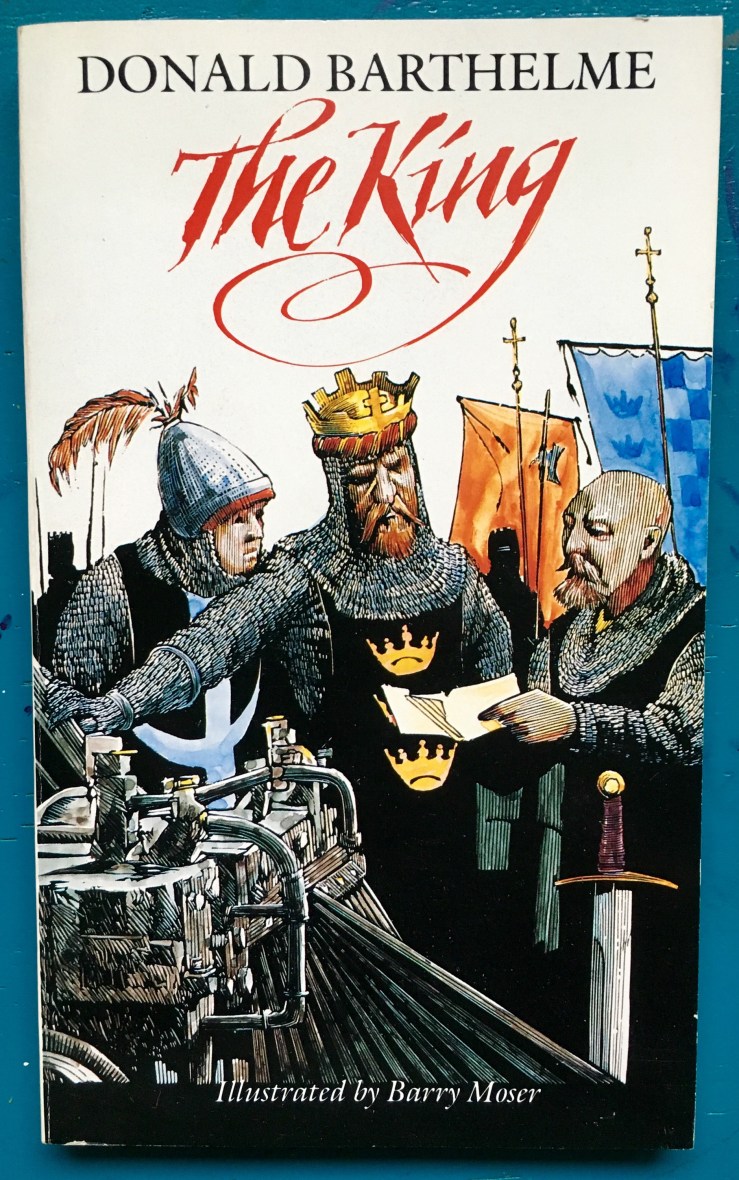
The King by Donald Barthelme. Features wood engravings by Barry Moser. 1990 trade paperback by Harper and Row. No designer credited, but surely Moser had a hand, no? This is the only Barthelme novel I haven’t read. Every time I pick it up I think, But then there will be no more. Fool. One can always reread.

The Temptation of St. Anthony — Lelio Orsi

10869701.jpg

Elegant bachelor

…it was here that Melville saw the work of JMW Turner

DP169567.jpg
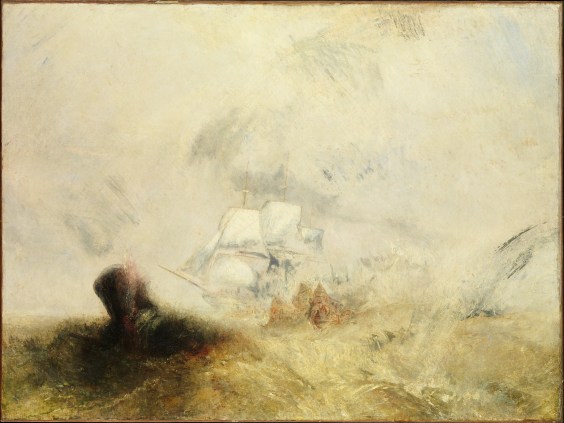
Whalers, JMW Turner

It is clear from Melville’s journal, one of only two such surviving documents, that his mind was already playing with these ideas. Late at night, he “turned flukes” down Oxford Street as if he were being followed by a great whale, and thought he saw “blubber rooms” in the butcheries of the Fleet Market. And when he saw Queen Victoria riding past in a carriage, he joked that the young man sitting beside her was the Prince of Whales. London – which itself had only lately been a whaling port – was stirring up the ghosts of his past.

Perhaps most importantly, it was here that Melville saw the work of J M W Turner, a clear visual influence on his book-to-be. Turner had painted a series of whaling scenes for Elhanan Bicknell, whose British whaling company was based in the Elephant and Castle; parts of Moby-Dick would read like commentaries to those tempestuous, brutally poetic canvases, not least the painting that greets Ishmael at the Spouter-Inn, “a boggy, soggy, squitchy picture” of “a black mass . . . floating in a nameless yeast . . . an exasperated whale”. It is all the more intriguing to note how Melville’s Anglophilia was the yeast out of which this great American novel emerged – especially given that the book failed spectacularly in his homeland and it was left to British writers to recognise first its wilful, prophetic genius.

Read the rest of Philip Hoare’s essay “White Whale in the Big Smoke: How the Geography of London Inspired Moby-Dick” at the New Statesmen.

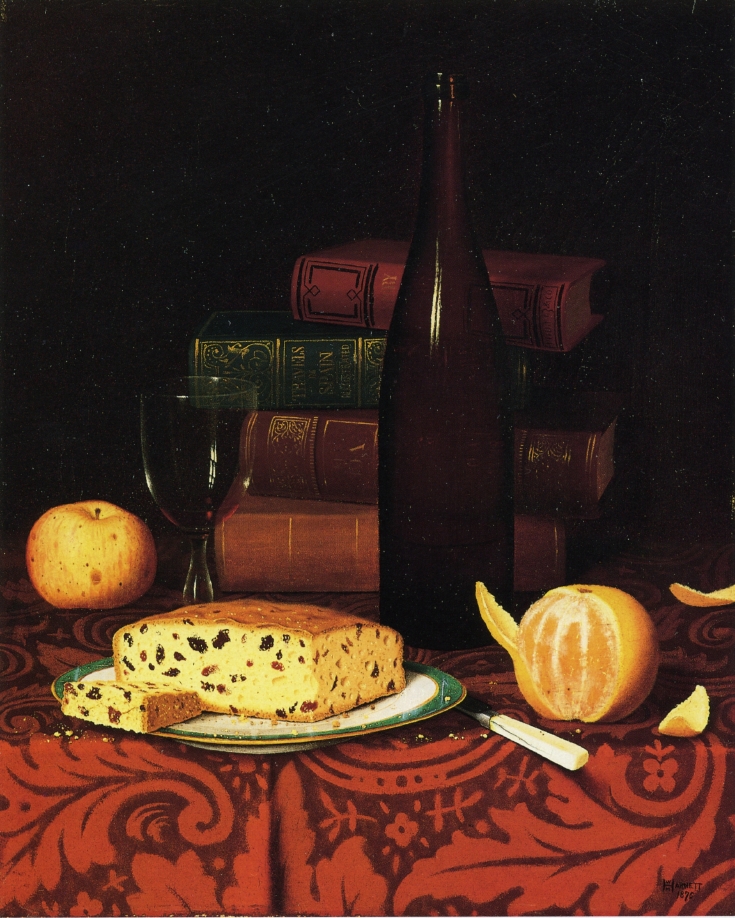
Still Life with Raisin Cake, Fruit and Wine — William Michael Harnett

still-life-with-raisin-cake-fruit-and-wine-1876

Bolaño Beyond

roberto-bolanoOn Avenida Juárez, across from the Alameda in Mexico City, sits an unassuming little bookstore, three steps below street level. It was here at the Librería del Sótano where Roberto Bolaño would buy novels or poetry books or, when he was short on cash (which was often), just pocket them. For centuries Latin American literature belonged not to those passionate, young biblioklepts like Bolaño but to affluent property owners who dabbled in writing the way they might take up equestrianism or falconry. Some time in the 1960s the roles reversed and the middle class became the seedbed of national literature. Bookstores, libraries, and the literary life prevailed in the cultural scene of Mexico City and Buenos Aires just as much as they did in Paris, New York, or London. This bibliophilia, this bibliomania, this passion for the literary life binds the world together in a global industry that sadly still remains separated by language barriers and a lack of curiosity.
Serious readers are omnivorous. They want to read everything great. The best translated fiction, emerging writers, overlooked classics, small-press finds, public intellectuals of the moment, mind-bending poetry—it all goes down the hatch. The problem, of course, is that no one can read everything. Selecting which books to read requires discernment, a degree of happenstance, and an iterative process that ideally sharpens the discernment itself with each volume digested.

Read the rest of Matt Bucher’s essay “Beyond Bolaño and Beyond” at Full Stop.

The Astonishment of the Mask Wouse — James Ensor

the-astonishment-of-the-mask-wouse-1889

That’s the definition of racism and prejudice (Ishmael Reed)

Screenshot 2015-12-01 at 7

Ishmael Reed, in a 1994 interview with Monica Valencia originally published in The Daily Californian and later republished in Conversations with Ishmael Reed.

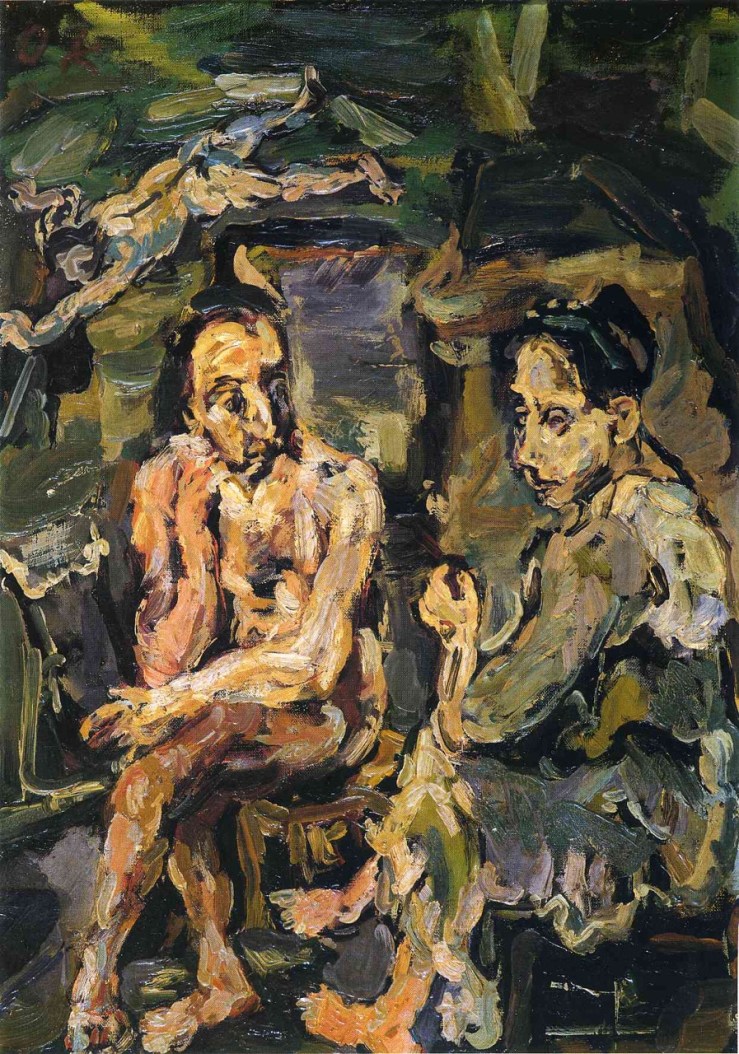
Orpheus and Eurydice — Oskar Kokoschka

ok

A daily diet of morning mist – from Bruce Chatwin’s The Songlines


Welwitchia-Louise Nienaber.jpg

It was nonsense, Dr Vrba continued, to study the emergence of man in a vacuum, without pondering the fate of other species over the same time-scale. The fact was that around 2.5 million, just as man took his spectacular ‘jump’, there was a ‘tremendous churning over of species’.

‘All hell’, she said, ‘broke loose among the antelopes.’

Everywhere in eastern Africa, the more sedentary browsers gave way to ‘brainier’ migratory grazers.  The basis for a sedentary existence was simply no longer there.

‘And sedentary species,’ she said, ‘like sedentary genes, are terribly successful for a while, but in the end they are self-destructive.’

In arid country, resources are never stable from one year to the next. A stray thunderstorm may make a temporary oasis of green, while only a few miles off the land remains parched and bare. To survive in drought, therefore, any species must adopt one of two stratagems: to allow for the worst and dig in; to open itself to the world and move.

Some desert seeds lie dormant for decades. Some desert rodents only stir from their burrows at night. The weltwitchia, a spectacular, strap-leaved plant of the Namib Desert, lives for thousands of years on its daily diet of morning mist. But migratory animals must move – or be ready to move.

Elizabeth Vrba said, at some point in the conversation, that antelopes are stimulated to migrate by lightning.

‘So’, I said, ‘are the Kalahari Bushmen. They also “follow” the lightning. For where the lightning has been, there will be water, greenery and game.’

From Bruce Chatwin’s novel/memoir/travelogue The Songlines. The image is Welwitschia by Louise Nienaber.