The Running Man (Summer Film Log)

the-running-man

Is The Running Man a good film?

I have no idea, but I’ve watched it at least a dozen times in the past 20 years, and I’ll watch it again. The 1987 film is certainly not the singular artistic vision of a supremely gifted auteur; it is not well-acted; the set design is imitative at best and terribly cheesy at worst; the costumes are silly; the music sucks. But The Running Man is zany fun, not least of all because its clumsy satire of a society clamoring to be entertained at any cost is as relevant as ever.  Ironically though, The Running Man’s satire inevitably reproduces the exact thing it aims to critique: a loud, violent, silly distracting entertainment.

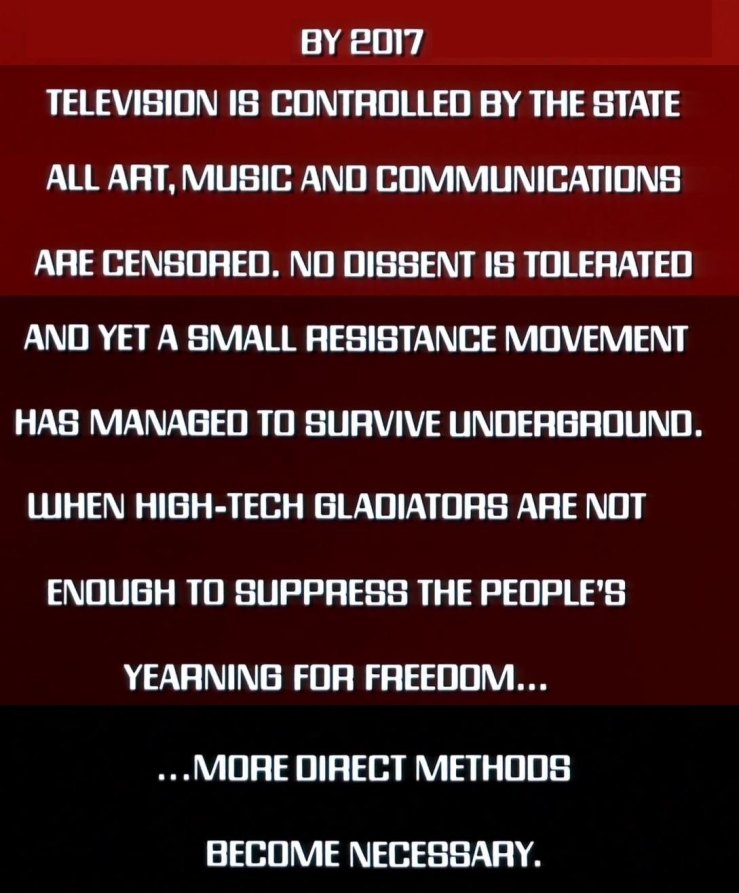
The Running Man foreground’s its plot in a (now retro-)futuristic font scroll at the film’s outset:

img-0188_orig

Those “high-tech gladiators” (dressed in ridiculous outfits and bearing ridiculous names like “Subzero” and “Captain Freedom”) stalk “contestants on a TV show called The Running Man. The show is hosted by Damon Killian, played by Richard Dawson (who you may know from reruns of Family Feud). Dawson fits into the film better than any other player—indeed his loose, improvisational, menacing charm is part and parcel of an entertainment empire built on attractive deception. He’s the consummate Master of Ceremonies, presiding over every aspect of his media empire. Dawson’s nemesis is Arnold Schwarzenegger, who plays Ben Richards, a former cop framed for a massacre. There’s a lot of fake news in Running Man, including an extended sequence of digital editing where faces are mapped onto body doubles. Schwarzenegger winds up on The Running Man, kills a bunch of stalkers, clears his name, and becomes a figurehead of the resistance.

Director Paul Michael Glasser (who played Starsky on Starsky and Hutch and later directed the Shaq-vehicle Kazaam) brings a workman-like approach to the film. His shots are often clumsy, and moments that should telegraph horror often come off as funny or just silly, as early in the film when a prisoner’s head explodes when he tries to escape a labor camp. Glasser makes no attempt to rein in Schwarzenegger’s ham. We get scenes where Schwarzenegger tries to imbue his character with a small measure of realism or pathos, and yet his mugging one-liners undercut any character building. He’s a cartoon of a cartoon, which is as it should be.

Schwarzenegger’s campy performance is balanced by María Conchita Alonso, who invests her foil Amber with a soul that belies the cheesy lines she’s forced to deliver.  Alonso has the closest thing to a character arc in The Running Man, and arguably, she anchors the film—she’s a stand-in for the film’s viewer, a normal person who gets swept up into adventure. Yaphet Kotto also stars in The Running Man, but he’s woefully underused, perhaps because his acting is simply too good; his naturalism doesn’t mesh in the film’s campy tone. Other bit players work wonderfully though. Mick Fleetwood and Dweezil Zappa try to play it cool as resistance fighters, but the effect on screen is endearingly goofy. Mick Fleetwood would have been about 40 when the film came out, but he looks like he’s about 70…which is how old he is now. (There is a fan theory about this, of course). Dweezil wears a goddamn beret. The stalkers include professional wrestlers Professor Tanaka and Jesse “The Body” Ventura, professional wrestler and opera singer Erland Van Lidth De Jeude, and NFL great Jim Brown. Ventura apparently could not be restrained from eating the scenery around him. He twitches and snarls, and delivers his lines as if he were speaking to Mean Gene Okerlund. It seems if director Glasser simply let his actors play versions of themselves. This is reality TV, after all.

The real success of Glasser’s direction is, ironically, the limitations of his aesthetic vision. The film looks like a TV show, and indeed, the strongest shots approximate TV shows and their live audiences. The Running Man is at its best when blending its satire of cheap Hollywood elements into the film proper, as in the ludicrous reality TV clips interspersed throughout (like Climbing for Dollars), or in the repeated montages set to cheesy wailing keytar jams, featuring a troupe of sassy flash dancers, the camera ogling their buns of steel. Ironically too, the fight scenes between the stalkers and Schwarzenegger’s team are actually the dullest element of the film—they look like bad TV (which is basically what they are). The Running Man wants to satirize the way cheap entertainments distract a populace and cheapen human worth, but it uses the same tools as the cheap entertainments it wants to skewer.

The Running Man is about spectacle culture, and is hence larded with shots of crowds reacting to what they see on screens. The film’s viewer can see the silly crowds cheering the stalkers or booing Schwarzenegger or enjoying Dawson’s charms, but the viewer is also a spectator himself. In the words of Dawson’s Killian, the film strives to “give the people what they want” — which here means an uplifting ending—Viva La Resistance!—a zany horrific comedy that simultaneously critiques and condones our worst impulses And yet the resistance uses the same tools to defeat the oppressive entertainment empire—video editing designed for mass consumption by a spectacle society. It’s Pop Art without the “Art.”

The Running Man is slightly stupid, which is a great part of its enduring charm. Its greatest stupidity is in its attempts to be clever—but again, there’s the charm of it. It’s a film about Bad TV that actually looks and feels like Bad TV. The film is like the less-talented but affable little cousin of Paul Verhoeven’s Robocop, which came out the same year. Both films satirize an emerging media-driven dystopian culture, but Robocop is actually a good film. The Running Man winks a bit too much (in contrast to, say, 1989’s Road House, probably the best film I can think of that plays its satire so straight that it potentially confounds its viewers).

And yet for all its silly weaknesses and bad hyperbole, The Running Man’s prognosis of American culture is painfully accurate. Fake news, bad actors, a TV president, lives thoroughly mediated by media, degradation of the human condition as entertainment—the Omnipresent Screen as the Ultimate Authority. The Running Man‘s 1987 vision of the future seems more accurate than the future posited in the film I watched yesterday, 1984And yet 1984 captures an emotional truth that The Running Man sets out to crush or gloss over or convert into something artificial, the idea or representation of a feeling, but not the feeling itself. That’s what entertainment does.

How I watched it: On a large television, via a streaming service, with semi-full attention.

1984 (Summer Film Log)

1984

Grim grey double plus unfun, Michael Radford’s 1984 adaptation of George Orwell’s 1948 novel 1984 is painful to watch. I think I first saw the film when I was in high school, in the mid-nineties, probably after I read the book, and I never bothered to watch it again until this morning. (It’s probably not a morning film). I might wait another 20 years to watch it again.

1984 is about as faithful to its source novel as it could be, capturing Orwell’s grim vision in relentlessly bleak (and occasionally gorgeous) shots of a dystopian post-war London.  The film’s initial “worldbuilding” scenes are some of its most intriguing, including scenes of Winston Smith not fully participating in the Two Minutes Hate, looking for black market razors, prowling among the proles, and generally not fitting in among his peers. John Hurt is perfect as Winston Smith. His eyes convey an intelligent soul in despair, a soul slowly pulsing under a stoic mask that Winston has to wear to survive. Surviving isn’t enough though, and Winston finds his soul ignited by Julia (Suzanna Hamilton). The pair’s illicit love affair is doomed, and the great tragedy of 1984 is their ultimate betrayals of each other and themselves.

Roger Deakins’ cinematography is a highlight of 1984, particularly in the rare scenes in which gray gives way to green. The Eurythmics soundtrack is hardly intrusive, and the music they made was quite good, but the film would have done better to dispense with extra-diegetic music altogether. Radford’s direction is remarkably understated; drama evolves from setting and vibe. And even in more direct moments, Radford is subtle, as when Winston scratches out his own thoughts (thoughtcrimes!) on paper. Some directors might feel compelled to underline such moments, drive the thesis in—but Radford shows us Winston in the process of discovering his own thoughts and feelings.

Faithful to its source material, 1984 is in no way a fun film, but it conveys the book’s central message and core humanity admirably. I’ve always preferred Brave New World to 1984—not that the two need to be in a contest—but Huxley’s book, with its zany details and wild contours is simply more engaging. There’s more complexity to its flavors (if not its argument). Sure, 1984 has its strong flavors too, but a big bitter bite with sour notes is not something one returns to again and again.

Screenshot 2018-05-14 at 12.07.42 PM

How I watched it: On a large television, via a streaming service, with full attention.

David Simon on Stanley Kubrick’s film Paths of Glory

Blog about Martin Scorsese’s film The King of Comedy

Screenshot 2018-04-27 at 7.41.03 PM

I watched Martin Scorsese’s 1982 film The King of Comedy last weekend and then added it to a list of examples for a much bigger Thing I’ve been working on for a few years (and hence will never likely finish, unlike these Blog about posts). The much bigger Thing is about the relationship between Comedy and Horror—not purely the formal characteristics that belong to specific genres of literature, film, and art, but rather the relationship between the emotions themselves (with special attention to how literature, film, and art evoke that relationship).

The short thesis for this bigger Thing is that I think that comedy relies strongly on horror, and that the best provocations of horror are tempered in humor. There is a long list of examples in support of this thesis, including Goya and Bolaño and Larry David and Don Quixote and Candide  and Thomas Bernhard and Surrealism and Get Out and etc. —-but that’s all for said bigger Thing, and the title of this post seems to promise Something (not a big Thing) on Martin Scorsese’s 1983 film The King of Comedy, which I recently rewatched.

I first saw The King of Comedy in the spring of 1998. I was a freshman at the University of Florida and had quickly discovered their library of films on VHS, which I would imbibe over my four years there. I started with stuff I was already a bit familiar with though. Like every other stupid eighteen-year old, I thought Taxi Driver was A Work of Genius (without fully understanding it), and I’d seen Goodfellas and Casino approximately one thousand times by this point. I started UF’s collection of Scorsese tapes with the neo-neorealism of Raging Bull, a brutal and hence thoroughly comprehensible character study, an ugly film shot in gorgeous black and white. The King of Comedy was next.

The internet in 1998 was not the internet of 2018. What I mean is that we generally learned about films through books and journals and magazines, or really other films, or really, really by word of mouth. I don’t think I had any word of mouth on The King of Comedy—what I mean is that I think I thought the film was a comedy. Which it is. Sort of. I mean, it’s funny—-very funny sometimes. But it’s also very cruel, and often scary and off putting, and generally queasy.

The King of Comedy stars Robert De Niro as Rupert Pupkin. That ridiculous name is on one hand a running joke, but on the other hand a vein of horror that pulsates throughout the film—an aberrant twitching oddity, a sort of literal curse, both on poor Rupert (who bears that name) and on every person who encounters him. Rupert is a would-be comedian who dreams (literally and often from his mother’s basement) of stardom. He dreams that he’ll achieve this stardom through a spotlight gig on The Jerry Langford Show, a Carson-style late night show hosted by Jerry Langford, played by a wonderfully fed-up Jerry Lewis.

Rupert is an autograph hound, an obsessive type of fan who makes Jerry’s life a literal terror.  Rupert’s foil is Masha, a trust-fund baby played by Sandra Bernhard. Masha stalks Jerry with extreme competitive anxiety; her stalking is a lifestyle elevated to art. When Masha goes too far early in the film and hijacks Jerry’s limo, Rupert sees an opening—he saves the day, ousting Masha, but then he invades the limo (proving himself stalker supreme over Masha).  In the limo ride, Rupert asks Jerry for help in advancing his career, and Jerry gives generous if general advice, which amounts to Put the work in and pay your dues. Rupert complains that he simply doesn’t have time to invest in doing the real hard grinding work, and basically demands that Jerry give him a shortcut.

In showing a deranged would-be artist who feels he’s entitled to bypass the years of work involved in honing a skill, Scorsese anticipates our current zeitgeist. Rupert Pupkin desires fame, adoration, and applause, but he is far less interested in producing an art that would earn these accolades. The King of Comedy slowly shows us that Pupkin is mentally ill, and that his disease is radically exacerbated by a culture of mass media.

The King of Comedy’s most sarcastic bite is that Rupert is eventually rewarded for his deranged behavior. He and Masha kidnap Jerry as part of a plan to get Rupert an opening set of The Jerry Langford Show. The plan succeeds, and Rupert executes it so that he not only gets to land his dream gig, he also gets to watch himself do it in front of The Girl He Liked in High School:

Rupert’s audacious gambit is part and parcel of a postmodern mass media era that makes only the slightest distinction between fame and infamy. Rupert is famous for doing something famous—and something horrific, kidnapping a beloved TV host. It’s his one bit of work, but it’s enough to land him a book deal, celebrity, and money (and a fairly short prison sentence).

Parts of Rupert’s monologue are funny, but other parts read like the memoir of a damaged soul trying to recover from an abusive childhood. And maybe these parts mix. Again, horror underwrites comedy.

This horror repeats in Scorsese’s framing of Rupert’s routine. There’s a dream-like quality to the monologue, with its television tube frame. This is not the first time we’ve seen this framing in King of Comedy—we get similar TV fantasies via Rupert’s deranged mind—but this time the plot asks us to think of it as “real,” even as Scorsese’s aesthetics suggest that the ending of the film may all be in Pupkin’s warped mind, the unseen clapping audience just another delusion of grandeur.

The same gesture is present at the end of Taxi Driver, which is essentially the twin of The King of Comedy. Travis Bickle—another ridiculous name, another loser—improbably ends up the hero of the narrative. But the conclusion of Taxi Driver has always struck me as the internal fantasy of its reactionary (anti-)hero. Likewise, The King of Comedy concludes in yet another fantasy in Rupert Pupkin’s addled consciousness.

With its metatextual contours and its insinuations of reality-as-mediated-by-mass-media, The King of Comedy is perhaps Scorsese’s most formally postmodern film (although his smaller follow-up After Hours might be his most thematically postmodern). It’s no wonder that the film didn’t land with audiences in 1983. Beyond its postmodern rhythms, The King of Comedy is essentially repulsive—nothing good happens; there is no clear hero; the world it depicts is devoid of any meaning not centered in relation to fame. Its satire is so black no light escapes. In comparison, Scorsese’s later films like Goodfellas and The Wolf of Wall Street are laugh riots.

The genius of The King of Comedy is something best felt. The film disrupts genre conventions (and audience expectations), pushing a comedy into a horror. Or maybe The King of Comedy is a horror film with comedic overtones. Or, really—I mean, what I really want to say here is:

The King of Comedy isn’t a horror film or a comedy film—like many of Scorsese’s best films, it’s a character study—realistic and engrossing and grotesque in its utter realism. Time has caught up with it. If Rupert Pupkin seemed an extreme example of the kind of derangement and alienation that could be aggravated by a mass media culture in the early 1980s, by today’s standards he’s perhaps charming. And that’s horrifying.

Paul Thomas Anderson on writing Phantom Thread

Film Poster for The Big Lebowski — Andrzej Krajewski

Polish Poster

If a thing can be filmed, film is implied in the thing itself (Don DeLillo)

“Film is more than the twentieth century art. It’s another part of the twentieth-century mind. It’s the world seen from inside. We’ve come to a certain point in the history of film. If a thing can be filmed, film is implied in the thing itself. This is where we are. The twentieth century is on film. It’s the filmed century. You have to ask yourself if there’s anything about us more important than the fact that we’re constantly on film, constantly watching ourselves. The whole world is on film, all the time. Spy satellites, microscopic scanners, pictures of the uterus, embryos, sex, war, assassinations, everything.”

From Don DeLillo’s novel The Names.

Peter Greenaway’s Darwin, a biography in 18 tableaux

Miles Davis recording the score for Louis Malle’s film Elevator to the Gallows

Omelette à la Alma | Phantom Thread riff


title2bcard

Rambling Preamble 

Phantom Thread (2017) is the eighth feature film by writer-director Paul Thomas Anderson. I have been a fan of Anderson’s work since I saw Boogie Nights (1997) in my freshman year of college, and have watched each of his subsequent films in the theater. The theater is the proper place to watch Anderson’s lush, luscious films, although they are also so strong as narratives that they hold up just fine on, say, a 19″ Toshiba television with a built-in VCR, which is how I repeatedly watched Blockbuster-remaindered cassettes of Boogie Nights and Magnolia (1999) circa 1998-2001. But again: The theater is the proper place to see an Anderson film, and Phantom Thread is exceptionally lovely on the big screen—one doesn’t so much watch it as imbibe it, or perhaps, in a reversal of that metaphor, sink into it. What I’m saying is: Watch Phantom Thread in the theater.

Is “Watch it in the theater” not enough in the way of argument, reader? Perhaps you want, like, details?

Here are some details I knew going in to the film (I generally try to avoid reviews and any press on any film I plan to see): The film was written and directed by Paul Thomas Anderson; the film stars Daniel Day-Lewis portraying a fashion designer; the film is set sometime in the 1950s.

My wife and I went to see the film yesterday afternoon and we loved it, then discussed it at length at dinner, and then again this morning over breakfast (perhaps prompted by “breakfast” itself, one of the film’s motifs). It’s a strange, beautiful, perplexing romantic comedy that will disarm and unsettle audiences. I can’t wait to see it again.


Screenshot 2018-02-04 at 3.27.03 PM

The Plot and the Major Characters

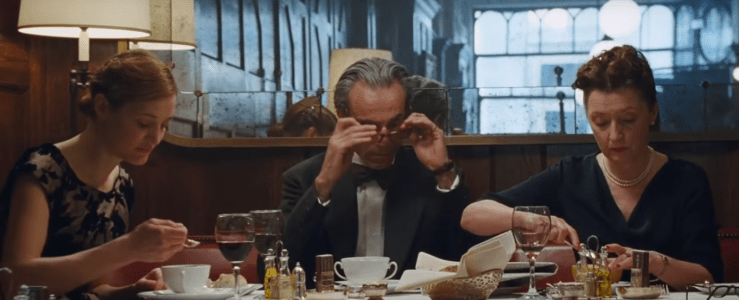
1950s. London and countryside environs. Reynolds Jeremiah Woodcock (Daniel Day-Lewis) is a famous fashion designer who dresses the highest of high in European society. He and his sister Cyril (Lesley Manville) run the House of Woodcock, following a precise, obsessive routine. At the film’s outset, Reynolds meets Alma (Vicky Krieps), a waitress in a countryside restaurant. He asks her to dinner that night, and from there the two enter into a strange relationship. The film’s trajectory explores the conflicts and confluences of that strange relationship, tracing how Reynolds’ and Alma’s romance intertwines with Cyril, business, design, and art. (Oh. And Reynolds’ and Cyril’s dead mother).


Cinematography, Score, Costume Design and Set Design

Gorgeous. Like I said, go see the film—the aesthetics are marvelous, rich, sumptuous. I’ve been writing about Paul Thomas Anderson as an auteur (and will continue to do so), but his production team is fantastic, and I think there’s an implicit argument in Phantom Thread itself against the whole auteur concept. (If you listen to or read interviews with Anderson, he will often use the pronoun “We” when discussing his work).


Screenshot 2018-02-04 at 3.26.09 PM

Phantom Thread’s Place in Paul Thomas Anderson’s Filmography

Phantom Thread might be Anderson’s “best” film to date: it is certainly one of the best-acted, best-shot, and best-directed, and its editing and pace move with a more precise rhythm than his looser and more sprawling films. I loved it, but it’s not necessarily my favorite Anderson film. If pressed to choose a favorite, I might point to the weird sprawl of Inherent Vice (2014) or the perfect imperfection of The Master (2012)—or just settle on There Will Be Blood (2007). Many Anderson fans point to Anderson’s shortest film, Punch-Drunk Love (2002) as his best.

In some ways, Phantom Thread has more in common with Punch-Drunk Love than his other films. They are both romantic comedies featuring emotionally-challenged leads who find their way to a strange resolution. In any case, Phantom Thread is an engaging character study focused on just a few intense personalities—like The MasterPunch-Drunk Love, or There Will Be Blood. It’s more focused in its vision than Boogie Nights or Magnolia, and more emotionally “true” than Anderson’s first feature, Hard Eight (1996). Those first three films seem to me particularly beholden to Martin Scorsese and Robert Altman, but Phantom Thread continues to show Anderson overcoming his anxiety of influence. (Although I’ll admit that I was occasionally reminded of Scorsese’s The Age of Innocence (1993) while watching Phantom Thread—probably because of the luxuriant imagery. And Daniel Day-Lewis. Anderson’s film is superior).


The Goddamn Movie Trailer


The discussion of the film that follows contains spoilers, including descriptions of the film’s ending 

Continue reading “Omelette à la Alma | Phantom Thread riff”

The Last Jedi and the Anxiety of Influence

58f13f34dd0895d2098b4814-1888

Let me start by erasing my own anxieties about “reviewing” The Last Jedi (2017, dir. Rian Johnson). I saw it over a month ago in a packed theater with my wife and two young children. We loved it. I haven’t seen it since then, although I’d like to. Because I’ve only seen it once, this “review” will be far lighter on specific illustrating examples than it should be. Now, with some of those (writing) anxieties dispersed, if not exactly erased:

The Last Jedi strikes me as one of the best Star Wars films to date, of a piece with The Empire Strikes Back (1980, dir. Irvin Kershner) and Revenge of the Sith (2005, dir. George Lucas).

Not everyone agrees with me. Clearly, a lot of people hated Rian Johnson’s take on Star Wars. I won’t repeat the laundry list of gripes about The Last Jedi, but instead offer this: the numerous noisy denunciations of The Last Jedi can be rebutted via the terms, tropes, and tones of any of the previous films themselves. Put another way, anything “wrong” (tone choices, plot devices, casting, etc.) with The Last Jedi can be found to be “wrong” with any of the previous films. Furthermore, I don’t intend to directly rebut gripes about The Last Jedi here. Most attacks on the film simply amount to iterations of, “This film did not do what I wanted this film to do,” to which my reply would be, “Well, good.”

“Well, good” — the passionate reactions to The Last Jedi show the film’s power—both narratively and more importantly, aesthetically—to disturb a cultural sense of what the Star Wars franchise “is” or “is not.” In burning down much of the mythos (again, both narratively and aesthetically) of the films that preceded it, The Last Jedi opens up new space for the series to grow.

I enjoyed The Last Jedi’s most immediate predecessor,  The Force Awakens (2015, dir. J.J. Abrams), but was critical of its inability to generate anything truly new. Riffing on The Force Awakens, I wrote that the film “is a fun entertainment that achieves its goals, one of which is not to transcend the confines of its brand-mythos. . . [the film] takes Star Wars itself (as brand-mythos) as its central subject. The film is ‘about’ Star Wars.” And, more to the point:

Isn’t there a part of us…that wants something more than the feeling of (the feeling of) a Star Wars film? That wants something transcendent—something beyond that which we have felt and can name? Something that we don’t know that we want because we haven’t felt it before?

The Last Jedi transcends the narrative stasis of The Force Awakens. “Stasis” is probably not a fair word to describe TFA. Abrams’s film excited viewers, roused emotions, offered engaging new characters, and even killed off a classic character via the classic Star Wars trope of Oedipal anxiety erupting in violent rage. TFA’s stasis is the static-but-not-stagnant excitement of having expectations confirmed. In contrast, Rian Johnson’s The Last Jedi punctures viewer expectations at almost every opportunity, aesthetically restaging tropes familiar to the series but then spinning them out in new, unforeseen directions.

The Last Jedi echoes visual tropes from The Empire Strikes Back in particular. Indeed, many fans believed that Rian Johnson’s TLJ would (or even should) reinterpret Irvin Kershner and Lawrence Kasdan’s entry into the series, much as J.J. Abrams had restaged A New Hope (1977, dir. George Lucas) with The Force Awakens. Instead, Johnson pushes the Star Wars narrative into new territory, with an often playful (and sometimes absurd) glee that has clearly upset many fans.

Johnson’s (successful) attempt to reinvent Star Wars might best be understood in terms of what the literary critic Harold Bloom has called the anxiety of influence. Bloom uses the anxiety of influence to describe an artist’s intense unease with all strong precursors. To succeed, new artists must overcome their aesthetic progenitors. Bloom compares the anxiety of influence to the Oedipal complex. An artist has to symbolically kill what has come before in order to thrive.

An apt description of franchise filmmaking’s inherent anxiety of influence can be found in Dan Hassler-Forest’s essay “The Last Jedi: Saving Star Wars from Itself,”  published last year in the Los Angeles Review of Books:

An overwhelming anxiety of influence predictably permeates any new director’s attempt to elaborate on the world’s most famous entertainment franchise. In J. J. Abrams’s hands, this anxiety was clearly that of a fan-producer struggling to meet other fans’ expectations while also establishing a viable template for future installments. In doing so, his cinematic points of reference never seemed to extend far beyond the Spielberg-Lucas brand of Hollywood blockbusters that shaped his generation of geek directors, and he tried desperately to make up for what he lacks in auteurist vision with energy, self-deprecating humor, and generous doses of fan service.

But Rian Johnson is a filmmaker of an entirely different caliber. Just as Irvin Kershner and Lawrence Kasdan once added complexity, wit, and elegance to Lucas’s childish world of spaceships and laser swords, Johnson makes his whole film revolve around characters’ fear of repeating the past, and both the attraction and the risk of breaking away from tradition.

A break with any tradition, however, paradoxically confirms the power of that tradition. Johnson understands and clearly respects the Star Wars tradition. Despite what his detractors may believe, Johnson hasn’t erased or trampled upon the Star Wars mythos in The Last Jedi; rather, as the Modernist manifesto commanded, he’s made it new. Continue reading “The Last Jedi and the Anxiety of Influence”

Behind the Scenes of Twin Peaks: The Return — “The Man with the Gray Elevated Hair”

https://www.youtube.com/watch?v=oULvBf_8S5o

This is the first part of the behind-the-scenes features for Twin Peaks: The Return. The other nine parts are up on YouTube as well (for now anyway).

Thirty-point riff on Star Wars: The Force Awakens

Rey-Star-Wars-Episode-7-Force-Awakens

  1. Star Wars: The Force Awakens is a fun entertainment that achieves its goals, one of which is not to transcend the confines of its brand-mythos.
  2. SW: TFA takes Star Wars itself (as brand-mythos) as its central subject. The film is “about” Star Wars.
  3. To this end, SW: TFA is basically a remake of A New Hope. My saying this is not insightful and cannot be insightful.
  4. In the first Star Wars film, A New Hope (aka Episode IV, aka simply Star Wars), George Lucas synthesized Flash Gordon and Kurosawa, Joseph Campbell and WWII serials into a cultural product that was simultaneously new and old, hokey and profound, campy and heroic.
  5. SW: TFA is not a synthesis (and does not seek to be a synthesis); rather it is a transcription, repetition, and  replication of the previous Star Wars films—particularly the so-called “original trilogy” (Episodes IV, V, and VI).
  6. Hence, SW: TFA often feels like a greatest hits collection, its sequences and visuals (engaging and visually spectacular) cribbed from the previous films. I could spend the rest of the riff outlining the correspondences—major and minor—but why? The correspondences are intentionally obvious to anyone who has seen the film; furthermore, they are not allusions, but the formal structure of the film.
  7. And this formal technique, this replication—it’s all very enjoyable and often warm and unexpectedly humorous and at times awfully sad even.
  8. And I liked the new characters very much, which I was of course supposed to. They are all in some ways replications of previously existing characters, just as the set pieces and sequences they act in/out/upon are replications.
  9. Let’s consider Rey, the heroine of The Force Awakens really quickly: She is, in some ways, a synthesis, but only a synthesis of the principals of the Star Wars brand-mythos: She is at once Han, Luke, and Leia: A figuration in the foreground: A childhood fantasy.
  10. A childhood fantasy: Watching SW: TFA feels like watching a Star Wars film—which is the film’s intention, obviously.
  11. But not obviously and really quickly and not a gripe: Isn’t there a part of us, by which us I mean me, that wants something more than the feeling of (the feeling of) a Star Wars film? That wants something transcendent—something beyond which we have felt and can name? Something that we don’t know that we want because we haven’t felt it before?
  12. Re: Point 11: I already made an (awfully) oblique argument at some length almost three years ago about franchise films in general and Star Wars films in particular, arguing (maybe arguing) for, say, Wong Kar Wai to direct the next Star Wars film.
  13. In that riff I wrote that, “J.J. Abrams is a safe bet. I can more or less already imagine the movie he’ll make.” That prediction was incorrect only in that I enjoyed the product that he made more than I thought I would. That prediction was wholly correct in that I could imagine the product Abrams made. It was easy to imagine. I’d already seen the film dozens of times before he even made it.
  14. So, to return to point 11, the “not a gripe” point: Is the argument then that film as an art form allows us (the illusion of) a transcendent perspective? That film at its best, at its strongest and strangest, offers us a new way of seeing?
  15. (Yes).
  16. The Force Awakens is strong but not strange. Its major advancement (by which I mean break from previous films) evinces in its casting choices—but these reflect the progress of our own era, not the brand-mythos of Star Wars itself, which was of course always diverse.
  17. The Force Awakens is fun. Entertaining. Like I wrote in point 1.
  18. And, to repeat point 2 after repeating point 1: SW: TFA is “about” Star Wars.
  19. So what do I mean by this? Consider for a minute what the other Star Wars films are “about.”
  20. A New Hope is about escape and rescue, both in the literal, romantic, and metatextual sense.
  21. The Empire Strikes Back is about Oedipal anxieties and Oedipal violence, family entanglements, friendships and loyalties.
  22. Return of the Jedi is about restoration and redemption, a film about the genius of ecology over mechanization.
  23. And while the (so-called) prequels are generally reviled, I like them: They are “about” something.
  24. For example, Revenge of the Sith is about democracy and fascism, community and ego—and more of that Oedipal violence.
  25. Indeed the entire series is Oedipally structured—which The Force Awakens replicates and continues.
  26. Yet Abrams’s reverence for Star Wars bears no clear trace (at least on my first viewing) of Oedipal anxiety towards Lucas. No attempt to transcend or surpass—as such a move would entail a kind of critical (if metaphorical) violence directed at Lucas’s vision. (Notably, many of the criticisms of the so-called prequels rest on the way those films look beyond their predecessors (in a way that Abrams’s film doesn’t)).
  27. “In order to criticize a movie, you have to make another movie,” said Jean-Luc Goddard.
  28. And Harold Bloom: “Every poem is a misinterpretation of a parent poem. A poem is not an overcoming of anxiety, but is that anxiety…There are no interpretations but only misinterpretations, and so all criticism is prose poetry.”
  29. Abrams’s goal was not to criticize Star Wars or poetically engage it; his goal was to praise it—to praise it as stasis, to replicate its comforts, to avow and vindicate its forms and tropes. And he succeeded.
  30. And of course the biggest success of the film: I want to watch it again.


Ed. note–Biblioklept originally ran this riff in December, 2015. I’ll see the new film on Saturday. 

Hunter in the Snow I — Joshua Hagler

31d329272bda3ec6904d82d3d29df3ee

Hunter in the Snow I, 2016 by Joshua Hagler (b. 1979)

Mental Places: A Conversation with Gerald Murnane

You’ve probably already seen these Blade Runner short films, but I hadn’t because I’d been avoiding all coverage of the film before I could see it.

A review of Blade Runner 2049

vumoudl
Film poster for Blade Runner 2049 by James Jean

I don’t remember how old I was the first time I saw Blade Runner (dir. Ridley Scott, 1982), but I do remember that it had an instant and formative aesthetic impact on me. Blade Runner’s dark atmosphere and noir rhythms were cut from a different cloth than the Star Wars and Spielberg films that were the VHS diet of my 1980’s boyhood. Blade Runner was an utterly perplexing film, a film that I longed to see again and again (we didn’t have it on tape), akin to Dune (dir. David Lynch, 1984), or The Thing (dir. John Carpenter, 1982)—dark, weird sci-fi visions that pushed their own archetypes through plot structures that my young brain couldn’t quite comprehend.

By the time Scott released his director’s cut of the film in 1993, I’d read Philip K. Dick’s source novel Do Androids Dream of Electric Sheep? and enough other dystopian fictions to understand the contours and content of Blade Runner in a way previously unavailable to me. And yet if the formal elements and philosophical themes of Blade Runner cohered for me, the central ambiguities, deferrals of meaning, and downright strangeness remained. I’d go on to watch Blade Runner dozens of times, even catching it on the big screen a few times, and riffing on it in pretty much every single film course I took in college. And while scenes and set-pieces remained imprinted in my brain, I still didn’t understand the film. Blade Runner is, after all, a film about not knowing.

Like its predecessor, Blade Runner 2049 (dir. Denis Villeneuve, 2017) is also a film about not knowing. Moody, atmospheric, and existentialist, the core questions it pokes at are central to the Philip K. Dick source material from which it originated: What is consciousness? Can consciousness know itself to be real? What does it mean to have–or not have—a soul?

Set three decades after the original, Blade Runner 2049 centers on KD6-3.7 (Ryan Gosling in Drive mode). K is a model Nexus-9, part of a new line of replicants created by Niander Wallace and his nefarious Wallace Corporation (Jared Leto, who chews up scenery with tacky aplomb). K is a blade runner, working for the LAPD to hunt down his own kind. At the outset of the film, K doesn’t recognize the earlier model Nexuses (Nexi?) he “retires” as his “own kind,” but it’s clear that the human inhabitants of BR ’49’s world revile all “skinjobs” as the same: scum, other, less human than human. K, beholden to his human masters, exterminates earlier-model replicants in order to keep the civil order that the corporate police state demands. This government relies on replicant slave labor, both off-world—where the wealthiest classes have escaped to—and back here on earth, which is recovering from a massive ecological collapse. The recovery is due entirely to Niander Wallace’s innovations in synthetic farming—and his reintroduction of the previously prohibited replicants.

Our boy K “retires” a Nexus-8 at the beginning of the film. This event leads to the film’s first clue: a box buried under a dead tree. This (Pandora’s) box is an ossuary, the coffin for a (ta da!) female replicant (a Nexus-7 if you’re counting). Skip the next paragraph if you don’t want any plot spoilers.

Continue reading “A review of Blade Runner 2049”