Commodified fantasy takes no risks (Ursula K. LeGuin)

All times are changing times, but ours is one of massive, rapid moral and mental transformation. Archetypes turn into millstones, large simplicities get complicated, chaos becomes elegant, and what everybody knows is true turns out to be what some people used to think.

It’s unsettling. For all our delight in the impermanent, the entrancing flicker of electronics, we also long for the unalterable.

We cherish the old stories for their changelessness. Arthur dreams eternally in Avalon. Bilbo can go “there and back again,” and there is always the beloved familiar Shire. Don Quixote sets out forever to kill a windmill… So people turn to the realms of fantasy for stability, ancient truths, immutable simplicities.

And the mills of capitalism provide them. Supply meets demand. Fantasy becomes a commodity, an industry.

Commodified fantasy takes no risks: it invents nothing, but imitates and trivializes. It proceeds by depriving the old stories of their intellectual and ethical complexity, turning their action to violence, their actors to dolls, and their truth- telling to sentimental platitude. Heroes brandish their swords, lasers, wands, as mechanically as combine harvesters, reaping profits. Profoundly disturbing moral choices are sanitized, made cute, made safe. The passionately conceived ideas of the great story-tellers are copied, stereotyped, reduced to toys, molded in bright-colored plastic, advertised, sold, broken, junked, replaceable, interchangeable.

What the commodifiers of fantasy count on and exploit is the insuperable imagination of the reader, child or adult, which gives even these dead things life—of a sort, for a while.

Imagination like all living things lives now, and it lives with, from, on true change. Like all we do and have, it can be co-opted and degraded; but it survives commercial and didactic exploitation. The land outlasts the empires. The conquerors may leave desert where there was forest and meadow, but the rain will fall, the rivers will run to the sea. The unstable, mutable, untruthful realms of Once-upon-a-time are as much a part of human history and thought as the nations in our kaleidoscopic atlases, and some are more enduring.

We have inhabited both the actual and the imaginary realms for a long time. But we don’t live in either place the way our parents or ancestors did. Enchantment alters with age, and with the age.

We know a dozen different Arthurs now, all of them true. The Shire changed irrevocably even in Bilbos lifetime. Don Quixote went riding out to Argentina and met Jorge Luis Borges there. Plus c’est la meme chose, plus fa change.

From Ursula K. LeGuin’s foreword to her 2001 collection Tales from Earthsea.

“The Sister-Years,” Nathaniel Hawthorne’s allegorical New Year’s tale

“The Sister-Years”

by

Nathaniel Hawthorne


Last night, between eleven and twelve o’clock, when the Old Year was leaving her final footprints on the borders of Time’s empire, she found herself in possession of a few spare moments, and sat down—of all places in the world—on the steps of our new city-hall. The wintry moonlight showed that she looked weary of body and sad of heart, like many another wayfarer of earth. Her garments, having been exposed to much foul weather and rough usage, were in very ill condition, and, as the hurry of her journey had never before allowed her to take an instant’s rest, her shoes were so worn as to be scarcely worth the mending. But after trudging only a little distance farther this poor Old Year was destined to enjoy a long, long sleep. I forgot to mention that when she seated herself on the steps she deposited by her side a very capacious bandbox in which, as is the custom among travellers of her sex, she carried a great deal of valuable property. Besides this luggage, there was a folio book under her arm very much resembling the annual volume of a newspaper. Placing this volume across her knees and resting her elbows upon it, with her forehead in her hands, the weary, bedraggled, world-worn Old Year heaved a heavy sigh and appeared to be taking no very pleasant retrospect of her past existence.

While she thus awaited the midnight knell that was to summon her to the innumerable sisterhood of departed years, there came a young maiden treading lightsomely on tip-toe along the street from the direction of the railroad dépôt. She was evidently a stranger, and perhaps had come to town by the evening train of cars. There was a smiling cheerfulness in this fair maiden’s face which bespoke her fully confident of a kind reception from the multitude of people with whom she was soon to form acquaintance. Her dress was rather too airy for the season, and was bedizened with fluttering ribbons and other vanities which were likely soon to be rent away by the fierce storms or to fade in the hot sunshine amid which she was to pursue her changeful course. But still she was a wonderfully pleasant-looking figure, and had so much promise and such an indescribable hopefulness in her aspect that hardly anybody could meet her without anticipating some very desirable thing—the consummation of some long-sought good—from her kind offices. A few dismal characters there may be here and there about the world who have so often been trifled with by young maidens as promising as she that they have now ceased to pin any faith upon the skirts of the New Year. But, for my own part, I have great faith in her, and, should I live to see fifty more such, still from each of those successive sisters I shall reckon upon receiving something that will be worth living for. Continue reading ““The Sister-Years,” Nathaniel Hawthorne’s allegorical New Year’s tale”

Zora Neale Hurston’s hand-drawn Christmas card

Screenshot 2015-12-25 at 4.34.25 PM

Zora Neale Hurston’s hand-drawn Christmas card (1926). From Fannie Hurst’s papers at the Harry Ransom center in Austin, TX. Via the Ransom Center’s Instagram account.

A review of Ishmael Reed’s Christmas satire, The Terrible Twos

Christmas approaches, so let me recommend a Christmas novel for you: Ishmael Reed’s The Terrible Twos (1982). I read it back in unChristmasy August and dipped into it a bit again today, looking for a passage or two to share. Maybe the bit where Santa Claus starts an anti-capitalist riot in Times Square?, or where the First Lady is electrocuted while lighting the White House Christmas tree?, or where the idiot U.S. President meets Harry Truman in A Christmas Carol tour of hell? I scrounged for a big fat citation that works on its own, but I kept wanting to build a frame, set a stage, and ended up with this instead, a “review,” a recommendation. A stage setting.  Of course, Ishmael Reed’s novels create their own stages, their own contexts and rhythms, and each paragraph, each sentence, each note fits into that context, blaring or humming or blasting the reader. Reed’s satire is simultaneously bitter and salty and sweet and sharp sharp sharp, the sort of strange rich dish you gobble up too fast and then, Hell!, it gives you weird dreams. For months.

But nice fat slices of Reed’s prose rest can well on their own, as John Leonard’s 1982 NYT  review of The Terrible Twos shows. Leonard’s review is ten paragraphs long and he quotes Reed in full for two of those paragraphs, including this one, the longest paragraph in the piece:

Two-year-olds are what the id would look like if the id could ride a tricycle. That’s the innocent side of 2, but the terrible side as well. A terrible world the world of 2-year-olds. The world of the witch’s door you knock on when your mother told you not to go near the forest in the first place. Pigs building houses of straw. Vain and egotistic gingerbread men who end up riding on the nose of a fox. Nightmares in the closet. Someone is constantly trying to eat them up. The gods of winter crave them – the gods of winter who, some say, are represented by the white horse that St. Nicholas, or St. Nick, rides as he enters Amsterdam, his blackamoor servant, Peter, following with his bag of switches and candy. Two-year-olds are constantly looking over their shoulders for the man in the shadows carrying the bag. Black Peter used to carry them across the border into Spain.

Leonard (who describes the paragraph as “a kind of jive transcendence”— I’ll settle for “transcendence”) offers up this nugget as a condensation of Reed’s themes and mythologies. The paragraph neatly conveys the central idea of Reed’s novel, that American capitalism refuses to allow its subjects to Grow Up. It’s a tidyish paragraph. Tidyish. Reed always sprawls into some new mumbo jumbo. The anarchic energy of his prose digs up old mythologies, boots skeletons out closets, and makes all the old ghosts of Western history sing and dance.

So there’s a lot going in The Terrible Twos’ not-quite 200 pages. Should I take a stab at unjumbling the plot? Okay, so: Reagan is elected president. Things are bad. Rough for, like, the people. Fast forward a few terms, to the early/mid-nineties (Reed’s future…this is a sci-fi fantasy). Former fashion model Dean Clift ascends to the Presidency. Only he’s just a puppet for his cabinet, a cabal of war-profiteering zealots secretly planning a genocidal operation that would not only destroy a nuclear-armed African nation, but also “rid America of surplus people.” Surplus = poor. After Clift’s wife dies in a freak (not-really-freak) Christmas-tree-lighting accident, his life changes, and Saint Nicholas (like, the real Santa) comes to visit him. Santa takes the President on a Dantean-cum-Dickensian trip through the hell of American past. The poor dumb idiot President transforms his soul. Hearing Truman lament the bombing of Hiroshima might do that (not that that’s the only horror that haunts this novel—but a nuclear winter is not a winter wonderland, and Reed’s characters, despite their verve, are all suffering from Cold War Blues). Clift goes on TV and advocates a Christmas Change—but too late. The conspiracy cabinet hits him with the 25th Amendment to the United States Constitution. Reed gives a history lesson to the highest office of the land, changes the man’s life, and then imprisons him in a sanatorium. Satire at its cruelest.

But hell, what am I doing here, foregrounding President Clift? Or even Santa? There’s so much more going on in The Terrible Twos: the secret sect of Nicolites who worship Saint Nick; devotees of Black Peter (a version of the Dutch tradition of “Zwarte Piet”); the North Pole syndicate; secret agents, thugs, and sundry assassins; punk rioters; a rasta dwarf (um, Black Peter). And somehow I’ve left out the novel’s semi-hapless hero, Nance Saturday…

Look, the plot—the picaresque, mumbo-jumbo, always-mutating plot of The Terrible Twos is, yes, fun—but it’s the prose, the energy, the commentary, and, yes, the prescience of the novel that makes it so engrossing and fun and terrifying. This is a book that begins: “By Christmas, 1980, the earth had had enough and was beginning to send out hints,” a book that has the American President meeting with the American Nazi Party in the Oval Office, a book that has one character comment to another, on the election of Reagan, that “It feels good to be a white man again with him in office.” The satire’s prescience is painful, but Reed’s wisdom—the ballast of this ever-shifting picaresque—anchors the commentary in a deeper condemnation: It has always been this way. Ishmael Reed seems so prescient because we keep failing the past. Same as it ever was. Thus The Terrible Twos plays out in a series of plots and schemes, retaliations and riots—but also wry comments and righteous resistance. And so if Reed’s analysis of American history is unbearably heavy, it also points towards a negation of that heavy history, towards a vision of something better.

I shall give the last words to Reed’s Santa:

Two years old, that’s what we are, emotionally—America, always wanting someone to hand us some ice cream, always complaining, Santa didn’t bring me this and why didn’t Santa bring me that…Nobody can reason with us. Nobody can tell us anything. Millions of people are staggering about and passing out in the snow and we say that’s tough. We say too bad to the children who don’t have milk….I say it’s time to pull these naughty people off their high chairs and get them to clean up their own shit. Let’s hit them where it hurts, ladies and gentlemen. In their pockets. Let’s stop buying their war toys, their teddy bears, their dolls, tractors, wagons, their video games, their trees. Trees belong in the forest.

A riot ensues.

Very highly recommended.


William H. Gass on postmodernism

William Gass: I don’t know whether The Tunnel’s hole is a trope for the Postmodern because I never understood Postmodernism. I’m not a Postmodernist. I only understand that term as it is used in architecture, where it makes some sense to me, and I don’t find the movement of much interest even there, simply eclectic and superficial. My work is probably best characterized as late or decayed Modern end of the road sort of thing, last gasp. All of my principles and models and so forth come from modernism. People may call The Tunnel Postmodern because of certain elements—visual, mostly—but everything I do has been done previously by other people. Even the dislocation and fragmentation is old stuff. Labels reflect the desire many people apparently have to give new life to old ways by conferring upon them new names. All kinds of exciting things are going on in the novel all over the world, and no one work puts an end to the production of another kind.

Jan Castro: Maybe we should trade our definitions of Postmodern. My definition, based on studying a bit with Sartre scholar Michel Rybalka, is the French idea, drawing from the range of sources that have existed both in modernist and in premodernist literatures. Modernism is a fairly strong rejection of the past whereas postmodernism recycles the past without taking it too seriously. According to my definition, you would be in the camp. You evidently have a different definition.

WG: Modernists all rode the recycling bike. The modernist tradition certainly rejects certain parts of the past, but only certain parts. Even when you have someone like Ezra Pound saying “make it new,” he’s going back to Provençal troubadours, to the Greeks. At the same time he’s saying this, he’s off stealing something from Confucius. So you can call, let’s say, Picasso modern, but he’s borrowing from Japanese, African, or other sources. This always takes place. What is important is not whether you are looking back (you had better), but how and for what reason. When you go back as a modernist in architecture, you’re going back to see, for instance, in Palladio, what you can discover about the very foundation of architecture. You can find in an earlier writer like Sterne, the very foundations of fiction—its possibilities. You don’t reach back to imitate them, to use Sterne like little signatures later on so people will say “Sterne!” When an architect suddenly starts using columns or round windows or friezes to remind us of the past, he’s probably only employing pastiche. But to go back to somebody with the idea of discovering what the art is all about, not by copying their style or mode, but by discovering the fundamental principles which they may help you to wield, that is what modernists tried to do at their best. Corbusier goes back to earlier principles to find out what architecture is all about, not to dance the Palladian polka.

I find Postmodernists rarely interested in fundamental things, but only interested in finding qualities of the past which they can decorate a modernist shed with. Most Postmodern buildings are merely modernist buildings wearing a different skirt, to switch the image. There are a few exceptions. Sterling’s Museum in Stuttgart, for example, is a triumph.

So when one returns to an earlier model, it’s not to copy something, it’s to refine the essence of the whole task. You know Cervantes understood fiction more deeply than almost anybody. You go back to find out what he knew if you can. That’s one more reason why certain people like Calvino or Borges or Beckett are so wonderful. They’re wondering what’s fundamental to their art. I undercut certain traditional forms in order to discover that beneath those superficial forms there is something that my novel, as crazy at it may appear, can share with a very well-mannered Jane Austen novel. We’re doing the same thing, basically.

JC: You have been put into the Postmodern camp by your friend Heide Ziegler.

WG: Yes, Heide certainly does, and most critics do. But when a number of us—John Barth and John Hawkes and I—were in Germany some years ago, and the Germans kept calling us postmodernists, we all rejected the label.

From an interview with William H. Gass published in Bomb #51, Spring 1995.

RIP William H. Gass

william-gass-s-library

RIP William H. Gass, 1924-2017

I have now deleted three iterations of this “RIP William H. Gass” blog post. (If this iteration survives I will not edit it (this is the only way it will survive)). Each of these earlier drafts did not start with the grammatical subject “I” (here referring to me, Ed Turner, the dumbass blogger running this dumbass blog).  Instead, I (I!) tried to make “William H. Gass” the grammatical subject of each sentence (or, like, he, the pronoun reference to Gass; or, in a bit of extension, his body of literature (or some such iteration))—leading to sentences like these:

“William H. Gass was one of the best and perhaps most underrated American authors of the past one hundred years. He published three novels in his lifetime: Omensetter’s Luck (1966), The Tunnel (a project that took over a quarter century to finish, published in 1995), and Middle C (2013). Gass’s literary criticism—a broad term here, one that serves as a catchall for language and life and what it all means—was and is especially special in its special specialness. William Howard Gass is a literary giant who will continue to cast a long shadow” [Etcetera].

The truth is that I have to be the grammatical subject here because want to perform the action expressed by the predicate verb, a verb which we have not yet arrived to, thanks to all of my dilly-dallying. That verb I want to arrive at is Thanks. Thanks is the whole damn big main point of this deal: I want to say Thank you. I want to say thank you to William H. Gass (he here the you) for teaching me to read literature anew. And by literature, I mean words:

“It seems a country-headed thing to say: that literature is language, that stories and the places and the people in them are merely made of words as chairs are made of smoothed sticks and sometimes of cloth or metal tubes” (Gass, “The Medium of Fiction,” Fiction and the Figures of Life, 1970).

I look at the silly little blurb I spurted out above, the indented bit that begins with the grammatical subject William H. Gass. It ends in a metaphor that is properly a cliché—Gass as a giant who casts a long shadow—an image that Gass the critic wouldn’t even bother to pick apart, I hope, it being such a hackneyed bit. I’d be better off to image Gass as a giant reflecting light, not casting a shadow. A generative grow lamp, a big fat beaming sun, shining down, nourishing words. But that’s probably just as corny too.

The cast a shadow cliché though seems maybe kinda sorta perhaps possibly peradventure appropriate.  Gass (never the kind of  hedger to use like maybe seven synonyms for peradventure) was a critic-author profoundly confident in his prose prowess. Unlike Harold Bloom, Gass didn’t foreground an anxiety of influence in his criticism or writing. Bloom’s heir apparent James Wood claimed that the “writer-critic is always showing a little plumage to the writer under discussion.” Whether he was teaching me how to read or reread Gertrude Stein or William Gaddis or Franz Kafka (et al), Gass never had to show a little plumage. I never registered any competitive anxiety, but rather a writer fully in control of his own prowess. Gass was a goldenthroated original, a dude who could wallop out a few sentences, fat and heavy, and then make them nimbly bend obliquely back to some other purpose that you weren’t aware you were jogging along to.

Hell, look at Gass’s contemporary Denis Donoghue wrasslin’ with Gass’s prose in a 1978 review of The World Within the World

“I haven’t, I know, given the impression that I enjoyed Mr. Gass’s book. The truth is I reveled in it, every last vivid, golden-tongued, wrong-headed word of it. Normally, I don’t like golden boys: monsters of wit, charm, the well-shaped thighs of phrase and cadence. But I don’t claim credit for making an exception in Mr. Gass’s favor…Mr. Gass will not thank me for suggesting that his book is best read as a sensuous experience, but the fact is (embarrassing to a sobersides like me) that his sentences, true or false, are pleasures. Reading them, I find myself caring about their truth or error to begin with, but ending up not caring as much as I suppose I ought, and taking them like delicacies of the palate.

Donoghue shows a bit of plumage here to Golden Boy Gass and his “well-shaped thighs of phrase,” methinks—and why not?! What motherfucker wouldn’t wish to serve up delicious sentence after delicious sentence, if he or she was able to? Donoghue calls out Gass as a “literary rake” (as if that were a bad thing) and eventually gets to the real but secret point of his essay:

“The price the literary rake pays for his dazzle is that his works stay in the reader’s mind not as convincing arguments but as things the reader wishes he had said–like this, for me, on [Malcolm] Lowry:

‘Lowry could not invent at the level of language, only at the level of life, so that having lied life into a condition suitable for fiction, he would then faithfully and truthfully record it.'”

And there we go: Donoghue gets to it then, bending assbackwards over to not say what he really means to say: I wish I had written what Gass had written. I. There, the point.  wish I had written what William H. Gass had written.

Gass was a great writer, a great critic. I haven’t read everything he’s written—I still haven’t made it through The Tunnel, but that’s something to look forward to, not a distant chore—I haven’t read everything Gass has written, but those interested in his fiction might start with Middle C or In the Heart of the Heart of the Country (1968) or really Cartesian Sonata and Other Novellas (1998), which I think is pretty perfect. Later, advance to his first novel, Omensetter’s Luck.

And you can’t go wrong with Gass’s nonfiction. Start with Fiction and the Figures of Life; here’s a sample:

“The aim of the artist ought to be to bring into the world objects which do not already exist there, and objects which are especially worthy of love. We meet people, grow to know them slowly, settle on some to companion our life. Do we value our friends for their social status, because they are burning in the public blaze? do we ask of our mistress her meaning? calculate the usefulness of our husband or wife? Only too often. Works of art are meant to be lived with and loved, and if we try to understand them, we should try to understand them as we try to understand anyone—in order to know them better, not in order to know something else (‘The Artist and Society,’ Fiction and the Figures of Life, 1970).

Or seek On Being Blue (1976), a poem disguised as a riff disguised as an essay. Or The World within the Word (1978), a collection of essays pretending to be about literary criticism that are actually about life and death and family and love and etcetera. Or if you want something more recent, something more like a master syllabus (?!), get to A Temple of Texts (2006) and read Gass on Flann O’Brien and Robert Coover and Stanley Elkin and William Gaddis and Rainer Maria Rilke and Gertrude Stein and etcetera.

Etcetera etcetera.

I could keep listing.

Gass loved lists. Good Christ, if you want a good list, you can look to his “Fifty Literary Pillars,” included (but not really the foundation of) A Temple of Texts. Gass led me to read stuff I might not have found or tried, like Georg Büchner’s fragment Lenz, or  John Hawkes’s  The Lime Twig or Stendhal—but what he did best was articulate what I loved or hated or what had perplexed me in the literature I’d read or tried to read before, whether it was Gaddis or Stein or Faulkner. And, selfishly, I want more of that. RIP William Gass. But, more than that, I thank you, William Gass. 
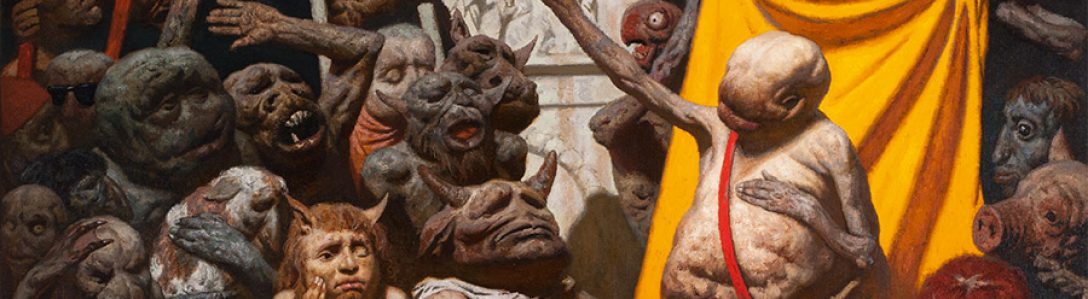
Georges de La Tour’s Mary Magdalene has not yet arrived at an ecstasy of repentance (Angela Carter)

a

Mary Magdalene, the Venus in sackcloth. Georges de La Tour’s picture does not show a woman in sackcloth, but her chemise is coarse and simple enough to be a penitential garment, or, at least, the kind of garment that shows you were not thinking of personal adornment when you put it on. Even though the chemise is deeply open on the bosom, it does not seem to disclose flesh as such, but a flesh that has more akin to the wax of the burning candle, to the way the wax candle is irradiated by its own flame, and glows. So you could say that, from the waist up, this Mary Magdalene is on the high road to penitence, but, from the waist down, which is always the more problematic part, there is the question of her long, red skirt.

b

Left-over finery? Was it the only frock she had, the frock she went whoring in, then repented in, then set sail in? Did she walk all the way to the Sainte-Baume in this red skirt? It doesn’t look travel-stained or worn or torn. It is a luxurious, even scandalous skirt. A scarlet dress for a scarlet woman. …

c

Georges de La Tour’s Mary Magdalene has not yet arrived at an ecstasy of repentance, evidently. Perhaps, indeed, he has pictured her as she is just about to repent — before her sea voyage in fact, although I would prefer to think that this bare, bleak space, furnished only with the mirror, is that of her cave in the woods. But this is a woman who is still taking care of herself. Her long, black hair, sleek as that of a Japanese woman on a painted scroll — she must just have finished brushing it, reminding us that she is the patron saint of hairdressers. Her hair is the product of culture, not left as nature intended. Her hair shows she has just used the mirror as an instrument of worldly vanity. Her hair shows that, even as she meditates upon the candle flame, this world still has a claim upon her.

Unless we are actually watching her as her soul is drawn out into the candle flame.

From Angela Carter’s short story “Impressions: The Wrightsman Magdalene.”

magdalene

Now seems as good a time as any to read Jack London’s dystopian novel The Iron Heel

The Iron Heel

by

Jack London


Foreword


It cannot be said that the Everhard Manuscript is an important historical document. To the historian it bristles with errors—not errors of fact, but errors of interpretation. Looking back across the seven centuries that have lapsed since Avis Everhard completed her manuscript, events, and the bearings of events, that were confused and veiled to her, are clear to us. She lacked perspective. She was too close to the events she writes about. Nay, she was merged in the events she has described.

Nevertheless, as a personal document, the Everhard Manuscript is of inestimable value. But here again enter error of perspective, and vitiation due to the bias of love. Yet we smile, indeed, and forgive Avis Everhard for the heroic lines upon which she modelled her husband. We know to-day that he was not so colossal, and that he loomed among the events of his times less largely than the Manuscript would lead us to believe.

We know that Ernest Everhard was an exceptionally strong man, but not so exceptional as his wife thought him to be. He was, after all, but one of a large number of heroes who, throughout the world, devoted their lives to the Revolution; though it must be conceded that he did unusual work, especially in his elaboration and interpretation of working-class philosophy. “Proletarian science” and “proletarian philosophy” were his phrases for it, and therein he shows the provincialism of his mind—a defect, however, that was due to the times and that none in that day could escape.

But to return to the Manuscript. Especially valuable is it in communicating to us the FEEL of those terrible times. Nowhere do we find more vividly portrayed the psychology of the persons that lived in that turbulent period embraced between the years 1912 and 1932—their mistakes and ignorance, their doubts and fears and misapprehensions, their ethical delusions, their violent passions, their inconceivable sordidness and selfishness. These are the things that are so hard for us of this enlightened age to understand. History tells us that these things were, and biology and psychology tell us why they were; but history and biology and psychology do not make these things alive. We accept them as facts, but we are left without sympathetic comprehension of them.

This sympathy comes to us, however, as we peruse the Everhard Manuscript. We enter into the minds of the actors in that long-ago world-drama, and for the time being their mental processes are our mental processes. Not alone do we understand Avis Everhard’s love for her hero-husband, but we feel, as he felt, in those first days, the vague and terrible loom of the Oligarchy. The Iron Heel (well named) we feel descending upon and crushing mankind.

And in passing we note that that historic phrase, the Iron Heel, originated in Ernest Everhard’s mind. This, we may say, is the one moot question that this new-found document clears up. Previous to this, the earliest-known use of the phrase occurred in the pamphlet, “Ye Slaves,” written by George Milford and published in December, 1912. This George Milford was an obscure agitator about whom nothing is known, save the one additional bit of information gained from the Manuscript, which mentions that he was shot in the Chicago Commune. Evidently he had heard Ernest Everhard make use of the phrase in some public speech, most probably when he was running for Congress in the fall of 1912. From the Manuscript we learn that Everhard used the phrase at a private dinner in the spring of 1912. This is, without discussion, the earliest-known occasion on which the Oligarchy was so designated.

The rise of the Oligarchy will always remain a cause of secret wonder to the historian and the philosopher. Other great historical events have their place in social evolution. They were inevitable. Their coming could have been predicted with the same certitude that astronomers to-day predict the outcome of the movements of stars. Without these other great historical events, social evolution could not have proceeded. Primitive communism, chattel slavery, serf slavery, and wage slavery were necessary stepping-stones in the evolution of society. But it were ridiculous to assert that the Iron Heel was a necessary stepping-stone. Rather, to-day, is it adjudged a step aside, or a step backward, to the social tyrannies that made the early world a hell, but that were as necessary as the Iron Heel was unnecessary.

Black as Feudalism was, yet the coming of it was inevitable. What else than Feudalism could have followed upon the breakdown of that great centralized governmental machine known as the Roman Empire? Not so, however, with the Iron Heel. In the orderly procedure of social evolution there was no place for it. It was not necessary, and it was not inevitable. It must always remain the great curiosity of history—a whim, a fantasy, an apparition, a thing unexpected and undreamed; and it should serve as a warning to those rash political theorists of to-day who speak with certitude of social processes.

Capitalism was adjudged by the sociologists of the time to be the culmination of bourgeois rule, the ripened fruit of the bourgeois revolution. And we of to-day can but applaud that judgment. Following upon Capitalism, it was held, even by such intellectual and antagonistic giants as Herbert Spencer, that Socialism would come. Out of the decay of self-seeking capitalism, it was held, would arise that flower of the ages, the Brotherhood of Man. Instead of which, appalling alike to us who look back and to those that lived at the time, capitalism, rotten-ripe, sent forth that monstrous offshoot, the Oligarchy.

Too late did the socialist movement of the early twentieth century divine the coming of the Oligarchy. Even as it was divined, the Oligarchy was there—a fact established in blood, a stupendous and awful reality. Nor even then, as the Everhard Manuscript well shows, was any permanence attributed to the Iron Heel. Its overthrow was a matter of a few short years, was the judgment of the revolutionists. It is true, they realized that the Peasant Revolt was unplanned, and that the First Revolt was premature; but they little realized that the Second Revolt, planned and mature, was doomed to equal futility and more terrible punishment.

It is apparent that Avis Everhard completed the Manuscript during the last days of preparation for the Second Revolt; hence the fact that there is no mention of the disastrous outcome of the Second Revolt. It is quite clear that she intended the Manuscript for immediate publication, as soon as the Iron Heel was overthrown, so that her husband, so recently dead, should receive full credit for all that he had ventured and accomplished. Then came the frightful crushing of the Second Revolt, and it is probable that in the moment of danger, ere she fled or was captured by the Mercenaries, she hid the Manuscript in the hollow oak at Wake Robin Lodge.

Of Avis Everhard there is no further record. Undoubtedly she was executed by the Mercenaries; and, as is well known, no record of such executions was kept by the Iron Heel. But little did she realize, even then, as she hid the Manuscript and prepared to flee, how terrible had been the breakdown of the Second Revolt. Little did she realize that the tortuous and distorted evolution of the next three centuries would compel a Third Revolt and a Fourth Revolt, and many Revolts, all drowned in seas of blood, ere the world-movement of labor should come into its own. And little did she dream that for seven long centuries the tribute of her love to Ernest Everhard would repose undisturbed in the heart of the ancient oak of Wake Robin Lodge.

ANTHONY MEREDITH

Ardis,

November 27, 419 B.O.M.


Read or download the rest of Jack London’s 1908 dystopian novel The Iron Heel at Project Gutenberg (and consider donating to their worthy cause while you’re there!).

What did Nathaniel Hawthorne see on December 1st, 1850?

December 1st.–I saw a dandelion in bloom near the lake.

Nathaniel Hawthorne’s journal entry for December 1st, 1850. From Passages from the American Note-Books.

“The Screwfly Solution” — Raccoona Sheldon

“The Screwfly Solution”

by

Raccoona Sheldon


The young man sitting at 2° N, 75° W sent a casually venomous glance up at the nonfunctional shoofly ventilador and went on reading his letter. He was sweating heavily, stripped to his shorts in the hotbox of what passed for a hotel room in Cuyapán.

How do other wives do it? I stay busy-busy with the Ann Arbor grant review programs and the seminar, saying brightly, “Oh yes, Alan is in Colombia setting up a biological pest control program, isn’t it wonderful?” But inside I imagine you being surrounded by nineteen-year-old raven-haired cooing beauties, every one panting with social dedication and filthy rich. And forty inches of bosom busting out of her delicate lingerie. I even figured it in centimeters, that’s 101.6 centimeters of busting. Oh, darling, darling, do what you want only come home safe.

Alan grinned fondly, briefly imagining the only body he longed for. His girl, his magic Anne. Then he got up to open the window another cautious notch. A long pale mournful face looked in—a goat. The room opened on the goatpen, the stench was vile. Air, anyway. He picked up the letter.

Everything is just about as you left it, except that the Peedsville horror seems to be getting worse. They’re calling it the Sons of Adam cult now. Why can’t they do something, even if it is a religion? The Red Cross has set up a refugee camp in Ashton, Georgia. Imagine, refugees in the U.S.A. I heard two little girls were carried out all slashed up. Oh, Alan.

Which reminds me, Barney came over with a wad of clippings he wants me to send you. I’m putting them in a separate envelope; I know what happens to very fat letters in foreign POs. He says, in case you don’t get them, what do the following have in common? Peedsville, Sao Paulo, Phoenix, San Diego, Shanghai, New Delhi, Tripoli, Brisbane, Johannesburg, and Lubbock, Texas. He says the hint is, remember where the Intertropical Convergence Zone is now. That makes no sense to me, maybe it will to your superior ecological brain. All I could see about the clippings was that they were fairly horrible accounts of murders or massacres of women. The worst was the New Delhi one, about “rafts of female corpses” in the river. The funniest (!) was the Texas Army officer who shot his wife, three daughters and his aunt, because God told him to clean the place up.

Barney’s such an old dear, he’s coming over Sunday to help me take off the downspout and see what’s blocking it. He’s dancing on air right now, since you left his spruce budworm-moth antipheromone program finally paid off. You know he tested over 2,000 compounds? Well, it seems that good old 2,097 really works. When I asked him what it does he just giggles, you know how shy he is with women. Anyway, it seems that a one-shot spray program will save the forests, without harming a single other thing. Birds and people can eat it all day, he says.

Well sweetheart, that’s all the news except Amy goes back to Chicago to school Sunday. The place will be a tomb, I’ll miss her frightfully in spite of her being at the stage where I’m her worst enemy. The sullen sexy subteens, Angie says. Amy sends love to her Daddy. I send you my whole heart, all that words can’t say.

Your Anne

Alan put the letter safely in his notefile and glanced over the rest of the thin packet of mail, refusing to let himself dream of home and Anne. Barney’s “fat envelope” wasn’t there. He threw himself on the rumpled bed, yanking off the lightcord a minute before the town generator went off for the night. In the darkness the last of places Barney had mentioned spread themselves around a misty globe that turned, troublingly, briefly in his mind. Something …

But then the memory of the hideously parasitized children he had worked with at the clinic that day took possession of his thoughts. He set himself to considering the data he must collect. Look for the vulnerable link in the behavioral chain—how often Barney—Dr. Barnhard Braithwaite—had pounded it into his skull. Where was it, where? In the morning he would start work on bigger canefly cages …


Read the rest of “The Screwfly Solution” by Racoona Sheldon (aka James Tiptree Jr. aka Alice Sheldon)

F. Scott Fitzgerald’s Turkey Leftovers

From F. Scott Fitzgerald’s Notebooks

TURKEY REMAINS AND HOW TO INTER THEM WITH NUMEROUS SCARCE RECIPES
At this post holiday season the refrigerators of the nation are overstuffed with large masses of turkey, the sight of which is calculated to give an adult an attack of dizziness. It seems, therefore, an appropriate time to give the owners the benefit of my experience as an old gourmet, in using this surplus material. Some of the recipes have been in my family for generations. (This usually occurs when rigor mortis sets in.) They were collected over years, from old cook books, yellowed diaries of the Pilgrim Fathers, mail order catalogues, golfbags and trash cans. Not one but has been tried and proven—there are headstones all over America to testify to the fact.
Very well then: Here goes:

1. Turkey Cocktail
To one large turkey add one gallon of vermouth and a demijohn of angostura bitters. Shake.

2. Turkey at la Francais.
Take a large ripe turkey, prepare as for basting and stuff with old watches and chains and monkey meat. Proceed as with cottage-pudding.

3. Turkey and Water
Take one turkey and one pan of water. Heat the latter to the boiling point and then put in the refrigerator When it has jelled drown the turkey in it. Eat. In preparing this recipe it is best to have a few ham sandwiches around in case things go wrong.

4. Turkey Mongole
Take three butts of salami and a large turkey skeleton from which the feathers and natural stuffing have been removed. Lay them out on the table and call up some Mongole in the neighborhood to tell you how to proceed from there.

5. Turkey Mousee
Seed a large prone turkey, being careful to remove the bones, flesh, fins, gravy, etc. Blow up with a bicycle pump. Mount in becoming style and hang in the front hall.

6. Stolen Turkey
Walk quickly from the market and if accosted remark with a laugh that it had just flown into your arms and you hadn’t noticed it. Then drop the turkey with the white of one egg-well, anyhow, beat it.

7. Turkey a la Creme.
Prepare the creme a day in advance, or even a year in advance. Deluge the turkey with it and cook for six days over a blast furnace. Wrap in fly paper and serve.

8. Turkey Hash
This is the delight of all connoisseurs of the holiday beast, but few understand how really to prepare it. Like a lobster it must be plunged alive into boiling water, until it becomes bright red or purple or something, and then before the color fades, placed quickly in a washing machine and allowed to stew in its own gore as it is whirled around.
Only then is it ready for hash. To hash, take a large sharp tool like a nail-file or if none is handy, a bayonet will serve the purpose—and then get at it! Hash it well! Bind the remains with dental floss and serve.
And now we come to the true aristocrat of turkey dishes:

9. Feathered Turkey.
To prepare this a turkey is necessary and a one pounder cannon to compell anyone to eat it. Broil the feathers and stuff with sage brush, old clothes, almost anything you can dig up. Then sit down and simmer. The feathers are to be eaten like artichokes (and this is not to be confused with the old Roman custom of tickling the throat).

10. Turkey at la Maryland
Take a plump turkey to a barber’s and have him shaved, or if a female bird, given a facial and a water wave. Then before killing him stuff with with old newspapers and put him to roost. He can then be served hot or raw, usually with a thick gravy of mineral oil and rubbing alcohol. (Note: This recipe was given me by an old black mammy.)

11. Turkey Remnant
This is one of the most useful recipes for, though not, “chic”, it tells what to do with the turkey after the holiday, and extract the most value from it.
Take the remants, or if they have been consumed, take the various plates on which the turkey or its parts have rested and stew them for two hours in milk of magnesia. Stuff with moth-balls.

12. Turkey with Whiskey Sauce.
This recipe is for a party of four. Obtain a gallon of whiskey, and allow it to age for several hours. Then serve, allowing one quart for each guest.
The next day the turkey should be added, little by little, constantly stirring and basting.

13. For Weddings or Funerals. Obtain a gross of small white boxes such as are used for bride’s cake. Cut the turkey into small squares, roast, stuff, kill, boil, bake and allow to skewer. Now we are ready to begin. Fill each box with a quantity of soup stock and pile in a handy place. As the liquid elapses, the prepared turkey is added until the guests arrive. The boxes delicately tied with white ribbons are then placed in the handbags of the ladies, or in the men’s side pockets.

There I guess that’s enough turkey to talk. I hope I’ll never see or hear of another until—well, until next year.

Zora Neale Hurston’s Mulatto Rice

At the beginning of Zora Neale Hurston’s novel Their Eyes Were Watching God, Janie returns from the Everglades to Eatonville in ragged overalls to a gossipy and unwelcoming town. The one exception is her best friend Phoeby, who brings Janie a “heaping plate of mulatto rice.” Janie gobbles up the simple, delicious meal, even as Phoeby notes that it “ain’t so good dis time. Not enough bacon grease.” She does however concede that “it’ll kill hongry.” No doubt.

We’ve always been intrigued by mulatto rice. What could it be? Is the dish still around today, but under a new name? Although the term “mulatto” has fallen into disuse, and perhaps distaste (just ask Larry David if you don’t believe us), organizations like mulatto.org have also taken a certain ownership of it. For Hurston, mulatto rice is a positive thing. Hurston could have had Phoeby bring any number of dishes to her friend Janie, so it’s telling that she chooses “mulatto rice” as a homecoming meal. The dish represents a communion, an admixture that reflects Janie’s multiracial identity as well as her resistance to gender-typing. “Mulatto” is also probably etymologically akin to the word “mule,” and if you’ve read Eyes, you know that mules are a major motif in the story. But enough literazin’.

Down to the nitty-gritty–we made up a mess of mulatto rice tonight thanks to a recipe from The Savannah Cook Book by Harriet Ross Colquitt. Not that we found this 1933 cookbook ourselves. No, the real merit here goes to the very cool website Take One Cookbook, which explores the history and culture and sociology behind old, weird cookbooks–all while making the recipes. Colquitt’s recipe, via Wendy at Take One Cookbook (see Wendy’s versionhere):

Mulatto Rice

This is the very chic name given to rice with a touch of the tarbrush.

Fry squares of breakfast bacon and remove from the pan. Then brown some minced onion (one small one) in this grease, and add one pint can of tomatoes. When thoroughly hot, add a pint of rice to this mixture, and cook very slowly until the rice is done. Or, if you are in a hurry, cold rice may be substituted, and all warmed thoroughly together.

The rice is very easy to make and very, very tasty. We substituted green onions for a small onion, and used a hickory-smoked bacon that infused the rice with a lovely sweetness (we also included a tablespoon of brown sugar right after the tomatoes). We served the dish, pictured above, with ham steaks and fried green tomatoes with a spicy yogurt sauce. Hearty and rich and satisfying–just the sort of thing one wants to eat after a soul-searching quest (or maybe just a long day). Recommended.

Cormac McCarthy’s Turtle Soup

In Cormac McCarthy’s novel Suttree, an Indian named Michael prepares a turtle soup for Suttree. First, catch the turtle. Then, kill the turtle, making sure to discard its head–

The Indian braced his feet and swung it up dripping from the river and onto the rocks and it squatted there watching them, its baleful pig’s eyes blinking. It was tied through the lower jaw with a section of wire and the Indian took hold of the wire and tugged at it. The turtle bated and hissed, its jaws gasped. The Indian had out his pocketknife and now he opened it and he pulled the turtle’s obscene neck out taut and with a quick upward motion of the blade severed the head. Suttree involuntarily drew back. The turtle’s craggy head swung from the wire and what lay between the braced forefeet was a black and wrinkled dog’s cunt slowly pumping gouts of near black blood. The blood ran down over the stones and dripped in the water and the turtle shifted slowly on the rock and started toward the river. The Indian undid the wire and flung the head into the river . .  .

Appetizing, no? Now that you’ve thrown the bloody head in the river (or your garbage can or wherever you throw turtle heads), it’s time to dress the beast–

Suttree laid the turtle on the rock and the Indian scouted about him until he came up with a goodsized stone.

Watch out, he said.

Suttree stepped back.

The Indian raised the stone and brought it down upon the turtle’s back. The shell collapsed with a pulpy buckling sound.

I never saw a turtle dressed before, said Suttree. But the Indian had knelt and was cutting away the broken plates of shell with his pocketknife and pitching them into the river. He pulled the turtle’s meat up off the plastron and gouged away the scant bowels with his thumb. He skinned out the feet. What hung headless in his grip as he raised it aloft was a wet gray foetal mass, a dim atavism limp and dripping.

Plenty of meat there, said the Indian. He laid it out on the rock and bent and swished the blade of his knife in the river.

Okay. Now that you’ve removed the shell and gouged away the scant bowels with your thumbs, it’s time to prepare the wet gray foetal mass.

Put him in a pot and cook him slow. Lots of vegetables. Lots of onions. I got my own things I put in.

Got it? Lots of onions. Slow cook that dim, limp, dripping atavism. The fact that the Indian has his “own things” that he puts in implies a call to the reader to experiment with the recipe. And how did Suttree like his turtle?

He spooned up a piece of the meat and cradled it in his mouth to cool it. He chewed it. It was succulent and rich, a flavor like no other.

Thomas Pynchon’s Banana Breakfast

At the beginning of Thomas Pynchon’s massive tome Gravitys Rainbow, Captain Geoffrey “Pirate” Prentice cooks up a bodacious banana breakfast for a bunch of hungover army officers—

Routine: plug in American blending machine won from some Yank last summer, some poker game, table stakes, B.O.Q. somewhere in the north, never remember now….Chop several bananas into pieces. Make coffee in urn. Get can of milk from cooler. Puree ‘nanas in milk. Lovely. I would coat all the booze-corroded stomachs of England. . . . Bit of marge, still smells all right, melt in the skillet. Peel more bananas, slice lengthwise. Marge sizzling, in go long slices. Light oven whoomp blow us all up someday oh, ha, ha, yes. Peeled whole bananas to go on broiler grill soon as it heats. Find marshmallows. . . .

Here’s how it all turns out–

With a clattering of chairs, upended shell cases, benches, and ottomans, Pirate’s mob gather at the shores of the great refectory table, a southern island well across a tropic or two from chill Corydon Throsp’s mediaeval fantasies, crowded now over the swirling dark grain of its walnut uplands with banana omelets, banana sandwiches, banana casseroles, mashed bananas molded into the shape of a British lion rampant, blended with eggs into batter for French toast, squeezed out a pastry nozzle across the quivering creamy reaches of a banana blancmange to spell out the words C’est magnifique, mais ce n’est pas la guerre (attributed to a French observer during the Charge of the Light Brigade) which Pirate has appropriated as his motto . . . tall cruets of pale banana syrup to pour oozing over banana waffles, a giant glazed crock where diced bananas have been fermenting since the summer with wild honey and muscat raisins, up out of which, this winter morning, one now dips foam mugsfull of banana mead . . . banana croissants and banana kreplach, and banana oatmeal and banana jam and banana bread, and bananas flamed in ancient brandy Pirate brought back last year from a cellar in the Pyrenees also containing a clandestine radio transmitter. . . .

James Joyce’s Burnt Kidney Breakfast

Another entry in our ongoing series of literary recipes to celebrate Thanksgiving.

Leopold Bloom, hero of James Joyce’s Ulysses likes kidneys for breakfast. In fact–

Mr Leopold Bloom ate with relish the inner organs of beasts and fowls. He liked thick giblet soup, nutty gizzards, a stuffed roast heart, liverslices fried with crustcrumbs, fried hencods’ roes. Most of all he liked grilled mutton kidneys which gave to his palate a fine tang of faintly scented urine.

Okay, so there’s not much to this recipe. First, you’ve gotta buy the kidney–

A kidney oozed bloodgouts on the willowpatterned dish: the last. He stood by the nextdoor girl at the counter. Would she buy it too, calling the items from a slip in her hand? Chapped: washingsoda. And a pound and a half of Denny’s sausages.

Then you cook it with some butter in a frying pan (don’t forget to share with the cat, and don’t forget the pepper)–

While he unwrapped the kidney the cat mewed hungrily against him. Give her too much meat she won’t mouse. Say they won’t eat pork. Kosher. Here. He let the bloodsmeared paper fall to her and dropped the kidney amid the sizzling butter sauce. Pepper. He sprinkled it through his fingers ringwise from the chipped eggcup.

Then take your lazy adulterous wife her breakfast that you’ve lovingly prepared for her (she’ll need her strength for later). Oh, and don’t forget about the kidney that’s still cooking for you (unless you’re making some kind of subconscious symbolic burnt offering or something)–

—There’s a smell of burn, she said. Did you leave anything on the fire?

—The kidney! he cried suddenly.

He fitted the book roughly into his inner pocket and, stubbing his toes against the broken commode, hurried out towards the smell, stepping hastily down the stairs with a flurried stork’s legs. Pungent smoke shot up in an angry jet from a side of the pan. By prodding a prong of the fork under the kidney he detached it and turned it turtle on its back. Only a little burnt. He tossed it off the pan on to a plate and let the scanty brown gravy trickle over it.

Enjoy with gravy, toast, and a cup of tea–

Cup of tea now. He sat down, cut and buttered a slice of the loaf. He shore away the burnt flesh and flung it to the cat. Then he put a forkful into his mouth, chewing with discernment the toothsome pliant meat. Done to a turn. A mouthful of tea. Then he cut away dies of bread, sopped one in the gravy and put it in his mouth. What was that about some young student and a picnic? He creased out the letter at his side, reading it slowly as he chewed, sopping another die of bread in the gravy and raising it to his mouth.

He sopped other dies of bread in the gravy and ate piece after piece of kidney.

Herman Melville’s Whale Steaks

In Chapter LXIV of Herman Melville’s Moby-Dick, Stubb, second mate of the Pequod, demands whale steaks for dinner. He’s not happy with how the cook has prepared the steaks though, complaining they are too tender and overdone — his taste is closer to the sharks who are making a racket outside the ship–

“Cook,” said Stubb, rapidly lifting a rather reddish morsel to his mouth, ” don’t you think this steak is rather overdone? You’ve been beating this steak too much, cook; it’s too tender. Don’t I always say that to be good, a whalesteak must be tough? There are those sharks now over the side, don’t you see they prefer it tough and rare? What a shindy they are kicking up! Cook, go and talk to ’em; tell ’em they are welcome to help themselves civilly, and in moderation, but they must keep quiet. Blast me, if I can hear my own voice. Away, cook, and deliver my message. Here, take this lantern,” snatching one from his sideboard; ” now, then, go and preach to ’em! “

Stubb then instructs the cook on the best way to prepare whale steaks, a process involving a hot live coal. Oh, and he likes his fins pickled and his flukes soused–

“Well then, cook, you see this whale-steak of yours was so very bad, that I have put it out of sight as soon as possible; you see that, don’t you? Well, for the future, when you cook another whale-steak for my private table here, the capstan, I’ll tell you what to do so as not to spoil it by overdoing. Hold the steak in one hand, and show a live coal to it with the other; that done, dish it; d’ye hear? And now to-morrow, cook, when we are cutting in the fish, be sure you stand by to get the tips of his fins; have them put in pickle. As for the ends of the flukes, have them soused, cook. There, now ye may go.”

Gordon Lish’s Chicken Soup Recipe

Get lost for two hours. Go read Jacques Derrida or the like, something to break your brain on and convince you that mind is nothing in the comfort department compared to the things of the spirit, which is what is going on in back in the kitchen. And down’t worry about setting a timer. The fevers sailing the ethers will call you back the instant you’re wanted.

From “Not Just Any Soup,” Gordon Lish’s recipe for chicken noodle soup, published in The New York Times in 1977.

Before you can get lost in Derrida (or the like) for a few hours, you’ve got to fill an 11″ by 5″ pot with three inches of water and inch of beer. Set the heat to low and add “scrubbed carrots…chopped chive, slivered celery, sliced onion, minced garlic, ground dill, paprika, Dijon mustard, pepper, salt, a dash of cinnamon.”

How much of each? Lish is unwilling to list amounts: “Amounts is for the insurance business…The heart with good posture doesn’t stoop to check amounts.”

Add the chicken (sans fat and skin), cover, lower to a simmer, and get lost for two hours.

After you’ve read Derrida (or the like) for two hours, add the noodles — “the slenderest money can buy” — and take another hour off. To kill the time, Lish prescribes Jack Gilberts’ Views of Jeopardy — “the last poems the English language needed”).

Once that hour’s passed, stir the mixture again, thoroughly: “Lid off, the eucharist rolled over in his languid waters so that the bottom shall be the top.” Put the lid back on and wait for eight hours. Lish advises using the time to think.

Huge thanks to David Winters for sharing the recipe with me; David found the piece as part of a great big important research thing he’s doing on Lish (he also interviewed Lish for the project, so we’ll have that to look forward to—but it’s not going to be in his new book, Infinite Fictions, new from Zero this January).