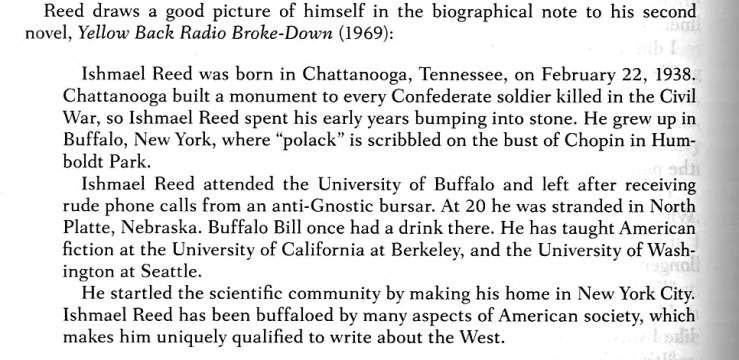
One of the better autobiographical notes I’ve read. This comes from The Norton Anthology of American Literature, Vol. E (8th ed.); my copy of Yellow Back Radio Broke-Down unfortunately doesn’t actually include this note.

One of the better autobiographical notes I’ve read. This comes from The Norton Anthology of American Literature, Vol. E (8th ed.); my copy of Yellow Back Radio Broke-Down unfortunately doesn’t actually include this note.
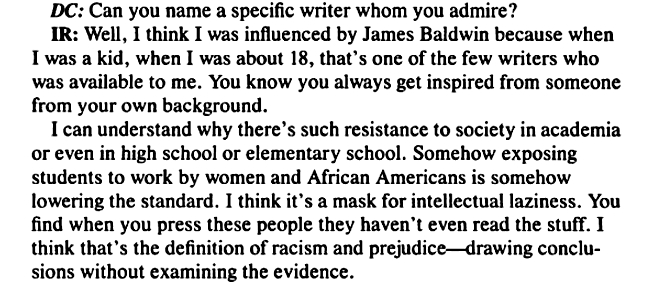
Ishmael Reed, in a 1994 interview with Monica Valencia originally published in The Daily Californian and later republished in Conversations with Ishmael Reed.
It was suggested that what was admired about the balloon was finally this: that it was not limited, or defined. Sometimes a bulge, blister, or subsection would carry all the way east to the river on its own initiative, in the manner of an army’s movements on a map, as seen in a headquarters remote from the fighting. Then that part would be, as it were, thrown back again, or would withdraw into new dispositions; the next morning, that part would have made another sortie, or disappeared altogether. This ability of the balloon to shift its shape, to change, was very pleasing, especially to people whose lives were rather rigidly patterned, persons to whom change, although desired, was not available. The balloon, for the twenty-two days of its existence, offered the possibility, in its randomness, of mislocation of the self, in contradistinctions to the grid of precise, rectangular pathways under our feet. The amount of specialized training currently needed, and the consequent desirability of long-term commitments, has been occasioned by the steadily growing importance of complex machinery, in virtually all kinds of operations; as this tendency increases, more and more people will turn, in bewildered inadequacy, to solutions for which the balloon many stand as a prototype, or “rough draft.”
Stephen Dedalus and Leopold Bloom have stopped at a cabman’s shelter, a small coffeehouse under the Loop Line Bridge, for a cuppa and a rest on their way home. And the hope that the coffee will sober Stephen up. After an appropriate period of such hospitality, Bloom sees that it is time to leave.
James Joyce. Ulysses, (1921).
To cut a long story short Bloom, grasping the situation, was the first to rise to his feet so as not to outstay their welcome having first and foremost, being as good as his word that he would foot the bill for the occasion, taken the wise precaution to unobtrusively motion to mine host as a parting shot a scarcely perceptible sign when the others were not looking to the effect that the amount due was forthcoming, making a grand total of fourpence (the amount he deposited unobtrusively in four coppers, literally the last of the Mohicans) he having previously spotted on the printed price list for all who ran to read opposite to him in unmistakable figures, coffee ad., confectionary do, and honestly well worth twice the money once in a way, as Wetherup used to remark.
Commonplaces Narrative Events
1. to cut a long story short authorial intervention
2. grasp the situation subjective interpretation
3. rise to his feet narrative action
4. don’t outstay your welcome rationale or justification
5. first and foremost subjective evaluation
6. good as his word characterization
7. foot the bill promise, therefore a prediction
8. take the wise precaution subjective evaluation
9. mine host authorial archness
10. parting shot subjective evaluation
11. scarcely perceptible sign narrative action
12. to the effect that subjective interpretation
13. amount due is forthcoming subjective interpretation
14. grand total characterization
15. literally the last of the Mohicans authorial intervention, allusion
16. previously spotted subjective interpretation
17. all who run can read authorial intervention, allusion
18. honestly (in this context) subjective interpretation
19. well worth it subjective interpretation
20. worth twice the money subjective interpretation
21. once in a waysubjective allusion
22. as [Wetherup] used to [remark] say attribution
The sentence without its commonplaces:
To be brief, Bloom, realizing they should not stay longer, was the first to rise, and having prudently and discreetly signaled to their host that he would pay the bill, quietly left his last four pennies, a sum—most reasonable—he knew was due, having earlier seen the price of their coffee and confection clearly printed on the menu.
Bloom was the first to get up so that he might also be the first to motion (to the host) that the amount due was forthcoming.
The theme of the sentence is manners: Bloom rises so he and his companion will not have sat too long over their coffees and cake, and signals discreetly (unobtrusively is used twice) that he will pay the four pence due according to the menu. The sum, and the measure of his generosity, is a pittance.
The sentence is itself an odyssey, for Bloom and Dedalus are going home. They stop (by my count) at twenty-two commonplaces on their way. Other passages might also be considered for the list, such as “when others were not looking.” Commonplaces are the goose down of good manners. They are remarks empty of content, hence never offensive; they conceal hypocrisy in an acceptable way, because, since they have no meaning in themselves anymore they cannot be deceptive. That is, we know what they mean (“how are you?”), but they do not mean what they say (I really don’t want to know how you are). Yet they soothe and are expected. We have long forgotten that “to foot the bill,” for instance, is to pay the sum at the bottom of it, though it could mean to kick a bird in the face. Bloom, we should hope, is already well above his feet when he rises to them. The principal advantage of the commonplace is that it is supremely self-effacing. It so lacks originality that it has no source. The person who utters a commonplace—to cut a long explanation short—has shifted into neutral.
From William H. Gass’s essay “Narrative Sentences.” Collected in Life Sentences.
“John Inglefield’s Thanksgiving”
by
Nathaniel Hawthorne
On the evening of Thanksgiving day, John Inglefield, the blacksmith, sat in his elbow-chair, among those who had been keeping festival at his board. Being the central figure of the domestic circle, the fire threw its strongest light on his massive and sturdy frame, reddening his rough visage, so that it looked like the head of an iron statue, all aglow, from his own forge, and with its features rudely fashioned on his own anvil. At John Inglefield’s right hand was an empty chair. The other places round the hearth were filled by the members of the family, who all sat quietly, while, with a semblance of fantastic merriment, their shadows danced on the wall behind then. One of the group was John Inglefield’s son, who had been bred at college, and was now a student of theology at Andover. There was also a daughter of sixteen, whom nobody could look at without thinking of a rosebud almost blossomed. The only other person at the fireside was Robert Moore, formerly an apprentice of the blacksmith, but now his journeyman, and who seemed more like an own son of John Inglefield than did the pale and slender student.
Only these four had kept New England’s festival beneath that roof. The vacant chair at John Inglefield’s right hand was in memory of his wife, whom death had snatched from him since the previous Thanksgiving. With a feeling that few would have looked for in his rough nature, the bereaved husband had himself set the chair in its place next his own; and often did his eye glance thitherward, as if he deemed it possible that the cold grave might send back its tenant to the cheerful fireside, at least for that one evening. Thus did he cherish the grief that was dear to him. But there was another grief which he would fain have torn from his heart; or, since that could never be, have buried it too deep for others to behold, or for his own remembrance. Within the past year another member of his household had gone from him, but not to the grave. Yet they kept no vacant chair for her.
While John Inglefield and his family were sitting round the hearth with the shadows dancing behind them on the wall, the outer door was opened, and a light footstep came along the passage. The latch of the inner door was lifted by some familiar hand, and a young girl came in, wearing a cloak and hood, which she took off, and laid on the table beneath the looking-glass. Then, after gazing a moment at the fireside circle, she approached, and took the seat at John Inglefield’s right hand, as if it had been reserved on purpose for her. Continue reading “Read “John Inglefield’s Thanksgiving,” a short story by Nathaniel Hawthorne”

Enjoy Thanksgiving with this menu of literary recipes:
F. Scott Fitzgerald’s Turkey Twelve Ways
Zora Neale Hurston’s Mulatto Rice
James Joyce’s Burnt Kidney Breakfast
Herman Melville’s Whale Steaks
Ernest Hemingway’s Absinthe Cocktail, Death in the Afternoon
Vladimir Nabokov’s Eggs à la Nabocoque
Thomas Pynchon’s Banana Breakfast
Robert Crumb’s Macaroni Casserole
Truman Capote’s Caviar-Smothered Baked Potatoes with 80-Proof Russian Vodka
Emily Dickinson’s Cocoanut Cake
Thomas Jefferson’s Vanilla Ice Cream
Christmas Bonus: George Orwell’s Recipes for Plum Cake and Christmas Pudding
My world, my Earth, is a ruin. A planet spoiled by the human species. We multiplied and gobbled and fought until there was nothing left, and then we died. We controlled neither appetite nor violence; we did not adapt. We destroyed ourselves. But we destroyed the world first. There are no forests left on my Earth. The air is grey, the sky is grey, it is always hot. It is habitable, it is still habitable, but not as this world is. This is a living world, a harmony. Mine is a discord. You Odonians chose a desert; we Terrans made a desert. . . . We survive there as you do. People are tough! There are nearly a half billion of us now. Once there were nine billion. You can see the old cities still everywhere. The bones and bricks go to dust, but the little pieces of plastic never do—they never adapt either. We failed as a species, as a social species. We are here now, dealing as equals with other human societies on other worlds, only because of the charity of the Hainish. They came; they brought us help. They built ships and gave them to us, so we could leave our ruined world. They treat us gently, charitably, as the strong man treats the sick one. They are a very strange people, the Hainish; older than any of us; infinitely generous. They are altruists. They are moved by a guilt we don’t even understand, despite all our crimes. They are moved in all they do, I think, by the past, their endless past. Well, we had saved what could be saved, and made a kind of life in the ruins, on Terra, in the only way it could be done: by total centralization. Total control over the use of every acre of land, every scrap of metal, every ounce of fuel. Total rationing, birth control, euthanasia, universal conscription into the labor force. The absolute regimentation of each life toward the goal of racial survival. We had achieved that much, when the Hainish came. They brought us . . . a little more hope. Not very much. We have outlived it. . . . We can only look at this splendid world, this vital society, this Urras, this Paradise, from the outside. We are capable only of admiring it, and maybe envying it a little. Not very much.
From Ursula K. Le Guin’s 1974 novel The Dispossessed.
Fulfillment, Shevek thought, is a function of time. The search for pleasure is circular, repetitive, atemporal. The variety seeking of the spectator, the thrill hunter, the sexually promiscuous, always ends in the same place. It has an end. It comes to the end and has to start over. It is not a journey and return, but a closed cycle, a locked room, a cell.Outside the locked room is the landscape of time, in which the spirit may, with luck and courage, construct the fragile, makeshift, improbable roads and cities of fidelity: a landscape inhabitable by human beings.
It is not until an act occurs within the landscape of the past and the future that it is a human act. Loyalty, which asserts the continuity of past and future, binding time into a whole, is the root of human strength; there is no good to be done without it.
So, looking back on the last four years, Shevek saw them not as wasted, but as part of the edifice that he and Takver were building with their lives. The thing about working with time, instead of against it, he thought, is that it is not wasted. Even pain counts.
From Ursula K. Le Guin’s 1974 novel The Dispossessed.
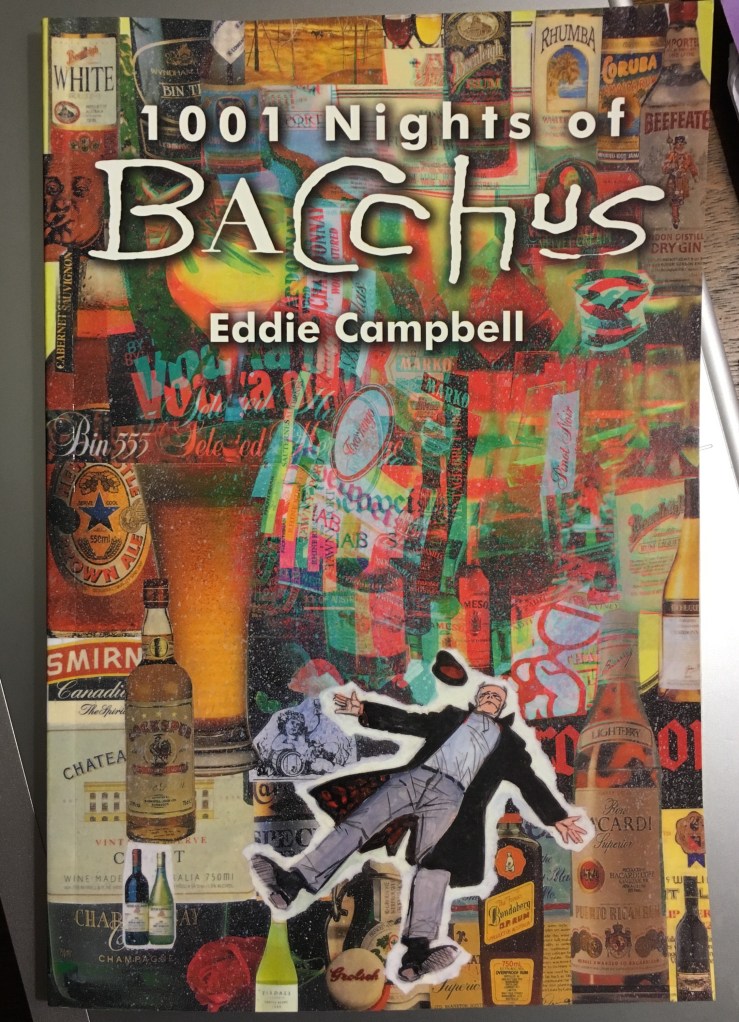
I took my kids to the bookstore yesterday because they wanted to get some more Choose Your Own Adventure books. We got a bunch of those—and maybe I’ll do a post on those, although I’ve never wanted this blog to be a nostalgia-soaked blog, although maybe that will be a nostalgia-soaked post. My son wanted to check out the comics section; he’s five, and short, and his height matched the “G” section, where he kept grabbing up Green Lantern comics (to which I: put those back). Incorrectly shelved there among the Corps though was Eddie Campbell’s 1001 Nights of Bacchus (to which I: give that here).
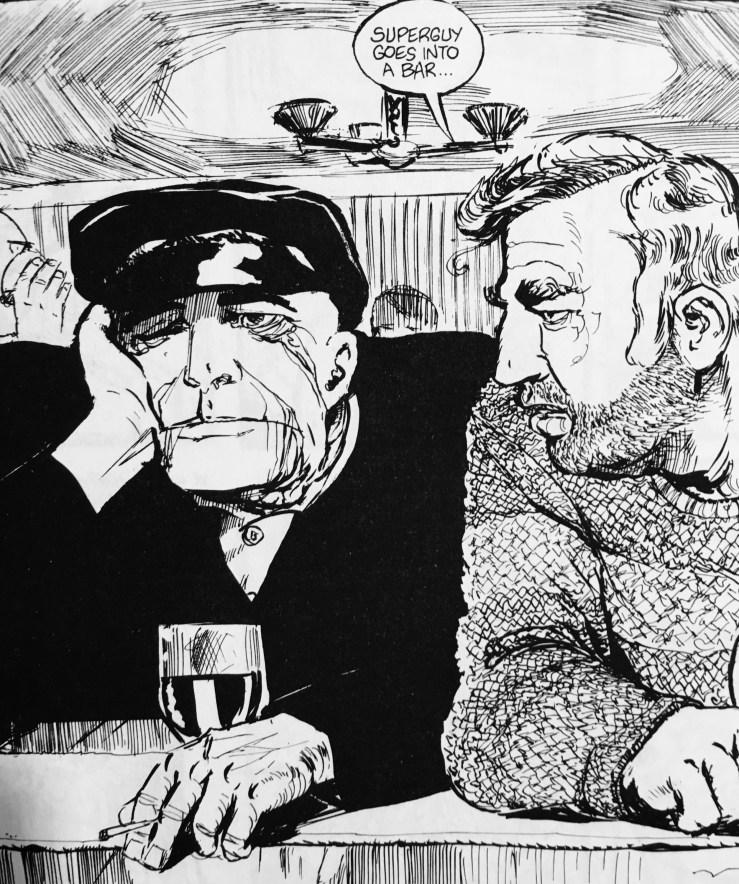
 The first time I saw Campbell’s art I was shocked. I was 12 or 13—it was in a back issue of Cerebus which I had bought in the comic shop next to the music store where I took trombone lessons (don’t ask)—so, being 12 or 13, I was still capable of shock. Dave Sim had printed (or reprinted?) the prologue, or part of the prologue, from From Hell, Campbell’s book with Alan Moore on the White Chapel/Jack the Ripper murders. What a book. I had never seen anything like that. Campbell’s inky lines seemed savage, severe, violent and sketchy, especially juxtaposed against the work of Sim and Gerhard in that particular issue of Cerebus. (The issue was part of Jaka’s Story). Continue reading “Eddie Campbell’s 1001 Nights of Bacchus (Book acquired, 11.19.2015)”
It is of the nature of idea to be communicated: written, spoken, done. The idea is like grass. It craves light, likes crowds, thrives on crossbreeding, grows better for being stepped on.
From Ursula K. Le Guin’s 1974 novel The Dispossessed.
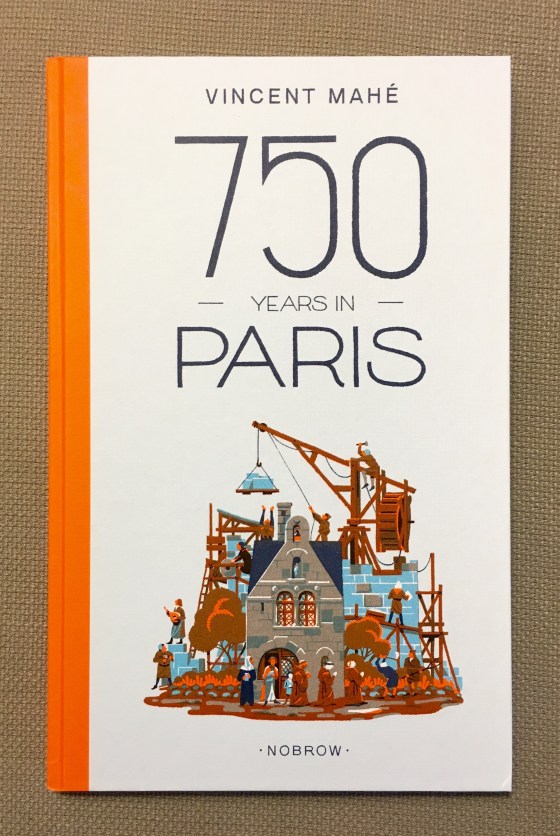
Two new(ish) graphic novels from Nobrow, Vincent Mahé’s 750 Years in Paris and Victor Hussenot’s The Spectators, showcase Paris as an enduring site of progression, turbulence, and renewal, both in culture and consciousness. Mahé’s 750 Years in Paris is a time-machine, putting its viewer in a stationary position to observe the dramatic changes in one building—and French society and culture—over the course of nearly a millennium. Hussenot’s The Spectators is a dream-machine, shuttling its characters through different skins, faces, and eyes. The titular spectators transcend not only time and space, but mind. Both books attest to the power of transformation while subtly noting the various forces that shape identity.
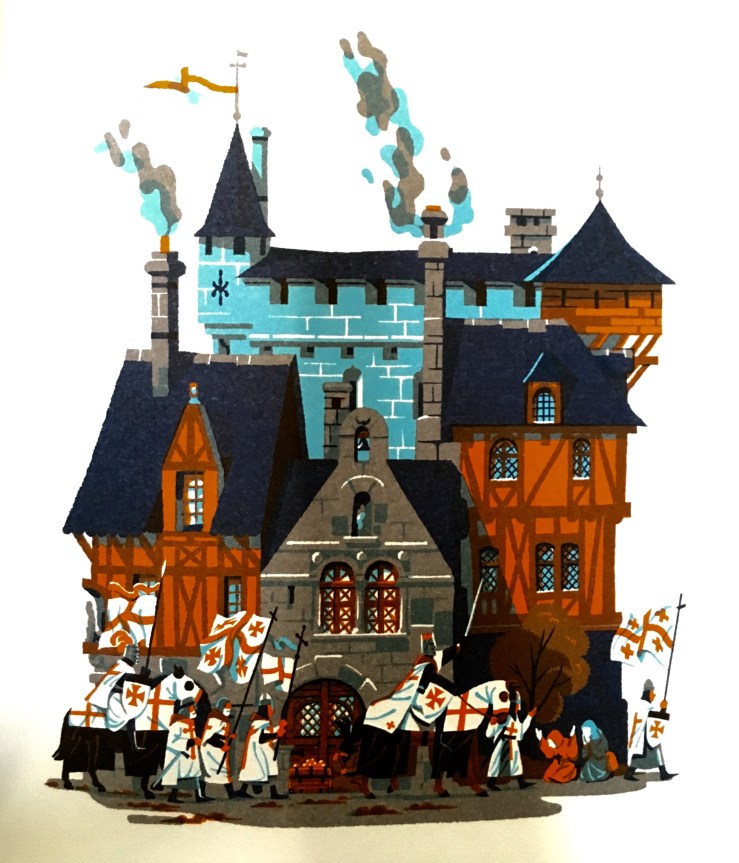
Vincent Mahé’s 750 Years in Paris begins in 1265 and moves its viewer through time to 2015. The book takes us through the Black Death Plague and the 100 Years War, the reigns of Louis XIV and IV, the storming of the Bastille and the Reign of Terror, Napoleon and Hausmann, a grand Metro and a terrible Flood. The second shot in this chronology shows us a Knights Templar procession in 1270. The crusaders remind us that Western history is inextricably bound in violence, religion, and territorial expansion—but also in the exchange of ideas, information, and knowledge. We get to May 1968 with a strong visual context for France’s history of intellectual turbulence.
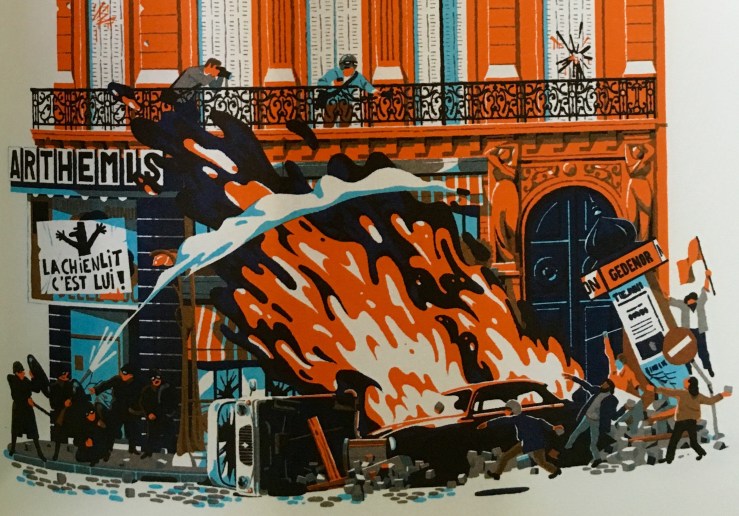 The book ends in 2015; I’ll let Mahé’s image speak for itself:

750 Years in Paris shows us that Paris not only survives drastic change, but progresses in the face of violence. When we see, for example, that a winch has been used to hang a Protestant during the St. Bartholomew’s Day Massacre of 1572—
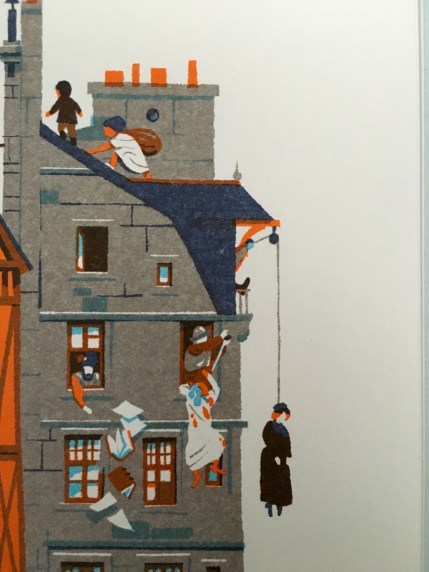
—it’s worth noting that on the next page, neighbors help each other during a terrible fire. The winch remains in the picture, a visual motif of progress, of building up.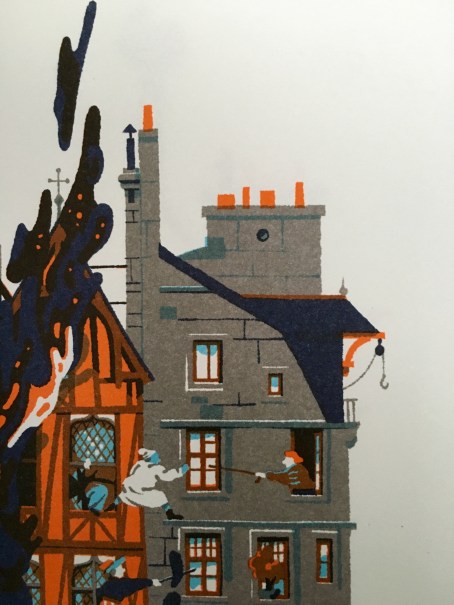
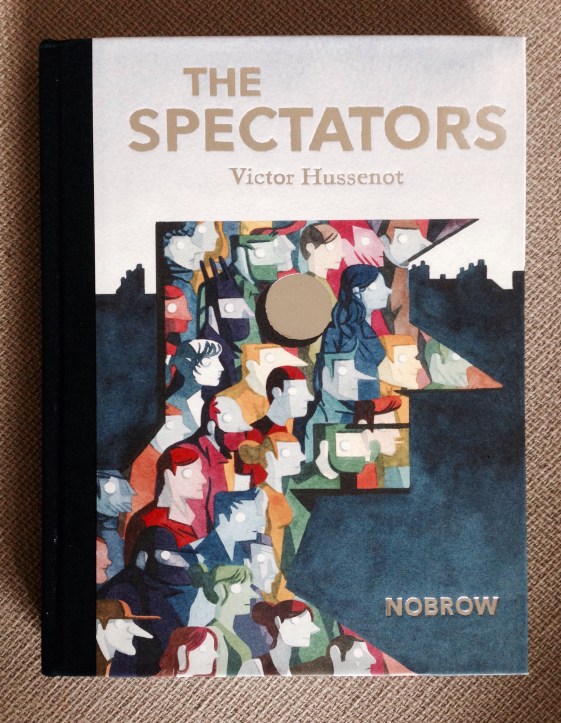
Like every Nobrow title I’ve read, Victor Hussenot’s The Spectators is better experienced than described. Its aesthetic is its narrative and its narrative is its aesthetic, flowing from a lovely dream-logic of identity shifts. Who shall I be today?, the book asks.
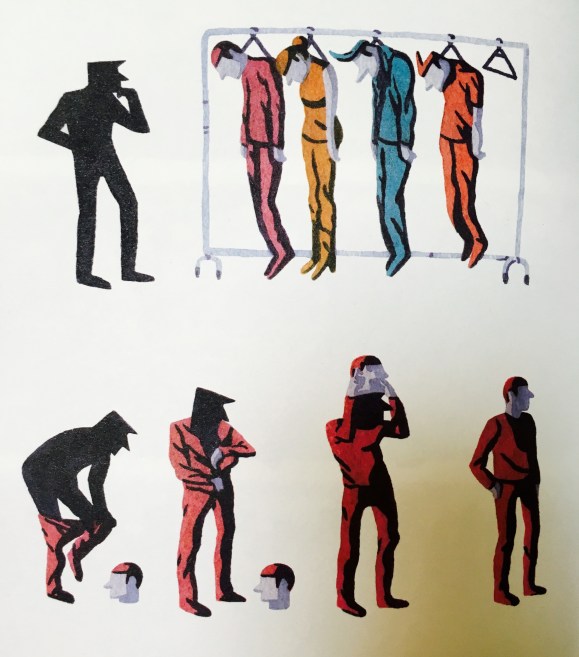
The titular spectators try on different skins, wear different hats, look through different eyes. Paris’s metro becomes a labyrinth dream-lab, where the spectators create the world anew by synthesizing known with unknown: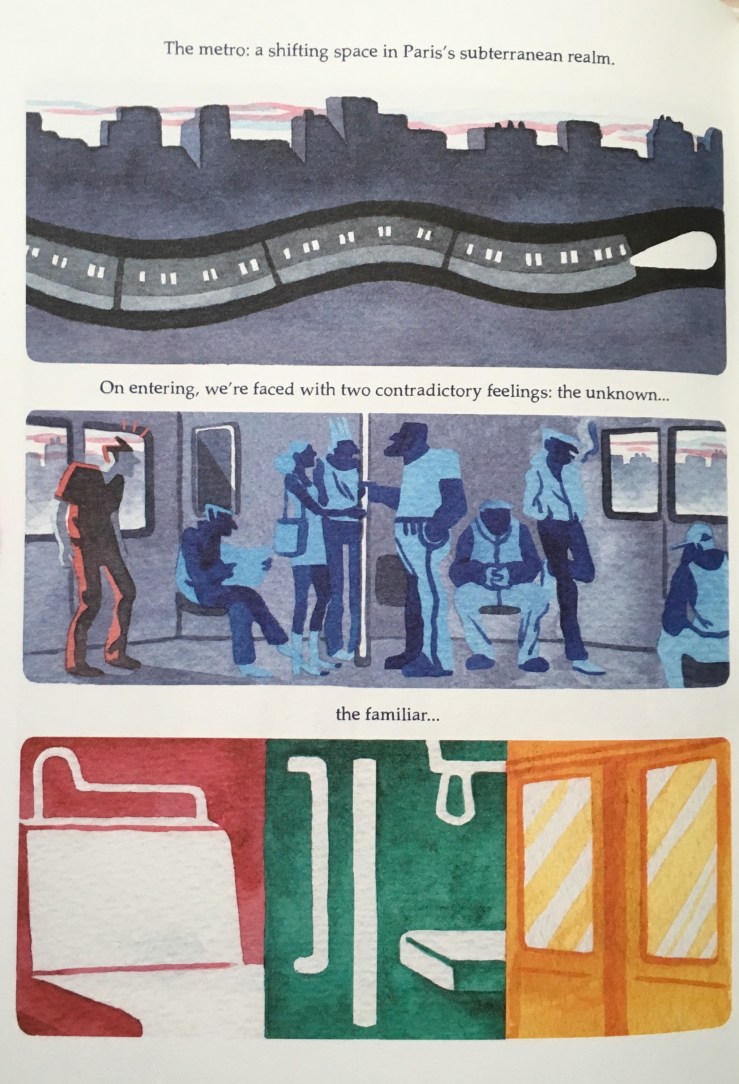
This vision of synthesis carries the narrative through a poetic examination of individuality and society. How much of me is me? Hussenot frames his characters in the geometry of picture puzzles, only to blur the borders that would constrain them.
It’s possible to imagine the spectators of Hussenot’s book gazing on Mahé’s ever-changing Paris building. Or, conversely, we can take Mahé’s building as one of Hussenot’s spectators—another shapeshifter in a city of shapeshifters.
I’ll close with an image from The Spectators that points towards a dream of synthesis, of infinite perspective, of unity. We have here not just a dream, but a vision of progress:

From Lay Morals (1879) by Robert Louis Stevenson
But, I may be told, we teach the ten commandments, where a world of morals lies condensed, the very pith and epitome of all ethics and religion; and a young man with these precepts engraved upon his mind must follow after profit with some conscience and Christianity of method. A man cannot go very far astray who neither dishonours his parents, nor kills, nor commits adultery, nor steals, nor bears false witness; for these things, rightly thought out, cover a vast field of duty.
Alas! what is a precept? It is at best an illustration; it is case law at the best which can be learned by precept. The letter is not only dead, but killing; the spirit which underlies, and cannot be uttered, alone is true and helpful. This is trite to sickness; but familiarity has a cunning disenchantment; in a day or two she can steal all beauty from the mountain tops; and the most startling words begin to fall dead upon the ear after several repetitions. If you see a thing too often, you no longer see it; if you hear a thing too often, you no longer hear it. Our attention requires to be surprised; and to carry a fort by assault, or to gain a thoughtful hearing from the ruck of mankind, are feats of about an equal difficulty and must be tried by not dissimilar means. The whole Bible has thus lost its message for the common run of hearers; it has become mere words of course; and the parson may bawl himself scarlet and beat the pulpit like a thing possessed, but his hearers will continue to nod; they are strangely at peace, they know all he has to say; ring the old bell as you choose, it is still the old bell and it cannot startle their composure. And so with this byword about the letter and the spirit. It is quite true, no doubt; but it has no meaning in the world to any man of us. Alas! it has just this meaning, and neither more nor less: that while the spirit is true, the letter is eternally false.
The shadow of a great oak lies abroad upon the ground at noon, perfect, clear, and stable like the earth. But let a man set himself to mark out the boundary with cords and pegs, and were he never so nimble and never so exact, what with the multiplicity of the leaves and the progression of the shadow as it flees before the travelling sun, long ere he has made the circuit the whole figure will have changed. Life may be compared, not to a single tree, but to a great and complicated forest; circumstance is more swiftly changing than a shadow, language much more inexact than the tools of a surveyor; from day to day the trees fall and are renewed; the very essences are fleeting as we look; and the whole world of leaves is swinging tempest-tossed among the winds of time. Look now for your shadows. O man of formulæ, is this a place for you? Have you fitted the spirit to a single case? Alas, in the cycle of the ages when shall such another be proposed for the judgment of man? Now when the sun shines and the winds blow, the wood is filled with an innumerable multitude of shadows, tumultuously tossed and changing; and at every gust the whole carpet leaps and becomes new. Can you or your heart say more?
Look back now, for a moment, on your own brief experience of life; and although you lived it feelingly in your own person, and had every step of conduct burned in by pains and joys upon your memory, tell me what definite lesson does experience hand on from youth to manhood, or from both to age? The settled tenor which first strikes the eye is but the shadow of a delusion. This is gone; that never truly was; and you yourself are altered beyond recognition. Times and men and circumstances change about your changing character, with a speed of which no earthly hurricane affords an image. What was the best yesterday, is it still the best in this changed theatre of a to-morrow? Will your own Past truly guide you in your own violent and unexpected Future? And if this be questionable, with what humble, with what hopeless eyes, should we not watch other men driving beside us on their unknown careers, seeing with unlike eyes, impelled by different gales, doing and suffering in another sphere of things?
And as the authentic clue to such a labyrinth and change of scene, do you offer me these two score words? these five bald prohibitions? For the moral precepts are no more than five; the first four deal rather with matters of observance than of conduct; the tenth, Thou shalt not covet, stands upon another basis, and shall be spoken of ere long. The Jews, to whom they were first given, in the course of years began to find these precepts insufficient; and made an addition of no less than six hundred and fifty others! They hoped to make a pocket-book of reference on morals, which should stand to life in some such relation, say, as Hoyle stands in to the scientific game of whist. The comparison is just, and condemns the design; for those who play by rule will never be more than tolerable players; and you and I would like to play our game in life to the noblest and the most divine advantage. Yet if the Jews took a petty and huckstering view of conduct, what view do we take ourselves, who callously leave youth to go forth into the enchanted forest, full of spells and dire chimeras, with no guidance more complete than is afforded by these five precepts?
Honour thy father and thy mother. Yes, but does that mean to obey? and if so, how long and how far? Thou shall not kill. Yet the very intention and purport of the prohibition may be best fulfilled by killing. Thou shall not commit adultery. But some of the ugliest adulteries are committed in the bed of marriage and under the sanction of religion and law. Thou shalt not bear false witness. How? by speech or by silence also? or even by a smile? Thou shalt not steal. Ah, that indeed! But what is to steal? Continue reading “Robert Louis Stevenson on the Ten Commandments”
It is too easy—the name game—in this case.
Christened “Pound, Ezra Loomis.” If used as a verb, “pound” means to beat. If used as a noun, “pound” signifies a unit of weight, a measure of money, pressure of air, or physical force. From time to time, apropos poetry, Pound wondered which should be sovereign, the verb or the noun, and concluded, if his practice may be entered as evidence, that the verb was most noticed when knocked off the sentence like a phallus from a kouros—“Spiretop alevel the well curb”—and when effects were hammered back into their causes with naillike hyphens—“Seal sport in the spray-whited circles of cliff-wash”—hence into a compaction like a headache … splitting.
As location, a pound sequesters sick animals and strays. “Places of confinement for lawbreakers” is the definition that immediately precedes Pound’s name in The American Heritage Dictionary, after which we encounter the listing for “pound of flesh” and read of “a debt harshly insisted upon.” Certainly a pound is a large bite by any standard, yet it resembles, in being Shylock’s payment, the neschek of the Jews: money for the rent of money; not a gnaw but, in the way it feels coming due, not a nibble either. It is a tax on use, this thinning of the dime, as if money would otherwise be free of entropy; although to put the bite on someone has come to mean to beg for a loan, possibly as a return of favor, where the request is clearly not intended to invite the interest of the loan’s own teeth. So one meaning of “pound” has a relative called “blood money.” It suggests racial forfeiture.
On the other hand, the pound of flesh we subtract from the flank of a steer may increase our girth and relieve many a primordial anxiety. We call it “putting our money to work.” Wear and repair, profit or loss, depends upon your point of view, the angle of the bank and the direction of the bounce. Our poet depended without protest, for much of his life, upon funds supplied by the family of his wife.
The first few paragraphs of William H. Gass’s essay “Ezra Pound.” Collected in Finding a Form.
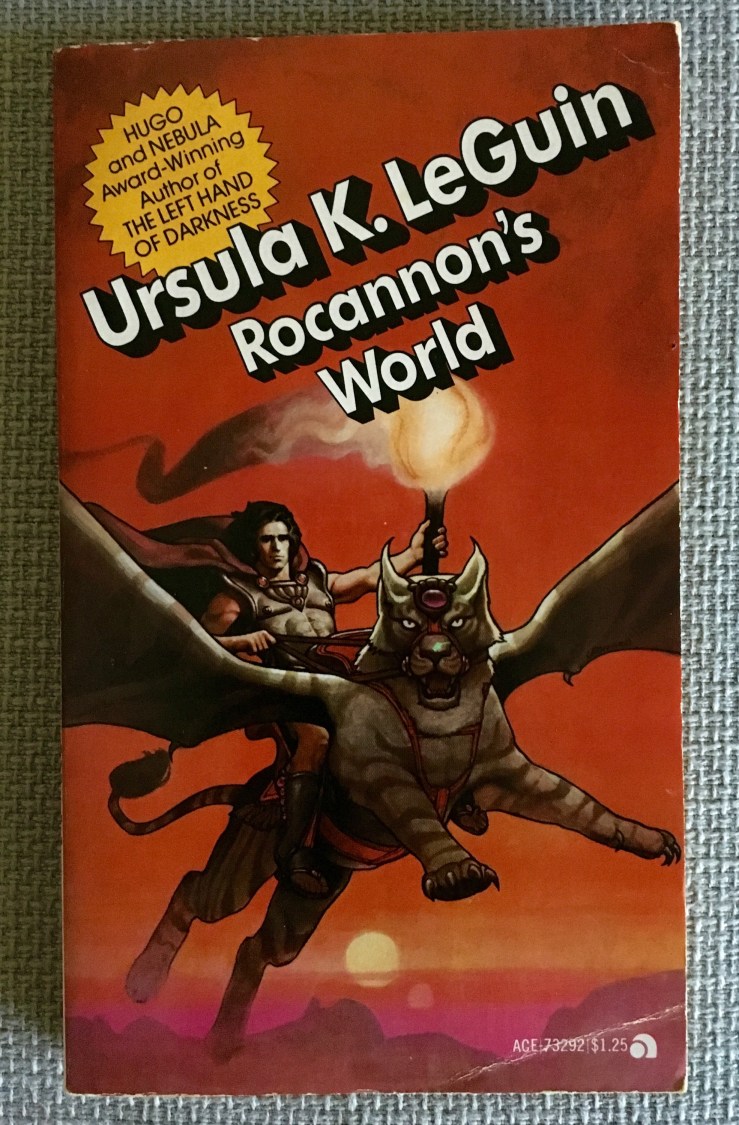
I just picked up Ursula K. Le Guin’s first novel Rocannon’s World on novelist Adam Novy’s recommendation. (Have you read Novy’s novel The Avian Gospels? It’s great).

Terms like space-warp, telekinesis, teleportation give to that latest avatar of the gothic, science fiction (even its name adapted to modern times), the most respectable of cachets. The blasphemous hope of Faustian man: the re-ordering of nature, the canceling out of the effects of original sin, the creation of life become the daily business of the laboratory, if not on today’s agenda, at least on tomorrow’s. Why should magic seem a problem when nothing is more magical than radar or earth satellites or the transistor, and when these are explained monthly in Scientific American? The wildest imaginings of ancient sorcery become the staples of science fiction (defended by reminding cavilers that the atomic bomb itself was only yesterday a mere fantasy of neo-gothic writers): dybbuk and golem, demons who possess and artificial men who remember and make choices, finally contest with their creators the rule of this world; such legendary creatures are called, however, “invaders from outer space” and “android robots,” so that no reader need feel his sense of fact offended by what thrills his nerves.
From Leslie Fiedler’s Love and Death in the American Novel.
“The Loves of the Tortoises”
by
Italo Calvino
There are two tortoises on the patio: a male and a female. Zlack! Zlack! Their shells strike each other. It is their mating season.
The male pushes the female sideways, all around the edge of the paving. The female seems to resist his attack, or at least she opposes it with inert immobility. The male is smaller and more active; he seems younger. He tries repeatedly to mount her, from behind, but the back of her shell is steep and he slides off.
Now he must have succeeded in achieving the right position: he thrusts with rhythmic, cadenced strokes; at every thrust he emits a kind of gasp, almost a cry. The female has her foreclaws flattened against the ground, enabling her to raise her hind part. The male scratches with his foreclaws on her shell, his neck stuck out, his mouth gaping. The problem with these shells is that there’s no way To get a hold; in fact, the claws can find no purchase.
Now she escapes him; he pursues her. Not that she is faster or particularly determined to run away: to restrain her he gives her some little nips on a leg, always the same one. She does not rebel. Every time she stops, the male tries to mount her; but she takes a little step forward and he topples off, slamming his member on the ground. This member is fairly long, hooked in a way that apparently makes it possible for him to reach her even though the thickness of the shells and their awkward positioning separates them. So there is no telling how many of these attacks achieve their purpose or how many fair, or how many are theater, play-acting.
It is summer; the patio is bare, except for one green jasmine in a corner. The courtship consists of making so many turns around the little patch of grass, with pursuits and flights and skirmishing not of the claws but of the shells, which strike in a dull clicking. The female tries to find refuge among the stalks of the jasmine; she believes—or wants to make others believe—that she does this to hide; but actually this is the surest way to remain blocked by the male, held immobile with no avenue of escape. Now he has most likely managed to introduce his member properly; but this time they are both completely still, silent.
The sensations of the pair of mating tortoises are something Mr. Palomar cannot imagine. He observes them with a cold attention, as if they were two machines: two electronic tortoises programmed to mate. What does eros become if there are plates of bone or horny scales in the place of skin? But what we call eros—is it perhaps only a program of our corporeal bodies, more complicated because the memory receives messages from every cell of the skin, from every molecule of our tissues, and multiplies them and combines them with the impulses transmitted by our eyesight and with those aroused by the imagination? The difference lies only in the number of circuits involved: from our receptions billions of wires extend, linked with the computer of feelings, conditionings, the ties between one person and another. . . . Eros is a program that unfolds in the electronic clusters of the mind, but the mind is also skin: skin touched, seen, remembered. And what about the tortoises, enclosed in their insensitive casing? The poverty of their sensorial stimuli perhaps drives them to a concentrated, intense mental life, leads them to a crystalline inner awareness. . . . Perhaps the eros of tortoises obeys absolute spiritual laws, whereas we are prisoners of a machinery whose functioning remains unknown to us, prone to clogging up, stalling, exploding in uncontrolled automatisms. . . .
Do the tortoises understand themselves any better? After about ten minutes of mating, the two shells separate. She ahead, he behind, they resume their circling of the grass. Now the male remains more distanced; every now and then he scratches his claw against her shell, he climbs on her for a little, but without much conviction. They go back under the jasmine. He gives her a nip or two on a leg, always in the same place.

