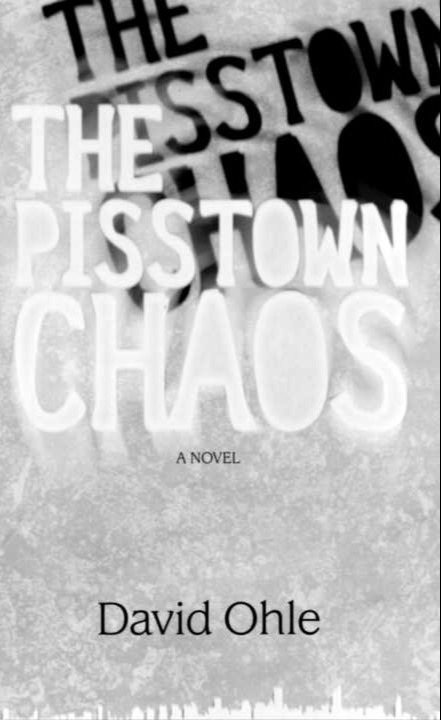
The Pisstown Chaos, David Ohle’s post-convenience novel of abject gags and grotesque japes

Let’s get the obvious out of the way first: The Pisstown Chaos is an improbably perfect and beautiful name for a novel. If you don’t like the title, The Pisstown Chaos isn’t for you. It is a foul, abject, hilarious, zany vaudeville act, a satire of post-apocalyptic literature, an extended riff on American hucksterism. It’s very funny and will make most readers queasy.

The author of The Pisstown Chaos is David Ohle. The novel was published in 2008; it is the second of three “sequels” to Ohle’s 1972 cult classic Motorman. You do not have to have read Motorman or The Age of Sinatra (2004) to “understand” The Pisstown Chaos. (But you’ll probably want to dig into those if you dig The Pisstown Chaos’s uh pungent urinous ammonia bouquet)

Moldenke, hero of Motorman, is a bit player in The Pisstown Chaos, a walk on, a song-and-dance man with no songs or dances. A storyteller. He’s a zombie, too — a “stinker” in the novel’s parlance — adorned in “black rags and a wide-brimmed white hat,” sporting “an inch-long tube of flesh protruding from just below his ear [which] had the general appearance and shape of an infant’s finger, but lacked a nail. In the end of the tube, a small hole leaked a clear, gelatinous fluid.”

Moldenke, we are to infer, is one of the “Victims of the Pisstown parasite…thought of as dead, but not enough to bury. Gray haggard, poorly dressed, they lay in gutters, sat rigidly on public benches, floated along canals and drank from rain-filled gutters.” He may or may not be centuries old.

It’s not clear how far into the future we are in the Ohleverse (it doesn’t really matter). After “the Great Forgetting,” and multiple and ongoing Chaoses, the world has regressed, or progressed, or really mutated, into a dusty, wet, gross, nasty post-infrastructure reality. You might read The Pisstown Chaos as a slapstick zombie Western.

The Reverend Hooker presides over this wonderfully abject world. Hooker’s loose theocratic federation revolves elliptically around a “shifting” scheme. Nothing is permanent, everything is moving, plates spinning on poles. Folks receive their shifting papers and must relocate from, say, a cozy cottage to a prison camp. Or they might end up paired with a new concubine or some such.

That’s the fate of Mildred Balls, née Mildred Vink, who meets Jacob Balls on the road to Witchy Toe. The pair meet cute and get on famously. (And who wouldn’t; after all, suave Jacob Balls was the inventor of  the “finely-grained, yellow-tinged powder” known as “Jake” — a kind of post-apocalyptic Bud Light.) Optimistic Jacob is optimistically optimistic of all the shifting, attesting his belief that “in any culture, when boredom and apathy take hold, the currency is debased and the decline is irreversible…What could be more of a tonic than a random redistribution of the populace?” Mildred is less convinced: “The whole scheme is idiotic.”

The Pisstown Chaos focuses on the Balls clan — primarily an older Mildred and her young adult grandkids, Roe and Ophelia. There are stinkers and imps, shifting folk consuming urpflanz, willy, and Jake on their way via Q-ped to Indian Apple or Bum Bay. Reverend Hooker is always lurking in the margins, too, before taking over the narrative’s final pages in a mock apotheosis that brought a stupid smile to my face.

Ohle’s narrative isn’t exactly a picaresque, but it runs on the same energy. Each chapter opens with a series of frank excerpts from the Pisstown rag, the City Moon. Here’s one update of news you need:

A fondness for pickled lips has led to the arrest of a Kootie Fiyo, a stinker known to be a trader in tooth gold and a vicious biter. Fiyo was just leaving the impeteria in South Pisstown when two Guards entered. The proprietor said, “That stink can eat more imp lips than I can heap in front of him. “

The City Moon is not just a source for the goods on a stinker’s glimpse of pickled imps’ lips, but also a gloss on the undead (or un-undead’s) physiology:

What then is a final-stage stinker’s life like? It has been described by scientists as showing a poverty of sensation and a low body temperature. In their nostrils is the persistent odor of urpmilk. The membrane which lines their mouth is extremely tough and is covered with thick scales. They like to touch fur and drink their own urine. Because they have been known to go without food for as long as eighteen years, we can assume that their sense of time passing is also very different from our own.

The Stinker Problem is likely the signature event of whatever century we are in. There’s probably an icky metaphor or allegory somewhere in there, but I find myself disinterested in that end of the novel. But still: Consider Mildred–who wants to find a “cure” for stinkerism–in charge of a crew of stinkers who, after their daily labors, commit “to walking in circles and searching the ground.” But these are not geologists peering into the navel of the world: “‘No, Miss,’ Spanish Johnny said, ‘We like to get dizzy and faint. It’s the way we have fun.'” We’ve all been there.

Mildred’s granddaughter Ophelia commands much of the narrative, shifting about her stations in life. Her domestic comedy with servants Red and Peters is a class-conscious comic delight. Our Miss Madame goes through a series of abject slapstick routines with the Help (including an enema gag that uh, gag me yeah). Here’s a foul episode in the life of Ophelia Balls:

She walked carefully from slippery stone to slippery stone until she got to the potting shed, then blew out the candle. She tried the door and found it locked. Wiping the dirty door-glass, she looked in at Peters, lying on the peat pile with his pants pulled down, fanning his rear with a handful of straw. Red, sitting beside him in Mildred Balls’s underwear, combed Peters’s coarse hair with a tortoise-shell comb. Peters’s cheeks were flushed, his eyes half-closed. When Ophelia entered, the scene seemed all the more lurid for the dim lantern and its flicker.

“I hope you don’t take any offense,” Red said, “but I’ve just mated with Peters here.”

Peters sat up. “I was quietly potting geraniums when that idiot stepped out of a dark corner and made advances, clumsy, lewd advances, with his big willy sticking out. I tried, but I couldn’t resist him.”

“Is that true, Red, that he put up resistance?”

“He lies like a rug. He clearly indicated he wanted me to sex him good and sex him hard.”

Ophelia saw the pointlessness of going any further with the inquiry. “All is forgiven. Let’s move past this.”

“I’ll serve the swan,” Red said.

If I’ll serve the swan isn’t your kinda punchline, The Pisstown Chaos ain’t your cup of Jake. It’s a rich, smelly, gross novel, fun, funny, fueled with 19th-century inventions viewed through piss-colored glasses, aimed at the apocalyptic future. It’s smoked imp-meat served with urpsmoke, a vaudeville buzz against the zombies in the gutter. When I was a kid we held our breath when we passed cemeteries. There are other ceremonies, other totems, but warding off the dead remains a concern.

I have neglected the Balls scion, young Roe, who eventually finds himself attending the Reverend Hooker. Late in the novel, Roe Balls prepares an enema for the theocrat; Hooker then delivers a sermon:

“I’ll warm up the bathroom right away, sir, and get the enema bag ready.”

Once Roe had firmly inserted the hose, the Reverend sat on the pot and closed his eyes. “There, that’s it, Roe. It’s in well enough.”

“Shall I leave you alone now, sir?”

“No. Don’t leave. Let me sermonize a little. I’ll tell you a story, a story with a lesson. In the days when all men were good, they had miraculous power. Lions, mountains, whales, jellyfish, hagfish, birds, rocks, clouds, seas, moved quietly from place to place, just as men ordered them at their whim and fancy. But the human race at last lost its miraculous powers through the laziness of a single man. He was a woodman in the Fertile Crescent. One morning he went into the forest to cut firewood for his master’s hearth. He sawed and split all day, until he had a considerable stack of hickory and oak. Then he stood before the pile and said, ‘Now, march off home!’ The great bundle of wood at once got up and began to walk, and the woodman tramped on behind it. But he was a very lazy man. Now, why shouldn’t I ride instead of galloping along this dusty road, he said to himself, and jumped up on the bundle of wood as it was walking in front of him and sat down on top of it. As soon as he did, the wood refused to go. The woodman got angry and began to strike it fiercely with his axe, all in vain. Still the wood refused to go. And from that time the human race had lost its power.”

“That certainly explains everything I’ve ever wondered about, sir.”

“You may clean me now.”

“Yes, sir.”

The punchlines accumulate after the Rev. Hooker’s fable — young Roe’s deadpan line “That certainly explains everything I’ve ever wondered about, sir” made me laugh aloud when I read it, and the following asswipe line is too much — but I think we have here in the fable a key to the novel. Not the key, but a key.

In the Rev’s woodman’s fable, humans once wielded Promethean power over the world. But that power’s contingent; it exists only when humans move with the world, attentive to its rhythms and limits. When the woodman attempts to ride the wood and make it a convenience instead of walking alongside it, cooperation collapses. S’all she wrote.

Ohle’s chaotic, grotesque world echoes his some-time collaborator William Burroughs’ alien abjection. It will also be comfortingly/nauseatingly familiar (familiar?!) with anyone who digs David Cronenberg’s corporeal horrors. The Pisstown Chronicles will also appeal to weirdos who dig the abject fictions of Vladmir Sorokin, José Donoso, and Antoine Volodine.

The Pisstown Chaos is not a novel for everyone, but there’s a certain type of reader who will love wading through its abject humor, grotesque imagery, and absurdist chaos. Ohle’s post-convenience world grunts and howls; it’s dark, vivid, gross, and hilarious. That scent will linger. Highly recommended.

We’re in for some dark ages, kid | Notes on Thomas Pynchon’s Shadow Ticket, Ch. 27-29

Notes on Chapters 1-7 | Glows in the dark.

Notes on Chapters 8-14 | Halloween all the time.

Notes on Chapters 15-18 | Ghostly crawl.

Notes on Chapters 19-20 | The needs of cold capitalist reality and those of adjoining ghost worlds come into rude contact.

Notes on Chapters 21-23 | Phantom gearbox.

Notes on Chapters 24-26 | Idiots get respect out here, they’re believed to be in touch with invisible forces.


Chapter 27 focuses on Hop Wingdale. Out on tour with his band (and maybe on the run, sorta, from Daphne) he meets up with his agent Nigel Trevelyan in Geneva. Hop refuses to play “any of these Nazi joints popping up all over,” but sympathetic Nigel has something kosher for the clarinetist: the “Trans-Trianon 2000 Tour of Hungary Unredeemed,” an anarchic, carnvialesque motorcycle race that will culminate in Fiume (aka Rijeka — a bilocated multilingual, multiethnic city-state). Everyone in Shadow Ticket is headed to Fiume — you too, reader.

Halfway through this short chapter, things take a spooky twist: Nigel dispenses with the tour stuff to move to “the real business at hand…Hop’s ‘booking agent’ turns out to be a” secret agent. He’s so secret that he literally physically morphs “through a smooth frame-by-frame personal transition, gaining a couple inches in height, mustache narrowing to little more than a lip gesture, discreetly tinted indoor specs.” It turns out that “the real business at hand” is the worsening “antisemitism situation.” Hop’s on a mission; the tour is a cover for him to scout “possible escape routes from Central Europe should a sudden exodus become necessary.” Nigel suggests that the “key connection will be to Fiume, also known as Rijeka.” He warns Hop that: “We’re in for some dark ages, kid.”

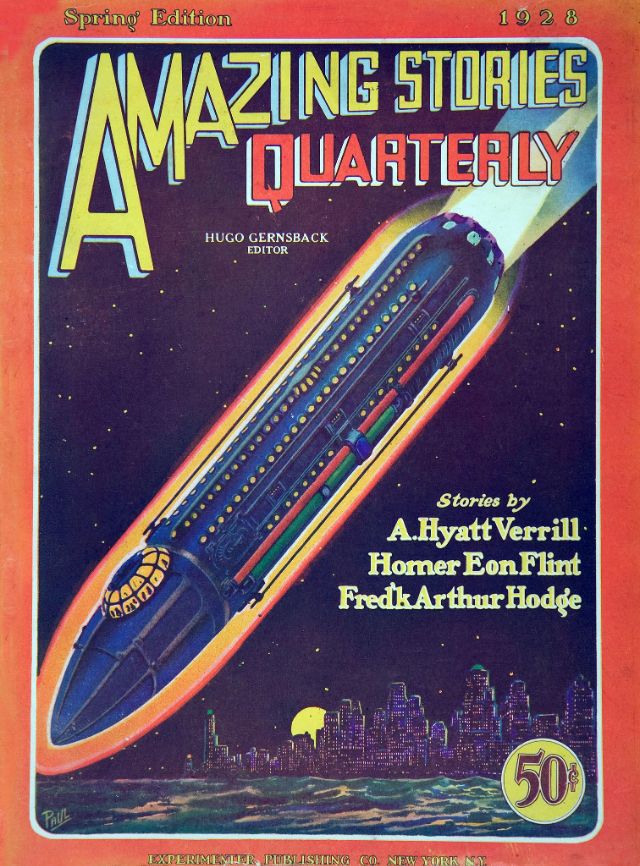
Nigel has arranged luxury transport for his asset: a “road-Pullman all lit up, size of a railway sleeping car, futuristic as something just rolled off the cover of Amazing Stories.” The notation of a “road-Pullman” threw me at first — Pynchon has evoked something like a sci-fi bus, sure, but I had always identified the term “Pullman” with railroad cars — like the one Hicks journeyed eastward out of Illinois (while chatting with a phantom Pullman porter) back in Ch. 17. Perhaps it’s just slang here?

Amazing Stories Quarterly , Spring 1928. Cover by Frank R. Paul.

Chapter 28 begins with homesickness blooming into idealized nostalgia: “Sometimes all Hicks wants is to be back in Milwaukee, restored to normal life, to a country not yet gone Fascist, a place of clarity and safety, still snoozy and safe…” I feel that Hicks!

The chapter then moves through a series of short vignettes that move the plot forward (however obscurely). Terike will be taking off on the Trans-Trianon bike tour; Hicks is worried that Harley-riding Ace Lomax will be there too. Hicks checks in with Egon Praediger, who implicitly offers to pay Hicks to kill Bruno Airhart. Hicks declines, claiming that assassination “draws too much kiddie outlaw attention” — but we get the sense that he’d like to find more meaningful work than just one “high-risk orangutan job after another, always in the service of someone else’s greed or fear.” Hicks also visits journalist Slide Gearheart, who questions whether or not the former strikebreaker might find forgiveness or “redemption via Cheez Princess.” Cynical Slide is dubious, but their exchange recalls psychic Zoltán von Kiss’s riff in Ch. 22 on the redemption of lamps: “even the most hopelessly ill-imagined lamp deserves to belong somewhere, to have been awaited, to enact some return, to stand watch on some table, in some corner, as a place-keeper, a marker, a promise of redemption.”

Chapter 28 then gives over to Daphne, who will finally, “in a turbulence and drift of multiple unlikelihoods” meet up with her estranged father Bruno. She meets him in Night of the World, a multi-floor cabaret whose “circles of depravity…go corkscrewing down…toward ancient depths few have been willing to dare, each with its own bar and dance band and clientele.” The image of the bar and its name recall German philosopher Georg Wilhelm Friedrich Hegel’s notion of “die Nacht der Welt” a reference to human subjectivity as a chaotic, unconscious darkness that lies beneath rational thought. Pynchon has previously referenced Carl Jung in Shadow Ticket, and while I don’t really think of Jung as a follower of Hegel, his concept of “the shadow” seems to resonate with Hegel’s “Nacht der Welt.”

Pynchon’s description of the Night of the World is worth sharing at length: “Each table here has a small circular cathode-ray tube or television screen set flush in the tabletop, throbbing more than flickering with shaggy images of about 100 lines’ resolution…Numbered push-button switches allow you to connect to any other table in the place and watch each other as you chat.” As if to underline the parody here of our twenties’ contemporary screen culture obsession, a strange man — it’s Bruno, spoiler — tells Daphne the screens are, “The future of flirtation…here they call it Gesichtsröhre, or ‘Face-Tube.’ ” 

But the theme here goes beyond the parodic surface. Looking in the screen, “Viewers sometimes do not agree on the nature of the image. Pareidolia is common. You look down into it, like a crystal gazer, and faces loom unbidden.” The language here recalls Hicks gazing into the shoe-fitting fluoroscope back in Ch. 15 and seeing “a face he’s supposed to know but doesn’t, or at least can’t name.” Is this image the shadow — like, the Jungian shadow? The night of the world? Or just Hicks’s paranoid pareidolia cooking up an answer to a corkscrew of images that amount to chaos.

Anyway–the weird stranger is Papa Bruno. Soon there’s another of Pynchon’s original songs and a daddy-daughter dance. Bruno looks much, much younger, and creepily, more virile. How? “These days the Central European backwoods, Bruno explains, are full of ‘scientists,’ elsewhere known as witch doctors, working miracle effects in chemical defiance of time.” All in the service of horny plutocrats, natch.

Daddy and daughter agree on a movie date and go to see Bigger Than Yer Stummick (1931), the latest hit starring child sensation Squeezita Thickly, which is about, well, eating, actually.” The description of Bigger Than Yer Stummick is, for me, a highlight of Shadow Ticket. It’s well-over whatever line of “good taste” some folks might set down (Squeezita Thickly!), over-indulgent, and I love it. Here’s Pynchon the auteur framing a special effects shot:

“A pot of soup, approached from overhead, now smoothly lap-dissolving into a giant swimming pool full of bathing beauties, bordered by palm trees and food pitches, offering an array of snacks from roast turkey drumsticks to deluxe hot dogs smothered in sport peppers and dripping green-blue pickle relish strangely aglow, even though the movie’s supposed to be in black-and-white, and gigantic Italian sandwiches quite a few feet long, and glutton-size ice-cream extravaganzas and oh well that sort of menu…”

I think I’ve pointed out in every single one of these riffs some instance of glow-in-the-dark material, like the “green-blue pickle relish” that manages supernatural radiation here.

The Bigger Than Yer Stummick routine isn’t just goofy fun though. It showcases the zany-sinister paradox that Pynchon is so good at evoking. The film is about eating, and thus, highlights hunger via hunger’s absence. And the film’s audience is hungry: “Back in the States, every showing of this movie, no matter where, has collapsed well before the second reel into civic disorder—screens across the nation presently inscribed with knife scars, fork tracks, spoon indentations as audiences, many of whom haven’t seen a square meal since the start of the Depression.” As the film progresses, it gets darker; first “the music has shifted grimly minor,” and soon folks are shooting at each other, both semi- and fully-automatically, not always in play, plus setting off spherical anarchist-style bombs.” There’s a war on the horizon — “We’re in for some dark ages, kid” — a war that will cannibalize the world. Consider Egon Praediger’s cocaine-inspired reverie back in Ch. 21. He predicts the coming war; although it will entail “a violent collapse of civil order” it will also point to a “horizon with enough edible prey to solve the Meat Question forever…”

One last note on Bigger Than Yer Stummick — the title is a take on the idiom “your eyes are bigger than your stomach,” meaning that you’ve overestimated your hunger or taken on more than you can handle. The missing word is “eyes” and two of the words are in alternate spellings. Perhaps Pynchon is inviting us to see not just a missing “eye” but a missing “I.” Maybe there’s something here with the shadow self, the missing or submerged self, the moral self that would love to transcend the material plain, the stomach of reality — if you weren’t so fucking hungry all the time.

Post-film credits, things get weird between Daphne and pops. The narrator tells us that, “If Daphne has been hoping for something incestuous yet romantic, she’s once again reminded how very little anybody can put past Bruno.” Uh, okay. Bruno wants to euchre her of her cattle/cheese rights; he needs cash as “Some very bad people are after your old Pop, itchin to take down the Al Capone of Cheese. Forces I once had no idea even existed.” We then switch back to Hicks and Slide, with Slide apparently hep to an apparent incest grift on Daphne’s point: Word around is she’s been working her own counter-scheme, luring Bruno deeper into a sordid and forbidden sex affair while hired photo crews secretly record every last shameful detail—” Hicks is shocked. But, like — incest, power, plutocracy. Daphne skips town, possibly hunting Hop.

Ch. 28 snowballs, adding characters, like Heino Zäpfchen, a much sought-after Judenjäger, or Jew-tracker”; the Vladboys, an anti-semitic gang of hooligans “desperate for Nazi approval” who are engaged in streetfighting; and “Zdeněk, who claims to be an authentic Czechoslovakian golem.” Thomas Pynchon is 88 years old. I have no idea how long he’s had this novel percolating, and I’m so thankful to get to read at least one more, and I think it’s a really good novel, but, yeah, there’s a sketchiness to it — a sense that the old master might not have the energy or time to flesh out all of the big ideas. Or, alternately–Shadow Ticket is leaner and meaner than the epics it points towards (Against the Day and Gravity’s Rainbow).

Okay, so I just mentioned Against the Day and Gravity’s Rainbow — parenthetically, sure. But “Zdeněk, who claims to be an authentic Czechoslovakian golem,” provides a clear link to Mason & Dixon. Golems show up in Mason & Dixon, first appearing in Chapter 49, where the narrator refers to “Kitchen-size” ones, not the giants we expect. Cf. Zdeněk being described as a “sort of snub-nose golem.” Then, in chapter 50, there’s an extended riff on the Rabbi of Prague (I wrote about it here). Back in Shadow Ticket, Zdeněk “explains, ever since Judah Loew was Rabbi of Prague, a body of powerful golem lore has been passed down, rabbi to rabbi.”

The (long) chapter ends with a flurry of references: to Imi Lichtenfeld (Hungarian-born inventor of the Israeli martial art krav maga (“’You could think of it as Jew-jitsu,’ sez Zdeněk”); to “a glamorous, indeed sultry, robotka or female robot named Dushka; and to “some business in Transylvania we needed to take care of.”


Chapter 29 is an ultracompressed precis of Central European history in the 1920s, the point of which is the origin of the Trans-Trianon motorcycle ride (that’s not really the point):

“Sometime in the period 1920–25 the first tentative motorcyclists set out on low-horsepower machinery, army dispatch bikes, city-street models. While the ’20s roared in Chicago and American expats whooped it up in Paree, while Dziga Vertov and Mikhail Kaufman went gliding through the city traffic of Petersburg filming a newly tsarless and not yet Stalinized people” —

— “while Berlin still offered unparalleled freedom and refuge to heretics and asylum seekers of all persuasions, this is what was going on in the strange ring of historical debris that had once belonged to the Kingdom of Hungary—bikers in motion, some riding clockwise, some counter-, not a rally, not a race, not a pilgrimage, no timekeepers, no grand prizes, no order of finish, no finish line for that matter, though some, speaking metaphysically, say if there were one it’d be at Fiume. Rijeka, whichever.”

Bilocation, anarchy, telekinesis.

Watch Man with a Movie Camera (dir. Vertov; dir. of photog. Kaufman).

Idiots get respect out here, they’re believed to be in touch with invisible forces | Notes on Thomas Pynchon’s Shadow Ticket, Ch. 24-26

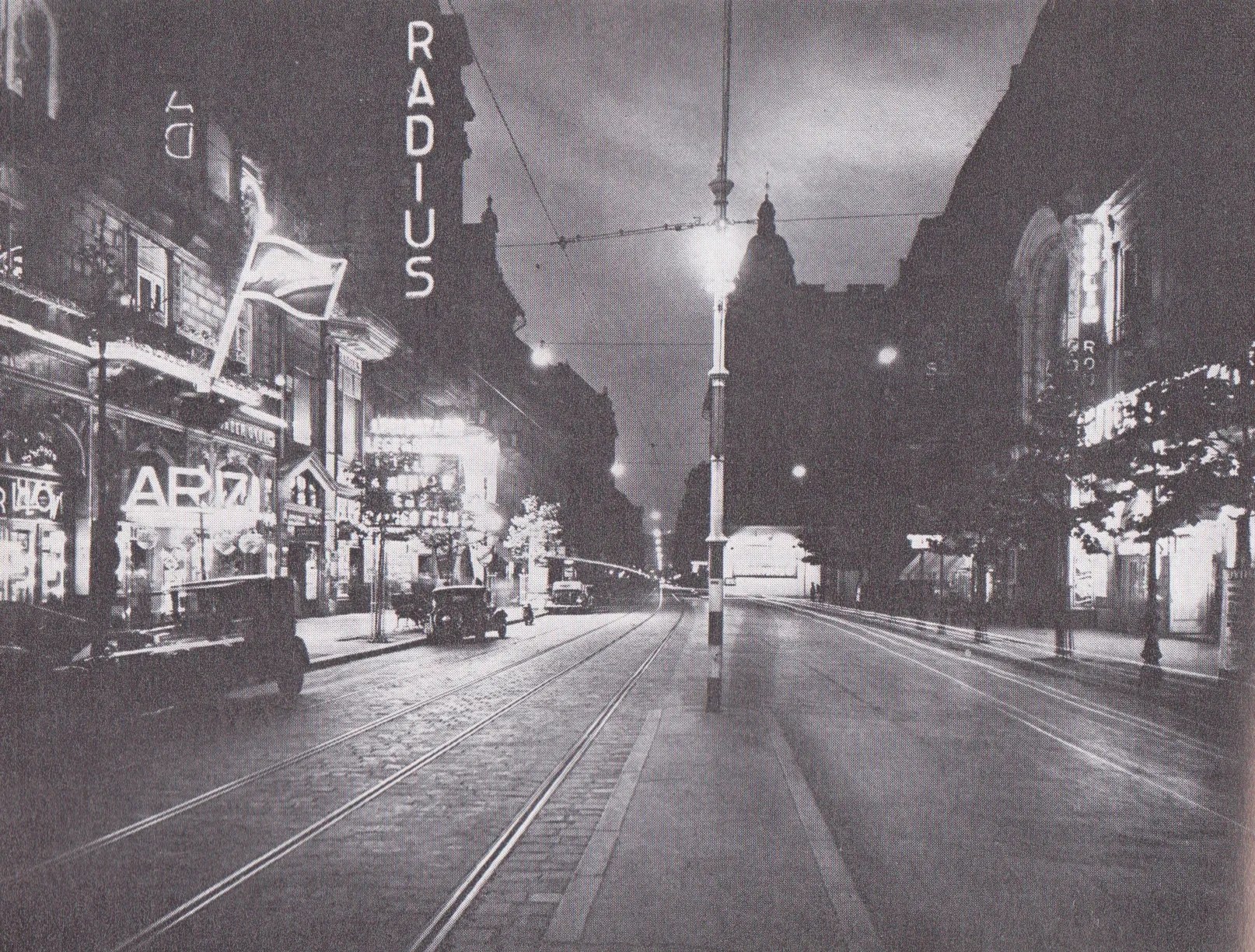
Nagymező Street, the Radius Film Theater (Radius Filmszínház)

Notes on Chapters 1-7 | Glows in the dark.

Notes on Chapters 8-14 | Halloween all the time.

Notes on Chapters 15-18 | Ghostly crawl.

Notes on Chapters 19-20 | The needs of cold capitalist reality and those of adjoining ghost worlds come into rude contact.

Notes on Chapters 21-23 | Phantom gearbox.


Chapter 24: Another fairly long chapter for Shadow Ticket. I’ve been over-summarizing in these notes, and maybe I’ll keep over-summarizing — at this point doing these notes has been my second reading of Shadow Ticket. I would say though, that we’ve reached a point well beyond the novel’s quick change glamour, its bilocative split — or its bait n’ switch, if you feel that way. The novel initially presents as a hardboiled noir send-up in the dark American Heartland only to pivot (or bilocate, to misapporpriate a term from Against the Day) to Central Europe where there’s preparation for a war on (moron). Hero Hicks fades, just a little, in the background; a larger cast steps up.

But Hicks is still the heart of Ch. 24, which begins at Egon Praediger’s office in Budapest, where the ICPC detective is snorting soup spoonfuls of cocaine while ranting about his inability to catch Bruno Airmont. Egon fears he’s wasting his talent “not on an evil genius but on an evil moron, dangerous not for his intellect, what there may be of it, but for the power that his ill-deserved wealth allows him to exert, which his admirers pretend is will, though it never amounts to more than the stubbornness of a child.” Oh man–wonder if that sounds like any evil moron of recent vintage? Egon would rather face off against a worthy villain, a “Dr. Mabuse or Fu Manchu,” references again underlining Shadow Ticket’s lurid pop Goth bona fides.

Hicks then runs into Terike, “just emerging from her latest run-in with the authorities over her motorcycle, a 500 cc Guzzi Sport 15″ — which more on this transport later. On the way to the bike, Hicks finds that he has somehow percolated through Terike, who has performed some kind of metaphysical quick change. He apports, I guess.

1937 Moto Guzzi GTS 500 with matching sidecar

For Terike, the Guzzista “is a metaphysical critter. We know, the way you’d say a cowboy knows, that there’s a fierce living soul here that we have to deal with.” As we should expect now in Ole Central Europe, this bike is spooky, and Terike is a superhero on it: “she can go straight up the sides of walls, pass through walls, ride upside down on the overheads, cross moving water, jump ditches, barricades, urban chasms one rooftop to the next, office-building corridors to native-quarter alleyways quicker than a wink.”

Hicks rides along in the sidecar. (A bit later we’ll see a charming pig, a spirit animal, really, riding sidecar–perhaps there’s a link between Hicks and Pynchon’s other pigmen, like Seaman Bodine or Tyrone Slothrop (or the unfortunate Major Marvy.) Their mission: deliver a batch of experimental vacuum tubes “specially designed for the theremin” to Club Hypotenuse,” a “cheerfully neon-lit” venue featuring a rotating dance floor and “not just one soloist on theremin but a half dozen, each expensively gowned tomato with more or less identical platinum bobs, waving their hands at these units and pulling music out of some deep invisibility, swooping one note to the next, hitting each one with pitch as perfect, Terike assures him, as the instrument’s reigning queen, Clara Rockmore. The joint effect of these six virtuoso cuties all going at once in close harmony is strangely symphonic.”

(Forgive me if I let the quote linger too long, the image is just too lovely.)

At Club Hypotenuse we get a bit of background on Terike, her rejection of her bourgeoisie upbringing, and recent Hungarian political struggles, before meeting yet another character, freelance foreign correspondent Slide Gearheart (he uses the alias “Judge Crater” at the bar. We last heard the name back in Ch. 18, but Crater, icon of the disappearing act, will pop up again). Slide lets Hicks in on a lead he has to cheese heiress Daphne Airmont’s whereabouts; he also gives our P.I. some advice about (not) fitting in to Hungary: “…best stick to English and there’s a chance they’ll take you for an idiot and leave you alone. It might help if you could also pretend now and then to hear voices they don’t. Idiots get respect out here, they’re believed to be in touch with invisible forces.” 

But Slide’s bigger note for Hicks is a soft warning to prepare him for the reality that you can never really go home.


Chapter 25: “Things pick up a day or two later when Slide reports that Daphne has been sighted at the Tropikus nightclub, in Nagymező utca, the Broadway of Budapest.” (This is I suppose the inspiration for the use of the photograph of Nagymező Street used on the cover of the first edition of Shadow Ticket.)

Daphne sings a song and then she and Hicks dance together.

So–I have really neglected Shadow Ticket as a song and dance routine. I think if you’ve read Pynchon you’d expect it; it’s a bit more prevalent here, the singing and dancing, in Shadow Ticket I mean, then in some of the other novels, but it’s certainly what you’d expect. The songs probably deserve their own whole blog or something to deal with (which I will never do); the dancing — well the dancing — I think something I should’ve highlighted much earlier is that Hicks is a really good dancer. Like fucking excellent. He’s a magician who goes into “one of those hoofer’s trances” in the previous chapter while dancing with Terike to the theremin orchestra. That notation — of the trance state — is given for various characters in Shadow Ticket who achieve a kind of short-term perfection outside the physical realm. (It’s the drummer Pancho Caramba (and like, Pynchon, c’mon man, that’s too much, name wise) — it’s the drummer Pancho Caramba in Ch. 25 who goes “into this kind of trance” at his drum kit, enchanting his audience.)

Most of the chapter is the dance and the dance-within-the-dance between Hicks and Daphne. There are Gothic-tinged allusions to their past in Wisconsin–his saving her from the “North Shore Zombie Two-Step” of forced psychiatric hospitalization, incurring a “Chippewa hoodoo” debt as her caretaker in perpetual.

We also start to get Daphne’s backstory with Hop Wingdale, the jazz clarinetist she left home for. She’s followed Hop and his band the Klezmopolitans around Europe, but is worried that the ill-fated lovers “need to relocate before it’s all Storm Trooper chorales and three-note harmony.” Daphne again underlines Shadow Ticket’s departure point — a big ugly change is gonna come. Hop is (rightfully) worried about Papa “Bruno’s invisible hand…” though. Awkwardly enough,” he tells Daphne, “it turns out more of your life than you think is being run on the Q.T. by none other” but her pops.

The phrase “on the Q.T.” — meaning quiet (or “on the quiet tip,” as I thought way back as a teen encountering it) — shows up a few times in Shadow Ticket. It’s phonetically doubled in the word cutie, which shows up more than a few times in Shadow Ticket.


Chapter 26: Another longish section by Shadow Ticket standards, and less breezy than the novel as a whole.

There’s a lot of Daphne-Hicks and Daphne-Hop stuff here — more bilocations, maybe? — in any case, our boy Hicks gets himself more wrapped up than he intended to. After Daphne urges him to help hunt down Hop, who’s kinda sorta left her, he reminds himself of his mantra “No More Matrimonials! Ever!”

By the end of the chapter our American idiot is wondering if “wouldn’t it be a nice turnaround to bring some couple back together again, put the matrimony back in ‘matrimonial’ for a change, instead of divorce lawyers into speedsters and limousines.” Here, I couldn’t help but think of Paul Thomas Anderson’s film revision to Pynchon’s novel Inherent Vice; PTA ties a neater bow on the narrative by letting its lead P.I. Doc Sportello restore the marriage of musician Coy Harlingen.

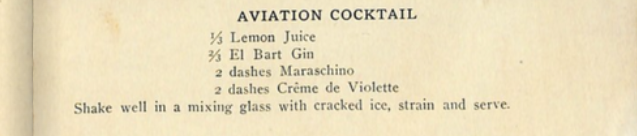
Anyway, we get Daphne and Hop’s origin story: “Talk about meeting cute. You’d think she’d have known better by then. It was in Chicago a few years back, still deep in her teen playgirl phase.” General gunplay shatters Daphne’s double aviation cocktail. She’s smitten with his woodwind serenades.

1917 recipe for aviation cocktail.

This chapter is chocked full of motifs and mottoes we’d expect from Shadow Ticket in particular at this point and Pynchon in general: invisibility, inconvenience, Judge Crater, “Who killed vaudeville?,” etc. It’s also pretty horny, with Hicks and Daphne finally consummating their meet cute from years gone by. Sorry if I’m breezing through.

I’m more interested in a specific exchange.

Carl Jung’s house in Kusnacht, Switzerland: VOCATUS ATQUE NON VOCATUS DEUS ADERIT —  “Called or not called, the god will be there.”

Daphne hips Hicks to something she saw “once, in one of these mental fix-it shops I kept getting sent to, up on the office wall was a motto of Carl Jung—Vocatus atque non vocatus deus aderit. I said what’s this my Latin’s a little rusty, he sez that’s called or not called, the god will come.”

The end of Ch. 23, at least in my guess, seemed to obliquely reference Jung’s Answer to Job, with the narrator suggesting that a trinity can only truly operate as a whole in the form of a stealth quatro — it’s phantom fourth piece balancing out the visible trio in the foreground. The reference to Jung here is not oblique but direct and maybe I will do something more direct with it down the line.

Of course the thing that comes to save Daphne isn’t “the god” but that Big Gorilla Hicks. He notes that, “Your old pals from the rez think it’s spoze to be a critter” who shows up to save the day. In a moment of vulnerability that I take to be sincere, Daphne asks Hicks if he didn’t think that she might actually be insane and should be returned to the hospital and not set free. His reply is a repetition of one of the novel’s several theses: “You were on the run, that was enough.”

Phantom gearbox | Notes on Thomas Pynchon’s Shadow Ticket, Ch. 21-23

Notes on Chapters 1-7 | Glows in the dark.

Notes on Chapters 8-14 | Halloween all the time.

Notes on Chapters 15-18 | Ghostly crawl.

Notes on Chapters 19-20 | The needs of cold capitalist reality and those of adjoining ghost worlds come into rude contact.


Chapter 21:

We move from trans-Atlantic passage to Central Europe pretty quickly. Hicks’s spy handlers Alf and Pip (and like at this point I don’t think he fully realizes Alf and Pip are his handlers on whatever shadow ticket he’s picked up) — Hicks’s spy handlers Alf and Pip leave Hicks on the train while they depart into Belgrade, Kingdom of Serbs, Croats, and Slovenes.

In the Quarrenders’ place emerges Egon Praediger, claiming to be of ICPC — the International Criminal Police Commission (not the Insane Clown Posse Crew), progenitor of Interpol (not the dour 2000s band, but the ICPO). Egon produces “a jarful of cocaine crystals” and grinds up some fat lines — “a routine known around Chicago as ‘hitching up the reindeer,'” the narrator informs us. While ingesting the coke, Egon eventually discloses the shadow ticket Hicks is working: “as you pursue the elusive Miss Airmont, we keep the shadow on you day and night, hoping that Bruno at a moment of diminished attention will make some fateful lunge.” (In another nod to Shadow Ticket’s Gothic motif, the narrator tells us that Egon pronounces the name Bruno Airmont “the way Dracula pronounces the name Van Helsing”).

It turns out that the Al Capone of cheese is the ICPC’s “most sought-after public enemy,” wanted for “criminal activities including murder, tax evasion in a number of countries, [and] Cheese Fraud.” For the terrible crime of counterfeiting cheese, “the International Cheese Syndicate,” or “InChSyn,” want to lock up Bruno. In a cocaine thrall, Egon riffs a bit at the sinister implications behind the scenes: “Cheese Fraud being a metaphor of course, a screen, a front for something more geopolitical, some grand face-off between the cheese-based or colonialist powers, basically northwest Europe, and the vast teeming cheeselessness of Asia.” Egon’s ranting here echoes the academic discussions of cheese back at the Airmont compound in Ch. 13, when discussion turns to breaking into the Asian markets: “How the heck do we create a market for dairy products in Japan short of invading and occupying the country outright? Taking away their tea or sake or whatever it is they drink and forcing them to drink milk like normal human beings?”

(Going back to Ch. 13 to find these lines, I realized that I’d neglected to include a Gothic reference in my riff on that chapter, where cheese is described as “a strange new form of life that was deliberately invented, like Doctor Frankenstein”).

Egon’s coked-up rant culminates in another of Shadow Ticket’s prophetic warnings of the Next Big War to Come. A glistening, entranced Egon declares:

“This is the ball bearing on which everything since 1919 has gone pivoting, this year is when it all begins to come apart. Europe trembles, not only with fear but with desire. Desire for what has almost arrived, deepening over us, a long erotic buildup before the shuddering instant of clarity, a violent collapse of civil order which will spread from a radiant point in or near Vienna, rapidly and without limit in every direction, and so across the continents, trackless forests and unvisited lakes, plaintext suburbs and cryptic native quarters, battlefields historic and potential, prairie drifted over the horizon with enough edible prey to solve the Meat Question forever…”

To repeat a claim I made in my last riff: Shadow Ticket is a bridge novel between two of Pynchon’s masterpieces, Against the Day and Gravity’s Rainbow.

And, to repeat another claim I’ve been making throughout these notes, as Hicks moves eastward, Shadow Ticket’s supernatural elements come closer to the foreground. He’s en route to Budapest, where, according to Egon, there “carouses a psychical Mardi Gras in every shade of the supernatural no matter how lurid.We learn that “Budapest just at the moment is the metropolis and beating heart of asport/apport activities, where objects precious and ordinary, exquisite and kitsch, big and small, have been mysteriously vanishing on the order of dozens per day.” The “asport/apport” motif was first announced back in Ch. 4, via ex-vaudeville psychic Thessalie Wayward. Whereas folks back in Wisconsin were far more skeptical about — or at least reticent to openly speak about — the spooky stuff, Central Europe doesn’t try to deny it.

The chapter ends with Egon giving Hicks a present: a brand new type of pistol called the “Walther PPK.” 


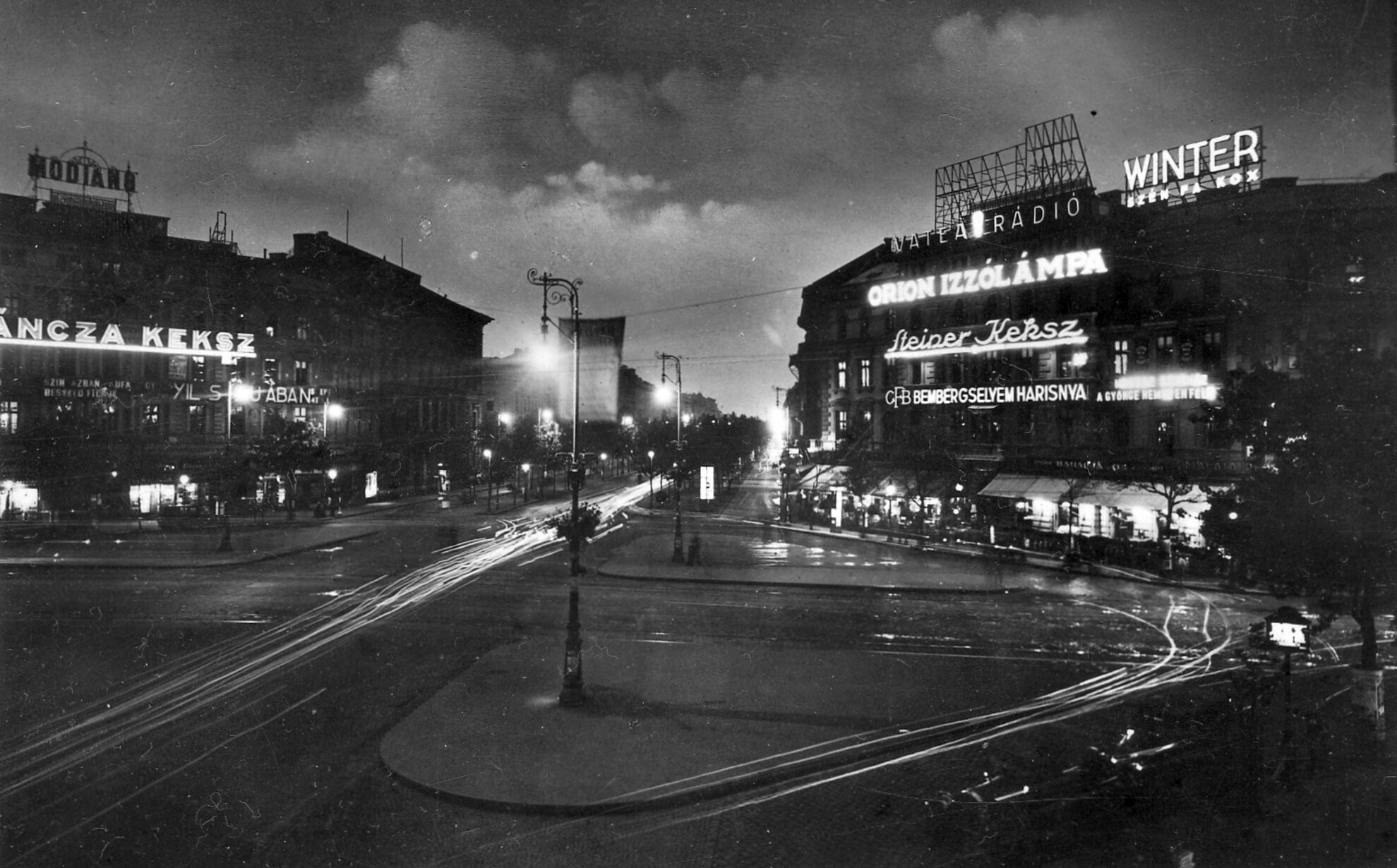
A photograph of the Oktagon, circa 1930

Chapter 22 begins in the Oktogon, a major intersection in Pest. Here, Hicks (and the readers) meet two new characters: Zoltán von Kiss, “once an echt working apportist, lately more of a psychic celebrity detective,” and motorcycle courier Terike who downplays her role as Zoltán’s “Glamorous Assistant.” Hicks is intrigued by Terike, and when she departs with “Szia!” — Hungarian for hello/goodbye, he responds with a “Hope so.” The pun is low hanging fruit but our boy Pynchon loves to eat from that tree.

Zoltán, or “Zoli,” as he prefers to be called has a mission for Hicks. But before getting into that (and a demonstration of his psychic and telekinetic powers), he distinguishes metaphysical Central Europe from concrete America:

“You are a practical people, Americans, everyone is either some kind of inventor or at least a gifted repairman. I myself have grown to rely too much on the passionate mindlessness which creeps over me just as an apport is about to arrive or depart. I am painfully aware of how much more exposure I need to the secular, material world.”

The phrase “passionate mindlessness” recalls Mindless Pleasures — a working title Pynchon used for what would become Gravity’s Rainbow.

mindless-pleasures

But onto that mission: Hicks will assist in the recovery and return of “the crown jewel of tasteless lamps… known in underworld Esperanto as La Lampo Plej Malbongusto.” (Zoli’s ever-inflating description of the lamp’s tastelessness is pure Pynchon.) Again, we get an echo of the Airmont compound back in Ch. 13, where Hicks stumbled into “an excessive number of electric lamps… Some are unusual-looking, to say the least, and few if any in what you’d consider good taste.” 

While the tasteless-lamp bit is, on the surface very goofy, it nevertheless highlights the novel’s concern with what can be seen and what remains unseen; with what casts a shadow, and with what is immaterial. Zolti posits the lamp’s recovery in language that approaches a holy restoration: “even the most hopelessly ill-imagined lamp deserves to belong somewhere, to have been awaited, to enact some return, to stand watch on some table, in some corner, as a place-keeper, a marker, a promise of redemption.” I think the notion here is beautiful answer to a rhetorical question posed in the opening nightmare of Gravity’s Rainbow: “Each has been hearing a voice, one he thought was talking only to him, say,You didn’t really believe you’d be saved. Come, we all know who we are by now. No one was ever going to take the trouble to save you…‘ Pynchon is for the preterite; even the ugliest light-bearer is poised for redemption.

Hicks and Zoli eventually make their way to “a neighborhood of warehouses, corner taverns, cafés and hashish bars, metallic shadows, sounds of mostly invisible train traffic” and into speakeasyish spot “turbulent with kleptos conferring in Esperanto, featuring a lot of words ending in u (‘Volitive mood,’ comments Zoltán, ‘used for yearnings, regrets, if-onlys…’)” (When I was young my mother had a friend who was a member of an Esperanto society. The notion of an invented language fascinated me; I also recognized, even as a child, that it was a doomed project. I love that Pynchon includes a few nods to L. L. Zamenhof’s utopian linguistic project, and highlights the “yearning” behind the invented grammar.) After some funny business by a vaudevillian magic act trio called Drei Im Weggla (secret agents themselves, we’re assured parenthetically) and a nonviolent showdown with “Bruno Airmont’s deputy Ace Lomax,” Hicks fulfills his mission with Zoli.


Chapter 23 sees Hicks reunite with the Quarrenders. Pips has performed a quick change glamour, to Hicks’s admiration. She tells him it’s, All part of the craft, give whoever’s watching something blonde and shiny to fix their attention, then should one need to disappear, simply get rid of it and fade into the mobility.” Like Terike and the other sleight-of-hand artists of Shadow Ticket, Pips understands the value of posing as the “Glamorous Assistant.” Later in this chapter we’ll meet another spy, Vassily Midoff, of whom we’re told “Impressions of what he looks like also vary widely. Not that he’s invisible, exactly, people see him all the time, but they don’t remember that they saw him.”

Alf soon (literally) materializes and complains of an exhausting morning at the “Crossword Suicide Café.” Alf then goes on to detail how “an unemployed waiter named Antal Gyula steps in to what was then known as the Emke Café,” committed suicide, and left a “farewell note in the form of a crossword puzzle he designed himself, whose solution will reveal the reasons he did the deed, along with the names of other people involved.” The puzzle remained unsolved, a “crypto bonanza potentially and yet just as easily somebody’s idea of a practical joke.” The note is zany and sinister, silly and sad, utterly Pynchonian but also, like, totally real.

1937 Böhmerland 603cc Langtouren

The chapter ends with the “nightclub apport trio Schnucki, Dieter, and Heinz, seated one behind another on a Böhmerland Long Touring motorcycle, ten and a half foot wheelbase, red and yellow paint job, riding patrol…” The spectacle upsets Vassily Midoff, who senses a fourth “invisible rider” at the motorcycle’s stern. He hits the high road, “spooked…back into invisibility,” the narrator noting that “for a trinity to be effective, and not just a set which happens to contain three members, there must be a fourth element, silent, withheld. A fourth rider, say, working a phantom gearbox…” 

Perhaps the invisible fourth rider alludes to Carl Jung’s Answer to Job, which argues for a unified, reconciled quaternity, and not a trinity; a symbolic totality that acknowledges the shadow (ticket?) suppressed by the idealized triad. In Jung’s schema, the fourth element completes the cycle by restoring what has been excluded, granting wholeness rather than perfection. The phantom rider becomes an embodiment of that hidden completion, an invisible force that trails behind the spectacle of the three visible figures, suggesting that beneath their exuberant surface rides the unacknowledged presence that makes the whole thing work. (Or perhaps threatens to undo it.)

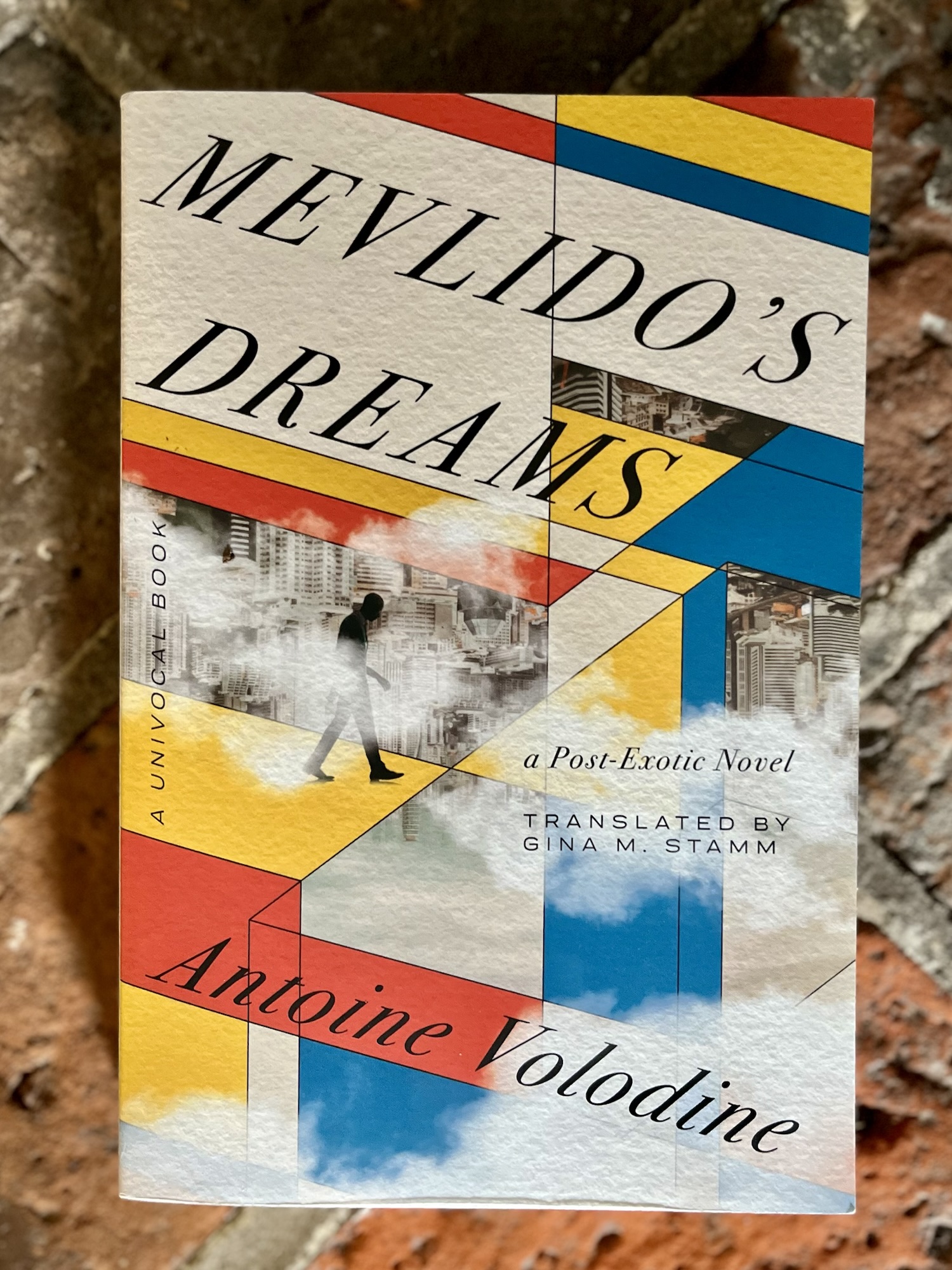
It still believes in night | A review of Antoine Volodine’s post-exotic novel Mevlido’s Dreams

Antoine Volodine’s 2007 novel Mevlido’s Dreams is a bleak, dystopian noir novel set several centuries in the future in the ruined city-state of Oulang-Oulane. Here, weary revolutionary Mevlido lives in a decaying ghetto called Henhouse Four, an eerie quarter inhabited by indigents, junkies, and other remnants of failed uprisings who must contend with the giant mutated birds who terrorize the borough.

Once a soldier of the revolution, Mevlido now serves as a policeman, yet he may also be a double or even triple agent, a sleeper sent through time from a kind of liminal afterlife, a bardo between death and rebirth. The novel drifts between waking and dream states, war memories and spectral futures, as Mevlido’s fragmented consciousness becomes a vessel for Volodine’s haunting post-exotic vision of history, language, and apocalypse.

About halfway through the novel, Mevlido’s bardo boss offers a handy summary of the apocalypse:

They’ve become an inexplicable species. They are just getting out of multiple wars of extermination, but a new conflict is already in sight. The population has decreased by a hundredfold, even more. Entire continents are currently uninhabitable. Those who have survived remain socially organized, but they no longer believe in themselves, or in society. They’ve inherited political systems to which they’ve lost the keys; for them ideology is a prayer devoid of meaning. The ruling classes have become criminalized, the poor obey them. Both classes act as if they were already dead. And as if, on top of that, they don’t even care. … Something in them has changed. You’d think that they no longer have the ability to differentiate between life, dreams, and death.

Our hero will be reborn into this turmoil, his consciousness a roiling mess of anxious irreality. “Even if I’m dreaming, I’m in reality,” he concludes at one point, as if to anchor himself in his mission. What that mission is, exactly, is never fully clear to Mevlido or the reader. Or perhaps the mission is very clear; as translator Gina M. Stamm puts it in her introduction, the plot of Mevlido’s Dreams “has the elements of a fairly classic tragic romance: man and woman are in love, the world prevents their being together, man descends into tragic circumstances.” This motif repeats in dreamlike iterations in the novel; Mevlido drifts through a post-exotic wasteland following orders no one remembers giving, haunted by his dead wife Verena Becker, whose presence threads through his days like a recurring dream or a flickering film reel.

We come to learn that Verena Becker died cruelly, murdered by the “child soldiers” who were pressed in to service by agents of the exploitative upper class. In Mevlido’s present time (or, more specifically one of Mevlido’s present times), the child soldiers are now “ex-child soldiers,” reviled refugees who hide under new identities, hoping to avoid the vengeance of people like Mevlido. The vengeance is not aimed just at these foot soldiers though; one of the novel’s heroes, Sonia Wolguelane, plots the assassination of the upper-echelon genociders who, now absolved of their war crimes, continue to rule the city-state with their one-time political foes. Here is Volodine’s description of one of the men Wolguelane assassinates:

Toni Müller, forty-nine years old, delegate to the Office of Fuel, policy officer during the final project of pacification of the remaining zones, initiator of the so-called controlled genocide practice, threatened with legal action after the disappearance of the Wongres, the Spanish, and the Myrzes, sued for not having been able to provide an explanation for the mysterious annihilation of the inhabitants of the Philippines. Amnestied. Director of the petroleum trusts in the remaining zones, billionaire, numerous books of economics published in his name, numerous honorific titles. During his last self-criticism, he admitted having constantly hidden from the masses the fact that he didn’t share the household chores with his wife.

While the apocalyptic stakes here are swollen to hyperbolic levels, Volodine’s critique of how the ruling class wields power nevertheless applies neatly to our own 21st-century blues. Henry Kissinger, for example, died fat and happy. I’m reminded too here of Thomas Pynchon’s critique of power, particularly in Gravity’s Rainbow, where the narrator laments that the Nazi war criminal Weissmann will not be punished but rather elevated, set to sit “among the successful academics, the Presidential advisers, the token intellectuals who sit on boards of directors. He is almost certainly there. Look high, not low.” Look low for the preterite heroes of Mevlido’s Dreams though. They are the “faded zombies, probably candidates for another hallucinatory expedition, left-behinds who imagine they will be able to leave again.”

I am making the novel sound too grim. It is rich, and much of that richness comes from a bureaucratic, deadpan humor, the laughter of exhausted ideologues trapped in their own paperwork. But what happens to faith in any ideology when it is sundered from observable reality? Consider this exchange, in which a lost Mevlido tries to communicate with a band of men who fail to recognize him as a human being:

“Incredible,” says one of the normal ones, “it’s still talking.”

“And what is it talking about?” asks the red cap.

“About the night,” says the fat one.

“It’s talking about the night?” the bare-chested one asks, surprised.

“Yes, it must still believe in night,” says one of the normal ones.

“Incredible,” says the other normal one, “it still believes in night.”

And beneath the satire, there’s love. Volodine writes love as a metaphysical condition, a persistence that outlasts ideology, memory, and even death. The tenderness between Mevlido and Verena gives the novel its pulse. It’s the one human rhythm left in a mechanical world. Stamm’s translation conveys this rhythm in clipped, moody sentences, wounded and precise.

Like Volodine’s 2014 novel Radiant Terminus, Mevlido’s Dreams operates in the twilight between horror and tenderness. But Mevlido’s Dreams is quieter, more interior—a story of a single man’s dissolution told in flickering vignettes. It reads like the afterimage of a life projected on a cracked wall.

That light, dim and trembling, is what Volodine and Stamm preserve. Mevlido’s Dreams reads not like a film script but like a film itself: shadowy scenes unfolding in silence, broken by bursts of deadpan dialogue and ghostly humor. You can see the ash swirling, hear the echo of curses in an alley haunted by mutant birds.

Oulang-Oulane feels shot through a grim lens, intense, ugly, beautiful, like something from Tarkovsky’s Stalker or a Béla Tarr film, with scenes of desolation punctuated by tenderness. Volodine isn’t cinematic because he borrows film tropes, but because he composes through atmosphere and rhythm. His sentences drift like a camera through fog and memory.

That line above—“it still believes in night”—could be the novel’s credo. Dreaming isn’t retreat; it’s resistance. Writing, too. Mevlido’s Dreams works as both a political fable and a séance for the lost, a way of keeping consciousness flickering in the dark. Highly recommended.


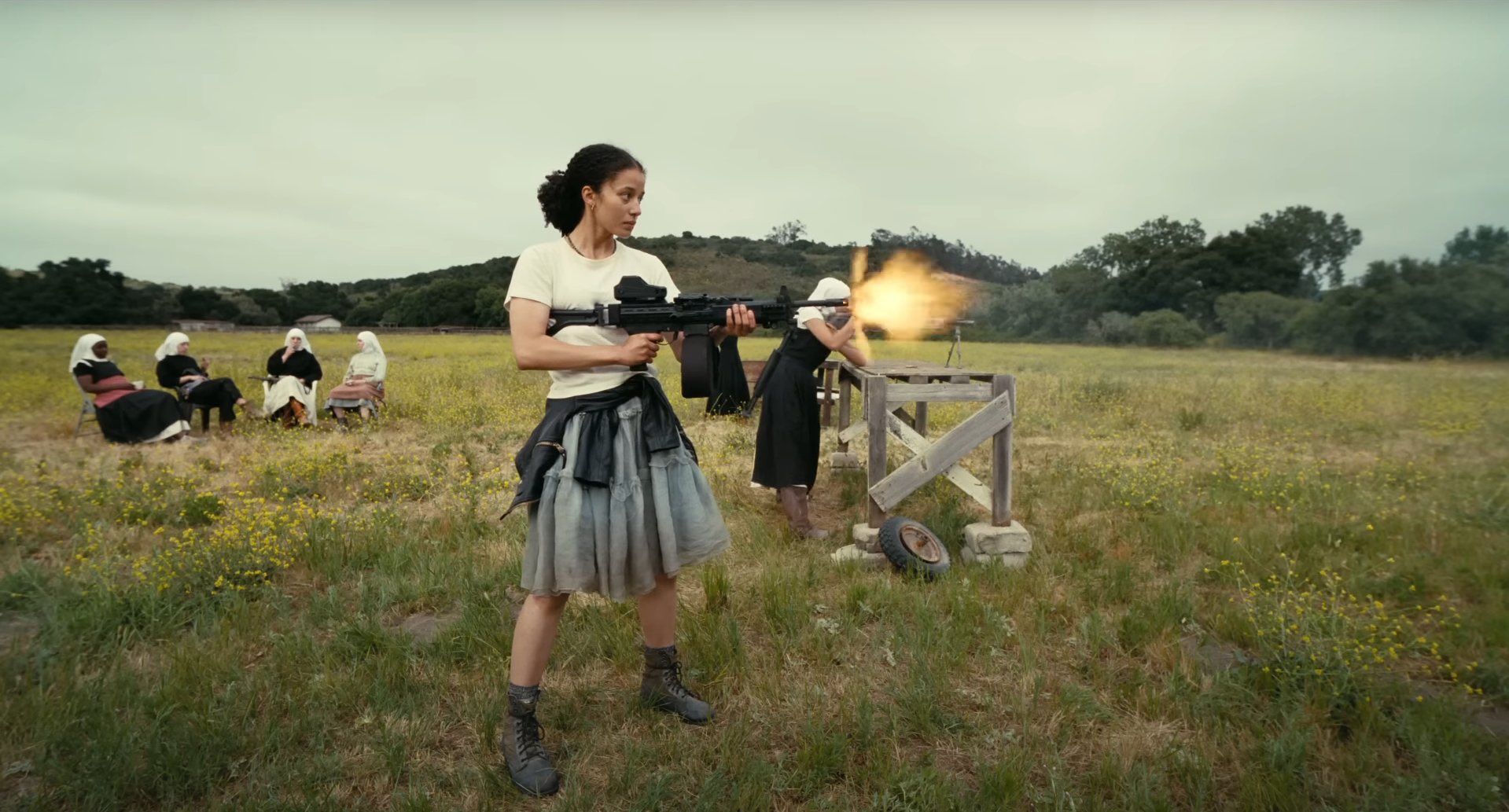
Paul Thomas Anderson’s One Battle After Another is a frenetic, vital reimagining of Thomas Pynchon’s Vineland

Paul Thomas Anderson’s One Battle After Another takes Thomas Pynchon’s 1990 novel Vineland and sets it ablaze, reshaping its abstract paranoia and fractured narrative into something both deliriously immediate and ominously timeless.

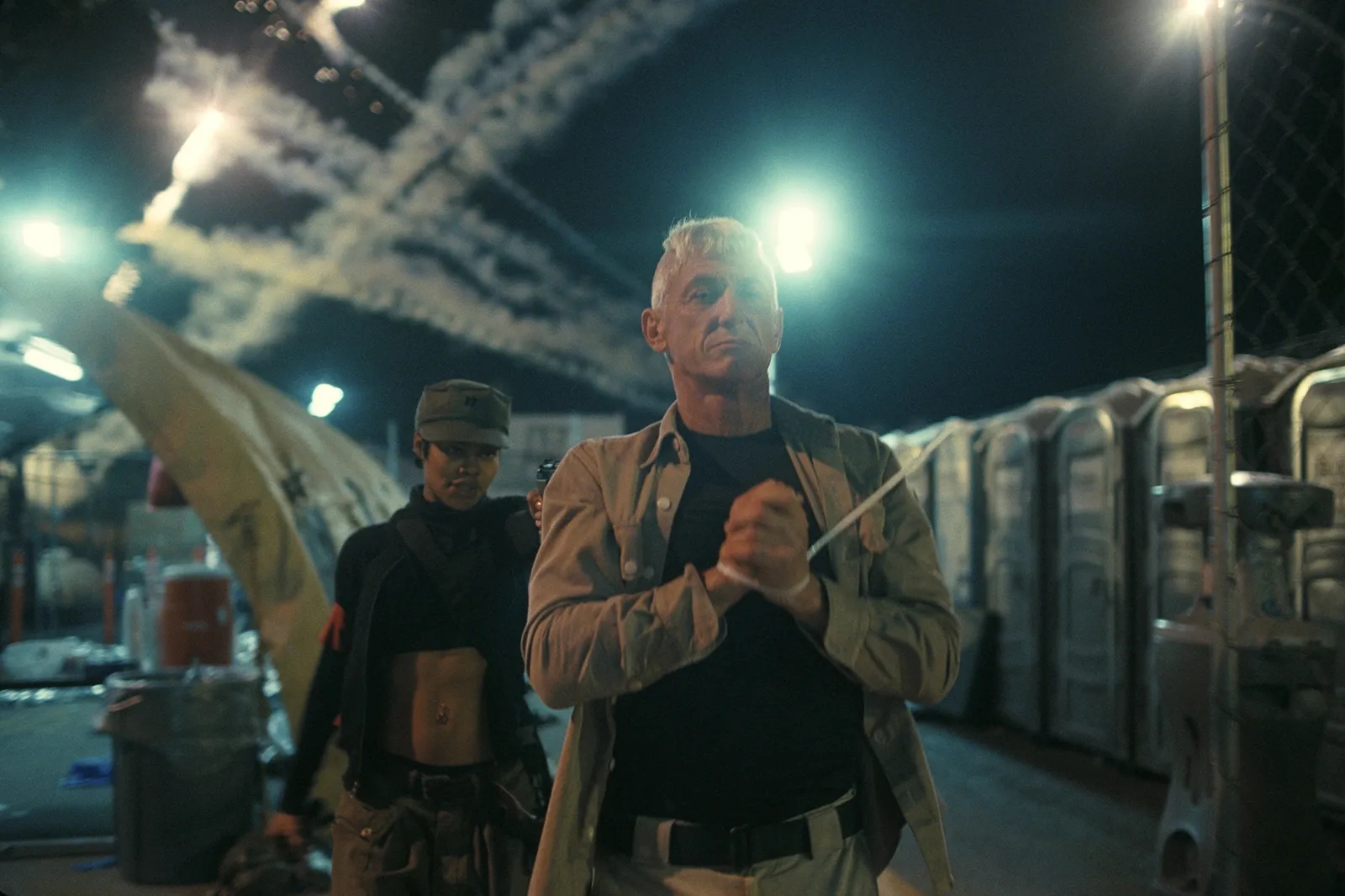
The bones of Pynchon’s original are still present: a family broken by state violence; a daughter growing up without a mother; a father caught between shame and reluctant resistance. In PTA’s feverish recasting of Vineland, Zoyd Wheeler becomes Bob Ferguson (Leonardo DiCaprio), a former “Rocket Man” revolutionary burning out the past in a haze of weed smoke. Frenesi Gates is reimagined as Perfidia Beverly Hills (Teyana Taylor), a revolutionary addicted to the sexual thrill of power. Prairie Wheeler morphs into Willa (Chase Infiniti — and like wow jeez that’s a Pynchonian name the young actress has there, isn’t it?). And villainous Brock Vond is warped into Colonel Lockjaw (Sean Penn), a grotesque embodiment of authoritarian menace. Timelines collapse into themselves, Reagan-era dread transposes into our own disturbed now. Vineland is set in 1984; in One Battle After Another, PTA shows that we’ve never really moved on from that dystopian year. PTA condenses Vineland’s sprawling flashbacks and absurd digressions into an action-forward narrative that’s far more linear yet equally dizzying. The result is enthralling.

The film’s plot might be distilled simply from its title. One Battle After Another follows the trajectory of most of Pynchon’s fiction: individual resistance to authoritarian evil. In PTA’s film, that resistance takes the form of the French 75, a loose clandestine revolutionary group to which Bob and his partner Perfidia once belonged. There’s really no retiring for French 75 agents though, and soon Willa is tangled in the same web her parents sought to sunder in their radical actions. Penn’s maniacal Colonel Lockjaw hunts her down. She’s on the run, and so is papa Bob.

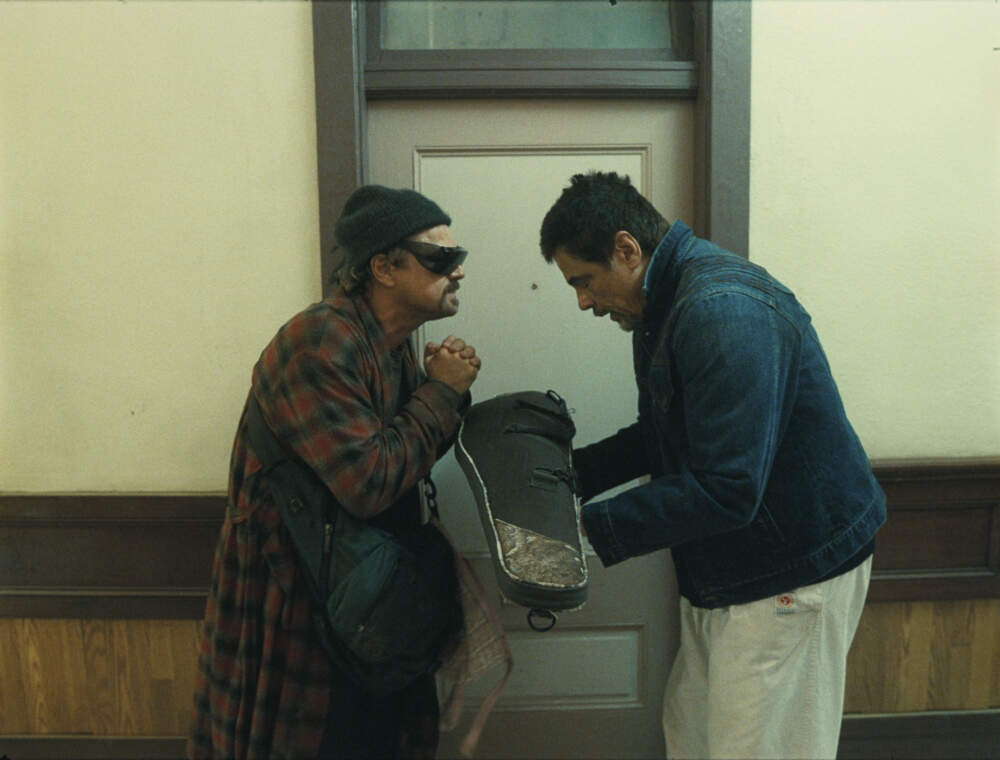
Pynchon’s novels frequently contrast Us vs Them systems — preterite vs. elect; misfits vs. authoritarians; freaks vs. the Man. And like Pynchon’s work, One Battle After Another shows the invisible overlapping and hierarchical confusions these Us/Them systems engender. The French 75’s sympathies directly correlate with the values of the immigrant community in Baktan Cross, the fictional sanctuary city Bob and Willa take refuge in. The de facto leader of these immigrants, Francisco (Benicio Del Toro), aids Bob in his fevered search for Willa. Francisco’s zen calm offers a counterbalance to Bob’s mania. Another Us group are the Sisters of the Brave Beaver (One Battle After another is crammed with Pynchonian vagina jokes), weed-growing nuns who offer Willa a brief safe harbor.

These disparate pockets of rebellion resist the tyranny of the modern racist capitalist system, embodied by Colonel Lockjaw and the military forces he commands (seemingly without any government oversight). We first meet Lockjaw running a migrant detention center — one of many timely PTA updates to Vineland — and his weird, forced, masochistic machismo plays out on the screen with a mix of menace and despair. For all his power and evil though, there’s yet another Them he isn’t part of. That would be the Christmas Adventurers Club, a shadowy cabal of elites on a racist mission to rid the world of “freaks.” Lockjaw would do quite literally anything to become a member of this club; his drive to to become even more Them propels the narrative while showing that Us-Them systems rely on hierarchies to perpetuate oppression.

One Battle After Another zigzags through a whirlwind of absurdity, suffocating paranoia, and frantic action. The film balances chaotic humor with a darker exploration of the emotional impulses that underlie power and attraction. Colonel Lockjaw’s obsessive fixation on Perfidia (arguably the film’s closest connection to Vineland) underscores the irrational power dynamics of obsession and control. PTA frames their relationship—along with Lockjaw’s obsession with Willa—as a twisted mirror reflecting the power imbalances that define both the personal and the political in Us-Them systems. PTA’s films have always explored systems of exploitation that grind people down and the outsiders who try to navigate them; One Battle After Another is, thus far, his most sustained, howling effort in this vein.

The film is gorgeous, too, as fans would expect from PTA. Michael Bauman’s cinematography conveys frenzied energy without sacrificing cohesion or clarity. There are several outstanding set pieces, including a beautiful sequence in which Bob does his best to keep up with a trio of skateboarders traversing rooftops at night, their figures silhouetted against the flames of a riot below. The film’s climactic three-car chase scene is particularly magnificent, its every twist and turn symbolizing not just physical pursuit, but deeper spirals of control, conflict, and paranoia. It made me physical ill. (That’s high praise.)

And while, yes, One Battle After Another is a bona fide action film, it’s still larded with strange little morsels that we’d expect from a PTA film — the image of Lockjaw licking his comb before taking it to his hair, his face contorted in anxious hope, or Bob, in his threadworn bathrobe, shoplifting a pair of cheap sunglasses. (Parenthetically, while the bathrobe is on my mind — Battle plays as a sinister inversion to The Big Lebowski. I will file the pair away for a future double feature.) One of the film’s funniest moments comes from Willa, who, despite being apparently subjugated by Lockjaw, nevertheless delivers the kind of crushing blow that can only come from a teen: “Why is your shirt so tight?” Indeed, Chase Infiniti’s portrayal of Willa is a revelation. In a movie crammed with paranoia and plot twists, she imbues in Willa a kind of moral force. She’s not an anchor exactly, because nothing is steady here. But maybe she’s the string you follow through the labyrinth.

One Battle After Another is almost three hours long, but it never drags, thanks to the tight direction and enthralling plot. Long-time PTA collaborator Jonny Greenwood’s score also keeps the film moving at a quick pace. The score is ever-present — something that usually irritates me in a film — but here the music provides emotional cohesion. It’s also just really fucking pretty.  Frenetic drumming and altered pianos meet up with swelling strings that suggest sirens, banshees. Take “Mean Alley,” for example, which initially greets the ear as if the guitar is out of tune, but then coheres into beautiful dissonance. And although Greenwood’s wall-to-wall score leaves little room for the needle drops we might expect from a PTA joint, the film deploys Tom Petty’s “American Girl” in a moment of transcendent bliss that brought a tear to my eye.

Pynchon has always soundtracked his novels. Pynchonwiki gives close to 400 musical references for Vineland, but I don’t think any of these tracks ended up in One Battle After Another. My giving this data is a weak way of transitioning to the sentence, This is a film inspired by Vineland, not an adaptation of it. And while PTA captures the soul of the book, the vibe, or spirit, or whatever you like to call it, is decidedly different: darker, edgier, uglier. He captures the same strange humor and frustration of Vineland, but it’s amplified here with a chaotic energy that matches our current moment.

It’s also instructive to compare One Battle After Another to PTA’s earlier Pynchon adaptation, Inherent Vice. While Inherent Vice was a hazy sunsoaked journey through the disorienting aftereffects of the muddled sixties, One Battle After Another feels darker, more urgent, as if the timeline of history has compressed itself into an unyielding present. Both films deal with the fracturing of the American dream, but One Battle After Another does so with a sharper edge, drawing clearer political parallels. In some ways, PTA’s Inherent Vice is closer to Pynchon’s Vineland in tone and theme, less angular, more forgiving.

With both of his Pynchon films, PTA foregrounds a sweet final note, a belief in love as a sustaining force against Them. To borrow my favorite lines from Pynchon’s opus Gravity’s Rainbow: “They are in love. Fuck the war.” In his adaptation of Inherent Vice, PTA pulled a loose thread from the novel to neatly weave back into a prettier picture. He allows Doc Sportello to restore the heroin-addicted musician Coy to his family. One Battle offers a similarly fractured, imperfect restoration of family, a rewriting of rat-sins answered on the ghost of radio waves. He cleans up Pynchon’s messiness, but doesn’t sacrifice the deep danger that underwrites radical love.

One Battle After Another feels dangerously prescient, or, more accurately, a diagnosis of the big ugly now. In PTA’s Inherent Vice, there was an underlying fractured partnership between Us and Them; weirdo Doc Sportello tried to find some kind of brotherhood of man with The Man, Detective Bigfoot. No humanity can be extended to Lockjaw — not even from the club that will refuse him. They are unforgiving of any perceived impurity. The themes of mass surveillance, state violence, and detention resonate deeply in today’s climate. The recent death of Assata Shakur—possibly one inspiration for Perfidia Beverly Hills—adds a haunting layer to the film’s exploration of systemic oppression, the ways in which the state seeks to control and erase voices of resistance. The political urgency is palpable, and will undoubtedly alienate a large section of the genpop normies that Warner Brothers has heavily advertised the film to. Some folks will always root for Them.

But fuck Them. One Battle After Another is a triumph, a dizzying, chaotic masterpiece that never loses its grip on the present—one battle after another, all too real, all too important. See it on the biggest screen you can.

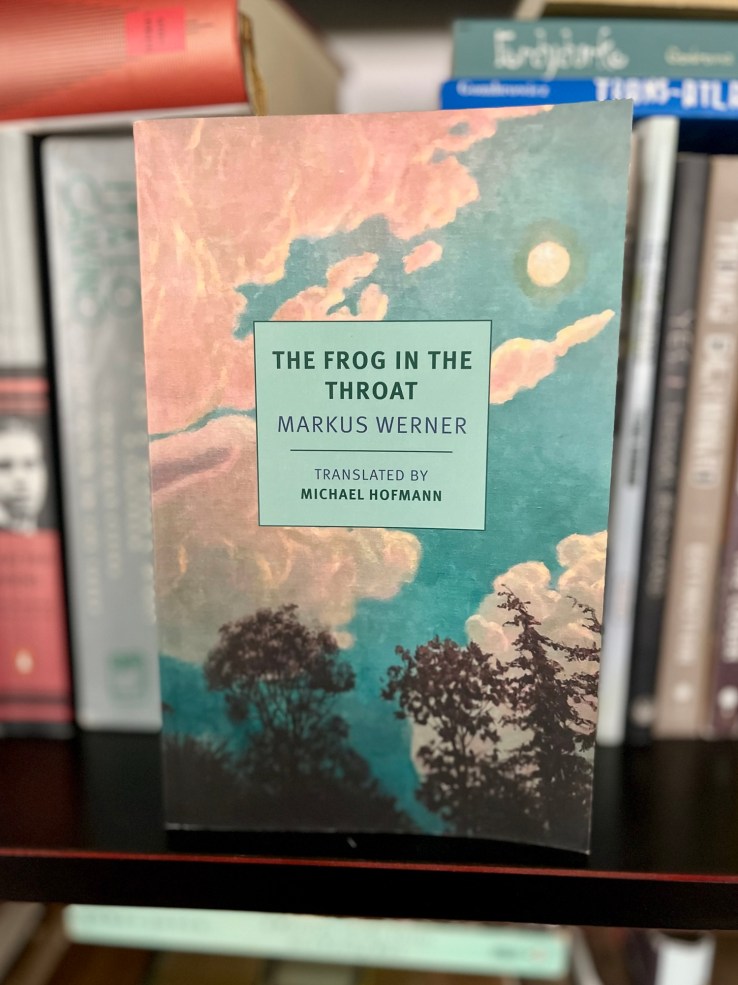
A put-upon frogman with too little oxygen vs. his angry father in Markus Werner’s novel The Frog in the Throat

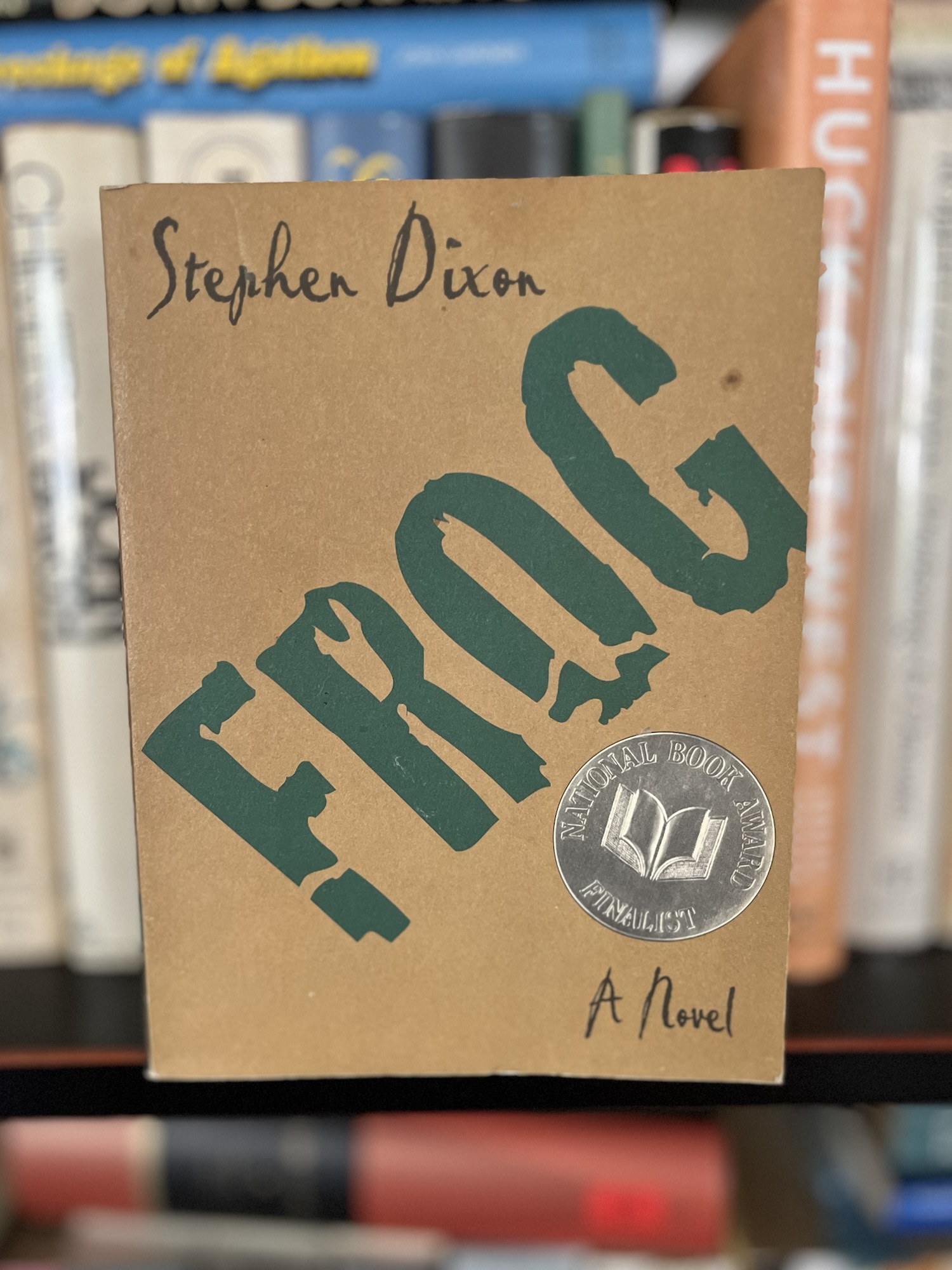
The hero of Markus Werner’s 1985 novel The Frog in the Throat is Franz Thalmann, a disgraced, divorced, defrocked clergyman, who lives ashamed and diminished, yet nevertheless resilient in a philosophical recalculation of his life. There’s a major complication to Franz’s reevaluation though: the memory (or ghost?) of his stern father Klement turns up as a literal (or is it just metaphorical?) frog in his throat. Klement presents as a tragicomic, pestering apparition who ventriloquizes his son—and the novel—with rural grumbles. He milks cows, rants against modernity, and accuses Franz of having betrayed the world he was born into. In Michael Hofmann’s translation, Werner’s prose is crisp, dryly mortified and quietly savage: intimate cruelty turned into a dark, pinprick comedy about guilt, family, and the stubbornness of provincial life.

The voices of son and father drive The Frog in the Throat. These voices collide in bursts that never find harmony. There are ten punchy chapters: Thalmann the Younger takes the odd chapters; Daddy Klement narrates the even ones. Franz’s chapters are philosophical, discursive, and given to a choppy, aphoristic rhythm. (Franz does, however, declare at one point, “Well. I’m not a philosopher, am I. I’m a put-upon frogman with too little oxygen.) Klement’s sections are denser and earthier, but, for all their ravings and rantings, somehow easier to digest. The voices prickle and stick, evoking that ancient tale, a failure to communicate. This is not a duet, not a dialogue.

Franz, helming the novel’s odd chapters, takes the lead. Here’s childhood, adolescence, nascent adulthood, distilled into fragments:

Obedience. Belief. Suffering. Instructions followed. Expectations fulfilled. Said yes and please and thank you and three bags full, sir. Controlled stray impulses. Cleaned teeth, ditto ears. Swilled elderberry syrup. Studied the Good Book. Knew mastery and eventually self-mastery. Did what was dinned into me, and eventually started doing some dinning of my own. Shoveled snow. Madonnified women. Got in shape. Fiddled. Suffered. Was afraid. Could barely stand Father’s glower. Rarely laughed. Prayed. Fed swine. Visited libraries. Mucked out the cowshed. Dogmas, apologias, ethics. Kissed Helen. Struggled for purity. Homiletics, catechesis, liturgy. Forswore eggs. Was afraid. Was good. Marriage. Ministry.

Franz betrays Helen not in a torrid tryst or a meaningful long-term affair with an extramarital soulmate. It’s a one-off, an almost comically ordinary lapse. It’s not a fling; it’s a thing that happens—and yet it detonates his life, initiating an existential crisis in Franz-as-preacher:

Once it’s been understood that our existential crisis is first and foremost a crisis of our senses, then in spite of metaphysical obfuscations we can see the therapy: The extension and promotion of sensuality. An expansion of the realm of the senses. Humanity will only have a future if we are successful in establishing a new Age of Tulips. The individual sets aside his gloom as soon as he feels his body is a house of joy. A precondition for this is moral enfeeblement, because morality has seen its role for thousands of years as an impediment to French kisses. To put it briefly: Traditional morality impedes sensuality.

Franz’s desire for sensuality is undercut by an intellectual airiness, a quippiness of the spirit. Our man is full of aphorisms:

Castrate the fathers, gag the mothers.

and

I say again, gladly: Happiness is remote.

and

Cleared out the attic, threw all the rubbish away. My concern: The head empty of rubbish and without level crossing attendant will produce badness.

and

Humor, though. Almost eludes description. Strangely adorable bastard child of love and wistfulness.

You can throw a small dart in this short book and find a nice line from Franz. (I plucked most of these from very early in the novel, before too much of the (non)plot develops.)

But back to our Franz’s claim that “Traditional morality impedes sensuality” and thus human joy requires “moral enfeeblement” — a problem for a one-time theologian.

In contrast, Franz’s father Klement expresses an earthy sensuality in each of his chapters; he milks his cows and reflects on their udders, their calfing, their literal breeding. His bovine reflections drift into memories of his family, sketching out the often painful history of his children. We also come to see that, like his son, Klement is an outsider. He doesn’t quite fit in at the local pub. The other patrons can’t comprehend his contempt for the modern world.

Some of the finest moments in The Frog in the Throat happen when Franz wanders into a theme that Klement, grumbling from the cowshed, will half-pick up on in the next chapter—less a conversation than a comic game of misheard telephone. These echoes and prefigurations create a thematic tone, however discordant. Take for instance middle-aged Franz, feeling as if he’ll never really mature:

I’ll be fifty soon and I wonder what being grown-up will feel like. Was I grown-up when I turned twenty-two? For a bet, then, I ate a coffee cup. No problem. My stomach was equal to the challenge. Today, I poke at my sauerkraut. An un-grown-up way of behaving, only confirming one’s suspicion that being grown-up, like everything else, is a passing condition.

And a chapter later, Klement confirms Franz’s intuition:

People remain a mystery, you can read a hundred books and you’ll be no closer to understanding them, that’s my view, and when I was younger, I always used to think: When I’m older, I’ll work it out. You see, when you’re young, you see old fellows with white hair, and you think: They may be old and knackered, but they have experience of life, they’re not floundering like us, and maybe they have wisdom. And suddenly you’re old and gray yourself, and you realize that’s all you are, old and gray and just as clueless as you ever were, and so I say: No one’s got the secret. I often think we should view everything from above, we should look down on the world from way up high, and who knows what we would see, what connections, what never-guessed bridges and linkages, or then again maybe not. What a tangled mess, what a confused jumble, I don’t know.

Perhaps the two preceding passages might give a prospective reader the incorrect impression that The Frog in the Throat is a dour novel; it is not. It is often quite funny and quite moving. It’s easy to identify with Franz’s groping questions, and as the book progresses, we come to see under Klement’s anger a wounded pathos. Perhaps the father’s name is not ultimately ironic; perhaps there is a mercy in his haunting his son. Maybe Franz sees the past with new eyes (or, rather ears) through his father’s visitation. But I’m inclined to agree with translator Michael Hofmann in his introduction, when he suggests that “reconciliation is out of the question, but equally there is no possibility of not laughing.”

Synthesis between father and son was never the goal of this novel, let alone a metaphysical coherence. Rather, Werner seems to express his own literary ambitions most directly near the end of the novel, when his antihero Franz declares his admiration for novels that

…are subversive, making clear that their authors, in writing them, did so to avoid doing something far worse…the books that crackle subtly, the semi-house-trained powder kegs of books, the incautious, unconsidered, and if you like erroneous ones…

I’m not sure that The Frog in the Throat is a powder keg, but it does crackle subtly.

I have perhaps overshared Werner’s prose in this review. The truth is I just really loved the way his sentences stack up. And I must again applaud translator Michael Hofmann’s work here; his new  translation of Alfred Döblin’s 1929 novel Berlin Alexanderplatz was one of my favorite reads in recent memory. So I’ll share one last stack of sentences, again from a Franz section. It’s a passage I dogeared, perhaps thinking it exemplary of the novel’s sharp pacing and shifts between pathos and dark humor:

In the morning I’m miserable, at night I’m scared, and during the day I am at pains not to attract attention, putting one foot in front of the other, forming sentences, combing my hair, leaving tips for the waitstaff and buying five tomatoes and answering the telephone in my best and brightest voice, reading this and that in the newspaper, not killing myself, showering regularly. And I give advice to people and listen to them and feel moved by their confidence in me. I sit around, I drink, I brood, I pat myself down for flaws and find many and each evening I say: Starting tomorrow I’m going to get a grip on myself.

—but really it’s that last clause there hanging from the colon that I most connect to. For tomorrow, I too will get a grip on myself.

Highly recommended.


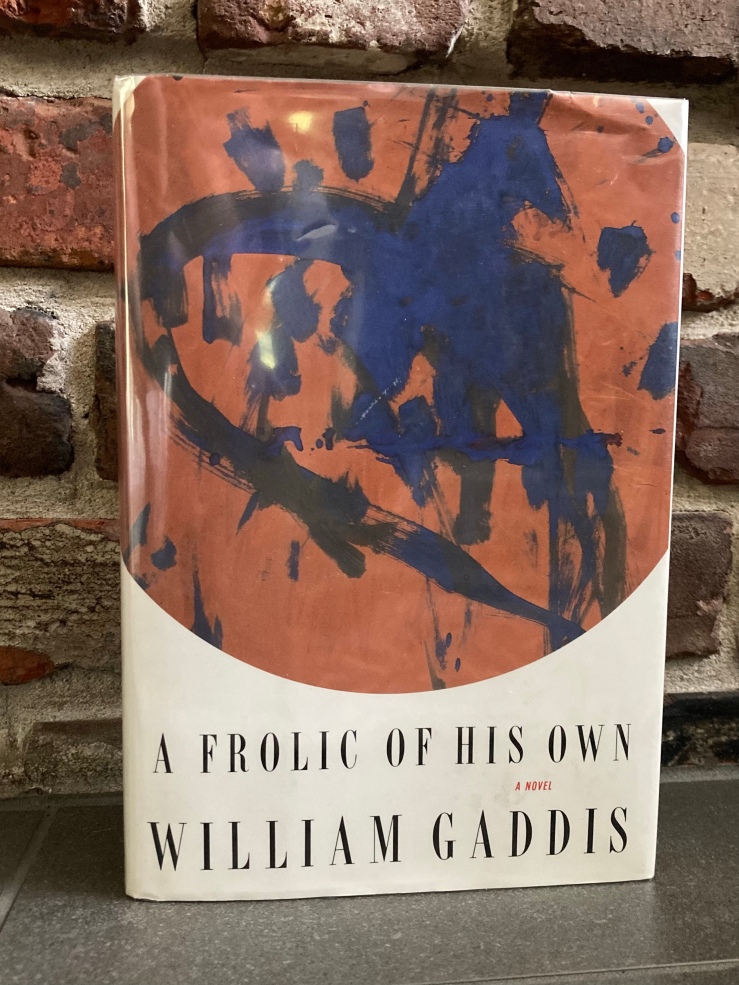
Cannibals all | On William Gaddis’s novel A Frolic of His Own

I want to comment on the themes and style of William Gaddis’s fourth novel, 1994’s A Frolic of His Own, and I’d like to do so without the burden of summarizing its byzantine plot, so I’ll crib from Steven Moore’s contemporary review of the novel that was first published in the Spring 1994 issue of The Review of Contemporary Fiction. Although he initially protests that the “plot is too wonderfully complex to summarize,” Moore nevertheless offers a concise precis. Moore writes that A Frolic of His Own

…concerns an interlocking set of lawsuits involving the Crease family: Oscar, a historian and playwright; Christina, his stepsister and married to a lawyer named Harry Lutz; and their father Judge Thomas Crease, presiding over two cases in Virginia during the course of the novel. The story unfolds by way of Gaddis’s trademark dialogue but also by various legal opinions, brilliantly rendered in the majestic language of the law.

Law, one of the major themes of the novel, is announced in its opening lines: “Justice? —You get justice in the next world, in this world you have the law.” A Frolic of His Own delves into the intersection of justice, law, art, theft, and compensation, all while foregrounding language as the mediating force of not just these nebulous concepts, but the medium, of course, of the novel itself. “What do you think the law is, that’s all it is, language,” the exasperated lawyer Harry declaims to his wife Christina.

Language is always destabilized and destabilizing in A Frolic of His Own. Gaddis lards the novel with mistakes, misinterpretations, and muddles of every mixture. Characters repeatedly fail to communicate clearly with each other, their dialogue twisting into new territories before they’ve mapped out their present concerns. A Frolic reads as linguistic channel surfing, an addled mind constantly turning the dial before a thought can fully land.

The effect of this linguistic channel surfing at times stuns and overwhelms the reader, approximating the noise of modern language that Gaddis’s heroes so often rail against, even as they participate in and create more of this noise. It’s worth sharing a paragraph in full to offer a sense of what Gaddis is doing in A Frolic of His Own. Here, Christina takes a phone call from her husband Harry, while her brother Oscar (who is slowly going mad) watches the evening news:

—Has Harry called? And when it finally rang —We’re fine, did you get to that new doctor? Well whatever you call him, you… I know that Harry but you’ve simply got to make time, if you don’t you’re going to end up like… that’s exactly what I mean, he’s sitting right here waiting for the evening news to whet his appetite for supper, I mean I can’t take care of both of you can I? Scenes of mayhem from Londonderry to Chandigarh, an overweight family rowing down main street in a freak flood in Ohio, a molasses truck overturned on the Jersey Turnpike, gunfire, stabbings, flaming police cars and blazing ambulances celebrating a league basketball championship in Detroit interspersed with a decrepit grinning couple on a bed that warped and heaved at the touch of a button —because they offered him a settlement Harry, almost a quarter million dollars but of course he insists on going ahead with the case or rather Mister Basie does, he was out here for… what? The Stars and Bars unfurled in a hail of rocks and beer cans showering the guttering remnants of a candlelight vigil—but if you can just try to be patient with her Harry, you know her mother just died and she’s been in an awful state trying to… to what? Oscar will you turn that down! that now she wants you to help her break her mother’s will? I don’t see what… well they never really got on after her mother was converted by that wildeyed Bishop Sheed was it? a million years ago convincing her that it was more exclusive with Clare Luce and all that after the wads of money she’d been giving St Bartholomew’s with these millions of Catholics jamming every slum you can think of if you call that exclusive, she…—Look! Christina look! Placards brandishing KEEP GOD IN AMERICA, MURDERER  come quickly! and caught in the emergency vehicles’ floodlights towering over it all the jagged thrust of —that, that Szyrk thing that, look!

The noisy force of mass-mediated language threatens to overwhelm the reader, whom Gaddis challenges to make meaning of his mess. Later, Christina sums up the problem: “I mean you talk about language how everything’s language it seems all that language does is drive us apart.” Naive Oscar, whose multiple lawsuits initiate the plot of A Frolic, tries to clarify the problem of language in his own way too: “—Isn’t that what language is for? to say what you mean? That’s why man invented language, isn’t it? so we can say what we mean?” But the events that Gaddis arranges in his novel suggest that the answer is, Not quite. There’s only one language all Americans understand—money:

—You want to sue them for damages, that’s money isn’t it?

—Because that’s the only damn language they understand! …Steal poetry what do you sue them for, poetry? …Two hundred hours teaching Yeats to the fourth grade?

Oscar’s complaint is the apparent plagiarism of his Civil War play Once at Antietam by a major Hollywood studio that has turned it into a “piece of trash” called The Blood in the Red White and Blue. Gaddis includes large sections of Oscar’s play in A Frolic of His Own, often having various characters (including its author) stop to make critical remarks. Here, Gaddis has actually cannibalized parts of a play he wrote in the late 1950s after he’d finished The Recognitions. He was unable to get Once at Antietam produced or published. In a 1961 letter, he admitted that “Now it reads heavy-handed, obvious, over-explained, oppressive,” adding that there might be some value somewhere in the work “but the vital problem remains, to extract it, to lift out something with a life of its own, give it wings, release it.” A Frolic of His Own may, on one hand, “release” Gaddis’s old play, but it denies it any life of its own. The play is bound within the text proper, incomplete, riddled with elisions, terminally unfinished.

It also comes to light (via a lengthy legal deposition) that Oscar (and perhaps the younger Gaddis?) has plagiarized large sections of his play, notably from Plato’s Republic. Oscar pleads that his plagiarisms are justified—they are art. But in A Frolic of His Own, “it all evaporates into language confronted by language turning language itself into theory till it’s not about what it’s about it’s only about itself turned into a mere plaything.”

Language is, of course, Gaddis’s plaything, and his novel repeatedly underlines its own textuality without the preciousness that sometimes afflicts postmodernist writing. For all his innovations and experimentation with form, Gaddis here and elsewhere is at his core a traditionalist like his hero T.S. Eliot. And like Eliot, he seeks to pick up the detritus of culture and meld it into something new, all while attacking the hollow men who run America. There’s more than just crankiness here: There is howling and bleating and often despair. There’s no justice for our characters, but at the same time, they hardly deserve any. For all their apparent cares and worries, these rich, venal, petty characters are ultimately, to borrow a phrase from another book, careless people, leaving messes for others to clean up (often quite literally). The satire bites; it’s rightfully mean-spirited, caustic, and bitter.

As such, A Frolic of His Own, for all its humor, is often very bleak. It also becomes increasingly claustrophobic. The characters get stuck in their language loops; the only way out seems to be madness or death. Gaddis’s writing had long evoked suffocating domestic spaces, whether it was the paper-stuffed 96th Street apartment shared by Bast, Eigen, and Gibbs in 1975’s J R or the haunted house of 1985’s Carpenter’s GothicA Frolic of His Own takes the madness to another level, setting the stage for the monolingual stasis of his final work, Agapē Agape.

Even if its cramped quarters are often gloomy and crammed with sharp objects, there’s a zaniness to the linguistic channel surfing of A Frolic that propels its fractured narrative forward. “The rest of it’s opera,” repeats Harry throughout, calling attention to the novel’s satirical histrionics. “It’s a farce,” repeats Oscar, pointing to both his own legal cases and his family history. As A Frolic progresses, its farcical twists become more and more bizarre, yet Gaddis always ties his loose ends. The modern world he satirizes is absurd, but it is real.

The realism Gaddis evokes in A Frolic centers around food and shelter. The action is confined primarily to the dilapidated old Crease estate, with its family (in ever-shifting configurations) frequently trying to feed themselves: “We’ve got to get some food in the house” becomes a mantra. Poor privileged half-siblings Oscar and Christina can hardly shop for themselves, let alone cook.

They are very adroit at drinking, however. As the novel careens towards madness, the half-siblings respond by hitting the booze. Consumption runs throughout the novel, presaged in its domestic-but-dooming epigraph, a recollection of something Thoreau said to Emerson while they were walking:

What you seek in vain for, half your life, one day you come full upon, all the family at dinner. You seek it like a dream, and as soon as you find it you become its prey.

Gaddis was fond of repurposing language, and first used the lines in his first novel, 1955’s The Recognitions. The last line of the epigraph, which finds the seeker become prey to his own dream, seems to me now to further highlight A Frolic’s themes of consumption—taboo consumption: cannibalism.

Very early in the novel, the narrator calls attention to Oscar’s copy of George Fitzhugh’s 1857 defense of slavery, Cannibals All! The phrase “cannibals all” is then inverted near the very end of the novel, when a former lawyer, in the hopes of perpetrating an insurance scam, wedges his foot in Oscar’s door: “they’re cannibals Mister Crease, they’re all cannibals,” the former lawyer insists, referring broadly to the insurance industry (he’ll later extend the term to those working in the real estate market in particular and humanity in general).

These direct inversions—cannibals-all/all-cannibals—bookend A Frolic of His Own, neatly encasing the metaphorical cannibalism that runs through the novel. Gaddis depicts a “dog eat dog” world (full of literal dead dogs) ruled by venal consumption. Family members cannibalize family members, law cannibalizes art, texts cannibalize texts. “When the food supply runs out and the only ones around are your own species, why go hungry?” interjects the narrator of a nature documentary that Oscar watches absentmindedly. Harry puts it succinctly:

That’s…what this whole country’s really all about? tens of millions out there with their candy and beer cans and this inexhaustible appetite for being entertained? Anything they can get their hands on…

Gaddis depicts a world where all attempts at culture and art are ultimately cannibalized and excreted by capital. In one of the novel’s goofiest and meanest gags, an entrepreneur seeks to exploit the highly-publicized death of Spot, a dog trapped and then zapped in an ugly postmodernist sculpture. The huckster, capitalizing on the public’s love for Spot, creates “Hiawatha’s Magic Mittens…labeled ‘Genuine Simulated Spotskin® Wear ‘Em With The Furside Outside.'”

“Hiawatha’s Magic Mittens” might seem like a throwaway joke, but the joke is nevertheless part of the novel’s theme of cannibalized culture. Those familiar with the legend of Hiawatha may recall that in many versions, Hiawatha practices ritual cannibalism until he is converted by the Great Peacemaker Deganawida. After his conversion, Hiawatha ceases to eat human flesh and strives for mutual aid and cooperation.

Gaddis also evokes the Hiawatha of Henry Wadsworth Longfellow’s epic poem, itself a cannibalization of sorts of the mytho-historical Hiawatha. Gaddis grafts the oft-cited opening line of “Hiawatha’s Childhood,” “By the shores of Gitche Gumee” a few times early in the novel. The poem seems to loll and roll around in Oscar’s skull; as his alcoholic madness increases, the poem’s trochaic tetrameter infects his thoughts. The result is some of the most beautiful prose in the book (even if the lines are intended as half-parody). Consider the following passage, which begins with Oscar watching the sunset on the wetlands around his crumbling estate, takes flight into the poetic cannibalization of Longfellow’s lines, and winds up in the jumble of Oscar’s fish tank (I strongly suggest reading the passage aloud to hear the trochaic tetrameter):

Neither the red scream of sunset blazing on the icebound pond nor the thunderous purple of its risings on a landscape blown immense through leafless trees off toward the ocean where in flocks the wild goose Wawa, where Kahgahgee king of ravens with his band of black marauders, or where the Kayoshk, the seagulls, rose with clamour from their nests among the marshes and the Mama, the woodpecker seated high among the branches of the melancholy pine tree past the margins of the pond neither rose Ugudwash, the sunfish, nor the yellow perch the Sahwa like a sunbeam in the water banished here, with wind and wave, day and night and time itself from the domain of the discus by the daylight halide lamp, silent pump and power filter, temperature and pH balance and the system of aeration, fed on silverside and flake food, vitamins and krill and beef heart in a patent spinach mixture to restore their pep and lustre spitting black worms from the feeder when a crew of new arrivals (live delivery guaranteed, air freight collect at thirty dollars) brought a Chinese algae eater, khuli loach and male beta, two black mollies and four neons and a pair of black skirt tetra cruising through the new laid fronds of the Madagascar lace plant.

Forgive the long quote. Or don’t. As the novel swerves to its gloomy end, the poem overtakes Oscar’s consciousness, the transcendental beauty of Longfellow’s vision cannibalized by the chainsaws of “land developers,” the real fauna replaced with Disneyfied simulations to send him off to drunken troubled dream. Dreamy Oscar:

…made a bed with boughs of hemlock where the squirrel, Adjidaumo, from his ambush in the oak trees watched with eager eyes the lovers, watched him fucking Laughing Water and the rabbit, the Wabasso sat erect upon his haunches, watched him fucking Minnehaha as the birds sang loud and sweetly where the rumble of the trucks drowned the drumming of the pheasant and the heron, the Shuh-shuh-gah gave a cry of lamentation from her haunts among the fenlands at the howling of the chainsaws and the screams of the wood chipper for that showplace on the corner promising a whole new order of woodland friends for the treeless landscape, where Thumper the Rabbit and Flower the Skunk would introduce the simpering Bambi to his plundered environment and instruct him in matters of safety and convenience by the shining Big-Sea-Water, by the shores of Gitche Gumee where the desolate Nokomis drank her whisky at the fireside, not a word from Laughing Water left abandoned by the windows, from the wide eyed Ella Cinders with the mice her only playmates as he turned his back upon them with his birch canoe exulting, all alone went Hiawatha.

Many contemporary reviewers suggested that A Frolic of His Own was Gaddis’s most accessible novel to date, and it might be. Whereas J R and Carpenter’s Gothic are composed almost entirely in dialogue, Gaddis provides more stage direction and connective tissue in A Frolic. There are also the fragments of other forms: legal briefs, depositions, TV news clips, Oscar’s play…Some of these departures can exhaust a reader. Gaddis’s parodies of legalese are full of jokes, but the tone of the delivery can lead one’s mind’s eye to glaze over. Oscar/Gaddis’s play is problematic too, but in a rewarding if confounding way: Is it supposed to be, like, good? The answer, I think, comes in its cannibalized version—I mean the cannibalized version that Oscar watches over broadcast television. When he finally sees The Blood in the Red White and Blue, Oscar experiences a wild array of emotions, both positive and negative—but his feelings are real.

A Frolic of His Own is not the best starting point for anyone interested in William Gaddis’s fiction, although I don’t think that’s where most people start. It is rewarding though, especially read contextually against his other works, in which it fits chaotically but neatly, underscoring the cranky themes in a divergent style that still feels fresh three decades after its original publication. Highly recommended.

[Ed. note — Biblioklept first ran this review in June 2023. I’ve been falling asleep to William Hootkins’ reading of The Song of Hiawatha every night for the past two weeks.]

Thirteen ways of looking at a portal | A review of Debbie Urbanski’s Portalmania

Debbie Urbanski’s new collection Portalmania is a metatextual tangle of science fiction, fantasy, and horror where portals don’t offer escape so much as expose the fractures beneath family, love, and identity. Her characters navigate asexuality, neurodivergence, and the quiet violence of domestic life against an uneasy backdrop of porous reality. At any moment a portal might appear, or a mutation might take hold, or, a wife might sell her daughter to a witch to assassinate her husband. Nothing is stable in Portalmania.

There are nine stories in Portalmania. Or maybe there are ten stories. Or eleven. Or maybe thirteen. If there are thirteen stories, maybe I could riff on that Wallace Stevens poem for my review titles (that would be too fucking precious and obnoxious though, wouldn’t it).

There are nine or ten or eleven or thirteen discrete “stories” in Portalmania, depending on how you want to count or what you want to count as a discrete story. But this need to count, or, more precisely, to pin down what-something-is-and-is-not, runs counter to the spirit of Portalmania, whose heroes push back on the definitions that are literal placeholders, linguistic lines that bind identities.

Perhaps the biggest through-line of the nineteneleventhirteen stories in Portalmania is the big ole question: What is love? In the story “How to Kiss a Hojacki,” a character puts the problem succinctly, writing a note to her husband: “We need to redefine love.

The opening story, “The Promise of a Portal,” helps to establish a realistic world punctured by magical sci-fi. In “Promise,” we come to understand portals as personal escape hatches away from the humdrum domesticity of family life. “I think you can love people–children, mothers–and still want to leave them,” the hero of the story muses. These same portals pop up throughout the collection, creating continuity so that the nine (or are we saying thirteen? I misremember) stories here read more like a loose, discontinuous novel.

The second story, “How to Kiss a Hojacki,” also introduces a sci-fi conceit that repeats in the collection. In this story women transform into “Wonderfuls” — “Hojackis,” “Smith-Smiths,” or “Tangers” — asexual beings who must fight for their autonomy against a reactionary Trumpian politician who campaigns on interring them in camps.

“Hojacki” hovers around the viewpoint of a husband who is becoming increasingly resentful and sexually frustrated with his changing wife. He is unwilling to even try to redefine love: “having sex is how people love each other,” he contends. “Hojacki” is most fascinating when set in context against the stories at the back end of Portalmania, which deal far more directly with themes of asexuality, sexual coercion, and marital rape. While it would be a stretch to say Urbanski depicts the husband sympathetically, her rendering is nevertheless nuanced enough to be later deconstructed in far more visceral detail in stories like “The Dirty Golden Yellow House,” “Hysteria,” and “Some Personal Arguments in Support of the BetterYou (Based on Early Interactions).”

“The Dirty Golden Yellow House” is the strongest piece in Portalmania. It rewrites “How to Kiss a Hojacki” (and reimagines Charlotte Perkins Gilman’s “The Yellow Wall-Paper”) from the perspective of an asexual writer trapped in a marriage marked by marital rape and emotional coercion. “Yellow House” combines elements of fairy tales and Gothic horror with the more prosaic forms of the essay and the internet forum to yield a harrowing story. “Yellow House” also quickly registers as a metatextual tale, a self-deconstructing narrative that pauses early to take would-be critics to task:

Certain reviewers and readers have already started complaining about my recent stories, both their thematic similarities and their very specific view of relationships. I have examples. From one reviewer: Other than the overt political addition to the obvious social metaphors which helps extend this to novelette length, this [one of my stories] is exactly like the same author’s [another one of my stories] in being an overlong underplotted offputtingly narrated story of a repugnant asexual wife and a repugnant husband and their repugnant relationship. From another reviewer: It [one of my stories] is probablsending a message about something—menopause maybe?… I have no clue what the ending is supposed to mean.From a reader: My takeaway is that the story [one of my stories] was an exercise in catharsis for the author, and has no real value as a morality tale beyond—

My past self slams her (our?) body against the window glass. Has she not been clear enough. Here is what she expects in my writing: revenge, on me, on him, on them, on the structure of the story itself, and if I ever consider not placing her at the bloody heart of whatever I write, she will do this to me. She acts out what she will do to me. There is so much blood.

Angry, self-aware, and emotionally scorching, “Yellow House” nevertheless offers sparks of mean humor. The narrator observes that her “neighbors staked colorful rainbow signs into their front yard: WE BELIEVE LOVE IS LOVE AND KINDNESS IS EVERYTHING.” While the sentiment of the sign might be progressive, the tautology “love is love” is reductive and unhelpful in a book where redefining what love is is the (de)central problem. 

Another highlight of the collection is “LK-32-C,” a triptych of stories about a troubled child’s fantasy world. (We might count “LK-32-C” as three stories, not one; each section has its own title.) The narratives in “LK-32-C” seem to run in concurrent yet divergent directions, where fantasy punctures reality or vice versa. In one such topsy-turvy moment, a distraught mother dreams up a magical totem of familial security: “if anyone questioned whether or not there was some love here, she could have pointed to that sphere.”

And again, in “The Portal,” fantasy punctures reality and metatextuality punctures the narrative. Our narrator interrupts building her fantasy world to tell us that,

I do realize that, as an author, I’m not supposed to let my other worlds become utopias. At least, that was one successful writer’s advice to me when I told him I was working on this story. He explained that when portal worlds are utopias, it’s like a flashing neon sign that says lazy writing. If we want such fantastic places to be believable (and who doesn’t want their writing to be believed?), they have to possess a substantial dark side.

Our author-hero’s rejoinder points out that the dark side is the absence of the utopia: “What if I’m trying to create an untroubled and pleasant world that might haunt someone for as long as they could remember it?” We’re always looking for that perfect portal.

Not everything in Portalmania works. “How to Kiss a Hojacki” has a great premise but its collapse into a political satire is dissatisfying. “Long May My Land Be Bright” is the weakest link in the collection. Its central conceit is that there are literal rifts in the USA, which create two separate antithetical political-cultural realities. It’s not that I’m not sympathetic to the sentiment here, it’s just that I think the metaphor should be pushed even further, to more absurd places.

I’m also not sure how I feel about Urbanski’s decision to include a tenth chapter in her book titled “Story Notes.” By the time I got to the (ostensibly)-last story “The Portal,” I was having a really hard time keeping all the New Criticism, death-of-the-author, grad-school reading training stuff out of my head. With its constant metatextual interruptions and its deeply– personal themes, it became very, very difficult not to read Portalmania as in part a work of autofiction. So the notion of “Story Notes” both intrigued and repelled me. Here is how “Story Notes” begins:

One of the indisputably vital roles of the modern reader is to tease out what is autobiographically true for the fiction writer versus what that writer made up in their stories. What is fiction after all if not a porthole into the author’s private life? So allow me to get this out of the way: Everything you’ve read in Portalmania (or will read, depending on your preferred order) actually happened to me. The portals, the lack of portals, the witches, the monsters, the ghosts, the murders, the space travel of beloved family members—every story in this collection is a factual account of my own experience. And now that you know this, I can spend the remaining space of these notes discussing whatever I want.

And I suppose she does discuss whatever she wants in the notes.

If we are counting “Story Notes” as a story, there are ten stories in Portalmania. If we keep reading after “Story Notes,” there is a final piece, “Coda” an unlisted hidden track of sorts. I love the decision to put this last, brief, and strong piece after “Story Notes.” “Coda” revisits the themes of Portalmania and concludes by pointing to “a terrifying and wide-open future,” which is what I suppose we can all expect as we fumble toward our own redefinition of love, storytelling, and escape. Good stuff.

A review of Gisèle Prassinos’s collection of surreal anti-fables, The Arthritic Grasshopper

img_7667

I can’t remember which particular Surrealist I was googling when I learned about Gisèle Prassinos. I do know that it was just a few weeks ago, and I’ve had an interest in Surrealist art and literature since I was a kid, so I was a bit stunned that I’d never heard of her before now—strange, given the origin of her first publication. In 1934, when she was 14, Prassinos was “discovered” by André Breton, and the Surrealists delighted in what they called her “automatic writing.” (Prassinos would later reject that label, and go as far as to declare that she had never been a surrealist). Her first book, La Sauterelle arthritique (The Arthritic Grasshopper) was published just a year later.

1-work
Prassinos reading her work to the Surrealists; photograph by Man Ray


I somehow found a .pdf of one of her stories, “A Nice Family,” a bizarre little tale that runs on its own surreal mythology. The story struck me as simultaneously grandiose and miniature, dense but also skeletal. It was impossible. Surreal. I wanted more.

Luckily, just this spring Wakefield Press released The Arthritic Grasshopper: Collected Stories, 1934-1944, a new English translation of a 1976 compendium of Prassinos’s tales, Trouver sans checher. The translation is by Henry Vale and Bonnie Ruberg, whose introduction to the volume is a better review and overview than I can muster here. Ruberg offers a miniature biography, and shares details from her letters and visits with Prassinos. She situates Prassinos within the Surrealists’ gender biases: “For a young writer such as Prassinos, being involved with the surrealists would have meant gaining access to resources like publishers, but it also would have meant being fetishized and marginalized.” Ruberg characterizes Prassinos’s tales eloquently and accurately—no simple feat given the material’s utter strangeness:

Taken collectively, their effect is a piercing cackle, a complete disorientation, rather than an ethical lesson. The politics of these stories are absurdist. They upend the world by making children dangerous, by reanimating the dead, by letting the carefully tended domestic deform, foam, and melt. No social structure holds power in the world of these stories—not on the basis of gender, or nationality, or class. The force that reigns is chaos.

Let’s look at that reigning chaos.

In “The Sensitivity of Others,” one of the earliest tales in the volume, we get the sparest narrative action seemingly possible: A speaker walks forward. And yet dream-nightmare touches impinge on all sides and on all senses. The opening line shows a world that is never stable, and if monsters and other dangers lurk just on the margins of our narrator’s shifting path, so do wonders and the promise of strange knowledge. Here’s the tale in full:

img_7666

I still have no idea what to make of the punchline there at the end, but those final images—a father, a faulty library, a power failure—hang heavy against the narrator’s trembling walk.

Many of Prassinos’s anti-fables conclude with such apparent non sequiturs, and yet the final lines can also cast a weird light back over the previous sentences. In “Photogenic Quality,” a dream-tale about the act of writing itself, the final line at first appears as sheer absurdity. A man receives a pencil from a child, whittles it into powder, blots the powder on paper, and throws the paper in the river (more things happen, too). The tale concludes with the man declaring, “Brass is made from copper and tin.” It’s possible to enjoy the absurdity here on its own; however, I think we can also read the last line as a kind of Abracadabra!, magic words that describe an almost alchemical synthesis—a synthesis much like the absurd modes of transformative writing that “Photogenic Quality” outlines.

img_7664

You’ll see above one of Allan Kausch’s illustrations for The Arthritic Grasshopper. Kausch’s collages pointedly recall Max Ernst’s surreal 1934 graphic novel Une semaine de bonté (A Week of Kindness). Kausch’s work walks a weird line between horror and whimsy; images from old children’s books and magazines become chimerical figures, sometimes cute, sometimes horrific, and sometimes both. They’re lovely.

img_7663

Surreal figures shift throughout the book—monks and kings, daughters and mothers, deep sea divers and knights and salesmen and talking horses—all slightly out of place, or, rather, all making new places. Even when Prassinos establishes a traditional space we might think we recognize—often a fairy trope—she warps its contours, shaping it into something else. “A Marriage Proposal,” with its unsuspecting title, opens with “Once upon a time” — but we are soon dwelling in impossibility: “the garter snake appeared in the doorway, arm in arm with the snail, who was slobbering with happiness.” Other stories, like “Tragic Fanaticism,” immediately condense fairy tales into pure images, leaving the reader to suss out connections. Here is that story’s opening line: “A black hole, a little old woman, animals.” At five pages, “Tragic Fanaticism” is one of the collection’s longer stories. It ends with a four line poem, sung by five red cats to the old woman: “Go home and burn / Darling / You’re the only one we’ll love / Trash Bin.”

I still have a number of stories to read in The Arthritic Grasshopper. I’ve enjoyed its tales most when taken as intermezzos between sterner (or compulsory) reading. There’s something refreshing in Prassinos’s illogic. In longer stretches, I find that I tire, get lazy—Prassinos’s imagery shifts quickly—there’s something even picaresque to the stories—and keeping up with its veering rhythms for tale after tale can be taxing. Better not to gobble it all up at once. In this sense, The Arthritic Grasshopper reminds me strongly of another recently-published volume of surreal, imagistic stories that I’ve been slowly consuming this year: The Complete Stories of Leonora CarringtonIn their finest moments, both of these writers can offer new ways of looking at art, at narrative, at the world itself.

I described Prassinos’s tales as “anti-fables” above—a description that I think is accurate enough, as literary descriptions go—but that doesn’t mean there isn’t something that we can learn from them (although, to be very clear, I do not think literature has to offer us anything to learn). What Prassinos’s anti-fables do best is open up strange impossible spaces—there’s a kind of radical, amorphous openness here, one that might be neatly expressed in the original title to this newly-translated volume—Trouver sans checher—To Find without Seeking.

In her preface (titled “To Find without Seeking”) Prassinos begins with the question, “To find what?” Here is a question that many of us have been taught we must direct to all the literature we read—to interrogate it so that it yields moral instruction. Prassinos answers: “The spot where innocence rejoices, trembling as it first meets fear. The spot where innocence unleashes its ferocity and its monsters.” She goes on to describe a “true and complete world” where the “earth and water have no borders and each us can live there if we choose, in just the same way, without changing our names.” Her preface concludes by repeating “To find what?”, and then answering the question in the most perfectly (im)possible way: “In the end, the mind that doesn’t know what it knows: the free astonishing voice that speaks, faceless, in the night.” Prassinos’s anti-fables offer ways of reading a mind that doesn’t know what it knows, of singing along with the free faceless astonishing voice. Highly recommended.

[Ed. note–Biblioklept originally ran this review in August of 2017.]

A review of Taking Care, Joy Williams’ debut short story collection

img_2446

Let’s begin with a paragraph from Joy Williams’ story “Winter Chemistry.” Let’s begin with this paragraph because I think it makes a better argument for reading Joy Williams’ story “Winter Chemistry” than I ever could. Here’s the paragraph:

Judy Cushman and Julep Lee had become friends the summer before when they were on the beach. It was a bitter, shining Maine day and they were alone except for two people drowning just beyond the breaker line. The two girls sat on the beach, eating potato chips, unable to decide if the people were drowning or if they were just having a good time. Even after they disappeared, the girls could not believe they had really done it. They went home and the next day read about it in the newspapers. From that day on, they spent all their time together, even though they never mentioned the incident again.

The paragraph is a perfect little short story on its own, the second part of its second sentence deployed in a simple, casually devastating manner (“they were alone except for two people drowning just beyond the breaker line”). There’s a wonderful ambiguity to the whole passage, an ambiguity most resonant in the second “they” of the fourth sentence—what is the referent of that “they”? The drowned victims? Or the girls who witnessed the drowning, inert, snacking?

Stripes of ambiguity like this one run throughout the sixteen stories in Joy Williams’ 1982 debut collection Taking Care. Williams’ characters—often young girls or young women—cannot quite fit what they immediately perceive into a coherent schema of the phenomenological world.

In the opening story, “The Lover,” for instance, Williams portrays a woman dissociating, told in a present-tense, free indirect style that trips into our hero’s troubled mind:

The girl wants to be in love. Her face is thin with the thinness of a failed lover. It is so difficult! Love is concentration, she feels, but she can remember nothing. She tries to recollect two things a day. In the morning with her coffee, she tries to remember and in the evening, with her first bourbon and water, she tries to remember as well. She has been trying to remember the birth of her child now for several days. Nothing returns to her. Life is so intrusive! Everyone was talking. There was too much conversation! … The girl wished that they would stop talking. She wished that they would turn the radio on instead and be still. The baby inside her was hard and glossy as an ear of corn. She wanted to say something witty or charming so that they would know she was fine and would stop talking. While she was thinking of something perfectly balanced and amusing to say, the baby was born.

There are over a dozen exclamation marks in “The Lover,” deployed in artful disregard for the conventional creative writing advice that eschews using those pointed poles. I don’t think I’ve ever seen a story use exclamation marks so effectively: “There was too much conversation!” Williams evokes her character’s emerging anxiety as it tips close to mania. We never discover a cause for her dissociation and neither does she. We get only the fallout, the effects, sentences piling together without a clear destination other than dissociation. She tries to find some kind of an answer, calling up an AM radio show called Action Line to talk to the Answer Man:

The girl goes to the telephone and dials hurriedly. It is very late. She whispers, not wanting to wake the child. There is static and humming. “I can’t make you out,” the Answer Man shouts. “Are you a phronemophobiac?” The girl says more firmly, “I want to know my hour.” “Your hour came, dear,” he says. “It went when you were sleeping. It came and saw you dreaming and it went back to where it was.”

A later story in Taking Care, “The Excursion,” returns to the themes of dissociation we saw in “The Lover.” In “The Excursion,” a girl named Jenny is unstuck in time. Her consciousness reels between childhood and adulthood; memories of her parents compound with adult experiences with her lover in Mexico. The result is startling, disorienting, and often upsetting. (And again, Williams deploys her exclamation marks like artful verbal pricks).

“The Lover” and “The Excursion” are probably the two most formally-daring stories in Taking Care, but their ambiguous spirit is part and parcel of the collection as a whole. Consider “Shorelines,” a rare first-person perspective story, which begins with the narrator trying to set order where there is none:

I want to explain. There are only the two of us, the child and me. I sleep alone. Jace is gone. My hair is wavy, my posture good. I drink a little. Food bores me. It takes so long to eat. Being honest, I must say I drink. I drink, perhaps, more than moderately, but that is why there is so much milk. I have a terrible thirst. Rum and Coke. Grocery wine. Anything that cools. Gin and juices of all sorts. My breasts are always aching, particularly the left, the earnest one, which the baby refuses to favor. First comforts must be learned, I suppose. It’s a matter of exposure.

“I want to explain,” our unnamed narrator declares, but her mind seems to wander away from this mission almost immediately. Who is Jace, and where has he gone? We never really find out, but we do get puzzling, upsetting clues, like this one:

It has always been Jace only. We were children together. We lived in the same house. It was a big house on the water. Jace remembers it precisely. I remember it not as well. There were eleven people in that house and a dog beneath it, tied night and day to the pilings. Eleven of us and always a baby. It doesn’t seem reasonable now when I think on it, but there were always eleven of us and always a baby. The diapers and the tiny clothes, hanging out to dry, for years!

Is Jace the father of the baby? Is he the narrator’s brother? The tingling ambiguities remain as the story concludes, the narrator still waiting on a return that may or may not happen.

What makes Williams’ ambiguities resonate so strongly is her precise evocation of place. Her stories happen in real physical space, the concrete details of which often contrast strongly with her character’s abstracted consciousnesses. “Shorelines” is one of several Florida stories in the collection, and Williams writes authoritatively about the Sunshine State without devolving into the caricature or grotesquerie that pervades so much writing about Florida. (As a Floridian, nothing annoys me quite so much in fiction as certain writers’ tendencies to exoticize Florida).

“Shepherd” is another of Wiliams’ Florida stories. (And one of her dog stories. And grief stories. And unnamed-girl-hero stories). It is set in the Florida Keys, where Williams lived for some time—her early career was in doing research for the U.S. Navy Marine Laboratory in Siesta Key, Florida. (Williams’ best-selling book is actually a history and tour guide of the Florida Keys). “Shepherd” is a sad story, one of the most basic stories in literature, really: Your dog dies. The story is ultimately about perception. After the dog’s death, the girl’s boyfriend cannot comprehend her grief. He scolds her:

“I think you’re wonderful, but I think a little realism is in order here. You would stand and scream at that dog, darling.” …

“I wasn’t screaming,” she said. The dog had a famous trick. The girl would ask, “Do you love me?” and he would leap up, all fours, into her arms. Everyone had been amazed.

While most readers will sympathize with the girl, her boyfriend’s perspective introduces an unsettling ambiguity. And yet Williams, or at least her character, resolves some of this ambiguity in what I take to be the story’s thesis:

Silence was a thing entrusted to the animals, the girl thought. Many things that human words have harmed are restored again by the silence of animals.

Taking Care is a bipolar book. Florida is one of its poles. Maine, where Williams grew up, is the other. “Winter Chemistry” (originally published in a different version as “A Story about Friends”) is a Maine story. In “Winter Chemistry,” two teenage girls, bored, play at something they don’t have the language for yet. Their game entails spying on their chemistry teacher, whom they both maybe are in love with. The girls may not comprehend what their emerging sexuality entails, but they do feel the physical world. Consider Williams’ evocation of Maine’s winter:

The cold didn’t invent anything like the summer has a habit of doing and it didn’t disclose anything like the spring. It lay powerfully encamped—waiting, altering one’s ambitions, encouraging ends. The cold made for an ache, a restlessness and an irritation, and thinking that fell in odd and unemployable directions.

The story propels the aching duo in “odd and unemployable directions” — and towards an unexpected violence foreshadowed earlier in the summer, as the two munched chips on the beach, watching a pair of swimmers drown.

In “Train,” Williams gives us another pair of girls, Danica and Jane. They are traveling from Maine to Florida, traversing the poles of Williams’ Taking Care. They explore “the entire train, from north to south” and find most of the adults drunk, or at least getting there. Jane’s parents, the Muirheads, clearly, strongly, definitively out of love, are in a fight. The adult world’s authority is always under suspicion in Taking Care. And yet the adults in Williams’ stories see what the children cannot yet see:

“Do you think Jane and I will be friends forever?” Dan asked.

Mr. Muirhead looked surprised. “Definitely not. Jane will not have friends. Jane will have husbands, enemies and lawyers.” He cracked ice noisily with his white teeth. “I’m glad you enjoyed your summer, Dan, and I hope you’re enjoying your childhood. When you grow up, a shadow falls. Everything’s sunny and then this big Goddamn wing or something passes overhead.”

“Oh,” Dan said.

The theme of caretaking evinces most strongly in the titular story. “Taking Care” seems to be set in Maine, although it’s not entirely clear. The story focuses on “Jones, the preacher,” who “has been in love all his life”; indeed, “Jones’s love is much too apparent and it arouses neglect.” Jones takes care of himself only so that he can take care of others. His wife is diagnosed with cancer; his daughter, in the midst of a nervous breakdown, has run away to Mexico, leaving Jones to care for her infant daughter, his only grandchild. The story is devastating in its evocation of love and duty, and ends although its ending is ambiguous, it nevertheless concludes on an achingly-sweet grace note.

Jones’s enduring, patient love is unusual in Taking Care, where friendships splinter, marriages fail, and children realize their parents’ vices and frailties might be their true inheritance. These are stories of domestic doom and incipient madness, alcoholism and lost pets. There’s humor here, but the humor is ice dry, and never applied as even a palliative to the central sadness of Taking Care. Williams’ humor is something closer to cosmic absurdity, a recognition of the ambiguity at the core of being human, of not knowing. It’s the humor of two girls eating chips on a beach, unable to decide if the people they are gazing at are drowning or just having a good time.

I enjoyed many of the stories in “Taking Care” very much, and especially enjoyed the stranger, more formally-adventurous ones, like “The Lover” and “The Excursion.” I look forward to reading more of Joy Williams’ work. Highly recommended.

[Ed. — we first ran this review in March 2019.]

Caren Beilin’s Revenge of the Scapegoat is a funny, ludic novel about trauma and art

A book should be like a lot of spit. But who would publish me? Who publishes a person who’s sort of soaking in pain, who can’t always walk, employed only pretty much in name?

Did writing exist in books anyway these days? I thought perhaps defensively. Maybe it didn’t.

Writing does exist in books these days, despite what Iris, the narrator of a book of writing that exists, a book by Caren Beilin entitled Revenge of the Scapegoat, thinks perhaps defensively.

Iris, who will later transform into Vivitrix Marigold, thinks these defensive thoughts after receiving a package from her estranged father. The package contains two letters her father wrote to her when she was a teenager and a play she began but never finished composing when she was 17. The play had a title though: Billy the Id.

And why does Iris need defensive thoughts to defend her against this offensive package? Well, it turns out she was the designated scapegoat of her family, the atavistic locus for her father’s animus and her terminally-ill mother’s helplessness.

Mom’s dead now and Iris has escaped to Philadelphia, where she’s an underemployed adjunct teaching creative writing to overworked kids. She’s been “re-parented by the crucial cosmos, if poorly,” living in a house her mother left to her “like a moldy letter, black botches all over, and all over the counters.” Her mother had bought the house as an escape plan for Iris and her brother, but she never escaped (“She died of staying”). Iris lives in the moldy old house with her alcoholic husband. He lies about being a recovering alcoholic (“He told me that microdosing heroin was helping him in his recovery”). It’s clear that the marriage is failing.

But this isn’t a marriage story. It’s not her husband’s unremarkable departure, but rather the arrival of the packaged writing, that sparks Iris’s transformation. This transformation occurs over four distinct sections.

The first section is mostly a dialogue between Iris and her friend Ray, who is transitioning between genders. Like Iris, Ray was the designated scapegoat of their family, and the pair bonds and shares their trauma at a coffee shop called Good Karma. There’s a zaniness to Scapegoat that frequently veers into absurd humor and even outright surrealism (as when, for example, Iris punctuates her conversation with this observation: “The sun was going down. Holograms of dead parrots flopped in the road,” which I take to be Beilin’s oblique approximation of the old chestnut, “Somewhere in the distance a dog barked”). But the zaniness in Scapegoat is never precious or cloying; rather, the verbal quirks and eccentric images are anchored in the concrete pain and real trauma that Iris is trying to process.

Inspired by her conversation with Ray, Iris offers them her house in exchange for their boxy old Subaru. Iris drives and drives and drives, out into the New England countryside, repeatedly playing the same cassingle, one “SCAR” by Vivitrix Marigold. The poor Subaru, which “had more than 700,000 miles” on it, eventually gives out, and Iris finds herself stranded “out in the middle of a New England nowhere” — but not a poor nowhere, “No, this was all richie rich.”

It’s in this second section that Iris transforms into Vivitrix, and the narrative becomes even more surreal. It begins with our hero outside of an obscure art museum called The mARTin. There is a heart-stepping cow, of old Nazi stock, stepping on her heart. From there things get even weirder, and it would be a shame to spoil more of the plot. I don’t actually care about plot too much, but a lot of wild stuff: a curator who may or may not have murdered her husband, cowherding, a patricidal pervert, kale marmalade made from bull semen, castration conversation, a queasy dinner party (with a forced table reading of Billy the Id!) and more.

There’s also a very cathartic end, which I wasn’t anticipating. But it was lovely.

Perhaps ultimately the plot of Revenge of the Scapegoat is about transforming trauma into art, but as I write this sentence out, it seems like something Iris would tell her students not to do in their writing. Iris scatters her writing advice into the narrative and then breaks it: “Do not italicize foreign words”; “I told students there could be no rain or scenes on benches”; “Don’t write about food in an inventive way”. And my favorite: “Don’t make adult women reconcile or admit anything in your writing.”

In addition to this metatextual conceit, Beilin also employs the strange rhetorical device of turning Iris’s poor arthritic feet into Bouvard and Pécuchet, characters from Flaubert’s unfinished satire Bouvard et Pécuchet. At one point the pair bicker over which kind of precious metal or gem a witch might prefer. They are the not-quite-chorus of Revenge of the Scapegoat.

Beilen also lards her tale with similes that wonderfully strain credulity. On the first page, Iris compares the vegan leather of shoes to “a liquid you would press from a hot tampon you are pulling now, by the lamplight, out of a toad’s omnibus of Anaïs Nin.” Iris will often then puncture the artifice of the simile with rough reality: “I was shaking in the grass like an Etch-a-Sketch a higher power was trying to erase wholesale. Fuck that. I stopped shaking.” Or consider the surreal swell and bathetic pop in this passage, where Iris (now Vivitrix) compares her first encounter with The mARTin museum to the narrator of Poe’s “The Fall of the House of Usher” seeing the titular house for the first time:

Like that narrator, that man, so too I, Vivitrix, first looked at the reflective water rather than at a real building, weird, so I first saw The mARTin upside down. Its pink door stretched tall on morning’s mandible, as though it were flocked in flamingo leather, a pink surpassing the high heat of “hot,” a flamingo ultravinegar spilled all over something like a primed bookcover of a welcome new monograph on someone like Sade, or Wilde, someone such as Rimbaud or O’Hara, or Keats, men with honorary vaginas who castrated by love and the system, Flaubert, Adorno or Baldwin. It was a very pink door.

I’ve shared a taste of Beilin’s prose at length, and while I think it’s representative of the novel’s style, it can’t replace the feeling of how her sentences flow and build and ebb and swell. Initially, some of the verbal tics in Scapegoat irritated me, but it was the kind of irritation that makes you want to keep reading. And, a few pages after the lovely strange passage I’ve quoted above, our hungry hungry hero declares, “I needed some beef like you wouldn’t beleef.”

I laughed out loud and that initial irritation resolved into something like love. Highly recommended.

Revenge of the Scapegoat is available now from Dorothy.

[ed. — we first ran this review in June 2022.]

Ann Quin’s novel Passages collapses hierarchies of center and margin

Ann Quin’s third novel Passages (1969) ostensibly tells the story of an unnamed woman and unnamed man traveling through an unnamed country in search of the woman’s brother, who may or may not be dead.

The adverb ostensibly is necessary in the previous sentence, because Passages does not actually tell that story—or it rather tells that story only glancingly, obliquely, and incompletely. Nevertheless, that is the apparent “plot” of Passages.

Quin is more interested in fractured/fracturing voices here. Passages pushes against the strictures of the traditional novel, eschewing character and plot development in favor of pure (and polluted) perceptions. There’s something schizophrenic about the voices in Passages. Interior monologues turn polyglossic or implode into elliptical fragments.

Quin repeatedly refuses to let her readers know where they stand. Indeed, we’re never quite sure of even the novel’s setting, which seems to be somewhere in the Mediterranean. It’s full of light and sea and sand and poverty, and the “political situation” is grim. (The woman’s brother’s disappearance may or may not have something to do with the region’s political instability.)

Passage’s content might be too slippery to stick to any traditional frame, but Quin employs a rhetorical conceit that teaches her reader how to read her novel. The book breaks into four unnamed chapters, each around twenty-five pages long. The first and third chapters find us loose in the woman’s stream of consciousness. The second and fourth chapters take the form of the man’s personal journal. These sections contain marginal annotations, which might be meant to represent actual physical annotations, or perhaps mental annotations–the man’s stream of consciousness while he rereads his journal.

Quin’s rhetorical strategy pays off, particularly in the book’s Sadean climax. This (literal) climax occurs at a carnivalesque party in a strange mansion on a small island. We see the events first through the woman’s perception, and then through the man’s. But I’ve gone too long without offering any representative language. Here’s a passage from the woman’s section, just a few paragraphs before the climax. To set the stage a bit, simply know that the woman plays voyeur to a bizarre threesome:

Mirrors faced each other. As the two turned, approached. Slower in movement in the centre, either side of him, turning back in the opposite direction to their first movement. Contours of their shadows indistinct. The first mirror reflected in the second. The second in the first. Images within images. Smaller than the last, one inside the other. She lay on the floor, wrists tied together. She bent back over the chair. He raised the whip, flung into space.

Later, the man’s perception of events at the party both clarify and cloud the woman’s account. As you can see in the excerpt above, the woman frequently refuses to qualify her pronouns in a way that might stabilize identities for her reader. Such obfuscation often happens in the course of a sentence or two:

I ran on, knowing I was being followed. She came to the edge, jumped into expanding blueness, ultra violet tilted as she went towards the beach. We walked in silence.

The woman’s becomes a She and then merges into a We. The other half of that We is a He, the follower (“He later threw the bottle against the rocks”), but we soon realize that this He is not the male protagonist, but simply another He that the woman has taken as a one-time lover.

The woman frequently takes off somewhere to have sex with another man. At times the sex seems to be part of her quest to find her brother; other times it’s simply part of the novel’s dark, erotic tone. The man is undisturbed by his lover’s faithlessness. He is passive, depressive, and analytical, while she is manic and exuberant. Late in the novel he analyzes himself:

How many hours I waste lying in bed thinking about getting up. I see myself get up, go out, move, drink, eat, smile, turn, pay attention, talk, go up, go down. I am absent from that part, yet participating at the same time. A voyeur in all senses, in my actions, non-actions. What a delight it might be actually to get up without thinking, and then when dressed look back and still see myself curled up fast asleep under the blankets.

The man longs for a kind of split persona, an active agent to walk the world who can also gaze back at himself dormant, passive.

This motif of perception and observation echoes throughout Passages. Consider one of the man’s journal entries from early in the book:

Above, I used an image instead of text to give a sense of what the journal entries and their annotations look like. Here, the man’s annotation is a form of self-observation, self-analysis.

Other annotations dwell on describing myths or artifacts (often Greek or Talmudic). In a “December” entry, the man’s annotation is far lengthier than the text proper. The main entry reads:

I am on the verge of discovering my own demoniac possibilities and because of this I am conscious I am not alone with myself.

Again, we see the fracturing of identity, consciousness as ceaseless self-perception. The annotation is far more colorful in contrast:

An ancient tribe of the Kouretes were sorcerers and magicians. They invented statuary and discovered metals, and they were amphibious and of strange varieties of shape, some like demons, some like men, some like fishes, some like serpents, and some had no hands, some no feet, some had webs between their fingers like gees. They were blue-eyed and black-tailed. They perished struck down by the thunder of Zeus or by the arrows of Apollo.

Quin’s annotations dare her reader to make meaning—to put the fragments together in a way that might satisfy the traditional expectations we bring to a novel. But the meaning is always deferred, always slips away. Passages collapses notions of center and margin. As its title suggests, this is a novel about liminal people, liminal places.

The results are wonderfully frustrating. Passages is abject, even lurid at times, but also rich and even dazzling in moments, particularly in the woman’s chapters, which read like pure perception, untethered by traditional narrative expectations like causation, sequence, and chronology.

As such, Passages will not be every reader’s cup of tea. It lacks the sharp, grotesque humor of Quin’s first novel, Berg, and seems dead set at every angle to confound and even depress its readers. And yet there’s a wild possibility in Passages. In her introduction to the new edition of Passages recently published by And Other Stories, Claire-Louise Bennett tries to capture the feeling of reading Quin’s novel:

It’s difficult to describe — it’s almost like the omnipotent curiosity one burns with as an adolescent — sexual, solipsistic, melancholic, fierce, hungry, languorous — and without limit.

Bennett, whose anti-novel Pond bears the stamp of Quin’s influence, employs the right adjectives here. We could also add disorienting, challengingabject and even distressing. While clearly influenced by Joyce and Beckett, Quin’s writing in Passages seems closer to William Burroughs’s ventriloquism and the hollowed-out alienation of Anna Kavan’s early work. Passages also points towards the writing of Kathy Acker, Alasdair Gray, and João Gilberto Noll, among others. But it’s ultimately its own weird thing, and half a century after its initial publication it still seems ahead of its time. Passages is clearly Not For Everyone but I loved it. Recommended.


[Ed. note–Biblioklept originally posted this review in May 2021.]

A review of Dinah Brooke’s excellent cult novel Lord Jim at Home

Dinah Brooke’s 1973 novel Lord Jim at Home had been out of print for five decades — and had never gotten a U.S. release — until McNally Editions republished in 2023 with a new foreword by the novelist Ottessa Moshfegh. I always save forewords until after I’ve finished a novel, so I missed Moshfegh’s implicit advice to go into Lord Jim at Home cold. She notes that the recommendation she received to read it “came with no introduction,” and that “I wouldn’t have wanted the effect of the novel to be mitigated in any way, so I’m reluctant to introduce it now.”

I am not reluctant to write about Brooke’s novel because I am so enthusiastic about it and I think those with tastes in literature similar to my own will find something fascinating in its plot and prose. However, l agree with Moshfegh’s advice that Lord Jim at Home is best experienced free from as much mitigating context as possible. I had never heard of the novel before lifting it from a bookseller’s shelf, attracted by the striking cover; I flipped it over to read a blurb parsed from Moshfegh’s foreword attesting that Brooke’s novel “was an instrument of torture. It’s that good.” The inside flap informed me that reviews upon its publication “described it as ‘squalid and startling,’ ‘nastily horrific,’ and a ‘monstrous parody’ of upper-middle class English life.” I was sold.

Lord Jim at Home is squalid and startling and nastily horrific. It is abject, lurid, violent, and dark. It is also sad, absurd, mythic, often very funny, and somehow very, very real for all its strangeness. The novels I would most liken Lord Jim at Home to, at least in terms of the aesthetic and emotional experience of reading it, are Ann Quin’s Berg, Anna Kavan’s Ice, Mervyn Peake’s Gormenghast novels, Virginia Woolf’s Mrs. Dalloway, and James Joyce’s Portrait (as well as bits of Ulysses). (I have not read Conrad’s Lord Jim, which Brooke has taken as something of a precursor text for Lord Jim at Home.)

After finishing Lord Jim at Home, I read it again by accident. At first I intended to take a few notes for a possible review, but after the first few pages I just kept reading. On a second reading, Brooke’s novel was just as strange—maybe even stranger—even if I was able to read it much more quickly, finding myself quicker to tune into the novel’s competing (and complementary) narrative registers. I found it far more precise, too, in the rhetorical development of its themes; Brooke’s styles and tones shift to capture the different ages of its hero. The novel begins in a mythical, archetypal mode and works its way through various registers, exploring the tropes of schoolboy novels, romances, war stories, adventure tales,  modernism, realism, and journalism. But despite its shifting modes, Lord Jim at Home is not a parodic pastiche. Rather, at its core, Lord Jim at Home skewers how aesthetic modes—primarily those derived from notions of class and manners—cover over abject cruelty. As Moshfegh puts it in her forward, Lord Jim at Home is “an accurate portrayal of how fucked-up people behave, artfully conveyed in a way that nice people are too polite to admit they understand.”

I’ve tried to be clear that I think it’s best to come to Lord Jim at Home without too much context—it’s best to just go with the novel’s strangeness. Below, however, I offer a more detailed discussion of the novel, its language, and some elements of the plot for those so inclined.

Answer, 2014 by Henrietta Harris

Continue reading “A review of Dinah Brooke’s excellent cult novel Lord Jim at Home”

873 words from Stephen Dixon’s 1991 novel Frog, followed by 469 words on Stephen Dixon’s 1991 novel Frog

Here are 873 words from Stephen Dixon’s long looping loopy lucid antilaconic 1991 novel Frog; the words are a segment of the ninth chapter, “Frog’s Brother”:

Alex was the only passenger on the freighter. His father’s patient called his son in England and asked as a favor to the man who’s treated his family’s teeth for forty years if he could take Alex aboard free. Alex was in London then, wanted to get back home, had little money, could have borrowed plane or ocean liner fare from his parents or Jerry, wanted the experience of being on a freighter during a long crossing. Though he got free passage, he asked to work without pay at any job the captain wanted him to. He’ll clean latrines, even, he said in his last letter to Howard. Anything the lowest-grade seaman does, just to get the full feel of it and perhaps seaman’s papers for a paid trip later. He was a newsman turned fiction writer. Two months after the ship disappeared a parcel of manuscripts arrived at their parents’ apartment from England by surface mail. Maybe the manuscripts he didn’t much care about. Maybe the ones he cared most about he took with him on the ship. Howard read the stories and vignettes soon after and then some of them every three or four years till about ten years ago. He never found them very good, but Alex was just starting. Two diaries and some oriental figurines in the parcel also, and lots of letters from his parents, brothers, friends. He’d traveled around the world. Saved up for three years to do it. Did it for a year. A prostitute in a dilapidated hut in a small village outside Bangkok. Why’s that experience come to mind first? It was in a letter to Howard, not the diaries. He searched the diaries for it, thinking an elaboration of it might be interesting, revealing, sexually exciting. She was fourteen years old. That made Alex sad. She asked him to marry her. She said she’d be devoted, would learn to cook and make love American, bear him many children if he wanted, all boys if he wanted (she knew how), would return to grade school. He gave her his silver ID bracelet, pleaded with her to give up prostitution. Then he did it a third time with her the same day and came back the next. Talk about hypocrisy! he said. What’s the trick of turning a customer into a suitor? he asked. But one who’ll be good to her and an adequate provider. If he knew, he’d give it to her. Sent her a pearl necklace from Manila. If he got a venereal disease from her he’d worry more about her than himself. He might go back for her before he leaves for India, or send for her once he gets back to America, and maybe even marry her when she comes of age. Keep this between them just in case it does happen. Taught English to Malaysian businessmen for a month. Met two old men in New Guinea—Canadians—who were living the primitive jungle life. They were good friends of his till they tried to drug and rape him. He’s afraid he had to kick them both in the balls to get out of there and then steal their canoe to get back to town. Fell in love with a witch. Read Proust’s Remembrances in five nearly sleepless days, an experience that’s left him dreaming of the books every night for the last six weeks. A Goan fortuneteller told him his trip would end badly. He said to go home by plane, don’t sail. Remind him when the time comes, for the man wouldn’t take any money. Had a fifteen-year-old girl in Nairobi. What can he tell Howard?—he likes young girls. It’s more than just the way their hair blows and breasts point and bellybuttons dimple and thighs are so even. Maybe it’s because of all the girls who barely let him pet them when he was a teenager. Rode a camel through part of the Sahara. Ate lizard, locusts, grasshoppers, grubs. Never felt very Jewish before till he started hitting all the old synagogues and Jewish cemeteries he could find in the Orient and Middle East. Wait’ll he gets to Poland and Prague and also tries to look the old families up. He’s afraid it’s converted him, but not to the point of wearing a skullcap. Hitchhiked with a sixteen-year-old sabra through Turkey and Yugoslavia, though she might have been younger. When she had to go back she said she thinks he got her pregnant—her device wasn’t put in right a few times, she was so new at it. He told her he’s heard that one before, but if she has the baby and the calendrical configurations fix it as his, or just if she still says it is, he’ll love and provide for it, adopt it if she wishes and take it to America with or without her or emigrate to Israel if she prefers, marry her if that’s what she wants—she’s quite striking and clever and potentially very artistic and smart. He’s written what he thinks is fairly decent work recently, he said in his last letter. He’s glad he’s found something he wants to do for the next twenty to thirty years, has Howard?

The titular “Frog’s Brother” is Alex. (“Frog,” by the way, is “Howard,” the protagonist of Frog.) Alex’s freighter goes missing in the North Atlantic; the ship is never recovered nor are lifeboats. No bodies. The only evidence of the disaster is absence.

In this absence, Frog imagines and reimagines Alex’s death at sea in different looping cycles; these reimaginings are also framed within Frog’s attempt to accurately recall his receiving the news that his brother Alex is lost at sea–was it by phone, that he received this awful news? in his other brother’s apartment? what were the specific conditions of this heartbreak?

Imagining and then reimagining the specific details of a horrifying, horrible, horrendous event is the rhetorical gist of Dixon’s 1995 follow-up to Frog, Interstate, a fucked-up eight-way riff on the narrator’s daughter’s murder by way of random highway violence.

I have read around 120 of Fog’s near 800 pages, and many of those pages feature the same rhetorical and narratological techniques or repetitions with differences that were so off-centered in Interstate: fraying phrases, looping tics, paranoid passages. In the absence of the one thing, Dixon’s narrators pony up iteration after iteration, something after something. But the narrators know that there’s not enough somethings to ever even come close to approximating everything. The iterations sharpen and highlight the beauty of the absence’s abyss.

That abyss was real, or true, or True, for Stephen Dixon, whose brother “Jimmy, a magazine writer, died in 1960 when the freighter he was on in the North Atlantic disappeared,” as the New York Times reported in Dixon’s 2019 obituary. The Times obituary continued: “Mr. Dixon felt that he was continuing his brother’s work. Jimmy Dixon had a short story published after his death.” If Jimmy Dixon was prototype to Alex Frogbrother, what are we to make of the fantastic paraphrase of his letters, above? The passage reads like a bizarre failed adventure tale, something we might expect from William T. Vollmann, who, with his heart of gold, tried to “free” sex workers. It’s also quite queasy when it comes to sex (a constant I’ve noticed in Dixon): “What can he tell Howard?—he likes young girls,” our narrator flatly, grossly reports.

The saddest and realest bit might be this though, the admission that “Howard read the stories and vignettes soon after and then some of them every three or four years till about ten years ago. He never found them very good, but Alex was just starting.” But Alex was just starting. The last bit of the section, “He’s glad he’s found something he wants to do for the next twenty to thirty years, has Howard?” seems both boon and curse, a door that opens and shuts simultaneously, cursing our Stephen Dixon, our Frog, to write write write write write write write write write…


Briana Loewinsohn’s graphic novel Raised by Ghosts turns absence into haunting art

A decade ago I finally tossed out most of the contents of an old shoebox crammed with high-school nostalgia. Notes from ex-girlfriends, summer postcards, flyers from local shows, a handful of choice mixtapes. Some Polaroids. Our stupid band’s stupid lyrics, which we usually forgot or simply abandoned live. There was even a pair of fat shoelaces. The pain of return always hits me hard at such times, and I got dizzy. That box was crammed the scraps of an older life.

The preceding paragraph is an unfair opening to a review of Briana Loewinsohn’s excellent graphic memoir Raised by Ghosts. Reading Raised by Ghosts felt like opening that old shoebox: painful, dizzying, beautiful. Loewinsohn is one of usone of us to borrow a chant from Tod Browning’s Freaks. “Sometimes I feel like I am an alien at this school…But there are other aliens here,” protagonist Briana writes in her diary.

Raised by Ghosts covers Briana’s seven rough years through middle and high school. These are the gay nineties. The narrator, like Loewinsohn herself, is about my age, which makes reading Raised by Ghosts an eerie act of self-recognition. It’s not a conventional memoir—it doesn’t hold your hand or deliver a clean, linear narrative. Instead, it moves like memory does: in flashes, in vignettes, in small sensory moments that coalesce into something greater than the sum of their parts. Everything here feels true. We have here the relics of a teenage moondream, those little ghosts of the past that flicker through memory like frayed photos freed from the rubberbanded bundle in an old Converse box. Briana’s adolescence unfurls as an ebb and flow of loneliness and acceptance among fellow weirdos. She finds her people, but never quite makes the scene; she dances at the live show but finds as much fun in playing cards in the back.

Loewinsohn’s art conveys Raised by Ghosts’ emotional weight. Soft, muted tones in drab olive and rust hues fill square panels that often resemble fading Polaroids. Candids and close-ups capture the messiness of high school. Briana is a sympathetic and endearing character, her sensitivity registering in ways she cannot understand herself, as when she skips out on a living-room VHS double feature. Oliver Stone’s Natural Born Killers would be way too much after the tragedy of You’re a Good Man, Charlie Brown.

Loewinsohn includes full handwritten pages to accompany the traditional comic strips in Raised by Ghosts. These handwritten pages serve as a kind of diary, but often take on subtle visual changes that suggest other media. Often, the handwritten pages mimic the form of the long notes bored Briana composes in class to pass to friends. A passage composed on graph paper praises the note-writing skills of a particular friend; the technique suggests this friend prefers squares to lines. A passage on a brown paper lunch bag reflects on how Briana’s father always takes the time to write her name in detailed, expressive lettering. The variations of handwritten pages enrich the narrative and subtly inform us of Briana’s artistic development.

My favorite of the handwritten passages though is simply a list of bands scrawled on lined paper. When I got to that page, about a third of the way into Raised by Ghosts, I was already persuaded by the book–but the page of band names seemed so utterly true, so beautiful and banal. We used to do that, I thought, and: Why did we used to do that? knowing the answer has no good intellectual answer.

But let’s get to the ghosts. Loewinsohn never “shows” us Briana’s parents, yet the picture we get of them is hardly incomplete: a distant, detached mother and a father in arrested development. “I would say I was raised in an AA meeting,” Briana remarks of her mother, noting that it’s often hard for single mothers to find childcare. Of her father’s abode: “My pop’s house is a combination of Indiana Jones’ office, Pee Wee’s playhouse, and an opium den. I am kinda like a roommate here.”

Briana’s parents exist in Raised by Ghosts the way memories of the absent often do—fragmented, elusive, more felt than seen. Loewinsohn never lets them fully materialize, yet their presence, or lack thereof, shapes Briana’s interactions with her world. Neither parent offers Briana guidance. She’s a latchkey kid left to cobble her own sense of belonging among friends, music, and the small rituals of adolescence. In the absence of stability, she builds meaning from mixtapes, handwritten notes, and fleeting moments of connection.

And art. The memoir climaxes in a moment of transformation—an act of self-possession and, ultimately, self-creation. Throughout Raised by Ghosts, Briana moves through a world shaped by absence, by the ghosts of parents who are physically present but emotionally distant. Yet, in the book’s remarkable penultimate sequence, she steps beyond that absence, beyond memory’s hazy grip, into a space that is entirely her own. The panels swirl into a dreamscape of shifting lines—formless and chaotic at first—until Briana gathers them together, lassoing meaning from the void. It is a moment of artistic alchemy, where creation becomes a form of agency, a way to shape her own narrative rather than just mimic one. When she carries those lines from dream to waking life, the transition is profound: she is no longer just a kid collecting relics of meaning from the world around her—she is an artist, making meaning herself.

Publisher Fantagraphics labels Raised by Ghosts as a “young adult graphic novel,” and teenagers will likely identify with Briana’s story—the loneliness, the search for belonging, the quiet acts of self-definition. They may also feel a strange twinge of envy for a world that no longer exists. Being a latchkey kid could be lonely, but it was not without its freedoms. Those of us who were teenage weirdos in the nineties will see in Loewinsohn’s memoir not a young adult novel, but rather a reflective elegy composed by a mature artist in control of her talent. Raised by Ghosts lingers like the echo of an old song in your dim memory — you know the one, right? It’s a memoir about growing up in the margins, about finding meaning in scraps and silence, about turning absence into something tangible. It haunts, in the very best way.

Maggie Umber’s Chrysanthemum Under the Waves blends horror, surrealism, and poetic fragmentation into a haunting vision of the uncanny

Maggie Umber calls the nine pieces collected in Chrysanthemum Under the Waves “comics,” so I will call them comics too. The term “comics” has long encompassed a wide range of visual storytelling techniques, resisting attempts to confine it to rigid structures, and Chrysanthemum Under the Waves shows the form’s expansive potential, blending horror, surrealism, and poetic fragmentation to tap into the alienation, paranoia, and repression that lurks under the surface of everyday life.

The stories here resist conventional narrative logic, which will likely confound any reader expecting something traditional. Umber eschews the common building blocks of the medium: there are no speech bubbles, no thought balloons, no panels stacking up into a coherent sequence. In fact, the few pages that use multiple panels feel like an anomaly. Most of the work in Chrysanthemum is confined to single, expansive images. Yet, these full-page spreads do not recall the bombastic splash pages of Jack Kirby or other Golden Age comics. Instead, they underscore the inherent incompleteness of storytelling. No artwork, no story, can ever present a full picture of reality—there are always gaps, always gutters. And in these gaps, dread and unease fester.

Umber’s comics aren’t so much about exploring the fragmentation of storytelling; rather, they showcase it as an aesthetic choice. It’s a choice that generates a palpable tension, a constant refusal to return to any resolution. There is no resolving tonic chord here. The uncanny permeates these pages—not in the sense of something foreign intruding upon the familiar, but as if the familiar itself has been subtly warped. Maybe this horror is “real,” maybe it’s not—but what is certain is its presence. The world Umber paints is one of perpetual strangeness, captured in black-and-white, shaded with grays. Pen and ink, printmaking, and watercolor all blur together in a form that makes us feel the unease before we can even articulate it.

And while Umber’s work is refreshing in its uniqueness, it is by no means sui generis, but rather part of  a clear tradition. As Umber notes in her introduction, Chrysanthemum started as a one-off “adaptation” of Shirley Jackson’s 1949 story “The Tooth.” If you have read “The Tooth” (and if you haven’t, do yourself a favor and resolve that problem) — if you have read “The Tooth,” you will likely recognize the uncanny unease that permeates Chrysanthemum. In her intro, Umber identifies James Harris as the agent of this unease: “James Harris snuck up on me when I was distracted by other things.” James Harris is a strange character who wanders in and out of not only “The Tooth,” but several of the other stories in Jackson’s The Lottery. Indeed, the original subtitle of The Lottery was not and Other Stories, but rather The Adventures of James Harris. This is the James Harris of the 17th century ballad “The Daemon Lover”; he is also the oblique star of Chrysanthemum Under the Waves. Look and you will find him in each of Umber’s tales, sliding like a shadow in and out of panels and gaps.

You will find so much more there as well–there are direct allusions to Goya’s Caprichos and Black Paintings, as well as nods to Toulouse-Lautrec and Sylvia Plath. There’s also a strong echo of Jackson’s American Gothic precursors and successors: Nathaniel Hawthorne, Edgar Allan Poe, Emily Dickinson, David Lynch, Kathy Acker — and, far less famously, Jason Schwartz. Chrysanthemum Under the Waves most reminded me of Schwartz’s prose-poem John the Posthumous, so much so that I read it again to confirm my notion.

I’ve failed to remark so far on the apparent plots of the tales here. I found myself arrested by the ominous vibes in my first readings, and I still could not pin down a summary. At the same time, I feel that Umber clearly knows “what’s happening” in her stories, even if she keeps that information in the gaps and margins, out of the panel, but still, maybe, hidden in the pictures. The lead story, “Those Fucking Eyes,” is a collision of horror and beauty, twisting the artist’s gaze  into something self-possessed and austere. “Rine” plays with fragmentation and distortion while evoking a ghostly presence. We get a gentleman caller, a broken bridge, a bouquet of flowers that flickers between reality and illusion. “Intoxicated” takes on a Gothic Toulouse-Lautrec aesthetic, unraveling into surreal rage and rejection. “The Devil Is a Hell of a Dancer” retells the “James Harris” ballad; it’s the first time written language infiltrates one of the stories.

The title track, “Chrysanthemum” is a surreal noir fantasia punctured by a cup of coffee, with daemon lover James Harris hovering menacingly in the background. It seems to reinterpret Shirley Jackson as does the aforementioned “The Tooth” — itself a revision of Charlotte Perkins Gilman’s suffocating 1892 classic, “The Yellow Wall-Paper.” The shortest comic, “There Is Water” unfolds like a koan, enigmatic and meditative. Standout “The Witch” returns to Goya but also channels the American Gothic vein. The piece might be a nightmare one of Hawthorne’s characters endures. There are clouds, castles, dreams, doors, flickering horror. Is that a witch burning? And do the flames morph into a glimpse of Goya’s Saturn, only to resolve into the shadowed face of a woman? Shadows and erasures pulse through the imagery. It is both the strongest and longest piece in the collection. The book ends with “The Rock,” another riff on the the ballad “James Harris.” It’s a fitting end, conclusive but elusive. What remains rattles: unsettled, open, and always strange.

Chrysanthemum Under the Waves is a haunting, layered work that defies easy categorization. Umber’s pieces blend literary, artistic, and Gothic influences into a unique vision that expands the possibilities her chosen medium’s conventions. With its distinctive style and  careful attention to space and detail, Chrysanthemum Under the Waves is a compelling read. Highly recommended.