


Three pages from Will Eisner’s “Izzy the Cockroach and the Meaning of Life,” part of A Life Force, collected in Eisner’s The Contract with God Trilogy, Norton, 2006.

Three pages from Will Eisner’s “Izzy the Cockroach and the Meaning of Life,” part of A Life Force, collected in Eisner’s The Contract with God Trilogy, Norton, 2006.
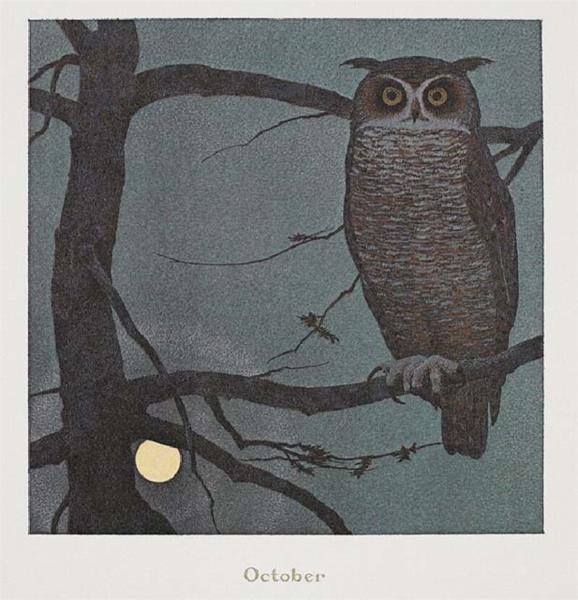
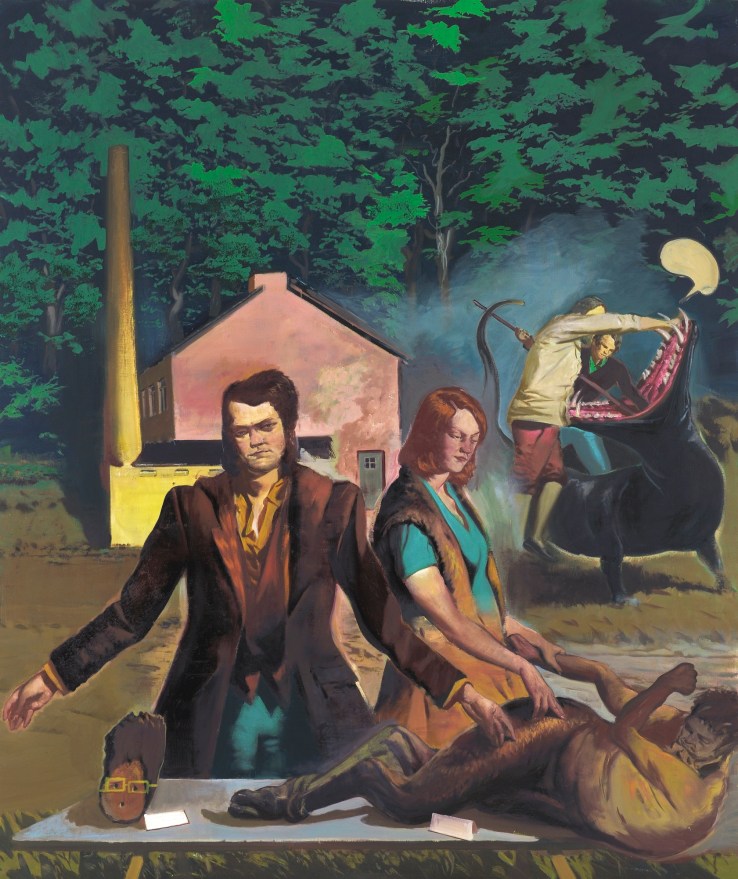


The War has been reconfiguring time and space into its own image 1. The track runs in different networks now. What appears to be destruction is really the shaping of railroad spaces to other purposes, intentions he can only, riding through it for the first time, begin to feel the leading edges of… .2
He checks in to the Hotel Nimbus 3, in an obscure street in the Niederdorf or cabaret section of Zürich. The room’s in an attic, and is reached by ladder. There’s also a ladder outside the window, so he reckons it’ll be O.K. 4 When night comes down he goes out looking for the local Waxwing rep, finds him farther up the Limmatquai, under a bridge, in rooms full of Swiss watches, clocks and altimeters 5. He’s a Russian named Semyavin. Outside boats hoot on the river and the lake. Somebody upstairs is practicing on a piano: stumbling, sweet lieder. Semyavin pours gentian brandy 6 into cups of tea he’s just brewed. “First thing you have to understand is the way everything here is specialized. If it’s watches, you go to one café. If it’s women, you go to another. Furs are subdivided into Sable, Ermine, Mink, and Others. Same with dope: Stimulants, Depressants, Psychomimetics… . What is it you’re after?”
“Uh, information?” Gee, this stuff tastes like Moxie… .
“Oh. Another one.” Giving Slothrop a sour look. “Life was simple before the first war. You wouldn’t remember. Drugs, sex, luxury items. Currency in those days was no more than a sideline, and the term ‘industrial espionage’ was unknown. But I’ve seen it change—oh, how it’s changed. The German inflation, that should’ve been my clue right there, zeros 7 strung end to end from here to Berlin. I would have stern talks with myself. ‘Semyavin, it’s only a temporary lapse away from reality 8. A small aberration, nothing to worry about. Act as you always have—strength of character, good mental health. Courage, Semyavin! Soon all will be back to normal.’ But do you know what?”
“Let me guess.”
A tragic sigh. “Information. What’s wrong with dope and women? 9 Is it any wonder the world’s gone insane, with information come to be the only real medium of exchange?”
“I thought it was cigarettes.”
“You dream.” He brings out a list of Zürich cafés and gathering spots. Under Espionage, Industrial, Slothrop finds three. Ultra, Lichtspiel, and Sträggeli 10. They are on both banks of the Limmat, and widely spaced.
“Footwork,” folding the list in an oversize zoot-suit pocket 11.
“It’ll get easier. Someday it’ll all be done by machine. Information machines. You are the wave of the future.” 12
1 If there is a central thread through these Gravity’s Rainbow annotations—and I’m not claiming that there is one—but if there is a central thread I’ve been trying to tease out, it’s that GR, despite being a complex and confounding conundrum, repeatedly clarifies its thesis. The narrator spells out another summary of the tale, this time in a dozen words.
2 The “he” here is Our Main Man Tyrone Slothrop en route to Zurich. It’s the spring of 1945, and we’re at the end of the second part of Gravity’s Rainbow, “Un Perm ‘au Casino Hermann Goering,” and riding into part three, “In the Zone.” Here, the war—excuse me, The War—is an entropy pushing out into “other purposes.”
3 Weisenburger notes in A Gravity’s Rainbow Companion that “The Nimbus appears to be a fictional hotel.”
You, dear reader, of course know that a “nimbus” is a cloud. I’ve always been partial to Magritte’s clouds.

“Nimbus” is also a term for the halo or aureola that often surrounds sacred or supernatural figures in artistic representation, like the rainbow that shimmers around Albion in Blake’s Albion Rose.

Later, in his hot air balloon escape from Marvy’s Mothers, Slothrop and his pirate pilot Schnorp will try to hide in a cloud.
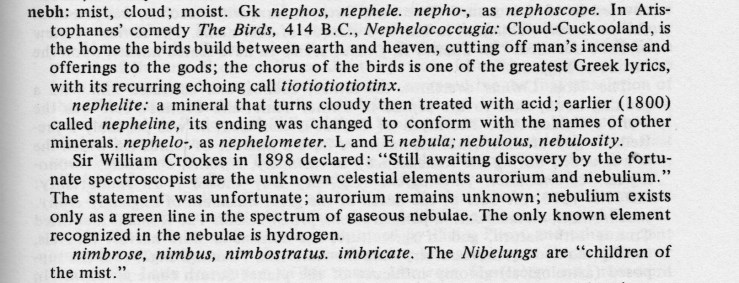
From Joseph T. Shipley’s The Origin of English Words: A Discursive Dictionary of Indo-European Roots (1984). Check his last notation (the Nibelungen are a motif in Gravity’s Rainbow):
4 As GR progresses, Our Free Agent Slothrop gets better and better at spotting means of escape (he’ll note the keys left in an unattended car later in Peenemünde, for example). A ladder up, a ladder down. Rise, ascend, escape. Repeat.
5 All devices for measuring, obviously—ones and zeroes and all that. Slothrop is a disruptive force to traditional means of measurement, natch.
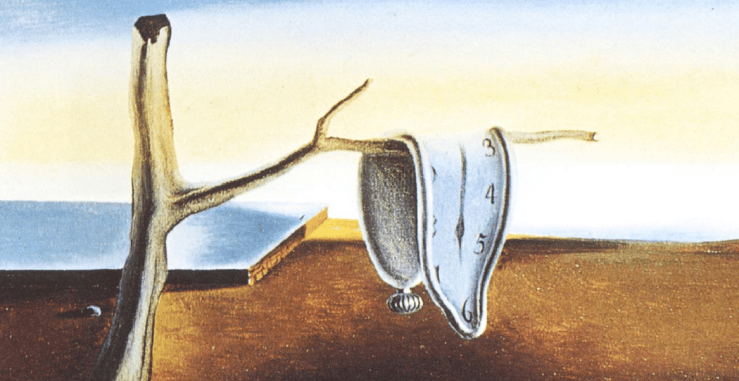
6 “French and Swiss liqueur distilled from the roots of gentian plants; also called Enzian” (Weisenburger, A Gravity’s Rainbow Companion).
Cf. Oberst Enzian, introduced on page 100—Enzian meets Slothrop a few dozen pages later and pushes Marvy from a train.
7 The inflation, the zeros…Pynchon intricately repeats his motifs, ever-threading them throughout the novel.
8 And who among us has not assured themselves that “it’s only a temporary lapse away from reality”? Semyavin’s complaint seems to be the default position of the 20th century. It’s downright quaint or naive in the 21st.
Reality is not a stable story, a progress, a culmination, but rather a entropic mess, a shuffling chaos, one big etc.
9 Nothing.
10 Weisenburger gives “Ultra, Lichtspiel, and Sträggeli” as nightclubs, and offers that Sträggeli means “‘specter,’ a ‘play of light’ (or Lichtspiel); in the same context, ‘Ultra’ refers to the very high frequency light waves in any spectrum of illumination.” Synonyms.
11 The zoot suit is another motif in GR (another kind of uniform that Slothrop dons—a non-uniform? a uniform of resistance?), and Pynchon’s evocation of the Los Angeles Zoot Suit Riots of 1943 (roughly 10 pages earlier) is a superb little number of storytelling.

The zoot suit received an unnecessary revival in the 1990s. I was then an impressionable lad in my very-late teens/early twenties, yet still had the sense to find this attire revolting. It’s possible now to see that the zoot suit revival gelled with the zeitgeist’s preference for baggy garb—hip-hop, mall goth, and skate culture clothes in particular.
12 Clearly prescient lines—both in the spring of 1945 and in 1973 when GR was published. Pynchon explores the idea of these information ideas in his 2009 novel Inherent Vice.
I love the metaphorical evocation of Slothrop as “the wave of the future” — a cliche that the narrative literalizes.

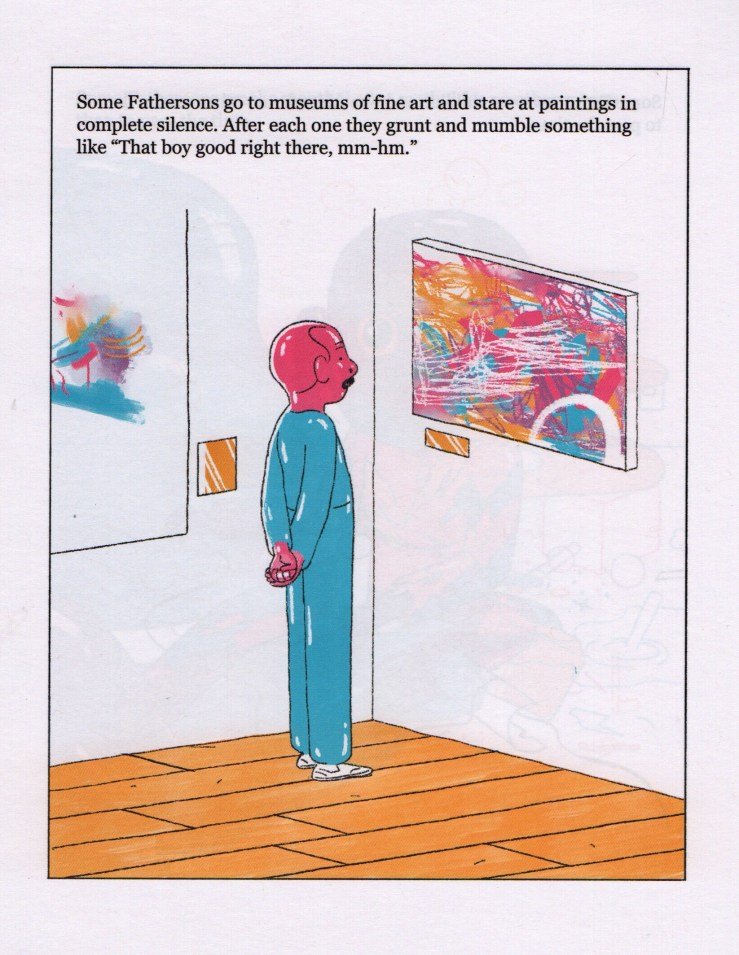
Richie Pope’s Fatherson showed up in today’s mail—it’s issue #13 of Youth in Decline’s monograph series Frontier. It’s so, so good—I’ve gone through it a few times now, and its immediate vibrancy and apparently simplicity slips into richer and richer territory each time.
It reminded me at first of a book my wife brought back to me years ago from San Francisco—a kids book called The Daddy Book by Todd Parr (she took our son when he was like, what—six months old?—left me with our daughter, alone, when she was like, what—twoish? Everything was fine and dandy cotton candy). And then, simultaneously, Fatherson reminded me of Donald Barthelme’s novel The Dead Father—particularly the “Manual for Sons” section.
And Fatherson reminded me of other stuff too, but mostly I loved it because of the stuff it didn’t remind me of. Highly recommended.
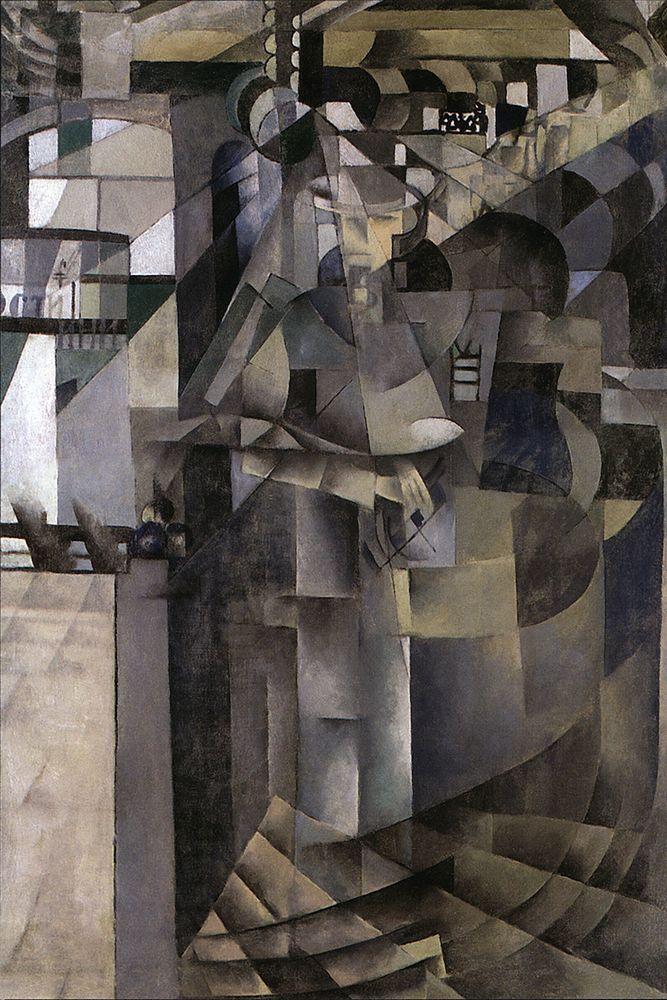

Aaron R. Even’s novel He Comes in Fire is new from Atticus Books. Their blurb:
In the late 1990s a rash of mysterious arsons swept the Southern United States. For some months the fires (many striking African-American churches in rural communities) made the national news, raising fears of a racist criminal conspiracy. Then slowly they faded from the public eye, with no clear pattern, motive, or responsible group ever detected.
He Comes In Fire is a fictional, investigative composite of a country in flames, a dark and fast-paced crime drama that explores how the search for comprehensible answers and meaning can lead a people astray—into false assumptions, accusations, and terrible miscarriages of justice.
The setting is a semi-fictitious county (Zion) in central Virginia, a stark and fallen world of preachers, felons, and lost souls whose voices God no longer hears. When a misunderstood drifter (Lucas Sneed) tangles with a preacher struggling to lead a moral life (Jack Dixon), the two men collide in an unforgiving place teeming with sin, selfishness, and violence.

I found this flyer for a 2001 Takashi Murakami show somewhere in Tokyo. I never made it to the exhibition. I just found the flyer again in an old folder of old stuff.

Today, I somehow ended up listening to a “rare” 1996 David Foster Wallace interview on Boston’s The Connection (I was purging a bunch of old stuff, student work, in my office, and, as I often do, put on YouTube as a distraction—the interview popped up after another vid I can’t recall, but one that featured DFW reading too). Here’s the audio:
The interview is pretty good, especially as it happens right before Infinite Jest explodes, but also in the midst of IJ’s marketing buzz, which posits Wallace-as-next-Pynchon, “voice of Gen X,” etc.
I consider myself Generation X, and I have to admit that although I know that much of how a generation is defined boils down to fucking marketing trends (look at how Millennial has been steadily pushed younger and younger over the last ten years), I’m still fascinated by broad-stroke characteristics. (I’m also just generally mad at boomers, as is my Gen X right).
Anyway, some of my favorite bits of the interview circle over Gen X and what it is or is not (prompted by caller “Don,” who wonders whether DFW is a Gen X Tom Pynchon).
Wallace, born in 1962, would be a late Baby Boomer according to many demographers and cultural analysts. (So would Douglas Coupland, author of the 1991 “novel” Generation X, born just a few months before Wallace. So too, for that matter, would be the members of Sonic Youth, born between 1953 and 1962).
The text below is from Kunal Jasty’s transcription:
Christopher Lydon: David Foster Wallace is our guest, his new novel — it’s his second novel and his third book — is this huge doorstop of a post-modern, experimental, funny, dark, incredibly compelling… my taste does not run to avant-garde fiction generally, but this is an irresistible book. I was dreading it, and then I didn’t want it to stop. Don is calling from Rockport.
Don: I have a short question. Just talking on your program months ago with John Updike about Thomas Pynchon, who gave a kind plaudit to him… is Mr. Wallace the Generation X’s Tom Pynchon?
Christopher Lydon: David Wallace, what do you think?
David Foster Wallace: I’d need some kind of cogent explanation of what Generation X is. I hear the term a lot and I’ve honestly never understood what it means. I don’t know Pynchon as well as you do, but for me Pynchon is a quintessentially sixties writer. His sensibility comes out of the late Beats of the sixties. One of the things that I think my generation misses is that real sense of unity and community in the sixties. One of the things I find amusing about Generation X is that it’s kind of a clumsy attempt to form some kind of rubric or community out of our generation. I’m 34, so we’re talking mostly about people who are younger than I, but I think one of the difficulties of my generation is that there’s a great amount of atomism and anomie, and there doesn’t feel like a whole lot of a community. There aren’t a whole lot of shared values. There aren’t a whole lot of shared ideals. I mean [Generation X] seems silly. It seems like it’s trying to impose some kind of sixties type agenda on a generation that as far as I can see is essentially very lost and lonely.
Christopher Lydon: There is an incredibly lost and lonely feeling running through this whole book, I’ve got to say, running through maybe all of American life at the end of this century. Can you talk about the lost and lonely piece?
David Foster Wallace: When I started the book the only idea I had is I wanted to do something about America that was sad but wasn’t just making fun of America. Most of my friends are extremely bright, privileged, well-educated Americans who are sad on some level, and it has something, I think, to do with loneliness. I’m talking out of my ear a little bit, this is just my opinion, but I think somehow the culture has taught us or we’ve allowed the culture to teach us that the point of living is to get as much as you can and experience as much pleasure as you can, and that the implicit promise is that will make you happy. I know that’s almost offensively simplistic, but the effects of it aren’t simplistic at all. I don’t have children but I’m sort of obsessed with the idea of what my children will think of me, and of us, and of what we’ve done with all we’ve been given, and why we are so sad.

 Biblioklept