April 7th.–It appears to me to have been the most uncomfortable day that ever was inflicted on poor mortals. . . . Besides the bleak, unkindly air, I have been plagued by two sets of coal-shovelers at the same time, and have been obliged to keep two separate tallies simultaneously. But I was conscious that all this was merely a vision and a fantasy, and that, in reality, I was not half frozen by the bitter blast, nor tormented by those grimy coal-heavers, but that I was basking quietly in the sunshine of eternity, . . . Any sort of bodily and earthly torment may serve to make us sensible that we have a soul that is not within the jurisdiction of such shadowy demons,–it separates the immortal within us from the mortal. But the wind has blown my brains into such confusion that I cannot philosophize now.
Nathaniel Hawthorne’s journal entry for April 7th, 1840.
The reason the Dead do not return nowadays is the boredom of it.
In the old time they would come casually, as suited them, without fuss and thinly, as it were, which is their nature; but when such visits were doubted even by those who received them and when new and false names were given them the Dead did not find it worth while. It was always a trouble; they did it really more for our sakes than for theirs and they would be recognised or stay where they were.
I am not certain that they might not have changed with the times and come frankly and positively, as some urged them to do, had it not been for Rabelais’ failure towards the end of the Boer war. Rabelais (it will be remembered) appeared in London at the very beginning of the season in 1902. Everybody knows one part of the story or another, but if I put down the gist of it here I shall be of service, for very few people have got it quite right all through, and yet that story alone can explain why one cannot get the dead to come back at all now even in the old doubtful way they did in the ’80’s and early ’90’s of the last century.
There is a place in heaven where a group of writers have put up a colonnade on a little hill looking south over the plains. There are thrones there with the names of the owners on them. It is a sort of Club.
Rabelais was quarrelling with some fool who had missed fire with a medium and was saying that the modern world wanted positive unmistakable appearances: he said he ought to know, because he had begun the modern world. Lucian said it would fail just as much as any other way; Rabelais hotly said it wouldn’t. He said he would come to London and lecture at the London School of Economics and establish a good solid objective relationship between the two worlds. Lucian said it would end badly. Rabelais, who had been drinking, lost his temper and did at once what he had only been boasting he would do. He materialised at some expense, and he announced his lecture. Then the trouble began, and I am honestly of opinion that if we had treated the experiment more decently we should not have this recent reluctance on the part of the Dead to pay us reasonable attention.
In the first place, when it was announced that Rabelais had returned to life and was about to deliver a lecture at the London School of Economics, Mrs. Whirtle, who was a learned woman, with a well-deserved reputation in the field of objective psychology, called it a rumour and discredited it (in a public lecture) on these three grounds:
(a) That Rabelais being dead so long ago would not come back to life now.
(b) That even if he did come back to life it was quite out of his habit to give lectures.
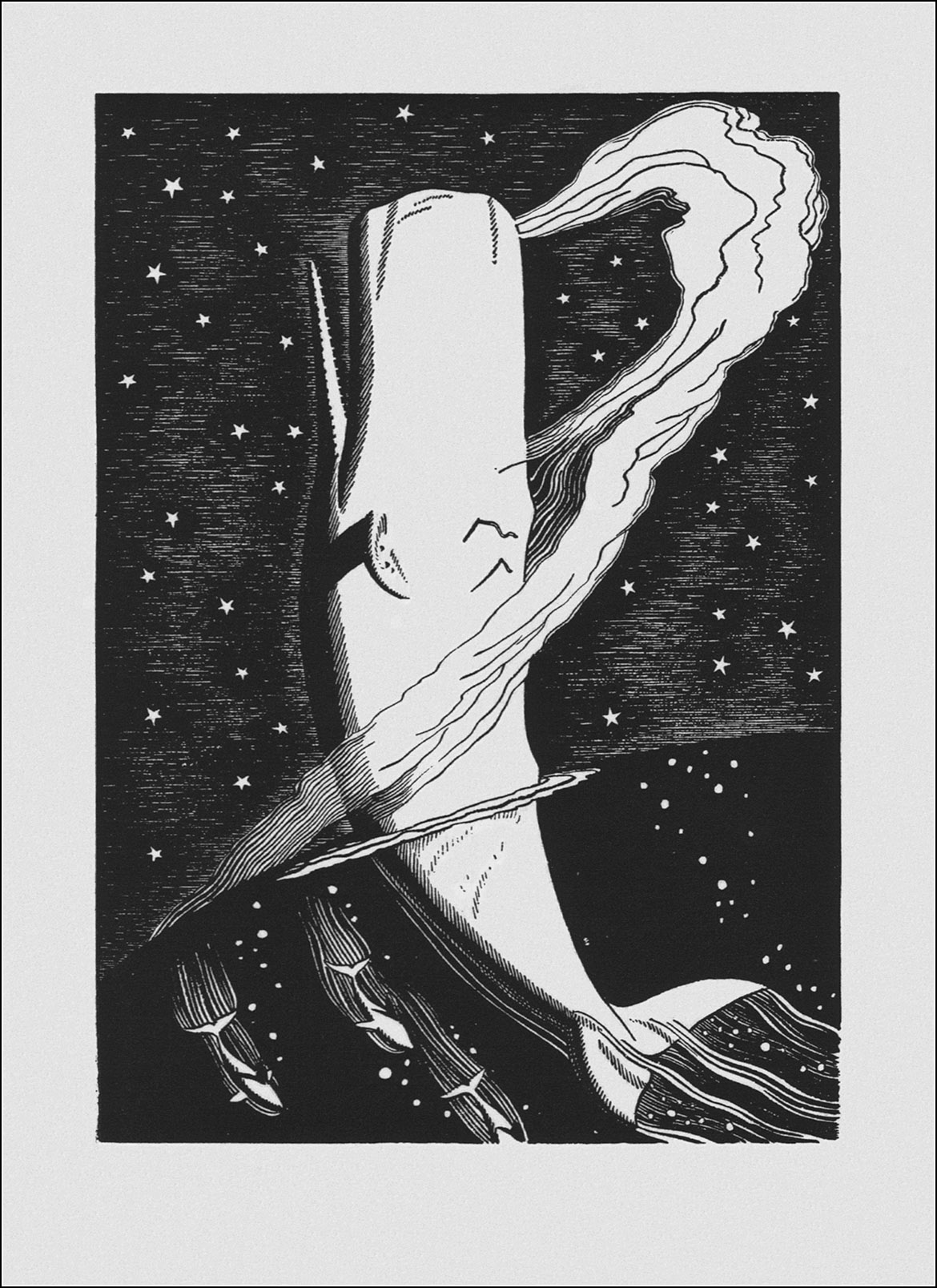
Moby-Dick, Rockwell KentI am a huge fan of audiobooks. I’ve pretty much always got one going—for commutes, jogs, workaday chores, etc. The usual. I love to listen to audiobooks of books I’ve already read, in particular, but I of course listen to new stuff too, or stuff that’s new to me, anyway. There just isn’t time to get to all the reading and rereading I want to do otherwise.
Beyond the fact that audiobooks allow me to experience more books than I would be able to otherwise, I like the medium itself: I like a reader reading me a story. Like a lot of people, some of my earliest, best memories are of someone reading to me. (The narrative in my family was always that my mother fell asleep while reading me The Lion, the Witch and the Wardrobe and that I picked it up and finished it on my own and that’s how I “learned” to read—I’m not really sure of this tale’s veracity, which makes it a good story, of course). So I’ve never fully understood folks who sniff their noses at audiobooks as less than real reading.
Indeed, the best literature is best read aloud. It is for the ear, as William H. Gass puts it in his marvelous essay “The Sentence Seeks Its Form”:
Breath (pneuma) has always been seen as a sign of life . . . Language is speech before it is anything. It is born of babble and shaped by imitating other sounds. It therefore must be listened to while it is being written. So the next time someone asks you that stupid question, “Who is your audience?” or “Whom do you write for?” you can answer, “The ear.” I don’t just read Henry James; I hear him. . . . The writer must be a musician—accordingly. Look at what you’ve written, but later … at your leisure. First—listen. Listen to Joyce, to Woolf, to Faulkner, to Melville.
Joyce, Woolf, Faulkner, Melville—a difficult foursome, no? I would argue that the finest audiobooks—those with the most perceptive performers (often guided by a great director and/or producer) can guide an auditor’s ear from sound to sense to spirit. A great audiobook can channel the pneuma of a complex and so-called difficult novel by animating it, channeling its life force. The very best audiobooks can teach their auditors how to read the novels—how to hear and feel their spirit.
I shall follow (with one slight deviation, substituting one William for another) Gass’s foursome by way of example. Joyce initiates his list, so:
I had read Joyce’s Ulysses twice before I first experience RTÉ’s 1982 dramatized, soundtracked, sound-effected, full cast recording of the novel (download it via that link). I wrote about the Irish broadcast company’s production at length when I first heard it, but briefly: This is a full cast of voices bringing the bustle and energy (and torpor and solemnity and ecstasy and etc.) of Bloomsday to vivid vivacious vivifying life. It’s not just that RTÉ’s cast captures the tone of Ulysses—all its brains and hearts, its howls and its harrumphs—it’s also that this production masterfully expresses the pace and the rhythm of Ulysses. Readers (unnecessarily) daunted by Ulysses’s reputation should consider reading the book in tandem with RTÉ’s production.
Woolf is next on Gass’s list. Orlando is my favorite book of hers, although I have been told by scholars and others that it is not as serious or important as To the Lighthouse or Mrs. Dalloway. It is probably not as “difficult” either; nevertheless, put it on the list! Clare Higgins’s reading of Orlando remains one of my favorite audiobooks of all times: arch without being glib, Higgins animates the novel with a picaresque force that subtly highlights the novel’s wonderful absurdities.
Faulkner…well, did you recall that I admitted I would not keep complete faith to Gass’s short list? Certainly Faulkner’s long twisted sentences evoke their own mossy music, but alas, I’ve yet to find an audiobook with a reader whose take on Faulkner I could tolerate. I tried Grover Gardner’s take on Absalom, Absalom! but alas!—our reader often took pains to untangle what was properly tangled. I don’t know. I was similarly disappointed in an audiobook of The Sound and the Fury (I don’t recall the reader). And yet I’m sure Faulkner could be translated into a marvelous audiobook (Apprise me, apprise me!).
Let me substitute another difficult William: Gaddis. I don’t know if I could’ve cracked J R if I hadn’t first read it in tandem with Nick Sullivan’s audiobook. J R is a tragicomic opera of voices—unattributed voices!—and it would be easy to quickly lose heart without signposts to guide you. Sullivan’s reading is frankly amazing, a baroque, wild, hilarious, and ultimately quite moving performance of what may be the most important American novel of the late twentieth century. A recent reread of J R was almost breezy; Sullivan had taught me how to read it.
Mighty Melville caps Gass’s list. I had read Moby-Dick a number of times, studying it under at least two excellent teachers, before I first heard William Hootkins read it. (Hootkins, a character actor, is probably most well-known as the X-wing pilot Porkins in A New Hope). As a younger reader, I struggled with Moby-Dick, even as it intrigued me. I did not, however, understand just how funny it was, and even though I intuited its humor later in life, I didn’t fully experience it until Hootkins’ reading. Hootkins inhabits Ishmael with a dynamic, goodwilled aplomb, but where his reading really excels is in handling the novel’s narrative macroscopic shifts, as Ishmael’s ego seems to fold into the crew/chorus, and dark Ahab takes over at times. But not just Ahab—Hootkins embodies Starbuck, Flask, and Stubb with humor and pathos. Hootkins breaths spirit into Melville’s music. I cannot overstate how much I recommend Hootkins audiobook, particularly for readers new to Moby-Dick. And readers old to Moby-Dick too.
“What can we do to find out how writing is written? Why, we listen to writers who have written well,” advises (or scolds, if you like) William Gass. The best audiobook performances of difficult books don’t merely provide shortcuts to understanding those books—rather, they teach auditors how to hear them, how to feel them, how to read them.
I got a lovely email, with the subject line “Audiobooks,” a few weeks ago from a guy named Ben. Basically, he asked me to do a post on some of my favorite audiobooks, which I suppose I could’ve done fairly easy as a list (and which, yes, if you want to drop down, I will list below, oh-so-non-definitively)—but after thinking about his question, I thought I might break the post up into a couple of posts on audiobooks in general—the excellent ones, the average ones, the terrible ones afflicted by readers who misread the material; the audiobooks I’m auditing now/recently; childhood favorites (on vinyl!); hell, maybe even a totally pretentious post called “How to listen to audiobooks” or some such garbage.
Before I go on though, let me share Ben’s email (he gave me his permission), which is mostly a marvelous anecdote about Álvaro Mutis’s Maqroll novellas:
After reading your post on The Adventures and Misadventures of Maqroll, I immediately ordered the book and read it with my father as we travelled through Borneo, passing it back and forth every dozen pages. The reading became even more significant as we reached the passage in which Maqroll is laid up sick in Northridge, California, in an area surrounded by orange groves. This area is where my father spent his childhood. Reading Maqroll with my father on that trip stands as my most meaningful reading experience. I thank you for putting us onto that book.
Have you done a post yet on your favorite audiobooks? I’d like to get your recommendations. I recall you mentioning a few in previous posts, but could not track them down. Keep at it.
Ben’s Maqroll story surely deserves a response in full, fleshed out detail, and my next post will discuss in detail why I praise the following audio productions. But for now a list (sans, alas, Álvaro Mutis: our Gaviero Maqroll has not found his way into an audiobook yet, at least to my knowledge).
In no real order, and by no means definitive, a list of eight perfect or near-perfect audiobooks:
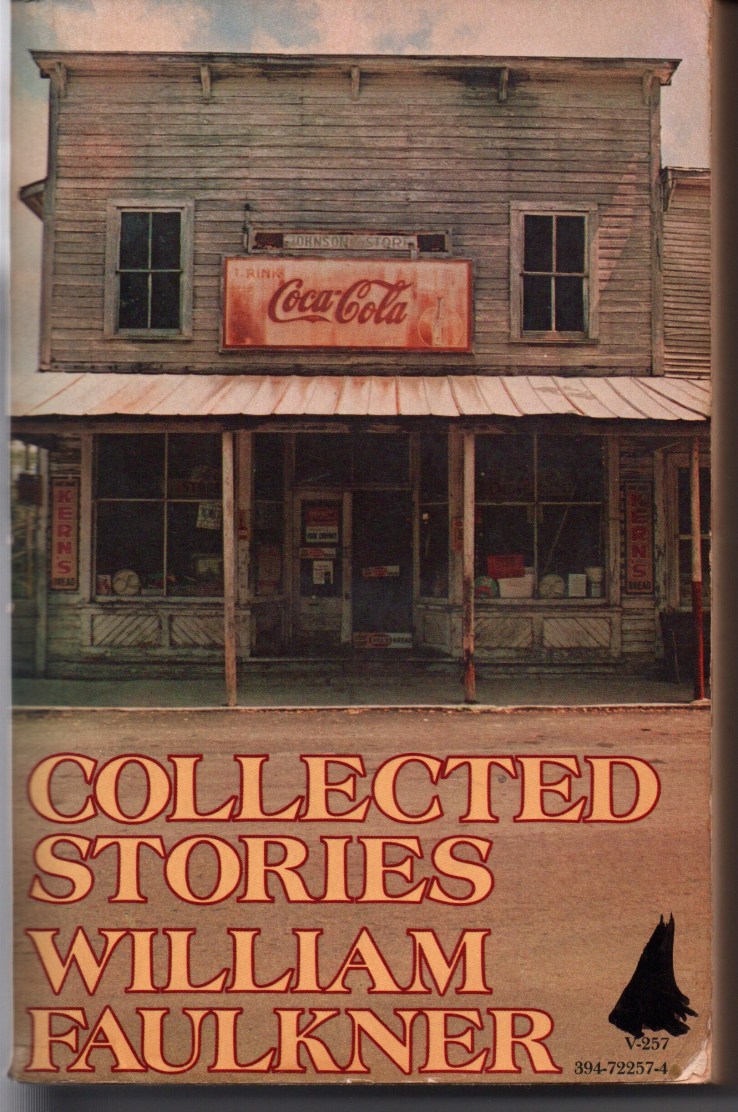
Collected Stories by William Faulkner. 1977 first edition trade paperback from Vintage. This book is 900 pages, exactly, not including the ancillary pages that detail publication dates and rights, as well as Vintage’s back catalog—and yet not one of those pages manages to credit the cover designer or photographer.
I’ve been reading/re-reading this very slowly, with the loose goal of finishing this year.
Nausicaä of the Valley of the Wind, Vol. 4 by Hayao Miyazaki. English translation by David Lewis and Toren Smith. Studio Ghibli Library edition by Viz Media, 2010. No designer credited, but the cover is by Miyazaki and I imagine we can probably credit Studio Ghibli with the design.
I started rereading Nausicaä this week after revisiting Princess Mononokethis week. Then I got horribly ill, and the only stuff I can really read when I’m really sick are comics. I scanned Vol. 4 for this week’s Three Books post; I finished it pretty late last night. Vol 5-7 remain.
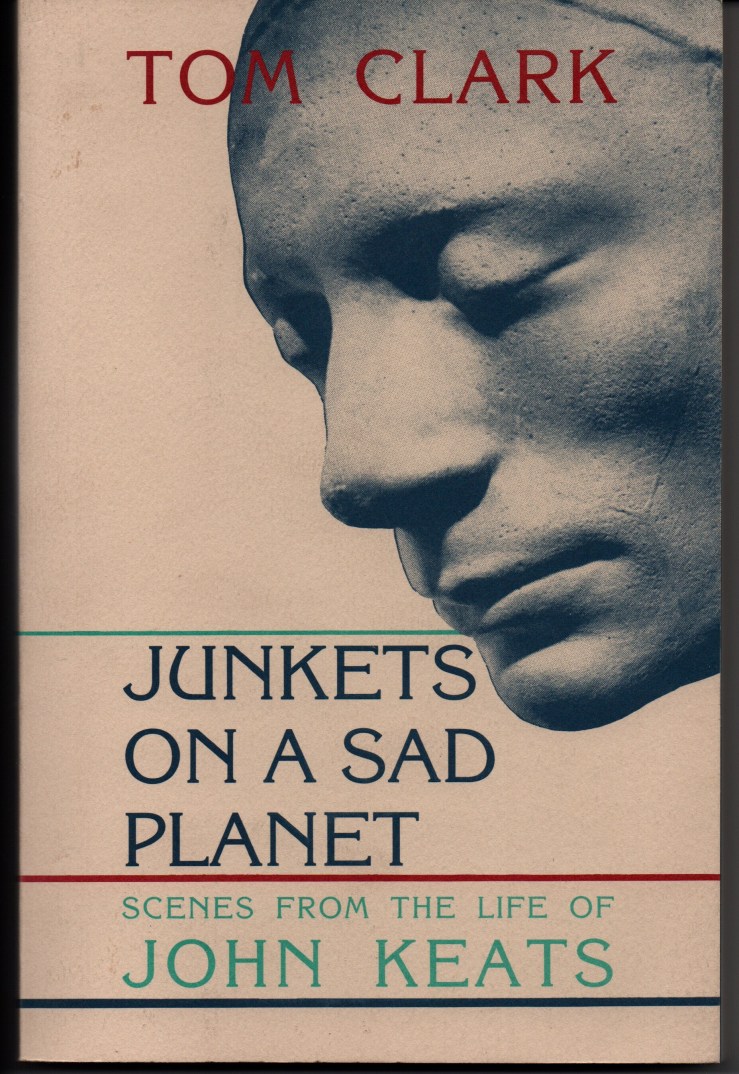
Junkets on a Sad Planet by Tom Clark. First edition trade paperback by Black Sparrow Press, 1994. Cover design by Barbara Martin. The image is of Benjamin Robert Haydon’s life mask for John Keats (from a photo by Christopher Oxford).
I awoke around 1am in the middle of last week, and unable to sleep, I wandered to our den and randomly took this from the shelf to begin reading/rereading. The book (its title is a pun) is difficult to explain, a beautiful experience, rich. Here’s Clark’s own description: “…an extended reflection on the modern poet’s life, as Keats lived it. The book may be read by turns as poetic novel, biography in verse, allegorical masque, historical oratorio for several voices.”
October 3rd. — A strange occurrence has taken place today. I got up fairly late, and when Mawra brought me my clean boots, I asked her how late it was. When I heard it had long struck ten, I dressed as quickly as possible.
To tell the truth, I would rather not have gone to the office at all today, for I know beforehand that our department-chief will look as sour as vinegar. For some time past he has been in the habit of saying to me, “Look here, my friend; there is something wrong with your head. You often rush about as though you were possessed. Then you make such confused abstracts of the documents that the devil himself cannot make them out; you write the title without any capital letters, and add neither the date nor the docket-number.” The long-legged scoundrel! He is certainly envious of me, because I sit in the director’s work-room, and mend His Excellency’s pens. In a word, I should not have gone to the office if I had not hoped to meet the accountant, and perhaps squeeze a little advance out of this skinflint.
A terrible man, this accountant! As for his advancing one’s salary once in a way — you might sooner expect the skies to fall. You may beg and beseech him, and be on the very verge of ruin — this grey devil won’t budge an inch. At the same time, his own cook at home, as all the world knows, boxes his ears.
I really don’t see what good one gets by serving in our department. There are no plums there. In the fiscal and judicial offices it is quite different. There some ungainly fellow sits in a corner and writes and writes; he has such a shabby coat and such an ugly mug that one would like to spit on both of them. But you should see what a splendid country-house he has rented. He would not condescend to accept a gilt porcelain cup as a present. “You can give that to your family doctor,” he would say. Nothing less than a pair of chestnut horses, a fine carriage, or a beaver-fur coat worth three hundred roubles would be good enough for him. And yet he seems so mild and quiet, and asks so amiably, “Please lend me your penknife; I wish to mend my pen.” Nevertheless, he knows how to scarify a petitioner till he has hardly a whole stitch left on his body. Continue reading ““Memoirs of a Madman” — Nikolai Gogol”→





 Biblioklept