The Orphan Master’s Son, Adam Johnson’s Novel About Identity and Storytelling in North Korea

Late in Adam Johnson’s novel The Orphan Master’s Son, the titular protagonist muses that, “In North Korea, you weren’t born, you were made.” The Orphan Master’s Son is a novel about what it means to claim agency—to literally make a self—in a totalitarian society that assigns an official narrative to each of its citizens. Our hero is Jun Do, a boy who takes on a martyr’s name like all North Korean orphans, even though he believes with absolute commitment in a narrative he’s created where he’s the son of the man who keeps him and the other orphan boys. His mother? Well, she’s a phantom in a photograph, a beautiful singer disappeared on a forgotten night.

In the orphanage, Jun Do decides which boys will eat and which ones will not, who will freeze and who will stay warm. He even chooses their names from the list of Revolutionary Martyrs. From the outset of his life, Jun Do must navigate a world where his own capacity for human feeling is always threatened, preëmpted, or outright destroyed by institutionalized suffering.

Reaching early adulthood, Jun Do joins the army where he’s trained in martial arts. He joins a tunnel unit, learning how to fight in total darkness. In the tunnels, Jun Do receives the first of many opportunities to defect (in this case to South Korea). Johnson explores the tension of such a choice again and again. In time, a special unit conscripts Jun Do to “pluck” (the official euphemism for kidnap) Japanese citizens from their own beaches and seafronts. As a reward for his skills, he’s allowed to learn English, and soon winds up as a radio spy on a North Korean fishing vessel (these are the best moments of the book). During this time, Jun Do eavesdrops on two American women who plan to row around the world, a plot point that resurfaces in the novel’s second-half. He also finds himself a decorated hero of North Korea—but almost as soon as he finds a would-be home and family in the fishing vessel and crew, he’s plucked away on a mission to Texas.

Okay: If the paragraph above seems all over the place, that’s because the first part of The Orphan Master’s Son, “The Biography of Jun Do,” is all over the place—in a good way. There’s a dazzling giddiness to the tale of Jun Do, and the swift turns of his identity read like a picaresque novel. I was repeatedly reminded of Candide or Invisible Man. It’s worth recalling Ralph Ellison’s description of Invisible Man : “it stands on its own if only as one of those pieces of writing which consists mainly of one damned thing after another sheerly happening.”

“The Biography of Jun Do” stands on its own as well, and for me it was the highlight of The Orphan Master’s Son, full of black humor, satirical venom, and genuine pathos. It also showcases some of the best prose in the novel. Let me share some, at length. Here’s the captain of the fishing boat (probably my favorite character in the novel). A bit of context: Pyongyang orders the fishing boat to obtain fresh shrimp, a mission that will take them illegally into Russian waters—an offense the captain has already been incarcerated for:

“The Russians gave me four years,” he said. “Four years on a fish-gutting ship, forever at sea, never once did we go to port. I got the Russians to let my crew go. They were young, village boys mostly. But next time? I doubt it.”

“We’ll just go out for shrimp,” the Pilot said, “and if we don’t get any, we don’t get any.”

The Captain didn’t say anything to that plan. “The trawlers were always coming,” he said. “They’d be out for weeks and then show up to transfer their catch to our prison ship. You never knew what it would be. You’d be down on the gutting floor, and you’d hear the engines of a trawler coming astern and then the hydraulic gates opening up and sometimes we’d even stand on our saw tables because down the chute, like a wave, would come thousands of fish—yellowtail, cod, snapper, even little sardines—and suddenly you were hip deep in them, and you’d fire up your pneumatic saws because nobody was getting out until you’d gutted your way out. Sometimes the fish were hoarfrosted from six weeks in a hold and sometimes they’d been caught that morning and still had the slime of life on them.

“Toward afternoon, they’d sluice the drains, and thousands of liters of guts would purge into the sea. We’d always go up top to watch that. Out of nowhere, clouds of seabirds would appear and then the topfish and sharks—believe me, a real frenzy. And then from below would rise the squid, huge ones from the Arctic, their albino color like milk in the water. When they got agitated, their flesh turned red and white, red and white, and when they struck, to stun their victims, they lanterned up, flashing bright as you could imagine. It was like watching underwater lightning to see them attack.

“One day, two trawlers decided to catch those squid. One set a drop net that hung deep in the water. The bottom of this net was tethered to the other trawler, which acted like a tug. The squid slowly surfaced, a hundred kilos some of them, and when they started to flash, the net was towed beneath them and buttoned up.

“We all watched from the deck. We cheered, if you can believe that. Then we went back to work as if hundreds of squid, electric with anger, weren’t about to come down that chute and swamp the lot of us. Send down a thousand sharks, please—they don’t have ten arms and black beaks. Sharks don’t get angry or have giant eyes or suckers with hooks on them. God, the sound of the squid tumbling down the chute, the jets of ink, their beaks against the stainless steel, the colors of them, flashing. There was this little guy on board, Vietnamese, I’ll never forget him. A nice guy for sure, kind of green, much like our young Second Mate, and I sort of took him under my wing. He was a kid, didn’t know anything about anything yet. And his wrists, if you’d seen them. They were no bigger than this.”

Jun Do heard the story as if it were being broadcast from some far-off, unknown place. Real stories like this, human ones, could get you sent to prison, and it didn’t matter what they were about. It didn’t matter if the story was about an old woman or a squid attack—if it diverted emotion from the Dear Leader, it was dangerous. Jun Do needed his typewriter, he needed to get this down, this was the whole reason he listened in the dark.

“What was his name?” he asked the Captain.

“The thing is,” the Captain said, “the Russians aren’t the ones who took her from me. All the Russians wanted was four years. After four years they let me go. But here, it never ends. Here, there is no limit to anything.”

“What’s that mean?” the Pilot asked.

“It means wheel her around,” the Captain told him. “We’re heading north again.”

The Pilot said, “You’re not going to do anything stupid, are you?”

“What I’m going to do is get us some shrimp.”

Jun Do asked him, “Were you shrimping when the Russians got you?”

But the Captain had closed his eyes. “Vu,” he said. “The boy’s name was Vu.”

I’ve quoted so much here—really more than belongs in a book review, I suppose—because I think that this little story perfectly condenses the novel’s best features. Our characters are forced into an impossible situation, one that can’t have a good end for them. We also get the sense of the deep personal loss—of disappeared persons—that haunts The Orphan Master’s Son. And: The power of story-telling, to move and motivate and thrill, but also to be yet another agent in the aforementioned disappearing.

The excerpt above is a really great stand-alone piece of writing, and I guess I feel the need to clarify that I think Johnson is a pretty good writer before I set about telling you why I didn’t like the second half of The Orphan Master’s Son.

I should probably clarify that I think many people will enjoy this novel and find it very moving and that the faults I found in its second half likely have more to do with my taste as a reader than they do Johnson’s skill as a writer, which skill,  again I’ve tried to demonstrate is accomplished. I like picaresque novels, fragmentary novels, novels that let the reader do the heavy-lifting, novels that leave open spaces and gaps. The first half of The Orphan Master’s Son is such a novel. The second half, “The Confessions of Commander Ga,” settles down into a plot- and motif-driven arc that too-often overstates its case. For me, a good riff of dark, sad, occasionally hilarious tales cohered too heavily in “Confessions” into a gelatinous mess of plot strands verging on soap opera. Johnson’s admirable ambition leads him to overload the novel with unmanageable plot turns and leitmotifs.

The biggest problem though is the overwhelming suspicion that Johnson is simply out of his element in trying to inhabit the North Korean imagination. Although he’s clearly done his research, North Korea is essentially closed to the rest of the world. And Johnson is a U.S. American. I mean, there’s this whole other impossible-to-digest ball of wax here that makes Johnson’s admirable intent to write a novel about “propaganda” just way too complicated to suss out in a review, and I’ll admit that I tend to read like a reviewer, and that these notions just bugged the hell out of me as the novel progressed.

Johnson’s novel repeatedly reminded me of David Mitchell’s excellent historical epic The Thousand Autumns of Jacob de Zoet, a book that also obsesses over storytelling and identity in a closed nation. Mitchell’s novel provides the Western reader with a European surrogate in the titular de Zoet, an obvious device that nonetheless adds to the book a richness—and frankly an authenticity—that The Orphan Master’s Son lacks. Johnson’s title character (again, reader surrogate) is North Korean, and even though Johnson takes pains to show the internal machinations of his character’s changing personality, there’s a deeply U.S. American perspective that underwrites his psychology. We’re repeatedly told that in North Korea it’s the story that’s absolute, “But in America, people’s stories change all the time. In America, it is the man who matters.” By changing his story, Jun Do emotionally, spiritually, psychologically (choose your idiom) defects to The Land of Opportunity.

If I’ve withheld summarizing or even illustrating the plot of “The Confessions of Commander of Ga,” I’ve done so to avoid spoilers. Again, many people will dig this novel, and any explication would ruin its second half. Let’s just say there’s an actress. And a second life. And those rowers come up again. And a love story. And a branding iron. And the Americans. And The Dear Leader, of course. And Casablanca. And dogs. Etc.

The Orphan Master’s Son is very much a dystopian novel, and its second half often reads like the love story from 1984 (should I point out here how dreary I often found that plot form 1984? No? Fair enough). Toward the end of The Orphan Master’s Son, I began imagining how the novel might read as a work divorced from historical or political reality, as its own dystopian blend—what would The Orphan Master’s Son be stripped of all its North Korean baggage? (This is a ridiculous question, of course, but it is the question I asked myself). I think it would be a much better book, one that would allow Johnson more breathing room to play with the big issues that he’s ultimately addressing here—what it means to tell a story, what it means to create, what it means to love a person who can not just change, but also disappear. These are the issues that Johnson tackles with aplomb; what’s missing though, I think, is a genuine take on what it means to be a North Korean in search of identity.

Reading (1932) — Pablo Picasso

Reading (1921) — Pablo Picasso

Bukowski Woodcut — Loren Kantor

Charles Bukowski woodcut by Loren Kantor.

Books Acquired, 6.02.2012 (Comix + Angela Carter)

20120611-142705.jpg

Little Lit: Strange Stories for Strange Kids is a collection of comix (and other oddities) for kids, edited by Art Spiegelman and his wife artist/publisher Françoise Mouly. I saw at random and picked it up for my daughter, whose birthday was the next day. She loves, loves, loves this book, spending hours poring over all its weird images and picture games. Cover is by the great Charles Burns; there are also comics by Spiegelman, the late great Maurice Sendak—

20120611-142717.jpg

—a weird search picture by Martin Handford (here’s a detail)—-

20120611-142725.jpg

—and comics by other notables like David Sedaris, Paul Auster, Claude Ponti, Jules Feiffer, and Kim Deitch. The endpapers — “Strange Cartoon Lessons” are by Kaz:

20120611-142742.jpg

I also picked up Burning Your Boats, which collects all of Angela Carter’s short stories:

20120611-142812.jpg

I was looking for her dystopian novel The Passion of New Eve, but no go. Of course, I couldn’t pass up this volume, which comprises four collections, as well as early and uncollected stuff.

Steve Kemper Talks to Biblioklept About A Labyrinth of Kingdoms, His New Book About Explorer Heinrich Barth

Steve Kemper’s latest book A Labyrinth of Kingdoms tells the story of Heinrich Barth, a German scientist who led a British-backed expedition into the central Sudan. While Barth’s name is not nearly as well-known as Livingstone or Stanley, Kemper makes a solid argument for a reappraisal of Barth’s neglected work. Barth explored Bornu and Sokoto, learned the ways of the nomadic Tuareg people, traveled to Timbuktu, and filled in many of the missing gaps that had been previously left to the guesswork of European geographers. Perhaps most importantly, Barth made numerous cultural connections in his time in Africa.

Barth’s story comes alive in Kemper’s capable hands; A Labyrinth of Kingdoms is erudite but never stuffy—at its core, the book is an excellent adventure story. Kemper’s first book, Code Name Ginger, traced the arc of invention and commerce by telling the story of the creation of the Segway transport. His work has also appeared journals like Smithsonian and National Geographic. To find out more about A Labyrinth of Kingdoms, check out Kemper’s blog .

Kemper was kind enough to talk to me about his book and Barth’s life in a series of emails.

A Labyrinth of Kingdoms is new in hardback from W.W. Norton on June 25th, 2012.

Biblioklept: What drew you to the story of Heinrich Barth? What made you want to write A Labyrinth of Kingdoms?

Steve Kemper: I got interested in Barth when I read a couple of paragraphs about him in Ryszard Kapuścińksi’s The Shadow of the Sun, a book of dispatches about Africa. In Timbuktu, Kapuścińksi notices a plaque on a house where Barth spent many months in 1853-1854, and he calls the explorer “one of the greatest travelers in the world” for his five years exploring the Sahara. He says that Barth survived death many times, including once by drinking his own blood. Kapuścińksi added that despite Barth’s accomplishments, he died young, unappreciated and almost forgotten. All of that sounded like the bones of a great story.

Biblioklept: Obviously, Barth’s tale is a great adventure story—but what are his greatest accomplishments?

SK: One of the reasons Barth isn’t better known is that he didn’t return with a headline accomplishment—the source of the Nile, a traverse of the continent, the location of a lost explorer. He did “discover” the Benue River and showed that it flowed into the Niger (that river’s major tributary) rather than into Lake Chad, and he settled the exact location of Timbuktu. But the reason that his work remains important to scholars is that he came back with reams of invaluable information and data about geography, anthropology, ethnography, and languages. He traveled across an immense territory and spent time with the major peoples of north-central Africa—Hausas, Kanuris, Tuaregs, Arabs, Songhais, Fulanis. The material he collected is still relevant. That can’t be said of most of Barth’s more famous peers. But then as now, headlines are more likely than scholarship to capture the public’s attention.

Biblioklept: North Africa, and the Islamic world in-general have captured more of the Western public’s attention in recent years though—what can we learn from Barth’s travels and experiences?

SK: Many things. First, that the region and the religion are not monolithic. Barth’s work (and my book) are full of a tremendous variety of peoples and cultures. Most Westerners—and I include myself in this, prior to writing this book—have a vague, fuzzy, and simplified image of the region that distorts everything about it—its many cultures, its complicated history, its complexity. Barth returned convinced that Islam was a great religion—not a popular view, then as now—but added that in some places it had been hijacked by thugs who used it as an excuse to pillage non-Muslims, or by fanatics, who used it as an excuse to kill or enslave non-Muslims. This still sounds familiar. But he also added that Islam wasn’t much different in this way from Christianity, another great religion sometimes hijacked by the greedy or the self-righteous. Barth met Muslim scholars and Muslim thieves, and tried to be clear about both. I could keep typing on this subject for a while but I don’t want the answer to get too long. I plan to write a couple of op-eds on the subject in time for the book’s pub date.

Biblioklept: In A Labyrinth of Kingdoms, you point out that Barth’s open-minded ideas were not well-received by his contemporaries, in part because these ideas conflicted with the emerging age of imperialist Europe. Is this also one of the reasons he hasn’t been canonized like other explorers?

SK: The short answer is yes, I believe so, though there are not straight lines connecting the two. But it seems clear that Barth’s ideas at least contributed to the reception of his work, along with Britain’s changing commercial and political goals, the interests of the public, and Barth’s own difficult personality.

Biblioklept: In what ways was Barth a difficult personality?

SK: During his journey and afterwards in England, Barth occasionally felt that he was being slighted by the British government or that his honor was being questioned (especially by one tormentor at the Royal Geographical Society). He was often right, but he reacted to these things with the touchiness of an anemone. An anemone’s touchiness is pretty to see; Barth’s was blunt and haughty and could even verge into petulance. His own strict sense of honor and proper conduct left him appalled at some of the machinations against him in England (and also in Germany). Barth’s brother-in-law and close friend wrote about him, “Heinrich is always too gruff and unyielding, and yet too modest and too imprudent. His pride doesn’t permit him to give in at the right moments. In the river of life he is a bold and persevering swimmer, but not a very agile one.”

Some of Barth’s difficulties stemmed from the fact that he was German, and the British liked their heroes home-grown. Some people in England couldn’t gracefully accept that the success of a British expedition had depended almost solely on a foreigner. (The British government funded the expedition, which began with an English leader. Barth was contracted as an independent scientist.)

Another part of Barth’s difficult personality stemmed from his sense of high calling. He truly did devote his life to science and the pursuit of truth, and he could be harsh when lesser mortals fell short of his standards.

It interests me that when he was in Africa, Barth showed far more patience and diplomacy than he did when back in Europe. In Africa, patience and diplomacy were often necessary to accomplish what he wanted and even to survive, but in Europe I think he expected better conduct and sometimes reacted poorly when he was disappointed.

Biblioklept: Barth’s story is one of culture and discovery, but it’s also an adventure story—can you share a favorite anecdote about Barth the adventurer?
SK: Tough question, since there are so many good ones, including death threats and narrow escapes. But I prefer the ones that reveal something about Barth. So: early in the journey, when he still considered himself nearly indestructible, he foolishly set off on foot one morning, with little water and no food, to climb a distant mountain. He soon ran out of water, got lost, and began to die of dehydration. Eventually he cut his arm and drank his own blood, which didn’t help. The following morning, at the caravan, the Tuareg guides told the expedition’s leader that no man could have survived the long Saharan day and night without water, but they agreed to search for him. Late that afternoon they found him, nearly comatose. The Tuaregs were amazed at his survival. They were also amazed the next day when, even though he couldn’t eat or speak, he rode seven hours with the caravan. This close call was a tough lesson, but Barth took it to heart and learned from it.

Another favorite, because it epitomizes how understated Barth always is about his adventures, occurred when he entered Kabara, a village on the Niger River not far from Timbuktu. Barth took up lodgings and was eating supper when a Tuareg warrior entered, glaring, and attempted to intimidate Barth into giving him a fine gift. Barth said he was eating and to go away. The Tuareg replied that he was a very dangerous man who was about to do something terrible. Barth writes, “After a very spirited altercation, I got rid of him.” I love the dry modesty of that. Imagine how Burton or Stanley would have handled it. After Barth expelled the warrior, 200 other men came in and silently eyed the stranger. Barth responded by staring back while lying across his smaller bags and protecting the bigger ones behind him. Very cool. Very Barth.

Biblioklept: I ran a blurb of your book the other day and a reader asked if the theologian Karl Barth might be a descendant of Heinrich’s. Any clue?

SK: I wondered the same thing, but haven’t come across anything that suggests they were related.

Biblioklept: You provide a fairly extensive set of end notes as well as a large bibliography for Labyrinth–clearly a lot of reading and research went into the book. Can you describe how you synthesized the information? What were some of your most important sources?

The principal source, of course, was Barth’s colossal book, Travels and Discoveries in North and Central Africa, which was originally published in five volumes and covered nearly 3500 pages. Other crucial primary sources were the extensive Foreign Office files in the British National Archives, which include dispatches from consuls, receipts, letters, and all the thorough bureaucratic documentation of the Victorian age. Barth’s brother-in-law and close friend, Gustav von Schubert, wrote a biography that I had translated; it provided many private glimpses of Barth.

The scholarship, of course, was invaluable, and I immersed myself in it to understand the era. Remember, I’ve spent the last 30 years as a journalist, writing about living people. I knew how to write narrative, but I had to learn how to do that with history. My goal with the book was to write an exciting, informative narrative that put readers inside the expedition with Barth, so all the scholarship is all folded into the action. I don’t quote many scholars in the text proper, because I didn’t want to intrude on the readers’ experience of the expedition. That’s all writer’s talk about technique and is probably more than your readers want to know.

Biblioklept: Actually, our readers seem to enjoy insights about writing technique, so I’m sure they’ll be interested in this stuff. (I’m interested, anyway). How long did it take to research and write the book?

SK: It’s hard to say, because I was also working on smaller jobs while researching and writing the book. The research just for the proposal was time-consuming, starting with Barth’s 3500 pages. Because I’m not a scholar of 19th century Africa or Europe, the background research took many months. The writing, including interruptions from other jobs, took about 9 months—probably 7 months net.

Biblioklept: What’s your next big project?

SK: I’m working on another book for W. W. Norton about another undeservedly obscure adventurer whom I stumbled across in my reading. An American this time, who lived the sort of epic life that’s no longer possible, on frontiers in several countries. I think I’ll keep his name to myself for the time being.

Biblioklept: Have you ever stolen a book?

SK: Yes, once, while in college—a paperback of several Sean O’Casey plays. It was also a library book, which I later realized compounded the crime, since I deprived others who could have gotten pleasure from it. I’ve since donated hundreds of dollars’ worth of books to libraries. Maybe I’ve subconsciously been seeking atonement.

Reading (Family Scene by Lamplight) — Salvador Dali

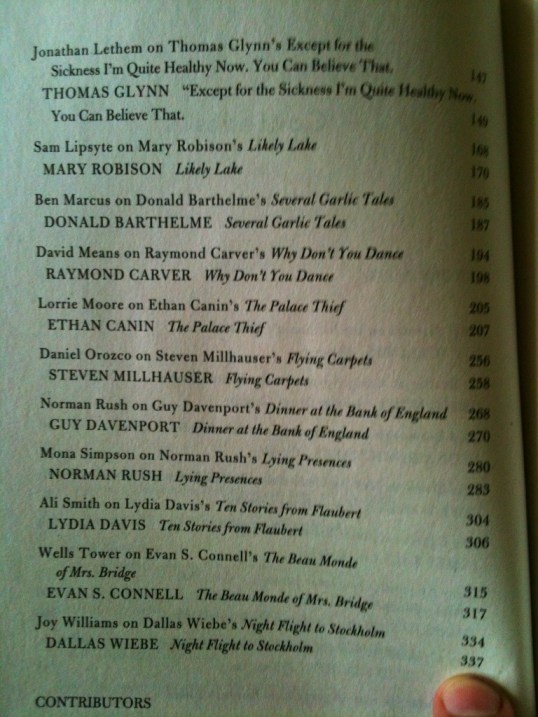
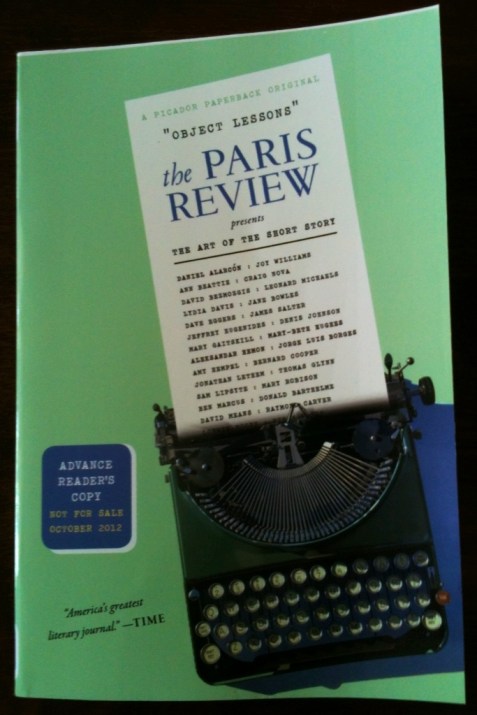
Object Lessons from The Paris Review, Where Writers Present Some of Their Favorite Short Stories from Other Writers (Book Acquired, 6.11.2012)

20120611-150824.jpg

Okay: This one is really cool: Object Lessons features a bunch of short stories, some you may have read, each with a short lead-in (two-five pages) by another writer. So, we get Jeffrey Eugenides on Denis Johnson, or Ben Marcus on Donald Barthelme, or Lydia Davis on Jane Bowles, or Ali Smith on Lydia Davis. You know what, let me just share the table of contents (review down the line):

20120611-150831.jpg

20120611-150837.jpg

David Foster Wallace on David Lynch’s Dune

1984’s Dune is unquestionably the worst movie of Lynch’s career, and it’s pretty darn bad. In some ways it seems that Lynch was miscast as its director: Eraserhead had been one of those sell-your-own-plasma-to-buy-the-film-stock masterpieces, with a tiny and largely unpaid cast and crew. Dune, on the other hand, had one of the biggest budgets in Hollywood history, and its production staff was the size of a small Caribbean nation, and the movie involved lavish and cutting-edge special effects (half the fourteen-month shooting schedule was given over to miniatures and stop-action). Plus Herbert’s novel itself is incredibly long and complex, and so besides all the headaches of a major commercial production financed by men in Ray-Bans Lynch also had trouble making cinematic sense of the plot, which even in the novel is convoluted to the point of pain. In short, Dune’s direction called for a combination technician and administrator, and Lynch, though as good a technician as anyone in film, is more like the type of bright child you sometimes see who’s ingenious at structuring fantasies and gets totally immersed in them but will let other kids take part in them only if he retains complete imaginative control over the game and its rules and appurtenances—in short very definitely not an administrator.

Watching Dune again on video you can see that some of its defects are clearly Lynch’s responsibility, e.g. casting the nerdy and potato-faced Kyle MacLachlan as an epic hero and the Police’s resoundingly unthespian Sting as a psycho villain, or—worse—trying to provide plot exposition by having characters’ thoughts audibilized (w/ that slight thinking-out-loud reverb) on the soundtrack while the camera zooms in on the character making a thinking-face, a cheesy old device that Saturday Night Live had already been parodying for years when Dune came out. The overall result is a movie that’s funny while it’s trying to be deadly serious, which is as good a definition of a flop as there is, and Dune was indeed a huge, pretentious, incoherent flop. But a good part of the incoherence is the responsibility of De Laurentiis’s producers, who cut thousands of feet of film out of Lynch’s final print right before the movie’s release, apparently already smelling disaster and wanting to get the movie down to more like a normal theatrical running-time. Even on video, it’s not hard to see where a lot of these cuts were made; the movie looks gutted, unintentionally surreal.

In a strange way, though, Dune actually ended up being Lynch’s “big break” as a filmmaker. The version of Dune that finally appeared in the theaters was by all reliable reports heartbreaking for him, the kind of debacle that in myths about Innocent, Idealistic Artists In The Maw Of The Hollywood Process signals the violent end of the artist’s Innocence—seduced, overwhelmed, fucked over, left to take the public heat and the mogul’s wrath. The experience could easily have turned Lynch into an embittered hack (though probably a rich hack), doing f/x-intensive gorefests for commercial studios. Or it could have sent him scurrying to the safety of academe, making obscure plotless l6mm.’s for the pipe-and-beret crowd. The experience did neither. Lynch both hung in and, on some level, gave up. Dune convinced him of something that all the really interesting independent filmmakers—Campion, the Coens, Jarmusch, Jaglom—seem to steer by. “The experience taught me a valuable lesson,” he told an interviewer years later. “I learned I would rather not make a film than make one where I don’t have final cut.”

—From “David Lynch Keeps His Head” by David Foster Wallace; collected in A Supposedly Fun Thing I’ll Never Do Again.

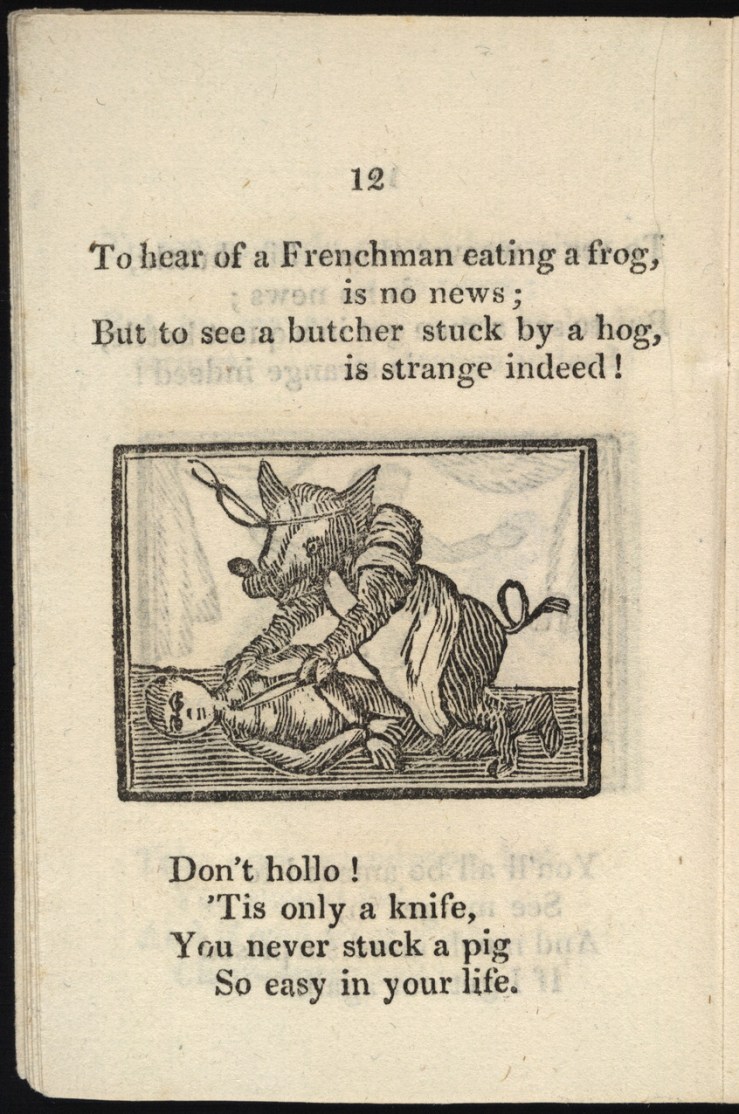
“To hear of a Frenchman eating a frog, is no news; / But to see a butcher stuck by a hog, is strange indeed!”

(From The World turned upside down, or, No news, and strange news (1820) by J. Kendrew. More/via.)
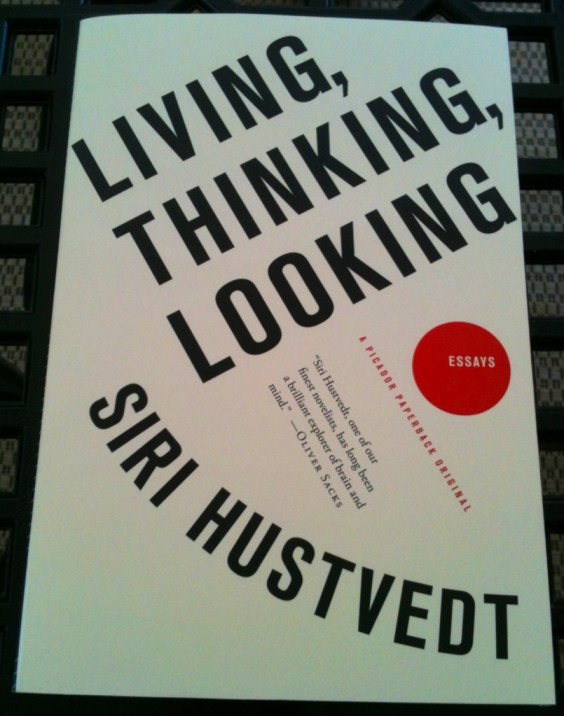
Siri Hustvedt’s Living, Thinking, Looking (Book Acquired, 5.15.2012)

20120606-120223.jpg

The whole point of these books acquired posts is to try to document interesting stuff that comes in before it winds up in my pile for months (to put things in perspective, I got a reader copy of Adam Johnson’s The Orphan Master’s Son back in January, and have finally gotten around to reading it just now). I usually spend a week or two looking over the book, maybe  publish a blurb or an excerpt of the book along with a photo, and then file it in one of three stacks — now, later, or never. Anyway, Siri Hustvedt’s new collection of essays Living, Thinking, Looking ended up never getting stacked anywhere, because I kept going back to it, poking into her essays on Goya, Gerhard Richter, Freud, reading her riff on sleeping, which somehow synthesizes Macbeth and Nabokov and REM science, pausing over her consideration of the Bush admin’s rhetoric. I haven’t finished the book but I will. Hustvedt combines her keen intellect with a range of ideas to explore her subjects (primarily, if the title didn’t tip you, living, thinking, looking). There’s a lot of lit here, a lot of psych, and plenty of art. Good stuff.

Old Woman Reading — Rembrandt

Hobo Symbols

(Via; for more on tramping read W.H. Davies’s The Autobiography of a Super-Tramp).

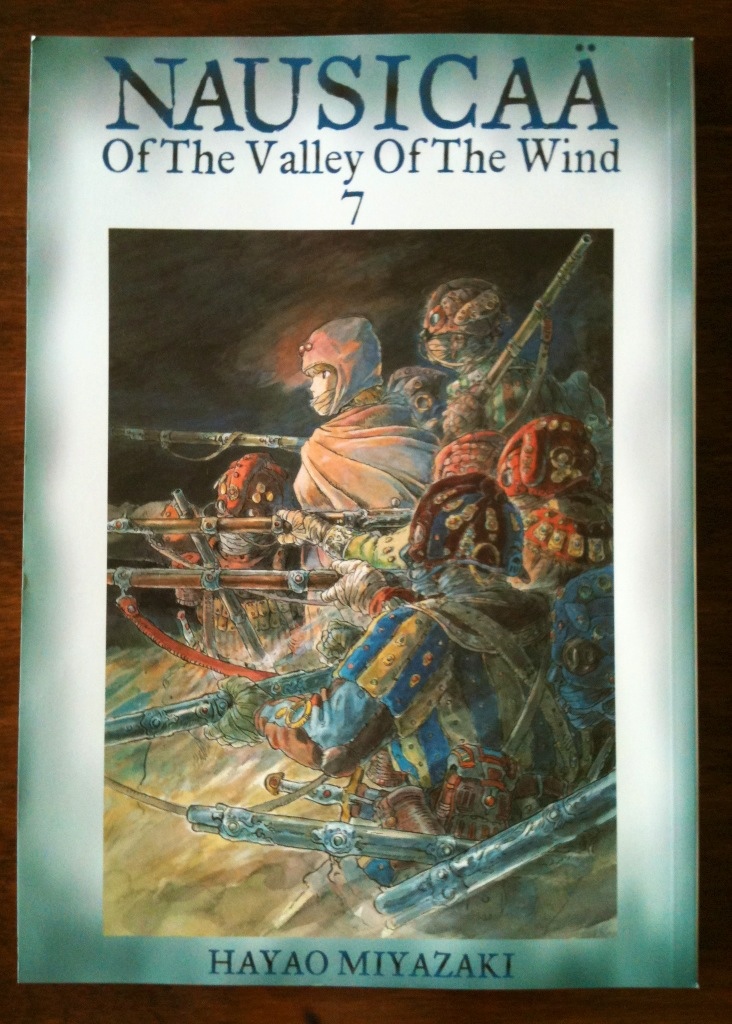
Nausicaä of The Valley of the Wind, Vol. 7 (Book Acquired, 6.07.2012)

20120611-155316.jpg

A birthday gift from my daughter. I got volumes 4-6 for Valentine’s Day from my darling wife, but have held off on reading them because I didn’t have the final volume, which is this one, volume 7.

“An Equal Amount of Blueberries in Each Muffin”

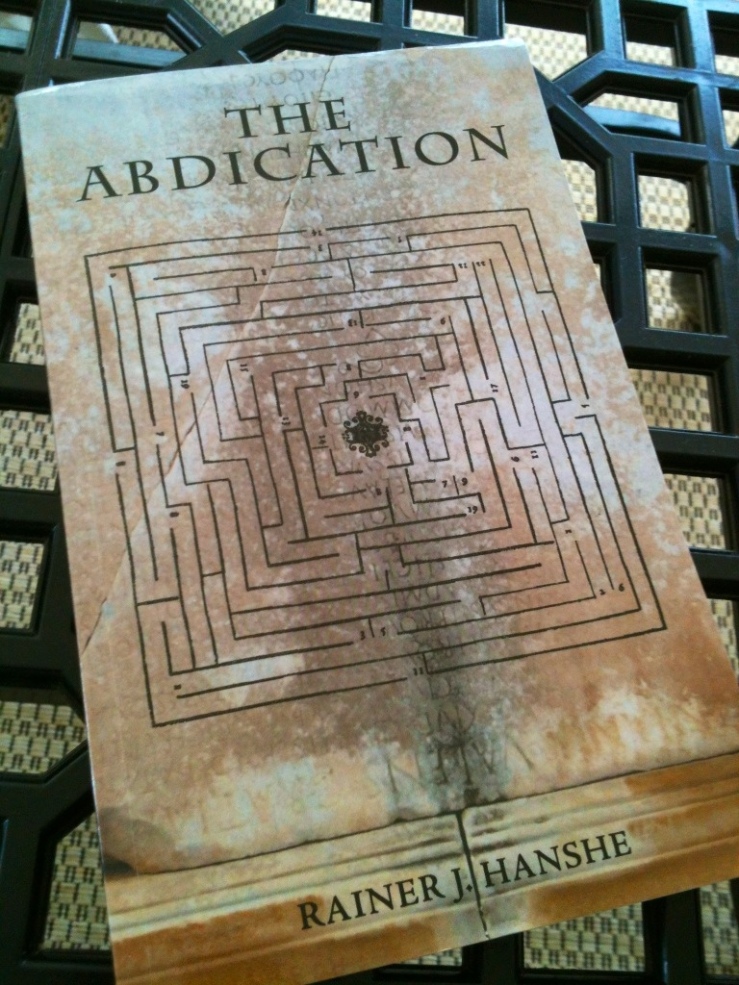
The Abdication (Book/Ero(t)icomic Epic Aquired, Sometime Last Week)

20120606-120115.jpg

Rainer J. Hanshe’s The Abdication. Started this one the yesterday. Very weird, very cool. More thoughts to come, but here’s the blurb:

Spring 2032: an enigmatic bandleader named Triboulet arrives by helicopter in Rome, where his carnivalesque troupe awaits with a legion of animals and unruly kids. When provoking states of joyous panic through their ritualistic frenzies, the troupe’s arrival proves restorative, for the world is beset with famines, plagues, and religious conflicts, which Triboulet seeks to neutralize with freeing laughter. As he and his troupe begin constructing strange edifices in the Eternal City, sacred sites around the world suffer terrible, often beguiling forms of vandalism, and rumors abound that the Christ has actually finally returned.
Although radical Islamic sects claim responsibility for the vandalism, the culprits remain unknown: is it the Jihadists, anarcho-atheist intellectuals, or eco-terrorists? Religious and political authorities grow leery of the troupe and suspicious of Triboulet, whose true identity remains a mystery. The very future of the world is at stake, and while touring Israel during Christmas, Triboulet and his raucous band of pranksters bear witness to the world’s pivotal crossing into a new reality.
Albert Camus noted that ‘the metaphysics of the worst’ expresses itself in a literature of damnation and argued that ‘we have still not yet found the exit’ from such literature. With his second novel, Hanshe has found the way out, offering in fact something not only promising, but astounding, a pathway that is into a new reality, into a ‘physics of the best.’ The Abdication is a true ero(t)icomic epic.

Seven Sci-Fi Films That Are Smarter Than Prometheus

A list of great sci-fi movies would undoubtedly include Ridley Scott’s signature films, Alien (1979) and Blade Runner (1982), but I don’t know if there’s enough room on that list for Scott’s latest  Prometheus, a gorgeous collection of set-pieces smeared onto a messy, hole-filled plot, signifying nothing. I’ve already written at some length about Prometheus’s metaphysical shortcomings, but I’m never especially happy to write negative reviews without providing alternatives. Here are seven movies that demonstrate the best in depth of intellect that the genre has to offer.


1. Metropolis, 1927 (Dir. Fritz Lang)

Metropolis foregrounds many of the tropes that will come to dominate serious sci-fi (film and literature alike). The dystopian future of Metropolis imposes a strict division of classes, relegating the poor workers to underground drudgery while the (literal) upper class enjoy privileged leisure. Lang explores this divide via a Romeo & Juliet story of sorts—Freder, son of the city’s Master becomes infatuated with Maria, a girl from the underworld. He follows her into the labyrinth under the city and soon witnesses industrial horrors that harm the subterranean workers. The plot becomes more complicated when a mad scientist unveils an automaton—a robotic Maria—that he will use as part of a nefarious scheme. Metropolis’s expressionistic design and camera work still seem fresh and innovative almost a century after filming, and the film’s take on class disparity is as affecting as ever.


2. Alphaville, 1965 (Dir. Jean-Luc Godard)

Godard’s dystopian New Wave crime noir talkie follows the strange exploits of Lemmy Caution, who drives in from the Outlands in his Ford Galaxie to find a missing agent, capture the founder of Alphaville, and destroy Alpha 60, the totalitarian computer that keeps Alphaville’s citizens from indulging in poetry (or other forms of free expression). Godard makes no attempt to design a future: Alphaville is filmed in contemporary Paris. The effect is baffling; Alphaville is an exercise in uncanny realizations. The dialogue is pure New Wave stuff—crammed with literary and art reference—and will just as likely bore as  many audience members as it enthralls. In the end though, Anna Karina as Natacha von Braun is reason enough to watch this film.


3. 2001: A Space Odyssey,1968 (Dir. Stanley Kubrick).

Watch it. Then watch it again.


4. Solaris, 1972 (Dir. Andrei Tarkovsky)

Tarkovsky’s Solaris is a slow, engrossing meditation on grief. Based on the novel by Polish writer Stanisław Lem, Solaris centers on psychologist Kris Kelvin, who goes to the space station orbiting the planet Solaris in order to investigate the series of emotional collapses that the crew have suffered. Kelvin soon slips into his own existential crisis, as a ghost–or psychological construct—of his dead wife appears to him. Solaris is gorgeous and measured, using its near-three-hour running time to grand effect.


5. The Thing, 1982 (Dir. John Carpenter)

Antarctic  research station. Shapeshifting parasites. Kurt Russell. Dogs. Flamethrowers. Blood tests. Kurt Russell’s beard. Ennio Morricone’s score. Wilford Fucking Brimley. Paranoia. Paranoia. Paranoia.


6. Nausicaä of the Valley of the Wind, 1984 (Dir. Hayao Miyazaki)

A millennium after apocalyptic war destroys human civilizations, the groups that remain scramble to control the few resources left on the planet. A toxic jungle swarming with mutant insects—and dominated by the giant Ohmus—encroaches on the few bastions of clean soil that remain to humankind. Adventurous Princess Nausicaä though learns the secrets of the jungle—and also knows how to communicate with the Ohmus—only she has to navigate sides in the emerging war between rival kingdoms. Miyazaki’s film, based on his manga, is lush and detailed, a fully-realized world that is simultaneously frightening and beautiful. The film’s take on ecology is not so much preachy as it is prescient.


7. Primer, 2004 (Dir. Shane Carruth)

Primer was shot on a $7,000 budget, but it never looks or feels cheap. This story of four engineers who invent a time machine in a garage is decidedly unglamorous and consistently engaging; Carruth (who also wrote and stars in the film) throws the audience into the deep end, offering no exposition, let alone explication for the audience to latch onto. The film explores the bizarre moral implications—and possible side effects (and defects) of time travel.