Book Shelves #9, 2.26.2012

We should first of all distinguish stable classifications from provisional ones. Stable classifications are those which, in principle, you continue to respect; provisional classifications are those supposed to last only a few days, the time it takes for a book to discover, or rediscover, its definitive place. This may be a book recently acquired and not read yet, or else a book recently read that you don’t quite know where to place and which you have promised to yourself you will put away on the occasion of a forthcoming ‘great arranging’, or else a book whose reading has been interrupted and that you don’t to classify before taking it up again and finishing it, or else a book you have used constantly over a given period, or else a book you have taken down to look up a piece of information or a reference and which you haven’t yet put back in its place, or else a book that you can’t put back in its place, or else a book that you can’t put back in its rightful place because it doesn’t belong to you and you’ve several times promised to give it back, etc.

—Georges Perec, from “The Art and Manner of Arranging One’s Books”

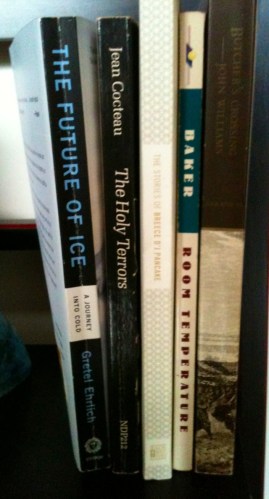
Book shelves series #9, ninth Sunday of 2012: In which I photograph three book shelves that I will examine more closely over the next several weeks.

Georges Perec goes on to admit that over three-quarters of his own books are provisionally categorized (at best). Libraries, like governments and tectonic plates and personalities, are not stable entities. Still, most of us try to impose some sense of order on our book collection, even if it’s an order apparent and relevant to ourselves alone. The three book shelves photographed below are probably the most “stable” in the house:

20120226-105205.jpg

Despite an ongoing process of accretion, relocation, and removal, these shelves tend to remain fairly constant, with minor rearrangements happening maybe monthly instead of weekly or daily. As of today, there’s only one slim piece of a shelf “free”—that is, holding unsorted books waiting to be read, shelved, or, in one case, reviewed (I swear I’ll make another stab at writing up Breece D’J Pancake one day . . .). These books will be elsewhere by the time I get to photographing the shelf they rest on now:

20120226-105217.jpg

“The Wholesome Fermentation or Eructation of Those Processes Eternally Active in Language” — Walt Whitman on Slang

From Walt Whitman’s essay “Slang in America,” :

Slang, profoundly consider’d, is the lawless germinal element, below all words and sentences, and behind all poetry, and proves a certain perennial rankness and protestantism in speech. As the United States inherit by far their most precious possession–the language they talk and write–from the Old World, under and out of its feudal institutes, I will allow myself to borrow a simile even of those forms farthest removed from American Democracy. Considering Language then as some mighty potentate, into the majestic audience-hall of the monarch ever enters a personage like one of Shakspere’s clowns, and takes position there, and plays a part even in the stateliest ceremonies. Such is Slang, or indirection, an attempt of common humanity to escape from bald literalism, and express itself illimitably, which in highest walks produces poets and poems, and doubtless in pre-historic times gave the start to, and perfected, the whole immense tangle of the old mythologies. For, curious as it may appear, it is strictly the same impulse-source, the same thing. Slang, too, is the wholesome fermentation or eructation of those processes eternally active in language, by which froth and specks are thrown up, mostly to pass away; though occasionally to settle and permanently chrystallize.

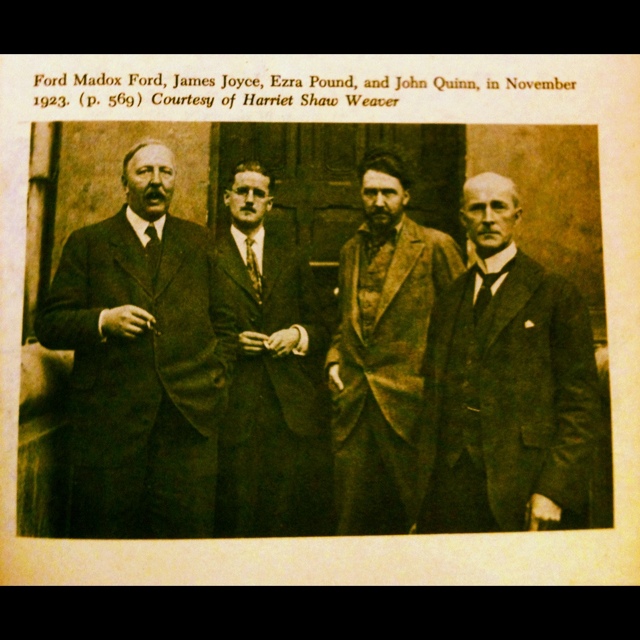
Modernist Bros

20120216-190332.jpg

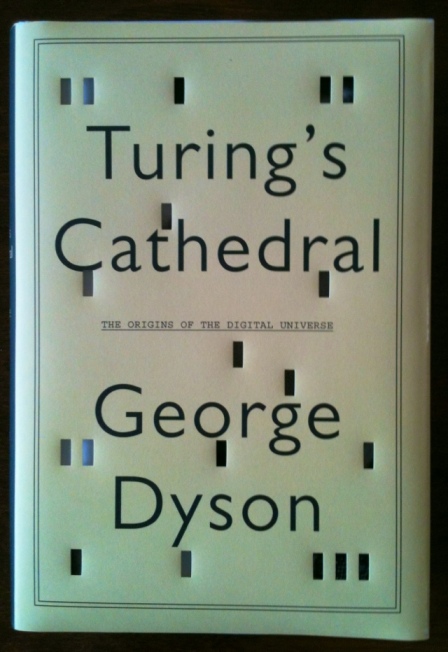
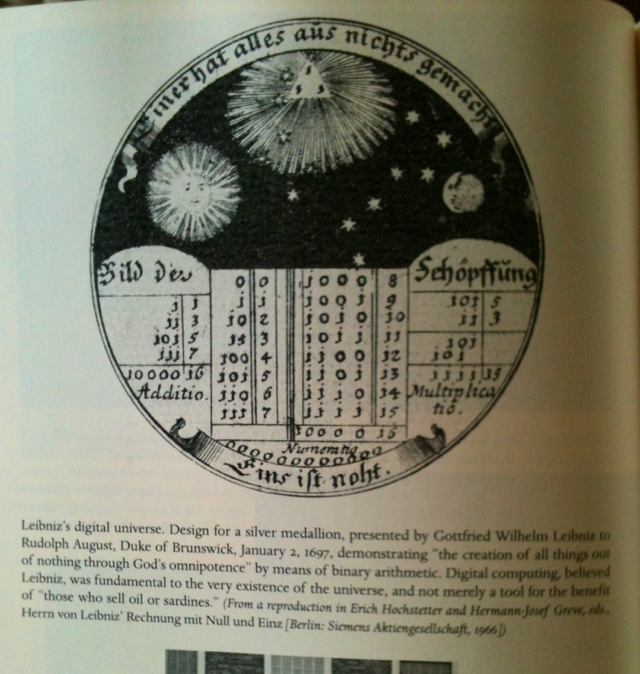
Turing’s Cathedral — George Dyson Explores the Origins of the Digital Universe (Book Acquired, 2.17.2012)

20120225-111107.jpg

George Dyson’s Turing’s Cathedral looks pretty cool. Here’s some copy from publisher Pantheon:

“It is possible to invent a single machine which can be used to compute any computable sequence,” twenty-four-year-old Alan Turing announced in 1936. In Turing’s Cathedral, George Dyson focuses on a small group of men and women, led by John von Neumann at the Institute for Advanced Study in Princeton, New Jersey, who built one of the first computers to realize Alan Turing’s vision of a Universal Machine. Their work would break the distinction between numbers that mean things and numbers that do things—and our universe would never be the same.

Using five kilobytes of memory (the amount allocated to displaying the cursor on a computer desktop of today), they achieved unprecedented success in both weather prediction and nuclear weapons design, while tackling, in their spare time, problems ranging from the evolution of viruses to the evolution of stars.

Dyson’s account, both historic and prophetic, sheds important new light on how the digital universe exploded in the aftermath of World War II. The proliferation of both codes and machines was paralleled by two historic developments: the decoding of self-replicating sequences in biology and the invention of the hydrogen bomb. It’s no coincidence that the most destructive and the most constructive of human inventions appeared at exactly the same time.

How did code take over the world? In retracing how Alan Turing’s one-dimensional model became John von Neumann’s two-dimensional implementation, Turing’s Cathedral offers a series of provocative suggestions as to where the digital universe, now fully three-dimensional, may be heading next.

I spent an hour with the book this morning and found it engrossing. (It was also a reminder that I don’t read enough nonfiction).

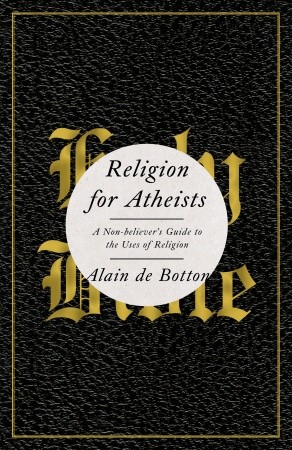
Regular readers will know I despise dust jackets—I’d rather see publisher’s put their efforts into handsome but simple hardback covers. Three out of the last four hardbacks to come in have done so, including Turing’s Cathedral:

20120225-111151.jpg

Still, the design concept for these books (Alain de Botton’s Religion for Atheists and Thomas Mallon’s Watergate are the other two) still involve an integration with the dust jacket. I’d like to see the dust jacket dusted, done away with, expired.

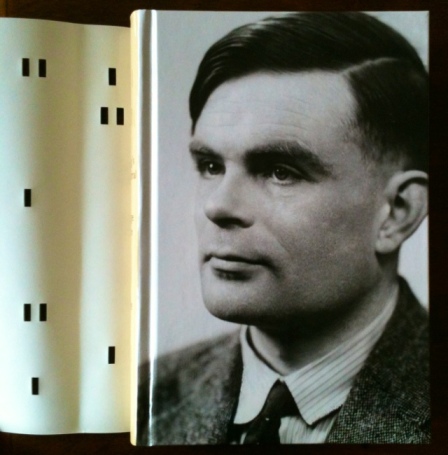
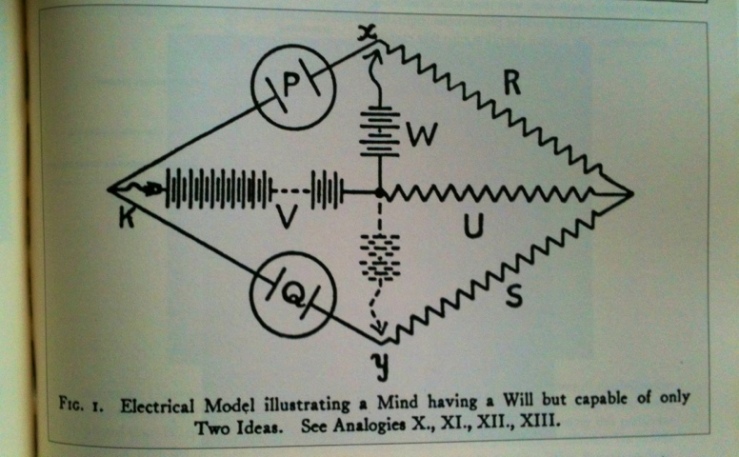
Some cool pics from the Dyson:

20120225-111159.jpg

20120225-111207.jpg

A Model Toward Helping Children Read Better

Umberto Eco’s Semiotic Schema for the Word “Neanderthal”

20120221-174318.jpg

(From The Role of the Reader by Umberto Eco) 

Alain de Botton’s Religion for Atheists: A Facile Self-Help Book that Entirely Misses the Point of Free Thinking

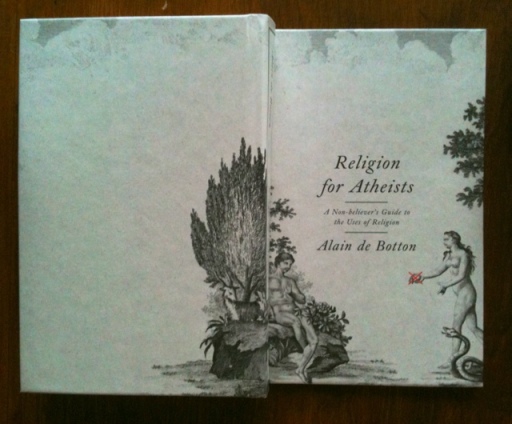
I’m slightly familiar with Alain de Botton’s work, and I’ve taken something of an interest in the so-called “New Atheist” movement — Hitchens, Dawkins, et al — so when a review copy of Religion for Atheists showed up a few weeks ago, it piqued my interest. I found its cover playfully annoying—a hole in the holy book—and its subtitle—A Non-believer’s Guide to the Uses of Religion—downright obnoxious. Still, I gotta give props to the design team at Pantheon for the book that’s under the horrid jacket: 
20120218-101910.jpg

Unfortunately, an attractive hardback design sans jacket is the best this book has to offer.

By way of explication (and my own laziness and indifference on this volume) here’s some copy on the book from de Botton’s website:

What if religions are neither all true or all nonsense? The boring debate between fundamentalist believers and non-believers is finally moved on by Alain’s inspiring new book, which boldly argues that the supernatural claims of religion are of course entirely false – and yet that religions still have some very important things to teach the secular world.

Religion for Atheists suggests that rather than mocking religions, agnostics and atheists should instead steal from them – because they’re packed with good ideas on how we might live and arrange our societies. Blending deep respect with total impiety, Alain (a non-believer himself) proposes that we should look to religions for insights into, among other concerns, how to:

– build a sense of community

– make our relationships last

– overcome feelings of envy and inadequacy

– escape the twenty-four hour media

– go travelling

– get more out of art, architecture and music

– and create new businesses designed to address our emotional needs.

For too long non-believers have faced a stark choice between either swallowing lots of peculiar doctrines or doing away with a range of consoling and beautiful rituals and ideas. At last, in Religion for Atheists, Alain has fashioned a far more interesting and truly helpful alternative.

The tone of the copy gives one a sense of the utter glibness of de Botton’s pamphlet. The book smacks of crude self-helpery, a hodgepodge of faux-intellectual poses for those who can smugly dismiss the history of philosophy. It’s like The Purpose Driven Life for atheists. There is a picture or graphic on every other page; de Botton seems to include these in lieu of, say, providing verbal imagery, or meaningful context, or simply trusting the intellect of his audience.

I suppose that I am fundamentally at odds with de Botton. I agree that religion has done much to initiate and facilitate (and in fairness, perhaps at times mitigate) atrocity; I agree that many (if not most) of the Big Problems in the world stem from the herd-mentality that organized religions impose on the people they indoctrinate. But de Botton would like to replace one herd with another.

Here is the Swiss writer suggesting that the academy (which he too-readily identifies as a bastion of atheist mores) follow the practices of black Southern Baptist churches:

The contrast with the typical lecture in the humanities could hardly be more damning. And unnecessary. What purpose can possibly be served by the academy’s primness? How much more expansive the scope of meaning in Montaigne’s essays would seem if a 100-strong and transported chorus were to voice its approval after every sentence. How much longer might Rousseau’s philosophical truths linger in our consciousness if they were structured around rhythmical verses of call-and-response. Secular education will never succeed in reaching its potential until humanities lecturers are sent to be trained by African-American Pentecostal preachers.

What we see here is a romanticization and idealization of a particular part of a culture that I think de Botton in no way understands. What’s even more disturbing here is his elevation of groupthink and indoctrination practices (I hear, “Oh no, I don’t want to play with Delta children” humming in the background). We see here the same teleological thinking that marks much of religious dogma, the sense that truth has been attained; the search is over—we just need to repeat it rhythmically enough, soak our young in it, until they think just like we do. This position strikes me as potentially dangerous as any organized religion’s attempts at indoctrination.

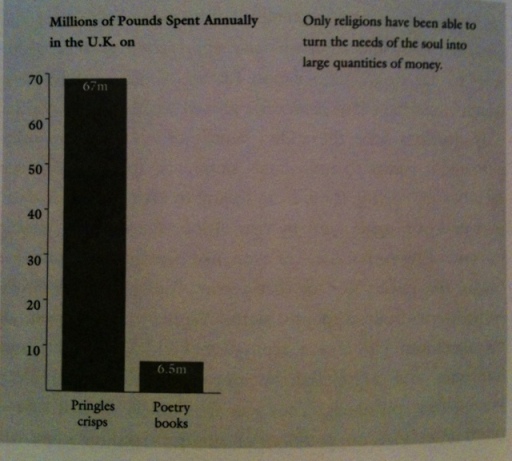
Religion for Atheists is full of sloppy logic gussied up in rushed anecdotes and glossed over with barely-connected pictures and silly graphs. Look at the following example, a visual non sequitur masquerading as meaningful information:
20120223-180200.jpg

Are we supposed to be horrified that the British spend more on potato chips than poetry books? Apples and oranges, bro. But what’s really ridiculous is the stinky pious claim that “Only religions have been able to turn the needs of the soul into large quantities of money.” This claim is plain silly, or at least predicated on a too-singular definition for “needs of the soul.”

Religion for Atheists seems to miss the point that many (if not most) atheists and agnostics are at heart free thinkers. De Botton romanticizes the mystery, awe, and grace of religion, even as he suggests that there is no metaphysical center from which these attributes emanate. His most basic argument really boils down to something like, “Hey, there is no God, no spirit, but religion does a good job of consoling people and keeping them in moral order, so, instead of TV and junk food, we should use the aesthetics of religion as consolation.” There is nothing revolutionary about this idea.

Religion for Atheists is a smug little tract, the sort of book that a supermarket would sell along with Chicken Soup for the Soul if supermarkets had the guts to sell self-help books for atheists. Readers should not be duped into thinking that de Botton has taken any real stance or said anything new here. Instead, hiding behind the pasteboard mask of utility, he offers a crass dodge away from meaningful inquiry. Get thee to Nietzsche instead.

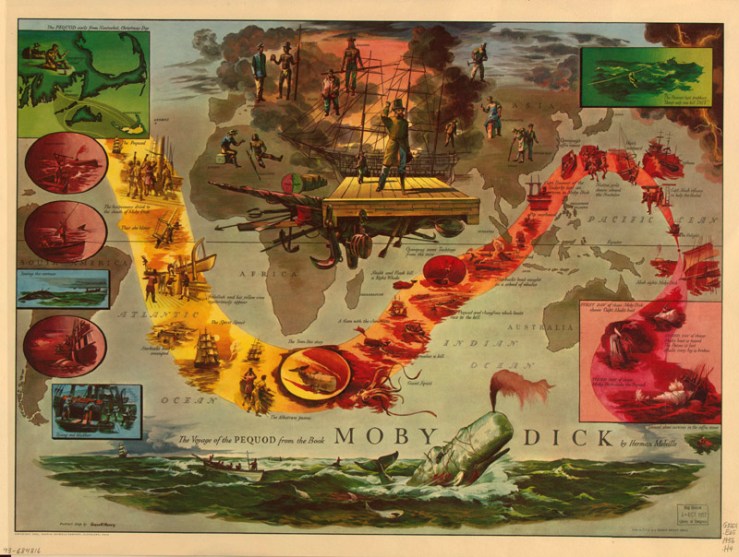
Voyage of the Pequod — A Map of Moby-Dick by Everett Henry

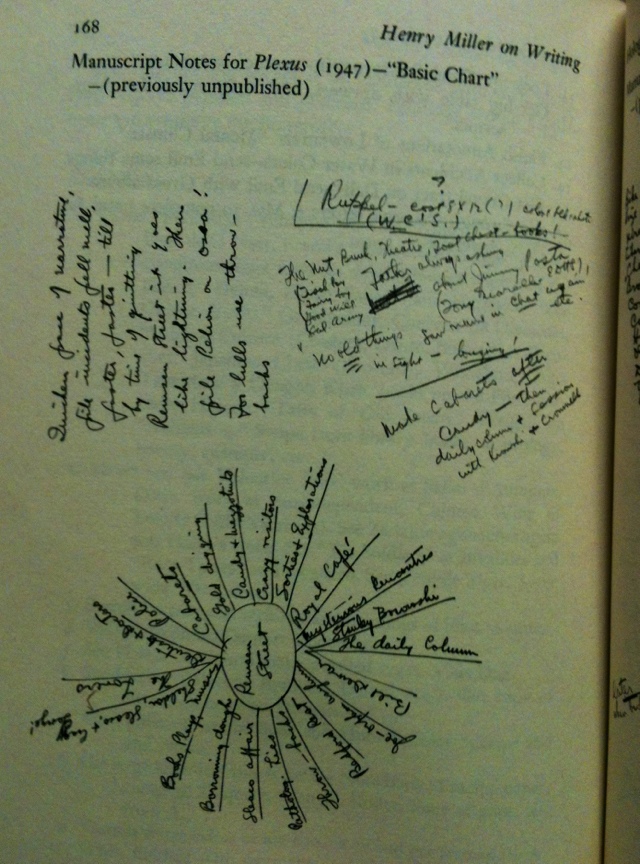
Henry Miller’s Basic Chart of Plexus

20120125-160448.jpg

(From Henry Miller on Writing, New Directions).

Buckminster Fuller Rambles Beautifully About Death

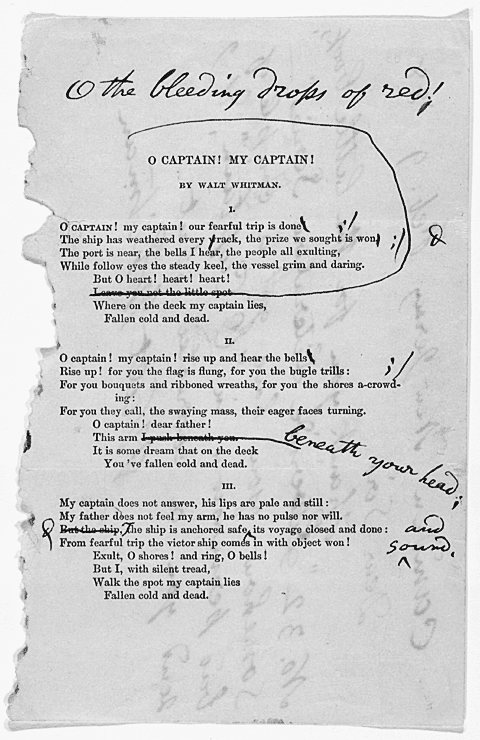
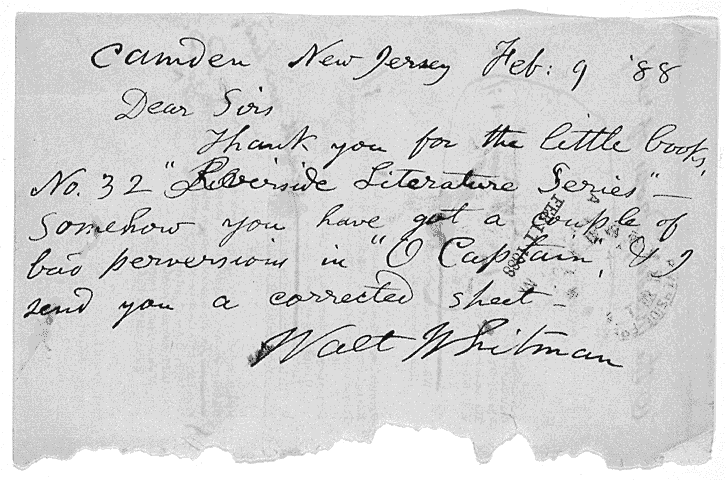
Letter and Corrected Reprint of Walt Whitman’s “O Captain, My Captain” with Comments by Author

(Via/more).

Ned Flanders Reads Harry Potter

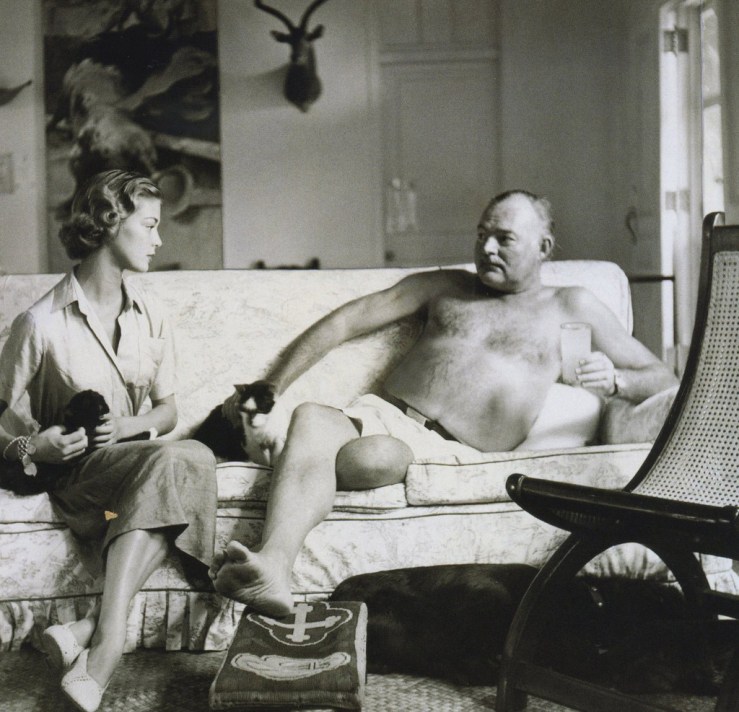
Topless Hemingway, Part IV

Pictured with Jean Patchett, Cuba, 1950

Siphonophorae — Ernst Haeckel

Alan Moore Talks Apocalypse (Video)

“My Tone Is Not Meant to Be Obnoxious. I Am in a State of Shock” — Flannery O’Connor Responds to an English Professor

From a 1961 letter by Flannery O’Connor to an English professor, who wrote her asking for an interpretation of her story “A Good Man Is Hard to Find.” In his letter, the professor concludes that the second half of the story is imaginary, an interpretation that seems to give Ms. O’Connor the vapors:

   The interpretation of your ninety students and three teachers is fantastic and about as far from my intentions as it could get to be.  If it were a legitimate interpretation, the story would be little more than a trick and its interest would be simply for abnormal psychology.  I am not interested in abnormal psychology.

There is a change of tension from the first part of the story to the second where the Misfit enters, but this is no lessening of reality.  This story is, of course, not meant to be realistic in the sense that it portrays the everyday doings of people in Georgia.  It is stylized and its conventions are comic even though its meaning is serious.

Bailey’s only importance is as the Grandmother’s boy and the driver of the car.  It is the Grandmother who first recognized the Misfit and who is most concerned with him throughout.  The story is a duel of sorts between the Grandmother and her superficial beliefs and the Misfit’s more profoundly felt involvement with Christ’s action which set the world off balance for him.

The meaning of a story should go on expanding for the reader the more he thinks about it, but meaning cannot be captured in an interpretation.  If teachers are in the habit of approaching a story as if it were a research problem for which any answer is believable so long as it is not obvious, then I think students will never learn to enjoy fiction.  Too much interpretation is certainly worse than too little, and where feeling for a story is absent, theory will not supply it.

My tone is not meant to be obnoxious.  I am in a state of shock.

Kurt Vonnegut on Story Shapes (Video)

I’d seen the diagrams, which I’ve used in the classroom for a few years now (along with Margaret Atwood’s excellent short short “Happy Endings”) but never seen this video (metaphorical hat tip to ‘klept reader ccllyyddee, who says he saw it at Curiosity Counts—cheers!).