At Penguin Classics on Air, David Simon explains how Stanley Kubrick’s film Paths of Glory—and the Humphrey Cobb novel it was based on–influenced his epic crime drama The Wire. (Via).
Vodpod videos no longer available.
At Penguin Classics on Air, David Simon explains how Stanley Kubrick’s film Paths of Glory—and the Humphrey Cobb novel it was based on–influenced his epic crime drama The Wire. (Via).
Vodpod videos no longer available.
Peter Lundren animates a sentence from Ben Stroud’s short story “Byzantium,” published in Electric Literature No. 4. Music by William “Lucky” Lee.
The sentence reads: “There I would watch others taking their pleasure—keeping to the shadows, my hand hidden, as I studied a chariot racer leaning into a prostitute, her leg wrapped round his torso, or libertines goading a gilded crocodile in the bearpit, their bodies slurred by powders from the east.”
Vodpod videos no longer available.
I will be trick or treating as a Francis Bacon painting this Halloween. (Via).
The National Post profiles Tom McCarthy about his new novel C. Here are a few choice lines from McCarthy–
From Cocteau’s Orphée–
Vodpod videos no longer available.
(Via).
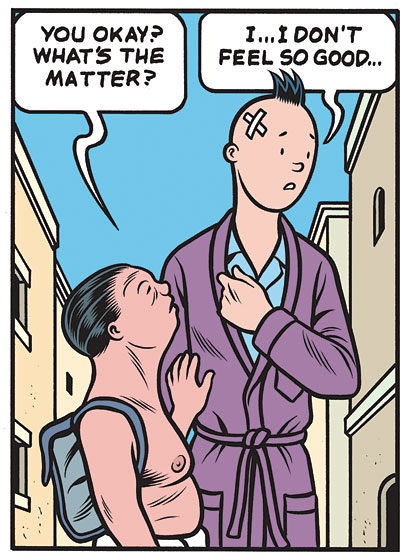
At New York Magazine, Charles Burns annotates a page from his excellent new graphic novel X’ed Out. See the slideshow here. A sample–
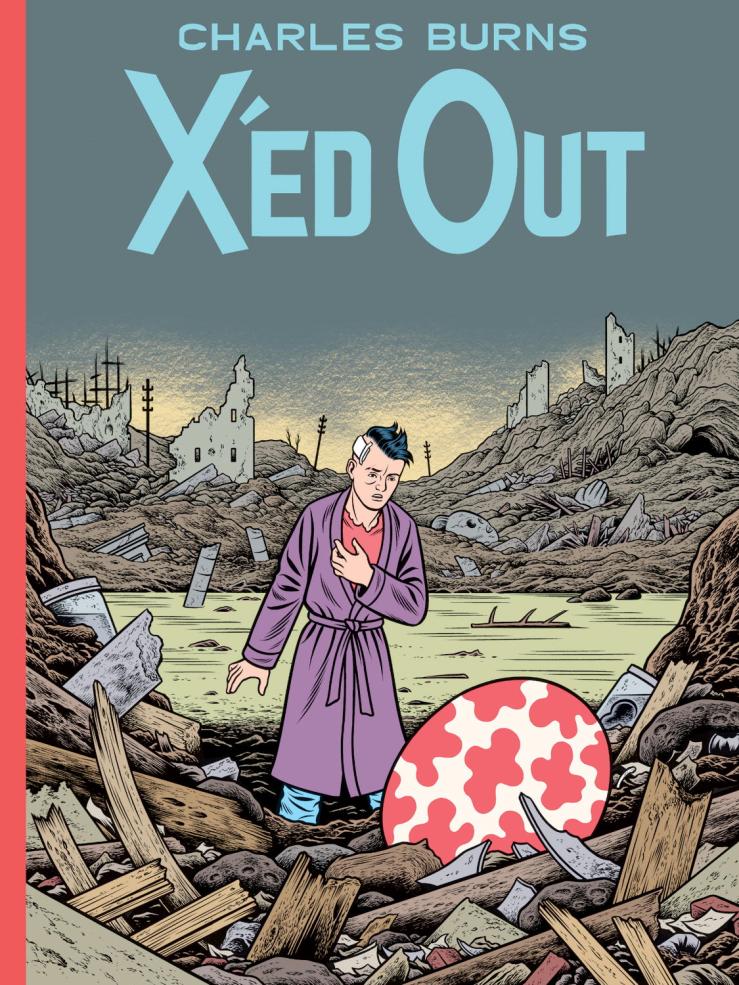
If you like Charles Burns, go ahead and pick up X’ed Out, the first (and very promising) entry in a new trilogy. Skip this review. You’ll probably be happier (and more unsettled) just experiencing all that vivid, glorious weirdness for yourself without any potential spoilers. If you need convincing, read on.
X’ed Out begins in a strange fever-dreamland that doesn’t immediately announce itself as such. Instead, we tentatively enter this weird world with Doug, the book’s protagonist, who, like Alice following the white rabbit, chases his (long dead) childhood cat through a crack in the wall. Doug traverses a cavernous, ruinous place, littered with murky detritus and swamped in a strange flood, to finally arrive in a bizarre desert town that approximates William Burroughs’s Interzone. Populated by mean lizards who dress like Mormon slackers and other grubby grotesques, the terrain readily recalls both Tatooine and Asian bazaars. Hapless Doug, still in pajamas, house coat, and slippers — and marked by an as-yet-unexplained head wound — soon finds himself under the guidance of a strange little diapered dwarf, who may or may not have his best interest in mind. The dreamworld unravels as Doug glances an old man — an “oldie,” as the dwarf says — who we will learn later is Doug’s father. An all of a sudden we’re back in the real world, back in waking life.
But no. That’s not right. Not “back” — we were never in the waking world to begin with. Significantly, X’ed Out begins in the Burroughsian dreamworld and then moves to a conscious, concrete reality. Burns’s dreamworld sequences explicitly reference Belgian cartoonist Hergé’s seminal Tintin comics (you can see how X’ed Out’s cover riffs on the Tintin adventure The Shooting Star here). Doug’s dream face is an expressive, stark mask, a naïve, cartoonish contrast to the bizarre nightmare to which it reacts.

Doug — the waking world Doug, the “real” Doug, that is — pulls a similar mask over his more realistically drawn face later in the story when he does his “Burroughs thing” at a slummy art punk party. Alienated from the scenesters who don’t get his cut-up poetry performance, Doug takes up with Sarah, a girl from his photography class with a thing for razor blades and pig hearts. The same night they meet, he loses his girlfriend, and her crazy boyfriend goes to jail for assaulting a cop. They initiate their romance in Patti Smith records, lines of cocaine, and sick Polaroids. Ah, young love.
But all of that is in another kind of dreamworld, the past, a retreat for the “real,” contemporary Doug, who spends his few waking hours cringing in his bathrobe, poring over old photos, and eating the occasional Pop Tart. At night he eats pain pills and goes to Interzone-land, a place that seems as real and solid and valid as his past with Sarah, a past he has apparently lost. Doug bears a huge patch over half his head (significantly x-shaped in his Interzone version), and both this wound as well as the psychic trauma he’s obviously endured (and is enduring) remain unexplained throughout X’ed Out. However, Burns’s often-grisly images hint repeatedly at a past event filled with violence and loss. X’ed Out leaves us in the Interzone, with the dwarf making long-term plans for Tintinized Doug. There’s even talk of establishing residency and employment–it feels like Doug is here to stay (at least in his non-waking hours). X’ed Out ends maddeningly with a girl who visually recalls Sarah being borne by lizard men to a giant hive. The dwarf explains that she is their new queen–and like some insect queen, she is a breeder. Yuck. The ending is the biggest problem with X’ed Out, simply because it leaves one stranded, wanting more weirdness.
In Black Hole, Burns established himself as a master illustrator and a gifted storyteller, using severe black and white contrast to evoke that tale’s terrible pain and pathos. X’ed Out appropriately brings rich, complex color to Burns’s method, and the book’s oversized dimensions showcase the art beautifully. This is a gorgeous book, both attractive and repulsive (much like Freud’s concept of “the uncanny,” which is very much at work in Burns’s plot). Like I said at the top, fans of Burns’s comix likely already know they want to read X’ed Out; weirdos who love Burroughs and Ballard and other great ghastly fiction will also wish to take note. Highly recommended.
X’ed Out is available in hardback from Pantheon on October 19th, 2010.
Andre da Loba animates a sentence from Roberto Ransom’s “Three Figures and a Dog.” Published in Electric Literature No. 4. Here’s the first paragraph–
He liked to be in the chapel at dawn, and also in the afternoon when something similar, though not identical, occurred. For that to happen, he had to leave home when his wife got up to milk the cow. He’d finally wake himself up by putting his hand into the bucket next to the well and wiping his face. He usually carried a loaf of bread, a piece of onion, and sometimes a little cheese, wrapped in a handkerchief. He’d leave his brushes, pencils, paints, and other tools in a corner of the chapel, behind some stones that hadn’t been used during its construction. He didn’t paint at that hour. He was waiting for the right color. He’d observe the sky and mix paints in a small clay vessel, smudging them with his finger, measuring quantities, adding water or oil or, on one occasion, wine. He imagined that if the wine was his blood and the blue of the sky he was seeking was the Virgin’s color, and the Virgin was his mother and if he and the Virgin were of the same blood, then maybe…


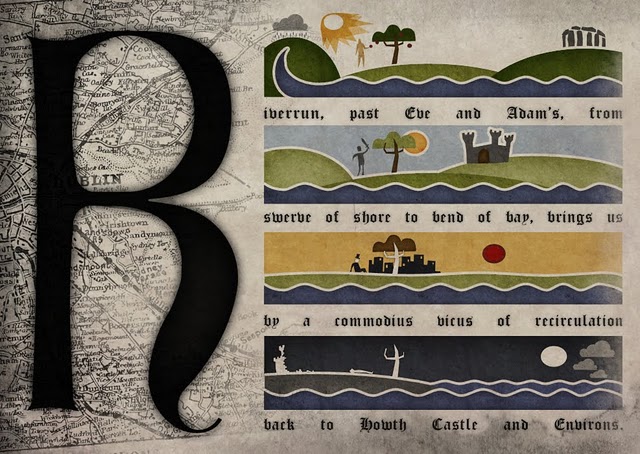
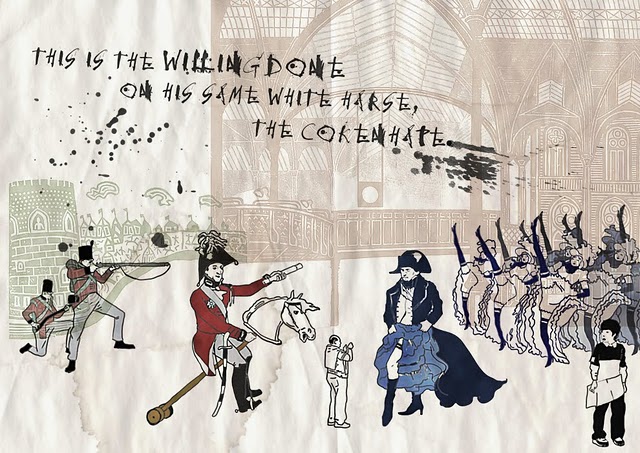
At Wake In Progress, Stephen Crowe has given himself the daunting task of illustrating James Joyce’s novel/linguistic black hole Finnegans Wake. It’s pretty cool stuff, and we love projects like these (see also: Six Versions of Blood Meridian and One Drawing for Every Page of Moby-Dick). Crowe’s site makes an interesting if different companion for the ongoing project at Ulysses “Seen.” Good luck to Stephen–keep them coming! (and thanks to @RhysTranter for sharing). More images–


In case you missed it: Last night’s episode of The Simpsons featured an intro directed by graffiti artist Banksy. The intro is a fairly grim, mostly unfunny satire of the how cheap South Korean and Chinese labor is used to produce The Simpsons animation and merchandise. Observe–

The New York Times profiles Karen Green, David Foster Wallace’s widow. The article details Green’s new art show Sure Is Quiet at the Space Arts Center and Gallery in South Pasadena,California. The article is worth reading in full, of course (it’s actually quite moving), but here are some of Green’s own words from the piece, on Wallace and her art—
David was a big sweater, and I just remember the sweat marks on his pillow when I changed the cases.
. . .
I wanted to redirect my anger, which is useless and fuels nothing, by invading my own privacy and then covering it up.
. . .
There’s been so much chaotic conversation in my head . . . I’ve been thinking, thinking so much. I wanted to take all the chaotic stuff and make it quiet.
. . .
David could be the great artist in the household, I didn’t care . . . I’ve been accused by academic friends of not having the right dialogue with the art world — not being knowledgeable about what’s cool, what’s desirable out there right now. But I’d rather work at Starbucks and make what I want.
. . .
I kept making art because I didn’t know what else to do, and that’s what I’ve always done . . . I felt everyone else was so much more advanced in the grieving process.
. . .
I really was thinking about language, the power of it . . . The power of David’s work, for example, which meant so much to people. But when you get as sick as he was, everything loses meaning.
. . .
You can be charmed and fooled by language . . It doesn’t stop, but it’s never enough.
Hamlet: The Facebook feed edition.
Every book mentioned on Mad Men so far.
Betting odds for the 2010 Nobel Prize for Literature (our boy Cormac McCarthy is at 8 to 1; Bob Dylan is at 150 to 1).
Folks are gettin’ hot and bothered about MFA programs.
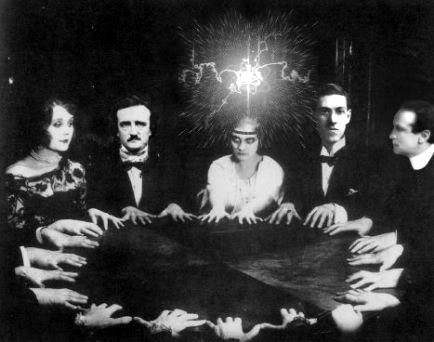
Linking to this post that is tangentially about Jean-Christophe Valtat’s awesome new book Aurorarama gives us an excuse to publish this weird pic of Edgar Allan Poe at a séance–
An inventory of opening sentences.
Vintage Portuguese book covers at A Journey Round My Skull.

 In his 1992 interview with The New York Times, Cormac McCarthy said, “The ugly fact is books are made out of books. The novel depends for its life on the novels that have been written.” McCarthy’s masterpiece Blood Meridian, as many critics have noted, is made of some of the finest literature out there–the King James Bible, Moby-Dick, Dante’s Inferno, Paradise Lost, Faulkner, and Shakespeare. While Blood Meridian echoes and alludes to these authors and books thematically, structurally, and linguistically, it also owes much of its materiality to Samuel Chamberlain’s My Confession: The Recollections of a Rogue.
Chamberlain, much like the Kid, Blood Meridian’s erstwhile protagonist, ran away from home as a teenager. He joined the Illinois Second Volunteer Regiment and later fought in the Mexican-American War. Confession details Chamberlain’s involvement with John Glanton’s gang of scalp-hunters. The following summary comes from the University of Virginia’s American Studies webpage—
According to Chamberlain, John Glanton was born in South Carolina and migrated to Stephen Austin’s settlement in Texas. There he fell in love with an orphan girl and was prepared to marry her. One day while he was gone, Lipan warriors raided the area scalping the elderly and the children and kidnapping the women- including Glanton’s fiancee. Glanton and the other settlers pursued and slaughtered the natives, but during the battle the women were tomahawked and scalped. Legend has it, Glanton began a series of retaliatory raids which always yielded “fresh scalps.” When Texas fought for its independence from Mexico, Glanton fought with Col. Fannin, and was one of the few to escape the slaughter of that regiment at the hands of the Mexican Gen. Urrea- the man who would eventually employ Glanton as a scalp hunter. During the Range Wars, Glanton took no side but simply assassinated individuals who had crossed him. He was banished, to no avail, by Gen. Sam Houston and fought as a “free Ranger” in the war against Mexico. Following the war he took up the Urrea’s offer of $50 per Apache scalp (with a bonus of $1000 for the scalp of the Chief Santana). Local rumor had it that Glanton always “raised the hair” of the Indians he killed and that he had a “mule load of these barbarous trophies, smoke-dried” in his hut even before he turned professional.
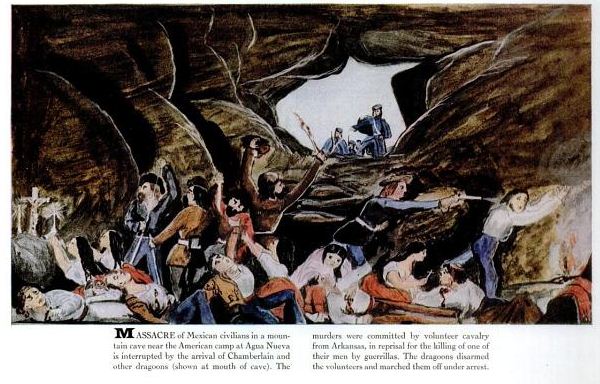
Chamberlain’s Confession also describes a figure named Judge Holden. Again, from U of V’s summary–
Glanton’s gang consisted of “Sonorans, Cherokee and Delaware Indians, French Canadians, Texans, Irishmen, a Negro and a full-blooded Comanche,” and when Chamberlain joined them they had gathered thirty-seven scalps and considerable losses from two recent raids (Chamberlain implies that they had just begun their careers as scalp hunters but other sources suggest that they had been engaged in the trade for sometime- regardless there is little specific documentation of their prior activities). Second in command to Glanton was a Texan- Judge Holden. In describing him, Chamberlain claimed, “a cooler blooded villain never went unhung;” Holden was well over six feet, “had a fleshy frame, [and] a dull tallow colored face destitute of hair and all expression” and was well educated in geology and mineralogy, fluent in native dialects, a good musician, and “plum centre” with a firearm. Chamberlain saw him also as a coward who would avoid equal combat if possible but would not hesitate to kill Indians or Mexicans if he had the advantage. Rumors also abounded about atrocities committed in Texas and the Cherokee nation by him under a different name. Before the gang left Frontreras, Chamberlain claims that a ten year old girl was found “foully violated and murdered” with “the mark of a large hand on her throat,” but no one ever directly accused Holden.
 It’s fascinating to note how much of the Judge is already there–the pedophilia, the marksmanship, the scholarship, and, most interesting of all, the lack of hair. Confession goes on to detail the killing, scalping, raping, and raiding spree that comprises the center of Blood Meridian. Chamberlain even describes the final battle with the Yumas, an event that signals the dissolution of the Glanton gang in McCarthy’s novel.

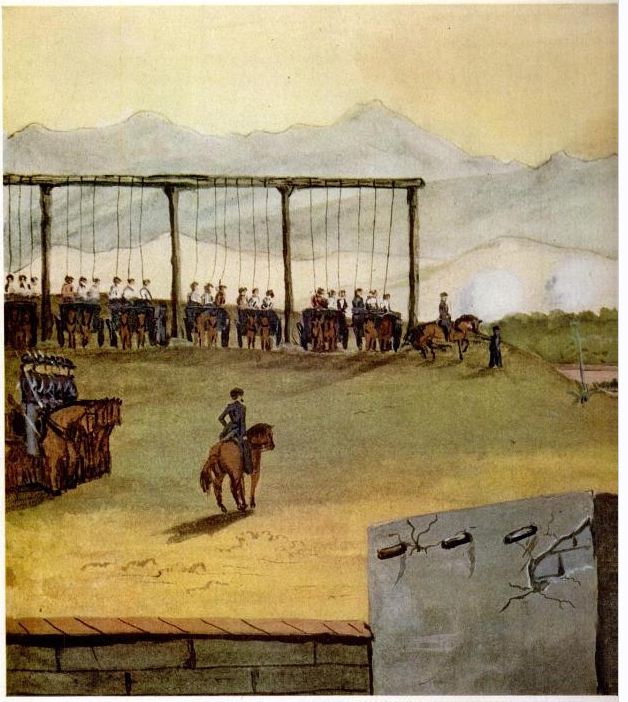
 Content aside, Chamberlain’s prose also seems to presage McCarthy’s prose. In his book Different Travelers, Different Eyes, James H. Maguire notes that, “Both venereal and martial, the gore of [Chamberlain’s] prose evokes Gothic revulsion, while his unschooled art, with its stark architectural angles and leaden, keen-edged shadows, can chill with the surreal horrors of the later Greco-Italian painter Giorgio de Chirico.” Yes, Chamberlain was an amateur painter (find his paintings throughout this post), and undoubtedly some of this imagery crept into Blood Meridian.
 You can view many of Chamberlain’s paintings and read an edit of his Confession in three editions of Life magazine from 1956, digitally preserved thanks to Google Books–here’s Part I, Part II, and Part III. Many critics have pointed out that Chamberlain’s narrative, beyond its casual racism and sexism, is rife with factual and historical errors. He also apparently indulges in the habit of describing battles and other events in vivid detail, even when there was no way he could have been there. No matter. The ugly fact is that books are made out of books, after all, and if Chamberlain’s Confession traffics in re-appropriating the adventure stories of the day, at least we have Blood Meridian to show for his efforts.
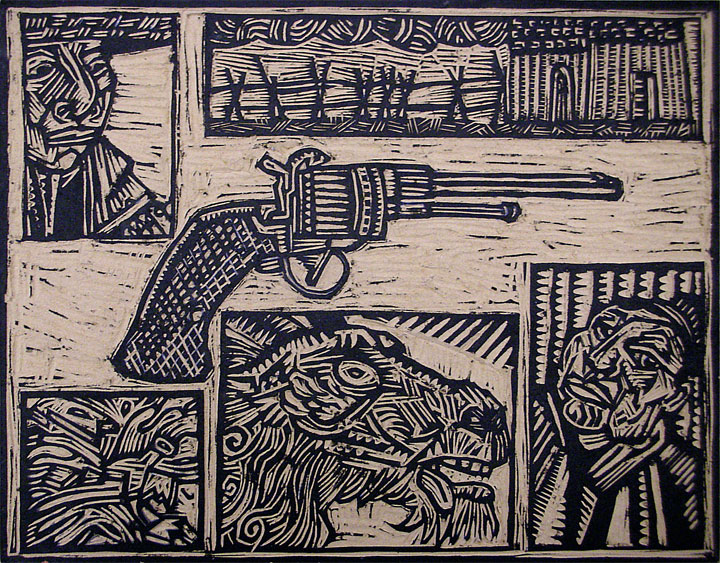
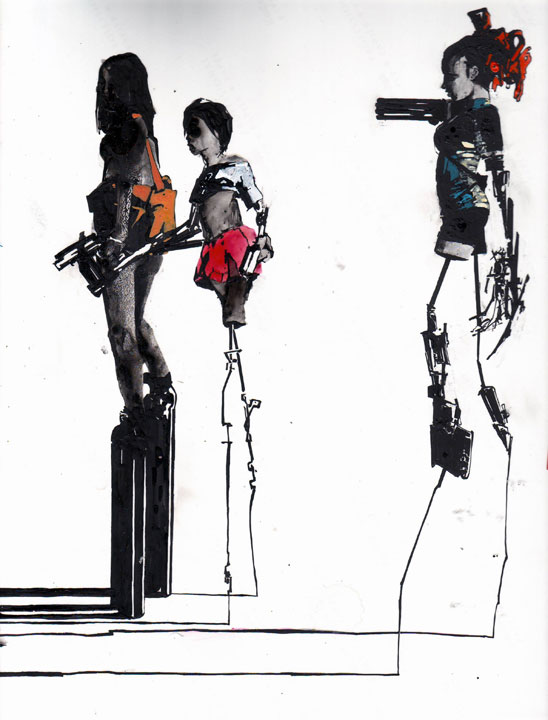
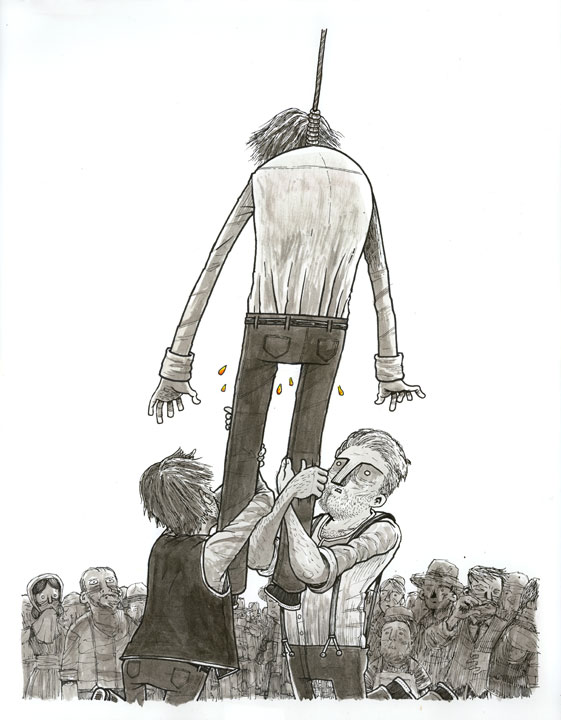
Six Versions of Blood Meridian is an ongoing project where six artists–Zak Smith, Sean McCarthy, John Mejias, Craig Taylor, Shawn Cheng, and Matt Wiegle–illustrate each page of Cormac McCarthy’s novel Blood Meridian. Zak Smith’s illustrations are particularly intriguing; he depicts the Glanton gang as women, a strange inversion that for some reason recalls the “Circe/Nighttown” episode of Joyce’s Ulysses. The Six Versions project’s eclectic range of styles and interpretations makes for one of the more fascinating approaches to a contemporary illuminated manuscript that I’ve seen on the internet (I’m also keen on Matt Kish’s handling of Moby-Dick). A few examples–
At A Piece of Monologue, Rhys Tranter reviews Simon Critchley’s “philosophical antidote to the self-help manual,” How to Stop Living and Start Worrying. Read our review of Critchley’s The Book of Dead Philosophers here.
MobyLives expands Flavorwire’s post on author photo clichés to include Melville House authors.
Here’s an author photo we love: Harold Bloom wearing big headphones and looking kinda skeptical and very green (the image is by Paul Festa from his film Apparition of the Eternal Church)–

If you still haven’t done your Juggalo Studies homework for this week, read Camille Dodero’s inspired report from this year’s The Gathering (at The Village Voice). And then watch “Miracles” again, because, hey, it only gets better. It still shocks the eyelids.
We love this tumblr (or is it tumblog?)–Anatomy–even if it looks like they aren’t doing much these days. C’mon guys. We need more gifs like this–

Finally, check out Stanford Kay’s series of paintings of books and bookshelves, “Gutenberg Variations.” Like abstract expressionism, only good (via) —

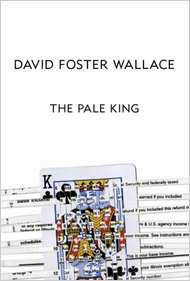
The New York Times reports that David Foster Wallace’s posthumous, unfinished novel The Pale King has the release date of April 15th, 2011–Tax Day–a fitting date, considering that the book is about an IRS tax return processing center. Little, Brown will publish the book. Here’s the cover–