My Father — George Adolphus Storey

My Father 1868 by George Adolphus Storey 1834-1919

My Father, 1868 by George Adolphus Storey (1834–1919)

Rédoine Faïd’s Outlaw, a crime memoir-in-interviews (Book acquired, 27 April 2020)

img_5690

I finally made some time this afternoon to dip into Rédoine Faïd’s memoir-in-interviews, Outlaw: Armed and Dangerous. It’s a propulsive, fast read so far–I put away the first 60 pages in one reading. Faïd, fresh out of prison, tells his life story to journalist Jérôme Pierrat. The book is newly-translated by John Galbraith Simmons and J.G. Barque, and available from Contra Mundum Press. Their blurb:

Memoirs of celebrated criminals purvey vivid personal stories while spawning sharp questions about the cultures that produced them. In Outlaw: Author Armed & Dangerous, Rédoine Faïd, of Algerian immigrant parents, born and raised in the housing projects surrounding Paris, recounts his career as an infamous and renowned bandit. Drawing inspiration and instruction from a host of films and television series, Faïd styled himself and was known to friends and accomplices as “Doc” — after Steve McQueen in the legendary suspense thriller, The Getaway.

With self-discipline and a striking ability to learn from experience, Faïd carried off his first robberies while still a teenager. He soon graduated from petty thievery to armed robbery, targeting computer component suppliers, jewelry stores, banks, and most memorably, armored trucks. A master of disguise, with bulletproof vest and a .357 Magnum as a prop to encourage compliance, he led a crew that operated with careful planning but eschewed bloodshed and physical violence.

In imitation of Michael Mann’s Heat, Faïd and his cohorts donned hockey masks for one job, sometimes even quoting from other famous heist films during their capers. When bold plans went wrong, he reacted with fast thinking that served him well — until it didn’t, and he was arrested and imprisoned in 1998.

Outlaw was first published in France in 2009, after which Faïd was imprisoned again. Subsequently, his dramatic escapes from jail, in 2013 and 2018, made front-page news in France and around the world.

Interviewed by journalist Jérôme Pierrat, who specializes in crime and investigative reportage, Rédoine Faïd tells his own story with panache and humor, darkened by introspection and cautionary tales. His story, like that of a character out of a Jean-Pierre Melville film or Dassin’s Rififi, is not only intriguing, it is also as compelling as any high-grade thriller. Three months after his daring helicopter escape from Réau Prison in 2018, Faïd was captured again. He currently remains in jail.

The Complete Short Stories of J.G. Ballard (Tenth Riff: The Eighties)

jgb_complete_ss4003111

PREVIOUSLY:

Introductions + stories 1956-1959

Stories of 1960

Stories of 1961

Stories of 1962

“The Subliminal Man,” Black Friday, and Consumerism

Stories of 1963-1964

Stories of 1966

Closing out the sixties

The seventies

IN THIS RIFF:

“A Host of Furious Fancies” (1980)

“News from the Sun” (1981)

“Memories of the Space Age” (1982)

“Myths of the Near Future” (1982)

“Report on an Unidentified Space Station” (1982)

“The Object of the Attack” (1984)

“Answers to a Questionnaire” (1985)

“The Man Who Walked on the Moon” (1985)

“The Secret History of World War 3” (1988)

“Love in a Colder Climate” (1989)

“The Enormous Space” (1989)

“The Largest Theme Park in the World” (1989)

“War Fever” (1989)

“News from the Sun” (1981) / “Myths of the Near Future” (1982) / “Memories of the Space Age” (1982)

Let me first confess how happy I am to be finished with this enormously enormous book (okay, not physically enormous on my Kindle, but still…). Let me also confess to dread at having to finish out these riffs (no, no one is forcing me, but still…). At this point, I feel like I could write my own Ballard story—a crazed astronaut here, a drained swimming pool there, a femme fatale, some psychotropic drugs, armchair psychology, a swamp, some birds (perhaps), a plane or two, time obsession, sex obsession, space obsession. Obsession obsession Anyway. Ballard arguably peaks in the early 1980s; everything after reads like a day-glow Keith Haringesque pop-approximation of his grittier seventies stuff—or (worse) scolding wrapped up in little morality plays.

But, like I said (wrote), Ballard is in his prime in the early 1980s, and “News,” “Myths,” and “Memories” are some of his finest stories (file these triplets in my quasi-fictional-but-c’mon-we-can-make-this-happen collection The Essential Short Stories of J.G. Ballard)—they are also some of his most Ballardian, riffing on space-travel-as-cosmic-taboo, paranoid parables obsessed with time. A particularly Ballardian paragraph (from “Memories”):

He had almost ceased to breathe. Here, at the centre of the space grounds, he could feel time rapidly engorging itself. The infinite pasts and future of the forest had fused together. A long–tailed parakeet paused among the branches over his head, an electric emblem of itself more magnificent than a peacock. A jewelled snake hung from a bough, gathering to it all the embroidered skins it had once shed.

(Parenthetical aside: “Myths” and “Memories” are both set in Florida. Ballard’s depiction of Florida feels thoroughly inauthentic (I’m Floridian), but that inauthenticity also feels thoroughly appropriate).

 “A Host of Furious Fancies” (1980)

Ballard constructs this little tale around a psychoanalytic reading of Cinderella:

The entire fairy tale of Cinderella was being enacted, perhaps unconsciously, by this deranged heiress. If she herself was Cinderella, Dr Valentina Gabor was the fairy godmother, and her magic wand the hypodermic syringe she waved about so spectacularly. The role of the pumpkin was played by the ‘sacred mushroom’, the hallucinogenic fungus from which psilocybin was extracted. Under its influence even an ancient laundry van would seem like a golden coach. And as for the ‘ball’, this of course was the whole psychedelic trip.

But who then was Prince Charming? As I arrived at the great mansion at the end of its drive it occurred to me that I might be unwittingly casting myself in the role, fulfilling a fantasy demanded by this unhappy girl. . . .

For all my resistance to that pseudo–science, it occurred to me that once again a psychoanalytic explanation made complete sense of these bizarre events and the fable of Cinderella that underpinned them. I walked up the staircase past the dismembered clock. Despite the fear–crazed assault on them, the erect hands still stood upright on the midnight hour – that time when the ball ended, when the courtships and frivolities of the party were over and the serious business of a real sexual relationship began. Fearful of that male erection, Cinderella always fled at midnight.

Etc.

Ballard’s Freudian riff would be more interesting as an essay.

(The story also showcases some of his typical chauvinism: The psychiatrist is described as the “woman psychiatrist” — just as earlier a dentist is referred to as a “lady dentist,” etc. Straight through to the end of the collection. In the 1990s).

“Report on an Unidentified Space Station” (1982) / “The Enormous Space” (1989)

“Report” and “Space” both read like takes on Sigizmund Krzhizhanovsky’s Soviet-era short story “Quadraturin” — both concern space, that corollary to time, and, just as Ballard repeatedly posits time as a matter of perspective, he treats space—area—the same way here. “Report” is a bit more satisfying than “Space,” which feels like a retread of so many of Ballard’s revenge stories—only with, uh, some comical cannibalism.

  1. “The Object of the Attack” (1984) / “Answers to a Questionnaire” (1985)

“Attack” and “Questionnaire” are maybe the same story—only “Questionnaire” is essentially perfect, whereas “Attack” feels like a clumsy, heavy first draft (but only because “Questionnaire” exists—do you see what I mean by this?)

Both stories showcase Ballard’s syntheses of religion (messianic; apocalyptic) and assassination (political; media-saturated). While “Attack” employs a discursive-but-still-linear approach to the theme, “Answers to a Questionnaire” gives us a discontinuous but more engaging riff in the form of (uh) exactly what its title promises.  First fifth:

1) Yes.

2) Male (?)

3) do Terminal 3, London Airport, Heathrow.

4) Twenty–seven.

5) Unknown.

6) Dr Barnardo’s Primary, Kingston–upon–Thames; HM Borstal, Send, Surrey; Brunel University Computer Sciences Department.

7) Floor cleaner, Mecca Amusement Arcades, Leicester Square.

8) If I can avoid it.

9) Systems Analyst, Sperry–Univac, 1979–83.

10) Manchester Crown Court, 1984.

11) Credit card and computer fraud.

12) Guilty.

13) Two years, HM Prison, Parkhurst.

14) Stockhausen, de Kooning, Jack Kerouac.

15) Whenever possible.

16) Twice a day.

17) NSU, Herpes, gonorrhoea.

18) Husbands.

19) My greatest ambition is to turn into a TV programme.

20) I first saw the deceased on 17 February 1986, in the chapel at London Airport. He was praying in the front pew.

Essential, natch.

“The Man Who Walked on the Moon” (1985)

I should’ve wedged this passable but ultimately forgettable little tale in elsewhere. J.G. Ballard’s faux memoir of a faux astronaut. Pass.

“The Secret History of World War 3” (1988)

“The Secret History of World War 3” is Ballard’s “I told you so” sequel to one of his best stories (frankly a much better story), 1968’s “Why I Want to Fuck Ronald Reagan.” In his unofficial sequel, Ballard imagines (the horror!) of a third Reagan term (post-Bush 1), in which the country is obsessed with the President’s (lack of) health:

…the nation’s TV screens became a scoreboard registering every detail of the President’s physical and mental functions. His brave, if tremulous, heartbeat drew its trace along the lower edge of the screen, while above it newscasters expanded on his daily physical routines, on the twenty–eight feet he had walked in the rose garden, the calorie count of his modest lunches, the results of his latest brain–scan, read–outs of his kidney, liver and lung function. In addition, there was a daunting sequence of personality and IQ tests, all designed to reassure the American public that the man at the helm of the free world was more than equal to the daunting tasks that faced him across the Oval Office desk.

The story concerns a man who—alone, always alone, despite his wife, I mean this is Ballard here, hero’s alone (and rightjustified) in his paraonoia—a man who is the only person to remember the brief outbreak of WW3, wedged, as it is, among updates of Ronnie and Nancy’s bowel movements. The story is farcical but juvenile, and if it seems surprisingly sophomoric, it’s worth noting that “TSHofWW3” echoes not just “Fuck Ronald Reagan,” but also one of Ballard’s earliest efforts, “Escapement” (1956), where a man sits on his couch in disbelief as his wife (stand-in for the whole world) fails to perceive what he perceives.

“Love in a Colder Climate” (1989) / “The Largest Theme Park in the World” (1989) /“War Fever” (1989)

A trio of late period lectures blazoned in the day glow approximations that anyone who live in the late eighties will not-so-fondly recall. Ballard evokes the neon apocalyptic impulses of the day, reworking his familiar themes—reproduction, civilization, war (etc.). Our baroque surrealist’s strokes are broader, not as sharp, more magnified—more Haring than Delvaux. Michel Houellebecq will pick up JGB’s torch here (with arguably better results) a decade and a half later.

On the horizon:

A handful of stories of the nineties: Or: Ballard returns to the same well with diminishing returns.

[Ed. note: Biblioklept originally ran a series of posts on The Complete Short Stories of J.G. Ballard between October 2013 and March 2014.]

The Complete Short Stories of J.G. Ballard (Eighth Riff: Closing Out the Sixties)

jgb_complete_ss40031

PREVIOUSLY:

Introductions + stories 1956-1959

Stories of 1960

Stories of 1961

Stories of 1962

“The Subliminal Man,” Black Friday, and Consumerism

Stories of 1963-1964

Stories of 1966

IN THIS RIFF:

“Cry Hope, Cry Fury!” (1967)

“The Recognition” (1967)

“The Cloud–Sculptors of Coral D” (1967)

“Why I Want to Fuck Ronald Reagan” (1968)

“The Dead Astronaut” (1968)

“The Comsat Angels” (1968)

“The Killing Ground” (1969)

“A Place and a Time to Die” (1969)

“Say Goodbye to the Wind” (1970)

“Cry Hope, Cry Fury!” (1967) / “The Cloud-Sculptors of Coral D” (1967) / “Say Goodbye to the Wind” (1970)

Ballard’s Vermilion Sands stories, collected and published together (under the title Vermilion Sands in 1971), are generally my least favorite selections in The Complete Short Stories of J.G. Ballard. The stories, composed over a decade, share a unified tone and a consistent (first-person) point of view to match their unified setting, and that setting is interesting enough—Ballardian enough—but each story is essentially just a delivery mechanism for a Cool Idea that Ballard has about art.

In “Cry Hope, Cry Fury!”, Ballard’s Cool Idea is a light-responsive painting technique:

Like all paintings produced at Vermilion Sands at that time, it would not actually need the exercise of the painter’s hand. Once the pigments had been selected, the photosensitive paint would produce an image of whatever still life or landscape it was exposed to. Although a lengthy process, requiring an exposure of at least four or five days, it had the immense advantage that there was no need for the subject’s continuous presence. Given a few hours each day, the photosensitive pigments would anneal themselves into the contours of a likeness.

This discontinuity was responsible for the entire charm and magic of these paintings. Instead of a mere photographic replica, the movements of the sitter produced a series of multiple projections, perhaps with the analytic forms of cubism, or, less severely, a pleasant impressionistic blurring.

The idea is interesting in and of itself, calling back to the central conceit of another VS story, “Studio 5, The Stars.” In that tale, poetry is the automated product of programmed machines. The concept of programmed art is fascinating, and clearly Ballard’s fiction tracks a predictive curve, but like most Vermilion Sands stories, “Cry Hope, Cry Fury!” is clumsily executed pulp fiction. “The Cloud-Sculptors of Coral D” is no different (the Cool Idea is cloud-sculpting, which allows Ballard to riff on one of his central motifs, airplanes). “Say Goodbye to the Wind” features living, responsive clothing. It also features another stereotypical Ballardian (pseudo)ingénue (the man really had a difficult time coming up with complex female characters). However, with its notes on “the teenage cult” and its obsession with plastic surgery, the story points to the more compelling territory Ballard was exploring.

“The Recognition” (1967)

A doomed circus, another (pseudo)ingénue, another dwarf, another morality fable, another stab at magical realism—far less successful than “The Drowned Giant” though.

“Why I Want to Fuck Ronald Reagan” (1968)

This is one you might as well just read: I mean, an attempt to describe it here will fail. But I’ll fail anyway.

“Reagan” was first published when the former actor and then-Governor of California was positioned as a write-in candidate for the ’68 election—the Gipper was the conservative alternative to Nixon. Written in the style of an academic psychology paper, the piece isn’t so much satire as something else entirely. I’m not sure exactly what that “something else” is, but it’s probably best signaled in Ballard’s own prose:

Sexual fantasies in connection with Ronald Reagan. The genitalia of the Presidential contender exercised a continuing fascination. A series of imaginary genitalia were constructed using (a) the mouth–parts of Jacqueline Kennedy, (b) a Cadillac rear–exhaust vent, (c) the assembly kit prepuce of President Johnson, (d) a child–victim of sexual assault. In 89 per cent of cases, the constructed genitalia generated a high incidence of self–induced orgasm. Tests indicate the masturbatory nature of the Presidential contender’s posture. Dolls consisting of plastic models of Reagan’s alternate genitalia were found to have a disturbing effect on deprived children.

According to a number of sources, including Ballard himself, the story was disseminated at the 1980 Republican National Convention in Detroit. VICE reports:

. . . a number of still-unknown former Situationists got hold of letterhead stamped with the seal of the Republican National Committee, upon which they printed Ballard’s Reagan text, replaced his offending title with the innocuous, “Official Republican 1980 Presidential Survey,” and managed to distribute copies to delegates on the convention floor in Detroit, one of the most audacious acts of political theater in our time.

“Reagan” is one of only three sections of The Atrocity Exhibition collected in The Complete Stories. It also clearly belongs in The Essential Short Stories of J.G. Ballard, an ideal collection that does not yet exist.

“The Dead Astronaut”

Betrayal, unfaithful wives, the fall-out of the space race against the backdrop of the Cold War, paranoia, radiation, etc.

“The Comsat Angels”

Ballard’s best stories, like “The Index,” “Why I Want to Fuck Ronald Reagan,” “The Beach Murders,” or “Answers to a Questionnaire” all succeed because their form is indivisible from their content—the idea that Ballard delivers is inseparable from the method of delivery. Most of Ballard’s stories are beholden to genre conventions though, and while Ballard’s treatment of these conventions are often excellent (and sometimes not-so-excellent), against the backdrop of his best stuff, the conventional exercises are always a little disappointing, or at least frustrating. Often clunky and heavy-handed, his stories for sci-fi mags are often the worst offenders.

However, when Ballard works through the conventions of detective fiction, he usually has stronger results. Edgar Allan Poe is surely Ballard’s foremost literary ancestor, a comparison that finds illustration in “The Comsat Angels,” a detective piece with a nimble streak of sci-fi running through it for flavor. Cloning, conspiracy, and paranoia done right. Great stuff.

“The Killing Ground” (1969) / “A Place and a Time to Die” (1969)

These stories are basically thought exercises where Ballard takes on the Vietnam War and its simultaneous culture war. “The Killing Ground” foregrounds the Vietnam War, but still displaces it, extrapolating a future where “Thirty years after the original conflict in south–east Asia, the globe was now a huge insurrectionary torch, a world Vietnam,” with Imperial America dominating the globe with its war machine. (Thank goodness nothing like that really happened!).  “A Place and a Time to Die” is more oblique, a tale of fear of invading otherness. “A Place and a Time to Die” could resonate just as strongly today in contemporary America, with its exurbs and gated communities and Stand Your Ground laws.

On the horizon:

Some of Ballard’s best, including “The Index” and another (oblique) Vietnam story, “Theatre of War.” I’ll also riff on Ballard’s pseudo-but-not-so-pseudo-autobiographical story, “Notes Toward a Mental Breakdown.”

[Ed. note: Biblioklept originally ran a series of posts on The Complete Short Stories of J.G. Ballard between October 2013 and March 2014.]

The Complete Short Stories of J.G. Ballard (Seventh Riff: 1966)

jgb_complete_ss40031

PREVIOUSLY:

Introductions + stories 1956-1959

Stories of 1960

Stories of 1961

Stories of 1962

“The Subliminal Man,” Black Friday, and Consumerism

Stories of 1963-1964

IN THIS RIFF:

“The Beach Murders'”(1966)

“The Day of Forever” (1966)

“The Impossible Man” (1966)

“Storm–Bird, Storm–Dreamer” (1966)

“Tomorrow is a Million Years” (1966)

“The Assassination of John Fitzgerald Kennedy Considered as a Downhill Motor Race” (1966)

“The Beach Murders” (1966)

Up until the mid-sixties, Ballard wasn’t able to find a rhetoric to match his ideas. Perhaps this makes sense if we consider that Ballard’s fiction has always been more interested in art, music, film, and biology than literature itself. He still relied on the tropes of magazine pulp fiction and hard-boiled detective stories to frame his tales, and while even the weakest of these tales was better than an episode of The Twilight Zone, they still occupied the same territory. Although Ballard’s earliest stories are distinctly Ballardian–obsessed with time, saturated in surrealism and psychology, shot through with a Cold War era paranoia and its attendant nihilism—it’s not until 1964, in the fragmentary “The Terminal Beach,” and the wry fabulism of “The Drowned Giant,” that Ballard finally merges form and content.

With “The Beach Murders,” Ballard manages to overstuff all of his tropes into a strange burlesque game. Paranoid, breast-obsessed, violent and funny, “The Beach Murders” comprises 26 sections, one for each letter in the English alphabet. And like the alphabet, Ballard’s story can be combined in any number of possibilities. In his introduction to the story, the narrator hints at a solution to the puzzle, before pointing out that any “final answer” will forever remain unclear:

Readers hoping to solve the mystery of the Beach Murders – involving a Romanoff Princess, a CIA agent, two of his Russian counterparts and an American limbo dancer – may care to approach it in the form of the card game with which Quimby, the absconding State Department cipher chief, amused himself in his hideaway on the Costa Blanca. The principal clues have therefore been alphabetized. The correct key might well be a familiar phrase, e. g. PLAYMATE OF THE MONTH, or meaningless, e. g. qwertyuiop… etc. Obviously any number of solutions is possible, and a final answer to the mystery, like the motives and character of Quimby himself, lies forever hidden.

“The Beach Murders” reads like a postmodern update of one of Edgar Allan Poe’s detective stories. Its gestures recall the fragmentation of his hero William Burroughs, as well as the techniques of his American contemporary Donald Barthelme–not to mention the emerging wave of continental deconstruction. It’s also very, very fun. Part of my ideal collection, The Essential Short Stories of J.G. Ballard.

“The Day of Forever” (1966)

It’s tempting to give in to biographical criticism when considering the subtle but significant shift in Ballard’s work after the shocking death of his wife Helen in 1964. While themes of loss, sleeplessness, and despair reverberate through many (if not most) of his early stories, they become sharper, more defined after 1964.

“The Day of Forever” is not exactly a great story, especially if you do what I’m doing—that is, read all of his stories chronologically. The story, about a world that has ceased to rotate, feels like a series of sketches that Ballard is using for something bigger (or has left out of something bigger). Taken in the context of his wife’s death, however, the story seems richer, sadder, more personal in its evocations of dreamlessness and loss.

When the story’s protagonist Halliday raids an abandoned gallery for its surrealist images, it’s hard not to intuit Ballard’s own desire to recover the unrecoverable:

In the students’ gallery hung the fading reproductions of a dozen schools of painting, for the most part images of worlds without meaning. However, grouped together in a small alcove Halliday found the surrealists Delvaux, Chirico and Ernst. These strange landscapes, inspired by dreams that his own could no longer echo, filled Halliday with a profound sense of nostalgia. One above all, Delvaux’s The Echo’, which depicted a naked Junoesque woman walking among immaculate ruins under a midnight sky, reminded him of his own recurrent fantasy. The infinite longing contained in the picture, the synthetic time created by the receding images of the woman, belonged to the landscape of his unseen night.

Delvaux’s The Echo

 “The Impossible Man” (1966)

The theme of recovery surfaces again in “The Impossible Man,” where a young man named Conrad (insert observation here that so many of Ballard’s protagonist’s are nakedly named for writers) is given the chance to walk again after a terrible accident—he’ll receive the limbs of a man who died causing the accident. With its fetishizing of scars, auto accidents, and surgery, “The Impossible Man” points directly toward Ballard’s weirdest works, The Atrocity Exhibition and Crash.

“Storm–Bird, Storm–Dreamer” (1966)

“Storm-Bird, Storm-Dreamer” evokes a rich, Gothic world, a swampland where humans battle mutant birds. Here, a strange woman in mourning awaits the return of her lost child (there’s that theme again!) through some avian agency. There are skiffs and pergolas and feathers and shotguns. There is a dwarf. Dark and romantic, the tale’s themes—and the delivery of those themes—recall Ballard’s earlier forays into magical realism, “The Drowned Giant” and 1962’s “The Garden of Time.”

“Tomorrow is a Million Years” (1966)

Ballard’s narrator in “Tomorrow is a Million Years” directly invokes Robinson Crusoe and Moby-Dick and alludes to the myth of the Flying Dutchman. Allusion is a fundamental trope of literature—indeed, most literature seems to take literature as its own subject—but Ballard’s allusions, beyond his character names (he christens a character in 1967’s “Cry Hope, Cry Fury!” Melville) tend to skew toward art and music. The allusions to doomed voyages and shipwreck are appropriate here, and Ballard synthesizes them into a tale of madness and hallucination. And, at the risk of spoiling the tale’s shocking ending, I’ll suggest again that Ballard is writing through/to/around/beneath the death of his wife.

“The Assassination of John Fitzgerald Kennedy Considered as a Downhill Motor Race” (1966)

Ballard begins “Assassination” with an author’s note:

The assassination of President Kennedy on November 22nd, 1963, raised many questions, not all of which were answered by the Report of the Warren Commission. It is suggested that a less conventional view of the events of that grim day may provide a more satisfactory explanation. In particular Alfred Jarry’s “The Crucifixion Considered as an Uphill Bicycle Race” gives us a useful lead.

Author of the infamous proto-surrealist play Ubu Roi, Alfred Jarry’s pataphysical conceits undoubtedly influenced and engaged Ballard, offering him new ways of writing beyond the constraints of his earlier pulp fiction. Published almost 60 years after Jarry’s death, “Assassination” is just as shocking as the text it’s modeled on, suggesting that the disruptive powers of language that Ballard was beginning to experiment with retain vitality outside of history. It’s worth sharing the opening paragraphs of “Assassination”:

Oswald was the starter.

From his window above the track he opened the race by firing the starting gun. It is believed that the first shot was not properly heard by all the drivers. In the following confusion Oswald fired the gun two more times, but the race was already under way.

Kennedy got off to a bad start.

There was a governor in his car and its speed remained constant at about fifteen miles an hour. However, shortly afterwards, when the governor had been put out of action, the car accelerated rapidly, and continued at high speed along the remainder of the course.

The visiting teams. As befitting the inauguration of the first production car race through the streets of Dallas, both the President and the Vice–President participated. The Vice–President, Johnson, took up his position behind Kennedy on the starting line. The concealed rivalry between the two men was of keen interest to the crowd. Most of them supported the home driver, Johnson.

If “Kennedy got off to a bad start” doesn’t crack you up then it’s likely this story isn’t for you. Ballard’s humor often rests entirely on a kind of moral irony in his earlier stories (you know, like something from the Twilight Zone series), but “Assassination” shows a wry constraint, a trust in the reader that probably originated in Ballard’s growing comfort in his own powers. (Later stories like “The Greatest Television Show on Earth” and “The Life and Death of God” advance Ballard’s control of dark humor).

“The Assassination of John Fitzgerald Kennedy Considered as a Downhill Motor Race” was published in The Atrocity Exhibition; for whatever reason, The Complete Short Stories only includes two other stories from that collection (“Why I Want to Fuck Ronald Reagan” and “The Secret History of World War 3,” which wasn’t actually part of the original AE pressing). So maybe Complete is not so complete.

Should go without saying: Essential.

Hear an audio version here.

 On the horizon:

I’m actually almost finished with the book (my Kindle tells me I’m at 72%). I should probably slow down and try to take more notes for these riffs—or just write faster and looser. But the reading becomes far more compelling at this point, as Ballard transcends the limitations of sci-fi pulp and begins to contend with his surrealist forbears. Next time: “Why I Want to Fuck Ronald Reagan”! Another Vermilion Sands story—this one not so bad! Ballard takes on Vietnam! Etc.

[Ed. note: Biblioklept originally ran a series of posts on The Complete Short Stories of J.G. Ballard between October 2013 and March 2014.]

Tutte — Jen Mazza

sdtutte

Tutte, 2009 by Jen Mazza (b. 1972)

Edith Sitwell — Wyndham Lewis

Edith Sitwell 1923-35 by Wyndham Lewis 1882-1957

Edith Sitwell, 1923–35 by Wyndham Lewis (1882–1957)

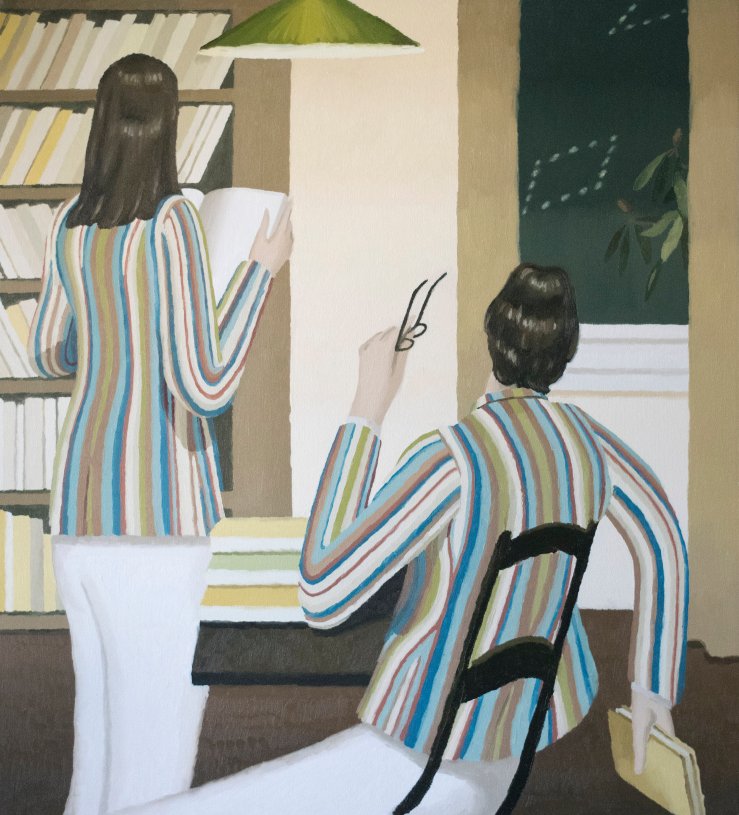
Book Club — Greg Burak

bookclubnew

Book Club, 2018 by Greg Burak (b. 1986)

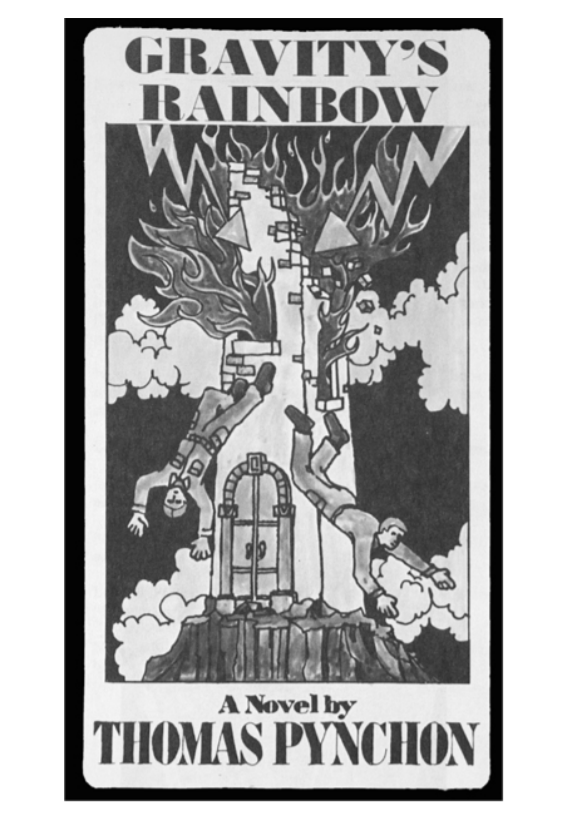
Trial cover art for Gravity’s Rainbow

trial art for gr

This trial cover for Thomas Pynchon’s novel Gravity’s Rainbow is included in Luc Herman and Steven Weisenburger’s book Gravity’s Rainbow, Domination, and Freedom (University of Georgia Press, 2013).

Herman and Weisenburger note the existence of an even earlier version with Pynchon’s working title Mindless Pleasures. I found it quickly at Pynchon Wiki, which notes:

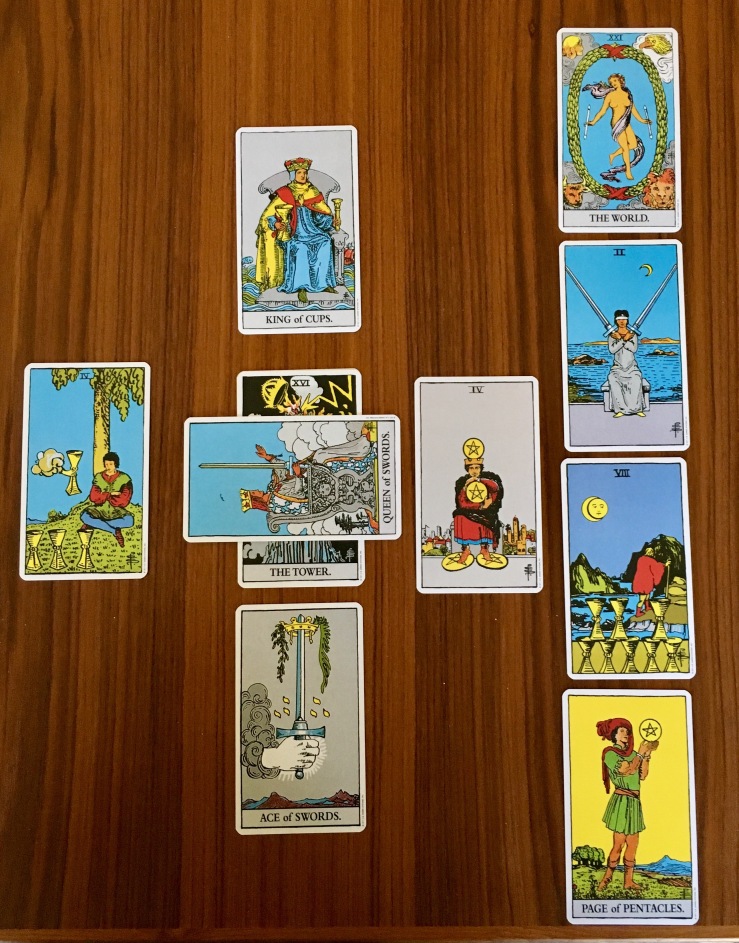
how the image is based on the Tarot card The Tower, which – as we learn in Weissmann’s Tarot (p. 746-47) – represents “any System which cannot tolerate heresy: a system which, by its nature, must sooner or later fall. We know by now that it is also the Rocket.”

mindless-pleasures

Here are Herman and Weisenburger on that first title, Mindless Pleasures:

…Pynchon’s, or perhaps the Viking editors’, extraction of that phrase [“mindless pleasures”] for the book title, although scotched, surely indexed some shared sense of thematic relevance. An early trial cover put the title “Mindless Pleasures” over a cleverly stylized version of the Tower, a key card in Weissmann/Blicero’s tarot reading. A second trial cover, also scotched, put “Gravity’s Rainbow” over the same image. The Tower gathers several interpretations, most notably (says our narrator) that of “a Gnostic or Cathar symbol for the Church of Rome, and this is generalized to mean any system which cannot tolerate heresy: a system which, by its nature, must sooner or later fall. We know by now that it is also the Rocket.” The notion of tolerance and intolerance is catchy and may also link to Marcuse on repression…. One reading of this cover would be that mindless pleasures bring down the system, are anathema to it. The common gloss of “mindless” is that it refers to the contrary of normativity, or not a mentality conditioned or “defined within rigid societal parameters”…. This contrariness presumes a hierarchy, an established order elevated above a variety of upstart alternatives, many of them popular, carnivalesque, of the body. And the arts are among them…

Weissmann’s tarot:

img_4289-1

Herman and Weisenburger cite Clifford Mead’s Thomas Pynchon: A Bibliography of Primary and Secondary Materials (Dalkey, 1989) as their source for the trial cover.

As far as I can find, no cover designer is credited.

Canto XX — Tom Phillips

Canto XX: [no title] 1982 by Tom Phillips born 1937

Canto XX, 1982 by Tom Phillips (b. 1937). From the Dante’s Inferno series.

Christian Retreat — Eric Fischl

80_035

Christian Retreat, 1980 by Eric Fischl (b. 1948)

Thomas Pynchon beats J.G. Ballard to win the 2020 Tournament of Zeitgeisty Writers

2020-03-31_183554

Thomas Pynchon beat out J.G. Ballard, earning 61% of 337 votes of my totally-scientific and not-at-all arbitrary twitter poll to become the Champion of the 2020 Tournament of Zeitgeisty Writers. Mr. Pynchon’s trophy is at Biblioklept World Headquarters here in Florida. After this whole quarantine business is over I’m sure he’ll arrange to pick it up.

My gut feeling is that the people who follow me on twitter are skewed toward Pynchon more than Ballard. Either of the pair could have taken the prize and I’d have been happy.

FG2744-3-14a

J.G. Ballard described the late twentieth century as good as anyone, and anticipated almost every aspect of our zeitgeist. The dude not only understood the intersection of commerce and politics and sex and art, but he could convey it in wild (and wildly-entertaining, forgive the cliche) stories and novels of the blackest and bleakest humor. There are any number of great starting places for Ballard, but if you haven’t read him yet, I’d recommend High-Rise or Concrete Island before jumping into the more challenging Crash. Then: The Atrocity Exhibition, the earlier novels (1962’s The Drowned World is particularly prescient) and the early stories of Vermilion Sands. Actually, if you can get a hold of The Complete Short Stories of J.G. Ballard, go for it. (I riffed on reading all the stories back in 2014.) I don’t recommend starting with the later novels—Ballard’s descriptions are so prescient that there’s this weird drop off in quality when reality catches up to him. In the meantime, why not read “The Secret Autobiography of  J G B”? (It was composed in 1981 but published in 2009; it took autofiction a few decades to catch up with the Notorious JGB.) Ballard is great.

Thomas Pynchon’s novels are famously byzantine, shaggy, esoteric, and paranoid. He captures both the zaniness and the menace of our zeitgeist. His protagonists are often straight figures who go crooked, insiders pushed to the outside through maladventure and adventure alike. Pynchon places a premium on the underdog who resists the Them—the technocracy, the war machine, the military-industrial-entertainment complex. His most famous (and probably best) novel Gravity’s Rainbow is an indictment of war and capitalism; although it’s set in WW2, it also addresses itself, ultimately, to that war’s hangover and the Nixonian evil contemporary with its publication. Pynchon’s loose California trilogy—The Crying of Lot 49Vineland, and Inherent Vice—document, describe, and deconstruct the myth of the American cultural revolution of the 1960s. Pynchon’s “historical novels,” Mason & Dixon and Against the Day are probably my favorites. Both analyze American history as a series of strange mistakes, big blunders, and minor foibles. His longest (and strangely, most accessible) novel Against the Day is also his clearest attack on the nebulous Them who oppose freedom, progress, and, ultimately, love. The humor and intelligence of Pynchon’s writing often softens the core anger of his work, an anger directed at the invisible forces that cry out, to steal from the Dead Kennedys, “Give me convenience or give me death!” He is a national treasure and I hope he lives forever—which he will, through his works.

Finally: I hope that everyone who participated in this thing had (at least the tiniest of sliver of) fun. I don’t think pitting writers against each other has anything to do with literature. I missed college basketball in March, so this is what I did. It also helped me drift off into other places for a while. Ballard is gone but I would love to read his quarantine novel. And I’ll read anything else we get from Pynchon.

Peace to all.


Canto X — Tom Phillips

Canto X: [no title] 1982 by Tom Phillips born 1937

Canto X, 1982 by Tom Phillips (b. 1937). From the Dante’s Inferno series.

Banned Book No. 2 — Liu Ye

sw08435banned_book2_copy0

Banned Book 2, 2008 by Liu Ye (b. 1964)

Charles Wright/Steve Erickson (Books acquired, 18 March 2020)

img_5192

A couple of days ago I took my daughter to the bookstore for what I imagine will be the last time for a while. She browsed the “Teen” section, which is new for both of us, and picked out a few books.

I picked up The Complete Novels of Charles Wright, which collects The Messenger, The Wig, and Absolutely Nothing to Get Alarmed About. I’m generally not a fan of omnibus editions, but I’m not sure how easy it is to get a hold of The Messenger or Absolutely Nothing (the bookstore had another copy of The Wig, which makes me think it’s in wider circulation). This Harper Perennial edition has no introduction, and I’m not crazy about the no-contrast cover, but it’s got a nice texture to it.

I also picked up Steve Erickson’s debut novel Days Between Stations, in part because Thomas Pynchon blurbed it (even though I wasn’t wild about the last novel I read because Pynchon blurbed it, Wurlitzer’s Nog), and also in part because I’m a sucker for Vintage Contemporaries editions, especially ones with covers illustrated by Rick Lovell.

Here’s Pynchon’s blurb:


img_5194

Steve Erickson has that rare and luminous gift for reporting back from the nocturnal side of reality, along with an engagingly romantic attitude and the fierce imaginative energy of a born storyteller. It is good news when any of these qualities appear in a writer– to find them all together in a first novelist is reason to break out the champagne and hors-d’oeuvres.

Pynchon also blurbed Jim Dodge’s novel Stone Junction (or wrote an introduction for it rather), which I’ve been looking for unsuccessfully for a while now—not because Pynchon blurbed it (which I only found out recently), but because I’ve heard it compared to Charles Portis. I was unsuccessful again this time.

I hope I’ll be able to get out of the house soon, but in the meantime I have more than enough reading material.

Bad trip | Blog about Rudolph Wurlitzer’s cult novel Nog

img_5165

I don’t know man.

I think I should have loved Nog, Rudolph Wurlitzer’s 1969 cult novel.

Nog is druggy, abject, gross, and shot-through with surreal despair, a Beat ride across the USA. Wurlitzter’s debut novel is told in a first-person that constantly deconstructs itself, then reconstructs itself, then wanders out into a situation that atomizes that self again.

Nog reads like a hallucinatory accounting of the American literature before it, starting with a narrator who aims for transcendentalism, but is “wrenched out of two months of calm” by the sight of a young woman walking the beach:

There was something about her large breasts under her faded blue tee shirt, the quick way she bent down, her firm legs in their rolled-up white jeans, her thin ankles – it was her feet, actually; they seemed for a brief, painful moment to be elegant.

Right in the first paragraph, Wurlitzer announces themes of travel (feet) and weird oedipal angles (those “large breasts”) that will pulsate throughout the novel. The image of the young lady zaps our narrator:

I had to pull out, I thought, I was beginning to notice things, lists were forming, comparisons were on the way. And now I don’t have the octopus.

Nog is larded with comparisons and lists and octopuses (or octopi, if you prefer—our (un-)helpful narrator points out both are acceptable). The narrator lists beaches, lakes, and rivers, a motif of travel and horizons that underscores the novel’s surreal critique of Manifest Destiny. The octopuses fit more neatly with Nog’s pscyhosphere of bodies wrangling bodies, possessed limbs wriggling willy-nilly, groping, prodding, promising. Wurlitzer uses similes and metaphors that repeatedly compare both people and situations to squid or octopuses, and also evokes the image without naming it in imagery (including a really gross menage a trois).

I have not described the plot of Nog yet. Describing the plot would not be impossible, I guess, but it would involve typing out most of the novel. Nog is a surreal picaresque fueled on All Of The Drugs and All Of The Sex, both a product and critique of the End Of The Sixties that birthed it. (Forgive all that capitalization.) Here is the slim blurb from indie Two Dollar Radio, which republished the novel a decade ago:

In Wurlitzer’s signature hypnotic and haunting voice, Nog tells the tale of a man adrift through the American West, armed with nothing more than his own three pencil-thin memories and an octopus in a bathysphere.

Nog is certainly a surreal Western, one organized around three memories that Our Hero keeps reinventing (memories often anchored by an octopus).

There are characters, of course, but the characterization is vague, hazy, slip-sliding. Wurlitzer sticks to Narrator and his foils Meridith and Lockett for the most part. The pair are Ur-Parents and Ur-Partners who his narrator fucks, fucks over, and gets fucked over by. At times, the narrator—who may or may not be Nog his damnself—even becomes iterations of Meridith or Lockett. In an effort to share Wurlitzer’s prose style in Nog, here is a paragraph from late in the novel that comes close to summarizing it, but not really summarizing it, due to its surreal aporia:

I’m not cold or warm. I might be approaching both. I don’t remember when I’ve last fallen asleep. I’m not asleep or awake. I first met Meridith over a jar of artichoke hearts. But it’s Lockett now… There’s no possibility of an erection. The supermarket was crowded. The colors were warm. Lockett’s hands moved easily over the frozen-meat packages, slipping them into his army overcoat. We discovered each other stealing. I had four jars of artichoke hearts in my pocket. Lockett kept me from being busted. He straightened me out. He sold me a doctor’s bag and gave me connections.

“There’s no possibility of an erection” ! — of course Thomas Pynchon blurbed Nog. Wurlitzer’s novel is an unmediated riff on Manifest Destiny’s ugly horniness (or is it hornyness — Wurlitzer and other authorities won’t sing on this matter). There are buffalo shoots, rapes, and all that westward expansion. But by the Space Age Nineteen-Sixties, where were the borders? As the narrator comments/laments:

Nothing for it but to plunge on to the manufactured end. The Pacific is gone.

No place to go but into the surreal.

But Nog also exemplifies everything wrong with the late sixties—a kind of self-indulgent, (literally-)masturbatory psychoromp that frequently tests the patience of its audience. (By “its audience” I mean “me.”)

Nog is dark and foul, poisonous, an indictment of the End Of A Big Dream (forgive my capitalization). It’s not fun, nor did I find it funny—maybe because I read it right after Charles Wright’s much funnier novel The Wig (1966), a novel that collapses the horror and humor of the Dream Of The Sixties (eh, capitalization) into something far sharper, funnier, surrealer, and ecstaicer (or is it ecstackier—authorities diverge on this matter).

Or maybe I didn’t dig Nog the way I wanted to because I read it during The Weirdest Spring Break Of My Life, in the quarantine that we’re all going through, uncomforted by its abject digressions, its plasticity, its refusal to mean in a healthy, wholesome, unvirused way.

Maybe I should read it again, in Healthier Times.

Nog for now reads a bit-too-disturbing, which I guess is actually Good, according to the traditional rubric that I’ve used to measure novels—the whole disturb the comfortable model, right? Maybe I’m disturbed, anxious, agoraphobic, hypochondriac. But this is a Bad Trip.

Nog reads like a bad trip right to its end. Near the novel’s end, our narrator (who may-or-may-not-be Nog, or Lockett — or locket or lock it) takes a bad trip on a ship to “the manufactured end” — to Manifest Destiny Done Run Out. Here’s the authoritarian captain:

“The main thing,” he says, “is to be obedient for a long time, and in one and the same direction. Keep to the same space. Don’t try to go to new ports. Eight hundred Chinese were imported to build a railroad alongside the Canal. They committed suicide when they were deprived of their opium. They strangled or hanged themselves or sat down on the beach and waited for the tide to drown them. Let that be a lesson to you. Be kind to her.”

I have no idea what to make of the captain’s advice to the narrator. On one hand, it seems antithetical to the spirit of the novel—of movement, of going in new directions and mooring in new ports. At the same time, it highlights the cruelty of the American Project of Manifest Destiny (goddamn dude, all those Capital Letters!) as a kind of murder-suicide.

Or maybe I just want to end on those words:

Be kind to her.


Lytton Strachey. Verso: Crime and Punishment — Duncan Grant

Lytton Strachey. Verso: Crime and Punishment c.1909 by Duncan Grant 1885-1978

Lytton Strachey. Verso: Crime and Punishment, c. 1909 by Duncan Grant (1885–1978)