Finnegans Wake (With Bear)

20120527-204833.jpg

20120527-204844.jpg

20120527-204859.jpg

20120527-204905.jpg

20120527-204916.jpg

20120527-204937.jpg

20120527-204947.jpg

Man, Sitting, Reading a Book — Vincent van Gogh

Books Acquired, 5.17.2012—Or, Here’s What’s New from Picador This June

20120521-122547.jpg

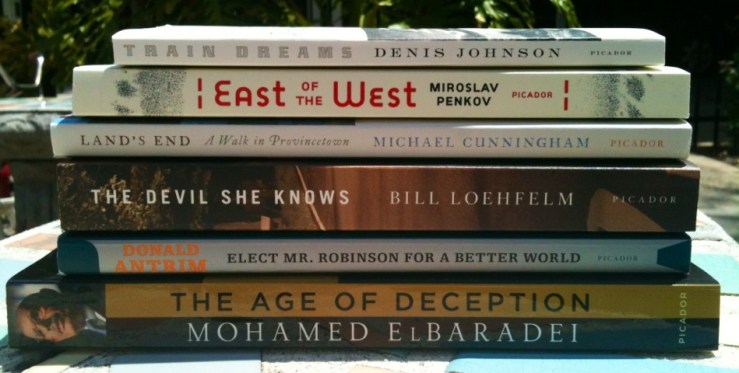
Nice little batch from the good folks at Picador, including Bill Loehfelm’s thriller The Devil She Knows, Mohamed ElBarardei’s The Age of Deception, an analysis of nuclear politics, and Michael Cunningham’s Land’s End, which I assume is a novelization of the clothing catalog.

Also in the batch: Denis Johnson’s novella Train Dreams, which I read in one sitting this Sunday. It’s a perfect novella, its pathos balanced with humor, its realism tempered in something of the mythic spirit of the American frontier. Full review forthcoming.

20120521-122553.jpg

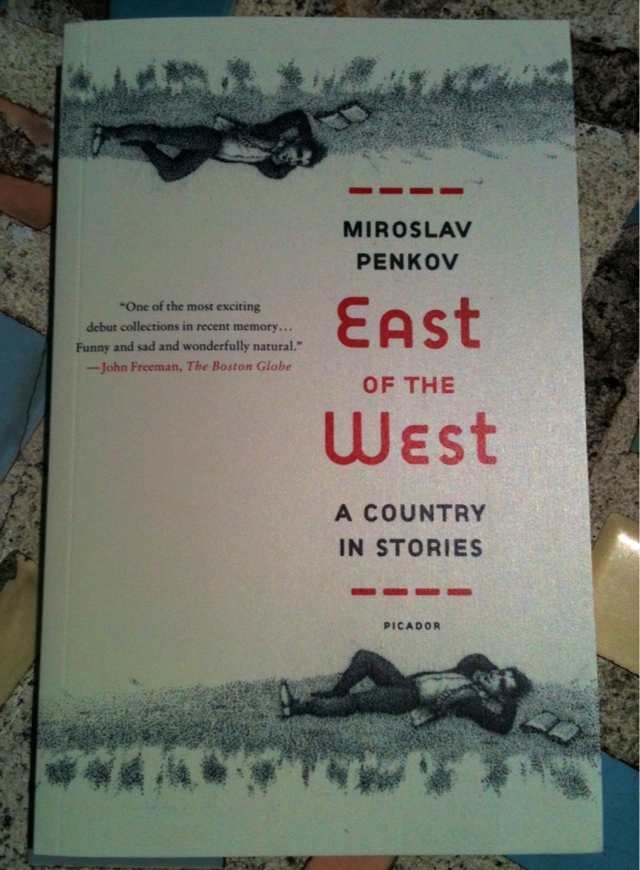
Miroslav Penkov’s collection East of the West looks pretty cool.

20120521-122559.jpg

Here’s a description from his website:

A grandson tries to buy the corpse of Lenin on eBay for his Communist grandfather. A failed wunderkind steals a golden cross from an Orthodox church. A boy meets his cousin (the love of his life) once every five years in the river that divides their village into east and west. These are Miroslav Penkov’s strange, unexpectedly moving visions of his home country, Bulgaria, and they are the stories that make up his charming, deeply felt debut collection.

20120521-122605.jpg

Donald Antrim’s debut Elect Mr. Robinson for a Better World has also been reissued with a new intro by Jeffrey Eugenides. Here’s an excerpt of the novel:

It was Friday, the day of the big theriomorphism workshop Rotary luncheon out at the Holiday Inn. My wife, Meredith, and I and a crowd of red-faced Rotarians and their well-dressed wives (Rotary Anns) sat around hotel banquet tables and listened to a visiting anthropology professor at the junior college say, “Pick an animal, any animal, fish, fowl, beast. Concentrate on aspects of the animal. Is it big? Small? Cute? Does it eat other animals? What color fur? If the animal is a bird, what color are its feathers? What song does it sing?”

“This is stupid,” I whispered to Meredith.

“It’s your fault we’re here, Pete. Why don’t you give it a chance?”

The anthropologist said, “Why don’t we all think about it for a minute? Okay, everybody got one?”

“Yes,” “No,” “Wait,” people said. Meredith whispered, “What’s yours?”

“I don’t know, what’s yours?”

“Coelacanth.”

“The prehistoric fish?”

“I need a volunteer,” declared the professor. Meredith raised her hand, and the man at the podium said, “Yes, back there. Tell us your name and the name of the animal you’ve chosen to become today.”

“Meredith Robinson. Coelacanth. It’s a kind of fish that scientists believed extinct until one was caught off the coast of Africa.”

“Excellent. Come forward. Sit here. Would someone please dim the lights?” I watched Rotary guys watch my wife. Bill Nixon, Tom Thompson, Abraham de Leon, Dick Morton, Terry Heinemann, Robert Isaac—all the usuals, plus others. Jerry and his wife, Rita, sat up front. The professor soothingly said, “Close your eyes, breathe deeply, and tell us about the coelacanth. Everybody else, let’s all breathe deeply too, and be thinking about our own animals. Go ahead, Meredith.”

“Well, it’s four feet long, deep slate blue, with bony, protruding fins and big jaws with scary teeth. It goes back seventy million years. It moves slowly, it dwells in dark water.” The professor nodded. Audience members inched forward in their seats. Meredith said, “At night it swims upside down with its head pointed to the sea bottom, bobbing along.”

“A feeding technique?”

“Maybe.”

“How’s the water?” I could see Meredith’s head settle forward as she softly answered, “Cold.”

“Feel the cold. Breathe that cold. Inhale that water. What do you feel?”

“Colors.”

“Colors?”

“Blue, black, indigo.”

Farmer Sitting at the Fireside and Reading — Vincent van Gogh

Survival Story (Fragment from Roberto Bolaño’s 2666)

A small story from Roberto Bolaño’s 2666. Context not important:

Instead of ghosts, now the passengers in front of him were talking about a person they called Bobby. This Bobby lived in Jackson Tree, Michigan, and had a cabin on Lake Huron. One time this Bobby had gone out in a boat and capsized. He managed to cling to a log that was floating nearby and waited for morning. But as night went on, the water kept getting colder and Bobby was freezing and started to lose his strength. He felt weaker and weaker, and even though he did his best to tie himself to the log with his belt, he couldn’t no matter how hard he tried. It may sound easy, but in real life it’s hard to tie your own body to a floating log. So he gave up hope, turned his thoughts to his loved ones (here they mentioned someone called Jig, which might have been the name of a friend or a dog or a pet frog he had), and clung to the branch as tightly as he could. Then he saw a light in the sky. He thought it was a helicopter coming to find him, which was foolish, and he started to shout. But then it occurred to him that helicopters clatter and the light he saw wasn’t clattering. A few seconds later he realized it was an airplane. A great big plane about to crash right where he was floating, clinging to that log. Suddenly all his tiredness vanished. He saw the plane pass just overhead. It was in flames. Maybe a thousand feet from where he was, the plane plunged into the lake. He heard two explosions, possibly more. He felt the urge to get closer to the site of the disaster and that’s what he did, very slowly, because it was hard to steer the log. The plane had split in half and only one part was still floating. Before Bobby got there he watched it sinking slowly down into the waters of the lake, which had gone dark again. A little while later the rescue helicopters arrived. The only person they found was Bobby and they felt cheated when he told them he hadn’t been on the plane, that he’d capsized his boat when he was fishing. Still, he was famous for a while, said the person telling the story.

“And does he still live in Jackson Tree?” asked the other man.

“No, I think he lives in Colorado now,” was the response.

Then they started to talk about sports. The man next to Fate finished his water and belched discreetly, covering his mouth with his hand.

“Lies,” he said softly.

“What?” asked Fate.

“Lies, lies,” said the man.

Right, said Fate, and he turned away and stared out the window at the clouds that looked like cathedrals or maybe just little toy churches abandoned in a labyrinthine marble quarry one hundred times bigger than the Grand Canyon.

Matt Bell Chats with Biblioklept About Apocalypse, Hairy Infants, Cures for Writer’s Block, and His New Book Cataclysm Baby

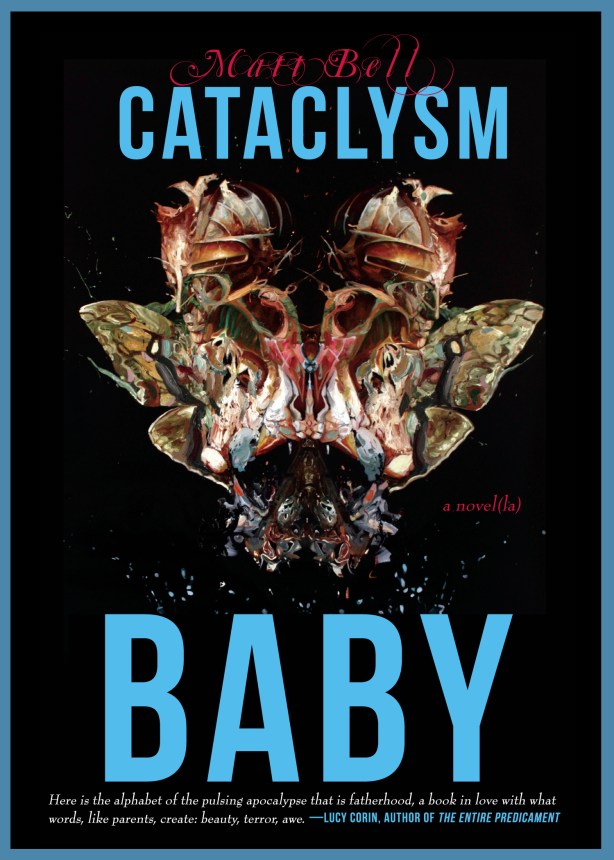
When an advance copy of Matt Bell’s new novella-in-stories Cataclysm Baby showed up in the mail a few months ago, I was immediately intrigued. Post-apocalyptic fiction is right up my proverbial alley, and the book’s conceit—Bell’s site describes the book as “twenty-six post-apocalyptic parenting stories, all narrated by fathers, each revealing some different family, some new end of the world”—seemed refreshingly different than the “family issues” novels that publishers tend to send my way. I was not a jot disappointed in Cataclysm Baby either; in my review I write:

Bell’s apocalypse is discontinuous; each tale evokes its own paradigm, its own idiom of grief. He’s less interested in the invention and world-building that marks so much of sci-fi and fantasy than he is in tapping into the mythological undercurrents of end-of-the-world narratives. The short pieces in Cataclysm Baby unfold (or burst, or twist) like strange, dark fairy tales, each proposing another vision of collapse.

Matt was kind enough to talk to me over an exchange of emails. In the margins of our exchanges—those little quips that aren’t part of the interview proper—I found Matt to be a very nice, generous fellow. I enjoyed talking with him.

Matt teaches writing at the University of Michigan; he also works for Dzanc Books, where he runs the literary magazine The Collagist.

Cataclysm Baby, new from indie Mud Luscious Press, is Matt’s second book after the collection How They Were Found.

Cataclysm-Baby-Final-Cover-Front

Biblioklept: Cataclysm Baby is a highly structured work that follows a clear pattern. Where did Cataclysm Baby begin? At what point did you start using the alphabet as an organizing principle for apocalypse family fiction?

Matt Bell: The writing of Cataclysm Baby began with its first story, “Abelard, Abraham, Absalom,” although I didn’t have that title for it then: I was just starting off to write a standalone short about this father, who was describing the birth of his son in what turned out to be fairly grim circumstances, and I didn’t know anything more than that—as is often the case with me, I was probably more interested in the voice than in the content or the character, at least at the very beginning. At some point in that draft, I wrote an early version of these lines: “For our baby, a name chosen from a book of names. Each name exhausted one after another, a sequence failure.” It was that suggestion of the baby name book that offered up that narrative’s title, and then alphabetizing as an organizing principle for more stories. Before that, I hadn’t intended to write a series, or this novella that they became, but the book’s structure was held in those lines, and that structure ended up driving a lot of the rest of the book’s drafting, by giving a shape for the other narratives to attach to.

Biblioklept: “Abelard, Abraham, Absalom” contains a horrifying image—the baby is born with a “furred esophagus,” and the dad must pull a hairball from the baby’s mouth. The following stories build on this horror: mutant offspring, forced-breeding, still birth, monster birth . . . You say that your initial concern was more with voice than content or character—but did you have any of these images in mind at the outset?

MB: It’s always a little hard to remember exactly—I wrote the first drafts of Cataclysm Baby in mid-2009—but I think that I would probably say that I didn’t have the imagery of the “furred esophagus” and that hair-choked baby before I started, but I might have had some of the others before starting their sections. Some of the sections were suggested by the names I chose, which in certain cases came first: Including the name “Cain” in the title of the third story, for instance, suggested at least a fratricide, if not exactly what that killing might entail.

For the most part, I’m typically not much of a planner, at the plot or situation level: I don’t have particularly good ideas, and so if I start there, I tend to end up with stories that are all surface, or that at least capture only the most surface stuff of me. By starting at the level of the sentence or the sound or the image—and then by staying at that level as long as I can—I feel more likely to dredge a little deeper, to discover something a little stronger. It’s in subsequent drafts that I do a lot of the plot and character shaping, and even some of the conceptual thinking. I need a certain critical mass of workable language before I can do too much story-work with it.

Bibliokept: Your language—tone, syntax, diction, etc.—inheres across the collection and works to unify the themes and images in Cataclysm Baby. Still, there’s a sense of disconnection of time and place between these stories, as if each one is its own discrete apocalypse or dystopia, even as they blend together.

In a sense, you seem to be playing obliquely with the tropes of end-of-the-world fiction, but resisting the heavy exposition and tendency for world-building we see in so much sci-fi. I suppose I’m pointing toward what I see as restraint in CB, but might have actually been editing on your part—how much of CB came from pruning and paring down?

MB: Generally I’d say that it’s my process to overwrite and then to cut back to the best version of any given story. That said, Cataclysm Baby was never a dramatically longer book, either as a whole or in its individual pieces. For me, many of these stories often operate more like fairy tales or biblical stories than contemporary sci-fi, and so have to do their world-building in different ways. I often write in fragments, and try to create useful spaces in the white spaces between—some regions of ambiguity or juxtaposition—and I think that when that’s working well those regions can end up standing in for what might otherwise require a lot of connective tissue and explanatory exposition.

Biblioklept: Why are end of the world stories are so compelling?

MB: The apocalyptic goes deep in us: Every civilization has its origin story, and also its story of how it’ll all end. Less of us might believe in more supernatural apocalypses now than in the past, but we’ve replaced those fears with secular ones, made all the more frightening for being manmade—global warming and constant war and economic inequality are the results of choices we’ve made, not the supernatural nature of the universe. We’re also within the first few generations that grew up during the environmental movement, taught to see the earth as something that needed to be saved by human action, from human action. All that adds to the gravity of certain kinds of apocalyptic stories: Our ending is now an act of agency instead of prophecy, and for me that changes everything.

Biblioklept: In what ways?

MB: What I mean is that if the end of the world is completely out of our control—if it’s the second coming or an unstoppable asteroid headed for earth —then we don’t bear any responsibility for it happening, and probably be can’t be tasked with stopping it. But if it’s a side effect of the way we live or the way we exploit the earth’s resources or of the way we treat each other, then I think we can be held responsible, both for what has already happened and our failures to make things better. The problem is that most of don’t actually have the chance to make a direct impact, or at least we don’t get to feel like we’re making one very often. It’s hard to make the links between our individual lives and our communal fates, in the biggest ways. But that doesn’t free us from the anxiety or the fear: If anything it probably makes it worse, because someone is making the decisions that might cost us everything, but it’s hard to pin down who it is, or to hold them accountable for their actions.

To bring it back toward Cataclysm Baby: The fathers in the book are rarely if ever responsible for the situations they and their families are in, and they aren’t generally given opportunities to improve things in a large-scale way. All they can do is focus on themselves and their families—which is, of course, what most of us do too, no matter how badly things are going outside our doors. This tension between what we know is wrong (climate change and oppression and war and every other kind of global problem) and what we are best suited for (caring for ourselves and the people closest to us) is problematic, and the solutions to that closing that gap aren’t particularly obvious, or at least they’re not obvious to me.

Biblioklept: I think that Cataclysm Baby has a positive ending—not necessarily a happy ending—but a positive one, or at least one that points to a future and generative capability. I’m curious if you tried out other ways to close the collection than those last few lines of “Zachary, Zahir, Zedekiah.”

MB: I’m so glad you read the ending that way: It’s definitely not a happy ending—and couldn’t be, after what’s come before—but I’d like to think that it at least leaves open the possibility of hope. That seems like such a slim solace, but it’s something, and sometimes enough.

As for whether there were other ways to end the novella: As I said above, I’m not generally a planner, and I ideally like to reach the final pages of a book or story in a burst, writing headlong, possessed by a sort of measured recklessness, in hopes that by moving as strongly as possible from sentence to sentence in a controlled sprint I might arrive at the end surprised and invigorated by what I find there, rather than overthinking or over-determining it. The final sentence of Cataclysm Baby was almost certainly tweaked through the rewriting process, but I arrived at its basic shape for the first time in much the same way I imagine a reader might, coming out of that run of repetitions and endings into something else, some possible future. I was glad that it contained that hope you felt, glad to know that was the way I instinctively responded when I reached the last page.

Biblioklept: Cataclysm Baby bears two epigraphs; one from the King James bible, and one from Cormac McCarthy’s The Road. The content of both quotations resonates with your work, as does the style.

McCarthy has said that “books are made out of books.” What writers or books were especially important or influential when you were composing Cataclysm Baby?

MB: I  love that McCarthy quote, and couldn’t agree more: I think that for me a lot of my formative experiences didn’t happen in “real life,” but inside of books, in that space between what’s printed on the page and what happens in the reader. So the books I’ve read are at least as important an influence as the things I’ve done.

The Bible is obviously an influence on the voice of the book, but it also owes a debt to texts like Beowulf or the Greek myths—there’s a purposeful attempt here to use a more archaic-seeming way of speaking to talk about these futures. Fairy tales are an important part of how I structure stories and character development, and I think that way of thinking was a huge help when working with all of these compressed narratives. And of course there are all the end-of-the-world tales I read when I was a kid or a teenager or more recently: I grew up almost exclusively on science fiction and fantasy and horror, and so much of that still filters into the work. It’s some of that stuff from when I was younger that sticks with me the most, the different world-ending plots of Swan Song and The Stand and Robots and Empire and so on. And then there’s stuff I read later, like Beckett’s Endgame, like Shirley Jackson and McCarthy and Brian Evenson. But of course all of this is over-simplifying, or choosing only the most direct or obvious choices, the ones I couldn’t deny anyway: As I said above, I’ve lived a rather large part of my life inside the books I love, and so it’s no surprise that part of my books would end up being set in some combined world, some landscape they’ve all been mashed into inside me.

Bibliokept: You work as both an editor and a writing teacher. How do those jobs overlap or contrast or influence your own fiction writing?

MB: By the time I finished grad school I was doing most of these things in some form: I was teaching writing there too, and I’d started The Collagist and was just about to join Dzanc full-time. I truly love my teaching and my editing, and am very grateful to have them both as part of my daily work. I think that more than anything they’ve allowed me to see all of these pursuits as part of a bigger literary life, and that this life was the real goal I wanted to realize. I’m very lucky to get to spend my days as a writer and as a reader and teacher and editor and reviewer and whatever else, and I think that all of these different activities add up to one satisfying whole. If there ever came a time when I couldn’t write—where I lost my nerve or my drive to create—I’d like to think that these other activities might sustain me through that loss.

Biblioklept: What about just plain old writer’s block? I seem to be suffering from it these days. Any suggestions you offer your students?

MB: First, my sympathies: I know how frustrating that sensation can feel. Personally, I think I rarely have true writer’s block, the kind where I don’t write. Instead I have days where I write only badly, and sometimes miserably so —and sometimes those days stretch into weeks. When I’m working on a project, there’s almost always something to do, so if I can’t go forward I just move backward in the story and try to revise my way into forward motion again. If I’m between projects, I try to start something new every day until one catches. Immediately after finishing Cataclysm Baby I must have written the beginnings of a dozen terrible short stories, not letting myself abandon one before my writing time was over for the day. So maybe I spent a month writing three or four hours a day on work I wasn’t going to continue with—but at least I was writing. That’s the only way I know to get past writer’s block that isn’t dumb luck.

Biblioklept: Obviously Cataclysm Baby is just out, but do you have any other books or writing projects on the horizon?

MB: I do, thankfully: I’ve been working almost exclusively on a novel for the past three years, and am in the very final phases of that book. I can’t say much more about it yet, but hopefully soon. Once that’s finished, who knows? I’m looking forward to getting back to that place of surprise and uncertainty, after a couple years of knowing what to work on every day.

Biblioklept: Have you ever stolen a book?

MB: Not from a store, I don’t think. Mostly, I probably have some borrowed books I never gave back, and after some number of years those have become something like a theft. When I was 21 or so, I believed someone lent me a copy of Sam Lipsyte’s Venus Drive, which absolutely blew me away, and was hugely influential on me as a writer. I had no idea who Lipsyte was, and at the time there weren’t any other books of his to read. I was sure my friend Irene had borrowed me the book, but she said she hadn’t, and later I tried to return it to a few other friends, but they wouldn’t claim it either. So maybe I did buy it, but I don’t remember doing so, and every time I see it on the shelf I wonder who it really belongs to. Assuming it does belong to some friend of mine, I owe them far more than the cover price: I wouldn’t be the same writer without having found Lipsyte then, or even the same person.

RIP Carlos Fuentes

https://i0.wp.com/hilobrow.com/wp-content/uploads/2012/11/carlos-fuentes-e1352492338103.jpg

RIP Carlos Fuentes, 1928-2012

Flann O’Brien and Alasdair Gray (Books Acquired, 5.12.2012)

20120512-174120.jpg

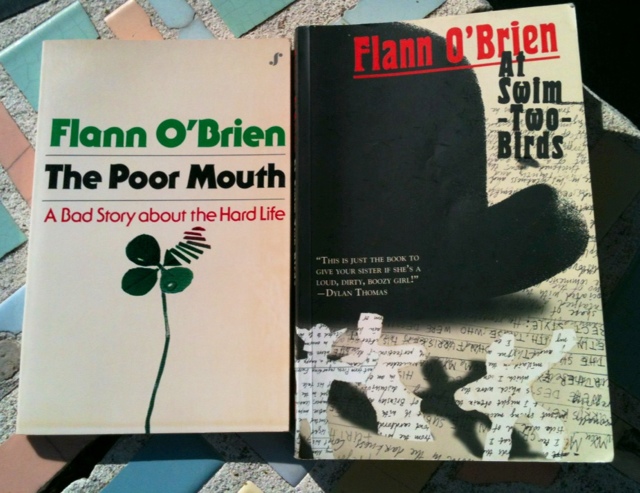
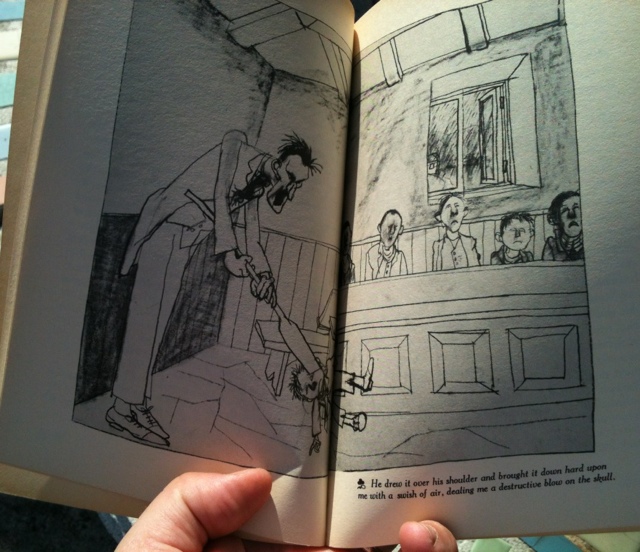
Picked up two more by Flann O’Brien after enjoying The Third Policeman so very much; thanks again to the reader suggestions on that one. The Poor Mouth has pictures:

20120512-175150.jpg
20120512-174128.jpg

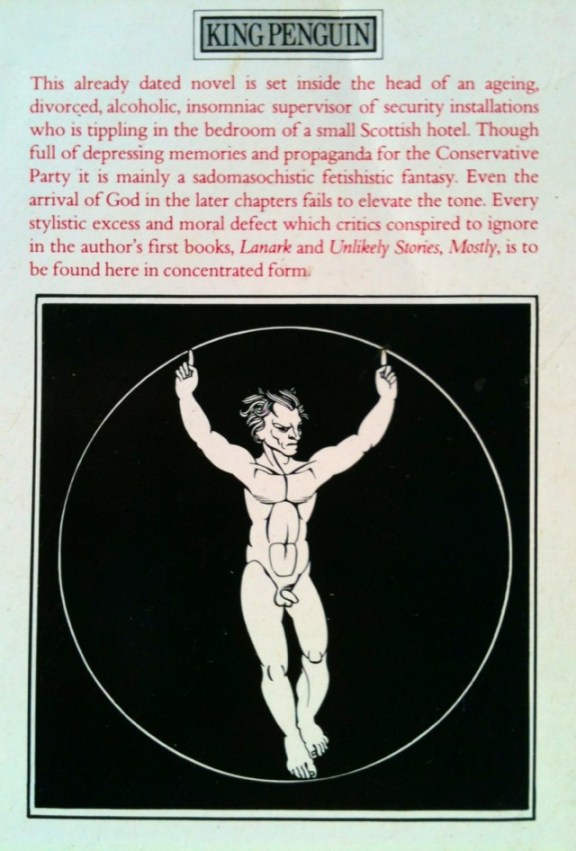
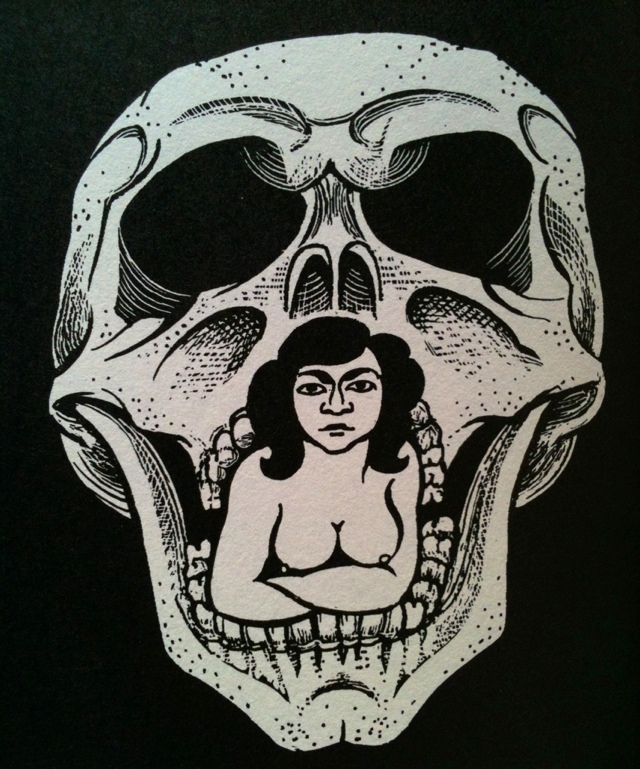
I was looking for Alasdair Gray’s first novel Lanark (no dice), but picked up 1982 Janine read the back and immediately knew I had to have it.

20120512-174146.jpg

I picked up Poor Things just to riffle a bit, and again, very intrigued. Also, another book with illustrations. Here’s one:

20120512-175200.jpg

And, as I shot these outside in the cheap showiness of nature, here’s a picture of a large plant’s tumescent bloom, because hey why not:

20120512-174156.jpg

The Best Blurb I’ve Seen in Ages

20120512-174052.jpg

The back of Alasdair Gray’s 1982, Janine. I promptly secured the book.

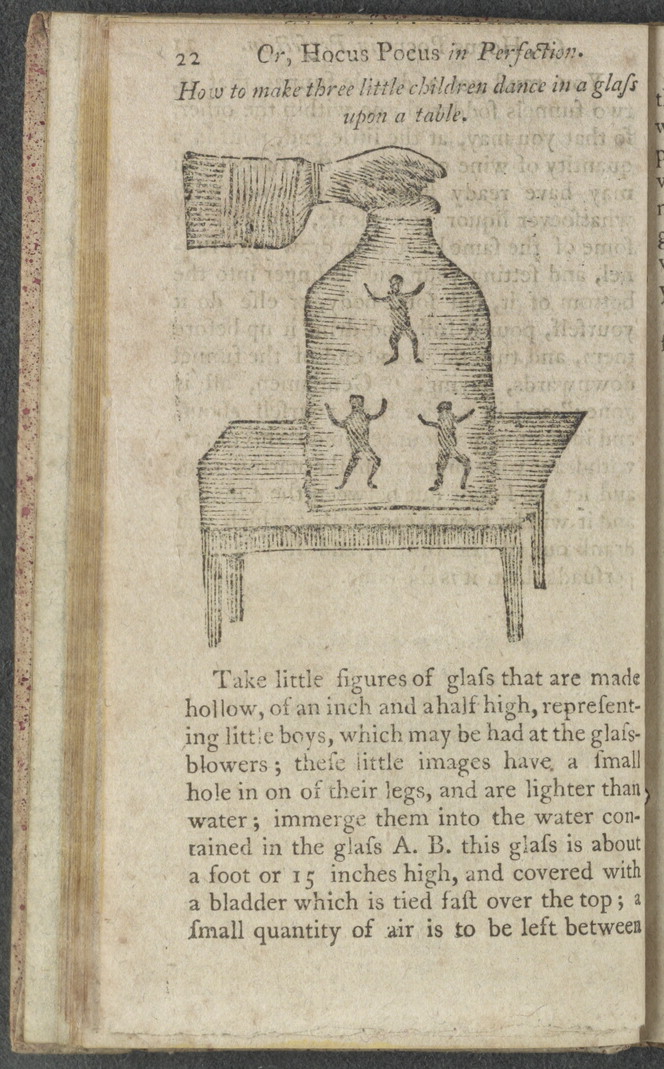
“How to make three little children dance in a glass upon a table”

From Hocus pocus, or The whole art of legerdemain, in perfection : by which the meanest capacity may perform the whole without the help of a teacher : together with the use of all the instruments belonging thereto : to which is now added abundance of new and rare inventions by Henry Dean

Books Acquired, Some Time Over the Past Two Weeks

20120510-132200.jpg

Henry Miller Reads (Film)

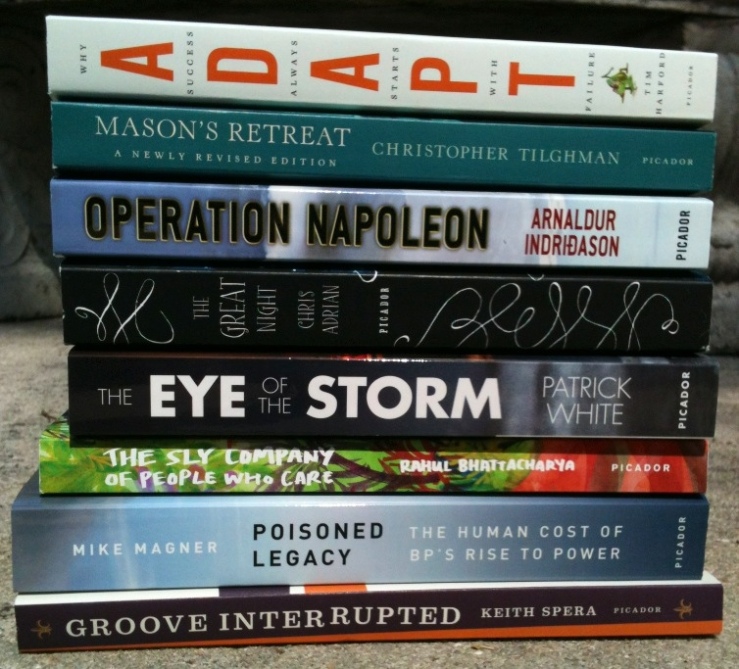
Books Acquired, 4.23.2012 — Or, Here’s What’s New from Picador This Month

20120502-162855.jpgNice little stack from the good people at Picador—novels, reissues, first-time-in-trade-paperbacks, nonfiction . . . a nice little spread.
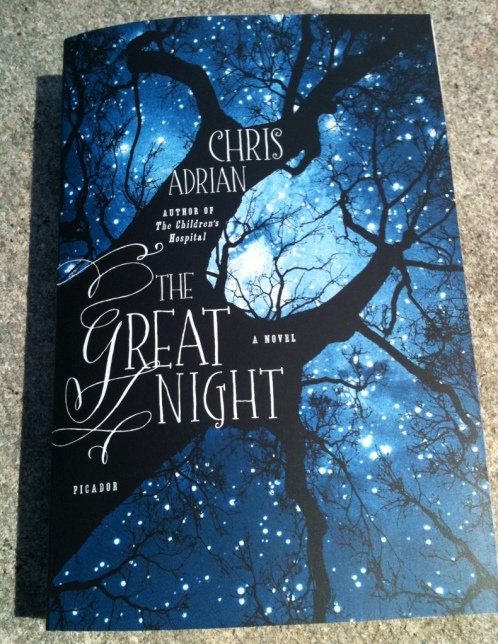
First up is Chris Adrian’s latest novel The Great Night, which, improbably, I’ve yet to read—I’m a huge fan of Chris Adrian’s other books, especially The Children’s Hospital (although I’ve reviewed his other books here too, for those inclined to hit the archives), and I love A Midsummer Night’s Dream, which I know The Great Night basically riffs on. Anyway, my wife snapped this one up right away (I had to go through her nightstand to fetch it up for yon photograph), so my reading will be delayed (although I will likely con her into reviewing it here).

20120502-162916.jpg

From Patrick Ness’s review at The Guardian—

The Great Night is set in Buena Vista Park in San Francisco. Titania and Oberon – the very ones from Shakespeare’s play – live under the park’s main hill with their full court. Puck is there too, a malevolent but chained force, chafing for revenge against his masters. He may get his chance, for Titania is collapsing under grief. Boy, a changeling brought in by Oberon to amuse her and for whom she felt the first maternal feelings of her immortal life, has died of a very human disease, leukaemia.

Consumed by the pain of her loss, Titania makes a terrible mistake and tells Oberon she never loved him. Furious, he abandons her and shows no signs of returning. But perhaps if Titania releases Puck, who the other faeries refer to as the Beast, then Oberon will have to return to enslave him again. Won’t he? She breaks Puck’s bonds on the Great Night – Midsummer’s Eve, naturally – for which he says, “Milady, I am in your debt, and so I shall eat you last.” . . .

. . . Adrian does nearly everything right here. The Shakespearean references are worn lightly, and the plotting is so skilful you barely notice it falling into place. The characterisations are rich, too. There’s a spellbinding chapter on Molly’s childhood in a performing Christian family band that is both deeply weird and blisteringly sad. Plus there’s an eye-wateringly matter-of-fact approach to sex (and lots of it), which here is essentially indistinguishable from magic, and from love as well, in all its “intimations from the world that there was more to be had, something different and something better”.

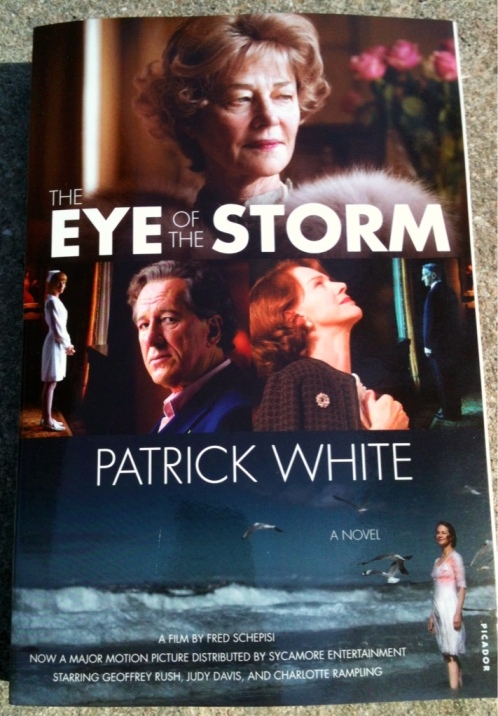
I like the cover of the Adrian, which I only mention here to transition into The Eye of the Storm, the novel that won Patrick White the Nobel in 1973. The book has been adapted into a film, so of course there’s a reissue with a film tie-in cover. (Buzzfeed’s addressed this phenomena recently; I did it a few years ago myself).

20120502-162937.jpg

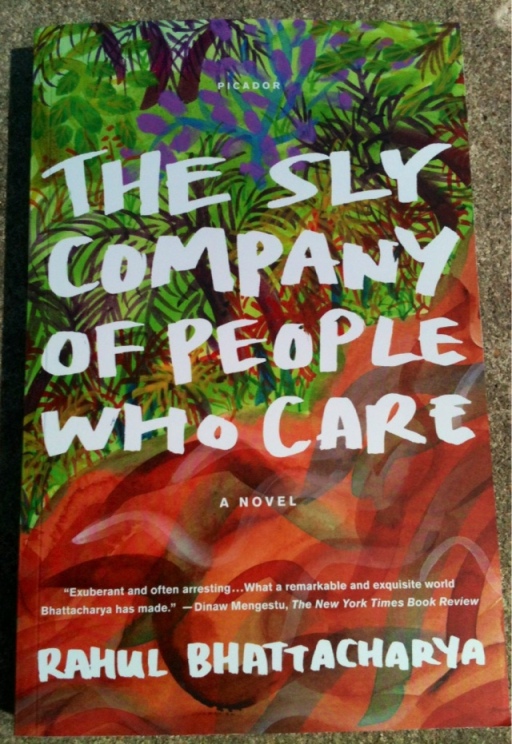
Speaking of covers: Love love love this one for The Sly Company of People Who Care by  Rahul Bhattacharya:

20120502-162952.jpg

Here’s novelist Dinaw Mengestu, from his review in The New York Times:

In the opening paragraph of Rahul Bhattacharya’s first novel, “The Sly Company of People Who Care,” the unnamed narrator, a former cricket journalist from India, declares his intentions for his life, and thus his story — to be a wanderer, or in his words, “a slow ramblin’ stranger.” That rambling, through the forests of Guyana; the ruined streets of its capital, Georgetown; and out to the borders of Brazil and Venezuela, constitutes the novel’s central action. But its heart lies in the exuberant and often arresting observations of a man plunging himself into a world full of beauty, violence and cultural strife.

20120502-163001.jpg

The Kirkus review of Mike Magner’s Poisoned Legacy:

This angry investigative report begins well before the 2010 Deepwater Horizon catastrophe.

In the first chapter, National Journal editor Magner describes a possible cancer epidemic in a Kansas town where refinery wastes have poisoned a wide area and where a courageous retired schoolteacher is fighting an uphill battle to force BP to clean up. Apparently, he had been researching this problem when the Gulf blowout forced him to change the book’s focus, but both stories alternate throughout the narrative. Readers with a taste for heated fist-shaking will have plenty of opportunities as Magner delivers detailed accounts of BP’s mishaps, emphasizing the massive 2005 Texas refinery explosion, leaks and malfunctions along the Alaska pipeline and the Deepwater disaster. Each follows an identical pattern: BP officials cut costs, safety budgets drop, employees grumble and warn of disaster, disaster occurs, individuals who suffered terribly tell their stories and government regulators and the media suddenly show interest, resulting in an outpouring of outrage, investigations, damning reports, fines and apologies from BP executives and the inevitable avalanche of lawsuits. Magner makes a strong case for BP’s negligence and the American government’s feeble oversight, but his case that BP operates less competently than other oil companies is not as convincing. Perhaps wisely, the author makes no argument that Americans are willing to make the painful sacrifices necessary to ensure that these catastrophes never recur. We want oil, and we don’t want it to cost too much.

A relentlessly critical denunciation of the latest environmental disaster that leaves the impression that more will follow.

20120502-163011.jpg

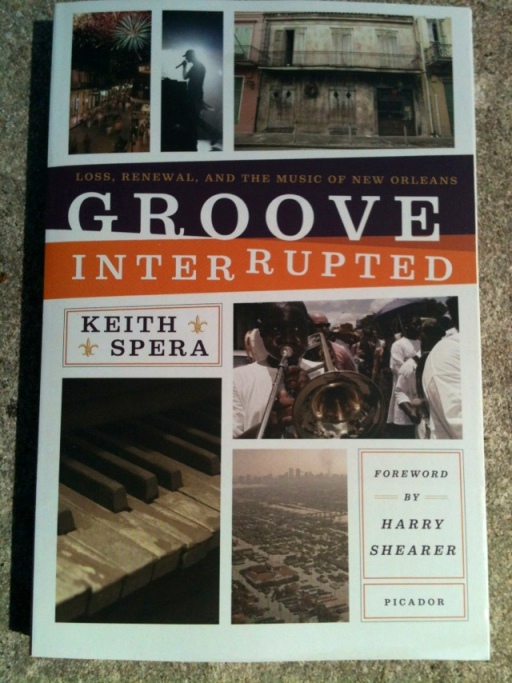
Groove Interrupted immediately piqued my interest and quickly found its way into my stack. Excerpt from Jazz Time’s review:

New Orleans native Spera, a longstanding music writer for The Times-Picayune who was also part of the newspaper’s Pulitzer Prize-winning Hurricane Katrina coverage team, focuses on tales of musicians confronting the challenges of trying to continue to make music in a post-Katrina environment. He covers those displaced New Orleanians forced to seek refuge in Houston, Austin, Nashville and other points around the country in the wake of Hurricane Katrina (known around New Orleans as “the Federal flood”). His profile of the cantankerous, Slidell-based blues guitarist-singer-fiddler Gatemouth Brown, who succumbed to lung cancer shortly after Katrina hit, is particularly moving, as is his eloquent recounting of Aaron Neville’s escape from his beloved hometown in the face of Katrina, his subsequent mourning over the loss of his wife to lung cancer in 2006 and triumphant return to New Orleans in 2008.

Parenting After the Apocalypse — I Review Matt Bell’s Cataclysm Baby

Cataclysm-Baby-Final-Cover-Front

Each of the twenty-six short pieces that comprise Matt Bell’s Cataclysm Baby offers a different take on family life after the apocalypse. The opening paragraphs of “Abelard, Abraham, Absalom”—the first tale in the collection—offers an overview of Cataclysm Baby’s program:

The smoldered cigar, last of a box of twenty, bought to celebrate happier times, now smoked to keep away the smell of our unwashed skin, of our slipping flesh, of our baby grown in my wife’s belly, the submerged sign of a prophecy burning, stretching taut her hard bulge: All hair, just like the others, gone wrong again.

Fists of black hail fall from the cloudless sky and spatter the house, streak the skin of our walls, break windows above broken beds. The birth-room fills with air the texture of mud, with black birds forgetting how to fly, these crows and vultures waiting to make a nest of our child, and still I I focus, keep my eyes on shattered glass, on my wife’s pelvis tilting toward sunlight, toward sun turned the color of baby’s first stool, then the color blood.

We see here the vestiges of civilization, emblematic in the narrator’s cigar smoking down to ash; we see the mutated child, another hirsute monster “just like the others, gone wrong again”; we see the backdrop of ecological disaster, of carrion birds that can no longer fly yet nevertheless maintain a brutal Darwinian competition with humanity; we see a deathly world that seems to all but occlude birth. These motifs—the end of social order, the species-transformation of new children, the utter collapse of ecological norms—run throughout Cataclysm Baby, telegraphed in Bell’s precise, concrete style.

These short fables are also united by the alphabet: “Abelard, Abraham, Absalom” gives way to “Beatrice, Bella, Blaise,” and so on until “Zachary, Zahir, Zedekiah.” However, Bell’s apocalypse is discontinuous; each tale evokes its own paradigm, its own idiom of grief. He’s less interested in the invention and world-building that marks so much of sci-fi and fantasy than he is in tapping into the mythological undercurrents of end-of-the-world narratives. The short pieces in Cataclysm Baby unfold (or burst, or twist) like strange, dark fairy tales, each proposing another vision of collapse.

Even in these collapses, Bell hints at some sense of social order, suggesting the occasional dystopia, as in “Fawn, Fiona, Fjola,” where forced breeders exchange their child for a basement with an oxygen supply and the occasional shower, or “Grayson, Griffin, Guillermo,” where the narrator-father’s awful offspring dooms the rest of the town:

How many babies are born before we realize that all their children are boys? That our town’s women are the past, thanks to my one-note issue, to their deadly sperm making deathly pregnancies, taking each of their partners the way of their own mother: the blood-wet, breath-gasped, split-wombed, at best to linger, never to recover from the makings of their children?

Elsewhere, there’s pure horror, like in “Svara, Sveta, Sylvana,” a riff on parenting-as-grave-digging, or “Prescott, Presley, Preston,” where precognitive children sound out their own infanticidal doom. Horror generally pervades Bell’s language, as in the opening paragraph of “Isaac, Isaiah, Ishmael”:

Even at birth they were already damaged, their brittle bones opened and crushed, powdered by their mother’s powerful organs, her pressing canal: All those thin ribs snapped and splintered upon the stainless steel of the operating room. All those skulls crooked and cracked, all those twisted greenstick limbs. We lifted each child out from the mother’s body and into surgeries of its own, did our best to splint and screw our prides together.

Despite its horrors, there are occasional moments of (very) dark humor in Cataclysm Baby, absurd comic eruptions, like these lines from “Domina, Doreen, Dorma”:

A chrysalis? I ask my wife. A cocoon?

What’s the difference, she says, when it’s your child inside, when it’s your caterpillar?

I’m tempted to offer more examples, but I fear that I’m approaching over-paraphrasing here when much of the pleasure (is this the right noun?) of Cataclysm Baby comes from its strange familiarity, its uncanny contours, its ugly surprises. Bell’s cryptic details—shaved heads, missing mothers, night soot—allow the reader’s imagination do much of the work. This trust pays off; Bell is aware of the tradition he taps into and equally aware of reader awareness.

The apocalyptic tradition evinces in the two epigraphs Cataclysm Baby bears. The first, from the King James bible version of Noah’s apocalypse, notes “the creeping thing” — a bizarre expression, frightening, frustrating, and intriguing in its vivid vagueness. (Bell appropriates the expression later in one of his narratives). The other epigraph comes fromThe Road, Cormac McCarthy’s sad apocalypse story about a father and son who are “carrying the fire.” There’s little room for other characters in The Road  and in a sense, Cataclysm Baby offers variations on the characters who might lurk in the margins of McCarthy’s story, or the edges of the other end-of-the-world stories we know. These parents simultaneously fear and fear for their children, harbingers of a world they will not survive. Recommended.

Cataclysm Baby is new from Mud Luscious Press.

Book Shelves #18, 4.29.2012

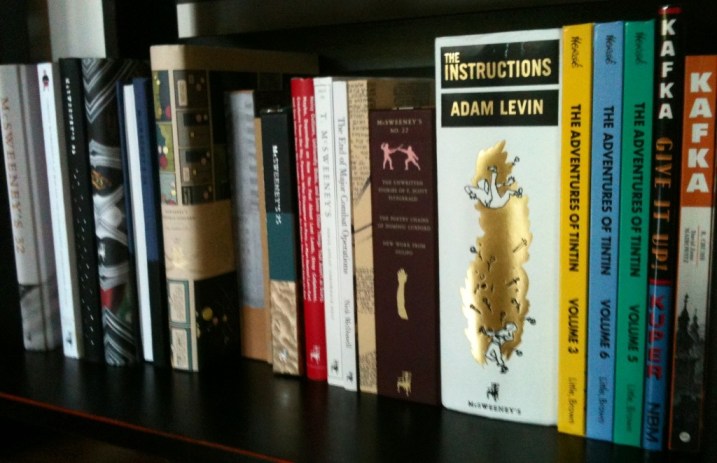
20120429-131113.jpg

Book shelves series #18, eighteenth Sunday of 2012.

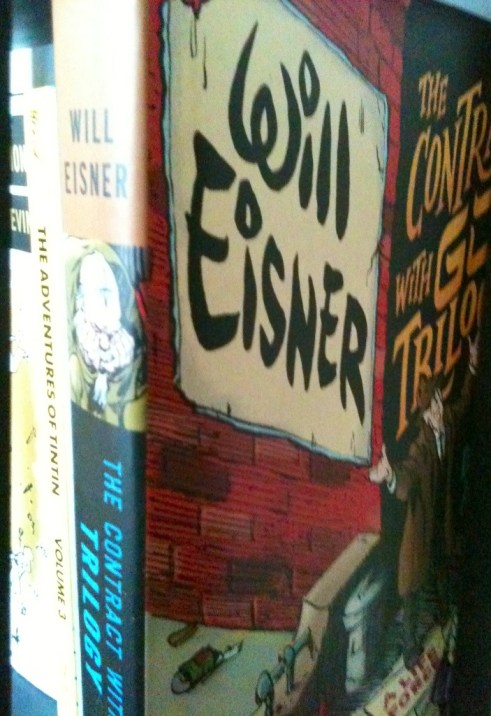
Lots of issues of McSweeney’s on this shelf. I abandoned The Instructions. Some Tintin omnibuses. Crumb-illustrated Kafka bio. Bookended by Will Eisner’s masterwork A Contract with God:

20120429-131124.jpg

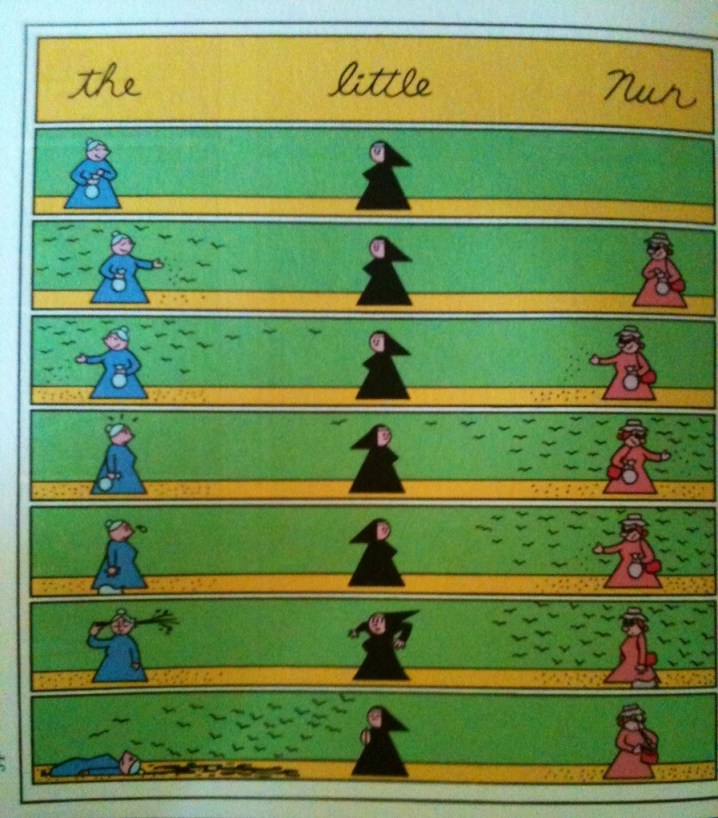
A Chris Ware comic from McSweeney’s #13:

20120429-131132.jpg

E-Books of the Future! (Retrofuture Fun from 1959)

(Via Disonancia, which is probably my favorite thing on the internet right now).

Book Shelves #17, 4.22.2012

Book shelves series #17, seventeenth Sunday of 2012.

20120422-114730.jpg

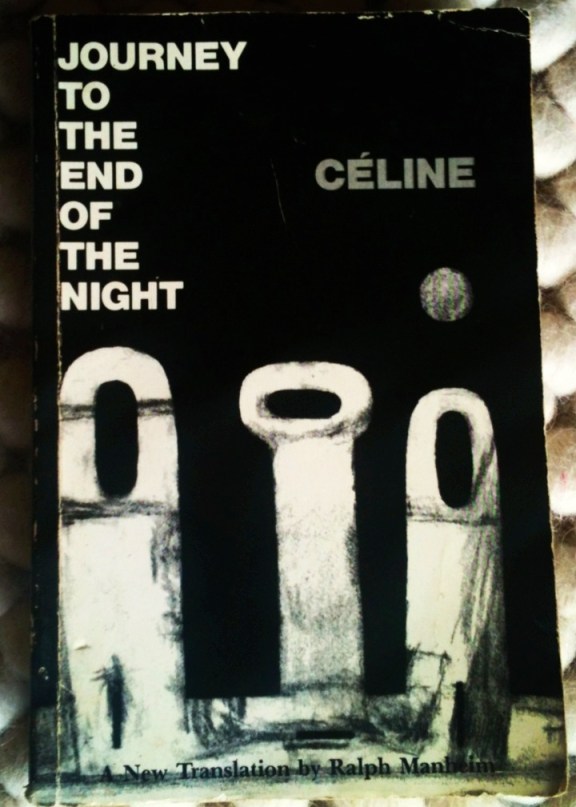
Hemingway, Fitzgerald, Steinbeck, Camus, Nabokov, Celine, Kafka.

20120422-130058.jpg

Jonathan Littell’s The Kindly Ones with Revere movie camera as bookend. Littell’s lurid, bizarre book is only shelved here temporarily (he’s in too-rarefied company, perhaps).

20120422-130453.jpg

A friend gave me this in high school.